Tag Archives: Engineering

Is college worth no cost?

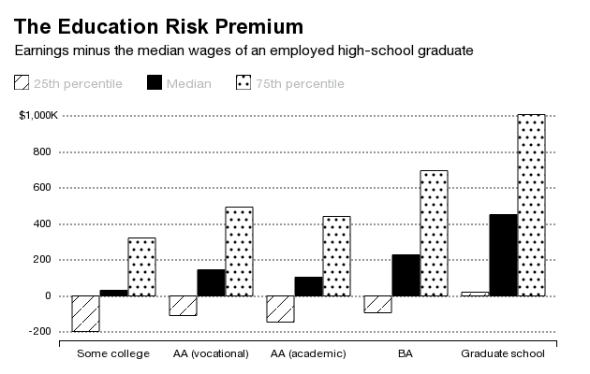
While a college degree gives most graduates a salary benefit over high school graduates, a study by the Bureau of Labor statistics indicates that the benefits disappear if you graduate in the bottom 25% of your class. Worse yet, if you don’t graduate at all you can end up losing salary money, especially if you go into low-paying fields like child development or physical sciences.

Salary benefits of a college degree are largely absent if you graduate in the bottom 25% of your class.

The average college graduate earns significantly more than a high school grad, but not if you attend a pricy school, or graduate in the bottom 1/4 of your class, or have the wrong major.

Most people realize there is a great earnings difference depending on your field of study with graduates in engineering and medicine doing fairly well financially and even top graduates in child development or athletic sciences barely able to justify the college and opportunity costs (worse if they go to an expensive college), but what isn’t always realized is that not all those who enter these fields graduate. For them there is a steep loss when the four (or more) years of lost income are considered.

risk premium in wages

If you don’t graduate or get only an AA or 2 year degree the increase in wages is minimal, and you lose time working and whatever your costs of education. The loss is particularly high if you study social science fields at an expensive college, and don’t graduate, or if you graduate in the bottom of your class.

A report from the New York Federal Reserve finds that the highest pay major is petroleum engineering, mid-career salary $176,300/yr, and the bottom is child development, mid-career salary $36,400/yr (click to check on your major). I’m not sure most students or advisors are aware of the steep salary difference, or that college can have a salary down-side if one picks the wrong major, or does not complete the degree. In terms of earnings, you might be better off avoiding even a free college degree in these areas unless you’re fairly sure you’ll complete the degree, or you really want to work in these fields.

Top earning majors Fed Reserve and Majors that pay you back.

Top earning majors: Majors that pay.

Of course college can provide more than money: knowledge, for instance, and learning: the ability to reason better. But these benefits are likely lost if you don’t work at it, or don’t go in a field you love. They can also come to those who study hard in self-taught reading. In either case, it is the work habits that will make you grow as a person, and leave you more employable. Tough colleges add a lot by exposure to new people and new ways of thinking about great books, and by forced experience in writing essays — but these benefits too are work-dependent and college dependent. If you work hard understanding a great book it will show. If you didn’t work at it, or only exposed yourself to easier fare, that too will show.

As students don’t like criticism, and as good criticism is hard to give — and harder to give well, many less-demanding colleges ,give little or no critical feedback, especially for disadvantaged students. This disadvantages them even more as criticism is an important part of learning. If all you get is a positive experience, a nice campus, and a dramatic graduation, this is not learning. Nor is it necessarily worth 4-5 years of your life.

As a comic take on the high time-cost of a liberal arts education, “Father” Guido Sarduchi, of Saturday Night LIve, describes his “5 minute college experience.” To a surprising extent, it provides everything you’ll remember of 4 year college experience in 5 minutes, including math, history, political science, and language (Spanish).For those who are not sure they will complete a liberal arts education, Father Sarduchi’s 5 minutes may be a better investment than a free 4 years in community college.

Robert. E. Buxbaum. January 21-22, 2015. My sense is that the better part of education is what you get when you don’t get what you want.

Nuclear fusion

I got my PhD at Princeton University 33 years ago (1981) working on the engineering of nuclear fusion reactors, and I thought I’d use this blog to rethink through the issues. I find I’m still of the opinion that developing fusion is important as the it seems the best, long-range power option. Civilization will still need significant electric power 300 to 3000 years from now, it seems, when most other fuel sources are gone. Fusion is also one of the few options for long-range space exploration; needed if we ever decide to send colonies to Alpha Centauri or Saturn. I thought fusion would be ready by now, but it is not, and commercial use seems unlikely for the next ten years at least — an indication of the difficulties involved, and a certain lack of urgency.

Oil, gas, and uranium didn’t run out like we’d predicted in the mid 70s. Instead, population growth slowed, new supplies were found, and better methods were developed to recover and use them. Shale oil and fracking unlocked hydrocarbons we thought were unusable, and nuclear fission reactors got better –safer and more efficient. At the same time, the more we studied, the clearer it came that fusion’s technical problems are much harder to tame than uranium fission’s.

Uranium fission was/is frighteningly simple — far simpler than even the most basic fusion reactor. The first nuclear fission reactor (1940) involved nothing more than uranium pellets in a pile of carbon bricks stacked in a converted squash court at the University of Chicago. No outside effort was needed to get the large, unstable uranium atoms split to smaller, more stable ones. Water circulating through the pile removed the heat released, and control was maintained by people lifting and lowering cadmium control rods while standing on the pile.

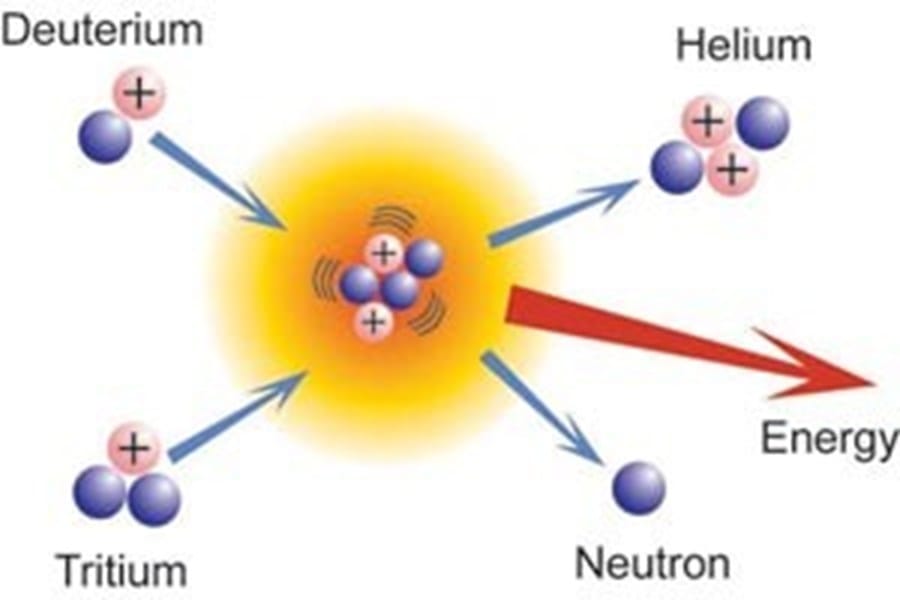
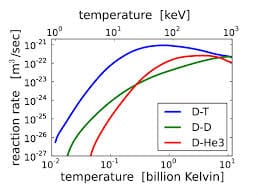
A fusion reactor requires high temperature or energy to make anything happen. Fusion energy is produced by combining small, unstable heavy hydrogen atoms into helium, a bigger more stable one, see figure. To do this reaction you need to operate at the equivalent of about 500,000,000 degrees C, and containing it requires (typically) a magnetic bottle — something far more complex than a pile of graphic bricks. The reward was smaller too: “only” about 1/13th as much energy per event as fission. We knew the magnetic bottles were going to be tricky, e.g. there was no obvious heat transfer and control method, but fusion seemed important enough, and the problems seemed manageable enough that fusion power seemed worth pursuing — with just enough difficulties to make it a challenge.

Basic fusion reaction: deuterium + tritium react to give helium, a neutron and energy.

Basic fusion reaction: deuterium + tritium react to give helium, a neutron and energy.

The plan at Princeton, and most everywhere, was to use a TOKAMAK, a doughnut-shaped reactor like the one shown below, but roughly twice as big; TOKAMAK was a Russian acronym. The doughnut served as one side of an enormous transformer. Hydrogen fuel was ionized into a plasma (a neutral soup of protons and electrons) and heated to 300,000,000°C by a current in the TOKOMAK generated by varying the current in the other side of the transformer. Plasma containment was provided by enormous magnets on the top and bottom, and by ring-shaped magnets arranged around the torus.

As development went on, we found we kept needing bigger and bigger doughnuts and stronger and stronger magnets in an effort to balance heat loss with fusion heating. The number density of hydrogen atoms per volume, n, is proportional to the magnetic strength. This is important because the fusion heat rate per volume is proportional to n-squared, n2, while heat loss is proportional to n divided by the residence time, something we called tau, τ. The main heat loss was from the hot plasma going to the reactor surface. Because of the above, a heat balance ratio was seen to be important, heat in divided by heat out, and that was seen to be more-or-less proportional to nτ. As the target temperatures increased, we found we needed larger and larger nτ reactors to make a positive heat balance. And this translated to ever larger reactors and ever stronger magnetic fields, but even here there was a limit, 1 billion Kelvin, a thermodynamic temperature where the fusion reaction went backward and no energy was produced. The Princeton design was huge, with super strong, super magnets, and was operated at 300 million°C, near the top of the reaction curve. If the temperature went above or below this temperature, the fire would go out. There was no room for error, but relatively little energy output per volume — compared to fission.

Fusion reaction options and reaction rates.

Fusion reaction options and reaction rates.

The most likely reaction involved deuterium and tritium, referred to as D and T. This was the reaction of the two heavy isotopes of hydrogen shown in the figure above — the same reaction used in hydrogen bombs, a point we rarely made to the public. For each reaction D + T –> He + n, you get 17.6 million electron volts (17.6 MeV). This is 17.6 million times the energy you get for an electron moving over one Volt, but only 1/13 the energy of a fission reaction. By comparison, the energy of water-forming, H2 + 1/2 O2 –> H2O, is the equivalent of two electrons moving over 1.2 Volts, or 2.4 electron volts (eV), some 8 million times less than fusion.

The Princeton design involved reacting 40 gm/hr of heavy hydrogen to produce 8 mol/hr of helium and 4000 MW of heat. The heat was converted to electricity at 38% efficiency using a topping cycle, a modern (relatively untried) design. Of the 1500 MWh/hr of electricity that was supposed to be produced, all but about 400 MW was to be delivered to the power grid — if everything worked right. Sorry to say, the value of the electricity did not rise anywhere as fast as the cost of the reactor and turbines. Another problem: 1100 MW was more than could be easily absorbed by any electrical grid. The output was high and steady, and could not be easily adjusted to match fluctuating customer demand. By contrast a coal plant’s or fuel cell’s output could be easily adjusted (and a nuclear plant with a little more difficulty).

Because of the need for heat balance, it turned out that at least 9% of the hydrogen had to be burnt per pass through the reactor. The heat lost per mol by conduction to the wall was, to good approximation, the heat capacity of each mol of hydrogen ions, 82 J/°C mol, times the temperature of the ions, 300 million °C divided by the containment time, τ. The Princeton design was supposed to have a containment of about 4 seconds. As a result, the heat loss by conduction was 6.2 GW per mol. This must be matched by the molar heat of reaction that stayed in the plasma. This was 17.6 MeV times Faraday’s constant, 96,800 divided by 4 seconds (= 430 GW/mol reacted) divided by 5. Of the 430 GW/mol produced in fusion reactions only 1/5 remains in the plasma (= 86 GW/mol) the other 4/5 of the energy of reaction leaves with the neutron. To get the heat balance right, at least 9% of the hydrogen must react per pass through the reactor; there were also some heat losses from radiation, so the number is higher. Burn more or less percent of the hydrogen and you had problems. The only other solution was to increase τ > 4 seconds, but this meant ever bigger reactors.

There was also a material handling issue: to get enough fuel hydrogen into the center of the reactor, quite a lot of radioactive gas had to be handled — extracted from the plasma chamber. These were to be frozen into tiny spheres of near-solid hydrogen and injected into the reactor at ultra-sonic velocity. Any slower and the spheres would evaporate before reaching the center. As 40 grams per hour was 9% of the feed, it became clear that we had to be ready to produce and inject 1 pound/hour of tiny spheres. These “snowballs-in-hell” had to be small so they didn’t dampen the fire. The vacuum system had to be able to be big enough to handle the lb/hr or so of unburned hydrogen and ash, keeping the pressure near total vacuum. You then had to purify the hydrogen from the ash-helium and remake the little spheres that would be fed back to the reactor. There were no easy engineering problems here, but I found it enjoyable enough. With a colleague, I came up with a cute, efficient high vacuum pump and recycling system, and published it here.

Yet another engineering challenge concerned the difficulty of finding a material for the first-wall — the inner wall of the doughnut facing the plasma. Of the 4000 MW of heat energy produced, all the conduction and radiation heat, about 1000 MW is deposited in the first wall and has to be conducted away. Conducting this heat means that the wall must have an enormous coolant flow and must withstand an enormous amount of thermal stress. One possible approach was to use a liquid wall, but I’ve recently come up with a rather nicer solid wall solution (I think) and have filed a patent; more on that later, perhaps after/if the patent is accepted. Another engineering challenge was making T, tritium, for the D-T reaction. Tritium is not found in nature, but has to be made from the neutron created in the reaction and from lithium in a breeder blanket, Li + n –> He + T. I examined all possible options for extracting this tritium from the lithium at low concentrations as part of my PhD thesis, and eventually found a nice solution. The education I got in the process is used in my, REB Research hydrogen engineering business.

Man inside the fusion reactor doughnut at ITER. He'd better leave before the 8,000,000°C plasma turns on.

Man inside the fusion reactor doughnut at ITER. He’d better leave before the 8,000,000°C plasma turns on.

Because of its complexity, and all these engineering challenges, fusion power never reached the maturity of fission power; and then Three-mile Island happened and ruined the enthusiasm for all things nuclear. There were some claims that fusion would be safer than fission, but because of the complexity and improvements in fission, I am not convinced that fusion would ever be even as safe. And the long-term need keeps moving out: we keep finding more uranium, and we’ve developed breeder reactors and a thorium cycle: technologies that make it very unlikely we will run out of fission material any time soon.

The main, near term advantage I see for fusion over fission is that there are fewer radioactive products, see comparison.  A secondary advantage is neutrons. Fusion reactors make excess neutrons that can be used to make tritium, or other unusual elements. A need for one of these could favor the development of fusion power. And finally, there’s the long-term need: space exploration, or basic power when we run out of coal, uranium, and thorium. Fine advantages but unlikely to be important for a hundred years.

Robert E. Buxbaum, March 1, 2014. Here’s a post on land use, on the aesthetics of engineering design, and on the health risks of nuclear power. The sun’s nuclear fusion reactor is unstable too — one possible source of the chaotic behavior of the climate. Here’s a control joke.

Toxic electrochemistry and biology at home

A few weeks back, I decided to do something about the low quality of experiments in modern chemistry and science sets; I posted to this blog some interesting science experiments, and some more-interesting experiments that could be done at home using the toxic (poisonous dangerous) chemicals available under the sink or on the hardware store. Here are some more. As previously, the chemicals are toxic and dangerous but available. As previously, these experiments should be done only with parental (adult) supervision. Some of these next experiments involve some math, as key aspect of science; others involve some new equipment as well as the stuff you used previously. To do them all, you will want a stop watch, a volt-amp meter, and a small transformer, available at RadioShack; you’ll also want some test tubes or similar, clear cigar tubes, wire and baking soda; for the coating experiment you’ll want copper drain clear, or copper containing fertilizer and some washers available at the hardware store; for metal casting experiment you’ll need a tin can, pliers, a gas stove and some pennies, plus a mold, some sand, good shoes, and a floor cover; and for the biology experiment you will need several 9 V batteries, and you will have to get a frog and kill it. You can skip any of these experiments, if you like and do the others. If you have not done the previous experiments, look them over or do them now.

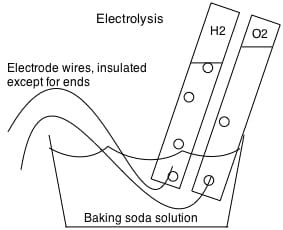
1) The first experiments aim to add some numerical observations to our previous studies of electrolysis. Here is where you will see why we think that molecules like water are made of fixed compositions of atoms. Lets redo the water electrolysis experiment now with an Ammeter in line between the battery and one of the electrodes. With the ammeter connected, put both electrodes deep into a solution of water with a little lye, and then (while watching the ammeter) lift one electrode half out, place it back, and lift the other. You will find, I think, that one of the other electrode is the limiting electrode, and that the amperage goes to 1/2 its previous value when this electrode is half lifted. Lifting the other electrode changes neither the amperage or the amount of bubbles, but lifting this limiting electrode changes both the amount of bubbles and the amperage. If you watch closely, though, you’ll see it changes the amount of bubbles at both electrodes in proportion, and that the amount of bubbles is in promotion to the amperage. If you collect the two gasses simultaneously, you’ll see that the volume of gas collected is always in a ratio of 2 to 1. For other electrolysis (H2 and Cl2) it will be 1 to1; it’s always a ratio of small numbers. See diagram below on how to make and collect oxygen and hydrogen simultaneously by electrolyzing water with lye or baking soda as electrolyte. With lye or baking soda, you’ll find that there is always twice as much hydrogen produced as oxygen — exactly.

You can also do electrolysis with table salt or muriatic acid as an electrolyte, but for this you’ll need carbon or platinum electrodes. If you do it right, you’ll get hydrogen and chlorine, a green gas that smells bad. If you don’t do this right, using a wire instead of a carbon or platinum electrode, you’ll still get hydrogen, but no chlorine. Instead of chlorine, you’ll corrode the wire on that end, making e.g. copper chloride. With a carbon electrode and any chloride compound as the electrolyte, you’ll produce chlorine; without a chloride electrolyte, you will not produce chlorine at any voltage, or with any electrode. And if you make chlorine and check the volumes, you’ll find you always make one volume of chlorine for every volume of hydrogen. We imagine from this that the compounds are made of fixed atoms that transfer electrons in fixed whole numbers per molecule. You always make two volumes of hydrogen for every volume of oxygen because (we think) making oxygen requires twice as many electrons as making hydrogen.

At home electrolysis experiment

At home electrolysis experiment

We get the same volume of chlorine as hydrogen because making chlorine and hydrogen requires the same amount of electrons to be transferred. These are the sort of experiments that caused people to believe in atoms and molecules as the fundamental unchanging components of matter. Different solutes, voltages, and electrodes will affect how fast you make hydrogen and oxygen, as will the amount of dissolved solute, but the gas produced are always the same, and the ratio of volumes is always proportional to the amperage in a fixed ratio of small whole numbers.

As always, don’t let significant quantities of use hydrogen and oxygen or pure hydrogen and chlorine mix in a closed space. Hydrogen and oxygen is quite explosive brown’s gas; hydrogen and chlorine are reactive as well. When working with chlorine it is best to work outside or near an open window: chlorine is a poison gas.

You may also want to try this with non-electrolytes, pure water or water with sugar or alcohol dissolved. You will find there is hardly any amperage or gas with these, but the small amount of gas produced will retain the same ratio. For college level folks, here is some physics/math relating to the minimum voltage and relating to the quantities you should expect at any amperage.

2) Now let’s try electro-plating metals. Using the right solutes, metals can be made to coat your electrodes the same way that bubbles of gas coated your electrodes in the experiments above. The key is to find the right chemical, and as a start let me suggest the copper sulphate sold in hardware stores to stop root growth. As an alternative copper sulphate is often sold as part of a fertilizer solution like “Miracle grow.” Look for copper on the label, or for a blue color fertilizer. Make a solution of copper using enough copper so that the solution is recognizably green, Use two steel washers as electrodes (that is connect the wires from your battery to the washers) and put them in the solution. You will find that one side turns red, as it is coated with copper. Depending on what else your copper solution contained, bubbles may appear at the other washer, or the other washer will corrode. 

You are now ready to take this to a higher level — silver coating. take a piece of silver plated material that you want to coat, and clean it nicely with soap and water. Connect it to the electrode where you previously coated copper. Now clean out the solution carefully. Buy some silver nitrate from a drug store, and dissolve a few grams (1/8 tsp for a start) in pure water; place the silverware and the same electrodes as before, connected to the battery. For a nicer coat use a 1 1/2 volt lantern battery; the 6 V battery will work too, but the silver won’t look as nice. With silver nitrate, you’ll notice that one electrode produces gas (oxygen) and the other turns silvery. Now disconnect the silvery electrode. You can use this method to silver coat a ring, fork, or cup — anything you want to have silver coated. This process is called electroplating. As with hydrogen production, there is a proportional relationship between the time, the amperage and the amount of metal you deposit — until all the silver nitrate in solution is used up.

As a yet-more complex version, you can also electroplate without using a battery. This was my Simple electroplating (presented previously). Consider this only after you understand most everything else I’ve done. When I saw this the first time in high school I was confused.

3) Casting metal objects using melted pennies, heat from a gas stove, and sand or plaster as a cast. This is pretty easy, but sort of dangerous — you need parents help, if only as a watcher. This is a version of an experiment I did as a kid.  I did metal casting using lead that some plumbers had left over. I melted it in a tin can on our gas stove and cast “quarters” in a plaster mold. Plumbers no longer use lead, but modern pennies are mostly zinc, and will melt about as well as my lead did. They are also much safer.

As a preparation for this experiment, get a bucket full of sand. This is where you’ll put your metal when you’re done. Now get some pennies (1970 or later), a pair of pliers, and an empty clean tin can, and a gas stove. If you like you can make a plaster mold of some small object: a ring, a 50 piece — anything you might want to cast from your pennies. With parents’ help, light your gas stove, put 5-8 pennies in the empty tin can, and hold the can over the lit gas burner using your pliers. Turn the gas to high. In a few minutes the bottom of the can will burn and become red-hot. About this point, the pennies will soften and melt into a silvery puddle. By tilting the can, you can stir the metal around (don’t get it on you!). When it looks completely melted you can pour the molten pennies into your sand bucket (carefully), or over your plaster mold (carefully). If you use a mold, you’ll get a zinc copy of whatever your mold was: jewelry, coins, etc. If you work at it, you’ll learn to make fancier and fancier casts. Adult help is welcome to avoid accidents. Once the metal solidifies, you can help cool it faster by dripping water on it from a faucet. Don’t touch it while it’s hot!

A plaster mold can be made by putting a 50¢ piece at the bottom of a paper cup, pouring plaster over the coin, and waiting for it to dry. Tear off the cup, turn the plaster over and pull out the coin; you’ve got a one-sided mold, good enough to make a one-sided coin. If you enjoy this, you can learn more about casting on Wikipedia; it’s an endeavor that only costs 4 or 5 cents per try. As a safety note: wear solid leather shoes and cover the floor near the stove with a board. If you drop the metal on the floor you’ll have a permanent burn mark on the floor and your mother will not be happy. If you drop hot metal on your you’ll have a permanent injury, and you won’t be happy. Older pennies are made of copper and will not melt. Here’s a video of someone pouring a lot of metal into an ant-hill (kills lots of ants, makes a mold of the hill).

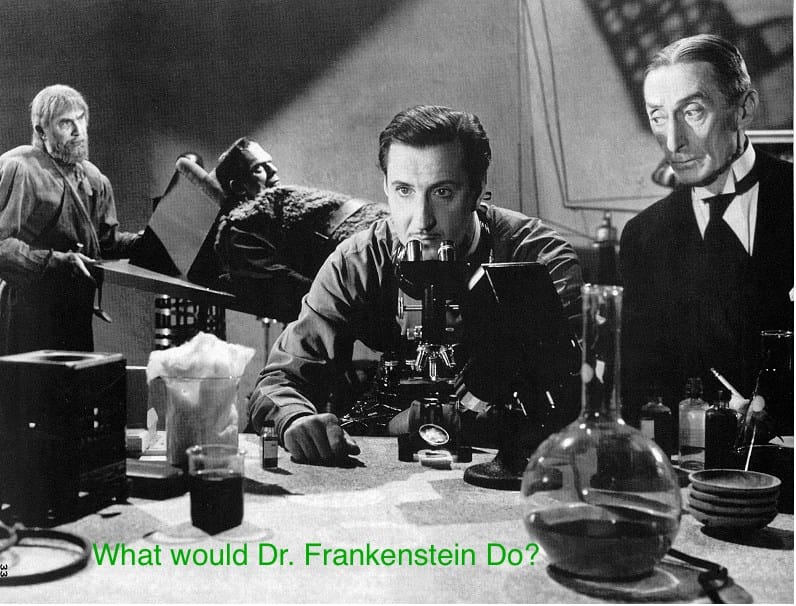
It's often helpful to ask yourself, "what would Dr. Frankenstein do?"

It’s nice to have assistants, friends and adult help in the laboratory when you do science. Even without the castle, it’s what Dr. Frankenstein did.

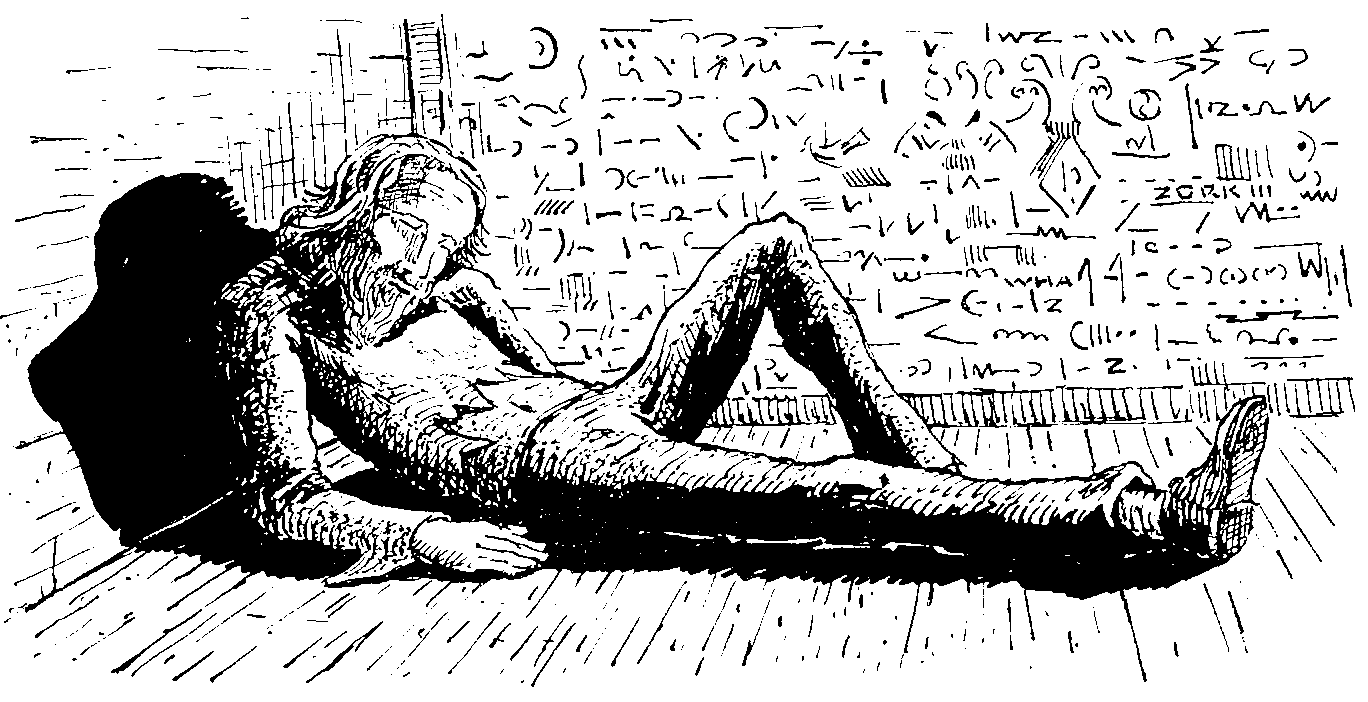
4) Bringing a dead frog back to life (sort of). Make a high voltage battery of 45 to 90 V battery by attaching 5-10, 9V batteries in a daisy chain they will snap together. If you touch both exposed contacts you’ll give yourself a wicked shock. If you touch the electrodes to a newly killed frog, the frog legs will kick. This is sort of groovy. It was the inspiration for Dr. Frankenstein (at right), who then decides he could bring a person back from the dead with “more power.” Frankenstein’s monster is brought back to life this way, but ends up killing the good doctor. Shocks are sometimes helpful reanimating people stricken by heat attacks, and many buildings have shockers for this purpose. But don’t try to bring back the long-dead. By all accounts, the results are less-than pleasing. Try dissecting the rest of the frog and guess what each part is (a world book encyclopedia helps). As I recall, the heart keeps going for a while after it’s out of the frog — spooky.

5) Another version of this shocker is made with a small transformer (1″ square, say, radioshack) and a small battery (1.5-6V). Don’t use the 90V battery, you’ll kill someone. As a first version of this shocker, strip 1″ of  insulation off of the ends of some wire 12″ long say, and attach one end to two paired wires of the transformer (there will usually be a diagram in the box). If the transformer already has some wires coming out, all you have to do is strip more insulation off the ends so 1″ is un-inuslated. Take two paired ends in your hand, holding onto the uninsulated part and touch both to the battery for a second or two. Then disconnect them while holding the bare wires; you’ll get a shock. As a nastier version, get a friend to hope the opposite pair of wires on the uninsulated parts, while you hold the insulated parts of your two. Touch your two to the battery and disconnect while holding the insulation, you will see a nice spark, and your friend will get a nice shock. Play with it; different arrangements give more sparks or bigger shocks. Another thing you can do: put your experiment near a radio or TV. The transformer sparks will interfere with most nearby electronics; you can really mess up a computer this way, so keep it far from your computer. This is how wireless radio worked long ago, and how modern warfare will probably go. The atom bomb was detonated with a spark like this.

If you want to do more advanced science, it’s a good idea to learn math. This is important for statistics, for engineering, for quantum mechanics, and can even help for music. Get a few good high school or college books and read them cover to cover. An approach to science is to try to make something cool, that sort-of works, and then try to improve it. You then decide what a better version would work like,  modify your original semi-randomly and see if you’re going in the right direction. Don’t redesign with only one approach –it may not work. Read whatever you can, but don’t believe all you read. Often books are misleading, or wrong, and blogs are worse (I ought to know). When you find mistakes, note them in the margin, and try to explain them. You may find you were right, or that the book was right, but it’s a learning experience. If you like you can write the author and inform him/her of the errors. I find mailed letters are more respectful than e-mails — it shows you put in more effort.

Robert Buxbaum, February 20, 2014. Here’s the difference between metals and non-metals, and a periodic table cup that I made, and sell. And here’s a difference between science and religion – reproducibility.

Ab Normal Statistics and joke

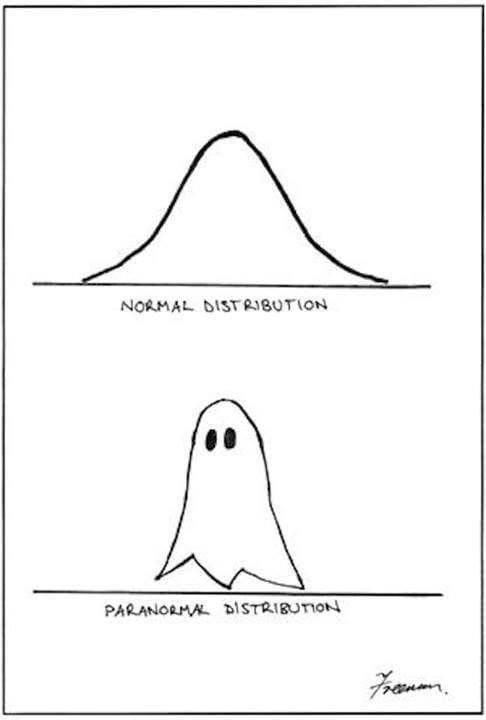
The normal distribution of observation data looks sort of like a ghost. A Distribution  that really looks like a ghost is scary.

The normal distribution of observation data looks sort of like a ghost. A Distribution that really looks like a ghost is scary.

It’s funny because …. the normal distribution curve looks sort-of like a ghost. It’s also funny because it would be possible to imagine data being distributed like the ghost, and most people would be totally clue-less as to how to deal with data like that — abnormal statistics. They’d find it scary and would likely try to ignore the problem. When faced with a statistics problem, most people just hope that the data is normal; they then use standard mathematical methods with a calculator or simulation package and hope for the best.

Take the following example: you’re interested in buying a house near a river. You’d like to analyze river flood data to know your risks. How high will the river rise in 100 years, or 1000. Or perhaps you would like to analyze wind data to know how strong to make a sculpture so it does not blow down. Your first thought is to use the normal distribution math in your college statistics book. This looks awfully daunting (it doesn’t have to) and may be wrong, but it’s all you’ve got.

The normal distribution graph is considered normal, in part, because it’s fairly common to find that measured data deviates from the average in this way. Also, this distribution can be derived from the mathematics of an idealized view of the world, where any variety derives from multiple small errors around a common norm, and not from some single, giant issue. It’s not clear this is a realistic assumption in most cases, but it is comforting. I’ll show you how to do the common math as it’s normally done, and then how to do it better and quicker with no math at all, and without those assumptions.

Lets say you want to know the hundred-year maximum flood-height of a river near your house. You don’t want to wait 100 years, so you measure the maximum flood height every year over five years, say, and use statistics. Lets say you measure 8 foot, 6 foot, 3 foot (a draught year), 5 feet, and 7 feet.

The “normal” approach (pardon the pun), is to take a quick look at the data, and see that it is sort-of normal (many people don’t bother). One now takes the average, calculated here as (8+6+3+5+7)/5 = 5.8 feet. About half the times the flood waters should be higher than this (a good researcher would check this, many do not). You now calculate the standard deviation for your data, a measure of the width of the ghost, generally using a spreadsheet. The formula for standard deviation of a sample is s = √{[(8-5.8)2 + (6-5.8)2 + (3-5.8)2 + (5-5.8)2 + (7-5.8)2]/4} = 1.92. The use of 4 here in the denominator instead of 5 is called the Brussels correction – it refers to the fact that a standard of deviation is meaningless if there is only one data point.

For normal data, the one hundred year maximum height of the river (the 1% maximum) is the average height plus 2.2 times the deviation; in this case, 5.8 + 2.2 x 1.92 = 10.0 feet. If your house is any higher than this you should expect few troubles in a century. But is this confidence warranted? You could build on stilts or further from the river, but you don’t want to go too far. How far is too far?

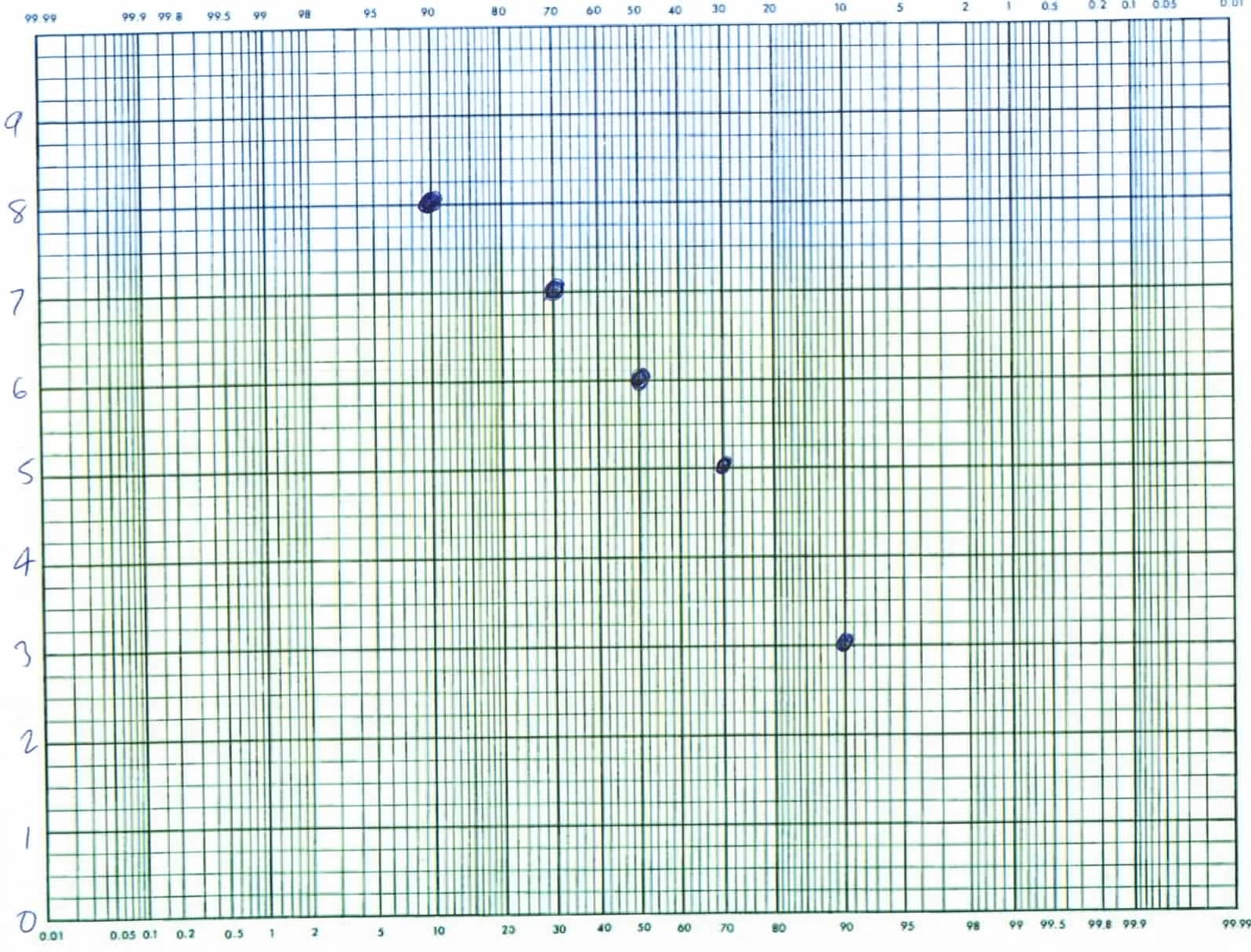
So let’s do this better. We can, with less math, through the use of probability paper. As with any good science we begin with data, not assumptions, like that the data is normal. Arrange the river height data in a list from highest to lowest (or lowest to highest), and plot the values in this order on your probability paper as shown below. That is on paper where likelihoods from .01% to 99.99% are arranged along the bottom — x axis, and your other numbers, in this case the river heights, are the y values listed at the left. Graph paper of this sort is sold in university book stores; you can also get jpeg versions on line, but they don’t look as nice.

probability plot of maximum river height over 5 years -- looks reasonably normal, but slightly ghost-like.

Probability plot of the maximum river height over 5 years. If the data suggests a straight line, like here the data is reasonably normal. Extrapolating to 99% suggests the 100 year flood height would be 9.5 to 10.2 feet, and that it is 99.99% unlikely to reach 11 feet. That’s once in 10,000 years, other things being equal.

For the x axis values of the 5 data points above, I’ve taken the likelihood to be the middle of its percentile. Since there are 5 data points, each point is taken to represent its own 20 percentile; the middles appear at 10%, 30%, 50%, etc. I’ve plotted the highest value (8 feet) at the 10% point on the x axis, that being the middle of the upper 20%. I then plotted the second highest (7 feet) at 30%, the middle of the second 20%; the third, 6 ft at 50%; the fourth at 70%; and the draught year maximum (3 feet) at 90%.  When done, I judge if a reasonably straight line would describe the data. In this case, a line through the data looks reasonably straight, suggesting a fairly normal distribution of river heights. I notice that, if anything the heights drop off at the left suggesting that really high river levels are less likely than normal. The points will also have to drop off at the right since a negative river height is impossible. Thus my river heights describe a version of the ghost distribution in the cartoon above. This is a welcome finding since it suggests that really high flood levels are unlikely. If the data were non-normal, curving the other way we’d want to build our house higher than a normal distribution would suggest. 

You can now find the 100 year flood height from the graph above without going through any the math. Just draw your best line through the data, and look where it crosses the 1% value on your graph (that’s two major lines from the left in the graph above — you may have to expand your view to see the little 1% at top). My extrapolation suggests the hundred-year flood maximum will be somewhere between about 9.5 feet, and 10.2 feet, depending on how I choose my line. This prediction is a little lower than we calculated above, and was done graphically, without the need for a spreadsheet or math. What’s more, our predictions is more accurate, since we were in a position to evaluate the normality of the data and thus able to fit the extrapolation line accordingly. There are several ways to handle extreme curvature in the line, but all involve fitting the curve some way. Most weather data is curved, e.g. normal against a fractal, I think, and this affects you predictions. You might expect to have an ice age in 10,000 years.

The standard deviation we calculated above is related to a quality standard called six sigma — something you may have heard of. If we had a lot of parts we were making, for example, we might expect to find that the size deviation varies from a target according to a normal distribution. We call this variation σ, the greek version of s. If your production is such that the upper spec is 2.2 standard deviations from the norm, 99% of your product will be within spec; good, but not great. If you’ve got six sigmas there is one-in-a-billion confidence of meeting the spec, other things being equal. Some companies (like Starbucks) aim for this low variation, a six sigma confidence of being within spec. That is, they aim for total product uniformity in the belief that uniformity is the same as quality. There are several problems with this thinking, in my opinion. The average is rarely an optimum, and you want to have a rational theory for acceptable variation boundaries. Still, uniformity is a popular metric in quality management, and companies that use it are better off than those that do nothing. At REB Research, we like to employ the quality methods of W. Edwards Deming; we assume non-normality and aim for an optimum (that’s subject matter for a further essay). If you want help with statistics, or a quality engineering project, contact us.

I’ve also meant to write about the phrase “other things being equal”, Ceteris paribus in Latin. All this math only makes sense so long as the general parameters don’t change much. Your home won’t flood so long as they don’t build a new mall up river from you with runoff in the river, and so long as the dam doesn’t break. If these are concerns (and they should be) you still need to use statistics and probability paper, but you will now have to use other data, like on the likelihood of malls going up, or of dams breaking. When you input this other data, you will find the probability curve is not normal, but typically has a long tail (when the dam breaks, the water goes up by a lot). That’s outside of standard statistic analysis, but why those hundred year floods come a lot more often than once in 100 years. I’ve noticed that, even at Starbucks, more than 1/1,000,000,000 cups of coffee come out wrong. Even in analyzing a common snafu like this, you still use probability paper, though. It may be ‘situation normal”, but the distribution curve it describes has an abnormal tail.

by Dr. Robert E. Buxbaum, November 6, 2013. This is my second statistics post/ joke, by the way. The first one dealt with bombs on airplanes — well, take a look.

An Aesthetic of Mechanical Strength

Back when I taught materials science to chemical engineers, I used the following poem to teach my aesthetic for the strength target for product design:

The secret to design, as the parson explained, is that the weakest part must withstand the strain. And if that part is to withstand the test, then it must be made as strong as all the rest. (by R.E. Buxbaum, based on “The Wonderful, One-hoss Shay, by Oliver Wendell Holmes, 1858).

My thought was, if my students had no idea what good mechanical design looked like, they’d never  be able to it well. I wanted them to realize that there is always a weakest part of any device or process for every type of failure. Good design accepts this and designs everything else around it. You make sure that the device will fail at a part of your choosing, when it fails, preferably one that you can repair easily and cheaply (a fuse, or a door hinge), and which doesn’t cause too much mayhem when it fails. Once this failure part is chosen and in place, I taught that the rest should be stronger, but there is no point in making any other part of that failure chain significantly stronger than the weakest link. Thus for example, once you’ve decided to use a fuse of a certain amperage, there is no point in making the rest of the wiring take more than 2-3 times the amperage of the fuse.

This is an aesthetic argument, of course, but it’s important for a person to know what good work looks like (to me, and perhaps to the student) — beyond just by compliments from the boss or grades from me. Some day, I’ll be gone, and the boss won’t be looking. There are other design issues too: If you don’t know what the failure point is, make a prototype and test it to failure, and if you don’t like what you see, remodel accordingly. If you like the point of failure but decide you really want to make the device stronger or more robust, be aware that this may involve strengthening that part only, or strengthening the entire chain of parts so they are as failure resistant as this part (the former is cheaper).

I also wanted to teach that there are many failure chains to look out for: many ways that things can wrong beyond breaking. Check for failure by fire, melting, explosion, smell, shock, rust, and even color change. Color change should not be ignored, BTW; there are many products that people won’t use as soon as they look bad (cars, for example). Make sure that each failure chain has it’s own known, chosen weak link. In a car, the paint on a car should fade, chip, or peel some (small) time before the metal underneath starts rusting or sagging (at least that’s my aesthetic). And in the DuPont gun-powder mill below, one wall should be weaker so that the walls should blow outward the right way (away from traffic).Be aware that human error is the most common failure mode: design to make things acceptably idiot-proof.

Dupont powder mills had a thinner wall and a stronger wall so that, if there were an explosion it would blow out towards the river. This mill has a second wall to protect workers. The thinner wall should be barely strong enough to stand up to wind and rain; the stronger walls should stand up to explosions that blow out the other wall.

Dupont powder mills had a thinner wall and a stronger wall so that, if there were an explosion, it would blow out ‘safely.’ This mill has a second wall to protect workers. The thinner wall must be strong enough to stand up to wind and rain; the stronger walls should stand up to all likely explosions.

Related to my aesthetic of mechanical strength, I tried to teach an aesthetic of cost, weight, appearance, and green: Choose materials that are cheaper, rather than more expensive; use less weight rather than more if both ways worked equally well. Use materials that look better if you’ve got the choice, and use recyclable materials. These all derive from the well-known axiom, omit needless stuff. Or, as William of Occam put it, “Entia non sunt multiplicanda sine necessitate.” As an aside, I’ve found that, when engineers use Latin, we look smart: “lingua bona lingua motua est.” (a good language is a dead language) — it’s the same with quoting 19th century poets, BTW: dead 19th century poets are far better than undead ones, but I digress.

Use of recyclable materials gets you out of lots of problems relative to materials that must be disposed of. E.g. if you use aluminum insulation (recyclable) instead of ceramic fiber, you will have an easier time getting rid of the scrap. As a result, you are not as likely to expose your workers (or you) to mesothelioma, or similar disease. You should not have to pay someone to haul away excess or damaged product; a scraper will oblige, and he may even pay you for it if you have enough. Recycling helps cash flow with decommissioning too, when money is tight. It’s better to find your $1 worth of scrap is now worth $2 instead of discovering that your $1 worth of garbage now costs $2 to haul away. By the way, most heat loss is from black body radiation, so aluminum foil may actually work better than ceramics of the same thermal conductivity.

Buildings can be recycled too. Buy them and sell them as needed. Shipping containers make for great lab buildings because they are cheap, strong, and movable. You can sell them off-site when you’re done. We have a shipping container lab building, and a shipping container storage building — both worth more now than when I bought them. They are also rather attractive with our advertising on them — attractive according to my design aesthetic. Here’s an insight into why chemical engineers earn more than chemists; and insight into the difference between mechanical engineering and civil engineering. Here’s an architecture aesthetic. Here’s one about the scientific method.

Robert E. Buxbaum, October 31, 2013

Surrealists art joke

How many surrealists does it take to screw in a lightbulb.


The fish.


Surrealism aims to show the reality that exceeds realism; the dream-like absurd that is beyond the rational, common-sensical and practical. Beyond control engineering.

And you know “How many engineers would it take to screw in a lightbulb?” —- “Minimally two, and it would have to be a very large lightbulb.”

Even if the insights of surrealism are common-place, for example, that the eye is a false mirror of the world, I like is that they become real (if the surrealist is talented.)

False Mirror by Magritte; The idea, I suppose is that the eye is a false mirror of the world, seeing what's already within it.

False Mirror by Magritte; the idea, I suppose is that we see what’s already within us.

“The greatest obstacle to discovering the shape of the earth, the continents, and the oceans was not ignorance but the illusion of knowledge.” What I particularly like is the falseness of the mirror is shown as both false and true. The world is rarely this or that. Another insight / joke.

We all have masks, especially with those we love.

We all have masks, especially with those we love.

I imagine most I could make second-rate surrealistic works. The way to know your work is second rate it’s beautiful and insightful, but not funny.

Creation of Man-the-militant in the style of Michelangelo

Creation of Man-the-militant. Kuksi. It’s well done, and interesting (a retake on Michelangelo), but it’s not funny. See my cartoon in mechanical v civil engineers joke.

And then there is bad modern art. You could argue that this isn’t surreal, but some sort of other modern art, or post modern art. But that’s all false: it’s just bad art.

Bad modern art: little skill, little meaning, no humor. If you have to ask: "is it art?" It usually isn't.

Bad modern art: little skill, little meaning, no humor. If you have to ask: “is it art?” It usually isn’t.

If you buy something like this, and put it in your corporate headquarters lobby, the joke’s on you, and the artist is laughing his or her way to the bank.  Here is a link to why surrealism should be funny, And why architecture should not be (someone’s got to live in that joke).

R. E. Buxbaum, August 5, 2013

Mechanical Engineer v Civil Engineer Joke

What’s the difference between a mechanical engineer and a civil engineer?


Mechanical engineers make weapons; civil engineers make targets.


Is funny because ….. it’s sort of true. Much of engineering is war-related, and always was. In earlier times, an engineer was someone who made engines of war: catapults, battering rams, and the like. Nowadays, mechanical engineers are the main designers for tanks, cannons, and ships. A civil engineer is one whose projects have civilian applications. But as these projects have military uses (roads, ports, offices, and bridges, for example), civilian projects are major targets for an opposing army.

An observation about war and peace: if you are really at making peacetime products, you’re a hero in your country and outside; if you design weapons, you are vilified by the enemy and likely to become a prisoner in your own land. Consider the designers of the atom bomb in the US, Russia, Israel, India, or Iran. They can’t go abroad, and are likely suspect at home. The leaders have to worry that these scientists will give the same weapons to their enemies (it’s happened) or that they will not be dedicated enough to make the next iteration of the weapon (ditto).

My advice: specialize items for peacetime or civilian use if you can. Those who make better cars, music, art or architecture are welcome everywhere; advances in death usually rebound on the inventor. Here’s a joke comparing chemists and chemical engineers, a piece on a favorite car engine advance, on perfect tuning of musical instrumentsan architecture joke, and a control engineer joke. People like civil engineers.

What sort of guy does a king keep locked in the castle dungeon — not the common thief.  #wordstothewise.

R. E. Buxbaum, August 1, 2013. I’m a chemical engineer, who makes hydrogen stuff and consults, mostly for peace-time use.

Chemist v Chemical Engineer joke

What’s the difference between a chemist and a chemical engineer?


How much they make.


I made up this joke up as there were no other chemical engineer jokes I knew. It’s an OK double entente that’s pretty true — both in terms of product produced and the amount of salary (there’s probably a cause-and-effect relation here). Typical of these puns, this joke ignores the internal differences in methodologies and background (see my post, How is Chemical engineering?). If you like, here’s another engineering joke,  a chemistry joke, and a dwarf joke.

R.E. Buxbaum –  June 28, 2013.

My steam-operated, high pressure pump

Here’s a miniature version of a duplex pump that we made 2-3 years ago at REB Research as a way to pump fuel into hydrogen generators for use with fuel cells. The design is from the 1800s. It was used on tank locomotives and steamboats to pump water into the boiler using only the pressure in the boiler itself. This seems like magic, but isn’t. There is no rotation, but linear motion in a steam piston of larger diameter pushes a liquid pump piston with a smaller diameter. Each piston travels the same distance, but there is more volume in the steam cylinder. The work from the steam piston is greater: W = ∫PdV; energy is conserved, and the liquid is pumped to higher pressure than the driving steam (neat!).

The following is a still photo. Click on the YouTube link to see the steam pump in action. It has over 4000 views!

Mini duplex pump. Provides high pressure water from steam power. Amini version of a classic of the 1800s Coffee cup and pen shown for scale.

Mini duplex pump. Provides high pressure water from steam power. A mini version of a classic of the 1800s Coffee cup and pen shown for scale.

You can get the bronze casting and the plans for this pump from Stanley co (England). Any talented machinist should be able to do the rest. I hired an Amish craftsman in Ohio. Maurice Perlman did the final fit work in our shop.

Our standard line of hydrogen generators still use electricity to pump the methanol-water. Even our latest generators are meant for nom-mobile applications where electricity is awfully convenient and cheap. This pump was intended for a future customer who would need to generate hydrogen to make electricity for remote and mobile applications. Even our non-mobile hydrogen is a better way to power cars than batteries, but making it mobile has advantages. Another advance would be to heat the reactors by burning the waste gas (I’ve been working on that too, and have filed a patent). Sometimes you have to build things ahead of finding a customer — and this pump was awfully cool.

Nuclear Power: the elephant of clean energy

As someone who heads a hydrogen energy company, REB Research, I regularly have to tip toe about nuclear power, a rather large elephant among the clean energy options. While hydrogen energy looks better than battery energy in terms of cost and energy density, neither are really energy sources; they are ways to transport energy or store it. Among non-fossil sources (sources where you don’t pollute the air massively) there is solar and wind: basically non-reliable, low density, high cost and quite polluting when you include the damage done making the devices.

Compared to these, I’m happy to report that the methanol used to make hydrogen in our membrane reactors can come from trees (anti-polluting), even tree farming isn’t all that energy dense. And then there’s uranium: plentiful, cheap and incredibly energy dense. I try to ignore how energy dense uranium is, but the cartoon below shows how hard that is to do sometimes. Nuclear power is reliable too, and energy dense; a small plant will produce between 500 and 1000 MW of power; your home uses perhaps 2 kW. You need logarithmic graph paper just to compare nuclear power to most anything else (including hydrogen):

log_scale

A tiny amount of uranium-oxide, the size of a pencil will provide as much power as hundreds of train cars full of coal. After transportation, the coal sells for about $80/ton; the sells for about $25/lb: far cheaper than the train loads of coal (there are 100-110 tons of coal to a train-car load). What’s more, while essentially all of the coal in a train car ends up in the air after it’s burnt, the waste uranium generally does not go into the air we breathe. The coal fumes are toxic, containing carcinogens, carbon monoxide, mercury, vanadium and arsenic; they are often radioactive too. All this is avoided with nuclear power unless there is a bad accident, and bad accidents are far rarer with nuclear power than, for example, with natural gas. Since Germany started shutting nuclear plants and replacing them with coal, it appears they are making all of Europe sicker).

It is true that the cost to build a nuclear plant is higher than to build a coal or gas plant, but it does not have to be: it wasn’t that way in the early days of nuclear power, nor is this true of military reactors that power our (USA) submarines and major warships. Commercial nuclear reactors cost a lot largely because of the time-cost for neighborhood approval (and they don’t always get approval). Batteries used for battery power get no safety review generally though there were two battery explosions on the Dreamliner alone, and natural gas has been known to level towns. Nuclear reactors can blow up too, as Chernobyl showed (and to a lesser extent Fukushima), but almost any design is better than Chernobyl.

The biggest worry people have with nuclear, and the biggest objection it seems to me, is escaped radiation. In a future post, I plan to go into the reality of the risk in more detail, but the worry is far worse than the reality, or far worse than the reality of other dangers (we all die of something eventually). The predicted death rate from the three-mile island accident is basically nil; Fukushima has provided little health damage (not that it’s a big comfort). Further, bizarre as this seems the thyroid cancer rate in Belarus in the wind-path of the Chernobyl plant is actually slightly lower than in the US (7 per 100,000 in Belarus compared to over 9 per 100,000 in the USA). This is clearly a statistical fluke; it’s caused, I believe, by the tendency for Russians to die of other things before they can get thyroid cancer, but it suggests that the health risks of even the worst nuclear accidents are not as bad as you might think. (BTW, Our company makes hydrogen extractors that make accidents less likely)

The biggest real radiation worry (in my opinion) is where to put the waste. Ever since President Carter closed off the option of reprocessing used fuel for re-use there has been no way to permanently get rid of waste. Further, ever since President Obama closed the Yucca Mountain burial repository there have been no satisfactory place to put the radioactive waste. Having waste sitting around above ground all over the US is a really bad option because the stuff is quite toxic. Just as the energy content of nuclear fuel is higher than most fuels, the energy content of the waste is higher. Burying it deep below a mountain in an area were no-one is likely to live seems like a good solution: sort of like putting the uranium back where it came from. And reprocessing for re-use seems like an even better solution since this gets rid of the waste permanently.

I should mention that nuclear power-derived electricity is a wonderful way to generate electricity or hydrogen for clean transportation. Further, the heat of hot springs comes from nuclear power. The healing waters that people flock to for their health is laced with isotopes (and it’s still healthy). For now, though I’ll stay in the hydrogen generator business and will ignore the clean elephant in the room. Fortunately there’s hardly any elephant poop, only lots and lots of coal and solar poop.