Tag Archives: Engineering

How long could you make a suspension bridge?

The above is one of the engineering questions that puzzled me as a student engineer at Brooklyn Technical High School and at Cooper Union in New York. The Brooklyn Bridge stood as a wonder of late 1800s engineering, and it had recently been eclipsed by the Verrazano bridge, a pure suspension bridge. At the time it was the longest and heaviest in the world. How long could a bridge be made, and why did Brooklyn bridge have those catenary cables, when the Verrazano didn’t? (Sometimes I’d imagine a Chinese engineer being asked the top question, and answering “Certainly, but How Long is my cousin.”)

I found the above problem unsolvable with the basic calculus at my disposal. because it was clear that both the angle of the main cable and its tension varied significantly along the length of the cable. Eventually I solved this problem using a big dose of geometry and vectors, as I’ll show.

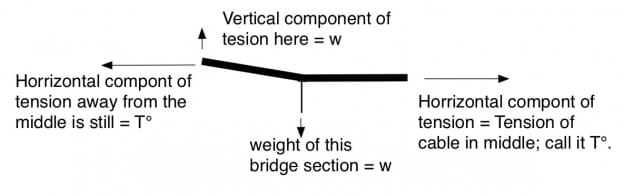
Vector diagram of forces on the cable at the center-left of the bridge.

Vector diagram of forces on the cable at the center-left of the bridge.

Consider the above vector diagram (above) of forces on a section of the main cable near the center of the bridge. At the right, the center of the bridge, the cable is horizontal, and has a significant tension. Let’s call that T°. Away from the center of the bridge, there is a vertical cable supporting a fraction of  roadway. Lets call the force on this point w. It equals the weight of this section of cable and this section of roadway. Because of this weight, the main cable bends upward to the left and carries more tension than T°. The tangent (slope) of the upward curve will equal w/T°, and the new tension will be the vector sum along the new slope. From geometry, T= √(w2 +T°2).

Vector diagram of forces on the cable further from the center of the bridge.

Vector diagram of forces on the cable further from the center of the bridge.

As we continue from the center, there are more and more verticals, each supporting approximately the same weight, w. From geometry, if w weight is added at each vertical, the change in slope is always w/T° as shown. When you reach the towers, the weight of the bridge must equal 2T Sin Θ, where Θ is the angle of the bridge cable at the tower and T is the tension in the cable at the tower.

The limit to the weight of a bridge, and thus its length, is the maximum tension in the main cable, T, and the maximum angle, that at the towers. Θ. I assumed that the maximum bridge would be made of T1 bridge steel, the strongest material I could think of, with a tensile strength of 100,000 psi, and I imagined a maximum angle at the towers of 30°. Since there are two towers and sin 30° = 1/2, it becomes clear that, with this 30° angle cable, the tension at the tower must equal the total weight of the bridge. Interesting.

Now, to find the length of the bridge, note that the weight of the bridge is proportional to its length times the density and cross section of the metal. I imagined a bridge where the half of the weight was in the main cable, and the rest was in the roadway, cars and verticals. If the main cable is made of T1 “bridge steel”, the density of the cable is 0.2833 lb/in3, and the density of the bridge is twice this. If the bridge cable is at its yield strength, 100,000 psi, at the towers, it must be that each square inch of cable supports 50,000 pounds of cable and 50,000 lbs of cars, roadway and verticals. The maximum length (with no allowance for wind or a safety factor) is thus

L(max) = 100,000 psi / 2 x 0.2833 pounds/in3 = 176,500 inches = 14,700 feet = 2.79 miles.

This was more than three times the length of the Verrazano bridge, whose main span is ‎4,260 ft. I attributed the difference to safety factors, wind, price, etc. I then set out to calculate the height of the towers, and the only rational approach I could think of involved calculus. Fortunately, I could integrate for the curve now that I knew the slope changed linearly with distance from the center. That is for every length between verticals, the slope changes by the same amount, w/T°. This was to say that d2y/dx2 = w/T° and the curve this described was a parabola.

Rather than solving with heavy calculus, I noticed that the slope, dy/dx increases in proportion to x, and since the slope at the end, at L/2, was that of a 30° triangle, 1/√3, it was clear to me that

dy/dx = (x/(L/2))/√3

where x is the distance from the center of the bridge, and L is the length of the bridge, 14,700 ft. dy/dx = 2x/L√3.

We find that:
H = ∫dy = ∫ 2x/L√3 dx = L/4√3 = 2122 ft,

where H is the height of the towers. Calculated this way, the towers were quite tall, higher than that of any building then standing, but not impossibly high (the Dubai tower is higher). It was fairly clear that you didn’t want a tower much higher than this, though, suggesting that you didn’t want to go any higher than a 30° angle for the main cable.

I decided that suspension bridges had some advantages over other designs in that they avoid the problem of beam “buckling.’ Further, they readjust their shape somewhat to accommodate heavy point loads. Arch and truss bridges don’t do this, quite. Since the towers were quite a lot taller than any building then in existence, I came to I decide that this length, 2.79 miles, was about as long as you could make the main span of a bridge.

I later came to discover materials with a higher strength per weight (titanium, fiber glass, aramid, carbon fiber…) and came to think you could go longer, but the calculation is the same, and any practical bridge would be shorter, if only because of the need for a safety factor. I also came to recalculate the height of the towers without calculus, and got an answer that was shorter, for some versions, a hundred feet shorter, as shown here. In terms of wind, I note that you could make the bridge so heavy that you don’t have to worry about wind except for resonance effects. Those are the effects are significant, but were not my concern at the moment.

The Brooklyn Bridge showing its main cable suspension structure and its catenaries.

Now to discuss catenaries, the diagonal wires that support many modern bridges and that, on the Brooklyn bridge, provide  support at the ends of the spans only. Since the catenaries support some weight of the Brooklyn bridge, they decrease the need for very thick cables and very high towers. The benefit goes down as the catenary angle goes to the horizontal, though as the lower the angle the longer the catenary, and the lower the fraction of the force goes into lift. I suspect this is why Roebling used catenaries only near the Brooklyn bridge towers, for angles no more than about 45°. I was very proud of all this when I thought it through and explained it to a friend. It still gives me joy to explain it here.

Robert Buxbaum, May 16, 2019.  I’ve wondered about adding vibration dampers to very long bridges to decrease resonance problems. It seems like a good idea. Though I have never gone so far as to do calculations along these lines, I note that several of the world’s tallest buildings were made of concrete, not steel, because concrete provides natural vibration damping.

Why concrete cracks and why sealing is worthwhile

The oil tanker Palo Alto is one of several major ships made with concrete hulls.

The oil tanker Palo Alto is one of several major ships made with concrete hulls.

Modern concrete is a wonderful construction material. Major buildings are constructed of it, and major dams, and even some ships. But under the wrong circumstances, concrete has a surprising tendency to crack and fail. I thought I’d explain why that happens and what you can do about it. Concrete does not have to crack easily; ancient concrete didn’t and military or ship concrete doesn’t today. A lot of the fault lies in the use of cheap concrete — concrete with lots of filler — and with the cheap way that concrete is laid. First off, the major components of modern concrete are pretty uniform: sand and rock, Portland cement powder (made from cooked limestone, mostly), water, air, and sometimes ash. The cement component is what holds it all together — cements it together as it were — but it is not the majority of even the strongest concretes. The formula of cement has changed too, but the cement is not generally the problem. It doesn’t necessarily stick well to the rock or sand component of concrete (It sticks far better to itself) but it sticks well enough that spoliation, isn’t usually a problem by itself.

What causes problem is that the strength of concrete is strongly affected (decreased) by having lots of sand, aggregate and water. The concrete used in sidewalks is as cheap as possible, with lots of sand and aggregate. Highway and wall concrete has less sand and aggregate, and is stronger. Military and ship concrete has little sand, and is quite a lot stronger. The lowest grade, used in sidewalks, is M5, a term that refers to its compressive strength: 5 Mega Pascals. Pascals are European (Standard International) units of pressure and of strength. One Pascal is one Newton per square meter (Here’ a joke about Pascal units). In US (English) units, 5 MPa is 50 atm or 750 psi.

Ratios for concrete mixes of different strength.

Ratios for concrete mixes of different strength; the numbers I use are double these because these numbers don’t include water; that’s my “1”.

The ratio of dry ingredients in various concretes is shown at right. For M5, and including water, the ratio is 1 2 10 20. That is to say there is one part water, two parts cement, 10 parts sand, and 20 parts stone-aggregate (all these by weight). Added to this is 2-3% air, by volume, or nearly as much air as water. At least these are the target ratios; it sometimes happens that extra air and water are added to a concrete mix by greedy or rushed contractors. It’s sometimes done to save money, but more often because the job ran late. The more the mixer turns the more air gets added. If it turns too long there is extra air. It the job runs late, workers will have to add extra water too because the concrete starts hardening. I you see workers hosing down wet concrete as it comes from the truck, this is why. As you might expect, extra air and water decrease the strength of the product. M-10 and M-20 concrete have less sand, stone, and water as a proportion to cement. The result is 10 MPa or 20 MPa strength respectively.

A good on-site inspector is needed to keep the crew from adding too much water. Some water is needed for the polymerization (setting) of the concrete. The rest is excess, and when it evaporates, it leaves voids that are similar to the voids created by having air mix in. It is not uncommon to find 6% voids, in commercial concrete. This is to say that, after the water evaporates, the concrete contains about as much void as cement by volume. To get a sense of how much void space is in the normal concrete outside your house, go outside to a piece of old concrete (10 years old at least) on a hot, dry day, and pour out a cup of water. You will hear a hiss as the water absorbs, and you will see bubbles come out as the water goes in. It used to be common for cities to send inspectors to measuring the void content of the wet (and dry) concrete by a technique called “pycnometry” (that’s Greek for density measurement). I’ve not seen a local city do this in years, but don’t know why. An industrial pycnometer is shown below.

Pyncnometer used for concrete. I don't see these in use much any more.

Pycnometer used for concrete. I don’t see these in use much any more.

One of the main reason that concrete fails has to do with differential expansion, thermal stress, a concept I dealt with some years ago when figuring out how cold it had to be to freeze the balls off of a brass monkey. As an example of the temperature change to destroy M5, consider that the thermal expansion of cement is roughly 1 x 10-5/ °F or 1.8 x10-5/°C. This is to say that a 1 meter slab of cement that is heated or cooled by 100°F will expand or shrink by 10-3 m respectively; 100 x 1×10-5 = 10-3. This is a fairly large thermal expansion coefficient, as these things go. It would not cause stress-failure except that sand and rock have a smaller thermal expansion coefficients, about 0.6×10⁻⁵ — barely more than half the value for cement. Consider now what happens to concrete that s poured in the summer when it is 80°F out, and where the concrete heats up 100°F on setting (cement setting releases heat). Now lets come back in winter when it’s 0°F. This is a total of 100°F of temperature change. The differential expansion is 0.4 x 10⁻⁵/°F x 100°F =  4 x10⁻⁴ meter/meter = 4 x10⁻⁴ inch/inch.

The force created by this differential expansion is the elastic modulus of the cement times the relative change in expansion. The elastic modulus for typical cement is 20 GPa or, in English units, 3 million psi. This is to say that, if you had a column of cement (not concrete), one psi of force would compress it by 1/3,000,000. The differential expansion we calculated, cement vs sand and stone is 4×10⁻⁴ ; this much expansion times the elastic modulus, 3,000,000 = 1200 psi. Now look at the strength of the M-5 cement; it’s only 750 psi. When M-5 concrete is exposed to these conditions it will not survive. M-10 will fail on its own, from the temperature change, without any help needed from heavy traffic. You’d really like to see cities check the concrete, but I’ve seen little evidence that they do.

Water makes things worse, and not only because it creates voids when it evaporates. Water also messes up the polymerization reaction of the cement. Basic, fast setting cement is mostly Ca3SiO5

2Ca3SiO5 + 6 H2O –> 3Ca0SiO2•H2O +3Ca(OH)2•H2O.

The former of these, 3Ca0SiO2•H2O, forms something of a polymer. Monomer units of SiO4 are linked directly or by partially hydrated CaO linkages. Add too much water and the polymeric linkages are weakened or do not form at all. Over time the Ca(OH)2 can drain away or react with  CO2 in the air to form chalk.

concrete  strength versus-curing time. Slow curing of damp concrete helps; fast dry hurts. Carbonate formation adds little or no strength. Jehan Elsamni 2011.

Portland limestone cement strength versus curing time. Slow curing and damp helps; fast dry hurts. Carbonate formation adds little or no strength. Jehan Elsamni 2011.

Ca(OH)2 + CO2 → CaCO3 + H2O

Sorry to say, the chalk adds little or no strength, as the graph at right shows. Concrete made with too much water isn’t very strong at all, and it gets no stronger when dried in air. Hardening goes on for some weeks after pouring, and this is the reason you don’t drive on 1 too 2 day old concrete. Driving on weak concrete can cause cracks that would not form if you waited.

You might think to make better concrete by pouring concrete in the cold, but pouring in the cold makes things worse. Cold poured cement will expand the summer and the cement will detach from the sand and stone. Ideally, pouring should be in spring or fall, when the temperature is moderate, 40-60°F. Any crack that develops grows by a mechanism called Rayleigh crack growth, described here. Basically, once a crack starts, it concentrates the fracture forces, and any wiggling of the concrete makes the crack grow faster.

Based on the above, I’ve come to suspect that putting on a surface coat can (could) help strengthen old concrete, even long after it’s hardened. Mostly this would happen by filling in voids and cracks, but also by extending the polymer chains. I imagine it would be especially helpful to apply the surface coat somewhat watery on a dry day in the summer. In that case, I imagine that Ca3SiO5 and Ca(OH)2 from the surface coat will penetrate and fill the pores of the concrete below — the sales pores that hiss when you pour water on them. I imagine this would fill cracks and voids, and extend existing CaOSiO2•H2O chains. The coat should add strength, and should be attractive as well. At least that was my thought.

I should note that, while Portland cement is mostly Ca3SiO5, there is also a fair amount (25%) of Ca2SiO4. This component reacts with water to form the same calcium-silicate polymer as above, but does so at a slower rate using less water per gram. My hope was that this component would be the main one to diffuse into deep pores of the concrete, reacting there to strengthen the concrete long after surface drying had occurred.

Trump tower: 664', concrete and glass. What grade of concrete would you use?

Trump tower: 664′, concrete and glass. What grade of concrete would you use?

As it happened, I had a chance to test my ideas this summer and also about 3 years ago. The city inspector came by to say the concrete flags outside my house were rough, and thus needed replacing, and that I was to pay or do it myself. Not that I understand the need for smooth concrete, quite, but that’s our fair city. I applied for a building permit to apply a surface coat, and applied it watery. I used “Quickrete” brand concrete patch, and so far it’s sticking OK. Pock-holes in the old concrete have been filled in, and so far surface is smooth. We’ll have to see if my patch lasts 10-20 years like fresh cement. Otherwise, no matter how strong the concrete becomes underneath, the city will be upset, and I’ll have to fix it. I’ve noticed that there is already some crumbling at the sides of flags, something I attribute to the extra water. It’s not a problem yet, but hope this is not the beginning of something worse. If I’m wrong here, and the whole seal-coat flakes off, I’ll be stuck replacing the flags, or continuing to re-coat just to preserve my reputation. But that’s the cost of experimentation. I tried something new, and am blogging about it in the hope that you and I benefit. “Education is what you get when you don’t get what you want.” (It’s one of my wise sayings). At the worst, I’ll have spent 90 lb of patching cement to get an education. And, I’m happy to say that some of the relatively new concrete flags that the city put in are already cracked. I attribute this to: too much sand, air, water or air (they don’t look like they have much rock): Poor oversight.

Dr. Robert E. Buxbaum. March 5, 2019. As an aside, the 664 foot Trump Tower, NY is virtually the only skyscraper in the city to be built of concrete and glass. The others are mostly steel and glass. Concrete and glass is supposed to be stiffer and quieter. The engineer overseeing the project was Barbara Res, the first woman to oversee a major, NY building project. Thought question: if you built the Trump Tower, which quality of concrete would you use, and why.

A logic joke, and an engineering joke.

The following is an oldish logic joke. I used it to explain a conclusion I’d come to, and I got just a blank stare and a confused giggle, so here goes:

Three logicians walk into a bar. The barman asks: “Do all of you want the daily special?” The first logician says, “I don’t know.” The second says, “I don’t know.” The third says, “yes.”

The point of the joke was that, in several situations, depending on who you ask, “I don’t know” can be a very meaningful answer. Similarly, “I’m not sure.”  While I’m at it, here’s an engineering education joke, it’s based on the same logic, here applied:

A team of student engineers builds an airplane and wheel it out before the faculty. “We’ve designed this plane”, they explain, “based on the principles and methods you taught us. “We’ve checked our calculations rigorously, and we’re sure we’ve missed nothing. “Now. it would be a great honor to us if you would join us on its maiden flight.”

At this point, some of the professors turn white, and all of them provide various excuses for why they can’t go just now. But there is one exception, the dean of engineering smiles broadly, compliments the students, and says he’ll be happy to fly. He gets onboard the plane seating himself in the front of the plane, right behind the pilot. After strapping himself in, a reporter from the student paper comes along and asks why he alone is willing to take this ride; “Why you and no one else?” The engineering dean explains, “You see, son, I have an advantage over the other professors: Not only did I teach many of you, fine students, but I taught many of them as well.” “I know this plane is safe: There is no way it will leave the ground.”heredity cartoon

Robert Buxbaum, November 2i, 2018.  And one last. I used to teach at Michigan State University. They are fine students.

magnetic separation of air

As some of you will know, oxygen is paramagnetic, attracted slightly by a magnet. Oxygen’s paramagnetism is due to the two unpaired electrons in every O2 molecule. Oxygen has a triple-bond structure as discussed here (much of the chemistry you were taught is wrong). Virtually every other common gas is diamagnetic, repelled by a magnet. These include nitrogen, water, CO2, and argon — all diamagnetic. As a result, you can do a reasonable job of extracting oxygen from air by the use of a magnet. This is awfully cool, and could make for a good science fair project, if anyone is of a mind.

But first some math, or physics, if you like. To a good approximation the magnetization of a material, M = CH/T where M is magnetization, H is magnetic field strength, C is the Curie constant for the material, and T is absolute temperature.

Ignoring for now, the difference between entropy and internal energy, but thinking only in terms of work derived by lowering a magnet towards a volume of gas, we can say that the work extracted, and thus the decrease in energy of the magnetic gas is ∫∫HdM  = MH/2. At constant temperature and pressure, we can say ∆G = -CH2/2T.

The maximum magnetization you’re likely to get with any permanent magnet (not achieved to date) is about 50 Tesla, or 40,000 ampere meters. At 20°C, the per-mol, magnetic susceptibility of oxygen is 1.34×10⁻⁶  This suggests that the Curie constant is 1.34 ×10−6 x 293 = 3.93 ×10⁻⁴. Applying this value to oxygen in a 50 Tesla magnet at 20°C, we find the energy difference, ∆G is 1072 J/mole = RT ln ß where ß is a concentration ratio factor between the O2 content of the magnetized and un-magnetized gas, C1/C2 =ß

At room temperature, 298K ß = 1.6, and thus we find that the maximum oxygen concentration you’re likely to get is about 1.6 x 21% = 33%. It’s slightly more than this due to nitrogen’s diamagnetism, but this effect is too small the matter. What does matter is that 33% O2 is a good amount for a variety of medical uses.

I show below my simple design for a magnetic O2 concentrator. The dotted line is a permeable membrane of no selectivity – with a little O2 permeability the design will work better. All you need is a blower or pump. A coffee filter could serve as a membrane.bux magneitc air separator

This design is as simple as the standard membrane-based O2 concentrator – those based on semi-permeable membranes, but this design should require less pressure differential — just enough to overcome the magnet. Less pressure means the blower should be smaller, and less noisy, with less energy use.  I figure this could be really convenient for people who need portable oxygen. With current magnets it would take 4-5 stages or low temperatures to reach this concentration, still this design could have commercial use, I’d think.

On the theoretical end, an interesting thing I find concerns the effect on the entropy of the magnetic oxygen. (Please ignore this paragraph if you have not learned statistical thermodynamics.) While you might imagine that magnetization decreases entropy, other-things being equal because the molecules are somewhat aligned with the field, temperature and pressure being fixed, I’ve come to realize that entropy is likely higher. A sea of semi-aligned molecules will have a slightly higher heat capacity than nonaligned molecules because the vibrational Cp is higher, other things being equal. Thus, unless I’m wrong, the temperature of the gas will be slightly lower in the magnetic area than in the non-magnetic field area. Temperature and pressure are not the same within the separator as out, by the way; the blower is something of a compressor, though a much less-energy intense one than used for most air separators. Because of the blower, both the magnetic and the non magnetic air will be slightly warmer than in the surround (blower Work = ∆T/Cp). This heat will be mostly lost when the gas leaves the system, that is when it flows to lower pressure, both gas streams will be, essentially at room temperature. Again, this is not the case with the classic membrane-based oxygen concentrators — there the nitrogen-rich stream is notably warm.

Robert E. Buxbaum, October 11, 2017. I find thermodynamics wonderful, both as science and as an analog for society.

A very clever hydrogen pump

I’d like to describe a most clever hydrogen pump. I didn’t invent it, but it’s awfully cool. I did try to buy one from “H2 Pump,” a company that is now defunct, and I tried to make one. Perhaps I’ll try again. Here is a diagram.

Electrolytic membrane H2 pump

Electrolytic membrane H2 pump

This pump works as the reverse of of a PEM fuel cell. Hydrogen gas is on both sides of a platinum-coated, proton-conducting membrane — a fuel cell membrane. As in a PEM fuel cell, the platinum splits the hydrogen molecules into H atoms. An electrode removes electrons to form H+ ions on one side of the membrane; the electrons are on the other side of the membrane (the membrane itself is chosen to not conduct electricity). The difference from the fuel cell is that, for the pump you apply a energy (voltage) to drive hydrogen across the membrane, to a higher pressure side; in a fuel cell, the hydrogen goes on its own to form water, and you extract electric energy.

As shown, the design is amazingly simple and efficient. There are no moving parts except for the hydrogen itself. Not only do you pump hydrogen, but you can purify it as well, as most impurities (nitrogen, CO2) will not go through the membrane. Water does permeate the membrane, but for many applications, this isn’t a major impurity. The amount of hydrogen transferred per plate, per Amp-second of current is given by Faraday’s law, an equation that also shows up in my discussion of electrolysis, and of electroplating,

C= zFn.

Here, C is the current in Amp-seconds, z is the number or electrons transferred per molecule, in this case 2, F is Faraday’s constant, 96,800, n is the number of mols transferred.  If only one plate is used, you need 96,800 Amp-seconds per gram of hydrogen, 53.8 Amp hours per mol. Most membranes can operate at well at 1.5 Amp per cm2, suggesting that a 1.1 square-foot membrane (1000 cm2) will move about 1 mol per minute, 22.4 slpm. To reduce the current requirement, though not the membrane area requirement, one typically stacks the membranes. A 100 membrane stack would take 16.1 Amps to pump 22.4 slpm — a very manageable current.

The amount of energy needed per mol is related to the pressure difference via the difference in Gibbs energy, ∆G, at the relevant temperature.

Energy needed per mol is, ideally = ∆G = RT ln Pu/Pd.

where R is the gas constant, 8.34 Joules per mol, T is the absolute temperature, Kelvins (298 for a room temperature process), ln is the natural log, and Pu/Pd is the ratio of the upstream and downstream pressure. We find that, to compress 2 grams of hydrogen (one mol or 22.4 liters) to 100 atm (1500 psi) from 1 atm you need only 11400 Watt seconds of energy (8.34 x 298 x 4.61= 11,400). This is .00317 kW-hrs. This energy costs only 0.03¢ at current electric prices, by far the cheapest power requirement to pump this much hydrogen that I know of. The pump is surprisingly compact and simple, and you get purification of the hydrogen too. What could possibly go wrong? How could the H2 pump company fail?

One thing that I noticed went wrong when I tried building one of these was leakage at the seals. I found it uncommonly hard to make seals that held even 20 psi. I was using 4″ x 4″ membranes so 20 psi was the equivalent of 320 pounds of force. If I were to get 200 psi, there would have been 3200 lbs of force. I could never get the seals to stay put at anything more than 20 psi.

Another problem was the membranes themselves. The membranes I bought were not very strong. I used a wire-mesh backing, and a layer of steel behind that. I figured I could reach maybe 200 psi with this design, but didn’t get there. These low pressures limit the range of pump applications. For many applications,  you’d want 150-200 psi. Still, it’s an awfully cool pump,

Robert E. Buxbaum, February 17, 2017. My company, REB Research, makes hydrogen generators and purifiers. I’ve previously pointed out that hydrogen fuel cell cars have some dramatic advantages over pure battery cars.

just water over the dam

Some months ago, I posted an engineering challenge: figure out the water rate over an non-standard V-weir dam during a high flow period (a storm) based on measurements made on the weir during a low flow period. My solution follows. Weir dams of this sort are erected mostly to prevent flooding. They provide secondary benefits, though by improving the water and providing a way to measure the flow.

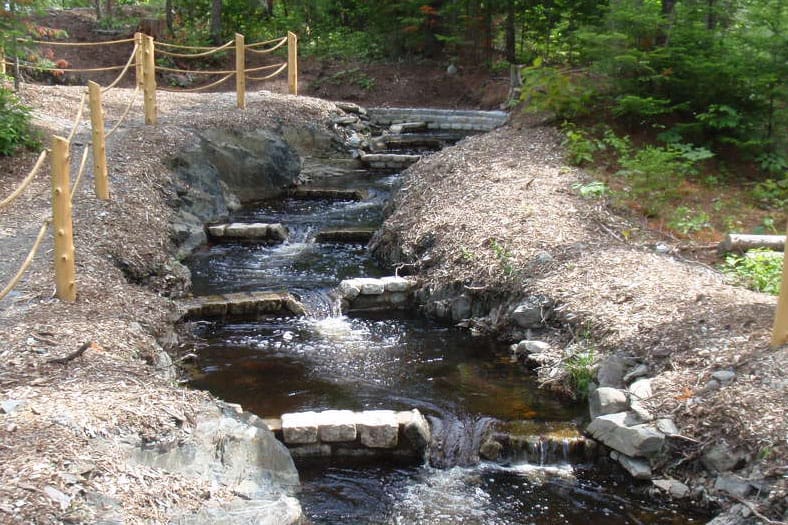
A series of weir dams on Blackman Stream, Maine. These are thick, rectangular weirs.

A series of compound, rectangular weir dams in Maine.

The problem was stated as follows: You’ve got a classic V weir on a dam, but it is not a knife-edge weir, nor is it rectangular or compound as in the picture at right. Instead it is nearly 90°, not very tall, and both the dam and weir have rounded leads. Because the weir is of non-standard shape, thick and rounded, you can not use the flow equation found in standard tables or on the internet. Instead, you decide to use a bucket and stopwatch to determine the flow during a relatively dry period. You measure 0.8 gal/sec when the water height is 3″ in the weir. During the rain-storm some days later, you measure that there are 12″ of water in the weir. Give a good estimate of the storm-flow based on the information you have.

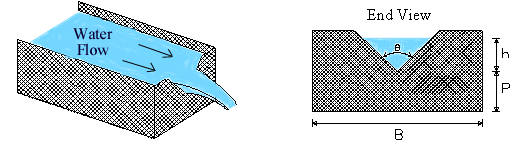
A V-notch weir, side view and end-on.

A V-notch weir, side view and end-on.

I also gave a hint, that the flow in a V weir is self-similar. That is, though you may not know what the pattern will be, you can expect it will be stretched the same for all heights.

The upshot of this hint is that, there is one, fairly constant flow coefficient, you just have to find it and the power dependence. First, notice that area of flow will increase with height squared. Now notice that the velocity will increase with the square root of hight, H because of an energy balance. Potential energy per unit volume is mgH, and kinetic energy per unit volume is 1/2 mv2 where m is the mass per unit volume and g is the gravitational constant. Flow in the weir is achieved by converting potential height energy into kinetic, velocity energy. From the power dependence, you can expect that the average v will be proportional to √H at all values of H.

Combining the two effects together, you can expect a power dependence of 2.5 (square root is a power of 0.5). Putting this another way, the storm height in the weir is four times the dry height, so the area of flow is 16 times what it was when you measured with the bucket. Also, since the average height is four times greater than before, you can expect that the average velocity will be twice what it was. Thus, we estimate that there was 32 times the flow during the storm than there was during the dry period; 32 x 0.8 = 25.6 gallons/sec., or 92,000 gal/hr, or 3.28 cfs.

The general equation I derive for flow over this, V-shaped weir is

Flow (gallons/sec) = Cv gal/hr x(feet)5/2.

where Cv = 3.28 cfs. This result is not much different to a standard one  in the tables — that for knife-edge, 90° weirs with large shoulders on either side and at least twice the weir height below the weir (P, in the diagram above). For this knife-edge weir, the Bureau of Reclamation Manual suggests Cv = 2.49 and a power value of 2.48. It is unlikely that you ever get this sort of knife-edge weir in a practical application. Be sure to measure Cv at low flow for any weir you build or find.

Robert Buxbaum, vote for me for water commissioner. Here are some thoughts on other problems with our drains.

More French engineering, the Blitzkrieg motorcycle.

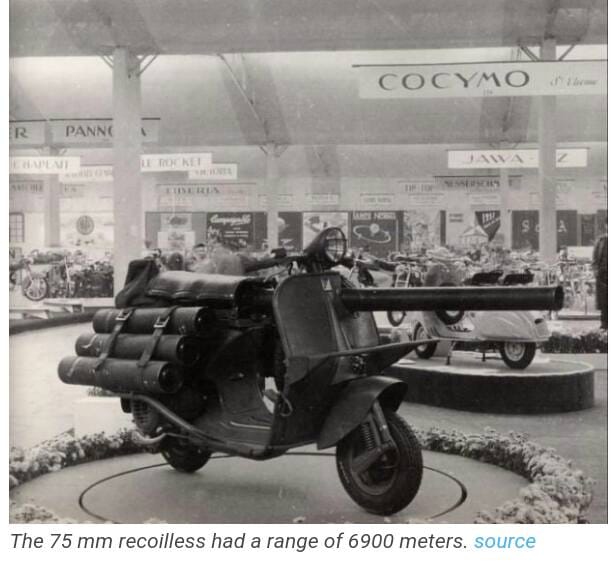
There’s something fascinating that I find in French engineering. I wrote a previous essay about French cars, bridges, and the Eiffel tower. Here’s a picture or two more. Things I wanted to include but didn’t. First here’s a Blitzkrieg Vespa motorcycle; the French built some 800 of these from 1947 to 1962 and used them in Vietnam and Algeria. What’s remarkable is how bizarrely light and unprotected it is. It’s a design aesthetic that follows no one, and that American engineers would not follow.

French Blitzkrieg Vespa used in Vietnam

French Blitzkrieg Vespa used in Vietnam; cannon range is 4.5 miles.

The key engineering insight that allows this vehicle to make sense is that recoil-less rifles are really recoil-less if you design them right. Thus, one can (in theory) mount them on something really light, like a Vespa. Another key (French) insight is that a larger vehicle may make the soldier more vulnerable rather than less by slowing him down and by requiring more gasoline and commissariat services.

Americans do understand the idea of light and mobile, but an American engineers idea of this is a jeep or an armored truck; not a Vespa. From my US engineering perspective, the French went way overboard here. The French copy no one, and no one copies the French, as they say. Still, these things must have worked reasonably well or they would not have made 800 of them over 15 years. A Vespa is certainly cheaper than a Jeep, and easier to transport to the battle zone….

Robert Buxbaum, February 18, 2016. The Italians have a somewhat similar design aesthetic to the French: they like light and cheap, but also like maneuverable and favor new technology. See my blog about a favorite Fiat engine.

Weird flow calculation

Here is a nice flow problem, suitable for those planning to take the professional engineers test. The problem concerns weir dams. These are dams with a notch in them, somethings rectangular, as below, but in this case a V-shaped notch. Weir dams with either sort of notch can be used to prevent flooding and improve the water, but they also provide a way to measure the flow of water during a flood. That’s the point of the problem below.

A series of weir dams on Blackman Stream, Maine. These are thick, rectangular weirs.

A series of weir dams with rectangular weirs in Maine.

You’ve got a classic V weir on a dam, but it is not a knife-edge weir, nor is it rectangular or compound as in the picture at right. Instead it is nearly 90°, not very tall, and both the dam and weir have rounded leads. Because the weir is of non-standard shape, thick and rounded, you can not use the flow equation found in standard tables or on the internet. Instead, you decide to use a bucket and stopwatch to determine that the flow during a relatively dry period. You measure 0.8 gal/sec when the water height is 3″ in the weir. During the rain-storm some days later, you measure that there are 12″ of water in the weir. The flow is too great for you to measure with a bucket and stopwatch, but you still want to know what the flow is. Give a good estimate of the flow based on the information you have.

As a hint, notice that the flow in the V weir is self-similar. That is, though you may not know what the pattern of flow will be, you can expect it will be stretched the same for all heights.

As to why anyone would use this type of weir: they are easier to build and maintain than the research-standard, knife edge; they look nicer, and they are sturdier. Here’s my essay in praise of the use of dams. How dams on drains and rivers could help oxygenate the water, and to help increase the retention time to provide for natural bio-remediation.

If you’ve missed the previous problem, here it is: If you have a U-shaped drain or river-bed, and you use a small dam or weir to double the water height, what is the effect on water speed and average retention time. Work it out yourself, or go here to see my solution.

Robert Buxbaum. May 20-Sept 20, 2016. I’m running for drain commissioner. send me your answers to this problem, or money for my campaign, and win a campaign button. Currently, as best I can tell, there are no calibrated weirs or other flow meters on any of the rivers in the county, or on any of the sewers. We need to know because every engineering decision is based on the flow. Another thought: I’d like to separate our combined sewers and daylight some of our hidden drains.

Advanced windmills + 20 years = field of junk

Everything wears out. This can be a comforting or a depressing thought, but it’s a truth. No old mistake, however egregious, lasts forever, and no bold advance avoids decay. At best, last year’s advance will pay for itself with interest, will wear out gracefully, and will be recalled fondly by aficionados after it’s replaced by something better. Water wheels, and early steamships are examples of this type of bold advance. Unfortunately, it is often the case that last years innovation turns out to be no advance at all: a technological dead end that never pays for itself, and becomes a dangerous, rotting eyesore or worse, a laughing-stock blot or a blot on the ecology. Our first two generations of advanced windmill farms seem to match this description; perhaps the next generation will be better, but here are some thoughts on lessons learned from the existing fields of rotting windmills.

The ancient design windmills of Don Quixote’s Spain (1300?) were boons. Farmers used them to grind grain or cut wood, and to to pump drinking water. Holland used similar early windmills to drain their land. So several American presidents came to believe advanced design windmills would be similar boons if used for continuous electric power generation. It didn’t work, and many of the problems could have been seen at the start. While the farmer didn’t care when his water was pumped, or when his wood is cut. When you’re generating electricity, there is a need to match the power demand exactly. Whenever the customer turns on the switch, electricity is expected to flow at the appropriate amount of Wattage; at other times any power generated is a waste or a nuisance. But electric generator-windmills do not produce power on demand, they produce power when the wind blows. The mismatch of wind and electric demand has bedeviled windmill reliability and economic return. It will likely continue to do so until we find a good way to store electric power cheaply. Until then windmills will not be able to produce electricity at competitive prices to compete with cheap coal and nuclear power.

There is also the problem of repair. The old windmills of Holland still turn a century later because they were relatively robust, and relatively easy to maintain. The modern windmills of the US stand much taller and move much faster. They are often hit, and damaged by lightning strikes, and their fast-turning gears tend to wear out fast, Once damaged, modern windmills are not readily fix, They are made of advanced fiberglass materials spun on special molds. Worse yet, they are constructed in mountainous, remote locations. Such blades can not be replaces by amateurs, and even the gears are not readily accessed to repair. More than half of the great power-windmills built in the last 35 years have worn out and are unlikely to ever get repair. Driving past, you see fields of them sitting idle; the ones still turning look like they will wear out soon. The companies that made and installed these behemoth are mostly out of the business, so there is no-one there to take them down even if there were an economic incentive to do so. Even where a company is found to fix the old windmills, no one would as there is not sufficient economic return — the electricity is worth less than the repair.

Komoa Wind Farm in Kona, Hawaii June 2010; Friends of Grand Ronde Valley.

Komoa Wind Farm in Kona, Hawaii, June 2010; A field of modern design wind-turbines already ruined by wear, wind, and lightning. — Friends of Grand Ronde Valley.

A single rusting windmill would be bad enough, but modern wind turbines were put up as wind farms with nominal power production targeted to match the output of small coal-fired generators. These wind farms require a lot of area,  covering many square miles along some of the most beautiful mountain ranges and ridges — places chosen because the wind was strong

Putting up these massive farms of windmills lead to a situation where the government had pay for construction of the project, and often where the government provided the land. This, generous spending gives the taxpayer the risk, and often a political gain — generally to a contributor. But there is very little political gain in paying for the repair or removal of the windmills. And since the electricity value is less than the repair cost, the owners (friends of the politician) generally leave the broken hulks to sit and rot. Politicians don’t like to pay to fix their past mistakes as it undermines their next boondoggle, suggesting it will someday rust apart without ever paying for itself.

So what can be done. I wish I could suggest less arrogance and political corruption, but I see no way to achieve that, as the poet wrote about Ozymandias (Ramses II) and his disastrous building projects, the leader inevitably believes: “I am Ozymandias, king of kings; look on my works ye mighty and despair.” So I’ll propose some other, less ambitious ideas. For one, smaller demonstration projects closer to the customer. First see if a single windmill pays for itself, and only then build a second. Also, electricity storage is absolutely key. I think it is worthwhile to store excess wind power as hydrogen (hydrogen storage is far cheaper than batteries), and the thermodynamics are not bad

Robert E. Buxbaum, January 3, 2016. These comments are not entirely altruistic. I own a company that makes hydrogen generators and hydrogen purifiers. If the government were to take my suggestions I would benefit.

The french engineering

There is something wonderful about French Engineering. It is good, but different from US or German engineering. The French don’t seem to copy others, and very few others seem to copy them. Nonetheless French engineering managed to build an atom bomb, is a core of the Airbus consortium, and both builds and runs the fastest passenger trains on earth, the TGF, record speed 357 mph on the line between Paris and Luxembourg.

JULY 14, 2015 Students of the Ecole Polytechnique (the most prestigious engineering school in France march in the Paris Bastille Day military parade. commemorating the storming of the Bastille in 1789.  (Photo by Thierry Chesnot/Getty Images).

JULY 14, 2015 Female engineering students of the Ecole Polytechnique, march in the Paris Bastille Day military parade. (Photo by Thierry Chesnot/Getty Images).

France was almost the only country to sell Israel weapons for the first 20 years of its existence, and as odd as the weapons they sold were, they worked. The Mirage jet was noted for short-range and maneuverability; in 1967, they handily defeated Egypt and Syria’s much larger force of Russian Migs. More recently, Argentina used French Exocet missiles to sink 3 British warships in the Argentine war, and last week, Turkey used a french missile to down a Su24, the new main Russian fighter-bomber. not bad for a country whose main engineering school marches in Napoleonic garb.

The classic of French Engineering, of course is the Eiffel Tower. It is generally unappreciated that this is not the only Eiffel structure designed this way. Eiffel designed railroad bridges, aqueducts. Here’s an Eiffel railroad bridge.

Eiffel railroad bridge, still in use

Eiffel railroad bridge, still in use. American, German, or British bridges of the era look nothing like this.

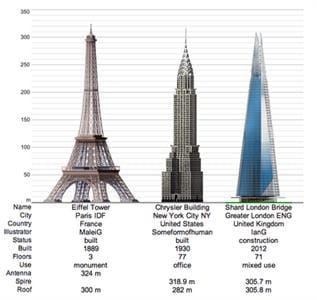
To get a sense of the engineering artistry of the Eifflel tower, consider that when the tower was built, in 1871, self-financed by Eiffel, it was more than twice as tall as the next-tallest building on earth. ff one weighed the air in a cylinder the height of the tower with a circle about its base, the air would weigh more than the steel of the tower. But here are some other random observations, while first level of the tower houses a restaurant, a normal American space-use choice,the second level housed, when the tower opened the print shop and offices of the International Herald Tribune; not a normal tenant. And, on the third level, near the very top, you will find Mr Eiffel’s apartment. The builder lived there; he owned the place. It’s still there today, but now there are now only mannequins in residence. It’s weird, but genius, like so much that is French engineering.

Eiffel's apartment atop the tower, now occupied by mannequins of Eiffel and Edison, a one-time guest.

Eiffel’s apartment atop the tower, now occupied by mannequins of Eiffel and Edison, a one-time guest.

Returning to the French airplane, The french were the first to make mono-planes. But having succeeded there, they made a decent-enough plane-like automobile, the 1932 Helicon car. It’s a three-man car with a propeller out front and rear-wheel steering. At first, you’d think this is a slow, unmanageable, deathtrap, like Buckminster Fuller’s Dymaxion,.  But you’d be wrong, the Helicon (apparently) is both speedy and safe it moves at 100 mph or more once it gets going, still passed French safety standards in 2000, and gets taken out for (semi-normal) jaunts. Don’t stand in front of the propeller (there’s a bicycle version too).

1932 Helicon; seats 3, rear staring, propeller-driven. Normal-ish. Photo by Yalon.

1932 Helicon car; 100 mph, seats 3, propeller-driven. Photo by Yalon.

The Helicon never quite took off, as it were, but an odd design motorcycle did quite well, at least in France, the Solex, front wheel motorcycle.Unlike US motorcycles, it’s just a bicycle with an engine above the front wheels. The engine runs “backwards” and drives the front wheel via a friction-cam. The only clutch action involves engaging the cam. Simple, elegant, and unlikely to be duplicated elsewhere.

A French Solex motorcycles, and an e-Solex. The e-Solex uses a battery.

A Solex motorcycle and an e-Solex, the battery-powered version. A Citroen and a Peugeot sport are in the background. Popular in France.

The reason I’m writing about French Engineering is perhaps because of the recent attacks. Or perhaps because of aesthetic. It’s important to have an engineering aesthetic — an idea you’re after — and to have pride in one’s craft too. The French stand out in how much they have of both. Some months ago I wrote about a more American engineering aesthetic, It’s a good article, but interestingly, I now note that some main examples I used were semi-French: the gunpowder factory of E. I. Dupont, the main productions facility of a Frenchman’s company in the US.

Robert Buxbaum, December 13, 2015. Some months ago, I wrote about a favorite car engine, finally being used on the Fiat 500 and Alfa Romeo. Fast, energy-efficient, light, maneuverable, and (I suspect) unreliable; the engine embodies a particularly Italian engineering aesthetic.