Category Archives: politics

Why did Hamilton wear his glasses at the duel?

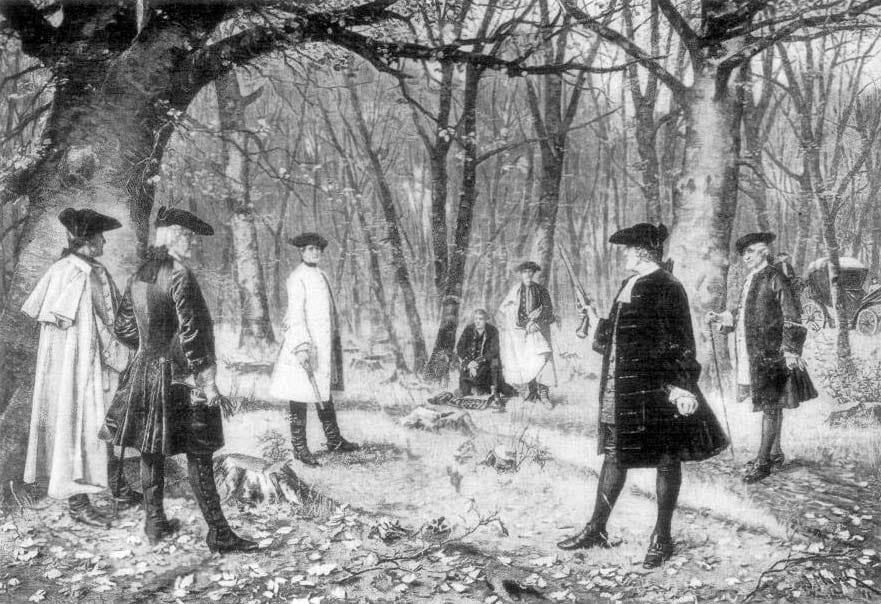
The musical play “Hamilton” ends with his duel with Burr. A song leading up to it, the world was wide enough tells the audience that Hamilton “wore his glasses” at the duel, and that he “methodically fiddled with the trigger.” It doesn’t say why, but tries to imply a sort of death-wish where Hamilton “threw away his shot” (fired into the air) because he didn’t want to kill his first friend, or because he thought of his son, who died near the spot. The theory is supported by popular myth, though the details of the events are, by necessity, muddy. All the witnesses testified that they looked away before the shooting started –customary in duels at the time.

There are some problems I find with this theory, and I’d like to present another: that Hamilton was so eager to kill Burr that he over-stacked the deck in his favor. The witnesses noted that Hamilton performed some provocative actions that seem out of character for someone who wants to commit suicide: “As they were taking their places, he (Hamilton) asked that the proceedings stop, adjusted his spectacles, and slowly, repeatedly, sighted along his pistol to test his aim”[1]. This seems like a taunt, if anything. As I reading the letters too, I find Hamilton taunting Burr to duel. He could have bowed out in many ways, as Washington always had, or been neutral. Why taunt? Why wear glasses and fiddle with the trigger? Why test your aim and then throw away your shot?

The choice of guns is important too, along with where the shot actually went. First the shot: While Hamilton’s second originally thought Hamilton had shot in the air, when the seconds went back the next day they found the shot in a cedar limb, “at an elevation of about twelve feet and a half, perpendicularly from the ground, between thirteen and fourteen feet from the mark on which General Hamilton stood, and about four feet wide of the direct line between him and Col. Burr, on the right side”.[2] The men stood 10 paces apart (16-18 feet), so apparently the shot hit about 6 feet above Burr’s head on a line reasonably towards him. That’s not quite shooting in the air.

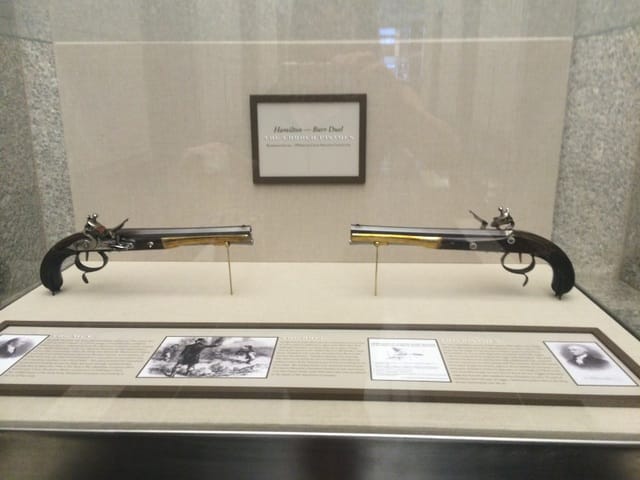
The pair of Wogdon dueling pistols used in the Hamilton - Burr duel.

The Wogdon pistols used in the Hamilton – Burr duel. Currently the property of the JP Morgan Chase Manhattan Bank, in 1976 they were found to have a hidden hair trigger, something Hamilton knew, but Burr would not have known.

The choice of pistols is also suggestive. The pistols were the property of John Church, a brother-in-law to Hamilton, and a business partner of both men. Church had fought a duel with Burr some years before and, using Burr’s pistols, shot a button off Burr’s coat. Burr missed completely. Church then bought these new pistols in London — Wogdon pistols, with an extra-large bore and sights. Sights were not considered “sporting” for duels, and not ordinarily allowed. With sights on the pistols, one could not miss if one aimed. As for the bigger bore, this too was unusual. If you hit, you killed; most gentlemen preferred a less-deadly duel. Hamilton chose to use these pistols even though he owned two, “legal” pistols (smaller bore, no sight). As the challenged party, it was his right. Still, why not choose your own, if not to make use of the sight and the large-bore. And, according to his second, he seems to have practiced with the pistols beforehand [4].

Analysis of the guns, done in the late 1970s [3] turned up another illegal feature. While they appear to be normal dueling pistols, these guns have a hidden feature. If you move the trigger a fraction of an inch forward it sets a hidden, hair-trigger. It’s a hidden feature that Hamilton knew about [3] but Burr almost certainly did not. If Hamilton surreptitiously set the hair-trigger, it would give him a tremendous advantage. He would be able to shoot more quickly and more accurately, with a much lighter squeeze on the trigger. The sights ensured it would be a kill. Burr’s gun, unset, would have required the normal, heavy, 10-15 pound pull. His shot would have been slower and less accurate. As it was, it seems Burr fired second.

Ten paces is not very far apart. People missed because of the 10-20 lb pull and lack of sights made it hard to hit. Besides, many people who were hit survived.

Ten paces is not very far apart. People missed because of the 10-20 lb pull and the lack of sights made it hard to hit anyone. Besides, with a small bore, you didn’t kill.

There are a couple of problems with using hair-trigger pistols, though. They can go off prematurely, even if you know the trigger’s been set [4], and it’s worse if you are not quite sure you’ve set the trigger. The Wogdon guns intentionally made it hard to tell if you have set the trigger or not, and made it impossible to unset the trigger without firing. I suspect that Hamilton cleaned his glasses, fiddled with the trigger, and sighted his aim because he was unsure whether he’d set the hair-trigger. My theory is he came to the wrong conclusion. According to the seconds, Burr’s shot was almost simultaneous, but his apparently achieved a lucky/ un-lucky hit. Burr killed his rival, but also killed his own political career, the unhappy end to a beautiful animosity, discussed in the play, and discussed by me from a different angle. [5]

References:

1. Testimony at trial, Centinel of Freedom, November 24, 1807, cited in Winfield, 1874, p. 220.

2.  Nathanial Pendelton’s Amended testimony of Nathaniel Pendleton and William P. Ness’s Statement of July 11, 1804. Amended after the pair revisited the site and found the bullet.

3. “Pistols shed light on famed duel”, Merrill Lindsay, Smithsonian Magazine. 1976.

4. ibid. Hamilton told his second not to set the hair-trigger, and then seems to have set his own. Linsay’s theory is that Hamilton knew he’d set the trigger, but squeezed it too early.

5. Since the witnesses looked away, you might think of another explanation: that Burr fired first and Hamilton’s gun then went off in death throw, in the general direction of Burr. A couple of problems with this theory: for the gun to go off like that, Hamilton would have had to set the hair-trigger. The ordinary 10-15 lb trigger would require a determined squeeze. Also, for the bullet to hit the tree like that, Hamilton would have had to raise his gun past Burr, though not to the side or down as one might if he wished to throw away his shot. And Burr would have to have set the trigger himself to shoot so fast and so well. Randall’s book, “Alexander Hamilton, a life”, claims he did, p. 424, but looking at this video of the hair-trigger mechanism, I find the mechanism is too cleverly hidden for Burr to have noticed. It escaped detection for 170 years. Finally, for Burr to shoot to kill without provocation, would require that he murder in cold blood, and Burr shows no evidence of that. Besides, Burr would have had to worry that the witnesses might turn around and see his dastardly deed. As it was, even with Hamilton’s gun going off, Burr’s reputation was ruined. I reject this theory, and assert as others have: “Hamilton did fire his weapon intentionally, and he fired first.”

Robert E. Buxbaum, May 10, 2017. You may like these other songs from Hamilton, “your obedient servant,” and “the ten duel commandments.” And you may like this essay about Burr, Tammany Hall and the Manhattan bank.

May 1, St. Tammany day

May 1 is St. Tammany day, a day to rejoice in the achievements of Tammany Hall, and of St Tammany, the guardian of crooked politicians everywhere. The Sons of St. Tammany started in 1773 as a charitable club of notable revolutionary-era individuals including Benjamin Franklin, John Hancock, and John Dickenson, but evolved into perhaps the most corrupt, and American, of political organizations. The picture of a US politician – the cartoon version at least — is the Tammany Democrat: a loud, drunken, womanizer, willing to do or promise whatever the people seem to want at the moment. Tammany and its bosses helped form this image. They helped new immigrants, but did so by creating needless government jobs, by filling them often with incompetent loyalists, and by overcharging on government contracts. Today, these Tammany ways rule in every major American city; the other clubs of the day are gone or influence-less.

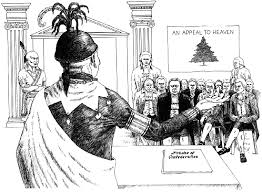
John Hancock leads a meeting of the St. Tammany (Columbian) society. Note the "Appeal to Heaven flag and the Indian, real or imagined. Indians participated in several, early St. Tammany meetings.

John Hancock leads a meeting of the St. Tammany society. Note the “Appeal to Heaven” flag. While Indians participated in some, early meetings, the one here is, I suspect, a ghost: St. Tammany.

In revolutionary-era America, the Sons of St. Tammany was just one of many social-charitable clubs (Americans like to form clubs), in many ways it was similar to the Masons and the Cincinnati, but those clubs were international and elitist. The sons of Tammany was purely American, and anti-elitist. It was open to anyone born on this side of the Atlantic, and had Indian customs. The Cincinnati society, for comparison, started with members who were as notable (Alexander Hamilton, George Washington, Marie, Marquis de Lafayette, Henry Knox, etc.) but was originally open only to high officers of the regular army, including foreigners like Lafayette, but not ordinary soldiers, minutemen (militia), or the general public. The symbols of the Tammanies were American: the liberty-cap and the “Appeal to Heaven” flag, now a popular symbol of the Tea Party; the leader was called by an Indian name: Sachem. By contrast, the Cincinnati society symbol was the Imperial Eagle (Washington’s was gold with diamonds), and the leader was called “general”. The Tammany society began admitting immigrants in 1810 or so, while the Cincinnati society remains closed to this day, except to descendants of Revolutionary officers — an aristocratic affectation in the eyes of some.

It was Aaron Burr who first saw the opportunity to use the Tammany organization as a for-profit, political machine. In the years 1795-9, New York was suffering from yellow fever and a variety of other diseases that were taken to be caused by a lack of clean water. Burr proposed, with Tammany support, the creation of a corporation to build a new water system to bring fresh, clean water from the Bronx River to lower Manhattan via iron pipes. The Manhattan company was duly chartered, with directors who were primarily Tammany men, Republican-Democrats, and not Federalists. Federalists (Hamilton, primarily) controlled the only NY banks at the time and controlled the directorate of every chartered company in the city. The Manhattan company requested a $2,000,000 perpetual charter, twice as big as the charter of Hamilton’s Bank of New York, and a monopoly on water distribution. These were reasonable requests given the task, but unusual in the lack of Federalist or governmental oversight. But the Manhattan company was a water company, and water was needed. But Burr’s intent, all along, it seems was to build a bank, not a water company. After the charter was approved, but before signing, he amended it to allow any excess funds to be used for any legal purpose. 

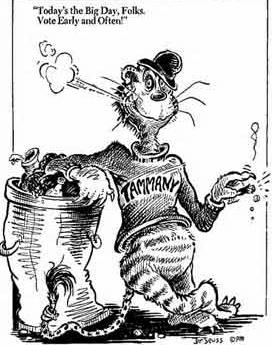
In this cartoon by Dr. Seuss, The Tammany Tiger says, "Today is the Big Day Folks. Vote Early and Often."

In this cartoon by Dr. Seuss, The Tammany Tiger says, “Today is the Big Day Folks. Vote Early and Often.”

Money was raised, but only $100,000 used for the water system. The remaining 95% of the charter funds, $1,900,000, went to found “The Bank of The Manhattan company” — later to be known as “The Chase Manhattan Bank” or “The Manhattan Bank of Cholera.” Instead of building the reservoir in upper Manhattan and filling it with clean water as originally proposed, Burr’s Tammany trustees voted to dig wells in lower Manhattan, and placed its reservoir in lower Manhattan too, near Chamber’s St,  next to a cemetery where Cholera victims were buried. New York suffered with Cholera, Typhoid, and leaky, wooden pipes until 1842 when Peter Cooper brought clean water to lower Manhattan from the Groton River via iron pipes. To this day, crooked water contracts are a staple of Tammany politics

The Bank of the Manhattan company opened at 40 Wall St on September 1, 1799, a mere four months after the water company’s incorporation. Hamilton was furious. The company continues today as The JP Morgan, Chase Manhattan Bank, one of the largest banking institutions in the world. Burr used the money and power of his company to reward supporters and to run for vice president with Thomas Jefferson’s tacit support. Except for his Tammany candidacy, John Adams would have won New York and a second term as president. Burr’s career pretty-well died after the Hamilton duel, but Tammany did well without him. By 1812, the Society built its first Tammany Hall, officially called the Wigwam, a $55,000, five-story building with a meeting hall for 2000. New York Democratic politics would center on Tammany Hall for the next century at least.

Following disappointment with John Quincy Adams, “the bitter branch of the bitter tree,” Tammy leaders went national. They recruited Andrew Jackson, a war hero and early recruit of Burr’s. They’d support Jackson if he’d hand over spoils, control of government jobs. He agreed and, as president, fired perfectly good, long-standing government employees He replaced them with Democratic loyalists. When Jackson stepped down in 1833, Tammany elected an equally corrupt New Yorker, Martin van Buren. Though there were periodic Whig and Republican reforms, Tammany learned they could wait those out. They always re-emerged like mushrooms after a rain.

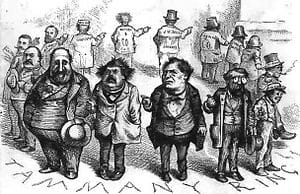
Boss Tweed and other Tammany leaders: who stole the money?

Boss Tweed and other Tammany leaders in a cartoon by Nast, Tammany Ring. “Who stole the money? He did.”  

A key vote-getter in the Tammany system is to provide Thanksgiving dinners and other charitable giveaways for the poor, as well as promises of jobs. By the late 1800s, William J. Brian added promises of soft money and wealth redistribution, cornerstones of the Democratic platform to this day. Tammany also tends to be for low tariffs as opposed to the high tariff ideas of Hamilton and many Whigs and 19th century Republicans. A case can be made for either view.

Tammany helped New York immigrants, particularly the Irish to get citizenship and avoid legal troubles in return for votes and occasional muscle. In other cities, Democratic clubs were less open to Catholics, reflecting the views of the common voter in each state. In the North they were pro-union, in the South anti, electing Klu Kluxers like George Wallace, Sam Ervin, and Robert Byrd. This lead to a famous split in the Democratic party about the 1968 convention. Famous Tammany leaders include William M. “Boss” Tweed, “Big” Tim Sullivan, and “Gentleman” Jimmy Walker. Sullivan famously authored the first anti-gun law, the Sullivan act; it was designed to protect his thugs against private citizens shooting them. It didn’t always work.

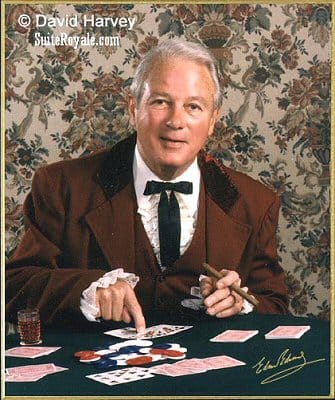
Edwin Edwards, Democratic Governor of Louisiana. 1972-1996. Who would not trust this man?

Hon. (?) Edwin Edwards, Governor of Louisiana. 1972-1996. Tammany lives

If you want to see Tammany politics in action, visit almost any large US city, or read its newspaper. In Chicago, the dead vote, and 4 of the last 6 governors have gone to jail. Mayor Daily famously told Kennedy that 90 percent of the registered voters of Cook County would vote for him. They did (sort of); because of this, JFK won Illinois and the presidency. In New York, voters discovered only in the 1960s that Tammany’s leader, Carmine DeSapio had been working for 30 years with known gangland murderer, Charles “Lucky” Luciano. In Detroit, where I live and corruption in the water department is legendary. Race-based job handouts, unemployment is high along with high minimum (living) wages. We’re now in the process of a $70,000,000 project to replace 100 feet of sewer pipe, and we’re building a $140 million, 3.3 mile trolley. Tammany loves all public works.

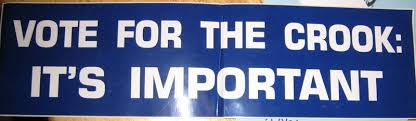
Then there is Louisiana, home to St Tammany parish. Louisiana Democrats like Huey Long and Edwin Edwards (shown at left) are unusual in that they’re proud to say that their corrupt methods are corrupt. Edwards has had two long runs as governor despite several convictions for doing illegal things he admits to doing. When Edwards was asked why he did favors for his friends. He responded: “Who should I do them for? My enemies?” Or, to quote one of Edwin Edwards campaign ads. Vote Edwin EdwardsPeople seem to love it, or did until the levy broke. There is a particularly American grandeur to all this. As Will Rodgers said, “America has the best politicians money can buy.” Today is the day to be proud of that uniquely American tradition. You too can grow up to buy a president.

Robert Buxbaum, April 28, 2017. I ran for water commissioner, and have written about sewage treatment, flood avoidance, and fluoride, as well as the plusses and minuses of trade unionization, and the difference between Republicans and Conservatives.

Taxes and accounting jokes

A friend called the other day asking about a financial matter. It seems his wife bought some pictures for  pictures a few days ago for $2000, and after having them apprised, she finds they’re worth $2,000,000.

I started talking about un-realized profits, and mentioned that I never imagined that his wife had such an eye for art. He said, they’re not art pictures, exactly; they’re of you discussing business with the Russians. (It’s a joke — I thought you-all might depreciate it).

—————

When I started my business, I found that you could deduct medical costs. I called the IRS and asked if I could deduct birth control. They told me: “only if it doesn’t work.”

—————

I’m glad I learned about parallelograms in school, instead something mundane, like taxes. It’s really come in handy this parallelogram season.

—————–

I got a robo-call asking me to press “1” to hear about a government program for those who wanted to avoid paying back taxes. I did, and a voice said “Leavenworth.”   It wasn’t much of a program, more of a sentence.

—————-

Robert E. Buxbaum, April 5, 2017.  For jokes on other topics, click the jokes tag, here.

Global warming and the president’s Resolute desk

In the summer of 2016, the Crystal Serenity, a cruse ship passed through the Northwest passage, going from the Pacific to the Atlantic above the Canadian arctic circle. It was a first for a cruise ship, but the first time any modern ship made the passage, it was 162 years ago, and the ship was wooden and unmanned. It was the British Resolute; wood from that ship was used to make the President’s main desk — one used by the last four presidents. And thereby hangs a tale of good global warming, IMHO.

President Trump meets with college presidents at the Resolute desk. Originally the front had portraits of Queen Victoria and President Hayes. Those are gone; the eagle on the front is an addition, as is the bottom stand.

President Trump meets with college presidents at the Resolute desk. Originally the front had portraits of Queen Victoria and President Hayes. Those are gone; the eagle on the front is an addition, as is the bottom stand. The desk is now 2″ taller than originally. 

The world today is warmer than it was in 1900. But, what is not generally appreciated is that, in 1900 the world was warmer than In 1800; that in 1800 it was warmer than in 1700; and that, in 1640, it was so cold there were regular fairs on the frozen river Themes. By the 1840s there were enough reports of global warming that folks in England thought the northwest passage might have opened at last. In 1845 the British sent two ships, the Erebus and the Terror into the Canadian Arctic looking for the passage. They didn’t make it. They and their crews were lost and not seen again until 2014. In hopes of finding them though, the US and Britain sent other ships, including the Resolute under the command of captain Edward Belcher.

The Resolute was specially made to withstand the pressure of ice. Like the previous ships, and the modern cruise ship, it entered the passage from the Pacific during the peak summer thaw. Like the ships before, the Resolute and a partner ship got stuck in the ice — ice that was not quite stationary, but nearly so, The ships continued to move with the ice, but at an unbearably slow pace. After a year and a half captain Belcher had moved a few hundred miles, but had had enough. He abandoned his ships and walked out of Canada to face courts martial in England (English captains were supposed to “go down with the ship”). Belcher was acquitted; the ice continued to move, and the ships moved with it. One ship sank, but the Resolute, apparently unscathed, passed through to the Atlantic. Without captain or crew, she was the first ship in recorded history to make the passage, something that would not happen again till the Nautilus nuclear submarine did it under the ice, 100 years later.


The ghost ship Resolute was found in September 1855, five years after she set sail, by captain Buddington of the American whaler, George Henry. She was floating, unmanned, 1200 miles from where captain Belcher had left her. And according to the law of the sea, she belonged to Buddington and his crew to use as they saw fit. But the US was inching to war with Britain, an outgrowth of the Crimean war and seized Russo-American property. Franklin Pierce thought it would help to return the ship as a sign of friendship — to break the ice, as it were. A proposal for funds was presented to congress and passed; the ship was bought, towed to the Brooklyn Navy yard for refitting, and returned to Britain as a gift. The gift may have worked: war with Britain was averted, and the seized property was returned. Then again, Britain went on to supply the confederacy early in the Civil War. None-the-less, it was a notable ship, and a notable gift, and when it was broken up, Parliament decided to have two “friendship desks” made of its timbers. One desk was presented to President Hayes, the other to Queen Victoria. One of these desks sits the British Naval museum at Portsmouth; its American cousin serves Donald Trump in the Oval office as it has served many president before him. It has been used by Coolidge, Kennedy, Carter, Reagan, Clinton, Bush II, and Obama before him — a reminder that global warming can be good, in both senses. If you are interested in the other presidents’ desks, I wrote a review of them here.

As for the reason for the global warming of the mid 1800s, It seems that climate is chaotic. ON a related note, I have proposed that we make a more-permanent northwest passage by cutting thorough one of the islands in northern Canada. If you want to travel the Northwest passage in 2017, there is another cruise scheduled, but passage is sold out.

Robert Buxbaum, March 16, 2017.

Arrested for decriminalized possession

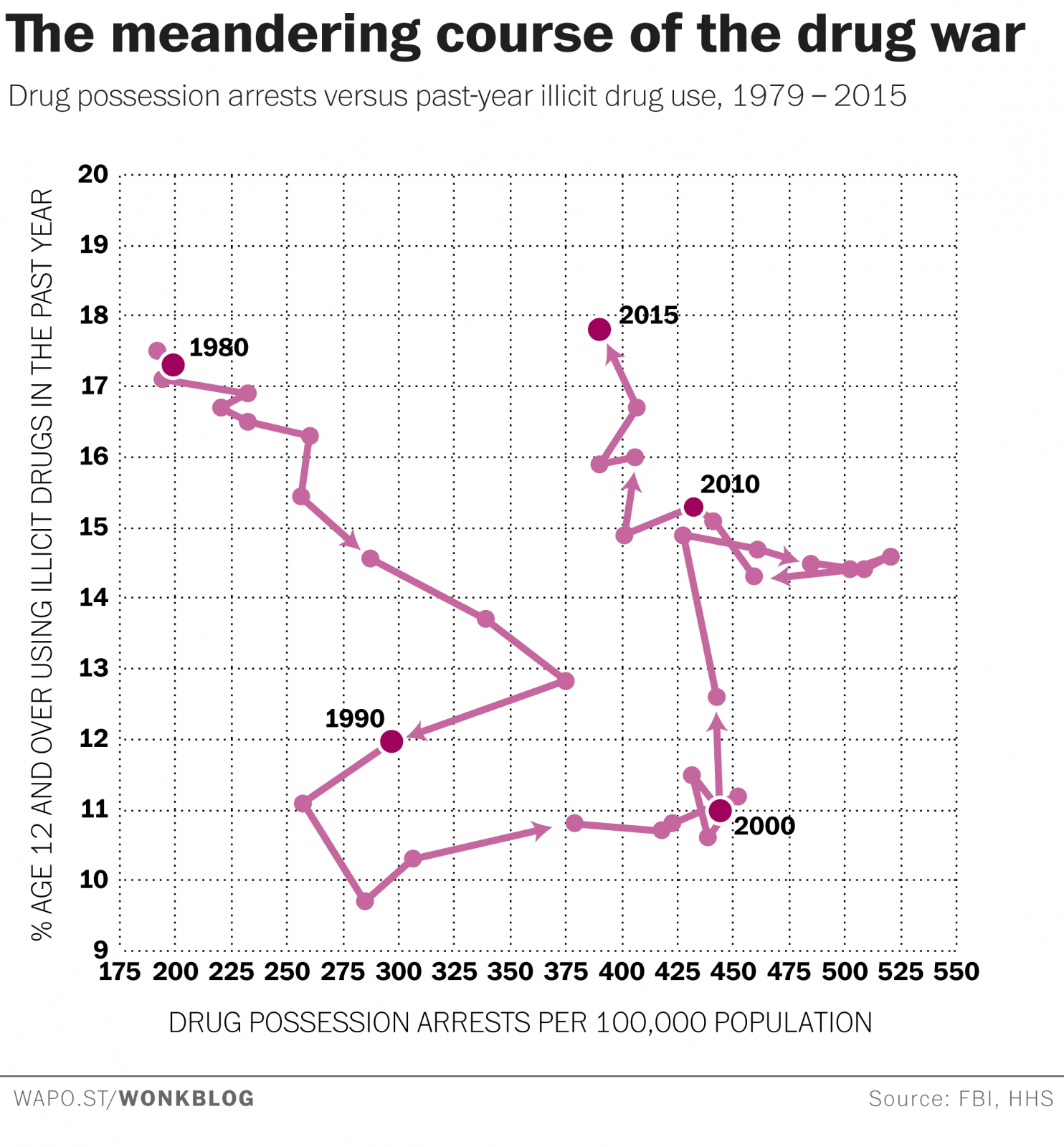
The arrest rate for marijuana is hardly down despite widespread decriminalization, but use is up. decriminalization, but use is up. A rate that exceeds that for all violent crime.

Despite years of marijuana decriminalization, arrest rates for marijuana are up from 20-25 years ago, and hardly down from last year. Why?

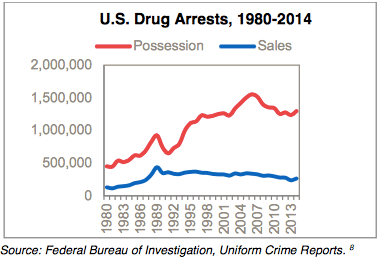
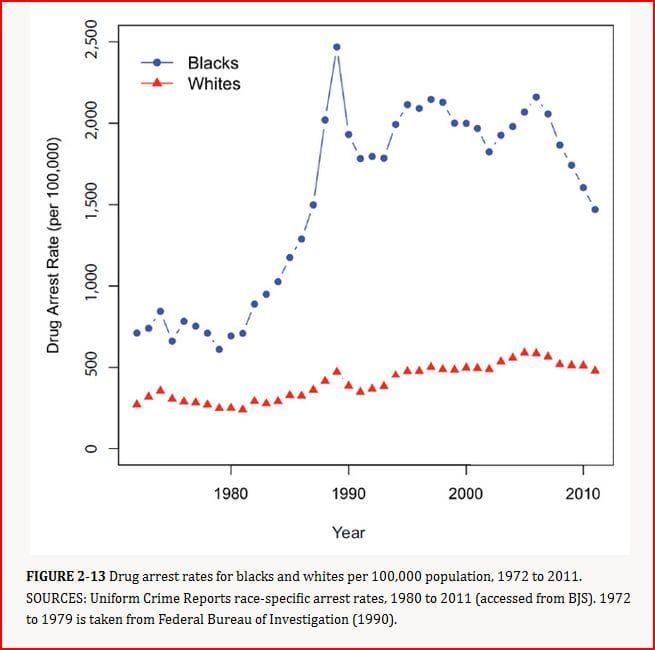
There are a couple of troubling patterns in US drug arrests. For one, though marijuana has been decriminalized in much of the USA, marijuana arrest rates are hardly down from five years ago, and higher than 20-30 years ago — see graph at right. Besides that, it’s still mostly black-people and Latinos arrested. And the crime is, 4/5 the of the time, drug possession, not sale.

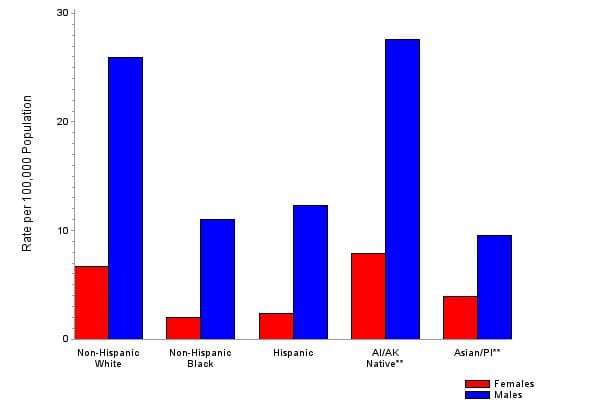
At the same time that violent crime rates are falling, marijuana possession arrests are rising (see graph below). Currently, according to FBI statistics,  more people are arrested for marijuana possession than for all violent crime combined. You’d expect it would not be this way, and a question I’d like to explore is why. But first, let’s look at more data. I note that part of an explanation is that marijuana use is up (18% in 2015 vs 12% in 1990). This still doesn’t explain the racial imbalance but it could explain the general rise. Marijuana isn’t quite legal, and if use is up, you’d expect arrests to be up. But even here, something is fishy: use rates are the same as in 1980, 35+ years ago in the midst of the “war on drugs,” but arrest rates have more than doubled since. Why? Take New York City as an example, 17,762 people were arrested for low-level marijuana possession in 2016 (smoking in public or possession of 25 gm to 2 oz). The low-level arrest rate is twice the national average in this Democratic-bastion city, where the drug was decriminalized years ago. Arrest rates in NYC went up an additional 10% in 2016, with black people arrested at 11 times the rate of white people. How could this be?

The race discrepancy of arrests persists across the US. Though black citizens use drugs only 15% or so more often than whites, and make up only 13% of the US population, they are arrested for drugs about three times as often and incarcerated about 4 times as often. It’s mostly for marijuana possession too, and the discrepancy varies very strongly by location In Louisiana, Illinois, and New York City arrests are particularly weighted to people of color. When New York City police precinct captains were asked about this, they explained that their instructions come from above. It’s a curious answer, I’d say, reflecting perhaps their dislike of the mayor.

Drug arrests are mostly for possession, not sale, and the spread is rising.

Drug arrests are mostly for possession, not sale and the spread is rising. More than half the time, it’s marijuana.

One of the race-affecting instructions is that the police are instructed to patrol black neighborhoods, but not the student unions of majority-white colleges like NYU. They’re mandated to stop and search junky cars but not nice ones, and to search people who have outstanding parking tickets, but not generally. They even get raises that depend on the number of tickets given, a practice that does not lead to a pattern of looking the other way — one many New Yorkers would prefer. Another issue: in many states, including New York, the police can keep money or cars, if they can claim that the asset was purchased with drug money or used in the drug trade. This leads to a practice where the city budget benefits when the police arrest persons they don’t expect will be convicted. It’s a practice called civil asset forfeiture, one lampooned, on Last Week Tonight, but jealously guarded. Since it is near impossible to prove that the money or car was not used in any way illegally, once they arrest someone, the police can expect to keep his or her money or cars indefinitely. The annoyance of lawyers perhaps encourages the arrest of people who do not seem to have them — people of color. New York mayor deBlassio justifies his arrests as a way to protect the neighborhoods, as his version of former mayor, Guilliani’s broken window approach. Maybe. But I think the profit motive is at least as relevant.

drug arrests hit black folks a lot more than white

Drug arrests hit black folks a lot more than white.

I note that strict justice tends to land hardest on the poor and defenseless. I also note that many important people have used marijuana without it damaging their lives in any obvious way. Both Jeb! Bush and Bill Clinton claimed to have smoked it; as did Barak Obama, Al Gore, and the Beatles. My bottom line: while marijuana decriminalization is worthwhile, it must go along with the repeal of civil asset forfeiture laws, and other means that make arrests into profit centers – or so it appears to me. Otherwise we’ll keep on flushing lives down the drain for no good reason.

Robert Buxbaum, March 6, 2017. I’ve previously blogged about the structure of criminal sentencing, coming to conclude that the least strict sentence that does the job is to be preferred. I also ran for water commissioner in 2016.

bicycle helmets kill

There is rarely a silver lining that does not come with a cloud, and often the cloud is bigger than the lining. A fine example is bicycle helmets. They provide such an obvious good that, at first glance, you’d think everyone would wear one, even without a law mandating it. Why would anyone risk their skull in a bicycle accident if injury were prevented by merely wearing a particular hat? Yet half the people ride without, even when there are laws and fines. There are some down-side to helmets, but they are so small that even mentioning them seems small. Helmets are inconvenient, and this causes people to ride a little less, so what?

hospital admissions for bicycle related head injuries, red, left; and bicycle related, non-head injuries, blue, right. Victoria Australia.

Hospital admissions for bicycle-related, head injuries, red, left scale, and bicycle-related, non-head injuries, blue, right scale. The ratio is 1:2 before and after the helmet law suggesting that helmet law did nothing but reduce ridership.

As to turns out, helmets hardly stop accidental injury, yet cause people to ride a lot less, and this lack of exercise causes all sorts of problems — far more than the benefits. In virtually every city where it was studied, bicycle ridership dropped by 30-40% when helmets were required, and as often as not, those who still rode, rode unhelmeted. There was a 30-40% decrease in head-trauma injuries, but it appears that this was just the result of 30-40% less ridership. You’d expect a larger decrease if the helmet helped, as such.

Take the experience of Victoria, Australia; head and non-head bicycle injury data plotted above. Victoria required bicycle helmets in January 1990. Before then, in the peak summer months, hospital records show some 50 bicycle-related head injuries per month, and 100 bicycle-related, non-head injuries — a 1:2 proportion. Later, after the law went into effect, each summer month saw about 35 bicycle-related, head injuries, and 70 bicycle-related, non head injuries. This proportion, 1:2, remained the same suggesting the only effect of the helmet law was to reduce ridership, with no increase in safety. The same 30% decrease was seen by direct count of riders on major streets, though now a greater proportion of those still riding were flaunting the law, and not wearing helmets.

One reason that helmets don’t help much is that the skull is already a very good helmet. As things stand, the main injury in a bicycle flip does not come from your skull cracking, it comes from your brain hitting the inside of your skull, and a second helmet doesn’t help stop that. There’s no increase in safety, and perhaps a decrease as the helmet appears to decrease vision. In a study of bicycle-injury-related highway deaths, Piet de Jong found that countries with the highest helmet use had the highest highway death rates. The country with the highest helmet use (the USA, 38% helmeted) had the highest cyclist death rate, 44 deaths per 1,000,000,000 km. By comparison, the nation with the least helmet use (Holland, 1% helmeted) had among the lowest death rates, only 10.7 deaths per 1,000,000,000 km. There are many explanations for this finding, one sense is that the helmets hurt vision making all types of injury and death more likely.

An hour or three of exercise per week adds years to your life -- especially among the middle aged.

From the national cancer institute. An hour or three of exercise per week adds years to your life — especially among the middle aged. Note these are healthy weight individuals. 

Worse than the effect on visibility, may be the effect on exercise. Exercise is tremendously beneficial, especially for middle-aged people in a sedentary population like the US. The lack of exercise is a lot more deadly, it turns out, than any likelihood of flying over the handlebars. How do I know? From studies like the National Cancer institute, shown at right. To calculate the cost/benefit of a little riding, less say you ride 3 hours per week at 10 mph (slow roll). The chart at right suggests a middle-aged person will add 3.4 years to your life, or about 10% life extension. Now consider the risks. This person will ride 30 miles per week, or 2400 km per year. Over 35 years the chance of death is only 0.36%. In order to get a 10% chance of death, you’d have to ride, over 2.3 million km, or 1000 years. Clearly the life extension benefit far outweighs the risk from fatal accident.

But life extension isn’t the total benefit of exercise. Exercise is shown to improve metal health, reducing depression and ADD in children, and likely in adults. Exercise also helps with weight loss, and that is another big health benefit (the chart above was for healthy body weight riders). So my first suggestion is get rid of bicycle helmet laws. I would not go so far as to ban helmets, but see clear disadvantages to the current laws.

The other suggestion: invent a better helmet. While most helmets are vented, and reasonably cool while you ride. They become uncomfortably hot when you stop. And they look funny in a store or restaurant. You can’t easily take them off, either: Restaurants no longer have hat racks, and stores never had them. What’s needed is a lighter, cooler helmet. Without that, and with helmet laws in place, people in the US tend to drive rather than ride a bicycle — and the lack of exercise is killing them.

Robert Buxbaum, January 19, 2017. One of my favorite writing subjects is the counter-intuitiveness of health science. See, eg. on radiation, or e-cigarettes, or sunshine, or health food. Here is a general overview of how to do science; I picked all the quotes from Sherlock Holmes.

A thought on what Cornwallis should have done 240 years ago

Build a wall.

As we’ve seen, Cornwallis’s actual plan January 1777 failed badly. Clearly, it was a bad mistake attacking Washington at Trenton. I’d asked what he should have done, and note that the British high command answer was that Cornwallis should have withdrawn from Trenton and hoped that Washington would have entered and allowed Cornwallis to trap him in the city. I don’t like this solution as it depends on Washington doing something very stupid.

After thinking a bit, I think Cornwallis should have left a detail of British soldiers, perhaps 2000-3000 and should have built a berm wall (an earthen wall) about the town. Cornwallis should have distributed guns to the Tory inhabitants, or encouraged the inhabitants to form a militia. Washington could still have shot in, but with far less precision than before. And he would now find he’s killing Americans. A likely result would have been the Trentonians shooting back at Washington’s men from Trenton’s rooftops. The combination of civil war and weather would have defeated Washington, or at least drawn him off. This is how we dealt with hostile Indians in the 1800s, and I suspect it could have worked here too.

Robert Buxbaum, December 27, 2016. Here, by the way is some odd Christmas music, and two odd Chanukkah songs. The strong defeated by the weak, the many by the few. In those days, at this time of year.

Cornwallis attacks. Washington goes to Princeton.

In the previous post, I asked what you would do as a general (Cornwallis), December 27, 1776. You command 30,000 troops, some 12,000 at Princeton of at total 50,000 against Washington’s 3500. Washington is camped 12 miles to the south just outside of Trenton with a majority of his men scheduled to leave in three days when their enlistments expire.

In fact, what Cornwallis did, is what every commenter recommended. He attacked at Trenton, and lost New Jersey. Cornwallis left 2-3000 troops at Princeton and marched south. Despite fallen trees, swollen rivers, destroyed bridges — all courtesy of Washington’s men –Cornwallis reached Trenton and attacked. By the time he got there, 2000 of Washington’s men had left, partially replaced by untrained militia. After a skirmish, Washington set up 400 militia to keep the fires burning, and without telling them where he was going “Fall back if the British attack”, he took the rest of his forces east, across frozen fields and swampland, then north to Princeton along the Quaker-bridge road. He later said the reason was to avoid looking like a retreat.

He split his forces just outside of Princeton, and a detachment, led by Hugh Mercer and 350  regulars had the first battle as they ran into the 17th and 55th British regiments as they prepared to escort supplies to Trenton. The British commander, Lt.colonel Mawhood, seeing how few men he faced, sent the 55th and most of the supplies back to Princeton, and led his men to shoot at the Americans from behind a fence. Mercer’s men fired back with rifles and cannon, doing little. Then, the trained British did what their training demanded: they rose up and charged the rebels with fixed bayonets. Mercer, having no bayonets, called “Retreat!” before being stabbed repeatedly, see painting. Mawhood’s men seized the cannon, turned it on the fleeing remnants of Mercer’s men.

General Mercer defeated at Princeton, as Washington shows up.

General Mercer defeated at Princeton, as Washington shows up.

It looked like a British victory, but then General Nathaniel Greene (the fighting Quaker) showed up with several hundred Pennsylvania militiamen. The militiamen had never seen battle, and many fled, after shooting into the British lines with rifles and another cannon and grape-shot. At this point it looked like a draw, but then, Washington himself joined the battle with two brigades of regulars: Hitchcock’s 253 New Englanders and Hand’s 200 Pennsylvania riflemen.

Washington managed to rally the fleeing Pennsylvanians; “Parade with us, my brave fellows! There is but a handful of the enemy and we will have them directly!” And Mawhood, now without most of his officers, ordered a last bayonet charge and fled down the Post Road to Trenton. Washington rode after for a bit “It’s a fine fox chase, my boys!”

James Peale, 1783. John Sullivan and his forces at Frog Hollow. Battle of Princeton

James Peale, 1783. John Sullivan and his forces at Frog Hollow. Battle of Princeton

The rest of the British along with Mawhood, met the rest of Washington’s men, lead by John Sullivan, at a place called Frog Hollow, near where Princeton Inn College (Forbes College) now stands. The Americans opened with grape-shot and the British put up little resistance. Those who did not surrender were chased into town, taking refuge in Nassau Hall, the central building of the university. Alexander Hamilton’s men (he’d been rejected by Princeton) took special enjoyment in shooting cannon into the building. A hole remains in the college walls and a cannonball supposedly decapitated a portrait of George II. About then the New Jersey militia broke in a door, and the British surrendered.

Washington had captured, killed, or destroyed most of three English regiments, took a wagon train of supplies, and left going north following a bit of looting. “Loyalists” were relieved of coins, liquor, shoes, blankets. They ate the breakfast prepared for the 40th, and were gone by 11 AM, heading north — to where?. Cornwallis returned before noon “in a most infernal sweat — running, puffing, blowing, and swearing.” His men looted the town again, but now what?

Was Washington headed to New Brunswick where a handful of British soldiers guarded Cornwallis’s supplies and a war chest of £70,000? He didn’t go directly, but perhaps by a circuitous route. Cornwallis went straight to New Brunswick and jealously guarded the place, its money and supplies. Washington meanwhile ran to safety in the Watchung Mountains outside Morristown. Cornwallis’s 17th claimed victory, having defeated a larger group, but Cornwallis gave up Princeton, Trenton, and the lives of the New Jersey loyalists. Rebels flocked to Washington. Loyalists were looted and chased. Hessians were shot in “a sort of continual hunting party.” Philip Freneau expressed the change thus:

When first Britannia sent her hostile crew; To these far shores, to ravage and subdue, We thought them gods, and almost seemed to say; No ball could pierce them, and no dagger slay. Heavens! what a blunder—half our fears were vain; These hostile gods at length have quit the plain.

Robert Buxbaum. December 21, 2016. So now that you know what happened, what SHOULD Cornwallis have done? Clearly, it’s possible to do everything right militarily, and still lose. This is an essence of comedy. The British had a similar Pyrrhic victory at Bunker Hill. I suspect Cornwallis should have fortified Trenton with a smaller force; built a stockade wall, and distributed weapons to the loyalists there. That’s a change in British attitude, but it’s this dynamic of trust that works. The British retreat music, “the world turned upside down“, is a Christmas song.

You are Cornwallis, Dec 29, 1776. What should you do?

Here’s a military thought question: what would you do? It is Dec 29, 1776, and you are General Howe and/or Cornwallis. You command 32,000 troops, a big chunk of the largest and finest expeditionary force that England has ever mustered. Washington’s rag-tag army has shrunk from 25,000 at the beginning of the year to 3335 now. They’re arrayed outside of Trenton NJ following their one victory of the year. Their Christmas raid on Trenton killed 100 Hessians and captured 900. In that raid Washington lost only 6 (two to frostbite), but otherwise his year has been nothing but defeats, and you’d like to make sure his string of bad luck continues.

Washington at Trenton with captured regimental flag. December 25, 1776. Peale.

Washington at Trenton with a captured British flag. Dec. 25, 1776. Peale. What should Cornwallis do now?

You’ve retaken the city and have 4000 or so at Trenton and another 10,000 at Princeton, 12 miles to the north. You can march or stay. In favor of staying: the enlistment of 3000 or so of Washington’s army is up Dec. 31, and they’ve not been fed or paid. They will almost certainly quit. You can thus wait and attack Jan. 1, or attack now and give the rabble another reason to quit. Two other options: hole up and let the weather do the job, or bypass Washington, cross the Delaware, and attack Philadelphia, the colonial capital. Philadelphia is completely undefended. What would you do? What should you do? Making the decision somewhat pressing, Washington’s men keep making skirmish raids in and around Trenton. Shooting cannon or rifles in, killing here and there.

Please post your opinion of what Cornwallis should have done, and in a week or so, I’ll post an account of what Cornwallis actually did and how it played out (not well for Cornwallis).

Robert E. Buxbaum, December 8, 2016, roughly 240 years after the events described. I’ve written about other great revolutionary mistakes, and about the battle of Bunker hill.

Everett, the better reviewed Gettysburg speaker

Lincoln’s election was greeted with horror by the educated classes who considered him a western rube. “Honest Ape” he was called in the press. Horace Greeley couldn’t stand him, and blamed the civil war on his reckless speech. Continuing their view that the press is never wrong, Lincoln’s Gettysburg address, November 17, 1863 was given very poor reviews, see my essay on why.

But the press wasn’t all bitterness and gall. A two-hour speech earlier that day by Edward Everett, was a hit with those who’d travelled, some hundreds of miles to hear it. Everett’s showed he was educated and understood the dire situation and causes of the battle. And he presents the conflict in a classical context, as a continuation of Roman and Greek conflicts. Here follows the beginning and end of his two hour address.

Edward Everett on the Fifty dollar silver certificate.

For nearly fifty years, Edward Everett’s face graced the Fifty dollar silver certificate. Now the world little notes, nor long remembers him. So passes glory.

[1] STANDING beneath this serene sky, overlooking these broad fields now reposing from the labors of the waning year, the mighty Alleghenies dimly towering before us, the graves of our brethren beneath our feet, it is with hesitation that I raise my poor voice to break the eloquent silence of God and Nature. But the duty to which you have called me must be performed;–grant me, I pray you, your indulgence and your sympathy.

[2] It was appointed by law in Athens, that the obsequies of the citizens who fell in battle should be performed at the public expense, and in the most honorable manner. Their bones were carefully gathered up from the funeral pyre where their bodies were consumed, and brought home to the city. There, for three days before the interment, they lay in state, beneath tents of honor, to receive the votive offerings of friends and relatives,–flowers, weapons, precious ornaments, painted vases (wonders of art, which after two thousand years adorn the museums of modern Europe),–the last tributes of surviving affection. Ten coffins of funereal cypress received the honorable deposit, one for each of the tribes of the city, and an eleventh in memory of the unrecognized, but not therefore unhonored, dead, and of those whose remains could not be recovered. On the fourth day the mournful procession was formed: mothers, wives, sisters, daughters, led the way, and to them it was permitted by the simplicity of ancient manners to utter aloud their lamentations for the beloved and the lost; the male relatives and friends of the deceased followed; citizens and strangers closed the train. Thus marshalled, they moved to the place of interment in that famous Ceramicus, the most beautiful suburb of Athens, which had been adorned by Cimon, the son of Miltiades, with walks and fountains and columns,–whose groves were filled with altars, shrines, and temples,–whose gardens were kept forever green by the streams from the neighboring hills, and shaded with the trees sacred to Minerva and coeval with the foundation of the city,–whose circuit enclosed

“the olive grove of Academe,
Plato’s retirement, where the Attic bird
Trilled his thick-warbled note the summer long,”–

whose pathways gleamed with the monuments of the illustrious dead, the work of the most consummate masters that ever gave life to marble. There, beneath the overarching plane-trees, upon a lofty stage erected for the purpose, it was ordained that a funeral oration should be pronounced by some citizen of Athens, in the presence of the assembled multitude.

[3] Such were the tokens of respect required to be paid at Athens to the memory of those who had fallen in the cause of their country. For those alone who fell at Marathon a peculiar honor was reserved. As the battle fought upon that immortal field was distinguished from all others in Grecian history for its influence over the fortunes of Hellas,–as it depended upon the event of that day whether Greece should live, a glory and a light to all coming time, or should expire, like the meteor of a moment; so the honors awarded to its martyr-heroes were such as were bestowed by Athens on no other occasion. They alone of all her sons were entombed upon the spot which they had forever rendered famous. Their names were inscribed upon ten pillars erected upon the monumental tumulus which covered their ashes (where, after six hundred years, they were read by the traveller Pausanias), and although the columns, beneath the hand of time and barbaric violence, have long since disappeared, the venerable mound still marks the spot where they fought and fell,–

“That battle-field where Persia’s victim-horde
First bowed beneath the brunt of Hellas’ sword.”

[4] And shall I, fellow-citizens, who, after an interval of twenty-three centuries, a youthful pilgrim from the world unknown to ancient Greece, have wandered over that illustrious plain, ready to put off the shoes from off my feet, as one that stands on holy ground,–who have gazed with respectful emotion on the mound which still protects the dust of those who rolled back the tide of Persian invasion, and rescued the land of popular liberty, of letters, and of arts, from the ruthless foe,–stand unmoved over the graves of our dear brethren, who so lately, on three of those all-important days which decide a nation’s history,–days on whose issue it depended whether this august republican Union, founded by some of the wisest statesmen that ever lived, cemented with the blood of some of the purest patriots that ever died, should perish or endure,–rolled back the tide of an invasion, not less unprovoked, not less ruthless, than that which came to plant the dark banner of Asiatic despotism and slavery on the free soil of Greece? Heaven forbid! And could I prove so insensible to every prompting of patriotic duty and affection, not only would you, fellow-citizens, gathered many of you from distant States, who have come to take part in these pious offices of gratitude,–you, respected fathers, brethren, matrons, sisters, who surround me,–cry out for shame, but the forms of brave and patriotic men who fill these honored graves would heave with indignation beneath the sod.

[5] We have assembled, friends, fellow-citizens, at the invitation of the Executive of the great central State of Pennsylvania, seconded by the Governors of seventeen other loyal States of the Union, to pay the last tribute of respect to the brave men who, in the hard-fought battles of the first, second, and third days of July last, laid down their lives for the country on these hillsides and the plains before us, and whose remains have been gathered into the cemetery which we consecrate this day. As my eye ranges over the fields whose sods were so lately moistened by the blood of gallant and loyal men, I feel, as never before, how truly it was said of old that it is sweet and becoming to die for one’s country. I feel, as never before, how justly, from the dawn of history to the present time, men have paid the homage of their gratitude and admiration to the memory of those who nobly sacrifice their lives, that their fellow-men may live in safety and in honor. And if this tribute were ever due, to whom could it be more justly paid than to those whose last resting-place we this day commend to the blessing of Heaven and of men?

………………………………….. The speech went on for 58 sections of more-or-less this size and ends by mentioning the achievements of the other union armies and navy saying, “But they, I am sure, will join us in saying, as we bid farewell to the dust of these martyr-heroes, that wheresoever throughout the civilized world the accounts of this great warfare are read, and down to the latest period of recorded time, in the glorious annals of our common country there will be no brighter page than that which relates THE BATTLES OF GETTYSBURG.”

_____________________________________________________________________

I find it long-winded and boring, but the crowd thought this speech wonderful. As grand as Lincoln’s 2 minute coda was plain. Part of the draw of Edward Everett was his cultured demeanor and his wide classical knowledge —  a big contrast to Lincoln. Everett had been president of Harvard, and had been a senator, a congressman, governor of Massachusetts, Secretary of State, and US Ambassador to Great Britain. Lincoln had been a country lawyer and one-term congressman. When states started succeeding, Everett had been the one called on to negotiate a compromise that delayed war until the firing on fort Sumter. All impressive in the day, now mostly forgotten glories. Today, many of his lines ring hollow today, e.g.  ” … that it is sweet and becoming to die for one’s country.” It just sounds weird to my ears. And the classic allusions sound pointless. By the early 20th century, most public pinion had changed; people decided that Lincoln’s was the better presentation, a monument to the spirit of man. The world remembers Lincoln fondly, but little notes, nor long remembers Everett, nor what he said there. The lesson: do not judge hastily. All things exist only in the context of time.

Robert E. Buxbaum, November 14, 2016. A week ago, Tuesday, our nation elected Donald Trump as 45th President of the United States, an individual as disliked and divisive as any since Lincoln. I do not know if he will prove to be honored or hated. There are demonstrations daily to remove him or overthrow the election. There are calls for succession, as when Lincoln took office. At Hampshire college, the flag was lowered in mourning. It’s possible that Trump is as offensive and unqualified as they say– but it is also possible that history will judge him otherwise in time. They did Lincoln.