Category Archives: History

Trump’s battleships, right size, perhaps too late

Donald Trump has announced his intent to build at least two battleships, the first built for our navy since the USS Missouri, 1944. The press has been largely negative on this, claiming that these ships are obsolete already, and will be more-so when they are completed — assuming they are completed. My sense is these are useful, overdue really, and I’d like to explain why.

The George Washington Carrier with nine surface support ships.

The centerpiece of America’s military power lies in our aircraft carrier groups, currently. We have 11 carriers in service: two modern, Ford class, and nine older, Nimitz class. Each of these weighs 100,000 tons, is 1100 feet long, and carries some 6000 men and women, 3200 navy crew, another 2500 in the air wing, and perhaps 300 support staff of doctors, nurses, and marines. Because they are vulnerable, each carrier travels in a group with six to ten other ships carrying an additional 3000 people, see photo. Without the support ships a carrier is deemed to be too vulnerable for use. Even with the support ships, Swedish and French submarines successfully “sank” U.S. carriers during exercises in 2005 and 2015. 

The support ships are typically slower than the carrier and difficult to maintain. Many are old with relatively short range. Our carriers can go around the world, 30000 miles, traveling at 30+ knots, but the main support ships, Arleigh Burke destroyers, 9000 tons, 350 crew, have a range of only 4,400 nmi  at a slower, 20 knots. They require regular refuelings for any major mission, like patrolling the Caribbean. Still, they’re “cheap,” about $2.5B each, capable, and work relatively well. We have some 75 in service, built since 1991, with more on order.

We also have nuclear missile submarines, but these are blunt instruments of policy, not suited to most navy missions, like keeping open shipping lanes in the Red Sea or stopping ISIS, or for blockading Venezuela. The mostly hold weapons of last resort.

The navy has recognized the need for a larger support ship for better carrier protection and more flexible roles, a cruiser likely, with good range and weapons, and with enough speed to keep up with a carrier crossing the Pacific. We’ve built many cruisers over the years, but these are old. Our latest are the Ticonderoga class  guided-missile cruisers built from 1980 onward. They have good speed, 32.5kn, and good range, 6000nm, but are well past their retirement date, and break down a lot. Only 7 are still in service.

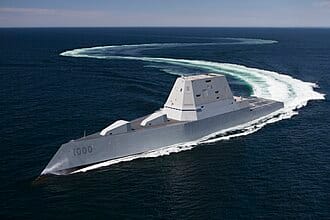
The USS Zumwalt at sea. Trump said it was “Ugly as F.”

The supposed replacement, was a cruiser-size, stealth ship, the Zumwalt destroyer, 17,000 tons and 600 feet long. It is reasonably fast, 33.5kn, and carries a small crew, <100. We’ve managed to build three of these since 2008, but have cancelled the project due to operational problems and costs that rose to $8B per ship. Zumwalts have inward-sloped sides that deflect radar, but they become unstable in turns. Its main weapons are expensive, too: Aegis missiles and CPS hypersonics costing $28-$50 million each. That’s uneconomical compared to French Aster missiles, Mach 3, 80 mile range, $1.1 million. Originally, Zumwalt destroyers carried a rail gun, but it required so much power that you could not move the ship and fire at the same time. The rail guns were eventually replaced by conventional 5″ cannon with a 24 mile range. The three Zumwalts we have are hardly used today, and no more are on order. Something cheaper was needed at least for support, and that was supposed to be the Constellation Frigate, approved by Trump in 2017.

A frigate is smaller than a cruiser, in this case about half the weight. The Constellation was a proven Italian design, 492 feet long and only 7,291 tons. It had good speed, 26 kn, good range, 6000 nm at 16kn, and cost only $950 million, at least when built in Europe. The contract was awarded to Fincantieri Marinette Marine (FMM) of Marinette Wisconsin, the US division of the Italian company. What could go wrong? The problem was that the navy kept adding capabilities and weight. As of November 2025, eight years on, the weight had increased by 700 tons, the cost to $9 B for two, and no design has been finalized. The first Constellation frigate is only 12% built! Trump has not quite cancelled the program, but has reduced the order to two from the original eight.

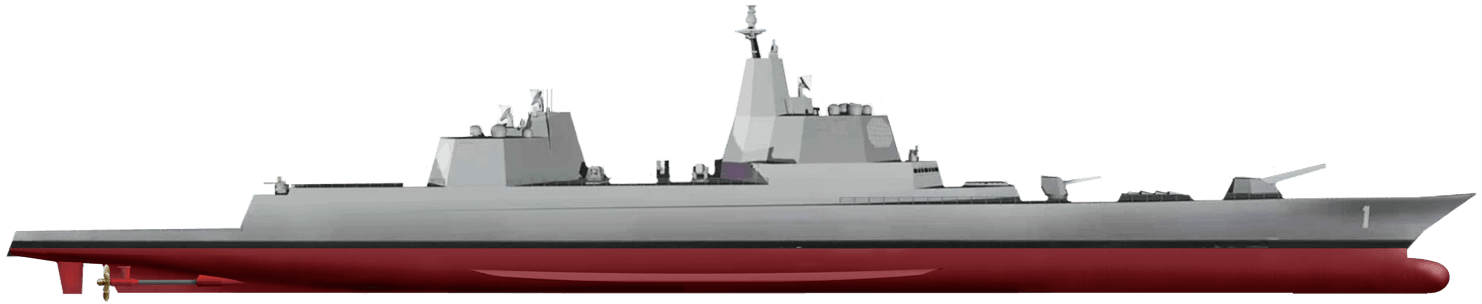
Trump-class battleship, as envisioned, with a rail-gun, lasers and two, conventional 5″ cannon.

And that brings us to the current, Trump class battleship, shown above. It’s long, 840-880 feet, and heavy, 39,000 tons, or 2.5 times the weight of the cruiser-sized, Zumwalt. As was intended for the Zumwalt, the offensive weapons are missiles and a rail gun, 32 MJ, but now there is enough power run the ship and fire the weapon. Japanese versions of the rail gun have launched cheap shells at hypersonic speeds, ~5000 mph (hypersonic) at up to one per second to 100 miles. The shells cost only $85,000 each, a bargain.

For defense, these battleships are to carry two, 300kW, Helios lasers, similar to Israel’s “Iron beam,” but 3 times as powerful. They are augmented by smaller lasers, by four, 30 mm chain guns (Gatling guns), and two, 5″ conventional navy guns of 24 mile range. Engines are estimated to be two gas turbines, perhaps 50MW each, to power the weapons, plus ~100 MW in diesel power for cruising at good mpg. I thus estimate a total of ~200 MW, about as much as on a carrier. There is plentiful space for missiles and fuel too, and it should be ale to do some resupply of support ships. The crew size is bigger than on the Ticonderoga, 600 to 800, but far less than on a carrier. And the look is impressive. It could be a command ship. Still, there are objections.

A main complaint is vulnerability as discussed here. Some see these ships are “bomb magnets,” not stealthy, nor as heavily armored as the Iowas, with lasers and chain guns insufficient to defend them, e.g. from dedicated swarm attacks. Detractors note that Battleships like the Bismarck, Yamamoto, and Arizona have been sunk, typically by air attack, but what they don’t mention is that it took a lot of bombs and torpedos to sink these battleships. Also these battleships will typically travel with support.

Detractors also question the rail gun. Can it shoot down an airplane? can it sink a ship? We don’t know. They point of that the cost and construction time of the ship is high and likely to balloon. Wouldn’t it make more sense to fix the Constellation or the Zumwalt. The tests I’ve seen suggest that the rail gun can not sink a ship with one shot; that still needs a missile. If the gun can hit a plane or missile, it will destroy it, but accuracy may not be sufficient, at long range. The gun seems appropriate for shore bombardment and for slowing a Chinese navy that is already bigger than ours. As for the defensive lasers, these have been shown to stop drones and cruise missiles at a cost of only $10 per shot: nothing compared to a harpoon missile ($1.4 million each) or Aegis ($28 million). I don’t see a smaller ship being able to power these weapons, especially if you want extra room for expansion, like adding a nuclear reactor.

The time-line is what worries me most. For ten years at least, we will have to rely on short-range Arleigh Burkes that could not bombard the Houthis effectively on land, did not effectively defend US shipping in the Red Sea, and that uses million-dollar missiles to shoot down $20,000 drones. And in ten years, will we still want it.

Robert Buxbaum, January 5, 2026. As a totally side issue: I doubt this is a battleship: It currently carries only one powerful gun. You need at least two to be a battleship, IMHO.

What causes innovation? is it worth it?

Innovation is the special sauce that propels growth and allows a country to lead and prosper. The current Nobel prize believe that innovation powered the Industrial Revolution, causing England to become rich and powerful, while other nations remained poor, weak, and stagnant. Similarly, Innovation, they believe is why 19th century Japan rose to defeat China, and propelled China’s 21st century rise. But why did they succeed when others did not. What could the leader of a country do to bring power and wealth through innovation. Improved education seems to help; all of the innovation countries have it, but it is not the whole. Some educated countries (Germany, Russia) stagnate. An open economy is nice, but it isn’t sufficient or that necessary: (look at China). That was the topic of this year’s, 2025 Nobel prize in economics to Mokyr, Howitt, and Aghion, with half going to Joel Mokyr for his insights, historical and forward looking, the other half going for economic modeling. I give below my understanding of their insights, more technical than most, but not so mathematical as to be obtuse the normal reader..

The winners hold that innovation, as during the industrial revolution, is a non-continuous contribultion caused by a particular combination of education and market opportunity, of theoretical knowledge, and practical, and that a key aspect is depreciation (destruction) of other suppliers. Let’s start by creating a simple, continuous function model for economic growth where growth = capital growth, that is dK/dt. K, Capital, is understood to be the sum of money, equipment, and labor knowledge, and t is time with dK/dt, the change in K with time modeled as equal to the savings rate, s, times economic activity, Y minus a depreciation factor, δ, times capital, K.

growth = dK/dt = sY − δ K.

Innovation, in the Howett model, is discontinuous and accumulative. It builds on itself.

For the authors, Y = GDP + x, where x is the cost of outside goods used. They then claim that Y is a non-linear function of K, where K is now considered a product of capital goods and labor K = xL and,

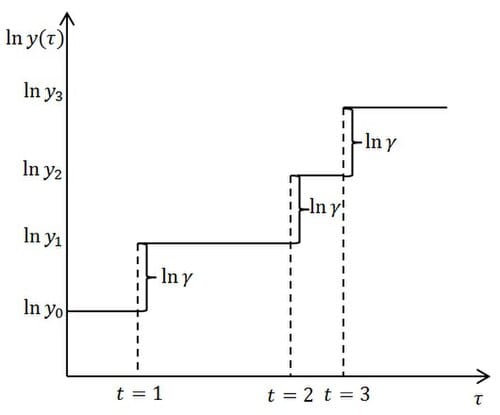
dY/dK = AKα + γ where 0< α <1, and where γ is the contribution of innovation and/or depreciation. The power function, as I understand it, is a mathematical way of saying there are economies of scale. The authors assume a set of interacting enterprises (countries0 so that the innovation factor, γ for one country is the depreciation factor for the other. That is, growth and destruction are connected, with growth being a function of monopoly power — control of your innovation.

According to the Nobel winners, γ is built n previous γ as shown in the digram at right. It can not be predicted as such, but requires education and monopolistic power. The inventor-manufacturer of the typewriter has a monopolistic advantage over the makers of fountain pens. Innovation thus causes depreciation, δ K as one new innovation depreciates many old processes and products. If you add enough math, you can derive formulas for GDP and GDP growth, all based on factors like A and α, that are hard to measure.

GDP = α(2α/1−α) (1-α2)A L,

Thus, GDP is proportional to Labor, L and per-capita GDP is mostly an independent function related to economies of scale and the ability to use capital and labor which is related to general country-wide culture.

The above analysis, as I understand it, is in contrast to Kensyan models, where growth is unrelated to innovation, and where destruction is bad. In these Kenysean models, growth can be created by government spending, especial spending to maintain large industries with economies of scale and by spending to promote higher education. The culture preferred here, as I understand is one that rewards risk-taking, monopoly economics, and creative destruction. Howitt, and Aghion, importantly codify all this with formulas, as presented above that (to me) provide little specific. No great guidance to the head of a country. Nor does the math make the models more true, but it makes the statements somewhat clearer. Or perhaps the only real value of the math is to make things sound more scientific see the Tom Lehrer song, Sociology.

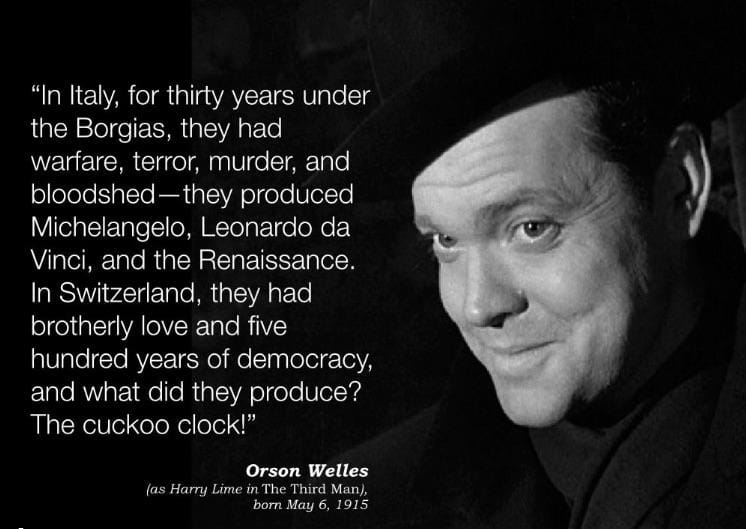
This insight from movie script by Grham Green suggests to me that progress may not be the greatest of advantages, perhaps not even worth it.

This work seems more realistic, to me, than the Keynesian models Both models are mathematically consistent, but if Keynes’s were true, Britain might still be on top, and Zambia would be a close competitor among the richest countries on earth. Besides these new fellows seem to agree with the views of Peter Cooper, my hero. See more here.

Writing all this reminds me that the fundamental assumption that progress is good, in not necessarily true. I quote above a line that Orson Wells, as Harry Lime, ad-libbed for the movie, “The Third Man.” Lime points out that innovation goes with suffering, and claims that Switzerland had little innovation because of its stability. Perhaps then, what you really want is the stability and peace of Switzerland, along with the lack of domination and innovation. On the same note, I’ve noticed that engineering innovators often ruin themselves dining in ruin, while the peaceable, stable civil engineers live long pleasant lives of honor.

Robert Buxbaum, November 16, 2025. A note about Switzerland is that was peaceful and stable because of a strong military. As Publius Vegetius wrote, Si vis pachim para bellum (if you wish of peace, prepare for war).

Thomas Kuhn, and why half of America loves/ hates Trump

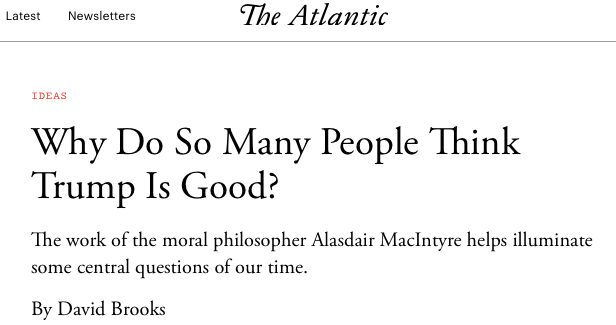
This post was inspired by articles like the one below asking how it was that some Americans, MAGAs think Trump is good when everyone of value sees him as a fat, bigoted, criminal clown. The Atlantic’s answer is they’re detached from classic ideals of good or moral, and are now fueled by “narcissism, fanaticism, and authoritarianism”. I thought a more helpful explanation was that we’re going through a paradigm shift, perhaps progressing in our thought of what it means to be good.

Consider Thomas Kuhn’s analysis of scientific progress. Tomas Kuhn was a major American Philosopher of the 1960s-70s who claimed that science progress was not uniform but included long periods of “normal science” punctuated by change. A “crisis” leading a “Revolution” resulting in big changes in language, outlook and thinking, a “paradigm shift”. In the midst of these scientific revolutions, the experts of the old system fight bitterly against the new while being confounded by the fact that it seems to work.

Consider the resistance to relativity and quantum mechanics. Before 1905 the experts were doing fine: Professors taught and students learned — formulas, tools and techniques were handed over. Educated had respect and money, and could communicate. There were some few contradictions, as in why the sun burned hot, or why the sky was blue, but one could ignore these. You knew who the experts were, and they didn’t include Einstein, Bohr, Pauli, Plank.

Democrats sell red hats and buttons with Fascist or Felon because Trump’s red MAGA (Make America Great Again) hats work for him.

But then came a few more problems, (inconsistencies in Kuhn-speak: radioactivity, photoelectrons, the speed of light… Einstein published on them in 1905, thoughts that few took seriously: imaginary time was a fourth dimension at right angles to the others, etc. The explantations seemed mad and for 14 years after he published, Einstein could not get a university job — anywhere. By 1919 detailed experiments suggested he might be right on a lot of things. It lead to the rise of a new group of experts plus a loss of esteem for the old, and a bunch of crank explainers who were neither but flourished in the confusion.

Hate abounded; new weapons and cures WWI removed aristocrats and beards. A popular book a lecture series of the time was “100 scientists against Einstein.” There followed a lost generation with no clear foundation. It took 50 years to resolve confusion, but there developed new thought leaders, a new language, new standard formulas and books were sold, and we were returned slowly to “normal science” in a new thought paradigm.

I see the conflict of opinion surrounding Mr Trump as a crisis in political thought similar to the crisis in science thought 100 years ago. Polite discourse if gone, replaced by stunts and insults. The government is currently shut, with 40% federal workers, those whose jobs are non-critical, on unpaid leave. It’s a collapse, not of morals, but of language. Trump hopes to use the shutdown, I think, to show that most of these 40%, are not needed. If they are not needed, it reflects a big lack in government — actually a big bloat in government. You can see why the opponents of cuts see Trump as a fascist who uses “dog whistles” to motivate “his base”, there is a lack of communication and a fear Trump may be right too, I think. The experiment in smaller government is being run as I write, and Trump seems confident that some 400,000 federal workers are not needed. Are they? Instead of debating, we’ve got to violence: two attempts on Trump’s life so far, the main college debater, Charlie Kirk, shot dead. Appropriate, I think, is Bob Dylan’s, “Times are a-changing” and “something is happening here, but you don’t know what it is, do you, Mr Jones.”

Other questions are being worked out as we speak -sending chills through the old order: Are China and Europe “ripping us off,” by free trade and stolen technology? Are tariffs an answer. Canadian and European leaders deride these thoughts openly, but I notice that both Canada and the EU have put heavy tariffs on Chinese goods.

Another issue is respect for experts. The Atlantic bemoaned that Trump supporters don’t respect experts on health, climate, and education, but perhaps they are lying. The seas have not risen as expected. Some warming may be good, or better than the remedies. Even if RFK Jr.’s ideas are wrong it seems that science has become unreliable (irreproducible), and that elite colleges aren’t fair in their assessment, nor do they provide great value.

Eventually things will settle down; we will some day have polite discourse. In 40-50 years, I suspect we’ll agree that some tariffs are good and that Trump’s tariffs are either to high or low, We’ll think that the climate push to no nuclear power, was a mistake, as was the giant, Ivanpah solar farm). And we’ll be able to discuss it civilly. I hope the change in thought takes less than 50 years.

Robert Buxbaum, October 3, 2025 – we are now entering another physics crisis too, I think.

Making semi-traditional STAM ink using walnuts.

Jewish tradition requires certain holy items that have to be written on parchment with kosher, opaque, black ink. These items are abbreviated, STAM, books of the Torah (Sifre Torah, in Hebrew), Philactaries (Tefillin in Hebrew), and Mezzuzos for the doorpost. To be kosher the ink must be made from kosher sources: plant matter, soot, water, and/or inorganic chemicals. That leaves a lot of options, and it is likely that black Sharpie would be kosher, at least after the fact. Ideally, the ink should wash off in water too, based on Numbers 5:23 (Also, Rambam, Hilchos Tefilin 1:4, and Shulchan Aruch, YD 271:6).

There are ancient recipes, and I decided to semi-follow one, using walnuts instead of the classic gall nut and copper vitriol instead of iron. The aim was an ink that’s dark, long lasting, compatible with animal-skin parchment, and dissolvable. Some vegetable inks rot or fade, and most iron-based inks become permanent, like paint, they do not re-dissolve in water. If you don’t want to go through all this, you can buy kosher iron ink, e.g. here, knowing that this ink isn’t ideal, but it’s the type most people use for the practical reason that it looks nicer and permanent is a comfort.

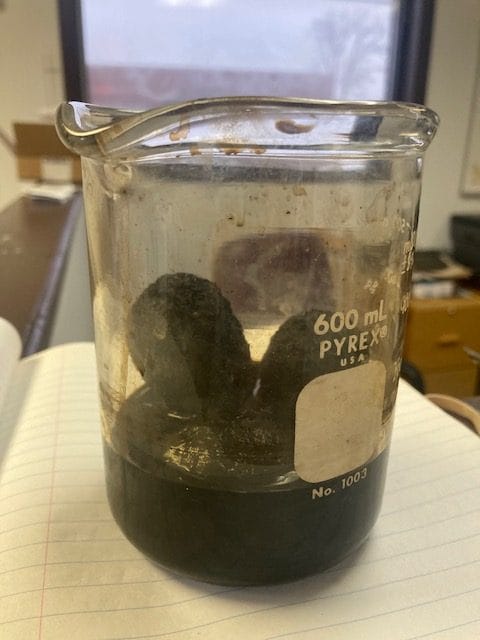
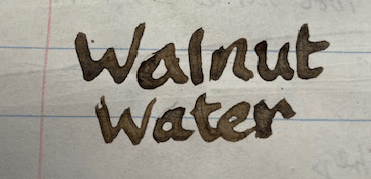
The classical recipes for STAM ink is based on using the shell of gall nuts, a tree-growth (not really a nut) found in the Mid-east. As an experiment, I’ve tried to make a respectable, kosher ink with walnuts instead. Walnut trees grow readily in the midwest. I collected a dozen walnuts with their husks from a tree near my home. The outer husk had been green originally, but had turned black by the time I picked them (mid November). Rather than extract the inner shell, I used the walnuts as I found them, and tried boiling them in denatured alcohol, and also in water. Boiling in alcohol didn’t work well, producing the weak ink shown below, left. Boiling in water (below right) produced a much darker liquid. I used this as the basis of my ink.

Boiling walnuts in water produced a dark liquid, walnut water.
I boiled walnuts in alcohol. The water-ink runs and isn’t dark.

The traditional recipe begins by boiling gall nuts in water to produce a brownish ink-wash that looks hardly darker than my alcohol-wash ink. You then add soot and “green vitriol”. Perhaps that is copper sulphate, or perhaps iron sulphate. Copper sulphate is a dark blue, while iron sulphate is a light green. With gall nut water, it turns out that iron vitriol works ‘better’, reacting with tannin in the gallnut water to make a nice, black color that becomes a permanent ink. When tried the two types of vitriol with my walnut water, I saw no color advantage to iron over copper, and no real color change.

I put the walnuts in a beaker as shown, nearly covering them with water, and put a piece of foil on top. The longer I simmered the darker it got. In the end, I left the mix on a hotplate, on low for nearly a day as shown above. The ink-wash, by itself is a reasonably good ink, as shown below left.

The traditional recipe that I’ worked off o’m modifying includes three more ingredients, so I experimented with them. These were vitriol, soot, and gum Arabic, in proportions shown below, in the form of a poem in Arabic written about 900AD. The first of these additions I tested was vitriol. I first tried copper sulphate, half as much as walnut water, and found that it darkens the color a little and makes the combination a bit thicker thought the ink is still watery. Copper sulphate is an antimicrobial too, so even without changing the color much, I imagined this was a worthwhile addition. I also tried making the walnut ink with iron sulphate. This makes the ink slightly darker too, perhaps, but not thicker. I have less confidence about iron’s antimicrobial properties, and there were concerns that it could harm a parchment over time. I also worried that it would make the ink permanent.

Ink made from walnut water, copper sulphate, and soot. Perhaps better?

The next ingredient was soot. It’s used to make the ink darker, and perhaps thicker. Traditional soot is made from burning olive oil. One collects the soot by placing a plate over the smoky oil fire. I tried a bit of this, but it was slow, and I had some chemically produced soot in my lab, bought from MER corp, leftovers from making buckminsterfullerene. I added as much soot as vitriol as in the poem below, and as expected found it increased the blackness of the ink. It also changed the texture, making the ink gritty and harder to write with. I had trouble dissolving the soot into the ink too, and apparently I’m not the first to have this trouble. Some suggested heating, and some suggested honey. I tried both, and heating helped more than honey. I also tried using a drop of dish soap. The result, above left, was blacker than the original, but the writing is not professional grade, IMHO. The ink does not write well, and it still doesn’t cover 100%. I moved on to the next ingredient, gum Arabica.

The recipe for ink, musclé, via a poem by Mukla Farsi, 900AD from blog of the Bodlieian Libraries at Oxford.

The mixing ratios in this poem are not exactly clear. The amount of soot is the same as of vitriol, and half that of gall, but is this the weight of the gall nuts, or volume, or the weight of the dried extract. I used volume of walnut water and volume of soot, and have the sense that this is too much soot. Also soot is messy and hard to dissolve; use gloves and a lab jacket. the soot does not come out easily.

My final ingredient is gum Arabic, the gum of the acacia tree. This seems to be used as a thickener. Gum Arabic is available in the US, on Amazon as an edible “candy”, so I bought some. It wasn’t expensive, but took about 10 days to get here. In the meantime, I tried honey as a thickener. It appears in some ancient recipes, but didn’t really help here, and left the page sort of sticky. Gum arabic is solider, so I hoped for for lasting product. When the Gum Arabic came, I found that it was solid, crystalline, with has hardly any taste. Maybe Arabs add sugar? I figure there might be a mystical advantage to gum Arabic since it comes from the Acacia tree, the type of tree used to make the Ark of the Covenant. My expectation was that it might also make the ink darker, and that it might help dissolve the soot.

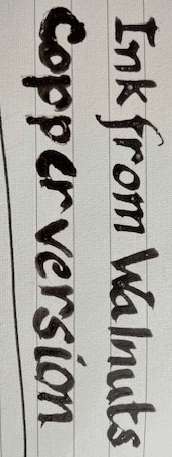
As it happens, gum Arabic doesn’t dissolve in cold water. But it did dissolve in hot water if I mixed it in and stirred for 5 minutes. The gum helped dissolve the soot too; gum Arabic seemed to do a better job than honey in this respect. Once the gum ink dried it was nice and solid, with the dried letters standing off the page a bit; they’re raised letters, and I really like that. The ink was still sort of grainy, perhaps from the walnut bits. I then tried dipping a written on parchment into some water and found the ink-letters dissolved easily. My understanding is that the ink I’d made was highly kosher for STAM, but as a follow-up experiment, I’m carrying some inked parchment in my breast pocket to see if it rots or fades. So far, no change. Some samples of writing are at left. The upper words are with the iron-vitriol version (iron sulphate), the lower with the copper vitriol (copper sulphate). You can sense why scribes might prefer the iron ink.

Robert Buxbaum, December 22, 2024. Scribes of 2000 years ago used wooden pens, it seems, as feather quills and fountain pens hadn’t been invented. I used a wood pen on some samples above, made by carving a popsicle stick. The better-looking letters, and longer passages, were written with a metal, calligraphy “quill.”

Sleepwalking into WWI, and WWIII

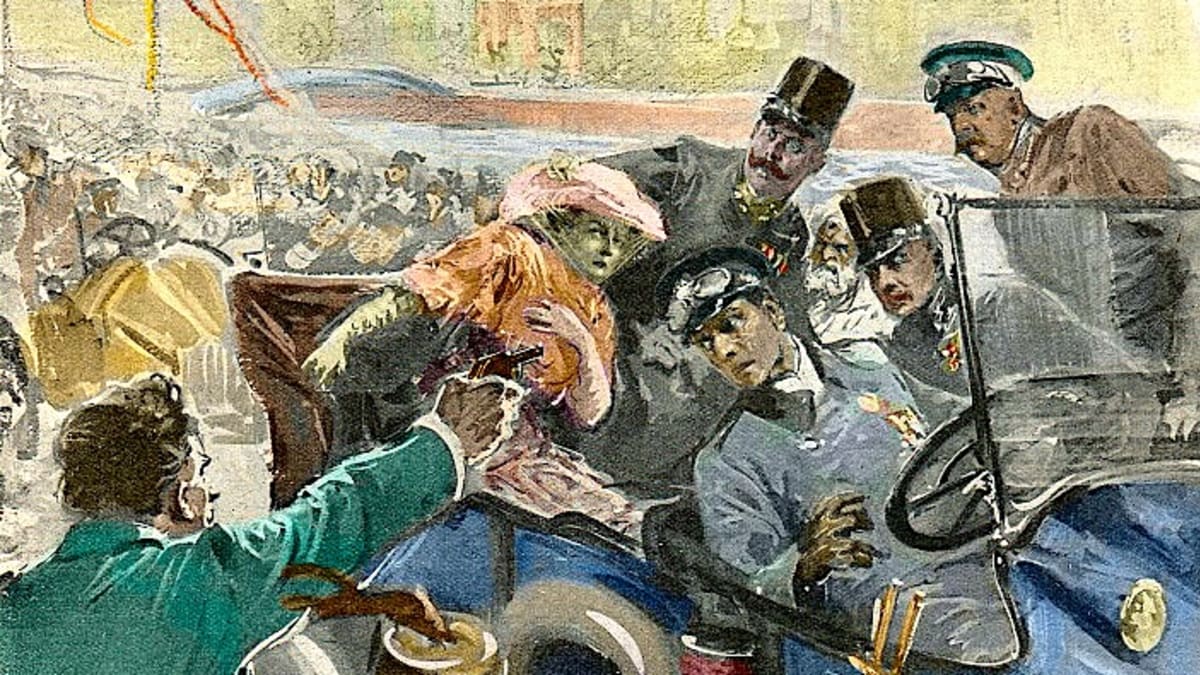
A remarkable book by Christopher Clark on WWI posits that WWI was an accident, entered into, by sleepwalk. That is, it was not brought on by the elaborate plan of an evil aggressor, Germany or Britain, acting for dominance or economic gain, but rather that many individuals precipitated the deadly conflict through a series of ever-more dangerous, unplanned steps. The great diplomats went on vacation following the June 28, 1914 assassination, and each minor actor felt a need to push for a previous status quo, emboldened by the certainty that nothing bad would happen, since none of the last acts had caused any serious harm, at least not to them. There was, in Clark’s view, a general numbness caused by earlier wars: in China and Russia, in Serbia and Albania, and by Italy’s invasion of Africa, and the fact that there had not been a major, deadly conflict since the Crimean war. In this environment, one nation shoving another was seen as normal conflict until a war broke out that killed millions and toppled four empires: the Russian, Austrian, German, and Ottoman.

Princip shoots Count Ferdinand, June 28, 914. Getty Immage.

Clark points out, too that the Serbs, the folks who started the war, benefited from it. They escaped from imperial control by Austria and from The Ottoman Empire. Self determination was the motivation for the assassination, and it worked too, for the Czechs, Croats, Poles, and communists. In just a few years, the former group got their own countries, and the communists took Russia, something that no one saw coming in June, 1914.

The key sleep-walk steps to war were as follows: In response to the assassination, and a decade of earlier insults, Austria-Hungary, demanded harsh cocessions from Serbia that Serbia found unacceptable. Austria Hungary, backed by Germany and Italy, declared war on Serbia. Russia then mobilized its troops for war with Germany, so Germany declared war on Russia. France, an ally of Russia, then mobilized for war with Germany, so on August 2 – 3, Germany declared war on France and invaded Luxembourg and Belgium. Why Luxembourg and Belgium — because they would not allow free transport of German troupes to attack France. This forced Great Britain to declare war on Germany, which, finally, on August 6, brought Austria-Hungary to declared war on Russia, and effectively on the rest of the Allies. Over the next few years, we (the US) were dragged in along with Japan, on our side.

What a mess, but I fear we may be sleepwalking to the same, grim altercation via our wars in Ukraine and Syria. As at the beginning of WWI, there are two big power alliances: NATO including The US and most of Europe, versus a BRICS alliance of Brazil, Russia, India, Iran, China, and South Africa, along with a few minor others. The alliances are now three years into a proxy war in Ukraine, and another one in Syria. So far the declared combatants are Russia vs Ukraine, and Turkey vs Syria, but both sides keeps harassing the other at a higher and higher pace. So far, the sleep-walk steps were that Russia invaded Crimea, in response to some insult, and then attempted to take Kiev. The NATO alliance responded provided limited weapons to Ukraine. But, as these proved insufficient, we (NATO) provided greater and more deadly weapons, plus some volunteer troops. Meanwhile Russia’s BRICS allies are selling drones and missiles into the conflict in return for Russian gold, wheat, and raw materials. One of us, perhaps Ukraine, then cut the RussianGerman gas pipeline, while China seems to have cut important communications cables in the Baltic Sea.

North Korea began sending troops, 12,000 apparently, to fight on the Russian side, while Biden has sent long-range missiles to be used for strikes deep into Russian territory, on logistic centers, train depots, food stores, airports, etc. Putin has threatened a nuclear response, but has done nothing so far beyond sending a few long range, hypersonic missiles against civilian targets and against Ukraine’s power grid. He’s lost some 600,000 Russians, and has lost control of Syria and Armenia, so he has reason to be upset. Ukraine has lost some 400,000, and is still losing territory, but is still demanding total victory, the removal of all Russian forces, including those in Crimea.

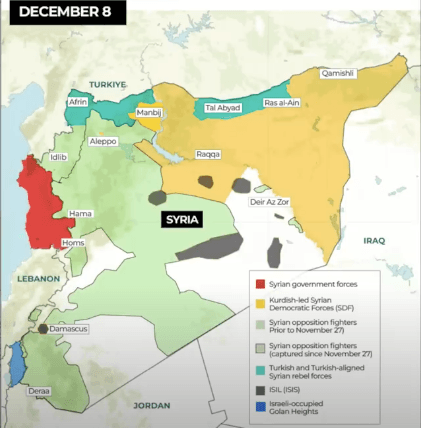
The fight has spread to Syria, where the US, Israel, and Turkey have bombed in recent days, something I would call an act of offensive war against a sovereign unstable government. It’s not totally unprevoked, of course. Syria and Iran had been attacking Israel for years from Lebanon, by way of Hezbollah jihadists. Recently Israel took out a major fraction of Hezbollah, and the jihadists (Sunni) seems to have gone back to Syria, and have removed Assad, Syria’s Shia president for life, with help from Turkey, another Sunni Moslem country. This too is an act of war. Assad retains a sliver on the coast where the Russian bases are, the red areas in the map below, but he isn’t popular with anyone at the moment. The rebel leader, Abu Mohammed al Jolani, was a member of Al Quada till 2006, and then member of ISIS (ISIL) under Abu Baghdadi till 2016 at least. He’s still on our terrorist list, though he now claims to be a progressive Moslem. Not everyone is convinced, or happy with him. Syria is divided into seven (or more) control zones, shown on the map below. He could bring peace to Syria, but his path to peace is clearly further war.

On the legal and PR front, we’ve called Russian president Putin a madman and war criminal, we support Turkey’s efforts to overthrow Assad, but complain about his attacks on the Kurds, the yellow areas, and dark green at right, and we both applaud and condemn Israeli President Netanyahu for attacking Syria in the south, and in the red sliver, destroying Syria’s navy. Meanwhile, we (the US) have taken it upon ourselves to attack ISIS (ISIL) camps in central Syria, the grey areas, as well as attacking troops (Iranian Shia) entering from Iraq. By normal definition, this would put us at war with Syria, and perhaps with Turkey since we support the Kurds in their war against Turks.

Recently we’ve decided that the rebel leader, al Jolani, might be taken off the terrorist list subject to a few conditions (I wonder which). We (Biden, Shumer) along with the International Criminal Court have called for the arrest and imprisonment of Israel’s PM Netanyahu. The Turks too have join in on this, while somewhat cheering Israel’s destruction of Assad’s navy. The Druze, allies of Israel (and us?) seem to be at war with al Jolani, and likely the Turks and Iran. They’re in south-east Syria, near Deraa, not shown by a color on the map. Meanwhile, Russia is trying to make peace with al Jolani, to secure their military bases, while Iran (Shia) has reached out to al Jolani (Sunni) in an effort to join with him in a war against Israel. It’s not quite tipped into world war, but it seems awfully close.

One possible peace maker might be the incoming US president, Trump, but the outgoing president, Biden, has done his best to tie his hands, branding him as a felon and seditionist, as well as claiming he’s a Russian asset. European leaders don’t like him either. France’s Macron might a peacemaker, but Macron’s government has fallen. The Germans or Turks might be peacemakers, but the government of Germany has nearly fallen, the economy of Germany is hurting, and Turkey is a combatant, at war with the Kurds and Druze. Iran, and Russia, though not combatants, are directly involved in the fighting, and both countries are under sanction by the US and EU, and the UN is discredited from it’s years helping Hezbolla. I thus see no clear path to peace and no peacemaker who will dial back the drama before we sleep-march into WWIII.

Robert Buxbaum, December 11, 2024

This is not the most important election, 1860 was

Every year we hear the same claim: that this the most important election of America’s history. This year is among the more contentious than most, but the issues dividing the candidates are few. Both, for example, claim they will protect the border and spur the economy. In lieu of issues, there’s name calling. Trump claims Harris is as incompetent buffoon and Harris claims Trump is a fascist dictator. The rancor practically guarantees as they’ll be riots whoever wins but, as these things go, the election is less important, and divisive than ’64 and ’68, and in particular, the election of 1860.

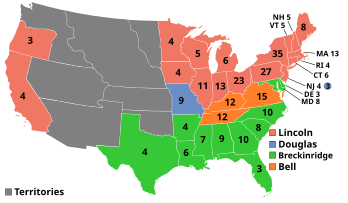
Following the 1860 election, election seven states ceded from the union and we had a Civil War. Even the most bleak prediction for 2024-25 is for a more peaceful transfer of power. The election of 1860 had two major issues on the ballot; one was slavery or rather the expansion of slavery to the territories, and the other was implementation of the Morrill tariffs. These import taxes, proposed by Justin Morrill and passed but not yet implemented, would have raised the average agricultural duty from 15% to to 47%. Duties on durable goods wool rise to 65%, with the burden falling disproportionately on the southern states. Duties on durable goods. There was also a price schedule that would have prevented British shippers from minimizing the effect by falsely claiming a price far below market, something China currently does. In September 1860, Republican Leader Thaddeus Stevens told a New York City audience that “the Tariff would impoverish the southern and western states, but that was essential for advancing national greatness and the prosperity of industrial workers.”

Matching the two sides to the two major issues of the day, there were four major candidates for president in 1860. All of them won states. Lincoln carried the greatest number, 18, and won the most electoral votes, 180. He was for high tariffs and against the expansion of slavery. Second was John Breckinridge, the Southern Democrat, who carried 11 states and got 72 electoral votes. He was for the expansion of slavery and against the higher tariffs. Then there was Stephen Douglas, the Northern Democrat, who was for allowing the expansion of slavery, considering it a “states right,” and also for the higher tariffs. Douglas carried only one state, Missouri, with 12 electoral votes. Finally, there was John Bell, the Constitutional Union candidate, who carried three states, Virginia, Tennessee, and Kentucky, representing 39 electoral votes. He opposed the expansion of slavery and also the increased tariff, but he generally believed that compromise was always possible. This was the worst vote split in US history. The worst split I’ve seen was 1968, when three candidates carried states.

Had either Bell or Douglas won, I suspect that the Civil War could have been avoided, at least temporarily. Virginia, the most important of the slave states, had shown it was willing to accept an anti-slavery president so long as he did not impose high tariffs — tariffs that benefitted the northern industrial workers and manufacturers at the expense of southern consumers and agricultural producers. Lincoln’s victory precipitated the immediate secession of 3 states. Another 4 seceded after inauguration.

The south imagined they could walk away because that’s how they read the constitution before the 13th amendment. They imagined they could win a civil war because they imagined they had British military support. “Cotton was king,” they claimed. The UK prime minister, Lord Palmerston, had told secretary Adams, “We do not like slavery, but we want cotton, and we dislike very much your Morrill tariff.” As it was, the British stayed on the sidelines, in part because of diplomacy. Besides, the gunship Monitor showed that the North could sink most any British ship that entered US waters.

As for 2024, I expect there will be riots whoever wins, but nothing more. The parties are realigning significantly, as happened in 1964-68, and neither side much understands the appeal of the other. This seems like less of a wrenching election than in 1964 and 1968, though. In ’64-’68 US boys were dying in Vietnam in numbers, and black folks and their white friends were being lynched in the south. Nothing like that is happening today. Today’s riots have been fueled by nothing more than name-calling, fear, and the occasional assassination attempt. Mild, even compared to 1968.

Robert Buxbaum, November 4, 2024. Justin Morrill is mostly remembered today for the Land-grant college act of 1862. This created an agricultural -technical college in each state. I taught at Michigan State University, Michigan’s land grant university. I’m generally a fan of tariffs, both as an aid to the domestic economy and as a tool of foreign policy. I present these views here. I got these views from Peter Cooper.

Einstein’s theory of diffusion in liquids, and my extension.

In 1905 and 1908, Einstein developed two formulations for the diffusion of a small particle in a liquid. As a side-benefit of the first derivation, he demonstrated the visible existence of molecules, a remarkable piece of work. In the second formulation, he derived the same result using non-equilibrium thermodynamics, something he seems to have developed on the spot. I’ll give a brief version of the second derivation, and will then I’ll show off my own extension. It’s one of my proudest intellectual achievements.

But first a little background to the problem. In 1827, a plant biologist, Robert Brown examined pollen under a microscope and noticed that it moved in a jerky manner. He gave this “Brownian motion” the obvious explanation: that the pollen was alive and swimming. Later, it was observed that the pollen moved faster in acetone. The obvious explanation: pollen doesn’t like acetone, and thus swims faster. But the pollen never stopped, and it was noticed that cigar smoke also swam. Was cigar smoke alive too?

Einstein’s first version of an answer, 1905, was to consider that the liquid was composed of atoms whose energy was a Boltzmann distribution with an average of E= kT in every direction where k is the Boltzmann constant, and k = R/N. That is Boltsman’s constant equals the gas constant, R, divided by Avogadro’s number, N. He was able to show that the many interactions with the molecules should cause the pollen to take a random, jerky walk as seen, and that the velocity should be faster the less viscous the solvent, or the smaller the length-scale of observation. Einstein applied the Stokes drag equation to the solute, the drag force per particle was f = -6πrvη where r is the radius of the solute particle, v is the velocity, and η is the solution viscosity. Using some math, he was able to show that the diffusivity of the solute should be D = kT/6πrη. This is called the Stokes-Einstein equation.

In 1908 a French physicist, Jean Baptiste Perrin confirmed Einstein’s predictions, winning the Nobel prize for his work. I will now show the 1908 Einstein derivation and will hope to get to my extension by the end of this post.

Consider the molar Gibbs free energy of a solvent, water say. The molar concentration of water is x and that of a very dilute solute is y. y<<1. For this nearly pure water, you can show that µ = µ° +RT ln x= µ° +RT ln (1-y) = µ° -RTy.

Now, take a derivative with respect to some linear direction, z. Normally this is considered illegal, since thermodynamic is normally understood to apply to equilibrium systems only. Still Einstein took the derivative, and claimed it was legitimate at nearly equilibrium, pseudo-equilibrium. You can calculate the force on the solvent, the force on the water generated by a concentration gradient, Fw = dµ/dz = -RT dy/dz.

Now the force on each atom of water equals -RT/N dy/dz = -kT dy/dz.

Now, let’s call f the force on each atom of solute. For dilute solutions, this force is far higher than the above, f = -kT/y dy/dz. That is, for a given concentration gradient, dy/dz, the force on each solute atom is higher than on each solvent atom in inverse proportion to the molar concentration.

For small spheres, and low velocities, the flow is laminar and the drag force, f = 6πrvη.

Now calculate the speed of each solute atom. It is proportional to the force on the atom by the same relationship as appeared above: f = 6πrvη or v = f/6πrη. Inserting our equation for f= -kT/y dy/dz, we find that the velocity of the average solute molecule,

v = -kT/6πrηy dy/dz.

Let’s say that the molar concentration of solvent is C, so that, for water, C will equal about 1/18 mols/cc. The atomic concentration of dilute solvent will then equal Cy. We find that the molar flux of material, the diffusive flux equals Cyv, or that

Molar flux (mols/cm2/s) = Cy (-kT/6πrηy dy/dz) = -kTC/6πrη dy/dz -kT/6πrη dCy/dz.

where Cy is the molar concentration of solvent per volume.

Classical engineering comes to a similar equation with a property called diffusivity. Sp that

Molar flux of y (mols y/cm2/s) = -D dCy/dz, and D is an experimentally determined constant. We thus now have a prediction for D:

D = kT/6πrη.

This again is the Stokes Einstein Equation, the same as above but derived with far less math. I was fascinated, but felt sure there was something wrong here. Macroscopic viscosity was not the same as microscopic. I just could not think of a great case where there was much difference until I realized that, in polymer solutions there was a big difference.

Polymer solutions, I reasoned had large viscosities, but a diffusing solute probably didn’t feel the liquid as anywhere near as viscous. The viscometer measured at a larger distance, more similar to that of the polymer coil entanglement length, while a small solute might dart between the polymer chains like a rabbit among trees. I applied an equation for heat transfer in a dispersion that JK Maxwell had derived,

where κeff is the modified effective thermal conductivity (or diffusivity in my case), κl and κp are the thermal conductivity of the liquid and the particles respectively, and φ is the volume fraction of particles. 

To convert this to diffusion, I replaced κl by Dl, and κp by Dp where

Dl = kT/6πrηl

and Dp = kT/6πrη.

In the above ηl is the viscosity of the pure, liquid solvent.

The chair of the department, Don Anderson didn’t believe my equation, but agreed to help test it. A student named Kit Yam ran experiments on a variety of polymer solutions, and it turned out that the equation worked really well down to high polymer concentrations, and high viscosity.

As a simple, first approximation to the above, you can take Dp = 0, since it’s much smaller than Dl and you can take Dl to equal Dl = kT/6πrηl as above. The new, first order approximation is:

D = kT/6πrηl (1 – 3φ/2).

We published in Science. That is I published along with the two colleagues who tested the idea and proved the theory right, or at least useful. The reference is Yam, K., Anderson, D., Buxbaum, R. E., Science 240 (1988) p. 330 ff. “Diffusion of Small Solutes in Polymer-Containing Solutions”. This result is one of my proudest achievements.

R.E. Buxbaum, March 20, 2024

Chinese stocks lost 30% this year, has China’s lost decade begun?

I predicted dire times for China six years ago, when Xi Jinping amended the constitution to make himself leader for life, in charge of the government, the party, the military, and the banks. Emperor, I called him, here. It now seems the collapse has begun, or at least stagnation. Chinese history is cyclic. Good times of peace and plenty give rise to a supreme emperor whose excesses bring war and famine, or at least stagnation. The cycle repeats every 50 to 100 years. Since Nixon opened China in 1973, the country has seen 50 years of prosperity and spectacular growth, but the growth has stopped and may be in decline. The stock market (Shanghai Shenzen 300) peaked in 2021 and has declined 50% from there. It’s down 30% for the last 12 months to levels seen in December 2010. US growth seemed slower than China’s but it’s been more steady. The main US stock market, the S+P 500, has more than tripled since 2010, up 24.5% this year.

Five years of the Shanghai 300 index with hardly any change. There has hardly been change in 15 years. One could argue that the lost decade is here and on-going. .

Each year Chairman Xi’s behaves more dictatorial. Last year he arrested his predecessor, Hu Jintao in front of the Communist party. He now tracks all his citizens actions by way of face recognition and phone software, and gives demerits for wrong thinking and wrong behaviors. You lose merits by buying western cars or visiting western internet sites. Taking money abroad is generally illegal. Needless to say, such behavior causes people to want to take money abroad, just in case. Last week, Xi proposed a limit on video game playing and clamped down on banks, demanding low interest rates. This is bad for the gaming corporations and teenagers, and banks, but so far there are no protests as there is no war.

Kissinger said that war was likely, though. Xi is building the navy at a fast pace, adding fast surface ships, nuclear submarines, aircraft carriers, and new attack airplanes. They’ve added hypersonic missiles too, and added listening stations and bases. There’s now a naval base in Djibouti, at the entrance to the Red Sea, where they oversee (or promote?) Iran’s attacks on Western shipping. Then there are the new Chinese Islands that were built to take oil and fishing rights, and to provide yet more military bases on key trade routes. These could easily be a trigger for war, but so far just one military interaction in the region. Last month, the Chinese and Philippines navy clashed over fishing!

In the Gulf of Finland last Month, a Chinese ship, New New Polarbear, destroyed the offshore cables and gas pipes between Finland and Estonia, in protest of Finland’s entry into NATO. It’s belligerent but not war. Undersea cables are not covered by the UN charter, law of the sea. Then there is the evidence that COVID-19 was the result of Chinese bioweapon development, and the Chinese spy ballon that was sent over the US. We maintain at peace, but an unsettled sort of peace — is it a preface to war? Wars don’t have to be big war against the west or Taiwan, more likely is Vietnam, IMHO.

China’s negative population growth means that property values will drop along with product consumption. Kids buy stuff; old folks don’t.

News from China is increasingly unreliable so it’s hard to tell what’s going on. There were claims of a coupe, but perhaps it was fake news. Reporters and spies have been arrested or shot so there is no window on anyone who knows. There are claims of high unemployment, and COVID deaths, and claims of a movement to “lie flat” and stop working. Perhaps that was behind the ban on excessive gaming. Who knows? Xi claims that China is self sufficient in food production, but record food shipments from the US to China suggest otherwise.

Major businesspeople have disappeared, often to reappear as changed men or women. Most recently, Jimmy Lai, the Hong Kong clothing magnate, was indicted for sedition by tweets. Perhaps he just wanted to fire workers, or pay down debt, or move abroad (his daughter is). Many businesses exist just to make jobs, it seems. Not all of these businesses are efficient, or profitable. Some exist to violate US patents or steal technology, particularly military technology. I suspect that China’s hot new car company, BYD, is a money-losing, job factory, behind Tesla in every open market. Some 91 public firms have delisted over the last two years, effectively vanishing from oversight. Are they gone, or still operating as employment zombies. Will BYD join them? If China manages to avoid war, I have to expect stagnation, a “lost decade” or two, as in Japan saw from 1990 to 2010, as they unwound their unprofitable businesses.

A sign suggesting that a Chinese lost decade has begun is that China’s is seeing deflation, a negative inflation rate of -0.2%/year according to the world bank. It seems people want to hold money, and don’t want Chinese products, services, or investment. Japan saw this and tried a mix of regulation and negative interest rates to revive the interest, basically paying people to borrow in hopes they spend.

In Japan, the main cause of their deflation seems to have been an excess of borrowing against overvalued and unoccupied real estate. The borrowed money was used to support unprofitable businesses to buy more real estate. This seems to be happening in China too. As in Japan, China originally needed new lots of new apartments when they opened up and people started moving to the cities. The first apartments increased in value greatly so people built more. But now they have about 100% oversupply: one unoccupied or half-built apartment for every one occupied, with many mortgaged to the hilt against other overvalued apartments and flailing businesses.

Chinese Dept, personal and corporate match Japan’s at the start of the lost decade(s). Personal debt is at 150% of GDP, corporate debt is at65% of GDP, all propped up by real estate.

As in Japan 30 years ago, China’s corporate + personal debt is now about two times their GDP. Japan tried to stop the deflation and collapse by increased lending, and wasteful infrastructure projects. People in the know sent the borrowed money abroad confident that they would repay less when they repaid. We are already seeing this; low interest loans, money flowing abroad and a profusion of fast trains, unused roads, and unused bridges. I suspect most fast trains don’t pay off, as planes are faster and cheaper. These investments are just postponing the collapse. China is also seeing a birth dearth, 1.1 children per woman. This means that within a generation there will be half as many new workers and families to use the trains, or occupy the apartments. As the country ages, retirees will need more services with fewer people to provide them. China’s culture promotes abortion. China’s working population will decline for the next 30 years at least.

Japan came through all this without war, somewhat poorer, but unified and modern. It helped that Japan was a democracy, unified in culture, with an open press and good leaders (Abe). There was no collapse, as such, but 20 years of stagnation. China is a dictatorship, with a disunited culture, and a closed press. I think it will get through this, but it will have a much rougher time.

Robert Buxbaum January 9, 2024. China isn’t alone in facing collapse and/or lost decades. Germany is in a similar state, especially since the start of the Ukraine war. It’s a democracy like Japan, and pacifist for now.

The Ukraine war could go for years. Don’t make a famine.

Russia is a collapsing, corrupt state with no meaningful elections. It is also the biggest exporter of food, fertilizer, gas, and oil. Nearly 2 years ago, it invaded Ukraine, another collapsing, corrupt, food-exporting state with suspended elections.

Both countries are in the midst of demographic collapse, with Ukraine worse off. Ukraine was invaded though, and thus has the better claim to our support. Then again Russia has atomic bombs. It’s also the largest exporter of wheat (or was), while Ukraine is only the 5th largest (or was before the war). The other three big exporters are the US, Canada, and France. We have benefitted financially, but don’t have enough output to make up for lost Russian and Ukrainian production. A likely result is famine unless the war can be brought to a quick end.

Ukraine’s grain terminals in flames, Odessa..

Food and energy prices have gone up too, and will probably continue to rise as the war stretches on. This adds to the risk of a global famine, particularly in the poorest areas of Africa, the Mid East, and India. Unfortunately, the war is still popular in Europe, Russia, Ukraine, and the US. It’s good business for our armaments industry, and for our recent mega-farmers (like Bill Gates). Also, for our political and spy class. They spend with little government oversight, and just recently misplaced $16 billion. Surely some of that lost money snuck back to the CIA and our politicians’ pockets. We’d have oversight, but “there’s a war on.”

As wars go, the death toll is low, a total of 354,000 dead and injured on both sides, as revealed by recently leaked documents. This is a small fraction of the countries population. Russia has lost 223,000 soldiers killed or wounded, 0.2% of the population, while the Ukrainians had lost 131,000, 0.3%, many of them civilians. While the war rages, the total death rate in the these two countries was 3.1 million people, 1.8% of the population; they’re dying mostly from heart disease, accidents, and alcoholism.

The Ukrainian population. Lots of retirees, few kids, very few of military age. This is a disaster, not a country.

More destructive than disease, alcoholism and the war is the demographic collapse. The fertility rate in Russia is 1.5 child per woman. In Ukraine it’s even lower, 1.21 per woman. For a stable population, you need at least 2.1 children per woman. Russia and Ukraine have had these low rates for at least 30 years. The net result is that we can expect that Russia’s population will drop by a third or so over the next generation, to about 50 million. This is the equivalent of killing 1/2 of the population; for Ukraine, the prognosis is worse. With few children and decent food supply, we can expect few workers, and increasingly many elderly. This will produce a cultural shift that virtually guarantees the breakup of Ukraine and the Russian federation in 20-30 years. Europe has this problem too, but with no war and some net immigration. The result is a cultural shift of a different type (to Islam). Russia has no immigration, and recently resorted to kidnapping Ukrainian children.

The loss of Russian and Ukrainian exports means famine for the poor importers and food inflation for all.

Europe has stopped taking delivery of Russian food and energy, in solidarity with Ukraine. This benefits the US, but hurts others. Meanwhile Russia has been destroying Ukrainian fields and food infrastructure, blowing a dam last month, flooding Ukraine’s fields, and yesterday destroyed the grain terminals at the port of Odessa,. This was tit-for-tat since Ukraine destroyed a key bridge, and Crimea’s irrigation canal. What’s more, evidence suggests that Ukraine blew up the Nord Stream pipeline — a key source of finance for Russia and Germany. This sort of tit-for-tat escalated to WWI, fueled by a belief, on both sides, that they would win “decisively and quickly.”

The result of WWI is that Germany was the biggest loser, losing men and land, and suffering a killing famine in 1916. In response, it militarized to prevent war from happening again, and this prevention helped cause WWII. Germany is the biggest loser so far, I’d say, aside from Ukraine, and I fear/expect they will militarize again. Russia too claims a need to increased military production. Biden’s promise that Ukraine’s will join NATO is a threat to Russia, as is our delivery of F16s, missiles and cluster bombs. We are killing Russians, and Putin doesn’t like it. Add to this, that Ukraine’s claim for independence rests mostly on its Nazi collaboration. For the good of everyone, maybe we can dial back, and stop adding gasoline to this fire.

Ukraine deserves our support, but I think that support need not go beyond small-ish arms, energy deliveries, and tariffs on Russian goods. Let’ s not push WWIII. Instead, we should help Ukraine and Russia export food and energy to avoid a famine. And a military Germany does no one any good.

Robert Buxbaum, July 20, 2023. When I was a teen, it was a given that war was bad. Now, for some reason, kids are in for war — here, and jehad in the Mid-East — especially the liberal classes. I find this absolutely bizarre.

Disney was a narcissist, like Trump, Putin, Musk, and Martin Luther King. It’s not a disease.

Among TV psychiatrists, the universal opinion of Trump, Putin, and Musk, that these individuals are narcissists, a psychological disease related to “toxic masculinity.” Musk, for his part claims the excuse of Asperger’s disease, high-functioning Autism. I half agree with the Narcissist diagnosis, and I’m confused by the Asperger’s claim because I don’t believe these folks are diseased. My sense is they have a leadership personality trait, common in all visionary leaders including Disney, Martin Luther King, and Genghis Khan. I’ve argued that it is important for a president to be a narcissist, and have explained Trump’s vision, “Make America great again” as independence.

Psychological narcissism, short for Narcissistic Personality Disorder, is a disease when it hurts the narcissists life. It is defined as a pattern of exaggerated feelings of self-importance, along with an excessive need for admiration. If it just annoys people it/s a disease, but it’s found among leaders, suggesting it’s not all bad. To get you to follow them, leaders present themselves as mini-messiahs, and try to get you to see them that way. They have a plan, a vision. If it’s successful, they’re visionaries. They fight to bring the vision into reality, which is very annoying to anyone who doesn’t see it or want it. But that’s leadership. Without it nothing big gets done.

Disney’s vision. Not everyone was pleased; quite a few considered him a tyrant.

For the narcissist to succeed, he or she must sell the vision, and his ability to get it done. The plan to get there is often vague and unattractive. These details are shared with only a few. You must see the leader there and yourself too, if you’re to fight for it. Disney was particularly visual, see photo. He got folks to buy into a building a magical kingdom with a private police force, where everyone is happy and cartoon characters glide among the paying visitors.

The majority of those who run into a narcissist reject both the vision and the narcissist. They fear any change, and fear that the success of the visionary will diminish them. For that reason, they run to no-bodies. But some see it, and follow, others throw stones. Disney got state officials to exempt him from state laws, and extend normal copyrights. Others smirked, and worked to stop him, but with less energy: it’s hard to be enthusiastic about no Disneyland. The conflict between doers and the smirkers is the subject of several Ayn Rand books, including The Fountainhead and Atlas Shrugged. She calls the opposing smirkers, “parasites”, “looters”, “moochers,” and my favorite: “do gooders.” It’s for the common good that the narcissist should fail, they claim.

Often these opponents have good reasons to oppose. The Ayatollah Khomeini had a vision similar to Disney: an Islamic Republic in Iran where everyone is happy being a devout Muslim of his stripe. The opponents feared, correctly, that everyone who was not happy would be flogged, hanged, or beheaded. I think it’s legitimate to not want to be forced to be devout. Similarly, with Genghis Khan, or Vladimir Putin. Putin compares himself to Peter the Great who expanded Russia and conquered Crimea. The opponents have legitimate fears of WWII and claim that Ukrainian independence is semi legit. Regarding Musk’s plans to colonize Mars, I note that Neil Armstrong and Gene Cernan have come out against it. There is no right or wrong here, but I have a soft spot for the visionaries, and a suspicion of the “smirkers” and “do gooders.”

Genghis Khan. He saw himself as a world changer. Some followed, some didn’t. Those who followed didn’t think he was crazy.

The smirkers and do-gooders include the most respectable people of today. They are thought leaders, who lose status if someone else exceeds them. They are surprised and offended by Martin Luther King’s dream, and Musk’s, Khomeini’s, Trump’s, and Lenin’s. Trump became president against formidable odds, and the smirkers said it was a fluke, he then lost, and they claimed it showed they were right. He may get a second term, though, and Musk may yet build a community on Mars. To the extent that the visionary succeeds, the smirkers claim it was easy; that they could have done the same, but faster and better. They then laud some fellow smirker, and point out aspects of the vision that failed. In any case, while the narcissist is definitely abnormal, it’s not a disease, IMHO. It’s what makes the world go round.

Robert Buxbaum, June 7, 2023