Category Archives: politics

Trump’s battleships, right size, perhaps too late

Donald Trump has announced his intent to build at least two battleships, the first built for our navy since the USS Missouri, 1944. The press has been largely negative on this, claiming that these ships are obsolete already, and will be more-so when they are completed — assuming they are completed. My sense is these are useful, overdue really, and I’d like to explain why.

The George Washington Carrier with nine surface support ships.

The centerpiece of America’s military power lies in our aircraft carrier groups, currently. We have 11 carriers in service: two modern, Ford class, and nine older, Nimitz class. Each of these weighs 100,000 tons, is 1100 feet long, and carries some 6000 men and women, 3200 navy crew, another 2500 in the air wing, and perhaps 300 support staff of doctors, nurses, and marines. Because they are vulnerable, each carrier travels in a group with six to ten other ships carrying an additional 3000 people, see photo. Without the support ships a carrier is deemed to be too vulnerable for use. Even with the support ships, Swedish and French submarines successfully “sank” U.S. carriers during exercises in 2005 and 2015. 

The support ships are typically slower than the carrier and difficult to maintain. Many are old with relatively short range. Our carriers can go around the world, 30000 miles, traveling at 30+ knots, but the main support ships, Arleigh Burke destroyers, 9000 tons, 350 crew, have a range of only 4,400 nmi  at a slower, 20 knots. They require regular refuelings for any major mission, like patrolling the Caribbean. Still, they’re “cheap,” about $2.5B each, capable, and work relatively well. We have some 75 in service, built since 1991, with more on order.

We also have nuclear missile submarines, but these are blunt instruments of policy, not suited to most navy missions, like keeping open shipping lanes in the Red Sea or stopping ISIS, or for blockading Venezuela. The mostly hold weapons of last resort.

The navy has recognized the need for a larger support ship for better carrier protection and more flexible roles, a cruiser likely, with good range and weapons, and with enough speed to keep up with a carrier crossing the Pacific. We’ve built many cruisers over the years, but these are old. Our latest are the Ticonderoga class  guided-missile cruisers built from 1980 onward. They have good speed, 32.5kn, and good range, 6000nm, but are well past their retirement date, and break down a lot. Only 7 are still in service.

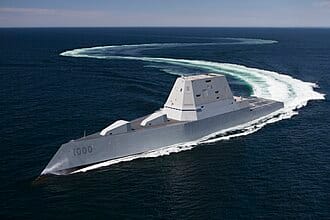
The USS Zumwalt at sea. Trump said it was “Ugly as F.”

The supposed replacement, was a cruiser-size, stealth ship, the Zumwalt destroyer, 17,000 tons and 600 feet long. It is reasonably fast, 33.5kn, and carries a small crew, <100. We’ve managed to build three of these since 2008, but have cancelled the project due to operational problems and costs that rose to $8B per ship. Zumwalts have inward-sloped sides that deflect radar, but they become unstable in turns. Its main weapons are expensive, too: Aegis missiles and CPS hypersonics costing $28-$50 million each. That’s uneconomical compared to French Aster missiles, Mach 3, 80 mile range, $1.1 million. Originally, Zumwalt destroyers carried a rail gun, but it required so much power that you could not move the ship and fire at the same time. The rail guns were eventually replaced by conventional 5″ cannon with a 24 mile range. The three Zumwalts we have are hardly used today, and no more are on order. Something cheaper was needed at least for support, and that was supposed to be the Constellation Frigate, approved by Trump in 2017.

A frigate is smaller than a cruiser, in this case about half the weight. The Constellation was a proven Italian design, 492 feet long and only 7,291 tons. It had good speed, 26 kn, good range, 6000 nm at 16kn, and cost only $950 million, at least when built in Europe. The contract was awarded to Fincantieri Marinette Marine (FMM) of Marinette Wisconsin, the US division of the Italian company. What could go wrong? The problem was that the navy kept adding capabilities and weight. As of November 2025, eight years on, the weight had increased by 700 tons, the cost to $9 B for two, and no design has been finalized. The first Constellation frigate is only 12% built! Trump has not quite cancelled the program, but has reduced the order to two from the original eight.

Trump-class battleship, as envisioned, with a rail-gun, lasers and two, conventional 5″ cannon.

And that brings us to the current, Trump class battleship, shown above. It’s long, 840-880 feet, and heavy, 39,000 tons, or 2.5 times the weight of the cruiser-sized, Zumwalt. As was intended for the Zumwalt, the offensive weapons are missiles and a rail gun, 32 MJ, but now there is enough power run the ship and fire the weapon. Japanese versions of the rail gun have launched cheap shells at hypersonic speeds, ~5000 mph (hypersonic) at up to one per second to 100 miles. The shells cost only $85,000 each, a bargain.

For defense, these battleships are to carry two, 300kW, Helios lasers, similar to Israel’s “Iron beam,” but 3 times as powerful. They are augmented by smaller lasers, by four, 30 mm chain guns (Gatling guns), and two, 5″ conventional navy guns of 24 mile range. Engines are estimated to be two gas turbines, perhaps 50MW each, to power the weapons, plus ~100 MW in diesel power for cruising at good mpg. I thus estimate a total of ~200 MW, about as much as on a carrier. There is plentiful space for missiles and fuel too, and it should be ale to do some resupply of support ships. The crew size is bigger than on the Ticonderoga, 600 to 800, but far less than on a carrier. And the look is impressive. It could be a command ship. Still, there are objections.

A main complaint is vulnerability as discussed here. Some see these ships are “bomb magnets,” not stealthy, nor as heavily armored as the Iowas, with lasers and chain guns insufficient to defend them, e.g. from dedicated swarm attacks. Detractors note that Battleships like the Bismarck, Yamamoto, and Arizona have been sunk, typically by air attack, but what they don’t mention is that it took a lot of bombs and torpedos to sink these battleships. Also these battleships will typically travel with support.

Detractors also question the rail gun. Can it shoot down an airplane? can it sink a ship? We don’t know. They point of that the cost and construction time of the ship is high and likely to balloon. Wouldn’t it make more sense to fix the Constellation or the Zumwalt. The tests I’ve seen suggest that the rail gun can not sink a ship with one shot; that still needs a missile. If the gun can hit a plane or missile, it will destroy it, but accuracy may not be sufficient, at long range. The gun seems appropriate for shore bombardment and for slowing a Chinese navy that is already bigger than ours. As for the defensive lasers, these have been shown to stop drones and cruise missiles at a cost of only $10 per shot: nothing compared to a harpoon missile ($1.4 million each) or Aegis ($28 million). I don’t see a smaller ship being able to power these weapons, especially if you want extra room for expansion, like adding a nuclear reactor.

The time-line is what worries me most. For ten years at least, we will have to rely on short-range Arleigh Burkes that could not bombard the Houthis effectively on land, did not effectively defend US shipping in the Red Sea, and that uses million-dollar missiles to shoot down $20,000 drones. And in ten years, will we still want it.

Robert Buxbaum, January 5, 2026. As a totally side issue: I doubt this is a battleship: It currently carries only one powerful gun. You need at least two to be a battleship, IMHO.

Is China really a smaller economy than the US, but twice as efficient

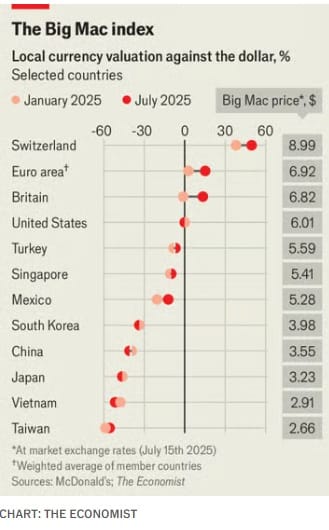
The Economist has run this burger-metric of currency valuation for 40 years or so. I find it instructive.

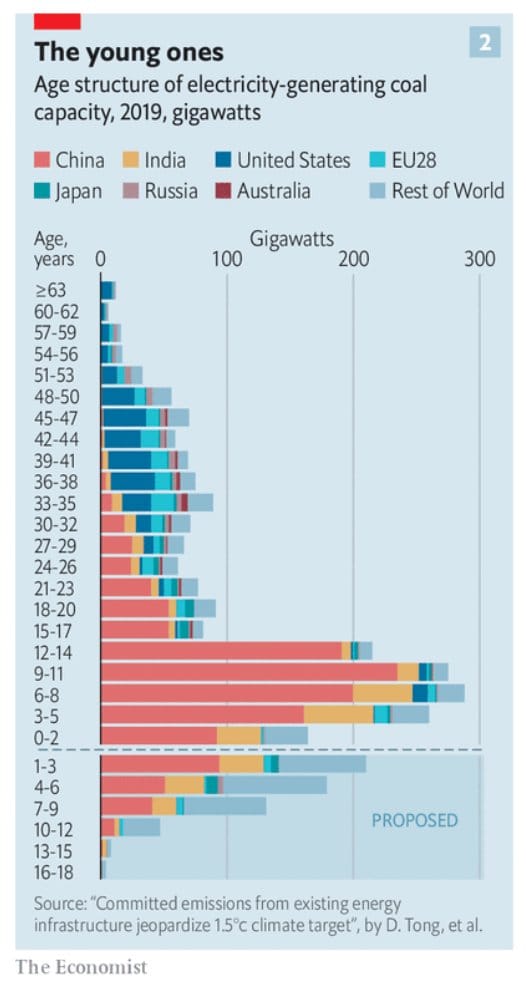
One can buy a new electric car in China for US $20,000, roughly half of what it would cost in the US. Similarly, a good phone is cheaper in China, or clothes, or a Big Mac. A McDonald’s Big Mac in China costs, effectively $3.55, 59% of what it costs in the US, slightly less than 3/5 the US price. The Chinese explanation is that China is nearly twice as efficient as the US at most every type of manufacturing. I don’t believe this explanation, though there is some truth to it: Their electricity is cheaper, in part because they burn mostly coal for electric power. Meanwhile we have shut-down our coal plants, and have hardly built nuclear since the 1970s.

Another source of efficiency is that China arranges its manufacturing into dedicated cities for different products, one city for toys, another for luggage, others for cars, planes, hair driers… This helps efficiency but I’m not sure how much, and I don’t see these advantages applying to McDonald’s. There is no way I believe their workers are 5/3 as efficient as US workers when it comes to making burgers. It’s not like they ship the burgers from a central factory, and they buy gain and meat from us. My sense, then, is that it’s not efficiency that keeps prices low, but that the Chinese currency, the yuan is undervalued.

It’s hard to estimate how much their currency is undervalued, but I will use the burger-metric, above and say the yuan selling for about 3/5 its true value, and that this explains most of why Chinese shoes, cars, and clothes are so cheap. The rest of the price difference is efficiency, I’d guess. China isn’t the only country with an under-valued currency; Japan’s currency seems even more undervalued. Similarly India, Taiwan… The China is a bigger economy, though, and correcting the Chinese GDP by 5/3, I find their economy is yet bigger, about 111% as big as ours. By a similar correction, European economies appear smaller than they are given credit for.

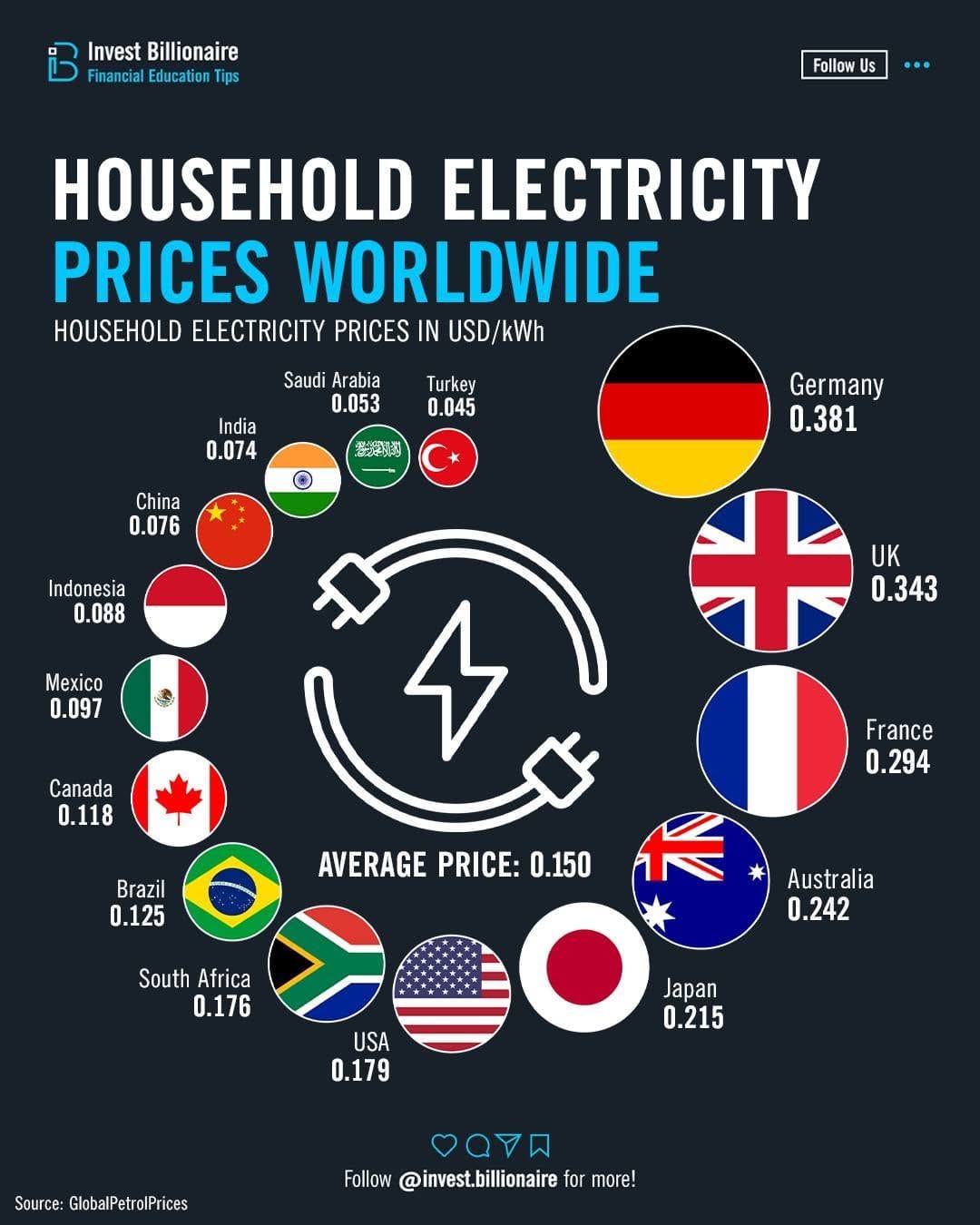
Chinese electricity is cheap, in part because they burn coal. Also, their currency is undervalued; ditto for India, Indonesia, Turkey.

China’s undervalued currency helps propel its growth, I think, and provides us with cheap goods, but our industry suffers. Also troubling, China will likely surpass us militarily in 3-5 years. One way of slowing this is through tariffs. Trump’s tariff formula, as I understand it, was designed to preserve some China trade, allowing US consumers to benefit, but also taxing the exchange. I think this is a good idea.

Another proposal is to lower the US interest rates. Currently our prime interest rate is 6.5% while China’s is 3%. This provides an incentive for the Chinese industry to invest in the US, maintaining its undervalued currency. The benefit isn’t quite as large as it might seem since we have a 2.7% inflation rate and China has a 0.7% inflation rate. Correcting for this, our bonds return an effective 3.8% and Chinese bonds return 2.3%. The difference is about 3/5 similar to the mismatch in our currencies. Trump has been pushing the Federal Reserve to lower our interest rates, and The Fed has grudgingly agreed, slowly. A lower interest rate would also spike US industry and inflation, and help reduce the government deficit. Trump has also proposed new ships for the navy. Too little, too late, I think. Things should get dicy in the next decade between the US and China.

Robert Buxbaum, December 30, 2025. I started this post not knowing where it would lead. As I research and write, I learn. Perhaps you will too,

Rich folks aren’t taxed because they have no income; you can do some of this too.

Two tax questions: (1) How do the top rich people manage to pay such low taxes, e.g. Warren Buffett paying at 0.1%. and (2) why do these rich folks campaign for higher taxes. Warren Buffett has campaigned for higher taxes for 50 years. These questions seem perhaps related.

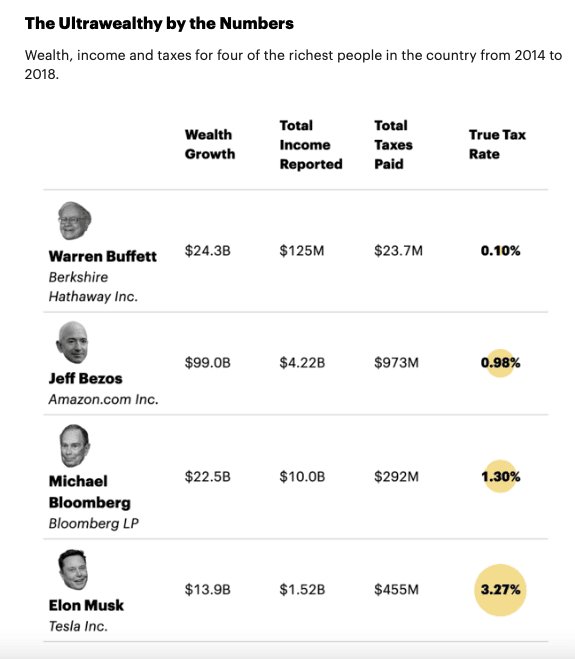
I got my tax data from a public tax advocacy group, ProPublica. In 2021 they received the tax filings for many important people including the 25 US richest from the years 2014 to 2018. They find that these individuals paid a total of $13.6 billion in federal income tax while their wealth rose a collective $401 billion, go here for more. Dividing the numbers, we see an average income tax rate of only 3.4%, with Warren Buffett paying the least, 0.1%. This is far less than the “half of the rate that my secretary pays,” that Buffett likes to claim.

The reason these people pay so little tax is that their taxable income is zero. They use a very wide variety techniques to do this. Among these are charitable foundations, including those that lobby for higher taxes and against climate change. The foundations buy private planes and send the founders (and their families) to climate change events in the South of France or Davos, Switzerland. “Pro-tax” foundations hire tax accountants to research ways that the rich avoid taxes, often the founders then use these methods while speaking out against others who do the same. Bezos was so successful at avoiding income that he got welfare payments in two of the five years, ProPublica found. Soros and his son got $2,400 in COVID payments. They had almost no income. The one tax all these folks hate is tariffs because it is almost impossible to buy new, expensive things from abroad while avoiding them. See my essay, “Tariffs are inflationary, but not on you.”

Another advantage of a charitable foundation is that 74% of your donation can offset capital gains. You have to itemize your donations, but If you give $1 million to your foundation, you can use it to offset $740,000 of stock appreciation earnings. Not a bad deal. You can also use any stock losses against gains. Thus, it’s a good idea, if you itemize, to sell some losing stocks when you sell gainers (while holding on to other gainers, of course.) All of this is only available to those who itemize, and it’s only the rich who benefit by itemizing.

Borrowing money against your assets is another popular tax avoidance scheme, one that ordinary folks could use (but don’t over-do it*). The scheme is often called “Borrow, Buy, Die.” You borrow a large sum against your assets (your home, your stocks, or options –Musk has lots of Tesla options, etc). You then use the borrowed money to purchase property, typically: a vacation home, rental properties, a hotel, or a car. If you structure the purchase right, the interest can be deducted from any other earnings you have including rents. You then have no taxable income, or a lower income while the property appreciates. You can often structure the purchase so that depreciation can be deducted against income as well. Meanwhile, you get to drive the car, live at the vacation home, or rent it as an Air B&B, or stay at the hotel for free.

You live this way until you die. When you die, your heirs get the asset, but they are not taxed on the appreciation. The asset is transferred at its value at the time of death. You’ve avoided paying all the income tax you’d have to pay if you were to sell before death. Most home-owners do this on a small scale: They borrow to buy their home or the building where their business is. Or borrow to buy a vacation home or income property. They use through their life-time, deducting the interest, then leave it to their kids. There is no inheritance tax on most homes or small businesses, and the asset appreciates year to year. Both Nixon and Obama proposed eliminating this loophole by taxing appreciation at death. This would be a lot fairer than the current inheritance tax that is full of loopholes, and unfair when it works. If your parent bought a $10,000,000 item with taxable income, and it remains at that value, why should it be taxed a second time at death?

For a small businessman like me, it made sense to borrow to buy the building that my business operates out of and pay myself a normal rent. It’s income, as real as salary, but taxed at a lower rate, Besides there is no payroll tax on rental income. Another advantage of renting to myself is I can be trusted to fix the building and pay the rent, and I will not throw myself out if there is a downturn, nor will I raise the rents exorbitantly. My car is owned by my business, another plus. I pay a fee for personal use, but this is cheaper than using my own taxed income. When I die, the building (and car) will go to my heirs, tax free.

One last change I’d like to see is in the payroll tax. I’d like to see it tax the entire taxable income, but at a lower percent than the current 15.2 or 7.6. Currently the first $150,000 of income is payroll taxed at 15.2% for a self-employed individual, a plumber or office cleane, even before he/she pays income tax. An office worker is taxes at half this rate, 7.6% before income tax, with the company making up the other 7.6%. A CEO making $10 million pays this rate too, but only on the first $150,000. This amounts to $11,400 in payroll tax, or less than 0.11% of salary. I consider this disparity a bigger scandal than the fact that the richest 25 Americans paid only 3.4% in income tax.

Robert Buxbaum, November 25, 2025. *Trump presents a cautionary tale about property investing; if you invest at the wrong time, you can lose your shirt. In the late 80s, the property market in NY collapsed briefly, and he really was less than penniless. Don’t over-extend. The property market doesn’t collapse often, but you don’t want to be wiped out if it does.

What causes innovation? is it worth it?

Innovation is the special sauce that propels growth and allows a country to lead and prosper. The current Nobel prize believe that innovation powered the Industrial Revolution, causing England to become rich and powerful, while other nations remained poor, weak, and stagnant. Similarly, Innovation, they believe is why 19th century Japan rose to defeat China, and propelled China’s 21st century rise. But why did they succeed when others did not. What could the leader of a country do to bring power and wealth through innovation. Improved education seems to help; all of the innovation countries have it, but it is not the whole. Some educated countries (Germany, Russia) stagnate. An open economy is nice, but it isn’t sufficient or that necessary: (look at China). That was the topic of this year’s, 2025 Nobel prize in economics to Mokyr, Howitt, and Aghion, with half going to Joel Mokyr for his insights, historical and forward looking, the other half going for economic modeling. I give below my understanding of their insights, more technical than most, but not so mathematical as to be obtuse the normal reader..

The winners hold that innovation, as during the industrial revolution, is a non-continuous contribultion caused by a particular combination of education and market opportunity, of theoretical knowledge, and practical, and that a key aspect is depreciation (destruction) of other suppliers. Let’s start by creating a simple, continuous function model for economic growth where growth = capital growth, that is dK/dt. K, Capital, is understood to be the sum of money, equipment, and labor knowledge, and t is time with dK/dt, the change in K with time modeled as equal to the savings rate, s, times economic activity, Y minus a depreciation factor, δ, times capital, K.

growth = dK/dt = sY − δ K.

Innovation, in the Howett model, is discontinuous and accumulative. It builds on itself.

For the authors, Y = GDP + x, where x is the cost of outside goods used. They then claim that Y is a non-linear function of K, where K is now considered a product of capital goods and labor K = xL and,

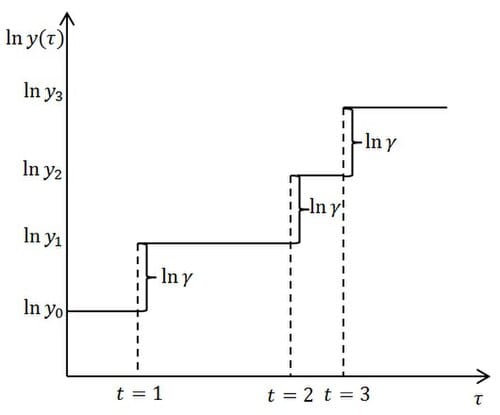
dY/dK = AKα + γ where 0< α <1, and where γ is the contribution of innovation and/or depreciation. The power function, as I understand it, is a mathematical way of saying there are economies of scale. The authors assume a set of interacting enterprises (countries0 so that the innovation factor, γ for one country is the depreciation factor for the other. That is, growth and destruction are connected, with growth being a function of monopoly power — control of your innovation.

According to the Nobel winners, γ is built n previous γ as shown in the digram at right. It can not be predicted as such, but requires education and monopolistic power. The inventor-manufacturer of the typewriter has a monopolistic advantage over the makers of fountain pens. Innovation thus causes depreciation, δ K as one new innovation depreciates many old processes and products. If you add enough math, you can derive formulas for GDP and GDP growth, all based on factors like A and α, that are hard to measure.

GDP = α(2α/1−α) (1-α2)A L,

Thus, GDP is proportional to Labor, L and per-capita GDP is mostly an independent function related to economies of scale and the ability to use capital and labor which is related to general country-wide culture.

The above analysis, as I understand it, is in contrast to Kensyan models, where growth is unrelated to innovation, and where destruction is bad. In these Kenysean models, growth can be created by government spending, especial spending to maintain large industries with economies of scale and by spending to promote higher education. The culture preferred here, as I understand is one that rewards risk-taking, monopoly economics, and creative destruction. Howitt, and Aghion, importantly codify all this with formulas, as presented above that (to me) provide little specific. No great guidance to the head of a country. Nor does the math make the models more true, but it makes the statements somewhat clearer. Or perhaps the only real value of the math is to make things sound more scientific see the Tom Lehrer song, Sociology.

This insight from movie script by Grham Green suggests to me that progress may not be the greatest of advantages, perhaps not even worth it.

This work seems more realistic, to me, than the Keynesian models Both models are mathematically consistent, but if Keynes’s were true, Britain might still be on top, and Zambia would be a close competitor among the richest countries on earth. Besides these new fellows seem to agree with the views of Peter Cooper, my hero. See more here.

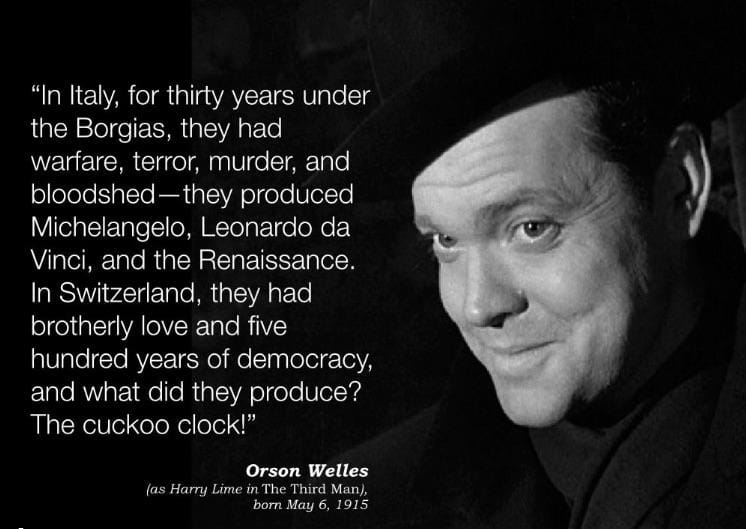
Writing all this reminds me that the fundamental assumption that progress is good, in not necessarily true. I quote above a line that Orson Wells, as Harry Lime, ad-libbed for the movie, “The Third Man.” Lime points out that innovation goes with suffering, and claims that Switzerland had little innovation because of its stability. Perhaps then, what you really want is the stability and peace of Switzerland, along with the lack of domination and innovation. On the same note, I’ve noticed that engineering innovators often ruin themselves dining in ruin, while the peaceable, stable civil engineers live long pleasant lives of honor.

Robert Buxbaum, November 16, 2025. A note about Switzerland is that was peaceful and stable because of a strong military. As Publius Vegetius wrote, Si vis pachim para bellum (if you wish of peace, prepare for war).

The shutdown will drag; we will win

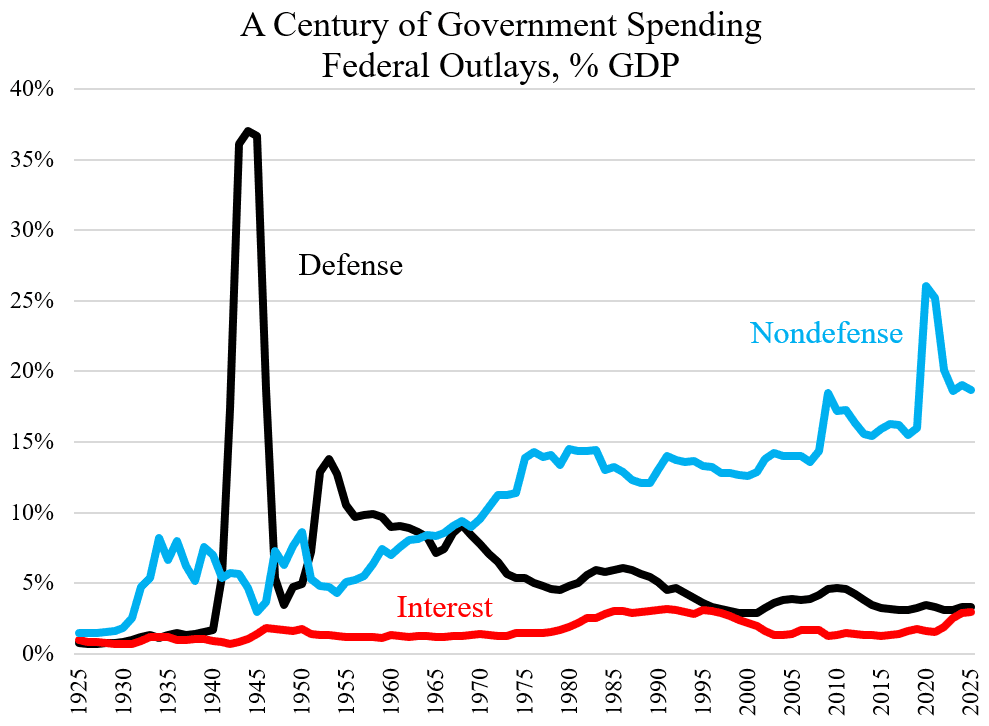
In theory, both US parties are committed to a balanced budget. Both claim they’ll tax as much as they spend, and we’ll pay our debts. In practice, both parties overspend wildly, year after year. The growth in non-defense spending (pork) is particularly egregious, see graph. For fiscal 2024, the 12 month period ending Sept. 30 2024, the government spent $6.75 trillion ($6750 billion), over 20% of GDP and 37% more than the $4.92 trillion we took in in taxes ($4,920 Billion). The difference, $1830 billion, was added to the national debt, already at $34 trillion, pushing it to $36 trillion, that’s more than 100% of our GDP. The interest cost alone is $1.22 trillion per year, 1/4 of our tax income.

Trump campaigned claiming he was going to balance the budget, but he has not (yet). There were some attempts via DOGE, saving about $214 billion, but the DOGE boys were outed, attacked, and gave up. And now the Democrats have forced a shutdown, using their power to prevent additional borrowing. This leaves Trump with a choice, either balance the budget or accept their spending demands. The expectation is that Trump will fold: there is no way he can find $1830 billion/year. Otherwise, many of the governments 4.2 million workers will go without pay, and many important services will stop.

So far, three weeks in, Trump seems fairly successful at keeping most things running while trying to balance the budget. Even if he fails, as seems likely, we will benefit from the attempt, I think.

Some government services are guaranteed to continue despite the shutdown: Social security and the post office because they are funded separately. Similarly, the patent office, the ports, and the airports. In the past some had to shut, but Trump has raised fees so they remain open and operating.

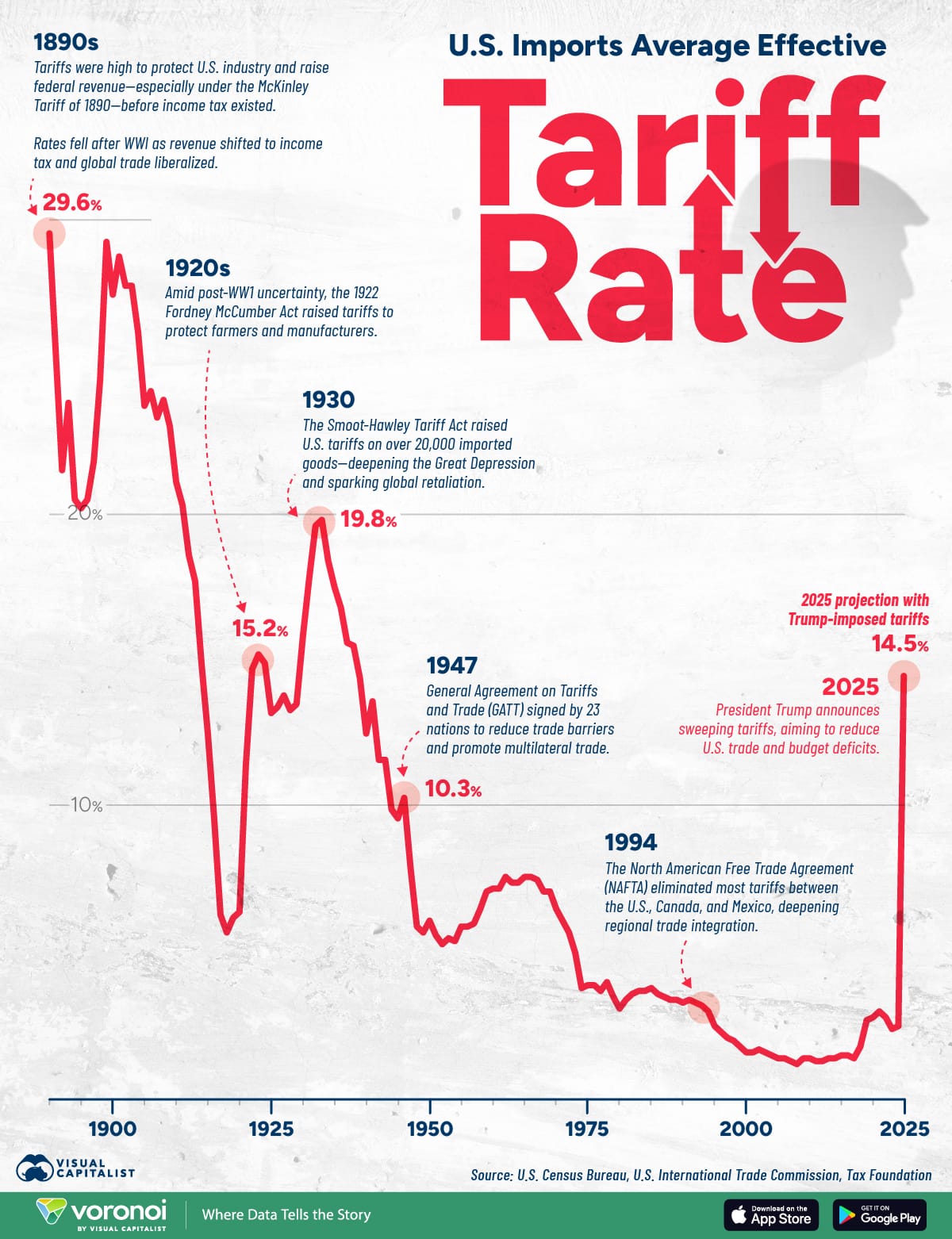
Essential workers, 800,000 people including customs agents and air traffic controllers continue working with most going unpaid. Trump committed to paying active duty military and for the WIC food program using money raised by new, 2025 tariffs. Tariffs are currently bringing in ~$300 Billion/ year, and so far tariffs mostly don’t affect ordinary folks, and help return manufacturing to the US. Some time soon we’ll have to pay the necessary workers and also some 750,000 non-necessary employees including: half the Dept. of Education, most of NASA and Energy.. They are not really useless, but are doing nothing essential to the day-to-day operation of the country.

Trump seems committed to removing many non-necessary workers in an effort to streamline and balance the budget. He fired 4200, bought out another 25,000 earlier this year, and has issued pre-termination notices to 75,000. A federal judge has blocked all firings as unlawful, but my sense is they are quite lawful and mostly beneficial. If you can’t fire non-working, un-necessary workers that you can’t afford to pay, who can you fire?

I suspect the shutdown will last well into November, well past the election, and that more folks will be fired or bought out. The key November crossroads will be food stamps, SNAP. These benefits are scheduled to end November 1 baring an end to the shutdown. Normally the bill is $110 billion/year, but Trump has eliminated benefits for illegal aliens and asylum seekers, and has instituted tougher work requirements. Democrats seem certain that Trump will fold. For the 11th time they scotched a bill to fund this and reopen the government and pay SNAP. I suspect that, at the last minute, Trump will find savings, or left-over funds and will keep SNAP funded through November.

Among the new savings, Trump ended the EV subsidy last month, saving about $7.5 billion/year ($7500 x 1 million EVs), and has negotiated some reductions in drug costs. He also increased the tariff on some Chinese and Canadian goods appropriate for rectifying trade imbalance, it’s been blocked by a federal judge. He’s also cancelled some rail work and research, saving $28 billion, and cancelled $20 billion for hydrogen hubs, and 83% of USAID. Also two navy ships that were years behind schedule and billions over budget. We need the ships, but don’t have the money. So far, this saved enough to pay all military servicemen.

Beyond this, I hope he cuts Biden’s high speed rail plans: $550 Billion for fast trains, Chicago to Seattle, Detroit to Toledo, San Francisco to LA, etc. The investment is $1,500 per person in the US. The eager thinkers overseeing this would never invest their own money, but are happy to invest everyone else’s. I also hope to see the end of NASA’s SLS rocket to the moon, nice but far more expensive than Falcon. We could also cancel some F35s ($0.1 Billion each to buy, and far more to maintain). Musk suggested replacing them with drones. I don’t know that these savings are enough. I don’t know how long we can continue, but each day shut, we move closer to a balanced budget, and that’s a good thing.

Robert Buxbaum, October 21, 2025

The logic to think that prenatal Tylenol causes autism and ADHD

Robert Kennedy Jr. recently started the process to add a warning to the labels of acetaminophen products, including Tylenol, noting a correlation between its use during pregnancy and autism and ADHD in children. The advisability of this is controversial. Experts at Scientific American say “the evidence against Tylenol is thin,” The British Journal, Nature, went further: “It’s Dangerous to Avoid Tylenol While Pregnant”, reversing its call for caution. Similarly, Barak Obama: “Trump’s announcement is violence against the truth.” Nature’s current logic is that any risk of Autism and ADHD is smaller than the risk if pregnant women do not take fever medication. Given the confusion and politicalization of the topic, I thought I’d write about the magnitude of the risk, and the logic to think Tylenol causes autism and ADHD.

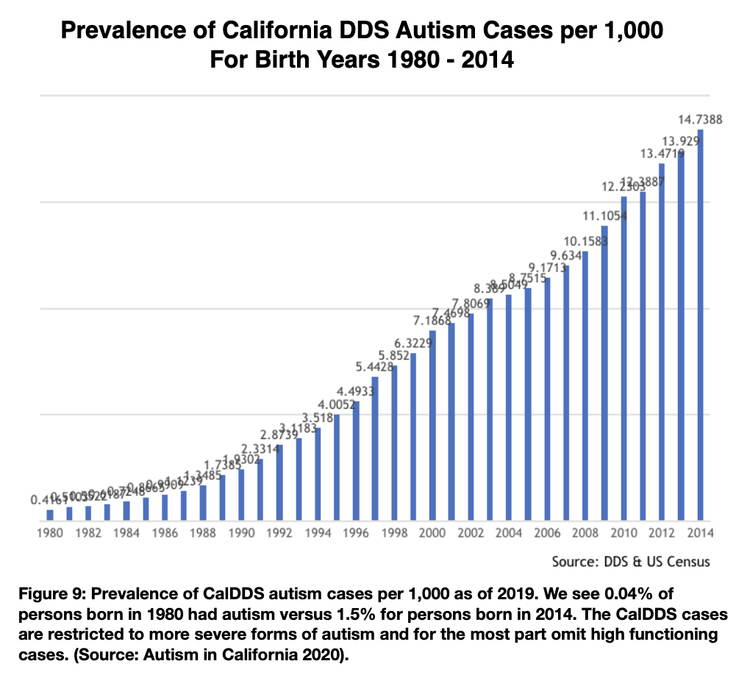
The evidence that there is some, large risk agent is the tremendous rise in the prevalence of autism and ADHD over the last 50 years, see chart above. The rise t matches the rise in the use of Tylenol as opposed to older medications, like aspirin. Correcting for other changes (confounders), this Oxford study finds 95% certainty association of acetaminophen with ADHD; care being taken to remove confounders.

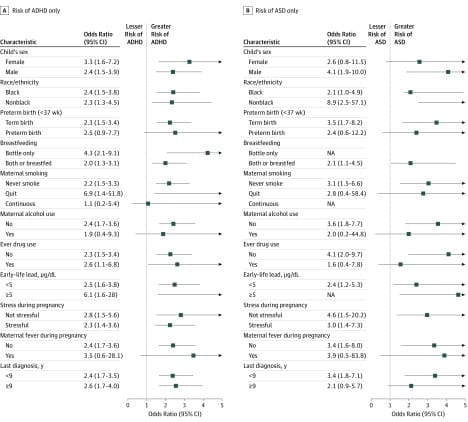
In terms of the magnitude of the Tylenol effect, this study from Johns Hopkins, compared fetal blood levels of acetaminophen enzymes (measured in the umbilical cord) to the risk of autism and ADHD. As shown below, there is roughly a three-times increase in risk for both in every sub-group of child: male and female, black and white, pre-term and full term, drug user or not, breast fed or not, fevered mother or not. Children with higher blood-acetaminophen levels (2nd, 3rd tercile) always have a higher chance of ADHD and ASD — about 3 times higher– than children in the lower tercile.

The higher cohorts of blood Tylenol is associated with higher risk of ASD and ADHD for every subgroup.

This European study found a similar association, but measured Tylenol use based on interviews. Between these studies, I find it reasonable to advise caution. This is the sort of evidence that caused us to put cancer warnings on cigarettes, caused us to caution against alcohol during pregnancy, and caused the mandate for seatbelts. This is usually what scientists use, it’s the best approach we have. I do not suggest dropping all fever medication, but suggest switching to older medications, like aspirin, or cool showers, or following the Harvard medical journal advice to take Tylenol in the minimum dose.

An upside to the political divide is that we’re likely to have better evidence in coming years. in Republican-leaning states, doctors have mostly favored the advisory. Meanwhile,in D-leaning states women are ignoring the advisory, some even filming themselves taking extra Tylenol, in distain for Trump. These two groups provide a controlled study, so that we should have have better data regarding Tylenol safety in 2-3 years.

Dr. Robert E. Buxbaum, October 12, 2025.

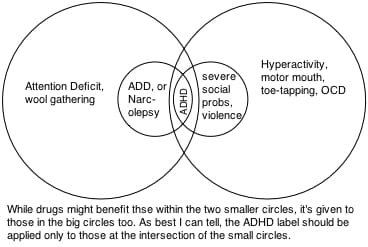
Added Oct. 20,2025: A cynical counter argument to the above, suggested by me ten years ago and others, is that there is no spike in ADHD, that it’s a scam perpetrated by teachers who prefer drugged students to antsy ones. If so, one could argue that the same genetics that make students antsy (ADHD and semi autistic) also affect Tylenol metabolism and use: Parents of such children take more Tylenol. Here is a good Swedish study that supports this view. If this proves to be true, the real scandal is how many normal students, mostly boys, have been drugged up and mis-educated.

Thomas Kuhn, and why half of America loves/ hates Trump

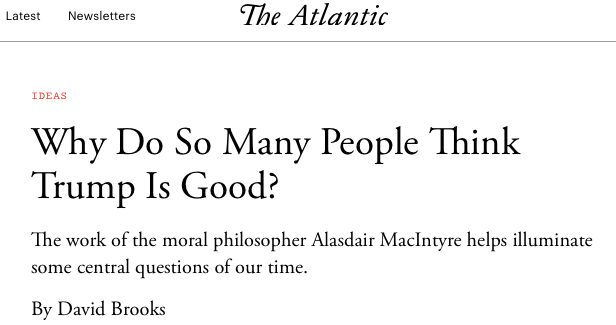
This post was inspired by articles like the one below asking how it was that some Americans, MAGAs think Trump is good when everyone of value sees him as a fat, bigoted, criminal clown. The Atlantic’s answer is they’re detached from classic ideals of good or moral, and are now fueled by “narcissism, fanaticism, and authoritarianism”. I thought a more helpful explanation was that we’re going through a paradigm shift, perhaps progressing in our thought of what it means to be good.

Consider Thomas Kuhn’s analysis of scientific progress. Tomas Kuhn was a major American Philosopher of the 1960s-70s who claimed that science progress was not uniform but included long periods of “normal science” punctuated by change. A “crisis” leading a “Revolution” resulting in big changes in language, outlook and thinking, a “paradigm shift”. In the midst of these scientific revolutions, the experts of the old system fight bitterly against the new while being confounded by the fact that it seems to work.

Consider the resistance to relativity and quantum mechanics. Before 1905 the experts were doing fine: Professors taught and students learned — formulas, tools and techniques were handed over. Educated had respect and money, and could communicate. There were some few contradictions, as in why the sun burned hot, or why the sky was blue, but one could ignore these. You knew who the experts were, and they didn’t include Einstein, Bohr, Pauli, Plank.

Democrats sell red hats and buttons with Fascist or Felon because Trump’s red MAGA (Make America Great Again) hats work for him.

But then came a few more problems, (inconsistencies in Kuhn-speak: radioactivity, photoelectrons, the speed of light… Einstein published on them in 1905, thoughts that few took seriously: imaginary time was a fourth dimension at right angles to the others, etc. The explantations seemed mad and for 14 years after he published, Einstein could not get a university job — anywhere. By 1919 detailed experiments suggested he might be right on a lot of things. It lead to the rise of a new group of experts plus a loss of esteem for the old, and a bunch of crank explainers who were neither but flourished in the confusion.

Hate abounded; new weapons and cures WWI removed aristocrats and beards. A popular book a lecture series of the time was “100 scientists against Einstein.” There followed a lost generation with no clear foundation. It took 50 years to resolve confusion, but there developed new thought leaders, a new language, new standard formulas and books were sold, and we were returned slowly to “normal science” in a new thought paradigm.

I see the conflict of opinion surrounding Mr Trump as a crisis in political thought similar to the crisis in science thought 100 years ago. Polite discourse if gone, replaced by stunts and insults. The government is currently shut, with 40% federal workers, those whose jobs are non-critical, on unpaid leave. It’s a collapse, not of morals, but of language. Trump hopes to use the shutdown, I think, to show that most of these 40%, are not needed. If they are not needed, it reflects a big lack in government — actually a big bloat in government. You can see why the opponents of cuts see Trump as a fascist who uses “dog whistles” to motivate “his base”, there is a lack of communication and a fear Trump may be right too, I think. The experiment in smaller government is being run as I write, and Trump seems confident that some 400,000 federal workers are not needed. Are they? Instead of debating, we’ve got to violence: two attempts on Trump’s life so far, the main college debater, Charlie Kirk, shot dead. Appropriate, I think, is Bob Dylan’s, “Times are a-changing” and “something is happening here, but you don’t know what it is, do you, Mr Jones.”

Other questions are being worked out as we speak -sending chills through the old order: Are China and Europe “ripping us off,” by free trade and stolen technology? Are tariffs an answer. Canadian and European leaders deride these thoughts openly, but I notice that both Canada and the EU have put heavy tariffs on Chinese goods.

Another issue is respect for experts. The Atlantic bemoaned that Trump supporters don’t respect experts on health, climate, and education, but perhaps they are lying. The seas have not risen as expected. Some warming may be good, or better than the remedies. Even if RFK Jr.’s ideas are wrong it seems that science has become unreliable (irreproducible), and that elite colleges aren’t fair in their assessment, nor do they provide great value.

Eventually things will settle down; we will some day have polite discourse. In 40-50 years, I suspect we’ll agree that some tariffs are good and that Trump’s tariffs are either to high or low, We’ll think that the climate push to no nuclear power, was a mistake, as was the giant, Ivanpah solar farm). And we’ll be able to discuss it civilly. I hope the change in thought takes less than 50 years.

Robert Buxbaum, October 3, 2025 – we are now entering another physics crisis too, I think.

Gerrymandering, old-politics, fairer versions could be worse than less fair

There is no truly good way to give representative voices to a population. The founders of the country decided that there would be a set number of congresional representatives, divided it by states, and left it to the individual states to subdivide, with a few provisos. They mandated that congressional districts have to be contiguous, entirely within a state, and contain approximately the same number of citizens in each. A later law specified that the districts should not directly disadvantage a racial minority. Within these parameters, legislators in most states have divided congressional districts to advantage those in power to a greater or lesser extent. The most egregious of these are Gerrymanders, odd shaped districts that protect sitting congressmen and parties, as bad as the worst of these are, they are better than some, truly awful, “fair” divisions, in my opinion.

This was Michigan’s district map (Detroit area) until redrawn by independent commission, 2022. My district was the dark blue one that looked like a man in a chair.

Consider my state: Michigan, a swing state that voted for both Biden, and Trump. Currently the state house is 52% R and 48% D, but Democrats were in majority as recently as 2024. Our congressional district map used to be a disaster, shown at left. In 2022 it was replaced by a map created by an independent committee that aimed for roughly square districts that aimed to keep towns and communities together. The result is that most districts are either safe D or safe R. This, we’re told, is bad in that it leads to factionalism, with congressmen pandering to political extremes, with little incentive to compromise.

A fairer alternative (?) would divide the congressional districts so that all or most district are swing, like the state. Supposedly such districts would elect moderates who compromise. This version, though no-less fair than the above, is not good, in my opinion. I expect it creates chaos and turnover. I’m also not convinced that compromise is always best.

Pennsylvania’s congressional map before redistricting by independent committee. Ugly, but fair in its way.

The variant of this that preceded our current is for congressmen and others in power to create districts that are fairly safe for themselves and their party, leaving those of the other party in a few, super-concentrated districts. This division is less fair, but far more stable and workable. It lead to ugly gerrymander districts in Michigan (left) and Pennsylvania (below). This is not bad in itself. What was bad about these gerrymanders is that the congress folk, secure in their jobs, formed a political aristocracy. Seats passed from generation to generation, and ruled fairly disconnected from the wishes of those they represented. A good part of the aristocracy is that they worked well with each other, across party lines. They were friends, alumni of the same schools, members of the same churches and country clubs. They were good-‘ol-boys, who didn’t pander nor embrace ideological extremes. Writers romanticize this, but I’ prefer our current’m glad it’s going in MI.

California and Texas politicians are pushing for more gerrymandering. California’s congressional districts were drawn by independent committee. Their governor called the Trump White House fascists as recently as today. There’s a vote to get five more D-districts. The claim is it’s to balance Texas’s push for three more R-districts. I nothing illegal or immoral here, just old style politics, power grabs left and right, with incendiary language. The districts look bad, but I’ve seen worse. No need to call ‘fascist’ unless your next step is to impeach president Trump again, or your hope is another shooting.

The worst option, in my opinion is term limits. It’s promoted from both sides, and I consider it insane, except for party bosses. It actively prevents people from re-electing the politicians they like based on the objection that these people have been on the job long enough to feel at home and get things done. I consider term limits completely non-republican, non-democratic, a disease, “fair” only in that it hurts every citizen equally, benefitting only party bosses.

Robert Buxbaum, September 27, 2025

Korean movies and music; my thoughts on why they do so well

A Korean animated movie, K-Pop Demon Hunters, KPDH, just broke all-time record for most watched movie in the History of Netflix. It’s only 92 days old, and not a big-budget film with massive marketing, but it’s had over 314 million views so far, appearing on the most-watched list in 32 countries. Some Chinese movies have had more views, but these tend to be specific to China, with limited appeal elsewhere. KPDH has three songs in the Billboard 100 too, including golden at no.1, see official music video, 352M views for the music video. The last movie to have three songs in the Billboard top 100 was Saturday Night Fever, some 45 years ago. Other top Korean groups include Stray Kids, BTS, and Black Pink, they’ve had multiple #1 songs world wide of the last five years, and fill 50,000 seat stadiums regularly with seats going for $150. Here are Black Pink, filling a 50,000 seat stadium in Paris. If you read the US press, you’d hardly know these groups exist. BTS had a big hit during Covid called, “Permission to Dance,” a positive song during that grim period, danced e.g at the UN. Listeners noticed, the press did not. I think the press finds Koreans “anodyne”, that is, insipid.

Top movies of the last 20 weeks include two Korean offerings, Squid Game and K-Pop Demon Hunters

One thing that turns off the US press, is that Korean songsters and movies are less sexual, and less politically moralizing. The top Oscar awards go to political movies. At the Emmies, this year, we were told, “F*ck ICE, Free Palestine.” Similarly, Green Day, Eminem, and other western bands lead chants of F*ck Trump. The press takes this moralizing as intellectual, but I find it cheap and suspect it turns off many potential fans.

Director of Star Wars, Kennedy, promoting diversity.

A favorite moralizing of US movies is to show women who don’t need or want men. Frozen was like that, as was Encanto, Last Dragon, Moana… Star Wars was a top franchise that Disney made more feminist, writing basically every man as bad. Women were good, powerful, and inherently talented. Rey a main new character, grabs a light saber with no background or training, and uses it like an expert. It turns off men, then women stayed away too.

End kiss of Pirates of Penzance, the pirate prince and the major general’s daughter

We like to show black actors in white rolls too, though not white actors in black rolls. Hamilton was successful, and had black actors playing in every positive roll, white actors playing evil idiots. It was done again with 1776, less successfully. All the founding fathers are cast as women; Jefferson is black, bisexual, and pregnant. There’s a message somewhere. The upcoming movie about King Gustaf of Sweden has a dark-skinned actor playing the king. Why? We had a dark- skinned daughter of the major general, who bends the pirate over to kiss him, a dark skinned Snow White with most of the Dwarves normal height, a female She-Hulk, stronger than the original, who lectures the original (and us) about anger. Apparently, the idea is to highlight the difficulties powerful women face. Korean shows have casts that make sense to the plot, and no gratuitous reversals or sex. Did Oppenheimer need the many sex scenes? Did the suicidal love interest have to be written stronger than the main character?

Then there are the sequels: the Marvel universe includes 37 interconnected movies, Star Wars, 19, Batman 13. To get the full story, you have to see them all. So far, in 2025, only two of the major funded movies were original (one was Korean, Mikey 17). The others are all reboots or sequels with recycled plots and ever-bigger explosions. It all works until it doesn’t, then they make a reboot. Law and Order, 26 years old with 500 episodes.

Scene from Crash Landing on You. These two are in serious trouble.

Korean entertainment has series too, but much shorter and with fewer explosions. A TV series will have only 16-24 episodes and I’ve yet to see one with a mass-murderer. The Squid game, has had 13 episodes over 3 seasons. Some deaths, but not wholesale. A longer series, “Crash Landing on You,” 24. In it, a successful South Korean executive (female) is blown across the border to North Korea into the arms of a handsome, North Korean. No deaths. They could have gone on for years, but didn’t. People rewatch the original.

Other countries movies moralize too, like ours do, but they tend to be patriotic moralization, and anti gratuitous violence, not violent, anti-patriotic as in the US. Chinese TV shows present Chinese politicians as honest, they have praise for the Chinese schools and infrastructure, and regular invocations to respect the police. India moralization is similar, but more towards family order. Korean messages are in-between, with some crooked politicians, some violence, people with mental or emotional problems who evolve.

Robert Buxbaum, September 17, 2025. The industry has pushed back against criticism of their wokeness, claiming that the only folks turned off are the toxic fans: white, MAGA men, mostly, who hate diversity. They claim to be happy when such fans stay home and watch KPDH, or go buy $150 tickets to see Koreans sing in Korean.

Kamala’s positivity; Gavin’s MAGA tears

Harris presents is something of a unifier.

Kamala Harris always seems happy while most Democrats come off as sad, and report being sad. Harris’s campaign also stood out from Clinton’s and Biden’s for positivity. She never played the racism card, or the feminine glass ceiling card, and still managed to raise $1.5 B, some three times more money than any other candidate in history. In a campaign of only 108 days, she focussed on the swing states, inspiring support from the press, comedians, academia, Socialist Bernie Sanders, and the billionaire class: Mark Zuckerberg, Bill Gates, Jeff Bezos, etc. Quite a mix. She lead in the polls to the end, barely beaten by a seasoned, media-savvy Trump, running effectively as an incumbent. I suspect she’ll be unbeatable in 2028, if she’s allowed to run.

Harris has some minor down-sides, all of them related to her positivity. First off, Harris comes across as somewhat dim-witted. That’s annoying to political junkies, but not really a problem for most Americans. She comes across as having a good heart, and that’s enough. We elected George W. Bush and Joe Biden, dim-witted, likable guys, who people we related to. Brains can even be a handicap: we voted out George H. W. Bush, despite his brains and expertise, even after he’d taken down the Berlin Wall. It helps to have competent helpers, and Kamala stayed close to Obama and Cheney. Her VP failed to impress, but she’s sure to pick better in 2028.

Harris also comes off as drunk; she giggles a lot (AOC too). It makes them seem young and insubstantial. I find it annoying, but not deadly. It’s a way around tough questions, Rather like Regan’s jokes, or Trump repetitions. Hilary campaigned as a good, heavy smart and mean. Her “basket of deplorables” comments, for example. They must have sounded OK for those already on her side, but they sound mean and dismissive to everyone else. Harris will need a signature issue by 2028, but is sure to find one. Free everything seems to be working for Mamdani in NY.

None of the other top D contenders for 2028 are anywhere near as likable as Harris. Gavin Newsom comes across as smart, but mean. Not too smart, but as mean as Hillary. His current push is to redistrict California to fight the Republicans. That’s smart but not inspiring; people of California will loose their representatives so the democrats can gain power. Then there are the photos he puts out of himself drinking “MAGA tears.” The idea he’s pushing is that Republicans are cry-babies, while he’s a man’s man, and that he enjoys making MAGA folks cry. It’s dismissive of the suffering (real and imagined) of the rural, less rich, less educated, white folks — the folks who are the core Republicans. He also calls them “The base,” and that’s another slight; they’re people, often hard working, disrespected, with uncertain job prospects, from communities that are unusually hit by prescription drug addiction. Harris knows enough to care or pretend to care.

A staple of Newsom’s campaign, him smiling, drinking “MAGA tears”

I don’t see Newsom as particularly manly, either. He looks less virile than Vance, who he targets as a compete wimp. Newsom recently published pictures with Vance’s head photoshopped onto a skinny female dancer. Is that funny? Is it true? Vance is an ex- marine. That’s the sort of manliness credential that Newsom doesn’t have, and is rare among Democrats. Not that I see America preferring manly men, but Newsom should know enough to not to get into a manliness fight with a marine.

And that brings us to baggage. Harris has relatively little. Newsom has the California fires that he screwed up by diverting water. He has ownership protecting high crime, the homelessness by fighting ICE and The national guard. He also has the baggage of California’s, high taxes, high regulations, high energy costs, and population flight. California keeps needing to borrow money, and in this, I doubt it helps that he’s made illegal immigrants a priority. He could acknowledge that Trump has reduced crime, as the DC mayor has. Harris has mostly avoided speaking on these issues, and it seems to help.

No empathy for Charlie Kirk from Manitoba’s Minister of Families

Other Democrat heavyweights are as bad. Walz says he checks his phone every day hoping to see that Trump is dead. He also claimed to enjoy news that Tesla stock is down. Illinois Governor Pritzker, here, blamed Trumps heated rhetoric for the murder of Charlie Kirk. Then there are those like the MSNBC host or CNN’s who blamed Kirk himself. Or this, from Manitoba’s Minister of Families. It’s mean, untrue, and not even self serving. Harris comes off as the best among the Ds, and the most electable.

Robert Buxbaum, September 12, 2025. I’m a New Yorker, and I like Trump’s accent, his brashness, his tariffs and peace initiatives — and that he backs Israel over Palestine. A lot of people can’t stand him though. Folks are likely to elect a Democrat in 2028 — so long as the D candidate doesn’t claim to drink MAGA tears or watch to see Republicans dead.