Category Archives: personal relationships

Is college worth no cost?

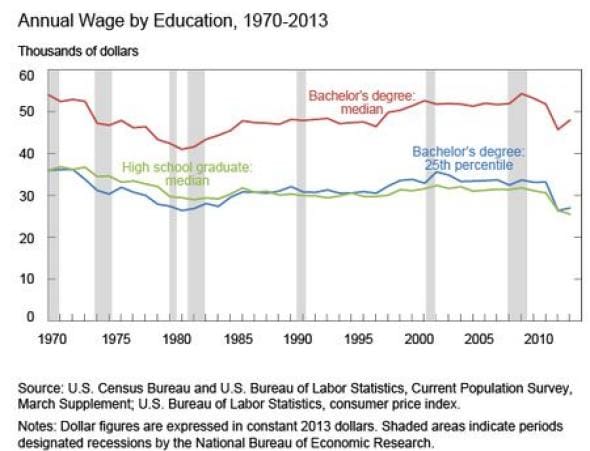
While a college degree gives most graduates a salary benefit over high school graduates, a study by the Bureau of Labor statistics indicates that the benefits disappear if you graduate in the bottom 25% of your class. Worse yet, if you don’t graduate at all you can end up losing salary money, especially if you go into low-paying fields like child development or physical sciences.

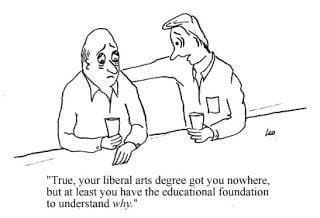
Salary benefits of a college degree are largely absent if you graduate in the bottom 25% of your class.

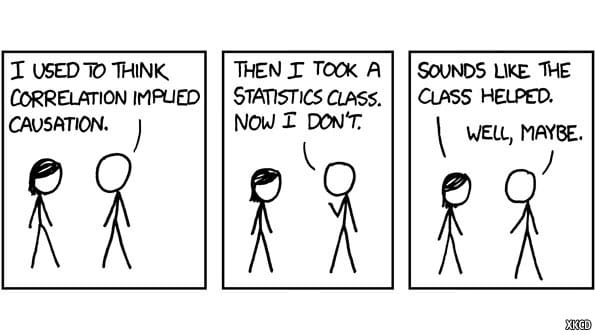
The average college graduate earns significantly more than a high school grad, but not if you attend a pricy school, or graduate in the bottom 1/4 of your class, or have the wrong major.

Most people realize there is a great earnings difference depending on your field of study with graduates in engineering and medicine doing fairly well financially and even top graduates in child development or athletic sciences barely able to justify the college and opportunity costs (worse if they go to an expensive college), but what isn’t always realized is that not all those who enter these fields graduate. For them there is a steep loss when the four (or more) years of lost income are considered.

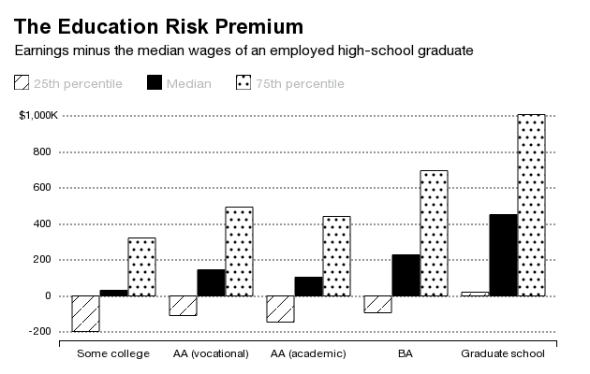
risk premium in wages

If you don’t graduate or get only an AA or 2 year degree the increase in wages is minimal, and you lose time working and whatever your costs of education. The loss is particularly high if you study social science fields at an expensive college, and don’t graduate, or if you graduate in the bottom of your class.

A report from the New York Federal Reserve finds that the highest pay major is petroleum engineering, mid-career salary $176,300/yr, and the bottom is child development, mid-career salary $36,400/yr (click to check on your major). I’m not sure most students or advisors are aware of the steep salary difference, or that college can have a salary down-side if one picks the wrong major, or does not complete the degree. In terms of earnings, you might be better off avoiding even a free college degree in these areas unless you’re fairly sure you’ll complete the degree, or you really want to work in these fields.

Top earning majors Fed Reserve and Majors that pay you back.

Top earning majors: Majors that pay.

Of course college can provide more than money: knowledge, for instance, and learning: the ability to reason better. But these benefits are likely lost if you don’t work at it, or don’t go in a field you love. They can also come to those who study hard in self-taught reading. In either case, it is the work habits that will make you grow as a person, and leave you more employable. Tough colleges add a lot by exposure to new people and new ways of thinking about great books, and by forced experience in writing essays — but these benefits too are work-dependent and college dependent. If you work hard understanding a great book it will show. If you didn’t work at it, or only exposed yourself to easier fare, that too will show.

As students don’t like criticism, and as good criticism is hard to give — and harder to give well, many less-demanding colleges ,give little or no critical feedback, especially for disadvantaged students. This disadvantages them even more as criticism is an important part of learning. If all you get is a positive experience, a nice campus, and a dramatic graduation, this is not learning. Nor is it necessarily worth 4-5 years of your life.

As a comic take on the high time-cost of a liberal arts education, “Father” Guido Sarduchi, of Saturday Night LIve, describes his “5 minute college experience.” To a surprising extent, it provides everything you’ll remember of 4 year college experience in 5 minutes, including math, history, political science, and language (Spanish).For those who are not sure they will complete a liberal arts education, Father Sarduchi’s 5 minutes may be a better investment than a free 4 years in community college.

Robert. E. Buxbaum. January 21-22, 2015. My sense is that the better part of education is what you get when you don’t get what you want.

Of Scrooge and rising wheat production

The Christmas Carol tells a tale that, for all the magic and fantasy, presents as true an economic picture of a man and his times as any in real-life history. Scrooge is a miserable character at the beginning of the tale, he lives alone in a dark house, without a wife or children, disliked by those around him. Scrooge has an office with a single employee (Bob Cratchit) in a tank-like office heated by a single lump of coal. He doesn’t associate much with friends or family, and one senses that he has few customers. He is poor by any life measure, and is likely poor relative to other bankers. At the end, through giving, he finds he enjoys life, is liked more, and (one has the sense) he may even get more business, and more money.

Scrooge (as best I can read him) believes in Malthus’s economic error of zero-sum wealth: That there is a limited amount of food, clothing, jobs, etc. and therefore Scrooge uses only the minimum, employs only the minimum, and spends only the minimum. Having more people would only mean more mouths to feed. As Scrooge says, “I can’t afford to make idle people merry. I help to support the establishments I have mentioned [the workhouses]. They cost enough, and … If they [the poor] would rather die,” said Scrooge, “they had better do it, and decrease the surplus population.”

Scrooge, the poor rich man.

Scrooge, the poor rich man with a tiny carbon footprint.

The teaching of the spirits is the opposite, and neither that of the Democrats or Republicans. Neither that a big government is needed to redistribute the wealth, nor that the free market will do everything. But, as I read it, the spirits bring a spiritual message of personal charity and happiness. That one enriches ones-self when one give of and by ones-self — just from the desire to be good and do good. The spirit of Christmas Present assures Scrooge that no famine will result from the excess population, but tells him of his 1800 brothers and shows him the unending cornucopia of food in the marketplace: spanish onions, oranges, fat chestnuts, grapes, and squab. Christmas future then shows him his funeral, and Tim’s: the dismal end of all men, rich and not:  “Will you decide what men shall live, what men shall die? It may be, that in the sight of Heaven, you are more worthless and less fit to live.” And Scrooge reforms, learns: gives a smile and a laugh, and employs a young runner to get Cratchit a fat goose. He visits his nephew Fred, a cheerful businessman for dinner, and laughs while watching Tom Topper court Fred’s plump sister-in-law.

The spirits do not redistribute Scrooge’s wealth for him, and certainly don’t present a formula for how much to give whom. Instead they present a picture of the value of joy and societal fellowship (as I read it). The spirits help Scrooge out of his mental rut so he’s sees worthy endeavors everywhere. Both hoarding and redistribution are Malthusian-Scroogian messages, as I read them. Both are based on the idea that there is only so much that the world can provide.

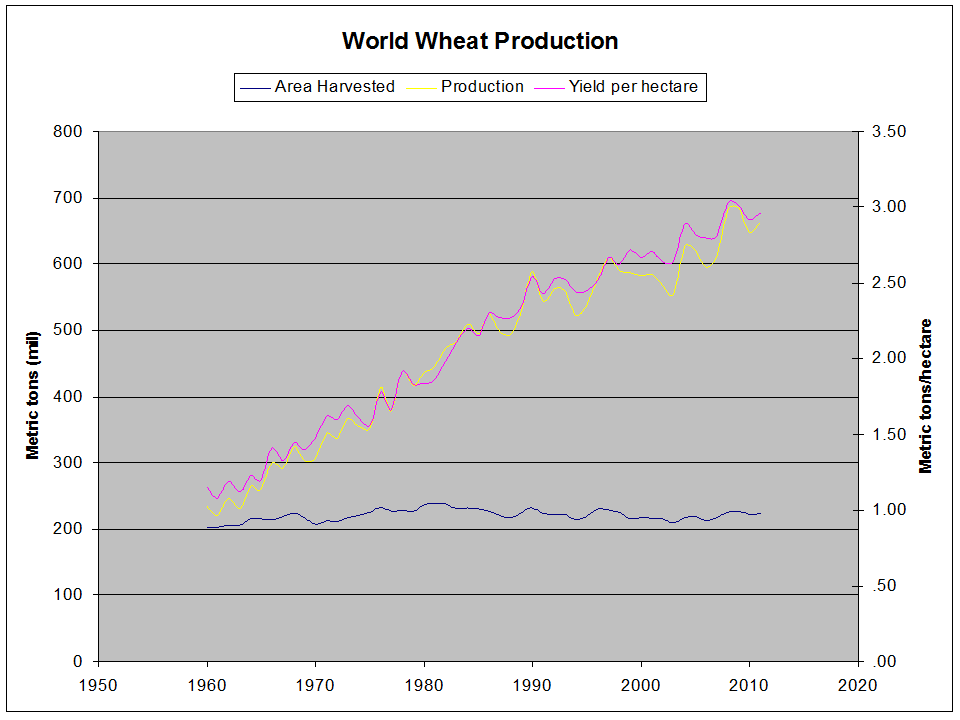
World wheet production

World wheat production tripled from 1960 to 2012 (faostat.fao.org), but acreage remained constant. More and more wheat from the same number of acres.

The history of food production suggests the spirits are right. The population is now three times what it was in Dickens’s day and mass starvation is not here. Instead we live among an “apoplectic opulence” of food. In a sense these are the product of new fertilizers, new tractors, and GMOs (Genetically modified organisms), but I would say it’s more the influence of better people. Plus, perhaps some extra CO2 in the air. Britons now complain about being too fat — and blame free markets for making them so. Over the last 50 years, wheat production has tripled, while the world population doubled, and the production of delicacies, like meat has expanded even faster. Unexpectedly, one sees that the opulence does not come from bringing new fields on-line — a process that would have to stop — but instead from increased production by the same tilled acres.

The opulence is not uniformly distributed, I should note. Countries that believe in Malthus and resort to hoarding or redistribution have been rewarded to see their grim prophesies fulfilled, as was Scrooge. Under Stalin, The Soviet Union redistributed grain from the unworthy farmer to the worth factory worker. The result was famine and Stalin felt vindicated by it. Even after Stalin, production never really grew under Soviet oversight, but remained at 75 Mtons/year from 1960 until the soviet collapse in 1990. Tellingly, nearly half of Soviet production was from the 3% of land under private cultivation. An unintended benefit: it appears the lack of Soviet grain was a major motivation for détente.  England had famine problems too when they enacted Malthusian “corn acts” and when they prevented worker migration Irish ownership during the potato famine. They saw starvation again under Attlee’s managed redistribution. In the US, it’s possible that behaviors like FDR scattering the bonus army may have helped prolong the depression. My sense is that the modern-day Scrooges are those against immigration “the foreigners will take our jobs,” and those who oppose paying folks on time, or nuclear and coal for fear that we will warm the planet. Their vision of America-yet-to-be matches Scrooge’s: a one-man work-force in a tank office heated by a single piece of coal.

Now I must admit that I have no simple formula for the correct charity standard. How does a nation provide enough, but not so much that it removes motivation– and the joy of success. Perhaps all I can say is that there is a best path between hoarding and false generosity. Those pushing the extremes are not helping, but creating a Dickensian world of sadness and gloom. Rejoice with me then, and with the reformed Scrooge. God bless us all, each and every one.

Robert Buxbaum, January 7, 2015. Some ideas here from Jerry Bowyer in last year’s Forbes.

What is learning?

It is common to spend the most of one’s youth in school — presumably learning something. The financial cost for primary education is a few hundred thousand dollars, borne by the state, plus 13 years or so of the student’s life. College learning costs another $50,000 to $200,000, borne by the student, plus another 4-6 years of life. The indication that you’ve learned something appears, in many majors by the ability to get a job that pays more than the school financial cost. But there is also a sense that you’ve learned something, and this is perhaps the only reward for students of film, religion, or archeology. My question is based mostly on this part: what is this learning. Is it the same as knowledge, a set of facts, or satisfaction — perhaps you could be as satisfied by ignorance or drugs. How do you evaluate the spiritual payback from 4-6 years of college? I don’t have all the answers, but ask to exercise my ignorance.

It would seem to me that an important standard of learning is that it should develop the mind and not corrupt it. But how do you recognize the difference? it seems to me one should leave with a set of mental skills should be new to you, recognizable to a normal outsider, and somewhat useful, as in the poem “Botany” even if you don’t use it. I’m not sure if the skills have to be true, by the way, or how useful they have to be. Perhaps developing a new confusion is better than having false notions — knowing that you doubt something.

sometimes education is the removal of false notions.

Sometimes learning can be the development of doubt.

If you’ve been educated in music, it seems to me you should be able to make sounds that appear pleasant to a normal listener; if you’ve been educated in mechanics, you should be able to make machines that work, and if you’ve been educated to think… perhaps then you should be able to walk into a discussion about something you once thought was true, and show that it is really false to an extent that others would accept it (and act upon it?). That is, my suspicion is that learning should involve an identifiable change –not only internal satisfaction, and I also suspect learning the new must involve unlearning the old.

Liberal Education may not be useful, or elevating

Education that isn’t useful isn’t particularly elevating

And that leads us to facts and methods: knowledge. Facts are good, they are the fuel and  substance of learning. Without facts there is nothing for the learning to attach to. But facts are often wrong — the ignorance of others, and even when right, they can be  deceptive. If you’ve learned the moon is made of rock, or out of green cheese, it’s pretty much the same unless there is a reason to think the fact you’ve learned is true, and unless you’ve a good understanding of what the fact ‘means.’ I can imagine a rock that is organic (a gall stone) and less solid than some (old) green cheese. The word rock or cheese must mean something to you to be a fact. Similarly in all subjects; if you learn that Shakespeare is a better writer than Poe, you should have a reason to believe it, and a clear understanding of the word ‘better’ in this context.

Turning to the knowledge of methods. It seems to me that learning a new method of thought, action, or argument is a necessary component of learning– one might even call it virtue, but this too seems to have limitations if it is not directed to use. A person is half-educated if he leaves school knowing how to do geometric proofs, but never doing any, or knowing how to run a great business, but never running one. A science graduate should at least be able to use the techniques learned to demonstrate that the world is made of atoms, and that the sun does not circle the earth and perhaps more. An argument can be made for traditional education areas of logic, rhetoric, mathematics, and dialectic. But these seem useless unless they are applied to a worthy end. One should do more with the new methods than to win drawing-room arguments.

There should be some satisfaction to accomplishments, but I'm not sure how it's learned.

Learning should provide satisfaction –in particular religious learning — but it’s nicer if it goes with doing good for someone (not only the poor) and the ability to earn an honest income. 

There should be a moral component of learning too, but here I feel less certain in describing it, or describing how it should be taught. Theodore Roosevelt said that “An uneducated man can steal from a rail car, “but an educated one can steal the whole railroad.” but perhaps stealing the railroad isn’t such a bad thing if it’s done legally. And as I don’t quite know when the honest stock deal is moral, I’m even more in the dark as to how to teach one to recognize the moral from the immoral in these situations. Two thoughts here: a student deserves some satisfaction from his or her learning and (from Aristotle’s Nicomachean Ethics) to be moral, the student has to earn an honest income. One who can not earn a living is bound to steal from someone sooner or later.

A final sign of learning, and perhaps it’s crown, is creativity, the ability to come to new understandings and develop new things. To do this productively requires some knowledge of the past plus an indescribable view of the future. A spark? A divine madness? Schools do not seem to be able to teach that, but it can help or hinder by either encouraging it, or beating it down. If you did not possess this ability when you entered school, you are unlikely to leave with it, even if you just did drugs, but school can teach one to direct the spark productively.

I’ve noticed that our high schools focus little on the above areas, perhaps because they are hard to test. Rather classes aim to the exams, and the exams test (as best I can tell), memorization, aptitude, and exposure. A surprisingly large fraction of our students leave diagnosed as ADHD. Still, strangely, our graduates do better than the Europeans.

Dr. Robert E. Buxbaum, December 29, 2014 (I taught in college). Here’s some advice I wrote for my 16 year old daughter in high school.

General Tso’s chicken

Self promotion. It's not for everyone.

Self promotion. It’s not for everyone.

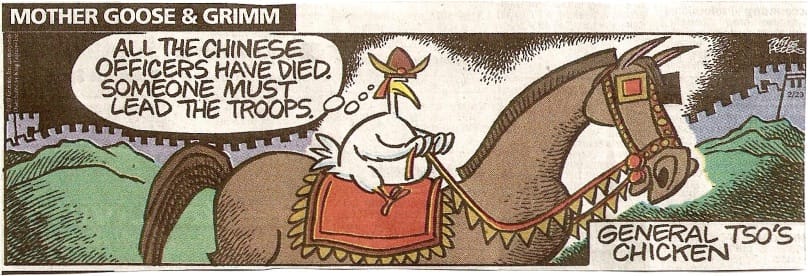
Is funny because …. it’s classical metaphysical humor. The lowly chicken becomes the hero and leader, and the troops are following him/it (to victory).

We know that some unlikely leaders are successful, perhaps just because they’ve the pluck to get up and do something (that’s the secret of American success). Presumably the troops are too timid to lead, and are following this chicken because of his determined air, and his hat and horse: clothes make the man. You should not follow every leader with determination, a fancy hat and a horse, by the way. Some leaders will devour their followers, and most do not care for self promoting underlings.

Robert Buxbaum, Nov.12, 2014.

Loyalty, part 2: power hurts the leader

In a previous post, I made the case that one should avoid accepting loyalty requests as these are generally requests for your self-destruction. Someone who asks for loyalty is not saying he’ll provide you with good pay, a comfortable environment, empowerment, and good security. Rather that he wants your service despite little or not pay, discomfort, enslavement, and likely death or disgrace. There are some, few exceptions, but loyal service of this type rarely serves the servant.

Your chance of surviving as a minion is low; your chance as master is lower.

Your chance of surviving as a minion is low; your chance as master is lower.

I’d now like to claim that having loyal followers hurts the leader, too, costing him good service, and separating him from health, friends, and family. Most leaders are better off as half of a duopoly, without minions, and only loose control of their workers. The first reason for this is to note that minions don’t do good work relative to free men. They die for no good reason (e.g. you forgot to feed them), or they stop work and wonder what you’d like next, or they get drunk and gripe, or they beat each other up over fervor or small territorial issues. They very rarely innovate or work together, and for any complex project like taking over the world (or the tristate area) needs workers who do. Good work requires pride in achievement, and a loyal slave has none.

Having loyal followers precludes one from having a close relationship with the followers (you can’t appear weak), and also with friends (your minions must have one leader, not two). The leader gets used to being surrounded by sycophants, and begins to doubt those who behave otherwise. The boss will begin to distrust friends and allies, those he needs to stay in power, as these are the very people who could most easily assist others to take leadership from him. Over time, the king, boss, monopolist and dictator share less and less. As a result they end up secret and bitter, with many fears and none he can call close. And what pleasure is there in power, if one can’t share the rewards with friends and family, or share the burden with others.

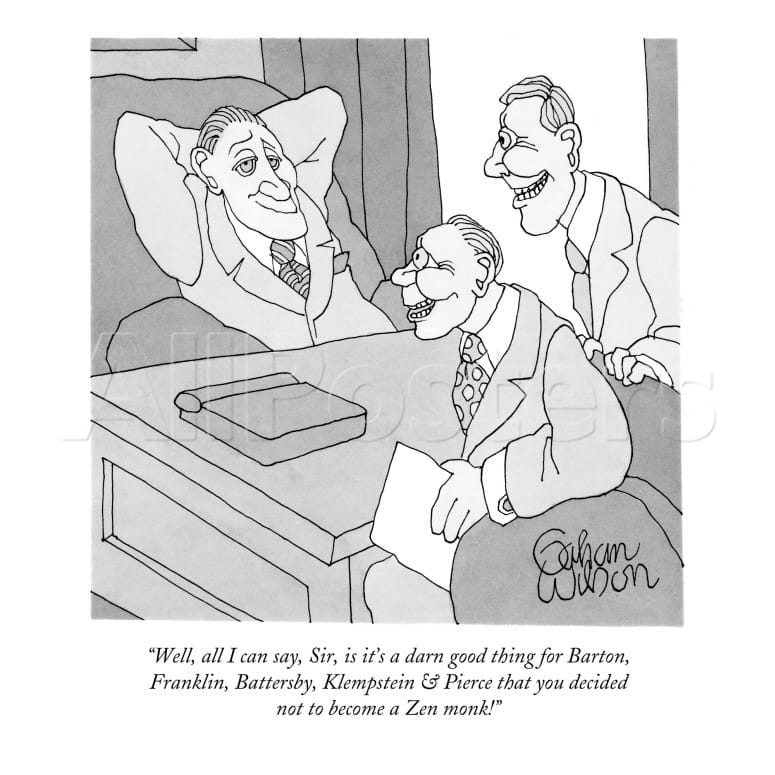
Only support someone who could rule reasonably honestly and well. Chaos is worse than a dictator. Kanin from the New Yorker.

Only support someone who could rule reasonably honestly and well. Chaos is worse than a dictator. Kanin from the New Yorker.

A great number of kings have killed themselves in one way or another, very often because of overly large ambitions (see cartoon). King Saul, in the Bible is perhaps the first, Hitler is perhaps the most famous, and Colonel Qadhafi of Libya is perhaps the most recent. More often, maximum leaders are murdered, typically by friends and family. Famous examples include Julius Caesar, Augustus Caesar, and Nero; Charles I, Louis XVI, Richard III, and Tzar Alexander. Both the king of rock (Elvis) and the king of pop (Michael Jackson) killed themselves with drugs. Yet others died in needless wars or were exiled. Napoleon was defeated, exiled, returned, re-exiled and then murdered by an associate.  It’s not that safe to be the infallible king. Perhaps the wisest move is that of Pope Benedict, who last year left Rome for a life of monk-like solitude. Machiavelli points out, in “The Prince”, that only two Roman Emperors died of natural causes, one because he became emperor at a very old age, and the other was Marcus Aurelius, an advanced ruler who empowered his subjects.

The great leaders create so much space for others to lead that they are almost invisible: they lead by offering encouragement.

Political bosses and monopolist businessmen, though lower in power, don’t fare much better in life. Boss Tweed died in jail, as did Capone, Boss Pendergast. Even if they avoid jail, the fact that no one likes you takes a toll. No one liked Vanderbilt or Rockefeller, Carnegie, Morgan, or Fisk. While they lived, they could expect nothing more than senate investigations and ugly lampoons in the free press, plus an unfavorable memory after death. William Hearst and Howard Hughes died as virtual hermits, best remembered as the inspiration for “Citizen Kane” and “The Navigator.” Peter Cooper and Steve Jobs are different,  industrialists liked in life and in death; and Bill Gates may join them too. Their secret was to empower others.

He's being eaten alive by his power, money, and respect. In the end, he had none.

He’s being eaten alive by his power, money, and respect, as are all those he might love.

Woe to the wife, child or friend of the dictator. The wife and children of a king or king-pin rarely enjoy much of the power. The king-pin doesn’t trust them (often with good reason), and neither do the people. Stalin killed his wife and children as did Nero, Frederick the Great, Herod, Hitler, and quite a few others. It was said that is was preferable to be an animal in the courtyard of these greats than a son at their table. And even if the king or king-pin doesn’t kill his wife child or son, the people often do e.g. Marie Antoinette was killed shortly after Louis XVI and the Tzarina of Russia alongside Alexander III. Similarly, the wife of Hitler, the Mistress of Mussolini, and the wife of Nicolae Ceausescu all died at their husband’s side, sharing the punishment for their husband’s ambition.

The kings of Sparta fared relatively well, as did their wives, despite the militarism of Sparta. Their trick was that Sparta was a du-archy, a country with two kings. Sparta was strong and stable, and their kings (mostly) died at home. In business too, it seems the selfish leader should step back and become almost invisible. It helps him, and helps the people too. If the leader can’t share power this way, he or she should at least give people a simple choice between two things he controls and accepts (chocolate and vanilla; Democrat and Republican). Workers with a choice, even a small one, learn to act somewhat independently, and customers (or citizens) don’t complain as much either if they have some control over their fate. All will come to like the leader more, and the leader will like himself more. People stopped resenting Microsoft when there was a viable alternative, Apple, and Microsoft engineers benefitted by having a competitor to their products. I suspect that Bill Gates realized this would happen when he helped fund Apple’s return to the market. Unfortunately, most monopolists, bosses, and king-pins are too stupid, or too afraid to do this. In the end, it’s the trapped employee or follower who shoots the leader from behind.

Einstein on freedom producing good. I'd say freedom is also a good in itself

The ideal situation is a delicate balance between control and freedom. A great leader will empower those around him and support the opposition. That was the unrealized sense of Mao Tse Tung’s hundred flowers movement (let 100 flowers bloom; left 100 schools of thought contend). It’s political tensegrity. Most leaders can not let go to do this (Mao could not). Still, there IS a sanity clause, Virginia. And a leader should know that there is no benefit to the king who gains the whole world and loses his friends, family and sleep.

Robert Buxbaum. Remember, remember the 5th of November; those oppressed, and those imagining themselves oppressed rise and plot.

When is loyalty a good thing? pt. 1

Loyalty to a person or institution is generally presented as a good thing — a sign of good character. Disloyalty, by contrast, is considered one of the basest of character traits — the sign of a dastard, a poltroon. But I’d like to make the case that the loyalty that leaders demand (the most common loyalty situation) isn’t real loyalty, but stupidity or worse, toadyship disguised as loyalty. I’d further like to suggest that this attachment hurts the leaders as much as the followers in most situations — well, nearly as much. That is, a sane leader is better off where there is a viable alternative to his product, leadership, or service — a loyal opposition party, as it were.

If you give loyalty for free don't expect it in return.

If you give loyalty above your self interest, don’t expect it in return. If you don’t value yourself, no one else will.

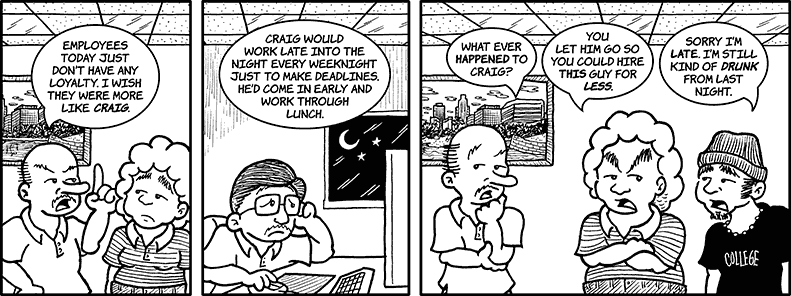
But first, what is Loyalty? If I believe a teacher because he makes sense, or serve a boss because he pays me well, this is not loyalty, but common self-interest. Similarly, if I eat at a restaurant or buy a product regularly, it isn’t loyalty if the quality is particularly good and the prices particularly reasonable. Loyalty is when you eat at a place despite the quality being bad, or the prices high; or follow a leader who pays poorly and provides only danger and hardship. Or who’s crooked and damaging to your sense of self.

If you give a company or group loyalty for free, they are likely to take it and you for granted; if you don't value yourself, no one else will.

If you give a company or person loyal service, they are likely to take it and you for granted; Matt Johnson, 2010.

In general, there are only two reasons why any person would follow a leader like this. One is an attachment to the leader’s vision of the horrible future if you do not. Tales of grisly torture from a distant enemy are good to keep the underlings in their place. An even better reason is attachment to a brilliant future if you do suffer in the present. Tales of the glorious messianic future where you and those you love benefit from the current struggle and sacrifice. It doesn’t have to be a godly messiah; communism presents a messianic vision without a god, but it’s glorious, and the sun always shines. Generally speaking leaders who ask for loyalty ask from both perspectives: a horrible enemy at the gates, and a glorious future if you follow.

There may be a rational basis to fear a grisly enemy, or to suffer and follow in hopes of a glorious future, but if you find you are being asked to follow a single individual or a group that’s controlled by one individual, it’s worthwhile worrying that the leader may not be loyalty to you. Ask yourself: does the leader share real power and information? Does the leader make you feel worthless for the heck of it? If you have a leader like that, it might be worth considering: if the messianic vision ever does materialize (unlikely) the leader may forget to reward your part. History has quite a few examples of this.

Loyalty to country includes the imperative to try to improve the leadership.

Loyalty to country requires one try to improve the leadership. Leadership rarely agrees.

Where real loyalty shows up as a sign of a fine personality, is in marriage where both parties share power, money, and information. Or in loyalty to a country where you (or your child) has a real, rational chance of being leader. If you really trust the significant other (a good marriage) or where there is reason to think one’s home and family will benefit from one’s personal sacrifice, one might rationally give up ones comfort and life following to protect one’s significant others. Even so, the real loyalty is not to the leader, but rather to an organization that one believes will protect one’s children and community. A leads who asks you to kill innocents (Al Qaeda, Stalin, HItler, Jonestown), or who amuses himself by your suffering, e.g. (Stalin) probably has lost the connection between your loyalty and the goal. (Cue the song– we don’t get fooled again).

An honest military leader will have a soldier council or protective group above him to keep him (and others) from over-reaching. There will also be a time limit on the loyalty commitment and an explicit understanding that service does not include suicide, genocide, immolation, or personal embarrassment for the amusement of others. There is an also understanding that the follower’s life and well-being will not be sacrificed in vain, and that no one will be expected to accept suicide rather than capture. On the other hand, a soldier who runs away from all danger and thus endangers his fellows or mission should expect punishment or courts-marshal.

Church groups don't often look favorably on oversight

Church groups don’t often look favorably on oversight

Many groups don’t tolerate oversight of this type, and these groups should be viewed with suspicion. Church groups for example, are often led by those would like you to believe that suspicion of them is suspicion of God, it isn’t — it’s suspicion of a person. An honest leader gives the option of going to the police or the union representative, or the newspaper if necessary. Without redress, the worker/soldier/churchman may come to suffer needlessly or come to commit atrocities because of the power of the organization or the personal charisma of the leader. Any organization with a messianic vision of the future is dangerous; all the more so if there is no half-way point, no real sharing of power in the way to get there, and no real oversight for the grand-high pooh-bah (or whatever the grand leader’s title). Let the follower beware.

A Parable: The Donkey and the Brigands, by I don’t know who (I can’t find a source, but know this isn’t my own creation).

There once was a farmer who had a donkey — a talking donkey, as is the way with these parables. At one point, as they were traveling through the woods, they heard the approach of brigands (thieves). “Move quickly,” the farmer said to the donkey, otherwise we’ll be captured.” “Will the brigands treat me any worse than you do?” asked the donkey. “No,” said the farmer, about the same.” “Will they feed me any less than you do, or beat me any more?” “No,” said the farmer, about the same, I’d guess.” Will they load me any heavier, or make me go on longer journeys?” No, said the farmer, about the same, I’d guess.” “When I’m too old to work, will they keep me in my old age, or will they kill me, as you likely will for animal feed and for my bones and skin?” “Probably they’ll do as I would,” said the farmer. “In that case,” said the donkey, “I’ll go at my pace and what will be with the capture will be.” The moral: loyal service has to be a two-way street.

In part 2 of this essay, I’ll explain why even the leader doesn’t benefit from your complete loyalty.

Robert Buxbaum, October 20, 2014. I run my own business, and sometimes think about it, and life.

On being a 16 year old girl

I’m not a teenage girl, in case you thought otherwise. I’m the father of a girl who just turned 16 though, and she asked me to write on the subject of what to expect from the next year or so. Here’s my sense of expectations.

You'll find yourself creeping up on adulthood, as a partner, not a kid; it's a scary and wonderful transition.

You’ll find yourself creeping up on adulthood, as a partner, not a kid; it’s a scary and wonderful transition.

In retrospect, you’re likely to say that 16 was among the best years of your life. These are the last glorious, innocent days with friends: days before competition means anything, before you really have to think of the world beyond your high school community. You are still hanging out, working together, and trying to feel your way towards a dim future as adults. Sorry to say, that’s in retrospect. While living through it, you’ll find this year fairly boring, and somewhat nerve-wracking. You’ll find your time filled with activities: school, home, hobbies. You’re likely to find these activities somewhat less stressful than before, because you’re more used to them and higher-up in the pecking order. Still, there are a lot of activities, and you’ll notice your day is pretty full. My advice: take time to enjoy your friends. Take pictures; they’ll be priceless.

At sixteen hobbies begin to be taken more seriously.

At sixteen, hobbies begin to be taken more seriously.

For both boys and girls, you are beginning the single most difficult, painful, and important transition of your life: the transition to adulthood. It’s not painful yet, but it will get worse in the next year or two. If all goes well, by age 22 or 23, you will be through it. Once through it, you will think of yourself as an independent moiety: someone who’s formed by us (your parents, family, and friends) but not defined by us. Once through it, if all goes well, you will be able to support yourself financially, and you will be able to live on your own. You are likely to want to live on your own too (teary smile) at least for a good portion of the year. At 16, this is a dimly seen, scary future, far off in the fog.

At this  point, you’re still tied to us, and I’m glad you don’t resent it. You’re happy to be a daughter, a sister to your siblings, a peer to your friends, and a student in your high school. Some teachers and classes you like, others less so. Your grades and hobbies are important to you, but your friends are more important. It’s nice to have high grades, but not so important as to disturb a friendship. You think of your hobbies as fun sidelights, and home as a place to relax with them. At home you write, read, draw, or cook for the fun of it. As the next few years wear on, this will change. You’ll think of yourself more as a writer, an artist, or plumber; as a private first class, or whatever. You’ll be good at something, not just generally bright. Some friends will fit better into this self-view; the friends who don’t fit will slowly drift away.

Sexuality rears its head in new ways at 16.

Sex rears its head unexpectedly.

At 16, I started thinking of myself as ‘an engineer’ or perhaps as a scientist or mathematician based on my hobbies and what I was good at in school. It became clear that I was not going to be an athlete, a historian, or a musician (though I retained an interest). Dropping options is a big, painful part of the transition. I recall almost hearing the doors closing behind me. You want to turn back, to catch the options. Know that, to not choose is to choose. As those doors close (and they should) new, better ones open that you didn’t realize existed. Losing friends and hobbies that are too high maintenance is good for you, and for them at this stage. Sex will rear its head, unexpectedly, and in new ways. Sexuality and homosexuality were words; for some they are becoming the dominant reality. For better or worse, you’ll be drawn in.

As the year draws to a close, you’re likely to find our parental presence more and more annoying. This is a good thing; it’s what will get you out the door, and launch you as a person. We’re on your side here, but won’t be able to help as your old you will begin to fight the new one. You plan to go to college, perhaps away from home (both options are good), but some of your friends will want to stay at home and do on-line vocational courses, or get married as soon as possible. You’ll likely drift away from those friends. Some college-bound friends will pick schools far from yours, or will pick majors or activities that you’re not interested in. You’re likely to find yourself gravitating to those friends who’re going to your college or for majors that match yours. There is pain in realizing that you won’t be as close with the remaining friends. Know that doors are opening here in two ways. First, just as high school provided your current friends, college and pre-college will provide you a new group — ones you may keep longer since the relationship based on shared direction, not just shared experiences. Also, know that some of the friends who drift away now will come back later — perhaps when you and they are married.

You may come to realize that some of your closest friends are your competitors for college places, scholarships. This may seem bad (or disloyal) but it’s good. Competition will help you improve, and will increase your drive, and that’s what you need this year. Think of the relationship in “A separate peace.” Think of how the relationship between the young Harper Lee and Truman Capote likely shaped “to kill a mockingbird” and furthered both of their careers. Competition with your cousins is good too. Watch how they deal with competition and life choices. Are there family members that could be life models or coaches? A big reason we have the family reunions is so that you can have a choice of life models and coaches.

Teen jobs are rarely all that exciting, but are an important part of personal development.

Teen jobs are rarely all that exciting, but are an important part of personal development.

Money will become a lot more important in the next few years — for things, travel, school applications, and clothes. You’re likely to find it’s annoying to get your money from us, and you’re likely to start working more for money. This is the beginning of financial independence. As you do, you’ll find yourself becoming defined by the job you do, how much you make, and what you spend your money on. This is good, but includes a loss of Idyl. Your first jobs will not be great, and you may find leaches hanging on: financial and emotional. As annoying as it is to have a leech, it’s worse to be the leach. Try to avoid it; be a good friend or neighbor. You may want to buy stock, or start a company, or produce a product for sale: a book, album, or whatever. If it’s something you’re interested in and you try to make money at it, the experience will be worth the effort. Even if it turns out a financial failure, it will be an important part of the emotional and financial person you make of yourself. If you don’t go into business, you may get involved in politics or religion, moving right or left. That’s OK, and very normal — another part of self-development.

You may find yourself re-evaluating your thoughts on religion and government.

You’re already beginning to develop wonderful life-skills. We don’t compliment you enough on this. You’ve learned to cook eggs and noodles, and find you like the independence it gives. That’s the ticket to adulthood. You’ll need more life skills to give you real independence, but you’re on the right track. You’ll need to learn to do laundry, shopping, and cleaning. You’re likely to need to be better at driving, writing, and negotiating: all difficult things. You’re likely to go through emotional cycles or depression as you think of the stuff you can’t do, or don’t understand, the friends you’re losing, or the things you’d like to do, but can’t. Don’t stress; you’ve got 5 years, or more. We’re very proud of you, and will try to help by tutoring, hugs, more-freedom, and the assurance that independence is worth the struggle. All beginnings are difficult, and this is a big beginning.

You can define yourself by your hobbies or by your man, but try not to define yourself by your man's hobbies.

You can define yourself by your hobbies or by your man, but try not to define yourself by your man’s hobbies.

Switching schools includes the opportunity to reinvent yourself as something completely new. Most people do this to a greater or lesser extent. Embrace your inner weirdo, but not your inner crook. Try to invent yourself as something fun and active, not sinful or destructive. Try to be the young scholar, mechanic, artist, or athlete, not the young goth, gangster, or drug addict. High schools try to help here by exposing you to books and movies about alienated 16-20 year olds. Popular in my day were Great Expectations, The Outsiders, Catcher in the Rye, The Dead Poets Society, To Kill a Mockingbird, Slaughterhouse 5, and A Separate Peace. Take what comfort you can. School assignments will include essays on law, government, and God. Write honestly, with conviction. These assignments can help develop your life views and personality. We’ll try not to stifle you here, even when your opinions differ significantly from ours. Of course, if you come up with something truly stupid or awesome, we’ll tell you.

Your friends will start dating, or discussing boys, and you are almost certain to start looking at boys differently: first as exciting possibilities, and then as potential mates. Part of the attraction involves the ability to define yourself by the boy you choose. This is a comfort and a curse. The comfort is that it avoids you having to define yourself, or grow up quite. The curse is that the boy doesn’t know who he is either. You’ll find that some boys are nice and some are grounded, others are not. And some are really messed up. With the right kind, you’ll find you can do more as a pair than as a single. Eventually you’re likely to pair off; in our community that happens at about 21-24. When it happens, I hope it’s with a nice, grounded fellow. It works best if you first know who you are, but even otherwise, it can work. Couples sometimes discover who they are together. And, at that point the transition will be over. You’ll be a married adult; you’ll introduce yourself as Mrs Shnicklefritz, or as Dr. and Mr Schniklefritz, or whatever, and we’ll prepare ourselves to spoil our grandkids.

Dr. Robert E. Buxbaum, proud father of you and your two older siblings. October 4, 2014. Though further along in their life paths, I can hope that the older siblings will enjoy these thoughts too. I’ve previously mused about US education, and whether ADHD was a real disease. For my older daughter’s 21st birthday, I invented a new mixed drink.

New mixed drink, the R°

Earlier this week, R__ turned 21, the drinking age in most of the USA. As a gift to her, I thought I might invent a new mixed drink that would suit her taste, and make her birthday more special. My requirements: that it should be kosher, that it’s made with widely available ingredients; that it should be relatively sophisticated, that it should be lower in alcohol (a fatherly concern), and that it should taste good to her and the general public.

The R___: gin tonic and grenadine

The R°: gin, tonic , ice, and grenadine

What I came up with, is something I call,The R°. It’s a modification of one of the great drinks of the western world, the gin and tonic. My modification is to use less gin, and to use grenadine instead of the traditional squeeze of lime. As she gets older, she may want to increase the gin content. The recipe: put 2/3 shot gin in a 10 oz straight-sided glass. Fill the glass 2/3 full of ice, near-fill with tonic water, and add a dash of grenadine, 1/4 shot or so (I used Rose’s). Stir slightly so the pink color stays mostly on the bottom. The result is slightly sweeter than the traditional gin and tonic, kosher in almost all places (you’ve got to check, but generally true), fairly sophisticated, good-tasting, and a reminder of Israel, a country where pomegranates grow all over. If you order one at a place with black lights and doesn’t stir much,you’ll discover that the tonic water glows electric-blue.

The verdict: R__ liked it. My hope is that you will enjoy it too. As a literary note, grenade is French for pomegranate; hand grenades got their name because of the shape. This drink is also suitable for talk like a pirate day (September 19).

Sept 14, 2014. My only previous gastronomic post was a recipe to make great lemonade. For a song by my daughter, go here, or here. For a joke about a neutron walking into a bar, go here.

In praise of openable windows and leaky construction

It’s summer in Detroit, and in all the tall buildings the air conditioners are humming. They have to run at near-full power even on evenings and weekends when the buildings are near empty, and on cool days. This would seem to waste a lot of power and it does, but it’s needed for ventilation. Tall buildings are made air-tight with windows that don’t open — without the AC, there’s be no heat leaving at all, no way for air to get in, and no way for smells to get out.

The windows don’t open because of the conceit of modern architecture; air tight building are believed to be good design because they have improved air-conditioner efficiency when the buildings are full, and use less heat when the outside world is very cold. That’s, perhaps 10% of the year. 

No openable windows, but someone figured you should suffer for art

Modern architecture with no openable windows. Someone wants you to suffer for his/her art.

Another reason closed buildings are popular is that they reduce the owners’ liability in terms of things flying in or falling out. Owners don’t rain coming in, or rocks (or people) falling out. Not that windows can’t be made with small openings that angle to avoid these problems, but that’s work and money and architects like to spend time and money only on fancy facades that look nice (and are often impractical). Besides, open windows can ruin the cool lines of their modern designs, and there’s nothing worse, to them, than a building that looks uncool despite the energy cost or the suffering of the inmates of their art.

Most workers find sealed buildings claustrophobic, musty, and isolating. That pain leads to lost productivity: Fast Company reported that natural ventilation can increase productivity by up to 11 percent. But, as with leading clothes stylists, leading building designers prefer uncomfortable and uneconomic to uncool. If people in the building can’t smell an ocean breeze, or can’t vent their area in a fire (or following a burnt burrito), that’s a small price to pay for art. Art is absurd, and it’s OK with the architect if fire fumes have to circulate through the entire building before they’re slowly vented. Smells add character, and the architect is gone before the stench gets really bad. 

No one dreams of working in an unventilated glass box.

No one dreams of working in a glass box. If it’s got to be an office, give some ventilation.

So what’s to be done? One can demand openable windows and hope the architect begrudgingly obliges. Some of the newest buildings have gone this route. A simpler, engineering option is to go for leaky construction — cracks in the masonry, windows that don’t quite seal. I’ve maintained and enlarged the gap under the doors of my laboratory buildings to increase air leakage; I like to have passive venting for toxic or flammable vapors. I’m happy to not worry about air circulation failing at the worst moment, and I’m happy to not have to ventilate at night when few people are here. To save some money, I increase the temperature range at night and weekends so that the buildings is allowed to get as hot as 82°F before the AC goes on, or as cold as 55°F without the heat. Folks who show up on weekends may need a sweater, but normally no one is here. 

A bit of air leakage and a few openable windows won’t mess up the air-conditioning control because most heat loss is through the walls and black body radiation. And what you lose in heat infiltration you gain by being able to turn off the AC circulation system when you know there are few people in the building (It helps to have a key-entry system to tell you how many people are there) and the productivity advantage of occasional outdoor smells coming in, or nasty indoor smells going out.

One irrational fear of openable windows is that some people will not close the windows in the summer or in the dead of winter. But people are quite happy in the older skyscrapers (like the empire state building) built before universal AC. Most people are nice — or most people you’d want to employ are. They will respond to others feelings to keep everyone comfortable. If necessary a boss or building manager may enforce this, or may have to move a particularly crusty miscreant from the window. But most people are nice, and even a degree of discomfort is worth the boost to your psyche when someone in management trusts you to control something of the building environment.

Robert E. Buxbaum, July 18, 2014. Curtains are a plus too — far better than self-darkening glass. They save energy, and let you think that management trusts you to have power over your environment. And that’s nice.

On gays, God, and owning Canadians

Here’s a great letter to Dr. Laura. I don’t know what Dr. Laura said to get this guy started, but I’ll answer at the end as if it came to me. I get good comments too, but mine are more thoughtful, and  less funny.

Dear Dr. Laura:

Thank you for doing so much to educate people regarding God’s Law. I have learned a great deal from your show, and try to share that knowledge with as many people as I can. When someone tries to defend the homosexual lifestyle, for example, I simply remind them that Leviticus 18:22 clearly states it to be an abomination. End of debate. I do need some advice from you, however, regarding some other elements of God’s Laws and how to follow them.

1. Leviticus 25:44 states that I may possess slaves, both male and female, provided they are purchased from neighboring nations. A friend of mine claims that this applies to Mexicans, but not Canadians. Can you clarify? Why can’t I own Canadians?

2. I would like to sell my daughter into slavery, as sanctioned in Exodus 21:7. In this day and age, what do you think would be a fair price for her?

3. I know that I am allowed no contact with a woman while she is in her period of menstrual uncleanliness – Lev.15: 19-24. The problem is, how do I tell? I have tried asking, but most women take offense.

4. When I burn a bull on the altar as a sacrifice, I know it creates a pleasing odor for the Lord – Lev.1:9. The problem is my neighbors. They claim the odor is not pleasing to them. Should I smite them?

5. I have a neighbor who insists on working on the Sabbath. Exodus 35:2 clearly states he should be put to death. Am I morally obligated to kill him myself, or should I ask the police to do it?

6. A friend of mine feels that even though eating shellfish is an abomination, Lev. 11:10, it is a lesser abomination than homosexuality. I don’t agree. Can you settle this? Are there ‘degrees’ of abomination?

7. Lev. 21:20 states that I may not approach the altar of God if I have a defect in my sight. I have to admit that I wear reading glasses. Does my vision have to be 20/20, or is there some wiggle-room here?

8. Most of my male friends get their hair trimmed, including the hair around their temples, even though this is expressly forbidden by Lev. 19:27. How should they die?

9. I know from Lev. 11:6-8 that touching the skin of a dead pig makes me unclean, but may I still play football if I wear gloves?

10. My uncle has a farm. He violates Lev.19:19 by planting two different crops in the same field, as does his wife by wearing garments made of two different kinds of thread (cotton/polyester blend). He also tends to curse and blaspheme a lot. Is it really necessary that we go to all the trouble of getting the whole town together to stone them? Lev.24:10-16. Couldn’t we just burn them to death at a private family affair, like we do with people who sleep with their in-laws? (Lev. 20:14).

I know you have studied these things extensively and thus enjoy considerable expertise in such matters, so I’m confident you can help.

Thank you again for reminding us that God’s word is eternal and unchanging.
Your adoring fan,
James M. Kauffman,
Ed.D. Professor Emeritus,
Dept. Of Curriculum, Instruction, and Special Education University of Virginia

P.S. (It would be a damn shame if we couldn’t own a Canadian.)

And my answer is: You CAN own a Canadian: go ice fishing with the right bait; put out some Molson’s or Labatt’s while playing the “Hockey Night in Canada” theme. They’ll come, eh.

Just because the Bible allows something, that doesn’t mean it’s a general good, and just because the Bible opposes something that doesn’t mean it’s a general bad. Generally, it’s not up to the individual “believer” to correct things by smiting. Besides, figuring out what God really want’s of each person is really tricky. He appears in a cloud, as it were (Ex. 16:10; Deut. 31:15, etc.). I’d say it’s up to the preachers to try to understand individual people and help them change for the better, ideally he (or she) first improves himself (or herself). Bible literalness isn’t a great approach to religion, I’d say, not science, not threats, nor miracle stories, but real concern and a fine example. Failing at self-improvement (and I usually do) I’d leave it to God to do the smiting. He does an awfully good job of it in the Old Testament and you wouldn’t want Him to lose the knack. R. E. Buxbaum, April 28, 2014.

It's sometimes hard to guess what God wants if you just read the Bible. Gary Hart, BC.

It’s sometimes hard to guess what God wants by just reading the Bible. Gary Hart, BC.