Category Archives: Business

The Brexit, Trump, Johnson anti-crash

Before Brexit, I opined, against all respectable economists, that a vote for Bexit would not sink the British economy. Switzerland, I argued, was outside the EU, and their economy was doing fine. Similarly, Norway, Iceland, and Israel — all were outside the EU and showed no obvious signs of riots, food shortages, or any of the other disasters predicted for an exited Britain. Pollsters were sure that Britain would vote “No” but, as it happened, they voted yes. The experts despaired, but the London stock market surged. It’s up 250% since the Brexit vote.

Lodon stock market prices from January 2016 through the Brexit vote, August 2016, to the Boris Johnson election, August 2019. The price has risen by more than 250%.

A very similar thing happened with the election of Trump and of Boris Johnson. In 2016 virtually every news paper supported Ms Clinton, and every respectable economic expert predicted financial disaster if he should, somehow win. As with Brexit, the experts were calmed by polls showing that Trump would, almost certainly lose. He won, and as with Brexit, the stock market took off. Today, after a correction that I over-worried about, the S+P index remains up 35% from when Trump was elected. As of today, it’s 2872, not far from the historic high of 3049. Better yet, unemployment is down to record levels, especially for black and hispanic workers, and employment is way up, We’ve added about 1% of adult workers to the US workforce, since 2017, see Federal Reserve chart below.

Returning to Britain, the economic establishment have been predicting food shortages, job losses and a strong stock market correction unless Brexit was re-voted and rejected. Instead, the ruling Conservative party elected Boris Johnson to prime-minister, “no deal” Brexiter. The stock market responded with a tremendous single day leap. See above

Ratio of Civilian Employment to US Population. Since Trump’s election, we’ve added about 1% of the working age US population to the ranks of the employed.

You’d think the experts would show embarrassment for their string of errors. Perhaps they would save some face by saying they were blinded by prejudice, or that their models had a minor flaw that they’ve now corrected, but they have not said anything of the sort. Paul Krugman of the New York Times, for example, had predicted a recession that would last as long as Trump did, and has kept up his predictions. He’s claimed a bone rattling stock crash continuously for nearly three years now, predicting historic unemployment. He has been rewarded with being wrong every week, but he’s also increased the readership of the New York Times. So perhaps he’s doing his job.

I credit our low un-employment rate to Trump’s tariffs and to immigration control. When you make imports expensive, folks tend to make more at home. Similarly, with immigration, when you keep out illegal workers, folks hire more legal ones. I suspect the same forces are working in Britain. Immigration is a good thing, but I think you want to bring in hard-working, skilled, honest folks to the extent possible. I’m happy to have fruit pickers, but would like to avoid drug runners and revolutionaries, even if they have problems at home.

I still see no immediate stock collapse, by the way. One reason is P/E analysis, in particular Schiller’s P/E analysis (he won a Nobel prize for this). Normal P/E analysis compares the profitability of companies to their price and to the bond rate. The inverse of the P/E is called the earnings yield. As of today, it’s 4.7%. This is to say, every dollar worth of the average S+P 500 stock generates 4.7¢ in profits. Not great, but it’s a lot better than the 10-year bond return, today about 1.5%.

The Schiller P/E is an improved version of this classic analysis. It compares stock prices to each company’s historic profitability, inflation adjusted for 10 years. Schiller showed that this historic data is a better measure of profitability than this year’s profitability. As of today, the Schiller P/E is 29.5, suggesting an average corporate profitability of 3.5%. This is still higher than the ten-year bond rate. The difference between them is 2%, and that is about the historic norm. Meanwhile, in the EU, interest rates are negative. The ten year in Germany is -0.7%. This suggests to me that folks are desperate to avoid German bank vaults, and German stocks. From my perspective, Trump, Johnson, and the Fed seem to be doing much better jobs than the EU bankers and pendents.

Robert E. Buxbaum, August 16, 2019.
Kindness and Cholera in California

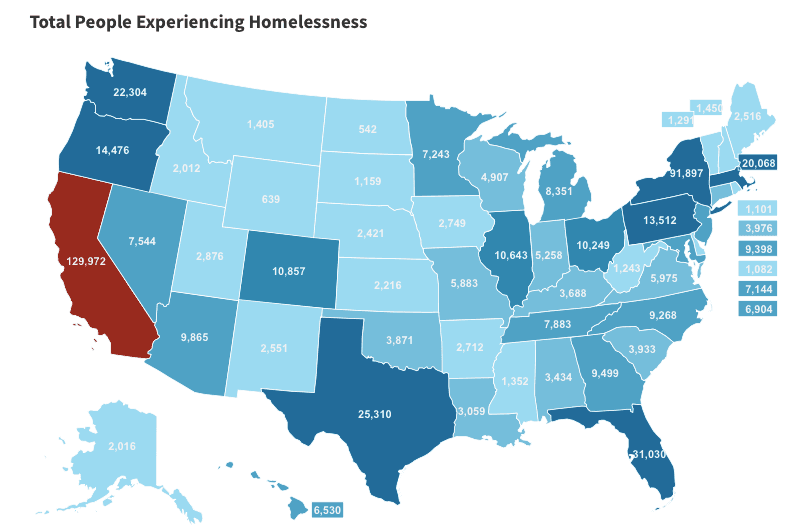
California likely leads the nation in socially activist government kindness. It also leads the nation in homelessness, chronic homelessness, and homeless veterans. The US Council on Homelessnesses estimates that, on any given day, 129,972 Californians are homeless, including 6,702 family households, and 10,836 veterans; 34,332 people are listed among “the chronic homeless”. That is, Californians with a disability who have been continuously homeless for one year or cumulatively homeless for 12 months in the past three years. No other state comes close to these numbers. The vast majority of these homeless are in the richer areas of two rich California cities: Los Angeles and San Francisco (mostly Los Angeles). Along with the homeless in these cities, there’s been a rise in 3rd world diseases: cholera, typhoid, typhus, etc. I’d like to explore the relationship between the policies of these cities and the rise of homelessness and disease. And I’d like to suggest a few cures, mostly involving sanitation. 

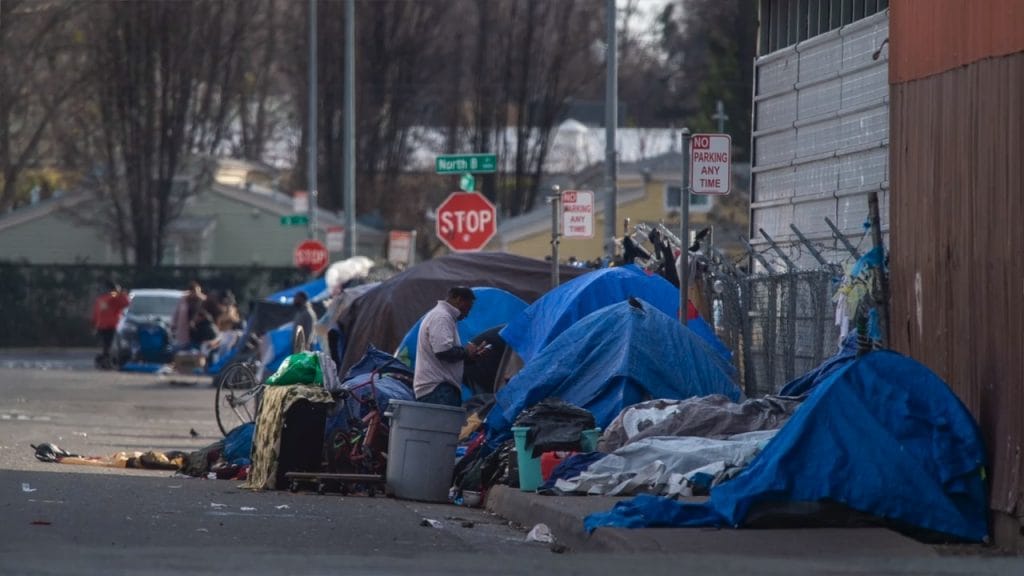
A homeless encampment in LosAngeles

Most of the US homeless do not live in camps or on the streets. The better off US homelessness find it is a temporary situation. They survive living in hotels or homeless shelters, or they “couch-serf,” with family or friends. They tend to take part time jobs, or collect unemployment, and they eventually find a permanent residence. For the chronic homeless things are a lot grimmer, especially in California. The chronic unemployed do not get unemployment insurance, and California’s work rules tend to mean there are no part time jobs, and there is not even a viable can and bottle return system in California, so the homeless are denied even this source of income*. There is welfare and SSI, but you have to be somewhat stable to sign up and collect. The result is that California’s chronic homeless tend to live in squalor strewn tent cities, supported by food handouts.

Californians provide generous food handouts, but there is inadequate sewage, or trash collection, and limited access to clean water. Many of the chronic homeless are drug-dependent or mentally ill, and though they might  benefit from religion-based missions, Los Angeles has pushed the missions to the edges of the cities, away from the homeless. The excess food and lack of trash collection tends to breed rats and disease, and as in the middle ages, the rats help spread the diseases. 

Total homelessness by state, 2018; California leads the nation. The better off among these individuals do not live on the streets, but in hotels or homeless shelters. For most, this is a short term situation. The rest, about 20%, are chronically homeless. About half of these live on the streets without adequate sewage and water. Many are drug-dependent.

The first major outbreaks of the homeless camps appeared in Los Angeles in August and September of 2017. They reappeared in 2018, and by late summer, rates were roughly double 2017’s. This year, 2019, looks like it could be a real disaster. The first case of a typhoid infected police officer showed up in May. By June there were six police officers with typhoid, and that suggests record numbers are brewing among the homeless.

To see why sanitation is an important part of the cure, it’s worth noting that typhoid is a disease of unclean hands, and a relative of botulism. It is spread by people who go to the bathroom and then handle food without washing their hands first. The homeless camps do not, by and large, have hand washing stations. and forced hygiene is prohibited. Los Angeles has set up porta-potties, with no easy hand washing. The result is typhoid epidemic that’s even affecting the police (six policemen in June!).

rate od disease spread.
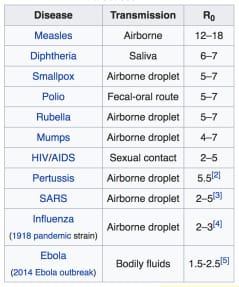
R-naught, reproduction number for some diseases, CDC.

Historically, the worst outbreaks of typhoid were spread by food workers. This was the case with “typhoid Mary of the early 20th century.” My guess is that some of the police who got typhoid, got it while trying to feed the needy. If so, this fellow could become another Typhoid Mary. Ideally, you’d want shelters and washing stations where the homeless are. You’d also want to pickup the dirtier among the homeless for forced washing and an occasional night in a homeless shelter. This is considered inhumane in Los Angeles, but they do things like this in New York, or they did.

Typhus is another major disease of the California homeless camps. It is related to typhoid but spread by rodents and their fleas. Infected rodents are attracted to the homeless camps by the excess food. When the rodents die, their infected fleas jump to the nearest warm body. Sometimes that’s a person, sometimes another animal. In a nastier city, like New York, the police come by and take away old food, dead animals, and dirty clothing; in Los Angeles they don’t. They believe the homeless have significant squatters rights. California’s kindness here results in typhus.

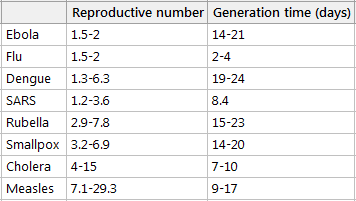
Reproduction number and generation time for some diseases.

The last of the major diseases of the homeless camps is cholera. It’s different from the others in that it is not dependent on squalor, just poor health. Cholera is an airborne disease, spread by coughing and sneezing. In California’s camps, the crazy and sick dwell close to each other and close to healthy tourists. Cholera outbreaks are a predictable result. And they can easily spread beyond the camps to your home town, and if that happens a national plague could spread really fast.

I’d discussed R-naught as a measure of contagiousness some months ago, comparing it to the reproductive number of an atom bomb design, but there is more to understanding a disease outbreak. R-naught refers merely to the number of people that each infected person will infect before getting cured or dying. An R-naught greater than one means the disease will spread, but to understand the rate of spread you also need the generation time. That’s the average time between when the host becomes infected, and when he or she infects others. The chart above shows that, for cholera, r-naught is about 10, and the latency period is short, about 9 days. Without a serious change in California’s treatment of the homeless, each cholera case in June will result in over 100 cases in July, and well over 10,000 in August. Cholera is somewhat contained in the camps, but once an outbreak leaves the camps, we could have a pandemic. Cholera is currently 80% curable by antibiotics, so a pandemic would be deadly.

Hygiene is the normal way to prevent all these outbreaks. To stop typhoid, make bathrooms available, with washing stations, and temporary shelters, ideally these should be run by the religious groups: the Salvation Army, the Catholic Church, “Loaves and Fishes”, etc. To prevent typhus, clean the encampments on a regular basis, removing food, clothing, feces and moving squatters. For cholera, provide healthcare and temporary shelters where people will get clean water, clean food, and a bed. Allow the homeless to work at menial jobs by relaxing worker hiring and pay requirements. A high minimum wage is a killer that nearly destroyed Detroit. Allow a business to hire the homeless to sweep the street for $2/hour or for a sandwich, but make a condition that they wash their hands, and throw out the leftovers. I suspect that a lot of the problems of Puerto Rico are caused by a too-high minimum wage by the way. There will always be poor among you, says the Bible, but there doesn’t have to be typhoid among the poor, says Dr. Robert Buxbaum.

*California has a very strict can and bottle return law where — everything is supposed to be recycled– but there are very few recycling centers, and most stores refuse to take returns. This is a problem in big government states: it’s so much easier to mandate things than to achieve them.

July 30, 2019. I ran for water commissioner in Oakland county, Michigan, 2016. If there is interest, I’ll run again. One of my big issues is clean water. Oakland could use some help in this regard.

The free press isn’t

Newspapers remain the primary source for verified news. Facts presumed to be sifted to avoid bias, while opinions and context is presumed to be that of the reporter whose name appears as the byline. We may look to other media sources for confirmation and fact-checking: news magazines, Snopes, and Facebook. Since 2016 these sources have been unanimous in their agreement about the dangers of biassed news. Republicans, including the president have claimed that the left-media spreads “fake news”, against him, while Democrats claim that Trump and the Russians have been spreading pro-Trump, fake news, While Trump and the Republicans claim that the left-media spreads fake news. In an environment like this, it’s worthwhile to point out that the left-wing and right-wing press is owned by a very few rich people, and none of it is free of their influence. An example of this is the following compilation of many stations praising their news independence: CBS, ABC, NBC, and FOX, praising their independence in exactly the same words.

It costs quite a lot to buy a newspaper or television station, and a lot more to keep it running. Often these are money-losing ventures, and as a result, the major newspapers tend to be owned by a few mega-rich individuals who have social or political axes to grind. As the video above shows, one main axe they have is convincing you of their own independence and reliability. The Sinclair news service, owned by the Smith news family came up with the text, and all the independent journalists read it in as convincing a voice as they could muster. This is not to say. that all the news is this bad or that the mega rich don’t provide a service by providing us the news, but it’s worth noting that they extract a fee by controlling what is said, and making sure that the news you see fits their agendas – agendas that are often obvious and open to the general view.

Perhaps the most prominent voice on the right is Rupert Murdoch who owns The New York Post, and The Wall Street Journal. He used to own Fox too, and is still the majority controller and guiding voice, but Fox is now owned by Disney who also owns ABC. Murdoch uses his many media outlets to make money and promote conservative and Republican causes. You might expect him to support Trump, but he has a person feud with him that boils up in the Post’s cover pages. Disney’s ABC tends to present news on the left, but as in the compilation above, left and right journalists have no problem parroting the same words. Here is another, older compilation, more journalistl saying the same thing in the same words, e.g. playing up the Conan O’Brian show.

Another media master is Ted Turner. He tends to own media outlets on the left including CNN. Turner manages to make CNN, and his other properties profitable, in part by courting controversy. His wife for a time was Jane Fonda, otherwise known as Hanoi Jane.

Another left-leaning media empire (whatever that means) is MSNBC. It is owned by Time-Warner, also owner of The Huffington Post. Both are anti-israel, and both promote zero-tariff, Pacific-rim trade, but as seen above, MSNBC anchors will read whatever trash they are told to read, and often it’s the same stuff you’d find on Fox.

Rounding out the list of those with a complete US media empires, I include the Emir of Qatar, perhaps the richest man in the world. He operates Al Jazeera, “the most respected news site for Middle east reporting” as an influence-buying vehicle. Al Jazeera is strongly anti-fracking, anti nuclear, and anti oil (Qatar is Asia’s latest supplier of natural gas). It is strongly anti-Israel, and anti Saudi. Qatar propagandist, Jamal Khashoggi worked for AlJazeera, and was likely killed for it. They’re also reliably pro-Shia, with positive stories about Hamas, The Muslim Brotherhood, and Iran, but negative stories about Sunni Egypt and Turkey. They present news, but not unbiassed.

But you don’t have to buy a complete media empire to present your politics as unbiassed news. Jeff Bezos, founder Amazon, bought The Washington Post for $250 million (chump change to hm). For most of the past two years, the paper mostly promoted anti-tariff views, and liberal causes, like high tax rates on the rich. Amazon thrives on cheep Chinese imports, and high tax rates don’t hurt because Amazon manages to not pay any taxes on $11 billion/year profits (by clever accounting they actually get a rebate). Recently Joe Biden made the mistake of calling out Amazon for not paying on $11 billion in profits, and The Washington Post has returned the favor by bashing Biden. As for why Bezos bought the money-losing Post, he said: “It is the newspaper in the Capital City of the most important country in the world… [As such] … “it has an incredibly important role to play in this democracy.”

Moving on to The New Your Times, its editorial slant is controlled by another contestant for world’s richest man: telecom mogul, Carlos “Slim” Helú. Carlos’s views are very similar to Bezos’s, with more of an emphasis on free trade with Mexico. Steve Jobs’s widow runs “The Atlantic” for the same reasons. It’s free on line, well written and money losing. Like with the above, it seems to be a vanity project to promote her views. It’s a hobby, but sh can afford it.

Like her, Chris Hughes, Facebook’s Co-founder and Zuckerberg room-mate, bought and runs the money losing “The New Republic“. He was Facebook’s director of marketing and communications before joining the Obama campaign as it internet marketing head. The New Republic’s had a stellar reputation, back in the day. Zuckerberg himself runs a media empire, but it’s different from the above: it’s social media where people pay for placement, and where those whose views he doesn’t like get censored: put in Facebook jail. He’s gotten into trouble over it, but as a media giant, there seem to have been no consequences.

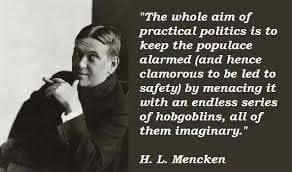
H.L. Menken on the fake news of the early – mid 20th century.

And it’s not only rich individuals who turn trusted news sources into propaganda outlets. The US CIA did this for years, and likely still do. Then there are the Russians, the Chinese, the Israelis, the British (BBC) and our very own NPRt. These sources present news that benefits them in the most positive light and scream about dangers to democracy and the world if their position is touched or their veracity is questioned. As these sources are all government funded, there is a they are unanimous supporters big governments as a cure to all ills. Closer to home, I’d like to mention that Detroit has two major papers, but only one owner. The left leaning Detroit Free Press, and the right-leaning Detroit News are owned by the same people, share a considerable staff, and generally agree on important issues. There are a dozen smaller papers in Metro Detroit; all but one is owned by one media group.

I’d like to end with a positive note. Not every reporter is in this sad grab-bag. In Detroit, Setve Neveling, “the motor-city muckraker” manages to present is independent, active news. Then there is Los Angeles’s Biotech billionaire, Patrick Soon-Shiong. He bought the LA Times in June 2018, claiming he will use it to fight fake news, “the cancer of our time.” I wish him luck. So far, I’d say, he’s made the LA Times is the best Newspaper in the US with The NY Post a close second ( love the snarky headlines).

Robert Buxbaum, July 15, 2019.

Bitcoin v cash to avoid Trump’s tariffs or ransom a sailor

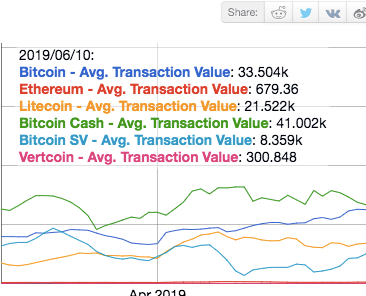
The number and cash value of bitcoin transactions has surged in the last two years, and it seems that a lot of the driving motivation is avoidance of Trump’s tariffs. If you want to avoid Trump’s tariffs, claim that the value of the shipment is less than it really is. Pay part via the normal banking system through the bill of lading (and pay tariffs on that) and pay the rest in bitcoin with no record and no taxes paid. The average bitcoin transaction amount has increased to $33,504, and that seems to be the amount of taxable value being dodged on each shipment. As noted in the journal, Cryptopolitan, “Smugglers attempting to export Chinese goods to the USA illegally have been found to be among the largest purchasers of Bitcoin.” https://www.cryptopolitan.com/is-us-china-trade-war-fueling-bitcoin-price-rally-to-7500/

Average transaction amount for several crypto currencies. The amount has surged for Bitcoin, blue line.

Bitcoin isn’t the only beneficiary of tariffs, of course, but it is the largest. The chart at right shows the average transaction value of the major cryptocurrencies. The average for most are in the dollar range that you’d expect for someone evading tariffs in containerized shipments. Someone who wants to import $100,000 worth of Chinese printers will arrange to have them shipped with a lower price bill of lading. The rest of the payment, 1/3 say, would be paid by a bitcoin transfer whose escrow is tied to the legally binding bill of lading.

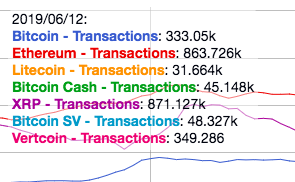
Number of transactions per day for several cryptocurrencies, data available from Bitinfocharts.com

Bitcoin does not stand out from the other cryptocurrencies so much in the amount of its average transaction, but in the number of transactions per day. As shown at left there are 333,050 bitcoin transactions per day at an average value of $33,504 per transaction. Multiplying these numbers together, we see that Bitcoin is used for some $11.2 billion in transactions per day, or $4.1 trillion dollars worth per year. The legitimate part of the US economy is only $58 billion per day, or $21 trillion per year. The amount will certainly rise if further tariffs are put into effect. 

Most other cryptocurrencies have fewer transactions per day, and the few that have similar (or higher) numbers deal in lower amounts. Etherium is used in 2.5 time more transactions, but the average Etherium transaction is only $679. This suggests that the total Etherium business is only $586 million per day. The dollar amounts of Etherium suggests that it is mostly used for drug trafficking, 

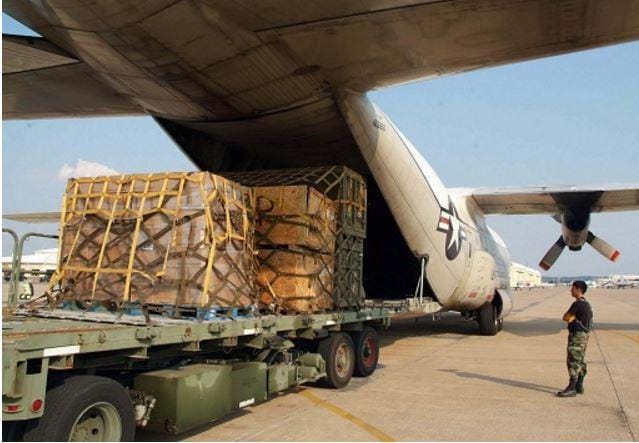
Cash-money is the old fashioned way to avoid tariffs, buy drugs, and do other illegal money transfers. This method isn’t going away any time soon. A suitcase of $100 bills gets handed over and the deal is done. Though it gets annoying as the amounts get large, there is a certain convenience at the other end, when you try to spend your ill-gotten gains. Thus, when Obama wanted to ransom the ten sailors that Iran had captured in 2016, he sent paper bills. According to the LA Times, this was three airplane shipments s of all non-US currency: Euros and Swiss Francs mostly. The first payment was $400 million, delivered as soon as Iran agreed to the release. The rest, $1.3 billion, was sent after the prisoners were released. Assuming that the bundles shown below contained only 100 Euro notes, each bundle would have held about $170 million dollars. We’d have had to send ten bundles of this size to redeem ten US sailors. The US ships, the laptops of sensitive information, and the weapons were granted as gifts to the Iranians. Obama claimed that all this was smart as it was cheaper than a war, and it likely is. The British had 15 sailors captured by Iran in 2009 and paid as well. In the late 1700s, John Adams (an awful president) paid 1/4 of the US budget as ransom to North African pirates. He paid in gold.

These are supposedly the pallets of cash used to ransom our sailors. Obama has justified the need to transfer the cash this way, and indeed a ransom is a lot cheaper than a war.

Obama could not have ransomed the sailors with Bitcoin as there was hardly enough Bitcoin value in existence at the time. Besides, the Iranians would have had a hard time spending it since, it is hard to spend Bitcoin on anything legal without first switching to bank checks or cash. Legitimate sellers want proof that they’ve paid, and financial watchdogs are always there sniffing at the conversion step. Things are simpler with paper money; not totally simple when there is no apparent source, but simply enough for mullahs.

Iranian released this picture of the US sailors captured. Obama ransomed them for $1.7 billion in Euros.

To get a sense of the amount of paper money used in illegal commerce, consider that there are $1.1 trillion in hundred dollar bills in circulation. This is four times more than the value of all Bitcoin in circulation currently. Based on the wear on our $100 bills, it seems each bill is used on average 30 times per year. This suggests there are $33 trillion dollars in trade that goes on with $100 bills. Not all of this trade is illegal, but I suspect a good fraction is, and this is eight times the trade in Bitcoin. The downside of cash is that cost of transferring large bails of it can be high, but at least it’s easy to make change for a bundle of $100 bills. With bitcoin, there is a fee for transfer too, and a fee charged to convert Bitcoin to cash; it’s often in excess of 1%, and that adds up when you do billion-dollar kidnappings and billion dollar arms buys. In case you are wondering how German uranium enrichment centrifuges got to Iran when there is an export embargo, I’m guessing it was done through an intermediary country using cash and/or Bitcoin payments.

It’s worth speculating on whether Bitcoin prices will rise as its use continues to rise. I think it will but don’t expect a fast rise. Over a year ago, I’d predicted that the price of Bitcoin would be about $10,500 each. I’d based that on Fisher’s monetary equation, that relates the value of a currency to the amount spent and the speed of money. As it happens I got the right dollar value because I’d underestimated the amount of Bitcoin purchases and the speed of the money by the same factor of four. For the price of a Bitcoin to rise, it is not enough for it to be used more. There also has to be no parallel rise in the velocity of transactions (turnovers per year). My sense is that both numbers will rise together and thus that the bitcoin price will level out, long term, with lots of volatility following daily changes in use and velocity.

As a political thought, I expect is that Bitcoin traders will mostly support Trump. My expectation here is for the classic alliance the existed between bootleggers and the prohibition police during prohibition. During prohibition, jobs among the police, plus salaries and bonuses depended on liquor being illegal, and thus they supported prohibition. Bootleggers benefitted too: their high prices and profits depended on prohibition. I thus expect Bitcoin traders will support Trump as a way of protecting profits and value. Real estate moguls, I suspect, support Trump because they benefit from the ability to sell real-estate with off tariff Bitcoin. If the tariffs went away, so would the amount of smuggling income going into real estate. Amazon’s owner, Jeff Bezos, is currently anti Trump, I suspect, because Amazon still pays tariffs.

Robert Buxbaum,  July 10, 2019. Here are my thoughts about tariffs and free trade, and here is Satochi’s original article proposing Bitcoin and explaining how it would work. As for Iran, they’ve announced a fee for any ship in the Gulf of Hormuz. If you don’t pay, you might get attacked as a Japanese tanker recently was. My guess is payments are made in cash or Bitcoin to avoid embarrassing the payer.

Making the train, City of New Orleans profitable

The City of New Orleans is the name of the only passenger train between Chicago and New Orleans. It’s also the name of a wonderful song by Steve Goodman, 1971. Hear it, sung by Arlo Guthrie with scenes from a modern ride.

“Riding on the City of New Orleans
Illinois Central Monday morning rail
Fifteen cars and fifteen restless riders
Three conductors and twenty-five sacks of mail
All along the southbound odyssey
The train pulls out at Kankakee
Rolls along past houses, farms and fields
Passin’ trains that have no names
Freight yards full of old black men
And the graveyards of the rusted automobiles…”

Every weekday, this train leaves Chicago at 9:00 PM and gets into New Orleans twenty hours later, at 5:00 PM. It’s a 925 mile trip at a 45 mph average: slow and money-losing, propped up by US taxes. Like much of US passenger rail, it “has the disappearing railroad blues.” It’s a train service that would embarrass the Bulgarians: One train a day?! 45 mph average speed!? It’s little wonder is that there are few riders, and that they are rail-enthusiasts: “the sons of Pullman porters, and the sons of engineers, Ride[ing] their father’s magic carpets made of steel.” The wonder, to me was that there was ever fifteen cars for these, “15 restless riders”.

A sack of mail being picked up on the fly.

I would be happy to see more trips and a faster speed, at an average speed of at least 60 mph. This would require 85 mph or higher between stops, but it would save on salaries, and it would bring in some new customers. But even if these higher speeds cost nothing extra, in net, you’d still need something more to make the trip profitable; a lot more if the goal is to add another train. Air-traffic will always be faster, and the automobile, more convenient. I find a clue to profitability in the fifteen cars of the song and in the sacks of mail.

Unless I’m mistaken, mail traffic was at least as profitable as passenger traffic, and those “twenty-five sacks of mail” were either very large, or just the number on-loaded at Kankakee. Passenger trains like ‘the city of New Orleans’ were the main mail carriers till the late 1970s, a situation that ended when union disputes made it unprofitable. Still, I suspect that mail might be profitable again if we used passenger trains only for fast mail — priority and first class — and if we had real fast mail again. We currently use trucks and freight trans for virtually all US mail, we do not have a direct distribution system. The result is that US mail is vastly slower than it had been. First class mail used to arrive in a day or two, like UPS now. But these days the post office claims 2 to 4 business days for “priority mail,” and ebay guarantees priority delivery time “within eight business days”. That’s two weeks in normal language. Surely there is room for a faster version. It costs $7.35 for a priority envelope and $12.80 for a priority package (medium box, fixed price). That’s hardly less than UPS charges.

Last day of rail post service New York to Washington, DC. .June 30, 1977.

Passenger trains could speed our slow mail a lot, even with our slow speed trains. The City of New Orleans makes its trip in less than a day, with connections to major cities across the US. If priority mail went north-south in under one day, people would use it more, and that could make the whole operation profitable. Trains are far cheaper than trucks when you are dealing with large volumes; there are fewer drivers per weight, and less energy use per weight. Still there are logistical issues to making this work, and you want to move away from having many post men handling individual sacks, I think. There are logistical advantages to on-loading and off-loading much larger packages and to the use of a system of standard sizes on a moving conveyor.

How would a revised mail service work? I’d suggest using a version of intermodal logistics. Currently this route consists of 20 stops including the first and last, Chicago and New Orleans. This suggests an average distance between stops of 49 Miles. Until the mid 70s, , mail would be dropped off and picked up at every stop, with hand sorting onboard and some additional on-off done on-the-fly using sacks and hooks, see picture above. For a modern version, I would suggest the same number of passenger stops, but fewer mail pick ups and drop offs, perhaps only 1/3 as many. These would be larger weight, a ton or more, with no hand sorting. I’d suggest mail drop offs and pick ups every 155 miles or so, and only of intermodal containers or pods: ten to 40 foot lengths. These containers plus their contents would weigh between 2,500 and 25,000 pounds each. They would travel on flatcars at the rear of the passenger cars, and contain first class and priority mail only. Otherwise, what are you getting for the extra cost?

The city of New Orleans would still leave Chicago with six passenger cars, but now these would be followed by eight to ten flatcars holding six or more containers. They’d drop off one of the containers at a stop around the 150 mile mark, likely Champaign Urbana, and pick up five or so more (they’d now have ten). Champaign Urbana is a major east-west intermodal stop, by the way. I’d suggest the use of six or more heavy forklifts to speed the process. At the next mail-stop, Centralia, two containers might come off and four or more might come on. Centralia is near St. Louis, itself a major rail hub for trains going west. See map below. The next mail stop might be Memphis. Though it’s not shown as such, Memphis is a major east-west rail hub; it’s a hub for freight. A stripped down mail-stop version of passenger train mail like this seems quite do-able — to me at least. It could be quite profitable, too.

Amtrak Passenger rail map. The city of New Orleans is the dark blue line going north-south in the middle of the map.

Intermodal, flat-bed trucks would take the mail to sorting locations, and from there to distribution points. To speed things, the containers might hold pre-sorted sacks of mail. Intermodal trucks might also carry some full containers east and west e.g. from Centralia to St. Louis, and some full flatcars could be switched on and off too. Full cars could be switched at the end, in New Orleans for travel east and west, or in the middle. There is a line about “Changing cars in Memphis Tennessee.” I imagine this relates to full carloads of mail joining or leaving the train in Memphis. Some of these full intermodal containers could take priority mail east and west. One day mail to Atlanta, and Houston would be nice. California in two days. That could be a money maker.

At this point, I would like to mention “super-fast” rail. The top speeds of these TGV’s “Transports of Grande Vitess” are in the range of 160 mph (265 km/hr) but the average speeds are lower because of curves and the need to stop. The average speeds are roughly 125 mph on the major routes in Europe, but they require special rails and rail beds. My sense is that this sort of special-use improvement is not worth the cost for US rail traffic. While 60 -90 mph can be handled on the same rails that carry freight, the need for dedicated track comes with a doubling of land and maintenance costs. And what do you have when you have it? The bullet rail is still less than half as fast as air travel. At an average speed of 125 mph, the trip between Chicago and New Orleans would take seven hours. For business travelers, this is not an attractive alternative to a two hour flight, and it is not well suited for intermodal mail. The fuel costs are unlikely to be lower than air travel, and there is no easy way to put mail on or off a TGV. Mail en-route would slow the 125 mph speed further, and the use of intermodal containers would dramatically increase the drag and fuel cost. Air travel has less drag because air density is lower at high altitude.

Meanwhile, at 60 mph average speeds, train travel can be quite profitable. Energy use is 1/4 as high at 60 mph average as at 120 mph. An increase of average speed to 60 mph would barely raise the energy use compared to TGV, but it would shorten the trip by five hours. The new, 15 hour version of “The City of New Orleans” would not be competitive for business travel, but it would be attractive for tourists, and certainly for mail. Having fewer hours of conductor/ engineer time would save personnel costs, and the extra ridership should allow the price to stay as it is, $135 one-way. A tourist might easily spend $135 for this overnight trip: leaving Chicago after dinner and arriving at noon the next day. This is far nicer than arriving at 5:00 PM, “when the day is done.”

Robert Buxbaum, June 21, 2019. One summer during graduate school, I worked in the mail room of a bank, stamping envelopes and sorting them by zip code into rubber-band tied bundles. The system I propose here is a larger-scale version of that, with pre-sorted mail bags replacing the rubber bands, and intermodal containers replacing the sacks we put them in.

How to avoid wet basements

My house is surrounded my mulch — it absorbs enough rainwater that I rarely have to water.

Generally speaking water gets to your basement from rain, and the basic way you avoid wet basements is by providing some more attractive spot for the rainwater to go to. There are two main options here: divert the water to a lake or mulch-filled spot at least 8 feet away from your home, or divert it to a well-operated street or storm drain. My personal preference is a combination of both.

At right I show a picture of my home taken on a particularly nice day in the spring. Out front is a mulch-filled garden and some grass. On the side, not shown is a driveway. Most of the rain that hits our lawn and gardens is retained in 4 inches of mulch, and waters the plants. Four inches of mulch-covered ground will hold at least four inches of rainwater. Most of the rain that hits the house is diverted to downspouts and flows down the driveway to the street. Keeping some rainwater in the mulch means you don’t have to pay so much to water the trees and shrubs. The tree at the center here is an apple tree. I like fruit trees like this, they really suck up water, and I like the apples. We also have blueberries and roses, and a decorative pear (I like pears too, but they are messy).

In my opinion, you want some slope even in the lawn area, so excess rainwater will run to the sewers and not form a yard-lake, but that’s a professional preferences; it’s not always practical and some prefer a brief (vernal ) lake. A vernal lake is one that forms only in the spring. If you’ve got one, you may want to fill it with mulch or add trees that are more water tolerant than the apple, e.g. swamp oak or red cedar. Trees remove excess water via transpiration (enhanced evaporation). Red Cedars grow “knees” allowing them to survive with their roots completely submerged.

For many homes, the trick to avoiding a flooded basement is to get the water away from your home and to the street or a retention area.

When it comes to rain that falls on your hose, one option is to send it to a vernal lake, the other option is to sent it to the street. If neither is working, and you find water in your basement, your first step is to try to figure out where your rainwater goes and how it got there. Follow the water when it’s raining or right after and see where it goes. Very often, you’ll discover that your downspouts or your driveway drain into unfortunate spots: spots that drain to your basement. To the extent possible, don’t let downspout water congregate in a porous spot near your house. One simple correction is to add extenders on the downspouts so that the water goes further away, and not right next to your wall. At left, I show a simple, cheap extender. It’s for sale in most hardware stores. Plastic or concrete downspout pans work too, and provide a good, first line of defense agains a flood basement. I use several to get water draining down my driveway and away from the house.

Sometimes, despite your best efforts, your driveway or patio slopes to your house. If this is the case, and if you are not quite ready to replace your driveway or patio, you might want to calk around your house where it meets the driveway or patio. If the slope isn’t too great, this will keep rainwater out for a while — perhaps long enough for it to dry off, or for most of the rainwater to go elsewhere. When my driveway was put in, I made sure that it sloped away from the house, but then the ground settled, and now it doesn’t quite. I’ve put in caulk and a dirt-dam at the edge of the house. It keeps the water out long enough that it (mostly) drains to the street or evaporates.

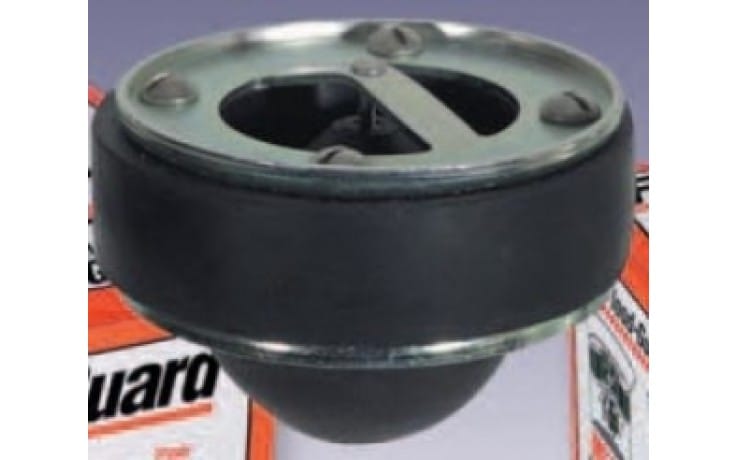
A drain valve. Use this to keep other people’s sewer water out of your basement.

There is one more source of wet basement water, one that hits the houses in my area once a year or so. In our area of Oakland county, Michigan, we have combined storm and sanitary sewers. Every so often, after a big rain, other people’s rainwater and sanitary sewage will come up through the basement drains. This is really a 3rd world sewer system, but we have it this way because when it was put in, in the 1900s, it was first world. One option if you have this is to put in a one-way drain valve. There are various options, and I suggest a relatively cheap one. The one shown at right costs about $15 at Ace hardware. It will keep out enough water, long enough to protect the important things in your home. The other option, cheaper and far more hill-billy, is to stuff rags over your basement drains, and put a brick over the rags. I’ll let you guess what I have in my basement.

Robert Buxbaum, June 13, 2019

Qatar, unbalanced but stable

Doha Airport, Qatar.

Doha Airport, Qatar.

I visited Qatar airport twice this month, just passing through, but there were several things that so impressed me that I had to write. What impressed me most was not so much the size and richness of the airport, but the clothes of the locals. All of the local men wore the same, very sharp robes: blindingly white, long sleeved, and floor-length. They’re called Thobes. While other nations wear something similar. Here, every one was unwrinkled, and unstained. They all looked new, with no signs they’d ever been washed. Some were worn with cuff-links (gold), and most had a pen sticking out of the breast pocket (gold). White pants peak from underneath and a headress usually sits on the head. It’s a really dramatic look, like seeing dozens of Ricardo Montaubans of Fantasy Island in one place. Local women and children were there too, but the thobes were so dramatic that the women and children disappeared from my mind-space almost immediately. There is a local woman in the picture above, but you hardly notice.

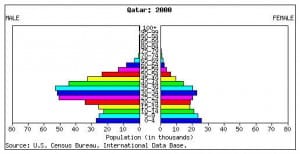
Not everyone wears the thobes. There are lots of stores filled with gold and technology, beer and coffee, and these are maned by non-locals, Moslems mostly, almost all men. The non-locals wear western garb, not particularly sharp; none wear thobes of any sort. Some months ago, I wrote that China had severe imbalance and speculated that it was ripe for revolution. As it happens the large number of foreign worker means that Qatar is far more unbalanced. To some extent this is shown by the male-female population pyramid below.

Qatar demographic pyramid. Vastly more males than females, mostly foreign workers.

Qatar demographic pyramid. The imbalance is caused by the presence of vastly more male than female foreign workers.

Qatar is a country of 2,500,000 residents, of whom 310,000 are locals — citizens and permanent residents. The rest are foreign workers; long term inhabitants without permanent residency or citizenship. They make up 85% of the population, recruited from poor, English-speaking Muslim countries mostly: Egypt, Malaysia, Tunisia. They do all the work, as best I could tell. I saw no one who looked like a local working, male or female.

Foreign workers have very few rights, but don’t seem unhappy. There is no right to unionize, and not even the right to roam around the country. For the most part, they live in employer-owned housing, and are transported back and forth to work in employer vans. They sign up for year-long contracts, and at the end of the year, they have the choice to re-up or leave. Up a year ago, foreign workers could not become permanent residents. Then, last year, the Emir’s order 10 authorized permanent residency status for as many as 100 foreign workers who had sufficient means, had been in Qatar for 10 to 20 years (depending on whether they were born there), had stayed out of trouble, and who otherwise were considered desirable. It’s a step.

I suspect that the foreign workers feel lucky to have good pay, decent hours, and a clean bed. Then again, the workers are recruited for positive outlook. And the ones I saw might have had more rights than most. The airport is part of the Umm Al Houl, free enterprise zone. These are areas of Qatar where westerners and their vices like alcohol are tolerated and welcome.

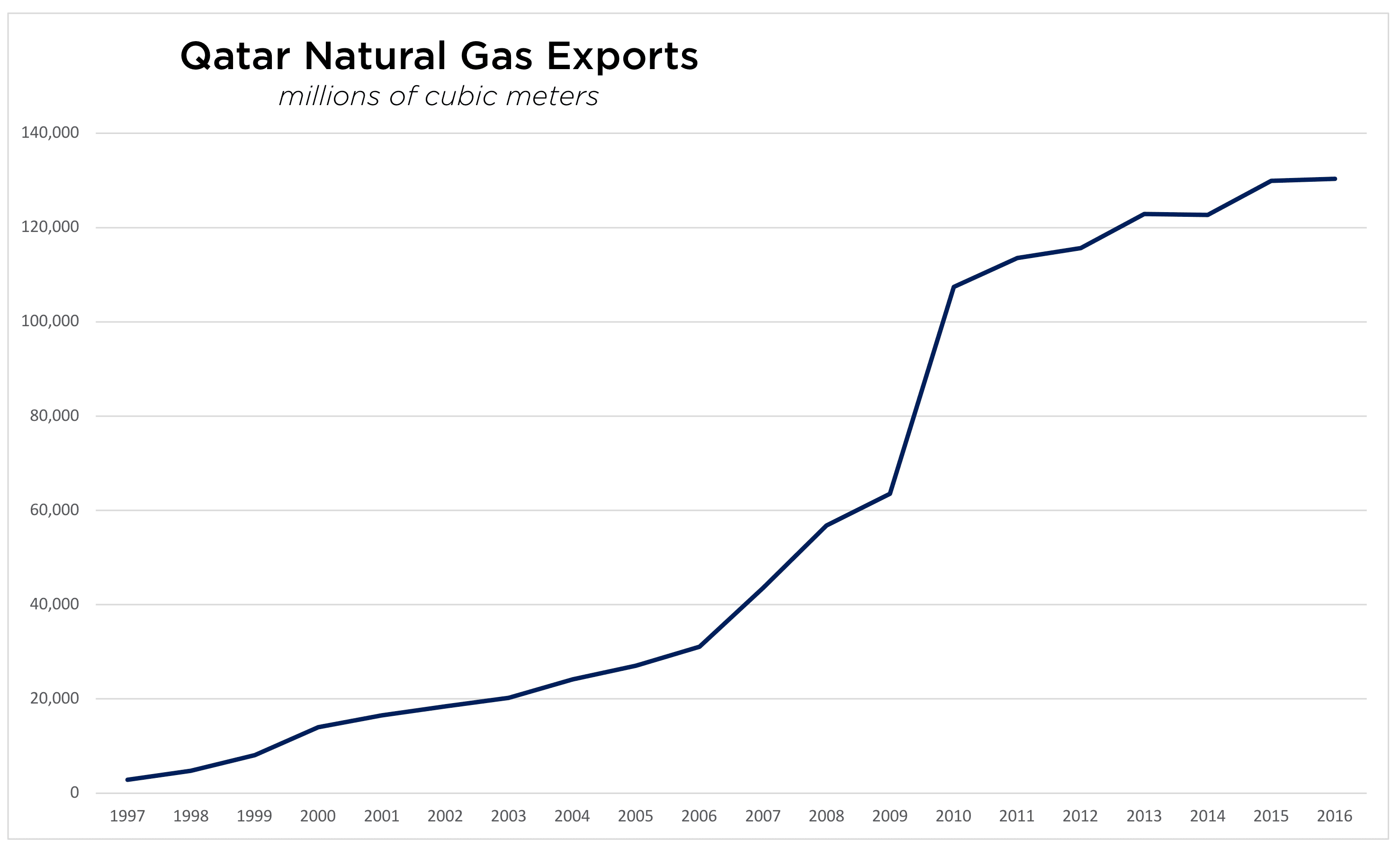
Qatar natural gas production. Natural gas provides 90% of the country's income as best I can tell.

Qatar natural gas production. Natural gas provides 90% of the country’s income as best I can tell. That’s half the GDP almost, the rest of the GDP is Qataris spending the money

There are three “free enterprise zones” in Qatar; the name for the one near the airport, “Al Houl” interestingly enough means “bird trap”. What’s going on with them, as best I can tell, is diversification. Qatar is the worlds second largest exporter of natural gas, with most going to Europe, and a significant portion to India and China. But the gas will run out eventually. They are trying to supplant this income with tourism, industry and transport: running a major airline, a bustling, air hub, and tourist hotels. The airline is only marginally profitable, and though I didn’t see the hotels, I imagine they are luxurious and marginally profitable too. Saudi Arabia, next door, is trying to diversify the same ways, aiming to control west-east, air-traffic via Emirates air.

The GDP of Qatar is $191 B as of last year at the going exchange, and over $450 B at price parity. That suggests a few things. For one, that the Qatari currency is undervalued. It also suggests a per-capita GDP of at least $76,400, but more likely $616,000 or higher depending on how you count buying power and foreign workers. This buys a nice lifestyle, if not republican freedoms.  In terms of government, Qatar is a real monarchy, Emir Hamad bin Khalifa al-Thani’s is an absolute ruler who came to power the traditional way: he overthrew his father. Then again his father, Khalifa al-Thani, came to power by overthrowing his cousin. Supporting the Emir’s rule, there is an Advisory Council. The 35 ministers are mostly relatives, and as in North Korea, and they have only advisory power. The Prime Minister and Minister of Foreign Affairs is Sheikh Hamad bin Jasim bin Jabir al-Thani; the Deputy Prime Minister is Abdallah Al-Thani. The Economy and Commerce minister is Fahd Al-Thani, and the Communications and Transport minister is Ahmad Al-Thani. Nasir al-Thani heads Cabinet Affairs; Hamad al-Thani is the Secretary of State, and the Governor of the Central Bank is Abdallah bin Saud al-Thani. All close relatives.

Qatar main mosque. Residents stand out from the foreign workers.

Qatar main mosque. Residents stand out from the foreign worker, though they pray together.

My sense was that Qatar was the Disneyland version of Islam. Life in the Qatari free zones resembled normal Islamic life the way that Main Street of Disneyland resembles an actual main street in the US. Every citizen is well dressed and rich without having to work. Western visitors are welcome, and not forced to follow the local customs; we’re allowed our vices, alcohol etc. in our own zones.

The state supports all ecological and left-wing causes except unionization. . Al Jazeera, the Emir’s left-leaning news agency, spreads money and influence world-wide. Left-flavored news is presented with high-quality graphics, and different versions of the news story published in different languages. The Emir acknowledges that Al Jazeera is a money-losing propaganda agency. It’s anti Israel, pro revolution (elsewhere of course) and virulently against petroleum production for all counties outside of Qatar. Professors and “independent” journalists world-wide are funded to promote these views. As with Disneyland, most people seem happy to live the fiction, as best I can tell.

Qatari woman and shop. They blend into the scenery compared to the resplendent men

Qatari woman and shop. They blend into the scenery compared to the resplendent men

One bonus of living in Qatar is that the world comes to you. The next world soccer tournament will be held in Qatar, 2022, and Qatari’s are excited, and pleased. There is a lot of building going on, some for the world cup, the rest for general tourism. The free enterprise zones are growing.

There is a cold war going on with Saudi Arabia, and the Saudis are doing what they can to pour cold water on the Qatari PR, but so far, Qatar seems to be winning the war at home and abroad. It shows a beautiful, progressive face to the west, and it seems to have brought in the majority of the middle east travel. More to come. It’s stable but for how long?

Robert Buxbaum April 15, 2019. As I side note, I just bought a Qatari Thobe.

Speed traps penalize the poor

On a street corner about 1/4 mile from my house, at the intersection of the two busiest of the local streets, in the center-median of the street, is parked a police car. He’s there, about 18 hours a day, looking to give out tickets. The cross-street that this officer watches is where drivers get off the highway. In theory, they should instantly go from 65 mph on the highway to 35 mph now. Very few people do. The officer does not ticket every car, by the way, but seems to target those of poor people from outside the city limits. The only time ai was ticketed, I was driving a broken-down car while mine was in the shop. As best I can tell, he choose cars for revenue, not for safety. It’s a speed trap. It’s appalling. And our city isn’t alone in having one.

Speed traps are an annoyance to rich, local folk who sometimes get ticketed, but they’re a disaster for the poor. Poor people are targeted, and these people don’t have any savings. They don’t have the means to pay a suddenly imposed bill of $150 or more. Meanwhile, the speed-trap officer is incentivized to increase revenue and look for other violations: expired registrations or insurance, seat-belt violations, open alcohol, unpaid tickets. Double and triple fines are handed out, and sometimes the car is impounded. A poor driver is often left without any legal way to get to work, to earn money to pay the fines. Police officers behave this way because they are evaluated based on the revenue they generate, based on the number of tickets they write. It’s a horrible situation, especially for the poor

Speed traps to little and cost much.

An article on the effect of speed traps. It appears they do little good and cause much pain, especially to the poor. Here is a link to the whole article.

The article above looks at the impact of speed traps on poor people. The damage is extreme. The folks targeted are often black, barely holding it together financially. They are generally not in a position to pay $150 for “impeding traffic,” and even less in a position to deal with having their car impounded. How are they supposed to pay the bill? And yet they are told they are lucky to have been given this ticket — impeding traffic, a ticket with no “points.” But they are not lucky. They are victims. Tickets with no points is are money generators, and many poor people realize it. If they were to get a speeding ticket, they would have the opportunity to void the penalty by going to traffic school. With a ticket for impeding traffic, there is no school option. Revenue stays local, mostly in that police precinct. Poor people know it, and they don’t like it. I don’t either. After a while, poor people cease to trust the police, or to even speak to them.

In what world should you pay $150 for impeding traffic, by the way? In what world should the police be taken from their main job protecting the people and turned into a revenue arm for the city? I’d like to see this crazy cycle ended. The first steps, I think, are to end speed traps, and to limit the incentive for giving minor tickets, like impeding traffic. As it is we have too many people in jail and too many harsh penalties. 

Robert Buxbaum, April 10, 2019. I ran for water commissioner in 2016, and may run again in 2020.

A probability paradox

Here is a classic math paradox for your amusement, and perhaps your edification: (edification is a fancy word for: beware, I’m trying to learn you something).

You are on a TV game show where you will be asked to choose between two, identical-looking envelopes. All you know about the envelopes is that one of them has twice as much money as the other. The envelopes are shuffled, and you pick one. You peak in and see that your envelope contains $400, and you feel pretty good. But then you are given a choice: you can switch your envelope with the other one; the one you didn’t take. You reason that the other envelope either has $800 or $200 with equal probability. That is, a switch will either net you a $400 gain, or loose you $200. Since $400 is bigger than $200, you switch. Did that decision make sense. It seems that, at this game, every contestant should switch envelopes. Hmm.

The solution follows: The problem with this analysis is an error common in children and politicians — the confusion between your lack of knowledge of a thing, and actual variability in the system. In this case, the contestant is confusing his (or her) lack of knowledge of whether he/she has the big envelope or the smaller, with the fixed fact that the total between the two envelopes has already been set. It is some known total, in this case it is either $600 or $1200. Lets call this unknown sum y. There is a 50% chance that you now are holding 2/3 y and a 50% chance you are holding only 1/3y. therefore, the value of your current envelope is 1/3 y + 1/6y = 1/2 y. Similarly, the other envelope has a value 1/2y; there is no advantage is switching once it is accepted that the total, y had already been set before you got to choose an envelope.

And here, unfortunately is the lesson:The same issue applies in reverse when it comes to government taxation. If you assume that the total amount of goods produced by the economy is always fixed to some amount, then there is no fundamental problem with high taxes. You can print money, or redistribute it to anyone you think is worthy — more worthy than the person who has it now – and you won’t affect the usable wealth of the society. Some will gain others will lose, and likely you’ll find you have more friends than before. On the other hand, if you assume that government redistribution will affect the total: that there is some relationship between reward and the amount produced, then to the extent that you diminish the relation between work and income, or savings and wealth, you diminish the total output and wealth of your society. While some balance is needed, a redistribution that aims at identical outcomes will result in total poverty.

This is a variant of the “two-envelopes problem,” originally posed in 1912 by German, Jewish mathematician, Edmund Landau. It is described, with related problems, by Prakash Gorroochurn, Classic Problems of Probability. Wiley, 314pp. ISBN: 978-1-118-06325-5. Wikipedia article: Two Envelopes Problem.

Robert Buxbaum, February 27, 2019

Harvard Eunuchs

Success is measured in different ways in different cultures. Among US academics, the first mark of success is going to a great college. If you graduate from Eureka college, as Ronald Reagan did, you are pretty-well assumed to be an idiot; if you went to Harvard and Princeton, as John Kennedy did, you’re off on a good start to popular acclaim, even if your entry essay was poor, and you got thrown out of one because of cheating. Graduation from a top college does not guarantee being seen as a success forever, though. You have to continue in the Harvard way: use big words — something that puts-off the less-educated; you have to win awards, write books or articles; have the right politics; work at a high power job and money, meet the right people, exercise regularly, etc. It’s hard work being successful; disposable income is tight, and one rarely has time for kids.

Fertility rates, 1950 and now

Fertility rates compared, world-wide, 1970 vs 2014.

By contrast, in ancient societies, success included food, leisure, land, and general respect. A successful person is seated at the front of the church, and consulted as few academics are. And there is another great measure: children. In traditional societies, children are valued, They are seen as a joy in your youth, and a comfort in your old age. They are you and your wife reborn, with reborn wonder. They are your future, and the defenders of your legacy; ready to take on the world with an outlook of their own, but one that you had a unique chance to mold. In the Bible, children are a sign of blessing, and the opposite is explicitly stated as a punishment for violating God’s commands.

I have come to wonder why rich countries have so few children, and why successful people in rich countries have yet fewer than the average. These people and countries are no worse than others, yet they are common. Harvard produces a surprising number of “Legal Eunuchs” — people with a refined place in society, but no time or children; people who work tirelessly for the pleasure and success of others. Harvard couples marry late, or not at all. If they marry, they usually produce childless households, DINKs — Double Income No Kids.

The same pattern is seen in Europe, UK, Japan, Canada, Russia, and China, as the map above shows. Particularly among the élite, the great works are being created for the deplorables and their children. Could anything be more depressing?

The seven things include that Eunuchs can be trusted, that they love to serve, that they are compassionate, that they are passionate (for excellence) and that they have fewer distractions.

There’s and organization for everything these days. In this case, the seven things you didn’t know include that Eunuchs can be trusted, that they love to serve, that they are compassionate, that they are passionate for excellence, and that they have fewer distractions. This is the opposite of toxic masculinity, but it comes at a cost. 

I think one reason for the growing ranks of Harvard Eunuchs is a dislike of masculinity; masculinity is sort-of toxic,  associated with war, revolution, and selfishness. In the 1800s, only Republicans and Communists had beards; the more-refined gentleman did not. The eunuch qualities listed above, are considered noble, charitable, and selfless. Clearly it helps others if you are selfless, but why do it? I think the answer is self-doubt about ones worthiness to enjoy the fruits of your labor. To get to Harvard takes striving, and that relates to a degree of self-doubt and loathing about your worthiness today.

I graduated from Cooper Union, and went to Princeton for graduate school. It was a magical place, I became machines chairman, then chairman of the Graduate College House Committee. I dealt with a lot of very bright, accomplished people, and a pattern I saw often was self-doubt and loathing. And the most accomplished students were the ones with the most self-loathing. It made them strive to be better; it drove the innovative research and the grant writing. It motivated graduates to try to become professors (only a few would succeed) or judges, or financiers, or politicians. All that takes time, striving, and putting off your wants in the here-and-now, for a reward to the future you that is worthy. It’s a system that produces greatness, but at great personal cost.

So what’s to be done? How do you help yourself, or some other, the bright, educated fellow see that he or she is good enough. Unfortunately, for those in the system, good enough equals bad. I found it helped to say, in my own words, the words or Solomon:”Eat, drink, and enjoy yourself.” “It is not good to be over-wise… Why wear yourself out?” Not that these words changed them, but they did seem to give comfort. I’d suggest the write things that were honest; that people understand, and that they take time for themselves. “May your fountain be blessed, and enjoy the wife of your youth.” (Ps.127:3-4, Ecc.8:15, Pr.5:18…) It suffices to retell old truths and raise a new generation. Only make sure that what you have to say is honest and logical, and trust your own value. As for toxic masculinity, it can have its own charm.

Robert E. Buxbaum, January 29, 2019. I got the title for this article, and the idea, from the phrase, “Legal Eunuchs” in this wonderful book review (2005) by Alan Dershowitz.