Category Archives: economics

Ferries make more sense than fast new trains.

Per pound mile of material, the transport cost by ship is 1/4 as much as by train, and about 1/8 as much as by truck. Ships are slower, it is true, but they can go where trucks and trains can not. They cross rivers and lakes at ease and can haul weighty freight with ease. I think America could use many more ferries, particularly drive-on, fast ferries. I don’t think we need new fast rail lines, because air travel will always be faster and cheaper. The Biden administration thinks otherwise, and spends accordingly.

Amtrak gets $30 Billion for train infrastructure this year, basically nothing for ferries.

The Biden administration’s infrastructure bill, $1.2 Trillion dollars total, provides $30 Billion this year for new train lines, but includes less than 1% as much for ferries, $220 million, plus $1B for air travel. I think it’s a scandal. The new, fast train lines are shown on the map, above. Among them is a speed upgrade to the “Empire Builder” train running between Chicago and Seattle by way of Milwaukee. I don’t think this will pay off — the few people who take this train, takes it for the scenery, I think, and for the experience, not to get somewhere fast.

There is money for a new line between Cleveland and Detroit, and for completion of the long-delayed, and cost-over-run prone line between LA and San Francisco. Assuming these are built, I expect even lower ridership since the scenery isn’t that great. Even assuming no delays (and there are always delays), 110 mph is vastly slower than flying, and typically more expensive and inconvenient. Driving is yet slower, but when you drive, you arrive with your car. With a train or plane, you need car rental, typically.

New Acela train, 150 mph max. 1/4 as fast as flying at the same price.

Drive-on ferries provide a unique advantage in that you get there with your car, often much faster than you would with by driving or by train. Consider Muskegon to Milwaukee (across the lake), or Muskegon to Chicago to Milwaukee, (along the lake). Cleveland to Canada, or Detroit to Cleveland. No land would have to be purchased and no new track would have to be laid and maintained. You’d arrive, rested and fed (they typically sell food on a ferry), with your car.

There’s a wonderful song, “City of New Orleans”, sung here by Arlo Guthrie describing a ride on the historic train of that name on a trip from Chicago to New Orleans, 934 miles in about one day. Including stops but not including delays, the average speed is 48 mph, and there are always delays. On board are, according to the song, “15 restless riders, 3 conductors, and 25 sacks of mail.” The ticket price currently is $200, one way, or about as much as a plane ticket. The line loses money. I’ve argued, here, for more mail use to hep make this profitable, but the trip isn’t that attractive as a way to get somewhere, it’s more of a land-cruise. The line is scheduled for an upgrade this year, but even if upgraded to 100 mph (14 hours to New Orleans including stops?) it’s still going to be far slower than air travel, and likely more expensive, and you still have to park your car before you get on, and then rent another when you get off. And will riders like it more? I doubt it, and doubt the speed upgrade will be to 100 mph.

Lake Express, 30 mph across Lake Michigan

Ferry travel tends to cost less than train or plane travel because water traffic is high volume per trip with few conductors per passenger. At present, there are only two ferryboats traveling across Lake Michigan, between Michigan and Wisconsin, Milwaulkee to Muskegon. They are privately owned, and presumably make money. The faster is the Lake Express, 30 mph. It crosses the lake in 2.5 hours. Passenger tickets cost $52 one way, or $118 for passenger and car. That’s less than the price of an Amtrak ticket or a flight. I think a third boat would make sense and that more lines would be welcome too. Perhaps Grand Haven to Racine or Chicago.

Route of the Lake Express. I’d like to see more like this; St. Joseph to Milwaukee say, and along Lake Erie.

Currently, there are no ferries across Lake Erie. Nor are there any along Lake Erie, or even across Lake St. Clair, or along the Detroit River, Detroit to Toledo or Toledo to Cleveland. These lines would need dock facilities, but they would have ridership, I think. New York’s Staten Island ferry has good ridership, 35,000 riders on a typical day, plus cars and trucks. In charge are roughly 120 engineers, captains and mates, one employee for every 300 passengers or so. By comparison, Amtrak runs 300 trains that carry a total of 87,000 passengers on an average day, mostly on the east coast. These 300 trains are run by 17,100 employees as of fiscal year 2021, one employee for every 4 passengers. Even at the slow speeds of our trains the cost is far higher per passenger and per passenger mile.

The Staten Island ferry is slow, 18.5 mph, but folks don’t seem to mind. The trip takes 20 minutes, about half as long as most people’s trips on Amtrak. There are also private ferry lines in NY, many of these on longer trips. People would take ferries for day-long trips along our rivers, I think. Fast ferries would be nice, 40 mph or more, but I think even slow ferries would have ridership and would make money. A sea cruise is better than a land cruise, especially if you can have a cabin. On the coal-steam powered, Badger, you can rent a state-room to spend the night in comfort. Truckers seem to like that they cover ground during their mandatory rest hours. The advantage is maximized, I think, for ferry trips that take 12 hours or so, 250 to 350 miles. That’s Pittsburgh to Cincinnatti or Chicago to Memphis.

New York’s Staten Island ferry leaves every 15 minutes during rush hour. Three different sizes of boat are used. The largest carry over 5000 passengers and 100 cars and trucks at a crossing.

A low risk way to promote ferry traffic between the US and Canada would be to negotiate bilateral exemption to The Jones Act and its Canadian equivalent. Currently, we allow only US ships with US crews for US travel within the US.* Cabotage it’s called, and it applies to planes as well, with exemptions. Canada has similar laws and exemptions. A sensible agreement would allow in-country and cross-country travel on both Canadian and US ships, with Canadian and/or US crew. In one stoke, ridership would double, and many lines would be profitable.

Politicians of a certain stripe support trains because they look futuristic and allow money to go to friends. Europeans brag of their fast trains, but they all lose money, and Europe had to ban many short hop flights to help their trains compete. Without this, Europeans would fly. There is room to help a friend with a new ferry, but not as much as when you buy land and lay track. We could try to lead in fancy ferries going 40 mph or faster, providing good docks, and some insurance. Investors would take little risk since a ferry route can be moved**. Don’t try that with a train.

In Detroit we have a close up of train mismanagement involving the “People Mover.” It has no ridership to speak of. Our politicians then added “The Q line” to connect to it. People avoid both lines. I think people would use a ferry along the Detroit river, though, St. Claire to Wyandotte, Detroit, Toledo — and to Cleveland or Buffalo. Our lakes and rivers are near-empty superhighways. Let’s use them.

Robert Buxbaum, January 2, 2024. *The US air cabotage act (49 U.S.C. 41703) prohibits the transportation of persons, property, or mail for compensation or hire between points of the U.S. in a foreign civil aircraft. We’ve managed exemptions, though, e.g. for US air traffic with Airbus and Embraer planes. We can do the same with ferries.

** I notice that it was New York’s ferries, and their captains, that rescued the people on Sullenberger’s plane when it went down in the Hudson River — added Jan. 6.

Cybertruck an almost certain success

Leading up to the Cybertruck launch 4 weeks ago, the expert opinion was that it was a failure. Morgan Stanley, here dubbed it as one, as did Rolling Stone here. Without having driven the vehicle, the experts at Motor trend, here, declared it was worse than you thought, “a novelty” car. I’d like to differ. The experts point out that the design is fundamentally different from what we’ve made for years. They claim it’s ugly, undesirable, and hard to build. Ford’s F-150 trucks are the standard, the top selling vehicle in the US, and Cybertruck looks nothing like an F-150. I suspect that, because of the differences, the Cybertruck can hardly fail to be a success in both profit and market share.

Cybertruck pulls a flat-bed trailer at Starbase.

Start with profit. Profit is the main measure of company success. High profit is achieved by selling significant numbers at a significant profit margin. Any decent profit is a success. This vehicle could trail the F-150 sales forever and Musk could be the stupidest human on the planet, so long as Tesla sells at a profit, and does so legally, the company will succeed. Tesla already has some 2 million pre-orders, and so far they show no immediate sign of leaving despite the current price of about $80,000. Unless you think they are all lying or that Musk has horribly mispriced the product, he should make a very decent profit. My guess is he’s priced to make over $10,000 per vehicle, or $20B on 2 million vehicles. Meanwhile, no other eV company seems to be making a profit.

The largest competing electric pickup company is Rivian. They sold 16,000 electric trucks in Q3 2023, but the profit margin is -100%. This is to say, they lose $1 for every $1 worth of sales –and that’s unsustainable. Despite claims to the contrary, a money-losing business is a failure. The other main competitors are losing too. Ford is reported to lose about $50,00 per eV. According to Automotive News, here, last week, Ford decided to cut production of its electric F-150, the Lightning, by 50%. This makes sense, but provides Cybertruck a market fairly clear of US e-competition.

2024 BYD, Chinese pickup truck

Perhaps the most serious competitor is BYD, a Chinese company backed by the communist government, and Warren Buffet. They are entering the US market this month with a new pickup. It might be profitable, but BYD is relatively immune to profitability. The Chinese want dominance of the eV market and are willing to lose money for years until they get it. Fortunately for Tesla, the BYD truck looks like Rivian’s. Tesla’s trucks should exceed them in range, towing, and safety. BYD, it seems, is aiming for a lower price point and a different market, Rivian’s.

A video, here, shows the skin of a Cybertruck is bulletproof to 9mm, shotgun, and 45 caliber machine gun fire. Experts scoff at the significance of bulletproof skin — good for folks working among Mexican drug lords, or politicians, or Israelis. Tesla is aiming currently for a more upscale customer, someone who might buy a Hummer or an F-250. This is more usable and cheaper.

Don’t try this with other trucks.

Another way Cybertruck could fail is through criminal activity. Musk could be caught paying off politicians or cheating on taxes or if the trucks fail their safety tests. So far, Cybertruck seems to meet Federal Motor Vehicle Safety Standards by a good margin. In a video comparison, here, it appears to take front end collisions as well as an F-150, and appears better in side collisions.

This leaves production difficulty. This could prevent the cybertruck from being a big success, and the experts have all harped on this. The vehicle body is a proprietary stainless steel, 0.07″ thick. Admittedly it’s is hard to form, but Tesla seems to manage it. VIN number records indicate that Tesla had delivered 448 cybertrucks as Friday last week, many of them to showrooms, but some to customers. Drone surveys of the Gigafactory lot show that about 19 are made per day. That’s a lot more than you’d see if assembly was by hand. Assuming a typical learning curve, it’s reasonable to expect some 600 will be delivered by December 31, and that production should reach 6000 per month in mid 2024. At that rate, they’ll be making and selling at the same rate as Rivian or Ford, and making real money doing it. The stainless body might even be a plus, deterring copycat competition. Other pluses are the add-ons, like the base-camp tent option, a battery extension, a ramp, and (it’s claimed) some degree of sea worthiness. Add-ons add profit and deter direct copying (for a time).

Basecamp, tent option.

So why do I think the experts are so wrong? My sense is that these people are experts because of long experience at other companies — the competitors. They know what was tried, and that innovation failed. They know that their companies chose not to make anything like a Cybertruck, and not to provide the add-ons. They know that the big boys avoid “novelty cars” and add-ons. There is an affinity among experts for consensus and sure success, the success that comes from Chinese companies, government support and international banking. If the Cybertruck success is an insult to them and their expertise. Nonetheless, if Cybertruck succeeds, they will push their companies towards a more angular design plus add-ons. And they will claim cybertruck is no way novel, but that government support is needed to copy it.

Robert Buxbaum, December 25, 2023.

Modern piracy and the gate of tears.

Piracy is illegal throughout the world, but has become increasingly popular. Over the last 3 weeks, perhaps 15 ships have been attacked by pirates (or privateers) in the narrow entrance to the Red Sea between Yemen, Somalia, and Djibouti, the “Bab el Mandab,” In Arabic, this means “the gate of tears”. Most of the ships attacked are large commercial vessels operating between Europe and Asia. The US destroyer, Carney has been attacked as well. Three of the attacked ships have been boarded, and two have been successfully hijacked, the car-carrier Galaxy Leader was taken to South Yemen, while the MV Ruen a Bulgarian owned dry bulk (grain) ship was brought to Somalia. The last of the hijacked ships, the Strinda, was recaptured by the US and Japanese navy. The other ships were attacked, at a distance, by Iranian ballistic missiles, cruise missiles, and drones, all fired from Yemen. All of these acts are defined as piracy under the UN Charter, Law of the Sea, UNCLOS. The punishment is 10+ years in prison, assuming you catch the pirate.

Bab al Mandab = Gate of tears, where the pirates operate.

All of these ships are European except for the Carney and a Chinese container ship flagged in, Hong Kong. You’d think that the European navies would protect their own ships here, but they do not. Neither did the Chinese navy, though they are stationed in Djibouti. It’s clear that Iran is organizing the attacks, and that they are using a spotter ship to help direct the missiles. My guess is that the European countries don’t want to annoy Iran here, nor do they like to use their $1 million missiles.

In theory, these attacks are in response to the Israel – Gaza war. The hijacked Galaxy Leader was registered in the UK, but owned by an Israeli Jew (see a video of the attack). Another ship that was attacked, the Strinda, was not directly associated with Israel, but was going to go to Israel at some point in the future. While it’s possible that the other attacked ships had Jewish or Israel connection, a simpler explanation is that this is economic terror. Israel-based Zim shipping has elected to avoid the straight and redirect around Africa instead, a much longer route that is sure to damage the shipper and Israel’s economy. I suppose that was an intent, but the damage is spreading.

Commercial vessel attacks in Bab al Mandab, chart from “What the Ship” video blog.

The European shippers have demanded that the US protect their ships, and perhaps Biden will agree. My sense is that Trump would have said no, or at least demand something in return. Personally, I see no reason to defend trade that doesn’t involve us, with no obvious payback. Yesterday, British Petroleum BP announced that it would avoid the Bab. Four major European container freight firms, MSC (Swiss), Maersk (Danish), Hapag-Lloyd (German) and CMA CGM (Italian, French). Currently Maersk supplies our troops, but has threatened to stop unless we defend their whole fleet. I consider this an offensive, a breech of contract. They European press seems to think it’s clever. We used to have a US company that supplied our troops, Landsea intermodal, but Maersk bought them out. Personally, I think it’s time to look for a company that doesn’t play these games.

As of two days ago, the economic damage has been minimal, except to Israel. Only 55 ships had diverted around Africa, or begun to. This is a small fraction of the 2,128 ships that have gone through the Bab since November 15. In the last day or so, European oil prices have started to rise, while ours fell. The thought is that Saudi oil will now flow to the US, not Europe. I think this is the beginning of a serious problem for Europe and that they should defend their own shipping. A few, million dollar missiles are a lot cheaper than the billions of loss to their economies that rerouting will cause. At present, Europe expects us to save them while they do little or nothing. I think we should say no. They think Biden will cave.

Robert Buxbaum, December 19, 2023. I’d like to call out my admiration for the “What the Ship” video blog, and Marine Link.

The UAW’s minimally-effective strike.

The aim of a strike, generally, is the same as the aim of war: it is to win concessions fast. To do this, one must strike to the utmost extent, as Von Clausewitz points out. The target company must come to understand that they need the workers, and that they need a quick settlement. In the case of the current united auto worker strike, the UAW asked for 40% and concessions, but only struck at a few plants. The resulting strike lasted 6 weeks, with Ford settling for a 25% raise over 4.5 years, to April 2028. Viewed on an average, that’s a 5.6% raise per year, assuming the Ford workers accept the deal.

I’m not sure how the UAW boss chose which plants to strike AGAINST. They were mostly low-profit ones at first. Workers at other plants kept on working and received a full salary. The suffering was borne some 45,000 UAW workers (1/4 of the UAW autoworkers) who left the job for strike pay, $500/week. This is a tiny fraction of the 4.36 million auto workers in the US. Auto production was reduced by 80,000 vehicles, we’re told, again a small fraction of several million vehicles typically made in the US in a year.

The strike does not seem to have affected vehicle sales or profits, as best I can tell. The remaining plants ran at higher capacity, and some production was made up by imports from Canada, Mexico, and China. Inventories today are at 60 days, the industry target. In a sense, the major lessons of the strike are that the auto companies don’t need so many workers, and that the UAW can direct suffering to whichever workers they wish.

The gasoline-powered F-150, left, is the most popular vehicle in the US. The Tesla Cybertruck, right, is an EV challenger of a sort that will soon be mandated. EVs require fewer workers and manufacture is non-union.

Ford’s settlement sounds good, but if viewed as a 5.6% raise per year, it barely covers inflation. Inflation is 3.6% now and was 8% last year. Ford retained the right to shed workers and close plants as the economy slows or production shifts. That’s a minimal gain for a 4.5 year commitment.

Battery plants may be covered or not; we’ve not been told. Production is expected to shift to battery vehicles, and these require fewer workers per car. President Biden has mandated a shift as part of his plan to stop global warming (a plan that I find misguided). He’s provided financial incentives for EV owners too, under the “inflation reduction act,” an effort to cause consumers to buy cars they would not otherwise. Largesse of this type is problematic, and highly inflationary, at least in the short term (the next few years). It is supposed to help out down the road, but workers pay their bills in the short term, the here and now.

Despite Biden’s financial incentives to buy electric, most consumers prefer to buy gasoline. The gasoline F150 is the most popular vehicle in America, selling over 600,000 per year. Trump claims that US workers would be better off if we stopped pushing EVs. Less incentives means less inflation, more internal combustion cars, and more union jobs he says. Biden has recently funded a Chinese battery plant, non-union in Michigan, suggesting that Trump is on to something. The strike has produced a raise, but its main contribution, it seems was to punish those UAW workers that the union boss didn’t like.

Robert Buxbaum, October 29, 2023. As I write, Stellantis has offered a tentative deal, but GM is still holding out, and we’ve yet to see if the workers ratify any of these deals.

Solving the evening solar power problem

Solar power is only available during the day, and people need power at night too. As a result, the people of a town will either need a lot of storage, or a back-up electric generator for use at night and on cloudy days. These are expensive, and use gasoline (generally) and they are hard to maintain for an individual. Central generated alternate power is cheaper, but the wires have to be maintained. As a result, solar power is duck curve, or canon curve power. It never frees you from hydrocarbons and power companies, and it usually saves no money or energy.

People need power at twilight and dawn too, and sunlight barely generates any power during these hours, and sometimes clouds appear and disappear suddenly while folks expect uniform power to their lights. The mismatch between supply and demand means that your backup generator, must run on and off suddenly. It’s difficult for small, home generators, but impossible for big central generators. In order to have full power by evening, the big generators need to run through the day. The result is that, for most situations, there is no value to solar power.

Installed solar power has not decreased the amount of generation needed, just changed when it is needed.

Power leveling through storage will address this problem, but it’s hardly done. Elon Musk has suggested that the city should pay people to use a home battery power leveler, a “power wall” or an unused electric car to provide electricity at night, twilight, and on cloudy days. It’s a legitimate idea, but no city has agreed, to date. In Europe, some locations have proposed having a central station that generates hydrogen from solar power during the day using electrolysis. This hydrogen can drive trucks or boats, especially if it is used to make hythane. One can also store massive power by water pumping or air compression.

Scottsbluff Neb. solar farm damaged by hail, 6/23.

In most locations, storage is not available, so solar power has virtually no value. I suspect that, at the very least, in these locations, the price per kWh should be significantly lower at noon on a sunny day (1/2 as expensive or less). The will cause people to charge their eVs at noon, and not at midnight. Adjusted prices will cause folks to do heavy manufacturing at noon and not at midnight. We have the technology for this, but not the political will, so far. Politicians find it easier to demand solar, overcharge people (and industry) and pretend to save the environment.

Robert Buxbaum Aug 8, 2023

I’d like to expand the Jones act so more ships can do US trade.

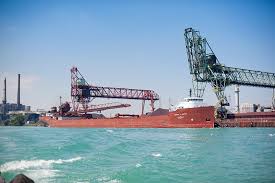
If you visit most any European port city, you’ll see a lot more shipping than in the Midwestern US. In Detroit, where I am, your’ll see an occasional ore boat from Wisconsin, and an occasional tourist cruise, but nothing to compare to German, Belgian, or Turkish ports. The reason for the difference is “The Jones act.”

The port of Istanbul with many ships

The Jones act , also known as “The Merchant Marine Act of 1920”, requires that all ships depositing cargo or people between US ports must be US owned, US built, US captained, US flagged, and at least 70% US manned. This raises costs and reduces options. The result is that few ships can move people or cargo between US cities, and these ships are older and less efficient than you’ll see elsewhere. World wide water traffic costs about 1/8 that of rail traffic per ton-mile, but in the US, the prices are more comparable. The original justification was to make sure the US would always have a merchant marine. The Jones act does that, sort of, but mostly, it just makes goods more expensive and travel more restrictive.

The port of Detroit — we rarely see more than one ship at a time.

Because it does some good, I don’t want to get rid of the Jones act entirely, but I’d like to see US shipping options expanded. Almost any expansion would do, e.g. allowing 50% US manned ships delivering along US rivers, or expanding to allow Canadian built ships or flagged, and ships that are more than 50% US owned, or expanding to any NAFTA vessel that meets safety standards. Any expansion of the number of ships available and would help.

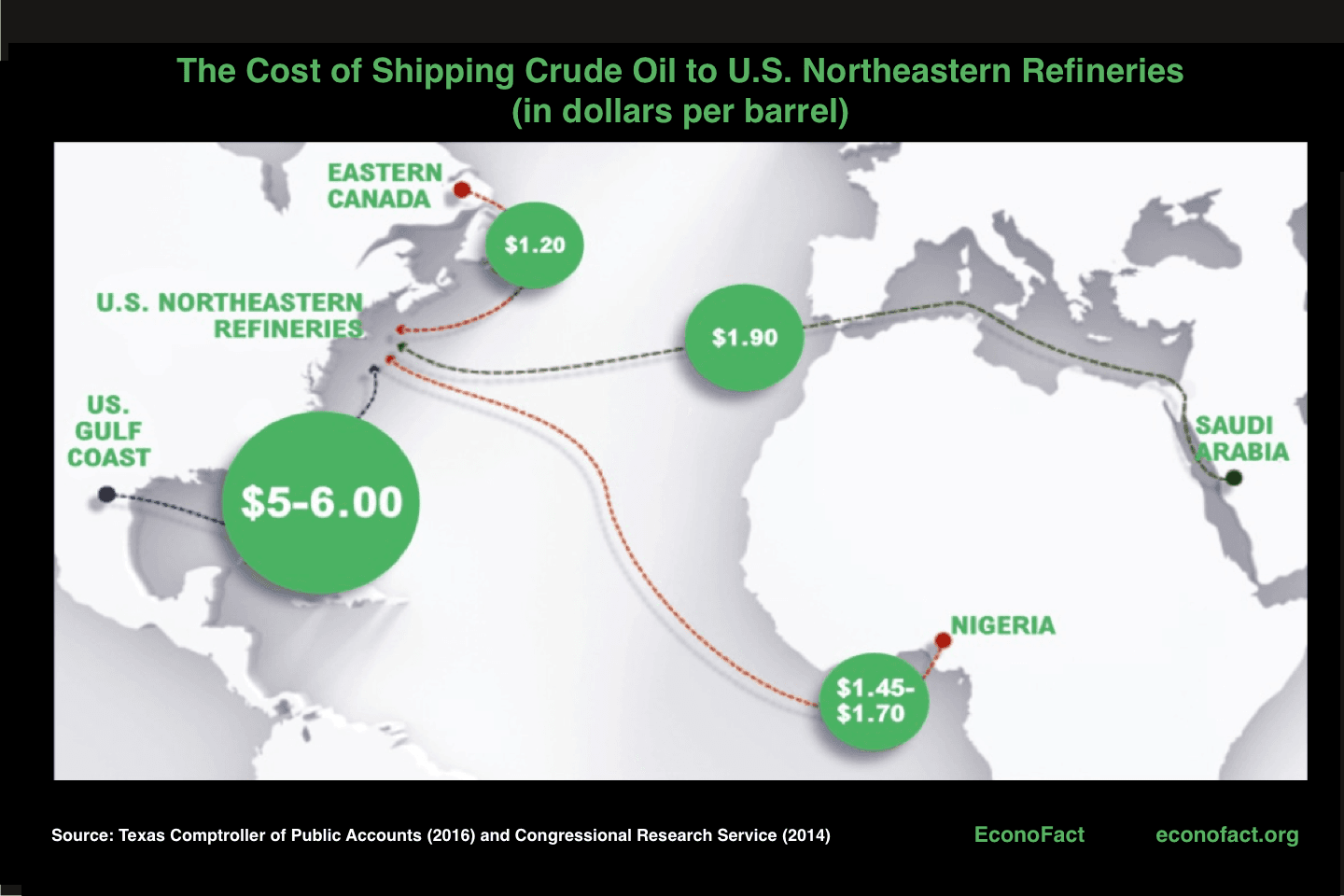
The jones act increase the price of oil transport by a factor of five, about.

Currently, the only exceptions to the Jones act are for emergencies (Trump voided the act during several storms) and for ships that visit a foreign port along the route. This exception is how every cruise ship between California and Hawaii works. They’re all foreign, but they stop in Mexico along the way. Similarly, cruises between Florida and Puerto Rico will stop in Bermuda typically, because the ships are foreign owned. Generally, passengers are not allowed to get off in Puerto Rico, but must sleep on board. This is another aspect of the Maritime act that I’d like to see go away.

Because of the Jones act, there is some US freight-ship building, and a supply of sailors and captains. A new, US ore-ship for the Great Lakes was launched last year, so far it’s been used to carry salt. There is also a US built and operated cruise ship in Hawaii, the “Pride of America,” that makes no stop in Mexico. I’d like to see these numbers expanded, and the suggestions above seem like they’d do more good than harm, lowering prices, and allowing modern container ships plus roll-on-roll-off car transports. Our rivers and lakes are super highways; I’d like to see them used more.

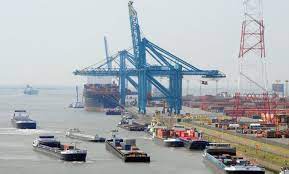
The port of Antwerp – far busier than Detroit.

Another way to expand the Jones act while perhaps increasing the number of US-built and operated ship would be through a deal with Canada so that ships from either country could ply trade on either countries rivers. As things stand, Canada has its own version of the Jones act, called the Coastal Trade Act where Canadian vessels must be used for domestic transport (cabotage) unless no such vessel is available. Maybe we can strike a deal with Canada so that the crew can be Canadian or US, and where built ships in either country are chosen on routes in either country, providing they meet the safety and environmental requirements of both.

Robert Buxbaum, June 14, 2023.

Right to work is a right.

In 26 states you can work in a unionized industry without joining a union. You can even cross a union strike line if you like. It’s called “right to work.” Michigan allowed it up till last month, but no longer. Immediately following the Democrats’ taking majority of the MI legislature, they voted to make non-union membership illegal. The claim was that those who do not want to be represented by the state-acknowledged union is misguided, or worse.

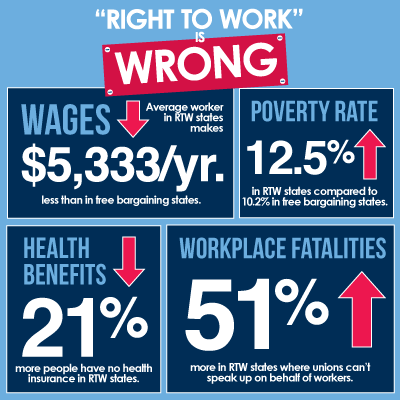
The argument for making union membership mandatory is presented in the poster at right. It notes that states that banned right to work are richer, with workers getting higher pay and benefits. These include California, New York, NJ, Washington, Alaska,.. See the map below. Although these states, on average have higher yearly wages, they also have higher taxes, higher costs of living, and more high-tech jobs. The cause and effect implied by this poster is erroneous, I think: The claim is that if you are forced to join a union you will be paid more with more benefits. I strongly suspect that the reality is that these states have high wages and high benefits and a lot of people working in safe fields, programming for example. They then force workers to work for one union so they’ll be easier managed, not because they want a strong opposition.

Another thing, even if you could guarantee higher wages by forced union membership, and you could avoid the high taxes and high cost of living that you find in NY and California, no person should be forced to accept representation by a group that they don’t get to choose, or who supports social goals that the worker doesn’t support. I don’t believe this is fair, or moral, but that’s how it is. It’s the law in most every state with a Democrat as governor and where Democrats control the legislature.

Right to work as of last month, before Michigan forced unionism.

Union membership had been declining in Michigan for years, but it took a particular nose dive in 2016 when the unions spent heavily for Clinton while blue collar workers supported Trump. It was 14% or workers before the law changed. Workers claimed that their unions were working against them, and complained about how their dues were spent. It also came out that some of the Michigan union bosses had stolen money from their funds to build fancy private houses — using non-union labor to do it. When the union bosses tried to show their muscle by calling strikes, the strikes accomplished little, or went on for months. The results were two-tier salaries, layoffs, and business failures. The working for the local newspapers teamsters struck, and one newspaper collapsed. The other chose non-union drivers. The teamsters are still on strike, 10 years later. I’d think a worker should be able to leave a union like this.

I’m a fan of unions, but think the worker should be able to choose. I’m a particular fan of craft unions that work to improve the quality of their work along with the quality of their workers lives. This helps everyone. I suspect that unions should not be able to support political parties too. See my thoughts on unions, here.

Michigan has a particularly strong history of crooked union bosses. When Jimmy Hoffa challenged the Teamster bosses over how the retirement fund was spent, he vanished. The union’s bosses seem to have had him killed. The last place where he was seen alive is an Andiamo Restaurant near my home. He was picked up by someone he knew, perhaps his nephew. No one’s talking and his remains were never found. In Michigan you used to be able to choose your union just as you chose your political club and your own lawyer, or you could choose none at all. Nowadays, the law says otherwise. Maybe you don’t like this law. Maybe you don’t like the union boss or how he’s spending. Maybe you’d like to visit with Jimmy Hoffa.

Robert Buxbaum May 19, 2023. Aside from everything else, you have a right to have a state that isn’t high-wage, high-tax, even if you could prove people were happier in such states. Freedom is a good, in and of itself.

Hydrogenation, how we’ve already entered the hydrogen economy

The hydrogen economy is generally thought to come in some distant future, where your car (and perhaps your home) runs on hydrogen, and the hydrogen, presumably, is made by clean nuclear or renewable solar or wind power. This is understood to be better than the current state of things where your car runs on dirty gasoline, and your home runs on coal or gas, except when the sun is shining bright and the wind is blowing hard. Our homes and cars can not run on solar or wind alone, although solar cells have become quite cheap, because solar power is only available in the daytime, basically for 6 hours, from about 9AM to 3PM. Hydrogen has been proposed as a good way to store solar and wind energy that you can’t use, but it’s not easy to store hydrogen — or is it? I’d like to suggest that, to a decent extent, we already store green hydrogen and use it to run our trucks. We store this hydrogen in the form of Diesel fuel, so you don’t realize it’s hydrogen.

Much of the oil in the United States these days comes from tar sands and shale. It doesn’t flow well at room temperature, and is too heavy and gooey for normal use. We could distill this crude oil and use only the light parts, but that would involve throwing away a huge majority of the oil. Instead we steam reform it to gasoline, ethylene and other products. The reaction is something like this, presuming an input feed of naphtha, C10H8:

C10H8 + 2 H2O –> C7H8 + C2H4 + CO2.

The C2H4 component is ethylene. We use it to make plastics. The C7H8 is called toluene. It is a component of high octane gasoline (octane rating about 114). The inventor of the process, Eugene Jules Houdry claimed to have won WWII for the allies because his secret process (Houdryflow catalytic cracking) allowed high production of lots of gasoline of very high octane, giving US and British planes and trucks higher mpg than the Germans or Japanese had. It was a great money maker, but companies can make even more by adding hydrogen.

Schematic of the hydrocracking process, from the US energy information agency

Over the last 2-3 decades, refineries have been adding catalytic hydrogenation processes. These convert high octane aromatic products, like toluene to low -octane diesel and jet fuel. These products sell for more. Aromatic toluene is exposed to hydrogen at about 500°C and 300 psi (20 bar) to produce heptane, an excellent diesel fuel with about 7% more energy content than toluene per gallon.

C7H8 + 4H2 –> C7H16.

Diesel fuel sell for about 20% more than gasoline per gallon, in part because of the higher energy content, and because Diesel engines are more efficient than gas engines. What’s more, toluene expands as it’s converted to heptane. One gallon of toluene converts to 1.16 gallons of heptane. As a result hydrogenation adds about 40% to the sales price per molecule. Refineries have found that they can make significant money this way if they can buy cheap hydrogen. Over the last few years, several refineries in Norway and Texas (high sun and wind areas) have added hydrogenators along with electrolysis units to produce the cheap hydrogen when no one needs the unwanted electricity generated when supply exceeds demand. Here is an analysis of the thermodynamics of this type of hydrogen generation.

Robert Buxbaum, May 11, 2023

Canada’s doctor-assisted suicide killed 10,064 in 2021

Canada’s healthcare is free to the user. It’s paid for by taxes, and it includes a benefit you can’t get in the US: free, doctor assisted suicide, euthanasia. This is a controversial benefit, forbidden in the Hippocratic oath because it’s close to murder, and includes the strong possibility of misuse of trust. Assistance by a trusted professional can be a bit likes coercion, and that starts to look like murder — especially since the professional often has a financial incentive to see you off.

From Charlie Hebdot (a French, humor magazine): The medical association refuses to participate in euthanasia — Why? People are already dining quite well on their own waiting in the emergency room.

In 2021, according to Statistics Canada, Canada assisted the suicide of 10,064 people, 3.3% of all Canadian deaths. There were about 4,000 more, non-assisted suicides. In Quebec, the Canadian Provence where Medical Assistance in Dying (MAiD) is most popular, 5.1% of deaths result from MAID. The Netherlands has a similar program that results in 4.8% of deaths. In Belgium, it’s 2.3%. These countries’ suicide rates are far higher than in the US, and account for far more deaths, per capita than from guns in the US. My guess is that suicide is common because it is free and professional. It’s called “Dignity in Dying,” in Europe, a title that suggests that old folks who don’t die this way are undignified.

In Canada, about 80% of those who requested MAiD were approved. A lot of the remainder were folks who died or changed their mind before receiving the fatal dose. If you attempt suicide on your own, it’s likely you won’t succeed, and you may not try again. With doctor assisted suicide, you’re sure to succeed (even if you change your mind after you get your lethal shot?)

In Canada you don’t have to be terminally ill to get MAiD, you just have to be in pain, and extreme psychological pain counts. Beginning March 17, 2024, depression will be added as a legitimate reason. According to Canadian TV news, depressives are lining up (read some interviews here). Belgium and Netherlands allows elders to be euthanized for dementia, and children to be euthanized on the recommendation of their parents. France passed similar legislation, but the doctors refused to go along, see cartoon. I applaud the French doctors.

Rodger Foley says he’s being pressured to ask for medical suicide, picture from the NY Post

There have been persistent claims that Canadian doctors and nurses push assisted suicide on poor patients, telling them how much bother they are and how much resources they are using. There has been an outcry in British and American newspapers, e.g. here in the Guardian, and in the NY Post, but not in Canada, so far. Rodger Foley, a patient interviewed by the NY Post, recorded conversations where his doctors and nurses put financial pressure on him. “They asked if I want an assisted death. I don’t. I was told that I would be charged $1,800 per day [for hospital care]. “I have $2 million worth of bills. Nurses here told me that I should end my life.” He claims they went so far as to send a collection agency to further pressure him. In another case, a disabled Canadian veteran asked for a wheelchair ramp, and was told to apply for MAiD.

Even without outside pressure, many people seeking MAiD often cite financial need as part of the reason. A 40 year old writer interviewed by Canadian television said that he can’t work and lives in poverty on a disability payment of just under $1,200 a month. “You know what your life is worth to you. And mine is worthless.”

The center of the argument is the value of a person in a social healthcare state when their economic value is less than the cost of keeping them alive. Here, Sabine Hossenfelder, an excellent physicist, argues that the best thing one could do for global warming and ecology is to have fewer people. Elon Musk says otherwise, but Ms Hossenfelder claims this only shows he is particularly unworthy. There’s a Germanic logic here that gave us forced euthanasia in the 1940s.

I find euthanasia abhorrent, especially when it’s forced on children, the elderly, and depressed folks. I also reject the scary view of global warming, that it is the death of the earth. I’ve argued that a warm earth is good, and that a cold earth is bad. Also, that people are good, that they are the reason for the world, not its misfortune. It seems to me that, if suicide aid must be provided, state-funded hospitals should not provide it. They have a financial incentive to drop non-paying, annoying patients. That seems to be happening in Canada. A patient must be able to trust his or her doctor, and that requires a belief that the doctor’s advice is for his or her good. Unfortunately, Canadian politicians have decided otherwise. I say hurray for the doctors of France for not going along.

Robert Buxbaum, April 25, 2023. The medical profession is shady even when you pay for services, see Elvis Presley’s prescription. There’s always a financial interest. Even based on old data, the US is not a particularly high-murder country if suicide is considered murder.

Britons did better than Germans since Brexit

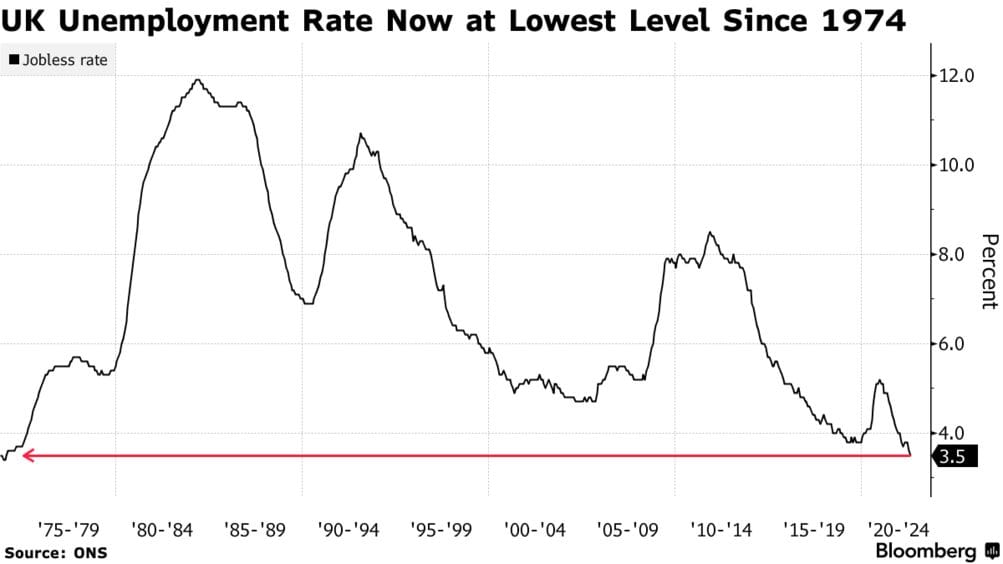
Britain and Germany are the two largest economies in Europe. When Britain voted to leave the EU seven years ago, 23 June 2016, economists, royals, and the richer, smarter set predicted disaster. The unemployment rate at the time was 5.2% in the UK; economists guaranteed it would rise with Brexit due to the loss of access to the common market. Unemployment fell to 3.7% today: Embarrassing for economists, a bonus for British workers. Germany unemployment today is 5.6%, basically slightly higher than the 4.3% of 2016. There has been a large influx of Ukrainians into both countries, and of illegal boat people into the UK. These are people coming to get jobs, seeking a better life than available in the rest of the EU. That boat people don’t go the other way suggests that things are better in the UK.

Fromm Bloomberg, October 2022. See full article here. UK unemployment is down to 2.5% in February 2023.

Britain’s GDP was supposed to suffer from Brexit, too. Instead, GDP has grown by 18% since 2016, about 2.5% per year on average, outpacing Germany’s 10.6% total growth, 1.5% per year. Between 2016 and 2022, the British GDP rose to $3.19T from $2.7 T. Germany’s GDP increased to $3.57T, from $3.14T (data from the world bank). Separating from the EU helped, it seems and helped us too something Trump promoted. Germany chose close ties to Russia instead. That does not seem to be a big plus.

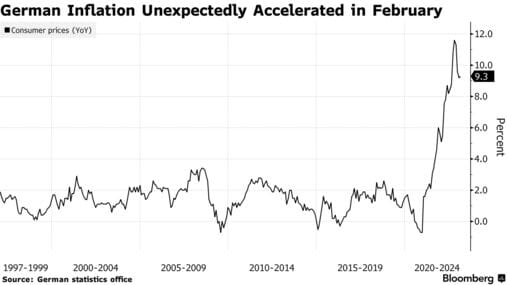
German Inflation has traditionally been low. It has increased in the past few months due to rising food and energy costs.

Inflation is higher in the UK than in Germany, 10.4% as of February 2023 versus 8.7% in Germany, or 9.9% in the European Union and a whole. I don’t think that’s Brexit. The UK typically has seen higher inflation rate than Germany, something seen by the steady drop of the pound. They have a tradition of inefficiency and silliness. Part of the problem today is that Britain gets much of its electricity from natural gas, while the French use nuclear power. Nuclear is cheap and clean, compared to natural gas. Coal is cheap and dirty; China uses it extensively and plans to use more. But the real cause of the UK’s higher inflation is inherent in the British and Germans, IMHO. The Germans hate inflation, the Brits don’t mind.

Population growth (green) or decline (orange) in Europe

For high-power, white collar workers, Britain seems to be as good a spot as Germany, maybe better. Maximum tax rates are slightly lower than in Germany (45% vs 47.45%), and the population is growing (slowly). Apparently, people like it enough to come there and have children; children are a good sign, IMHO. It’s harder to get good workers, but population growth suggests that the problems won’t be catastrophic (as they were in Japan, and likely will be in Germany). If you want a developed economy with yet-lower taxes, plus good workers, the US is the place to be, IMHO. Our maximum tax rate is 37%. You get fewer free services (healthcare), but you can earn enough to afford it. Prince Harry moved to the US recently, joining foot-baller David Beckham, and Pele a few years back. Former Python, John Cleese, came here too… They complain that Americans are cheap when it comes to helping others (but that’s out attraction). They claim that we’re violent and crass (true enough!) but say that the UK isn’t what it was. The fact that refugees seem to prefer the UK to Germany, suggests that Britain is a place to go. Britain, I’d say seems to have come out pretty well from Brexit. It could have done better if it accepted a trade deal, with the US, but that’s another story.

Robert Buxbaum, April 11, 2023