Tag Archives: water

Water Towers, usually a good thing.

Most towns have at least one water tower. Oakland county, Michigan has four. When they are sized right, they serve several valuable purposes. They provide water in case of a power failure; they provide increased pressure in the morning when people use a lot of water showering etc.; and they allow a town to use smaller pumps and to pump with cheaper electricity, e.g. at night. If a town has no tower, all these benefits are gone, but a town can still have water. It’s also possible to have a situation that’s worse than nothing. My plan is to show, at the end of this essay, one of the ways that can happen. It involves thermodynamic properties of state i a situation where there is no expansion headspace or excess drain (most towers have both).

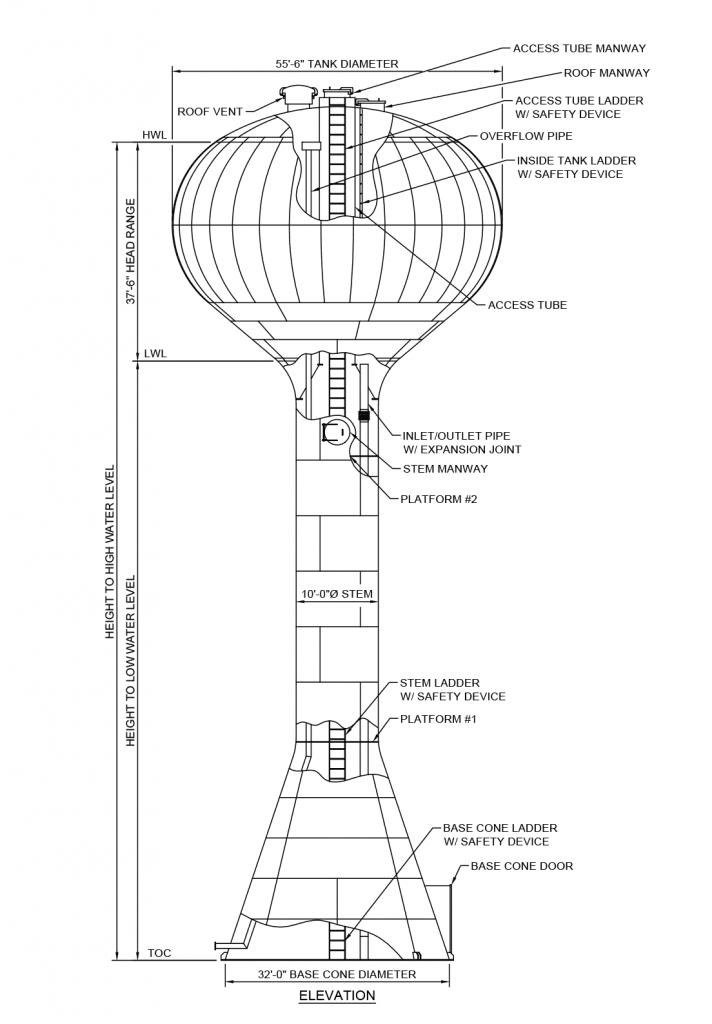
A typical water tower — spheroidal design. A tower of the dimensions shown would contain about 1/2 million gallons of water.

The typical tower stands at the highest point in the town, with the water level about 170 feet above street level. It’s usable volume should be about as much water as the town uses in a typical day. The reason for the height has to do with the operating pressure of most city-level water pipes. It’s about 75 psi and each foot of water “head” gives you about 0.43 psi. You want pressures about 75 psi for fire fighting, and to provide for folks in apartment buildings. If you have significantly higher pressures, you pay a cost in electricity, and you start losing a lot of water to leaks. These leaks should be avoided. They can undermine the roads and swallow houses. Bob Dadow estimates that, for our water system the leakage rate is between 15 and 25%.

Oakland county has four water towers with considerably less volume than the 130 million gallons per day that the county uses. I estimate that the South-east Oakland county tower, located near my home, contains, perhaps 2 million gallons. The other three towers are similar in size. Because our county’s towers are so undersized, we pay a lot for water, and our water pressure is typically quite low in the mornings. We also have regular pressure excursions and that leads to regular water-boil emergencies. In some parts of Oakland county this happens fairly often.

There are other reasons why a system like ours should have water towers with something more like one days’ water. Having a large water reserve means you can benefit from the fact that electric prices are the lowest at night. With a days’ volume, you can avoid running the pumps during high priced, day times. Oakland county loses this advantage. The other advantage to having a large volume is that it gives you more time to correct problems, e.g. in case of an electric outage or a cyber attack. Perhaps Oakland thinks that only one pump can be attacked at one time or that the entire electric grid will not go out at one time, but these are clearly false assumptions. A big system also means you can have pumps powered by solar cells or other renewable power. Renewable power is a good thing for reliability and air pollution avoidance. Given the benefits, you’d expect Oakland county would reward towns that add water towers, but they don’t, as best I can tell.

Here’s one way that a water column can cause problems. You really need those pressure reliefs.

Now for an example of the sort of things that can go wrong in a water tower with no expansion relief. Every stand-pipe is a small water tower, and since water itself is incompressible, it’s easy to see that a small expansion in the system could produce a large pressure rise. The law requires that every apartment hose water system has to have expansion relief to limit these increases; The water tower above had two forms of reliefs, a roof vent, and an overflow pipe, both high up so that pressure could be maintained. But you can easily imagine a plumber making a mistake and installing a stand pipe without an expansion relief. I show a system like that at left, a 1000 foot tall water pipe, within a skyscraper, with a pump at the bottom, and pipes leading off at the sides to various faucets.

Lets assume that the pressure at the top is 20 psi, the pressure at the bottom will be about 450 psi. The difference in pressure (430 psi) equals the weight of the water divided by the area of the pipe. Now let’s imagine that a bubble of air at the bottom of the pipe detaches and rises to the top of the pipe when all of the faucets are closed. Since air is compressible, while water is not, the pressure at the bubble will remain the same as the bubble rises. By the time the bubble reaches the top of the pipe, the pressure there will rise to 450 psi. Since water has weight, 430 psi worth, the pressure at the bottom will rise to 880 psi = 450 + 430. This is enough to damage pump and may blow the pipes as well. A scenario like this likely destroyed the New Horizon oil platform to deadly consequences. You really want those pressure reliefs, and you want a competent plumber / designer for any water system, even a small one.

Robert Buxbaum, September 28- October 6, 2019. I ran for water commissioner is 2016.

Why does water cost what it does?

Water costs vary greatly about Oakland county, and around the US, and I have struggled in vain to find out why. In part the problem is that each city gets to add as much maintenance and management costs as the city government thinks appropriate. High management and infrastructure fees can increase to the cost of water, but I also not that different cities about Oakland County Michigan get their water at different rates from the multi-county organization that oversees water in South East Michigan: GLWA, The Great Lakes Water Authority.

$112 water bill for zero usage. The base charge is so large that prices are essentially independent of useage.

I’ve attended meetings, both local and multi county and have tried to find out why one town gets its water at a far lower rate than another, near by. Towns get lower rates if they have a water tower, but it is not at all clear what the formula is. It also helps to separate the storm sewage from the sanitary sewage — something that I have proposed for all of Oakland county, but if there is fixed formula of how that affects rates, I’ve not seen it. And I wonder how well communities monitor the amount of storm sewage they generate.

The water itself is free. For the most part, in this county, we pump it from the Detroit river. Some of the rest of the water is pumped from wells. None of this costs anything. There is a pump cost, but it is manicure. Pumping 1 gallon of water up 75 feet, costs about 0.002¢ in pumping cost. The rest of the cost is infrastructure: the cost of the pumps, the pipes, the treatment, the billing and sewage. Among the sewage fees is a pollution penalty, and Oakland county pays plenty of pollution penalties. When it rains, we generate more sewage than the system will handle, and we dump the rest into the rivers and lakes. This results in closed beaches and poisoned fish, and fines too. The county pays the EPA when we do this, and the county passes the cost to the cities. I don’t know what the formula for fee distribution is, and don’t even know what it should be. What I do know is that we do this vastly too often. I’d really like us to stop this by moving to separate the sewers so that, as a city, we don’t spend so much on treating rainwater and we don’t pollute so often.

Another oddity is that we do a propaganda campaign to tell folks to use less water. Why? I’d much prefer if people would use more. We could then charge a lower base charge, and then collect the rest on per-gallon fees. As with much that is socialist, the current system is inefficient, but pleasant for the management. Or, for those cheapskates and environmentalists who wish to save water, here are some ideas.

August 21, 2019, Robert Buxbaum

How to avoid wet basements

My house is surrounded my mulch — it absorbs enough rainwater that I rarely have to water.

Generally speaking water gets to your basement from rain, and the basic way you avoid wet basements is by providing some more attractive spot for the rainwater to go to. There are two main options here: divert the water to a lake or mulch-filled spot at least 8 feet away from your home, or divert it to a well-operated street or storm drain. My personal preference is a combination of both.

At right I show a picture of my home taken on a particularly nice day in the spring. Out front is a mulch-filled garden and some grass. On the side, not shown is a driveway. Most of the rain that hits our lawn and gardens is retained in 4 inches of mulch, and waters the plants. Four inches of mulch-covered ground will hold at least four inches of rainwater. Most of the rain that hits the house is diverted to downspouts and flows down the driveway to the street. Keeping some rainwater in the mulch means you don’t have to pay so much to water the trees and shrubs. The tree at the center here is an apple tree. I like fruit trees like this, they really suck up water, and I like the apples. We also have blueberries and roses, and a decorative pear (I like pears too, but they are messy).

In my opinion, you want some slope even in the lawn area, so excess rainwater will run to the sewers and not form a yard-lake, but that’s a professional preferences; it’s not always practical and some prefer a brief (vernal ) lake. A vernal lake is one that forms only in the spring. If you’ve got one, you may want to fill it with mulch or add trees that are more water tolerant than the apple, e.g. swamp oak or red cedar. Trees remove excess water via transpiration (enhanced evaporation). Red Cedars grow “knees” allowing them to survive with their roots completely submerged.

For many homes, the trick to avoiding a flooded basement is to get the water away from your home and to the street or a retention area.

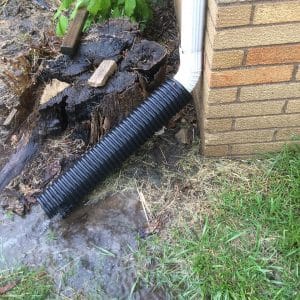
When it comes to rain that falls on your hose, one option is to send it to a vernal lake, the other option is to sent it to the street. If neither is working, and you find water in your basement, your first step is to try to figure out where your rainwater goes and how it got there. Follow the water when it’s raining or right after and see where it goes. Very often, you’ll discover that your downspouts or your driveway drain into unfortunate spots: spots that drain to your basement. To the extent possible, don’t let downspout water congregate in a porous spot near your house. One simple correction is to add extenders on the downspouts so that the water goes further away, and not right next to your wall. At left, I show a simple, cheap extender. It’s for sale in most hardware stores. Plastic or concrete downspout pans work too, and provide a good, first line of defense agains a flood basement. I use several to get water draining down my driveway and away from the house.

Sometimes, despite your best efforts, your driveway or patio slopes to your house. If this is the case, and if you are not quite ready to replace your driveway or patio, you might want to calk around your house where it meets the driveway or patio. If the slope isn’t too great, this will keep rainwater out for a while — perhaps long enough for it to dry off, or for most of the rainwater to go elsewhere. When my driveway was put in, I made sure that it sloped away from the house, but then the ground settled, and now it doesn’t quite. I’ve put in caulk and a dirt-dam at the edge of the house. It keeps the water out long enough that it (mostly) drains to the street or evaporates.

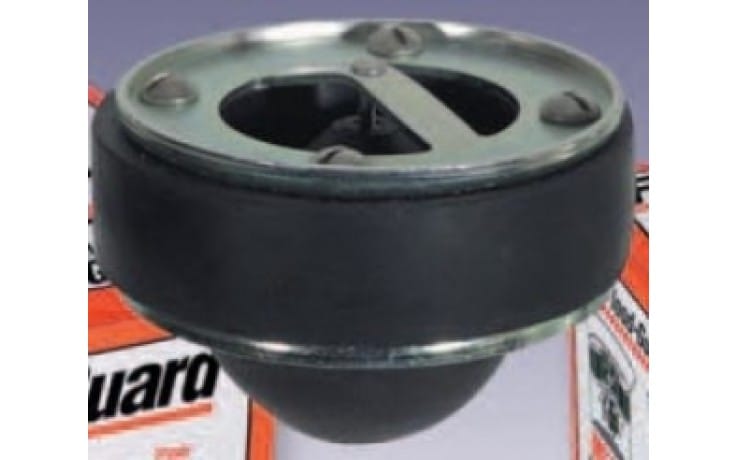
A drain valve. Use this to keep other people’s sewer water out of your basement.

There is one more source of wet basement water, one that hits the houses in my area once a year or so. In our area of Oakland county, Michigan, we have combined storm and sanitary sewers. Every so often, after a big rain, other people’s rainwater and sanitary sewage will come up through the basement drains. This is really a 3rd world sewer system, but we have it this way because when it was put in, in the 1900s, it was first world. One option if you have this is to put in a one-way drain valve. There are various options, and I suggest a relatively cheap one. The one shown at right costs about $15 at Ace hardware. It will keep out enough water, long enough to protect the important things in your home. The other option, cheaper and far more hill-billy, is to stuff rags over your basement drains, and put a brick over the rags. I’ll let you guess what I have in my basement.

Robert Buxbaum, June 13, 2019

Water Conservation for Michigan – Why?

The Michigan Association of Planners joined several environmental groups to pass state legislation requiring water conservation for public, and private users.

Among the legislation are laws requiring low flush toilets, and prohibiting high-volume shower heads as in this Seinfeld episode. I suppose I should go along: I’m running for water commissioner, and consider myself a conservationist. The problem is, I can’t see a good argument for these laws here in Oakland County, or in neighboring Macomb and Wayne Counties. The water can’t run out because most users take it from the Detroit river and return it there, cleaned after it’s used; it’s all recycled.

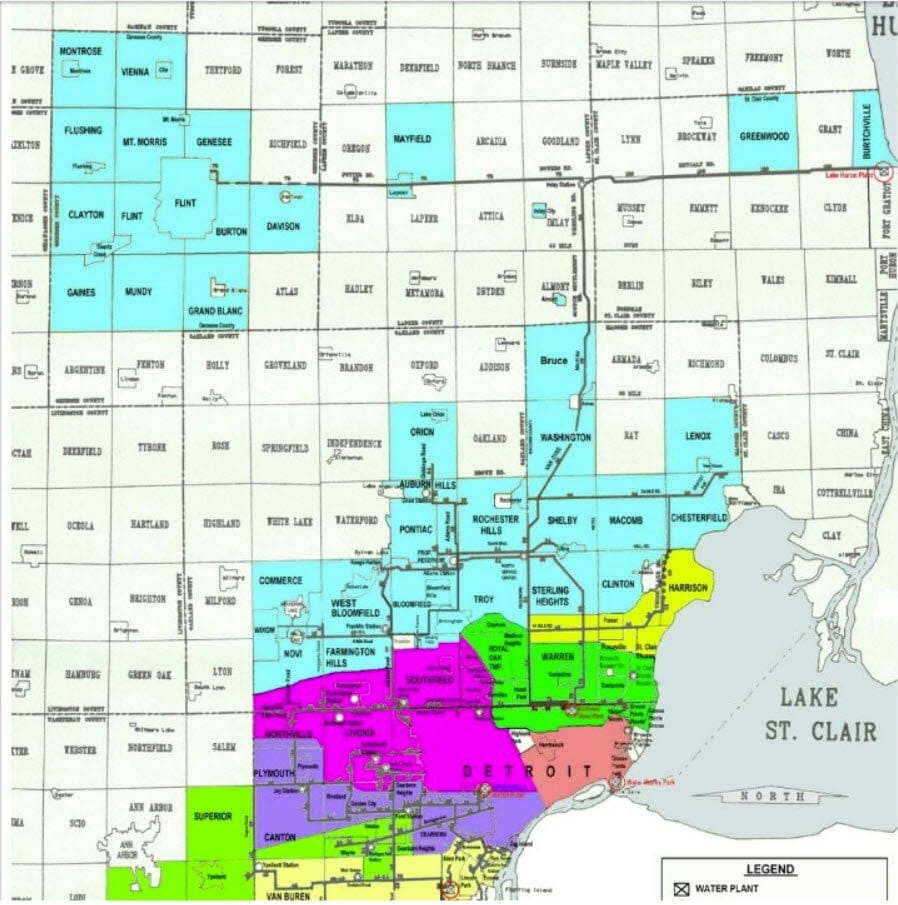
Map of the main drinking-water pipes serving south-east Michigan

Map of the main drinking-water pipes serving south-east Michigan

The map above shows the clean water system for south-east Michigan. The high-population areas, the ones that are colored in the map, get their water from the Detroit River or from Lake Huron. It’s cleaned, pumped, and carried to your home along the pipes shown. Then after you’ve used the water, it travels back along another set of pipes to the water treatment plant and into the Detroit River.

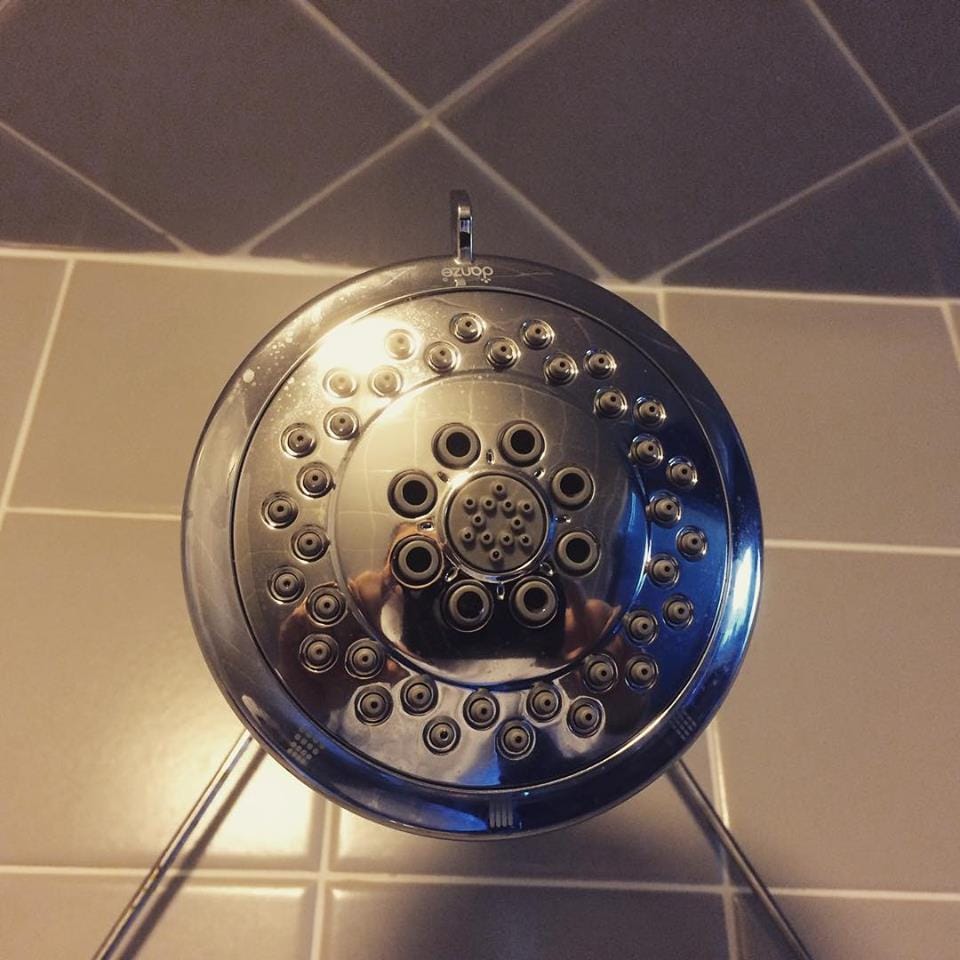
Three-position shower head -- a wonderful home improvement  I got it at universal plumbing.

Three-position shower head — a wonderful home improvement. I got it at universal plumbing.

When the system is working well, the water we return to the Detroit River is cleaner than the water we took in. So why legislate against personal use? If a customer wants to enjoy a good shower, and is willing to pay for the water at 1.5¢ per gallon, who cares how much water that customer uses? I can understand education efforts, sort-of, but find it hard to push legislation like we have against a high-volume shower head. We can not run out, and the more you use, the less everyone pays per gallon. A great shower head is a great gift idea, in my opinion.

The water department does not always work well, by the way, and these problems should be solved by legislation. We give away, for $200/year, high value clean water to Nestle company and then buy it back for $100,000,000. That’s a problem. Non-flushable toilet wipes are marketed as flushable; this causes sewer blockades. Our combined sewers regularly dump contaminated water into our rivers, lakes, and basements. These problems can be solved with legislation and engineering. It’s these problems that I’m running to solve.

Robert Buxbaum, January 6, 2019. If you want to save water, either to save the earth, or because you are cheep, here are some conservation ideas that make sense (to me).

We don’t need no stinking primary clarifier

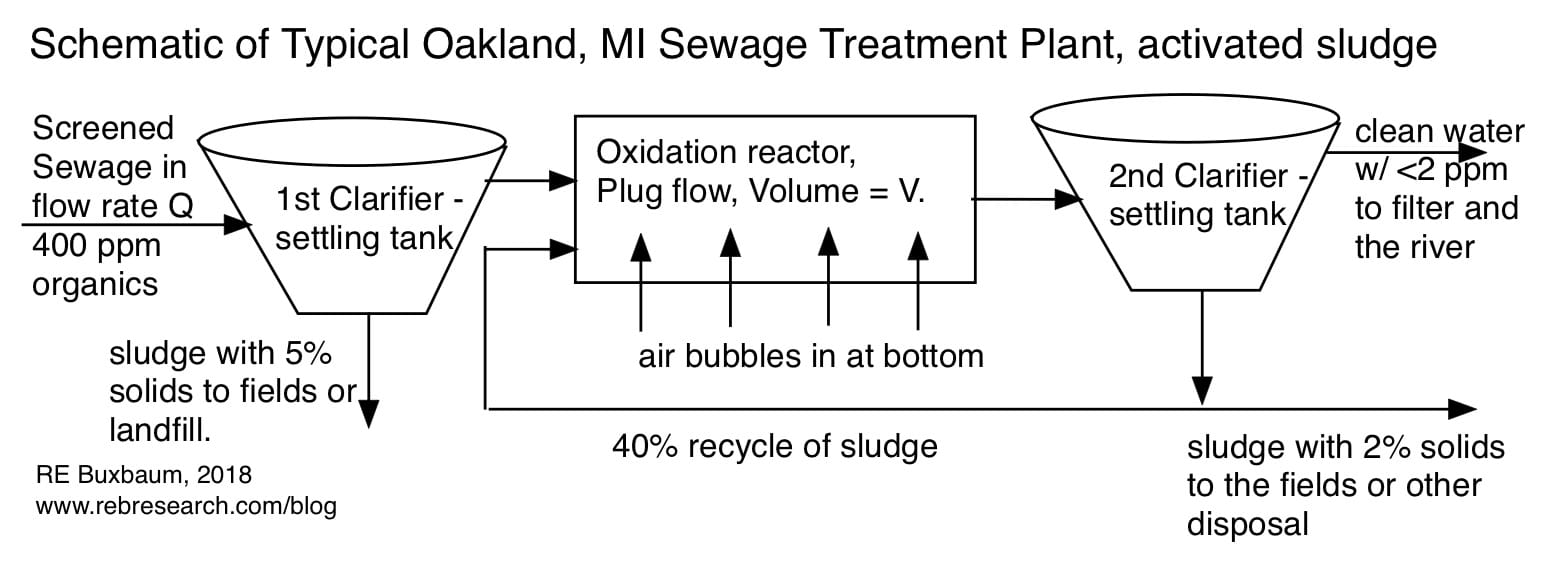
Virtually every sewage plant of Oakland County uses the activated sludge process, shown in the layout below. Raw sewage comes in, and goes through physical separation — screening, grit removal, and a first clarifier – settling tank before moving to the activated sludge oxidation reactor. The 1st clarifier, shown at left below, removes about half of the incoming organics, but it often stinks and sometimes it “pops” bubbles of fart. This is usually during periods of low flow, like at night. When the flow is slow, it arrives at the plant as a rotting smelly mess; it’s often hard to keep the bubbles of smell down.

Typical Oakland Sewage plant, activated sludge process with a primary clarifier.

Typical Oakland County Sewage treatment plant, activated sludge process with a primary clarifier.

The smell is much improved in the oxidation reactor, analyzed here, and in the 2nd clarifier, shown above at right. Following that is a filter, an ultraviolet cleanup stage, and the liquids are discharged to a local river. In Oakland county, the solids from the two clarifiers are hauled off to a farm, or buried in a landfill. Burial in a landfill is a costly waste, as I discuss here. The throughputs for most of these treatment plants is only about 2-3 million gallons of sewage per day. But Oakland county can produce 500 million gallons of sewage per day. The majority of this goes to Detroit for treatment, and sometimes the overflow is dumped rotting and smelly, in the rivers.

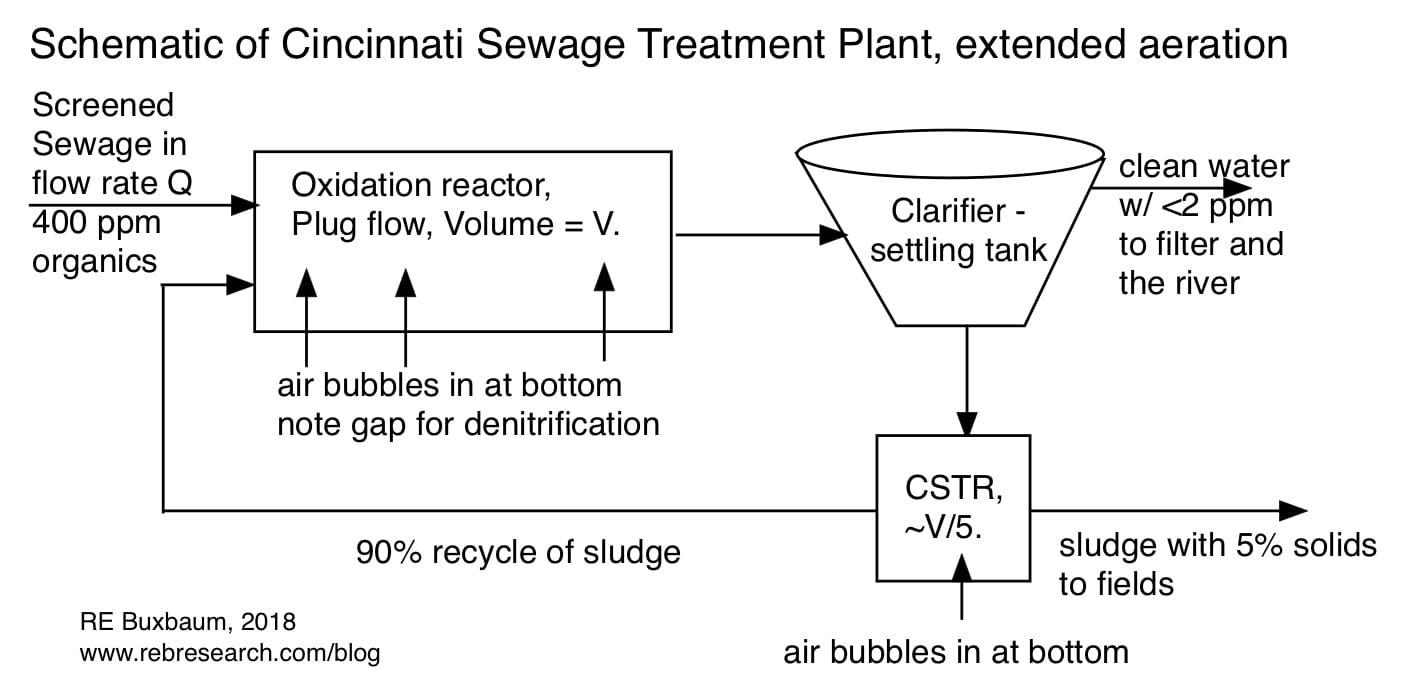
A few months ago, I visited the Sycamore Creek Wastewater facility outside of Cincinnati. This is an 8 million gallon per day plant that uses the “extended aeration process”, shown in the sketch below. I noticed several things I liked: the high throughput (the plant looks no bigger than our 2-3 million gallon plants) and the lack of a bad smell, primarily. The Sycamore Creek plant had an empty hole where the primary clarifier had once been. Lacking this clarifier, the screened sewage could not sit and pop. Instead it goes directly from grit removal to the oxidation reactor, a reactor that looks no bigger than in our plants. This reactor manages a four times higher throughput, I think, because of a higher concentration of cellular catalyst. Consider the following equation derived in a previous post:

ln C°/C = kV/Q.

Here, C° and C are the incoming and exit concentrations of soluble organic; k is the reaction rate, proportional to cellular concentration, V is the volume of the reactor, Q is the flow, and ln is natural log. The higher cellular concentration in the extended aeration plant results in an increased reaction rate, k. The higher the value of k, the higher the allowed flow, Q, per reactor volume, V.

The single clarifier at the end of the Sycamore Creek plant does not look particularly big. My sense is that it deals with a lot more sludge and flow than is seen in our 2nd clarifiers because (I imaging) the sludge is higher density, thus faster settling. I expect that, without the 1 clarifier, there is extra iron and sulfate in the sludge, and more large particles too. In our plants, a lot of these things are removed in the primary clarifier. Sludge density is also increased, I think, because the Cincinnati plant recycle a greater percentage of the sludge (I list it as 90% in the diagram). Extra iron in the reactor also helps to remove phosphates from the water effluent that flows back to the river, an important pollution concern. Iron phosphates are insoluble, and thus leave with the sludge. In Oakland county’s activated sludge plants, it is typical to add iron to the reactor or clarifier. In Cincinnati’s extended aeration plant, I’m told, iron addition is generally not needed.

Typical Oakland Sewage plant, activated sludge process with a primary clarifier.

Cincinnati sewage treatment plant, extended aeration process with no primary clarifier.

The extended aeration part of the above process refers to the secondary sludge oxidizer, the continuously stirred tank reactor, or CSTR shown at lower right above. The “CSTR” is about 1/5 the volume of the main oxidation reactor and about the size of a clarifier. Oxidation in the CSTR compliments that in the main oxidizer removing organics, making bio-polymer, and improving (I think) the quality of the sludge that goes to the farms. Oxidation in the CSTR reduces the amount of sludge that goes to the farms. The sludge that does go, is  less-toxic and more concentrated in organics and minerals. I’m not sure if the CSTR product is as good as the product from an anaerobic digester, or if the CSTR is cheaper to operate, but it looks cheaper since there is no roof, and no (or minimal) heating. This secondary oxidizer is very efficient at removing organics because the cellular catalyst concentration is very high – much higher than in the main oxidizer.

During periods of high load, early morning, the CSTR seems to serve as a holding tank so that sludge does not build up in the clarifier. Too much sludge in the clarifier can start to rot, and ruin the effluent quality. The way you tell if there is too much sludge, by the way, is through a device called the “sludge judge.” I love that name. The Cincinnati plant used a centrifugal drier; none of our plants do. The Cincinnati plant had gap the bubble spots of the main oxidizer. This is good for denitrification, I’m told, an important process that I discuss elsewhere.

The liquid output of their clarifier (or ours) is not pure enough to be sent directly to the river. In this plant, the near-pure water from the clarifier is sent to a trickling filter, a bed of sand and anthracite that removes colloidal remnants. Some of our plants do the same. I suspect that the large surface area in this filter is also home to some catalysis: last stage oxidation of remaining bio-organics. On a regular basis, the filter bed is reverse-flushed to remove cellular buildup, slime, and send it to the beginning of the process. The trickling filter output is then sent to an ultraviolet, bacteria-killing step before being released to the rivers. All in all, I suspect that an extended aeration process like this is worth looking into for Oakland County, especially for our North Pontiac sewage treatment facility. That plant is particularly bad smelling, and clearly too small to treat all its sewage. Perhaps we can increase the throughput and decrease the smell at a minimal cost.

Dr. Robert E. Buxbaum, December 18, 2018. I’m running for water commissioner of Oakland county, MI. If you like, visit my campaign site. Here are some sludge jokes and my campaign song.

Activated sludge sewage treatment bioreactors

I ran for water commissioner of Oakland county in 2016, a county with 1.3 million people and eight sewage treatment plants. One of these plants uses the rotating disk contractor, described previously, but the others process sewage by bubbling air through it in a large tank — the so-called, activated sludge process. A description is found here in Wikipedia, but with no math, and thus, far less satisfying than it could be. I thought I might describe this process relevant mathematics, for my understanding and those interested: what happens to your stuff after you flush the toilet or turn on the garbage disposal.

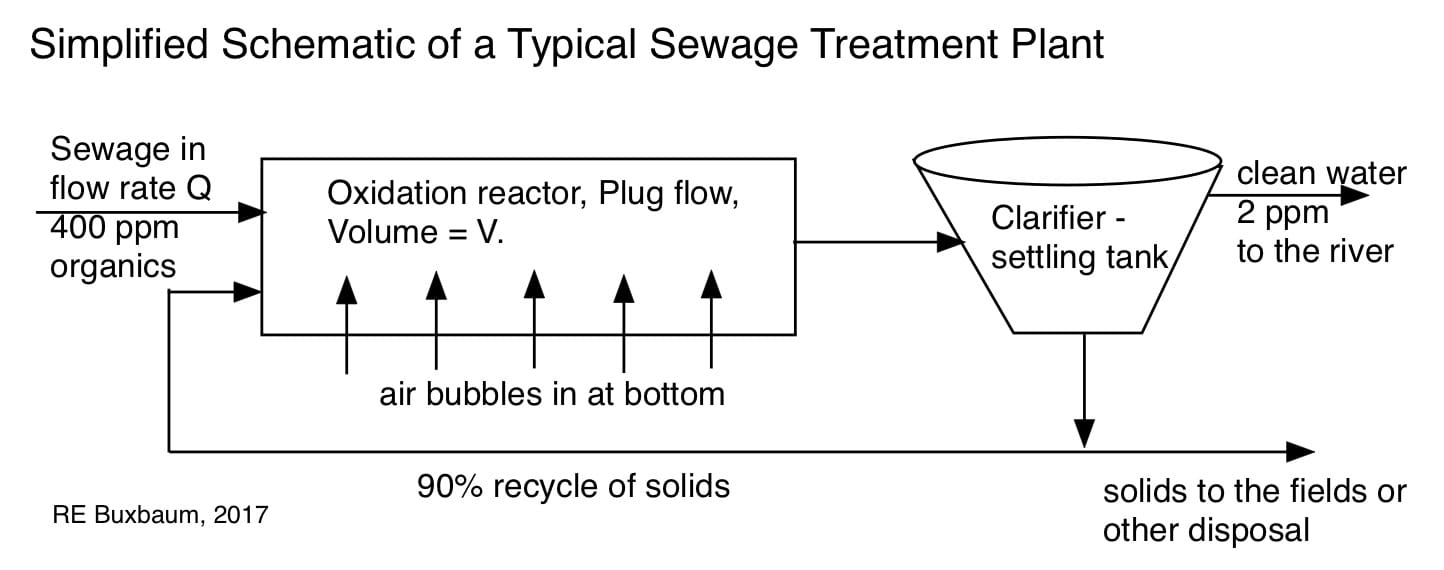
Simplified sewage plant: a plug-flow reactor with a 90+% solids recycle used to maintain a high concentration of bio-catalyst material.

Simplified sewage plant: a bubbling, plug-flow bio-reactor with 90% solids recycle and a settler used to extract floc solids and bio-catalyst material.

In most of the USA, sanitary sewage, the stuff from your toilet, sink, etc. flows separately from storm water to a treatment plant. At the plant, the sewage is first screened (rough filtered) and given a quick settle to remove grit etc. then sent to a bubbling flow, plug-flow bioreactor like the one shown at right. Not all cities use this type of sludge processes, but virtually every plant I’ve seen does, and I’ve come to believe this is the main technology in use today.

The sewage flows by gravity, typically, a choice that provides reliability and saves on operating costs, but necessitates that the sewage plant is located at the lowest point in the town, typically on a river. The liquid effluent of the sewage, after bio-treatment is typically dumped in the river, a flow that is so great more than, during dry season, more than half the flow of several rivers is this liquid effluent of our plants – an interesting factoid. For pollution reasons, it is mandated that the liquid effluent leaves the plant with less than 2 ppm organics; that is, it leaves the plant purer than normal river water. After settling and screening, the incoming flow to the bio-reactor typically contains about 400 ppm of biomaterial (0.04%), half of it soluble, and half as suspended colloidal stuff (turd bits, vegetable matter, toilet paper, etc). Between the activated sludge bio-reactor and the settler following it manage to reduce this concentration to 2 ppm or less. Soluble organics, about 200 ppm, are removed by this cellular oxidation (metabolism), while the colloidal material, the other 200 ppm, is removed by adsorption on the sticky flocular material in the tank (the plug-flow tank is called an oxidation ditch, BTW). The sticky floc is a product of the cells. The rate of oxidation and of absorption processes are proportional to floc concentration, F and to organic concentration, C. Mathematically we can say that

dC/dt = -kFC

where C and F are the concentration of organic material and floc respectively; t is time, and k is a reaction constant. It’s not totally a constant, since it is proportional to oxygen concentration and somewhat temperature dependent, but I’ll consider it constant for now.

As shown in the figure above, the process relies on a high recycle of floc (solids) to increase the concentration of cells, and speed the process. Because of this high recycle, we can consider the floc concentration F to be a constant, independent of position along the reactor length.

The volume of the reactor-ditch, V, is fixed -it’s a concrete ditch — but the flow rate into the ditch, Q, is not fixed. Q is high in the morning when folks take showers, and low at night. It’s also higher — typically about twice as high — during rain storms, the result of leakage and illegal connections. For any flow rate, Q, there is a residence time for a bit of sewage flowing through a tank, τ = V/Q. We can now solve the above equation for the value of τ for an incoming concentration C° = 400 ppm, an outgoing concentration Co of 2 ppm. We integrate the equation above and find that:

ln (C°/Co) = kFτ

Where τ equals the residence time, τ = V/Q. Thus,

ln (C°/Co) = kFV/Q.

The required volume of reactor, V, is related to the flow rate, Q, as follows for typical feed and exit concentrations:

V = Q/kF ln( 400/2) = 5.3 Q/kF.

The volume is seen to be dependent on F. In Oakland county, tank volume V is chosen to be one or two times the maximum expected value of Q. To keep the output organic content to less than 2 ppm, F is maintained so that kF≥ 5.3 per day. Thus, in Oakland county, a 2 million gallon per day sewage plant is built with a 2-4 million gallon oxidation ditch. The extra space allows for growth of the populations and for heavy rains, and insures that most of the time, the effluent contains less than 2 ppm organics.

Bob Martin by the South Lyon, MI, Activated Sludge reactor

Bob Martin chief engineer the South Lyon, MI, Activated Sludge plant, 2016. His innovation was to control the air bubblers according to measurements of the oxygen content. The O2 sensor is at bottom; the controller is at right. When I was there, some bubblers were acting up.

As you may guess, the activated sludge process requires a lot of operator control, far more than the rotating disk contractor we described. There is a need for constant monitoring and tweaking. The operator deals with some of the variations in Q by adjusting the recycle amount, with other problems by adjusting the air flow, or through the use of retention tanks upstream or downstream of the reactor, or by adding components — sticky polymer, FeCl3, etc. Finally, in have rains, the settler-bottom fraction itself is adjusted (increased). Because of all the complexity. sewer treatment engineer is a high-pay, in demand, skilled trade. If you are interested, contact me or the county. You’ll do yourself and the county a service.

I’d mentioned that the effluent water goes to the rivers in Oakland county. In some counties it goes to the fields, a good idea, I think. As for the solids, in Oakland county, the solid floc is concentrated to a goo containing about 5% solids. (The goo is called unconsolidated sludge) It is shipped free to farmer fields, or sometimes concentrated to more than 5% (consolidated sludge), and provided with additional treatment, anaerobic digestion to improve the quality and extract some energy. If you’d like to start a company to do more with our solids, that would be very welcome. In Detroit the solids are burned, a very wasteful, energy-consuming process, IMHO. In Wisconsin, the consolidated sludge is dried, pelletized, and sold as a popular fertilizer, Milorganite.

Dr. Robert Buxbaum, August 1, 2017. A colleague of mine owned (owns?) a company that consulted on sewage-treatment and manufactured a popular belt-filter. The name of his company: Consolidated Sludge. Here are some sewer jokes and my campaign song.

Nestle pays 1/4,000 what you pay for water

When you turn on your tap or water your lawn, you are billed about 1.5¢ for every gallon of water you use. In south-east Michigan, this is water that comes from the Detroit river, chlorinated to remove bacteria, e.g. from sewage, and delivered to you by pipe. When Nestle’s Absopure division buys water, it pays about 1/4000 as much — $200/ year for 218 gallons per minute, and they get their water from a purer source, a pure glacial aquifer that has no sewage and needs no chlorine. They get a far better deal than you do, in part because they provide the pipes, but it’s mostly because they have the financial clout to negotiate the deal. They sell the Michigan water at an average price around $1/gallon, netting roughly $100,000,000 per year (gross). This allows them to buy politicians — something you and I can not afford.

Absopure advertises that I t will match case-for-case water donations to Flint. Isn't that white of them.

Absopure advertises that I t will match case-for-case water donations to Flint. That’s awfully white of them.

We in Michigan are among the better customers for the Absopure water. We like the flavor, and that it’s local. Several charities purchase it for the folks of nearby Flint because their water is near undrinkable, and because the Absopure folks have been matching the charitable purchases bottle-for bottle. It’s a good deal for Nestle, even at 50¢/gallon, but not so-much for us, and I think we should renegotiate to do better. Nestle has asked to double their pumping rate, so this might be a good time to ask to increase our payback per gallon. So far, our state legislators have neither said yes or no to the proposal to pump more, but are “researching the matter.” I take this to mean they’re asking Nestle for campaign donations — the time-honored Tammany method. Here’s a Detroit Free Press article.

I strongly suspect we should use this opportunity to raise the price by a factor of 400 to 4000, to 0.15¢ to 1.5¢ per gallon, and I would like to require Absopure to supply a free 1 million gallons per year. We’d raise $300,000 to $3,000,000 per year and the folks of Flint would have clean water (some other cities need too). And Nestle’s Absopure would still make $200,000,000 off of Michigan’s, clean, glacial water.

Robert Buxbaum, May 15, 2017. I ran for water commissioner, 2016, and have occasionally blogged about water, E.g. fluoridationhidden rivers, and how you would drain a swamp, literally.

pee in the shower and other water savers

Do you want to save the planet and save money at the same time? Here are some simple tips:

The first money and planet saver, is to pee in the shower. For those who don’t have a lawn, or who don’t water, your single biggest water cost is likely the toilet. Each person in your household will use it several times per day, at roughly 1.6 gallons per flush. In Oak Park, Michigan the cost of water is 1.5¢/gallon, so each flush costs you, roughly 2.5¢. If you pee in the shower every morning, you’ll save yourself about one flush per day, or 2.5¢. Over the course of a year you’ll have used about 500 gallons less, and will have saved yourself somewhere between $5 and $10. Feel good about yourself every morning; the effort involved is truly minimal.

Related to peeing in the shower, I should mention that many toilets leak. A significant part of your water bill can often be cut by replacing the “flapper valve on the inside of your toilet tank, and/or by cleaning the needle fill valve. To see if you need this sort of help, put a few drops of food dye in the toilet when you leave in the morning. If the color is largely gone by the time you get back, the toilet is leaking the equivalent of a few volumes per day, that is at least as much water as is flushed. If the color goes faster, or you hear the tank refill when no one used it, you’re leaking more. Check the flapper and replace it if it’s worn — it’ll cost about $3 — and check the needle-fill valve. They don’t work forever. Cleanliness is near godliness.

Mulch is good, this is too much concentrated by the tree trunk. Use only 2 inches and spread it out to save water and weeding.

Mulch is good, this is too much concentrated by the tree trunk. Use only 2-3 inches and spread it out from the trunk to save water and weeding without attracting bugs.

If your valve is leaking and you decide to replace it, you may want to replace with a variable flush valve. Typically, there are two options: a big vale for big flush (1.6 gal) and a small valve for small flush (1 gal or less). These are widely used in Europe. You can make up for this cost rather quickly at 1.5¢/gallon.

The next big issue is lawn-care. If you water your lawn and flowers daily, you’ve likely noticed that you pay about $300/month for water in the summer: a lot more than in the winter, or than your lazes-faire neighbor in the summer. Every $150 of summer-excess, water bill you pay represents about 10,000 gallons applied to your lawn. That’s a cubic foot, or 1¢ to 2¢ of water applied per ft2 per month for typical watering. While many sites advise that you can save by adding a rain barrel, I disagree. Rain barrels are costly, ugly, and are a lot of work ago plumb in. And each barrel only holds 55 gallons of water, 82¢ worth when full. You do a lot better, IMHO by putting down an inch or two of mulch around your flowers and vegetables. This mulch requires no work and will keep you from needing to water these areas for the 3-4 days after every rainfall. A layer of 1″ to 2″ will help your soil hold 0.5 to 1 gallon of water per square foot. At typical prices of mulch and water, this will pay for itself in 1-2 years and will help you avoid weeding. Mulch is a far better return than the rain-barrels that are often touted, and there’s far less effort involved. Buy the mulch, not the barrel, but don’t put down too more than 2″ on flowers and vegetable. Trees can take 3 -4″; don’t use more. Avoid a mulch mountain right next to a tree, it causes the roots to grow weird, and provides a home for bugs and undesirable anaerobic molds.

A little more work than the above is to add a complete rain garden or bioswale. Build it at the bottom of any large incline on your property, where the water runs off (It’s likely a soggy swamp already). Dig the area deeper and put, at the bottom of the hole, a several-inch layer of mulch and gravel. Top it off with the soil you just removed, ideally raising the top high enough that, if the rain garden should fill, the water will run off to the street. Plant in the soil at the top long-rooted grasses, or flowers, vegetables, or water-tolerant trees. You may want to direct the water from your home’s sump pump here too (It can help to put a porous pipe at the bottom to distribute this water). If you do this right, you’ll get vegetables or trees and you won’t have to water the garden, ever. Also, you’ll add value to your property by removing the swampy eyesore. You’ll protect your home too, since a major part of home flooding comes from the water surge of sump water to the sanitary sewer.

Robert E. Buxbaum, April 14, 2017. I ran for water commissioner, Oakland County, MI, Nov. 2016. Among my other thoughts: increased retention to avoid flooding, daylighting rivers, and separating the sanitary from the storm sewers. As things stand, the best way to save money on water– get the same deal the state gave to Nestle/ Absopure: they pay only $200/year to pump 200 gal/minute. That is, they pay only 1/3000 of what you and I pay. It helps to have friends in government.

Rethinking fluoride in drinking water

Every now and again, it pays to rethink what everyone knows is so. As it happens I was asked to rethink fluoride in the drinking water. So here goes.

Fluoride is a poison, toxic for a small child in doses of 500 mg, and toxic to an adult in doses of a few thousand mg. It is a commonly used rat poison that kills by robbing the brain of its ability to absorb oxygen. In the form of hydrofluoric acid, it is responsible for the deaths of more famous chemists than any other single compound: Humphrey Davy died trying to isolate fluorine; Paul Louyet and Jerome Nickles, too. Thomas Knox nearly died, and Henri Moissan’s life was shortened. Louis-Joseph Gay Lussac, George Knox, and Louis- Jacques Thenard suffered burns and similar, George Knox was bedridden for three years. Among the symptoms of fluoride poisoning is severe joint pain and that your brain turns blue.

In low doses, though, fluoride is thought to be safe and beneficial. If true, this would be an example of hormesis. It’s found that many things that are toxic at high doses are beneficial at low. Most drugs fall into this category; chemotherapy works this way. Sunshine and radioactivity show hormesis too. Fluoride seems to be like this. In small doses, Fluoride is associated with strong teeth, and few cavities, and no obvious health risks. It is found at ppm levels many well water systems, and has shown no sign of toxicity, either for humans or animals at these ppm levels. Following guidelines set by the AMA, most US cities have been putting fluoride in drinking water since the 1960s, typically at concentrations between 0.7 and 1.2 ppm. We have seen no deaths or clear evidence of any injury from this, but there has been controversy. Much of the controversy stems from a Chinese study that links fluoride to diminished brain function, and passivity (Anti-fluoriders falsely attribute this finding to a Harvard researcher, but the Harvard study merely cites the Chinese). The American dental association strongly maintains that worries based on this study are groundless, and that the advantage in lower cavities more than off-sets any other risks. Notwithstanding, I thought I’d take another look. The typical US adult consumes 1-3 mg/day the result of drinking 1-3 liters of fluoridated water (1 ppm = 1 mg/liter). This < 1/1000 the toxic dose,

While there is no evidence that people who drink high-fluoride well water are any less-healthy than those who drink city water, or distilled / filtered water, that does not mean that our city levels are ideal. Two months ago, while running for water commissioner, I was asked about fluoride, and said I would look into it. Things have changed since the 1960s: our nutrition has changed, we have vitamin D milk, and our toothpastes now contain fluoride. My sense is we can reduce the water concentration. As shown below, many industrial countries that don’t add fluoride have similar tooth decay rates to the US.

World Health Organization data on tooth decay and fluoridation.

World Health Organization data on tooth decay and fluoridation.

This chart should not be read to suggest that fluoride doesn’t help; all the countries shown use fluoride toothpaste, and some give out fluoride pills, too. And some countries that don’t add fluoride have higher levels of cavities. Norway and Japan, for example. They don’t add fluoride and have 50% more cavities than we do. Germany doesn’t add fluoride, and has fewer cavities, but they hand out fluoride pills, To me, the chart suggests that our levels should be lower than the AMA guidance, though not zero. In 2015, the Department of Health recommend lowering the fluoride level to 0.7 ppm, the lower end of the previous range, but based on the experience of Europe, I’d pick 1/2 the original dose: 0.6 to 0.35 ppm. I’d then revisit the data in another 15 years.

Having picked my target fluoride concentration, I checked to see what the levels we use in my county, Oakland county, MI. I was happy to discover that the levels were already below the AMA guide. The water the county drinks, provided by Detroit Water and Sewage, NOCWA and SOCWA contains 0.43-0.55 ppm fluoride, in the center of in the range I would have picked. Fluoride concentrations are higher in towns that use well water, about  0.65-0.85 ppm. I do not know if this is because the well water comes from the ground with these fluoride concentrations or if the towns add more, aiming at the Department of Health target. In either case, I don’t find these levels alarming. If you live in one of these towns, or outside of Oakland county, check your fluoride levels. If they seem high, write to your water commissioner or add a filter to your tap. You can also switch from fluoride toothpaste to non-fluoride, or baking soda. In any case, remember to brush. That does make a difference, and it’s completely non-toxic.

Robert Buxbaum, January 9, 2017. Another toxic additive is chlorine. I discuss chlorine addition a bit in this essay. As a side issue, a main mechanism of sewer pipe decay is related to tooth decay. The roofs of sewer pipes grow acid-producing, cavity causing bacteria that live off of the foul sewer gas. In time these bacteria destroy concrete sewer pipes. The remedies for this erosion is to clean sewer pipes regularly, after having them checked by a professional, about once per year. As with death, one should repair cavities early. Here too, it seems high fluoride cement resists cavities better.

How do you drain a swamp, literally

The Trump campaign has been claiming it wants to “drain the swamp,” that is to dispossess Washington’s inbred army of academic consultants, lobbyists, and reporter-spin doctors, but the motto got me to think, how would you drain a swamp literally? First some technical definitions. Technically speaking, a swamp is a type of wetland distinct from a marsh in that it has no significant flow. The water just, sort-of sits there. A swamp is also unlike a fen or a bog in that swamp water contains enough oxygen to support life: frogs, mosquitos, alligators,., while a fen or bog does not. Common speech ignores these distinctions, and so will I.report__jaguars_running_back_denard_robi_0_5329357_ver1-0_640_360

If you want to drain a large swamp, such as The Great Dismal Swamp that covered the south-east US, or the smaller, but still large, Hubbard Swamp that covered south-eastern Oakland county, MI, the classic way is to dig a system of open channel ditches that serve as artificial rivers. These ditches are called drains, and I suppose the phrase, “drain the swamp comes” from them. As late as the 1956 drain code, the width of these ditch-drains was specified in units of rods. A rod is 16.5 feet, or 1/4 of a chain, that is 1/4 the length of the 66′ surveyor’s chains used in the 1700’s to 1800’s. Go here for the why these odd engineering units exist and persist. Typically, 1/4 rod wide ditches are still used for roadside drainage, but to drain a swamp, the still-used, 1956 code calls for a minimum of a 1 rod width at the top and a minimum of 1/4 rod, 4 feet, at the bottom. The sides are to slope no more than 1:1. This geometry is needed. experience shows, to slow the flow, avoid soil erosion and help keep the sides from caving in. It is not unusual to add one or more weirs to control and slow the flow. These weirs also help you measure the flow.

The main drain for Royal Oak and Warren townships, about 50 square miles, is the Red Run drain. For its underground length, it is 66 foot wide, a full chain, and 25 feet deep (1.5 rods). When it emerges from under ground at Dequindre rd, it expands to a 2 chain wide, open ditch. The Red Run ditch has no weirs resulting in regular erosion and a regular need for dredging; I suspect the walls are too steep too. Our county needs more and more drainage as more and more housing and asphalt is put in. Asphalt reduces rain absorption and makes for flash floods following any rain of more than 1″. The red run should be improved, and more drains are needed, or Oakland county will become a flood-prone, asphalt swamp.

Classic ditch drain, Bloomfiled MI. Notice the culverts used to convey water from the ditch under the road.

Small ditch drain, Bloomfield, MI. The ditches connect to others and to the rivers via the culvert pipes in the left and center of the picture. A cheap solution to flooding.

Ditch drains are among the cheapest ways to drain a swamp. Standard sizes cost only about $10/lineal foot, but they are pretty ugly in my opinion, they fill up with garbage, and they tend to be unsafe. Jaguars running back Denard Robinson was lucky to have survived running into one in his car (above) earlier this year. Ditches can become mosquito breeding grounds, too and many communities have opted for a more expensive option: buried, concrete or metal culverts. These are safer for the motorist, but reduce ground absorption and flow. In many places, we’ve buried whole rivers. We’ve no obvious swamps but instead we get regular basement and road flooding, as the culverts still have combined storm and sanitary (toilet) sewage, and as more and more storm water is sent through the same old culverts.

Given my choice I would separate the sewers, add weirs to some of our ditch drains, weirs, daylight some of the hidden rivers, and put in French drains and bioswales, where appropriate. These are safer and better looking than ditches but they tend to cost about $100 per lineal foot, about 10x more than ditch drains. This is still 70x cheaper than the $7000/ft, combined sewage tunnel cisterns that our current Oakland water commissioner has been putting in. His tunnel cisterns cost about $13/gallon of water retention, and continue to cause traffic blockage.

Bald cypress swamp

Bald cypress in a bog-swamp with tree knees in foreground.

Another solution is trees, perhaps the cheapest solution to drain a small swamp or retention pond, A full-grown tree will transpire hundreds of gallons per day into the air, and they require no conduit connecting the groundwater to a river. Trees look nice and can complement French drains and bioswales where there is drainage to river. You want a species that is water tolerant, low maintenance, and has exceptional transpiration. Options include the river birch, the red maple, and my favorite, the bald cypress (picture). Bald cypress trees can live over 1000 years and can grow over 150 feet tall — generally straight up. When grown in low-oxygen, bog water, they develop knees — bits of root-wood that extend above the water. These aid oxygen absorption and improve tree-stability. Cypress trees were used extensively to drain the swamps of Israel, and hollowed-out cypress logs were the first pipes used to carry Detroit drinking water. Some of these pipes remain; they are remarkably rot-resistant.

Robert E Buxbaum, December 2, 2016. I ran for water commissioner of Oakland county, MI 2016, and lost. I’m an engineer. While teaching at Michigan State, I got an appreciation for what you could do with trees, grasses, and drains.