Tag Archives: war

Major blunders of the American Revolution

As nice as it is to discuss the brilliant men and great battles that allowed the American colonials to win the American Revolution, there is another way to see things –perhaps less enjoyable, but just as legitimate: looking at the great dunderheads and mistakes that allowed the greatest military power on earth to be defeated by a small group of undisciplined rabble. Here follows brief essays on my three top dunderheads: two British, one French. No one realized they were dunces until much later.

Pride of place goes, I think, to King Louis 16th of France. He helped us to win the war, and lost his own empire in the process. King Louis had nothing to gain by funding the American cause. And he had quite a lot to lose in men and money. He lost his ships and men in Rhode Island, lost colonies in India and the Seychelles, and spent millions he’d need when the famine of 1789 came. Worse, by supporting America, Louis put the bug of Liberty in the French ear. Far better (for Louis) would have been if he had waited, non-committally for another 3-5 years as the Dutch and Spanish did. He could have continued to host and honor Franklin, could have continued to sell weapons (to both sides) and could have even encouraged hot-head volunteers like Lafayette to go over and fight. We might still have won (see below) but at a greater cost to us and a fraction of the cost to the French monarchy. Let us thank God for fools. Here are my thoughts on when to get involved in a foreign war.
The basic issue of big-scale blunders is not seeing the disaster that hides behind a small-scale victory. And that tends to be funny.

The basic of every great dunderhead is not seeing the disaster that hides behind a small-scale victory. And that tends to be funny.

British admiral George Rodney is my second, honored dunce. He had many victories, especially after the war was lost, but his major war achievement was not-relieving Cornwallis at Yorktown, and thus losing the war. In early 1781, Rodney was defending Jamaica and other British “Sugar Islands” in the Caribbean while waiting for orders to either fight the French fleet or relieve Cornwallis. As it was, he did neither but instead attacked a Dutch-held, Caribbean island, St. Eustatius. Rodney noticed that British freighters were being hijacked by pirates and that the island was a major trading port to the American colonists. By going after these pirates, he gained booty, but left the rest of the empire under-gunned. This allowed French Admiral, de Grasse Tilly to defeat Admiral Hood in the Caribbean; allowed him to take Tobago for the French. And then, while Rodney was still protecting his St Eustatius booty, de Grasse circled back to Virginia in time to bottle up Cornwallis. British Admiral Graves tried twice to dislodge de Grasse, but without Rodney he hadn’t the firepower. Cornwallis surrounded the day Graves gave up his second, failed attempt.

Rodney’s choice was one of greed, self-interest, and glory-seeking at the expense of British national interest. It isn’t unique in the Revolution or in British military history. Clinton’s move to attack Philadelphia when he was supposed to aid Burgoyne caused the loss of Burgoyne’s army and got the French in on our side, but I judge Rodney’s screw-up bigger if only because Cornwallis’s defeat ended the war and lost America.

Finally, I give the third-place dunce cap to General Banastre Tarleton, otherwise known as “Bloody Ban,” the most hated man in America. Tarleton was the son of a noted slave trader and mayor of Liverpool. He tended to win battles, but as fictionalized in the movie, The Patriot, he rarely differentiated rebel from loyalist, burning farms and churches of both. He also became known for “Tarleton’s quarter”, killing his enemies after they had surrendered. In the long run, this sort of thing turns your friends in to your enemies, and so it did here.

The view, common in Tarlton’s regiment, was that this was at least partially a religious war. If a congregation wasn’t Anglican — a church with the king as its head — it was a “sedition shop” and needed to be eliminated. He wasn’t totally wrong, but it rarely goes down well; for example the Sunni vs Shiite, Hamas vs ISIS wars. He certainly undermined Benedict Arnold’s claims that King George was serious in granting religious freedom.
A religious dissertation on why resistance to the king is obedience to God.

A religious dissertation: resistance to a tyrant is obedience to God.

When Tarleton was given the job of capturing Marion Francis, the Swamp Fox, his approach, with Major James Wemyss and Captain Christian Hock (or Hook), was to burn the farms, churches, and plantations of anyone in the area. In one of Wemyss memoranda, he writes he had “burnt and laid waste about 50 houses and Plantations, mostly belonging to People who have either broke their Paroles or Oaths of Allegiance, and are now in Arms against us.” Note the word, “mostly.” These methods did succeed in drawing out the Swamp Fox, but it also drew out most everyone else in the south, even those who’d given up on the revolution. The now-farmless farmers enlisted and produced enthusiastic counter-attacks at Gibson’s Meeting House, Hill’s Iron Works, Fishdam Ford (Wemyss capture), Williamson’s Plantation (Huck’s Defeat), Blackstock’s farm and Cowpens. By the end, the colonials had even figured out how to use Tarleton’s enthusiasm against him.The right way to deal with your enemy is with focus and mercy, as Grant treated Lee at Appomattox. Tarleton’s methods would have made the Revolution a centuries-long, religious war IMHO, if the French had not gotten involved on our side.

Robert Buxbaum. July 16, 2015. If you have other classics of stupidity, please tell me. I’d like to recommend two books by A. J. O’Shaughnessy: “An Empire Divided,” and “The men who lost America.” As a final note: after the war Tarleton retired to Parliament where he served until 1833 as a fierce advocate for British slavery. Britain ended their use of slave workers in the Caribbean and south Africa in 1833, but didn’t stop their use in Ceylon and areas of East India company until 1843. Most Slaves who came to the new world did so in British ships.

Gatling guns and the Spanish American War

I rather like inventions and engineering history, and I regularly go to the SME, a fair of 18th to 19th century innovation. I am generally impressed with how these machines work, but what really brings things out is when talented people use the innovation to do something radical. Case in point, the Gatling gun; invented by Richard J. Gatling in 1861 for use in the Civil war, it was never used there, or in any major war until 1898 when Lieut. John H. Parker (Gatling Gun Parker) showed how to deploy them successfully, and helped take over Cuba. Until then, they were considered another species of short-range, grape-shot cannon, and ignored.

1876_Gatling_gun_NPS_Fort_Laramie_WY_by-Matthew_Trump_2004

A Gatling gun of the late 1800s. Similar, but not identical to the ones Parker brought along.

Parker had sent his thoughts on how to deploy a Gatling gun in a letter to West Point, but they were ignored, as most new thoughts are. For the Spanish-American War, Parker got 4 of the guns, trained his small detachment to use them, and registered as a quartermaster corp in order to sneak them aboard ship to Cuba. Here follows Theodore Roosevelt’s account of their use.

“On the morning of July 1st, the dismounted cavalry, including my regiment, stormed Kettle Hill, driving the Spaniards from their trenches. After taking the crest, I made the men under me turn and begin volley-firing at the San Juan Blockhouse and entrenchment’s against which Hawkins’ and Kent’s Infantry were advancing. While thus firing, there suddenly smote on our ears a peculiar drumming sound. One or two of the men cried out, “The Spanish machine guns!” but, after listening a moment, I leaped to my feet and called, “It’s the Gatlings, men! It’s our Gatlings!” Immediately the troopers began to cheer lustily, for the sound was most inspiring. Whenever the drumming stopped, it was only to open again a little nearer the front. Our artillery, using black powder, had not been able to stand within range of the Spanish rifles, but it was perfectly evident that the Gatlings were troubled by no such consideration, for they were advancing all the while.

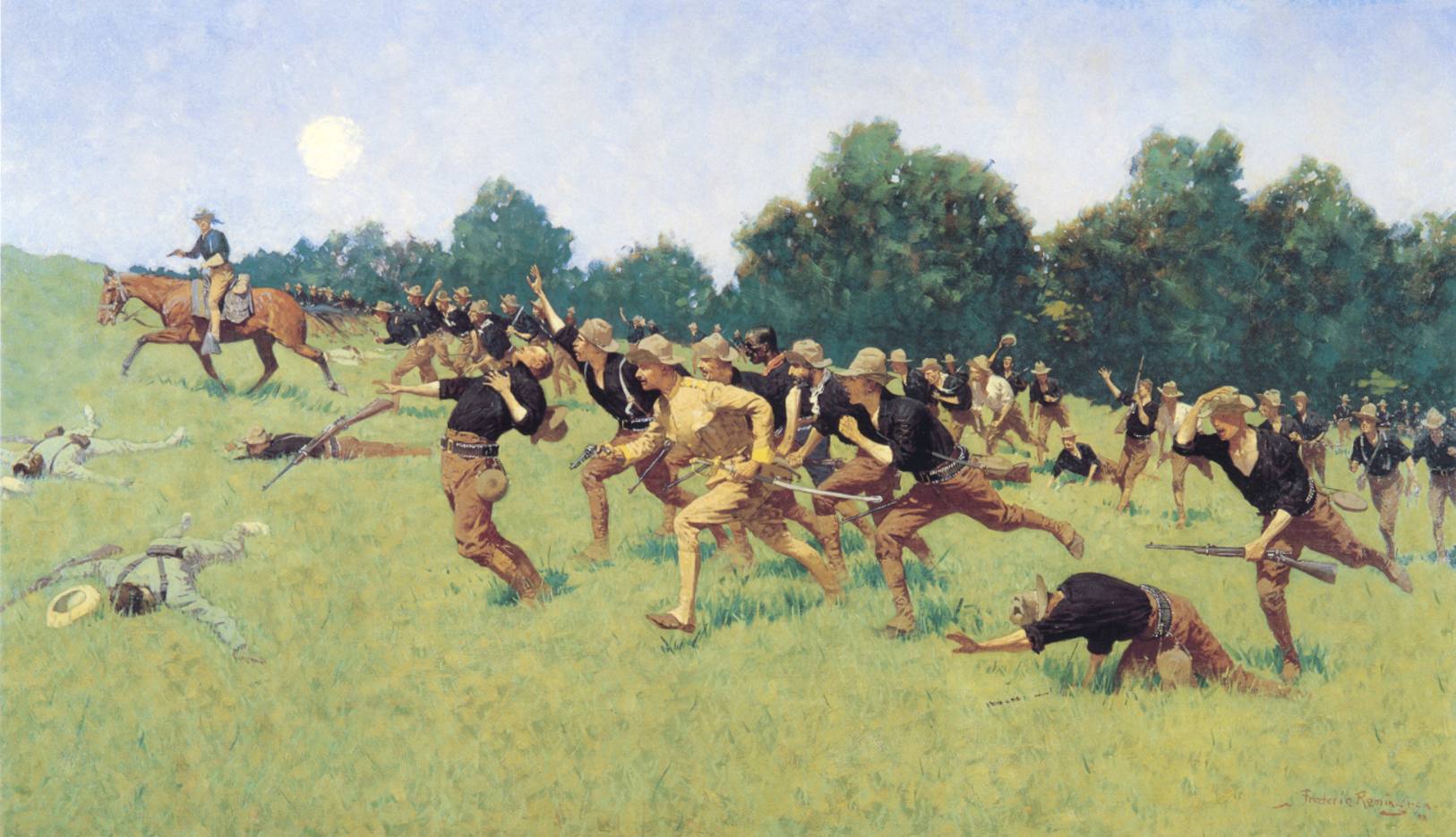
Roosevelt and the charge up Kettle Hill, Frederick Remington

Roosevelt, his volunteers, and the Buffalo soldiers charge up Kettle Hill, Frederick Remington.

Soon the infantry took San Juan Hill, and, after one false start, we in turn rushed the next line of block-houses and intrenchments, and then swung to the left and took the chain of hills immediately fronting Santiago. Here I found myself on the extreme front, in command of the fragments of all six regiments of the cavalry division. I received orders to halt where I was, but to hold the hill at all hazards. The Spaniards were heavily reinforced and they opened a tremendous fire upon us from their batteries and trenches. We laid down just behind the gentle crest of the hill, firing as we got the chance, but, for the most part, taking the fire without responding. As the afternoon wore on, however, the Spaniards became bolder, and made an attack upon the position. They did not push it home, but they did advance, their firing being redoubled. We at once ran forward to the crest and opened on them, and, as we did so, the unmistakable drumming of the Gatlings opened abreast of us, to our right, and the men cheered again. As soon as the attack was definitely repulsed, I strolled over to find out about the Gatlings, and there I found Lieut. Parker with two of his guns right on our left, abreast of our men, who at that time were closer to the Spaniards than any others.

From thence on, Parker’s Gatlings were our inseparable companion throughout the siege. They were right up at the front. When we dug our trenches, he took off the wheels of his guns and put them in the trenches. His men and ours slept in the same bomb-proofs and shared with one another whenever either side got a supply of beans or coffee and sugar. At no hour of the day or night was Parker anywhere but where we wished him to be, in the event of an attack. If a troop of my regiment was sent off to guard some road or some break in the lines, we were almost certain to get Parker to send a Gatling along, and, whether the change was made by day or by night, the Gatling went. Sometimes we took the initiative and started to quell the fire of the Spanish trenches; sometimes they opened upon us; but, at whatever hour of the twenty-four the fighting began, the drumming of the Gatlings was soon heard through the cracking of our own carbines.

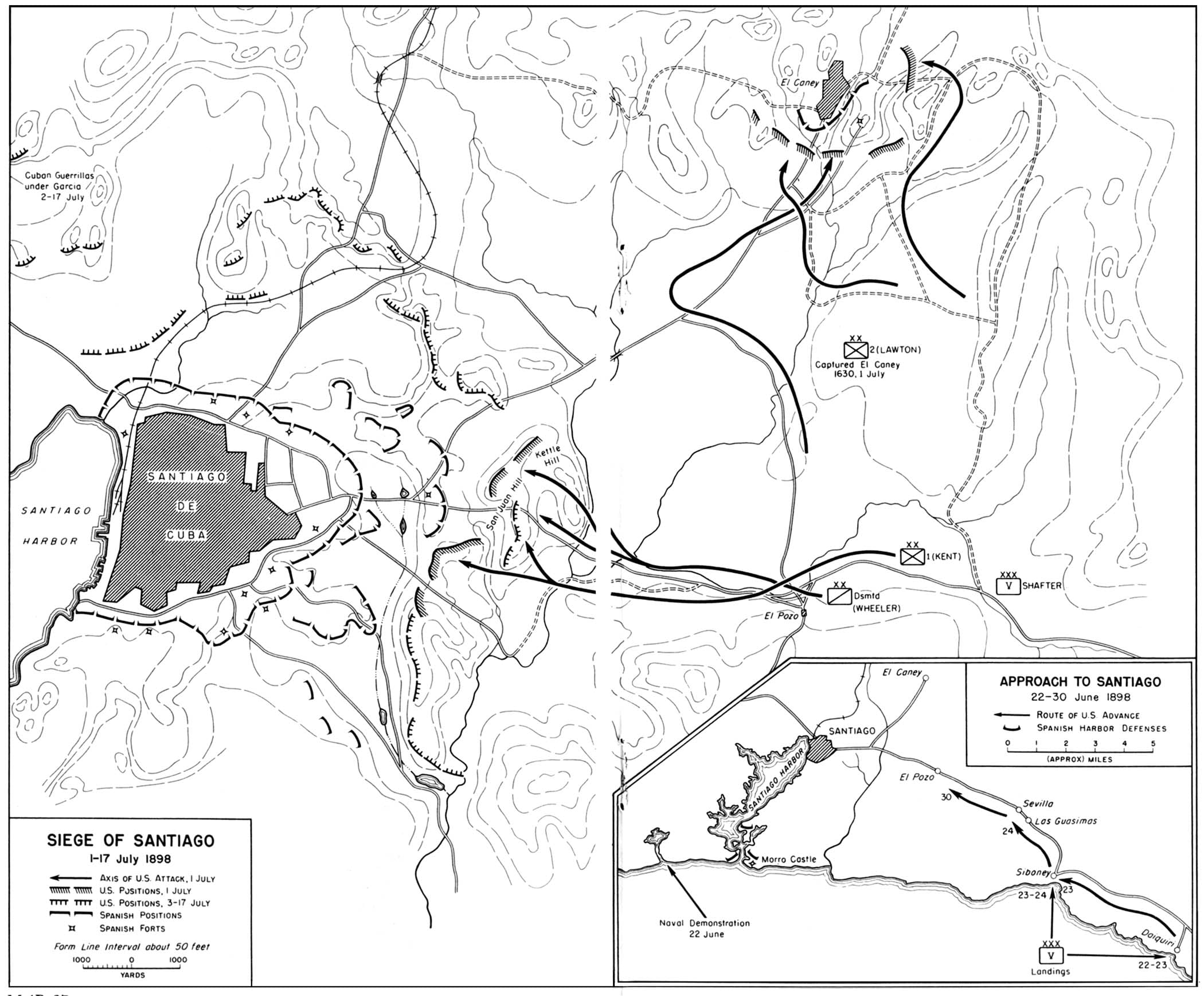
Map of the Attack on Kettle Hill and San Juan Hill in the Spanish American War.

Map of the Attack on Kettle Hill and San Juan Hill in the Spanish-American War, July 1, 1898 The Spanish had 760 troops n the in fortified positions defending the crests of the two hills, and 10,000 more defending Santiago. As Americans were being killed in “hells pocket” near the foot of San Juan Hill, from crossfire, Roosevelt, on the right, charged his men, the “Rough Riders” [1st volunteers] and the “Buffalo Soldiers [10th cavalry], up Kettle Hill in hopes of ending the crossfire and of helping to protect troops that would charge further up San Juan Hill. Parker’s Gatlings were about 600 yards from the Spanish and fired some 700 rounds per minute into the Spanish lines. Theyy were then repositioned on the hill to beat back the counter attack. Without the Parker’s Gatling guns, the chances of success would have been small.

I have had too little experience to make my judgment final; but certainly, if I were to command either a regiment or a brigade, whether of cavalry or infantry, I would try to get a Gatling battery–under a good man–with me. I feel sure that the greatest possible assistance would be rendered, under almost all circumstances, by such a Gatling battery, if well handled; for I believe that it could be pushed fairly to the front of the firing-line. At any rate, this is the way that Lieut. Parker used his battery when he went into action at San Juan, and when he kept it in the trenches beside the Rough Riders before Santiago.”

Here is how the Gatling gun works; it’s rather like 5 or more rotating zip guns; a pall pulls and releases the firing pins. Gravity feeds the bullets at the top and drops the shells out the bottom. Lt’ Parker’s deployment innovation was to have them hand-carried to protected positions, near-enough to the front that they could be aimed. The swivel and rapid fire of the guns allowed the shooter to aim them to correct for the drop in the bullets over fairly great distances. This provided rapid-fire accurate protection from positions that could not be readily hit. Shortly after the victory on San Juan HIll, July 1 1898, the Spanish Caribbean fleet was destroyed July 3, Santiago surrendered July 17, and all of Cuba surrendered 4 days later, July 21 (my birthday) — a remarkably short war. While TR may not have figured out how to use the Gatling guns effectively, he at least recognized that Lt. John Parker had.

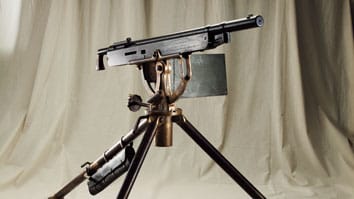
A new type of machine gun,  a colt browning repeating rifle, a gift from Con'l Roosevelt to John Parker's Gatling gun detachment.

Roosevelt gave two of these, more modern, Colt-Browning repeating rifles to Parker’s detachment the day after the battle. They were not particularly effective. By WWI, “Gatling Gun” Parker would be a general; by 1901 Roosevelt would be president.

The day after the battle, Col. Roosevelt gifted Parker’s group with two Colt-Browning machine guns that he and his family had bought, but had not used. According to Roosevelt, but these rifles, proved to be “more delicate than the Gatlings, and very readily got out-of-order.” The Brownings are the predecessor of the modern machine gun used in the Boxer Rebellion and for wholesale deaths in WWI and WWII.

Dr. Robert E. Buxbaum, June 9, 2015. The Spanish-American War was a war of misunderstanding and colonialism, but its effects, by and large, were good. The cause, the sinking of the USS Maine, February 15, 1898, was likely a mistake. Spain, a decaying colonial power, was a conservative monarchy under Alfonso XIII; the loss of Cuba seems to have lead to liberalization. The US, a republic, became a colonial power. There is an inherent friction, I think between conservatism and liberal republicanism, Generally, republics have out-gunned and out-produced other countries, perhaps because they reward individual initiative.

Hamas head deposed, no peace in the middle east

Just about one month ago, the head of the head of Hamas in Syria was removed from his position atop Sheikh Abu Salah Taha’s shoulders. ISIS gave the Sheikh the metaphorical 72 virgins of severance, and his head was given a new post, a wooden pole. Though the fighting has died down since, as it were, we seem no closer to peace. As head of Hamas, Sheik Taha killed many, and ISIS has killed many more. And now, Hamas has pledged Jihad against ISIS, It’s likely ISIS heads will roll, as surviving Hamas members have joined Assad, their murderous enemy of just a few months previous.

Hamas head removed, Sheik Sala, presumed dead.

Hamas head deposed by ISIS. Sheik Salah presumed dead. Prediction: those who killed him will be killed. 

My sense is that bringing peace to the region will require 4 things: (1) one side must have a decisive military victory; (2) They must get the defeated leader to sign a surrender with some clear terms (3) They have to treat the defeated well enough that others will surrender too, and (4) They had to demonstrate the ability to govern. The surrender at Appomattox included all these things, as did Texas independence and the US revolution. By contrast, the history Mexican civil wars suggests that peace becomes near-impossible when you kill the losers, as ISIS has done in Syria. When Santa Ana killed the Texans who surrendered to him at the Alamo and at Goliad, he guaranteed that the Texans would fight on forever, no matter how desperate the odds.

When Santa Anna ordered the execution of all the Texans who surrendered he guaranteed that Texans would not surrender. That's not a road to peace.

When Santa Anna executed the Texans who surrendered at the Alamo and Goliad he guaranteed that Texans would not surrender. That’s not the road to peace.

Governance of any kind is a key distinction between countries and non-countries. In the Middle East, there is a tradition of governance by tyranny and partial genocide, but the rule cemented this way is tenuous at best. About 100 years ago, the Turks cemented their rule over Armenia by killing off many Armenians, and Russia did the same toward to Cossacks, but 70 years later Kasackstan seceded. Sadam Hussain, Bashar Assad, Col’nl Khadaffi, and Ayatollah Khomeini all ruled for reasonable times as murderous tyrants, but two of those ruler’s were killed and three of the kingdoms have descended into chaos. People who’ve seen war will often accept tyranny as a better alternative to chaos in the streets, but eventually they revolt. By contrast, Israel and Jordan have stayed reasonably stable by providing a degree of tolerance and justice.

In the Mid-East peace, we’ve chosen to support tyrants: Hamas and the Iranian Khomeini, even though they are murderously anti-democracy, and even though the Ayatollah has vowed to wipe us out, and even though ISIS seems to be winning. This strategy may work for us temporarily, but I suspect these leaders will fall in a few years, and leave us to deal with anger in the wake. Faced with the options available, I’d prefer to let the war take its course, and only step in when things wind down. This is what Theodore Roosevelt did with the Russo-Japanese war: he waited for it to die down, and then stepped in to make peace when asked to do so. Syria doesn’t seem ready for peace right now, but when it is, I suspect it will be better for us if we take the role of peacemaker later than if we support a losing murder now.

Robert E. Buxbaum, May 7, 2015, edited May 11. I’ve shown previously that there is no peace with zombies until there is a cure. Until then, it’s best to run. For those who don’t know it, Roosevelt was an odd dude: here he is riding a moose.

Winning the peace at Appomattox

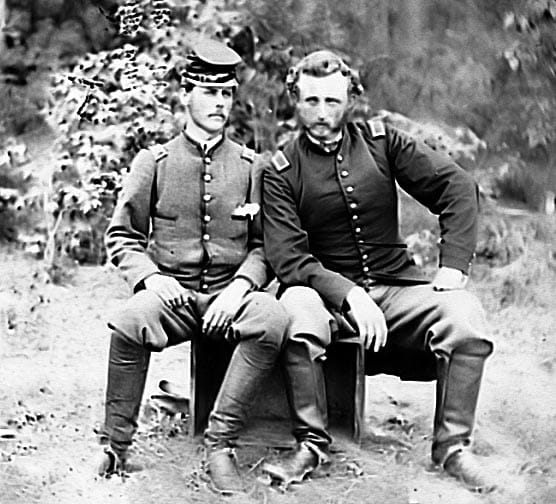
George A. Custer with captured confederate prisoner. Custer was a man of action but not of cruelty.

George A. Custer with a captured confederate prisoner. Custer was a man of action, but not of cruelty.

It is often forgotten that the aim of generalship is not winning a war, but winning a stable peace. In that sense, most generals and most diplomats are failures; their victories benefit only the undertaker; their peace-treaties only provide time to reload. That was the case with the Mexican civil war but not the US civil war. The choices and surrender at Appomattox, 150 years ago lead to a genuine, stable peace. It’s worthwhile, therefore to consider the how that was done here and not in Mexico, perhaps as a lesson for the future.

I begin, near the end of the war with a much-maligned general, George A Custer on April 8, 1865; this  is the day the 13th Amendment passed, four days after Lincoln walked through a defeated, smoldering Richmond, the capital of the south. The war would end soon, but would the result be peace, or chaos. George A. Custer had graduated at the very bottom of his class at West Point, the position known as goat. As is not atypical with goats, he was not particularly suited to following orders during peacetime, but was supremely suited to war and action. Custer liked to attack first and think later, but he was also a man of peace; he become the youngest Union Brevet General in US history. On April 8, with Lee at Appomattox Court House (that’s the name of the town), Custer led a small group of men to attack a nearby town, Appomattox Station, a rail depot three miles to the southwest. There he captured, without a fight, three, rail cars full of desperately needed arms, ammunition and supplies that had been sent to Lee’s army from Lynchburg.

While leaving the station, Custer’s men ran into the artillery unit of Confederate Brig. Gen. Reuben Walker, and attacked (of course) eventually capturing 25 artillery pieces, nearly 1,000 prisoners and all of their supplies. It took several attacks to win, but the results were worth it. Custer took the cannon and his troops, and positioned them on Lee’s likely escape route, on the Richmond-Lynchburg Stage Road south of Appomattox Courthouse. Lee was now nearly trapped, but didn’t know it yet.

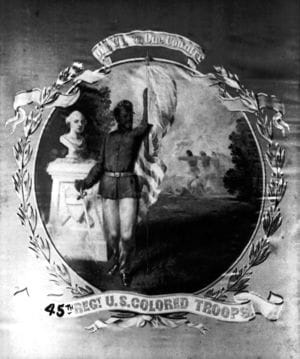
Paining in honor of the 45th regiment colored troops: Afro-American soldier stands with flag before a bust of Washington.

Painting in honor of the 45th regiment colored troops: Afro-American soldier stands, with flag, before a bust of Washington and a depiction of battle (Fair Oaks? Petersburg?)

On the same day, April 8, General Grant sent Lee a proposition to surrender. Lee responded that he was not interested in that, but would like to meet at the McLean House at 10:00 A.M. April 9 to discuss “restoration of peace.” Grant replied that he didn’t have that power but agreed to meet Lee, none the less.

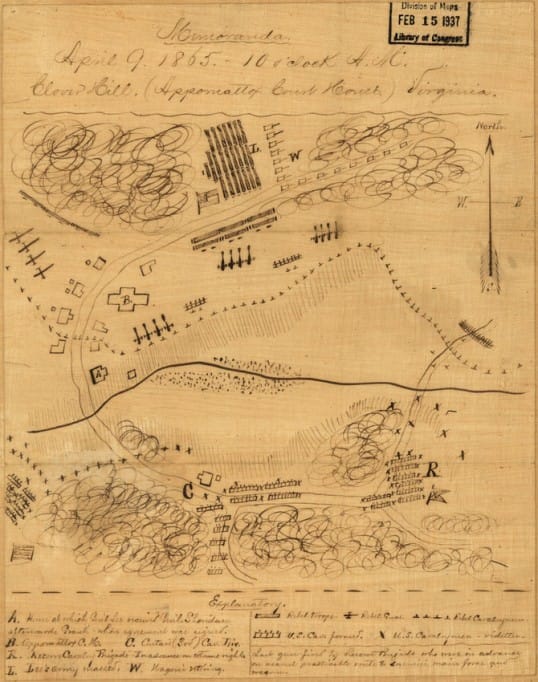
In the meantime, Lee prepared his forces to clear the Stage Road so his forces could escape south-west, to Appomattox station and home. Grant, no newcomer to war, ordered two corps (XXIV and V) under the commands of Maj. Gen. John Gibbon and Bvt. Maj. Gen. Charles Griffin to march all night to the west and north. These corps included 5000 Afro-American troops, mostly in the 45th and 116th U.S. Colored Troop Brigades. On the morning of April 9, Lee attacked to the south and managed to capture the forward pickets defending the Richmond-Lynchburg Stage Road. But when he reached the rise of the hill, he saw his escape was blocked. His 45,000 troops were surrounded by 113,000, better-armed Union soldiers, cannon and cavalry. It was then suggested that Lee disband his troops for an extended guerrilla war, an option he refused as it would lead to murdering bands roaming the county, and would make peace nearly impossible. Instead Lee rode off to discuss surrender to Grant. 

Map of the troop arrangements April 9, 1865. Checkmate. Lee's forces, x or + are out numbered, out gunned and surrounded. The end.

Map of the troop arrangements April 9, 1865. Checkmate. Lee’s forces, x or +, are out numbered, out gunned, and surrounded.

Lee’s surrender, finalized that afternoon, was penned by Grant’s aide-de camp, Lt Col’, Ely S. Parker, a Seneca Indian who had an engineering degree and studied law. The kindness to Indians may have suggested similar kindness to the surrendering Confederates. Parker eventually rose to the rank of general, and then to head of the Bureau of Indian Affairs. The terms of surrender too, were chosen to be unusually generous. Grant did not take the confederates soldiers captive, but instead allowed them to return home, relatively unmolested. Also, he allowed the officers to keep their swords and personal weapons. Kind acts like these may have eased reconstruction. Custer had demanded unconditional surrender from General Beauregard on April 9, something he probably imagined U.S. (Unconditional Surrender) Grant would have wanted; he was over-ruled by his commanding officer, Phillip Sheridan, who probably knew Grant better. 

After the war, most of the confederates swore loyalty to the US. Lee did what he could to promote reconciliation; he supported civil rights and reconstruction, and became president of Washington and Lee College. Some confederate generals and 2500 soldiers headed south to Mexico to join the French/Austrian forces of Emperor, Maximilian I, engaged in a civil war of his own. Maximilian, only 34 years old and a highly decorated Austrian officer, had little local support. He was captured and executed, June 19, 1867. Mexico then descended into chaos: a Pyrrhic victory, and a model to avoid.

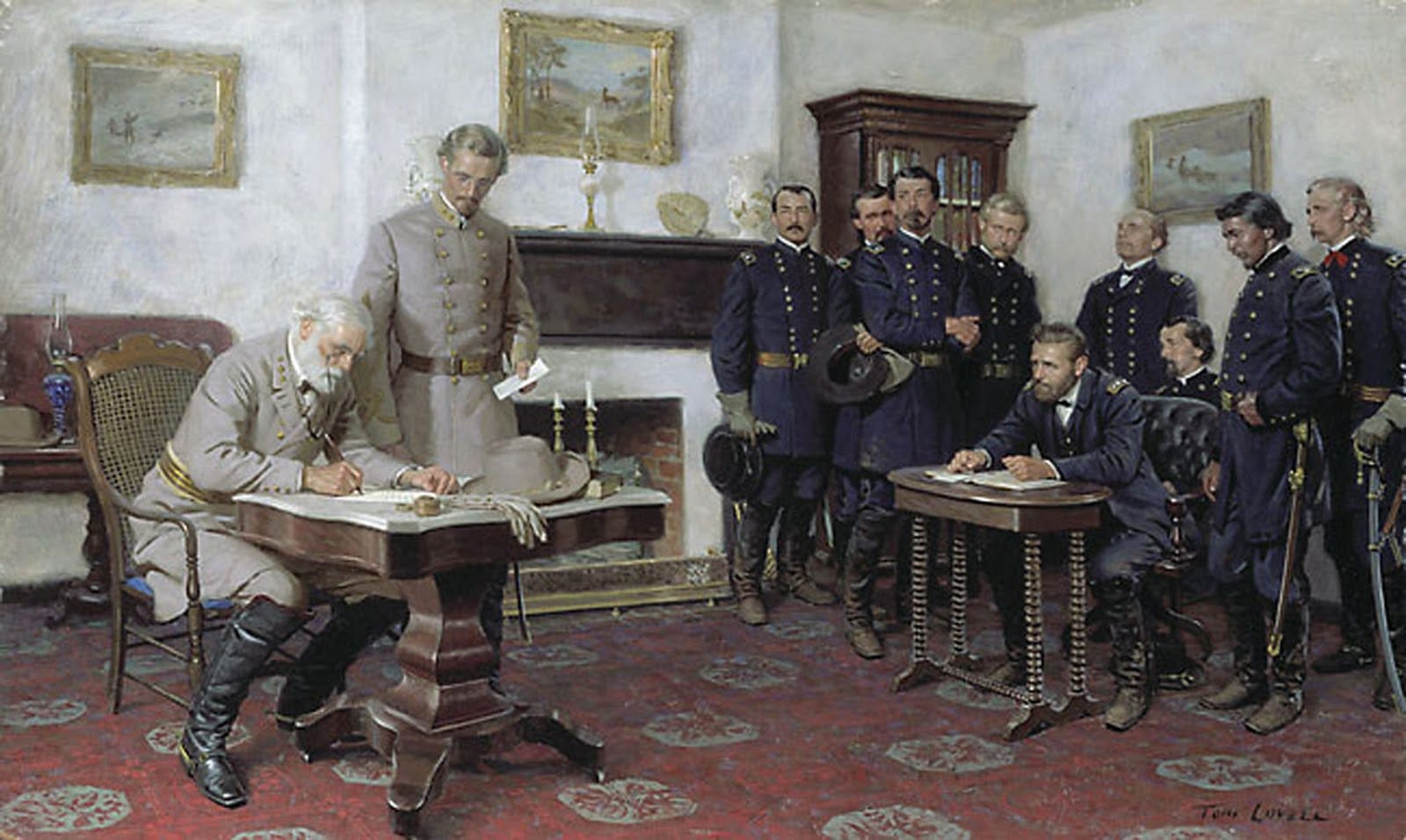
Surrender at Appomattox; with Grant are Philip H. Sheridan, Orville E. Babcock, Horace Potter, Edward O.C. Ord, Seth Williams, Theodore S. Bowers, Ely S. Parker and George A. Custer. With Lee is Charles Marshall, his military secretary.

Surrender at Appomattox; with Grant are Philip H. Sheridan, Orville E. Babcock, Horace Potter, Edward O.C. Ord, Seth Williams, Theodore S. Bowers, Ely S. Parker and George A. Custer. With Lee is Charles Marshall, his military secretary. After the signing, most of the furnishings were purchased by Union officers as souvenirs. Lee shook Parker’s hand and said, I’m glad to see a real American here.” Parker replied, “We are all Americans.”

What did Mexico do wrong? For one, in order to win a peace, they failed to get the other side to agree to the peace, with clear documentation about what it is that’s been agreed to (That’s why Parker’s role is so important). Instead of killing Maximilian, they should have had him sign some sort of document and retire him to a farm or college where he could support the peace. In order to win a peace, it’s important to leave a stable country, with stable borders and a strong military, one that can govern itself fairly and well. A stable peace generally involves recognition of your government by other nations, and that too requires not killing your defeated enemy wholesale.

Robert E. Buxbaum, April 7-12, 2015. My sense is that the conditions for building a lasting peace get far too little attention in the study of war and history. I should mention that the 45th were mostly escaped slave volunteers. The 116th were ex-slaves that the Union purchased from Kentucky slave-owners at the beginning of the war to fight for the Union cause. This was thought to be a good emollient for peace, and may have helped keep Kentucky on the Union side. I should note too, that Lee freed his slaves in 1862, near the beginning of the war, a time when Grant still owned some. I’ve noted that men who choose beards tend to show a surprising republican (or communist) generosity. As Lincoln said, “Do I not defeat my enemy when I make him a friend?” For more thoughts on Lincoln’s Gettysburg Address, see here.

Brass monkey cold

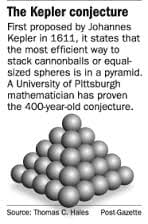
In case it should ever come up in conversation, only the picture at left shows a brass monkey. The other is a bronze statue of some sort of a primate. A brass monkey is a rack used to stack cannon balls into a face centered pyramid. A cannon crew could fire about once per minute, and an engagement could last 5 hours, so you could hope to go through a lot of cannon balls during an engagement (assuming you survived).

A brass monkey cannonball holder. The classic monkeys were 10 x 10 and made of navy brass.

Small brass monkey. The classic monkey might have 9 x 9 or 10×10 cannon balls on the lower level.

Bronze sculpture of a primate playing with balls -- but look what the balls are sitting on: it's a surreal joke.

Bronze sculpture of a primate playing with balls — but look what the balls are sitting on: it’s a dada art joke.

But brass monkeys typically show up in conversation in terms of it being cold enough to freeze the balls off of a brass monkey, and if you imagine an ornamental statue, you’d never guess how cold could that be. Well, for a cannonball holder, the answer has to do with the thermal expansion of metals. Cannon balls were made of iron and the classic brass monkey was made of brass, an alloy with a much-greater thermal expansion than iron. As the temperature drops, the brass monkey contracts more than the iron balls. When the drop is enough the balls will fall off and roll around.

The thermal expansion coefficient of brass is 18.9 x 10⁻⁶/°C while the thermal expansion coefficient of iron is 11.7 x10⁻⁶/°C. The difference is 7.2×10⁻⁶/°C; this will determine the key temperature. Now consider a large brass monkey, one with 400 x 400 holes on the lower level, 399 x 399 at the second, and so on. Though it doesn’t affect the result, we’ll consider a monkey that holds 12 lb cannon balls, a typical size of 1750 -1830. Each 12 lb ball is 4.4″ in diameter at room temperature, 20°C in those days. At 20°C, this monkey is about 1760″ wide. The balls will fall off when the monkey shrinks more than the balls by about 1/3 of a diameter, 1.5″.

We can calculate ∆T, the temperature change, °C, that is required to lower the width-difference by 1.5″ as follows:

kepler conjecture, brass monkey

-1.5″ = ∆T x 1760″ x 7.2 x10⁻⁶

We find that ∆T = -118°C. The temperature where this happens is 118 degrees cooler than 20°C, or -98°C. That’s a temperature that you could, perhaps reach on the South Pole or maybe deepest Russia. It’s not likely to be a problem, especially with a smaller brass monkey.

Robert E. Buxbaum, February 21, 2015 (modified Apr. 28, 2021). Some fun thoughts: Convince yourself that the key temperature is independent of the size of the cannon balls. That is, that I didn’t need to choose 12 pounders. A bit more advanced, what is the equation for the number of balls on any particular base-size monkey. Show that the packing density is no more efficient if the bottom lawyer were an equilateral triangle, and not a square. If you liked this, you might want to know how much wood a woodchuck chucks if a woodchuck could chuck wood, or on the relationship between mustaches and WWII diplomacy.

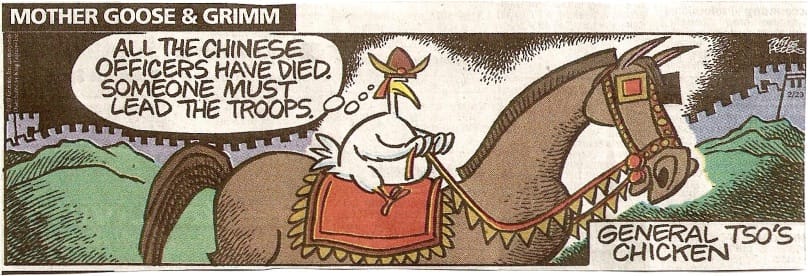
General Tso’s chicken

Self promotion. It's not for everyone.

Self promotion. It’s not for everyone.

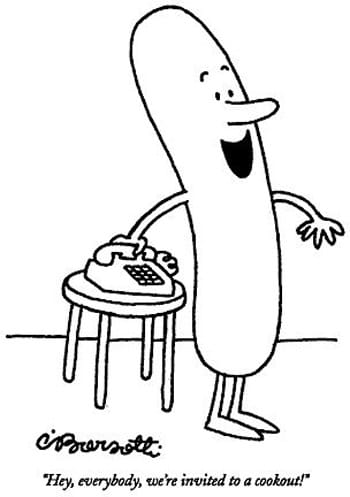
Is funny because …. it’s classical metaphysical humor. The lowly chicken becomes the hero and leader, and the troops are following him/it (to victory).

We know that some unlikely leaders are successful, perhaps just because they’ve the pluck to get up and do something (that’s the secret of American success). Presumably the troops are too timid to lead, and are following this chicken because of his determined air, and his hat and horse: clothes make the man. You should not follow every leader with determination, a fancy hat and a horse, by the way. Some leaders will devour their followers, and most do not care for self promoting underlings.

Robert Buxbaum, Nov.12, 2014.

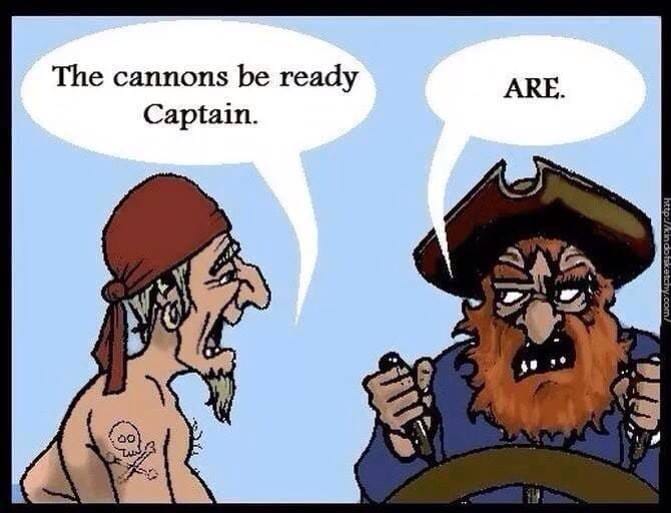
Grammar on the high seas, pirate joke, trans ready

Grammar Pirate by Scott Clark, 2013.

Grammar Pirate by Scott Clark, 2013.

Pirate grammar has a special place in American English. The father of our country’s navy was likely John Paul Jones, a pirate; he redesigned our ships, captured some 16 British merchant vessels in the Revolution, and helped supply Washington’s army with guns and powder. Jean Lafitte, pirate hero of the war of 1812, may have been Jewish! The state of Michigan officially celebrates “Talk LIke a Pirate Day” September 19, the day before national pickle day.

No other country states in their constitution that a purpose of the government is to give out letters of marque — that is to mint pirates. Piracy is a great way to fight a war –severely underestimated. ISIS does it quite well. By taking supplies from the other side you weaken them while strengthening yourself. Assuming you need the stuff, you avoid the cost of manufacture, shipping, and logistics, and even if you don’t need some of it, you can usually trade these items you for items you need. It’s a great way to make foreign friends and allies. Ben Franklin sold our pirates’  captured stuff for them during the American Revolution making himself and us better liked — we had no direct need for red uniforms, for example. Pirates should not kill captured merchant seamen, I think, but ransom them , or put them to service in the cause. The Somali pirates do this; not everyone is impressed. Pirate beards may encourage bravery by showing commitment to a revolution. Here’s a song relating beards to piracy: mannen met baarden (men with beards). Bet your aaars, it’s in Dutch.

Pirate grammar is a dialect, not a sign of poor education or lack of success. I suspect that pirate grammar is more useful than standard for referring to people on the fringes of society. For example, how would you introduce a patent lawyer who’s a some-time cross-dresser? It’s simple in pirate-speak: ‘Ms Smith, pleased to meet Johnson, arrrgh patent lawyer.’ Pirate speak can also avoid the uncomfortable he/she by use of the pirate “e”: ‘E’s a scurvy sea dog, e is.’

Robert Buxbaum, July 2, 2014. I think I’ll be havin’ a rum now, and toast to Arrrgh country.

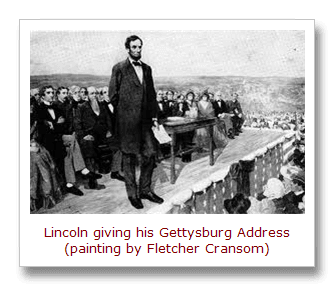
Lincoln’s Gettysburg address, not as bad as first thought.

Three score days ago, The Harrisburg Patriot & Union retracted its unflattering 1863 review of Lincoln’s Gettysburg address. But this retraction deserves more attention, I think, than that the editors reconsidered. The Patriot & Union was a Republican journal; it carried an accurate account of the speech, and so it’s worthwhile to ask why its editors labeled this great speech, “silly remarks”, deserving “a veil of oblivion”; “without sense.” Clearly the editors saw a serious lack that we do not see today. It’s worth asking then, what made them think it was silly and lacking in sense?

The Union & Patriot has retracted their review of this 1863 speech.

Lincoln in 1863; The Union & Patriot has retracted their review of this Gettysburg speech — in the fullness of time, they’ve come to reconsider their original review.

Lincoln spoke a few words in honor of the dead, but Edward Everett spoke on this topic for two hours before Lincoln rose. This lack does not appear to be what bothered the editors: “To say of Mr. Everett’s oration that it rose to the height which the occasion demanded, or to say of the President’s remarks that they fell below our expectations, would be alike false. Neither the orator nor the jester surprised or deceived us. Whatever may be Mr. Everett’s failings he does not lack sense – whatever may be the President’s virtues, he does not possess sense. Mr. Everett failed as an orator, because the occasion was a mockery, and he knew it, and the President succeeded, because he acted naturally, without sense and without constraint, in a panorama which was gotten up more for his benefit and the benefit of his party than for the glory of the nation and the honor of the dead.” The editors came to Gettysburg (I think) to hear Lincoln to hear things that only LIncoln could provide — his real thoughts on slavery and an update on his efforts at peace. As best I can tell, it was in these areas that they saw “a veil of oblivion.” Even so, for them to call this address, “silly remarks” there must be more going on. Here are my thoughts.

Lincoln had freed southern slaves a few months earlier by the emancipation proclamation, but no one knew their status; there had been a riot over this a few days previous. Did Lincoln claim equality for these ex-slaves, and if not, what were his thoughts on the extent of their in-equality. They were confiscated as war booty; would Lincoln return them to their owners after the war was over? If so, they were not free at all. Along with this, what was Lincoln doing to end the war? It was far from clear that the North could win in 1863. Lee had many victories, and now England had entered in support of the Confederacy. In my opinion, it was Ericsson’s Monitors that allowed the North to stop the British and win, but it appears that, in 1863, only the British navy realized that their power had been neutralized, and the south was lost.

By 1863 Ericsson was turning out two of these Monitor-type sips per month, enough to keep the British from any major port in America

The North’s Monitor, right, fights the Confederate Merrimac, left, to a draw over control of Norfolk harbor. Ericsson turned out two Monitor ships per month. In my opinion is was these ships that stopped the British and won the war.

Lincoln was cryptically brief when it came to slavery or peace: 271 words. About half the speech is devoted to the brave men who struggled here; the other half speaks of “the Nation,” or the “government.” Not the United States, the Union, the North, the South, but an undefined entity that Lincoln claims came into existence 70 years earlier, in 1776. Most educated people would have said that 1776 created no nation or government, only a confederation of independent states as described by the articles of confederation. Under these articles, these 13 states could only act by consensus and had the right to leave at will. To the extent that anyone held the South was bound now, it was because of the Constitution, signed ten years later, but Lincoln does not mention the Constitution at all– perhaps because most Democrats, understood the Constitution to allow departure. Also, to the extent the Constitution mentions slavery, it’s not to promote equality, but to give each slave 3/5 the vote-power of a free man. If “created equal” is to come from anywhere, it’s the Declaration, but most people understood the intent of the Declaration differently from the vision Lincoln now presented.

As far as most people understood it, The Declaration claimed the God-given right to separate from England and gain us a measure of self-rule — something that the South now claimed for itself, but Lincoln opposed. Further, we claimed in The Declaration, that British mis-management made the separation necessary, and listed the abhorrent offenses including suspension of habeas corpus, and the confiscation of property without process of law — things Lincoln was doing even now. Even the introductory phrase, created equal, was not understood to imply that everyone was equal. Rather, as Stephen Douglass pointed out in their 1858 Chicago debate, we’d created a nation “by the white man, for the benefit of the white man, to be administered by white men, in such a manner as they should determine.”

Ulysses Grant had a slave who he freed in 1859, and had control of his wife's slaves, who became free only in 1865. Lee's slaves were freed in 1862.

Ulysses Grant had a slave he freed in 1859; his wife held slaves till 1865. Lee freed his in 1862.

Where was Lincoln coming from? What was he saying that November day? It’s been speculated that Lincoln was proposing a secular religion of administered freedom. There appears to be some legitimacy here, but more I suspect Lincoln was referring to the UNANIMITY requirement behind the Declaration — by agreement all the states had to agree to independence, or we would all stay bound to Britain. If we had to unanimously bind ourselves, we must have unanimously bound ourselves to some shared vision of the union or democracy, -presumably that all were created equal. Five years earlier, William Herndon, Lincoln’s law partner, had given Lincoln a book of the sermons of Theodore Parker, a Boston Unitarian. That volume includes the following section marked by Lincoln in reference to what the unanimous binding entailed: “‘Democracy is direct self-government, over all the people, for all the people, by all the people.” Whether Lincoln was now speaking in direct reference to this line, or more-likely, as I suspect, to a more general refutation of the claims of Southern separation and Douglas’s 1858 white man claim, Lincoln’s sense of the import of the Declaration was one that few understood or agreed with. The North still had slaves — Grant’s wife for example, and there was no obvious desire for a new birth of freedom, just an end to the war. Lincoln’s words thus must have sounded like gobbledygook to the majority of learned ears.

Based on the events and issues of the time, and the un-obvious point of the speech, I’d say the editors were justified in their ill review. Further, the issues that bothered them then, abuse of power, citizen and states’ rights, remain as relevant today as ever. Do the current editors see any import of the 9th and 10th amendment limiting the power of federal government? If so, what. Thus, I’m a bit disappointed that the Union & Patriot retracted its review of Lincoln’s short speech with nothing more than claiming to see things differently today. We stand on LIncoln’s shoulders now, and though we see the nation, and the Declaration, through his eyes, their issues remain, and the original review gives perspective on the nation as it looked at a very different time. Thus, while I understand the editors desire to look correct in retrospect, I’d prefer if the current editors would have left the review, or at least addressed the points that bothered their earlier colleagues. It’s a needed discussion. When every person thinks alike, nobody thinks very much.

January 6, 2014 by Robert E. Buxbaum, a doctor of Philosophy (in Chemical Engineering). Here is a translation of the Address into Jive. And into yeshivish. I’ve also written an essay on a previous retraction (regarding GM food). If Lincoln had a such a long address, how did he ever get mail?

When to enter a neighbors war or family dispute

As I write this, our favored insurgents in Syria have been over-run by our disfavored insurgents, who may be over-run by the government we are trying to topple. We have also committed to help Japan and Vietnam in their disputes with China. I’ve also had the experience of dealing with a couple going through a bitter divorce. So here are five thoughts for myself and president Obama on getting involved in other people’s problems. I’ll hope that at least one person (me) listens.

1. Learn how to wait without committing to either side so you don’t step in something really smelly. Commiserate with both sides; yes you have grievances, yes what they’ve done isn’t nice. Suggest outside review. Just don’t commit until you feel comfortable sticking with this one side in victory, defeat, or (possible) reconciliation.

In a war, even simple gifts of food or transport are support; avoid these gifts, and especially avoid gifts to both sides. Assume any support to a side will be considered treason from the other side. Supporting both sides just causes havoc, and it’s always possible that your gifts will fall in the hands of the wrong side, as in Syria.

Being helpful isn't always helpful. Matthew Deffee, The New Yorker

Being helpful isn’t always helpful, or appreciated. Learn to wait. Matthew Deffee, The New Yorker

Remind yourself that disputes are a normal part of life, that peace always comes eventually, and that disputes are sometimes good in the long run. Offer sympathy only until you really want to support one side or the other — or until they make peace. When peace comes, it’s possible that the resolution will be better than the status quo-anti. As such, perhaps long-term non-intervention is the best cure. Time often answers what wisdom does not.

2.  If you choose to support a side, only support one that openly, and traditionally supports us. No Syrian leaders have openly pledged support to the US and its allies; why ally with someone who won’t support you? The enemy of your enemy might be another enemy, as with the Taliban. In a marriage dispute, lean to support your close relative or friend — it’s less offensive than the opposite, and less likely to cause hurt. As bad as it is when two sides attack each other, it’s worse when both attack you.

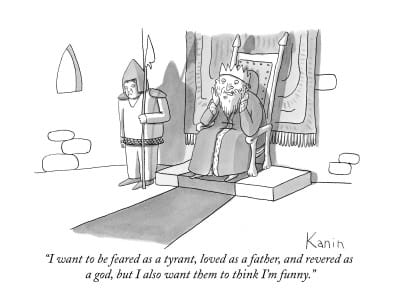
Only support someone who could rule reasonably honestly and well. Chaos is worse than a dictator. Kanin from the New Yorker.

Only support someone who could rule reasonably well. Chaos is worse than a dictator. Kanin from the New Yorker.

3. If you feel it’s important to act in a neighbor’s dispute, you don’t always have to ally with either side. You can retaliate for someone blowing up a ship or killing an advisor, or beating their children by intervening at a distance. Perhaps you can use a missile (ideally against a pointless target), or sanctions, or by the UN or a volunteer force (this tends to work for the US). In family disputes, it’s often best to send a councilor or the police or child protective services. There is room to escalate or de-escalate an action like this depending on how things play out. And it’s easier to distance yourself from a 3rd party’s actions than from one’s own. It is not necessary to support either side to achieve a personal goal or protect children in a divorce.

4.  If you decide to choose sides, make sure to keep in mind the end you seek: what good you want to do, what reasonable peace you seek, then act. Do not worry that you can not do everything, but make sure you target a viable end, and that you support a side that could win and rule. Try to pick a side that’s moral and perceived as legitimate from within, but if you can’t, at least pick one that could rule the country or manage the family without your help. Don’t support a loser, or one who can’t stand on his/her own. Chaos is worse than a crooked dictator; see, for example, the French Revolution. In a fight between parents, make sure the one you support could actually raise the kids. And once the goal is achieved, don’t stay too long. If a friend tells you to go, as in Afghanistan, leave quickly. Independence is the goal we hope for — for our children, our friends, and our neighbors.

Being a fair broker of peace is a great role -- in the proper time. From the New Yorker

Being a fair broker of peace is a great role — but only for the right person in the proper time. From the New Yorker

5. Be willing to serve as an honest broker of the peace. An honest broker is very valuable, and it requires that you’re perceived as unbiassed by both sides. Wait till the right moment before offering this service, and offer it like the precious jewel it is. Offer it when asked or when the fighting dies down. If the offer is refused, be willing to go away and return to the first rule. T. Roosevelt won the Nobel peace prize for ending the Russo-Japanese war because he was a good, honest broker: someone who understood the situation and could stand back when not needed.

Robert E. Buxbaum, Dec 18, 2013. Blessed are the peacemakers. 

Mechanical Engineer v Civil Engineer Joke

What’s the difference between a mechanical engineer and a civil engineer?

Mechanical engineers make weapons, and civil engineers make targets.

Is funny because ….. it’s sort of true. Much of engineering is war-related, and always was. In earlier times, an engineer was someone who made engines of war: catapults, battering rams, and the like. Nowadays, mechanical engineers are the main designers for tanks, cannons, and ships. A civil engineer is one whose projects have civilian applications. But as these projects have military uses (roads, ports, offices, and bridges, for example), civilian projects are major targets for an opposing army.

An observation about war and peace: if you are really at making peacetime products, you’re a hero in your country and outside; if you design weapons, you are vilified by the enemy and likely to become a prisoner in your own land. Consider the designers of the atom bomb in the US, Russia, Israel, India, or Iran. They can’t go abroad, and are likely suspect at home. The leaders have to worry that these scientists will give the same weapons to their enemies (it’s happened) or that they will not be dedicated enough to make the next iteration of the weapon (ditto).

My advice: specialize items for peacetime or civilian use if you can. Those who make better cars, music, art or architecture are welcome everywhere; advances in death usually rebound on the inventor. Here’s a joke comparing chemists and chemical engineers, a piece on a favorite car engine advance, on perfect tuning of musical instrumentsan architecture joke, and a control engineer joke. People like civil engineers.

What sort of guy does a king keep locked in the castle dungeon — not the common thief.  #wordstothewise.

R. E. Buxbaum, August 1, 2013. I’m a chemical engineer, who makes hydrogen stuff and consults, mostly for peace-time use.