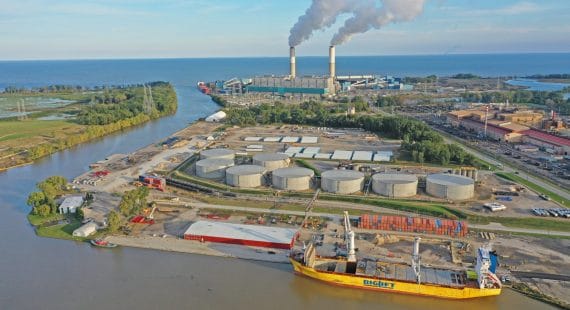
Michigan has only one container-capable port, the port of Monroe, shown below. It’s small, connected to Lake Erie via a channel that’s 500 ft wide but only 21 feet deep. This is OK for handling Great Lakes, wide-bottom rafts and some shallow draft barges, but it is too shallow to handle ocean going vessels, or even larger Great Lakes ships. The only way Port Monroe takes containers is by pushing them onto rafts that are then drawn by tug, typically to Canada. The port has been neglected due to a belief, popular with Michigan Democrats, that fast rail traffic is the future success, while ports are the past. This is a popular belief in Europe, Japan, and China, but planes, cars, and ships make more sense in the US I think, in part because of regulations that prevent rail-carried mail. A nice thing about planes and ships is we don’t buy land, nor maintain tracks.
In term of price per pound mile, ships are vastly cheaper than any other system, especially big ships. But big ships need deep water ports, ideally ports with good road (or rail) connections, and good connections to the sea. Monroe has good road and rail connections, and Detroit does too. Detroit is an obvious city for a hub, centrally located on the narrows between the US and Canada, but Detroit has no port infrastructure currently, and shows no interest in adding any. That leaves Monroe, pretty bad, but better than nothing.
The port of Monroe, MI, is a bulker port, mostly and handles no ferries or cruise ships. Some few containers leave by barge. The shallow channel is part of the problem. Picture from the Detroit News.
I would like to see the Port Monroe improved, with cranes and more storage area, and with the channel deepened to handle seaway – max vessels of 27 feet draft so we could handle ocean- cargo business, and cruise ships — a ferry would be nice too. With an improved Michigan port, our exports would not have to be trucked to New York for shipment, and we would be able to import machinery and steel without it having to stop in New York, or Montreal. The lack of a decent port is why Detroit is the most expensive major US city in terms of the cost of international trade.
Monroe has the space for improvement, and they got a recent USDoT grant of $15 million to improve. It’s covered the building of a new dock, and is expect to provide for some berths for Coast Guard ships and tugs (needed). With the new dock, there’s rumors that Monroe could be a decent way to export windmills components and other items that are too large for bridges and unsuitable to major ships. We’ll see how things develop.
Pearl of the Seas, one of several Great Lakes cruise companies.
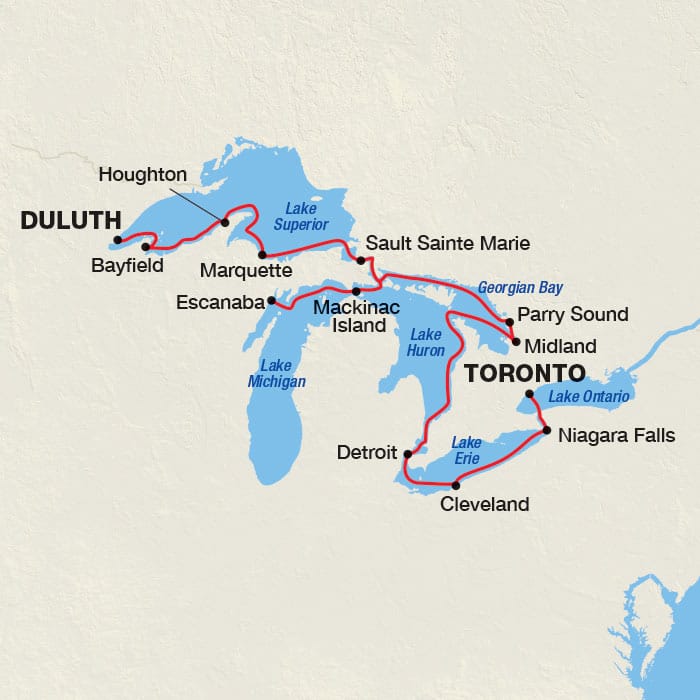
The Great Lakes system presents a growing summer cruise opportunity, relatively untraveled, but so far relatively expensive. There’s great scenery, including Niagara Falls, Mackinac, Painted Rocks, Chicago, and the Soo Locks: interesting sites, and the options are growing. As a cheaper alternative, as interesting, IMHO, is the lower Saint Lawrence seaway, including Quebec City, Montreal, Portland and Prince Edward Island, leaving from Boston, NYC, or Philadelphia.
The 2026 Great Lakes season includes seven cruise lanes and 10 largish ships and 7 cruise lines, up from six lines and eight ships in 2025. Major lines include Viking, Pearl Seas, Ponant, and American Cruise Lines who provide over 800 port visits in 2026, up from 700 in 2025. The largest of the Great Lakes ships are smaller than those for Alaska and the Caribbean cruises, but more luxurious. On the St Lawrence, the ships are bigger, the prices lower, and you get more or less what you’d expect on an Alaska cruise, with an open bar, typically.
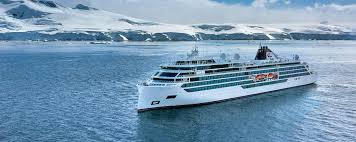
Viking Oceanis
The cost differences are more than I would expect, but coming down, I expect. Currently, a nine-day Great Lakes cruise from a Viking Oceanis cruise from Cleveland costs a minimum of $8,675 per person. The 14-day version in the map above costs $14,270+. Details: https://l.cleveland.com/g2f86w. By comparison, a Boston to Quebec City cruise costs about $1200 per person, similar to a one week European or Alaska tour, on average.
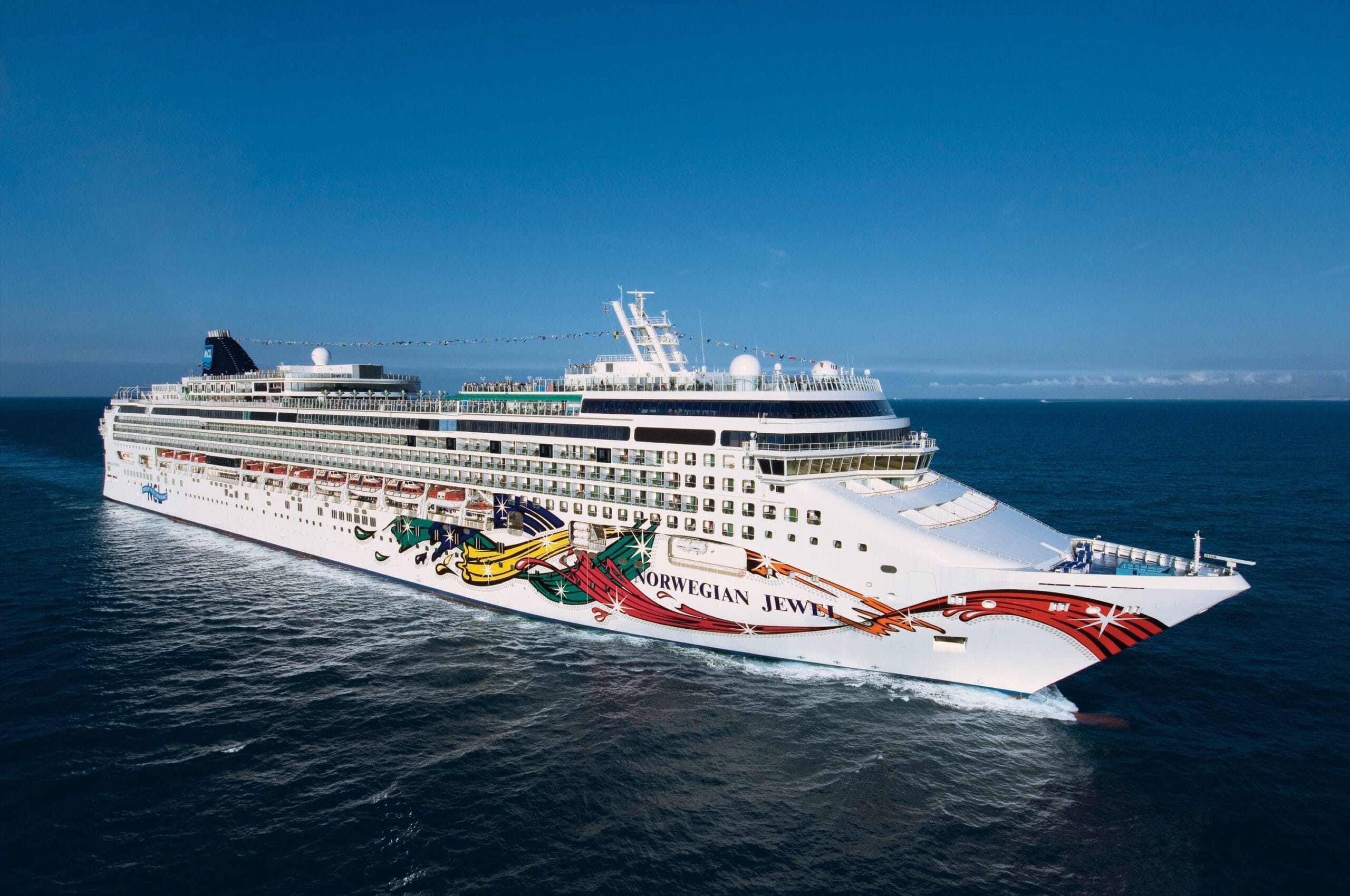
I put the blame for the high cost of Great Lakes cruising on the size limits of the locks on the St Lawrence canal and on the Niagara Falls, Welland Canal: 740 feet (225.5 m) in length, 78 feet (23.8 m) in width (beam), and 26.5 feet (8.08 m) of depth (draft). The largest cruise ship now operating on the Great Lakes, the Viking Oceanis, show above measures 665 feet (205 meters) length, by 77 feet (23.5 meters) width, by 19 feet, 8″ draft, barely smaller than the canal. It boasts a capacity for 378 guests and 256 crew members. By contrast, the Norwegian Jewel, a popular ship for the New York and Boston to Quebec City route holds 2,870 passenger and a crew of about 1,069. This explains some of the price difference but not all. The rest, perhaps is competition. A standard European cruise ship can be rerouted to the St. Lawrence, but not to the Great Lakes.
Aerial Norwegian Jewel
Norwegian Jewel – Norwegian Cruise Line
If one wanted to run a large cruise ship on the Great Lakes, it would have to be built there. It could be done, but isn’t currently. We make very large ore carriers that operate entirely on the Great Lakes, so the capacity exists. The other alternative would be to expand one of the canals. IF this were done, there would be a lot more competition and ships, and we could be served by much larger container ships as well. An unfortunate aspect of the small lock size of the Welland and upper St. Lawrence is that currently, only very small container ships can enter or leave the Great Lakes. The result is that cargo prices are much higher than for any of the US coastal ports or the Mississippi. Both the US and Canada would benefit from a larger connection to the sea.
Japan’s decision to attack the US on December 7, 1941 was made a year earlier, December 1940, largely because of the need for oil, but also because of a perceived need for an empire. An approriate nave was fitted out, and airmen were trained. Nine months later, September, 1941, we cut off oil to Japan following Japan’s invasion of Indonesia and their ceasing the Indonesian oil fields. Japan now had the choice of war with us or of moderating their economy and ambitions. The worry is that China may choose the same if Iran and/or Russia goes off-line. That was my worry at the start of this essay. I’m no longer that concerned.
Some background, as I see it: China’s economy is larger than the IMF gives it credit for, In my opinion. I’ve calculated that it is 11% lager than the US calculated here based on food purchasing parity They also have a larger army and navy, 754 ships vs 440 for the US, with military ambitions for Taiwan and new, man-made islands in the China sea. They continue to add aircraft carriers and submarines (we’re still ahead there), and like Japan in 1940, China fuels all this with oil. They use some 17 million barrels per day: 11.3 million imported by ship. They put another million bb/day into a reserve of 2.2 billion barrels, amounting to 6 months of current use. Japan did the same in 1940-41.
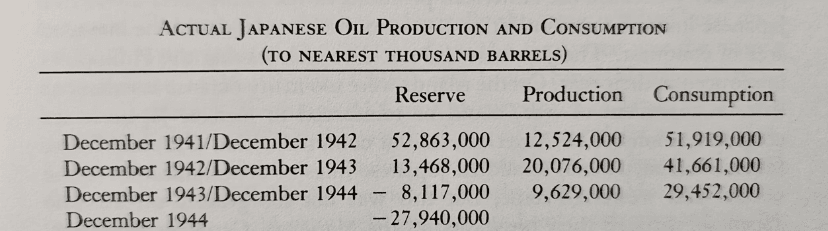
This shows how dependent Japan was on foreign oil, before and during WWII. The cut off of imports sues them to attack Pearl Harbor, source = Sarah Paine, military historian
As with Japan, China’s internal production is far below their consumption, 4.5million bbl/day, a big vulnerability. One of their main suppliers, Venezuela, just went off line, sending 800,000 bbl/day of oil to the US. That’s oil that would have gone to China. Two other of their major suppliers, Iran and Russia have had delivery issues too; a disruption in oil could cause a revolt in China. Perhaps this fear will drive China to war with us in a drive for stability and empire.
Currently, China buys most of its imported oil from four countries: Russia, Iran, Saudi Arabia, and Iraq; two of these are under sanction. China used to get another 0.8 million barrels per day from Venezuela, another country under sanction, but that route was closed by Trump last week. Buying from sanctioned countries saves them significantly, and supports the BRICS alliance, an alliance specifically against the US and the EU. The money China pays for oil supports the war against Ukraine, plus ISIS’s, war against us, and the mullahs oppression in Iran.
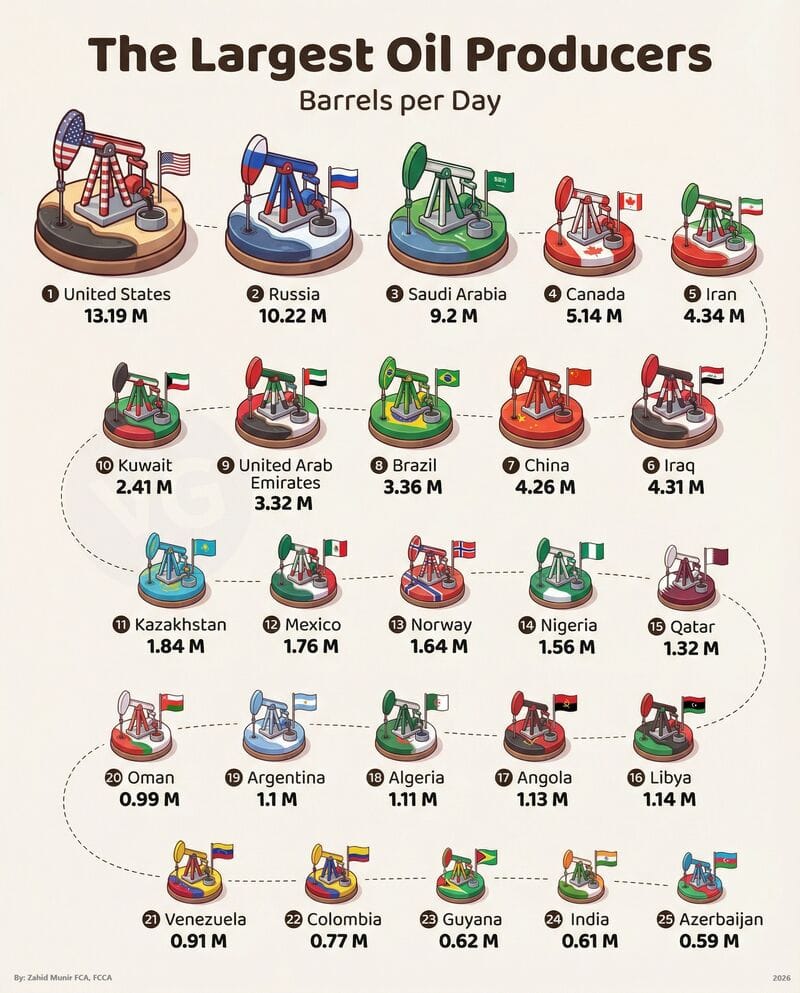
Oil production worldwide, 2024. How much China buys from each varies month to month.
The problem for China is that Russian production is under attack from Ukraine. Ukraine sank or disabled several Russian tankers, and we took some more; they’ve blown up pumping stations, including three on the Caspian Sea, set fire, to a large liquid natural gas terminal and damaged the major off-load platform for Kazakh oil. According to the Foundation for Democracy report, here, by October 2025, China was down to getting only 800,000 bbl/day from Russia, a major blow, and Ukraine’s attacks continue.
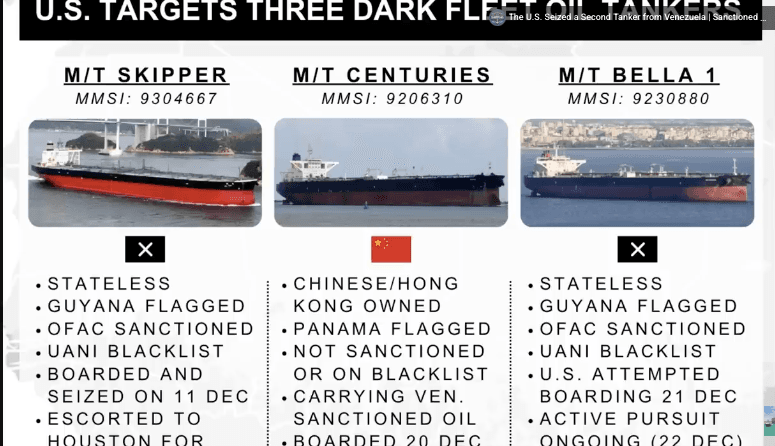
Some dark fleet ships captured by the US navy off of Venezuela, on their way to China with sanctioned oil.
Iran too is under attack. Up until recently they provided nearly 2 million barrels of oil per day, 90% of Iran’s seaborne export. Much of that went indirectly, shipped to Indonesia, turkey, Iraq, and Kuwait where it was relabeled, blended or refined to avoid sanction penalties. Everyone makes a profit here. But Iran is in the midst of a revolution, and last week, Trump imposed an across-the board 25% additional tariff on counties that help Iran avoid the sanctions. My guess is that this tariff will be effective and that it will last until the revolution is over. His tariffs have been effective and profitable, it seems, for us. They’re harmful for China, but not exactly a cause for war.
One reason I don’t expect a war with China is that China has many other, non-sanctioned suppliers, something Japan didn’t have. They buy some 1.6 million barrels per day from Saudi Arabia, 1.2 million bbl/day, from Iraq, 1.3 million bbl per day from Malaysia, 700,000/ day from Brazil, and about 900,000/day from the USA. While it would cost more, they could make up any losses in Russian or Iranian supply by buying more on the open market. Trump could cut China off totally, and that would be a devastating cause for war, but I don’t expect it. Still, for all I know, Trump’s activities in Venezuela and Iran are meant to force a war decision on China before they are strong enough to defeat us militarily. It seems to have been part of FDR’s logic in cutting off Japan.
The main peaceful way China has addressed it oil vulnerability, as best I can tell, has been to push EVs development. They’ve financed some 500 new EV companies who now (late 2025) provide about 50% of new Chinese automobiles. Another 19% are hybrids, the rest ICs. In the US, only 8% of new cars are EVs, and 16% hybrids. Large-scale use of EVs lessens the pressure on Chinese leaders to find oil sources, some 40% of oil imports can be assumed to go to fuel automobiles; if China were to go 80% EV, it would save 5.5 million barrels/day, more than it gets from Russia and Iran combined. For now, China still has a big need for gasoline, and has a big excess in EV manufacturing. It’s turned to Canada as a customer for EVs and as a supplier for oil, a smart move.
Last week, Canadian PM, Mark Carney visited China and announced a “Strategic Partnership” on Agriculture, energy, finance, and Global governance.” There’s no specific mention of oil, but it’s implied. China gets most favored nation status sending goods, including EVs to Canada at rates lower than on US goods. China will export some 50,000 EVs in 2026, rising to 70,000 by 2030 with tariffs set to 6.1%. US-made cars are tariffed at 25%. Canadians will get visa-free, tourist visits), plus a loan of $1B to be used buying Chinese ships. In Davos last week, “We are in the midst of a Rupture” away from the US. He urged the EU and other “middle powers” to band together. He talks like China is a good, reliable friend to Canada, and like the US isn’t. I would worry more about his comments and the “global governance” phrase, if the EU seemed to be going along, but it is not. Nor do I see a real move in China for war. I see positive effects of increased EV sales for China, Canada, and the world. Even if the quality isn’t great, Go Canada, go peace.
Economic experts claimed the tariffs would raise no signifiant money, would bring in no jobs, and would be so inflationary that the damage would far exceed any benefit. President Trump instituted them anyway, claiming they would benefit workers, raising wages, returning manufacturing to the US, and serving as a tool of diplomacy. Based on data so far, it appears the experts were completely wrong, and that Trump was right on all counts.
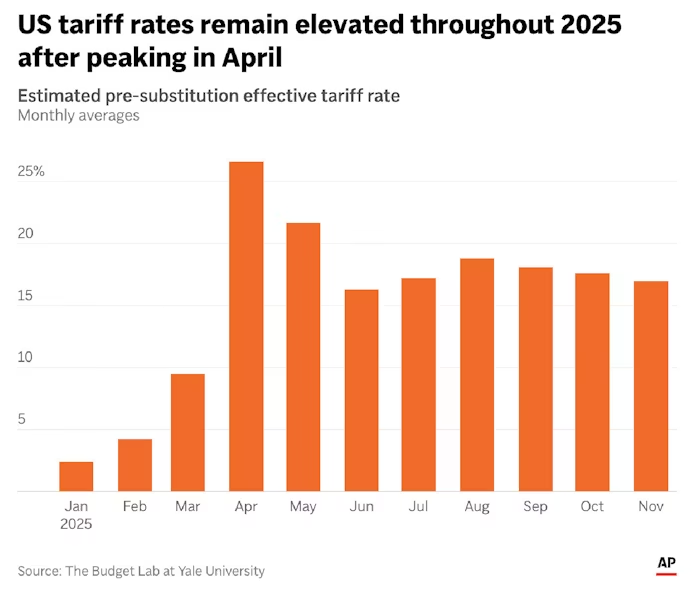
As an average, for the last nine months, our tariff rate has been about 17%, as shown in the chart above, bringing in about $30 billion per month. That tariff rate is as high as it’s been since the 1940s, but far lower than it was in the early 20th century. Chinese products are taxed more, at 47.5% on average, while goods from Mexico and Canada are taxed less, about 5%. High or low the tariffs generate complaints all around. Strangely, those complaining, in the US and out, see nothing amiss with the tariffs that our trading partners have placed on US products. The money from these tariffs came in handy, for example during the recent government shutdown, when we could not borrow money. This tariff money allowed us to pay the military and has helped reduce the annual deficit.
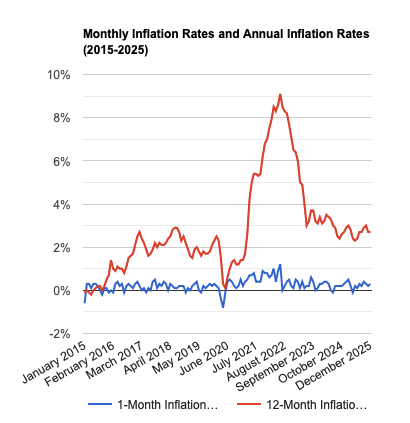
Despite the dire inflation prediction, there has been no noticeable uptick. Inflation has held constant for the last year, at about 2.7%. This is the same as during the last months under Biden, see chart, and is far lower than the 4-8% we saw for most of the Biden term. Basic commodities, in particular, remain cheap, with the price of gasoline and beer lower than in 2024, and luxury imports somewhat more expensive. Lower and middle income Americans don’t seem to mind since most of us don’t buy these goods. This year of inflation data supports Milton Friedman’s claim that taxes are inflation neutral, and that the cause of inflation is government overspending, as he says here. Liberal experts disagree, but the data says otherwise. I suspect the experts are blinded by overly simple theory, of Keynes, that they refuse to abandon. Alternately, they may be willfully lying to promote the agenda of university heads and all others who fund them. I noticed this pattern with global warming experts too. They don’t change their models and dire predictions though it’s way past 2014, and the arctic isn’t ice free.
There has been some job growth, but less than hoped for. There was a decrease in the tech sector and in government employment, but an uptick in services and healthcare. Unemployment has changed little, remaining at 4.4%. Several foreign businesses have moved manufacturing to the US. These include BASF, Volkswagen, LG, and Hanwha to name a few. Hanwha just completed its purchase of the Philadelphia shipyard, and committed $5B to its modernization. I consider this very important. It provides jobs, but beyond this, improved shipbuilding will help us commercially and militarily.
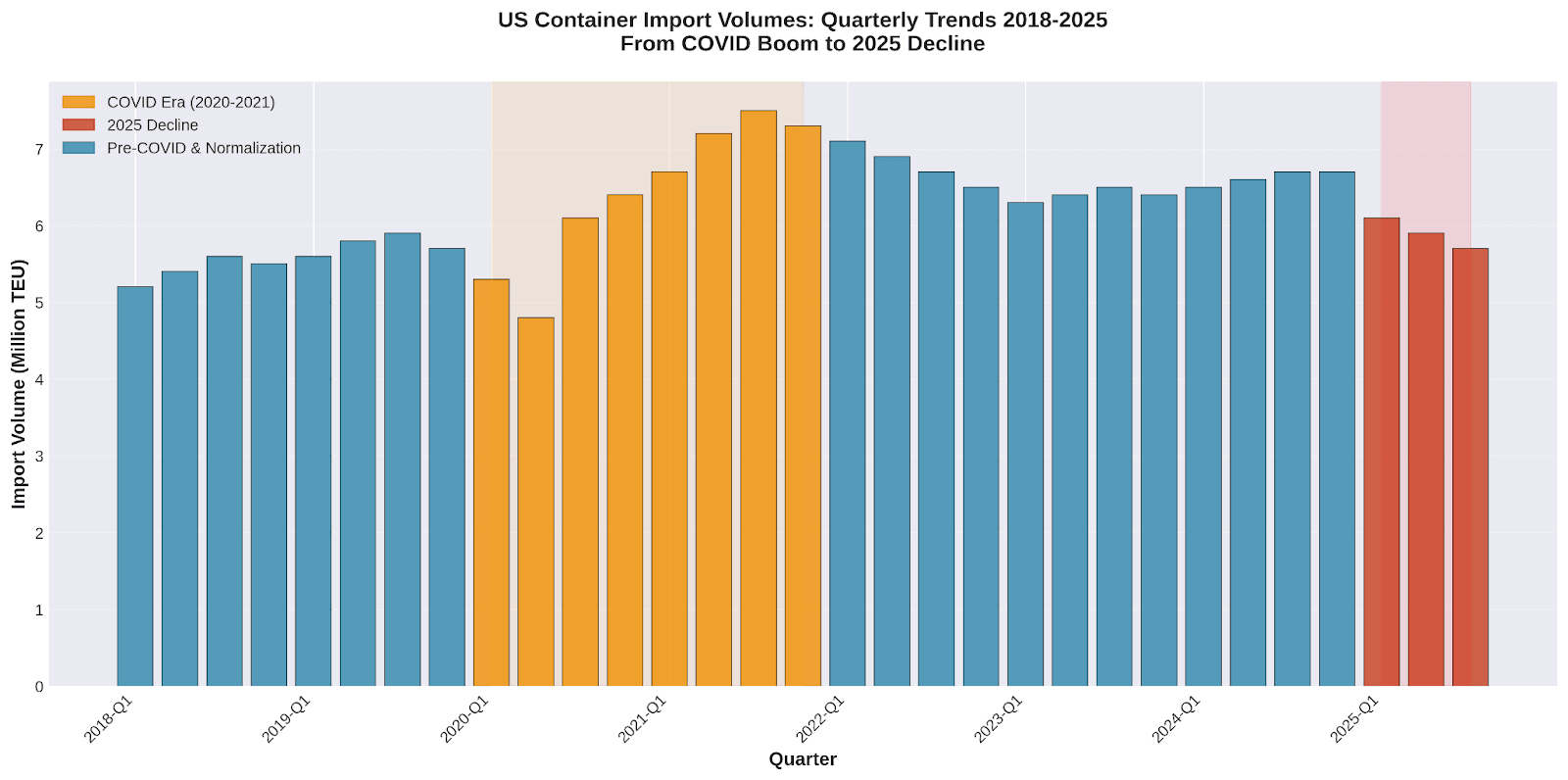
The reason that employment has not gone up as much as hoped seems to be that we’re still buying the same amount from abroad as before, containerized are the same as in the pre-COVID years, see chart below. There’s been some switching of sources, with more coming from Mexico, Taiwan, and Vietnam, and less from Canada and India. Import volumes from China have hardly changed though, since last year, nor have the prices that Americans pay risen. This suggests that China is “eating the tariffs”. I suspect they’ve undervalued their currency to make this happen. We’re selling a little more too, causing the trade imbalance to narrow, but the sales increase are largely precious metals (gold) to China, about 1000 tons in 2025. I’m not sure what China achieves by this; they’ve raised the price of gold to $4,675/oz currently, about double in 1.5 years, and kept the price of Chinese currency low. Perhaps that’s the intent — to keep their currency devalued relative to the dollar. Maybe they have some other idea, like to switch to a gold-backed currency? Who knows? Their purchases increase the value of our gold in Ft. Knox.
Trump’s other justification for the tariffs was as a tool of diplomacy. Trump is using tariffs somewhat this way, as a non-military stick to encourage friendly nations to do what he wants. He got Mexico to stop immigrants and drugs, encouraged the same from Canada and Columbia. He got the EU to spend more in their defense, and got them deal a little less with Russia. They’re still the biggest buyer of Russian natural gas. He also used tariffs to nudge for peace in the Middle East, and between Cambodia and Thailand. Recently, he’s using them to support the Iranian rebels by threatening countries that buy from Iran, or that help the mullahs launder their money and oil. All in all, the tariffs seem to be working for us. The experts are not impressed.
Donald Trump has announced his intent to build at least two battleships, the first built for our navy since the USS Missouri, 1944. The press has been largely negative on this, claiming that these ships are obsolete already, and will be more-so when they are completed — assuming they are completed. My sense is these are useful, overdue really, and I’d like to explain why.
The George Washington Carrier with nine surface support ships.
The centerpiece of America’s military power lies in our aircraft carrier groups, currently. We have 11 carriers in service: two modern, Ford class, and nine older, Nimitz class. Each of these weighs 100,000 tons, is 1100 feet long, and carries some 6000 men and women, 3200 navy crew, another 2500 in the air wing, and perhaps 300 support staff of doctors, nurses, and marines. Because they are vulnerable, each carrier travels in a group with six to ten other ships carrying an additional 3000 people, see photo. Without the support ships a carrier is deemed to be too vulnerable for use. Even with the support ships, Swedish and French submarines successfully “sank” U.S. carriers during exercises in 2005 and 2015.
The support ships are typically slower than the carrier and difficult to maintain. Many are old with relatively short range. Our carriers can go around the world, 30000 miles, traveling at 30+ knots, but the main support ships, Arleigh Burke destroyers, 9000 tons, 350 crew, have a range of only 4,400 nmi at a slower, 20 knots. They require regular refuelings for any major mission, like patrolling the Caribbean. Still, they’re “cheap,” about $2.5B each, capable, and work relatively well. We have some 75 in service, built since 1991, with more on order.
We also have nuclear missile submarines, but these are blunt instruments of policy, not suited to most navy missions, like keeping open shipping lanes in the Red Sea or stopping ISIS, or for blockading Venezuela. The mostly hold weapons of last resort.
The navy has recognized the need for a larger support ship for better carrier protection and more flexible roles, a cruiser likely, with good range and weapons, and with enough speed to keep up with a carrier crossing the Pacific. We’ve built many cruisers over the years, but these are old. Our latest are the Ticonderoga class guided-missile cruisers built from 1980 onward. They have good speed, 32.5kn, and good range, 6000nm, but are well past their retirement date, and break down a lot. Only 7 are still in service.
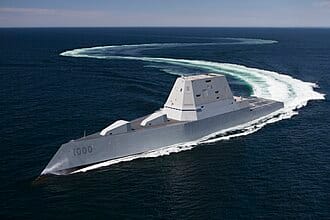
The USS Zumwalt at sea. Trump said it was “Ugly as F.”
The supposed replacement, was a cruiser-size, stealth ship, the Zumwalt destroyer, 17,000 tons and 600 feet long. It is reasonably fast, 33.5kn, and carries a small crew, <100. We’ve managed to build three of these since 2008, but have cancelled the project due to operational problems and costs that rose to $8B per ship. Zumwalts have inward-sloped sides that deflect radar, but they become unstable in turns. Its main weapons are expensive, too: Aegis missiles and CPS hypersonics costing $28-$50 million each. That’s uneconomical compared to French Aster missiles, Mach 3, 80 mile range, $1.1 million. Originally, Zumwalt destroyers carried a rail gun, but it required so much power that you could not move the ship and fire at the same time. The rail guns were eventually replaced by conventional 5″ cannon with a 24 mile range. The three Zumwalts we have are hardly used today, and no more are on order. Something cheaper was needed at least for support, and that was supposed to be the Constellation Frigate, approved by Trump in 2017.
A frigate is smaller than a cruiser, in this case about half the weight. The Constellation was a proven Italian design, 492 feet long and only 7,291 tons. It had good speed, 26 kn, good range, 6000 nm at 16kn, and cost only $950 million, at least when built in Europe. The contract was awarded to Fincantieri Marinette Marine (FMM) of Marinette Wisconsin, the US division of the Italian company. What could go wrong? The problem was that the navy kept adding capabilities and weight. As of November 2025, eight years on, the weight had increased by 700 tons, the cost to $9 B for two, and no design has been finalized. The first Constellation frigate is only 12% built! Trump has not quite cancelled the program, but has reduced the order to two from the original eight.
Trump-class battleship, as envisioned, with a rail-gun, lasers and two, conventional 5″ cannon.
And that brings us to the current, Trump class battleship, shown above. It’s long, 840-880 feet, and heavy, 39,000 tons, or 2.5 times the weight of the cruiser-sized, Zumwalt. As was intended for the Zumwalt, the offensive weapons are missiles and a rail gun, 32 MJ, but now there is enough power run the ship and fire the weapon. Japanese versions of the rail gun have launched cheap shells at hypersonic speeds, ~5000 mph (hypersonic) at a distance of over 100 miles and a fire-rate of ~one per second. The shells cost only $85,000 each, a bargain compared to hypersonic missiles.
For defense, these battleships are to carry two, 300kW, Helios lasers, similar to Israel’s “Iron beam,” but 3 times as powerful. They are augmented by smaller lasers, by four, 30 mm chain guns (Gatling guns), and two, 5″ conventional navy guns of 24 mile range. Engines are estimated to be two gas turbines, perhaps 50MW each of for acceleration and to power the weapons, plus ~100 MW in diesel power for cruising at good speed and mpg. I thus estimate a total of ~200 MW, about as much as on a carrier. There is plentiful space for missiles and fuel, so it should provide some resupply of support ships. The crew size is bigger than on the Ticonderoga, 600 to 800, but far less than on a carrier, and the look is impressive. A Trump goal is that it should be an attractive, command ship. Still, there are objections.
A main complaint is vulnerability as discussed here, the claim is these ships are “bomb magnets,” not stealthy, nor as heavily armored as the Iowas. Detractors claim that lasers and chain guns are insufficient for defense from drone swarm attacks. They note that the Bismarck, Yamamoto, and Arizona have been sunk, typically by air attack. What the detractors don’t mention is that it took a lot of bombs and torpedos to sink these battleships nor that these battleships will travel with support ships, while the Bismarck travelled alone.
Detractors also question the rail gun. Can it shoot down an airplane? can it sink a ship? The tests I’ve seen suggest that the rail gun can take out an airplane, but that it can not sink a ship, at least not with one shot. That still needs a missile, but the battleship does have missiles. The gun seems appropriate for shore bombardment too, even against hardened targets, and for dissuading actions by a Chinese navy that is already bigger than ours. As for the defense against drones, the battleship is to have high-powered lasers that have been shown to stop drones and cruise missiles at a cost of only ~$10 per shot. That’s nothing compared to a harpoon missile ($1.4 million each) or Aegis ($28 million). These are great weapons, and I don’t see a smaller ship being able to power them. Also it’s nice to have extra room for expansion — like adding a nuclear reactor.
The time-line is what worries me most. These will take ten years at least. Until then, we will have to rely on our short-range Arleigh Burkes that did not have the firepower to bombard the Houthis effectively on land, nor effectively defend US shipping in the Red Sea. Those ships had to use million-dollar missiles to shoot down $20,000 drones. I expect us to really need the battleships, even if it takes us ten years to get one.
Robert Buxbaum, January 5, 2026. As a totally side issue: some claim this isn’t a battleship. It carries only one gun, admittedly a powerful gun. I half agree, you need at least two big guns to be a battleship, IMHO.
The SS United States is in the process of being towed to its final resting place, on the sea floor near florida, to be a scuba-diving reef. She is the largest ocean liner to be entirely constructed in the United States and was the fastest ocean liner to cross the Atlantic Ocean in either direction, 36 knots or 41 mph average speed. She won the Blue Riband for this on her first voyage, in 1952, and retained that title till today. There was a faster crossing in June, 1990 by the Hoverspeed Great Britain, 36.6 knots, 42.1 mph average speed, but the Hoverspeed was a 76 meter channel catamaran, not an ocean liner.
The SS United States was half-paid for by the US government. Its purpose was fast passenger transport across the Atlantic. The government contributed because it might be used as a troop ship if needed in times of war. In terms of speed, she handily beat the luxurious British liners, Queen Elizabeth and Queen Ann, but the compromises for speed and military use made the SS United States unsuited for use as a luxury cruise ship.
Designed by William Francis Gibbs, one of the greatest ship designers, the high speed was achieved, in part, by making the ship very light. He used aluminum for the entire superstructure, the stuff above water level, making it the largest aluminum construction when built, 1951. Though larger than the Titanic, the United States is thinner and more pointy. Much lighter than the Queen Elizabeth or Queen Ann, she could go as fast backward as the Titanic could forward. The hull is doubled, with fuel stored between the layers as a protection from collisions and canon; the interior is highly compartmentalized too, to make her fairly unsinkable. This was confirmed when she survived a sea collision shortly after launch. Making the ship light on the top made the SS United States stable in wind and rough seas despite its narrow shape. There were two engine sections, divided into four engine rooms, done to increase the chances that the engines would survive an explosion or torpedo attack.
The interior design was American modern, and fire-proof, with few weighty decorations. Furnishings were fiberglass, steel or aluminum, for the most part, see picture below. The red, white, and blue stacks added to the American look. Both are used (recall that there are two engine rooms), and both have aluminum wings. These shield the deck from any sparks that might come out the stacks.
In the end, it was the crossing speed not the comfort level that doomed the SS United States. Even at a top speed of 44.1 mph, crossing the Atlantic took 3+ days. That could not compete with jet planes that travelled at 500 mph. I’ve argued that long range, “high speed” passenger trains make little sense for the same reason. Even at 100+ mph, few Americans will be willing to spend 36 hours traveling from Chicago to Seattle. Fast boats are useful, I think, but only in smaller size foreshorten trips, similar to the Hoverspeed.
5 blade propeller on display at Throg’s neck. Paired with a 4 blade propeller it reduced vibration and wear at high speed.
Also helping it reach the speeds it did, the SS United States benefitted from innovations in the engines and in the propellers. There were four engines, in two engine sections. These were modern, light weight, compact, steam turbines running at high pressures and temperatures: 975°F and 925 psi. Each turbine delivered 60,000 shaft hp to a variable-speed, geared shaft. The inboard propellers had 5 blades and the outboard (end of ship) had four. This difference in blade number was a secret, design innovation that allowed faster speed, without vibration and cavitation. The 5 blade propeller shown on display at left, accelerated the water, while the 4 blade accelerated it faster. At the time, this was secret technology. We now have some better propellers, though no faster ocean liners. The Hoverspeed uses water jet for propulsion, by the way.
Leaving the Delaware River heading to the Gulf of X
On its way to the bottom of the sea, the ship will first stop at MARS. That is not the planet Mars, but at an engineering firm, “Modern American Recycling Services” in Mobile Alabama, on The Gulf of X. There the MARS folks will prepare the ship to sink in an even way, where its supposed to; a way that works for scuba divers.
Robert Buxbaum, February 28, 2025. My sense is there is still room for steam power. I also think the US government should return to investing in US ship-building, especially for double-use, military and commercial, like this one. A new favorite phrase, from Ovid, Metamorphosis: “Omnia mutantur, nihil interit”. Everything changes, but nothing passes away. RIP, old friend.
I’ve gone sailing a few times this summer, and once again was struck by the great difference between sailing and boating, as well as by the mystery of the hull speed.
Sailors are distinct from boaters in that they power their boats by sails in the wind. Sailing turns out to be a fairly pleasant way to spend an afternoon. At least as I did it, it was social, pleasant, and not much work, but the speeds were depressingly slow. I went on two boats (neither were my own), each roughly 20 feet long, with winds running about 10-15 knots (about 13 mph). We travelled at about 3 knots, about 3.5 mph. That’s walking speed. At that speed it would take about 7 hours to cross Lake St. Clair (25 miles wide). To go across and back would take a full day.
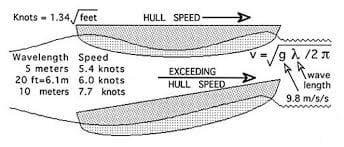
Based on the length of the boats, they should have been able to go a lot faster, at about 5.8 knots (6 mph). This target speed is called the hull speed; it’s the speed where the wave caused by the bow provides a resonance at the back of the boat giving it a slight surfing action, see drawing.
This speed can be calculated from the relationship between wave speed and wavelength, so that Vhull = √gλ/2π where g is the gravitational constant and λ is the water line length of the boat. For Vhull in knots, it’s calculated as the square-root of the length in feet, multiplied by 1.34. For a 20 foot boat, then,
While power boats routinely go much faster than this, as do racing skulls and Americas cup sailboats, most normal sailboats are designed for this speed. One advantage is that it leads to a relatively comfortable ride. There is just enough ballast and sail so that the boat runs out of wind at this speed while tipping no more than 15°. Sailors claim there is a big increase in drag at this speed, but a look at the drag profile of some ocean kayaks (12 to 18 feet, see below) shows only a very slight increase around this magical speed. More important is weight; the lowest drag in the figure below is found for the shortest kyack that is also the lightest. I suspect that the sailboats I was on could have gone at 6 knots or faster, even with our current wind, if we’d unrolled the spinnaker, and used a ‘screecher’ (a very large jib), and hung over the edge to keep the boat upright. But the owner chose to travel in relative comfort, and the result is that we had a pleasant afternoon going nowhere.
Data from Vaclav Stejskal of “oneoceankyacks.com”
And this brings me to my problem with power boating. Th boats are about the same length as the sailboats I was in, and the weight is similar too. You travel a lot faster, 20 to 25 knots, and you get somewhere, but the boats smell, and provide a jarring ride, and I felt they burn gas too fast for my comfort. The boats exceed hull speed and hydroplane, somewhat. That is, they ride up one wave, fly a bit, and crash down the other side, sending annoying wakes to the sailboaters. We crossed lake St. Clair and rode a way down the Detroit river. This was nice, but it left me thinking there was room for power -assisted sailing at an intermediate speed, power sailing.
Both sailboats I was on had outboard motors, 3 hp, as it happened, and both moved nicely at 1 hp into and out of the harbor, even without the sail up. Some simple calculations suggest that, with I could power a 15 to 20 foot sailboat or canoe at a decent speed – hull speed – by use of a small sail and an electric motor drawing less than 1 hp, ~400 W, powered by one or two car batteries.
Consider the drag for the largest, heaviest kayak in the chart a move, the Cape Ann Double, going at 6.5 knots. At 6 knots, the resistance is seen to be 15 lbs. To calculate the power demand, convert this speed to 10 fps and multiply by the force:
Power for 6 knot cruising = 10 fps x 15 lbs = 150 ft lbs/s = 202 W or 0.27 hp.
Outboard motors are not 100% efficient, so let’s assume that you need to draw more like 250 W at the motor, and you will need to add power by a sail. How big a battery is needed for the 250 W? I’ll aim for powering a 4 hour trip, and find the battery size by multiplying the 250 W by 4 hours: that’s 1250 Hrs, or 1.25 kWh. A regular, lithium car battery is all that’s needed. In terms of the sail, I’m inclined to get really invovative, and use a Flettner sail, as discussed here.
It seems to me that adding this would be a really fun way to sail. I’d expect to be able to go somewhere, without the smell, or the cost, or being jarred to badly. Now, all I need is a good outboard motor, and a willing companion to try this with.
The Houtis, a Shia Islamic group, have been attacking ships in the Red Sea, hitting European ships, mostly carrying goods going between China and Europe. They use ballistic missiles plus cheap drones with great effect, targeted by an Iranian spotter ship in the Red Sea narrows, the Bab el Mandab. The US response is “Prosperity Guardian.” We’ve sent four missile destroyers. and the British one. These are arrayed along the entire coastline, too much coast for 5 ships to protect, and we try to shoot down drones and missiles. We manage to shoot down most of the missiles and and drones, but some always get through, and they mostly hit US and British targets. Recently the Maersk Detroit, a US flagged ship and 3 days ago, the British tanker, Marlin Luanda, shown below. It was carrying Russian naphtha headed for China. Some months ago, The Houtis kidnapped a British ship (Jewish owned) and took it to Yemen, as described previously.
British oil tanker, Marlin Luanda, on fire in the Gulf of Aden after being hit by an Iranian missile fired by Yemen’s Houthis. The tanker is hauling Russian naphtha, headed for China.
Iran supplies the missiles, and helps choose targets. According to Kissinger the aim of their attacks, and of the attacks on Israel, is to delegitimize Sunni Moslem countries like Egypt and Turkey that have made peace with Israel and the west. Whatever the motivation, Chinese and Russian ships are not targeted, but our ships are. We don’t attack the Iranian spotter for fear of starting a war. Instead we bomb Yemen, and protect ships carrying Chinese good and Russian oil. Currently 80% of the oil tanker transits of the Suez carry Russian oil (see below).
Most of the oil trade in the Suez is Russian — yellow line. Everyone else is shown in blue-black. It’s down to 0.5 ships per day, on average.
I don’t mind helping European countries get cheap Chinese goods, but I think the the main folks to pay should be the Europeans. We’re firing expensive anti-missiles and we’re showing the strengths and vulnerabilities to the Iranians, Chinese and Russians. Currently it’s our sailors who are at risk. The US trades with China too, but our China trade is not benefitted by ‘Prosperity guardian. Mostly our China trade avoids the Suez Canal, and comes around Africa to Savana or NY, or it comes across the Pacific, directly to Los Angeles. Our India trade most goes the same way. Some used to go through the Suez before the Houtis started attacking.
France and Japan have not joined prosperity guardian. Instead they have chosen to convoy their own flagged ships, even allowing the occasional stringer to tag along. Doing this, they use fewer ships, and it seems to work better than our approach. The picture at left shows a French courvair-escort escorting two French container ships. Note how much bigger the container ships are than the French warship. Should the Houtis’s missiles get too close to a French ship, I suspect that the French would retaliate hard. I think we should switch to following the French model and convoy-protect our shipping, plus whoever wants to tag along.
Map of Yemen and the Red Sea narrows.
Shipping, insurance rates have risen to about 1% of the cargo value. It’s now so expensive that no US cargo carrier will transit the area except when needed to supply our troops. At this point it’s worth asking, “Whose property are we guarding?” Also, is this really worth the lives of US sailors? If it is, why not hit the source of the problem — The Iranian spotter. The behavior of the French and Japanese makes sense to me. Biden’s behavior here does not.
Robert Buxbaum, February 6, 2024. Iran also funds and arms Hezbollah, a group that killed 3 US soldiers two months ago, and who killed several Kurdish allied troops in Syria just yesterday, and have shelled Israel intensely for months. IMHO, you want a few, well defended bases, not in harms way in Syria, but close enough to come back fast, in force.
Per pound mile of material, the transport cost by ship is 1/4 as much as by train, and about 1/8 as much as by truck. Ships are slower, it is true, but they can go where trucks and trains can not. They cross rivers and lakes at ease and can haul weighty freight with ease. I think America could use many more ferries, particularly drive-on, fast ferries. I don’t think we need new fast rail lines, because air travel will always be faster and cheaper. The Biden administration thinks otherwise, and spends accordingly.
Amtrak gets $30 Billion for train infrastructure this year, basically nothing for ferries.
The Biden administration’s infrastructure bill, $1.2 Trillion dollars total, provides $30 Billion this year for new train lines, but includes less than 1% as much for ferries, $220 million, plus $1B for air travel. I think it’s a scandal. The new, fast train lines are shown on the map, above. Among them is a speed upgrade to the “Empire Builder” train running between Chicago and Seattle by way of Milwaukee. I don’t think this will pay off — the few people who take this train, takes it for the scenery, I think, and for the experience, not to get somewhere fast.
There is money for a new line between Cleveland and Detroit, and for completion of the long-delayed, and cost-over-run prone line between LA and San Francisco. Assuming these are built, I expect even lower ridership since the scenery isn’t that great. Even assuming no delays (and there are always delays), 110 mph is vastly slower than flying, and typically more expensive and inconvenient. Driving is yet slower, but when you drive, you arrive with your car. With a train or plane, you need car rental, typically.
New Acela train, 150 mph max. 1/4 as fast as flying at the same price.
Drive-on ferries provide a unique advantage in that you get there with your car, often much faster than you would with by driving or by train. Consider Muskegon to Milwaukee (across the lake), or Muskegon to Chicago to Milwaukee, (along the lake). Cleveland to Canada, or Detroit to Cleveland. No land would have to be purchased and no new track would have to be laid and maintained. You’d arrive, rested and fed (they typically sell food on a ferry), with your car.
There’s a wonderful song, “City of New Orleans”, sung here by Arlo Guthrie describing a ride on the historic train of that name on a trip from Chicago to New Orleans, 934 miles in about one day. Including stops but not including delays, the average speed is 48 mph, and there are always delays. On board are, according to the song, “15 restless riders, 3 conductors, and 25 sacks of mail.” The ticket price currently is $200, one way, or about as much as a plane ticket. The line loses money. I’ve argued, here, for more mail use to hep make this profitable, but the trip isn’t that attractive as a way to get somewhere, it’s more of a land-cruise. The line is scheduled for an upgrade this year, but even if upgraded to 100 mph (14 hours to New Orleans including stops?) it’s still going to be far slower than air travel, and likely more expensive, and you still have to park your car before you get on, and then rent another when you get off. And will riders like it more? I doubt it, and doubt the speed upgrade will be to 100 mph.
Lake Express, 30 mph across Lake Michigan
Ferry travel tends to cost less than train or plane travel because water traffic is high volume per trip with few conductors per passenger. At present, there are only two ferryboats traveling across Lake Michigan, between Michigan and Wisconsin, Milwaulkee to Muskegon. They are privately owned, and presumably make money. The faster is the Lake Express, 30 mph. It crosses the lake in 2.5 hours. Passenger tickets cost $52 one way, or $118 for passenger and car. That’s less than the price of an Amtrak ticket or a flight. I think a third boat would make sense and that more lines would be welcome too. Perhaps Grand Haven to Racine or Chicago.
Route of the Lake Express. I’d like to see more like this; St. Joseph to Milwaukee say, and along Lake Erie.
Currently, there are no ferries across Lake Erie. Nor are there any along Lake Erie, or even across Lake St. Clair, or along the Detroit River, Detroit to Toledo or Toledo to Cleveland. These lines would need dock facilities, but they would have ridership, I think. New York’s Staten Island ferry has good ridership, 35,000 riders on a typical day, plus cars and trucks. In charge are roughly 120 engineers, captains and mates, one employee for every 300 passengers or so. By comparison, Amtrak runs 300 trains that carry a total of87,000 passengers on an average day, mostly on the east coast. These 300 trains are run by 17,100 employees as of fiscal year 2021, one employee for every 4 passengers. Even at the slow speeds of our trains the cost is far higher per passenger and per passenger mile.
The Staten Island ferry is slow, 18.5 mph, but folks don’t seem to mind. The trip takes 20 minutes, about half as long as most people’s trips on Amtrak. There are also private ferry lines in NY, many of these on longer trips. People would take ferries for day-long trips along our rivers, I think. Fast ferries would be nice, 40 mph or more, but I think even slow ferries would have ridership and would make money. A sea cruise is better than a land cruise, especially if you can have a cabin. On the coal-steam powered, Badger, you can rent a state-room to spend the night in comfort. Truckers seem to like that they cover ground during their mandatory rest hours. The advantage is maximized, I think, for ferry trips that take 12 hours or so, 250 to 350 miles. That’s Pittsburgh to Cincinnatti or Chicago to Memphis.
New York’s Staten Island ferry leaves every 15 minutes during rush hour. Three different sizes of boat are used. The largest carry over 5000 passengers and 100 cars and trucks at a crossing.
A low risk way to promote ferry traffic between the US and Canada would be to negotiate bilateral exemption to The Jones Act and its Canadian equivalent. Currently, we allow only US ships with US crews for US travel within the US.* Cabotage it’s called, and it applies to planes as well, with exemptions. Canada has similar laws and exemptions. A sensible agreement would allow in-country and cross-country travel on both Canadian and US ships, with Canadian and/or US crew. In one stoke, ridership would double, and many lines would be profitable.
Politicians of a certain stripe support trains because they look futuristic and allow money to go to friends. Europeans brag of their fast trains, but they all lose money, and Europe had to ban many short hop flights to help their trains compete. Without this, Europeans would fly. There is room to help a friend with a new ferry, but not as much as when you buy land and lay track. We could try to lead in fancy ferries going 40 mph or faster, providing good docks, and some insurance. Investors would take little risk since a ferry route can be moved**. Don’t try that with a train.
In Detroit we have a close up of train mismanagement involving the “People Mover.” It has no ridership to speak of. Our politicians then added “The Q line” to connect to it. People avoid both lines. I think people would use a ferry along the Detroit river, though, St. Claire to Wyandotte, Detroit, Toledo — and to Cleveland or Buffalo. Our lakes and rivers are near-empty superhighways. Let’s use them.
Robert Buxbaum, January 2, 2024. *The US air cabotage act (49 U.S.C. 41703) prohibits the transportation of persons, property, or mail for compensation or hire between points of the U.S. in a foreign civil aircraft. We’ve managed exemptions, though, e.g. for US air traffic with Airbus and Embraer planes. We can do the same with ferries.
** I notice that it was New York’s ferries, and their captains, that rescued the people on Sullenberger’s plane when it went down in the Hudson River — added Jan. 6.
Piracy is illegal throughout the world, but has become increasingly popular. Over the last 3 weeks, perhaps 15 ships have been attacked by pirates (or privateers) in the narrow entrance to the Red Sea between Yemen, Somalia, and Djibouti, the “Bab el Mandab,” In Arabic, this means “the gate of tears”. Most of the ships attacked are large commercial vessels operating between Europe and Asia. The US destroyer, Carney has been attacked as well. Three of the attacked ships have been boarded, and two have been successfully hijacked, the car-carrier Galaxy Leader was taken to South Yemen, while the MV Ruen a Bulgarian owned dry bulk (grain) ship was brought to Somalia. The last of the hijacked ships, the Strinda, was recaptured by the US and Japanese navy. The other ships were attacked, at a distance, by Iranian ballistic missiles, cruise missiles, and drones, all fired from Yemen. All of these acts are defined as piracy under the UN Charter, Law of the Sea, UNCLOS. The punishment is 10+ years in prison, assuming you catch the pirate.
Bab al Mandab = Gate of tears, where the pirates operate.
All of these ships are European except for the Carney and a Chinese container ship flagged in, Hong Kong. You’d think that the European navies would protect their own ships here, but they do not. Neither did the Chinese navy, though they are stationed in Djibouti. It’s clear that Iran is organizing the attacks, and that they are using a spotter ship to help direct the missiles. My guess is that the European countries don’t want to annoy Iran here, nor do they like to use their $1 million missiles.
In theory, these attacks are in response to the Israel – Gaza war. The hijacked Galaxy Leader was registered in the UK, but owned by an Israeli Jew (see a video of the attack). Another ship that was attacked, the Strinda, was not directly associated with Israel, but was going to go to Israel at some point in the future. While it’s possible that the other attacked ships had Jewish or Israel connection, a simpler explanation is that this is economic terror. Israel-based Zim shipping has elected to avoid the straight and redirect around Africa instead, a much longer route that is sure to damage the shipper and Israel’s economy. I suppose that was an intent, but the damage is spreading.
Commercial vessel attacks in Bab al Mandab, chart from “What the Ship” video blog.
The European shippers have demanded that the US protect their ships, and perhaps Biden will agree. My sense is that Trump would have said no, or at least demand something in return. Personally, I see no reason to defend trade that doesn’t involve us, with no obvious payback. Yesterday, British Petroleum BP announced that it would avoid the Bab. Four major European container freight firms, MSC (Swiss), Maersk (Danish), Hapag-Lloyd (German) and CMA CGM (Italian, French). Currently Maersk supplies our troops, but has threatened to stop unless we defend their whole fleet. I consider this an offensive, a breech of contract. They European press seems to think it’s clever. We used to have a US company that supplied our troops, Landsea intermodal, but Maersk bought them out. Personally, I think it’s time to look for a company that doesn’t play these games.
As of two days ago, the economic damage has been minimal, except to Israel. Only 55 ships had diverted around Africa, or begun to. This is a small fraction of the 2,128 ships that have gone through the Bab since November 15. In the last day or so, European oil prices have started to rise, while ours fell. The thought is that Saudi oil will now flow to the US, not Europe. I think this is the beginning of a serious problem for Europe and that they should defend their own shipping. A few, million dollar missiles are a lot cheaper than the billions of loss to their economies that rerouting will cause. At present, Europe expects us to save them while they do little or nothing. I think we should say no. They think Biden will cave.