Tag Archives: peace

Winning the peace at Appomattox

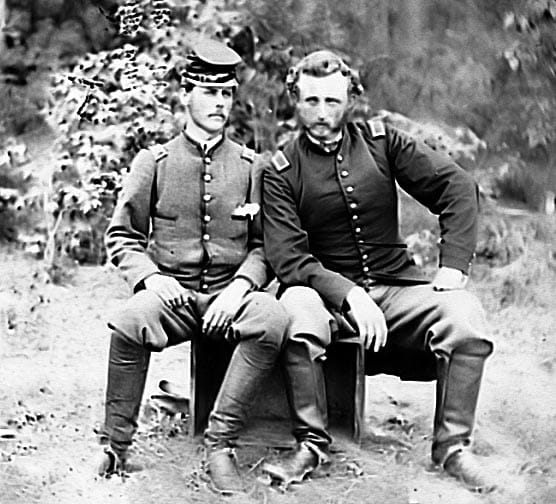
George A. Custer with captured confederate prisoner. Custer was a man of action but not of cruelty.

George A. Custer with a captured confederate prisoner. Custer was a man of action, but not of cruelty.

It is often forgotten that the aim of generalship is not winning a war, but winning a stable peace. In that sense, most generals and most diplomats are failures; their victories benefit only the undertaker; their peace-treaties only provide time to reload. That was the case with the Mexican civil war but not the US civil war. The choices and surrender at Appomattox, 150 years ago lead to a genuine, stable peace. It’s worthwhile, therefore to consider the how that was done here and not in Mexico, perhaps as a lesson for the future.

I begin, near the end of the war with a much-maligned general, George A Custer on April 8, 1865; this  is the day the 13th Amendment passed, four days after Lincoln walked through a defeated, smoldering Richmond, the capital of the south. The war would end soon, but would the result be peace, or chaos. George A. Custer had graduated at the very bottom of his class at West Point, the position known as goat. As is not atypical with goats, he was not particularly suited to following orders during peacetime, but was supremely suited to war and action. Custer liked to attack first and think later, but he was also a man of peace; he become the youngest Union Brevet General in US history. On April 8, with Lee at Appomattox Court House (that’s the name of the town), Custer led a small group of men to attack a nearby town, Appomattox Station, a rail depot three miles to the southwest. There he captured, without a fight, three, rail cars full of desperately needed arms, ammunition and supplies that had been sent to Lee’s army from Lynchburg.

While leaving the station, Custer’s men ran into the artillery unit of Confederate Brig. Gen. Reuben Walker, and attacked (of course) eventually capturing 25 artillery pieces, nearly 1,000 prisoners and all of their supplies. It took several attacks to win, but the results were worth it. Custer took the cannon and his troops, and positioned them on Lee’s likely escape route, on the Richmond-Lynchburg Stage Road south of Appomattox Courthouse. Lee was now nearly trapped, but didn’t know it yet.

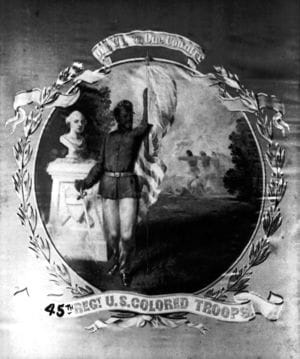
Paining in honor of the 45th regiment colored troops: Afro-American soldier stands with flag before a bust of Washington.

Painting in honor of the 45th regiment colored troops: Afro-American soldier stands, with flag, before a bust of Washington and a depiction of battle (Fair Oaks? Petersburg?)

On the same day, April 8, General Grant sent Lee a proposition to surrender. Lee responded that he was not interested in that, but would like to meet at the McLean House at 10:00 A.M. April 9 to discuss “restoration of peace.” Grant replied that he didn’t have that power but agreed to meet Lee, none the less.

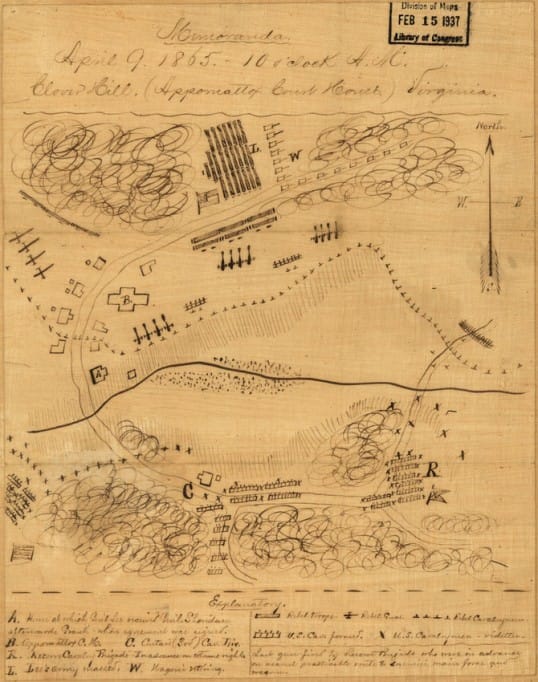
In the meantime, Lee prepared his forces to clear the Stage Road so his forces could escape south-west, to Appomattox station and home. Grant, no newcomer to war, ordered two corps (XXIV and V) under the commands of Maj. Gen. John Gibbon and Bvt. Maj. Gen. Charles Griffin to march all night to the west and north. These corps included 5000 Afro-American troops, mostly in the 45th and 116th U.S. Colored Troop Brigades. On the morning of April 9, Lee attacked to the south and managed to capture the forward pickets defending the Richmond-Lynchburg Stage Road. But when he reached the rise of the hill, he saw his escape was blocked. His 45,000 troops were surrounded by 113,000, better-armed Union soldiers, cannon and cavalry. It was then suggested that Lee disband his troops for an extended guerrilla war, an option he refused as it would lead to murdering bands roaming the county, and would make peace nearly impossible. Instead Lee rode off to discuss surrender to Grant. 

Map of the troop arrangements April 9, 1865. Checkmate. Lee's forces, x or + are out numbered, out gunned and surrounded. The end.

Map of the troop arrangements April 9, 1865. Checkmate. Lee’s forces, x or +, are out numbered, out gunned, and surrounded.

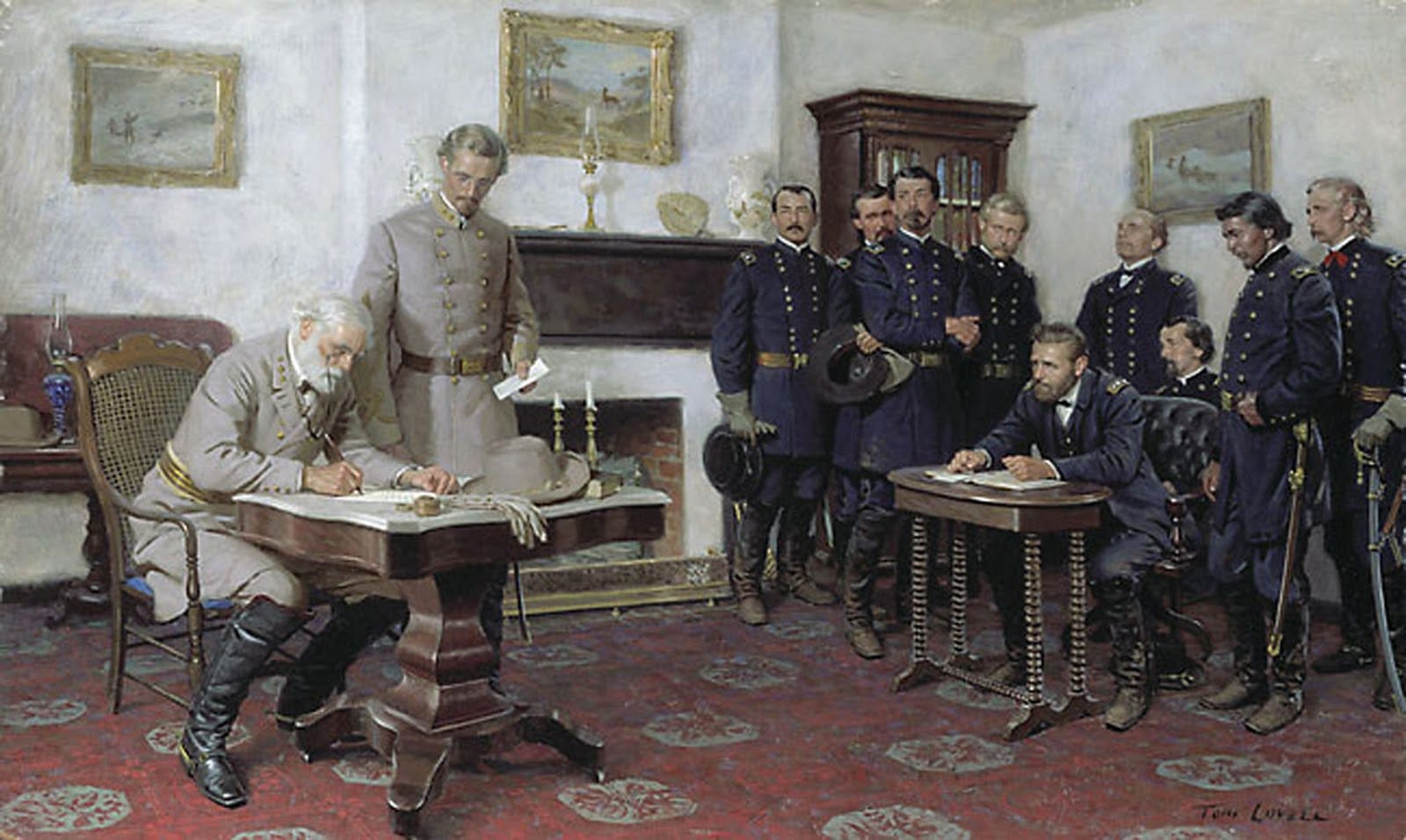
Lee’s surrender, finalized that afternoon, was penned by Grant’s aide-de camp, Lt Col’, Ely S. Parker, a Seneca Indian who had an engineering degree and studied law. The kindness to Indians may have suggested similar kindness to the surrendering Confederates. Parker eventually rose to the rank of general, and then to head of the Bureau of Indian Affairs. The terms of surrender too, were chosen to be unusually generous. Grant did not take the confederates soldiers captive, but instead allowed them to return home, relatively unmolested. Also, he allowed the officers to keep their swords and personal weapons. Kind acts like these may have eased reconstruction. Custer had demanded unconditional surrender from General Beauregard on April 9, something he probably imagined U.S. (Unconditional Surrender) Grant would have wanted; he was over-ruled by his commanding officer, Phillip Sheridan, who probably knew Grant better. 

After the war, most of the confederates swore loyalty to the US. Lee did what he could to promote reconciliation; he supported civil rights and reconstruction, and became president of Washington and Lee College. Some confederate generals and 2500 soldiers headed south to Mexico to join the French/Austrian forces of Emperor, Maximilian I, engaged in a civil war of his own. Maximilian, only 34 years old and a highly decorated Austrian officer, had little local support. He was captured and executed, June 19, 1867. Mexico then descended into chaos: a Pyrrhic victory, and a model to avoid.

Surrender at Appomattox; with Grant are Philip H. Sheridan, Orville E. Babcock, Horace Potter, Edward O.C. Ord, Seth Williams, Theodore S. Bowers, Ely S. Parker and George A. Custer. With Lee is Charles Marshall, his military secretary.

Surrender at Appomattox; with Grant are Philip H. Sheridan, Orville E. Babcock, Horace Potter, Edward O.C. Ord, Seth Williams, Theodore S. Bowers, Ely S. Parker and George A. Custer. With Lee is Charles Marshall, his military secretary. After the signing, most of the furnishings were purchased by Union officers as souvenirs. Lee shook Parker’s hand and said, I’m glad to see a real American here.” Parker replied, “We are all Americans.”

What did Mexico do wrong? For one, in order to win a peace, they failed to get the other side to agree to the peace, with clear documentation about what it is that’s been agreed to (That’s why Parker’s role is so important). Instead of killing Maximilian, they should have had him sign some sort of document and retire him to a farm or college where he could support the peace. In order to win a peace, it’s important to leave a stable country, with stable borders and a strong military, one that can govern itself fairly and well. A stable peace generally involves recognition of your government by other nations, and that too requires not killing your defeated enemy wholesale.

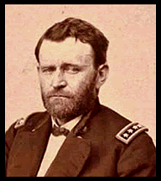
Robert E. Buxbaum, April 7-12, 2015. My sense is that the conditions for building a lasting peace get far too little attention in the study of war and history. I should mention that the 45th were mostly escaped slave volunteers. The 116th were ex-slaves that the Union purchased from Kentucky slave-owners at the beginning of the war to fight for the Union cause. This was thought to be a good emollient for peace, and may have helped keep Kentucky on the Union side. I should note too, that Lee freed his slaves in 1862, near the beginning of the war, a time when Grant still owned some. I’ve noted that men who choose beards tend to show a surprising republican (or communist) generosity. As Lincoln said, “Do I not defeat my enemy when I make him a friend?” For more thoughts on Lincoln’s Gettysburg Address, see here.

Lincoln’s Gettysburg address, not as bad as first thought.

Three score days ago, The Harrisburg Patriot & Union retracted its unflattering 1863 review of Lincoln’s Gettysburg address. But this retraction deserves more attention, I think, than that the editors reconsidered. The Patriot & Union was a Republican journal; it carried an accurate account of the speech, and so it’s worthwhile to ask why its editors labeled this great speech, “silly remarks”, deserving “a veil of oblivion”; “without sense.” Clearly the editors saw a serious lack that we do not see today. It’s worth asking then, what made them think it was silly and lacking in sense?

The Union & Patriot has retracted their review of this 1863 speech.

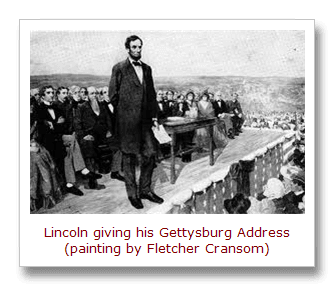
Lincoln in 1863; The Union & Patriot has retracted their review of this Gettysburg speech — in the fullness of time, they’ve come to reconsider their original review.

Lincoln spoke a few words in honor of the dead, but Edward Everett spoke on this topic for two hours before Lincoln rose. This lack does not appear to be what bothered the editors: “To say of Mr. Everett’s oration that it rose to the height which the occasion demanded, or to say of the President’s remarks that they fell below our expectations, would be alike false. Neither the orator nor the jester surprised or deceived us. Whatever may be Mr. Everett’s failings he does not lack sense – whatever may be the President’s virtues, he does not possess sense. Mr. Everett failed as an orator, because the occasion was a mockery, and he knew it, and the President succeeded, because he acted naturally, without sense and without constraint, in a panorama which was gotten up more for his benefit and the benefit of his party than for the glory of the nation and the honor of the dead.” The editors came to Gettysburg (I think) to hear Lincoln to hear things that only LIncoln could provide — his real thoughts on slavery and an update on his efforts at peace. As best I can tell, it was in these areas that they saw “a veil of oblivion.” Even so, for them to call this address, “silly remarks” there must be more going on. Here are my thoughts.

Lincoln had freed southern slaves a few months earlier by the emancipation proclamation, but no one knew their status; there had been a riot over this a few days previous. Did Lincoln claim equality for these ex-slaves, and if not, what were his thoughts on the extent of their in-equality. They were confiscated as war booty; would Lincoln return them to their owners after the war was over? If so, they were not free at all. Along with this, what was Lincoln doing to end the war? It was far from clear that the North could win in 1863. Lee had many victories, and now England had entered in support of the Confederacy. In my opinion, it was Ericsson’s Monitors that allowed the North to stop the British and win, but it appears that, in 1863, only the British navy realized that their power had been neutralized, and the south was lost.

By 1863 Ericsson was turning out two of these Monitor-type sips per month, enough to keep the British from any major port in America

The North’s Monitor, right, fights the Confederate Merrimac, left, to a draw over control of Norfolk harbor. Ericsson turned out two Monitor ships per month. In my opinion is was these ships that stopped the British and won the war.

Lincoln was cryptically brief when it came to slavery or peace: 271 words. About half the speech is devoted to the brave men who struggled here; the other half speaks of “the Nation,” or the “government.” Not the United States, the Union, the North, the South, but an undefined entity that Lincoln claims came into existence 70 years earlier, in 1776. Most educated people would have said that 1776 created no nation or government, only a confederation of independent states as described by the articles of confederation. Under these articles, these 13 states could only act by consensus and had the right to leave at will. To the extent that anyone held the South was bound now, it was because of the Constitution, signed ten years later, but Lincoln does not mention the Constitution at all– perhaps because most Democrats, understood the Constitution to allow departure. Also, to the extent the Constitution mentions slavery, it’s not to promote equality, but to give each slave 3/5 the vote-power of a free man. If “created equal” is to come from anywhere, it’s the Declaration, but most people understood the intent of the Declaration differently from the vision Lincoln now presented.

As far as most people understood it, The Declaration claimed the God-given right to separate from England and gain us a measure of self-rule — something that the South now claimed for itself, but Lincoln opposed. Further, we claimed in The Declaration, that British mis-management made the separation necessary, and listed the abhorrent offenses including suspension of habeas corpus, and the confiscation of property without process of law — things Lincoln was doing even now. Even the introductory phrase, created equal, was not understood to imply that everyone was equal. Rather, as Stephen Douglass pointed out in their 1858 Chicago debate, we’d created a nation “by the white man, for the benefit of the white man, to be administered by white men, in such a manner as they should determine.”

Ulysses Grant had a slave who he freed in 1859, and had control of his wife's slaves, who became free only in 1865. Lee's slaves were freed in 1862.

Ulysses Grant had a slave he freed in 1859; his wife held slaves till 1865. Lee freed his in 1862.

Where was Lincoln coming from? What was he saying that November day? It’s been speculated that Lincoln was proposing a secular religion of administered freedom. There appears to be some legitimacy here, but more I suspect Lincoln was referring to the UNANIMITY requirement behind the Declaration — by agreement all the states had to agree to independence, or we would all stay bound to Britain. If we had to unanimously bind ourselves, we must have unanimously bound ourselves to some shared vision of the union or democracy, -presumably that all were created equal. Five years earlier, William Herndon, Lincoln’s law partner, had given Lincoln a book of the sermons of Theodore Parker, a Boston Unitarian. That volume includes the following section marked by Lincoln in reference to what the unanimous binding entailed: “‘Democracy is direct self-government, over all the people, for all the people, by all the people.” Whether Lincoln was now speaking in direct reference to this line, or more-likely, as I suspect, to a more general refutation of the claims of Southern separation and Douglas’s 1858 white man claim, Lincoln’s sense of the import of the Declaration was one that few understood or agreed with. The North still had slaves — Grant’s wife for example, and there was no obvious desire for a new birth of freedom, just an end to the war. Lincoln’s words thus must have sounded like gobbledygook to the majority of learned ears.

Based on the events and issues of the time, and the un-obvious point of the speech, I’d say the editors were justified in their ill review. Further, the issues that bothered them then, abuse of power, citizen and states’ rights, remain as relevant today as ever. Do the current editors see any import of the 9th and 10th amendment limiting the power of federal government? If so, what. Thus, I’m a bit disappointed that the Union & Patriot retracted its review of Lincoln’s short speech with nothing more than claiming to see things differently today. We stand on LIncoln’s shoulders now, and though we see the nation, and the Declaration, through his eyes, their issues remain, and the original review gives perspective on the nation as it looked at a very different time. Thus, while I understand the editors desire to look correct in retrospect, I’d prefer if the current editors would have left the review, or at least addressed the points that bothered their earlier colleagues. It’s a needed discussion. When every person thinks alike, nobody thinks very much.

January 6, 2014 by Robert E. Buxbaum, a doctor of Philosophy (in Chemical Engineering). Here is a translation of the Address into Jive. And into yeshivish. I’ve also written an essay on a previous retraction (regarding GM food). If Lincoln had a such a long address, how did he ever get mail?

When to enter a neighbors war or family dispute

As I write this, our favored insurgents in Syria have been over-run by our disfavored insurgents, who may be over-run by the government we are trying to topple. We have also committed to help Japan and Vietnam in their disputes with China. I’ve also had the experience of dealing with a couple going through a bitter divorce. So here are five thoughts for myself and president Obama on getting involved in other people’s problems. I’ll hope that at least one person (me) listens.

1. Learn how to wait without committing to either side so you don’t step in something really smelly. Commiserate with both sides; yes you have grievances, yes what they’ve done isn’t nice. Suggest outside review. Just don’t commit until you feel comfortable sticking with this one side in victory, defeat, or (possible) reconciliation.

In a war, even simple gifts of food or transport are support; avoid these gifts, and especially avoid gifts to both sides. Assume any support to a side will be considered treason from the other side. Supporting both sides just causes havoc, and it’s always possible that your gifts will fall in the hands of the wrong side, as in Syria.

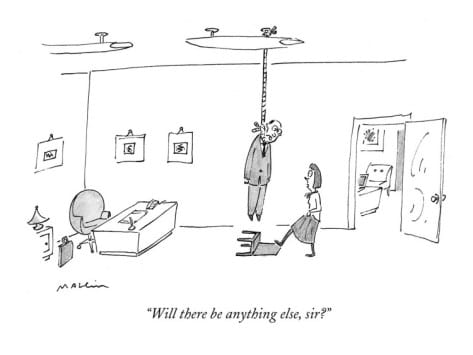
Being helpful isn't always helpful. Matthew Deffee, The New Yorker

Being helpful isn’t always helpful, or appreciated. Learn to wait. Matthew Deffee, The New Yorker

Remind yourself that disputes are a normal part of life, that peace always comes eventually, and that disputes are sometimes good in the long run. Offer sympathy only until you really want to support one side or the other — or until they make peace. When peace comes, it’s possible that the resolution will be better than the status quo-anti. As such, perhaps long-term non-intervention is the best cure. Time often answers what wisdom does not.

2.  If you choose to support a side, only support one that openly, and traditionally supports us. No Syrian leaders have openly pledged support to the US and its allies; why ally with someone who won’t support you? The enemy of your enemy might be another enemy, as with the Taliban. In a marriage dispute, lean to support your close relative or friend — it’s less offensive than the opposite, and less likely to cause hurt. As bad as it is when two sides attack each other, it’s worse when both attack you.

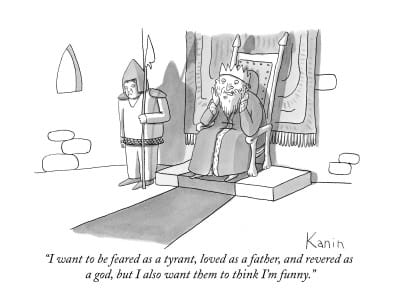
Only support someone who could rule reasonably honestly and well. Chaos is worse than a dictator. Kanin from the New Yorker.

Only support someone who could rule reasonably well. Chaos is worse than a dictator. Kanin from the New Yorker.

3. If you feel it’s important to act in a neighbor’s dispute, you don’t always have to ally with either side. You can retaliate for someone blowing up a ship or killing an advisor, or beating their children by intervening at a distance. Perhaps you can use a missile (ideally against a pointless target), or sanctions, or by the UN or a volunteer force (this tends to work for the US). In family disputes, it’s often best to send a councilor or the police or child protective services. There is room to escalate or de-escalate an action like this depending on how things play out. And it’s easier to distance yourself from a 3rd party’s actions than from one’s own. It is not necessary to support either side to achieve a personal goal or protect children in a divorce.

4.  If you decide to choose sides, make sure to keep in mind the end you seek: what good you want to do, what reasonable peace you seek, then act. Do not worry that you can not do everything, but make sure you target a viable end, and that you support a side that could win and rule. Try to pick a side that’s moral and perceived as legitimate from within, but if you can’t, at least pick one that could rule the country or manage the family without your help. Don’t support a loser, or one who can’t stand on his/her own. Chaos is worse than a crooked dictator; see, for example, the French Revolution. In a fight between parents, make sure the one you support could actually raise the kids. And once the goal is achieved, don’t stay too long. If a friend tells you to go, as in Afghanistan, leave quickly. Independence is the goal we hope for — for our children, our friends, and our neighbors.

Being a fair broker of peace is a great role -- in the proper time. From the New Yorker

Being a fair broker of peace is a great role — but only for the right person in the proper time. From the New Yorker

5. Be willing to serve as an honest broker of the peace. An honest broker is very valuable, and it requires that you’re perceived as unbiassed by both sides. Wait till the right moment before offering this service, and offer it like the precious jewel it is. Offer it when asked or when the fighting dies down. If the offer is refused, be willing to go away and return to the first rule. T. Roosevelt won the Nobel peace prize for ending the Russo-Japanese war because he was a good, honest broker: someone who understood the situation and could stand back when not needed.

Robert E. Buxbaum, Dec 18, 2013. Blessed are the peacemakers.