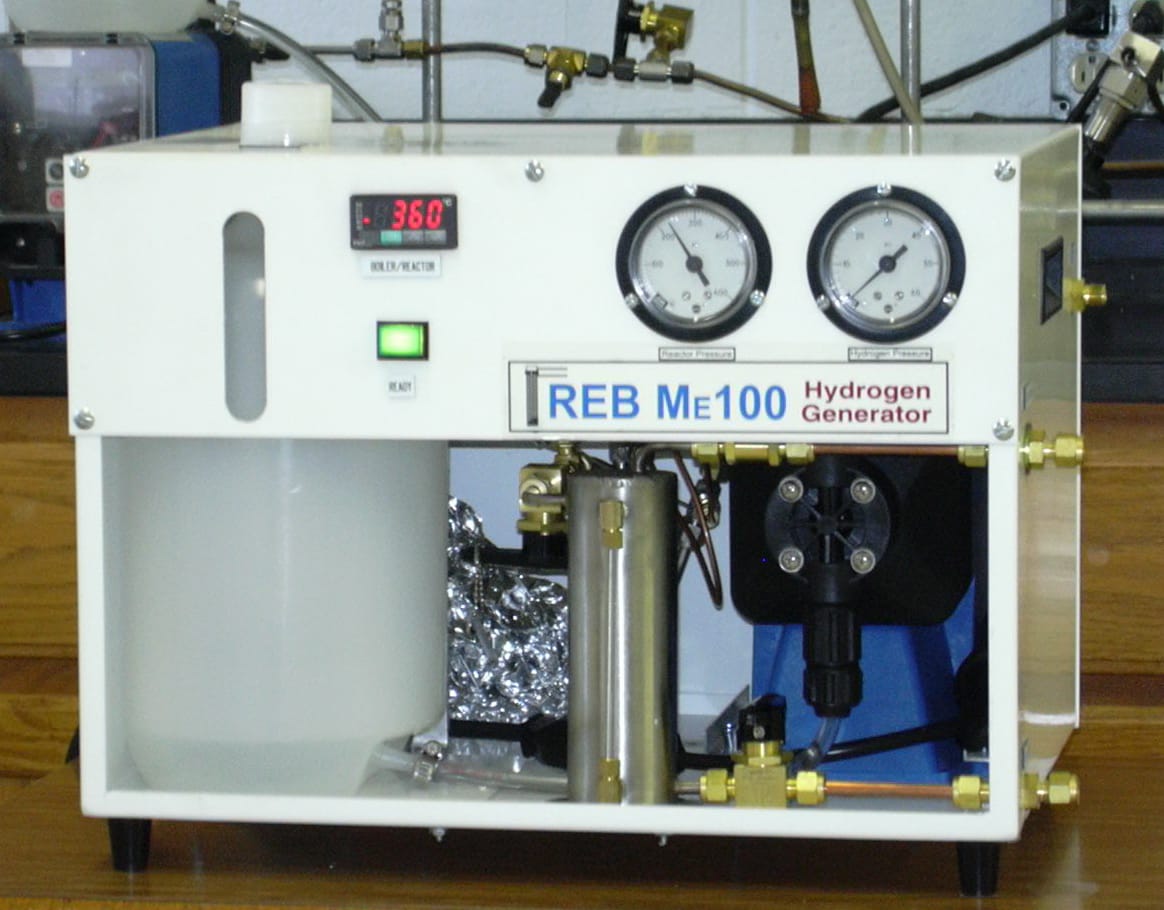
Answering best questions is always tricky since best depends on situation, but I’ll cover some hydrogen storage options here, and I’ll try to explain where our product options (cylinder gas purifiers and methanol-water reformers) fit in.
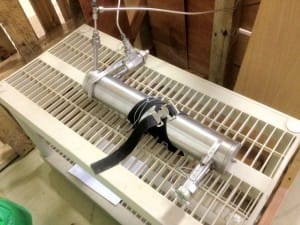
The most common laboratory option for hydrogen storage is inside a tank; typically this tank is made of steel, but it can be made of aluminum, fiberglass or carbon fiber. Tanks are the most convenient source for small volume users since they are instantly ready for delivery at any pressure up to the storage pressure; typically that’s 2000 psi (135 atm) though 10,000 (1350 atm) is available by special order. The maximum practical density for this storage is about 50 g/liter, but this density ignores the weight of the tank. The tank adds a factor of 20 or to the weight, making tanks a less-favored option for mobile users. Tanks also add significantly to the cost. They also tend to add impurities to the gas, and there’s a safety issue too: tanks sometimes fall over, and compressed gas can explode. For small-volume, non-mobile users, one can address safety by chaining up ones tank and adding a metal membrane hydrogen purifier; This is one of our main products.
Another approach is liquid hydrogen; The density of liquid hydrogen is higher than of gas, about 68 g/liter, and you don’t need as a tank that’s a big or heavy. One problem is that you have to keep the liquid quite cold, about 25 K. There are evaporative losses too, and if the vent should freeze shut you will get a massive explosion. This is the storage method preferred by large users, like NASA.
Moving on to metal hydrides. These are heavy and rather expensive but they are safer than the two previous options. To extract hydrogen from a metal hydride bed the entire hydride bed has to be heated, and this adds complexity. To refill the bed, it generally has to be cooled, and this too adds complexity. Generally, you need a source of moderately high pressure, clean, dry hydrogen to recharge a bed. You can get this from either an electrolysis generator, with a metal membrane hydrogen purifier, or by generating the hydrogen from methanol using one of our membrane reactor hydrogen generators.
Borohydrides are similar to metal hydrides, but they can flow. Sorry to say, they are more expensive than normal metal hydrides and they can not be regenerated.They are ideal for some military use
And now finally, chemical materials: water, methanol, and ammonia. Chemical compounds are a lot cheaper than metal hydrides or metal borohydrides, and tend to be far more readily available and transportable being much lighter in weight. Water and/or methanol contains 110 gm of H2/liter; ammonia contains 120 gms/liter, and the tanks are far lighter and cheaper too. Polyethylene jugs weighing a few ounces suffices to transport gallon quantities of water or methanol and, while not quite as light, relatively cheap metallic containers suffice to hold and transport ammonia.
The optimum choice of chemical storage varies with application and customer need. Water is the safest option, but it can freeze in the cold, and it does not contain its own chemical energy. The energy to split the water has to come externally, typically from electricity via electrolysis. This makes water impractical for mobile applications. Also, the hydrogen generated from water electrolysis tends to be impure, a problem for hydrogen that is intended for storage or chemical manufacture. Still, there is a big advantage to forming hydrogen from something that is completely non-toxic, non-flammable, and readily available, and water definitely has a place among the production options.
Methanol contains its own chemical energy, so hydrogen can be generated by heating alone (with a catalyst), but it is toxic to drink and it is flammable. I’ve found a my unique way of making hydrogen from methanol-water using a membrane reactor. Go to my site for sales and other essays.
Finally, ammonia provides it’s own chemical energy like methanol, and is flammable, like methanol; we can convert it to hydrogen with our membrane reactors like we can methanol, but ammonia is far more toxic than methanol, possessing the power to kill with both its vapors and in liquid form. We’ve made ammonia reformers, but prefer methanol.