On being a 16 year old girl

I’m not a teenage girl, in case you thought otherwise. I’m the father of a girl who just turned 16 though, and she asked me to write on the subject of what to expect from the next year or so. Here’s my sense of expectations.

You'll find yourself creeping up on adulthood, as a partner, not a kid; it's a scary and wonderful transition.

You’ll find yourself creeping up on adulthood, as a partner, not a kid; it’s a scary and wonderful transition.

In retrospect, you’re likely to say that 16 was among the best years of your life. These are the last glorious, innocent days with friends: days before competition means anything, before you really have to think of the world beyond your high school community. You are still hanging out, working together, and trying to feel your way towards a dim future as adults. Sorry to say, that’s in retrospect. While living through it, you’ll find this year fairly boring, and somewhat nerve-wracking. You’ll find your time filled with activities: school, home, hobbies. You’re likely to find these activities somewhat less stressful than before, because you’re more used to them and higher-up in the pecking order. Still, there are a lot of activities, and you’ll notice your day is pretty full. My advice: take time to enjoy your friends. Take pictures; they’ll be priceless.

At sixteen hobbies begin to be taken more seriously.

At sixteen, hobbies begin to be taken more seriously.

For both boys and girls, you are beginning the single most difficult, painful, and important transition of your life: the transition to adulthood. It’s not painful yet, but it will get worse in the next year or two. If all goes well, by age 22 or 23, you will be through it. Once through it, you will think of yourself as an independent moiety: someone who’s formed by us (your parents, family, and friends) but not defined by us. Once through it, if all goes well, you will be able to support yourself financially, and you will be able to live on your own. You are likely to want to live on your own too (teary smile) at least for a good portion of the year. At 16, this is a dimly seen, scary future, far off in the fog.

At this  point, you’re still tied to us, and I’m glad you don’t resent it. You’re happy to be a daughter, a sister to your siblings, a peer to your friends, and a student in your high school. Some teachers and classes you like, others less so. Your grades and hobbies are important to you, but your friends are more important. It’s nice to have high grades, but not so important as to disturb a friendship. You think of your hobbies as fun sidelights, and home as a place to relax with them. At home you write, read, draw, or cook for the fun of it. As the next few years wear on, this will change. You’ll think of yourself more as a writer, an artist, or plumber; as a private first class, or whatever. You’ll be good at something, not just generally bright. Some friends will fit better into this self-view; the friends who don’t fit will slowly drift away.

Sexuality rears its head in new ways at 16.

Sex rears its head unexpectedly.

At 16, I started thinking of myself as ‘an engineer’ or perhaps as a scientist or mathematician based on my hobbies and what I was good at in school. It became clear that I was not going to be an athlete, a historian, or a musician (though I retained an interest). Dropping options is a big, painful part of the transition. I recall almost hearing the doors closing behind me. You want to turn back, to catch the options. Know that, to not choose is to choose. As those doors close (and they should) new, better ones open that you didn’t realize existed. Losing friends and hobbies that are too high maintenance is good for you, and for them at this stage. Sex will rear its head, unexpectedly, and in new ways. Sexuality and homosexuality were words; for some they are becoming the dominant reality. For better or worse, you’ll be drawn in.

As the year draws to a close, you’re likely to find our parental presence more and more annoying. This is a good thing; it’s what will get you out the door, and launch you as a person. We’re on your side here, but won’t be able to help as your old you will begin to fight the new one. You plan to go to college, perhaps away from home (both options are good), but some of your friends will want to stay at home and do on-line vocational courses, or get married as soon as possible. You’ll likely drift away from those friends. Some college-bound friends will pick schools far from yours, or will pick majors or activities that you’re not interested in. You’re likely to find yourself gravitating to those friends who’re going to your college or for majors that match yours. There is pain in realizing that you won’t be as close with the remaining friends. Know that doors are opening here in two ways. First, just as high school provided your current friends, college and pre-college will provide you a new group — ones you may keep longer since the relationship based on shared direction, not just shared experiences. Also, know that some of the friends who drift away now will come back later — perhaps when you and they are married.

You may come to realize that some of your closest friends are your competitors for college places, scholarships. This may seem bad (or disloyal) but it’s good. Competition will help you improve, and will increase your drive, and that’s what you need this year. Think of the relationship in “A separate peace.” Think of how the relationship between the young Harper Lee and Truman Capote likely shaped “to kill a mockingbird” and furthered both of their careers. Competition with your cousins is good too. Watch how they deal with competition and life choices. Are there family members that could be life models or coaches? A big reason we have the family reunions is so that you can have a choice of life models and coaches.

Teen jobs are rarely all that exciting, but are an important part of personal development.

Teen jobs are rarely all that exciting, but are an important part of personal development.

Money will become a lot more important in the next few years — for things, travel, school applications, and clothes. You’re likely to find it’s annoying to get your money from us, and you’re likely to start working more for money. This is the beginning of financial independence. As you do, you’ll find yourself becoming defined by the job you do, how much you make, and what you spend your money on. This is good, but includes a loss of Idyl. Your first jobs will not be great, and you may find leaches hanging on: financial and emotional. As annoying as it is to have a leech, it’s worse to be the leach. Try to avoid it; be a good friend or neighbor. You may want to buy stock, or start a company, or produce a product for sale: a book, album, or whatever. If it’s something you’re interested in and you try to make money at it, the experience will be worth the effort. Even if it turns out a financial failure, it will be an important part of the emotional and financial person you make of yourself. If you don’t go into business, you may get involved in politics or religion, moving right or left. That’s OK, and very normal — another part of self-development.

You may find yourself re-evaluating your thoughts on religion and government.

You’re already beginning to develop wonderful life-skills. We don’t compliment you enough on this. You’ve learned to cook eggs and noodles, and find you like the independence it gives. That’s the ticket to adulthood. You’ll need more life skills to give you real independence, but you’re on the right track. You’ll need to learn to do laundry, shopping, and cleaning. You’re likely to need to be better at driving, writing, and negotiating: all difficult things. You’re likely to go through emotional cycles or depression as you think of the stuff you can’t do, or don’t understand, the friends you’re losing, or the things you’d like to do, but can’t. Don’t stress; you’ve got 5 years, or more. We’re very proud of you, and will try to help by tutoring, hugs, more-freedom, and the assurance that independence is worth the struggle. All beginnings are difficult, and this is a big beginning.
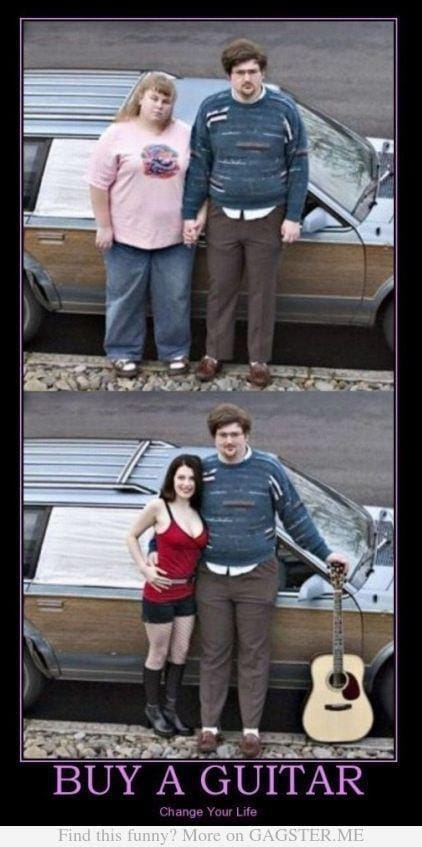
You can define yourself by your hobbies or by your man, but try not to define yourself by your man's hobbies.

You can define yourself by your hobbies or by your man, but try not to define yourself by your man’s hobbies.

Switching schools includes the opportunity to reinvent yourself as something completely new. Most people do this to a greater or lesser extent. Embrace your inner weirdo, but not your inner crook. Try to invent yourself as something fun and active, not sinful or destructive. Try to be the young scholar, mechanic, artist, or athlete, not the young goth, gangster, or drug addict. High schools try to help here by exposing you to books and movies about alienated 16-20 year olds. Popular in my day were Great Expectations, The Outsiders, Catcher in the Rye, The Dead Poets Society, To Kill a Mockingbird, Slaughterhouse 5, and A Separate Peace. Take what comfort you can. School assignments will include essays on law, government, and God. Write honestly, with conviction. These assignments can help develop your life views and personality. We’ll try not to stifle you here, even when your opinions differ significantly from ours. Of course, if you come up with something truly stupid or awesome, we’ll tell you.

Your friends will start dating, or discussing boys, and you are almost certain to start looking at boys differently: first as exciting possibilities, and then as potential mates. Part of the attraction involves the ability to define yourself by the boy you choose. This is a comfort and a curse. The comfort is that it avoids you having to define yourself, or grow up quite. The curse is that the boy doesn’t know who he is either. You’ll find that some boys are nice and some are grounded, others are not. And some are really messed up. With the right kind, you’ll find you can do more as a pair than as a single. Eventually you’re likely to pair off; in our community that happens at about 21-24. When it happens, I hope it’s with a nice, grounded fellow. It works best if you first know who you are, but even otherwise, it can work. Couples sometimes discover who they are together. And, at that point the transition will be over. You’ll be a married adult; you’ll introduce yourself as Mrs Shnicklefritz, or as Dr. and Mr Schniklefritz, or whatever, and we’ll prepare ourselves to spoil our grandkids.

Dr. Robert E. Buxbaum, proud father of you and your two older siblings. October 4, 2014. Though further along in their life paths, I can hope that the older siblings will enjoy these thoughts too. I’ve previously mused about US education, and whether ADHD was a real disease. For my older daughter’s 21st birthday, I invented a new mixed drink.


A shaggy dog story

Shortly after Patricia O’Hara marries Sam Whack, a talking shaggy dog walks into the bank where Patricia works and asks her if he can borrow $10,000. The dog claims to know the bank manager. ‘What have you got for collateral,’ Patricia asks, and the dog presents her with a ceramic octopus that he claims is very valuable.

What is this? she asks.

What is this? she asks.

Confused, Patricia goes to the bank manager. ‘What is this?’ she asks.

“It’s a nick knack, Patty Whack, give the dog a loan.

R.E. Buxbaum, September 29, 2014. The nick knack belongs to a long-time friend, Rich Fezza. The joke is also a long-time friend. For other jokes, click on the navigation bar at right.

Change your underwear, bomber; of mites and men

The underware bomber mites make it right.

Umar, the underwear bomber.

For those who don’t know it, the underwear bomber, Umar Farook Abdulmutallab, wore his pair of explosive underwear for 3 weeks straight before trying to detonate them while flying over Detroit in 2009. They didn’t go off, leaving him scarred for life. It’s quite possible that the nasty little mites that live in underwear stopped the underwear bomber. They are a main source of US allergens too.

Dust mite, skin, and pollen seen with a light  microscope. Gimmie some skin.

Dust mite, skin, and pollen seen with a light microscope. Gimmie some skin.

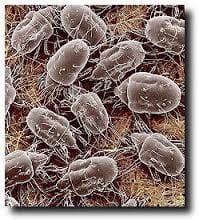
If you’ve ever used an electron microscope to look at household objects, you’ll find them covered with brick-like flakes of dried out skin-cells: yours and your friends’. Each person sheds his or her skin every month, on average. The outer layer dries out and flakes off as new skin grows in behind it. Skin flakes are the single largest source of household dust, and if not for the fact that these flakes are the main food for mites, your house would be chock full of your left over skin. When sunlight shines in your window, you see the shimmer of skin-flakes hanging in the air. Under the electron microscope, the fresh skin flakes look like bricks, but mite-eaten skin flakes look irregular. Less common, but more busy are the mites.

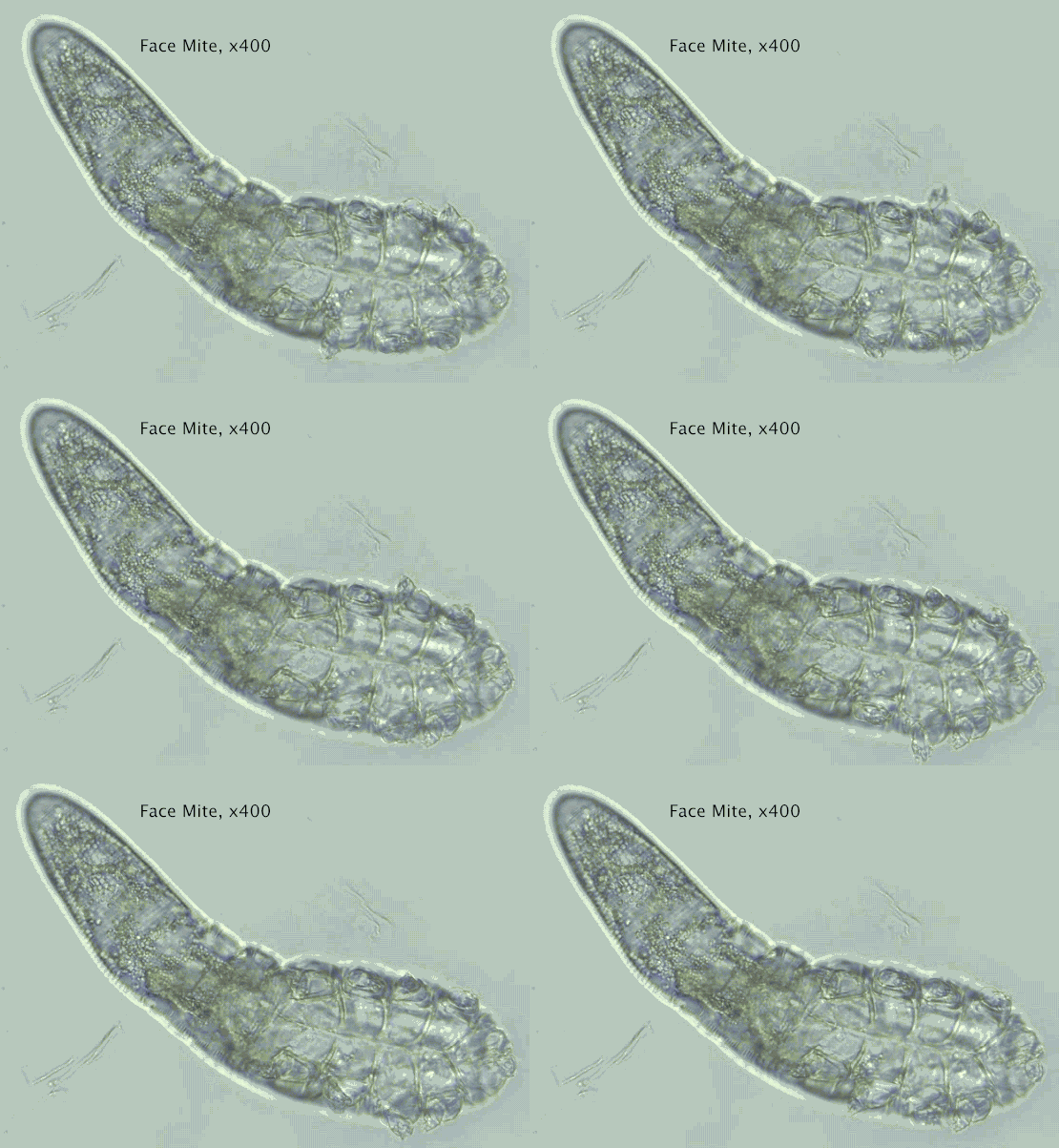
The facial mite movie. They live on in us, about 1 per hair follicle, particularly favoring eyelashes. Whenever you shower, your shower with a friend.

The facial mite movie. They live on in us, about 1 per hair follicle, particularly favoring eyelashes. Whenever you shower, you shower with a friend.

Dry skin is mostly protein (keratin), plus cholesterol and squalene. This provides great nutrition for dust mites and their associated bacteria. In warm, damp environments, as in your underwear or mattress, these beasties multiply and eat the old skin. The average density of dust mites on a mattress is greater than 2500/gram of dust.[1]  The mites leave behind excrement and broken off mite-limbs: nasty bits that are the most common allergens in the US today.

An allergy to dust shows up as sneezing, coughing, clogged lungs, and eczema. The most effective cure is a high level of in-home hygiene; mites don’t like soap or dry air. You’ve go to mop and vacuum regularly. Clean and change your clothing, particularly your undergarments; rotate your mattresses, and shake the dust out of your bedding. Vacuuming is less-effective as a significant fraction of the nasties go through the filter and get spread around by the vacuum blower.

As it turns out, dust mites and their bacteria eat more than skin. They also eat dried body fluids, poop residue, and the particular explosive used by Umar Farook, pentaerythritol tetra nitrate, PETN (humans can eat and metabolize this stuff too — it’s an angina treatment). The mites turn PETN into less-explosive versions, plus more mites.

Mighty mites as seen with electron microscopy. They eat more than skin.

Mighty mites as seen with electron microscopy. They eat more than skin.

There are many varieties of mite living on and among us. Belly button mites, for example, and face mites as shown above (click on the image to see it move). On average, people have one facial mite per hair follicle. It’s also possible that the bomber was stopped by poor quality control engineering and not mites at all. Religion tends to be at odds with a science like quality control, and followers tend to put their faith in miracles.

Chigger turning on a dime

Chigger turning on a dime

larger than the dust mite is the chigger, shown at left. Chiggers leave visible bites, particularly along the underwear waste-band. There are larger-yet critters in the family: lice, bed bugs, crabs. Bathing regularly, and cleaning your stuff will rid yourself of all these beasties, at least temporarily. Keeping your hair short and your windows open helps too. Mites multiply in humid, warm environments. Opening the windows dries and cools the air, and blows out mite-bits that could cause wheezing. Benjamin Franklin and took air-baths too: walking around naked with the windows open, even in winter. It helped that he lived on the second floor. Other ways to minimize mite growth include sunlight, DOT (a modern version of DDT), and eucalyptus oil. At the very minimum, change your underwear regularly. It goes a long way to reduce dust embarrassing moments at the jihadist convention.

Dr. Robert E. Buxbaum, Sept 21, 2014. Not all science or life is this weird and wonderful, but a lot is, and I prefer to write about the weird and wonderful bits. See e.g. the hazards of health food, the value of sunshine, or the cancer hazard of living near a river. Or the grammar of pirates.

New mixed drink, the R°

Earlier this week, R__ turned 21, the drinking age in most of the USA. As a gift to her, I thought I might invent a new mixed drink that would suit her taste, and make her birthday more special. My requirements: that it should be kosher, that it’s made with widely available ingredients; that it should be relatively sophisticated, that it should be lower in alcohol (a fatherly concern), and that it should taste good to her and the general public.

The R___: gin tonic and grenadine

The R°: gin, tonic , ice, and grenadine

What I came up with, is something I call,The R°. It’s a modification of one of the great drinks of the western world, the gin and tonic. My modification is to use less gin, and to use grenadine instead of the traditional squeeze of lime. As she gets older, she may want to increase the gin content. The recipe: put 2/3 shot gin in a 10 oz straight-sided glass. Fill the glass 2/3 full of ice, near-fill with tonic water, and add a dash of grenadine, 1/4 shot or so (I used Rose’s). Stir slightly so the pink color stays mostly on the bottom. The result is slightly sweeter than the traditional gin and tonic, kosher in almost all places (you’ve got to check, but generally true), fairly sophisticated, good-tasting, and a reminder of Israel, a country where pomegranates grow all over. If you order one at a place with black lights and doesn’t stir much,you’ll discover that the tonic water glows electric-blue.

The verdict: R__ liked it. My hope is that you will enjoy it too. As a literary note, grenade is French for pomegranate; hand grenades got their name because of the shape. This drink is also suitable for talk like a pirate day (September 19).

Sept 14, 2014. My only previous gastronomic post was a recipe to make great lemonade. For a song by my daughter, go here, or here. For a joke about a neutron walking into a bar, go here.

How do technology companies sell stuff?

As the owner of a technology company, REB Research, hydrogen generators and hydrogen purifiers, I spend a fair amount of time trying to sell my stuff, and wondering how other companies connect to potential customers and sell to them. Sales is perhaps the most important area of business success, the one that makes or breaks most businesses — but it was sadly ignored in my extensive college education. Business books are hardly better: they ignore the salesmen (and women); you’re left to imagine sales and profit came of themselves by the insight of the great leader. The great, successful internet companies are applauded for giving away services, and the failed interned companies are barely mentioned. And hardly any book mentions smaller manufacturing businesses, like mine.

So here are some sales thoughts: things I tried, things that worked, and didn’t. I started my company, REB Research, about 20 years ago as a professor at Michigan State University. I figured I knew more about hydrogen purifiers than most of my colleagues, and imagined this knowledge would bring me money (big mistake: I needed customers and profitable sales). My strategy was to publish papers on hydrogen and get some patents as a way to build credibility (worked reasonably well: I write well, do research well, and I’m reasonably inventive). Patents might have been a better strategy if I had not then allowed my patents to be re-written by lawyers. I built the company. while still a professor (a good idea, I think).

When I realized I needed sales, I decided to use trade fairs, conferences, and ads as the big companies did. Most of my budget went for ads in The Thomas Register of American Manufacturing, a fantastically large compendium of who did or sold what (it worked OK, but was since rendered obsolete by the internet). I bought $1500 worth of ads, and got 2 small lines plus a 1/8 page. That’s where I got my sales until the internet cam along. In retrospect, I suspect I should have bought more ads.

William Hamilton cartoon from the new-yorker. I sure wish I could make deals.

William Hamilton cartoon from the new-yorker.

My other big expense was trade fairs. Many big companies sold at trade fairs, events that are widely attended in my field. Sorry to say, I never found customers at these fairs, even when the fairs were dedicated to hydrogen, everyone who’d come by was was selling, and no one was buying, as best I could tell.Somehow, my bigger competitors (also at the fairs) seemed to get interest but I’m not sure if they got sales there. They seem to find sales somewhere, though. Is it me? Am I at the wrong fairs, or are fairs just a scam where no one wins but the organizers? I don’t know. Last month, I spent $2000 for a booth in Ann Arbor, MI, including $350 for inclusion into the promoter’s book and $400 for hand-out literature. As with previous events, few people came by and none showed anything like interest, I got no e-mail addresses and no sales. Some hungry students wandered the stalls for food and freebees, but there was not one person with money in his/her pocket and a relevant project to spend it on. I doubt anyone read the literature they took.

To date, virtually all of my sales have come from the internet. I got on the internet early, and that has helped my placement in Google. I’ve never bought a google ad, but this may change. Instead I was lucky. About 20 years ago, 1994?, I attended a conference at Tufts on membrane reactors, and stayed at a bed-and-breakfast. After the conference let out, the owner of the BnB suggested I visit something that was new at Harvard; a cyber cafe, the second one in the US. They had Macintosh computers and internet explorer a year before the company went public. I was hooked, went home, learned html, and wrote a web-site. I bought my domain name shortly thereafter.

The problem, I don’t know the next big thing. Twitter? Facebook? LinkedIn? I’m on 2 of these 3, and have gotten so sales from social media. I started a blog (you’re reading it), but I still wonder, why are the bigger companies selling more? The main difference I see is they attend a lot more product fairs than I do, have slicker web-sties (not very good ones, I think), and they do print advertising. Perhaps they match their fairs to their products better, or have a broader range of products. People need to see my products somewhere, but where? My latest idea: this week I bought HydrogenPurifier.com. Send me advice, or wish me luck.

Robert E. Buxbaum, flailing entrepreneur, September 10, 2014. Here’s a feedback form, the first time I’m adding one. 

Marijuana, paranoia, and creativity

Many studies have shown that marijuana use and paranoid schizophrenia go together, the effect getting stronger with longer-term and heavy use. There also seems to be a relation between marijuana (pot) and creativity. The Beetles and Stones; Dylan, DuChaps, and Obama: creative musicians painters, poets and politicians, smoked pot. Thus, we can ask what causes what: do crazy, creative folks smoke pot, or does pot-smoking cause normal folks to become crazy and creative, or is there some other relationship. Dope dealers would like you to believe that pot-smoking will make you a creative, sane genius, but this is clearly false advertising. If you were not a great artist, poet, or musician before, you are unlikely to be one after a few puffs of weed.

The Freak Brothers, by Gilbert Shelton. While these boys were not improved by dope, It would be a shame to put the artist in prison for any length of time.

The Freak Brothers, by Gilbert Shelton. What’s the relationship?

When things go together, we apply inductive reasoning. There are four possibilities: A causes B (pot makes you crazy and/or creative), B causes A (crazy folks smoke pot, perhaps as self medication), A and B are caused by a third thing C (in this case, poverty culture, or some genetic mutation). Finally, it’s possible there’s no real relationship but a failure to use statistics right. If we looked at how many golf tournaments were won by people with W last names (Woods, Wilson, Watson) we might be fooled to think it’s a causal relationship. Key science tidbit: correlation does not imply causation.

The most likely option, I suspect is that some of all of the above is going on here: There is an Oxford University study that THC, the main active ingredient in pot, causes some, temporary paranoia, and another study suggests that pot smoking and paranoid insanity may be caused by the same genetics. To this mix I’d like to add another semi-random causative: that heavy metals and other toxins that are sometimes found in marijuana are the main cause of the paranoia — while being harmful to creativity.

marijuana -paranoia

Pot cultivation is easy — that’s why it’s called weed– and cultivation is often illegal, even in countries with large pot use, like Jamaica. As a result, I suspect pot is grown preferentially in places contaminated with heavy metal toxins like vanadium, cadmium, mercury, and lead. No one wants to grow something illegal on their own, good crop-land. Instead it will be grown on toxic brownfields where no one goes. Heavy metals are known to absorb in plants, and are known to have negative psychoactive properties. Inhalation of mercury is known to make you paranoid: mad as a hatter. Thus, while the pot itself may not drive you nuts, it’s possible that heavy metals and other toxins in the pot-soil may. The creativity would have to come from some other source, and would be diminished by smoking bad weed.

I suspect that creativity is largely an in-born, genetic trait that can be improved marginally by education, but I also find that creative people are necessarily people who try new things, go off the beaten path. This, I suspect, is what leads them to pot and other “drug experiments.” You can’t be creative and walk the same, standard path as everyone else. I’d expect, therefore, that in high use countries, like Jamaica, creative success is preferentially found in the few, anti-establishment folks who eschew it.

Robert E. (landslide) Buxbaum, September 4, 2014. The words pot, marijuana, dope, and weed all mean the same but appear in different cultural contexts. To add to the confusion, Jamaicans refer to pot as ganja or skiff, and their version of paranoid schizophrenia is called “ganja psychosis”. I’m not anti-pot, but favor government regulation— perhaps along the lines of beer regulation, or perhaps the stricter regulation of Valium. My most recent essay was on the tension-balance between personal freedom and government control. I was recently elected in Oak Park’s 3rd voting district. My slogan: “A Chicken in every pot, not pot in every chicken”. I won by one vote. For those who are convinced they’ve become really deep, creative types without having to create anything, let me suggest the following cartoon about talent. Also, if pot made you smart, Jamaica would be floating in Einsteins.

Political tensegrity: the west is best

We are regularly lectured about the lack of kindness and humility of the western countries. Eastern and communist leaders in Russia, Iran, Saudi Arabia point to Western pollution, consumerism, unemployment as prof you need a strong leader and central control to do good by regulation, thought policing, and wealth redistribution.

Let me point out that the good these leaders provide is extracted from the populace, and the advantage of central control is rarely as clear to the populous as to the leadership. When leaders redistribute wealth or place limits on the internet, movies or books, the leaders are generally exempted, and the populous are not made more moral or generous either. One does not say a prisoner or slave-worker is more generous of moral than one on the outside despite the prisoner working for free. The leaders feel certain they are protecting their people from thought and greed, but it isn’t clear outside of the leadership that these dangers are as great as the danger of despotism or rule by whim.

Authors and thoughts are blocked in the East by the whim of a supreme leader who also determines who is an infidel or enemy, or friend, and which businesses should flourish, and who should be rich (his buddies). By contrast, two fundamentals of western society — things that lead to purported immorality, are citizen rights and the rule of law: that citizens can possess things and do things for their own reasons, or no reason at all, and that citizens may stand as equals before a bar of law, to be judged by spelled-out laws or freed, with equal believability and claim.

In Russia or Iran, the Commissar and Imam have special rights: they can take possessions from others at whim, shut down businesses at whim; imprison at whim  — all based on their own interpretation of God’s will, the Koran, or “the good of the state.” Only they can sense the true good, or the true God well enough to make these decisions and laws. And when they violate those laws they are protected from the consequences; the masses can be prosecuted to the full extent of the law, and then some, not even requiring a trial in many places (Gaza, for example) if the leader feels speed is needed. The rule of law with equal treatment is a fundamental of western civilization (republicanism). It is commanded by Moses in the Bible at least seven times: Numbers 15:15, Numbers 15:16, Numbers 15:29, Exodus 12:49, Numbers 9:14, and Leviticus 24:22, “One law and one ordinance you should have, for the home-born, and the foreigner who dwells among you.”

The equal treatment under the law: for rich and poor, king and commoner, citizen and foreigner is a revolutionary idea of the west; that justice is blind. Another idea is personal possessions and freedoms. There is no concept of equality under business law unless there is a business that you can own, and personal possessions and rights. These are not in place in eastern theocracies: they tend to treat the preachers (imams) better than non preachers because they are presumed smarter and better; similarly men are treated better than women, who have few rights, and the state religion is treated better than infidels. In communist countries and dictatorships the dictator can get away with anything. Admittedly, in capitalistic states the rich and powerful find loopholes while the poor find prison, but not always (our Detroit’s ex-mayor is in prison) and it’s not the law. A feature of Eastern theocracies and dictatorships is that they lack a free press, and thus no forum for public exposure of legal mischief.

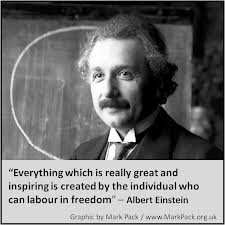
Einstein on freedom producing good. I'd say freedom is also a good in itself

Einstein on freedom producing good. I’d say freedom is also a good in itself.

The strongest arguments for socialist dictatorship and theocracy is that this is needed to protect the weak. Clement Attlee (labor socialist British Prime Minister, 1945 -56) explained his government’s take over of almost all British business: “There was a time when employers were free to work little children for sixteen hours a day… when employers were free to employ sweated women workers on finishing trousers at a penny halfpenny a pair. There was a time when people were free to neglect sanitation so that thousands died of preventable diseases. For years every attempt to remedy these crying evils was blocked by the same plea of freedom for the individual. It was in fact freedom for the rich and slavery for the poor. Make no mistake, it has only been through the power of the State, given to it by Parliament, that the general public has been protected against the greed of ruthless profit-makers and property owners.”  (Quotes from Spartacus.edu). it’s a brilliant speech, and it taps into the government’s role in the common defense, but it’s not at all clear that a chinless bureaucrat will be a better boss than the capitalist who built the firm. Nor is it clear that you help people by preventing them from work at a salary you decide is too low

England suffered a malaise from public ownership and the distribution of profit by those close the liberal party. Under Attlee there was lack of food and coal while the rest of Europe, and particularly Germany prospered, and passed England in productivity. Germany had no minimum wage, and  still doesn’t have one. In eastern countries, ingenuity is deadened by the knowledge that whatever a genius or worker achieves is taken by the state and redistributed. A cute joke exchange: Churchill and Attlee are supposed to have found themselves in adjoining stalls of the men’s room of Parliament. Churchill is supposed to have moved as far as possible from Attlee. “Feeling standoffish, Winston” Attlee is supposed to have said. “No. Frightened. “Whenever you see something large you try to nationalize it.” Perhaps more telling is this Margret Thatcher’s comment, and exchange. Making everyone’s outcome equal does more to penalize those with real pride in their ideas and work than it does to help the truly needy.

While there is a need for government in regards to safety, roads, and standards, and to maintain that equality of law. It seems to me the state should aid the poor only to the extent that it does not turn them into dependents. There is thus a natural tension between private good and public service similar to the tensegrity that holds cells together. Capitalists can only make money by providing desired goods and services at worthwhile rate, and paying enough to keep workers; they should be allowed to keep some of that, while some must be taken from them to get great things done. I’ve related the tensegrity of society to the balance between order and disorder in a chemical system.

Robert E. Buxbaum August 27, 2014. This essay owes special thanks to a Princeton chum, Val Martinez. Though my training is in engineering, I’ve written hobby pieces on art, governance, history, and society. Check out the links at right.

The speed of sound, Buxbaum’s correction

Ernst Mach showed that sound must travel at a particular speed through any material, one determined by the conservation of energy and of entropy. At room temperature and 1 atm, that speed is theoretically predicted to be 343 m/s. For a wave to move at any other speed, either the laws of energy conservation would have to fail, or ∆S ≠ 0 and the wave would die out. This is the only speed where you could say there is a traveling wave, and experimentally, this is found to be the speed of sound in air, to good accuracy.

Still, it strikes me that Mach’s assumptions may have been too restrictive for short-distance sound waves. Perhaps there is room for other sound speeds if you allow ∆S > 0, and consider sound that travels short distances and dies out far from the source. Waves at these, other speeds might affect music appreciation, or headphone design. As these waves were never treated in my thermodynamics textbooks, I wondered if I could derive their speed in any nice way, and if they were faster or slower than the main wave? (If I can’t use this blog to re-think my college studies, what good is it?)

I t can help to think of a shock-wave of sound wave moving down a constant area tube of still are at speed u, with us moving along at the same speed as the wave. In this view, the wave appears stationary, but there is a wind of speed u approaching it from the left.

Imagine the sound-wave moving to the right, down a constant area tube at speed u, with us moving along at the same speed. Thus, the wave appears stationary, with a wind of speed u from the right.

As a first step to trying to re-imagine Mach’s calculation, here is one way to derive the original, for ∆S = 0, speed of sound: I showed in a previous post that the entropy change for compression can be imagines to have two parts, a pressure part at constant temperature: dS/dV at constant T = dP/dT at constant V. This part equals R/V for an ideal gas. There is also a temperature at constant volume part of the entropy change: dS/dT at constant V = Cv/T. Dividing the two equations, we find that, at constant entropy, dT/dV = RT/CvV= P/Cv. For a case where ∆S>0, dT/dV > P/Cv.

Now lets look at the conservation of mechanical energy. A compression wave gives off a certain amount of mechanical energy, or work on expansion, and this work accelerates the gas within the wave. For an ideal gas the internal energy of the gas is stored only in its temperature. Lets now consider a sound wave going down a tube flow left to right, and lets our reference plane along the wave at the same speed so the wave seems to sit still while a flow of gas moves toward it from the right at the speed of the sound wave, u. For this flow system energy is concerned though no heat is removed, and no useful work is done. Thus, any change in enthalpy only results in a change in kinetic energy. dH = -d(u2)/2 = u du, where H here is a per-mass enthalpy (enthalpy per kg).

dH = TdS + VdP. This can be rearranged to read, TdS = dH -VdP = -u du – VdP.

We now use conservation of mass to put du into terms of P,V, and T. By conservation of mass, u/V is constant, or d(u/V)= 0. Taking the derivative of this quotient, du/V -u dV/V2= 0. Rearranging this, we get, du = u dV/V (No assumptions about entropy here). Since dH = -u du, we say that udV/V = -dH = -TdS- VdP. It is now common to say that dS = 0 across the sound wave, and thus find that u2 = -V(dP/dV) at const S. For an ideal gas, this last derivative equals, PCp/VCv, so the speed of sound, u= √PVCp/Cv with the volume in terms of mass (kg/m3).

The problem comes in where we say that ∆S>0. At this point, I would say that u= -V(dH/dV) = VCp dT/dV > PVCp/Cv. Unless, I’ve made a mistake (always possible), I find that there is a small leading, non-adiabatic sound wave that goes ahead of the ordinary sound wave and is experienced only close to the source caused by mechanical energy that becomes degraded to raising T and gives rise more compression than would be expected for iso-entropic waves.

This should have some relevance to headphone design and speaker design since headphones are heard close to the ear, while speakers are heard further away. Meanwhile the recordings are made by microphones right next to the singers or instruments.

Robert E. Buxbaum, August 26, 2014

In praise of openable windows and leaky construction

It’s summer in Detroit, and in all the tall buildings the air conditioners are humming. They have to run at near-full power even on evenings and weekends when the buildings are near empty, and on cool days. This would seem to waste a lot of power and it does, but it’s needed for ventilation. Tall buildings are made air-tight with windows that don’t open — without the AC, there’s be no heat leaving at all, no way for air to get in, and no way for smells to get out.

The windows don’t open because of the conceit of modern architecture; air tight building are believed to be good design because they have improved air-conditioner efficiency when the buildings are full, and use less heat when the outside world is very cold. That’s, perhaps 10% of the year. 

No openable windows, but someone figured you should suffer for art

Modern architecture with no openable windows. Someone wants you to suffer for his/her art.

Another reason closed buildings are popular is that they reduce the owners’ liability in terms of things flying in or falling out. Owners don’t rain coming in, or rocks (or people) falling out. Not that windows can’t be made with small openings that angle to avoid these problems, but that’s work and money and architects like to spend time and money only on fancy facades that look nice (and are often impractical). Besides, open windows can ruin the cool lines of their modern designs, and there’s nothing worse, to them, than a building that looks uncool despite the energy cost or the suffering of the inmates of their art.

Most workers find sealed buildings claustrophobic, musty, and isolating. That pain leads to lost productivity: Fast Company reported that natural ventilation can increase productivity by up to 11 percent. But, as with leading clothes stylists, leading building designers prefer uncomfortable and uneconomic to uncool. If people in the building can’t smell an ocean breeze, or can’t vent their area in a fire (or following a burnt burrito), that’s a small price to pay for art. Art is absurd, and it’s OK with the architect if fire fumes have to circulate through the entire building before they’re slowly vented. Smells add character, and the architect is gone before the stench gets really bad. 

No one dreams of working in an unventilated glass box.

No one dreams of working in a glass box. If it’s got to be an office, give some ventilation.

So what’s to be done? One can demand openable windows and hope the architect begrudgingly obliges. Some of the newest buildings have gone this route. A simpler, engineering option is to go for leaky construction — cracks in the masonry, windows that don’t quite seal. I’ve maintained and enlarged the gap under the doors of my laboratory buildings to increase air leakage; I like to have passive venting for toxic or flammable vapors. I’m happy to not worry about air circulation failing at the worst moment, and I’m happy to not have to ventilate at night when few people are here. To save some money, I increase the temperature range at night and weekends so that the buildings is allowed to get as hot as 82°F before the AC goes on, or as cold as 55°F without the heat. Folks who show up on weekends may need a sweater, but normally no one is here. 

A bit of air leakage and a few openable windows won’t mess up the air-conditioning control because most heat loss is through the walls and black body radiation. And what you lose in heat infiltration you gain by being able to turn off the AC circulation system when you know there are few people in the building (It helps to have a key-entry system to tell you how many people are there) and the productivity advantage of occasional outdoor smells coming in, or nasty indoor smells going out.

One irrational fear of openable windows is that some people will not close the windows in the summer or in the dead of winter. But people are quite happy in the older skyscrapers (like the empire state building) built before universal AC. Most people are nice — or most people you’d want to employ are. They will respond to others feelings to keep everyone comfortable. If necessary a boss or building manager may enforce this, or may have to move a particularly crusty miscreant from the window. But most people are nice, and even a degree of discomfort is worth the boost to your psyche when someone in management trusts you to control something of the building environment.

Robert E. Buxbaum, July 18, 2014. Curtains are a plus too — far better than self-darkening glass. They save energy, and let you think that management trusts you to have power over your environment. And that’s nice.

Dr. Who’s Quantum reality viewed as diffusion

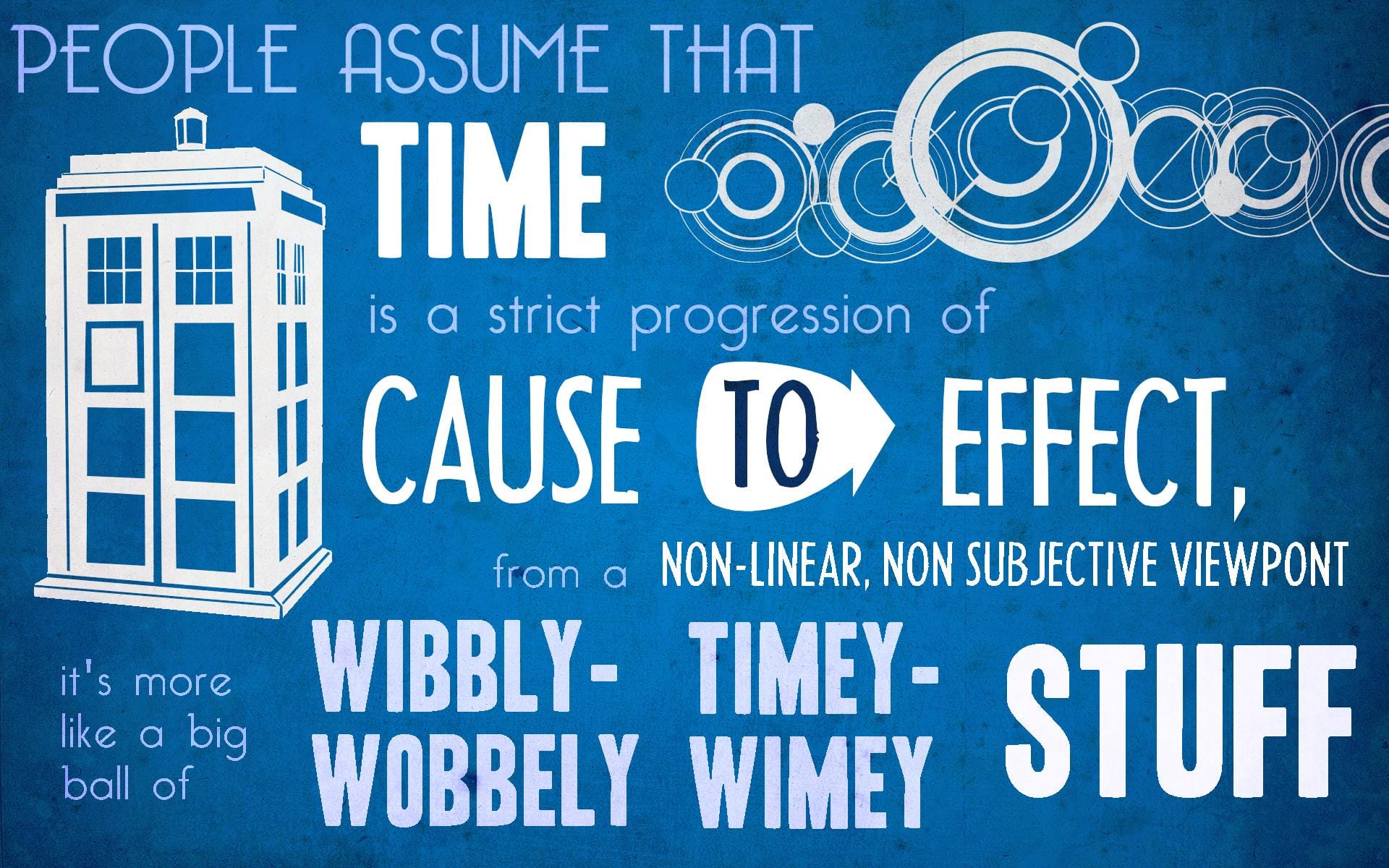
It’s very hard to get the meaning of life from science because reality is very strange, Further, science is mathematical, and the math relations for reality can be re-arranged. One arrangement of the terms will suggest a version of causality, while another will suggest a different causality. As Dr. Who points out, in non-linear, non-objective terms, there’s no causality, but rather a wibbly-wobbely ball of timey-wimey stuff.

Time as a ball of wibblely wobbly timey wimey stuff.

Reality is a ball of  timey wimpy stuff, Dr. Who.

To this end, I’ll provide my favorite way of looking at the timey-wimey way of the world by rearranging the equations of quantum mechanics into a sort of diffusion. It’s not the diffusion of something you’re quite familiar with, but rather a timey-wimey wave-stuff referred to as Ψ. It’s part real and part imaginary, and the only relationship between ψ and life is that the chance of finding something somewhere is proportional Ψ*|Ψ. The diffusion of this half-imaginary stuff is the underpinning of reality — if viewed in a certain way.

First let’s consider the steady diffusion of a normal (un-quantum) material. If there is a lot of it, like when there’s perfume off of a prima donna, you can say that N = -D dc/dx where N is the flux of perfume (molecules per minute per area), dc/dx is a concentration gradient (there’s more perfume near her than near you), and D is a diffusivity, a number related to the mobility of those perfume molecules. 

We can further generalize the diffusion of an ordinary material for a case where concentration varies with time because of reaction or a difference between the in-rate and the out rate, with reaction added as a secondary accumulator, we can write: dc/dt = reaction + dN/dx = reaction + D d2c/dx2. For a first order reaction, for example radioactive decay, reaction = -ßc, and 

dc/dt = -ßc + D d2c/dx2               (1)

where ß is the radioactive decay constant of the material whose concentration is c.

Viewed in a certain way, the most relevant equation for reality, the time-dependent Schrödinger wave equation (semi-derived here), fits into the same diffusion-reaction form:

dΨ/dt = – 2iπV/h Ψ + hi/4πm d2Ψ/dx               (2)

Instead of reality involving the motion of a real material (perfume, radioactive radon, etc.) with a real concentration, c, in this relation, the material can not be sensed directly, and the concentration, Ψ, is semi -imaginary. Here, h is plank’s constant, i is the imaginary number, √-1, m is the mass of the real material, and V is potential energy. When dealing with reactions or charged materials, it’s relevant that V will vary with position (e.g. electrons’ energy is lower when they are near protons). The diffusivity term here is imaginary, hi/4πm, but that’s OK, Ψ is part imaginary, and we’d expect that potential energy is something of a destroyer of Ψ: the likelihood of finding something at a spot goes down where the energy is high.

The form of this diffusion is linear, a mathematical term that refers to equations where solution that works for Ψ will also work for 2Ψ. Generally speaking linear solutions have exp() terms in them, and that’s especially likely here as the only place where you see a time term is on the left. For most cases we can say that

Ψ = ψ exp(-2iπE/h)t               (3)

where ψ is not a function of anything but x (space) and E is the energy of the thing whose behavior is described by Ψ. If you take the derivative of equation 3 this with respect to time, t, you get

dΨ/dt = ψ (-2iπE/h) exp(-2iπE/h)t = (-2iπE/h)Ψ.               (4)

If you insert this into equation 2, you’ll notice that the form of the first term is now identical to the second, with energy appearing identically in both terms. Divide now by exp(-2iπE/h)t, and you get the following equation:

(E-V) ψ =  -h2/8π2m d2ψ/dx2                      (5)

where ψ can be thought of as the physical concentration in space of the timey-wimey stuff. ψ is still wibbly-wobbley, but no longer timey-wimey. Now ψ- squared is the likelihood of finding the stuff somewhere at any time, and E, the energy of the thing. For most things in normal conditions, E is quantized and equals approximately kT. That is E of the thing equals, typically, a quantized energy state that’s nearly Boltzmann’s constant times temperature.

You now want to check that the approximation in equation 3-5 was legitimate. You do this by checking if the length-scale implicit in exp(-2iπE/h)t is small relative to the length-scales of the action. If it is (and it usually is), You are free to solve for ψ at any E and V using normal mathematics, by analytic or digital means, for example this way. ψ will be wibbely-wobbely but won’t be timey-wimey. That is, the space behavior of the thing will be peculiar with the item in forbidden locations, but there won’t be time reversal. For time reversal, you need small space features (like here) or entanglement.

Equation 5 can be considered a simple steady state diffusion equation. The stuff whose concentration is ψ is created wherever E is greater than V, and is destroyed wherever V is greater than E. The stuff then continuously diffuses from the former area to the latter establishing a time-independent concentration profile. E is quantized (can only be some specific values) since matter can never be created of destroyed, and it is only at specific values of E that this happens in Equation 5. For a particle in a flat box, E and ψ are found, typically, by realizing that the format of ψ must be a sin function (and ignoring an infinity). For more complex potential energy surfaces, it’s best to use a matrix solution for ψ along with non-continuous calculous. This avoids the infinity, and is a lot more flexible besides.

When you detect a material in some spot, you can imagine that the space- function ψ collapses, but even that isn’t clear as you can never know the position and velocity of a thing simultaneously, so doesn’t collapse all that much. And as for what the stuff is that diffuses and has concentration ψ, no-one knows, but it behaves like a stuff. And as to why it diffuses, perhaps it’s jiggled by unseen photons. I don’t know if this is what happens, but it’s a way I often choose to imagine reality — a moving, unseen material with real and imaginary (spiritual ?) parts, whose concentration, ψ, is related to experience, but not directly experienced.

This is not the only way the equations can be rearranged. Another way of thinking of things is as the sum of path integrals — an approach that appears to me as a many-world version, with fixed-points in time (another Dr Who feature). In this view, every object takes every path possible between these points, and reality as the sum of all the versions, including some that have time reversals. Richard Feynman explains this path integral approach here. If it doesn’t make more sense than my version, that’s OK. There is no version of the quantum equations that will make total, rational sense. All the true ones are mathematically equivalent — totally equal, but differ in the “meaning”. That is, if you were to impose meaning on the math terms, the meaning would be totally different. That’s not to say that all explanations are equally valid — most versions are totally wrong, but there are many, equally valid math version to fit many, equally valid religious or philosophic world views. The various religions, I think, are uncomfortable with having so many completely different views being totally equal because (as I understand it) each wants exclusive ownership of truth. Since this is never so for math, I claim religion is the opposite of science. Religion is trying to find The Meaning of life, and science is trying to match experiential truth — and ideally useful truth; knowing the meaning of life isn’t that useful in a knife fight.

Dr. Robert E. Buxbaum, July 9, 2014. If nothing else, you now perhaps understand Dr. Who more than you did previously. If you liked this, see here for a view of political happiness in terms of the thermodynamics of free-energy minimization.