He/she gave it to him/her/them – the new grammar of transgender

When I was in grad school, at Princeton there was a grammar joke about a ghetto kid who comes to Princeton. The kid asks, “Where’s the library at?” and is told, “This is an ivy league school. One does not end one’s sentences with a preposition here.” So the kid rephrase: “Where’s the library at, asshole?” What makes this joke poignant was that I found language divides class, and is a weapon of class war, too. At Princeton, I was of lower economic class along with virtually all of the grad school. It was not that we had less spending money, but we came from public schools, while the undergraduates were virtually all from private, “prep school”. It showed in wardrobe, tastes, and especially language.

Protesting at Fergusson; white radicals marching against cops and the system.

Ferguson rally; white radicals in a black neighborhood. Are the locals as against cops and the system?

To the prep-schooler, the working class was cheap because they were racist, or apartheid, and the preppy was trying to remedy this through activism. Rarely mentioned was that daddy was a major landlord, a college president or ambassador to Chad, or that they planned to go off to jobs in finance, law, or politics as soon as they were done rallying against class, racism, and the system. I imagine that their radical politics was partially sincere, but partially a social tool to keep the unwashed bourgeois at arm’s length. The best answer, I thought then, and now, is in grammar: we are not stingy racists, just being frugal.

The sexist label of today seems similar to the racist label of those days: partly sincere, partly a social tool built on fear, and the answer too, I think is grammar. Most people see no problem with a name change (just file the paperwork), or with a change in driver’s license sex indicator (who knows or cares?). The problem comes in with the loudly gender fluid: those who’re male today and female tomorrow and want to be respected for it. Are they a legitimate 3rd gender, or an over-pampered minority with no good claim to victimhood or anything else.

Transgender does not have to do with bed partners. Some people like to "keep it fluid" and this is where the grammar problems come in.

Transgender does not have to do with bed partners, but with self-image. Some people are confused and like (need?) to “keep it fluid”; this is where the grammar problems come in. Yet others are sons of privilege trying to make a point. Is this person confused or trying to make a point? Does it matter?

In this, and all such cases, I think it pays to respond to the legitimate complainant first and see if that answers all. One popular option is to use the words “they” or “them” when male or female labels don’t fit. Thus: “I gave my homework to them,” even though only one person received it. This is bad in my mind as it solves one problem but creates at least two others. It’s confusing to call one person many, and gives that person’s opinion extra weight. “They voted yea”, implies many people, not just one. Most Americans cringe when the queen of England says, “We request…” The queen gives her request extra weight by speaking in the plural. Similarly, “L’État, c’est moi.

More republican would be to avoid all pronouns and use the person’s name, e.g. “I gave it to Dennis”. But this can be awkward if the name is long (Hermione) or repetitively used, or if the person’s name is in flux too. What to do with someone who’s Ernestine to some, Dr. Peters to others (and Ernest in the country). Once a person settles on a single gender the grammatical problem pretty well resolves: good manners suggest one use the pronoun “him” for one who dresses male and calls himself Alphonse, not Alice.
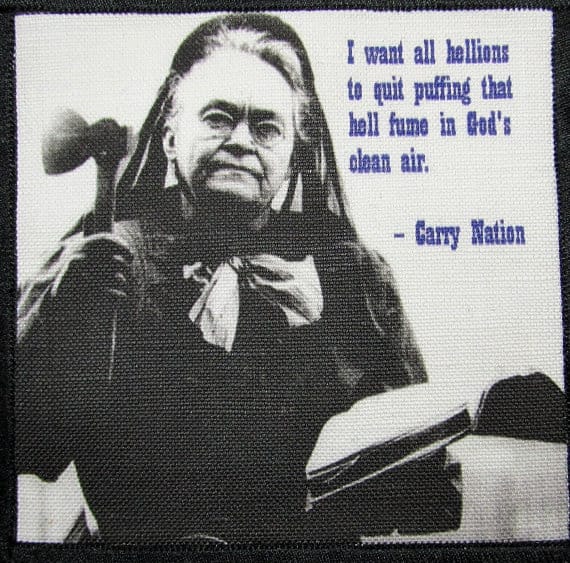
Carrie Nation, If she says she's a woman, good manners suggests I agree

Carrie Nation, prohibitionist. If she says she’s a woman, good manners and common sense suggest we agree — no matter how masculine her behavior or dress.

There is thus a need for a good singular pronoun for the gender-fluid, and the socialists have one ready: call all people “comrade,” a word specifically chosen to be gender neutral. It further implied political solidarity and economic unity. This is fine, for some, but uncomfortable for a capitalist. Another option, one Karl Marx himself used, is “citizen.” But this word carries its own baggage from revolutionary France. Instead, I suggest “yer mate” for him/her and “matey” for he/she. Both are based on pirate lingo. Thus, ‘Matey looks t’ be drunk’. or ‘Give yer homework over to yer mate.’ It’s’s strange, but works. Give it a try on “talk like a pirate day,” September 16 every year.

It’s now to be asked, have we addressed the broader problem of those who see any gender identification as an injustice of the capitalist, repressive system? I answer, does it matter? I suspect these folks are unhappy with themselves, and will never be otherwise, but that’s just a suspicion. Even unhappy folks do good, and sometimes it’s when they try to do bad.  Here’s a poem “International Women’s Day” (1920) by–Alexandra Kollontai (1920).

Down with the world of Property and the Power of Capital! Away with Inequality, Lack of Rights and the Oppression of Women – The Legacy of the Bourgeois World! Forward To the International Unity of Working Women and Male. Workers in the Struggle for the Dictatorship of the Proletariat: The Proletariat of Both Sexes!
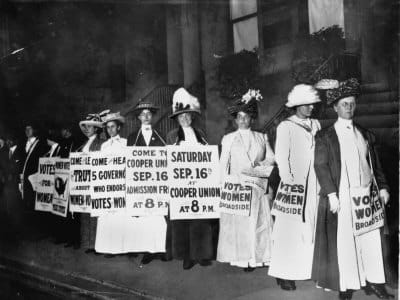
Suffragettes -- Meeting at Cooper Union. Not quite the poor, oppressed, but bringers of positive change, when they were not fighting for prohibition.

Suffragettes meeting at Cooper Union. Not quite the oppressed, but bringers of positive change– and also of prohibition.

Ms Kollontai was a main founder of Women’s day, and this is/ was a good thing. She was also a daughter of privilege and a fan of Stalin’s brand of social engineering: the sort that hung engineers from the lamp-posts as a warning to anti-proletarians. She was Soviet ambassador to Sweden, and as ambassador, kept Sweden from helping Poland or Finland when Stalin and Hitler joined forces to simultaneously invade those countries and murder the population. She did her good and bad together as one package. I find that the world is crazy this was, and so are the people who do things. You just have to try to take the good with the bad, and laugh if you can. Matey here owes as much to yer mate.

Robert E. Buxbaum, March 30-31, 2015.
Much of the chemistry you learned is wrong

When you were in school, you probably learned that understanding chemistry involved understanding the bonds between atoms. That all the things of the world were made of molecules, and that these molecules were fixed proportion combinations of the chemical elements held together by one of the 2 or 3 types of electron-sharing bonds. You were taught that water was H2O, that table salt was NaCl, that glass was SIO2, and rust was Fe2O3, and perhaps that the bonds involved an electron transferring between an electron-giver: H, Na, Si, or Fe… to an electron receiver: O or Cl above.

Sorry to say, none of that is true. These are fictions perpetrated by well-meaning, and sometime ignorant teachers. All of the materials mentioned above are grand polymers. Any of them can have extra or fewer atoms of any species, and as a result the stoichiometry isn’t quite fixed. They are not molecules at all in the sense you knew them. Also, ionic bonds hardly exist. Not in any chemical you’re familiar with. There are no common electron compounds. The world works, almost entirely on covalent, shared bonds. If bonds were ionic you could separate most materials by direct electrolysis of the pure compound, but you can not. You can not, for example, make iron by electrolysis of rust, nor can you make silicon by electrolysis of pure SiO2, or titanium by electrolysis of pure TiO. If you could, you’d make a lot of money and titanium would be very cheap. On the other hand, the fact that stoichiometry is rarely fixed allows you to make many useful devices, e.g. solid oxide fuel cells — things that should not work based on the chemistry you were taught.

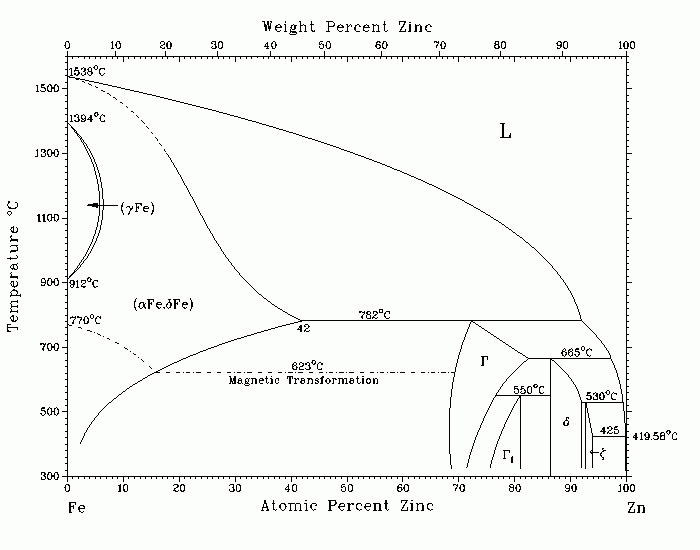
Iron -zinc forms compounds, but they don't have fixed stoichiometry. As an example the compound at 60 atom % Zn is, I guess Zn3Fe2, but the composition varies quite a bit from there.

Iron -zinc forms compounds, but they don’t have fixed stoichiometry. As an example the compound at 68-80 atom% Zn is, I guess Zn7Fe3 with many substituted atoms, especially at temperatures near 665°C.

Because most bonds are covalent many compounds form that you would not expect. Most metal pairs form compounds with unusual stoicheometric composition. Here, for example, is the phase diagram for zinc and Iron –the materials behind galvanized sheet metal: iron that does not rust readily. The delta phase has a composition between 85 and 92 atom% Zn (8 and 15 a% iron): Perhaps the main compound is Zn5Fe2, not the sort of compound you’d expect, and it has a very variable compositions.

You may now ask why your teachers didn’t tell you this sort of stuff, but instead told you a pack of lies and half-truths. In part it’s because we don’t quite understand this ourselves. We don’t like to admit that. And besides, the lies serve a useful purpose: it gives us something to test you on. That is, a way to tell if you are a good student. The good students are those who memorize well and spit our lies back without asking too many questions of the wrong sort. We give students who do this good grades. I’m going to guess you were a good student (congratulations, so was I). The dullards got confused by our explanations. They asked too many questions, and asked, “can you explain that again? Or why? We get mad at these dullards and give them low grades. Eventually, the dullards feel bad enough about themselves to allow themselves to be ruled by us. We graduates who are confident in our ignorance rule the world, but inventions come from the dullards who don’t feel bad about their ignorance. They survive despite our best efforts. A few more of these folks survive in the west, and especially in America, than survive elsewhere. If you’re one, be happy you live here. In most countries you’d be beheaded.

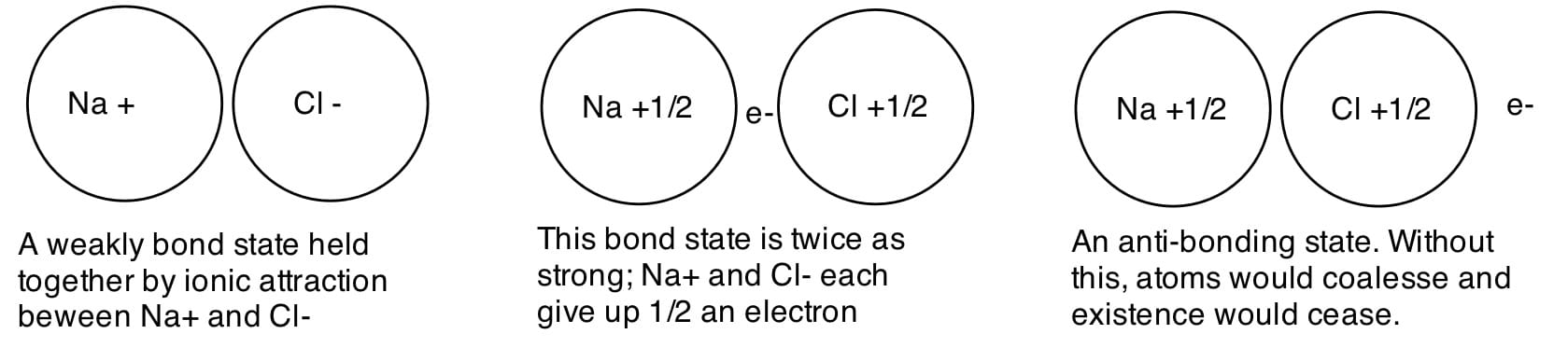
Back to chemistry. It’s very difficult to know where to start to un-teach someone. Lets start with EMF and ionic bonds. While it is generally easier to remove an electron from a free metal atom than from a free non-metal atom, e.g. from a sodium atom instead of oxygen, removing an electron is always energetically unfavored, for all atoms. Similarly, while oxygen takes an extra electron easier than iron would, adding an electron is energetically unfavored. The figure below shows the classic ion bond, left, and two electron sharing options (center right) One is a bonding option the other anti-bonding. Nature prefers this to electron sharing to ionic bonds, even with blatantly ionic elements like sodium and chlorine.

Bond options in NaCl. Note that covalent is the stronger bond option though it requires less ionization.

Bond options in NaCl. Note that covalent is the stronger bond option though it requires less ionization.

There is a very small degree of ionic bonding in NaCl (left picture), but in virtually every case, covalent bonds (center) are easier to form and stronger when formed. And then there is the key anti-bonding state (right picture). The anti bond is hardly ever mentioned in high school or college chemistry, but it is critical — it’s this bond that keeps all mater from shrinking into nothingness.

I’ve discussed hydrogen bonds before. I find them fascinating since they make water wet and make life possible. I’d mentioned that they are just like regular bonds except that the quantum hydrogen atom (proton) plays the role that the electron plays. I now have to add that this is not a transfer, but a covalent spot. The H atom (proton) divides up like the electron did in the NaCl above. Thus, two water molecules are attracted by having partial bits of a proton half-way between the two oxygen atoms. The proton does not stay put at the center, there, but bobs between them as a quantum cloud. I should also mention that the hydrogen bond has an anti-bond state just like the electron above. We were never “taught” the hydrogen bond in high school or college — fortunately — that’s how I came to understand them. My professors, at Princeton saw hydrogen atoms as solid. It was their ignorance that allowed me to discover new things and get a PhD. One must be thankful for the folly of others: without it, no talented person could succeed.

And now I get to really weird bonds: entropy bonds. Have you ever noticed that meat gets softer when its aged in the freezer? That’s because most of the chemicals of life are held together by a sort of anti-bond called entropy, or randomness. The molecules in meat are unstable energetically, but actually increase the entropy of the water around them by their formation. When you lower the temperature you case the inherent instability of the bonds to cause them to let go. Unfortunately, this happens only slowly at low temperatures so you’ve got to age meat to tenderize it.

A nice thing about the entropy bond is that it is not particularly specific. A consequence of this is that all protein bonds are more-or-less the same strength. This allows proteins to form in a wide variety of compositions, but also means that deuterium oxide (heavy water) is toxic — it has a different entropic profile than regular water.

Robert Buxbaum, March 19, 2015. Unlearning false facts one lie at a time.

Brass monkey cold

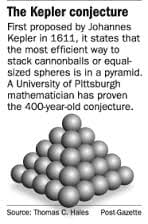
In case it should ever come up in conversation, only the picture at left shows a brass monkey. The other is a bronze statue of some sort of a primate. A brass monkey is a rack used to stack cannon balls into a face centered pyramid. A cannon crew could fire about once per minute, and an engagement could last 5 hours, so you could hope to go through a lot of cannon balls during an engagement (assuming you survived).

A brass monkey cannonball holder. The classic monkeys were 10 x 10 and made of navy brass.

Small brass monkey. The classic monkey might have 9 x 9 or 10×10 cannon balls on the lower level.

Bronze sculpture of a primate playing with balls -- but look what the balls are sitting on: it's a surreal joke.

Bronze sculpture of a primate playing with balls — but look what the balls are sitting on: it’s a dada art joke.

But brass monkeys typically show up in conversation in terms of it being cold enough to freeze the balls off of a brass monkey, and if you imagine an ornamental statue, you’d never guess how cold could that be. Well, for a cannonball holder, the answer has to do with the thermal expansion of metals. Cannon balls were made of iron and the classic brass monkey was made of brass, an alloy with a much-greater thermal expansion than iron. As the temperature drops, the brass monkey contracts more than the iron balls. When the drop is enough the balls will fall off and roll around.

The thermal expansion coefficient of brass is 18.9 x 10⁻⁶/°C while the thermal expansion coefficient of iron is 11.7 x10⁻⁶/°C. The difference is 7.2×10⁻⁶/°C; this will determine the key temperature. Now consider a large brass monkey, one with 400 x 400 holes on the lower level, 399 x 399 at the second, and so on. Though it doesn’t affect the result, we’ll consider a monkey that holds 12 lb cannon balls, a typical size of 1750 -1830. Each 12 lb ball is 4.4″ in diameter at room temperature, 20°C in those days. At 20°C, this monkey is about 1760″ wide. The balls will fall off when the monkey shrinks more than the balls by about 1/3 of a diameter, 1.5″.

We can calculate ∆T, the temperature change, °C, that is required to lower the width-difference by 1.5″ as follows:

kepler conjecture, brass monkey

-1.5″ = ∆T x 1760″ x 7.2 x10⁻⁶

We find that ∆T = -118°C. The temperature where this happens is 118 degrees cooler than 20°C, or -98°C. That’s a temperature that you could, perhaps reach on the South Pole or maybe deepest Russia. It’s not likely to be a problem, especially with a smaller brass monkey.

Robert E. Buxbaum, February 21, 2015 (modified Apr. 28, 2021). Some fun thoughts: Convince yourself that the key temperature is independent of the size of the cannon balls. That is, that I didn’t need to choose 12 pounders. A bit more advanced, what is the equation for the number of balls on any particular base-size monkey. Show that the packing density is no more efficient if the bottom lawyer were an equilateral triangle, and not a square. If you liked this, you might want to know how much wood a woodchuck chucks if a woodchuck could chuck wood, or on the relationship between mustaches and WWII diplomacy.

Detroit emerges from bankruptcy. Not quite.

missing homes Detroit

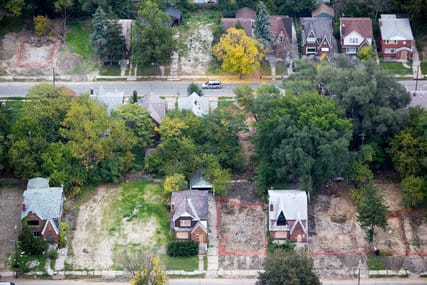
While Detroit’s central core comes back, surrounding, homes burn at 220+/month, leave Detroit streets looking like the teeth of an aging hillbilly.

Detroit went bankrupt last year, the largest US city to do so since New York in 1970. As with New York’s bankruptcy, Detroit’s was used to cancel old debts and rewrite ill-thought contracts. Detroit also got to jail some crooked politicians including mayor Kilpatrick, described as “a walking crime wave.” But the city and county have no easy path out of bankruptcy as both city and county are likely insolvent. That is, they spend more than they take in despite massive out-state funding, and high taxes, 10% above the state level. To make matters worse, they are losing population at the rate of 1% or so per year. It’s hard to fund a city built for 2 million on the tax revenue of 1/3 as many, especially when they are mostly unemployed. Unless a lot changes soon, another bankruptcy is almost inevitable — likely this time at the county level.

We got in this predicament, largely as a result of a 50 year war between the black political establishment of the city, solidly Democrat, crooked, somewhat anarchist, and the white, stayed, mostly Republican out-state. The white population fled following Detroits riots of the 60s, and the richer black population soon followed. The remainder, poor, old and black, stayed, trapped in slowly decaying neighborhoods, relying on flashy, crooked politicians as the city went broke. White flight allowed the black community to develop its own, Motown culture, but except for the music industry, Detroit has not benefitted from this culture.

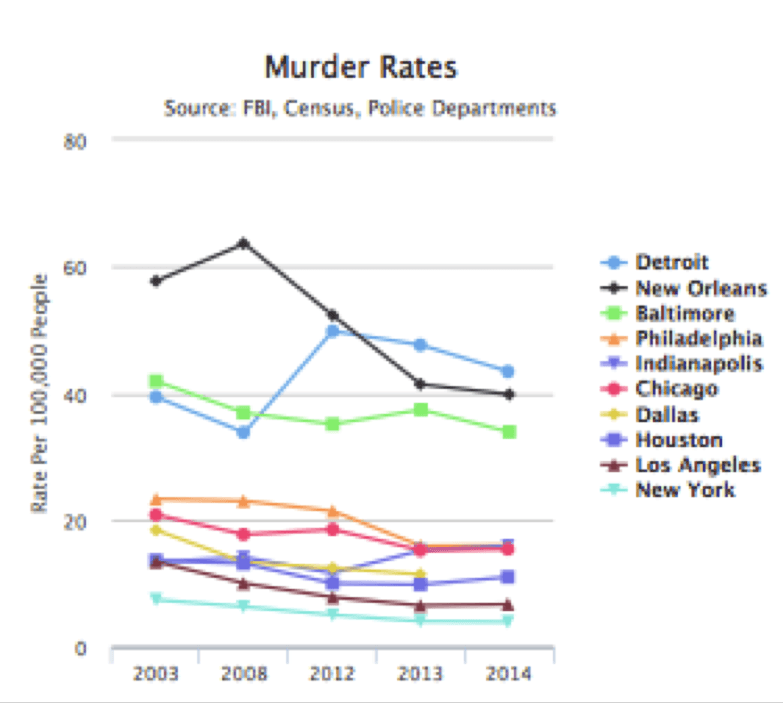
Detroit's murder rate, 45/100,000, is the highest in the US. It's coming down but not that fast.

Detroit’s murder rate is the highest in the US. It’s come down 10% in the last 2 years, but has far to go.

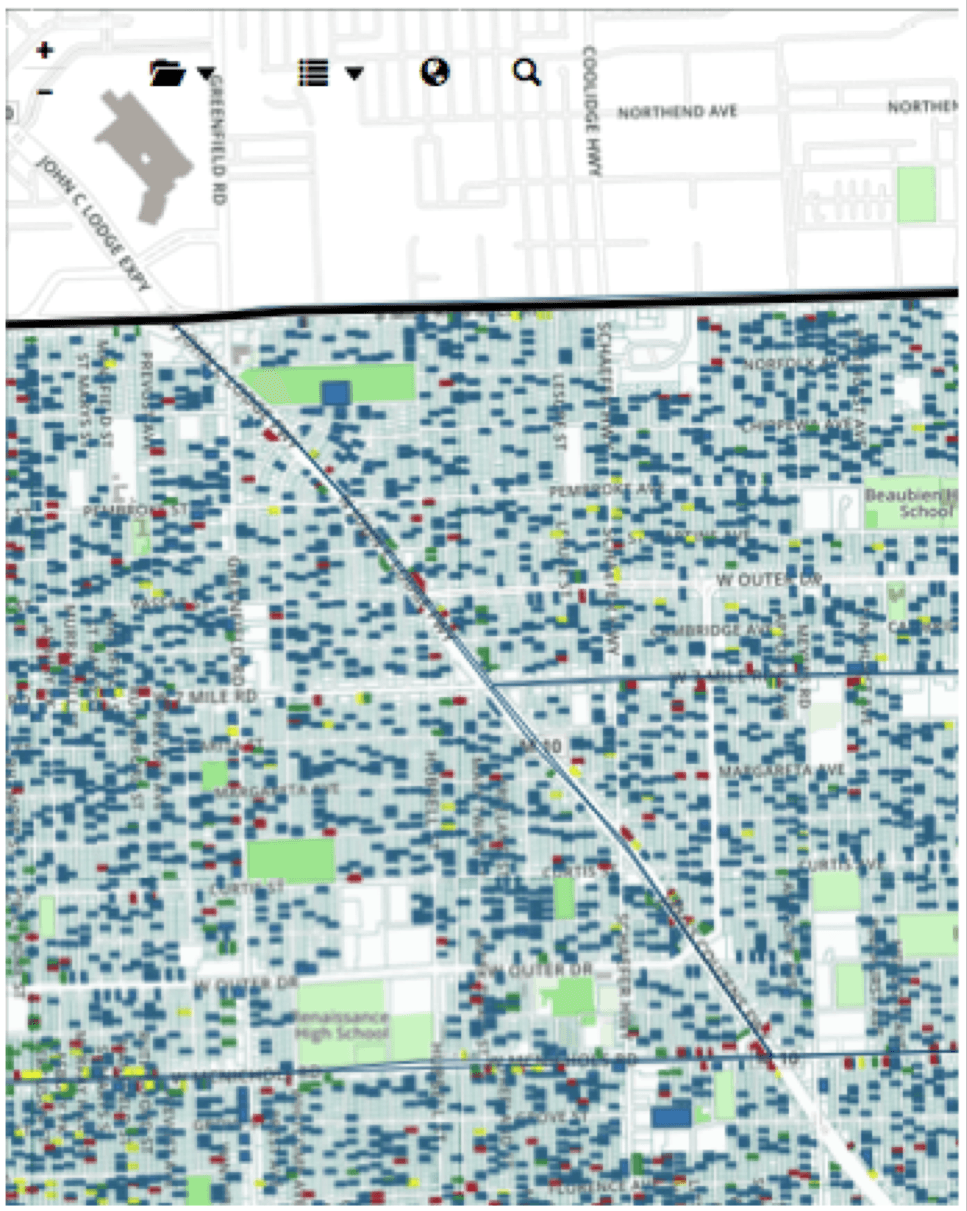
Detroiters have poor health, poor savings rates, high murder rates. The fire rate is about .22% per month, 2.6% per year. The city lacks reliable fire fighting and street plowing. Police, at one point, erected signs at the border that said, “Enter at your own risk.” There is a lack of small businesses and the services they would provide too: laundromats, grocery stores, and taxis (though no lack of bars and marijuana maintenance clinics). Employment in the auto-industry is down. And it’s not being replaced by home-grown small business – perhaps hampered by the low savings rate. A surprisingly large fraction of Detroit homes are in foreclosure, see map, and with it there’s a high abandonment rate. The high fire rate is at least half arson to collect on insurance. As pheasant and dear return, non-core Detroit is beginning to look like farm country.

Detroit foreclosures near me. Blue is occupied homes, red is unoccupied, yellow unknown, and green is destroyed homes or vacant, foreclosed land.

Detroit foreclosures near me. Homes in dark blue are occupied foreclosed, red is unoccupied, and green plots are destroyed homes or vacant, foreclosed land.

It’s not clear what political leaders should do now. The city council would like to return to their pre-bankruptcy ways where they could borrow as much as they felt they needed and spend on whatever they saw fit — often on fast friends, fast cars, gambling, and vacation homes outside of the city. But the out-state population has been reluctant to give them the credit card. Is this racist or prudent — probably both, but this war can not continue. The city and county pension funds were ransacked for ill-advised investments and consulting fees to cronies and their power-lawyers. Either the money is replaced from out-state or there will be some unhappy retirees in the not-too-distant future. My guess is that the state will have to pick up the tab for this mismanagement, but only if they don’t have to hand over management control afterwards.

Rand Paul, a potential GOP presidential candidate, has proposed rebuilding business and property values by a method that the city will almost certainly reject. His solution: cut services to low-population density areas and cut taxes on business and earned income. While this would likely bring in new people and new businesses, the people would likely be white, and the businesses white-owned/ white-serving. Black-Detroiters have too little savings, organization and income to directly benefit from this plan, and black politicians are likely to feel threatened. They are likely to claim, not without merit, that this is welfare for rich whites: a way for them to become yet-richer while doing nothing for the poor blacks of the burning neighborhoods. They are likely to demand control as the elected officials of the town: regulating business and raising the minimum wage to create “equality.” I suspect this is a bad idea.

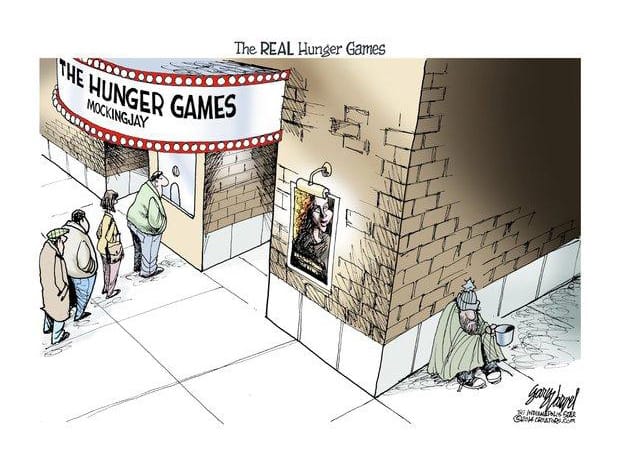
Detroit hunger games

Detroit suffers from two populations and a divide.

To some extent we’re already seeing the return of white-owned, white-serving businesses. Classic buildings in the core of the city have been purchased by white developers – notably Dan Gilbert of Quicken Loans leading to gentrification and an influx of single, white hipsters. The newcomers are viewed as half-saviors, half-carpetbaggers. They dwell in a whiter city core with hipster bars and expensive restaurants. Does a poor city with massive debt, crime, and unemployment benefit from a core filled with high-priced, gourmet coffee and fern bars?

The author, Robert Buxbaum, enjoys a day at an artificial beach in central Detroit.

The author, Robert Buxbaum, enjoys a beer at an artificial beach-cafe in central Detroit with some, few black folks, none poor. Is this good for Detroit?

The new hipsters put a squeeze on city services too — one that’s hard to deal with fairly. Detroit can not afford to plow all the streets after a snow. Should the new high-tax white folks get plowed streets, or should they suffer equally with everyone else? Detroit education is abysmal, but the high tax-bracket folks want better. Should they get it, or suffer equally? They want extra street lights and police protection. Should they get it, or suffer equally? Is this the way up?  A solution I’d proposed some while ago was to divide the core city from the now-rural outskirts so that each could be managed more sanely. It’s not a grand a solution like Rand’s plan, but less likely to be rejected. One way or another, we seem destined to have a Detroit with a rich core and abandoned neighborhoods. I suspect it might as well be managed that way.

Robert E. Buxbaum, February 10, 2015. I don’t have solutions, but write about the city’s problems, and the partial solutions I’ve heard of as a way to clarify my thinking — and perhaps yours too.

you are what you eat?

The simplest understanding of this phrase is that you should eat good, healthy foods to be healthy, and that this will make you healthy in body and mind.

The author of the study published this book against GM foods simultaneously with release of his paper.

The author of this book against unhealthy foods faked his analysis to support the book.

Clearly there is some truth to this. Crazy people look crazy and often eat crazy. Even ‘normal’ people, if they eat too much are likely to become fat, lazy, and sick. There is a socio- economic effect (fat people earn less), and a physiological evidence that gut bacteria affects anxiety and depression (at least in rats). My sense here is at the diet extremes though. There is little, or no evidence to suggest you can make yourself more intelligent (or kind or good) by eating more of the right stuff, or just the right foods in just the right amounts. A better diet can make you look better, but there is a core lie at work when you extend this to imply that the real you is your body, or so tied to your body that a healthy mind can not be found in a sickly body. But most evidence is that the mind is the real you, and (following Socrates) that beautiful minds are found in sickly bodies. I’ve seen few (basically, no) healthy poets, writers, or great artists. Neither are there scientists of note (that I can recall) who lived without smoking, drinking, and any bad habits. Many creative people did drugs. George Orwell smoked cigarette, and died of TB, but wrote well to the end. There is no evidence that bad writing or thinking can be improved by health foods. Stupid is as stupid does, and many healthy people are clearly dolts.

Not that it’s always clear what constitutes good health, or what constitutes good food for health, or what constitutes a good mind. Skinny people may be admired and may earn more, but it is not clear they are healthy. Yule Gibbons, the natural food guru died young of stomach cancer. Adele Davis, another the author of “eat right to be healthy,” died of brain cancer. And Jim Fix, “the running doctor” died young of a heat attack while running. Their health foods may have killed them, and that unhealthy foods, like chocolate and coffee can be good for you. It’s likely a question of balance. While a person will feel better who dresses well, the extreme is probably no good. Very often, a person is drawn after his self-image to be the person he pretends. Show me a man who eats only vegetarian, and I’ll show you someone who sees himself as spiritual, or wants to be seen as spiritual. And that man is likely to be drawn to acting spiritual. Among the vegetarians you find Einstein, George B. Shaw, and Gandhi, people who may have been spiritual from the start, but may have been kept to spirituality from their diets. You also find Hitler: spirituality can take all sorts of forms.

Ward Sullivan in the New Yorker

Ward Sullivan in the New Yorker. People eat, drink, and dress like who they are. And people become like those they eat drink and dress like.

Choice of diet also helps select the people you run into. If you eat vegetarian, you’re likely to associate with other vegetarians, and you will likely behave like them. If you eat Chinese, Greek, or Mexican food, you’re likely to associate with these communities and behave like them. Similarly, an orthodox Jew or Moslem is tied to his community with every dinner and every purchase from the kosher or halal store.

And now we come to the bizarre science of bio-systems. Each person is a complex bio-system, with more non-human DNA than human, and more non-human cells than human. A person has a vast army of bugs on him, and a similarly vast pool of bugs within him. Recent research suggests that what we eat affects this bio-system, and through it our mental state. For whatever the mechanism, show me someone who drinks only 30 year Scotch or 40-year-old French wine, and I’ll show you a food snob. By contrast, show me someone who eats good, cheap food, and drinks good, cheap wine or Scotch (Lauder’s or Dewar’s), and I’ll show you a decent person very much like myself, a clever man who either is a man of the people or who wants to be known as one.”Dis-moi ce que tu manges, je te dirai ce que tu es.” [Tell me what you eat and I will tell you what you are].

Robert E. Buxbaum, February, 2015. My 16-year-old daughter asked me to write on this topic. Perhaps she didn’t know what it meant, or how true I thought it was, or perhaps she liked my challenges of being 16.

Is college worth no cost?

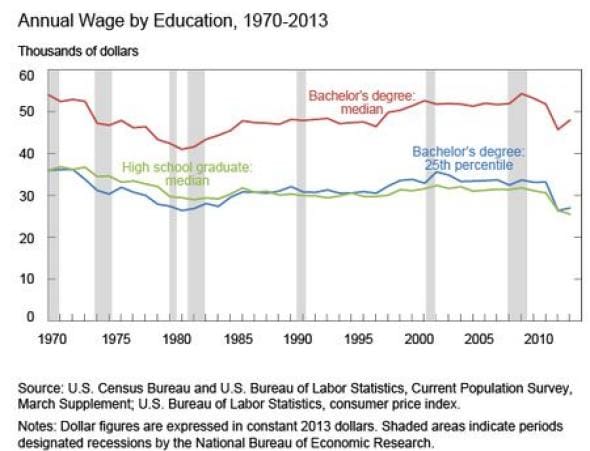
While a college degree gives most graduates a salary benefit over high school graduates this has to be balanced against the four years of not working. What’s more, a Bureau of Labor statistics study found that the salary benefits disappear if you graduate in the bottom 25% of your class, and if you don’t graduate at all you can end up losing salary money, especially if you go into low-paying fields like child development or physical sciences.

Salary benefits of a college degree are largely absent if you graduate in the bottom 25% of your class.

The average college graduate earns significantly more than a high school grad, but not if you attend a pricy school, or graduate in the bottom 1/4 of your class, or have the wrong major.

Most people realize there is a great earnings difference depending on your field of study with graduates in engineering and medicine doing better, financially. Even top graduates in child development or athletic sciences are barely able to justify the tuition and opportunity costs –it’s worse at an expensive college, but what isn’t always realized is that not everyone entering these fields graduates. For them, there is a steep loss when the tuition and four (or more) years of lost income are considered.

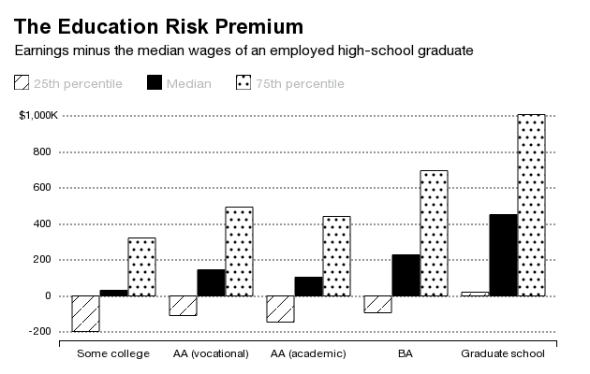
risk premium in wages

If you don’t graduate or get only an AA or 2 year degree the increase in wages is minimal, and you lose time working and whatever your costs of education. The loss is particularly high if you study social science fields at an expensive college, and don’t graduate, or if you graduate in the bottom of your class.

A report from the New York Federal Reserve finds that the highest pay major is petroleum engineering, mid-career salary $176,300/yr, and the bottom is child development, mid-career salary $36,400/yr (click the report link to check on your major). I’m not sure most students or advisors are aware of the steep salary difference, or that college gives a salary down-grade if one picks the wrong major, or does not complete the degree. In terms of earnings, you’d be better off avoiding even a free college in these areas unless you’re fairly sure you’ll complete the degree, or you really want to work in these fields.

Top earning majors Fed Reserve and Majors that pay you back.

Top earning majors: Majors that pay.

Of course college can provide more than money: knowledge, for instance, and learning: the ability to reason better. But these benefits are likely lost if you don’t work at it, or don’t go in a field you love. They can also come to those who study hard in self-taught reading. In either case, it is the work habits that will make you grow as a person, and leave you more employable. Tough colleges add a lot by exposure to new people and new ways of thinking about great books, and by forced experience in writing essays — but these benefits too are work-dependent and college dependent. If you work hard understanding a great book it will show. If you didn’t work at it, or only exposed yourself to easier fare, that too will show.

Colleges bend education to get students and keep them enrolled, to the detriment of the students. They understand that students don’t like criticism, and that good criticism is hard to give. As a result, many less-demanding colleges give little or no critical feedback, especially for disadvantaged students. This disadvantages them even more. You get is a positive experience, a nice campus, and a dramatic graduation, but this is not learning. Positivity isn’t bad, but is it worth the cost and 4-5 years of your life.

As an alternative to a liberal arts education, I present “Father” Guido Sarduchi, of Saturday Night LIve, and his “5 minute college experience.” To a surprising extent, it provides everything you’ll remember from 4 years of college in 5 minutes, including math, history, political science, and language (Spanish). For many Americans, Father Sarduchi’s 5 minutes may be a better investment than even a free 4 years in college.

Robert. E. Buxbaum. January 21-22, 2015. Education is what you get when you don’t get what you want.

Can you spot the man-made climate change?

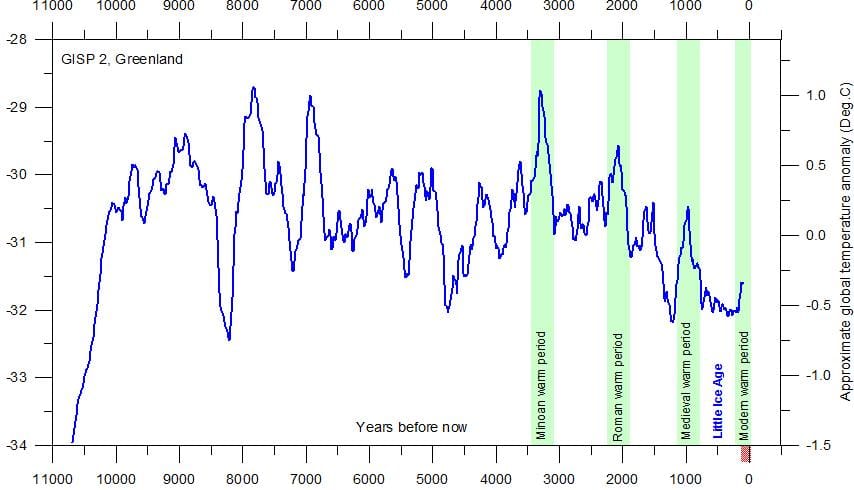
As best I can tell, the only constant in climate is change, As an example, the record of northern temperatures for the last 10,000 years, below, shows nothing but major ups and downs following the end of the last ice age 9500 years ago. The only pattern, if you call it a pattern, is fractal chaos. Anti-change politicos like to concentrate on the near-recent 110 years from 1890 to 2000. This is the small up line at the right, but they ignore the previous 10000 or more, ignore the fact that the last 17 years show no change, and ignore the variation within the 100 years (they call it weather). I find I can not spot the part of the change that’s man-made.

10,000 years of climate change based on greenland ice cores. Ole Humlum – Professor, University of Oslo Department of Geosciences.

10,000 years of northern climate temperatures based on Greenland ice cores. Dr. Ole Humlum, Dept. of Geosciences, University of Oslo. Can you spot the part of the climate change that’s man-made?

Jon Stewart makes the case for man-made climate change.

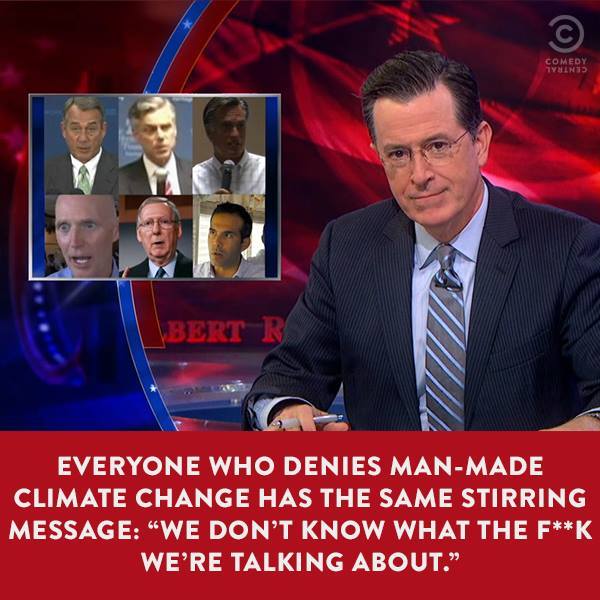
Steven Colbert makes his case for belief: If you don’t believe it you’re stupid.

Steven Colbert makes the claim that man-made climate change is so absolutely apparent that all the experts agree, and that anyone who doubts is crazy, stupid, or politically motivated (he, of course is not). Freeman Dyson, one of the doubters, is normally not considered crazy or stupid. The approach reminds me of “the emperor’s new clothes.” Only the good, smart people see it. The same people used to call it “Global Warming” based on a model prediction of man-made warming. The name was changed to “climate change” since the planet isn’t warming. The model predicted strong warming in the upper atmosphere, but that isn’t happening either; ski areas are about as cold as ever (we’ve got good data from ski areas).

I note that the climate on Jupiter has changed too in the last 100 years. A visible sign of this is that the great red spot has nearly disappeared. But it’s hard to claim that’s man-made. There’s a joke here, somewhere.

Jupiter's red spot has shrunk significantly. Here it is now. NASA

Jupiter’s red spot has shrunk significantly. Here it is now. NASA

As a side issue, it seems to me that some global warming could be a good thing. The periods that were warm had peace and relative plenty, while periods of cold, like the little ice age, 500 years ago were times of mass starvation and plague. Similarly, things were a lot better during the medieval warm period (1000 AD) than during the dark ages 500-900 AD. The Roman warm period (100 BC-50 AD) was again warm and (relatively) civilized. Perhaps we owe some of the good food production of today to the warming shown on the chart above. Civilization is good. Robert E. Buxbaum January 14, 2015. (Corrected January 19; I’d originally labeled Steven Colbert as Jon Stewart)

The funeral joke.

One day, while having a latte at my favorite Starbucks, I noticed a most unusual funeral. Instead of one hearse, there were two, one after the other, moving slowly down the street. Behind the hearse, there walked a man with a dog an a leash. Perhaps 80 other men walked behind him, single file.

As this was very unusual, I went up to the man with the dog and asked about it as respectfully as I could. I don’t want to intrude on your sorrow, sir, but I couldn’t help notice this funeral procession. Who passed away, if I may ask. The man looked at me and said that the first hearse contained his wife. “She’d gotten real mad at the dog, and the dog attacked her and killed her.” “I see,” I said, but what about the second hearse? After a pause, the man said, “That’s my mother-in-law. She started to beat the dog, and and the dog went and killed her too.” There then passed a moment of silent brotherhood between me and the fellow.

“Can I borrow the dog?”

“Get in line.”

Robert Buxbaum, January 7, 2014. It’s another shaggy dog story. Long story, sort of pointless; common phrase at the end. It’s funny because it’s a mini-mystery. All the clues were there from the start. Every now and again, I post jokes: engineering jokes, buddhist jokes, a dwarf joke and a Canadian joke, art, architecture.

Of Scrooge and rising wheat production

The Christmas Carol tells a tale that, for all the magic and fantasy, presents as true an economic picture of a man and his times as any in real-life history. Scrooge is a miserable character at the beginning of the tale, he lives alone in a dark house, without a wife or children, disliked by those around him. Scrooge has an office with a single employee (Bob Cratchit) in a tank-like office heated by a single lump of coal. He doesn’t associate much with friends or family, and one senses that he has few customers. He is poor by any life measure, and is likely poor relative to other bankers. At the end, through giving, he finds he enjoys life, is liked more, and (one has the sense) he may even get more business, and more money.

Scrooge (as best I can read him) believes in Malthus’s economic error of zero-sum wealth: That there is a limited amount of food, clothing, jobs, etc. and therefore Scrooge uses only the minimum, employs only the minimum, and spends only the minimum. Having more people would only mean more mouths to feed. As Scrooge says, “I can’t afford to make idle people merry. I help to support the establishments I have mentioned [the workhouses]. They cost enough, and … If they [the poor] would rather die,” said Scrooge, “they had better do it, and decrease the surplus population.”

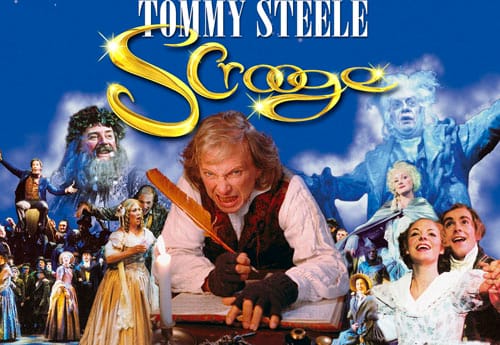
Scrooge, the poor rich man.

Scrooge, the poor rich man with a tiny carbon footprint.

The teaching of the spirits is the opposite, and neither that of the Democrats or Republicans. Neither that a big government is needed to redistribute the wealth, nor that the free market will do everything. But, as I read it, the spirits bring a spiritual message of personal charity and happiness. That one enriches ones-self when one give of and by ones-self — just from the desire to be good and do good. The spirit of Christmas Present assures Scrooge that no famine will result from the excess population, but tells him of his 1800 brothers and shows him the unending cornucopia of food in the marketplace: spanish onions, oranges, fat chestnuts, grapes, and squab. Christmas future then shows him his funeral, and Tim’s: the dismal end of all men, rich and not:  “Will you decide what men shall live, what men shall die? It may be, that in the sight of Heaven, you are more worthless and less fit to live.” And Scrooge reforms, learns: gives a smile and a laugh, and employs a young runner to get Cratchit a fat goose. He visits his nephew Fred, a cheerful businessman for dinner, and laughs while watching Tom Topper court Fred’s plump sister-in-law.

The spirits do not redistribute Scrooge’s wealth for him, and certainly don’t present a formula for how much to give whom. Instead they present a picture of the value of joy and societal fellowship (as I read it). The spirits help Scrooge out of his mental rut so he’s sees worthy endeavors everywhere. Both hoarding and redistribution are Malthusian-Scroogian messages, as I read them. Both are based on the idea that there is only so much that the world can provide.

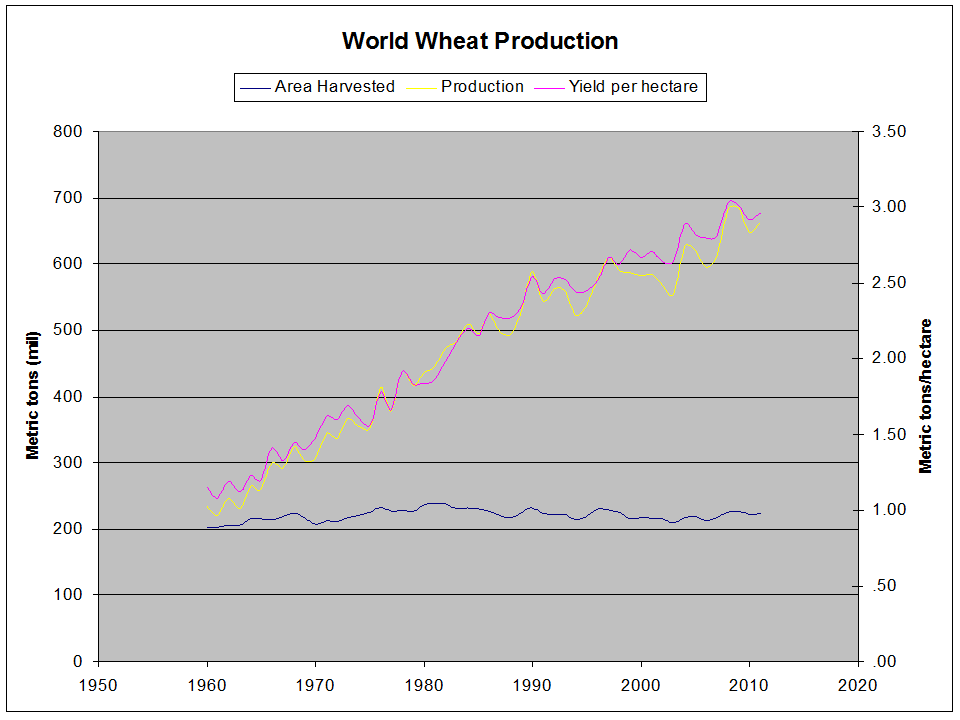
World wheet production

World wheat production tripled from 1960 to 2012 (faostat.fao.org), but acreage remained constant. More and more wheat from the same number of acres.

The history of food production suggests the spirits are right. The population is now three times what it was in Dickens’s day and mass starvation is not here. Instead we live among an “apoplectic opulence” of food. In a sense these are the product of new fertilizers, new tractors, and GMOs (Genetically modified organisms), but I would say it’s more the influence of better people. Plus, perhaps some extra CO2 in the air. Britons now complain about being too fat — and blame free markets for making them so. Over the last 50 years, wheat production has tripled, while the world population doubled, and the production of delicacies, like meat has expanded even faster. Unexpectedly, one sees that the opulence does not come from bringing new fields on-line — a process that would have to stop — but instead from increased production by the same tilled acres.

The opulence is not uniformly distributed, I should note. Countries that believe in Malthus and resort to hoarding or redistribution have been rewarded to see their grim prophesies fulfilled, as was Scrooge. Under Stalin, The Soviet Union redistributed grain from the unworthy farmer to the worth factory worker. The result was famine and Stalin felt vindicated by it. Even after Stalin, production never really grew under Soviet oversight, but remained at 75 Mtons/year from 1960 until the soviet collapse in 1990. Tellingly, nearly half of Soviet production was from the 3% of land under private cultivation. An unintended benefit: it appears the lack of Soviet grain was a major motivation for détente.  England had famine problems too when they enacted Malthusian “corn acts” and when they prevented worker migration Irish ownership during the potato famine. They saw starvation again under Attlee’s managed redistribution. In the US, it’s possible that behaviors like FDR scattering the bonus army may have helped prolong the depression. My sense is that the modern-day Scrooges are those against immigration “the foreigners will take our jobs,” and those who oppose paying folks on time, or nuclear and coal for fear that we will warm the planet. Their vision of America-yet-to-be matches Scrooge’s: a one-man work-force in a tank office heated by a single piece of coal.

Now I must admit that I have no simple formula for the correct charity standard. How does a nation provide enough, but not so much that it removes motivation– and the joy of success. Perhaps all I can say is that there is a best path between hoarding and false generosity. Those pushing the extremes are not helping, but creating a Dickensian world of sadness and gloom. Rejoice with me then, and with the reformed Scrooge. God bless us all, each and every one.

Robert Buxbaum, January 7, 2015. Some ideas here from Jerry Bowyer in last year’s Forbes.

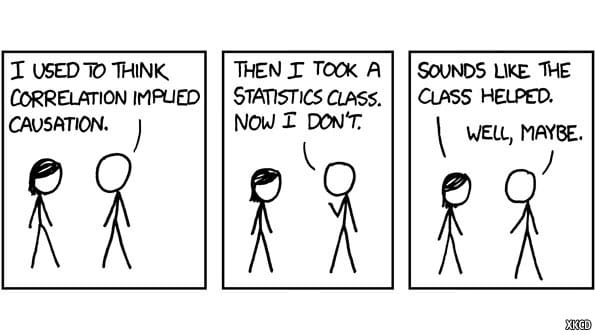
What is learning?

It is common to spend the most of one’s youth in school — presumably learning something. The financial cost for primary education is a few hundred thousand dollars, borne by the state, plus 13 years or so of the student’s life. College learning costs another $50,000 to $200,000, borne by the student, plus another 4-6 years of life. The indication that you’ve learned something appears, in many majors by the ability to get a job that pays more than the school financial cost. But there is also a sense that you’ve learned something, and this is perhaps the only reward for students of film, religion, or archeology. My question is based mostly on this part: what is this learning. Is it the same as knowledge, a set of facts, or satisfaction — perhaps you could be as satisfied by ignorance or drugs. How do you evaluate the spiritual payback from 4-6 years of college? I don’t have all the answers, but ask to exercise my ignorance.

It would seem to me that an important standard of learning is that it should develop the mind and not corrupt it. But how do you recognize the difference? it seems to me one should leave with a set of mental skills should be new to you, recognizable to a normal outsider, and somewhat useful, as in the poem “Botany” even if you don’t use it. I’m not sure if the skills have to be true, by the way, or how useful they have to be. Perhaps developing a new confusion is better than having false notions — knowing that you doubt something.

sometimes education is the removal of false notions.

Sometimes learning can be the development of doubt.

If you’ve been educated in music, it seems to me you should be able to make sounds that appear pleasant to a normal listener; if you’ve been educated in mechanics, you should be able to make machines that work, and if you’ve been educated to think… perhaps then you should be able to walk into a discussion about something you once thought was true, and show that it is really false to an extent that others would accept it (and act upon it?). That is, my suspicion is that learning should involve an identifiable change –not only internal satisfaction, and I also suspect learning the new must involve unlearning the old.

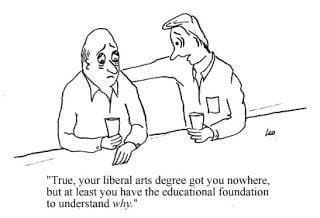
Liberal Education may not be useful, or elevating

Education that isn’t useful isn’t particularly elevating

And that leads us to facts and methods: knowledge. Facts are good, they are the fuel and  substance of learning. Without facts there is nothing for the learning to attach to. But facts are often wrong — the ignorance of others, and even when right, they can be  deceptive. If you’ve learned the moon is made of rock, or out of green cheese, it’s pretty much the same unless there is a reason to think the fact you’ve learned is true, and unless you’ve a good understanding of what the fact ‘means.’ I can imagine a rock that is organic (a gall stone) and less solid than some (old) green cheese. The word rock or cheese must mean something to you to be a fact. Similarly in all subjects; if you learn that Shakespeare is a better writer than Poe, you should have a reason to believe it, and a clear understanding of the word ‘better’ in this context.

Turning to the knowledge of methods. It seems to me that learning a new method of thought, action, or argument is a necessary component of learning– one might even call it virtue, but this too seems to have limitations if it is not directed to use. A person is half-educated if he leaves school knowing how to do geometric proofs, but never doing any, or knowing how to run a great business, but never running one. A science graduate should at least be able to use the techniques learned to demonstrate that the world is made of atoms, and that the sun does not circle the earth and perhaps more. An argument can be made for traditional education areas of logic, rhetoric, mathematics, and dialectic. But these seem useless unless they are applied to a worthy end. One should do more with the new methods than to win drawing-room arguments.

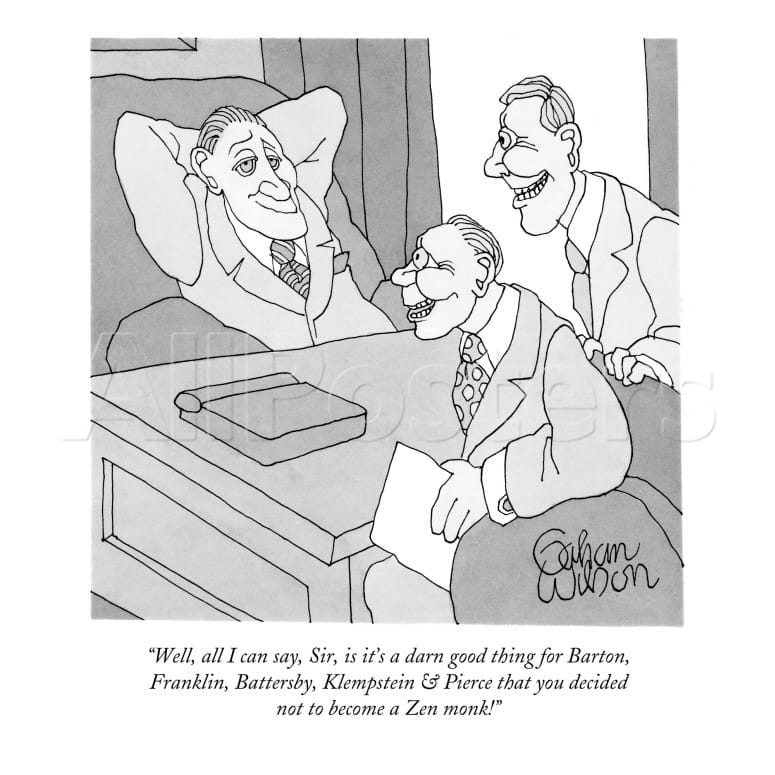
There should be some satisfaction to accomplishments, but I'm not sure how it's learned.

Learning should provide satisfaction –in particular religious learning — but it’s nicer if it goes with doing good for someone (not only the poor) and the ability to earn an honest income.

There should be a moral component of learning too, but here I feel less certain in describing it, or describing how it should be taught. Theodore Roosevelt said that “An uneducated man can steal from a rail car, “but an educated one can steal the whole railroad.” but perhaps stealing the railroad isn’t such a bad thing if it’s done legally. And as I don’t quite know when the honest stock deal is moral, I’m even more in the dark as to how to teach one to recognize the moral from the immoral in these situations. Two thoughts here: a student deserves some satisfaction from his or her learning and (from Aristotle’s Nicomachean Ethics) to be moral, the student has to earn an honest income. One who can not earn a living is bound to steal from someone sooner or later.

A final sign of learning, and perhaps it’s crown, is creativity, the ability to come to new understandings and develop new things. To do this productively requires some knowledge of the past plus an indescribable view of the future. A spark? A divine madness? Schools do not seem to be able to teach that, but it can help or hinder by either encouraging it, or beating it down. If you did not possess this ability when you entered school, you are unlikely to leave with it, even if you just did drugs, but school can teach one to direct the spark productively.

I’ve noticed that our high schools focus little on the above areas, perhaps because they are hard to test. Rather classes aim to the exams, and the exams test (as best I can tell), memorization, aptitude, and exposure. A surprisingly large fraction of our students leave diagnosed as ADHD. Still, strangely, our graduates do better than the Europeans.

Dr. Robert E. Buxbaum, December 29, 2014 (I taught in college). Here’s some advice I wrote for my 16 year old daughter in high school.