Category Archives: Science: Physics, Astronomy, etc.

you are what you eat?

The simplest understanding of this phrase is that you should eat good, healthy foods to be healthy, and that this will make you healthy in body and mind.

The author of the study published this book against GM foods simultaneously with release of his paper.

The author of this book against unhealthy foods faked his analysis to support the book.

Clearly there is some truth to this. Crazy people look crazy and often eat crazy. Even ‘normal’ people, if they eat too much are likely to become fat, lazy, and sick. There is a socio- economic effect (fat people earn less), and a physiological evidence that gut bacteria affects anxiety and depression (at least in rats). My sense here is at the diet extremes though. There is little, or no evidence to suggest you can make yourself more intelligent (or kind or good) by eating more of the right stuff, or just the right foods in just the right amounts. A better diet can make you look better, but there is a core lie at work when you extend this to imply that the real you is your body, or so tied to your body that a healthy mind can not be found in a sickly body. But most evidence is that the mind is the real you, and (following Socrates) that beautiful minds are found in sickly bodies. I’ve seen few (basically, no) healthy poets, writers, or great artists. Neither are there scientists of note (that I can recall) who lived without smoking, drinking, and any bad habits. Many creative people did drugs. George Orwell smoked cigarette, and died of TB, but wrote well to the end. There is no evidence that bad writing or thinking can be improved by health foods. Stupid is as stupid does, and many healthy people are clearly dolts.

Not that it’s always clear what constitutes good health, or what constitutes good food for health, or what constitutes a good mind. Skinny people may be admired and may earn more, but it is not clear they are healthy. Yule Gibbons, the natural food guru died young of stomach cancer. Adele Davis, another the author of “eat right to be healthy,” died of brain cancer. And Jim Fix, “the running doctor” died young of a heat attack while running. Their health foods may have killed them, and that unhealthy foods, like chocolate and coffee can be good for you. It’s likely a question of balance. While a person will feel better who dresses well, the extreme is probably no good. Very often, a person is drawn after his self-image to be the person he pretends. Show me a man who eats only vegetarian, and I’ll show you someone who sees himself as spiritual, or wants to be seen as spiritual. And that man is likely to be drawn to acting spiritual. Among the vegetarians you find Einstein, George B. Shaw, and Gandhi, people who may have been spiritual from the start, but may have been kept to spirituality from their diets. You also find Hitler: spirituality can take all sorts of forms.

Ward Sullivan in the New Yorker

Ward Sullivan in the New Yorker. People eat, drink, and dress like who they are. And people become like those they eat drink and dress like.

Choice of diet also helps select the people you run into. If you eat vegetarian, you’re likely to associate with other vegetarians, and you will likely behave like them. If you eat Chinese, Greek, or Mexican food, you’re likely to associate with these communities and behave like them. Similarly, an orthodox Jew or Moslem is tied to his community with every dinner and every purchase from the kosher or halal store.

And now we come to the bizarre science of bio-systems. Each person is a complex bio-system, with more non-human DNA than human, and more non-human cells than human. A person has a vast army of bugs on him, and a similarly vast pool of bugs within him. Recent research suggests that what we eat affects this bio-system, and through it our mental state. For whatever the mechanism, show me someone who drinks only 30 year Scotch or 40-year-old French wine, and I’ll show you a food snob. By contrast, show me someone who eats good, cheap food, and drinks good, cheap wine or Scotch (Lauder’s or Dewar’s), and I’ll show you a decent person very much like myself, a clever man who either is a man of the people or who wants to be known as one.”Dis-moi ce que tu manges, je te dirai ce que tu es.” [Tell me what you eat and I will tell you what you are].

Robert E. Buxbaum, February, 2015. My 16-year-old daughter asked me to write on this topic. Perhaps she didn’t know what it meant, or how true I thought it was, or perhaps she liked my challenges of being 16.
Is college worth no cost?

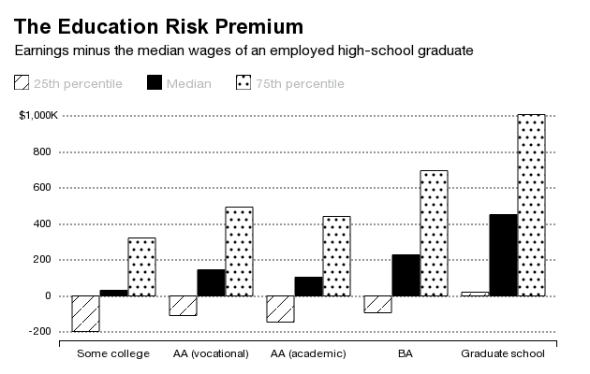
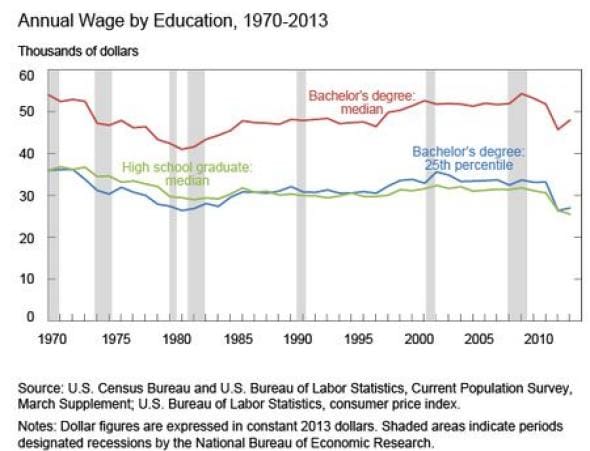
While a college degree gives most graduates a salary benefit over high school graduates this has to be balanced against the four years of not working. What’s more, a Bureau of Labor statistics study found that the salary benefits disappear if you graduate in the bottom 25% of your class, and if you don’t graduate at all you can end up losing salary money, especially if you go into low-paying fields like child development or physical sciences.

Salary benefits of a college degree are largely absent if you graduate in the bottom 25% of your class.

The average college graduate earns significantly more than a high school grad, but not if you attend a pricy school, or graduate in the bottom 1/4 of your class, or have the wrong major.

Most people realize there is a great earnings difference depending on your field of study with graduates in engineering and medicine doing better, financially. Even top graduates in child development or athletic sciences are barely able to justify the tuition and opportunity costs –it’s worse at an expensive college, but what isn’t always realized is that not everyone entering these fields graduates. For them, there is a steep loss when the tuition and four (or more) years of lost income are considered.

risk premium in wages

If you don’t graduate or get only an AA or 2 year degree the increase in wages is minimal, and you lose time working and whatever your costs of education. The loss is particularly high if you study social science fields at an expensive college, and don’t graduate, or if you graduate in the bottom of your class.

A report from the New York Federal Reserve finds that the highest pay major is petroleum engineering, mid-career salary $176,300/yr, and the bottom is child development, mid-career salary $36,400/yr (click the report link to check on your major). I’m not sure most students or advisors are aware of the steep salary difference, or that college gives a salary down-grade if one picks the wrong major, or does not complete the degree. In terms of earnings, you’d be better off avoiding even a free college in these areas unless you’re fairly sure you’ll complete the degree, or you really want to work in these fields.

Top earning majors Fed Reserve and Majors that pay you back.

Top earning majors: Majors that pay.

Of course college can provide more than money: knowledge, for instance, and learning: the ability to reason better. But these benefits are likely lost if you don’t work at it, or don’t go in a field you love. They can also come to those who study hard in self-taught reading. In either case, it is the work habits that will make you grow as a person, and leave you more employable. Tough colleges add a lot by exposure to new people and new ways of thinking about great books, and by forced experience in writing essays — but these benefits too are work-dependent and college dependent. If you work hard understanding a great book it will show. If you didn’t work at it, or only exposed yourself to easier fare, that too will show.

Colleges bend education to get students and keep them enrolled, to the detriment of the students. They understand that students don’t like criticism, and that good criticism is hard to give. As a result, many less-demanding colleges give little or no critical feedback, especially for disadvantaged students. This disadvantages them even more. You get is a positive experience, a nice campus, and a dramatic graduation, but this is not learning. Positivity isn’t bad, but is it worth the cost and 4-5 years of your life.

As an alternative to a liberal arts education, I present “Father” Guido Sarduchi, of Saturday Night LIve, and his “5 minute college experience.” To a surprising extent, it provides everything you’ll remember from 4 years of college in 5 minutes, including math, history, political science, and language (Spanish). For many Americans, Father Sarduchi’s 5 minutes may be a better investment than even a free 4 years in college.

Robert. E. Buxbaum. January 21-22, 2015. Education is what you get when you don’t get what you want.

Can you spot the man-made climate change?

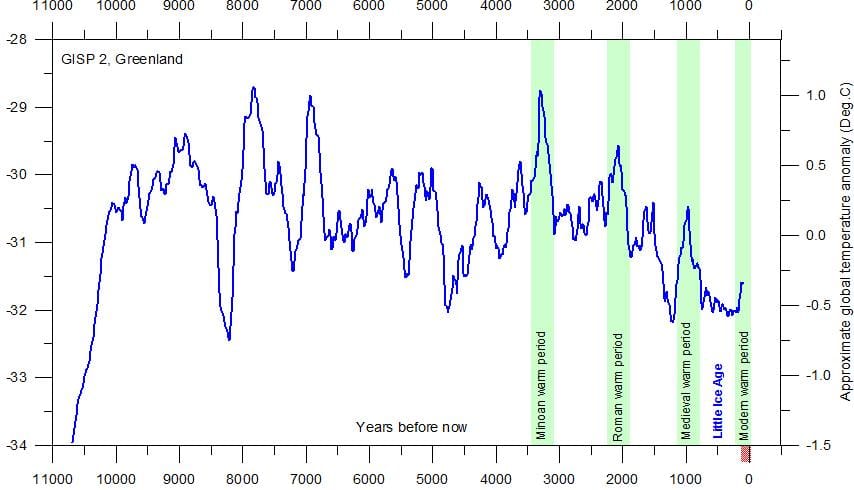
As best I can tell, the only constant in climate is change, As an example, the record of northern temperatures for the last 10,000 years, below, shows nothing but major ups and downs following the end of the last ice age 9500 years ago. The only pattern, if you call it a pattern, is fractal chaos. Anti-change politicos like to concentrate on the near-recent 110 years from 1890 to 2000. This is the small up line at the right, but they ignore the previous 10000 or more, ignore the fact that the last 17 years show no change, and ignore the variation within the 100 years (they call it weather). I find I can not spot the part of the change that’s man-made.

10,000 years of climate change based on greenland ice cores. Ole Humlum – Professor, University of Oslo Department of Geosciences.

10,000 years of northern climate temperatures based on Greenland ice cores. Dr. Ole Humlum, Dept. of Geosciences, University of Oslo. Can you spot the part of the climate change that’s man-made?

Jon Stewart makes the case for man-made climate change.

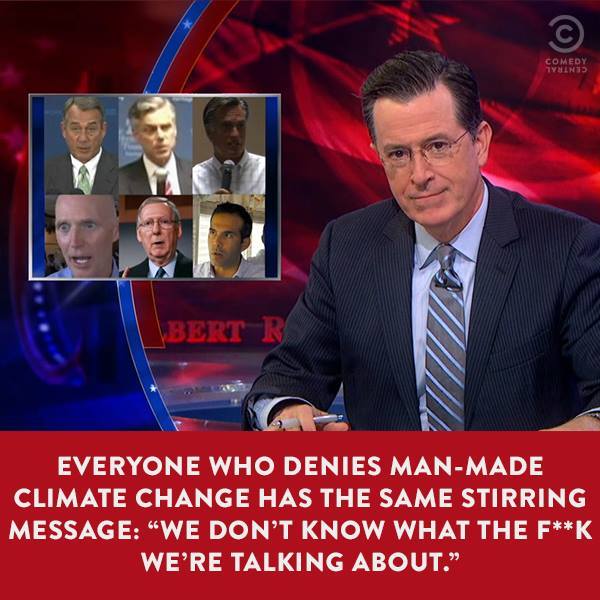
Steven Colbert makes his case for belief: If you don’t believe it you’re stupid.

Steven Colbert makes the claim that man-made climate change is so absolutely apparent that all the experts agree, and that anyone who doubts is crazy, stupid, or politically motivated (he, of course is not). Freeman Dyson, one of the doubters, is normally not considered crazy or stupid. The approach reminds me of “the emperor’s new clothes.” Only the good, smart people see it. The same people used to call it “Global Warming” based on a model prediction of man-made warming. The name was changed to “climate change” since the planet isn’t warming. The model predicted strong warming in the upper atmosphere, but that isn’t happening either; ski areas are about as cold as ever (we’ve got good data from ski areas).

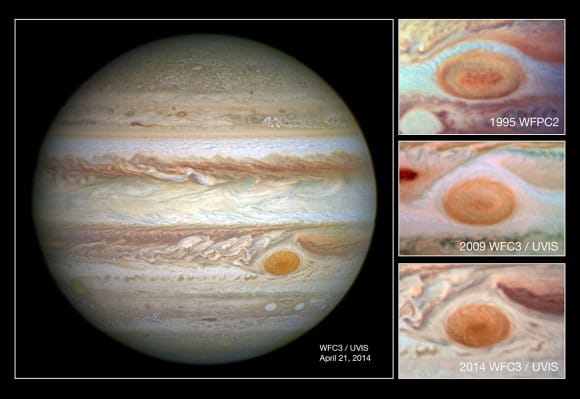
I note that the climate on Jupiter has changed too in the last 100 years. A visible sign of this is that the great red spot has nearly disappeared. But it’s hard to claim that’s man-made. There’s a joke here, somewhere.

Jupiter's red spot has shrunk significantly. Here it is now. NASA

Jupiter’s red spot has shrunk significantly. Here it is now. NASA

As a side issue, it seems to me that some global warming could be a good thing. The periods that were warm had peace and relative plenty, while periods of cold, like the little ice age, 500 years ago were times of mass starvation and plague. Similarly, things were a lot better during the medieval warm period (1000 AD) than during the dark ages 500-900 AD. The Roman warm period (100 BC-50 AD) was again warm and (relatively) civilized. Perhaps we owe some of the good food production of today to the warming shown on the chart above. Civilization is good. Robert E. Buxbaum January 14, 2015. (Corrected January 19; I’d originally labeled Steven Colbert as Jon Stewart)

Our expanding, black hole universe

In a previous post I showed a classical derivation of the mass-to-size relationship for black -holes and gave evidence to suggest that our universe (all the galaxies together) constitute a single, large black hole. Everything is inside the black hole and nothing outside but empty space — We can tell this because you can see outside from inside a black hole — it’s only others, outside who can not see in (Finkelstein, Phys Rev. 1958). Not that there appear to be others outside the universe, but if they were, they would not be able to see us.

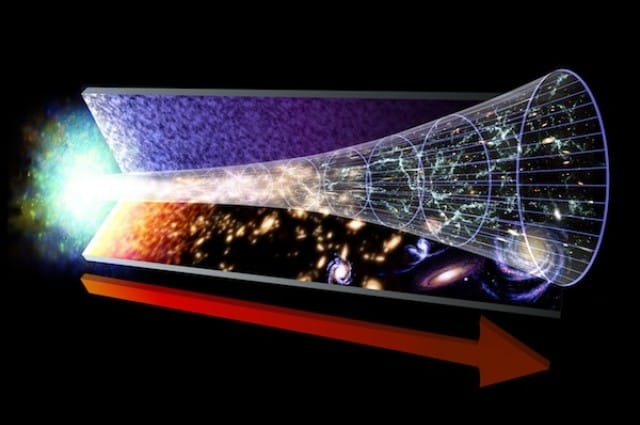
In several ways having a private, black hole universe is a gratifying thought. It provides privacy and a nice answer to an easily proved conundrum: that the universe is not infinitely big. The black hole universe that ends as the math requires, but not with a brick wall, as i the Hitchhiker’s guide (one of badly-laid brick). There are one or two problems with this nice tidy solution. One is that the universe appears to be expanding, and black holes are not supposed to expand. Further, the universe appears to be bigger than it should be, suggesting that it expanded faster than the speed of light at some point. its radius now appears to be 40-46 billion light years despite the universe appearing to have started as a point some 14 billion years ago. That these are deeply disturbing questions does not stop NASA and Nova from publishing the picture below for use by teachers. This picture makes little sense, but it’s found in Wikipedia and most, newer books.

Standard picture of the big bang theory. Expansions, but no contractions.

Standard picture of the big bang theory: A period of faster than light expansion (inflation) then light-speed, accelerating expansion. NASA, and Wikipedia.

We think the creation event occurred some 14 billion years ago because we observe that the majority of galaxies are expanding from us at a rate proportional to their distance from us. From this proportionality between the rate of motion and the distance from us, we conclude that we were all in one spot some 14 billion years ago. Unfortunately, some of the most distant galaxies are really dim — dimmer than they would be if they were only 14 billion light years away. The model “explains this” by a period of inflation, where the universe expanded faster than the speed of light. The current expansion then slowed, but is accelerating again; not slowing as would be expected if it were held back by gravity of the galaxies. Why hasn’t the speed of the galaxies slowed, and how does the faster-than-light part work? No one knows. Like Dr. Who’s Tardis, our universe is bigger on the inside than seems possible.

Einstein's preferred view of the black-hole universe is one that expands and contracts at some (large) frequency. It could explain why the universe is near-uniform.

Einstein’s oscillating universe: it expands and contracts at some (large) frequency. Oscillations would explain why the universe is near-uniform, but not why it’s so big or moving outward so fast.

Einstein’s preferred view was of an infinite space universe where the mass within expands and contracts. He joked that two things were infinite, the universe and stupidity… see my explanation... In theory, gravity could drive the regular contractions to an extent that would turn entropy backward. Einstein’s oscillating model would explain how the universe is reasonably stable and near-uniform in temperature, but it’s not clear how his universe could be bigger than 14 billion light years across, or how it could continue to expand as fast as it does. A new view, published this month suggests that there are two universes, one going forward in time the other backward. The backward in time part of the universe could be antimatter, or regular matter going anti entropy (that’s how I understand it — If it’s antimatter, we’d run into the it all the time). Random other ideas float through the physics literature: that we’re connected to other space through a black hole/worm hole, perhaps to many other universes by many worm holes in fractal chaos, see for example, Physics Reports, 1992.

The forward-in-time expansion part of the two universes model.

The forward-in-time expansion part of the two universes model. This drawing, like the first, is from NASA.

For all I know, there are these many black hole  tunnels to parallel universes. Perhaps the universal constant and all these black-hole tunnels are windows on quantum mechanics. At some point the logic of the universe seems as perverse as in the Hitchhiker guide.

Something I didn’t mention yet is the Higgs boson, the so-called God particle. As in the joke, it’s supposed to be responsible for mass. The idea is that all particles have mass only by interaction with these near-invisible Higgs particles. Strong interactions with the Higgs are what make these particles heavier, while weaker – interacting particles are perceived to have less gravity and inertia. But this seems to me to be the theory that Einstein’s relativity and the 1919 eclipse put to rest. There is no easy way for a particle model like this to explain relativistic warping of space-time. Without mass being able to warp space-time you’d see various degrees of light bending around the sun, and preferential gravity in the direction of our planet’s motion: things we do not see. We’re back in 1900, looking for some plausible explanation for the uniform speed of light and Lawrence contraction of space.As likely an explanation as any the_hitchhikers_guide_to_the_galaxy

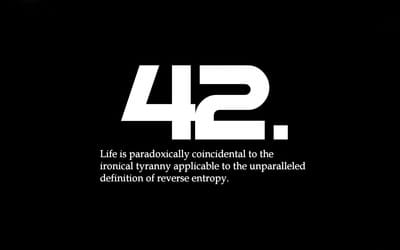
Dr. r µ ßuxbaum. December 20, 2014. The  meaning of the universe could be 42 for all I know, or just pickles down the worm hole. No religion seems to accept the 14 billion year old universe, and for all I know the God of creation has a wicked sense of humor. Carry a towel and don’t think too much.

Statistics of death and taxes — death on tax day

Strange as it seems, Americans tend to die in road accidents on tax-day. This deadly day is April 15 most years, but on some years April 15th falls out on a weekend and the fatal tax day shifts to April 16 or 17. Whatever weekday it is, about 8% more people die on the road on tax day than on the same weekday a week earlier or a week later; data courtesy of the US highway safety bureau and two statisticians, Redelmeier and Yarnell, 2014.

Forest plot of individuals in fatal road crashes over 30 years. X-axis shows relative increase in risk on tax days compared to control days expressed as odds ratio. Y-axis denotes subgroup (results for full cohort in final row). Column data are counts of individuals in crashes. Analytic results expressed with 95% confidence intervals setting control days as referent. Results show increased risk on tax day for full cohort, similar increase for 25 of 27 subgroups, and all confidence intervals overlapping main analysis. Recall that odds ratios are reliable estimates of relative risk when event rates are low from an individual driver’s perspective.

Forest plot of individuals in fatal road crashes for the 30 years to 2008  on US highways (Redelmeier and Yarnell, 2014). X-axis shows relative increase in risk on tax days compared to control days expressed as odds ratio. Y-axis denotes subgroup (results for full cohort in final row). Column data are counts of individuals in crashes (there are twice as many control days as tax days). Analytic results are 95% confidence intervals based on control days as referent. Dividing the experimental subjects into groups is a key trick of experimental design.

To confirm that the relation isn’t a fluke, the result of well-timed ice storms or football games, the traffic death data was down into subgroups by time, age, region etc– see figure. Each groups showed more deaths than on the average of the day a week before and after.

The cause appears unrelated to paying the tax bill, as such. The increase is near equal for men and women; with alcohol and without, and for those over 18 and under (presumably those under 18 don’t pay taxes). The death increase isn’t concentrated at midnight either, as might be expected if the cause were people rushing to the post office. The consistency through all groups suggests this is not a quirk of non-normal data, nor a fluke but a direct result of  tax-day itself.Redelmeier and Yarnell suggest that stress — the stress of thinking of taxes — is the cause.

Though stress seems a plausible explanation, I’d like to see if other stress-related deaths are more common on tax day — heart attack or stroke. I have not done this, I’m sorry to say, and neither have they. General US death data is not tabulated day by day. I’ve done a quick study of Canadian tax-day deaths though (unpublished) and I’ve found that, for Canadians, Canadian tax day is even more deadly than US tax day is for Americans. Perhaps heart attack and stroke data is available day by day in Canada (?).

Robert Buxbaum, December 12, 2014. I write about all sorts of stuff. Here’s my suggested, low stress income tax structure, and a way to reduce/ eliminate income taxes: tariffs– they worked till the Civil war. Here’s my thought on why old people have more fatal car accidents per mile driven.

Seniors are not bad drivers.

Seniors cause accidents, but need to get places too

Seniors are often made fun of for confusion and speeding, but it’s not clear they speed, and it is clear they need to get places. Would reduced speed limits help them arrive alive?

Seniors have more accidents per-mile traveled than middle age drivers. As shown on the chart below, older Canadians, 75+, get into seven times more fatal accidents per mile than 35 to 55 year olds. At first glance, this would suggest they are bad drivers who should be kept from the road, or at least made to drive slower. But I’m not so sure they are bad drivers, and am pretty certain that lower speed limits should not be generally imposed. I suspect that a lot of the problem comes from the a per-mile basis comparison with folks who drive long distances on the same superhighways instead of longer, leisurely drives on country roads. I suspect that, on a per-hour basis, the seniors would look a lot safer, and on a per highway-mile basis they might look identical to younger drivers.

Canadian Vehicle Survey, 2001, Statistics Canada, includes drivers of light duty vehicles.

Deaths per billion km. Canadian Vehicle Survey, 2001, Statistics Canada, includes light duty vehicles.

Another source of misunderstanding, I find, is that comparisons tend to overlook how very low the accident rates are. The fatal accent rate for 75+ year old drivers sounds high when you report it as 20 deaths per billion km. But that’s 50,000,000 km between fatalities, or roughly one fatality for each 1300 drives around the earth. In absolute terms it’s nothing to worry about. Old folks driving provides far fewer deaths per km than 12-29 year olds walking, and fewer deaths per km than for 16-19 year olds driving.

When starting to research this essay, I thought I’d find that the high death rates were the result of bad reaction times for the elderly. I half expected to find that reduced speed limits for them helped. I’ve not found any data directly related to reduced speeds, but now think that lowered speed limits would not help them any more than anyone else. I note that seniors drive for pleasure more than younger folks and do a lot more short errand drives too — to the stores, for example. These are places where accidents are more common. By contrast, 40 to 70 year olds drive more miles on roads that are relatively safe.

Don't walk, especially if you're old.

Don’t walk, especially if you’re old. Netherlands data, 2001-2005 fatalities per billion km.

The Netherlands data above suggest that any proposed solution should not involve getting seniors out of their cars. Not only do seniors find walking difficult, statistics suggest walking is 8 to 10 times more dangerous than driving, and bicycling is little better. A far better solution, I suspect, is reduced speeds for everyone on rural roads. If you’re zipping along a one-lane road at the posted 40, 55, or 60 mph and someone backs out of a driveway, you’re toast. The high posted speeds on these roads pose a particular danger to bicyclists and motorcyclists of all ages – and these are folks who I suspect drive a lot on the rural roads. I suspect that a 5 mph reduction would do quite a lot.

For automobiles on super-highways, it may be worthwhile to increase the speed limits. As things are now, the accident fatality rates are near zero, and the main problem may be the time wasted behind the wheel – driving from place to place. I suspect that an automobile speed limit raise to 80 mph would make sense on most US and Canadian superhighways; it’s already higher on the Autobahn in Germany.

Robert Buxbaum, November 24, 2014. Expect an essay about death on tax-day, coming soon. I’ve also written about marijuana, and about ADHD.

A simple, classical view of and into black holes

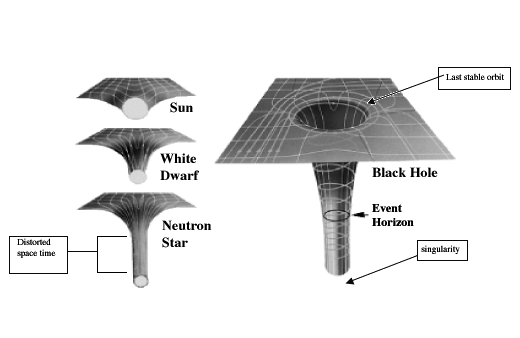
Black holes are regions of the universe where gravity is so strong that light can not emerge. And, since the motion of light is related to the fundamental structure of space and time, they must also be regions where space curves on itself, and where time appears to stop — at least as seen by us, from outside the black hole. But what does space-time look like inside the black hole.

NASA's semi-useless depiction of a black hole -- one they created for educators. I'm not sure what you're supposed to understand from this.

NASA’s semi-useless depiction of a black hole — one they created for educators. Though it’s sort of true, I’m not sure what you’re supposed to understand from this. I hope to present a better version.

From our outside perspective, an object tossed into a black hole will appear to move slower as it approaches the hole, and at the hole horizon it will appear to have stopped. From the inside of the hole, the object appears to just fall right in. Some claim that tidal force will rip it apart, but I think that’s a mistake. Here’s a simple, classical way to calculate the size of a black hole, and to understand why things look like they do and do what they do.

Lets begin with light, and accept, for now, that light travels in particle form. We call these particles photons; they have both an energy and a mass, and mostly move in straight lines. The energy of a photon is related to its frequency by way of Plank’s constant. E = hν, where E is the photon energy, h is Plank’s constant and ν is frequency. The photon mass is related to its energy by way of the formula m=E/c2, a formula that is surprisingly easy to derive, and often shown as E= mc2. The version that’s relevant to photons and black holes is:

m =  hν/c2.

Now consider that gravity affects ν by affecting the energy of the photon. As a photon goes up, the energy and frequency goes down as energy is lost. The gravitational force between a star, mass M, and this photon, mass m, is described as follows:

F = -GMm/r2

where F is force, G is the gravitational constant, and r is the distance of the photon from the center of the star and M is the mass of the star. The amount of photon energy lost to gravity as it rises from the surface is the integral of the force.

∆E = – ∫Fdr = ∫GMm/r2 dr = -GMm/r

Lets consider a photon of original energy E° and original mass m°= E°/c2. If ∆E = m°c2, all the energy of the original photon is lost and the photon disappears. Now, lets figure out the height, r° such that all of the original energy, E° is lost in rising away from the center of a star, mass M. That is let calculate the r for which ∆E = -E°. We’ll assume, for now, that the photon mass remains constant at m°.

E° = GMm°/r° = GME°/c2r°.

We now eliminate E° from the equation and solve for this special radius, r°:

r° =  GM/c2.

This would be the radius of a black hole if space didn’t curve and if the mass of the photon didn’t decrease as it rose. While neither of these assumptions is true, the errors nearly cancel, and the true value for r° is double the size calculated this way.

r° = 2GM/c2

r° = 2.95 km (M/Msun).

schwarzschild

Karl Schwarzschild 1873-1916.

The first person to do this calculation was Karl Schwarzschild and r° is called the Schwarzschild radius. This is the minimal radius for a star of mass M to produce closed space-time; a black hole. Msun is the mass of our sun, sol, 2 × 1030 kg.  To make a black hole one would have to compress the mass of our sun into a ball of 2.95 km radius, about the size of a small asteroid. Space-time would close around it, and light starting from the surface would not be able to escape.

As it happens, our sun is far bigger than an asteroid and is not a black hole: we can see light from the sun’s surface with minimal space-time deformation (there is some seen in the orbit of Mercury). Still, if the mass were a lot bigger, the radius would be a lot bigger and the density would be less. Consider a black hole the same mass as our galaxy, about 1 x1012 solar masses, or 2 x 1042  kg. This number is ten times what you might expect since our galaxy is 90% dark matter. The Schwarzschild radius with the mass of our galaxy would be 3 x 1012 km, or 0.3 light years. That’s far bigger than our solar system, and about 1/20 the distance to the nearest star, Alpha Centauri. This is a very big black hole, though it is far smaller than our galaxy, 5 x 10¹⁷ km, or 50,000 light years. The density, though is not all that high.

Now let’s consider a black hole comprising 15 billion galaxies, the mass of the known universe. The folks at Cornell estimate the sum of dark and luminous matter in the universe to be 3 x 1052 kg, about 15 billion times the mass of our galaxy. This does not include the mass hidden in the form of dark energy, but no one’s sure what dark energy is, or even if it really exists. A black hole encompassing this, known mass would have a Schwarzschild radius about 4.5 billion light years, or about 1/3 the actual size of the universe when size is calculated based on its Hubble-constant age, 14 billion years. The universe may be 2-3 times bigger than this on the inside because space is curved and, rather like Dr. Who’s Tardis it’s bigger on the inside, but in astronomical terms a factor of 3 or 10 is nothing: the actual size of the known universe is remarkably similar to its Schwarzschild radius, and this is without considering the mass its dark energy must have if it exists.

Standard picture of the big bang theory. Dark energy causes the latter-stage expansion.

Standard picture of the big bang theory. Dark energy causes the latter-stage expansion.

The evidence for dark energy is that the universe is expanding faster and faster instead of slowing. See figure. There is no visible reason for the acceleration, but it’s there. The source of the energy might be some zero-point effect, but wherever it comes from, the significant amount of energy must have significant mass, E = mc2. If the mass of this energy is 3 to 10 times the physical mass, as seems possible, we are living inside a large black hole, something many physicists, including Einstein considered extremely likely and aesthetically pleasing. Einstein originally didn’t consider the possibility that the hole could be expanding, but a reviewer of one of his articles convinced him it was possible.

Based on the above, we now know how to calculate the size of a black hole of any mass, and we now know what a black hole the size of the universe would look like from the inside. It looks just like home. Wait for further posts on curved space-time. For some reason, no religion seems to embrace science’s 14 billion year old, black-hole universe (expanding or not). As for the tidal forces around black holes, they are horrific only for the small black holes that most people write about. If the black hole is big, the tidal forces are small.

 Dr. µß Buxbaum Nov 17, 2014. The idea for this post came from an essay by Isaac Asimov that I read in a collection called “Buy Jupiter.” You can drink to the Schwarzchild radius with my new R° cocktail.

Change your underwear, bomber; of mites and men

The underware bomber mites make it right.

Umar, the underwear bomber.

For those who don’t know it, the underwear bomber, Umar Farook Abdulmutallab, wore his pair of explosive underwear for 3 weeks straight before trying to detonate them while flying over Detroit in 2009. They didn’t go off, leaving him scarred for life. It’s quite possible that the nasty little mites that live in underwear stopped the underwear bomber. They are a main source of US allergens too.

Dust mite, skin, and pollen seen with a light  microscope. Gimmie some skin.

Dust mite, skin, and pollen seen with a light microscope. Gimmie some skin.

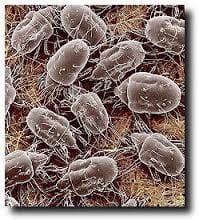
If you’ve ever used an electron microscope to look at household objects, you’ll find them covered with brick-like flakes of dried out skin-cells: yours and your friends’. Each person sheds his or her skin every month, on average. The outer layer dries out and flakes off as new skin grows in behind it. Skin flakes are the single largest source of household dust, and if not for the fact that these flakes are the main food for mites, your house would be chock full of your left over skin. When sunlight shines in your window, you see the shimmer of skin-flakes hanging in the air. Under the electron microscope, the fresh skin flakes look like bricks, but mite-eaten skin flakes look irregular. Less common, but more busy are the mites.

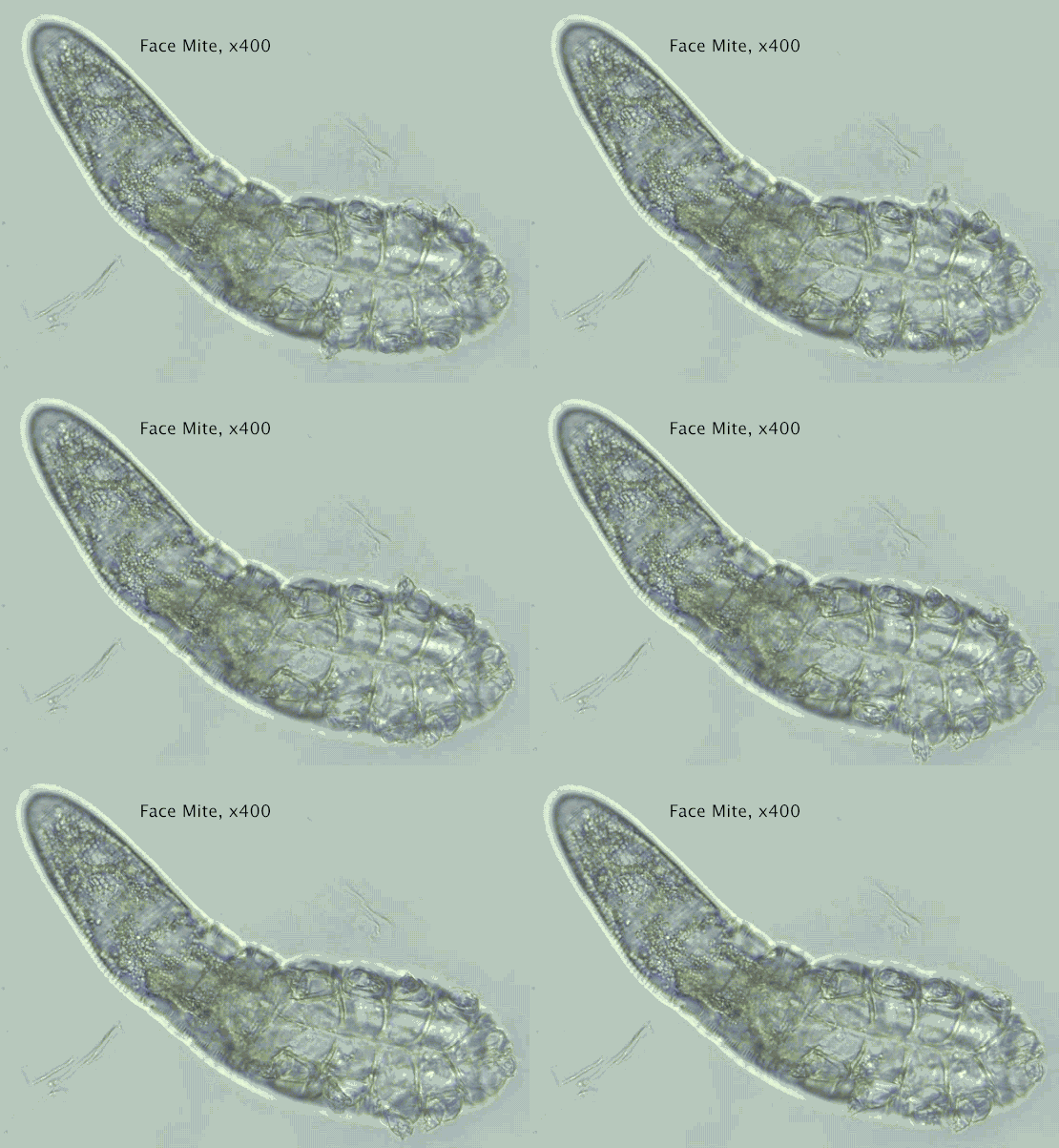
The facial mite movie. They live on in us, about 1 per hair follicle, particularly favoring eyelashes. Whenever you shower, your shower with a friend.

The facial mite movie. They live on in us, about 1 per hair follicle, particularly favoring eyelashes. Whenever you shower, you shower with a friend.

Dry skin is mostly protein (keratin), plus cholesterol and squalene. This provides great nutrition for dust mites and their associated bacteria. In warm, damp environments, as in your underwear or mattress, these beasties multiply and eat the old skin. The average density of dust mites on a mattress is greater than 2500/gram of dust.[1]  The mites leave behind excrement and broken off mite-limbs: nasty bits that are the most common allergens in the US today.

An allergy to dust shows up as sneezing, coughing, clogged lungs, and eczema. The most effective cure is a high level of in-home hygiene; mites don’t like soap or dry air. You’ve go to mop and vacuum regularly. Clean and change your clothing, particularly your undergarments; rotate your mattresses, and shake the dust out of your bedding. Vacuuming is less-effective as a significant fraction of the nasties go through the filter and get spread around by the vacuum blower.

As it turns out, dust mites and their bacteria eat more than skin. They also eat dried body fluids, poop residue, and the particular explosive used by Umar Farook, pentaerythritol tetra nitrate, PETN (humans can eat and metabolize this stuff too — it’s an angina treatment). The mites turn PETN into less-explosive versions, plus more mites.

Mighty mites as seen with electron microscopy. They eat more than skin.

Mighty mites as seen with electron microscopy. They eat more than skin.

There are many varieties of mite living on and among us. Belly button mites, for example, and face mites as shown above (click on the image to see it move). On average, people have one facial mite per hair follicle. It’s also possible that the bomber was stopped by poor quality control engineering and not mites at all. Religion tends to be at odds with a science like quality control, and followers tend to put their faith in miracles.

Chigger turning on a dime

Chigger turning on a dime

larger than the dust mite is the chigger, shown at left. Chiggers leave visible bites, particularly along the underwear waste-band. There are larger-yet critters in the family: lice, bed bugs, crabs. Bathing regularly, and cleaning your stuff will rid yourself of all these beasties, at least temporarily. Keeping your hair short and your windows open helps too. Mites multiply in humid, warm environments. Opening the windows dries and cools the air, and blows out mite-bits that could cause wheezing. Benjamin Franklin and took air-baths too: walking around naked with the windows open, even in winter. It helped that he lived on the second floor. Other ways to minimize mite growth include sunlight, DOT (a modern version of DDT), and eucalyptus oil. At the very minimum, change your underwear regularly. It goes a long way to reduce dust embarrassing moments at the jihadist convention.

Dr. Robert E. Buxbaum, Sept 21, 2014. Not all science or life is this weird and wonderful, but a lot is, and I prefer to write about the weird and wonderful bits. See e.g. the hazards of health food, the value of sunshine, or the cancer hazard of living near a river. Or the grammar of pirates.

New mixed drink, the R°

Earlier this week, R__ turned 21, the drinking age in most of the USA. As a gift to her, I thought I might invent a new mixed drink that would suit her taste, and make her birthday more special. My requirements: that it should be kosher, that it’s made with widely available ingredients; that it should be relatively sophisticated, that it should be lower in alcohol (a fatherly concern), and that it should taste good to her and the general public.

The R___: gin tonic and grenadine

The R°: gin, tonic , ice, and grenadine

What I came up with, is something I call,The R°. It’s a modification of one of the great drinks of the western world, the gin and tonic. My modification is to use less gin, and to use grenadine instead of the traditional squeeze of lime. As she gets older, she may want to increase the gin content. The recipe: put 2/3 shot gin in a 10 oz straight-sided glass. Fill the glass 2/3 full of ice, near-fill with tonic water, and add a dash of grenadine, 1/4 shot or so (I used Rose’s). Stir slightly so the pink color stays mostly on the bottom. The result is slightly sweeter than the traditional gin and tonic, kosher in almost all places (you’ve got to check, but generally true), fairly sophisticated, good-tasting, and a reminder of Israel, a country where pomegranates grow all over. If you order one at a place with black lights and doesn’t stir much,you’ll discover that the tonic water glows electric-blue.

The verdict: R__ liked it. My hope is that you will enjoy it too. As a literary note, grenade is French for pomegranate; hand grenades got their name because of the shape. This drink is also suitable for talk like a pirate day (September 19).

Sept 14, 2014. My only previous gastronomic post was a recipe to make great lemonade. For a song by my daughter, go here, or here. For a joke about a neutron walking into a bar, go here.

The speed of sound, Buxbaum’s correction

Ernst Mach showed that sound must travel at a particular speed through any material, one determined by the conservation of energy and of entropy. At room temperature and 1 atm, that speed is theoretically predicted to be 343 m/s. For a wave to move at any other speed, either the laws of energy conservation would have to fail, or ∆S ≠ 0 and the wave would die out. This is the only speed where you could say there is a traveling wave, and experimentally, this is found to be the speed of sound in air, to good accuracy.

Still, it strikes me that Mach’s assumptions may have been too restrictive for short-distance sound waves. Perhaps there is room for other sound speeds if you allow ∆S > 0, and consider sound that travels short distances and dies out far from the source. Waves at these, other speeds might affect music appreciation, or headphone design. As these waves were never treated in my thermodynamics textbooks, I wondered if I could derive their speed in any nice way, and if they were faster or slower than the main wave? (If I can’t use this blog to re-think my college studies, what good is it?)

I t can help to think of a shock-wave of sound wave moving down a constant area tube of still are at speed u, with us moving along at the same speed as the wave. In this view, the wave appears stationary, but there is a wind of speed u approaching it from the left.

Imagine the sound-wave moving to the right, down a constant area tube at speed u, with us moving along at the same speed. Thus, the wave appears stationary, with a wind of speed u from the right.

As a first step to trying to re-imagine Mach’s calculation, here is one way to derive the original, for ∆S = 0, speed of sound: I showed in a previous post that the entropy change for compression can be imagines to have two parts, a pressure part at constant temperature: dS/dV at constant T = dP/dT at constant V. This part equals R/V for an ideal gas. There is also a temperature at constant volume part of the entropy change: dS/dT at constant V = Cv/T. Dividing the two equations, we find that, at constant entropy, dT/dV = RT/CvV= P/Cv. For a case where ∆S>0, dT/dV > P/Cv.

Now lets look at the conservation of mechanical energy. A compression wave gives off a certain amount of mechanical energy, or work on expansion, and this work accelerates the gas within the wave. For an ideal gas the internal energy of the gas is stored only in its temperature. Lets now consider a sound wave going down a tube flow left to right, and lets our reference plane along the wave at the same speed so the wave seems to sit still while a flow of gas moves toward it from the right at the speed of the sound wave, u. For this flow system energy is concerned though no heat is removed, and no useful work is done. Thus, any change in enthalpy only results in a change in kinetic energy. dH = -d(u2)/2 = u du, where H here is a per-mass enthalpy (enthalpy per kg).

dH = TdS + VdP. This can be rearranged to read, TdS = dH -VdP = -u du – VdP.

We now use conservation of mass to put du into terms of P,V, and T. By conservation of mass, u/V is constant, or d(u/V)= 0. Taking the derivative of this quotient, du/V -u dV/V2= 0. Rearranging this, we get, du = u dV/V (No assumptions about entropy here). Since dH = -u du, we say that udV/V = -dH = -TdS- VdP. It is now common to say that dS = 0 across the sound wave, and thus find that u2 = -V(dP/dV) at const S. For an ideal gas, this last derivative equals, PCp/VCv, so the speed of sound, u= √PVCp/Cv with the volume in terms of mass (kg/m3).

The problem comes in where we say that ∆S>0. At this point, I would say that u= -V(dH/dV) = VCp dT/dV > PVCp/Cv. Unless, I’ve made a mistake (always possible), I find that there is a small leading, non-adiabatic sound wave that goes ahead of the ordinary sound wave and is experienced only close to the source caused by mechanical energy that becomes degraded to raising T and gives rise more compression than would be expected for iso-entropic waves.

This should have some relevance to headphone design and speaker design since headphones are heard close to the ear, while speakers are heard further away. Meanwhile the recordings are made by microphones right next to the singers or instruments.

Robert E. Buxbaum, August 26, 2014