Category Archives: politics

Gatling guns and the Spanish American War

I rather like inventions and engineering history, and I regularly go to the SME, a fair of 18th to 19th century innovation. I am generally impressed with how these machines work, but what really brings things out is when talented people use the innovation to do something radical. Case in point, the Gatling gun; invented by Richard J. Gatling in 1861 for use in the Civil war, it was never used there, or in any major war until 1898 when Lieut. John H. Parker (Gatling Gun Parker) showed how to deploy them successfully, and helped take over Cuba. Until then, they were considered another species of short-range, grape-shot cannon, and ignored.

1876_Gatling_gun_NPS_Fort_Laramie_WY_by-Matthew_Trump_2004

A Gatling gun of the late 1800s. Similar, but not identical to the ones Parker brought along.

Parker had sent his thoughts on how to deploy a Gatling gun in a letter to West Point, but they were ignored, as most new thoughts are. For the Spanish-American War, Parker got 4 of the guns, trained his small detachment to use them, and registered as a quartermaster corp in order to sneak them aboard ship to Cuba. Here follows Theodore Roosevelt’s account of their use.

“On the morning of July 1st, the dismounted cavalry, including my regiment, stormed Kettle Hill, driving the Spaniards from their trenches. After taking the crest, I made the men under me turn and begin volley-firing at the San Juan Blockhouse and entrenchment’s against which Hawkins’ and Kent’s Infantry were advancing. While thus firing, there suddenly smote on our ears a peculiar drumming sound. One or two of the men cried out, “The Spanish machine guns!” but, after listening a moment, I leaped to my feet and called, “It’s the Gatlings, men! It’s our Gatlings!” Immediately the troopers began to cheer lustily, for the sound was most inspiring. Whenever the drumming stopped, it was only to open again a little nearer the front. Our artillery, using black powder, had not been able to stand within range of the Spanish rifles, but it was perfectly evident that the Gatlings were troubled by no such consideration, for they were advancing all the while.

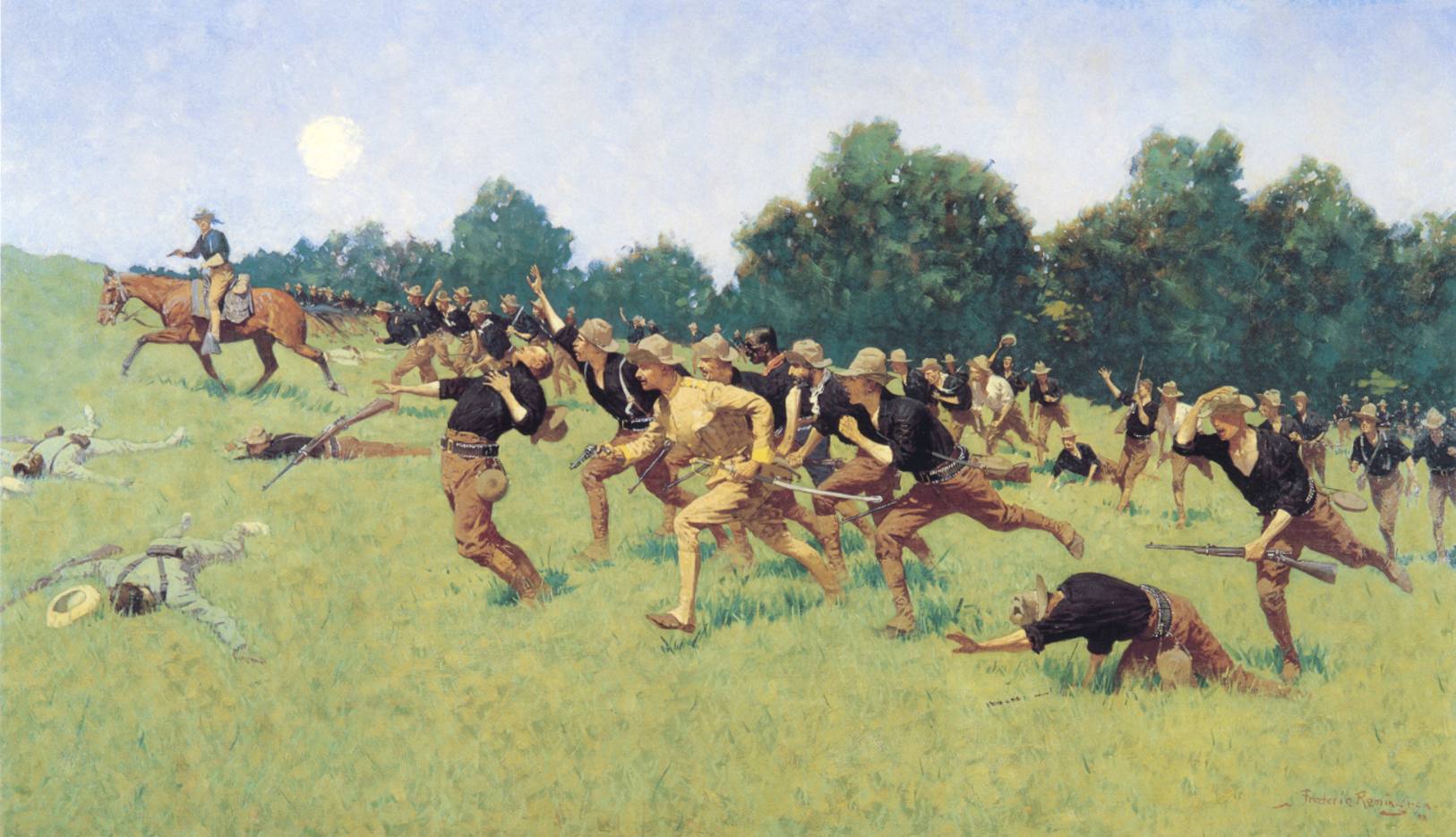
Roosevelt and the charge up Kettle Hill, Frederick Remington

Roosevelt, his volunteers, and the Buffalo soldiers charge up Kettle Hill, Frederick Remington.

Soon the infantry took San Juan Hill, and, after one false start, we in turn rushed the next line of block-houses and intrenchments, and then swung to the left and took the chain of hills immediately fronting Santiago. Here I found myself on the extreme front, in command of the fragments of all six regiments of the cavalry division. I received orders to halt where I was, but to hold the hill at all hazards. The Spaniards were heavily reinforced and they opened a tremendous fire upon us from their batteries and trenches. We laid down just behind the gentle crest of the hill, firing as we got the chance, but, for the most part, taking the fire without responding. As the afternoon wore on, however, the Spaniards became bolder, and made an attack upon the position. They did not push it home, but they did advance, their firing being redoubled. We at once ran forward to the crest and opened on them, and, as we did so, the unmistakable drumming of the Gatlings opened abreast of us, to our right, and the men cheered again. As soon as the attack was definitely repulsed, I strolled over to find out about the Gatlings, and there I found Lieut. Parker with two of his guns right on our left, abreast of our men, who at that time were closer to the Spaniards than any others.

From thence on, Parker’s Gatlings were our inseparable companion throughout the siege. They were right up at the front. When we dug our trenches, he took off the wheels of his guns and put them in the trenches. His men and ours slept in the same bomb-proofs and shared with one another whenever either side got a supply of beans or coffee and sugar. At no hour of the day or night was Parker anywhere but where we wished him to be, in the event of an attack. If a troop of my regiment was sent off to guard some road or some break in the lines, we were almost certain to get Parker to send a Gatling along, and, whether the change was made by day or by night, the Gatling went. Sometimes we took the initiative and started to quell the fire of the Spanish trenches; sometimes they opened upon us; but, at whatever hour of the twenty-four the fighting began, the drumming of the Gatlings was soon heard through the cracking of our own carbines.

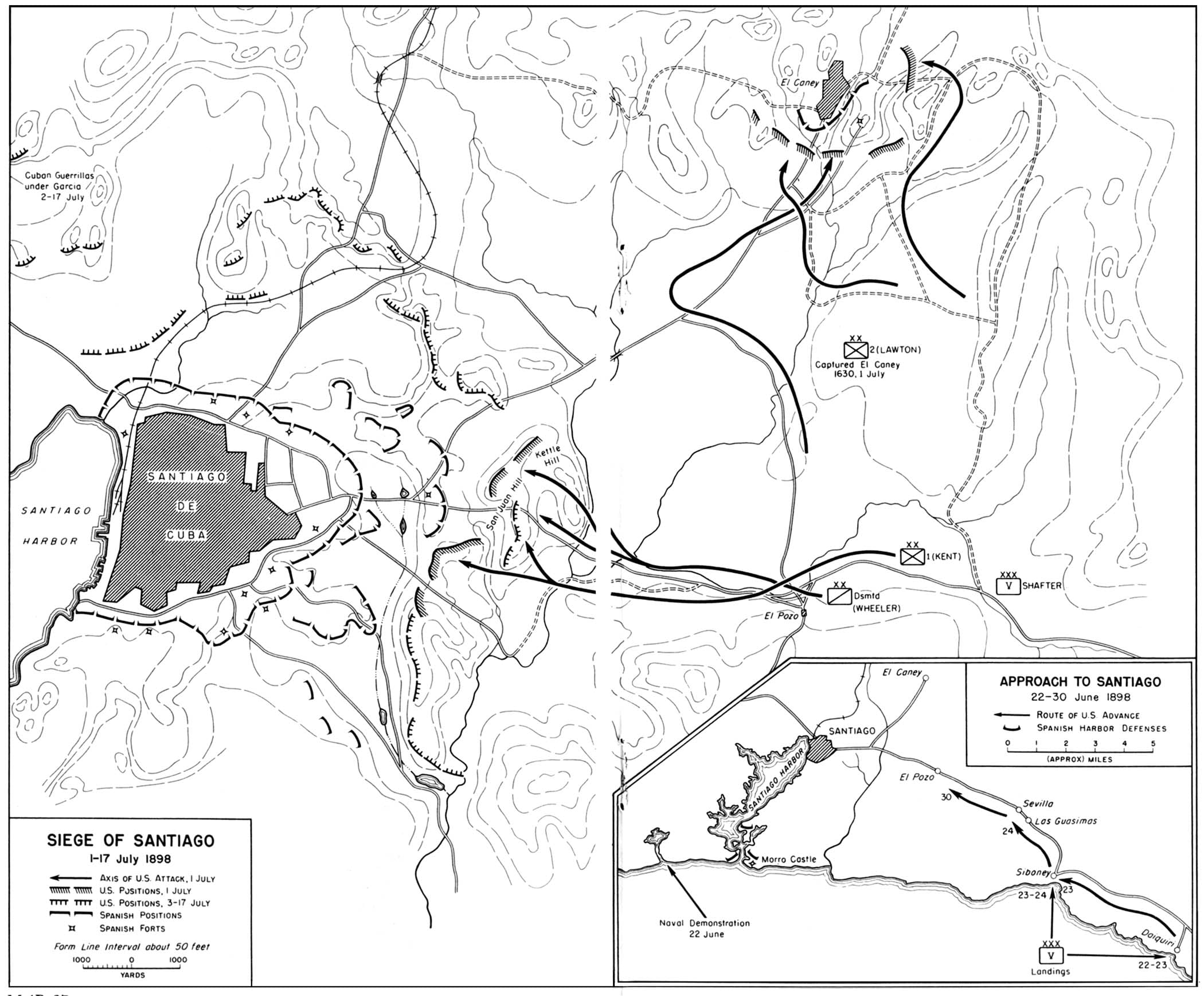
Map of the Attack on Kettle Hill and San Juan Hill in the Spanish American War.

Map of the Attack on Kettle Hill and San Juan Hill in the Spanish-American War, July 1, 1898 The Spanish had 760 troops n the in fortified positions defending the crests of the two hills, and 10,000 more defending Santiago. As Americans were being killed in “hells pocket” near the foot of San Juan Hill, from crossfire, Roosevelt, on the right, charged his men, the “Rough Riders” [1st volunteers] and the “Buffalo Soldiers [10th cavalry], up Kettle Hill in hopes of ending the crossfire and of helping to protect troops that would charge further up San Juan Hill. Parker’s Gatlings were about 600 yards from the Spanish and fired some 700 rounds per minute into the Spanish lines. Theyy were then repositioned on the hill to beat back the counter attack. Without the Parker’s Gatling guns, the chances of success would have been small.

I have had too little experience to make my judgment final; but certainly, if I were to command either a regiment or a brigade, whether of cavalry or infantry, I would try to get a Gatling battery–under a good man–with me. I feel sure that the greatest possible assistance would be rendered, under almost all circumstances, by such a Gatling battery, if well handled; for I believe that it could be pushed fairly to the front of the firing-line. At any rate, this is the way that Lieut. Parker used his battery when he went into action at San Juan, and when he kept it in the trenches beside the Rough Riders before Santiago.”

Here is how the Gatling gun works; it’s rather like 5 or more rotating zip guns; a pall pulls and releases the firing pins. Gravity feeds the bullets at the top and drops the shells out the bottom. Lt’ Parker’s deployment innovation was to have them hand-carried to protected positions, near-enough to the front that they could be aimed. The swivel and rapid fire of the guns allowed the shooter to aim them to correct for the drop in the bullets over fairly great distances. This provided rapid-fire accurate protection from positions that could not be readily hit. Shortly after the victory on San Juan HIll, July 1 1898, the Spanish Caribbean fleet was destroyed July 3, Santiago surrendered July 17, and all of Cuba surrendered 4 days later, July 21 (my birthday) — a remarkably short war. While TR may not have figured out how to use the Gatling guns effectively, he at least recognized that Lt. John Parker had.

A new type of machine gun,  a colt browning repeating rifle, a gift from Con'l Roosevelt to John Parker's Gatling gun detachment.

Roosevelt gave two of these, more modern, Colt-Browning repeating rifles to Parker’s detachment the day after the battle. They were not particularly effective. By WWI, “Gatling Gun” Parker would be a general; by 1901 Roosevelt would be president.

The day after the battle, Col. Roosevelt gifted Parker’s group with two Colt-Browning machine guns that he and his family had bought, but had not used. According to Roosevelt, but these rifles, proved to be “more delicate than the Gatlings, and very readily got out-of-order.” The Brownings are the predecessor of the modern machine gun used in the Boxer Rebellion and for wholesale deaths in WWI and WWII.

Dr. Robert E. Buxbaum, June 9, 2015. The Spanish-American War was a war of misunderstanding and colonialism, but its effects, by and large, were good. The cause, the sinking of the USS Maine, February 15, 1898, was likely a mistake. Spain, a decaying colonial power, was a conservative monarchy under Alfonso XIII; the loss of Cuba seems to have lead to liberalization. The US, a republic, became a colonial power. There is an inherent friction, I think between conservatism and liberal republicanism, Generally, republics have out-gunned and out-produced other countries, perhaps because they reward individual initiative.

Hamas head deposed, no peace in the middle east

Just about one month ago, the head of the head of Hamas in Syria was removed from his position atop Sheikh Abu Salah Taha’s shoulders. ISIS gave the Sheikh the metaphorical 72 virgins of severance, and his head was given a new post, a wooden pole. Though the fighting has died down since, as it were, we seem no closer to peace. As head of Hamas, Sheik Taha killed many, and ISIS has killed many more. And now, Hamas has pledged Jihad against ISIS, It’s likely ISIS heads will roll, as surviving Hamas members have joined Assad, their murderous enemy of just a few months previous.

Hamas head removed, Sheik Sala, presumed dead.

Hamas head deposed by ISIS. Sheik Salah presumed dead. Prediction: those who killed him will be killed. 

My sense is that bringing peace to the region will require 4 things: (1) one side must have a decisive military victory; (2) They must get the defeated leader to sign a surrender with some clear terms (3) They have to treat the defeated well enough that others will surrender too, and (4) They had to demonstrate the ability to govern. The surrender at Appomattox included all these things, as did Texas independence and the US revolution. By contrast, the history Mexican civil wars suggests that peace becomes near-impossible when you kill the losers, as ISIS has done in Syria. When Santa Ana killed the Texans who surrendered to him at the Alamo and at Goliad, he guaranteed that the Texans would fight on forever, no matter how desperate the odds.

When Santa Anna ordered the execution of all the Texans who surrendered he guaranteed that Texans would not surrender. That's not a road to peace.

When Santa Anna executed the Texans who surrendered at the Alamo and Goliad he guaranteed that Texans would not surrender. That’s not the road to peace.

Governance of any kind is a key distinction between countries and non-countries. In the Middle East, there is a tradition of governance by tyranny and partial genocide, but the rule cemented this way is tenuous at best. About 100 years ago, the Turks cemented their rule over Armenia by killing off many Armenians, and Russia did the same toward to Cossacks, but 70 years later Kasackstan seceded. Sadam Hussain, Bashar Assad, Col’nl Khadaffi, and Ayatollah Khomeini all ruled for reasonable times as murderous tyrants, but two of those ruler’s were killed and three of the kingdoms have descended into chaos. People who’ve seen war will often accept tyranny as a better alternative to chaos in the streets, but eventually they revolt. By contrast, Israel and Jordan have stayed reasonably stable by providing a degree of tolerance and justice.

In the Mid-East peace, we’ve chosen to support tyrants: Hamas and the Iranian Khomeini, even though they are murderously anti-democracy, and even though the Ayatollah has vowed to wipe us out, and even though ISIS seems to be winning. This strategy may work for us temporarily, but I suspect these leaders will fall in a few years, and leave us to deal with anger in the wake. Faced with the options available, I’d prefer to let the war take its course, and only step in when things wind down. This is what Theodore Roosevelt did with the Russo-Japanese war: he waited for it to die down, and then stepped in to make peace when asked to do so. Syria doesn’t seem ready for peace right now, but when it is, I suspect it will be better for us if we take the role of peacemaker later than if we support a losing murder now.

Robert E. Buxbaum, May 7, 2015, edited May 11. I’ve shown previously that there is no peace with zombies until there is a cure. Until then, it’s best to run. For those who don’t know it, Roosevelt was an odd dude: here he is riding a moose.

Winning the peace at Appomattox

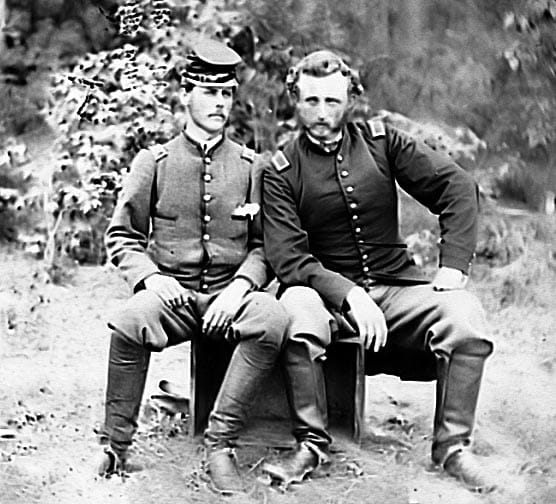
George A. Custer with captured confederate prisoner. Custer was a man of action but not of cruelty.

George A. Custer with a captured confederate prisoner. Custer was a man of action, but not of cruelty.

It is often forgotten that the aim of generalship is not winning a war, but winning a stable peace. In that sense, most generals and most diplomats are failures; their victories benefit only the undertaker; their peace-treaties only provide time to reload. That was the case with the Mexican civil war but not the US civil war. The choices and surrender at Appomattox, 150 years ago lead to a genuine, stable peace. It’s worthwhile, therefore to consider the how that was done here and not in Mexico, perhaps as a lesson for the future.

I begin, near the end of the war with a much-maligned general, George A Custer on April 8, 1865; this  is the day the 13th Amendment passed, four days after Lincoln walked through a defeated, smoldering Richmond, the capital of the south. The war would end soon, but would the result be peace, or chaos. George A. Custer had graduated at the very bottom of his class at West Point, the position known as goat. As is not atypical with goats, he was not particularly suited to following orders during peacetime, but was supremely suited to war and action. Custer liked to attack first and think later, but he was also a man of peace; he become the youngest Union Brevet General in US history. On April 8, with Lee at Appomattox Court House (that’s the name of the town), Custer led a small group of men to attack a nearby town, Appomattox Station, a rail depot three miles to the southwest. There he captured, without a fight, three, rail cars full of desperately needed arms, ammunition and supplies that had been sent to Lee’s army from Lynchburg.

While leaving the station, Custer’s men ran into the artillery unit of Confederate Brig. Gen. Reuben Walker, and attacked (of course) eventually capturing 25 artillery pieces, nearly 1,000 prisoners and all of their supplies. It took several attacks to win, but the results were worth it. Custer took the cannon and his troops, and positioned them on Lee’s likely escape route, on the Richmond-Lynchburg Stage Road south of Appomattox Courthouse. Lee was now nearly trapped, but didn’t know it yet.

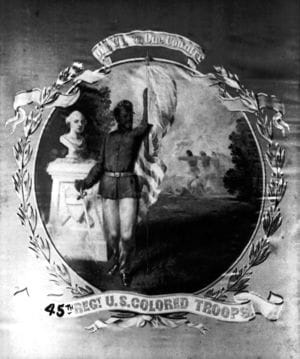
Paining in honor of the 45th regiment colored troops: Afro-American soldier stands with flag before a bust of Washington.

Painting in honor of the 45th regiment colored troops: Afro-American soldier stands, with flag, before a bust of Washington and a depiction of battle (Fair Oaks? Petersburg?)

On the same day, April 8, General Grant sent Lee a proposition to surrender. Lee responded that he was not interested in that, but would like to meet at the McLean House at 10:00 A.M. April 9 to discuss “restoration of peace.” Grant replied that he didn’t have that power but agreed to meet Lee, none the less.

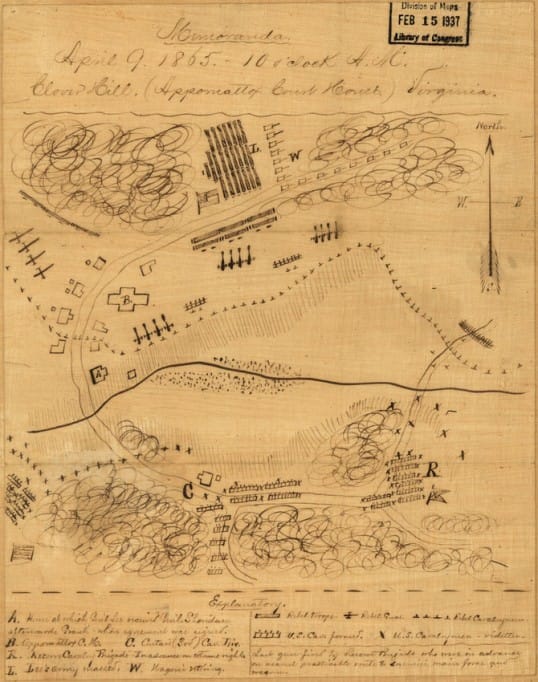
In the meantime, Lee prepared his forces to clear the Stage Road so his forces could escape south-west, to Appomattox station and home. Grant, no newcomer to war, ordered two corps (XXIV and V) under the commands of Maj. Gen. John Gibbon and Bvt. Maj. Gen. Charles Griffin to march all night to the west and north. These corps included 5000 Afro-American troops, mostly in the 45th and 116th U.S. Colored Troop Brigades. On the morning of April 9, Lee attacked to the south and managed to capture the forward pickets defending the Richmond-Lynchburg Stage Road. But when he reached the rise of the hill, he saw his escape was blocked. His 45,000 troops were surrounded by 113,000, better-armed Union soldiers, cannon and cavalry. It was then suggested that Lee disband his troops for an extended guerrilla war, an option he refused as it would lead to murdering bands roaming the county, and would make peace nearly impossible. Instead Lee rode off to discuss surrender to Grant. 

Map of the troop arrangements April 9, 1865. Checkmate. Lee's forces, x or + are out numbered, out gunned and surrounded. The end.

Map of the troop arrangements April 9, 1865. Checkmate. Lee’s forces, x or +, are out numbered, out gunned, and surrounded.

Lee’s surrender, finalized that afternoon, was penned by Grant’s aide-de camp, Lt Col’, Ely S. Parker, a Seneca Indian who had an engineering degree and studied law. The kindness to Indians may have suggested similar kindness to the surrendering Confederates. Parker eventually rose to the rank of general, and then to head of the Bureau of Indian Affairs. The terms of surrender too, were chosen to be unusually generous. Grant did not take the confederates soldiers captive, but instead allowed them to return home, relatively unmolested. Also, he allowed the officers to keep their swords and personal weapons. Kind acts like these may have eased reconstruction. Custer had demanded unconditional surrender from General Beauregard on April 9, something he probably imagined U.S. (Unconditional Surrender) Grant would have wanted; he was over-ruled by his commanding officer, Phillip Sheridan, who probably knew Grant better. 

After the war, most of the confederates swore loyalty to the US. Lee did what he could to promote reconciliation; he supported civil rights and reconstruction, and became president of Washington and Lee College. Some confederate generals and 2500 soldiers headed south to Mexico to join the French/Austrian forces of Emperor, Maximilian I, engaged in a civil war of his own. Maximilian, only 34 years old and a highly decorated Austrian officer, had little local support. He was captured and executed, June 19, 1867. Mexico then descended into chaos: a Pyrrhic victory, and a model to avoid.

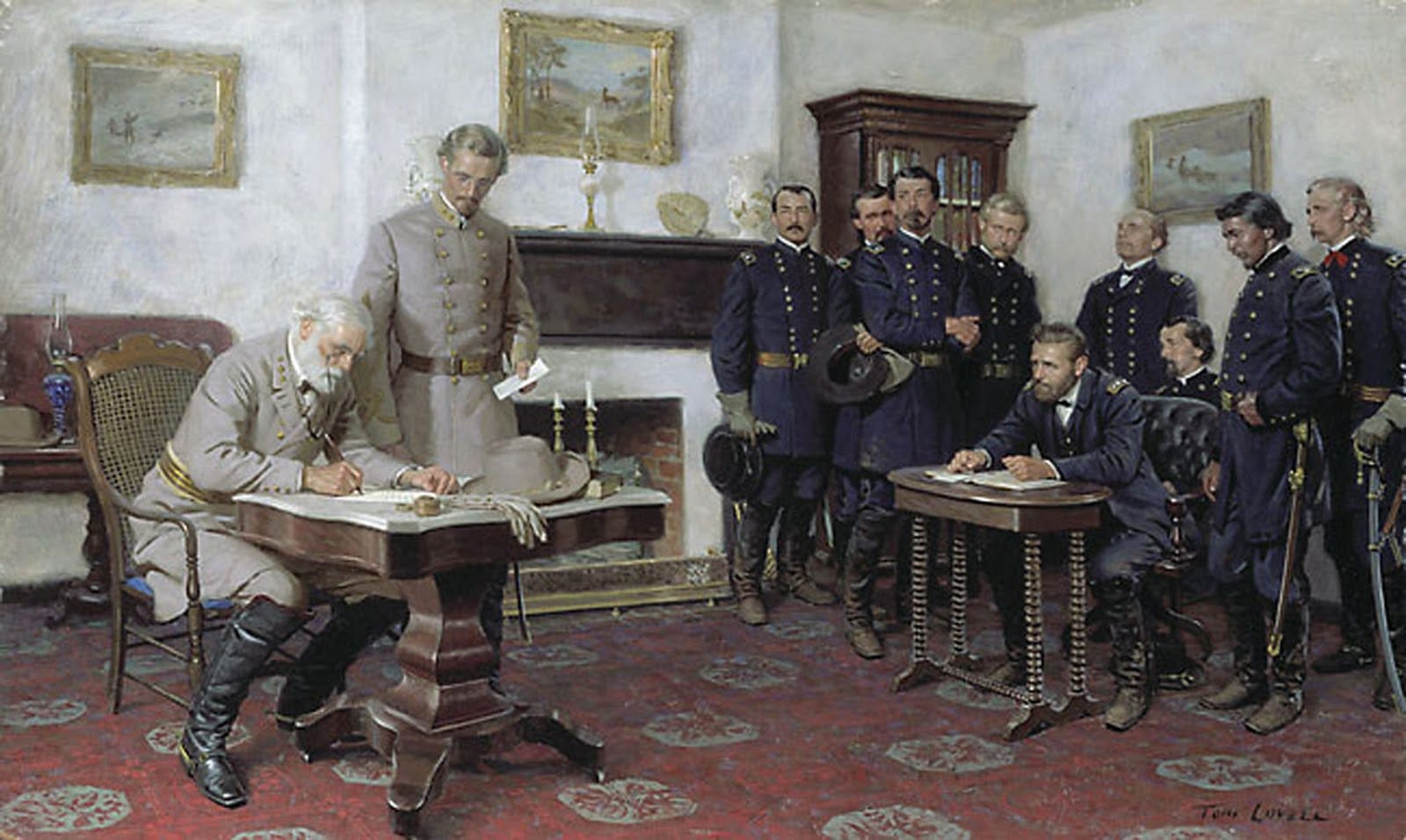
Surrender at Appomattox; with Grant are Philip H. Sheridan, Orville E. Babcock, Horace Potter, Edward O.C. Ord, Seth Williams, Theodore S. Bowers, Ely S. Parker and George A. Custer. With Lee is Charles Marshall, his military secretary.

Surrender at Appomattox; with Grant are Philip H. Sheridan, Orville E. Babcock, Horace Potter, Edward O.C. Ord, Seth Williams, Theodore S. Bowers, Ely S. Parker and George A. Custer. With Lee is Charles Marshall, his military secretary. After the signing, most of the furnishings were purchased by Union officers as souvenirs. Lee shook Parker’s hand and said, I’m glad to see a real American here.” Parker replied, “We are all Americans.”

What did Mexico do wrong? For one, in order to win a peace, they failed to get the other side to agree to the peace, with clear documentation about what it is that’s been agreed to (That’s why Parker’s role is so important). Instead of killing Maximilian, they should have had him sign some sort of document and retire him to a farm or college where he could support the peace. In order to win a peace, it’s important to leave a stable country, with stable borders and a strong military, one that can govern itself fairly and well. A stable peace generally involves recognition of your government by other nations, and that too requires not killing your defeated enemy wholesale.

Robert E. Buxbaum, April 7-12, 2015. My sense is that the conditions for building a lasting peace get far too little attention in the study of war and history. I should mention that the 45th were mostly escaped slave volunteers. The 116th were ex-slaves that the Union purchased from Kentucky slave-owners at the beginning of the war to fight for the Union cause. This was thought to be a good emollient for peace, and may have helped keep Kentucky on the Union side. I should note too, that Lee freed his slaves in 1862, near the beginning of the war, a time when Grant still owned some. I’ve noted that men who choose beards tend to show a surprising republican (or communist) generosity. As Lincoln said, “Do I not defeat my enemy when I make him a friend?” For more thoughts on Lincoln’s Gettysburg Address, see here.

For All Fools Day, April 1, 2015

On this April Fools day I’m reminded of:

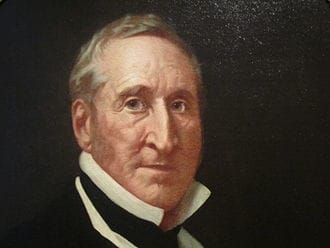
Democratic Senator Thomas Hart Benton, of Missouri. Before being elected to the US senate, he had been the lawyer for another Democrat, Andrew Jackson (before he was president). Like most prominent Americans of their day both men liked to settle arguments through by use of gunnery at close range. After Andrew Jackson participated in a duel with Benton’s brother, Benton himself challenged Jackson to a duel (I try to avoid this with my lawyers).

Seantor Thomas Hart Benton

Senator Thomas Hart Benton; his feud with A. Jackson, ended by common hatred of the Federal Reserve Bank

When asked about it later, Benton said, “Yes, sir, I knew him, sir; General Jackson was a very great man, sir. I shot him, sir. Afterward he was of great use to me, sir, in my battle with the United States Bank.” Ain’t that America. You can be shooting enemies one day, best of buddies the next.

In world politics and life this doesn’t happen as regularly as perhaps it should, but it happens. A few years after WWII we were allies with Germany and Italy, but enemies with the USSR. After WWI we were allies with Japan, until we weren’t; now we are again. Some day ISIS and Iran will be friends (won’t Mr A Bomb be sad).

I should also mention, and recommend the most amusing work of philosophy you are ever likely to encounter: St Erasmus of Rotterdam’s panegyric, “In Praise of Folly”. The thesis, if I may summarize: that most people like a fool and some folly; so does God. That most people don’t like long, boring lectures; neither does God. Etc. Good folly is likely to hurt you in a way you don’t mind (e.g. music, drinking, chasing women, reading long boring books if you like them); bad folly hurts others, e.g. when priest lives royally off of charity.

You might imagine that Erasmus would be executed for this but it seems he was not. It seems to me that Erasmus did something even more remarkable and made himself into a saint by claiming that God would not mind if people prayed to him for all good things. Apparently they started to, and got answered. A cheerful answer from a world of fools.

Robert E. Buxbaum, April 1, 2015.

Brass monkey cold

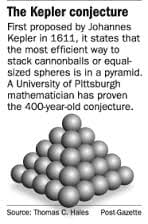
In case it should ever come up in conversation, only the picture at left shows a brass monkey. The other is a bronze statue of some sort of a primate. A brass monkey is a rack used to stack cannon balls into a face centered pyramid. A cannon crew could fire about once per minute, and an engagement could last 5 hours, so you could hope to go through a lot of cannon balls during an engagement (assuming you survived).

A brass monkey cannonball holder. The classic monkeys were 10 x 10 and made of navy brass.

Small brass monkey. The classic monkey might have 9 x 9 or 10×10 cannon balls on the lower level.

Bronze sculpture of a primate playing with balls -- but look what the balls are sitting on: it's a surreal joke.

Bronze sculpture of a primate playing with balls — but look what the balls are sitting on: it’s a dada art joke.

But brass monkeys typically show up in conversation in terms of it being cold enough to freeze the balls off of a brass monkey, and if you imagine an ornamental statue, you’d never guess how cold could that be. Well, for a cannonball holder, the answer has to do with the thermal expansion of metals. Cannon balls were made of iron and the classic brass monkey was made of brass, an alloy with a much-greater thermal expansion than iron. As the temperature drops, the brass monkey contracts more than the iron balls. When the drop is enough the balls will fall off and roll around.

The thermal expansion coefficient of brass is 18.9 x 10⁻⁶/°C while the thermal expansion coefficient of iron is 11.7 x10⁻⁶/°C. The difference is 7.2×10⁻⁶/°C; this will determine the key temperature. Now consider a large brass monkey, one with 400 x 400 holes on the lower level, 399 x 399 at the second, and so on. Though it doesn’t affect the result, we’ll consider a monkey that holds 12 lb cannon balls, a typical size of 1750 -1830. Each 12 lb ball is 4.4″ in diameter at room temperature, 20°C in those days. At 20°C, this monkey is about 1760″ wide. The balls will fall off when the monkey shrinks more than the balls by about 1/3 of a diameter, 1.5″.

We can calculate ∆T, the temperature change, °C, that is required to lower the width-difference by 1.5″ as follows:

kepler conjecture, brass monkey

-1.5″ = ∆T x 1760″ x 7.2 x10⁻⁶

We find that ∆T = -118°C. The temperature where this happens is 118 degrees cooler than 20°C, or -98°C. That’s a temperature that you could, perhaps reach on the South Pole or maybe deepest Russia. It’s not likely to be a problem, especially with a smaller brass monkey.

Robert E. Buxbaum, February 21, 2015 (modified Apr. 28, 2021). Some fun thoughts: Convince yourself that the key temperature is independent of the size of the cannon balls. That is, that I didn’t need to choose 12 pounders. A bit more advanced, what is the equation for the number of balls on any particular base-size monkey. Show that the packing density is no more efficient if the bottom lawyer were an equilateral triangle, and not a square. If you liked this, you might want to know how much wood a woodchuck chucks if a woodchuck could chuck wood, or on the relationship between mustaches and WWII diplomacy.

Detroit emerges from bankruptcy. Not quite.

missing homes Detroit

While Detroit’s central core comes back, surrounding, homes burn at 220+/month, leave Detroit streets looking like the teeth of an aging hillbilly.

Detroit went bankrupt last year, the largest US city to do so since New York in 1970. As with New York’s bankruptcy, Detroit’s was used to cancel old debts and rewrite ill-thought contracts. Detroit also got to jail some crooked politicians including mayor Kilpatrick, described as “a walking crime wave.” But the city and county have no easy path out of bankruptcy as both city and county are likely insolvent. That is, they spend more than they take in despite massive out-state funding, and high taxes, 10% above the state level. To make matters worse, they are losing population at the rate of 1% or so per year. It’s hard to fund a city built for 2 million on the tax revenue of 1/3 as many, especially when they are mostly unemployed. Unless a lot changes soon, another bankruptcy is almost inevitable — likely this time at the county level.

We got in this state, largely as a result of a 50 year war between the black, solidly Democrat, somewhat anarchist, political establishment of Detroit, and the white, stayed, mostly Republican out state. The white population fled following the riots of the 60s and the richer black population soon followed. The remainder stayed, trapped in slowly decaying neighborhoods as the city went broke. White flight allowed the black community to develop its own, Motown culture, but except for the music industry, it has not benefitted from this culture.

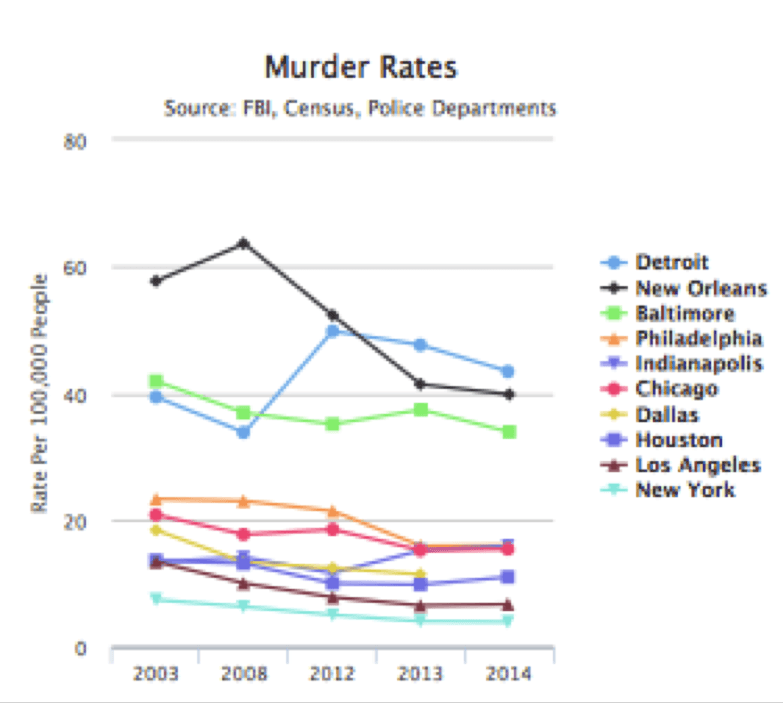
Detroit's murder rate, 45/100,000, is the highest in the US. It's coming down but not that fast.

Detroit’s murder rate is the highest in the US. It’s come down 10% in the last 2 years, but has far to go.

Detroiters have poor health, poor savings rates, high murder rates, and a fire rate of about .22% per month, 2.6% per year. The city lacks basic city services like reliable fire fighting and street plowing. Police at one point erected signs that said, “enter at your own risk.” There is a lack of small businesses and the services they would provide too: laundromats, grocery stores, and taxis (though no lack of bars and marijuana maintenance clinics). Employment in the auto-industry is down. And it’s not being replaced by home-grown small business – perhaps hampered by the low savings rate. A surprisingly large fraction of the Detroit homes are in foreclosure, see map, and with it a high abandonment rate and a high fire rate. As pheasant and dear return, non-core Detroit is beginning to look like farm country.

Detroit foreclosures near me. Blue is occupied homes, red is unoccupied, yellow unknown, and green is destroyed homes or vacant, foreclosed land.

Detroit foreclosures near me. Homes in dark blue are occupied foreclosed, red is unoccupied, and green plots are destroyed homes or vacant, foreclosed land.

It’s not clear what political leaders should do. The city council would like to return to their pre-bankruptcy ways where they could borrow as much as they felt they needed and spend on whatever they saw fit — often on fast friends, fast cars, gambling, and vacation homes outside of the city. But the out-state population has been reluctant to give them the credit card. Is this racist or is it prudent — probably both, but this can not continue. The city and county pension funds were ransacked for ill-advised investments and consulting fees to cronies and their power-lawyers. Either the money is replaced from out-state or there will be some unhappy retirees in the not-too-distant future. My guess is that the state will have to pick up the tab for this mismanagement, but that they won’t want to hand over management control afterwards.

Rand Paul, a potential GOP presidential candidate, has proposed rebuilding business and property values by a method that the city will almost certainly reject. His solution: cut services to low-population density areas and cut taxes on business and earned income. While this would likely bring in new people and new businesses, the people would likely be white, and the businesses white-owned/ white-serving. Black-Detroiters have too little savings, organization and income to directly benefit from this plan. Detroit’s Democrat politicians will claim, not without merit, that this is welfare for rich whites: a way for them to become yet-richer while doing nothing for the poor blacks of the burning neighborhoods. They are likely to demand control as the elected officials of the town: regulating business and raising the minimum wage to create “equality.” I suspect this is a bad idea.

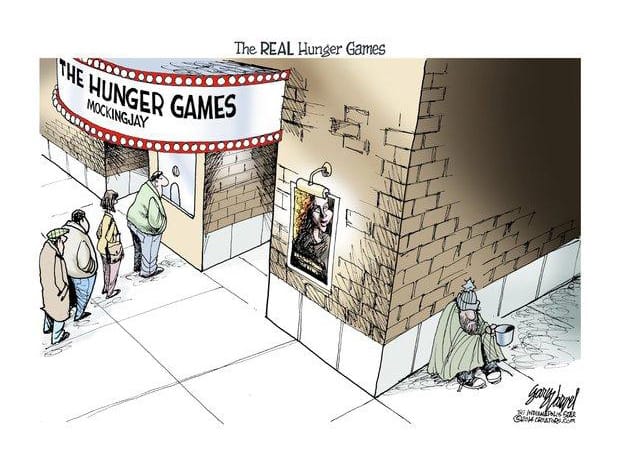
Detroit hunger games

Detroit suffers from two populations and a divide.

To some extent we’re already seeing the return of white-owned, white-serving businesses. Classic buildings in the core of the city have been purchased by white developers – notably Dan Gilbert of Quicken Loans leading to gentrification and an influx of single, white hipsters. The newcomers are viewed as half-saviors, half-carpetbaggers. They dwell in a whiter city core with hipster bars and expensive restaurants. Does a poor city with massive debt, crime, and unemployment benefit from a core filled with high-priced, gourmet coffee and fern bars?

The author, Robert Buxbaum, enjoys a day at an artificial beach in central Detroit.

The author, Robert Buxbaum, enjoys a beer at an artificial beach-cafe in central Detroit with some, few black folks, none poor. Is this good for Detroit?

The new hipsters put a squeeze on city services too — one that’s hard to deal with fairly. Detroit can not afford to plow all the streets after a snow. Should the new high-tax white folks get plowed streets, or should they suffer equally with everyone else? Detroit education is abysmal, but the high tax-bracket folks want better. Should they get it, or suffer equally? They want extra street lights and police protection. Should they get it, or suffer equally? Is this the way up?  A solution I’d proposed some while ago was to divide the core city from the now-rural outskirts so that each could be managed more sanely. It’s not a grand a solution like Rand’s plan, but less likely to be rejected. One way or another, we seem destined to have a Detroit with a rich core and abandoned neighborhoods. I suspect it might as well be managed that way.

Robert E. Buxbaum, February 10, 2015. I don’t have solutions, but write about the city’s problems, and the partial solutions I’ve heard as a way to clarify my thinking — and perhaps yours too.

Of Scrooge and rising wheat production

The Christmas Carol tells a tale that, for all the magic and fantasy, presents as true an economic picture of a man and his times as any in real-life history. Scrooge is a miserable character at the beginning of the tale, he lives alone in a dark house, without a wife or children, disliked by those around him. Scrooge has an office with a single employee (Bob Cratchit) in a tank-like office heated by a single lump of coal. He doesn’t associate much with friends or family, and one senses that he has few customers. He is poor by any life measure, and is likely poor relative to other bankers. At the end, through giving, he finds he enjoys life, is liked more, and (one has the sense) he may even get more business, and more money.

Scrooge (as best I can read him) believes in Malthus’s economic error of zero-sum wealth: That there is a limited amount of food, clothing, jobs, etc. and therefore Scrooge uses only the minimum, employs only the minimum, and spends only the minimum. Having more people would only mean more mouths to feed. As Scrooge says, “I can’t afford to make idle people merry. I help to support the establishments I have mentioned [the workhouses]. They cost enough, and … If they [the poor] would rather die,” said Scrooge, “they had better do it, and decrease the surplus population.”

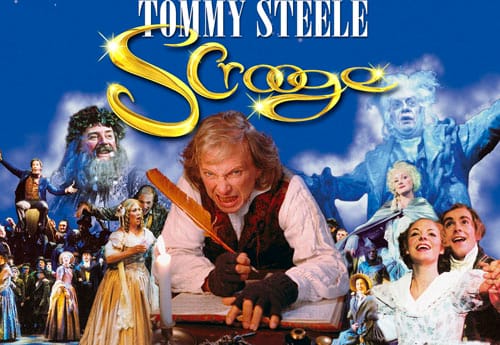
Scrooge, the poor rich man.

Scrooge, the poor rich man with a tiny carbon footprint.

The teaching of the spirits is the opposite, and neither that of the Democrats or Republicans. Neither that a big government is needed to redistribute the wealth, nor that the free market will do everything. But, as I read it, the spirits bring a spiritual message of personal charity and happiness. That one enriches ones-self when one give of and by ones-self — just from the desire to be good and do good. The spirit of Christmas Present assures Scrooge that no famine will result from the excess population, but tells him of his 1800 brothers and shows him the unending cornucopia of food in the marketplace: spanish onions, oranges, fat chestnuts, grapes, and squab. Christmas future then shows him his funeral, and Tim’s: the dismal end of all men, rich and not:  “Will you decide what men shall live, what men shall die? It may be, that in the sight of Heaven, you are more worthless and less fit to live.” And Scrooge reforms, learns: gives a smile and a laugh, and employs a young runner to get Cratchit a fat goose. He visits his nephew Fred, a cheerful businessman for dinner, and laughs while watching Tom Topper court Fred’s plump sister-in-law.

The spirits do not redistribute Scrooge’s wealth for him, and certainly don’t present a formula for how much to give whom. Instead they present a picture of the value of joy and societal fellowship (as I read it). The spirits help Scrooge out of his mental rut so he’s sees worthy endeavors everywhere. Both hoarding and redistribution are Malthusian-Scroogian messages, as I read them. Both are based on the idea that there is only so much that the world can provide.

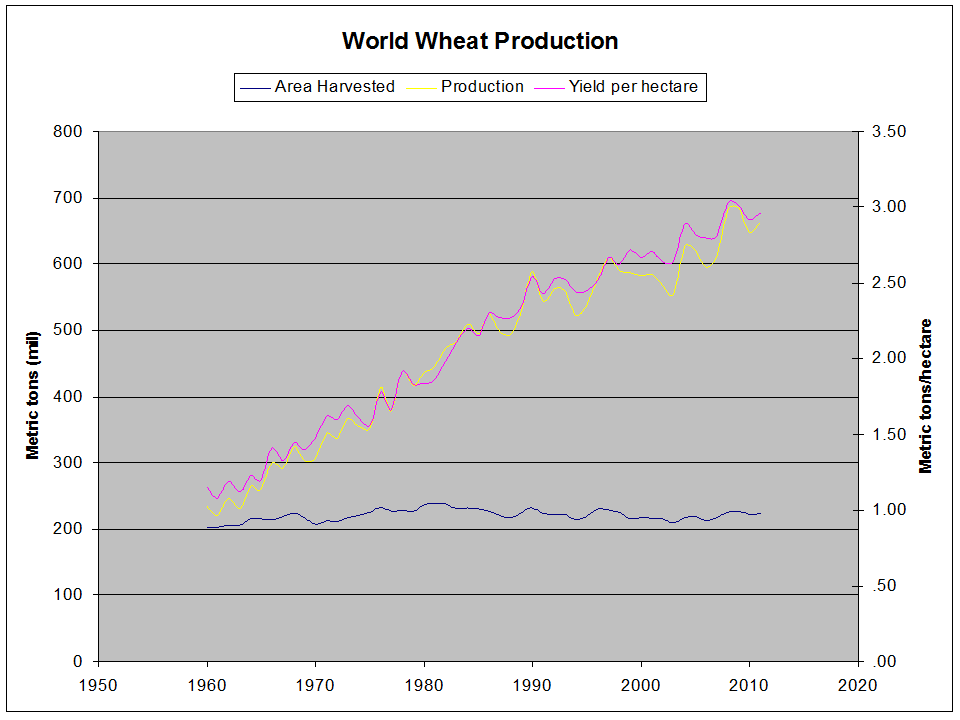
World wheet production

World wheat production tripled from 1960 to 2012 (faostat.fao.org), but acreage remained constant. More and more wheat from the same number of acres.

The history of food production suggests the spirits are right. The population is now three times what it was in Dickens’s day and mass starvation is not here. Instead we live among an “apoplectic opulence” of food. In a sense these are the product of new fertilizers, new tractors, and GMOs (Genetically modified organisms), but I would say it’s more the influence of better people. Plus, perhaps some extra CO2 in the air. Britons now complain about being too fat — and blame free markets for making them so. Over the last 50 years, wheat production has tripled, while the world population doubled, and the production of delicacies, like meat has expanded even faster. Unexpectedly, one sees that the opulence does not come from bringing new fields on-line — a process that would have to stop — but instead from increased production by the same tilled acres.

The opulence is not uniformly distributed, I should note. Countries that believe in Malthus and resort to hoarding or redistribution have been rewarded to see their grim prophesies fulfilled, as was Scrooge. Under Stalin, The Soviet Union redistributed grain from the unworthy farmer to the worth factory worker. The result was famine and Stalin felt vindicated by it. Even after Stalin, production never really grew under Soviet oversight, but remained at 75 Mtons/year from 1960 until the soviet collapse in 1990. Tellingly, nearly half of Soviet production was from the 3% of land under private cultivation. An unintended benefit: it appears the lack of Soviet grain was a major motivation for détente.  England had famine problems too when they enacted Malthusian “corn acts” and when they prevented worker migration Irish ownership during the potato famine. They saw starvation again under Attlee’s managed redistribution. In the US, it’s possible that behaviors like FDR scattering the bonus army may have helped prolong the depression. My sense is that the modern-day Scrooges are those against immigration “the foreigners will take our jobs,” and those who oppose paying folks on time, or nuclear and coal for fear that we will warm the planet. Their vision of America-yet-to-be matches Scrooge’s: a one-man work-force in a tank office heated by a single piece of coal.

Now I must admit that I have no simple formula for the correct charity standard. How does a nation provide enough, but not so much that it removes motivation– and the joy of success. Perhaps all I can say is that there is a best path between hoarding and false generosity. Those pushing the extremes are not helping, but creating a Dickensian world of sadness and gloom. Rejoice with me then, and with the reformed Scrooge. God bless us all, each and every one.

Robert Buxbaum, January 7, 2015. Some ideas here from Jerry Bowyer in last year’s Forbes.

Einstein failed high-school math –not.

I don’t know quite why people persist in claiming that Einstein failed high school math. Perhaps it’s to put down teachers –who clearly can’t teach or recognize genius — or perhaps to stake a claim to a higher understanding that’s masked by ADHD — a disease Einstein is supposed to have had. But, sorry to say, it ain’t true. Here’s Einstein’s diploma, 1896. His math and physics scores are perfect. Only his English seems to have been lacking. He would have been 17 at the time.

Einstein's high school diploma

Albert Einstein’s high school diploma, 1896.

Robert Buxbaum, December 16, 2014. Here’s Einstein relaxing in Princeton. Here’s something on black holes, and on High School calculus for non-continuous functions.

von NotHaus, the terrorist who uttered money.

Bernard von NotHaus was sentenced two days ago, December 3, 2014 in Federal court, North Carolina on charges of terrorism for the crime of making token coinage. This crime is called uttering money in English common law, but it is not generally considered terrorism, or generally prosecuted at all in modern times. The sentencing was covered by only one newspaper, The New York Sun. The New York Times and others, I guess, found it wasn’t news fit to print. But I find it newsworthy enough to blog about.

The current price of silver (as I write) is $16.60 per ounce. Had Bernard von NotHaus limited himself to selling ordinary, one ounce, silver medallions for $20 each, he could have made money on each, and perhaps been awarded a medal for his artistry. Instead, von NotHaus stands convicted as a terrorist against the US economy. The problem: his $20 medallions include the symbol “$20” and the word “dollar” on the coins. The government’s claim is that people might come to use his silver medallions to buy $20 worth of products, and this, it was argued, could bring down the government. Also incendiary was the phrase “Trust in God.” The federal prosecutor argued this was too close to our government’s, “In God we Trust.”

A liberty dollar. The crime is terrorism by uttering money -- saying that this coin should be used as $20 currency.

A liberty $20 piece The crime is terrorism, undermining the US by suggesting people use this coin as currency.

Von NotHaus was arrested on June 6, 2009, and had his coins and metal confiscated. He was convicted of terrorism March, 2011. Among the evidence are gold coins with the image of Ron Paul and certificates with von NotHaus’s image marked as 1 Dollar negotiable currency. Making these items isn’t quite counterfeiting, as the coins and certificates don’t look like US currency, but the US government decided it’s worse: economic terrorism. Anne Tompkins, the federal prosecutor successfully argued that von NotHaus is suggesting that the currency of the US is somehow deficient, and perhaps that the president and his crowd are doing something wrong in their efforts to drive inflation by printing excess currency. Ms. Tompkins successfully argued that such “attempts to undermine the legitimate currency of this country are simply a unique form of domestic terrorism” and that they “represent a clear and present danger to the economic stability of this country.” I’d say that’s over-reacting.

The Liberty Dollar. It's not counterfeiting, but the crime of terrorism by uttering money. Printing certificates with the intent of having them used as currency.

The Liberty Dollar. It’s not counterfeiting, but terrorism. 20 of these can be exchanged for a silver coin. US currency is non-negotiable; you have no right to change

The mechanism whereby these items are supposed to undermine the economic stability is the reverse of Gresham’s law. Gresham’s law is that the worse currency will stay in circulation and the better will be driven out. Applied here, Gresham would predict that people will hoard these liberty dollars and will spend only the paper. That’s what happens with ordinary art, or gold bars. But our government’s terrorism argument assumes Gresham’s theories are wrong, and that people will hoard Obama’s paper while spending von NotHaus’s coins. On that chance, Mr. von NotHaus stands convicted of terrorism. Mr. von NotHaus’s defense is that he never claimed his medallions should be used as currency. The judge rejected this defense. For all I know, Ms Tompkins could now pursue Von NotHaus for sedition: suggesting there is something wrong with the way we pursue minters.

The Ron Paul $1000, weapon of mass destruction.

The Ron Paul, $1000 weapon of national destruction.

At sentencing yesterday, Judge Voorhees ignored rules that should have condemned von NotHause to life in prison. Instead, he ruled for 6 month’s house arrest and 3 years probation saying he didn’t believe von NotHaus was motivated by evil intent, but rather by philosophical speech (something partially protected by the first amendment). I’m always glad for lenient sentencing, especially when the argument involves freedom of speech. I’m also glad for philosophy, but that does not mean I’m happy about the outcome. To me, von NotHaus deserves a medal; he is the Rosa Parks of hard currency. And I think that’s fit to print.

Part of the reason this conviction bugs me is that I got a free education courtesy of Peter Cooper, the citizen industrialist of the 19th century who founded the greenback party. He published (uttered) $3 bread notes to advertise his cause. Robert Buxbaum is a good US citizen, who uses only non-negotiable, fiat currency; none of this negotiable stuff for me. December 5, 2014.

Hong Kong and Palestine; what makes a country?

As I write this, Hong Kong protesters are battling for a degree of independence from China — something China seemed to have agreed to when taking over the province in 1997. While there is some sympathy for the protesters, not one country so far supports them. Meanwhile, by a vote of 138 to 9, the United Nations has accepted Palestine as an independent, observer state, the same status as the Vatican and Switzerland. A majority of nations have further stated that it is illegal for Israel to erect a wall between itself and Palestine as the wall implies a de-facto border. Why the differences, and what’s wrong with borders?

Distinctive dress, traditions, or physiology can justify a country's independence, as can a military tradition.

Britain has been shaved of many of its possessions since WWII, The possessions have demanded independent nation status based on their distinctive dress, language, history, traditions, or physiology.

Perhaps a good place to start is with British ownership of Hong Kong and Israel/Palestine. Britain acquired both by war, and both were possessions during World War II. Hong Kong island was ceded to Great Britain by the Treaty of Nanking ending the first Opium War. British control of Israel/ Palestine was achieved by invasion in World War I and confirmed by the League of Nations. Following WWII, British Palestine was split into several nations: Egypt, Israel, Jordan, Saudi Arabia … Israel declared independence in 1948 — and was accepted to the United Nations in 1949 following its war of independence. Hong Kong did not fight any war, but was handed to China in 1997 in return for guarantees of autonomy. If Hong Kong had not been handed over, it would probably be independent today, like Ireland, Canada, Jamaica, Belize, Micronesia, Malaysia, Bali, Indonesia, etc.

Clearly part of the reason no one accepts Hong Kong as a country, while a majority of the UN accepts Palestine (and Israel?) as countries, is that both Arab Palestine and Israel have fought wars for independence, while Hong Kong has been a peaceful go-along. Another difference is related to how the world perceives China and Arab Palestine. China may be a semi-autocratic, one party oppressor of Inner Mongolia and Tibet, but its economic and military power helps insure that China is considered the respected, socialist owner of semi-democratic HK. Israel is much weaker, and much less-well regarded. It is viewed as a dispensable, European annoyance stuck improbably into the Middle east, and thus its claim on existence is weakened. The UN resolved in 1975 that Zionism is racism, and world leaders routinely called Israel a racist or apartheid occupier, as a state religion is considered anathema to freedom — they don’t have this problem with the state religions of the Vatican or Saudi Arabia. Ex-president Jimmy Carter calls Israel an occupier state, suggesting that Israel has no right to exist, and many western religious and academic groups agree or have voted to treat it as such. In 2013 alone, the UN passed 21 resolutions of protest against Israel, and only 3 against all other nations combined (A historical list is presented here). But disdained or not Israel goes on, in part by military might, in part by meeting the Montevideo requirements of 1933.

Comparison Hong Kong and Gaza

A map used to support Hong Kong Independence showing that Hong Kong is roughly 4 times the size of Gaza; and about twice the population. The government is more stable, and less divided too.

The UN’s grudging acceptance of Israel rests in part, on its meeting the four Montevideo conference (1933) requirements. A country must have: 1. a fixed population (more-or-less met) 2. fixed borders (war gains are an issue here, as is Palestine’s claim to all of Israel). 3. an internal government with internal control (here Israel exceeds Arab Palestine having a stable government. While Palestine manages to keep some law on a local level there are no unified elections, and only minimal education and healthcare. The two halves would likely shoot each other if they could shoot over Israel). The final Montevideo requirement, 4 is that a country must have the ability to make binding foreign treaties. This something Israel has, while neither Hong Kong nor Arab Palestine does. Both Palestine and Hong Kong are prevented from making treaties– with Israel and with China. Some in The United Nations have seen fit to waive this requirement for Palestine, but not Hong Kong.

While neither the Montevideo protocols nor the UN requires that a country must be democratic in any sense (most every country signing was a monarchy or dictatorship, and many still are (Jordan, Syria, Cuba, China….), there is a growing consensus that the age of kings is over, or ending. That a united Palestine would likely be a dictatorship, or kleptocracy thus runs afoul of another, uniquely American approach to state-hood — natural law, and the Rights of Man.

The United States, at its inception, appealed to the self-evident, Rights of Man, as a justification for its independence. That is to Justice, and to “Nature and Nature’s God.” We never claimed to have clear borders, or a fixed population, or any other Montevideo requirement. Instead we claimed nation-status by “the powers of the earth.” It was never clear what the legal limits of these powers were, not what Nature’s God demanded, but the idea is not mere poetry, but shows up throughout the policy speeches of Lincoln, Wilson, and Kennedy and Reagan. I’ve speculated that the poor reviews Lincoln got for his Gettysburg Address were due to the foreign-ness of these claims back in 1863, but 150 years later many thinkers seem to accept, at least as an ideal, that the legitimacy of a county rests on the will of its people, freely exercised. It’s a standard that hardly any country of the 19th century met, but that Israel meets, while Arab Palestine does not.

And that brings us back to the first and oldest basis of statehood: force of arms; self-preservation as a raison d’estat. If the people see death around them and are willing fight hard enough to keep out an enemy, they become a country. Even if they can not keep fixed borders, and even if they disband their army later, the fight for independence makes them so. (Micronesia has no army, but presumably would fight if they had to, and while Costa Rica had army once, the president disbanded it after he took over by military coup — it’s a threat to his life-long leadership). This view is the grim side of Nature’s law, that country is any organized horde who manage, by any means, to keep from being killed or disbanded. So long as the group survives, anywhere, it’s a nation. The Confederate States are not any sort of country, largely because the union has had such a stronger military that their army could operate against us, nor could the paramilitary remnant (the KKK) remain as an operational horde within our borders. China so over-matches Hong Kong that there can be no independent Hong Kong without China’s approval. Israel’s army, similarly, is strong enough to defeat any likely invasion or civil insurrection, though it might lose land, or gain it. It’s the dark version of natural law: the strong and vigorous survive at the expense of the weak and willing.

My observation is that neither Hong Kong nor Palestine is ready for independent statehood, via any of the justifications above, while Israel is a country by all of them. As for when to step in to create a state, my answer is only rarely; see my essay, when to enter a neighbor’s war.

Robert Buxbaum, December 4, 2014.