Category Archives: politics

Flat tax countries: Russia, Mongolia, Hungary

For no obvious reason, many Republicans and some (few) Democrats are fans of the flat tax. That is a fixed percentage tax on every dollar earned with no deductions, or very few. They see the flat tax as better, or more fair, than the progressive, graduated tax found in the US and most industrial countries. While most Republicans don’t like high taxes, as in Sweden, France, or in the UK, the flat-taxers want a single tax rate: a constant percentage for all. A common version is what Ben Carson described earlier this month, “if you earn ten million dollars your tax will be one million; if you earn ten dollars, your tax will be one dollar.” Herman Caine (R) proposed something similar eight years ago, and (surprisingly) so did Jerry Brown (D).

Ben Carson proposes a 10% flat tax. I'm guessing his source is the Bible.

Ben Carson proposes a 10% flat tax.

As it happens, of the 230 nations on the planet, several already have a flat income tax, and none of them are industrial juggernauts. I will list the larger of these countries in order their tax rate: Mongolia and Kazakhstan, 10% flat tax and hardly any services; Russia and Bolivia, 13% flat tax: moribund, raw-material-based, police-states; Romania and Hungary 16%; Lithuania and Georgia 20%; Zambia 22%; Switzerland, 35% when you include the Cantonal and municipal flat rates, and (topping the list) Greenland at 45%. Not one of these is a productive, industrial powerhouse, like the US, and there is no indication that this will change any time soon.

I suspect that the flat tax enters the minds of conservatives from the Bible, from the 10% of grain that was given to the Levites (Numb. 18:24), and the second 10% eaten of pilgrimage festivals or given to the poor (Deut. 14:22-24). If that’s the source, let me suggest a better modern version is to give out cans of food, or to support ones church. But as a model for government finance, I’d suggest it’s best to leave more in the pockets of the poor, and tax more from the rich. Even in Biblical times, the government (king) levied a substantial tax above the 10%s described above.

A measure of tax rate is the percentage of the total GDP that goes to taxes. As things go, our tax rate isn't particularly high.

A measure of tax rate is the percentage of the total GDP that goes to taxes. As things go, our tax rate isn’t particularly high.

A flat tax does not necessarily imply a low tax, either. Greenland’s flat 45% rate is among the highest in the world, and Israel had a 50% flat tax until fairly recently. It’s also worth noting that personal income isn’t the only thing one can tax. Several countries combine moderate personal income rates with high corporate rates (Venezuela, Zambia, Argentina), or add on a high sales tax, or a transaction tax. Herman Caine’s 9-9-9 tax plan included a 9% transaction tax and a 9% federal sales tax that would have gone on top of whatever the state tax would have been. The revenue collected by the 9-9-9 plan would have been no less than we had, but would be, he claimed, simpler. Cain’s flat tax wasn’t even really flat either, as there was an exclusion, an income level below which you were taxed 0%. That is, he was really proposing a two tier system, with a 0% rate at the first tier. Rand Paul seems to favor something similar today.

The two advantages of a flat tax are simplicity, and that it reins in the tendency to tax the rich too much, a tendency found with many liberal alternatives. The maximum tax rate was 95% in England under Attlee. Their 95% tax-rate appears in the Beetles’s song, Mr Taxman: “…There’s one for you, nineteen for me; ‘Cause I’m the Taxman.” High rates like this caused the destruction of many UK businesses, and caused The Beetles’s to leave and reincorporate in the Cayman Islands. Bernie Sanders recently proposed a top rate that was nearly as high, 90%, and praised Denmark (60% maximum rate) for its high social services. Sorry to say, Denmark seems to have concluded that their 60% maximum was excessive, and earlier this year reduced their maximum to 47.794%. This is below the maximum US rate if you include New York state and city income taxes. History suggests that if you tax the rich at rates like this, they leave or do other socially unacceptable things, like go black-market. On the other hand, if you tax too little, there is no money for education or basic social services, e.g. for the desperately poor. At one point, I proposed the following version of graduated to negative scheme that manages to provide a floor, a non-excessive top rate, and manages to encourage work at every income level (I’m rather proud of it). And there are other key issues necessary for success, like respect for law, and not having excessive minimum wages or other excess regulations.

Bernie Sanders: tax the rich at 90% of income.

Bernie Sanders: tax the rich at 90%; I doubt this is a good idea.

Whatever the tax structure is, there is probably an optimal average rate and an optimal size for the government sector. I suspect ours is near optimal, but have no real reason to think so (probably just nativism). I’ve found that comparing the US tax rates to other countries’ is very difficult, too. Most countries have a substantial Value Added Tax (VAT), that is a tax applied to all purchases including labor, but we do not. Some countries have import taxes (Tariffs, I’m in favor of them), while we have hardly any. And many countries tax corporate profits (and sales) at rates above 60% (France taxes them at 66.6%). To make any sort-of comparison, I’ve divided the total tax income of several countries by the country’s GDP (I got my data here). This percent is shown in the chart above. The US looks pretty average, though a little on the low side for an industrial nation: just where I like to see it.

Robert E. Buxbaum, November 29, 2015. I imagine myself to be a centrist, since all of my opinions make sense to me. When I change my mind on something, I stay at the center, but the center moves. If this subject interests you,  seems to have dedicated his life to following the flat tax.

A day of thanksgiving during the civil war

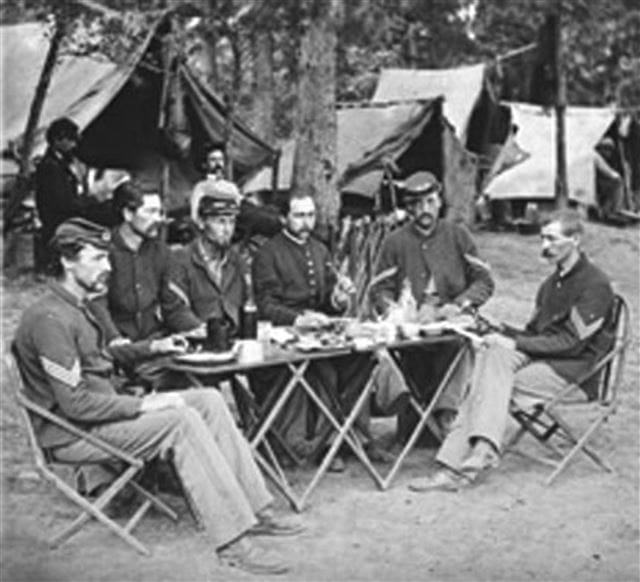
At the height of the civil war, Abraham Lincoln proclaimed a day of thanksgiving for the last Thursday of November, 1863. It’s the first time Thanksgiving was proclaimed for the date we now keep every year. The war was not going well. The Union defeat at Chickamauga, Sept. 19-20 1863, left 35,000 dead, the bloodiest two days in US history. Most citizens would have called for a day of fasting and prayer, but in Lincoln’s view, things were good, and there was a need for joy and thanksgiving:

“to thank the Almighty God” …for.. “the blessings of fruitful fields and healthful skies… “for peace that…. “has been preserved with all nations.” [That] “harmony has prevailed everywhere except in the theatre of military conflict….  “a day of Thanksgiving and Praise to our beneficent Father who dwelleth in the Heavens”…. and for … “the care all those who have become widows, orphans, mourners or sufferers in the lamentable civil strife.”  (see the whole proclamation here.)

A Civil War Thanksgiving. It's fellowship that makes peace possible.

A Civil War Thanksgiving. It’s fellowship that makes peace possible.

His was an interesting view, as important then as now. There is a need to remember that the good we have is more than the bad, and that there is a source of the good. As of today (2015) the economy is good in Michigan and the US. We are at peace with our neighbors and have civil obedience in our streets; we have food on our tables and clothes on our backs. We have cleaner air and cleaner water than in decades, blue skies, and plentiful rain. The ozone hole has shrunk, and global warming seems to have stopped. We have so much food that hardly anyone in our country suffers starvation, but only the hunger for finer, fancy things. We have roads without bandits, lighting at the flip of a switch, water at the turn of a tap, indoor heat, and (for most) indoor cooling in the summer. We have telephone communication, and radio, and television, and music at our fingertips. We have libraries with books, and free childhood education. We have a voice in our government, and information from the far ends of the earth. All these call for joy and thanksgiving.

And we can even find a cause for thanks in the things we don’t have: space travel and the diseases we can’t cure, for example. The things we don’t have provide a reason to wake up in the morning, and a motivation to do great things. We live in a country where we can change things, and it’s nice to know there are things worth changing. For ideas that lack expression, we can provide it. For diseases, we can still search for a cure. For those who lack happiness and friendship, we can help provide both (a joyful celebration is a good occasion to do so). For those who lack a job, we can help. And to those who feel a lack of meaning in life, perhaps the best answer is a celebration to explore the source of all blessings. Let us reach out to “all those who have become widows, orphans, mourners or sufferers.” A lesson Scrooge learned from the ghosts is that joy and generous celebration are self-sustaining and attractive. Let joy and good fellowship extend to all. God Bless us each and every one.

Robert Buxbaum, Detroit, November 18, 2015, The anniversary of Lincoln’s Gettysburg address is tomorrow, Nov. 19th (it wasn’t well received). As for Black Friday shopping, lets not get up from the table of thanks to jostle each other for some useless trinket.

Sept. 11, 1683: Army of Islam attacks Vienna.

In the US, September 11 is mostly known for the 2001 attacks on the World Trade Center and the Pentagon. But to the wider world wide, I think it’s mostly known for the Battle of Vienna, the high-water mark of many battles where army of Islam tried to take over the ‘corrupt’ western world, the Dar al-Harab. This is not the first time that Islamic armies tried to make Vienna part of the world of Islāmic peace, the Dar al-Islam. Suleiman the Magnificent had tried unsuccessfully in 1526. In 1682, Caliph Mohamed IV set out to do what Suleiman had not. He broke the Treaty of Vasvár, and collected an army of 150,000 under the generalship of his Grand Vizier, Kara Mustafa Pasha.

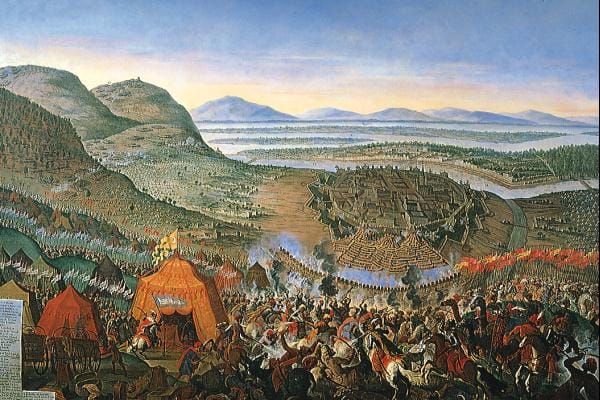
The forces of Mohamet IV surround Vienna, September 11, 1683.

The forces of the Caliph surround Vienna, the city of good wine, September, 1683.

Mohamed IV’s army spent a year on the march to Vienna. On the way, they conquered or subdued Rumania, Bulgaria, Serbia, Croatia, and Hungary. But the western leaders did not sit idly by. Emperor Leopold I and Charles V, Duke of Lorraine left Vienna to be defended by only 24,000 under command of Ernst Rüdiger von Starhemberg. Meanwhile, they scoured Europe for allies. By the time Kara Mustafa army arrived, July 14 1883, Leopold had gotten a pledge of financial support from the pope, and a mutual defense treaty with the Polish-Lithuanians, and with Saxony, Baden, Bavaria, Swabia and Franconia. it was good work, but none of these armies were at Vienna yet.

Fortunately (for Vienna), Kara Mustafa did not attack immediately but instead laid siege to the city, and to nearby Perchtoldsdorf (Petersdorf). Perchtoldsdorf surrendered, and Kara Mustafa massacred the entire Christian population who did not convert, some 30,000 people in the city square, and took their booty. This move did nothing to encourage a Viennese surrender. It took until September, 1683 for the armies of Leopold, Charles V, and John III Sobieski (Poland) to arrive. Kara Mustafa finally attacked on September 11, but it was too late. In the counter attack, his Islamic army was defeated. Kara Mustafa was put to death by the caliph for his failure to take Vienna (I guess he won’t make that mistake again).

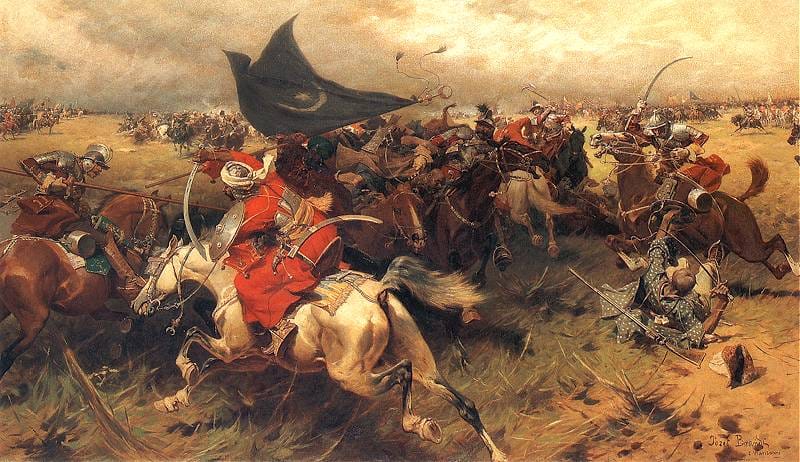
Cavalry fighting at the Battle of Vienna, 1683

The Polish cavalry at the Battle of Vienna, 1683

The loss at Vienna was the beginning of a long retreat for Mohamed IV and for Islam. Hapsburg rulers captured Romania, Bulgaria, and Hungary; Russia conquered the Ukraine from the Mongol-Tartars (the Golden Hoard). The victorious Viennese established a feast day for September 11, the Day of the Holy Name, and created a crescent-shaped sweet roll in the shape of the Moslem crescent as a remembrance. In France, these crescent rolls are called “Viennoise.”

I suspect that many believing Moslems find the breads and holiday offensive, as they believe Vienna is, by right part of the Dar al-Islam. My guess is that this is why Osama bin Laden picked September 11. Osama had traveled in Europe as a teen, and his bookshelf included titles suggesting he would have known about the date, e.g. , “The Rise and Fall of the Great Powers (Paul Kennedy)”. I note that the US embassy in Benghazi, was attacked September 11 (2012). Perhaps this was similar revenge on the earlier Sept 11’s, and not, as Ms Clinton claims, a response to a Jewish-made, Hollywood film.

It seems clear that not every Islāmic leader understands the obligation to conquer the Dar al Harab as one of armies, swords, and bombs. In the last year, the Iranian leader, Ayatollah Ali Khamenei has explained that his slogan, “Death to America,” does not mean death to the American people, but “death to U.S. policies and arrogance.” He claims this struggle is “backed by the reason and wisdom,” of the Koran.

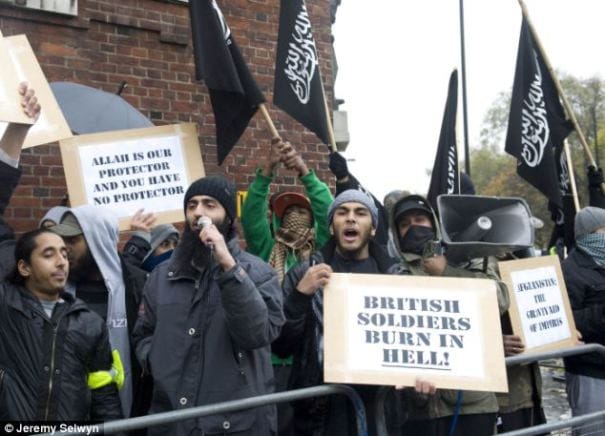
"Muslims against Crusaders" chanting during the two minutes of Remembrance Day (Armistice Day) silence, 2010.

“Muslims against Crusaders” chanting during the two minutes of Remembrance Day (Armistice Day) silence, 2010, “Our soldiers are in paradise, yours burn in Hell.”

As I understand it, The Ayatollah is saying that aim of the Iran’s missiles and atom bomb program is our benefit: to save us from Hell, and make our countries part of the Dar al Islam, the Moslem world of peace. Even at our best, our infidel Dar al-Harab is considered evil because of our arrogance and independence. We compete with each other in a world of chaotic commerce. As they see it, each infidel tries to wrest wealth from his fellow in an economic struggle that can only be ended by Caliphate-control that must include Iraq, Saudi Arabia, and Israel.

The Ayatollah does not mention that the Dar al-Islam has been in turmoil for the last 1000 years but perhaps acknowledges it in private as a slight embarrassment. To me, it seems more like Aesop’s fable of the toad physician who claimed he could heal everyone, but could not heal himself. I note that many other religions have the same jaundiced view of commerce, and have fought over it. Many Islamic thinkers find this to be a flaw in Christianity, and they are right. All major religions, it seems, claim to seek peace, and claim to love their fellows as themselves. They then go on to enforce this peace and love by killing.

If you find errors in my thinking, please tell me; I’m an engineer, not a historian or a theologian. I know enough Hebrew/Aramaic to know what the above phrases mean, and boost my claim by the public comments of the Ayatollah, who I take to be a spokesperson for practical Isalm.  In case you have not guessed, I think that a world of economic chaos is  better, and more satisfying, than any world of statist religious rule. I’d say that G-d likes entropy in all its forms, and that chaos is a gift of God, producing an odd stability.

Robert E. Buxbaum, Friday, November 13, 2015.

Is cannibal tourism good for Michigan?

Governor Snyder has no appetite for it, but ex-governor Jennifer Granholm did, and some of her Democratic colleagues still do. Not cannibal tourism, as such, but movie subsidies paid for by a tax on business property independent of profits. Some seven years ago, in 2008, then-governor Granholm and a majority of our legislature instituted a $132 million/year subsidy program that provided up to 42% of movie production costs. The hope was that films would bring Hollywood-type wealth and glamor, and that they would spark tourism. As it happened, the jobs went to Hollywood transients to such an extent that the total number of MI film employees was reduced. It is now 100 lower than at the start, and virtually all of the money spent went to out-of state employees (quite often the high-priced star) who left as soon as the filming was done. The report concluded that the program returned 11¢ for every tax dollar spent. One of Governor Snyder’s first acts was to diminish the subsidies, and the legislature has just put an end to them: revenge of the nerd.

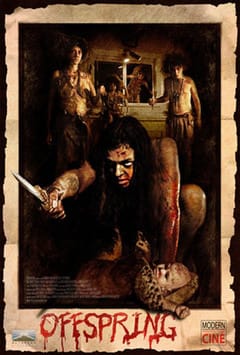
Offspring, filmed in Michigan. It does not seem to have promoted Michigan tourism.

Offspring: no jobs created, and perhaps no tourism … but think of the cool factor.

The amount spent in the early years, $132 million/year, was about 1/3 of the state’s deficit, a major misuse of funds. Reason magazine claimed it was “stone-crazy” to support movies when the state had, at the time, 14% unemployment, the highest rate in the nation. They argued that the money could be better spent on roads, or schools, or left in folks’ pockets (I agree).

The effect on tourism isn’t quite what was hoped. Movie makers tend to see Michigan as a setting for dystopian films, for example, “Offspring,” a film about cannibal tourism. This film got one of the largest state subsidies. A plot summary is:  “Survivors of a feral flesh-eating clan are chowing their way through the locals.” If this encouraged tourism, it’s not necessarily the tourists you wanted. You can tell it’s Michigan by the Michigan symbol on the police cars. Michigan funds also brought two Batman movies to Detroit, along with Michael Moor’s “Capitalism, a love story“, a  movie billed as showing how capitalism makes life in America a nightmare. The current head of the film board has noted that “realistic cannibalism; the gruesome and graphically violent depiction …. is unlikely to promote tourism in Michigan or to present or reflect Michigan in a positive light.” I can agree.

Batman and Superman in Detroit.

“Batman vs Superman.” They battle in Downtown Detroit, as do “Red Dawn” and “Transformers.”

Opposition to dropping the program came mostly from the Democratic side of the aisle. Rep. Jeremy Moss, D-Southfield, said the film incentives were creating good jobs. Rep. Kristy Pagan, D-Canton, pointed to “… the cool factor. Who doesn’t want to see Ben Affleck or Amy Adams walk down our streets?” (I don’t). In the end, three Democrats and virtually every Republican voted to end the program. Among the Republicans for keeping the program were Kathy Crawford R-Novi, and Mike McCready, R-Birmingham.

You should not feel too bad for the makers of gore films. Subsides are still available in Massachusetts, Oregon, Washington, California, Minnesota, Nevada, and several other states. Massachusetts welcomed Part 2 of The Offspring, a Massachusetts headline proclaimed the victory: “Come to Massachusetts, We Love Cannibals!” Massachusetts folks have been full of themselves for years. As for the money we saved, our Michigan legislature has finally begun balancing the budget and decreasing the destructive personal property tax that helped fund these schemes.

Robert E. Buxbaum, November 5, 2015. I should also commend the legislature for making “talk like a pirate day” a state holiday, and for passing, on November 3, a necessary roads bill. It was signed by most Republicans and two Democrats. Bipartisan-ish. With good management, Michigan might be coming back – lets hope it continues.

Michigan’s road bill — why not?

Stagnating before the Michigan Senate is a road improvement bill that passed the Michigan house 10 days ago. Though it’s not great, I hope they sign the bill. The bill would raise raise $600 million to $1.2 billion/year, an increase of $60 to $120 per person per year ratcheting up over the next six years. The first stage of the bill would take effect in October 2016, and would raise $400 million by increasing our car/ truck registration fees by about 40%. People with normal sedans would pay about $60 more per car per year. Those with more expensive, heavier vehicles would pay more. Though our registration fee is already among the highest in the nation, raising it further has the potential (It seems to me) to be the most fair and reasonable source of additional revenue. People with fancy cars, I imagine, are wealthy and those with heavy cars (I imagine) do the most road damage. This is the part of the bill that has proven the most contentious.

The next stage would begin in early 2018. It would raise $200 million by increasing Michigan diesel and gasoline taxes. The larger part would be on diesel fuel, an increase of 7.3 cents/gal presumably to soak out-of-state truckers who come through Michigan. These individuals deserve extra taxation, I imagine, because they don’t pay registration fees and probably damage our roads even more than those with fancy cars. Besides, they don’t vote in Michigan. The gas tax increase is smaller, 3.3 cents/ gal on regular gas, but Democrats are correct to point out that it is regressive. It takes a greater fraction from the poorer than from the rich. The hope is that, by the time the tax increase takes effect, we’ll have some inflation and also some more fuel-efficient cars so the bite won’t be as bad. Sorry to say, we already pay the 10th highest gas tax in the country.

The final phase of the road funding bill would not take full effect until 2021. The idea is to transfer $600 million from the general fund to pay for the roads with money left over to reduce home-owner taxes. Underlying the ability to do this is an assumption that Michigan industry and home prices will recover enough between now and then that we’ll be able to stop using the gasoline taxes to fund our schools, ideally with money left over from the regular income and sales tax. While I’d like to see this happen, and while this is possible given that the last few years have seen the state’s GDP recover at a 15.5+% growth rate (third highest in the nation) there is also a basis to say the assumptions are over- optimistic. On the other hand, the Democratic plan, based on 1.6% growth next year is likely over-pessimistic. As The Yogi says, “Predictions are always difficult, especially about the future.”

Whatever your views of the future, our roads are crumbling now, and new money is needed to fix them now before they get worse. If taxes must be raised, I’m inclined to do it with use -taxes, that is by charging those who use the services most. This is a philosophical preference of mine. Not all Republicans agree with this, and only one House Democrat has signed on so far. It was the view of the old-time, labor Democrats I grew up with, but not of today’s Democrats who prefer to tax “the rich” for any and all goods and services. Their point: that there are struggling, poor people who drive heavy, expensive cars. They’ve something of a point on the heavy cars, but I have less sympathy for the rest. I wrote a comic story about a poor guy trying to dispose of an expensive car, a Viper. My guess is that struggling rappers and poser politicians would not find it funny.

Dollars per capita spent on roads, 2013. From MDoT's road funding proposal.

Dollars per capita spent on roads, 2013. From MDoT’s road funding proposal.

Part of the way that MDoT (the Michigan Department of Transportation) justified its target of $600 million to $1.2 billion was by comparison with surrounding states — not my favorite way of analysis. The MDoT graphic shows that Michiganians spend about $57 less per capita on roads than folks in Illinois, Wisconsin, or Ohio, and about $100 less than folks in Indiana or Pennsylvania. Multiply $57 by our state’s population, 10 million, and they conclude we should spend some $570 million more per year. Multiply by $100, and you get $1.0 billion.

While the need for at least $600 million/year sounds about right, I note that the per-capita spending justification seems dubious. If you calculate instead on the basis of dollars per lane-mile, as below, you find that Michiganians are already paying more per mile than Minnesota, Wisconsin, or Indiana. You’ll also note that Ohio and Illinois pays about 1 1/2 times as much their roads aren’t much better. A major part of the variation, I suspect, is corruption, and the rest, I guess is incompetence. Illinois, perhaps the most corrupt state in the mid-west, has seen 4 of its past 5 governors go to jail, along with innumerable Chicago Aldermen and lesser officials. Citizens of Illinois pay for this corruption in over-size construction projects, and over-size construction fees. After the $600 million increase, we’ll pay $8,950 per lane mile suggesting we are still not quite as costly per lan-mile as Illinois or Ohio. If it turns out we need the full $1.2 billion extra, it will suggest we are even more incompetent or corrupt than Illinois.

Road funding state by state comparison.

Road funding state by state comparison, from the same MDoT report, 2013.

An ideal way I’d like to reduce the costs of Michigan’s roads would be to reduce corruption, a trend that’s already helped to revitalize Detroit since the Justice department jailed the mayor and his father plus some associates for “pay for play”. I’m sure it also helped to remove the chief of police (millions in his ceiling) and Bobby Ferguson of the useless, expensive Jail project and Guardian building scandal.

Conviceted IL

It’s somewhat hard to judge the level of general incompetence in a state, and even harder to find a fix. Minnesota had a bridge collapse in 2007, and we had the Zilwaukee in 1982 (and 2008), the 9 mile bridge collapse of 2009, and the Southfield overpass collapse of 2014. It’s been proposed that we should be able to fix both our corruption and our incompetence problems by holding the contractors responsible for any failures. If only it were that easy. Holding contractors responsible might get some contractors to allow the concrete cure for longer periods under water before opening a road, but I’m not sure the public would stand for it. A more-likely outcome is that crooked contractors would charge more for the same bad work, and then go bankrupt as soon as the road fails. If their company were appropriately structured, they could re-appear the next day: the same people and equipment, operating under a new corporate name.

The biggest single incompetence issue that I can see appears to be poor under-road drainage. In Oakland county, where I am, the drain department looks responsible for the major flood of last summer. We’ve had rains this big in previous years without this massive flooding. I suspect a lack of dry-wells, but don’t know. From what I see, the drainage is bad beneath many Oakland roads, too. It seems like the concrete slabs are not deteriorating as much as they are coming apart. That’s a sign of bad drainage. I also see sink-holes, new lakes, and places where the sidewalks sink. Again, that’s a sign of bad drainage; a sign there is a swamp near or beneath the road. If the ground below a major road is a swamp, there is no practical way a contractor can build a long-lasting road over it. Until the drains get better, or the corruption subsides, we’re going to have to replace the roads often at a cost of another $600 million/year. We might as well acknowledge our problems and sign the bill.

Robert Buxbaum, November 2-3, 2015. If you feel like getting involved, contact your state senator and tell him/her to vote yes (or no). Our senator is Vince Gregory. And if anyone would like to put me on a drainage board, I’d be happy to serve for free.

What happened to Jack Kelly of Newsies

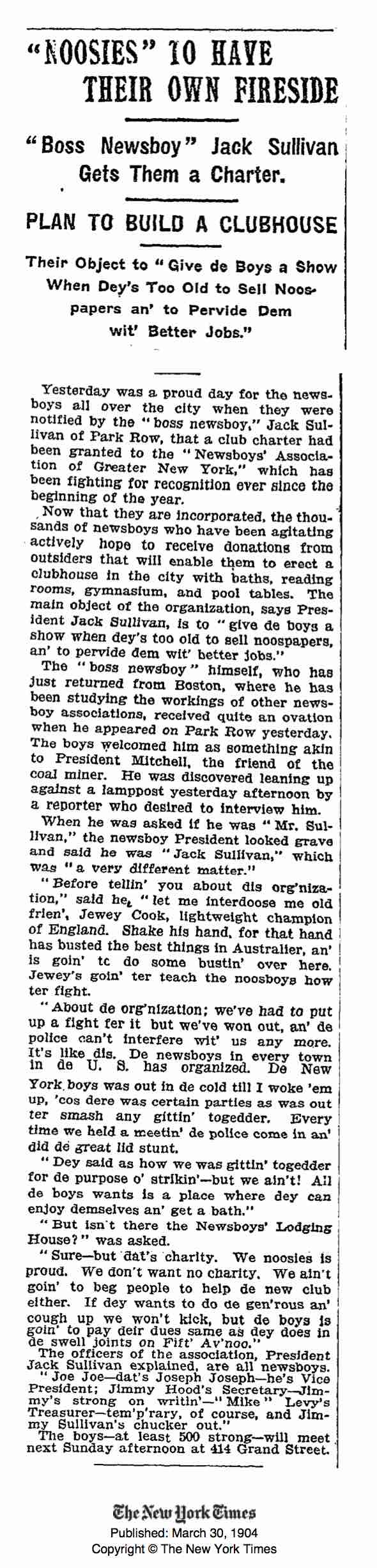
As my daughters are fans of the Disney play and movie, “Newsies,” and as I’ve taken interest in the early 20th century, they’ve asked me to find out what happened to Jack Kelly, the main character of the play/movie. If you’ve never seen it, Newsies is a musical about the New York newsboy strike of 1899. According to the play/ movie, as soon as the strike ends (the newsboys win), the strike leader, “cowboy” Jack Kelly goes off with Theodore Roosevelt, presumably headed to Santa Fé, New Mexico to become a real cowboy. But a simple search did not reveal what actually happened to the real Jack Kelly; here’s what I found. Noosies NYT

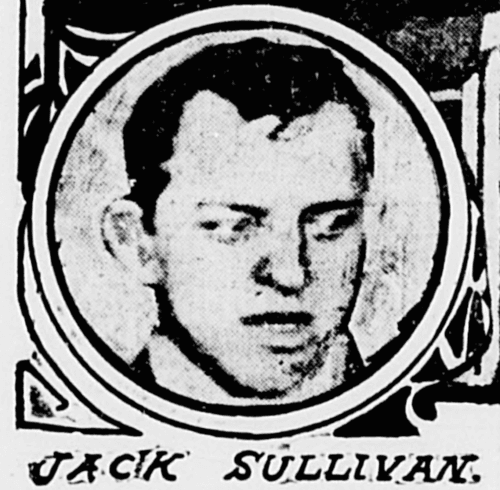
Without looking, I told my daughters that, if Jack Kelly had gone to Santa Fé in 1899, he would have found something very interesting: a cowboy school for young men. As it happened one of Roosevelt’s rough riders from the battle of San Juan Hill, retired to Santa Fé and set up a cowboy school for boys in the mountains above the town. He built a very outdoorsy operation in an area called “Los Alamos”. It ran until 1942 when the location was taken over to become “Site Y” of the Manhattan Project. This is where J. Robert Oppenheimer and co designed and built the first Atom Bombs. That Jack would have gone there would make for a nice, tidy story, but the truth appears to have been more messy, and more interesting. Jack got involved with William Hearst and George M. Cohan, the Titanic, a famous murder, and eventually with the fall of Tammany Hall. Here’s a picture.

Jack Sullivan

Jack Sullivan, head Newsie. He isn’t ugly, but isn’t Christian Bale either.

First, there was an actual newsboy strike in 1899; it was about raising the price the newsboys paid per paper, but the problem was that the price had been raised earlier, for the Spanish-American War, and not decreased after the war ended. The newsboys did win, and there was a leader named Jack, but according to the papers, the name of the leader was “Jack Sullivan”, not Jack Kelly or Francis Sullivan. The New York Tribune, July 22, 1899, lists Jack Sullivan as the leader of the strike Arbitration Committee and a leader of “the first group of newsboys to declare and demand their rights.” There are other leaders too: Louis “Kid Blink” Baletti, and David “Dave/ Yaller” Simmons. “Kid Blink” (he wore an eye patch and appears in the movie) got an award from the newsboys for making the best speech. I’ll guess that the Dave “the mouth” character is based on David “Yaller” Simmons, but it is not clear that he had any close relationship with Sullivan.

As for the movie showing Jack leaving with T. Roosevelt. it might have suited Roosevelt, but the real Jack appears to have stayed in New York, and appears to have taken a job as a bodyguard for William Randolph Hearst, one of the newspaper moguls who’d raised his rates and precipitated the strike. But it doesn’t end there. In 1904, Jack Sullivan, “the Boss Noosie” has gotten a charter for a Newsies Club to be set-up on 4th street in lower New York (the Bowery). A New York Times article (at left) includes an interview with Jack that fans should find pleasing, if only for his grammar. He uses the word, “papes” instead of papers or newspapers. I suspect this is a put-on affect for benefit of Times-readers, but who knows? It is sometimes the height of wisdom to appear stupid.

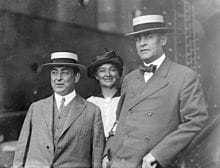
By 1909, Jack has lost control of his newsboy’s club. He appears to have used the club to teach boxing (how crude) and on at least one occasion used club assets to post bail for women accused of “loitering,” a jail-able offense in corrupt, Tammany-era New York. The club closed 2 years later. And then Jack gets married (November 27, 1910), and it appears that Jack’s real name was not Sullivan at all, but Reich. He marries Sarah Siegel at the Ohav Tzedek synagogue as “Jacob Reich”. The name Jacob Reich appears on his marriage license, on his death certificate, and on various court records, though he still appears as Jack Sullivan in other activities. Jack/ Jacob appears to have chosen the Irish-sounding name “Sullivan” as an homage to the leader of the Tammany (Democratic) machine, “Big Tim” Sullivan, shown in the photo below.

Turn of the century Tammany boss, "Big Tim" Sullivan, shown at right.

Turn of the century Tammany boss, “Big Tim” Sullivan, shown at right.

By March, 1912, Jack appears again in the news, this time suing two film companies for use of his story and likeness without payment to him. It’s a film called “the Gangsters.” It would be interesting to see if a copy still exists.

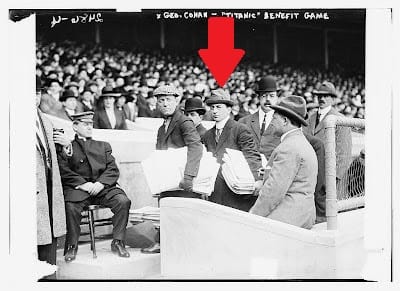
A month later, April 15, 1912, The unsinkable Titanic goes down, and six days after that, April 21, 1912, Jack is selling papers at a charity baseball game to benefit the survivors. The game takes place on a Sunday, normally prohibited by New York blue laws, between The New York Giants and The New York Yankees (the Yankees are still called the Highlanders in those days, but are already wearing pinstripes). In the picture below, Jack is under the red arrow with lots of “papes” under his arm, just behind famous song-writer, playwright, George M. Cohan. Both are dressed as newsies. George M. Cohan, known for the WWI song “Over there”, had four plays on Broadway at the time. He is one of the very few successful New Yorkers to have avoided major attachment to the crooked, New York political machine.

Jack Sullivan with George M Cohan, April 1912 selling a special newspaper to help survivors of the Titanic.

Jack Sullivan (arrow) with George M Cohan, April 1912 selling a special newspaper to help survivors of the Titanic.

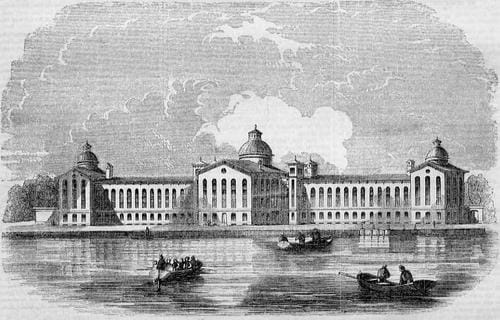
New York Refuge

The New York house of refuge

And now Jack Kelly / Sullivan/ Reich enters history as a tragic bystander. When he got married, Jack borrowed $1000, from a Jewish gambler and gambling hall owner, Herman (Beansy) Rosenthal. Rosenthal was a good friend of his, and of “Big Tim” Sullivan, but he (and Sullivan) had enemies. Among them, the crooked police Lieutenant, Charles Becker, who headed the city vice squad and delighted in shaking down the gamblers, pimps, etc for protection money. Becker wanted Rosenthal dead, in part to keep him from going to the newspapers with stories of police corruption.

By 1912, “Big Tim” lost control of the Tammany organization and was put in seclusion under Tammany guard. Within a year he’d be dead. Someone (Becker?) then hired four hit men to kill Rosenthal (1:30 AM, July 16, 1912 in front of The Metropole Hotel). It’s an event recounted in “The Great Gatsby.” Several beat-policemen were there to see the shooting, but every one looked away. Not one shot back or took the license of the car. In fact, the police did nothing to catch the murderers except to lock up the only honest witness to keep him from testifying. Before the shooting, Becker took Jack Sullivan out for an evening at Madison Square Garden; he then dropped Jack at the Metropole just before the 1:30 shooting. Becker and the police then blamed Jack and four others for the murder based on testimony that they had concocted. In the end, Jack was acquitted, but not the other four, or Becker. All five went to the electric chair; all five protested their innocence.

Becker was the first US police lieutenant to be put to death for murder. It seems unlikely that he was innocent, but was he a murderer, or just an accomplice. As for the other four, perhaps they were guilty, perhaps not; it’s hard to tell from Tammany-era records. The judge was crooked; Police chief Devery was at least as crooked as Becker in terms of shaking down hoodlums. And Devery had as much motive as Becker to want Rosenthal dead. The witnesses were lying from a script they’d been given — that’s what justice was like in those days. Within a year of the murder, Big Tim was dead and Charles Francis Murphy had gained firm control of Tammany Hall. The police spent the next decade in criminal activities while trying to pin something on Jack, now a cigar store owner. He was busted for gambling and related offenses, but nothing much came of it. Jack cleared his name from the charge of murder only in 1936, two years before his death — three years after Fiorello La Guardia was elected mayor. Republican/ Fusion candidate, La Guardia ran against Tammany and did much to end their police corruption.

As for The Refuge, The New York House of Refuge is a real place. It sat on Randal’s Island between Manhattan, The Bronx, and Queens. The Island is now famous as the center of The Triborough Bridge. There is now a park where The Refuge was. Was The Refuge run honestly? If it was, it would have been virtually the only public institutions to run that way. Tammany was corrupt to the core.

Robert E. Buxbaum, October 25, 2015. Much of the information here comes from a tumbler exchange called, “newsies historical research.” I organized it and added some background about Baseball, Tammany, etc. If you like Newsies, or the era, I can recommend the novel (and movie), The Great Gatsby, or Fiorello!, a musical version of La Guardia’s unlikely rise to power. Hearst is treated somewhat positively in Newsies, but less-so as “Citizen Kane.” If someone’s seen, or has a link to “The Gangsters” please tell me.

Republicans vs conservatives

Most of the great divides of the 1800s pitted conservatives against Republicans. This was the Divide in the Mexican civil wars of the 1800s, and there were several; it is the divide in the South American wars of Independence, and in much of the US and European political debate of the 1800s as well.

Ned Flanders, cartoon conservative from "The Simpsons" He's generally well meaning and helpful, but also a bit creepy.

Ned Flanders, cartoon conservative from “The Simpsons” He’s generally well-meaning and helpful, but also a bit creepy.

In general, the difference between conservatives and republicans is that conservative governments favor religion, and religion-based leadership, while republicans favor individual liberty. In 1800s Mexico, conservatives backed two emperors (Maximilian I and Agustin I) and Santa Anna, the ruler who suspended all personal rights an ignited the war of Texan independence. Conservatives generally favor the religion of the majority: Protestantism in England, Catholicism in Central and South America, Judaism in Israel, and Islam in most of the Muslim world. This tends to annoy the irreligious and minority religious populations, who tend to become republicans. Cinco de Mayo celebrates the 1862 victory of Mexican republicans over the French-backed, conservative Maximilian I, at the battle of Puebla. The US Civil War, in essence, pitted the irreligious, industrial, republican north against the conservative, evangelical South; slavery is in the Bible so it must be good.

Conservatives usually favor government actions against sin in all it’s forms: miserliness, drunkenness, drugs, pornography, wild music, money-making, and freedom as such. Conservative-ruled countries have generally had anti-blasphemy laws and enforced “blue laws”, restrictions on business on holidays. Republican governments have few, or none of these. In pre-revolution France, the penalty for blasphemy was death, just as the Bible mandates. This changed when the republicans came into power. In England, private blasphemy was prosecuted as late as 1977. Similar penalties are still in force in Iran and other conservative Islāmic countries. Many US states still restrict the sale of alcohol on Sunday, for similar, conservative reasons. Conservatives usually favor sexual morality laws, putting strong restrictions on homosexuality, abortion, and divorce. In England, amicable divorce wasn’t legalized until 1930, and homosexuality was illegal until 1970. In the US, sexual laws are a fairly bizarre mix, in my humble opinion, the result of republicans, liberals, and conservatives making inelegant compromises.

In republican democracies like modern-day France, Holland, and Germany, sexual immorality laws are more lax than in the US. Republican governments strive to protect the rights of the individual; among these their right to property and to a fairly unbridled pursuit of pleasure. Republican countries tend to suffer from (or benefit from) significant income inequality. People can become rich due to hard work, talent, luck, or birth. And they very often become arrogant and obnoxious after they become rich — and sometimes before — to an extent that bothers conservatives and liberals alike. People can also become very poor: from laziness or bad choices, or just from bad luck or having been born to the wrong parents. Conservative and liberal elements then strive to help the very poorest, providing them with food, money and basic housing — generally achieved by taxing the rich. This is good in moderation, but taken to excess, this can lead to dependency of the poor, and redirection of the rich into less-productive fields like politics and the church. Conservatives very rarely leave a good pathway for the poor out of dependency, nor have they found a way to keep scoundrels out of the government and the church.

Scrooge McDuck. he'd likely be a Republican, if only to protect his wealth.

Scrooge McDuck, banker, railroad tycoon, steel magnate; he’d likely be republican, though not likely conservative. Motivated by money and power, he may do good, but not in any direct way, usually.

At present, the US Republican Party, the GOP, consists of approximately equal halves conservatives and republicans. That is, GOP leadership is currently an approximate balance between kindly folks like Ned Flanders who would rule by the Bible, and an equal number of rougher individuals, more like Scrooge McDuck who would rule by money.  in a sense, this is a wonderful compromise as the excesses of each group reins in the excesses of the other. In another sense though, the balance between conservatives and republicans is an ungovernable mess that leads to regular de Condorcet failures. I’m not sure how this will play out in the 2016 elections.

Fortunately, not all irreconcilable differences are as irreconcilable as one might think. Many de Condorcet problems are solvable by compromise, or by the effects of time. Compromise between charity and commerce can produce the best of all worlds, a major theme point, as I understand it, of Dickens’s Christmas Carol.

Robert E. Buxbaum, October 20, 2015. I use these essays to refine my thinking — here, more than usual. Any help you can provide will be welcome, feedback, corrections, comments. I’m trying to figure out what I, myself think. The divide between Conservatives and Liberals produces some of the most wonderful quote – exchanges, e.g. between Churchill and Attlee in 1950s England. Liberals, and I have not quite made up my understanding here, seem like a sort of like conservatives in that they believe in wealth redistribution, but without the guidance of a church, or church-based morality. At some point in the future, I’ll hope to arrange my thoughts about them, and about the difference between liberals and democrats.

Marie de Condorcet and the tragedy of the GOP

This is not Maire de Condorcet, it's his wife Sophie. Marie (less attractive) was executed by Robespierre for being a Republican.

Marie Jean is a man’s name. This is not he, but his wife, Sophie de Condorcet. Marie Jean was executed for being a Republican in Revolutionary France.

During the French Revolution, Marie Jean de Condorcet proposed a paradox with significant consequence for all elective democracies: It was far from clear, de Condorcet noted, that an election would choose the desired individual — the people’s choice — once three or more people could run. I’m sorry to say, this has played out often over the last century, usually to the detriment of the GOP, the US Republican party presidential choices.

The classic example of Condorcet’s paradox occurred in 1914. Two Republican candidates, William H. Taft and Theodore Roosevelt, faced off against a less-popular Democrat, Woodrow Wilson. Despite the electorate preferring either Republican to Wilson, the two Republicans split the GOP vote, and Wilson became president. It’s a tragedy, not because Wilson was a bad president, he wasn’t, but because the result was against the will of the people and entirely predictable given who was running (see my essay on tragedy and comedy).

The paradox appeared next fifty years later, in 1964. President, Democrat Lyndon B. Johnson (LBJ) was highly unpopular. The war in Vietnam was going poorly and our cities were in turmoil. Polls showed that Americans preferred any of several moderate Republicans over LBJ: Henry Cabot Lodge, Jr., George Romney, and Nelson Rockefeller. But no moderate could beat the others, and the GOP nominated its hard liner, Barry Goldwater. Barry was handily defeated by LBJ.

Then, in 1976; as before the incumbent, Gerald Ford, was disliked. Polls showed that Americans preferred Democrat Jimmy Carter over Ford, but preferred Ronald Regan over either. But Ford beat Reagan in the Republican primary, and the November election was as predictable as it was undesirable.

Voters prefer Bush to Clinton, and Clinton to Trump, but Republicans prefer Trump to Bush.

Voters prefer Bush to Clinton, and Clinton to Trump, but Republicans prefer Trump to Bush.

And now, in 2015, the GOP has Donald Trump as its leading candidate. Polls show that Trump would lose to Democrat Hillary Clinton in a 2 person election, but that America would elect any of several Republicans over Trump or Clinton. As before,  unless someone blinks, the GOP will pick Trump as their champion, and Trump will lose to Clinton in November.

At this point you might suppose that Condorcet’s paradox is only a problem when there are primaries. Sorry to say, this is not so. The problem shows up in all versions of elections, and in all versions of decision-making. Kenneth Arrow demonstrated that these unwelcome, undemocratic outcomes are unavoidable as long as there are more than two choices and you can’t pick “all of the above.” It’s one of the first great applications of high-level math to economics, and Arrow got the Nobel prize for it in 1972. A mathematical truth: elective democracy can never be structured to deliver the will of the people.

This problem also shows up in business situations, e.g. when a board of directors must choose a new location and there are 3 or more options, or when a board must choose to fund a few research projects out of many. As with presidential elections, the outcome always depends on the structure of the choice. It seems to me that some voting systems must be better than others — more immune to these problems, but I don’t know which is best, nor which are better than which. A thought I’ve had (that might be wrong) is that reelections and term limits help remove de Condorcet’s paradox by opening up the possibility of choosing “all of the above” over time. As a result, many applications of de Condorcet’s are wrong, I suspect. Terms and term-limits create a sort of rotating presidency, and that, within limits, seems to be a good thing.

Robert Buxbaum, September 20, 2015. I’ve analyzed the Iran deal, marriage vs a PhD, and (most importantly) mustaches in politics; Taft was the last of the mustached presidents. Roosevelt, the second to last.

Why I don’t like the Iran deal

Treaties, I suspect, do not exist to create love between nations, but rather to preserve, in mummified form, the love that once existed between leaders. They are useful for display, and as a guide to the future, their main purpose is to allow a politician to help his friends while casting blame on someone else when problems show up. In the case of the US Iran-deal that seems certain to pass in a day or two with only Democratic-party support, and little popular support, I see no love between the nations. On a depressingly regular basis, Iranian leaders promise Death to America, and Death to America’s sometime-ally Israel. Iran has acted on these statements too, funding Hezbollah missiles and suicide bombers, and hanging its dissidents: practices that lead it to become something of a pariah among its neighbors. They also display the sort of nuclear factories and ICBMs (long-range rockets) that could make them much bigger threats if they choose to become bigger threats. The deal just signed by US Secretary of State and his counterpart in Iran (read in full here) seems to preserve this state. It releases to Iran $100,000,000,000 to $150,000,000,000 that it claims it will use against Israel, and Iran claims to have no interest in developing multi-point compression atom bombs. This is a tiny concession given that our atom bomb at Hiroshima was single-point compression, first generation, and killed 90,000 people.

Iranian intercontinental ballistic missile, several stories high, brought out during negotiations. Should easily deliver nuclear weapons far beyond Israel, and even to the USA.

Iranian intercontinental ballistic missile, new for 2015. Should easily deliver warheads far beyond Israel -even to the US.

The deal itself is about 170 pages long and semi-legalistic, but I found it easy to read. The print is large, Iran has few obligations, and the last 100 pages or so are a list companies that will no longer be sanctioned. The treaty asserts that we will defend Iran against attacks including military and cyber attacks, and sabotage –presumably from Israel, but gives no specifics. Also we are to help them with oil, naval, and fusion technology, while leaving them with 1500 kg of 20% enriched U235. That’s enough for quick conversion to 8 to 10 Hiroshima-size A-bombs (atom bombs) containing 25-30 kg each of 90% U235. The argument in favor of the bill seems to be that, by giving Iran the money and technology, and agreeing with their plans, Iran will come to like us. My sense is that this is wishful-thinking, and unlikely (as Jimmy Carter discovered). The unwritten contract isn’t worth the paper it’s written on.

As currently written, Iran does not recognize Israel’s right to exist. To the contrary, John Kerry has stated that a likely consequence is further attacks on Israel. Given Hezbollah’s current military budget is only about $150,000,000 and Hamas’s only about $15,000,000 (virtually all from Iran), we can expect a very significant increase in attacks once the money is released — unless Iran’s leaders prove to be cheapskates or traitors to their own revolution (unlikely). Given our president’s and Ms Clinton’s comments against Zionist racism, I assume that they hope to cow Israel into being less militant and less racist, i.e. less Jewish. I doubt it, but you never know. I also expect an arms race in the middle east to result. As for Iran’s statements that they seek to kill every Jew and wipe out the great satan, the USA: our leaders may come to regret hat they ignore such statements. I guess they hope that none of their friends or relatives will be among those killed.

Kerry on why we give Iran the ability to self-inspect.

Kerry on why we give Iran the ability to self-inspect.

I’d now like to turn to fusion technology, an area I know better than most. Nowhere does the treaty say what Iran will do with nuclear fusion technology, but it specifies we are to provide it, and there seem to be only two possibilities of what they might do with it: (1) Build a controlled fusion reactor like the TFTR at Princeton — a very complex, expensive option, or (2) develop a hydrogen fusion bomb of the sort that vaporized the island of Bimini: an H-bomb. I suspect Iran means to do the latter, while I imagine that, John Kerry is thinking the former. Controlled fusion is very difficult; uncontrolled fusion is a lot easier. With a little thought, you’ll see how to build a decent H-bomb.

My speculation of why Iran would want to make an H-bomb is this: they may not trust their A-bombs to win a war with Israel. As things stand, their A-bomb scientists are unlikely to coax more than 25 to 100 kilotons of explosive power out of each bomb, perhaps double that of Hiroshima and Nagasaki. But our WWII bombs “only” killed 70,000 to 90,000 people each, even with the radiation deaths. Used against Israel, such bombs could level the core of Jerusalem or Tel Aviv. But most Israelis would survive, and they would strike back, hard.

To beat the Israelis, you’d need a Megaton-size, hydrogen bomb. Just one Megaton bomb would vaporize Jerusalem and it’s suburbs, kill a million inhabitants at a shot, level the hills, vaporize the artifacts in the jewish museum, and destroy anything we now associate with Israel. If Iran did that, while retaining a second bomb for Tel-Aviv, it is quite possible Israel would surrender. As for our aim, perhaps we hope Iran will attack Israel and leave us alone. Very bright people pushed for WWI on hopes like this.

Robert E. Buxbaum. September 9, 2015. Here’s a thought about why peace in the middle east is so hard to achieve,

Racial symbols: OK or racist

Washington Redskins logo and symbol. Shows race or racism?

Washington Redskins lost protection of their logo and indian symbol. Symbol of race or racism?

In law, one generally strives for uniformity, as in Leviticus 24:22: “You shall have one manner of law; the same for the home-born as for the stranger,”  but there are problems with putting this into effect when dealing with racism. The law seems to allow each individual group to denigrate itself with words that outsiders are not permitted. This is seen regularly in rap songs but also in advertising.

Roughly a year ago, the US Patent office revoked the copyright protection for the Washington Redskin logo and for the team name causing large financial loss to the Redskins organization. The patent office cited this symbol as the most racist-offensive in sports. I suspect this is bad law, in part because it appears non-uniform, and in part because I’m fairly sure it isn’t the most racist-offensive name or symbol. To pick to punish this team seems (to me) an arbitrary, capricious use of power. I’ll assume there are some who are bothered by the name Redskin, but suspect there are others who take pride in the name and symbol. The image is of a strong, healthy individual, as befits a sports team. If some are offended, is his (or her) opinion enough to deprive the team of its merchandise copyright, and to deprive those who approve?

More racist, in my opinion, is the fighting Irishman of Notre Dame. He looks thick-headed, unfit, and not particularly bright: more like a Leprechaun than a human being. As for offensive, he seems to fit a racial stereotype that Irishmen get drunk and get into fights. Yet the US Patent office protects him for the organization, but not the Washington Redskin. Doesn’t the 14th amendment guarantee “equal protection of the laws;” why does Notre Dame get unequal protection?

Notre Damme Fighting Irish. Is this an offensive stereotype.

Notre Dame’s Fighting Irishman is still a protected symbol. Is he a less-offensive, racist stereotype?

Perhaps what protects the Notre Dame Irishman is that he’s a white man, and we worry more about insulting brown people than white ones. But this too seems unequal: a sort of reverse discrimination. And I’m not sure the protection of the 14th was meant to extend to feelings this way. In either case, I note there are many other indian-named sports teams, e.g. the Indians, Braves, and Chiefs, and some of their mascots seem worse: the Cleveland Indians’ mascot, “Chief Wahoo,” for example.

Chief Wahoo, symbol of the Cleveland Indians. Still protected logo --looks more racist than the Redskin to me.

Chief Wahoo, Still protected symbol of the Cleveland Indians –looks more racist than the Redskin to me.

And then there’s the problem of figuring out how racist is too racist. I’m told that Canadians find the words Indian and Eskimo offensive, and have banned these words in all official forms. I imagine some Americans find them racist too, but we have not. To me it seems that an insult-based law must include a clear standard of  how insulting the racist comment has to be. If there is no standard, there should be no law. In the US, there is a hockey team called the Escanaba (Michigan) Eskimos; their name is protected. There is also an ice-cream sandwich called Eskimo Pie — with an Eskimo on the label. Are these protected because there are relatively fewer Eskimos or because eskimos are assumed to be less-easily insulted? All this seems like an arbitrary distinction, and thus a violation of the “equal protection” clause.

And is no weight given if some people take pride in the symbol: should their pride be allowed balance the offense taken by others? Yankee, originally an insulting term for a colonial New Englander became a sign of pride in the American Revolution. Similarly, Knickerbocker was once an insulting term for a Dutch New Yorker; I don’t think there are many Dutch who are still insulted, but if a few are, can we allow the non-insulted to balance them. Then there’s “The Canucks”, an offensive term for Canadian, and the Boston Celtic, a stereotypical Irishman, but also a mark of pride of how far the Irish have come in Boston society. Tar-heel and Hoosiers are regional terms for white trash, but now accepted. There must be some standard of insult here, but I see none.

The Frito Bandito, ambassador of Frito Lays corn chips.

The Frito Bandito, ambassador of Frito Lays corn chips; still protected, but looks racist to me.

Somehow, things seem to get more acceptable, not less if the racial slur is over the top. This is the case, I guess with the Frito Bandito — as insulting a Mexican as I can imagine, actually worse than Chief Wahoo. I’d think that the law should not allow for an arbitrary distinction like this. What sort of normal person objects to the handsome Redskin Indian, but not to Wahoo or the Bandito? And where does Uncle Ben fit in? The symbol of uncle Ben’s rice appears to me as a handsome, older black man dressed as a high-end waiter. This seems respectable, but I can imagine someone seeing an “uncle tom,” or being insulted that a black man is a waiter. Is this enough offense  to upend the company? Upending a company over that would seem to offend all other waiters: is their job so disgusting that no black man can ever be depicted doing it? I’m not a lawyer or a preacher, but it seems to me that promoting the higher levels of respect and civil society is the job of preachers not of the law. I imagine it’s the job of the law to protect contracts, life, and property. As such the law should be clear, uniform and simple. I can imagine the law removing a symbol to prevent a riot, or to maintain intellectual property rights (e.g. keeping the Atlanta Brave from looking too much like the Cleveland Indian). But I’d think to give people wide berth to choose their brand expression. Still, what do I know?

Robert Buxbaum, August 26, 2015. I hold 12 patents, mostly in hydrogen, and have at least one more pending. I hope they are not revoked on the basis that someone is offended. I’ve also blogged a racist joke about Canadians, and about an Italian funeral.