Category Archives: politics

Peace killed the Indian, ended Spain’s golden age

The why of history is always more speculative than the what. Yet, to write about only the what, is to do only half of the job, if that. The what is largely interchangeable: the names of kings and generals, the dates and locals of battles and treaties. It’s the why that adds interest, and provides whatever lessons one can take forward. With this as background, I’d like to speculate on the cause of: the destruction of the American Indian, and the end of the golden age of Spain. For both and some others, I suggest an unusual villain, peace: too much peace. It’s a speculative why, but bear with me.

Lets start with the American Indian. In the mid 1700s, Indians controlled the majority of the continent. They had an advanced society of six main nations, held together by mutual treaty. The Indians had few guns, but were not less intelligent than the Japanese or Chinese, suggesting that they could have learned to make them if they desired (or realized they needed to desire). The Japanese did so in short order. Indians addressed the Continental assemblies, and though they were not integrated, quite, they were not segregated either. But this first period of co-existence ended, as best i can tell, in the years of and following the French and Indian war. In the war, some Indians supported the French and some the British, and each side looked after their Indians. After peace was established, however, English leaders like Lord Jeffery Amherst set up to wipe out the Indians of both sides, “this execrable race,” with blankets infected with smallpox, and good old-fashioned cruelty. His activities are memorialized, on the cafeteria china used at Amherst Colleges till the 1960s.

Cup from the cafeteria of Amherst College shows Lord Jeff pursuing the Indians.

Cup from the cafeteria of Amherst College, used till the 1960s, shows Lord Jeffery Amherst pursuing a band of Indians. Purple and white are the Amherst colors. 

My thought of why he did it, and why he succeeded, is that the Indians had outlived their usefulness. The ones on the French side had been enemies, and might be again. The ones on his, English side were annoying and might turn in the next conflict. Besides, Lord Jeffery and his ilk had idle military power. Removing the Indians was something they could do. The army at peace could otherwise get destructive, or turn on him (I’m speculating here on motives).

This pattern appeared again in the Revolutionary war and in the War of 1812. During each war, Indians were befriended by both sides, and recruited. Indians fought important battles in each war, now mostly forgotten; the defense of Canada was largely by Indians. After each war, these Indians were largely betrayed. In the War of 1812, the Shawnee, Potawatomi, Ojibwa, and Creek mostly sided with the British, led by the fierce Shawnee general, Tecumseh. The Muscogee, Creek, Seminole, Choctaw, Cherokee, and Chickasaw, mostly sided with the US. Iroquois fought on both sides. In the years following the wars, these and these were sent west of the Mississippi. Those who had been allies with the US were paid for their land, those that sided with the British were not. A good price, but it was a forced sale none-the-less. I will speculate that they were exiled because they retained a government structure independent of the US, making them a threat. Also (I speculate) the military, Generals Harrison, Jackson, etc., had nothing better to do with an army that might have mutinied otherwise. By 1846, there was no serious future for the American Indian east of the Mississippi, and besides, there was an external enemy to fight — The Mexicans. My speculation: the Indians were destroyed by “the era of good feelings” that follows war.

In the case of Spain, I note that the Inquisition and Jewish expulsion followed suddenly after 300 years of science, art, literature, and coöperation. I also note that the Alhambra decrees (March 1492) followed almost immediately after the defeat the last major Moslem-held citadel, Granada in December, 1491, and the peace treaty of Granada (January 2, 1492). The Alhambra decrees of March 31, 1492 mandated that all Jews must convert or leave Spain, and gave free-reign to the Inquisition to punish heresy. At the time, the financier of the Spanish crown was a Jew, Don Isaac Abarbanel. And some years earlier another Jew, Shmuel HaNagged hand been vizier (2nd) to the king. My theory of the cause for the sudden switch is that it was not a sudden surge in religion, as some have suggested, but rather that the king and queen no longer needed an army or Jewish or Moslem allies, but they still had an army that might turn against them if not otherwise occupied.

In the interwar, peace years, Stalin removed 3 of the 5 top generals, 13 of 15 below them; 8 of 9 admirals, 50 of 57 army corps commanders, 154 out of 186 division commanders, 16 of 16 army commissars, and 25 of 28 army corps commissars.

In the interwar, peace years, Stalin removed 3 of the 5 top generals, 13 of 15 below them; 8 of 9 admirals, 50 of 57 army corps commanders, 154 out of 186 division commanders, 16 of 16 army commissars, and 25 of 28 army corps commissars. Peace is hell.

I’m reminded that peace is the background to intrigue in at least six of Shakespeare’s historical plays: Macbeth, Hamlet, Richard III, Lear, Julius Caesar, and Othello. Richard III explains his behavior as follows (Act I, Scene 1):  “Why, I, in this weak piping time of peace, have no delight to pass away the time, unless to spy my shadow in the sun and descant on mine own deformity.”

A few other examples: After WWI, most of Europe removed their bearded aristocracy, and Stalin used the peacetime to remove much of the communist leadership including many of his generals and former friends – this was especially so after signing a peace treaty with Germany. And, in the US after WWII, we entered a period of communist witch hunts — a mini Inquisition directed at the writers and artists who provided Allied propaganda during the war. Even a general good, like peace can leave casualties.

Robert Buxbaum, July 7, 2017. I like to speculate on the why of history, and like to imagine my speculations are partially true, at least.

West’s Batman vs Zen Batmen

“Holy kleenex Batman, it was right under our noses and we blew it.” I came of age with Adam West’s Batman on TV and a relatively sane Batman in the comic books. Batman was a sort of urban cowboy: a loner, but a law-abiding, honest loner. A proud American who was polite to the police and to the ordinary citizen. He was both good, and “nice.” Back then, as today, no one died by the hand of Batman, but that was largely because he worked with the police who made the final arrests

bat-buddah

More recent Batmen have been not nice, and arguably not good either. They do not work with the police but act above the law. Their ethos is not from US civics class, but from dark training in eastern monasteries by masters of kung fu. It’s a morality no one quite understands, not least himself. Quite literally, ‘He is a dark and stormy knight.’

A few days ago, I found this plastic Batman-Buddah for sale on e-Bay and I started wondering about how far our current movie Batmen have moved from those of the 60s. And on the deep, Zen thoughts that Batman now expounds on life and crime. These zen thoughts are pretty messed up, as psychologists have noted.

Example. In a recent Batman movie, Batman beats up an invasive wannabe wearing hockey pads. He gets asked: “What gives you the right? What’s the difference between you and me?” The response, “I’m not wearing hockey pads.” This is to say, the current Batman believe his physical prowess makes him above the law. Some more comments:
“Sometimes it’s only madness that makes us what we are.”
“That mask — it’s not to hide who I am, but to create what I am.”
“I won’t kill you, but I don’t have to save you.”

When he speaks to the Joker, it’s not clear which one is crazier. E.g.. Batman tells the Joker that he doesn’t kill because, “If you kill a killer, the number of killers remains the same.” To which Joker replies: “Unless you kill more than one….” That sounds sane to me.

By contrast. consider Adam West as Batman in the 1960s: “Underneath this garb, we’re perfectly ordinary Americans.” Another quote: “A reporter’s lot is not easy, making exciting stories out of plain, average, ordinary people like Robin and me.” Though this comment is “off” it’s nice to see that this Batman feels for peoples’ problems, respects their professions, and does not profess to be better than they are. He’s weird, but not a psychopath, and he leaves Gotham city pretty much the way you find it at the beginning of a comic or episode.

Not a classic Batmobile, but I like the concept.

Not a classic Batmobile, but I like it. Adam West’s Batman always strove to be socially responsible. 

By contrast, the current, dark, depressive Batmen always leave Gotham City in shambles, with piles of dead and destroyed buildings and infrastructure. Given the damage Batman does, you wonder why anyone calls for Batman; current Batmen never works with the police, quite.

And where’s Robin. To the extent that Robin appears at all, his relationship with Batman is more frenemy than ally. Batgirl too is mostly absent, and has changed. The original Batgirl was connected to the police. She was Barbara Gordon, Police Commissioner Gordon’s daughter, a positive female with a good relationship with her supportive, non-sexist father (an early version of Kim Possible’s dad) and with society as a whole. The current Batgirl appears is the butler’s daughter, and except for one brief appearance, you never see her, not at Wayne Manor, not anywhere. Somehow she’s Batgirl though it’s presented that didn’t know what her dad was up to.

Here are some real interactions between Adam West as Batman with Robin. He shows an interest in Robin’s education and well-being, something currently lacking:

AW Batman: “Haven’t you noticed how we always escape the vicious ensnarements of our enemies?” Robin: “Yeah, because we’re smarter than they are!”  Batman: “I like to think it’s because our hearts are pure.”

AW Batman: “Better put 5 cents in the meter.” Robin: “No policeman’s going to give the Batmobile a ticket.” Batman: “This money goes to building better roads. We all must do our part.”

Robin: “You can’t get away from Batman that easy!” AW Batman: “Easily.” Robin: “Easily.”
“Good grammar is essential, Robin.” Robin: “Thank you.” Batman: “You’re welcome.”

Robin/Dick: “What’s so important about Chopin?” Batman: “All music is important, Dick. It’s the universal language. One of our best hopes for the eventual realization of the brotherhood of man.” Dick: “Gosh Bruce, yes, you’re right. I’ll practice harder from now on.”

AW Batman: “That’s one trouble with dual identities, Robin. Dual responsibilities.”

“Even crime fighters must eat. And especially you. You’re a growing boy and you need your nutrition.”

“What took you so long, Batgirl?” Batgirl: “Rush hour traffic, plus all the lights were against me. And you wouldn’t want me to speed, would you?” Robin: “Your good driving habits almost cost us our lives!” Batman: “Rules are rules, Robin. But you do have a point.”

And finally, AW Batman: “I think you should acquire a taste for opera, Robin, as one does for poetry and olives.”

Clearly this Batman takes an interest in Robin’s health and education, and in Batgirl’s. Robin is his ward, after all, a foster child. And Batgirl is a protege, as well as the daughter of a friend.

The modern Batman claims, “It’s not who I am underneath, but what I do that defines me.” It’s, more or less, a quote from Karl Jung that shows pride in one’s art, but it also shows an attachment to job over self. This approach appeared in the olden days, in the form of Catwoman, a woman with her own moral code, and proud of it. Batman found her odious, abhorrent, and “insegrievious”. The only difference between her and the Joker, he says, is the amount of damage done. I’m sorry to find that recent, Zen Batmen and Supermen might as well be Cat-women, or Jokers. To quote Robin: “Holy strawberries, Batman, we’re in a jam.”

Robert Buxbaum, June 26, 2017. Insegeivious is a made-up word, and I love it. I also love the humor of Robin’s “holy xxx” comments.

Race and suicide

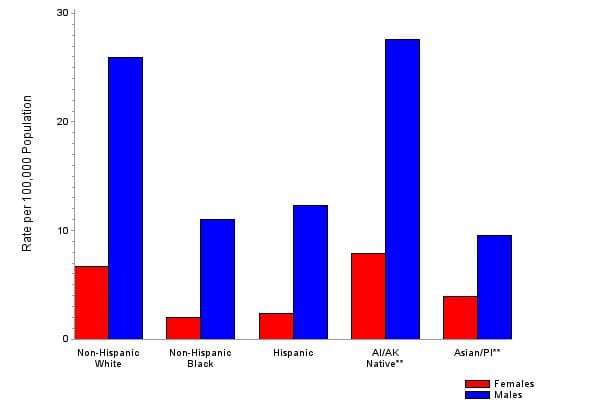
Suicide is generally understood as a cry of desperation. If so, you’d expect that the poorer, less-powerful, less-mobile members of society — black people, Hispanics, and women — would be the most suicidal. The opposite is true. While black people and Hispanics have low savings, and mobility, they rarely commit suicide. White Protestants and Indians are the most suicidal groups in the US; Blacks, Hispanics, Jews, Catholics, Moslems, Orientals, are significantly less prone. And black, non-Hispanic women are the least suicidal group of all — something I find rather surprising.

US, Race-specific suicide, all ages, Center for Disease control 2002-2012

US, Race-specific suicide, all ages, Center for Disease control 2002-2012

Aha, I hear you say: It’s the stress of upward mobility that causes suicide. If this were true, you’d expect Asians would have a high suicide rate. They do not, at least not American Asians. Their rate (male + female) is only 6.5/100,000, even lower than that for Afro-Americans. In their own countries, it’s different, and Japanese, Chinese, and Koreans commit suicide at a frightening rate. My suspicion is that American Asians feel less trapped by their jobs, and less identified too. They do not feel shame in their company’s failures, and that’s a good, healthy situation. In Korea, several suicides were related to the Samsung phones that burst into flames. While there is some stress from upward mobility, suggested by the suicide rates for Asian-American females being higher than for other woman, it’s still half that of non-hispanic white women, and for women in China and Korea. This suggests, to me, that the attitude of Asian Americans is relatively healthy.

The only group with a suicide rate that matches that of white protestants is American Indians, particularly Alaskan Indians. You’d figure their rate would be high given the alcoholism, but you’d expect it to be similar to that for South-American Hispanics, as these are a similar culture, but you’d be wrong, and it’s worthwhile to ask why. While men in both cultures have similar genes, suffer financially, and are jailed often, American Indians are far more suicidal than Mexican Americans. It’s been suggested that the difference is religiosity or despair. But if Indians despair, why don’t Mexicans or black people? I find I don’t have a completely satisfactory explanation, and will leave it at that.

Age-specific suicide rates.

Age-specific suicide rates, US, all races, 2012, CDC.

Concerning age, you’d probably guess that teenagers and young adults would be most suicidal — they seem the most depressed. This is not the case. Instead, middle age men are twice as likely to commit suicide as teenage men, and old men, 85+, are 3.5 times more suicidal. The same age group, 85+ women, is among the least suicidal. This is sort-of surprising since they are often in a lot of pain. Why men and not women? My suspicion is that the difference, as with the Asians has to do with job identification. I note that middle age is a particularly important time for job progress, and note that men are more-expected to hold a job and provide than women are. When men feel they are not providing –or worse –see themselves as a drag on family resources, they commit suicide. At least, this is my explanation.

It’s been suggested that religion is the consolation of women and particularly of black women and Catholics. I find this explanation doubtful as I have no real reason to think that old women are more religious than old men, or that Protestants and Indians are less religious than Hispanics, Asians, Moslems, and Jews. Another difference that I (mostly) reject is that access to guns is the driver of suicide. Backing this up is a claim in a recent AFSP report, that women attempt suicide three times more often than men. That men prefer guns, while women prefer pills and other, less-violent means is used to suggest that removal of guns would (or should) reduce suicide. Sorry to say, a comparison between the US and Canada (below) suggests the opposite.

A Centers for Disease Control study (2012) found that people doing manual labor jobs are more prone to suicide than are people in high-strew, thinking jobs. That is, lumberjacks, farmers, fishermen, construction workers, carpenters, miners, etc. All commit suicide far more than librarians, doctors, and teachers, whatever the race. My suspicion is that it’s not the stress of the job so much, as the stress of unemployment between gigs. The high suicide jobs, it strikes me, are jobs one would identify with (I’m a lumberjack, I’m a plumber, etc. ) and short term. I suspect that the men doing these jobs (and all these are male-oriented jobs) tend to identify with their job, and tend to fall into a deadly funk when their laid off. They can not sit around the house. Then again, many of these jobs go hand in hand with heavy drinking and an uncommon access to guns, poison, and suicidal opportunities.

zc-percentage-total-suicides-by-method-2000-2003-ca-2007-us

Canadians commit suicide slightly more often than Americans, but Canadians do it mostly with rope and poison, while more than half of US suicides are with guns.

I suspect that suicide among older men stems from the stress of unemployment and the boredom of sitting around feeling useless. Older women tend to have hobbies and friends, while older men do not. And older men seem to feel they are “a burden” if they can no-longer work. Actor Robin Williams, as an example, committed suicide, supposedly, because he found he could not remember his lines as he had. And Kurt Gödel (famous philosopher) just stopped eating until he died (apparently, this is a fairly uncommon method). My speculation is that he thought he was no longer doing productive work and concluded “if I don’t produce, I don’t deserve to eat.” i’m going to speculate that the culture of women, black men, Hispanics, Asians, etc. are less bound to their job, and less burdened by feelings of worthlessness when they are not working. Clearly, black men have as much access to guns as white men, and anyone could potentially fast himself to death.

I should also note that people tend to commit suicide when they lose their wife or husband; girlfriend or boyfriend. My thought is that this is similar to job identification. It seems to me that a wife, husband, or loved one is an affirmation of worth, someone to do for. Without someone to do for, one may feel he has nothing to live for. Based on the above, my guess about counseling is that a particularly good approach would be to remind people in this situation that there are always other opportunities. Always more fish in the sea, as it were. There are other women and men out there, and other job opportunities. Two weeks ago, I sent a suicidal friend a link to the YouTube of Stephen Foster’s song, “there are plenty of fish in the sea” and it seemed to help. It might also help to make the person feel wanted, or needed by someone else — to involve him or her is some new political or social activity. Another thought, take away the opportunity. Since you can’t easily take someone’s gun, rope, or pills — they’d get mad and suspicious –I’d suggest taking the person somewhere where these things are not — a park, the beach, a sauna or hot-tub, or just for a walk. These are just my thoughts, I’m a PhD engineer, so my thinking may seem odd. I try to use numbers to guide my thought. If what I say makes sense, use it at your own risk.

Robert Buxbaum, June 21, 2017.Some other odd conclusions: that Hamilton didn’t throw away his shot, but tried to kill Burr. That tax day is particularly accident prone, both in the US and Canada, and that old people are not particularly bad drivers, but they drive more dangerous routes (country roads, not highways).

Future airplane catapults may not be electric

President Trump got into Hot Water with the Navy this week for his suggestion that they should go “back to god-damn steam” for their airplane catapults as a cure for cost over-runs and delays with the Navy’s aircraft carriers. The Navy had chosen to go to a more modern catapult called EMALS (electromagnetic, aircraft launch system) based on a traveling coil and electromagnetic pulses. This EMAL system has cost $5 Billion in cost over-runs, has added 3 years to the program, and still doesn’t work well. In response to the president’s suggestion (explosion), the Navy did what the rest of Washington has done: blame Trump’s ignorance, e.g. here, in the Navy Times. Still, for what it’s worth, I think Trump’s idea has merit, especially if I can modify it a bit to suggest high pressure air (pneumatics) instead of high pressure steam.


Tests of the navy EMALS, notice that some launches go further than others; the problem is electronics, supposedly.

If you want to launch a 50,000 lb jet fighter at 5 g acceleration, you need to apply 250,000 lbs of force uniformly throughout the launch. For pneumatics, all that takes is 250 psi steam or air, and a 1000 square inch piston, about 3 feet in diameter. This is a very modest pressure and a quite modest size piston. A 50,000 lb object accelerated this way, will reach launch speed (130 mph) in 1.2 seconds. It’s very hard to get such fast or uniform acceleration with an electromagnetic coil since the motion of the coil always produces a back voltage. The electromagnetic pulses can be adjusted to counter this, but it’s not all that easy, as the Navy tests show. You have to know the speed and position of the airplane precisely to get it right, and have to adjust the firing of the pushing coils accordingly. There is no guarantee of smooth acceleration like you get with a piston, and the EMALS control circuit will always be vulnerable to electromagnetic and cyber attack. As things stand, the control system is thought to be the problem.

A piston is invulnerable to EM and cyber attack since, if worse comes to worse, the valves can be operated manually, as was done with steam-catapults throughout WWII. And pistons are very robust — far more robust than solenoid coils — because they are far less complex. As much force as you put on the plane, has to be put on the coil or piston. Thus, for 5 g acceleration, the coil or piston has to experience 250,000 lbs of horizontal force. That’s 3 million Newtons for those who like SI units (here’s a joke about SI units). A solid piston will have no problem withstanding 250,000 lbs for years. Piston steamships from the 50s are still in operation. Coils are far more delicate, and the life-span is likely to be short, at least for current designs. 

The reason I suggest compressed air, pneumatics, instead of steam is that air is not as hot and corrosive as steam. Also an air compressor can be located close to the flight deck, connected to the power center by electric wires. Steam requires long runs of steam pipes, a more difficult proposition. As a possible design, one could use a multi-stage, inter-cooled air compressor connected to a ballast tank, perhaps 5 feet in diameter x 100 feet long to guarantee uniform pressure. The ballast tank would provide the uniform pressure while allowing the use of a relatively small compressor, drawing less power than the EMALS. Those who’ve had freshman physics will be able to show that 5 g acceleration will get the plane to 130 mph in only 125 feet of runway. This is far less runway than the EMALS requires. For lighter planes or greater efficiency, one could shut off the input air before 120 feet and allow the remainder of the air to expand for 200 feet of the piston.

The same pistons could be used for capturing an airplane. It could start at 250 psi, dead-ended to the cylinder top. The captured airplane would push air back into the ballast tank, or the valve could be closed allowing pressure to build. Operated that way, the cylinder could stop the plane in 60 feet. You can’t do that with an EMAL. I should also mention that the efficiency of the piston catapult can be near 100%, but the efficiency of the EMALS will be near zero at the beginning of acceleration. Low efficiency at low speed is a problem found in all electromagnetic actuators: lots of electromagnetic power is needed to get things moving, but the output work,  ∫F dx, is near zero at low velocity. With EM, efficiency is high at only at one speed determined by the size of the moving coil; with pistons it’s high at all speeds. I suggest the Navy keep their EMALS, but only as a secondary system, perhaps used to launch drones until they get sea experience and demonstrate a real advantage over pneumatics.

Robert Buxbaum, May 19, 2017. The USS Princeton was the fanciest ship in the US fleet, with super high-tech cannons. When they mis-fired, it killed most of the cabinet of President Tyler. Slow and steady wins the arms race.

Nestle pays 1/4,000 what you pay for water

When you turn on your tap or water your lawn, you are billed about 1.5¢ for every gallon of water you use. In south-east Michigan, this is water that comes from the Detroit river, chlorinated to remove bacteria, e.g. from sewage, and delivered to you by pipe. When Nestle’s Absopure division buys water, it pays about 1/4000 as much — $200/ year for 218 gallons per minute, and they get their water from a purer source, a pure glacial aquifer that has no sewage and needs no chlorine. They get a far better deal than you do, in part because they provide the pipes, but it’s mostly because they have the financial clout to negotiate the deal. They sell the Michigan water at an average price around $1/gallon, netting roughly $100,000,000 per year (gross). This allows them to buy politicians — something you and I can not afford.

Absopure advertises that I t will match case-for-case water donations to Flint. Isn't that white of them.

Absopure advertises that I t will match case-for-case water donations to Flint. That’s awfully white of them.

We in Michigan are among the better customers for the Absopure water. We like the flavor, and that it’s local. Several charities purchase it for the folks of nearby Flint because their water is near undrinkable, and because the Absopure folks have been matching the charitable purchases bottle-for bottle. It’s a good deal for Nestle, even at 50¢/gallon, but not so-much for us, and I think we should renegotiate to do better. Nestle has asked to double their pumping rate, so this might be a good time to ask to increase our payback per gallon. So far, our state legislators have neither said yes or no to the proposal to pump more, but are “researching the matter.” I take this to mean they’re asking Nestle for campaign donations — the time-honored Tammany method. Here’s a Detroit Free Press article.

I strongly suspect we should use this opportunity to raise the price by a factor of 400 to 4000, to 0.15¢ to 1.5¢ per gallon, and I would like to require Absopure to supply a free 1 million gallons per year. We’d raise $300,000 to $3,000,000 per year and the folks of Flint would have clean water (some other cities need too). And Nestle’s Absopure would still make $200,000,000 off of Michigan’s, clean, glacial water.

Robert Buxbaum, May 15, 2017. I ran for water commissioner, 2016, and have occasionally blogged about water, E.g. fluoridationhidden rivers, and how you would drain a swamp, literally.

Why did Hamilton wear his glasses at the duel?

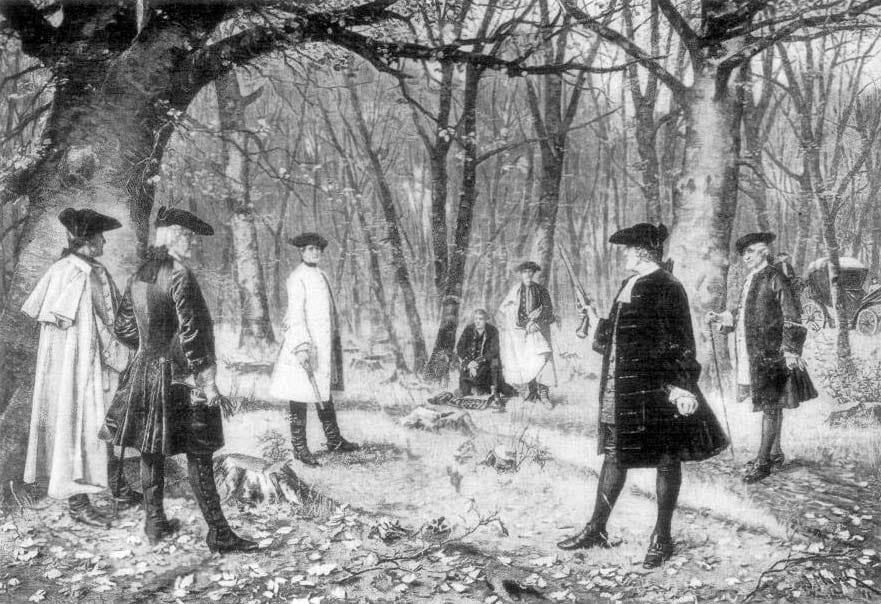
The musical play “Hamilton” ends with his duel with Burr. A song leading up to it, the world was wide enough tells the audience that Hamilton “wore his glasses” at the duel, and that he “methodically fiddled with the trigger.” It doesn’t say why, but tries to imply a sort of death-wish where Hamilton “threw away his shot” (fired into the air) because he didn’t want to kill his first friend, or because he thought of his son, who died near the spot. The theory is supported by popular myth, though the details of the events are, by necessity, muddy. All the witnesses testified that they looked away before the shooting started –customary in duels at the time.

There are some problems I find with this theory, and I’d like to present another: that Hamilton was so eager to kill Burr that he over-stacked the deck in his favor. The witnesses noted that Hamilton performed some provocative actions that seem out of character for someone who wants to commit suicide: “As they were taking their places, he (Hamilton) asked that the proceedings stop, adjusted his spectacles, and slowly, repeatedly, sighted along his pistol to test his aim”[1]. This seems like a taunt, if anything. As I reading the letters too, I find Hamilton taunting Burr to duel. He could have bowed out in many ways, as Washington always had, or been neutral. Why taunt? Why wear glasses and fiddle with the trigger? Why test your aim and then throw away your shot?

The choice of guns is important too, along with where the shot actually went. First the shot: While Hamilton’s second originally thought Hamilton had shot in the air, when the seconds went back the next day they found the shot in a cedar limb, “at an elevation of about twelve feet and a half, perpendicularly from the ground, between thirteen and fourteen feet from the mark on which General Hamilton stood, and about four feet wide of the direct line between him and Col. Burr, on the right side”.[2] The men stood 10 paces apart (16-18 feet), so apparently the shot hit about 6 feet above Burr’s head on a line reasonably towards him. That’s not quite shooting in the air.

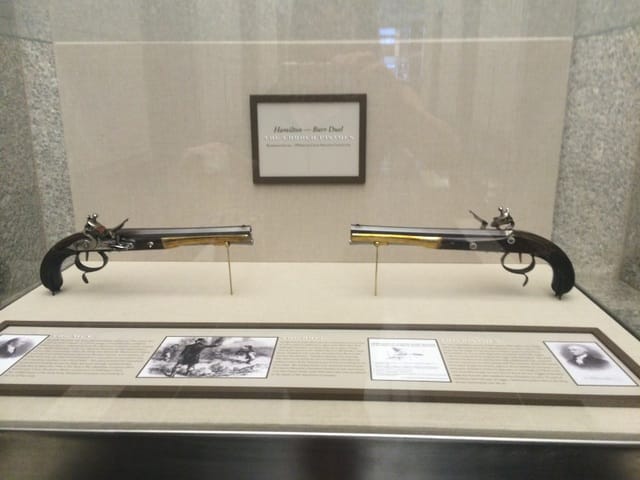
The pair of Wogdon dueling pistols used in the Hamilton - Burr duel.

The Wogdon pistols used in the Hamilton – Burr duel. Currently the property of the JP Morgan Chase Manhattan Bank, in 1976 they were found to have a hidden hair trigger, something Hamilton knew, but Burr would not have known.

The choice of pistols is also suggestive. The pistols were the property of John Church, a brother-in-law to Hamilton, and a business partner of both men. Church had fought a duel with Burr some years before and, using Burr’s pistols, shot a button off Burr’s coat. Burr missed completely. Church then bought these new pistols in London — Wogdon pistols, with an extra-large bore and sights. Sights were not considered “sporting” for duels, and not ordinarily allowed. With sights on the pistols, one could not miss if one aimed. As for the bigger bore, this too was unusual. If you hit, you killed; most gentlemen preferred a less-deadly duel. Hamilton chose to use these pistols even though he owned two, “legal” pistols (smaller bore, no sight). As the challenged party, it was his right. Still, why not choose your own, if not to make use of the sight and the large-bore. And, according to his second, he seems to have practiced with the pistols beforehand [4].

Analysis of the guns, done in the late 1970s [3] turned up another illegal feature. While they appear to be normal dueling pistols, these guns have a hidden feature. If you move the trigger a fraction of an inch forward it sets a hidden, hair-trigger. It’s a hidden feature that Hamilton knew about [3] but Burr almost certainly did not. If Hamilton surreptitiously set the hair-trigger, it would give him a tremendous advantage. He would be able to shoot more quickly and more accurately, with a much lighter squeeze on the trigger. The sights ensured it would be a kill. Burr’s gun, unset, would have required the normal, heavy, 10-15 pound pull. His shot would have been slower and less accurate. As it was, it seems Burr fired second.

Ten paces is not very far apart. People missed because of the 10-20 lb pull and lack of sights made it hard to hit. Besides, many people who were hit survived.

Ten paces is not very far apart. People missed because of the 10-20 lb pull and the lack of sights made it hard to hit anyone. Besides, with a small bore, you didn’t kill.

There are a couple of problems with using hair-trigger pistols, though. They can go off prematurely, even if you know the trigger’s been set [4], and it’s worse if you are not quite sure you’ve set the trigger. The Wogdon guns intentionally made it hard to tell if you have set the trigger or not, and made it impossible to unset the trigger without firing. I suspect that Hamilton cleaned his glasses, fiddled with the trigger, and sighted his aim because he was unsure whether he’d set the hair-trigger. My theory is he came to the wrong conclusion. According to the seconds, Burr’s shot was almost simultaneous, but his apparently achieved a lucky/ un-lucky hit. Burr killed his rival, but also killed his own political career, the unhappy end to a beautiful animosity, discussed in the play, and discussed by me from a different angle. [5]

References:

1. Testimony at trial, Centinel of Freedom, November 24, 1807, cited in Winfield, 1874, p. 220.

2.  Nathanial Pendelton’s Amended testimony of Nathaniel Pendleton and William P. Ness’s Statement of July 11, 1804. Amended after the pair revisited the site and found the bullet.

3. “Pistols shed light on famed duel”, Merrill Lindsay, Smithsonian Magazine. 1976.

4. ibid. Hamilton told his second not to set the hair-trigger, and then seems to have set his own. Linsay’s theory is that Hamilton knew he’d set the trigger, but squeezed it too early.

5. Since the witnesses looked away, you might think of another explanation: that Burr fired first and Hamilton’s gun then went off in death throw, in the general direction of Burr. A couple of problems with this theory: for the gun to go off like that, Hamilton would have had to set the hair-trigger. The ordinary 10-15 lb trigger would require a determined squeeze. Also, for the bullet to hit the tree like that, Hamilton would have had to raise his gun past Burr, though not to the side or down as one might if he wished to throw away his shot. And Burr would have to have set the trigger himself to shoot so fast and so well. Randall’s book, “Alexander Hamilton, a life”, claims he did, p. 424, but looking at this video of the hair-trigger mechanism, I find the mechanism is too cleverly hidden for Burr to have noticed. It escaped detection for 170 years. Finally, for Burr to shoot to kill without provocation, would require that he murder in cold blood, and Burr shows no evidence of that. Besides, Burr would have had to worry that the witnesses might turn around and see his dastardly deed. As it was, even with Hamilton’s gun going off, Burr’s reputation was ruined. I reject this theory, and assert as others have: “Hamilton did fire his weapon intentionally, and he fired first.”

Robert E. Buxbaum, May 10, 2017. You may like these other songs from Hamilton, “your obedient servant,” and “the ten duel commandments.” And you may like this essay about Burr, Tammany Hall and the Manhattan bank.

May 1, St. Tammany day

May 1 is St. Tammany day, a day to rejoice in the achievements of Tammany Hall, and of St Tammany, the guardian of crooked politicians everywhere. The Sons of St. Tammany started in 1773 as a charitable club of notable revolutionary-era individuals including Benjamin Franklin, John Hancock, and John Dickenson, but evolved into perhaps the most corrupt, and American, of political organizations. The picture of a US politician – the cartoon version at least — is the Tammany Democrat: a loud, drunken, womanizer, willing to do or promise whatever the people seem to want at the moment. Tammany and its bosses helped form this image. They helped new immigrants, but did so by creating needless government jobs, by filling them often with incompetent loyalists, and by overcharging on government contracts. Today, these Tammany ways rule in every major American city; the other clubs of the day are gone or influence-less.

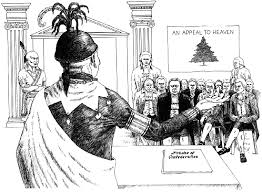
John Hancock leads a meeting of the St. Tammany (Columbian) society. Note the "Appeal to Heaven flag and the Indian, real or imagined. Indians participated in several, early St. Tammany meetings.

John Hancock leads a meeting of the St. Tammany society. Note the “Appeal to Heaven” flag. While Indians participated in some, early meetings, the one here is, I suspect, a ghost: St. Tammany.

In revolutionary-era America, the Sons of St. Tammany was just one of many social-charitable clubs (Americans like to form clubs), in many ways it was similar to the Masons and the Cincinnati, but those clubs were international and elitist. The sons of Tammany was purely American, and anti-elitist. It was open to anyone born on this side of the Atlantic, and had Indian customs. The Cincinnati society, for comparison, started with members who were as notable (Alexander Hamilton, George Washington, Marie, Marquis de Lafayette, Henry Knox, etc.) but was originally open only to high officers of the regular army, including foreigners like Lafayette, but not ordinary soldiers, minutemen (militia), or the general public. The symbols of the Tammanies were American: the liberty-cap and the “Appeal to Heaven” flag, now a popular symbol of the Tea Party; the leader was called by an Indian name: Sachem. By contrast, the Cincinnati society symbol was the Imperial Eagle (Washington’s was gold with diamonds), and the leader was called “general”. The Tammany society began admitting immigrants in 1810 or so, while the Cincinnati society remains closed to this day, except to descendants of Revolutionary officers — an aristocratic affectation in the eyes of some.

It was Aaron Burr who first saw the opportunity to use the Tammany organization as a for-profit, political machine. In the years 1795-9, New York was suffering from yellow fever and a variety of other diseases that were taken to be caused by a lack of clean water. Burr proposed, with Tammany support, the creation of a corporation to build a new water system to bring fresh, clean water from the Bronx River to lower Manhattan via iron pipes. The Manhattan company was duly chartered, with directors who were primarily Tammany men, Republican-Democrats, and not Federalists. Federalists (Hamilton, primarily) controlled the only NY banks at the time and controlled the directorate of every chartered company in the city. The Manhattan company requested a $2,000,000 perpetual charter, twice as big as the charter of Hamilton’s Bank of New York, and a monopoly on water distribution. These were reasonable requests given the task, but unusual in the lack of Federalist or governmental oversight. But the Manhattan company was a water company, and water was needed. But Burr’s intent, all along, it seems was to build a bank, not a water company. After the charter was approved, but before signing, he amended it to allow any excess funds to be used for any legal purpose. 

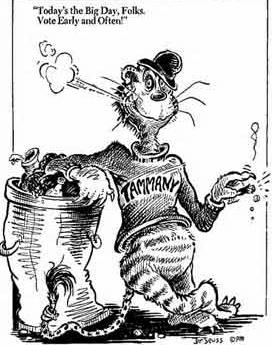
In this cartoon by Dr. Seuss, The Tammany Tiger says, "Today is the Big Day Folks. Vote Early and Often."

In this cartoon by Dr. Seuss, The Tammany Tiger says, “Today is the Big Day Folks. Vote Early and Often.”

Money was raised, but only $100,000 used for the water system. The remaining 95% of the charter funds, $1,900,000, went to found “The Bank of The Manhattan company” — later to be known as “The Chase Manhattan Bank” or “The Manhattan Bank of Cholera.” Instead of building the reservoir in upper Manhattan and filling it with clean water as originally proposed, Burr’s Tammany trustees voted to dig wells in lower Manhattan, and placed its reservoir in lower Manhattan too, near Chamber’s St,  next to a cemetery where Cholera victims were buried. New York suffered with Cholera, Typhoid, and leaky, wooden pipes until 1842 when Peter Cooper brought clean water to lower Manhattan from the Groton River via iron pipes. To this day, crooked water contracts are a staple of Tammany politics

The Bank of the Manhattan company opened at 40 Wall St on September 1, 1799, a mere four months after the water company’s incorporation. Hamilton was furious. The company continues today as The JP Morgan, Chase Manhattan Bank, one of the largest banking institutions in the world. Burr used the money and power of his company to reward supporters and to run for vice president with Thomas Jefferson’s tacit support. Except for his Tammany candidacy, John Adams would have won New York and a second term as president. Burr’s career pretty-well died after the Hamilton duel, but Tammany did well without him. By 1812, the Society built its first Tammany Hall, officially called the Wigwam, a $55,000, five-story building with a meeting hall for 2000. New York Democratic politics would center on Tammany Hall for the next century at least.

Following disappointment with John Quincy Adams, “the bitter branch of the bitter tree,” Tammy leaders went national. They recruited Andrew Jackson, a war hero and early recruit of Burr’s. They’d support Jackson if he’d hand over spoils, control of government jobs. He agreed and, as president, fired perfectly good, long-standing government employees He replaced them with Democratic loyalists. When Jackson stepped down in 1833, Tammany elected an equally corrupt New Yorker, Martin van Buren. Though there were periodic Whig and Republican reforms, Tammany learned they could wait those out. They always re-emerged like mushrooms after a rain.

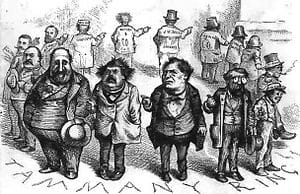
Boss Tweed and other Tammany leaders: who stole the money?

Boss Tweed and other Tammany leaders in a cartoon by Nast, Tammany Ring. “Who stole the money? He did.”  

A key vote-getter in the Tammany system is to provide Thanksgiving dinners and other charitable giveaways for the poor, as well as promises of jobs. By the late 1800s, William J. Brian added promises of soft money and wealth redistribution, cornerstones of the Democratic platform to this day. Tammany also tends to be for low tariffs as opposed to the high tariff ideas of Hamilton and many Whigs and 19th century Republicans. A case can be made for either view.

Tammany helped New York immigrants, particularly the Irish to get citizenship and avoid legal troubles in return for votes and occasional muscle. In other cities, Democratic clubs were less open to Catholics, reflecting the views of the common voter in each state. In the North they were pro-union, in the South anti, electing Klu Kluxers like George Wallace, Sam Ervin, and Robert Byrd. This lead to a famous split in the Democratic party about the 1968 convention. Famous Tammany leaders include William M. “Boss” Tweed, “Big” Tim Sullivan, and “Gentleman” Jimmy Walker. Sullivan famously authored the first anti-gun law, the Sullivan act; it was designed to protect his thugs against private citizens shooting them. It didn’t always work.

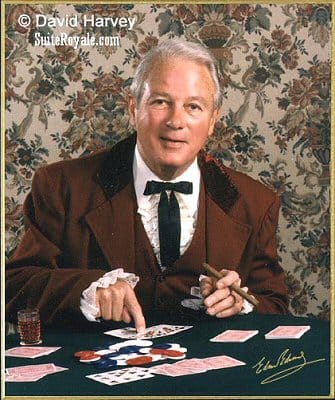
Edwin Edwards, Democratic Governor of Louisiana. 1972-1996. Who would not trust this man?

Hon. (?) Edwin Edwards, Governor of Louisiana. 1972-1996. Tammany lives

If you want to see Tammany politics in action, visit almost any large US city, or read its newspaper. In Chicago, the dead vote, and 4 of the last 6 governors have gone to jail. Mayor Daily famously told Kennedy that 90 percent of the registered voters of Cook County would vote for him. They did (sort of); because of this, JFK won Illinois and the presidency. In New York, voters discovered only in the 1960s that Tammany’s leader, Carmine DeSapio had been working for 30 years with known gangland murderer, Charles “Lucky” Luciano. In Detroit, where I live and corruption in the water department is legendary. Race-based job handouts, unemployment is high along with high minimum (living) wages. We’re now in the process of a $70,000,000 project to replace 100 feet of sewer pipe, and we’re building a $140 million, 3.3 mile trolley. Tammany loves all public works.

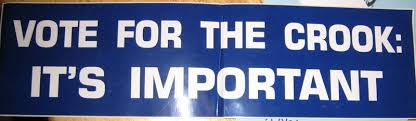
Then there is Louisiana, home to St Tammany parish. Louisiana Democrats like Huey Long and Edwin Edwards (shown at left) are unusual in that they’re proud to say that their corrupt methods are corrupt. Edwards has had two long runs as governor despite several convictions for doing illegal things he admits to doing. When Edwards was asked why he did favors for his friends. He responded: “Who should I do them for? My enemies?” Or, to quote one of Edwin Edwards campaign ads. Vote Edwin EdwardsPeople seem to love it, or did until the levy broke. There is a particularly American grandeur to all this. As Will Rodgers said, “America has the best politicians money can buy.” Today is the day to be proud of that uniquely American tradition. You too can grow up to buy a president.

Robert Buxbaum, April 28, 2017. I ran for water commissioner, and have written about sewage treatment, flood avoidance, and fluoride, as well as the plusses and minuses of trade unionization, and the difference between Republicans and Conservatives.

Taxes and accounting jokes

A friend called the other day asking about a financial matter. It seems his wife bought some pictures for  pictures a few days ago for $2000, and after having them apprised, she finds they’re worth $2,000,000.

I started talking about un-realized profits, and mentioned that I never imagined that his wife had such an eye for art. He said, they’re not art pictures, exactly; they’re of you discussing business with the Russians. (It’s a joke — I thought you-all might depreciate it).

—————

When I started my business, I found that you could deduct medical costs. I called the IRS and asked if I could deduct birth control. They told me: “only if it doesn’t work.”

—————

I’m glad I learned about parallelograms in school, instead something mundane, like taxes. It’s really come in handy this parallelogram season.

—————–

I got a robo-call asking me to press “1” to hear about a government program for those who wanted to avoid paying back taxes. I did, and a voice said “Leavenworth.”   It wasn’t much of a program, more of a sentence.

—————-

Robert E. Buxbaum, April 5, 2017.  For jokes on other topics, click the jokes tag, here.

Global warming and the president’s Resolute desk

In the summer of 2016, the Crystal Serenity, a cruse ship passed through the Northwest passage, going from the Pacific to the Atlantic above the Canadian arctic circle. It was a first for a cruise ship, but the first time any modern ship made the passage, it was 162 years ago, and the ship was wooden and unmanned. It was the British Resolute; wood from that ship was used to make the President’s main desk — one used by the last four presidents. And thereby hangs a tale of good global warming, IMHO.

President Trump meets with college presidents at the Resolute desk. Originally the front had portraits of Queen Victoria and President Hayes. Those are gone; the eagle on the front is an addition, as is the bottom stand.

President Trump meets with college presidents at the Resolute desk. Originally the front had portraits of Queen Victoria and President Hayes. Those are gone; the eagle on the front is an addition, as is the bottom stand. The desk is now 2″ taller than originally. 

The world today is warmer than it was in 1900. But, what is not generally appreciated is that, in 1900 the world was warmer than In 1800; that in 1800 it was warmer than in 1700; and that, in 1640, it was so cold there were regular fairs on the frozen river Themes. By the 1840s there were enough reports of global warming that folks in England thought the northwest passage might have opened at last. In 1845 the British sent two ships, the Erebus and the Terror into the Canadian Arctic looking for the passage. They didn’t make it. They and their crews were lost and not seen again until 2014. In hopes of finding them though, the US and Britain sent other ships, including the Resolute under the command of captain Edward Belcher.

The Resolute was specially made to withstand the pressure of ice. Like the previous ships, and the modern cruise ship, it entered the passage from the Pacific during the peak summer thaw. Like the ships before, the Resolute and a partner ship got stuck in the ice — ice that was not quite stationary, but nearly so, The ships continued to move with the ice, but at an unbearably slow pace. After a year and a half captain Belcher had moved a few hundred miles, but had had enough. He abandoned his ships and walked out of Canada to face courts martial in England (English captains were supposed to “go down with the ship”). Belcher was acquitted; the ice continued to move, and the ships moved with it. One ship sank, but the Resolute, apparently unscathed, passed through to the Atlantic. Without captain or crew, she was the first ship in recorded history to make the passage, something that would not happen again till the Nautilus nuclear submarine did it under the ice, 100 years later.


The ghost ship Resolute was found in September 1855, five years after she set sail, by captain Buddington of the American whaler, George Henry. She was floating, unmanned, 1200 miles from where captain Belcher had left her. And according to the law of the sea, she belonged to Buddington and his crew to use as they saw fit. But the US was inching to war with Britain, an outgrowth of the Crimean war and seized Russo-American property. Franklin Pierce thought it would help to return the ship as a sign of friendship — to break the ice, as it were. A proposal for funds was presented to congress and passed; the ship was bought, towed to the Brooklyn Navy yard for refitting, and returned to Britain as a gift. The gift may have worked: war with Britain was averted, and the seized property was returned. Then again, Britain went on to supply the confederacy early in the Civil War. None-the-less, it was a notable ship, and a notable gift, and when it was broken up, Parliament decided to have two “friendship desks” made of its timbers. One desk was presented to President Hayes, the other to Queen Victoria. One of these desks sits the British Naval museum at Portsmouth; its American cousin serves Donald Trump in the Oval office as it has served many president before him. It has been used by Coolidge, Kennedy, Carter, Reagan, Clinton, Bush II, and Obama before him — a reminder that global warming can be good, in both senses. If you are interested in the other presidents’ desks, I wrote a review of them here.

As for the reason for the global warming of the mid 1800s, It seems that climate is chaotic. ON a related note, I have proposed that we make a more-permanent northwest passage by cutting thorough one of the islands in northern Canada. If you want to travel the Northwest passage in 2017, there is another cruise scheduled, but passage is sold out.

Robert Buxbaum, March 16, 2017.

Arrested for decriminalized possession

The arrest rate for marijuana is hardly down despite widespread decriminalization, but use is up. decriminalization, but use is up. A rate that exceeds that for all violent crime.

Despite years of marijuana decriminalization, arrest rates for marijuana are up from 20-25 years ago, and hardly down from last year. Why?

There are a couple of troubling patterns in US drug arrests. For one, though marijuana has been decriminalized in much of the USA, marijuana arrest rates are hardly down from five years ago, and higher than 20-30 years ago — see graph at right. Besides that, it’s still mostly black-people and Latinos arrested. And the crime is, 4/5 the of the time, drug possession, not sale.

At the same time that violent crime rates are falling, marijuana possession arrests are rising (see graph below). Currently, according to FBI statistics,  more people are arrested for marijuana possession than for all violent crime combined. You’d expect it would not be this way, and a question I’d like to explore is why. But first, let’s look at more data. I note that part of an explanation is that marijuana use is up (18% in 2015 vs 12% in 1990). This still doesn’t explain the racial imbalance but it could explain the general rise. Marijuana isn’t quite legal, and if use is up, you’d expect arrests to be up. But even here, something is fishy: use rates are the same as in 1980, 35+ years ago in the midst of the “war on drugs,” but arrest rates have more than doubled since. Why? Take New York City as an example, 17,762 people were arrested for low-level marijuana possession in 2016 (smoking in public or possession of 25 gm to 2 oz). The low-level arrest rate is twice the national average in this Democratic-bastion city, where the drug was decriminalized years ago. Arrest rates in NYC went up an additional 10% in 2016, with black people arrested at 11 times the rate of white people. How could this be?

The race discrepancy of arrests persists across the US. Though black citizens use drugs only 15% or so more often than whites, and make up only 13% of the US population, they are arrested for drugs about three times as often and incarcerated about 4 times as often. It’s mostly for marijuana possession too, and the discrepancy varies very strongly by location In Louisiana, Illinois, and New York City arrests are particularly weighted to people of color. When New York City police precinct captains were asked about this, they explained that their instructions come from above. It’s a curious answer, I’d say, reflecting perhaps their dislike of the mayor.

Drug arrests are mostly for possession, not sale, and the spread is rising.

Drug arrests are mostly for possession, not sale and the spread is rising. More than half the time, it’s marijuana.

One of the race-affecting instructions is that the police are instructed to patrol black neighborhoods, but not the student unions of majority-white colleges like NYU. They’re mandated to stop and search junky cars but not nice ones, and to search people who have outstanding parking tickets, but not generally. They even get raises that depend on the number of tickets given, a practice that does not lead to a pattern of looking the other way — one many New Yorkers would prefer. Another issue: in many states, including New York, the police can keep money or cars, if they can claim that the asset was purchased with drug money or used in the drug trade. This leads to a practice where the city budget benefits when the police arrest persons they don’t expect will be convicted. It’s a practice called civil asset forfeiture, one lampooned, on Last Week Tonight, but jealously guarded. Since it is near impossible to prove that the money or car was not used in any way illegally, once they arrest someone, the police can expect to keep his or her money or cars indefinitely. The annoyance of lawyers perhaps encourages the arrest of people who do not seem to have them — people of color. New York mayor deBlassio justifies his arrests as a way to protect the neighborhoods, as his version of former mayor, Guilliani’s broken window approach. Maybe. But I think the profit motive is at least as relevant.

drug arrests hit black folks a lot more than white

Drug arrests hit black folks a lot more than white.

I note that strict justice tends to land hardest on the poor and defenseless. I also note that many important people have used marijuana without it damaging their lives in any obvious way. Both Jeb! Bush and Bill Clinton claimed to have smoked it; as did Barak Obama, Al Gore, and the Beatles. My bottom line: while marijuana decriminalization is worthwhile, it must go along with the repeal of civil asset forfeiture laws, and other means that make arrests into profit centers – or so it appears to me. Otherwise we’ll keep on flushing lives down the drain for no good reason.

Robert Buxbaum, March 6, 2017. I’ve previously blogged about the structure of criminal sentencing, coming to conclude that the least strict sentence that does the job is to be preferred. I also ran for water commissioner in 2016.