Category Archives: law

Qatar, unbalanced but stable

Doha Airport, Qatar.

Doha Airport, Qatar.

I visited Qatar twice this month, just passing through and only visited in the airport, but there were several things that so impressed me that I had to write. What impressed me most was not so much the size and richness of the airport, but the clothes of the locals. All of the local men wore the same, very sharp robes: blindingly white, long sleeved, and floor-length. They’re called Thobes. While other nations wear something similar. Here, every one was unwrinkled, and unstained. They all looked new, with no signs they’d ever been washed. Some were worn with cuff-links (gold), and most had a pen sticking out of the breast pocket (gold). White pants peak from underneath and a headress usually sits on the head. It’s a really dramatic look, like seeing dozens of Ricardo Montaubans of Fantasy Island in one place. Local women and children were these too, but I found the thobes so dramatic that the women and children disappeared from my mind-space almost immediately. There is a local woman in the picture above, but you hardly notice.

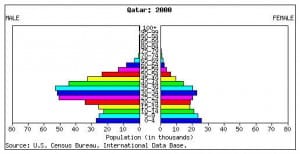
Not everyone wears the thobes. There are lots of stores filled with gold and technology, beer and coffee, and these are maned by non-locals, Moslems mostly, almost all men. The non-locals wear western garb, not particularly sharp; none wear thobes of any sort. Some months ago, I wrote that China had severe imbalance and speculated that it was ripe for revolution. As it happens the large number of foreign worker means that Qatar is far more unbalanced. To some extent this is shown by the male-female population pyramid below.

Qatar demographic pyramid. Vastly more males than females, mostly foreign workers.

Qatar demographic pyramid. The imbalance is caused by the presence of vastly more male than female foreign workers.

Qatar is a country of 2,500,000 residents, of whom 310,000 are locals — citizens and permanent residents. The rest are foreign workers; long term inhabitants without permanent residency or citizenship. They make up 85% of the population. They are  recruited from poor, English-speaking Muslim countries mostly: Egypt, Malaysia, Tunisia. They do all the work, as best I could tell. I saw no one who looked like a local working, male or female.

Foreign workers have very few rights, but don’t seem unhappy. There is no right to unionize, and not even the right to roam around the country. For the most part, they live in employer-owned housing, and are transported back and forth to work in employer vans. They sign up for year-long contracts, and at the end of the year, they have the choice to re-up or leave. Up a year ago, foreign workers could not become permanent residents. As of last year, the Emir’s order 10 authorized permanent residency status for as many as 100 foreign workers who had sufficient means, had been in Qatar for 10 to 20 years (depending on whether they were born there), had stayed out of trouble, and who otherwise were considered desirable. It’s a step.

I suspect that the foreign workers feel lucky to have good pay, decent hours, and a clean bed. Then again, the workers are recruited for positive outlook. And the ones I saw might have had more rights than most. The airport is part of the Umm Al Houl, free enterprise zone. These are areas of Qatar where westerners and their vices like alcohol are tolerated and welcome.

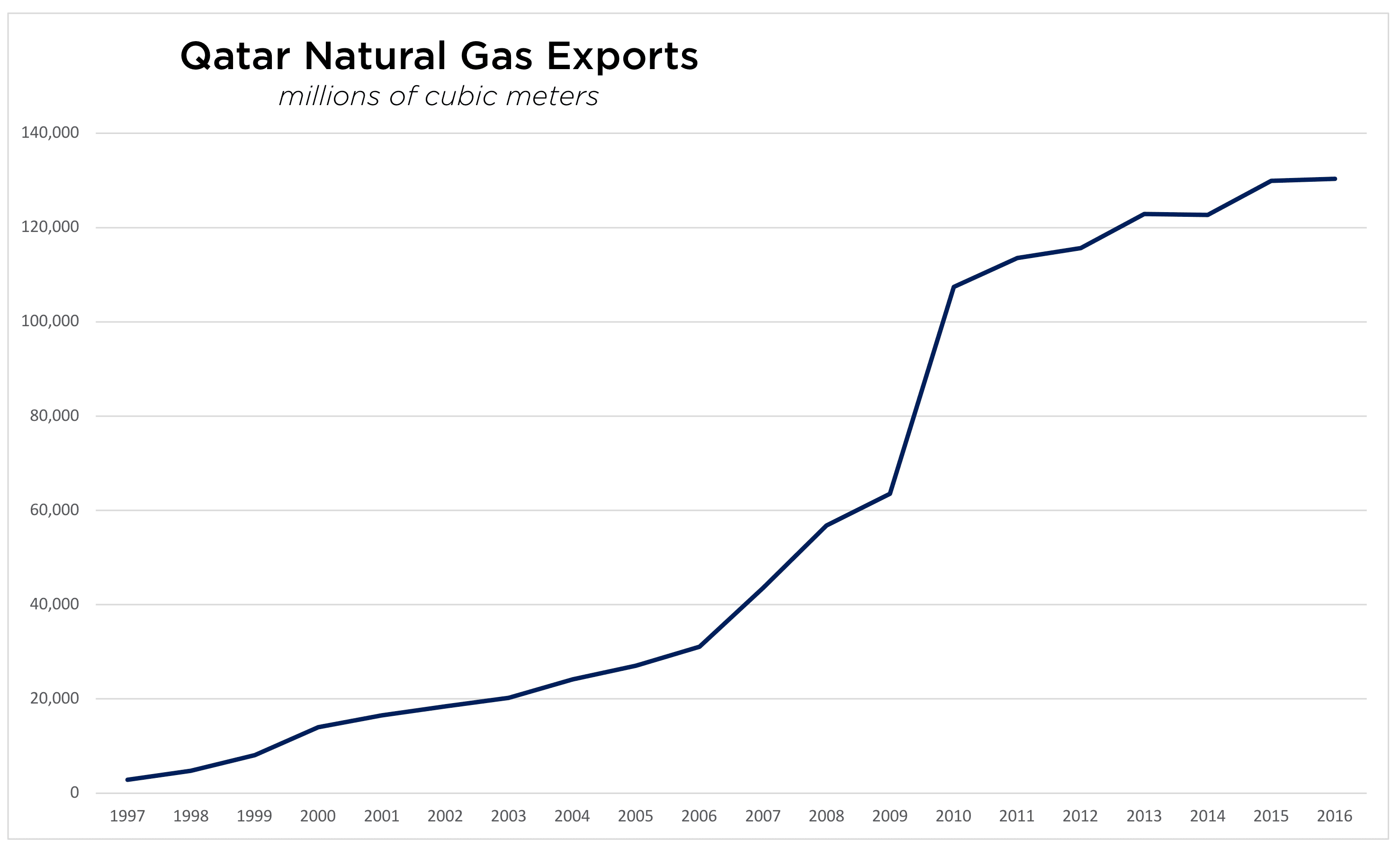
Qatar natural gas production. Natural gas provides 90% of the country's income as best I can tell.

Qatar natural gas production. Natural gas provides 90% of the country’s income as best I can tell. That’s half the GDP almost, the rest of the GDP is Qataris spending the money

There are three “free enterprise zones” in Qatar; the name for the one near the airport, “Al Houl” interestingly enough means “bird trap”. What’s going on with them, as best I can tell, is diversification. Qatar is the worlds second largest exporter of natural gas, with most going to Europe, and a significant portion to India and China. But the gas will run out eventually. They are trying to supplant this income with tourism, industry and transport: running a major airline, a bustling, air hub, and tourist hotels. The airline is only marginally profitable, and though I didn’t see the hotels, I imagine they are luxurious and marginally profitable too. Saudi Arabia, next door, is trying to diversify the same ways, aiming to control west-east, air-traffic via Emirates air.

The GDP of Qatar is $191 B as of last year at the going exchange, and over $450 B at price parity. That suggests a few things. For one that the Qatari currency is undervalued. It also suggests a per-capita GDP of at least $76,400, or perhaps of $616,000 or higher depending on how you count buying power and foreign workers. This money buys a nice lifestyle, if not republican freedoms.  In terms of government, Qatar is a real monarchy, Emir Hamad bin Khalifa al-Thani’s is an absolute ruler who came to power the traditional way: he overthrew his father. Similar to this, his father, Khalifa al-Thani, came to power by overthrowing his cousin. Supporting the Emir’s rule, there is an Advisory Council. The 35 ministers are mostly relatives, and as in North Korea, it has only advisory power. The Prime Minister and Minister of Foreign Affairs is Sheikh Hamad bin Jasim bin Jabir al-Thani; the Deputy Prime Minister is Abdallah Al-Thani. The Economy and Commerce minister is Fahd Al-Thani, and the Communications and Transport minister is Ahmad Al-Thani. Nasir al-Thani heads Cabinet Affairs; Hamad al-Thani is the Secretary of State, and the Governor of the Central Bank is Abdallah bin Saud al-Thani.

Qatar main mosque. Residents stand out from the foreign workers.

Qatar main mosque. Residents stand out from the foreign workers.

My sense was that Qatar was the Disneyland version of Islam. Life in the Qatari free zones resembled normal Islamic life the way that Main Street of Disneyland resembles an actual main street in the US. Every citizen is well dress and rich without having to work. Western visitors are welcome, and not forced to follow the local customs with vices in their own zones. And the state supports all ecological and left-wing causes except for unionization. It’s anti Israel, pro revolution (elsewhere of course) and virulently against petroleum production in all counties outside of Qatar. Al Jazeera, the Emir’s left-leaning news agency, spreads money and influence world-wide. Left-flavored news is presented with high-quality graphics, and different versions of the news story published in different languages. The Emir acknowledges that Al Jazeera is a money-losing propaganda agency, but as with Disneyland, most people seem happy to live the fiction.

Qatari woman and shop. They blend into the scenery compared to the resplendent men

Qatari woman and shop. They blend into the scenery compared to the resplendent men

The local Qataris seem happy with their lot, as best I can tell. The next world soccer tournament will be held in Qatar, 2022, and Qatari’s are excited, as best I can tell. There is a lot of building going on, some for the world cup, the rest for general tourism and the free enterprise zones. The free enterprise zones may catch on, but there is a cold war going on with Saudi Arabia, and the Saudi’s are doing what they can to pour cold water on the programs. So far Qatar seems to be winning the propaganda war at home and abroad. Its people are happy, it shows a beautiful, progressive face to the west, and it seems to have the majority of the middle east travel. Stable but for how long?

Robert Buxbaum April 15, 2019. As I side note, I just bought a Qatari Thobe.

Speed traps penalize the poor

On a street corner about 1/4 mile from my house, at the intersection of the two busiest of the local streets, in the center-median of the street, is parked a police car. He’s there, about 18 hours a day, looking to give out tickets. The cross-street that this officer watches is where drivers get off the highway. In theory, they should instantly go from 65 mph on the highway to 35 mph now. Very few people do. The officer does not ticket every car, by the way, but seems to target those of poor people from outside the city limits. The only time ai was ticketed, I was driving a broken-down car while mine was in the shop. As best I can tell, he choose cars for revenue, not for safety. It’s a speed trap. It’s appalling. And our city isn’t alone in having one.

Speed traps are an annoyance to rich, local folk who sometimes get ticketed, but they’re a disaster for the poor. Poor people are targeted, and these people don’t have any savings. They don’t have the means to pay a suddenly imposed bill of $150 or more. Meanwhile, the speed-trap officer is incentivized to increase revenue and look for other violations: expired registrations or insurance, seat-belt violations, open alcohol, unpaid tickets. Double and triple fines are handed out, and sometimes the car is impounded. A poor driver is often left without any legal way to get to work, to earn money to pay the fines. Police officers behave this way because they are evaluated based on the revenue they generate, based on the number of tickets they write. It’s a horrible situation, especially for the poor

Speed traps to little and cost much.

An article on the effect of speed traps. It appears they do little good and cause much pain, especially to the poor. Here is a link to the whole article.

The article above looks at the impact of speed traps on poor people. The damage is extreme. The folks targeted are often black, barely holding it together financially. They are generally not in a position to pay $150 for “impeding traffic,” and even less in a position to deal with having their car impounded. How are they supposed to pay the bill? And yet they are told they are lucky to have been given this ticket — impeding traffic, a ticket with no “points.” But they are not lucky. They are victims. Tickets with no points is are money generators, and many poor people realize it. If they were to get a speeding ticket, they would have the opportunity to void the penalty by going to traffic school. With a ticket for impeding traffic, there is no school option. Revenue stays local, mostly in that police precinct. Poor people know it, and they don’t like it. I don’t either. After a while, poor people cease to trust the police, or to even speak to them.

In what world should you pay $150 for impeding traffic, by the way? In what world should the police be taken from their main job protecting the people and turned into a revenue arm for the city? I’d like to see this crazy cycle ended. The first steps, I think, are to end speed traps, and to limit the incentive for giving minor tickets, like impeding traffic. As it is we have too many people in jail and too many harsh penalties. 

Robert Buxbaum, April 10, 2019. I ran for water commissioner in 2016, and may run again in 2020.

C-Pap and Apnea

A month of so ago, I went to see a sleep doctor for my snoring. I got a take-home breathing test that gave me the worst night’s sleep in recent memory. A few days later, I got a somber diagnosis: “You are a walking zombie.” Apparently, I hold my breath for ten seconds or more every minute and a half while sleeping. Normal is supposed to be every 4 to 10 minutes. But by this standard, more than half of all middle-aged men are sub-normal (how is this possible?). As a result of my breath-holding, the wrinkled, unsmiling DO claimed I’m brain-dead now and will soon be physically dead unless I change my ways. Without spending 3 minutes with me, the sleep expert told me that I need to lose weight, and that I need a C-Pap (continuous positive airway pressure) device as soon as possible. It’s supposed to help me lose that weight and get back the energy. With that he was gone. The office staff gave me the rest of the dope: I was prescribed  a “ResMed” brand C-Pap, supplied by a distributor right across the hall from the doctor (how convenient).

I picked up the C-Pap three months later. Though I was diagnosed as needing one “as soon as possible,” no one would release the device until they were sure it was covered by my insurance company. The device when I got it, was something of a horror. The first version I tried fit over the whole face and forces air into my mouth and nose simultaneously, supposedly making it easier to inhale, but harder to exhale. I found it more than a bit uncomfortable. The next version was nose only and marginally more comfortable. I found there was a major air-flow restriction when I breath in and a similar pressure penalty when I breathed out. And it’s loud. And, if you open your mouth, there is a wind blowing through. As for what happens if the pump fails or the poor goes out, I notice that there are the tiniest of air-holes to prevent me from suffocating, barely. A far better design would have given me a 0-psi flapper valve for breathing in, and a 1/10 psi flapper for breathing out. That would also reduce the pressure restriction I was feeling every time I took a deep breath. One of my first blog essays was about engineering design aesthetics; you want your designs to improve things under normal conditions and fail safe, not like here. Using this device while awake was anything but pleasant, and I found I still hold my breath, even while awake, about every 5 minutes.

Since I have a lab, and the ability to test these things, I checked the pressure of the delivered air, and found it was 3 cm of water, about 1/20 psi. The prescription was for 5 cm or water (1/14 psi). The machine registers this, but it is wrong. I used a very simple water manometer, a column of water, similar to the one I used to check the pressure drop in furnace air filters. Is 1/20 psi enough?How did he decide on 1/14 psi by the way? I’ve no idea. !/14 psi is about 1/200 atm. Is this enough to do anything? While the C-Pap should get me to breathe more, I guess, about half of all users stop after a few tries, and my guess is that they find it as uncomfortable as I have. There is no research evidence that treatment with it reduces stroke or heart attack, or extends life, or helps with weight loss. The assumption is that, if you force middle-aged men to hold their breath less, they will be healthier, but I’ve no clear logic or evidence to back the assumption. At best, anything you gain on the ease of breathing in, you lose on the difficulty of breathing out. The majority of middle-aged men are prescribed a C-Pap, if they go for a sleep study, and it’s virtually 100% for overweight men with an apple-shaped body.

I’d have asked my doctor about alternatives or for a second opinion but he was out the door too fast. Besides, I was afraid I’d get the same answer that Rodney Dangerfield got: “You want a second opinion? OK. You’re ugly, too.” Mr. Dangerfield was not a skinny comic, by the way, but he was funny, and I assume he’d have been prescribed a C-Pap (maybe he was). He died at 82, considerably older than Jim Fixx, “the running doctor,” Adelle Davis, the “eat right for health” doctor, Euell Gibbons “in search of the wild asparagus,” or Ethan Pritkin, the diet doctor. God seems to prefer fat comedians to diet experts; I expect that most-everyone does.

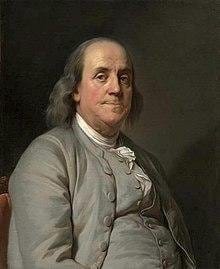
Benjamin Franklin and his apple-shaped body

Benjamin Franklin and his apple-shaped body; I don’t think of him as a zombie.

What really got my goat, besides my dislike of the C-Pap, is that I object to being called a walking zombie. True, I’m not as energetic as I used to be, but I manage to run a company, and to write research papers, and I get patents (this one was approved just today). And I write these blogs — I trust that any of you who’ve read this far find them amusing. Pretty good for a zombie — and I ran for water commissioner. People who use the C-Pap self-report that they have more energy, but self-reporting is poor evidence. A significant fraction of those people who start with the C-Pap, stop, and those people, presumably were not happy. Besides, a review of the internet suggests that a similarly large fraction of those who buy a “MyPillow.com” claim they have more energy. And I’ve seen the same claims from people who take a daily run, or who pray, or smoke medical marijuana (available for sleep apnea, but not from this fellow), or Mirtazapine (study results here), or  for electro-shock therapy, a device called “Inspire.” With so many different products providing the same self-reported results, I wonder if there isn’t something more fundamental going on. I’d wish the doc had spent a minute or two to speak to this, or to the alternatives.

As for weight loss, statistical analysis of lifespan suggests that there is a health advantage to being medium weight: not obese, but not skinny. I present some of this evidence here, along with evidence that extra weight helps ward off Alzheimer’s. For all I know this protection is caused by holding your breath every few minutes. It helps to do light exercise, but not necessary for mental health. In terms of mental health, the evidence suggests that weight loss is worse than nothing.

Jared Gray, author of the Alien movies, was diagnosed with apnea, so he designed his own sleep-mask.

Jared Gray, author of the Alien movies, was diagnosed with apnea, so he designed his own sleep-mask.

Benjamin Franklin was over-weight and apple-shaped, and no zombie, The same is true of John Adams, Otto Von Bismarck, and Alfred Hitchcock. All lived long, productive lives. Hitchcock was sort of morbid, it will be admitted, but I would not want him otherwise. Ed McMahon, Johnny Carson’s side-kick, apologized to America for being overweight and smoking, bu the outlived Johnny Carson by nine years, dying at 89. Henry Kissinger is still alive and writing at 95. He was always fatter than any of the people he served. He almost certainly had sleep apnea, back in the day, and still has more on the ball, in my opinion, than most of the talking-head on TV. The claim that overweight, middle-aged men are all zombies without a breath assisting machine doesn’t make no sense to me. But then, I’m not a sleep doctor. (Do sleep doctors get commissions? Why did he choose, this supplier or this brand device? With so little care about patients, I wonder who runs the doctor’s office.)

I looked up my doctor on this list provided by the American Board of Sleep Medicine. I found my doctor was not certified in sleep medicine. I suppose certified doctors would prescribe something similar  but was disappointed that you don’t need sleep certification to operate as a sleep specialist. In terms of masks, I figure, if you’ve got to wear something, you might as well wear something cool. Author Jared Gray, shown above (not the author of the Alien) was diagnosed with Apnea 6 months ago and made his own C-Pap mask to make it look like the alien was attacking him. Very cool for an ex-zombie, but I’m waiting to see a burst of creative energy.

What do we zombies want? Brains.

When do we want them? Brains.

What do vegetarian zombies want? Grains.

Robert Buxbaum, March 15, 2019. In case real zombies should attack, here’s what to do.  An odd legal/insurance issue: in order to get the device, I had to sign that, if I didn’t use it for 20 days in the first month of 4 hours per night, and thus if the insurance did not pay, I would be stuck with the full fee. I signed. This might cost me $1000 though normally in US law, companies can only charge a reasonable restock fee, but it can’t be unreasonable, like the full  price. I also had to sign that I would go back to the same, quick-take doctor, but again there has to be limits. We’ll see how the machine pans out, but one difference I see already: unlike my pillow.com, there is no money back guarantee with the C-Pap treatment.

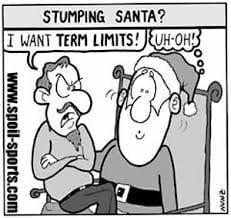
Term limits, in what world are they Republican or conservative?

The desire for term limits is one of the political innovations that leaves me baffled. What is the logic, especially for conservatives or Republicans. In theory, Republicans favor any freedom that does not hurt the individual, and in theory conservatives favor things according to the Bible. Both should oppose term limits. No individual is hurt by term limits, and in the Bible, good kings, judges, and advisors should serve for life. Rehoboam, Solomon’s son, splits Israel by ignoring his father’s advisors (1 Kings 12 ff). term limits

In a more-secular context, if you have a good doctor, one who took years to learn the craft, would you get rid of him just because you’re afraid he’ll become comfortable? It’s insane personally, and worse to make a law forcing other people to do it. It suggests a paranoia of public will, the opposite of what a Democratic Republic stands for. These are laws to keep people from voting for the fellow they like! it’s like we believe ourselves to be addicts with a deadly addiction. It’s also like we believe policy is so simple and so corrupting that a beginner is always better than everyone with experience. As it happened, Rehoboam’s young councilors were more money-hungry than the old.

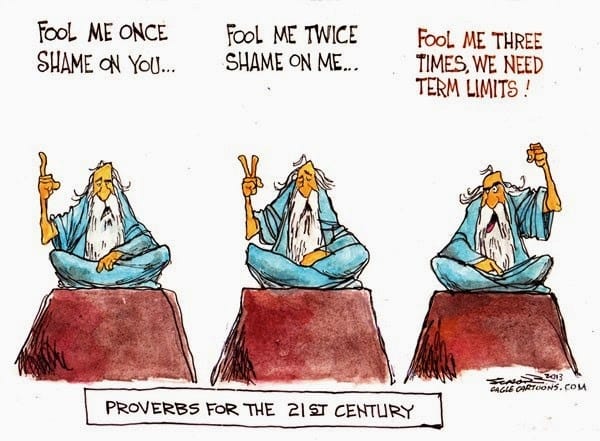
Protect me from making the same mistake thrice.

Protect me from making the same mistake thrice.

Michigan’s term limits are worse than most because ours are uncommonly short: 6 years for the house. 8 for the senate, 8 for governor. While I can accept an eight year  term limit for the governor, in theory he’s just an executor, I can see no basis for the short term limits on those serving in the MI house or senate. If we can’t eliminate these limits, we should at least extend them. Also I would not make the exclusion on any of these individuals life-long. If someone served in the senate say, then left and served as governor, why not let the fellow run again for senate?

For those reading this in future decades, it's funny because XI is president of China for life, something US presidents (Trump) can't be. But they can be  put in prison for life.

behind bars  For those reading this in future decades, it’s funny because XI is president of China for life, something US presidents (Trump) can’t be. But they can be put in prison for life.

For the same reason, I’m not a fan of long, mandatory minimum prison sentences. It’s like we don’t trust our judges to be tough enough. If we don’t trust them, don’t elect them, or remove them. As it is, we have more people per-capita behind bars than any other nation on earth. We assume, I guess that we can’t pick a good judge, but have to make sure he or she isn’t a lenient rascal who’ll serve for life. But is that so bad? Is it better to force the judge to spit on everyone?

There are many problems with fair sentencing, but I’m inclined to say that extenuating circumstances are always relevant, and that the shortest sentence sufficient to prevent further crime is usually the best. If judges are rascals, then the way to deal with it is judicial review or un-election. As Cotton Mather said years after overseeing the Salem witch hunts: “It’s better that a hundred witches go free than that we kill a single innocent person”. With judges, as with voters, restricting choice by law seems proper only when the effect is to protect the individual, not when the effect is to increase his burden, or so it seems to me.

Robert E. Buxbaum, October 11, 2018.

School violence and the prepositional subjective

There is a new specialty in the law, both in prosecution and defense: dealing with possible school shooters and other possible purveyors of violence. Making threats of violence has always been a felony — it’s a form of assault. But we’ve recently extended this assault charge to those student who make statements to the effect that they might like to commit violence, a conditional subjunctive statement of assault. This finer net manages to catch, in Michigan alone, about 100 per month. That’s a large number. Mostly they are male high-school age students who shot off their mouth, kids caught for saying “I’ll kill you” often in an argument, or following one. They are arrested for protection of others, but the numbers are so high and the charge so major, 15 – 20 year felonies, it’s possible that the cure is worse than the disease.

Eight students of the 100 charged in the last month in crimes of potential violence.

Putting some faces to the crime. Eight of the 100 charged in Michigan in the last month for potential violence. All or most are boys. 

Several of the cases are described in this recent Free-Press article, along with the picture at right. According to the article, many of those charged, are sentenced to lower crimes than the 15 -20 maximum, things like reckless endangerment. Many, the majority, I hope — they are not mentioned in the article — are let go with a warning. But even there, one wonder if these are the richer, white ones. In any case, it’s clear that many are not let go and have their lives ruined because they might come to commit a crime.

Let’s consider one case in-depth, outcome unknown: A top high school student, skinny, but without many friends, who gets picked on regularly. One day, one of the more popular kids in school calls him out and says, “You look like you’re one of those school shooters.” The loner responds, “If I were a school shooter, you’d be the first I’d shoot.” And that’s enough to ruin the kid’s life. Straight to the principal, and then to the police. The ACLU has not seen to get involved as there are competing rights at play: the right of the loner to have a normal education, and the rights of the other students. One thing that bothers me is that this crime hangs on the conditional subjunctive:  “If I were…., then you would be…”

What makes the threat subjective is that “I’ll kill you” or “I’d shoot you first” is something you’d like to be true at some time in the indefinite future. There is no clear time line or weapon, just a vague desire that the person should be shot. It’s a desire that more-likely than not, is a fleeting hyperbole, and not an actual threat. What makes the threat conditional on the person has yet to decide to show up with a weapon or show any sign of doing violence: “If I were to become a school shooter.”

The person who drew this faces 15 years in prison. The only evidence is this picture.

The person who drew this faces 15 years in prison. The only evidence of a threat is this picture.

It did not used to be that either the conditional or the subjunctive were considered threats. A person was assumed to be blowing off steam if he (or she) said “I’d like to see you dead” or even “I’ll kill you.” And we certainly never bothered folks who prefaced it with, “If I were a …” In theory, we had to extend the law to protect the weak from a shooter, but we’ve also put a weapon in the hands of the schoolyard bully. The school bully can now ruin the life of his fellow by accusing him of being a potential school scooter. We’ve weaponized the conditional subjunctive, and I don’t like it. The boy who drew the picture at right was charged with a 15 year felony for drawing something that, in earlier generations, would be called a fantasy picture.

It bothers me is that the majority of those charged — perhaps all those charged — are boys. Generally these boys are doing things that normal boys have often done. The picture of a shooting is considered a written threat of violence, but to me it looks like a normal boy picture. Girls have not been caught, so far, perhaps because their words and pictures are more “girly” so their threats are not considered threats. Sometimes is seems that it is boy-behaviors themselves are being criminalized, or at minimum diagnosed as ADHD (crazy). There is so much we don’t like about boy-behaviors, and we’ve elevated the female to such an extent, that we may have lost the positive idea of what a male should be. We want boys to be “girly” or at least “trans,” and that’s not normal in the sense that it’s not normative. We’ve come to worry about boyness, creating a cure that may be worse than the harm we are trying to prevent.

Robert Buxbaum, May 7, 2018. I’ve also noted how bizarre US sex laws are, and have written about pirates and transgender grammar.

Elvis Presley and the opioid epidemic

For those who suspect that the medical profession may bear some responsibility for the opioid epidemic, I present a prescription written for Elvis Presley, August 1977. Like many middle age folks, he suffered from back pain and stress. And like most folks, he trusted the medical professionals to “do no harm” prescribing nothing with serious side effects. Clearly he was wrong.

Elis prescription, August 1977. Opioid city.

Elis prescription, August 1977. Opioid city.

The above prescription is a disaster, but you may think this is just an aberration. A crank doctor who hooked (literally) a celebrity patient, but not as aberrant as one might think. I worked for a pharmacist in the 1970s, and the vast majority of prescriptions we saw were for these sort of mood altering drugs. The pharmacist I worked for refused to service many of these customers, and even phoned the doctor to yell at him for one particular egregious case: a shivering skinny kid with a prescription for diet pills, but my employer was the aberration. All those prescriptions would be filled by someone, and a great number of people walked about in a haze because of it.

The popular Stones song, Mother’s Little Helper, would not have been so popular if it were not true to life. One might ask why it was true to life, as doctors might have prescribed less addicting drugs. I believe the reason is that doctors listened to advertising then, and now. They might have suggested marijuana for pain or depression — there was good evidence it worked — but there were no colorful brochures with smiling actors. The only positive advertising was for opioids, speed, and Valium and that was what was prescribed then and still today.

One of the most common drugs prescribed to kids these days is speed, marketed as “Ritalin.” It prevents daydreaming and motor-mouth behaviors; see my essay is ADHD a real disease?. I’m not saying that ADD kids aren’t annoying, or that folks don’t have back ached, but the current drugs are worse than marijuana as best I can tell. It would be nice to get non-high-inducing pot extract sold in pharmacies, in my opinion, and not in specialty stores (I trust pharmacists). AS things now stand the users have medical prescription cards, but the black sellers end up in jail..

Robert Buxbaum, January 25, 2018. Please excuse the rant. I ran for sewer commissioner, 2016, And as a side issue, I’d like to reduce the harsh “minimum” penalties for crimes of possession with intent to sell, while opening up sale to normal, druggist channels.

Bitcoin risks, uses, and bubble

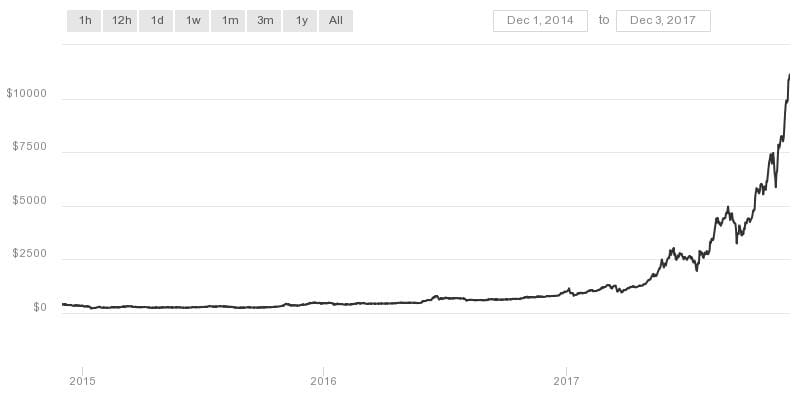
Bitcoin prices over the last 3 years

Bitcoin prices over the last 3 years

As I write this, the price of a single bitcoin is approximately $11,100 yesterday, up some 2000% in the last 6 months. The rise rate suggests it is a financial bubble. Or maybe it’s not: just a very risky investment suited for inclusion in a regularly balanced portfolio. These are two competing views of bitcoin, and there are two ways to distinguish between them. One is on the basis of technical analysis — does this fast rise look like a bubble (Yes!), and the other is to accept that bitcoin has a fundamental value, one I’ll calculate that below. In either case, the price rise is so fast that it is very difficult to conclude that the rise is not majorly driven by speculation: the belief that someone else will pay more later. The history of many bubbles suggests that all bubbles burst sooner or later, and that everyone holding the item loses when it does. The only winners are the brokers and the last investors who get out just before the burst. The speculator thinks that’s going to be him, while the investor uses rebalancing to get some of benefit and fun, without having to know exactly when to get out.

That bitcoin is a bubble may be seen by comparing the price three years ago. At that point it was $380 and dropping. A year later, it was $360 and rising. One can compare the price rise of the past 2-3 years with that for some famous bubbles and see that bitcoin has risen 30 times approximately, an increase that is on a path to beat them all except, perhaps, the tulip bubble of 1622.

A comparison between Bitcoin prices, and those of tulips, 1929 stocks, and other speculative bubbles; multiple of original price vs year from peak.

A comparison between Bitcoin prices, and those of tulips, 1929 stocks, and other speculative bubbles; multiple of original price vs year from peak.

That its price looks like a bubble is not to deny that bitcoin has a fundamental value. Bitcoin is nearly un-counterfeit-able, and its ownership is nearly untraceable. These are interesting properties that make bitcoin valuable mostly for illegal activity. To calculate the fundamental value of a bitcoin, it is only necessary to know the total value of bitcoin business transactions and the “speed of money.” As a first guess, lets say that all the transactions are illegal and add up to the equivalent of the GDP of Michigan, $400 billion/year. The value of a single bitcoin would be this number divided by the number of bitcoin in circulation, 15,000,000 currently, and by the “speed of money,” the number of business transactions per year per coin. I’ll take this to be 3 per year. It turns out there are 5 bitcoin transactions total per year per coin, but 2/5 of that, I’ll assume, are investment transactions. Based on this, a single bitcoin should be worth about $8890, slightly below its current valuation. The gross speed number, 5/year, includes bitcoin transactions that are investments and never traded for goods, and those actively being used in smuggling, drug-deals, etc.

If the bitcoin trade will grow to $600 billion year in a year with no other change, the price rise of a single coin would surpass that of Dutch tulip bulbs except that more coins are bing minted, and that the speed is increasing. If you assume that coin use will reach $1,600 billion/year, the GDP of Texas in the semi-near future, before the Feds jump in, the fundamental value of a coin should grow no higher than $44,000 or so. There are several problems for bitcoin investors who are betting on this. One is that the Feds are unlikely to tolerate so large an unregulated, illegal economy. Another is that bitcoin transactions are not likely to go totally legal. It is very hard (near impossible) to connect a bitcoin to its owner. This is a plus for someone trying to deal in drugs or trying hide profits from the IRS (or his spouse), but a legal merchant will want the protection of courts of law. For this, he or she needs to demonstrate ownership of the item being traded, and that is not available with bitcoin. The lack of a solid, legitimate business need suggests to me that the FBI will likely sweep in sooner or later, and that the value of a coin will never reach $44,000.

Yet another problem for those wishing to invest in bitcoin is the existence of more bitcoins (undiscovered, or un-mined so far) and the existence of other cryptocurrencies with the same general qualities: Litecoin (LTC), Ethereum (ETH), and Zcash (ZEC) as examples. The existence of these coins increases the divisor one should use when calculating the value of a bitcoin. The total number of bitcoins is capped at 21,000,000, that is 6,000,000 coins more than known today. Assuming more use and more acceptance, the speed (turnovers per year) is likely to increase to four or five, similar to that of other currencies. Let’s assume that the bitcoin will control 1 trillion dollars per year of a $1.6 trillion/year illegal market. One can now calculate the maximum long term target price of a bitcoin by dividing $1 trillion/year by the number of bitcoins, 21,000,000, and by the speed of commercial use, 4.5/year. This suggests a maximum fundamental value of $10,582 per coin. This is just about the current price. Let the investment buyer beware.

For an amusing, though not helpful read into the price: here are Bill Gates, Warren Buffet, Charlie Munger, and Noam Chomsky discussing Bitcoin.

Robert Buxbaum, December 3, 2017.

Why Warren Buffett pays 0% social security tax

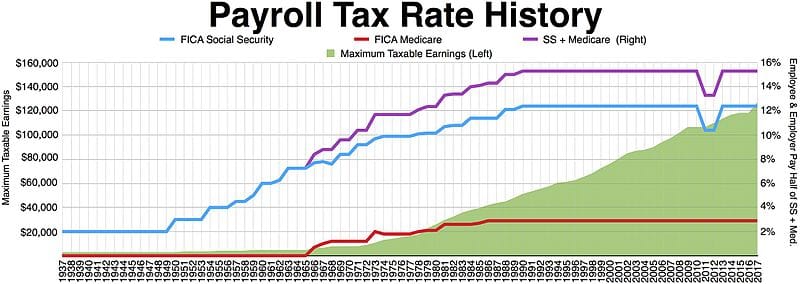
Social Security is billed along with Medicare (health care for the poor) as an anti-flat tax called FICA where middle class workers pay 7.65 -15.3%, and rich people pay essentially 0%. The reason that Warren Buffet and other rich people pay 0%, on a percentage basis, far less than their secretaries, is that there is a FICA cap of $127,200 currently, and he earns far more than $127,200. Buffett’s secretaries pays 7.65%, or which 6% approximately is social-security payment, and the rest Medicare. Buffett’s company then matches the 7.65% — a situation that applies to virtually every employee in the US.

A self employed person though, a gardener say, pays both the employee and employer portion or 15.3%. The same $127,200 cap applies, but since few gardeners make more than this amount, they are likely to pay 15.3% on all earnings, with no deductions. FICA really socks the poor and middle class, and barely touches a rich man like Buffett. This is the tax-inequality that most needs addressing, in my opinion, and one I have not heard discussed.

A short history of FICA

A visual history of FICA rates (right), and of the salary cap (left). Medicare contributions were added in 1966.

As I write this, there is a debate about tax reform that mostly involves income tax, but not at all FICA. Income tax could be improved, in my opinion, and should be. We could remove some exemptions that are being abused, and we should lower the general rates, especially for foreign-earnings, but the current income tax isn’t that bad, in my opinion. Buffett likes to brag about the high rate he pays, but it’s not a bad rate compared to the rest of the world. And Buffett benefits from a lot of things we don’t. His income is taxed at a lower rate than a worker’s would be since most of it is unearned. And, like most rich folks, he has exemptions and deductions that do not apply to most. He can deduct cars, private airplanes, and interest; most folks don’t deduct these things since they don’t spend enough to exceed the “standard deduction”. I’m happy to say these issues are being addressed in the current tax re-write.

The current, House version of the GOP tax proposal includes a raise in the standard deduction and a cap on interest and other deductions. There is a general decrease in the tax rate for earnings, and a decrease for earnings made abroad and repatriated. I’d like to see tariffs, too but they do not appear in the versions I’ve seen. And I’ve very much like to see a decrease in the FICA rate coupled with a removal of the salary cap. Pick a rate, 4% say, where we collect the same amount, but spread the burden uniformly. Why should 7.65%-15.3% or the workmanship wages got to the window, the orphan, and healthcare of the poor, while 0% of Buffett’s go for this?

Some other tax ideas: I’d like to see shorter criminal sentences, especially for drugs, and I’d like to see healthcare addressed to reduce the administrative burden.

Robert E. Buxbaum, November 17, 2017. In the news today, the senate version puts back the tax exemption on private jets. The opposite of progress, they say, is congress.

Forced diversity of race is racist

Let me browse through some thoughts on efforts to address endemic racism. I’m not sure I’ll get anywhere, but you might as well enter the laboratory of my mind on the issue.

I’d like to begin with a line of the bible (why not?) “‘Do not pervert justice; do not show partiality to the poor or favoritism to the great, but judge your neighbor fairly.” (Lev. 19:15). This sounds good, but in college admissions, I’ve found we try to do better by showing  favoritism to the descendants of those who’ve been historically left-out. This was called affirmative action, it’s now called “diversity”.  

In 1981, when I began teaching chemical engineering at Michigan State University, our department had race-based quotas to allow easier admission to the descendants of historically-disadvantaged groups. All major universities did this at the time. The claim was that it would be temporary; it continues to this day. In our case, the target was to get 15% or so black, Hispanics and American Indians students (7 in a class of 50). We achieved this target by accepting such students with a 2.0 GPA, and not requiring a math or science background; Caucasians required 3.0 minimum, and we did require math or science. I’m not sure we helped the disadvantaged by this, either personally or professionally, but we made the administration happy. The kids seemed happy too, at least for a while. The ones we got were, by and large, bright. To make up for the lack of background we offered tutoring and adjusted grades. Some diversity students did well, others didn’t. Mostly they went into HR or management after graduation, places they could have gone without our efforts.

After some years, the Supreme court ended our quota based selection, saying it was, itself racist. They said we could still reverse-discriminate for “diversity,” though. That is, if the purpose wasn’t to address previous wrongs, but to improve the class. We changed our literature, but kept our selection methods and kept the same percentage targets as before.

This is a popular meme about racism. It makes sense to me.

This is a popular meme about racism.

The only way we monitored that we met the race-percent target was by a check-box on forms. Students reported race, and we collected this, but we didn’t check that black students look black or Hispanic students spoke Spanish. There was no check on student honesty. Anyone who checked the box got the benefits. This lack of check bread cheating at MSU and elsewhere. Senator Elizabeth Warren got easy entry into Harvard and Penn, in part by claiming to be an Indian on her forms. She has no evidence of Indian blood or culture Here’s Snopes. My sense is that our methods mostly help the crooked.

The main problem with is, I suspect, is the goal. We’ve decided to make every university department match the state’s racial breakdown. It’s a pretty goal, but it doesn’t seem like one that helps students or the state. Would it help the MSU hockey squad to force to team to racially match the state; would it help the volleyball team, or the football team?  So why assume it helps every academic department to make it’s racial makeup match the state’s. Why not let talented black students head to business or management departments before graduation. They might go further without our intervention.

This is not to say there are not racial inequalities, but I suspect that these diversity programs don’t help the students, and may actually hurt. They promote crookedness, and divert student attention from achieving excellence to maintaining victim status. Any group that isn’t loud enough in claiming victim status is robbed of the reverse-discrimination that they’ve been told they need. They’re told they can’t really compete, and many come to believe it. In several universities, we gone so far as to hire “bias referees” to protect minorities from having to defend their intellectual views in open discussion. The referee robs people of the need to think, and serves, I suspect, no one but a group of powerful politicians and administrators — people you are not supposed to criticize. On that topic, here is a video of Malcolm X talking about the danger of white liberals. Clearly he can hold his own in a debate without having a bias referee, and he makes some very good points about white liberals doing more harm than good.

Robert Buxbaum, November 5, 2017. In a related problem, black folks are arrested too often. I suggest rational drug laws. Some financial training could help too.

West’s Batman vs Zen Batmen

“Holy kleenex Batman, it was right under our noses and we blew it.” I came of age with Adam West’s Batman on TV and a relatively sane Batman in the comic books. Batman was a sort of urban cowboy: a loner, but a law-abiding, honest loner. A proud American who was polite to the police and to the ordinary citizen. He was both good, and “nice.” Back then, as today, no one died by the hand of Batman, but that was largely because he worked with the police who made the final arrests

bat-buddah

More recent Batmen have been not nice, and arguably not good either. They do not work with the police but act above the law. Their ethos is not from US civics class, but from dark training in eastern monasteries by masters of kung fu. It’s a morality no one quite understands, not least himself. Quite literally, ‘He is a dark and stormy knight.’

A few days ago, I found this plastic Batman-Buddah for sale on e-Bay and I started wondering about how far our current movie Batmen have moved from those of the 60s. And on the deep, Zen thoughts that Batman now expounds on life and crime. These zen thoughts are pretty messed up, as psychologists have noted.

Example. In a recent Batman movie, Batman beats up an invasive wannabe wearing hockey pads. He gets asked: “What gives you the right? What’s the difference between you and me?” The response, “I’m not wearing hockey pads.” This is to say, the current Batman believe his physical prowess makes him above the law. Some more comments:
“Sometimes it’s only madness that makes us what we are.”
“That mask — it’s not to hide who I am, but to create what I am.”
“I won’t kill you, but I don’t have to save you.”

When he speaks to the Joker, it’s not clear which one is crazier. E.g.. Batman tells the Joker that he doesn’t kill because, “If you kill a killer, the number of killers remains the same.” To which Joker replies: “Unless you kill more than one….” That sounds sane to me.

By contrast. consider Adam West as Batman in the 1960s: “Underneath this garb, we’re perfectly ordinary Americans.” Another quote: “A reporter’s lot is not easy, making exciting stories out of plain, average, ordinary people like Robin and me.” Though this comment is “off” it’s nice to see that this Batman feels for peoples’ problems, respects their professions, and does not profess to be better than they are. He’s weird, but not a psychopath, and he leaves Gotham city pretty much the way you find it at the beginning of a comic or episode.

Not a classic Batmobile, but I like the concept.

Not a classic Batmobile, but I like it. Adam West’s Batman always strove to be socially responsible. 

By contrast, the current, dark, depressive Batmen always leave Gotham City in shambles, with piles of dead and destroyed buildings and infrastructure. Given the damage Batman does, you wonder why anyone calls for Batman; current Batmen never works with the police, quite.

And where’s Robin. To the extent that Robin appears at all, his relationship with Batman is more frenemy than ally. Batgirl too is mostly absent, and has changed. The original Batgirl was connected to the police. She was Barbara Gordon, Police Commissioner Gordon’s daughter, a positive female with a good relationship with her supportive, non-sexist father (an early version of Kim Possible’s dad) and with society as a whole. The current Batgirl appears is the butler’s daughter, and except for one brief appearance, you never see her, not at Wayne Manor, not anywhere. Somehow she’s Batgirl though it’s presented that didn’t know what her dad was up to.

Here are some real interactions between Adam West as Batman with Robin. He shows an interest in Robin’s education and well-being, something currently lacking:

AW Batman: “Haven’t you noticed how we always escape the vicious ensnarements of our enemies?” Robin: “Yeah, because we’re smarter than they are!”  Batman: “I like to think it’s because our hearts are pure.”

AW Batman: “Better put 5 cents in the meter.” Robin: “No policeman’s going to give the Batmobile a ticket.” Batman: “This money goes to building better roads. We all must do our part.”

Robin: “You can’t get away from Batman that easy!” AW Batman: “Easily.” Robin: “Easily.”
“Good grammar is essential, Robin.” Robin: “Thank you.” Batman: “You’re welcome.”

Robin/Dick: “What’s so important about Chopin?” Batman: “All music is important, Dick. It’s the universal language. One of our best hopes for the eventual realization of the brotherhood of man.” Dick: “Gosh Bruce, yes, you’re right. I’ll practice harder from now on.”

AW Batman: “That’s one trouble with dual identities, Robin. Dual responsibilities.”

“Even crime fighters must eat. And especially you. You’re a growing boy and you need your nutrition.”

“What took you so long, Batgirl?” Batgirl: “Rush hour traffic, plus all the lights were against me. And you wouldn’t want me to speed, would you?” Robin: “Your good driving habits almost cost us our lives!” Batman: “Rules are rules, Robin. But you do have a point.”

And finally, AW Batman: “I think you should acquire a taste for opera, Robin, as one does for poetry and olives.”

Clearly this Batman takes an interest in Robin’s health and education, and in Batgirl’s. Robin is his ward, after all, a foster child. And Batgirl is a protege, as well as the daughter of a friend.

The modern Batman claims, “It’s not who I am underneath, but what I do that defines me.” It’s, more or less, a quote from Karl Jung that shows pride in one’s art, but it also shows an attachment to job over self. This approach appeared in the olden days, in the form of Catwoman, a woman with her own moral code, and proud of it. Batman found her odious, abhorrent, and “insegrievious”. The only difference between her and the Joker, he says, is the amount of damage done. I’m sorry to find that recent, Zen Batmen and Supermen might as well be Cat-women, or Jokers. To quote Robin: “Holy strawberries, Batman, we’re in a jam.”

Robert Buxbaum, June 26, 2017. Insegeivious is a made-up word, and I love it. I also love the humor of Robin’s “holy xxx” comments.