Category Archives: crime

School violence and the prepositional subjective

There is a new specialty in the law, both in prosecution and defense: dealing with possible school shooters and other possible purveyors of violence. Making threats of violence has always been a felony — it’s a form of assault. But we’ve recently extended this assault charge to those student who make statements to the effect that they might like to commit violence, a conditional subjunctive statement of assault. This finer net manages to catch, in Michigan alone, about 100 per month. That’s a large number. Mostly they are male high-school age students who shot off their mouth, kids caught for saying “I’ll kill you” often in an argument, or following one. They are arrested for protection of others, but the numbers are so high and the charge so major, 15 – 20 year felonies, it’s possible that the cure is worse than the disease.

Eight students of the 100 charged in the last month in crimes of potential violence.

Putting some faces to the crime. Eight of the 100 charged in Michigan in the last month for potential violence. All or most are boys. 

Several of the cases are described in this recent Free-Press article, along with the picture at right. According to the article, many of those charged, are sentenced to lower crimes than the 15 -20 maximum, things like reckless endangerment. Many, the majority, I hope — they are not mentioned in the article — are let go with a warning. But even there, one wonder if these are the richer, white ones. In any case, it’s clear that many are not let go and have their lives ruined because they might come to commit a crime.

Let’s consider one case in-depth, outcome unknown: A top high school student, skinny, but without many friends, who gets picked on regularly. One day, one of the more popular kids in school calls him out and says, “You look like you’re one of those school shooters.” The loner responds, “If I were a school shooter, you’d be the first I’d shoot.” And that’s enough to ruin the kid’s life. Straight to the principal, and then to the police. The ACLU has not seen to get involved as there are competing rights at play: the right of the loner to have a normal education, and the rights of the other students. One thing that bothers me is that this crime hangs on the conditional subjunctive:  “If I were…., then you would be…”

What makes the threat subjective is that “I’ll kill you” or “I’d shoot you first” is something you’d like to be true at some time in the indefinite future. There is no clear time line or weapon, just a vague desire that the person should be shot. It’s a desire that more-likely than not, is a fleeting hyperbole, and not an actual threat. What makes the threat conditional on the person has yet to decide to show up with a weapon or show any sign of doing violence: “If I were to become a school shooter.”

The person who drew this faces 15 years in prison. The only evidence is this picture.

The person who drew this faces 15 years in prison. The only evidence of a threat is this picture.

It did not used to be that either the conditional or the subjunctive were considered threats. A person was assumed to be blowing off steam if he (or she) said “I’d like to see you dead” or even “I’ll kill you.” And we certainly never bothered folks who prefaced it with, “If I were a …” In theory, we had to extend the law to protect the weak from a shooter, but we’ve also put a weapon in the hands of the schoolyard bully. The school bully can now ruin the life of his fellow by accusing him of being a potential school scooter. We’ve weaponized the conditional subjunctive, and I don’t like it. The boy who drew the picture at right was charged with a 15 year felony for drawing something that, in earlier generations, would be called a fantasy picture.

It bothers me is that the majority of those charged — perhaps all those charged — are boys. Generally these boys are doing things that normal boys have often done. The picture of a shooting is considered a written threat of violence, but to me it looks like a normal boy picture. Girls have not been caught, so far, perhaps because their words and pictures are more “girly” so their threats are not considered threats. Sometimes is seems that it is boy-behaviors themselves are being criminalized, or at minimum diagnosed as ADHD (crazy). There is so much we don’t like about boy-behaviors, and we’ve elevated the female to such an extent, that we may have lost the positive idea of what a male should be. We want boys to be “girly” or at least “trans,” and that’s not normal in the sense that it’s not normative. We’ve come to worry about boyness, creating a cure that may be worse than the harm we are trying to prevent.

Robert Buxbaum, May 7, 2018. I’ve also noted how bizarre US sex laws are, and have written about pirates and transgender grammar.

Bitcoin risks, uses, and bubble

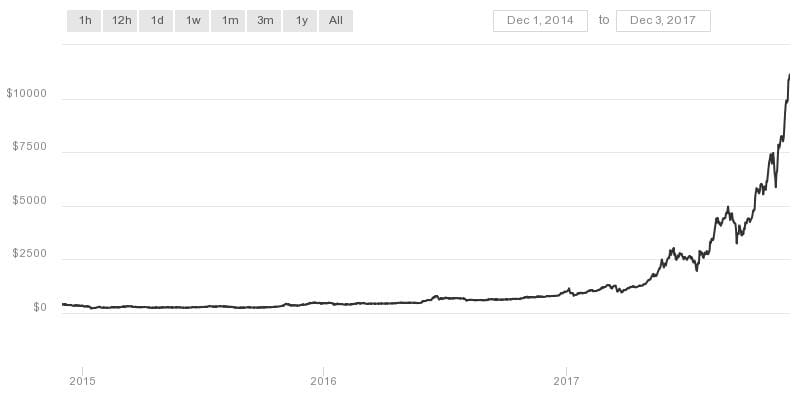
Bitcoin prices over the last 3 years

Bitcoin prices over the last 3 years

As I write this, the price of a single bitcoin is approximately $11,100 yesterday, up some 2000% in the last 6 months. The rise rate suggests it is a financial bubble. Or maybe it’s not: just a very risky investment suited for inclusion in a regularly balanced portfolio. These are two competing views of bitcoin, and there are two ways to distinguish between them. One is on the basis of technical analysis — does this fast rise look like a bubble (Yes!), and the other is to accept that bitcoin has a fundamental value, one I’ll calculate that below. In either case, the price rise is so fast that it is very difficult to conclude that the rise is not majorly driven by speculation: the belief that someone else will pay more later. The history of many bubbles suggests that all bubbles burst sooner or later, and that everyone holding the item loses when it does. The only winners are the brokers and the last investors who get out just before the burst. The speculator thinks that’s going to be him, while the investor uses rebalancing to get some of benefit and fun, without having to know exactly when to get out.

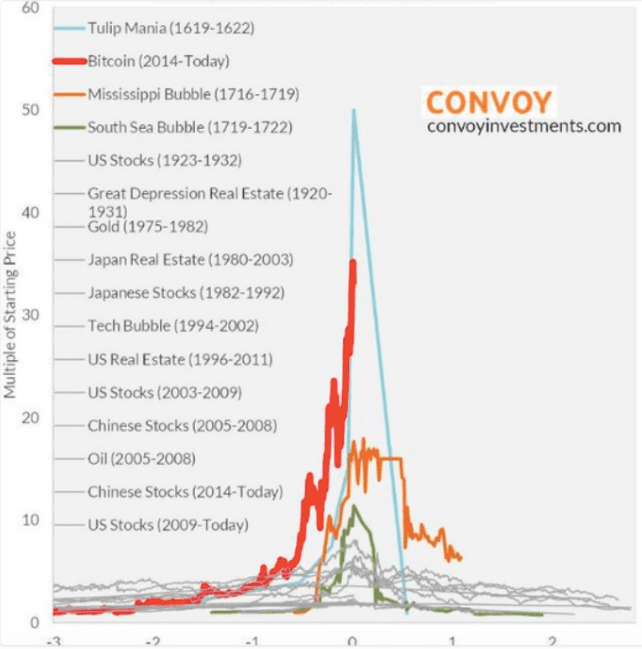
That bitcoin is a bubble may be seen by comparing the price three years ago. At that point it was $380 and dropping. A year later, it was $360 and rising. One can compare the price rise of the past 2-3 years with that for some famous bubbles and see that bitcoin has risen 30 times approximately, an increase that is on a path to beat them all except, perhaps, the tulip bubble of 1622.

A comparison between Bitcoin prices, and those of tulips, 1929 stocks, and other speculative bubbles; multiple of original price vs year from peak.

A comparison between Bitcoin prices, and those of tulips, 1929 stocks, and other speculative bubbles; multiple of original price vs year from peak.

That its price looks like a bubble is not to deny that bitcoin has a fundamental value. Bitcoin is nearly un-counterfeit-able, and its ownership is nearly untraceable. These are interesting properties that make bitcoin valuable mostly for illegal activity. To calculate the fundamental value of a bitcoin, it is only necessary to know the total value of bitcoin business transactions and the “speed of money.” As a first guess, lets say that all the transactions are illegal and add up to the equivalent of the GDP of Michigan, $400 billion/year. The value of a single bitcoin would be this number divided by the number of bitcoin in circulation, 15,000,000 currently, and by the “speed of money,” the number of business transactions per year per coin. I’ll take this to be 3 per year. It turns out there are 5 bitcoin transactions total per year per coin, but 2/5 of that, I’ll assume, are investment transactions. Based on this, a single bitcoin should be worth about $8890, slightly below its current valuation. The gross speed number, 5/year, includes bitcoin transactions that are investments and never traded for goods, and those actively being used in smuggling, drug-deals, etc.

If the bitcoin trade will grow to $600 billion year in a year with no other change, the price rise of a single coin would surpass that of Dutch tulip bulbs except that more coins are bing minted, and that the speed is increasing. If you assume that coin use will reach $1,600 billion/year, the GDP of Texas in the semi-near future, before the Feds jump in, the fundamental value of a coin should grow no higher than $44,000 or so. There are several problems for bitcoin investors who are betting on this. One is that the Feds are unlikely to tolerate so large an unregulated, illegal economy. Another is that bitcoin transactions are not likely to go totally legal. It is very hard (near impossible) to connect a bitcoin to its owner. This is a plus for someone trying to deal in drugs or trying hide profits from the IRS (or his spouse), but a legal merchant will want the protection of courts of law. For this, he or she needs to demonstrate ownership of the item being traded, and that is not available with bitcoin. The lack of a solid, legitimate business need suggests to me that the FBI will likely sweep in sooner or later, and that the value of a coin will never reach $44,000.

Yet another problem for those wishing to invest in bitcoin is the existence of more bitcoins (undiscovered, or un-mined so far) and the existence of other cryptocurrencies with the same general qualities: Litecoin (LTC), Ethereum (ETH), and Zcash (ZEC) as examples. The existence of these coins increases the divisor one should use when calculating the value of a bitcoin. The total number of bitcoins is capped at 21,000,000, that is 6,000,000 coins more than known today. Assuming more use and more acceptance, the speed (turnovers per year) is likely to increase to four or five, similar to that of other currencies. Let’s assume that the bitcoin will control 1 trillion dollars per year of a $1.6 trillion/year illegal market. One can now calculate the maximum long term target price of a bitcoin by dividing $1 trillion/year by the number of bitcoins, 21,000,000, and by the speed of commercial use, 4.5/year. This suggests a maximum fundamental value of $10,582 per coin. This is just about the current price. Let the investment buyer beware.

For an amusing, though not helpful read into the price: here are Bill Gates, Warren Buffet, Charlie Munger, and Noam Chomsky discussing Bitcoin.

Robert Buxbaum, December 3, 2017.

Detroit 1967 to 2017: unemployment comes down, murder rate doesn’t.

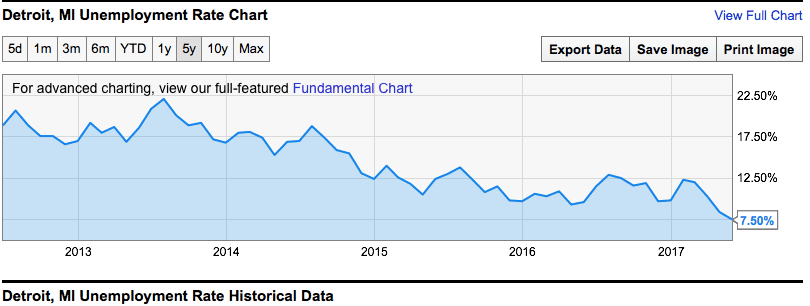
Almost 50 years ago today, July 23, 1967 white policemen raided an unlicensed, “blind pig” bar in a black neighborhood, the 12th street of Detroit, and the city responded with four days of rioting, 43 killings (33 black, 10 white), 2509 stores looted, and over 1000 fires. In 2017, at last the city is beginning to show signs of recovery. By 2015 the city’s unemployment had gone down from about 20% to 12%, and  in the first six months 2017, the firs six months of the Trump presidency, 2017 it’s gone down again to 7 1/2%. It’s not that 7 1/2% unemployment is good, but it’s better. Per-hour salaries are hardly up, but I take that as better than having a high average salary at very low employment. As a point of reference, the unemployment rate in Detroit in 1967, before the riots was 3.4%. Within weeks, 150,000 jobs were lost, and anyone who could leave the city, did.

Detroit Unemployment rates are way down, but the city still looks like a mess.

Detroit Unemployment rates are way down, but the city still looks like a mess.

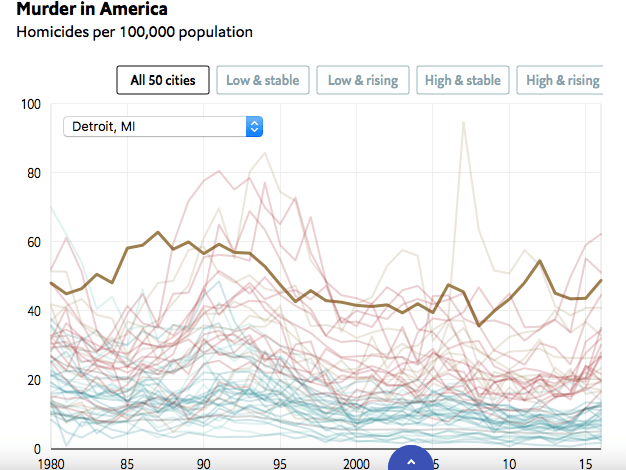
Another issue for Detroit is its uncommonly high murder rate. In the mid-80s, Detroit had the highest murder rate in the US, about 55 murders per 100,000 population per year (0.055%/year). As of February 1, 2017, the murder rate was virtually unchanged: 50 per 100,000 or 0.05%/year, but two cities have higher rates yet. At present rates, you have a 3.5% of dying by homicide if you live in Detroit for 70 years — even higher if you’re male. The rate in the rest of the US is about 1/10th this, 0.005%/year, or 5 per 100,000, with a dramatic difference between rural and urban populations.

Murder rate in 50 cities with Detroit highlighted. From The Economist, February 2017.

Murder rate in 50 cities with Detroit highlighted, from The Economist.

One of the causes of the high murder rate in Detroit, and in the US generally, I suspect, is our stiff, minimum-penalties for crime. As sir Thomas Moose pointed out, when crime is punished severely, there is a tendency to murder. If you’re going to spend the next 20 years behind bars, you might as well try any means you can to escape. Another thought — the one favored by social liberals — is that it’s the presence of guns in the US encourages murder. It may, but it also seems to prevent crime by allowing the victim to defend himself or herself. And the effect on murder is not so clear, if you consider suicide as a form of murder. In countries like Canada with few guns, people kill themselves by hanging or by throwing themselves off high buildings. My hope is that Detroit’s murder rate will drop in 2017 to match its improved economic condition, but have no clear reason to think it will.

Robert Buxbaum, July 20, 2017. Here are some suggestions I’ve made over the years.

May 1, St. Tammany day

May 1 is St. Tammany day, a day to rejoice in the achievements of Tammany Hall, and of St Tammany, the guardian of crooked politicians everywhere. The Sons of St. Tammany started in 1773 as a charitable club of notable revolutionary-era individuals including Benjamin Franklin, John Hancock, and John Dickenson, but evolved into perhaps the most corrupt, and American, of political organizations. The picture of a US politician – the cartoon version at least — is the Tammany Democrat: a loud, drunken, womanizer, willing to do or promise whatever the people seem to want at the moment. Tammany and its bosses helped form this image. They helped new immigrants, but did so by creating needless government jobs, by filling them often with incompetent loyalists, and by overcharging on government contracts. Today, these Tammany ways rule in every major American city; the other clubs of the day are gone or influence-less.

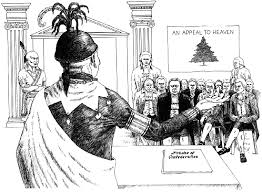
John Hancock leads a meeting of the St. Tammany (Columbian) society. Note the "Appeal to Heaven flag and the Indian, real or imagined. Indians participated in several, early St. Tammany meetings.

John Hancock leads a meeting of the St. Tammany society. Note the “Appeal to Heaven” flag. While Indians participated in some, early meetings, the one here is, I suspect, a ghost: St. Tammany.

In revolutionary-era America, the Sons of St. Tammany was just one of many social-charitable clubs (Americans like to form clubs), in many ways it was similar to the Masons and the Cincinnati, but those clubs were international and elitist. The sons of Tammany was purely American, and anti-elitist. It was open to anyone born on this side of the Atlantic, and had Indian customs. The Cincinnati society, for comparison, started with members who were as notable (Alexander Hamilton, George Washington, Marie, Marquis de Lafayette, Henry Knox, etc.) but was originally open only to high officers of the regular army, including foreigners like Lafayette, but not ordinary soldiers, minutemen (militia), or the general public. The symbols of the Tammanies were American: the liberty-cap and the “Appeal to Heaven” flag, now a popular symbol of the Tea Party; the leader was called by an Indian name: Sachem. By contrast, the Cincinnati society symbol was the Imperial Eagle (Washington’s was gold with diamonds), and the leader was called “general”. The Tammany society began admitting immigrants in 1810 or so, while the Cincinnati society remains closed to this day, except to descendants of Revolutionary officers — an aristocratic affectation in the eyes of some.

It was Aaron Burr who first saw the opportunity to use the Tammany organization as a for-profit, political machine. In the years 1795-9, New York was suffering from yellow fever and a variety of other diseases that were taken to be caused by a lack of clean water. Burr proposed, with Tammany support, the creation of a corporation to build a new water system to bring fresh, clean water from the Bronx River to lower Manhattan via iron pipes. The Manhattan company was duly chartered, with directors who were primarily Tammany men, Republican-Democrats, and not Federalists. Federalists (Hamilton, primarily) controlled the only NY banks at the time and controlled the directorate of every chartered company in the city. The Manhattan company requested a $2,000,000 perpetual charter, twice as big as the charter of Hamilton’s Bank of New York, and a monopoly on water distribution. These were reasonable requests given the task, but unusual in the lack of Federalist or governmental oversight. But the Manhattan company was a water company, and water was needed. But Burr’s intent, all along, it seems was to build a bank, not a water company. After the charter was approved, but before signing, he amended it to allow any excess funds to be used for any legal purpose. 

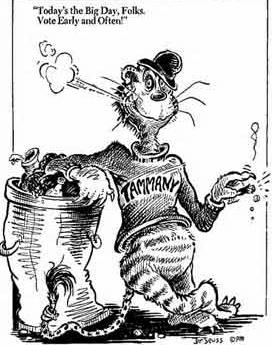
In this cartoon by Dr. Seuss, The Tammany Tiger says, "Today is the Big Day Folks. Vote Early and Often."

In this cartoon by Dr. Seuss, The Tammany Tiger says, “Today is the Big Day Folks. Vote Early and Often.”

Money was raised, but only $100,000 used for the water system. The remaining 95% of the charter funds, $1,900,000, went to found “The Bank of The Manhattan company” — later to be known as “The Chase Manhattan Bank” or “The Manhattan Bank of Cholera.” Instead of building the reservoir in upper Manhattan and filling it with clean water as originally proposed, Burr’s Tammany trustees voted to dig wells in lower Manhattan, and placed its reservoir in lower Manhattan too, near Chamber’s St,  next to a cemetery where Cholera victims were buried. New York suffered with Cholera, Typhoid, and leaky, wooden pipes until 1842 when Peter Cooper brought clean water to lower Manhattan from the Groton River via iron pipes. To this day, crooked water contracts are a staple of Tammany politics

The Bank of the Manhattan company opened at 40 Wall St on September 1, 1799, a mere four months after the water company’s incorporation. Hamilton was furious. The company continues today as The JP Morgan, Chase Manhattan Bank, one of the largest banking institutions in the world. Burr used the money and power of his company to reward supporters and to run for vice president with Thomas Jefferson’s tacit support. Except for his Tammany candidacy, John Adams would have won New York and a second term as president. Burr’s career pretty-well died after the Hamilton duel, but Tammany did well without him. By 1812, the Society built its first Tammany Hall, officially called the Wigwam, a $55,000, five-story building with a meeting hall for 2000. New York Democratic politics would center on Tammany Hall for the next century at least.

Following disappointment with John Quincy Adams, “the bitter branch of the bitter tree,” Tammy leaders went national. They recruited Andrew Jackson, a war hero and early recruit of Burr’s. They’d support Jackson if he’d hand over spoils, control of government jobs. He agreed and, as president, fired perfectly good, long-standing government employees He replaced them with Democratic loyalists. When Jackson stepped down in 1833, Tammany elected an equally corrupt New Yorker, Martin van Buren. Though there were periodic Whig and Republican reforms, Tammany learned they could wait those out. They always re-emerged like mushrooms after a rain.

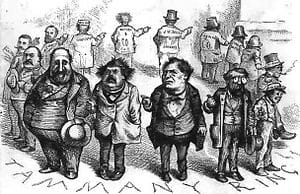
Boss Tweed and other Tammany leaders: who stole the money?

Boss Tweed and other Tammany leaders in a cartoon by Nast, Tammany Ring. “Who stole the money? He did.”  

A key vote-getter in the Tammany system is to provide Thanksgiving dinners and other charitable giveaways for the poor, as well as promises of jobs. By the late 1800s, William J. Brian added promises of soft money and wealth redistribution, cornerstones of the Democratic platform to this day. Tammany also tends to be for low tariffs as opposed to the high tariff ideas of Hamilton and many Whigs and 19th century Republicans. A case can be made for either view.

Tammany helped New York immigrants, particularly the Irish to get citizenship and avoid legal troubles in return for votes and occasional muscle. In other cities, Democratic clubs were less open to Catholics, reflecting the views of the common voter in each state. In the North they were pro-union, in the South anti, electing Klu Kluxers like George Wallace, Sam Ervin, and Robert Byrd. This lead to a famous split in the Democratic party about the 1968 convention. Famous Tammany leaders include William M. “Boss” Tweed, “Big” Tim Sullivan, and “Gentleman” Jimmy Walker. Sullivan famously authored the first anti-gun law, the Sullivan act; it was designed to protect his thugs against private citizens shooting them. It didn’t always work.

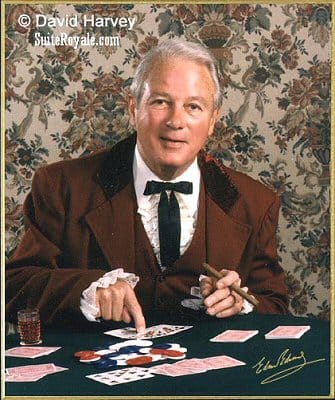
Edwin Edwards, Democratic Governor of Louisiana. 1972-1996. Who would not trust this man?

Hon. (?) Edwin Edwards, Governor of Louisiana. 1972-1996. Tammany lives

If you want to see Tammany politics in action, visit almost any large US city, or read its newspaper. In Chicago, the dead vote, and 4 of the last 6 governors have gone to jail. Mayor Daily famously told Kennedy that 90 percent of the registered voters of Cook County would vote for him. They did (sort of); because of this, JFK won Illinois and the presidency. In New York, voters discovered only in the 1960s that Tammany’s leader, Carmine DeSapio had been working for 30 years with known gangland murderer, Charles “Lucky” Luciano. In Detroit, where I live and corruption in the water department is legendary. Race-based job handouts, unemployment is high along with high minimum (living) wages. We’re now in the process of a $70,000,000 project to replace 100 feet of sewer pipe, and we’re building a $140 million, 3.3 mile trolley. Tammany loves all public works.

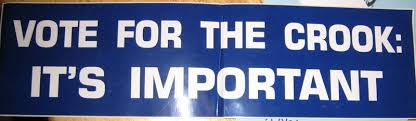
Then there is Louisiana, home to St Tammany parish. Louisiana Democrats like Huey Long and Edwin Edwards (shown at left) are unusual in that they’re proud to say that their corrupt methods are corrupt. Edwards has had two long runs as governor despite several convictions for doing illegal things he admits to doing. When Edwards was asked why he did favors for his friends. He responded: “Who should I do them for? My enemies?” Or, to quote one of Edwin Edwards campaign ads. Vote Edwin EdwardsPeople seem to love it, or did until the levy broke. There is a particularly American grandeur to all this. As Will Rodgers said, “America has the best politicians money can buy.” Today is the day to be proud of that uniquely American tradition. You too can grow up to buy a president.

Robert Buxbaum, April 28, 2017. I ran for water commissioner, and have written about sewage treatment, flood avoidance, and fluoride, as well as the plusses and minuses of trade unionization, and the difference between Republicans and Conservatives.

if everyone agrees, something is wrong

I thought I’d try to semi-derive, and explain a remarkable mathematical paper that was published last month in The Proceedings of the Royal Society A (see full paper here). The paper demonstrates that too much agreement about a thing is counter-indicative of the thing being true. Unless an observation is blindingly obvious, near 100% agreement suggests there is a hidden flaw or conspiracy, perhaps unknown to the observers. This paper has broad application, but I thought the presentation was too confusing for most people to make use of, even those with a background in mathematics, science, or engineering. And the popular versions press versions didn’t even try to be useful. So here’s my shot:

Figure 2 from the original paper. For a method that is 80% accurate, you get your maximum reliability at the third to fifth witness. Beyond that, more agreement suggest a flaw in the people or procedure.

Figure 2 from the original paper. For a method that is 80% accurate, you get your maximum reliability at 3-5 witnesses. More agreement suggests a flaw in the people or procedure.

I will discuss only on specific application, the second one mentioned in the paper, crime (read the paper for others). Lets say there’s been a crime with several witnesses. The police line up a half-dozen, equal (?) suspects, and show them to the first witness. Lets say the first witness points to one of the suspects, the police will not arrest on this because they know that people correctly identify suspects only about 40% of the time, and incorrectly identify perhaps 10% (the say they don’t know or can’t remember the remaining 50% of time). The original paper includes the actual factions here; they’re similar. Since the witness pointed to someone, you already know he/she isn’t among the 50% who don’t know. But you don’t know if this witness is among the 40% who identify right or the 10% who identify wrong. Our confidence that this is the criminal is thus .4/(.4 +.1) = .8, or 80%.

Now you bring in the second witness. If this person identifies the same suspect, your confidence increases; to roughly (.4)2/(.42+.12) = .941,  or 94.1%. This is enough to make an arrest, but let’s say you have ten more witnesses, and all identify this same person. You might first think that this must be the guy with a confidence of (.4)10/(.410+.110) = 99.99999%, but then you wonder how unlikely it is to find ten people who identify correctly when, as we mentioned, each person has only a 40% chance. The chance of all ten witnesses identifying a suspect right is small: (.4)10 = .000104 or 0.01%. This fraction is smaller than the likelihood of having a crooked cop or a screw up the line-up (only one suspect had the right jacket, say). If crooked cops and systemic errors show up 1% of the time, and point to the correct fellow only 15% of these, we find that the chance of being right if ten out of ten agree is (0.0015 +(.4)10)/( .01+ .410+.110) = .16%. Total agreement on guilt suggests the fellow is innocent!

The graph above, the second in the paper, presents a generalization of the math I just presented: n identical tests of 80% accuracy and three different likelihoods of systemic failure. If this systemic failure rate is 1% and the chance of the error pointing right or wrong is 50/50, the chance of being right is P = (.005+ .4n)/(.01 +.4n+.1n), and is the red curve in the graph above. The authors find you get your maximum reliability when there are two to four agreeing witness.

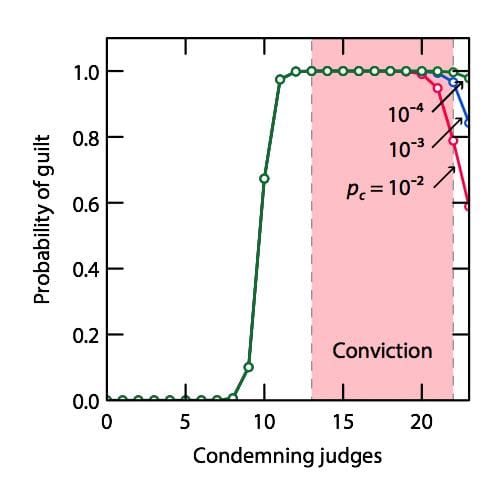
Confidence of guilt as related to the number of judges that agree and your confidence in the integrity of the judges.

Confidence of guilt as related to the number of judges that agree and the integrity of the judges.

The Royal Society article went on to a approve of a feature of Jewish capital-punishment law. In Jewish law, capital cases are tried by 23 judges. To convict a super majority (13) must find guilty, but if all 23 judges agree on guilt the court pronounces innocent (see chart, or an anecdote about Justice Antonin Scalia). My suspicion, by the way, is that more than 1% of judges and police are crooked or inept, and that the same applies to scientific analysis of mental diseases like diagnosing ADHD or autism, and predictions about stocks or climate change. (Do 98% of scientists really agree independently?). Perhaps there are so many people in US prisons, because of excessive agreement and inaccurate witnesses, e.g Ruben Carter. I suspect the agreement on climate experts is a similar sham.

Robert Buxbaum, March 11, 2016. Here are some thoughts on how to do science right. Here is some climate data: can you spot a clear pattern of man-made change?

Michigan, an emerging economy

Between 2009 and 2014, Michigan’s per-capita GDP grew at 14% per year, an amazing growth rate similar to that of an emerging, tiger economies. According tot the Bureau of Economic analysis, the only US states that grew faster were Texas and North Dakota, and these oil states were hit badly in the current year 2015-16.
GDPGROWTH


Unfortunately, Michigan remains relatively poor despite it’s growth. Its per-capita GDP, $20,263 (2016), lags behind even perennial backwaters like Vermont, Oklahoma, and Missouri. The wealth gap in Michigan is growing, as in an emerging economy, and the cities, e.g. Detroit and Flint, are known for high murder rates, and a large-scale bankruptcy.

Michigan population change, Detroit Free Press

Michigan population change, Detroit Free Press

Then there’s pollution and flooding. Our beaches close for e-coli after every major rain, and we recently found that the drinking water in Flint was contaminated with lead; it seems other MI cities have lead problems too. Add to this, that we’ve  had major floods, a result of mismanagement, cronyism, and rampant growth, and Michigan keeps looking more and more like Vietnam, China, and India.

Everything here isn’t third world, though. We replaced our hapless, ex-governor Granholm with a relatively competent (in my opinion) nerd, Rick Snyder. We’ve jailed the of worst crooks, e.g. Detroit’s walking-crime-wave mayor, Kwame Kilpatrick, and his father, “Pay-for-play”, and the corrupt city manager, Bobby Ferguson. Under the previous administration, the state population shrank. It is now growing slowly.

Flood of 2014; the view at 696 and Mound rd. It's just incompetence.

Flood of 2014; the view at 696 and Mound rd. It’s part incompetence and part growth.


We passed a needed roads bill. Taxes are high, but not as bad as Illinois, and even Detroit is beginning to look good, at least in the center city. Industry is coming back, and so is Michigan real-estate. Here are some of my ideas going forward: pay our teachers well, and don’t imprison for so long. Some ideas to keep us on the upswing.

Robert Buxbaum, February 23, 2016. I’m running to be the Oakland county water commissioner, by the way.

How to help Flint and avoid lead here.

As most folks know, Flint has a lead-poisoning problem that seems to have begun in April, 2014 when the city switched its water supply from Detroit-supplied, Lake Huron water to their own source, water from the Flint River. Here are some thoughts on how to help the affected population, and how to avoid a repeat in Oakland county, where I’m running for water commissioner. First observation, it is not enough to make sure that the source water does not contain lead. The people who decided on the switch had found that the Flint river water had no significant content of lead or other obvious toxins. A key problem, it seems: the river water did not contain anticorrosion phosphates, and none, it seems, were added by the Flint water folks. It also seems that insufficient levels of chlorine (hypochlorite) were added. After the switch, citizens started seeing disgusting, brown water come from their taps, and citizens with lead pipes or solder were poisoned with ppb-levels of lead. There was also an outbreak of legionaries disease that killed 12 people. It was the legionaries that alerted the CDC to the possibility of lead, since it seems the water folks were fudging the numbers there, and hiding that part of the problem.

Flint water, Sept 2015, before switching back to Lake Huron.

Flint water after 5 hours of flushing, Sept 2015, before switching back to Lake Huron.

The city began solving its problem by switching back to Detroit-supplied, Lake Huron water in October, 2015. Beginning in December, 2015, they started adding triple doses of phosphate to the wate. As a result, Flint tap-water is now back within EPA standards, but it’s still fairly unsafe, see here for more details.

There has been a fair amount of finger-pointing. At Detroit for raising the price of water so Flint had to switch, at water officials ignoring the early signs of lead and fudging their reports, at other employees for not adding phosphate or enough chlorine, and at “the system” for not providing Flint’s government with better oversight. My take is that a lot of the problem came from the ignorance of the water commission, and it’s commissioner. We elect our water commissioners to be competent overseers of complex infrastructure, but in may counties folks seem to pick them the same way they pick aldermen: for a nice smile, a great handshake, and an ability to remember names. That, anyway, seems to be the way that Oakland got its current water commissioner. When you pick your commissioner that way, it’s no surprise that he (or she) isn’t particularly up on corrosion chemistry, something that few people understand, and fewer care about until it bites them.

Flint river water contains corrosive chloride that probably helped dissolve the lead from pipes and solder. Contributing to the corrosion problem, I’m going to guess that Flint River water also contains, relatively little carbonate, but significant amounts of chelating chemicals, like EDTA, in 10s of ppb concentration. EDTA isn’t poisonous at these concentrations, but it’s common in industry and is the most commonly used antidote for lead poisoning. EDTA extracts lead and other metals from people and would tend to contribute to the process of extracting lead and iron oxide from the pipes surface into the drinking water. With EDTA in the water, a lot of phosphate or hypochlorite would be needed to avoid the lead poisoning problem and the deadly multiplication of disease.

Detroit ex-mayor Kwame Kilpatrick has claimed that both Flint water and Detroit water were known to be poisoned even a decade before the switch. I find these claims believable given the high levels of lead in kids blood even before the switch. Also, I note that there are areas of Detroit where the blood-lead levels are higher than Flint. Flint tested at the taps in a way that fudged the data during the first days of the poisoning, and I suspect many of our MI cities do this today — just to make the numbers look better. My first suggestion therefore is to test correctly, both at the pipes and at the taps; lead pipes are most-often found in the last few feet before the tap. In particular, we should test at all schools and other places where the state has direct authorization to fix the problem. A MI senate bill has been proposed to this effect, but I’m not sure where it stands in the MI house. It seems there are movements to add lots of ‘riders’ and that’s usually a bad sign.

Another thought is that citizens should be encouraged to test their private taps and helped to fix them. The state can’t come in and test or rip out your private pipes, even if they suspect lead, but the private owner has that authorization. The state could condemn a private property where they believe the water is bad, but I doubt they could evict the residents. It’s a democratic republic, as I understand; you have the right to be deadly stupid. But I’ll take my own suggestion to encourage you: If you think your water has lead, take a sample and call (517) 335-8184. Do it.

Another suggestion, perhaps the easiest and most important, is drink bottled water for now, and if you feel you’ve been poisoned, take an antidote.  As I understand things, the state is already providing bottles of imported water. The most common antidote is, as I’d mentioned, EDTA. Assuming that Flint River water had enough EDTA to significantly worsen the problem, the cheapest antidote might be Flint River water, assuming you drew it in lead-free pipes and chlorinated sufficiently to rid it of bugs. If there is EDTA it will help the poisoned. Another antidote is Succinic acid, something sold by REB Research, my company. As with EDTA it is non-toxic, even in fairly large doses, but its use would have to be doctor- approved.

Robert E. Buxbaum, January 19-31, 2016. I hope this helps. We’d have to check Flint River water for levels of EDTA, but I suspect we’d find biologically significant concentrations. If you think Oakland should have an engineer in charge of the water, elect Buxbaum for water commissioner.

What happened to Jack Kelly of Newsies

As my daughters are fans of the Disney play and movie, “Newsies,” and as I’ve taken interest in the early 20th century, they’ve asked me to find out what happened to Jack Kelly, the main character of the play/movie. If you’ve never seen it, Newsies is a musical about the New York newsboy strike of 1899. According to the play/ movie, as soon as the strike ends (the newsboys win), the strike leader, “cowboy” Jack Kelly goes off with Theodore Roosevelt, presumably headed to Santa Fé, New Mexico to become a real cowboy. But a simple search did not reveal what actually happened to the real Jack Kelly; here’s what I found. Noosies NYT

Without looking, I told my daughters that, if Jack Kelly had gone to Santa Fé in 1899, he would have found something very interesting: a cowboy school for young men. As it happened one of Roosevelt’s rough riders from the battle of San Juan Hill, retired to Santa Fé and set up a cowboy school for boys in the mountains above the town. He built a very outdoorsy operation in an area called “Los Alamos”. It ran until 1942 when the location was taken over to become “Site Y” of the Manhattan Project. This is where J. Robert Oppenheimer and co designed and built the first Atom Bombs. That Jack would have gone there would make for a nice, tidy story, but the truth appears to have been more messy, and more interesting. Jack got involved with William Hearst and George M. Cohan, the Titanic, a famous murder, and eventually with the fall of Tammany Hall. Here’s a picture.

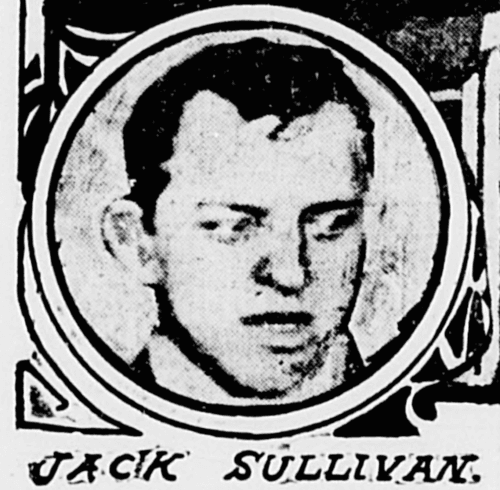
Jack Sullivan

Jack Sullivan, head Newsie. He isn’t ugly, but isn’t Christian Bale either.

First, there was an actual newsboy strike in 1899; it was about raising the price the newsboys paid per paper, but the problem was that the price had been raised earlier, for the Spanish-American War, and not decreased after the war ended. The newsboys did win, and there was a leader named Jack, but according to the papers, the name of the leader was “Jack Sullivan”, not Jack Kelly or Francis Sullivan. The New York Tribune, July 22, 1899, lists Jack Sullivan as the leader of the strike Arbitration Committee and a leader of “the first group of newsboys to declare and demand their rights.” There are other leaders too: Louis “Kid Blink” Baletti, and David “Dave/ Yaller” Simmons. “Kid Blink” (he wore an eye patch and appears in the movie) got an award from the newsboys for making the best speech. I’ll guess that the Dave “the mouth” character is based on David “Yaller” Simmons, but it is not clear that he had any close relationship with Sullivan.

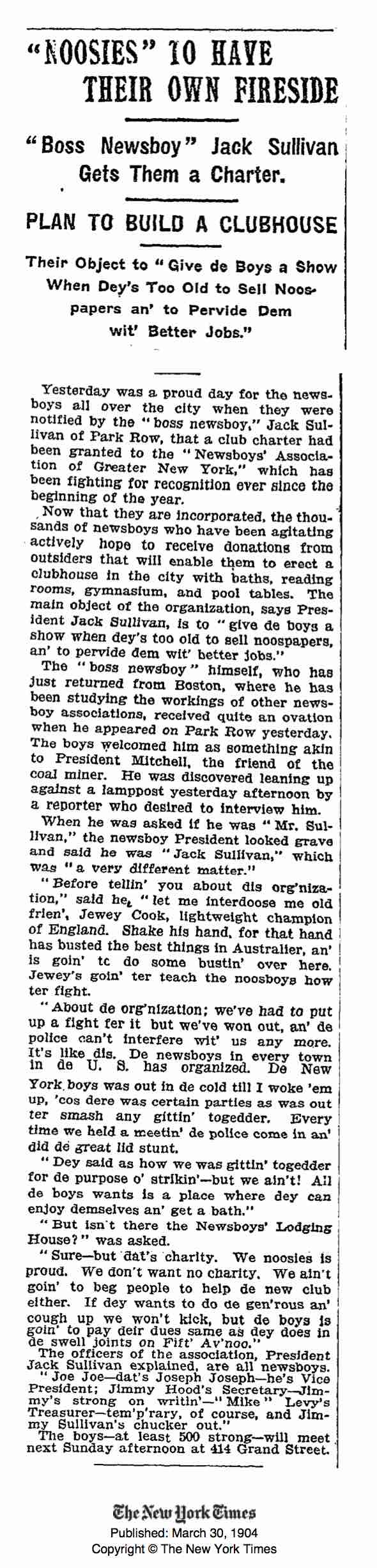
As for the movie showing Jack leaving with T. Roosevelt. it might have suited Roosevelt, but the real Jack appears to have stayed in New York, and appears to have taken a job as a bodyguard for William Randolph Hearst, one of the newspaper moguls who’d raised his rates and precipitated the strike. But it doesn’t end there. In 1904, Jack Sullivan, “the Boss Noosie” has gotten a charter for a Newsies Club to be set-up on 4th street in lower New York (the Bowery). A New York Times article (at left) includes an interview with Jack that fans should find pleasing, if only for his grammar. He uses the word, “papes” instead of papers or newspapers. I suspect this is a put-on affect for benefit of Times-readers, but who knows? It is sometimes the height of wisdom to appear stupid.

By 1909, Jack has lost control of his newsboy’s club. He appears to have used the club to teach boxing (how crude) and on at least one occasion used club assets to post bail for women accused of “loitering,” a jail-able offense in corrupt, Tammany-era New York. The club closed 2 years later. And then Jack gets married (November 27, 1910), and it appears that Jack’s real name was not Sullivan at all, but Reich. He marries Sarah Siegel at the Ohav Tzedek synagogue as “Jacob Reich”. The name Jacob Reich appears on his marriage license, on his death certificate, and on various court records, though he still appears as Jack Sullivan in other activities. Jack/ Jacob appears to have chosen the Irish-sounding name “Sullivan” as an homage to the leader of the Tammany (Democratic) machine, “Big Tim” Sullivan, shown in the photo below.

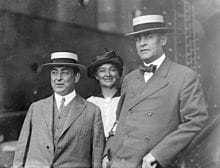
Turn of the century Tammany boss, "Big Tim" Sullivan, shown at right.

Turn of the century Tammany boss, “Big Tim” Sullivan, shown at right.

By March, 1912, Jack appears again in the news, this time suing two film companies for use of his story and likeness without payment to him. It’s a film called “the Gangsters.” It would be interesting to see if a copy still exists.

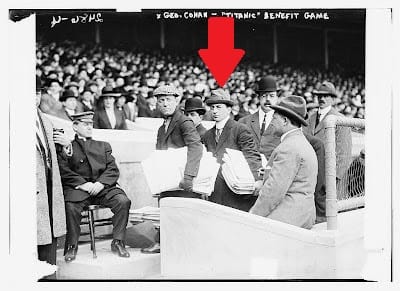
A month later, April 15, 1912, The unsinkable Titanic goes down, and six days after that, April 21, 1912, Jack is selling papers at a charity baseball game to benefit the survivors. The game takes place on a Sunday, normally prohibited by New York blue laws, between The New York Giants and The New York Yankees (the Yankees are still called the Highlanders in those days, but are already wearing pinstripes). In the picture below, Jack is under the red arrow with lots of “papes” under his arm, just behind famous song-writer, playwright, George M. Cohan. Both are dressed as newsies. George M. Cohan, known for the WWI song “Over there”, had four plays on Broadway at the time. He is one of the very few successful New Yorkers to have avoided major attachment to the crooked, New York political machine.

Jack Sullivan with George M Cohan, April 1912 selling a special newspaper to help survivors of the Titanic.

Jack Sullivan (arrow) with George M Cohan, April 1912 selling a special newspaper to help survivors of the Titanic.

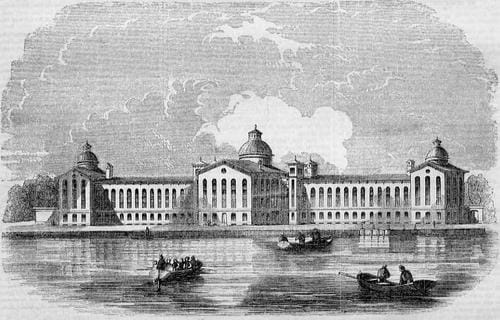
New York Refuge

The New York house of refuge

And now Jack Kelly / Sullivan/ Reich enters history as a tragic bystander. When he got married, Jack borrowed $1000, from a Jewish gambler and gambling hall owner, Herman (Beansy) Rosenthal. Rosenthal was a good friend of his, and of “Big Tim” Sullivan, but he (and Sullivan) had enemies. Among them, the crooked police Lieutenant, Charles Becker, who headed the city vice squad and delighted in shaking down the gamblers, pimps, etc for protection money. Becker wanted Rosenthal dead, in part to keep him from going to the newspapers with stories of police corruption.

By 1912, “Big Tim” lost control of the Tammany organization and was put in seclusion under Tammany guard. Within a year he’d be dead. Someone (Becker?) then hired four hit men to kill Rosenthal (1:30 AM, July 16, 1912 in front of The Metropole Hotel). It’s an event recounted in “The Great Gatsby.” Several beat-policemen were there to see the shooting, but every one looked away. Not one shot back or took the license of the car. In fact, the police did nothing to catch the murderers except to lock up the only honest witness to keep him from testifying. Before the shooting, Becker took Jack Sullivan out for an evening at Madison Square Garden; he then dropped Jack at the Metropole just before the 1:30 shooting. Becker and the police then blamed Jack and four others for the murder based on testimony that they had concocted. In the end, Jack was acquitted, but not the other four, or Becker. All five went to the electric chair; all five protested their innocence.

Becker was the first US police lieutenant to be put to death for murder. It seems unlikely that he was innocent, but was he a murderer, or just an accomplice. As for the other four, perhaps they were guilty, perhaps not; it’s hard to tell from Tammany-era records. The judge was crooked; Police chief Devery was at least as crooked as Becker in terms of shaking down hoodlums. And Devery had as much motive as Becker to want Rosenthal dead. The witnesses were lying from a script they’d been given — that’s what justice was like in those days. Within a year of the murder, Big Tim was dead and Charles Francis Murphy had gained firm control of Tammany Hall. The police spent the next decade in criminal activities while trying to pin something on Jack, now a cigar store owner. He was busted for gambling and related offenses, but nothing much came of it. Jack cleared his name from the charge of murder only in 1936, two years before his death — three years after Fiorello La Guardia was elected mayor. Republican/ Fusion candidate, La Guardia ran against Tammany and did much to end their police corruption.

As for The Refuge, The New York House of Refuge is a real place. It sat on Randal’s Island between Manhattan, The Bronx, and Queens. The Island is now famous as the center of The Triborough Bridge. There is now a park where The Refuge was. Was The Refuge run honestly? If it was, it would have been virtually the only public institutions to run that way. Tammany was corrupt to the core.

Robert E. Buxbaum, October 25, 2015. Much of the information here comes from a tumbler exchange called, “newsies historical research.” I organized it and added some background about Baseball, Tammany, etc. If you like Newsies, or the era, I can recommend the novel (and movie), The Great Gatsby, or Fiorello!, a musical version of La Guardia’s unlikely rise to power. Hearst is treated somewhat positively in Newsies, but less-so as “Citizen Kane.” If someone’s seen, or has a link to “The Gangsters” please tell me.

A prison tale (fiction) by R. E. Buxbaum

I’m writing from the Michigan Department of Corrections; Mail-stop 5678 E, Jackson, MI, awaiting trial on auto-related charges. So, legally speaking, I’m still innocent, if not quite free. So, here’s my  story, and my bargain. The whole situation, it seems, is more comical than criminal. At its source, at bottom, all I was trying to do was take care of some left over issues from unofficial jobs I was doing for the city. For his honor, the mayor. That’s K.K., Kwamie Kilpatrick, the ex-mayor to you, but always his honor to me; great guy. Anyway, cars that fall in the river aren’t that unusual in this town, and it’s not like I planned to smuggle anything to Canada. You’ll notice my case doesn’t involve theft, or injuring anyone but myself. Just trespass, though I wouldn’t mind a short prison stay if it can be arranged. Sort of like Shawshank redemption.

Anyway, my minor crime was committed a week ago, Thursday, and involved a Dodge Viper. One that I own, straight-up, with a partner and the bank: a yellow, convertible viper costing some $220,000 when new. Beautiful machine; tinted glass, and capable of doing 180 mph without breaking a sweat. I use it, or did, to take care of errands for his honor. He tips nice, and helps out when I’m in a jam, so I did get paid for the work, but for the most part, it’s like I’m like a patriot-servant to the city. I’m using my own car for city business. In better days, those errands included taking judges for the occasional joy ride, to the airport or lunch, plus other deliveries. Not generally on the water, like last Thursday, and yes that’s me, waving in the photo. Shame about the car.

As to how I got the viper, I got it at the dealer on Woodward, just over the 8 mile bridge, and paid for it mostly myself, with a loan from First Federal. At the time I had a good job running errands for his honor, as I mentioned. Now I’m so of unemployed. What sort of errands? The sort of ones you’d want to run in a viper, Duh. Aside from driving judges to meetings, there were girl errands; some boy errands; some money errands. Occasionally a disposal — nothing illegal, but embarrassing maybe. When you’re disposing of city property, you don’t look too carefully at the item. When you’re carrying something big, or someone’s wife or girlfriend, or a lot of money, it’s nice to be able to move quickly. Judges and senators like to move fast too, behind tinted windows. They still do.

Anyway, after his honor goes to prison (real shame, that), and my job becomes near-ended. There’s still some errands to to, but not so many, and I’ll grant that the viper has become more of a liability than an asset. Not that there’s insurance fraud behind me ending up in the river, just good-ole fun, and maybe a little reckless driving. I’m owing like 165k still on the machine, and my brother and I came up with this great plan for a movie — no fraud intended. There’s this great spot that we know by Zug Island, where the Rouge meets the Detroit river. It’s pretty well deserted, with a pier and a boat ramp. We used it all the time, back in the day for meetings and such. No-one goes there because of the smells. There’s always an oil slick and the water there will dissolve most anything metal. The Zug Island folks make sure of there are no cameras or loiterers either — just so no-one steals their secrets. Anyway, my brother and I figured that, if I got the viper up to about 30- 40 mph on the pier we could sail it out over the rocks and garbage into the river, land softly in the water, and make for a great movie. We never planned to file an insurance claim like we’d lost the car or it was stolen. Anyway, the water’s only about 8′ below the end of the pier, so it’s sort of like a high-dive. I figured I’d get out of the sinking car swim up to the boat ramp, and walk to my brother’s car on the street. The car would dissolve to rust in a week; the water’s pretty nasty there. He’d film the whole thing. I’d dry off; we’d drive home, have a beer or two, then sell the film. Probably pull the rust out of the river in a week, just to keep everything in it’s pure, pristine state. Though, now that I think of it, insurance might still cover most of the value of the car. You never know.

So the first part goes OK. We drive to the pier about 9:00 PM, Thursday, just as the sun’s setting. There’s that good, reddish light over the Windsor skyline, and the pier is empty. There are two winos off far from my intended route. My brother and I take down the top and line up the vehicle so I avoid unwanted bumps and garbage as I sail out on my way to glory. And, with a shot of Jack, and a wave to my brother (It’s on the film), I go shooting out down the pier and over the water. Fine. No bumps, no rocks. Nice flight. No soft landing, though. The car hits water like a pumpkin on concrete. Ouch! The thing bends in the middle sealing the door shut and me inside. There’s hardly any spring to the seats anyway, and what little there once was is lost. My back gets twisted into the steering wheel. I can barely turn and I can’t quite get out. Then, about 5 minutes later, the air bag goes off. Guess they didn’t design for this accident. My back, is now twisted into the sat-back, and I’m in pain.

I think it’s some sort of Sprite Healey fracture like Kevin Everett got last year. I can walk, thanks, but it needs medical attention that I’m not likely to get on Medicaid. Anyway, like I said, I’m trapped inside the vehicle, and suppose I’d be dead if the car sank like we planned, bit it don’t sink. The thing floats. Like, forever. The car weighs like two tons and it floats! Who knew. I’m carried by my momentum and by some random Rouge current out past Zug Island into the main channel between Detroit and Windsor where I’m almost run down by an ore boat. Anyway, the yellow metal Viper-dingy I’m in gets noticed by the boat lookout and by some fishermen, but no one helps. Everyone’s seems to think it’s really funny. They’re all taking pictures, and texting, and calling their friends. And everyone is laughing but me. It’s funny, like a fart in a space suit. Meanwhile my brother’s been driving along by the river, filming everything and hoping I get out and can somehow swim to safety, and I keep floating off to Canada. Finally, someone calls the coast guard, but when the come, it turns out I’m in Canadian waters. So the Canadians come, and they’re all think it’s a boot. I’m a celebrity with pictures of me in my car floating all over the internet. And well, here I am, a relatively innocent man, with a junked car and a bad back. And I’m ready to make a deal. I’ll admit it looks like I was planning to defraud someone, but there’s no evidence. I’ll admit to trespass if you like, but not fraud or endangerment. There was no one there to endange, and no one endangered, except of me. And I won’t press charges (little joke).

What with all the publicity, I figure you want to press more than just trespass, and what I was thinking of is reckless driving. I’ll admit to that with no contest. Looked at the right way, that’s like a 60 day sentence, maybe 90 days, and that’s just fine with me. I don’t have the cleanest record, but it’s not like I’ve done this before. I think it would be fair if I got 60 to 90-days of incarceration with medical benefits and job rehabilitation. I’d like to learn a new trade, like auto repair. That’s a win-win for everyone. You close the case, and I get cured and put my job skills to work just as soon as I get out. But I really need the medical though. My health insurance doesn’t cover injury-in-performance-of-a-crime — it’s right there on page 28. And Medicare is garbage. Next time you get insurance, your honor, make sure to read the contract.

Anyway, you have the tape and the pictures, and can check with my brother. We have plenty of people who will testify for us, even folks in congress and in the police department. They’ll all tell you, we’re just a couple of good fellows, somewhat down on our luck, waiting to get out and go straight. Thanks for your help, and God-bless.

R. E. Buxbaum. Sept 30, 2015. Some weeks ago, I wrote an essay, “What is comedy.” So I thought I’d try writing one. Tell me how you think I did. No one in the story is meant to be anyone real, except for “his honor,’ who’s meant to be a fictional version of His Honor.

Hamas head deposed, no peace in the middle east

Just about one month ago, the head of the head of Hamas in Syria was removed from his position atop Sheikh Abu Salah Taha’s shoulders. ISIS gave the Sheikh the metaphorical 72 virgins of severance, and his head was given a new post, a wooden pole. Though the fighting has died down since, as it were, we seem no closer to peace. As head of Hamas, Sheik Taha killed many, and ISIS has killed many more. And now, Hamas has pledged Jihad against ISIS, It’s likely ISIS heads will roll, as surviving Hamas members have joined Assad, their murderous enemy of just a few months previous.

Hamas head removed, Sheik Sala, presumed dead.

Hamas head deposed by ISIS. Sheik Salah presumed dead. Prediction: those who killed him will be killed. 

My sense is that bringing peace to the region will require 4 things: (1) one side must have a decisive military victory; (2) They must get the defeated leader to sign a surrender with some clear terms (3) They have to treat the defeated well enough that others will surrender too, and (4) They had to demonstrate the ability to govern. The surrender at Appomattox included all these things, as did Texas independence and the US revolution. By contrast, the history Mexican civil wars suggests that peace becomes near-impossible when you kill the losers, as ISIS has done in Syria. When Santa Ana killed the Texans who surrendered to him at the Alamo and at Goliad, he guaranteed that the Texans would fight on forever, no matter how desperate the odds.

When Santa Anna ordered the execution of all the Texans who surrendered he guaranteed that Texans would not surrender. That's not a road to peace.

When Santa Anna executed the Texans who surrendered at the Alamo and Goliad he guaranteed that Texans would not surrender. That’s not the road to peace.

Governance of any kind is a key distinction between countries and non-countries. In the Middle East, there is a tradition of governance by tyranny and partial genocide, but the rule cemented this way is tenuous at best. About 100 years ago, the Turks cemented their rule over Armenia by killing off many Armenians, and Russia did the same toward to Cossacks, but 70 years later Kasackstan seceded. Sadam Hussain, Bashar Assad, Col’nl Khadaffi, and Ayatollah Khomeini all ruled for reasonable times as murderous tyrants, but two of those ruler’s were killed and three of the kingdoms have descended into chaos. People who’ve seen war will often accept tyranny as a better alternative to chaos in the streets, but eventually they revolt. By contrast, Israel and Jordan have stayed reasonably stable by providing a degree of tolerance and justice.

In the Mid-East peace, we’ve chosen to support tyrants: Hamas and the Iranian Khomeini, even though they are murderously anti-democracy, and even though the Ayatollah has vowed to wipe us out, and even though ISIS seems to be winning. This strategy may work for us temporarily, but I suspect these leaders will fall in a few years, and leave us to deal with anger in the wake. Faced with the options available, I’d prefer to let the war take its course, and only step in when things wind down. This is what Theodore Roosevelt did with the Russo-Japanese war: he waited for it to die down, and then stepped in to make peace when asked to do so. Syria doesn’t seem ready for peace right now, but when it is, I suspect it will be better for us if we take the role of peacemaker later than if we support a losing murder now.

Robert E. Buxbaum, May 7, 2015, edited May 11. I’ve shown previously that there is no peace with zombies until there is a cure. Until then, it’s best to run. For those who don’t know it, Roosevelt was an odd dude: here he is riding a moose.