Category Archives: economics

Ocean levels down from 3000 years ago; up from 20,000 BC

In 2006 Al Gore claimed that industry was causing 2-5°C of global warming per century, and that this, in turn, would cause the oceans to rise by 8 m by 2100. Despite a record cold snap this week, and record ice levels in the antarctic, the US this week banned all incandescent light bulbs of 40W and over in an effort to stop the tragedy. This was a bad move, in my opinion, for a variety of reasons, not least because it seems the preferred replacement, compact fluorescents, produce more pollution than incandescents when you include disposal of the mercury and heavy metals they contain. And then there is the weak connection between US industry and global warming.

From the geologic record, we know that 2-5° higher temperatures have been seen without major industrial outputs of pollution. These temperatures do produce the sea level rises that Al Gore warns about. Temperatures and sea levels were higher 3200 years ago (the Trojan war period), without any significant technology. Temperatures and sea levels were also higher 1900 years ago during the Roman warming. In those days Pevensey Castle (England), shown below, was surrounded by water.

During Roman times Pevensey Castle (at right) was surrounded by water at high tide.If Al Gore is right, it will be surrounded by water again soon.

During Roman times the world was warmer, and Pevensey Castle (right) was surrounded by water;. If Al Gore is right about global warming, it will be surrounded by water again by 2100.

From a plot of sea level and global temperature, below, we see that during cooler periods the sea was much shallower than today: 140 m shallower 20,000 years ago at the end of the last ice age, for example. In those days, people could walk from Asia to Alaska. Climate, like weather appears to be cyclically chaotic. I don’t think the last ice age ended because of industry, but it is possible that industry might help the earth to warm by 2-5°C by 2100, as Gore predicts. That would raise the sea levels, assuming there is no new ice age.

Global temperatures and ocean levels rise and sink together

Global temperatures and ocean levels change by a lot; thousands of years ago.

While I doubt there is much we could stop the next ice age — it is very hard to change a chaotic cycle — trying to stop global cooling seems more worthwhile than trying to stop warming. We could survive a 2 m rise in the seas, e.g. by building dykes, but a 2° of cooling would be disastrous. It would come with a drastic reduction in crops, as during the famine year of 1814. And if the drop continued to a new ice age, that would be much worse. The last ice age included mile high glaciers that extended over all of Canada and reached to New York. Only the polar bear and saber-toothed tiger did well (here’s a Canada joke, and my saber toothed tiger sculpture).

The good news is that the current global temperature models appear to be wrongor highly over-estimated. Average global temperatures have not changed in the last 16 years, though the Chinese keep polluting the air (for some reason, Gore doesn’t mind Chinese pollution). It is true that arctic ice extent is low, but then antarctic ice is at record high levels. Perhaps it’s time to do nothing. While I don’t want more air pollution, I’d certainly re-allow US incandescent light bulbs. In cases where you don’t know otherwise, perhaps the wisest course is to do nothing.

Robert Buxbaum, January 8, 2014

A Masculinist History of the Modern World, pt. 1: Beards

Most people who’ve been in university are familiar with feminist historical analysis: the history of the world as a long process of women’s empowerment. I thought there was a need for a masculinist history of the world, too, and as this was no-shave November, I thought it should focus on the importance of face hair in the modern world. I’d like to focus this post on the importance of beards, particularly in the rise of communism and of the Republican party. I note that all the early communists and Republicans were bearded. More-so, the only bearded US presidents have been Republicans, and that their main enemies from Boss Tweed, to Castro to Ho Chi Minh, have all been bearded too. I note too, that communism and the Republican party have flourished and stagnated along with the size of their beards, with a mustache interlude of the early to mid 20th century. I’ll shave that for my next post.

Marxism and the Republican Party started at about the same time, bearded. They then grew in parallel, with each presenting a face of bold, rugged, machismo, fighting the smooth tongues and chins of the Democrats and of Victorian society,and both favoring extending the franchise to women and the oppressed through the 1800s against opposition from weak-wristed, feminine liberalism.

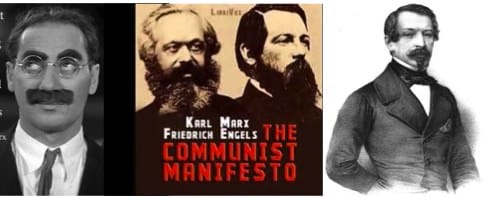
Marx and Engles (middle) wrote the Communist Manifesto in 1848, the same year that Lincoln joined the new Republican Party, and the same year that saw Louis Napoleon (right) elected in France. The communists both wear full bards, but there is something not-quite sincere in the face hair at right and left.

Marx and Engels (middle) wrote the Communist Manifesto in 1848, the same year that Lincoln joined the new Republican Party, and the same year that saw Louis Napoleon (right) elected in France. The communists both wear full bards, but there is something not-quite sincere in the face hair at right and left.

Karl Marx (above, center left, not Groucho, left) founded the Communist League with Friedrich Engels, center right, in 1847 and wrote the communist manifesto a year later, in 1848. In 1848, too, Louis Napoleon would be elected, and the same year 1848 the anti-slavery free-soil party formed, made up of Whigs and Democrats who opposed extending slavery to the free soil of the western US. By 1856 the Free soils party had collapsed, along with the communist league. The core of the free soils formed the anti-slavery Republican party and chose as their candidate, bearded explorer John C. Fremont under the motto, “Free soil, free silver, free men.” For the next century, virtually all Republican presidential candidates would have face hair.

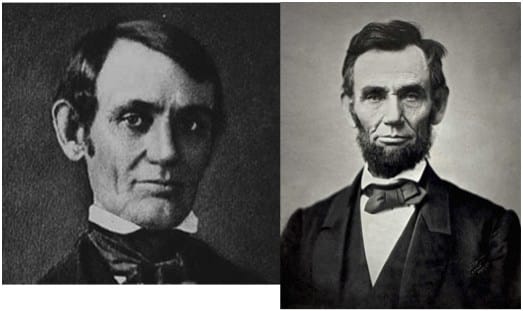
Lincoln the Whig had no beard -- he was the western representative of the party of Eastern elites. Lincoln the Republican grew whiskers. He was a log-cabin frontiersman, rail -splitter.

Lincoln, the Whig, had no beard — he was the western representative of the party of eastern elites. Lincoln, the Republican, grew whiskers. He was now a log-cabin frontiersman, rail-splitter.

In Europe, revolution was in the air: the battle of the barricades against clean-chined, Louis Napoleon. Marx (Karl) writes his first political economic work, the Critique of Political Economy, in 1857 presenting a theory of freedom by work value. The political economic solution of slavery: abolish property. Lincoln debates Douglas and begins a run for president while still clean-shaven. While Mr. Lincoln did not know about Karl Marx, Marx knew about Lincoln. In the 1850s and 60s he was employed as a correspondent  for the International Herald Tribune, writing about American politics, in particular about the American struggle with slavery and inflation/ deflation cycles.

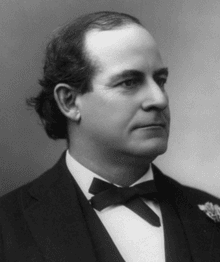
William Jennings Bryan, 3 time Democrat presidential candidate, opponent of alcohol, evolution, and face hair.

William Jennings Bryan was three-times the Democratic presidential candidate; more often than anyone else. He opposed alcohol, gambling, big banks, intervention abroad, monopoly business, teaching evolution, and gold — but he supported the KKK, and unlike most Democrats, women’s suffrage.

As time passed, bearded frontier Republicans would fight against the corruption of Tammany Hall, and the offense to freedom presented by prohibition, anti industry sentiment, and anti gambling laws. Against them, clean-shaven Democrat elites could claim they were only trying to take care of a weak-willed population that needed their help. The Communists would gain power in Russia, China, and Vietnam fighting against elites too, not only in their own countries but American and British elites who (they felt) were keeping them down by a sort of mommy imperialism.

In the US, moderate Republicans (with mustaches) would try to show a gentler side to this imperialism, while fighting against Democrat isolationism. Mustached Communists would also present a gentler imperialism by helping communist candidates in Europe, Cuba, and the far east. But each was heading toward a synthesis of ideas. The republicans embraced (eventually) the minimum wage and social security. Communists embraced (eventually) some limited amount of capitalism as a way to fight starvation. In my life-time, the Republicans could win elections by claiming to fight communism, and communists could brand Republicans as “crazy war-mongers”, but the bureaucrats running things were more alike than different. When the bureaucrats sat down together, it was as in Animal Farm, you could look from one to the other and hardly see any difference.

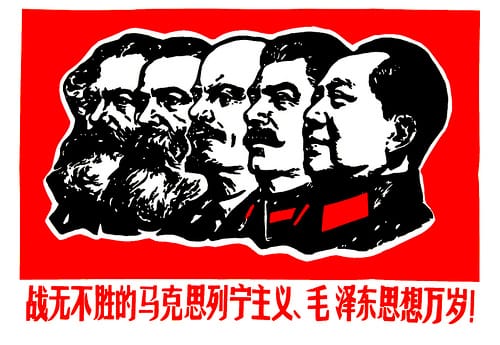
The history of Communism seen as a decline in face hair. The long march from the beard to the bare.

The history of Communism seen as a decline in face hair. The long march from the beard to the bare. From rugged individualism to mommy state socialism. Where do we go from here?

Today both movements provide just the barest opposition to the Democratic Party in the US, and to bureaucratic socialism in China and the former Soviet Union. All politicians oppose alcohol, drugs, and gambling, at least officially; all oppose laser faire, monopoly business and the gold standard in favor of government created competition and (semi-controlled) inflation. All oppose wide-open immigration, and interventionism (the Republicans and Communists a little less). Whoever is in power, it seems the beardless, mommy conservatism of William Jennings Bryan has won. Most people are happy with the state providing our needs, and protecting our morals. is this to be the permanent state of the world? There is no obvious opposition to the mommy state. But without opposition won’t these socialist elites become more and more oppressive? I propose a bold answer, not one cut from the old cloth; the old paradigms are dead. The new opposition must sprout from the bare chin that is the new normal. Behold the new breed of beard.

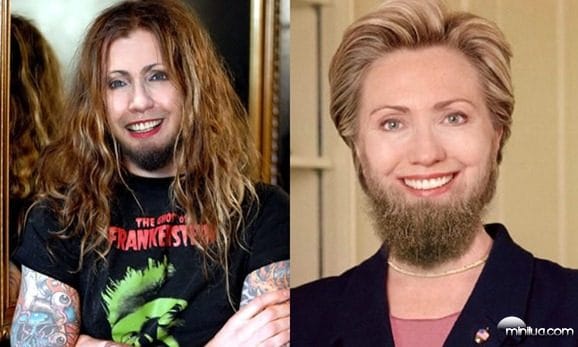
The future opposition must grow from the barren ground of the new normal.

The future opposition must grow from the barren ground of the new normal. Another random thought on the political implications of no-shave November.

by Robert E. Buxbaum, No Shave, November 15, 2013. Keep watch for part 2 in this horrible (tongue in) cheek series: World War 2: Big mustache vs little mustache. See also: Roosevelt: a man, a moose, a mustache, and The surrealism of Salvador: man on a mustache.


An Aesthetic of Mechanical Strength

Back when I taught materials science to chemical engineers, I used the following poem to teach my aesthetic for the strength target for product design:

The secret to design, as the parson explained, is that the weakest part must withstand the strain. And if that part is to withstand the test, then it must be made as strong as all the rest. (by R.E. Buxbaum, based on “The Wonderful, One-hoss Shay, by Oliver Wendell Holmes, 1858).

My thought was, if my students had no idea what good mechanical design looked like, they’d never  be able to it well. I wanted them to realize that there is always a weakest part of any device or process for every type of failure. Good design accepts this and designs everything else around it. You make sure that the device will fail at a part of your choosing, when it fails, preferably one that you can repair easily and cheaply (a fuse, or a door hinge), and which doesn’t cause too much mayhem when it fails. Once this failure part is chosen and in place, I taught that the rest should be stronger, but there is no point in making any other part of that failure chain significantly stronger than the weakest link. Thus for example, once you’ve decided to use a fuse of a certain amperage, there is no point in making the rest of the wiring take more than 2-3 times the amperage of the fuse.

This is an aesthetic argument, of course, but it’s important for a person to know what good work looks like (to me, and perhaps to the student) — beyond just by compliments from the boss or grades from me. Some day, I’ll be gone, and the boss won’t be looking. There are other design issues too: If you don’t know what the failure point is, make a prototype and test it to failure, and if you don’t like what you see, remodel accordingly. If you like the point of failure but decide you really want to make the device stronger or more robust, be aware that this may involve strengthening that part only, or strengthening the entire chain of parts so they are as failure resistant as this part (the former is cheaper).

I also wanted to teach that there are many failure chains to look out for: many ways that things can wrong beyond breaking. Check for failure by fire, melting, explosion, smell, shock, rust, and even color change. Color change should not be ignored, BTW; there are many products that people won’t use as soon as they look bad (cars, for example). Make sure that each failure chain has it’s own known, chosen weak link. In a car, the paint on a car should fade, chip, or peel some (small) time before the metal underneath starts rusting or sagging (at least that’s my aesthetic). And in the DuPont gun-powder mill below, one wall should be weaker so that the walls should blow outward the right way (away from traffic).Be aware that human error is the most common failure mode: design to make things acceptably idiot-proof.

Dupont powder mills had a thinner wall and a stronger wall so that, if there were an explosion it would blow out towards the river. This mill has a second wall to protect workers. The thinner wall should be barely strong enough to stand up to wind and rain; the stronger walls should stand up to explosions that blow out the other wall.

Dupont powder mills had a thinner wall and a stronger wall so that, if there were an explosion, it would blow out ‘safely.’ This mill has a second wall to protect workers. The thinner wall must be strong enough to stand up to wind and rain; the stronger walls should stand up to all likely explosions.

Related to my aesthetic of mechanical strength, I tried to teach an aesthetic of cost, weight, appearance, and green: Choose materials that are cheaper, rather than more expensive; use less weight rather than more if both ways worked equally well. Use materials that look better if you’ve got the choice, and use recyclable materials. These all derive from the well-known axiom, omit needless stuff. Or, as William of Occam put it, “Entia non sunt multiplicanda sine necessitate.” As an aside, I’ve found that, when engineers use Latin, we look smart: “lingua bona lingua motua est.” (a good language is a dead language) — it’s the same with quoting 19th century poets, BTW: dead 19th century poets are far better than undead ones, but I digress.

Use of recyclable materials gets you out of lots of problems relative to materials that must be disposed of. E.g. if you use aluminum insulation (recyclable) instead of ceramic fiber, you will have an easier time getting rid of the scrap. As a result, you are not as likely to expose your workers (or you) to mesothelioma, or similar disease. You should not have to pay someone to haul away excess or damaged product; a scraper will oblige, and he may even pay you for it if you have enough. Recycling helps cash flow with decommissioning too, when money is tight. It’s better to find your $1 worth of scrap is now worth $2 instead of discovering that your $1 worth of garbage now costs $2 to haul away. By the way, most heat loss is from black body radiation, so aluminum foil may actually work better than ceramics of the same thermal conductivity.

Buildings can be recycled too. Buy them and sell them as needed. Shipping containers make for great lab buildings because they are cheap, strong, and movable. You can sell them off-site when you’re done. We have a shipping container lab building, and a shipping container storage building — both worth more now than when I bought them. They are also rather attractive with our advertising on them — attractive according to my design aesthetic. Here’s an insight into why chemical engineers earn more than chemists; and insight into the difference between mechanical engineering and civil engineering. Here’s an architecture aesthetic. Here’s one about the scientific method.

Robert E. Buxbaum, October 31, 2013