Author Archives: R.E. Buxbaum

About R.E. Buxbaum

Robert Buxbaum is a life-long engineer, a product of New York's Brooklyn Technical High School, New York's Cooper Union to Science and Art, and Princeton University where he got a PhD in Chemical Engineering. From 1981 to 1991 he was a professor of Chemical Engineering at Michigan State, and now runs an engineering shop in Oak Park, outside of Detroit, Michigan. REB Research manufactures and sells hydrogen generation and purification equipment. He's married with 3 wonderful children who, he's told, would prefer to not be mentioned except by way of complete, unadulterated compliments. As of 2016, he's running to be the drain commissioner/ water resources commissioner of Oakland county.

Michigan tax wrongs righted

This month, at last, the Michigan legislature began to take seriously the job of correcting some tax wrongs that needed correcting for years. The most important change: they decreased the tax on business property (only by 10% but it’s a start) and shifted the burden to a tax on business profit.

The personal property tax was paid on any equipment, inventory, or supplies that a business kept in-house. No matter if their were sales or none, a tax was due so long as a business had equipment or unsold inventory. Even in years where there were no profits or sales, money was due to the state — a tax on your dreams of somehow making a go of things. Aside from its complexity of valuing your unused supplies and inventory, the tax guaranteed that struggling businesses would fail — immediately. The governor (Granholm – glad she’s gone) claimed that taxing unused equipment and inventory protected the state coffers from the ups and downs of the business cycle, but the state was is far better shape than a struggling business when it came to the cost of borrowing. Besides, I’m not sure she was doing Michigan any favors by destroying businesses that were barely hanging on.

Governor Granholm (thank G-d she’s gone) gave out the money she collected to the right sort of people, her friends, and to targeted businesses that she liked: e.g. movie makers who made money-losing, dystopian films and left as soon as the checks cashed. The current governor, Snyder claims his aim is to eliminate the business property tax in 10 years, 10% at a time. I hope, we’ll see.

Another tax that’s now gone, at last, is the 0.8% on transactions between businesses. It wasn’t an unfair tax like the property tax, but was annoying to keep track of. What a mess. Keep up the good work, lads. Now if only they can do something about Detroit’s uncommonly high minimum wage.

Robert Buxbaum, November 20, 2012
Big new hydrogen purifier ships

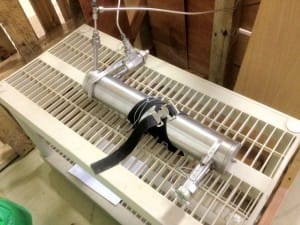
We shipped out our largest hydrogen purifier to date on Thursday, one designed for use in hydrogen-powered airplanes. I’m pretty happy; lots of throughput, light weight, low pressure drop, quite durable. We had a pizza party Friday to celebrate(if we didn’t invite you, sorry). I’m already working on design improvements (lessons learned) in case we get another order, or another, similar customer. I think we could do even better in our next version.

Largest hydrogen purifier to date pressure test

Here is our latest hydrogen purifier to date being pressure tested. Output is 650 slpm; that’s 40 m3/hr, 3.5 kg/hr. The device is tied down for burst-pressure testing behind a blast fort, just in case the thing bursts during tests. So far, no failures, no leaks. I sure hope the customer pays.

here's our largest H2 purifier being burst-pressure tested

here’s our largest H2 purifier being burst-pressure tested

The universe is not endless

You may have heard that the universe is not endless, ending at a brick wall, perhaps, some 15 billion light years out. But what you may not know is that this understanding is backed by a classic proof, going back to the middle ages. What follows is that proof.

Consider an endless universe with a fairly uniform distribution of stars. In any large-enough volume of this universe we expect to find many stars, e.g. in the spherical shell between 100 and 101 trillion miles from earth. At this distance, each of these stars is close enough to see individually; the combination of them (the sum in this volumetric shell) sheds a small amount of heat on the earth. Now consider another shell, the same thickness but twice as far from us, that is between 200 and 201 trillion miles from earth. If the universe is uniform, there will be 4 times as many stars in this shell, but since these stars are twice the distance from us, each star will present us with ¼ as much heat. Now, with 4 times the stars, the total effect is to radiate as much heat to us as from the first shell.

The same argument goes for each spherical shell of this 1 trillion miles thickness: each one presents us with the same amount of heat. If the universe is infinite and uniform, we find there will be an infinite number of shells radiating this amount of heat, and therefore an infinite amount of heat bathing us. We should expect to roast from all of it. Since we have not roasted, we conclude that the universe is not an endless, uniform expanse.

Based on this proof, the universe could be uniform, but only if it’s not endless. It could end with a brick wall, as in the Hitch-hikers guide. Alternately, the universe could have an end because it’s expanding from a big bang. This latter is suggested by the observed red shift showing that stars far from us move away faster in proportion to their distance. I’d expect this to be a favored answer of creationists because a point of creation suggests a creator. Creationists hate this finding, and dismiss the data too because the observed redshift suggests creation happened 15 Billion years ago. Atheists, needless to say, hate this “Big Bang” explanation.

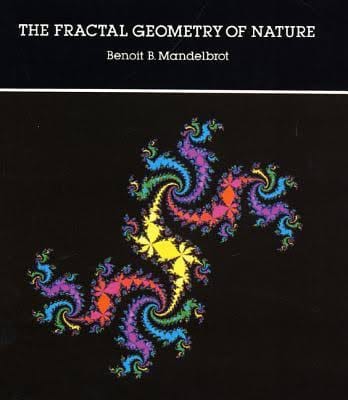
Book: Fractals in Nature by Mandelbrot

The mathematician Bernard B Mandelbrot noticed that much of nature has a distribution that scaled by fractional dimensional, like 2.5

Another thought, more acceptable to atheists, is that the universe is a closed, oscillating four dimensional hypersphere, where time is oscillating along with space. Einstein liked this view, but never fleshed it out, perhaps because there was no way for this expansion to bounce in, and periodically reverse time and entropy.

A fairly recent view that I like is that the universe could be fractal in distribution. (Mandelbrot). It isn’t clear how the universe got that way, or how it fits with the observed redshift, but it easily allows for a universe that isn’t endless nor possessing a clear limit, a last star as it were. It also provides a uniform/ non-uniform model of mass distribution. Besides, this matches much of nature. As it turns out to be fractal. Chaos of this sort is sort of God’s fingerprint.

For another unsolved cosmological question, consider why are there stable galactic arms, see here. Robert Buxbaum, October 22, 2012.

New hydrogen generator for gas chromatography etc.

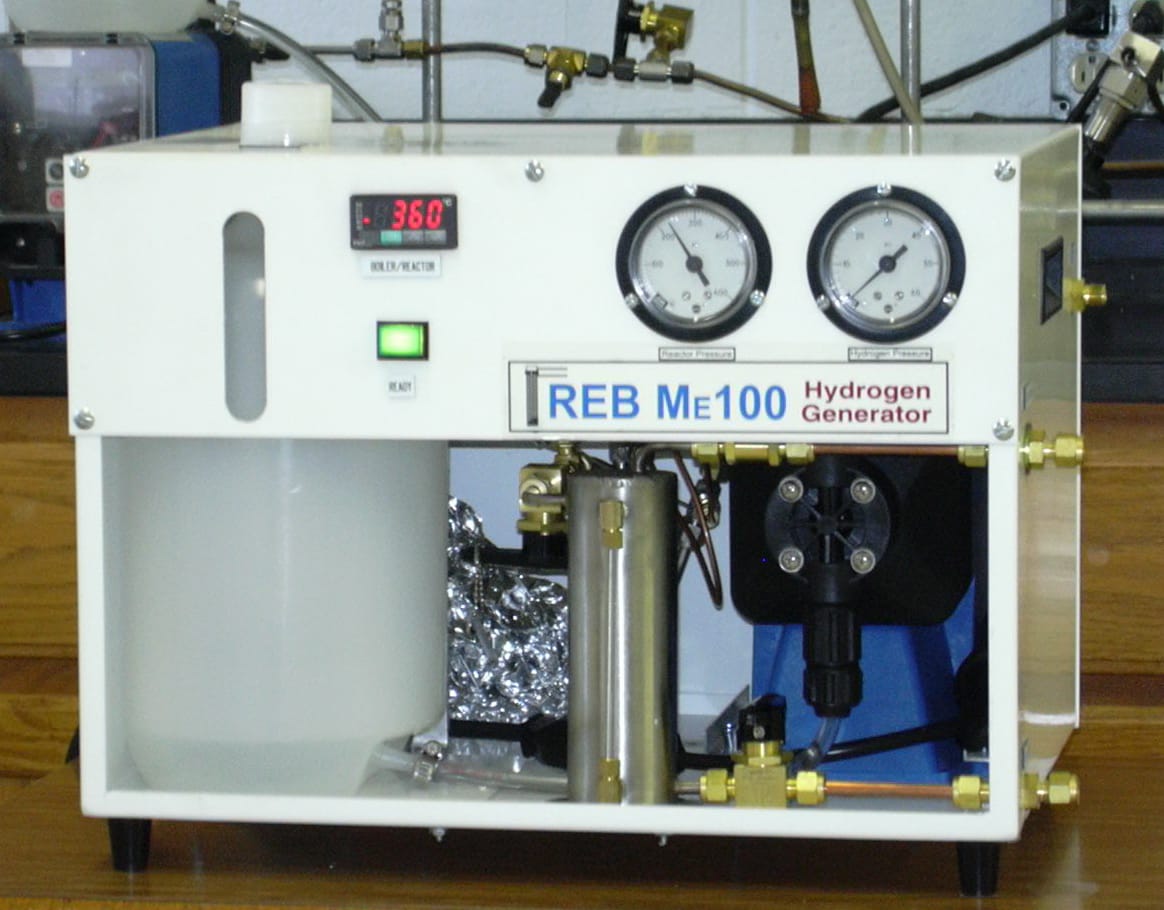
Shown below is our latest product: a hydrogen generator, designed to provide carrier and flame gas for gas chromatography, and small industrial use. It outputs hydrogen at up to 90 psi, while not a high pressure, it’s higher than any other H2 generator in the GC space. The purity is greater than available with electrolysis, 99.99995%, good enough to be used as the carrier gas, and there is not desiccant to use up. Fairly low price too.http://www.rebresearch.com/
hydrogen generator

Me100 Hydrogen Generator

The hydrogen is made from methanol-water reforming in a membrane reactor, with a palladium membrane to purify the H2. It’s a small chemical plant. You can still adjust things, but we closed up the front a bit, so folks don’t stick their fingers where they don’t belong. There’s also a semi-transpartent tank so you have a decent idea of the liquid level. The use of the membrane reactor reduces energy use, and the metal membrane is why our hydrogen is purer. Our competition, (Porter, etc) uses only a desiccant.
Robert Buxbaum

Why tornadoes and hurricanes lift up cars, cows, etc.

Here’s a video I made for my nieces and any other young adults on why it is that tornadoes and hurricanes lift stuff up. It’s all centrifugal forces — the same forces that generate the low pressure zone at the center of hurricanes. The explanation is from Albert Einstein, who goes on show why it is that rivers don’t run straight; before you read any more of it, I’d suggest you first watch the video here. It’s from my Facebook page, so it should be visible.

If can’t see, you may have to friend me on Facebook, but until then the video shows a glass coffee cup with some coffee grounds and water in it. Originally, the grounds are at the bottom of the cup showing that they are heavier than the water. When I swirl the water in the cup, you’ll see that the grounds are lifted up into a heap in the center with some flowing all around in a circle — to the top surface and then to the walls of the cup. This is the same path followed by light things (papers for example) in a tornado. Cows, houses and cars that are caught up in real tornadoes get sucked in and lifted up too, but they never get to the top to be thrown outward.

The explanation for the lifting is that the upper layers of liquid swirl faster than the lower layers. As a result there is a low pressure zone above the middle of the swirl. The water (or air) moves upward into this lower pressure area and drags along with it cows, cars, houses and the like (Here’s another post on the subject of where the swirl comes from). The reason the swirl is faster above the bottom of the cup is that the cup bottom adds drag to the flow (the very bottom isn’t swirling at all). The faster rotating, upper flows have a reasonable amount of centrifugal force and thus a lower pressure in the middle of the swirl, and a higher pressure further out. The non-rotating bottom has a more uniform pressure that’s relatively higher in the middle, and relatively lower on the outside. As a result there is a secondary flow where air moves down around the outside of the flow and up in the middle. You can see this secondary flow in the video by following the lighter grounds.

Robert. E. Buxbaum. Weather is not exactly climate, but in my opinion both are cyclic and chaotic. I find there is little evidence that we can stop climate change, and suspect there is no advantage to wanting the earth colder. There was a tornado drought in 2013, and a hurricane draught too. You may not have heard of either because it’s hard to report on the storms that didn’t happen.

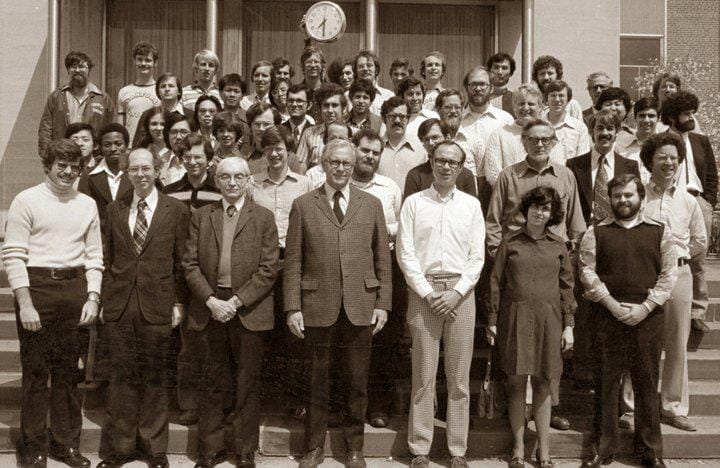
Here are the Princeton PhD group of 1980. I’m the hairy bearded fellow at right who’s looking the wrong way. My thesis advisor, Ernest Johnson is the suited fellow just left of center. Dave Ollis is in front of me, and Joe Calo is in front of him, etc. Visit my Facebook page to see how my friends tagged themselves. 35 years ago!
Princeton Chemical Engineering Grad-students, late 1970s. My thesis advisor is the tall fellow at center; I'm the bearded fellow at right looking the wrong way.

Princeton Chemical Engineering Grad-students, late 1970s. My thesis advisor is the tall fellow at center; I’m the bearded fellow at right looking the wrong way.

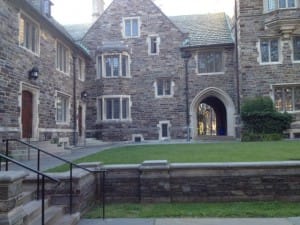
The dining room, and my room at the Princeton Grad College.

I took these pictures at reunions this year 2012; the first shot is the dining room at the Princeton Grad college. They favored robes for formal dinners when I started; the fellows in white are waiters– and we had stewards to help clean up our rooms. (Mine knew Einstein). The second photo shows the courtyard looking towards two of my dorm rooms. One year I was in the second floor room at left with the bay window. One year in the second floor room at upper right (barely visible).

GC dining 2 my dormroom

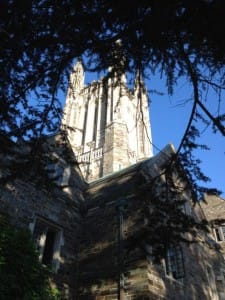
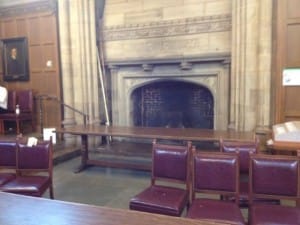
And here is the Grad Tower — Otherwise known as “Cleveland Tower” to honor Princeton alumnus, Grover Cleveland, and here’s the fireplace in the dining room. Reminds one of The School of Witchcraft and Wizardry, in that book by JK Rowling– Boar-scabs, I think. The motto: bonus entra, melior exi: good coming, better leaving.

Grad tower  GC dining fireplace

Here’s my PhD class; at first glance, you would not think we belong.

Robert Buxbaum, June, 2012