Tag Archives: war

The British Exit from Afghanistan, and ours

As bad as our exit from Afghanistan has been, the slow British exit in the 1840s to 1920 was worse. While we lost a lot of stuff and left hundreds of Americans and contractors behind, the British, in their first try at leaving, lost a whole army including thousands of civilians. Then they returned and left repeatedly for 80 years, having to fight against their own weapons and people that they had trained. We did many of the same things the Brits did, like trusting our security to folks we’d been trying to kill, but we have not lost anywhere near as many people (yet) and we have not returned (yet). What follows is a look at the British exit, based mostly on Wikipedia articles: “The First Afghan War“, and the retreat from Kabul, 1842, and the biographies of Shah Shujah and Akbar Khan, pictures below.
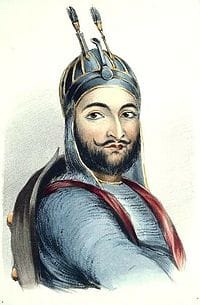
Akbar Khan. The British tried to kill him, then negotiated with him. Sketch by Vincent Eyre
Britain’s Puppet King, Shah Shujah, Sketch by Vincent Eyre.

The British went into Afghanistan, as we did, to create a more stable and western-friendly government. Their first act was to remove the king, Mohammed Khan, and install a more pliant leader, Sultan Shujah. Mohammed was part of the Khanate, that is the Moguls (Mongols), a deadly violent group who the British were fighting in India. We did the same when we entered Afghanistan. We removed the elected president, Burhanuddin Rabbani, a “radical Moslem” associated with the Taliban leader, Mohammed Omar, an even more radical moslem. Omar was associated Osama bin Laden who’d attacked the US on 9-11. We replaced these, long-bearded Moslems with Hamid Karzai, a moderate Moslem: short beard, reasonably popular, US-friendly, elected in Bonn, Germany. The problem with Shah Shujah and Hamid Karzai is neither one had legitimacy in the eyes of the people, nor respect from the army, either. In part that’s because we put them in power and kept them there, in part that’s because we never let them lead in war or diplomacy. Our follow-on leader, Ashraf Ghani, had no beard, and even less legitimacy and respect. The Afghan army left Ghani as soon as we started leaving; they’d done the same to Shah Shujah when the British left in 1842.
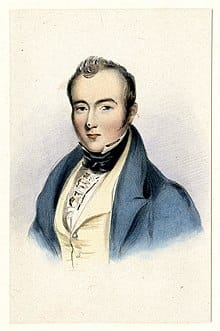
William Macnaughten, the British Envoy, prison sketch by Vincent Eyre, the same fellow who sketched Akbar and Shujah above.

Shah Shujah had a habit of mutilating those who worked for him whenever he got upset. All of Shujah’s servants were missing ears or noses or testicles. Strangely, this seems to have given him more legitimacy than Ghani had. Perhaps if we allowed our leaders to lead, or at least mutilate, the army would have stayed loyal. Then again, maybe nothing would have prevented the puppet from collapsing when the puppet-master left. Both we and the Brits relied on our own troops to keep the peace, along with payoffs and occasional assassinations (we call those airstrikes). It worked for a time, but did not build loyalty or love.

Among those the British paid off and occasionally tried to kill was Akbar Khan, the son of imprisoned Mohammed Khan. Eventually, the British felt they needed Akbar’s help to protect their exit, as he controlled the hills around Kabul including the old Silk Road that the British hoped to travel. Similarly, in the end, we found we needed Taliban help to clear the road to the airport. We didn’t quite get the help, nor did the Brits.

On December 23, 1841, the British envoy, William Macnaughten, visited Akbar Khan and proposed that he would hand over Shah Shujah and make him king in return for safe passage for 16,500 people under General Keith Elphinstone on a journey from Kabul to fort Jalalabad: 93 miles due east. Akbar agreed, but had Macnoughton arrested and later killed. His body was hung in the bazaar. Akbar seems to have figured that anyone willing to betray his old friend would be likely to betray him as well.
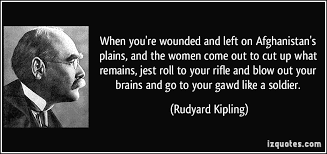
Kipling was stationed in India, near the Afghan border. His view of the locals is rather gruesome.

General Elphinstone left Kabulon January 5, 1842 with 4,500 armed soldiers, several cannon, and 12,000+ unarmed civilians. The going was slow and supplies didn’t arrive. Five days later, January 10, allies of Akbar attacked in the hills and killed or captured most of the group. Akbar invited Elphinstone to tea the next day and announced that the group was now his prisoner. He offered safe passage for the women and children, but demanded payment. The alternative was that they freeze in the hills. Elphinstone, at first refused, then ransomed himself and others, in all nine people. The rest of the group were shot, stabbed, taken by the Afghanis to be wives, or stripped of clothing and left to freeze. Younger children were raised as Afghanis, only identified as British sixty or more years later– the British liked to pretend they had not left them. Of the rest, only two survived. One soldier, William Brydon made it to Jalalabad, January 13, 1842. Elphinstone died in captivity in Kabul, April, 1842. According to Kipling’s poem, the Afghanis mutilated British bodies. More likely it was animals.

Hamid Karzai, American supported President, now under house arrest.

The British re-invaded Kabul several times after that, each time hoping to free captives and show who’s boss. There followed a second Anglo Afghan war (1878-80) and third (1919-20), and arguably a fourth (2001-21). Our exit isn’t as bad, at least not yet. We’ve left behind 200-300 Americans plus hundreds of helicopters, trucks, and high-tech weapons. The Taliban are now in charge, folks we’d tried to kill, all of them were associated with Omar, and several with Osama bin Laden, too. Our security forces have been shot, the embassy translator is scheduled to be beheaded, the new government includes several senior members who had been detained at Guantánamo Bay, released to Qatar in a prisoner swap for Bowe Bergdahl in 2014. Hamid Karzai is in captivity, and we’ve taken 100,000 Afghanis who may not integrate well into US society. But at lest there is no sign we’re going back, not for Karzai, or the Americans, or for anyone else. It’s very bad, but it could be worse. Biden calls it a success. Compared to the British exit, it is so far.

Robert Buxbaum, Sept. 5, 2021. IMHO beards are associated with commitment.

Wilsonian Obama vs the Trump Doctrine

As best I see it, Obama’s approach to world peace was a version of Woodrow Wilson’s: he consistently supported left-leaning, popular groups and governments, even when they were anti-American over pro-American kings, generals, and dictators. Obama heaped money and praise on elected leaders of Iran and the Palestinian Authority, while condemning Israel, and encouraging Democrats to walk out of a speech its PM. He then sent a statement to be read on the floor of congress that the Israeli PM  had nothing to say. Similarly, Obama refused to negotiate with Kim Jung Un of North Korea, a dictator in his eyes, but he had no problem with Raul Castro. Leftists, in his view, were for the masses, and thus democratic. Such democrats were on the side of the angels in his view, though Castro’s Cuba was not exactly free.

The co-head of the Democratic Party wears a shirt that reads "I don't believe in borders." It's a Moslem Brotherhood slogan. They do not believe in borders between Gaza and Israel, but do believe in them between Yemen and Saudi Arabia.

The co-head of the Democratic Party wears a shirt that reads “I don’t believe in borders.” It’s a globalist slogan, a Moslem Brotherhood slogan. The Trump doctrine requires boundaries between ‘turf.”

One of the most popular, if violent groups on the world stage was (is) the Moslem Brotherhood. A few months after becoming president, he gave his first foreign speech at Cairo University,  making the Wilsonian request to include the Brotherhood here and in all further negotiations. The Moslem Brotherhood was anti-American and left leaning, and they favored elections. On the other hand, they had assassinated Egyptian president Anwar el-Sadat and Egyptian prime minister Mohammad Pasha just a few years previous. They had also tried to overthrow the government of Egypt and Jordan by force, and had tried to assassinate Egyptian president Nasser and Jordan’s kings Abdullah and Hussein, unsuccessfully. Including the Brotherhood was symptomatic of a general problem of Wilsonian diplomacy; it provides no good way to tell the good guys from the bad without putting them in power. Some hints: the Brotherhood afforded no rights to women or gays; they had no clear distinctions from Hezbollah, Hamas, or Al Qaeda; and they were anti-American and anti Israel to the extent that they shouted death to both.

Even though the Moslem Brotherhood was Sunni-Moslem, a fair number in the mid-east cane to claim that Obama had included them because he was a Shiite Moslem, and just using them to overthrow more-stable Sunni governments of Egypt, Jordan, Turkey, and Saudi Arabia. Here’s a bit from an Iraqi MP, and from Saudi TV making this claim. Here too is a joke about Sunni and Shia to help you keep the two groups straight. Whatever his motivation, the outcome was the so-called Arab Spring (2011) uprisings that overthrew pro-American regimes in Egypt, Algeria, Tunisia and Turkey. It also brought the end of a free press in Turkey, and trouble for pro-American regimes in Bahrain, UAE, and Saudi Arabia. After the Brotherhood murdered the American ambassador in Libya and his (few) US guards, Obama blamed the death on some Jewish film-makers. My sense is that Obama was unwilling to believe that a fellow leftist of the Brotherhood would lie to him and murder our ambassador just to get at billions of dollars of Libya’s oil.

Trump, his daughter, el Sisi, and the King of Saudi Arabia. No Emir of Qatar.

Trump, Melania, the King of Saudi Arabia, and  el-Sisi of Egypt at a meeting in Riyadh with other friendly leaders; no Emir of Qatar, no Muslim Brotherhood.

Wilson lived to see the Mid-east parts of his 14 points lead to disaster in country after country (those were points V, XI, and XII for the Woody Woo fans). Obama similarly backed Kurdish and Hezbollah “moderates” only to see them turn sides and fight one another, or fight against our ally Turkey, or join together and form ISIS. He backed Palestinians in Gaza too, and saw them murder gays and suspected traitors on TV. He supported “moderate” Turkey, and found his Turkish allies killing his Kurds. Obama fueled a murderous tribal war, like Wilson had done, based on the best of intentions, and an American naiveté about how the world works.

Closer to home, at the very end of Obama’s presidency, he ended the registry of the National Security Entry-Exit System (NSEERS) intended to track terrorists. He closed this border program because it was racist in his view. Most of the illegals caught were Moslems or brown-skinned. Republicans seem to agree that a border-security program like this is problematic, especially where children are involved, but they claim it is better than letting in terrorists, or criminals, or the occasional human trafficker. Lacking anyone with a better answer, they elected Donald Trump, a man who claimed he’d bring peace by building a wall.

Trump made his first mideast speech in Saudi Arabia, but unlike Obama, he invited only pro-American, authoritarian leaders. He left out the Muslim Brotherhood and the rulers of any “republican” government that chanted “Death to America.” Trump announced that the US will not dictate how leaders should run their countries, or how people in these countries should live. Instead, we would be a friend to our friends, and that we would mediate disputes where necessary and helpful. There was also a threat against “bad guys” understood to be the enemies of America.

This “Trump doctrine” seems (to me) to have been borrowed from Charles (Lucky) Luciano, a New York mob boss who kept peace between the various mob families of New York and New Jersey by keeping the territories separate and clear (similar to Trump’s wall). Luciano allowed the various family heads to do what they wanted on their own turf, and offered to mediate disputes (see the similarity?). He also treated to hit those who hit him, and he took no guff. So far, Trump’s version of this seems to be working. The mideast is far calmer than when Obama was president, perhaps because its leaders understand Trump better, and Trump may have negotiated an end to the Korean war. Wilsonian Democrats (Obama) claimed that you can’t negotiate with a murderous thug like Kim Jung Un, but Trump has no problem — they both like walls. Besides, Trump points out that the alternative is nuclear war.

I suspect that Trump is hated by the Europeans is the comparison with Obama. Obama spent our money liberally, on them and on their issues, while Trump does not. A thought: if the Europeans think a president is spending enough, he's spending too much.

Obama spent our money liberally on the Europeans while Trump does not. A thought: if the Europeans think you spend enough, you’re spending too much.

How does Trump hit back? For one, he refuses to serve as free protector for those who can defend themselves. Trump has threatened Germany saying they must pay for their own defense, and has cut funding to the UN Human Rights commission and the Paris climate council, groups he considers pointless or worse. More recently, he ended Obama’s constraints on natural gas exploration and exports. In 2017 US gas exports rose by $4B, a factor of four from 2016, dramatically lowering the price of natural gas on the open market. Several oil nations were hit by this including Qatar the main gas exporter in 2014 (Russia is now) and a main funder of Al Jazeera, and of Al Qaeda, Hezbollah, and Hamas.

Robert Buxbaum, June 26, 2018. I’ve never understood why people expect Marxist leaders to be peaceful. Marx himself claims that the mode of production determines a country’s social, political and intellectual life. A leader hoping to control the latter must control the former with a war-like ferocity if he’s to be a Marxist, and even the most milk-toast Marxists have done so.

Cornwallis attacks. Washington goes to Princeton.

In the previous post, I asked what you would do as a general (Cornwallis), December 27, 1776. You command 30,000 troops, some 12,000 at Princeton of at total 50,000 against Washington’s 3500. Washington is camped 12 miles to the south just outside of Trenton with a majority of his men scheduled to leave in three days when their enlistments expire.

In fact, what Cornwallis did, is what every commenter recommended. He attacked at Trenton, and lost New Jersey. Cornwallis left 2-3000 troops at Princeton and marched south. Despite fallen trees, swollen rivers, destroyed bridges — all courtesy of Washington’s men –Cornwallis reached Trenton and attacked. By the time he got there, 2000 of Washington’s men had left, partially replaced by untrained militia. After a skirmish, Washington set up 400 militia to keep the fires burning, and without telling them where he was going “Fall back if the British attack”, he took the rest of his forces east, across frozen fields and swampland, then north to Princeton along the Quaker-bridge road. He later said the reason was to avoid looking like a retreat.

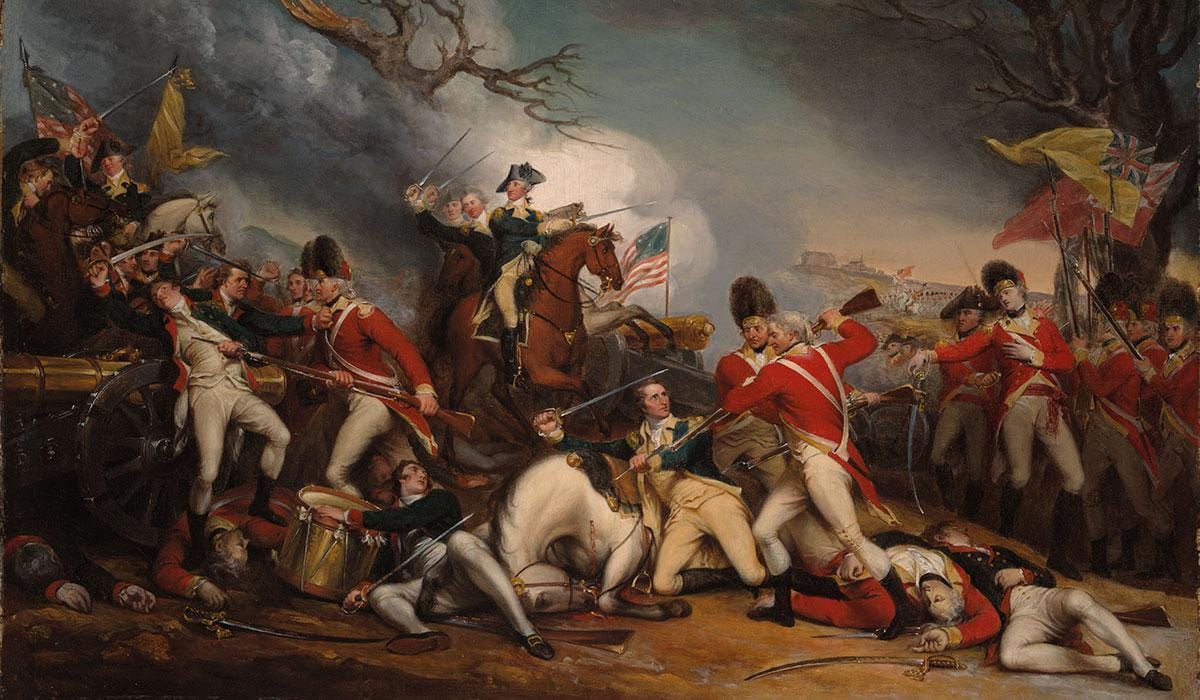
He split his forces just outside of Princeton, and a detachment, led by Hugh Mercer and 350  regulars had the first battle as they ran into the 17th and 55th British regiments as they prepared to escort supplies to Trenton. The British commander, Lt.colonel Mawhood, seeing how few men he faced, sent the 55th and most of the supplies back to Princeton, and led his men to shoot at the Americans from behind a fence. Mercer’s men fired back with rifles and cannon, doing little. Then, the trained British did what their training demanded: they rose up and charged the rebels with fixed bayonets. Mercer, having no bayonets, called “Retreat!” before being stabbed repeatedly, see painting. Mawhood’s men seized the cannon, turned it on the fleeing remnants of Mercer’s men.

General Mercer defeated at Princeton, as Washington shows up.

General Mercer defeated at Princeton, as Washington shows up.

It looked like a British victory, but then General Nathaniel Greene (the fighting Quaker) showed up with several hundred Pennsylvania militiamen. The militiamen had never seen battle, and many fled, after shooting into the British lines with rifles and another cannon and grape-shot. At this point it looked like a draw, but then, Washington himself joined the battle with two brigades of regulars: Hitchcock’s 253 New Englanders and Hand’s 200 Pennsylvania riflemen.

Washington managed to rally the fleeing Pennsylvanians; “Parade with us, my brave fellows! There is but a handful of the enemy and we will have them directly!” And Mawhood, now without most of his officers, ordered a last bayonet charge and fled down the Post Road to Trenton. Washington rode after for a bit “It’s a fine fox chase, my boys!”

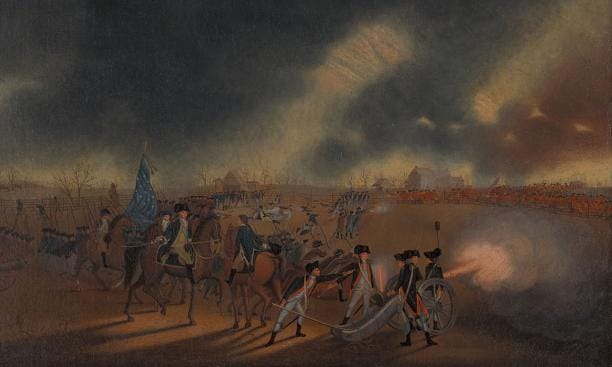
James Peale, 1783. John Sullivan and his forces at Frog Hollow. Battle of Princeton

James Peale, 1783. John Sullivan and his forces at Frog Hollow. Battle of Princeton

The rest of the British along with Mawhood, met the rest of Washington’s men, lead by John Sullivan, at a place called Frog Hollow, near where Princeton Inn College (Forbes College) now stands. The Americans opened with grape-shot and the British put up little resistance. Those who did not surrender were chased into town, taking refuge in Nassau Hall, the central building of the university. Alexander Hamilton’s men (he’d been rejected by Princeton) took special enjoyment in shooting cannon into the building. A hole remains in the college walls and a cannonball supposedly decapitated a portrait of George II. About then the New Jersey militia broke in a door, and the British surrendered.

Washington had captured, killed, or destroyed most of three English regiments, took a wagon train of supplies, and left going north following a bit of looting. “Loyalists” were relieved of coins, liquor, shoes, blankets. They ate the breakfast prepared for the 40th, and were gone by 11 AM, heading north — to where?. Cornwallis returned before noon “in a most infernal sweat — running, puffing, blowing, and swearing.” His men looted the town again, but now what?

Was Washington headed to New Brunswick where a handful of British soldiers guarded Cornwallis’s supplies and a war chest of £70,000? He didn’t go directly, but perhaps by a circuitous route. Cornwallis went straight to New Brunswick and jealously guarded the place, its money and supplies. Washington meanwhile ran to safety in the Watchung Mountains outside Morristown. Cornwallis’s 17th claimed victory, having defeated a larger group, but Cornwallis gave up Princeton, Trenton, and the lives of the New Jersey loyalists. Rebels flocked to Washington. Loyalists were looted and chased. Hessians were shot in “a sort of continual hunting party.” Philip Freneau expressed the change thus:

When first Britannia sent her hostile crew; To these far shores, to ravage and subdue, We thought them gods, and almost seemed to say; No ball could pierce them, and no dagger slay. Heavens! what a blunder—half our fears were vain; These hostile gods at length have quit the plain.

Robert Buxbaum. December 21, 2016. So now that you know what happened, what SHOULD Cornwallis have done? Clearly, it’s possible to do everything right militarily, and still lose. This is an essence of comedy. The British had a similar Pyrrhic victory at Bunker Hill. I suspect Cornwallis should have fortified Trenton with a smaller force; built a stockade wall, and distributed weapons to the loyalists there. That’s a change in British attitude, but it’s this dynamic of trust that works. The British retreat music, “the world turned upside down“, is a Christmas song.

Lessons of WWI: remove aristocrats and beards

Tzar Nicholas II and King George V.

Tzar Nicholas II and King George V, cousins and allies.

When I was a kid, Veterans day was called Armistice day. It marked the end of WWI. As many people died on all sides (there were many shifting alliances), it’s worthwhile asking what we’ve learned. The main thing, I think, is that aristocrats suck, both hereditary aristocrats, and the aristocrats of thought. Europe entered a world war for no big reason: small gains of land and status gains for a few aristocrats, generals, and thinkers at the top of society. These saw an opportunity to get medals and prove they could lead men in battle. The mass of Europeans cheered for war (see photo below, right) and followed them in battle. Millions were sent running at machine guns and poison gas. Most died, Those who survived returned home feeling less enthused about the ignorant, arrogant hereditary aristocrats, but still honored the generals and thinkers. They executed Tzar Nicolas of Russia and greatly reduce the power of the kings of England, Belgium, Turkey, Holland, and Austria. The thinkers inherited that power, but dropped the monarch’s face hair.

Emperor Franz Joseph

Emperor Franz Joseph II

mehmedv

Calif Mohammet V

Before WWI, virtually all of Europe was ruled by king; generally bearded kings who were believed to rule by divine right, as the will of God. The king generally had aid of a republican congress, a large aristocracy — counts, dukes, marchese, and earls, and the academic élite — professors and generals. All of these avoided association with the masses, except for show, all spent lavishly, and all maneuvered for power. By the end of WWI, no king in Europe retained real power, and the hereditary aristocrats discredited, power went to the intellectual aristocrats, where it resides today: generals, professors, newspapermen, novelists, generally mustached and modern. In 20 years or so, the new aristocrats would bring on WWII, in part because of a fear of war. Their wisdom proved to be little better than the old, but it is hard to say it was worse. The main lessons learned: avoid beards and aristocrats.

Brittains unified and cheering for the start of WWI

Britains unified and cheering for the start of WWI

In his book, “Diplomacy”, Henry Kissinger draws a few more lessons from the Great War. A major one is that balance of power works: it worked for the 100 years until WWI. Another lesson he draws: don’t let mutual defense treaties kick in until an actual invasion has begun: until troops actually cross the border. He blames hair trigger treaties for much of the trouble of WWI. His book is a good read, though, if only as a background his diplomatic approaches.

I write about WWI because of today is Veterans day, and also because two days ago we elected Donald Trump president of the US in a bitterly divisive election. Trump claims he wants “to drain the swamp,” a claim I take to mean that he intends to diminish the power of the intellectual aristocracy, the generals, writers, professors and politicians who think together, vacation together, club together, and control what it means to be educated. The Washington Post calls this removal a threat to western civilization; it removes the intelligentsia, and replaces it with racist boobs, or so they see Trump’s crew. There were anti election demonstrations in Boston, New York, Oakland, Austin, and Detroit. Upon election news a movement was started to impeach Trump, or get him to step down on claims that he stole the election. Officials of Hampshire college lowered the flag to half mast as a sign of mourning for our democracy. These acts of dissent are as heartfelt a reaction as the widespread approval that greeted WWI. I can hope the outcome is better.

For what it’s worth, I do not believe the supporters of Trump are as angry, or as stupid as portrayed: half a basketball of deplorables and irredeemables, the other half needing re-education (to borrow from Ms Clinton). These are the people who fight our wars, and I suspect we’ll be somewhat better off for giving them a voice. As for veterans day, honor the poor blokes who fought for our folly.

Robert E. Buxbaum, November 10, 2016.

1939, when East and West became friends and partners

Forward Marx

The large mustache, Soviet Socialist it seems is very much like his neighbor, the small mustache, National Socialist.

In August, 1939, just about 77 years ago to the day, Germany and the Soviet union signed a non-aggression pact — The Molotov von Ribbentrop agreement. The open text suggested peace, but there was a secret rider that was made widely available. The large mustache soviet socialist and the small mustache national socialist had divided up the land between them. “In case there was war,” Russia would get Lithuania, Finland, Eastern Poland, and Bessarabia (Northern Romania). Germany would get Denmark, Western Poland, and Greece.

Commemoration of the Soviet -German non-aggression pact, August 1939.

Commemoration of the Soviet – German non-aggression pact, August 1939.

Up till then, we in the US assumed that these nations were bitter enemies and that their enmity would protect us. It turned out they were friends, or at least that they had the common goal of conquest and domination. Both were socialists in the sense that they did not respect the property rights of their neighbors. In the cartoon at right, Uncle Sam is standing on the battlements, looking stupid, holding his useless umbrella (The League of Nations? US foreign policy?). The title, “Watchman, What of the Night.” Is from Isaiah. In August, 1939 night was most definitely coming along with a combined storm of aggression from Germany and the USSR.

I’m posting this as a reminder that East and West are more similar than is generally believed. That left and right too are often useless distinctions. That folks will generally seek their own advantage over philosophical purity, and over the advantage of the US. Internationalism, thus, is not a panacea for peace. Generally speaking, I suspect that Flavius’s dictum still applies: “if you wish for peace, prepare for war.” Also, I had these great cartoons, courtesy of my friend, Jim Wald.

Robert Buxbaum, August 25, 2016. People often forget/ ignore that the USSR started its part of WWII by invading Finland and Poland. Finland resisted invasion a lot better than Poland. So well that, when Germany broke the agreement and Russia became our friend, Finland became our enemy– sort-of. They were still fighting Russia. And, in the East, Russia remained an ally of Japan for another year, even briefly after Japan attacked Pearl Harbor. This made sending aid to Russia problematic, though Roosevelt did it. I’ve written about WWII in terms of mustaches because, to me, it makes as much sense as anything, and more sense than east vs west.

Comic Colonialism II: of Busbys and Bear Skins.

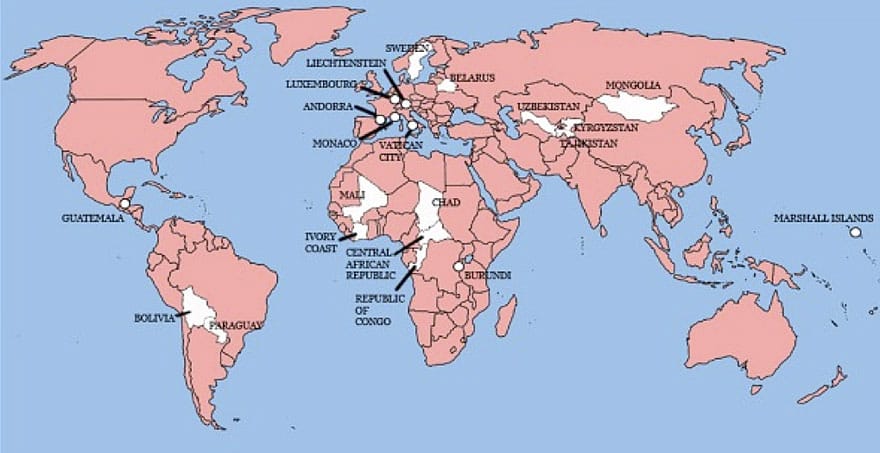
The map below shows, in white, all the countries that England has not invaded.

The white spots on this map are the countries that England has not invaded.

The white spots on this map are the countries that England has not invaded.

England now controls virtually none of these countries. In most of these, English is the national language, or the language of business, and defeating the British is hailed as the central national experience. Still, many have opted to become part of the British Commonwealth, a loose organization of ex-British states. Generally this requires agreeing to the rule of the Queen, despite having nominally free states. Entering Canada, for example, one finds a picture of Elisabeth II, Queen of Canada, And there are royal colleges where inventions belong to her. The same with Australia and New Zealand. The question to ask, then, the question despots have asked, is how did the English manage it –or perhaps, how can I extend my despotism the same way. Part of the answer, it seems to me, is that England used tall, silly hats: Busbys and Bearskins.

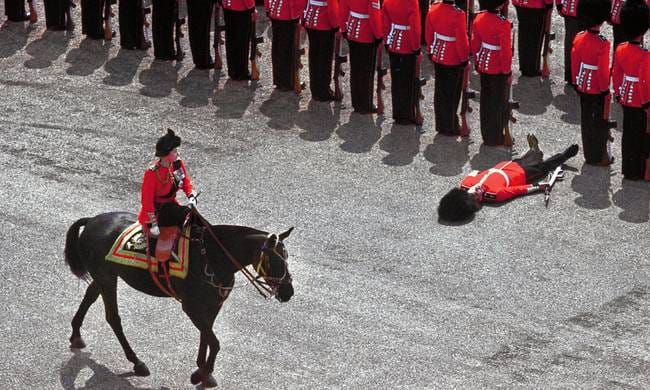
The Queen of Canada reviews her troops. She's wearing a Busby; he's in a bearskin.

The Queen of Canada reviews her troops. She’s wearing a Busby; he’s in a bearskin.

The Bearskin hat is perhaps the silliest hat in worldwide military use, and certainly the largest. The bearskin is made of the complete skin of a black or a brown (grisly) bear dyed black, The skin is shaped over a wicker frame to stand 16″ tall (a black bear skin is used for enlisted men, and a grisly bear for officers). It is heavy, quite fuzzy, and completely non-aerodynamic and protects the head not at all. As best American military experts have found, it only makes the person wearing it a better target for being shot. And yet, Britons have striven to be given the honor of wearing this thing. There is also a slightly shorter, slightly fuzzier version of the Bearskin worn by officers. It’s called a Busby, and it’s made from beaver skin. Even in this day of social correctness, skins are found for this use, and “harvested”, mostly in Canada.

The front-line British soldiers in the American Revolution wore these hats when they marched in ranks to attack the colonials at Lexington and Concord, and again at Bunker Hill, and again, in the war of 1812 at New Orleans. It made them slow, impressive, and dead. Because of their weight, these hats are often worn with a leather collar to help support them. The collar makes it hard for soldiers to look down, a plus for soldiers on parade, but a minus when walking over uneven ground, e.g. when attacking Bunker Hill. You’d think the British would have given up on these weird hats long ago, but the British won in many conflicts and have come to dominate many countries. They seem to credit the hat, I’m beginning to think it deserves more attention than it’s gotten.

The hat they wore through the war of 1812, through the Crimean war and the Boer war; in the heat of the Indian revolts, in Africa, and to this day for show makes British soldiers look taller, and more elegant. It makes them stand straighter than most, and gives guards an other-worldly appearance. American soldiers uniformly reminisced how hard it was to shoot someone who marched so elegantly. The Queen likes them, and she, after all is nothing if not elegant. Perhaps the unworldly elegance of the bearskin give soldiers the courage to invade countries and die in the name of a sovereign who reigns by Devine right as expressed through the sword Excalibur ‘of pure Semite’, whatever that is. It’s a story that not one adult Britain believes, yet they die for (why?) Perhaps it’s the honor of mass craziness. Perhaps, because they see simple folks are impressed by soldiers wearing the tall funny hats (I guess thats why some US marching bands use them). And then again, it might be pure luck, superstition, and stupidity. The method of science would be to ask if other countries or team bands do better while wearing the silly hats. I suspect not, but it deserves statistical analysis.

Robert Buxbaum, March 30, 2016. Comic colonialism 1 dealt with the mistakes leading to the US capture of Guam. Catch also my essays, the greatest blunders of the US revolution, and mustaches and WWII: similar mustaches foreshadow stable alliances.

Comic colonialism I: How the US got Guam without a fight.

America is often criticized for land it acquired by war e.g. Guam in the Spanish-American War. Though Spanish were corrupt and incompetent, and had (it seems) sunk the USS Maine by accident, the idea is that conquest is bad. Well, for better or worse, here’s how the US acquired Guam in a comic bloodless non-battle that provides an example of God laughing as he protects children, fools, and the U.S. of A.

It’s mid June, 1898, the Spanish-American War has raged for two months, and Theodore Roosevelt is in Cuba. Four ships lead by the USS Charleston leave Hawaii on a secret mission with orders to be opened only at sea. Captain Glass of the Charleston find he is to try to take Guam and destroy its fortress before proceeding to the Philippines for the major battle of the war. Glass is informed that Guam Harbor is defended Spanish warships plus a thick-walled fort housing many heavy cannon. A land assault will face, he’s told, over 1000 fighting men, dug in, heavily armed, and thoroughly familiar with the terrain. As it happens, military intelligence had vastly overstated the challenge. There are only 56 soldiers on Guam, and Span has neglected to tell the garrison that there’s a war on.

USS Charleston

The USS Charleston, victor of the non-battle of Guam.

Expecting a fierce battle, our soldiers and naval gunners practice shooting at towed targets and get excellently proficient, or so Glass believes. Fortunately, he’s wrong. On June 20, 1898, The Charleston steams into Guam’s harbor and finds no resistance. The only major ship is a Japanese trader sitting at anchor. No shots are fired, and there is no apparent activity on shore. In some confusion, Captain Glass order that 13 shots be fired at the fort. As it happens, it’s a fortuitous number. Also fortuitous, is that all the shots miss. In complete ignorance, the folks on shore think it is a 13 gun salute: that the Charleston is here for an official, state visit.

Now, the normal response would be for folks on Guam to return the 13 gun salute. If they had, it would have likely begun a cycle of death and destruction. But God is the protector of fools, and the fortress is out of gunpowder. The Spanish send an officer to the Charleston to ask for gunpowder and apologize for not returning the salute. After what must have been a most uncomfortable parlé, it is agreed that our nations were at war; that the officer was now a captured prisoner; and that he is being released to request surrender.

Coins celebrating our colonial territories.

Coins celebrating our colonial territories. None have senators or congressmen. Only DC gets to vote for president, a result of the 23rd amendment, 1961.

As soon as he is sent off, captain Glass begins to worry: maybe this is a trap. Maybe the guns are now focussed on him and his men? Maybe he should resume fire on the fort! Right about then, a friendly whaleboat sails by flying the American flag. It’s captained by Francisco “Frank”Portusach-Martinez from Chicago, an old friend of an officer aboard the Charleston. Captain Portusach comes on board, shows his US bona-fides, and explains that it’s no trap, just ignorance. Taking his advice, Captain Glass lands with a small party, arrests all 56 soldiers without a fight, and raises the American flag. The Star Spangled Banner is played, and Glass doesn’t quite know what to do next. What would you do in his shoes?

Captain Henry Glass

Captain Henry Glass, man with a mustache.

Having no experience or other orders, Captain Glass appoints Portusach as the first US Governor of Guam, and leaves to join Dewey in the Philippines. He does not destroy the fort as he finds it in such poor repair that he can claim it’s already destroyed. And that’s how we got Guam. Credit to Captain Glass for not screwing things up or angering the locals needlessly. One hundred and eighteen years later, Guam is still a US territory, though there have been movements for statehood, for union with Hawaii, and for independence. Until the folks on Guam decide otherwise, they are US citizens, but can not vote for president or have representation in congress. They pay federal income taxes, but not state taxes. Bill Clinton is the only US president to ever visit Guam.

Dr. Robert E. Buxbaum. February 1, 2016. I’ve written previously on the ways of peace, and on what makes a country, and on beards: why only communists and Republicans have them. Stay tuned for “Comic Colonialism II: Canada’s Queen.”

Sept. 11, 1683: Army of Islam attacks Vienna.

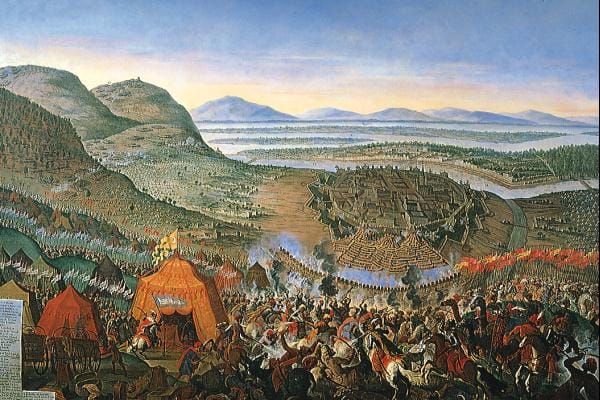
In the US, September 11 is mostly known for the 2001 attacks on the World Trade Center and the Pentagon. But to the wider world wide, I think it’s mostly known for the Battle of Vienna, the high-water mark of many battles where army of Islam tried to take over the ‘corrupt’ western world, the Dar al-Harab. This is not the first time that Islamic armies tried to make Vienna part of the world of Islāmic peace, the Dar al-Islam. Suleiman the Magnificent had tried unsuccessfully in 1526. In 1682, Caliph Mohamed IV set out to do what Suleiman had not. He broke the Treaty of Vasvár, and collected an army of 150,000 under the generalship of his Grand Vizier, Kara Mustafa Pasha.

The forces of Mohamet IV surround Vienna, September 11, 1683.

The forces of the Caliph surround Vienna, the city of good wine, September, 1683.

Mohamed IV’s army spent a year on the march to Vienna. On the way, they conquered or subdued Rumania, Bulgaria, Serbia, Croatia, and Hungary. But the western leaders did not sit idly by. Emperor Leopold I and Charles V, Duke of Lorraine left Vienna to be defended by only 24,000 under command of Ernst Rüdiger von Starhemberg. Meanwhile, they scoured Europe for allies. By the time Kara Mustafa army arrived, July 14 1883, Leopold had gotten a pledge of financial support from the pope, and a mutual defense treaty with the Polish-Lithuanians, and with Saxony, Baden, Bavaria, Swabia and Franconia. it was good work, but none of these armies were at Vienna yet.

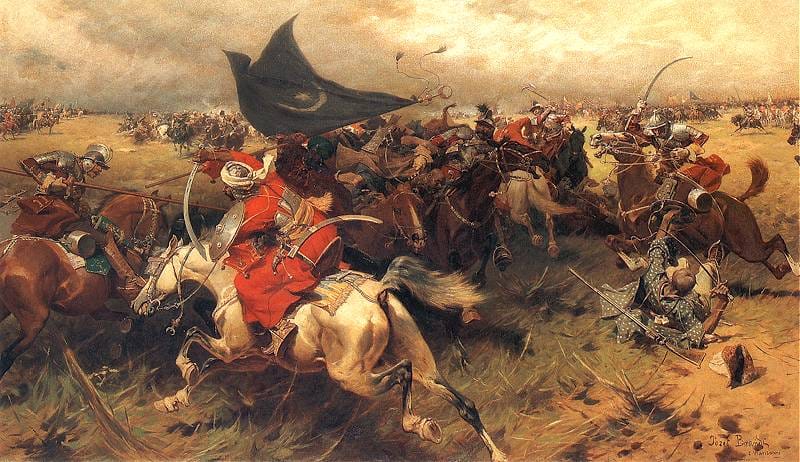
Fortunately (for Vienna), Kara Mustafa did not attack immediately but instead laid siege to the city, and to nearby Perchtoldsdorf (Petersdorf). Perchtoldsdorf surrendered, and Kara Mustafa massacred the entire Christian population who did not convert, some 30,000 people in the city square, and took their booty. This move did nothing to encourage a Viennese surrender. It took until September, 1683 for the armies of Leopold, Charles V, and John III Sobieski (Poland) to arrive. Kara Mustafa finally attacked on September 11, but it was too late. In the counter attack, his Islamic army was defeated. Kara Mustafa was put to death by the caliph for his failure to take Vienna (I guess he won’t make that mistake again).

Cavalry fighting at the Battle of Vienna, 1683

The Polish cavalry at the Battle of Vienna, 1683

The loss at Vienna was the beginning of a long retreat for Mohamed IV and for Islam. Hapsburg rulers captured Romania, Bulgaria, and Hungary; Russia conquered the Ukraine from the Mongol-Tartars (the Golden Hoard). The victorious Viennese established a feast day for September 11, the Day of the Holy Name, and created a crescent-shaped sweet roll in the shape of the Moslem crescent as a remembrance. In France, these crescent rolls are called “Viennoise.”

I suspect that many believing Moslems find the breads and holiday offensive, as they believe Vienna is, by right part of the Dar al-Islam. My guess is that this is why Osama bin Laden picked September 11. Osama had traveled in Europe as a teen, and his bookshelf included titles suggesting he would have known about the date, e.g. , “The Rise and Fall of the Great Powers (Paul Kennedy)”. I note that the US embassy in Benghazi, was attacked September 11 (2012). Perhaps this was similar revenge on the earlier Sept 11’s, and not, as Ms Clinton claims, a response to a Jewish-made, Hollywood film.

It seems clear that not every Islāmic leader understands the obligation to conquer the Dar al Harab as one of armies, swords, and bombs. In the last year, the Iranian leader, Ayatollah Ali Khamenei has explained that his slogan, “Death to America,” does not mean death to the American people, but “death to U.S. policies and arrogance.” He claims this struggle is “backed by the reason and wisdom,” of the Koran.

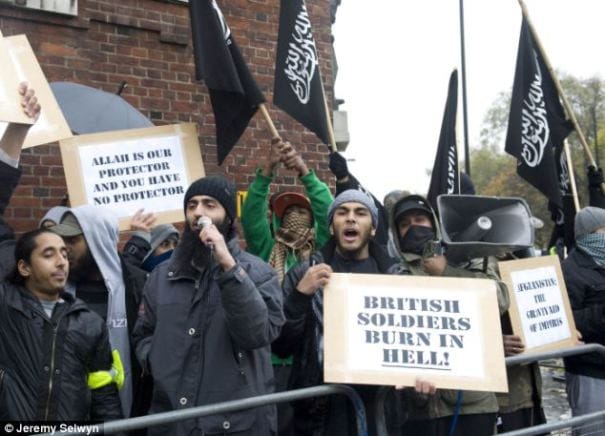
"Muslims against Crusaders" chanting during the two minutes of Remembrance Day (Armistice Day) silence, 2010.

“Muslims against Crusaders” chanting during the two minutes of Remembrance Day (Armistice Day) silence, 2010, “Our soldiers are in paradise, yours burn in Hell.”

As I understand it, The Ayatollah is saying that aim of the Iran’s missiles and atom bomb program is our benefit: to save us from Hell, and make our countries part of the Dar al Islam, the Moslem world of peace. Even at our best, our infidel Dar al-Harab is considered evil because of our arrogance and independence. We compete with each other in a world of chaotic commerce. As they see it, each infidel tries to wrest wealth from his fellow in an economic struggle that can only be ended by Caliphate-control that must include Iraq, Saudi Arabia, and Israel.

The Ayatollah does not mention that the Dar al-Islam has been in turmoil for the last 1000 years but perhaps acknowledges it in private as a slight embarrassment. To me, it seems more like Aesop’s fable of the toad physician who claimed he could heal everyone, but could not heal himself. I note that many other religions have the same jaundiced view of commerce, and have fought over it. Many Islamic thinkers find this to be a flaw in Christianity, and they are right. All major religions, it seems, claim to seek peace, and claim to love their fellows as themselves. They then go on to enforce this peace and love by killing.

If you find errors in my thinking, please tell me; I’m an engineer, not a historian or a theologian. I know enough Hebrew/Aramaic to know what the above phrases mean, and boost my claim by the public comments of the Ayatollah, who I take to be a spokesperson for practical Isalm.  In case you have not guessed, I think that a world of economic chaos is  better, and more satisfying, than any world of statist religious rule. I’d say that G-d likes entropy in all its forms, and that chaos is a gift of God, producing an odd stability.

Robert E. Buxbaum, Friday, November 13, 2015.

Comedy: what is comedy?

It’s a mistake, I think, to expect that comedy will be funny; the Devine comedy isn’t, nor are Shakespeare’s comedies. It seems, rather, that comedy is the result of mistakes, fakes, and drunks stumbling along to a (typically) unexpected outcome. That’s sometimes funny, as often not. Our expectation is that mistakes and fools will fail in whatever the try, but that’s hardly ever the outcome in literature. Or in life. As often as not, the idiot ends up as king with the intelligent man working for him. It’s as if God is a comic writer and we are his creation. Perhaps God keeps us around for our amusement value, and drops us when we get stale.

It’s not uncommon to have laughs in a comedy; a Shakespearian comedy has some, as does life. But my sense is that you find more jokes in a tragedy, e.g. Romeo and Juliet, or Julius Caesar. What makes these tragedies, as best I can tell, is the great number of honorable people behaving honorably. Unlike what Aristotle claims, tragedy doesn’t have to deal with particularly great people (Romeo and Juliet aren’t) but they must behave honorably. If Romeo were to say “Oh well, she’s dead, I’ll find another,” it would be a comedy. When the lovers choose honorable death over separation, that’s tragedy.

hell viewed as a layer cake. Here is where suicides end up.

Dante’s hell viewed as a layer cake. The “you” label is where suicides end up; it’s from an anti-suicide blog.

Fortunately for us, in real life most people behave dishonorably most of the time, and the result is usually a happy ending. In literature and plays too, dishonorable behavior usually leads to a happy ending. In literature, I think it’s important for the happy ending to come about semi-naturally with some foreshadowing. God may protect fools, but He keeps to certain patterns, and I think a good comic writer should too. In one of my favorite musicals, the Music Man, the main character, a lovable con man is selling his non-teaching of music in an Iowa town. In the end, he escapes prison because, while the kids can’t play at all, the parents think they sound great. It’s one of the great Ah hah moments, I think. Similarly at the end of Gilbert and Sullivan’s Mikado, it’s not really surprising that the king (Mikado) commutes the death sentence of his son’s friends on the thinnest of presence: he’s the king; those are his son’s friends, and one of them has married a horrible lady who’s been a thorn in the king’s side. Of course he commutes the sentence: he’s got no honor. And everyone lives happily.

Even in the Divine Comedy (Dante), the happy ending (salvation) comes about with a degree of foreshadowing. While you meet a lot of suffering fools in hell and purgatory, it’s not totally unexpected to find some fools and sinners in heaven too. Despite the statement at the entrance of hell, “give up all hope”, you expect and find there is Devine grace. It shows up in a sudden break-out from hell, where a horde of the damned are seen to fly past those in purgatory for being too pious. And you even find foolish sinning at the highest levels of heaven. The (prepared) happy ending is what makes it a good comedy, I imagine.

There is such a thing as a bad comedy, or a tragic-comedy. I suspect that “The merchant of Venice” is not a tragedy at all, but a poorly written, bad comedy. There are fools aplenty in merchant, but too many honorable folks as well. And the happy ending is too improbable: The disguised woman lawyer wins the case. The Jew loses his money and converts, everyone marries, and the missing ships reappear, as if by magic. A tragic-comedy, like Dr Horrible’s sing along blog; is something else. There are fools and mistakes, but not totally unexpected ending is unhappy. It happens in life too, but I prefer it when God writes it otherwise.

It seems to me that the battle of Bunker Hill was one of God’s comedies, or tragic-comedies depending on which side you look. Drunken Colonials build a bad fort on the wrong hill in the middle of the night. Four top British generals agree to attack the worthless fort with their best troops just to show them, and the result is the greatest British loss of life of the Revolutionary war — plus the British in charge of the worthless spit of land. It’s comic, despite the loss of life, and despite that these are not inferior people. There is a happy ending from the American perspective, but none from the British.

I can also imagine happy tragedies: tales where honorable people battle and produce a happy result. It happens rarely in life, and the only literature example I can think of is  1776 (the musical). You see the cream of the colonies, singing, dancing, and battling with each other with honorable commitment. And the result is a happy one, at least from the American perspective.

Robert E. Buxbaum, September 17-24, 2015. I borrowed some ideas here from Nietzsche: Human, All too Human, and Birth of Tragedy, and added some ideas of my own, e.g. re; God. Nietzsche is quite good on the arts, I find, but anti-good on moral issues (That’s my own, little Nietzsche joke, and my general sense). The original Nietzsche is rather hard to read, including insights like: “A joke is an epigram on the death of a feeling.”

Why I don’t like the Iran deal

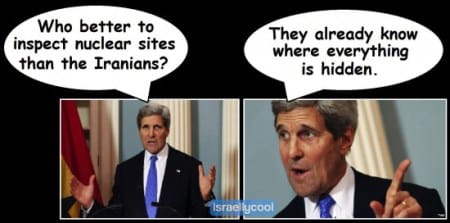
Treaties, I suspect, do not exist to create love between nations, but rather to preserve, in mummified form, the love that once existed between leaders. They are useful for display, and as a guide to the future, their main purpose is to allow a politician to help his friends while casting blame on someone else when problems show up. In the case of the US Iran-deal that seems certain to pass in a day or two with only Democratic-party support, and little popular support, I see no love between the nations. On a depressingly regular basis, Iranian leaders promise Death to America, and Death to America’s sometime-ally Israel. Iran has acted on these statements too, funding Hezbollah missiles and suicide bombers, and hanging its dissidents: practices that lead it to become something of a pariah among its neighbors. They also display the sort of nuclear factories and ICBMs (long-range rockets) that could make them much bigger threats if they choose to become bigger threats. The deal just signed by US Secretary of State and his counterpart in Iran (read in full here) seems to preserve this state. It releases to Iran $100,000,000,000 to $150,000,000,000 that it claims it will use against Israel, and Iran claims to have no interest in developing multi-point compression atom bombs. This is a tiny concession given that our atom bomb at Hiroshima was single-point compression, first generation, and killed 90,000 people.

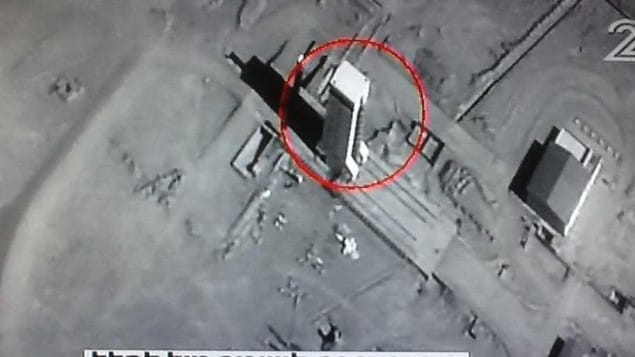
Iranian intercontinental ballistic missile, several stories high, brought out during negotiations. Should easily deliver nuclear weapons far beyond Israel, and even to the USA.

Iranian intercontinental ballistic missile, new for 2015. Should easily deliver warheads far beyond Israel -even to the US.

The deal itself is about 170 pages long and semi-legalistic, but I found it easy to read. The print is large, Iran has few obligations, and the last 100 pages or so are a list companies that will no longer be sanctioned. The treaty asserts that we will defend Iran against attacks including military and cyber attacks, and sabotage –presumably from Israel, but gives no specifics. Also we are to help them with oil, naval, and fusion technology, while leaving them with 1500 kg of 20% enriched U235. That’s enough for quick conversion to 8 to 10 Hiroshima-size A-bombs (atom bombs) containing 25-30 kg each of 90% U235. The argument in favor of the bill seems to be that, by giving Iran the money and technology, and agreeing with their plans, Iran will come to like us. My sense is that this is wishful-thinking, and unlikely (as Jimmy Carter discovered). The unwritten contract isn’t worth the paper it’s written on.

As currently written, Iran does not recognize Israel’s right to exist. To the contrary, John Kerry has stated that a likely consequence is further attacks on Israel. Given Hezbollah’s current military budget is only about $150,000,000 and Hamas’s only about $15,000,000 (virtually all from Iran), we can expect a very significant increase in attacks once the money is released — unless Iran’s leaders prove to be cheapskates or traitors to their own revolution (unlikely). Given our president’s and Ms Clinton’s comments against Zionist racism, I assume that they hope to cow Israel into being less militant and less racist, i.e. less Jewish. I doubt it, but you never know. I also expect an arms race in the middle east to result. As for Iran’s statements that they seek to kill every Jew and wipe out the great satan, the USA: our leaders may come to regret hat they ignore such statements. I guess they hope that none of their friends or relatives will be among those killed.

Kerry on why we give Iran the ability to self-inspect.

Kerry on why we give Iran the ability to self-inspect.

I’d now like to turn to fusion technology, an area I know better than most. Nowhere does the treaty say what Iran will do with nuclear fusion technology, but it specifies we are to provide it, and there seem to be only two possibilities of what they might do with it: (1) Build a controlled fusion reactor like the TFTR at Princeton — a very complex, expensive option, or (2) develop a hydrogen fusion bomb of the sort that vaporized the island of Bimini: an H-bomb. I suspect Iran means to do the latter, while I imagine that, John Kerry is thinking the former. Controlled fusion is very difficult; uncontrolled fusion is a lot easier. With a little thought, you’ll see how to build a decent H-bomb.

My speculation of why Iran would want to make an H-bomb is this: they may not trust their A-bombs to win a war with Israel. As things stand, their A-bomb scientists are unlikely to coax more than 25 to 100 kilotons of explosive power out of each bomb, perhaps double that of Hiroshima and Nagasaki. But our WWII bombs “only” killed 70,000 to 90,000 people each, even with the radiation deaths. Used against Israel, such bombs could level the core of Jerusalem or Tel Aviv. But most Israelis would survive, and they would strike back, hard.

To beat the Israelis, you’d need a Megaton-size, hydrogen bomb. Just one Megaton bomb would vaporize Jerusalem and it’s suburbs, kill a million inhabitants at a shot, level the hills, vaporize the artifacts in the jewish museum, and destroy anything we now associate with Israel. If Iran did that, while retaining a second bomb for Tel-Aviv, it is quite possible Israel would surrender. As for our aim, perhaps we hope Iran will attack Israel and leave us alone. Very bright people pushed for WWI on hopes like this.

Robert E. Buxbaum. September 9, 2015. Here’s a thought about why peace in the middle east is so hard to achieve,