Tag Archives: war

James K. Polk, a great president who did what he said and made America great

One of my favorite presidents is James K. Polk. While running for president he claimed we would do four major things –and do them as a one-term president. He then did them, and left office — and died 103 days later at the age of 53. Mr Polk’s four stated objectives were: a reduction in the tariff, an independent treasury, settlement of the Oregon boundary dispute, and acquisition of California. Acquisition of California required admission of Texas, plus a war with Mexico and a cash payment, but he was ready. Settling the Oregon border required a compromise and a cash payment. But he did it and more. Modern professors are not happy with Polk, ranking him far below Obama, Kennedy, or Adams, but his aims were good, and he got hem done. Few presidents do that, and even fewer left office if they had the power to stay. No professor I know has ever willingly left if he had the power to stay, and didn’t have a better job to go to.
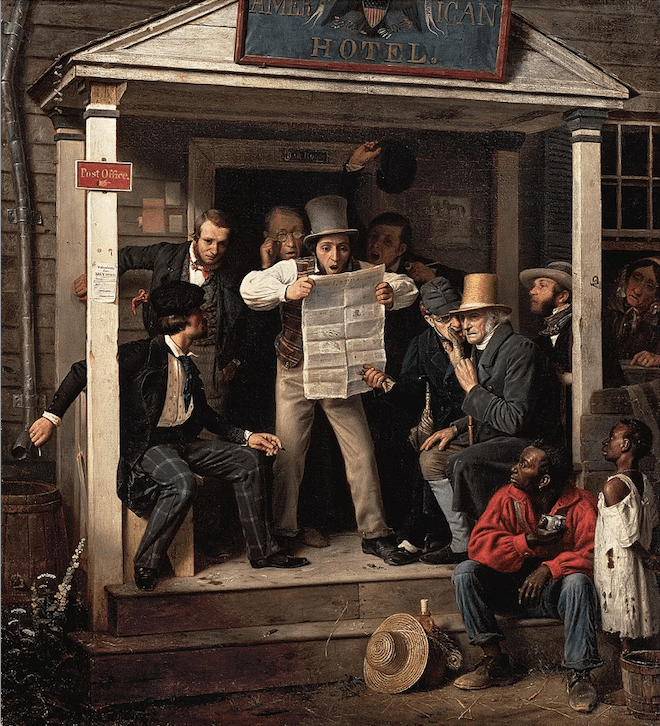
News from Mexico, oil on canvas painting by Richard Caton Woodville Sr., Düsseldorf, 1848. Polk was a god-send for newspaper sales.

I believe that the clarity of Polk’s four objectives was the reason he was a candidate at all, and the reason he won the election, and also the reason he achieved the objectives. There is a magic in clear objectives, repeated often, I find. It’s a formula that got Trump elected that few seem to understand: “Make America Great Again.” “Build the Wall”, “Drill baby Drill” “Deport illegals” “Tariffs. ” Like these ideas or not, you know Trump’s aims. Also, you know that, if. you oppose them, you oppose him. Trump’s pastor, Norman Vincent Peale promoted this approach, one I’ve thought of trying myself. I suspect that Polk died so shortly after leaving office because he had no further goal beyond relaxing; bad water hurt him too.. I suspect that Trump will die shortly after leaving office too- from lack of purpose.

Polk wasn’t expected to be a candidate, but was a “dark horse”, ex-governor of Tennessee, who had lost his past two elections. Martin Van Burin was expected to be the Democrats’ candidate, but he opposed slavery, and most Democrats were for it. What’s more, he was opposing annexation of Texas, at least south of the Nueces River, and many Democrats were for, as were some Whigs.
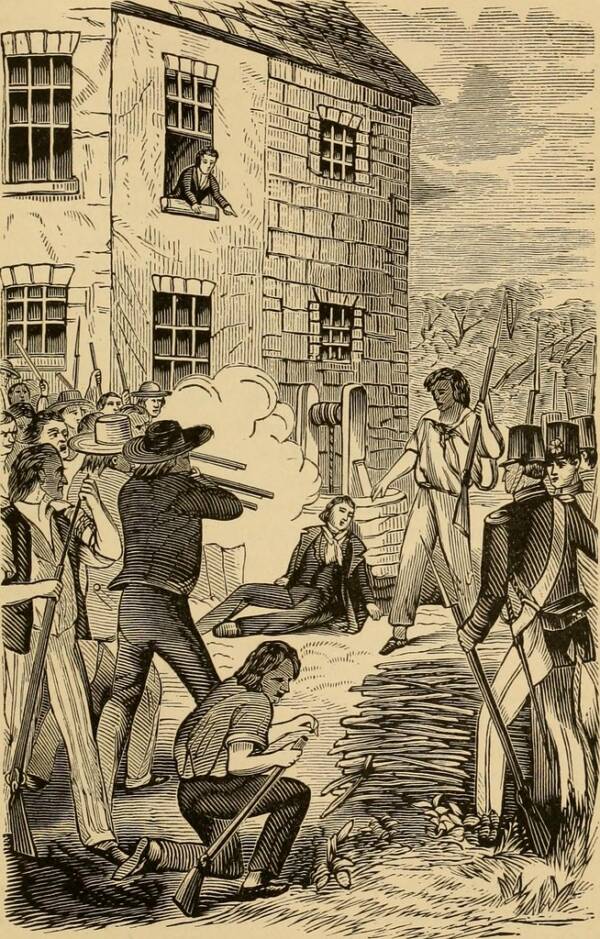
Joseph Smith was shot multiple times while campaigning for president.

Polk was pro-slavery, as was the Whig candidate, Henry Clay. But Polk said repeatedly that he would annex Texas — all the way to the Rio Grande, “no matter what any Mexican said.” He also said he’d fight for California and all of Oregon too: “Fifty four forty or fight”. You might not agree with this, Grant did not, but you knew where he stood. And Polk said he’d serve only one term. Thus, if you didn’t like him, he’d be gone in four years. After a few ballots, Polk became the Democratic Party candidate, with George Dallas as his VP. Like Polk, Dallas was pro Texas – they eventually named a city after him. Clay was Polk’s main opposition, anti Texas, and more vague about everything else.

At first John Tyler, the incumbent, also ran against Polk, but when he saw he was losing, he dropped out to help Polk. Also running for president, 1844 was Joseph Smith, the Mormon founder-profit. he ran as an independent because God told him to. He was shot multiple times, and died while campaigning. Finally there was James G. Birney, the Liberty party candidate. He gained few votes running on an abolitionist ticket. It’s been speculated that Polk won because Birney split the Whig vote. My take is that’s unlikely: Clay was pro-slavery. Polk’s win, I think, was in the power of his clarity.
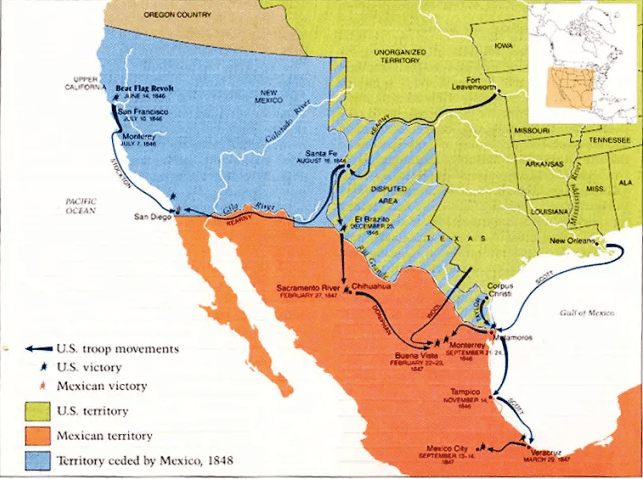
Map of the territory and war.

Once elected, Polk first moved to annex Texas, something he achieved with the help of expresident John Tyler. Tyler sent his Secretary of State, Abel Upsher to negotiat an annexation treaty with Sam Houston, but the Whig-controlled congress rejected it. After the election, Tyler resubmitted the treaty to the new, Democrat-controlled congress, and got two versions passed. The house passed a pro-slavery version, while the senate, pushed by Thomas Hart Benton (a favorite of mine) produced an annexation treaty that divided Texas in half, with a pro-slave and an anti-slave half. Polk liked the pro-slave, House version, returning it to Texas in his first week in office. He instructed the Texas legislature to accept it unconditionally, with no change so he could submit it directly to the Senate. The Texans did so, and congress approved this version later that year. Texas entered the union as one, large, slaveholder state.

With annexation not yet ratified by congress, Polk sent a diplomatic mission to buy California from Mexico along with all of the disputed Texas territory and everything in between for $25 million. Mexico refused, so Polk invited war. He sent 4000 soldiers into disputed Texas territory south of the Nueces River, under command of General Zachary Taylor. Mexican forces attacked them in April 1846, and Polk declared war. The war lasted to 1848, winning all the desired lands including California, and achieving a release of any rights Mexico might have on Oregon.
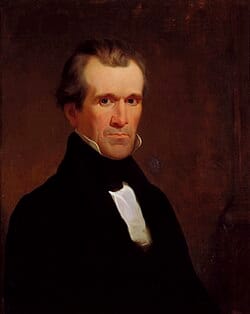
Polk, as governor of Tennessee

The next Polk goal was resolution of the Oregon dispute, ideally with us getting all of it: land that included the current states of Washington, Oregon, and Idaho, plus the Canadian Provence of British Columbia. Britain and Russia also claimed this land, so Polk’s first step was to buy off Russia. The British said they’d fight, noting that they had a larger army and navy and that the US was already at war with Mexico. Polk’s response was to back settlers going to Oregon. Americans had started migrating to Oregon in 1843. In his inaugural address, 1845, Polk said he would defend them “against the British and Indians.” By 1846 Britain recognized the difficulty of fighting US settlers so far from home. On June 15, they agreed to a deal that split the territory along the 49th parallel, giving the US the lower half, except for Vancouver Island, thus allowing Britain an opening to the sea. This deal had been proposed by Edward Everett, Tyler’s minister in London. Polk gave up nothing, beyond an informal agreement to lower tariffs on British goods, something he aimed to do anyway. It’s generally thought that Polk’s willingness for war allowed him to achieve so much without fighting. Polk said, in his inaugural, March 1845: “The world has nothing to fear from military ambition in our government,” a statement that clearly means the opposite of what it claims to say.

Polk’s third goal was lowering the “Black Tariffs”. High and uneven, they were 32% on average, with cut-outs to help specific, northern businesses. Polk’s secretary of the treasury, Robert Walker negotiated a flat advalorum tariff of 25%, with luxury goods, tobacco and alcohol tariffed higher. The “Walker tariff” bill was passed July, 1846, one month after the Oregon agreement. The British, reduced their “corn tariffs” against US grain, benefitting both countries. Our tariffs average 17%, currently, with many cut-outs. I think our tariffs should be more like the Walker tariff, perhaps 20% and simpler.

Polk’s 4th campaign promise was establishing an independent treasury. This was done to weaken “pet” banks, and stabilize the economy. The treasury would now hold all US assets; they would issue most currency, and would pay people directly, either in specie (gold or silver) or notes of debt. Independent banks could still issue notes, but only in amounts over $20. Polk passed this bill August 6, 1846, one week after the Walker Tariff bill. With this, Polk had already achieved all of his goals except California by the mid-term elections, 1846.

Having achieved so much, Polk set out to buy Cuba, but Spain said no. Some other accomplishments: opening the U.S. Naval Academy and the Smithsonian Institution, overseeing the groundbreaking for the Washington Monument, and the issuance of the first United States postage stamp. By the summer of 1848 Polk confirmed that he was satisfied and would not run for re-election. In his address to congress, December 1848, he said, “Peace, plenty, and contentment reign throughout our borders, and our beloved country presents a sublime moral spectacle to the world.” …. “I am heartily rejoiced that my term is so near its close. I will soon cease to be a servant and will become a sovereign.” I trust that was met with applause.

Robert Buxbaum. February 6, 2026. Edward Everett would go on to make the better received speech at Gettysburg. The officer who commanded the 4000 man Texas force, Zachary Taylor, became president in 1849. Like Polk, he died of bad water with too little alcohol added.
Will a cut-off in oil to China spark war?

China is likely the largest economy in the world, 11% lager than the US calculated here based on food purchasing parity They also have a larger army and navy, 754 ships vs 440, with military ambitions for Taiwan and new, man-made islands in the China sea. They continue to add aircraft carriers and submarines (we’re still ahead there), but China fuels all this with oil. They use some 17 million barrels per day: 11.3 million imported by ship, and put another million bb//day per into reserve in case there is a shutoff.

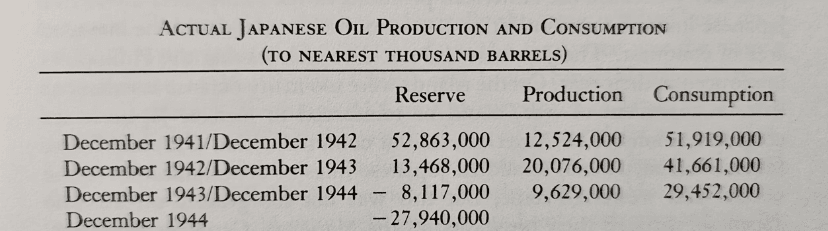
A problem for China is that their internal production, 4.5million bbl/day, is far below their consumption, a big vulnerability. One of their main suppliers, Venezuela, just went off line, sending 800,000 bbl/day of oil to the US that would have gone to China. Two other of their major, sanctioned suppliers, Iran and Russia have had delivery issues too; a disruption in oil could cause a revolt in China. Perhaps this fear will drive China to war with us, similar to the way that a cut off in oil caused Japan went to go to war with us in WWII, see table below. Japan had the choice of war or shutting down their economy and ambitions. Perhaps China may choose the same if Iran and/or Russia goes off-line. That was my worry, I’m no longer that concerned.

This shows how dependent Japan was on foreign oil, before and during WWII. The cut off of imports sues them to attack Pearl Harbor, source = Sarah Paine, military historian

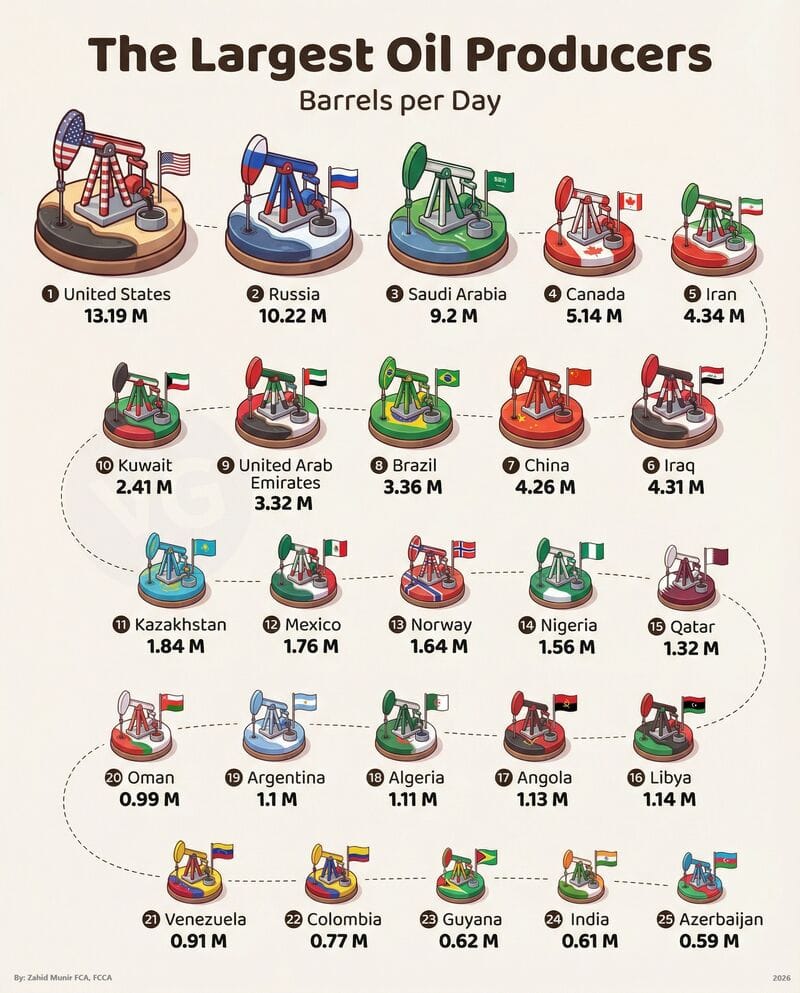
Currently, China buys most of its imported oil from four countries: Russia, Iran, Saudi Arabia, and Iraq; two of these are under sanction. China used to get another 0.8 million barrels per day from Venezuela, another country under sanction, but that route was closed by Trump last week. Buying from sanctioned countries saves them significantly, and supports the BRICS alliance, an alliance specifically against the US (NAFTA?) and the EU. The money they pay to Russia and Iran supports the war against Ukraine, plus ISIS’, war against us, and the mullahs oppression in Iran.

Oil production worldwide, 2024. How much China buys from each varies month to month.

China was buying, from Russia, some 2.2 million barrels of oil and refined products, plus natural gas and coal (China is a big coal user). The rest of Russia’s output goes to India, Turkey, and the EU. The EU buys more than half of eastern Russia’s natural gas output, shamefully it has likely kept Germany from collapsing. The problem for China is that Russian production is under attack from Ukraine. Ukraine sank or disabled several Russian tankers, and we took some more; they’ve blown up pumping stations, including three on the Caspian Sea, set fire, to a large liquid natural gas terminal and damaged the major off-load platform for Kazakh oil. According to the Foundation for Democracy report, here, by October 2025, China was down to getting only 800,000 bbl/day from Russia, a major blow, and Ukraine’s attacks continue.

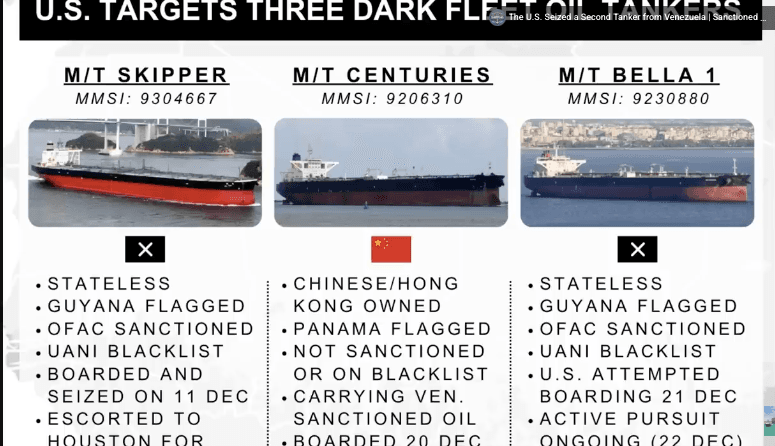
Some dark fleet ships captured by the US navy off of Venezuela, on their way to China with sanctioned oil.

Iran is another major supplier under attack. Up until recently they provided nearly 2 million barrels of oil per day, 90% of Iran’s seaborne export. Much of that went indirectly, going to Indonesia, turkey, Iraq, and Kuwait where it was relabeled, blended or refined to avoid sanction penalties. Everyone makes a profit here, but Iran is in the midst of a revolution. Last week, Trump imposed an across-the board 25% additional tariff on counties that help Iran avoid the sanctions. My guess is that this tariff will be effective and that it will last until the revolution is over. His tariffs have been effective and profitable, it seems.

China has non-sanctioned suppliers. They buy some 1.6 million barrels per day from Saudi Arabia, about 1.2 million bbl/day, from Iraq, about 1.3 million bbl per day from Malaysia, about 700,000/ day from Brazil, and about 900,000/day from the USA. In principle, they could make up any losses by buying more here, but the price would be higher. Worse yet, Trump could cut China off. That would be devastating; it’s the reason China built up a reserve of 2.2 billion barrels amounting to 6 months of current use. Japan did something similar in 1941, building up a year’s worth. They then used all of it in the first year of the war, while conquering Indonesia, a new supplier. For all I know, Trump’s activities in Venezuela and Iran are meant to force a war decision on China before they are strong enough to defeat us. It seems to have been FDR’s logic.

China’s main way to address a possible oil disruption, as best I can tell, has been to push EVs development. They’ve financed some 500 new EV companies who now (late 2025) provide about 50% of new Chinese automobiles. Another 19% are hybrids. In the US, only 8% of new cars are EVs, and 16% hybrids. Large-scale use of EVs lessens the pressure on Chinese leaders to find oil sources, some 40% of oil imports can be assumed to go to fuel automobiles; if China were to go 80% EV, it would save 5.5 million barrels/day, more than it gets from Russia and Iran combined. For now, though, China has a big need for gasoline, and has a big excess in EV manufacturing. It has turned to Canada both as a customer for EVs and as a supplier for oil.

Last week, Canadian PM, Mark Carney visited China and announced a “Strategic Partnership” on Agriculture, energy, finance, and Global governance.” There’s no specific mention of oil, but it’s implied. China gets most favored nation status sending goods, including EVs to Canada at rates lower than on US goods. China will export some 50,000 EVs in 2026, rising to 70,000 by 2030 with tariffs set to 6.1%. US-made cars are tariffed at 25%. Canadians will get visa-free, tourist visits), plus a loan of $1B to be used buying Chinese ships. In Davos last week, “We are in the midst of a Rupture” away from the US. He urged the EU and other “middle powers” to band together. He talks like China is a good, reliable friend to Canada, and like the US isn’t. I would worry more about his comments and the “global governance” phrase, if the EU seemed to be going along, but it is not. Nor do I see a real move in China for war. I see positive effects of increased EV sales for China, Canada, and the world. Even if the quality isn’t great, Go Canada, go peace.

Robert Buxbaum, January 25, 2026. *The plan to attack Pearl Harbor was made in December 1940, a year before it happened and 9 months before we cut off oil shipments. We cut off oil shipments in September, following Japan’s invasion of Indonesia, done to take the oil there. While oil was not Japan’s only aim in WWII, it was an aim and a big participant at every step.

What causes innovation? is it worth it?

Innovation is the special sauce that propels growth and allows a country to lead and prosper. The current Nobel prize believe that innovation powered the Industrial Revolution, causing England to become rich and powerful, while other nations remained poor, weak, and stagnant. Similarly, Innovation, they believe is why 19th century Japan rose to defeat China, and propelled China’s 21st century rise. But why did they succeed when others did not. What could the leader of a country do to bring power and wealth through innovation. Improved education seems to help; all of the innovation countries have it, but it is not the whole. Some educated countries (Germany, Russia) stagnate. An open economy is nice, but it isn’t sufficient or that necessary: (look at China). That was the topic of this year’s, 2025 Nobel prize in economics to Mokyr, Howitt, and Aghion, with half going to Joel Mokyr for his insights, historical and forward looking, the other half going for economic modeling. I give below my understanding of their insights, more technical than most, but not so mathematical as to be obtuse the normal reader..

The winners hold that innovation, as during the industrial revolution, is a non-continuous contribultion caused by a particular combination of education and market opportunity, of theoretical knowledge, and practical, and that a key aspect is depreciation (destruction) of other suppliers. Let’s start by creating a simple, continuous function model for economic growth where growth = capital growth, that is dK/dt. K, Capital, is understood to be the sum of money, equipment, and labor knowledge, and t is time with dK/dt, the change in K with time modeled as equal to the savings rate, s, times economic activity, Y minus a depreciation factor, δ, times capital, K.

growth = dK/dt = sY − δ K.

Innovation, in the Howett model, is discontinuous and accumulative. It builds on itself.

For the authors, Y = GDP + x, where x is the cost of outside goods used. They then claim that Y is a non-linear function of K, where K is now considered a product of capital goods and labor K = xL and,

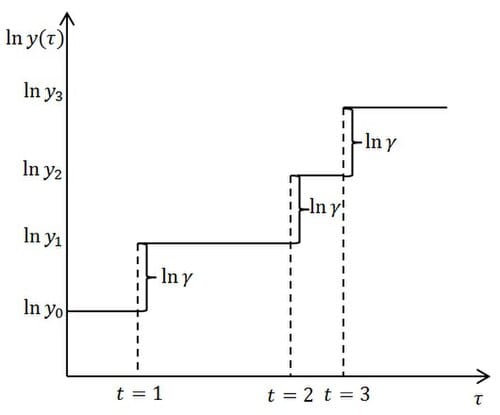
dY/dK = AKα + γ where 0< α <1, and where γ is the contribution of innovation and/or depreciation. The power function, as I understand it, is a mathematical way of saying there are economies of scale. The authors assume a set of interacting enterprises (countries0 so that the innovation factor, γ for one country is the depreciation factor for the other. That is, growth and destruction are connected, with growth being a function of monopoly power — control of your innovation.

According to the Nobel winners, γ is built n previous γ as shown in the digram at right. It can not be predicted as such, but requires education and monopolistic power. The inventor-manufacturer of the typewriter has a monopolistic advantage over the makers of fountain pens. Innovation thus causes depreciation, δ K as one new innovation depreciates many old processes and products. If you add enough math, you can derive formulas for GDP and GDP growth, all based on factors like A and α, that are hard to measure.

GDP = α(2α/1−α) (1-α2)A L,

Thus, GDP is proportional to Labor, L and per-capita GDP is mostly an independent function related to economies of scale and the ability to use capital and labor which is related to general country-wide culture.

The above analysis, as I understand it, is in contrast to Kensyan models, where growth is unrelated to innovation, and where destruction is bad. In these Kenysean models, growth can be created by government spending, especial spending to maintain large industries with economies of scale and by spending to promote higher education. The culture preferred here, as I understand is one that rewards risk-taking, monopoly economics, and creative destruction. Howitt, and Aghion, importantly codify all this with formulas, as presented above that (to me) provide little specific. No great guidance to the head of a country. Nor does the math make the models more true, but it makes the statements somewhat clearer. Or perhaps the only real value of the math is to make things sound more scientific see the Tom Lehrer song, Sociology.

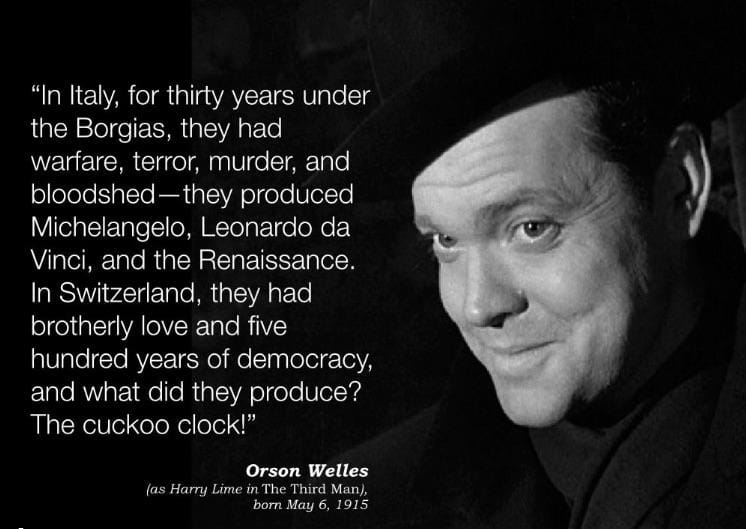
This insight from movie script by Grham Green suggests to me that progress may not be the greatest of advantages, perhaps not even worth it.

This work seems more realistic, to me, than the Keynesian models Both models are mathematically consistent, but if Keynes’s were true, Britain might still be on top, and Zambia would be a close competitor among the richest countries on earth. Besides these new fellows seem to agree with the views of Peter Cooper, my hero. See more here.

Writing all this reminds me that the fundamental assumption that progress is good, in not necessarily true. I quote above a line that Orson Wells, as Harry Lime, ad-libbed for the movie, “The Third Man.” Lime points out that innovation goes with suffering, and claims that Switzerland had little innovation because of its stability. Perhaps then, what you really want is the stability and peace of Switzerland, along with the lack of domination and innovation. On the same note, I’ve noticed that engineering innovators often ruin themselves dining in ruin, while the peaceable, stable civil engineers live long pleasant lives of honor.

Robert Buxbaum, November 16, 2025. A note about Switzerland is that was peaceful and stable because of a strong military. As Publius Vegetius wrote, Si vis pachim para bellum (if you wish of peace, prepare for war).

Sleepwalking into WWI, and WWIII

A remarkable book by Christopher Clark on WWI posits that WWI was an accident, entered into, by sleepwalk. That is, it was not brought on by the elaborate plan of an evil aggressor, Germany or Britain, acting for dominance or economic gain, but rather that many individuals precipitated the deadly conflict through a series of ever-more dangerous, unplanned steps. The great diplomats went on vacation following the June 28, 1914 assassination, and each minor actor felt a need to push for a previous status quo, emboldened by the certainty that nothing bad would happen, since none of the last acts had caused any serious harm, at least not to them. There was, in Clark’s view, a general numbness caused by earlier wars: in China and Russia, in Serbia and Albania, and by Italy’s invasion of Africa, and the fact that there had not been a major, deadly conflict since the Crimean war. In this environment, one nation shoving another was seen as normal conflict until a war broke out that killed millions and toppled four empires: the Russian, Austrian, German, and Ottoman.

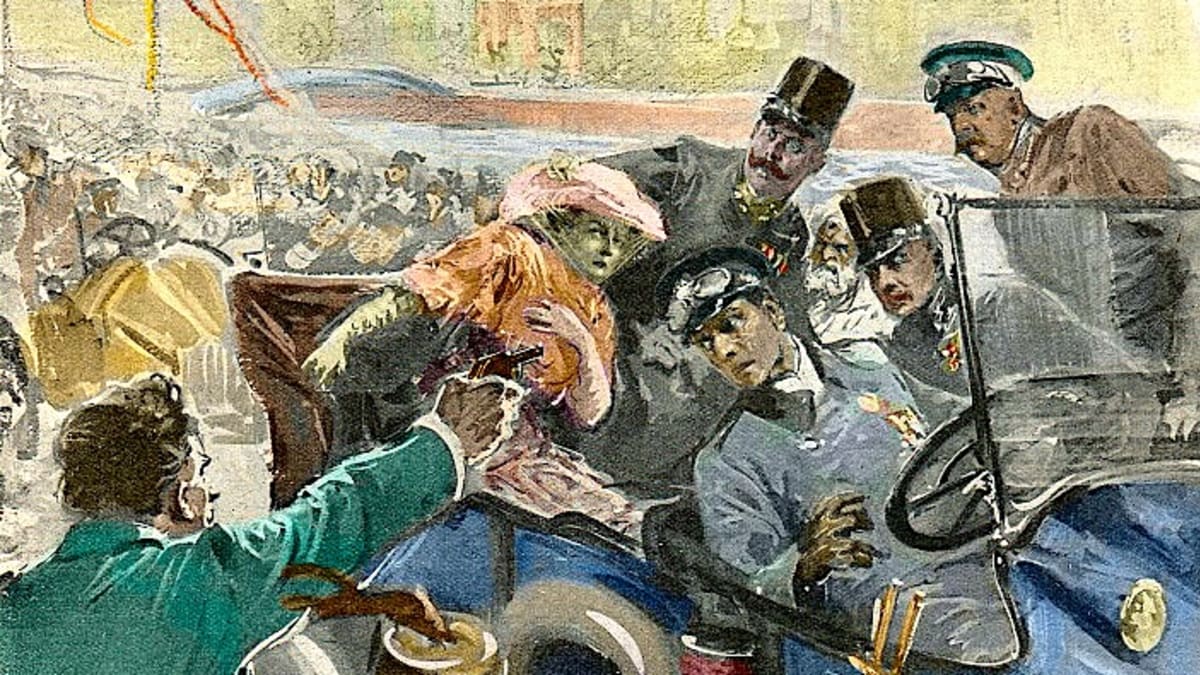
Princip shoots Count Ferdinand, June 28, 914. Getty Immage.

Clark points out, too that the Serbs, the folks who started the war, benefited from it. They escaped from imperial control by Austria and from The Ottoman Empire. Self determination was the motivation for the assassination, and it worked too, for the Czechs, Croats, Poles, and communists. In just a few years, the former group got their own countries, and the communists took Russia, something that no one saw coming in June, 1914.

The key sleep-walk steps to war were as follows: In response to the assassination, and a decade of earlier insults, Austria-Hungary, demanded harsh cocessions from Serbia that Serbia found unacceptable. Austria Hungary, backed by Germany and Italy, declared war on Serbia. Russia then mobilized its troops for war with Germany, so Germany declared war on Russia. France, an ally of Russia, then mobilized for war with Germany, so on August 2 – 3, Germany declared war on France and invaded Luxembourg and Belgium. Why Luxembourg and Belgium — because they would not allow free transport of German troupes to attack France. This forced Great Britain to declare war on Germany, which, finally, on August 6, brought Austria-Hungary to declared war on Russia, and effectively on the rest of the Allies. Over the next few years, we (the US) were dragged in along with Japan, on our side.

What a mess, but I fear we may be sleepwalking to the same, grim altercation via our wars in Ukraine and Syria. As at the beginning of WWI, there are two big power alliances: NATO including The US and most of Europe, versus a BRICS alliance of Brazil, Russia, India, Iran, China, and South Africa, along with a few minor others. The alliances are now three years into a proxy war in Ukraine, and another one in Syria. So far the declared combatants are Russia vs Ukraine, and Turkey vs Syria, but both sides keeps harassing the other at a higher and higher pace. So far, the sleep-walk steps were that Russia invaded Crimea, in response to some insult, and then attempted to take Kiev. The NATO alliance responded provided limited weapons to Ukraine. But, as these proved insufficient, we (NATO) provided greater and more deadly weapons, plus some volunteer troops. Meanwhile Russia’s BRICS allies are selling drones and missiles into the conflict in return for Russian gold, wheat, and raw materials. One of us, perhaps Ukraine, then cut the RussianGerman gas pipeline, while China seems to have cut important communications cables in the Baltic Sea.

North Korea began sending troops, 12,000 apparently, to fight on the Russian side, while Biden has sent long-range missiles to be used for strikes deep into Russian territory, on logistic centers, train depots, food stores, airports, etc. Putin has threatened a nuclear response, but has done nothing so far beyond sending a few long range, hypersonic missiles against civilian targets and against Ukraine’s power grid. He’s lost some 600,000 Russians, and has lost control of Syria and Armenia, so he has reason to be upset. Ukraine has lost some 400,000, and is still losing territory, but is still demanding total victory, the removal of all Russian forces, including those in Crimea.

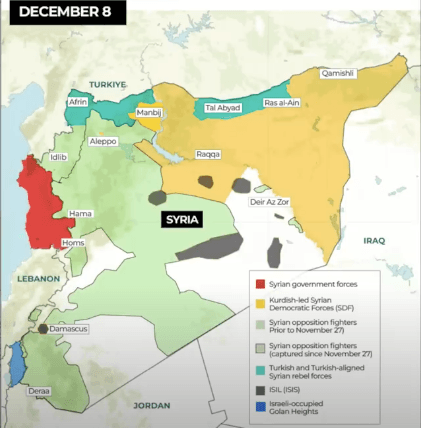
The fight has spread to Syria, where the US, Israel, and Turkey have bombed in recent days, something I would call an act of offensive war against a sovereign unstable government. It’s not totally unprevoked, of course. Syria and Iran had been attacking Israel for years from Lebanon, by way of Hezbollah jihadists. Recently Israel took out a major fraction of Hezbollah, and the jihadists (Sunni) seems to have gone back to Syria, and have removed Assad, Syria’s Shia president for life, with help from Turkey, another Sunni Moslem country. This too is an act of war. Assad retains a sliver on the coast where the Russian bases are, the red areas in the map below, but he isn’t popular with anyone at the moment. The rebel leader, Abu Mohammed al Jolani, was a member of Al Quada till 2006, and then member of ISIS (ISIL) under Abu Baghdadi till 2016 at least. He’s still on our terrorist list, though he now claims to be a progressive Moslem. Not everyone is convinced, or happy with him. Syria is divided into seven (or more) control zones, shown on the map below. He could bring peace to Syria, but his path to peace is clearly further war.

On the legal and PR front, we’ve called Russian president Putin a madman and war criminal, we support Turkey’s efforts to overthrow Assad, but complain about his attacks on the Kurds, the yellow areas, and dark green at right, and we both applaud and condemn Israeli President Netanyahu for attacking Syria in the south, and in the red sliver, destroying Syria’s navy. Meanwhile, we (the US) have taken it upon ourselves to attack ISIS (ISIL) camps in central Syria, the grey areas, as well as attacking troops (Iranian Shia) entering from Iraq. By normal definition, this would put us at war with Syria, and perhaps with Turkey since we support the Kurds in their war against Turks.

Recently we’ve decided that the rebel leader, al Jolani, might be taken off the terrorist list subject to a few conditions (I wonder which). We (Biden, Shumer) along with the International Criminal Court have called for the arrest and imprisonment of Israel’s PM Netanyahu. The Turks too have join in on this, while somewhat cheering Israel’s destruction of Assad’s navy. The Druze, allies of Israel (and us?) seem to be at war with al Jolani, and likely the Turks and Iran. They’re in south-east Syria, near Deraa, not shown by a color on the map. Meanwhile, Russia is trying to make peace with al Jolani, to secure their military bases, while Iran (Shia) has reached out to al Jolani (Sunni) in an effort to join with him in a war against Israel. It’s not quite tipped into world war, but it seems awfully close.

One possible peace maker might be the incoming US president, Trump, but the outgoing president, Biden, has done his best to tie his hands, branding him as a felon and seditionist, as well as claiming he’s a Russian asset. European leaders don’t like him either. France’s Macron might a peacemaker, but Macron’s government has fallen. The Germans or Turks might be peacemakers, but the government of Germany has nearly fallen, the economy of Germany is hurting, and Turkey is a combatant, at war with the Kurds and Druze. Iran, and Russia, though not combatants, are directly involved in the fighting, and both countries are under sanction by the US and EU, and the UN is discredited from it’s years helping Hezbolla. I thus see no clear path to peace and no peacemaker who will dial back the drama before we sleep-march into WWIII.

Robert Buxbaum, December 11, 2024

Prosperity guardian; whose prosperity are we guarding?

The Houtis, a Shia Islamic group, have been attacking ships in the Red Sea, hitting European ships, mostly carrying goods going between China and Europe. They use ballistic missiles plus cheap drones with great effect, targeted by an Iranian spotter ship in the Red Sea narrows, the Bab el Mandab. The US response is “Prosperity Guardian.” We’ve sent four missile destroyers. and the British one. These are arrayed along the entire coastline, too much coast for 5 ships to protect, and we try to shoot down drones and missiles. We manage to shoot down most of the missiles and and drones, but some always get through, and they mostly hit US and British targets. Recently the Maersk Detroit, a US flagged ship and 3 days ago, the British tanker, Marlin Luanda, shown below. It was carrying Russian naphtha headed for China. Some months ago, The Houtis kidnapped a British ship (Jewish owned) and took it to Yemen, as described previously.

British oil tanker, Marlin Luanda, on fire in the Gulf of Aden after being hit by an Iranian missile fired by Yemen’s Houthis. The tanker is hauling Russian naphtha, headed for China.

Iran supplies the missiles, and helps choose targets. According to Kissinger the aim of their attacks, and of the attacks on Israel, is to delegitimize Sunni Moslem countries like Egypt and Turkey that have made peace with Israel and the west. Whatever the motivation, Chinese and Russian ships are not targeted, but our ships are. We don’t attack the Iranian spotter for fear of starting a war. Instead we bomb Yemen, and protect ships carrying Chinese good and Russian oil. Currently 80% of the oil tanker transits of the Suez carry Russian oil (see below).

Most of the oil trade in the Suez is Russian — yellow line. Everyone else is shown in blue-black. It’s down to 0.5 ships per day, on average.

I don’t mind helping European countries get cheap Chinese goods, but I think the the main folks to pay should be the Europeans. We’re firing expensive anti-missiles and we’re showing the strengths and vulnerabilities to the Iranians, Chinese and Russians. Currently it’s our sailors who are at risk. The US trades with China too, but our China trade is not benefitted by ‘Prosperity guardian. Mostly our China trade avoids the Suez Canal, and comes around Africa to Savana or NY, or it comes across the Pacific, directly to Los Angeles. Our India trade most goes the same way. Some used to go through the Suez before the Houtis started attacking.

France and Japan have not joined prosperity guardian. Instead they have chosen to convoy their own flagged ships, even allowing the occasional stringer to tag along. Doing this, they use fewer ships, and it seems to work better than our approach. The picture at left shows a French courvair-escort escorting two French container ships. Note how much bigger the container ships are than the French warship. Should the Houtis’s missiles get too close to a French ship, I suspect that the French would retaliate hard. I think we should switch to following the French model and convoy-protect our shipping, plus whoever wants to tag along.

Map of Yemen and the Red Sea narrows.

Shipping, insurance rates have risen to about 1% of the cargo value. It’s now so expensive that no US cargo carrier will transit the area except when needed to supply our troops. At this point it’s worth asking, “Whose property are we guarding?” Also, is this really worth the lives of US sailors? If it is, why not hit the source of the problem — The Iranian spotter. The behavior of the French and Japanese makes sense to me. Biden’s behavior here does not.

Robert Buxbaum, February 6, 2024. Iran also funds and arms Hezbollah, a group that killed 3 US soldiers two months ago, and who killed several Kurdish allied troops in Syria just yesterday, and have shelled Israel intensely for months. IMHO, you want a few, well defended bases, not in harms way in Syria, but close enough to come back fast, in force.

Modern piracy and the gate of tears.

Piracy is illegal throughout the world, but has become increasingly popular. Over the last 3 weeks, perhaps 15 ships have been attacked by pirates (or privateers) in the narrow entrance to the Red Sea between Yemen, Somalia, and Djibouti, the “Bab el Mandab,” In Arabic, this means “the gate of tears”. Most of the ships attacked are large commercial vessels operating between Europe and Asia. The US destroyer, Carney has been attacked as well. Three of the attacked ships have been boarded, and two have been successfully hijacked, the car-carrier Galaxy Leader was taken to South Yemen, while the MV Ruen a Bulgarian owned dry bulk (grain) ship was brought to Somalia. The last of the hijacked ships, the Strinda, was recaptured by the US and Japanese navy. The other ships were attacked, at a distance, by Iranian ballistic missiles, cruise missiles, and drones, all fired from Yemen. All of these acts are defined as piracy under the UN Charter, Law of the Sea, UNCLOS. The punishment is 10+ years in prison, assuming you catch the pirate.

Bab al Mandab = Gate of tears, where the pirates operate.

All of these ships are European except for the Carney and a Chinese container ship flagged in, Hong Kong. You’d think that the European navies would protect their own ships here, but they do not. Neither did the Chinese navy, though they are stationed in Djibouti. It’s clear that Iran is organizing the attacks, and that they are using a spotter ship to help direct the missiles. My guess is that the European countries don’t want to annoy Iran here, nor do they like to use their $1 million missiles.

In theory, these attacks are in response to the Israel – Gaza war. The hijacked Galaxy Leader was registered in the UK, but owned by an Israeli Jew (see a video of the attack). Another ship that was attacked, the Strinda, was not directly associated with Israel, but was going to go to Israel at some point in the future. While it’s possible that the other attacked ships had Jewish or Israel connection, a simpler explanation is that this is economic terror. Israel-based Zim shipping has elected to avoid the straight and redirect around Africa instead, a much longer route that is sure to damage the shipper and Israel’s economy. I suppose that was an intent, but the damage is spreading.

Commercial vessel attacks in Bab al Mandab, chart from “What the Ship” video blog.

The European shippers have demanded that the US protect their ships, and perhaps Biden will agree. My sense is that Trump would have said no, or at least demand something in return. Personally, I see no reason to defend trade that doesn’t involve us, with no obvious payback. Yesterday, British Petroleum BP announced that it would avoid the Bab. Four major European container freight firms, MSC (Swiss), Maersk (Danish), Hapag-Lloyd (German) and CMA CGM (Italian, French). Currently Maersk supplies our troops, but has threatened to stop unless we defend their whole fleet. I consider this an offensive, a breech of contract. They European press seems to think it’s clever. We used to have a US company that supplied our troops, Landsea intermodal, but Maersk bought them out. Personally, I think it’s time to look for a company that doesn’t play these games.

As of two days ago, the economic damage has been minimal, except to Israel. Only 55 ships had diverted around Africa, or begun to. This is a small fraction of the 2,128 ships that have gone through the Bab since November 15. In the last day or so, European oil prices have started to rise, while ours fell. The thought is that Saudi oil will now flow to the US, not Europe. I think this is the beginning of a serious problem for Europe and that they should defend their own shipping. A few, million dollar missiles are a lot cheaper than the billions of loss to their economies that rerouting will cause. At present, Europe expects us to save them while they do little or nothing. I think we should say no. They think Biden will cave.

Robert Buxbaum, December 19, 2023. I’d like to call out my admiration for the “What the Ship” video blog, and Marine Link.

The Ukraine war could go for years. Don’t make a famine.

Russia is a collapsing, corrupt state with no meaningful elections. It is also the biggest exporter of food, fertilizer, gas, and oil. Nearly 2 years ago, it invaded Ukraine, another collapsing, corrupt, food-exporting state with suspended elections.

Both countries are in the midst of demographic collapse, with Ukraine worse off. Ukraine was invaded though, and thus has the better claim to our support. Then again Russia has atomic bombs. It’s also the largest exporter of wheat (or was), while Ukraine is only the 5th largest (or was before the war). The other three big exporters are the US, Canada, and France. We have benefitted financially, but don’t have enough output to make up for lost Russian and Ukrainian production. A likely result is famine unless the war can be brought to a quick end.

Ukraine’s grain terminals in flames, Odessa..

Food and energy prices have gone up too, and will probably continue to rise as the war stretches on. This adds to the risk of a global famine, particularly in the poorest areas of Africa, the Mid East, and India. Unfortunately, the war is still popular in Europe, Russia, Ukraine, and the US. It’s good business for our armaments industry, and for our recent mega-farmers (like Bill Gates). Also, for our political and spy class. They spend with little government oversight, and just recently misplaced $16 billion. Surely some of that lost money snuck back to the CIA and our politicians’ pockets. We’d have oversight, but “there’s a war on.”

As wars go, the death toll is low, a total of 354,000 dead and injured on both sides, as revealed by recently leaked documents. This is a small fraction of the countries population. Russia has lost 223,000 soldiers killed or wounded, 0.2% of the population, while the Ukrainians had lost 131,000, 0.3%, many of them civilians. While the war rages, the total death rate in the these two countries was 3.1 million people, 1.8% of the population; they’re dying mostly from heart disease, accidents, and alcoholism.

The Ukrainian population. Lots of retirees, few kids, very few of military age. This is a disaster, not a country.

More destructive than disease, alcoholism and the war is the demographic collapse. The fertility rate in Russia is 1.5 child per woman. In Ukraine it’s even lower, 1.21 per woman. For a stable population, you need at least 2.1 children per woman. Russia and Ukraine have had these low rates for at least 30 years. The net result is that we can expect that Russia’s population will drop by a third or so over the next generation, to about 50 million. This is the equivalent of killing 1/2 of the population; for Ukraine, the prognosis is worse. With few children and decent food supply, we can expect few workers, and increasingly many elderly. This will produce a cultural shift that virtually guarantees the breakup of Ukraine and the Russian federation in 20-30 years. Europe has this problem too, but with no war and some net immigration. The result is a cultural shift of a different type (to Islam). Russia has no immigration, and recently resorted to kidnapping Ukrainian children.

The loss of Russian and Ukrainian exports means famine for the poor importers and food inflation for all.

Europe has stopped taking delivery of Russian food and energy, in solidarity with Ukraine. This benefits the US, but hurts others. Meanwhile Russia has been destroying Ukrainian fields and food infrastructure, blowing a dam last month, flooding Ukraine’s fields, and yesterday destroyed the grain terminals at the port of Odessa,. This was tit-for-tat since Ukraine destroyed a key bridge, and Crimea’s irrigation canal. What’s more, evidence suggests that Ukraine blew up the Nord Stream pipeline — a key source of finance for Russia and Germany. This sort of tit-for-tat escalated to WWI, fueled by a belief, on both sides, that they would win “decisively and quickly.”

The result of WWI is that Germany was the biggest loser, losing men and land, and suffering a killing famine in 1916. In response, it militarized to prevent war from happening again, and this prevention helped cause WWII. Germany is the biggest loser so far, I’d say, aside from Ukraine, and I fear/expect they will militarize again. Russia too claims a need to increased military production. Biden’s promise that Ukraine’s will join NATO is a threat to Russia, as is our delivery of F16s, missiles and cluster bombs. We are killing Russians, and Putin doesn’t like it. Add to this, that Ukraine’s claim for independence rests mostly on its Nazi collaboration. For the good of everyone, maybe we can dial back, and stop adding gasoline to this fire.

Ukraine deserves our support, but I think that support need not go beyond small-ish arms, energy deliveries, and tariffs on Russian goods. Let’ s not push WWIII. Instead, we should help Ukraine and Russia export food and energy to avoid a famine. And a military Germany does no one any good.

Robert Buxbaum, July 20, 2023. When I was a teen, it was a given that war was bad. Now, for some reason, kids are in for war — here, and jehad in the Mid-East — especially the liberal classes. I find this absolutely bizarre.

China won’t invade Taiwan, perhaps Vietnam

For 2000 years Chinese rulers have either fixed the problems caused by their predecessors, or become the absolute ruler who brings new problems and a war. Eighteen times over the last 2000 years, the absolute ruler has chosen is to invade Vietnam. Chairman Xi Jinping took full power over China five years ago, and as I predicted then, purged the party of all other competent leaders, including his predecessor, Hu. He now has to do something, and that’s typically a war. Xi talks like he’d like to invade Taiwan, but I believe he’ll invade Vietnam instead, as so many others did before him. Taiwan (Formosa) is separated from mainland China by 100 miles of open sea. There’s been only two successful, modern invasions; by the Qing Chinese in 1683 with the help of the Dutch fleet, and in 1895 by Japan against the 5 month old Republic of Taiwan. Vietnam is much easer to invade: you just have to walk in.

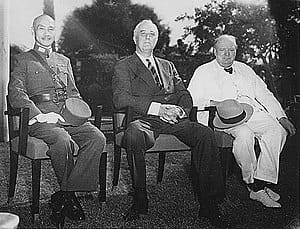
Chiang KaiShek with Roosevelt and Churchill. He took power after WWII.Taiwan is now a Republic

Here’s my brief summary of 60 years of cyclical Chinese history: In the last decade of his life, 1966-76, Mao Zedung brought a horrible cultural revolution, killing 100 million or so by violence and famine, targeting anyone who might disagree with him. He was followed by Hua Kuofeng, Hu Yaobang, and Zhao Ziyang. They removed “the Gang of Four” and brought reform, toleration, and some rapprochement with the west. Hu also returned some autonomy to Tibet. Deng Xiaoping followed, put Zhao under house arrest, removed Hua and Hu (only recently buried), absorbed Tibet, invaded Vietnam, instituted a brutal on-child policy with, forced abortions and sterilizations, and put down the Tiananmen uprising 1989 -an uprising caused by the removal of Hu. Deng was followed by Jiang Zemin and Hu Jintao who exited Vietnam, lightened the one-child policy, and brought back some measure of freedom. This lead to Xi Jinping who appears to be in the mold of Mao and Deng. He’s removed Hu publicly during a communist party meeting, has taken absolute control, arrested China’s business innovators, and (likely) caused a pandemic by unsafe research at the Wuhan bio-research facility. His response to the pandemic is worthy of Mao: he welded people into their homes. Xi now needs a war to unify the country, and talks like he’ll invade Taiwan. Xi might do it; he has increased military spending by 2.5 times, to double that of the EU (equal to US spending). His army is likely to be used somewhere soon. But where?

At first glance, it makes some sense to think he’ll invade Taiwan. He has the same justification as Deng had for Vietnam, “to punish the wayward province.” Taiwan is small, 23 million people, and very rich (GDP = $1.3T, 10-15% of China). It’s especially rich in high-tech areas that Xi seems to want, and China ruled the island (Formosa) for 212 years between 1683 and its brief independence in 1895. I expect that Xi will invade Vietnam though, for many of the same reasons that Deng did: it’s easier, and the invasion won’t destroy US trade. Vietnam will not be super easy to conquer, of course, Putin’s invasion of Ukraine looks like it will go on for years, but Xi has 100 million men of military age. Driving these men into Vietnam is a lot easier than an amphibious invasion. Vietnam now, as then, has few friends -perhaps only India -while Taiwan has many (The US and Japan, primarily), and they have naval breakwaters that would make an amphibious landing difficult. Vietnam is only about half as rich as Taiwan (GDP = $650 B), but it has two things China needs more than technology: oil and food.

The Japanese invasion of independent Taiwan, The Republic of Formosa, in 1895. It took 5 months despite lopsided advantages. Plus 7 years to pacify the population.

Japan’s invasion of the Republic of Formosa in 1895 would have to be the model for a Chinese invasion today, assuming that’s the route Xi would take. Japan used a small force of 20,000 highly trained men, and a surprise landing at two sites. The formosan army of 75,000 was hardly armed, but it still took the Japanese 5 months to defeat them. It took another 7 years to pacify the population. Taiwan today is a lot better prepared than it was, with modern missiles and drones, a well-trained army of 500,000, and an active navy. Japan, Philippines, and the US would likely try to resupply Taiwan, and would have to be blockaded to prevent delivery. This is not so easy, since the nearest Japanese island is closer to Taiwan than Taiwan is to mainland China, and the Philippines is not far either. Then there are the sanctions that would follow an invasion of Taiwan, but not an invasion of Vietnam: the freezing of assets and the closing of markets. Susch sanctions have been tough on Russia but they would be devastating to China since China imports most of its oil and half of its food, much of it by sea. Whatever Xi gets from invading Taiwan will not match these losses, and I think Xi know it.

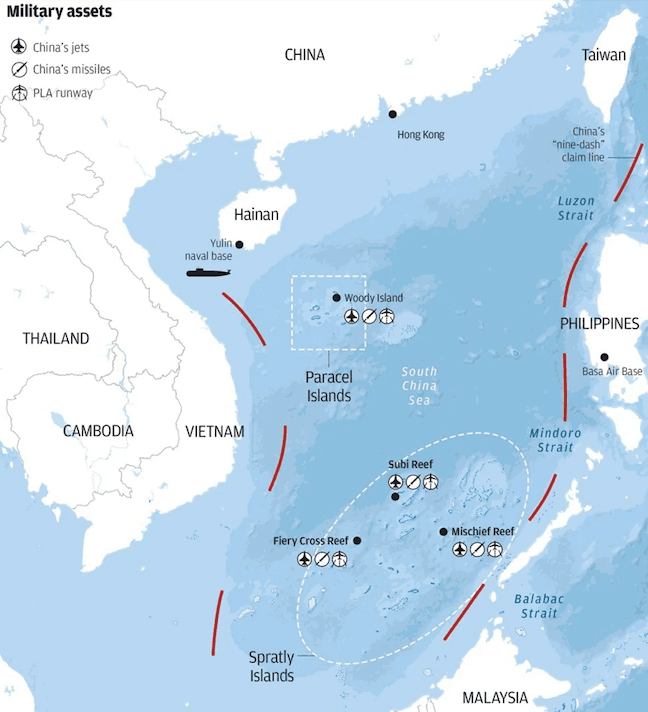
China’s new military bases are located around Vietnam, not around Taiwan

I suspect that Xi has already concluded that Vietnam is the smart place to invade. Supporting this view is a look at his preparations. Xi has not built the landing fleet that he’d need for Taiwan, but has instead militarized Hainan Island, plus four other, newly constructed, illegal islands in the South China Sea. These islands surround Vietnam, and are well suited to cut off the country from western aid. They are too far south to be effective in an action against Taiwan. You can tell a lot about what a person will do from what he has done, and what Xi has done is to prepare for an invasion of Vietnam.

Robert Buxbaum, April 27, 2023.

Ukraine looks like Vietnam or the beginnings of WWI

The press and our Russian experts claim we’re helping in Ukraine, protecting it from a Russian invasion. I suspect they are wrong, and that our help and protection will prove to be as deadly to all as in the Vietnam war. I’m also uncomfortable with their presentation their framing of Putin as an out of touch autocrat. Putin has popular support, and acts with a strong sense of history, as I see it, just not our version of history. In the Russian version, it was Russia that stopped the Nazis — of Germany and Ukraine. We are not the heroes of WWII in their telling; I doubt we’ll be the heroes of this conflict either.

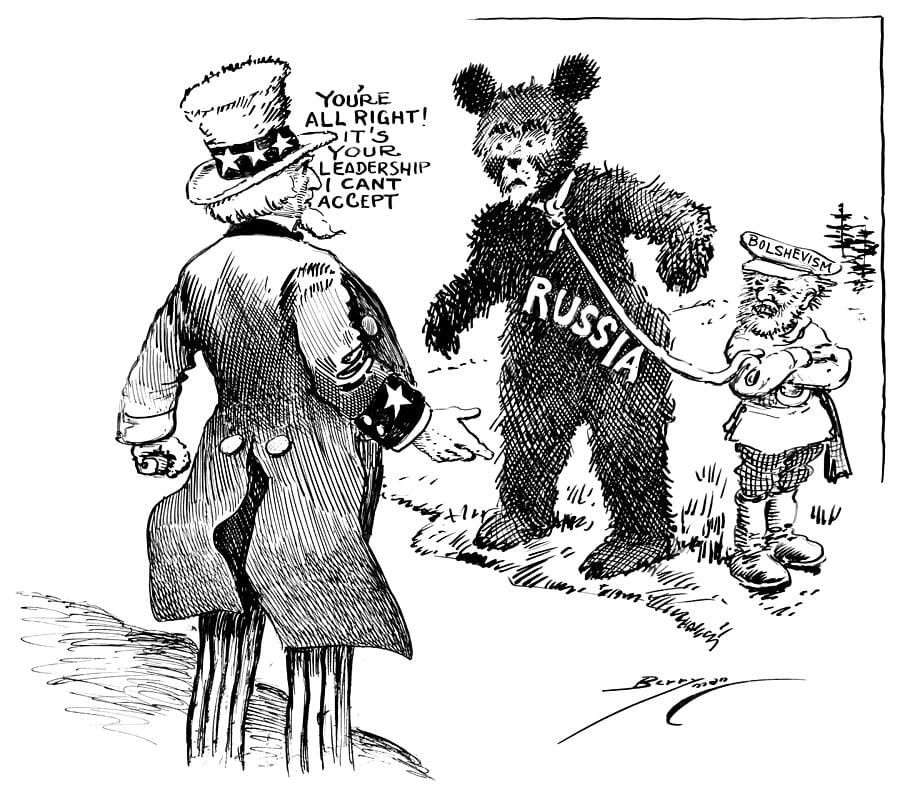
We have a habit of seeing ourselves as saving heroes as we enter other people’s conflicts. It is how we got into Vietnam, to save the South from the North. It’s also how Europe got into WWI: Russia was saving Serbia, Germany was saving Austria, etc (see cartoon below). We meddle our way, and leave much later than we planned. The result, as in Vietnam and Afghanistan is far more death and destruction than if we’d minded our own business. And US war-dead too. In Vietnam 58,000 US deaths. In Afghanistan 2,400 US dead. and no obvious accomplishment. As Henry Kissinger famously commented: “It’s dangerous to be America’s enemy, but deadly to be America’s friend.”

European aggression in WWII started with the good intention of preventing aggression. It got out of hand, as I fear our good intentions will in Ukraine.

The US troops we’ve sent to Ukraine are not called soldiers. They are “fighting advisors” sent to help the Ukrainians use our weapons. In WWI and Vietnam, fighting advisors are called invaders; it’s how we got drawn into Vietnam. The Russians claimed to send advisors when they entered the Crimea and later the Dundas. We called it an invasion. We can’t be that blind to our own words. Sooner or later, the advisors will start killing each other– something we’ll call an unprovoked attack. Our high tech aid including anti-tank missiles are reported to have killed some 10,000 Russians so far. We don’t seem to think the Russians will mind, or that they’ll give up as the body count mounts. In Vietnam, the more we killed with our high-tech weapons, the more the Vietnamese on both sides called us the villains, and the more Vietnamese joined the fight against us. That’s the future I fear for Ukraine, or worse. The conflict in WWI spiraled quickly beyond the borders of Serbia to include the whole world, and continued through WWII.

Our approach to diplomacy is counterproductive too, in my opinion, and similar to Vietnam too. We call Putin a terrorist, a madman and a narcissist, and then we begin talks with him to end the war. Biden has asked to have Putin removed by assassination.Does he think this will help, or if Putin is removed his successor will be a friend of the US? We demonized Ho Chi Minh, and propped up our favored, corrupt leaders. Minh was popular, as is Putin, and both have valid reasons for opposing us. Putin worries about the expansion of NATO. It’s not an illegitimate worry given Russian history of repeated invasions from the west.

Our desire to remove Russian leadership is a long-standing mistake. It does not lead to peace, or good negotiation, nor even peaceful co-existence.

Russia has been invaded many times. US schools mention Napoleon’s invasion in 1812 and the German’s in 1941, but there are more. They were invaded by the Germans in WWI too, and by the Ukrainian Cossacks in the days of Khmelnytsky, 1646-57. Before that the Polish Lithuanians, 1609-1618, the Swedes, 1701-1709, and in the early days, it was Tartars, Mongols, who invaded and ruled Russia from about 1225 til they joined with the Russian Tzars about 1650. Add to that, our help in the war of the Whites vs the Reds (1917-23) that produced Ukrainian independence — I talk about the relevance here. With a history like that, Russia has every reason to worry about NATO expansion. We should be cognizant of this and stop calling Putin a madman. Let’s accept the Russian version of history, and the sitting ruler of Russia.

Some cite the Budapest memorandum that lead to the removal of “Ukrainian” nuclear weapons, read it here. It’s short, only 1 page, and deliberately vague. it was signed by Putin’s predecessor, Boris Yeltsin, for the Russian Federation, along with representatives for Ukraine, The US, and The UK. The missiles were not Ukrainian, they were Soviet, and pointed at us. As a result of that agreement, they were dismantled and moved into Russia. There is no sense that this is an invitation for us to protect Ukraine against Russia. The co-signers sort-of agree to protect Ukraine from outsiders (Germany, Turkey,..?), but that’s not clear. We commit ourselves to peace in the region, and can claim that Russia violated the peace first, but there’s no invitation for us to violate it second. Until recently, the UK provided no military aid. China and most of the EU still trades with Russia; if they see a villainy, it’s not enough to stop trade.

Robert McNamara was Secretary of Defense under Kennedy and Johnson, and a key “Whiz Kid” pushing for war in Vietnam. Years later, he decided Vietnam was a mistake. A sad cartoon: the veterans are walking past the grave monument for the 58,000 US dead. I worry we’ll have a similar cartoon after this war.

In my opinion, our best course is to reduce our military aid to providing only basics: bullets, blankets, food… We should reopen discussions with Putin, not demonize him, or try to remove him. Ukraine will likely fight on even without our high-tech weapons. Perhaps they’ll buy from Europe, or from independent dealers. The death rate on both sides will be lower and peace will come quicker without us. Crimea might remain Ukrainian or Russian, but that will not be our decision. We’ve done enough damage for now. It took many years after the end of the Vietnam war for the instigators admit is was a mistake.

Robert Buxbaum April 3, 2022. Much of my thinking about Vietnam comes from Francis Fitzgerald’s wonderful book “Fire in the Lake”. I see it all happening again here. Also worth reading is this 2014 letter by Henry Kissinger about how to negotiate a peace: “Damning Putin is not a foreign policy; it’s an alibi for the lack of one.” It’s a nice insight. He seems to understand diplomacy about as well as anyone.

The claim that Ukrainians are Nazis is also Ukraine’s claim to statehood.

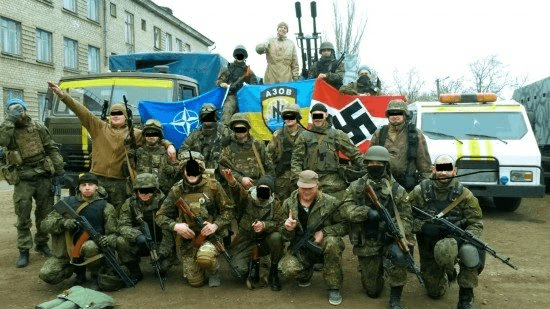
Recently Putin claimed he was going into Ukraine to fight Nazis. Twitter makes fun of this, but also shows many pictures of these Nazis. Under the hashtag #AzovBattalion, you’ll see many pictures of white boys with swastikas and Ukraine flags (see below). Perhaps these pictures are just Russian propaganda: According to our media there are no Nazis to speak of, and besides, the president of Ukraine is a Jew. Still, the pictures look real, and based on Ukraine history, there is quite a bit reason to think they are not an aberration. Still, to the extent that they represent Ukraine, these individuals are a major basis of Ukraine’s claim for independence. They are also a good reason to leave Ukraine out of NATO, IMHO.

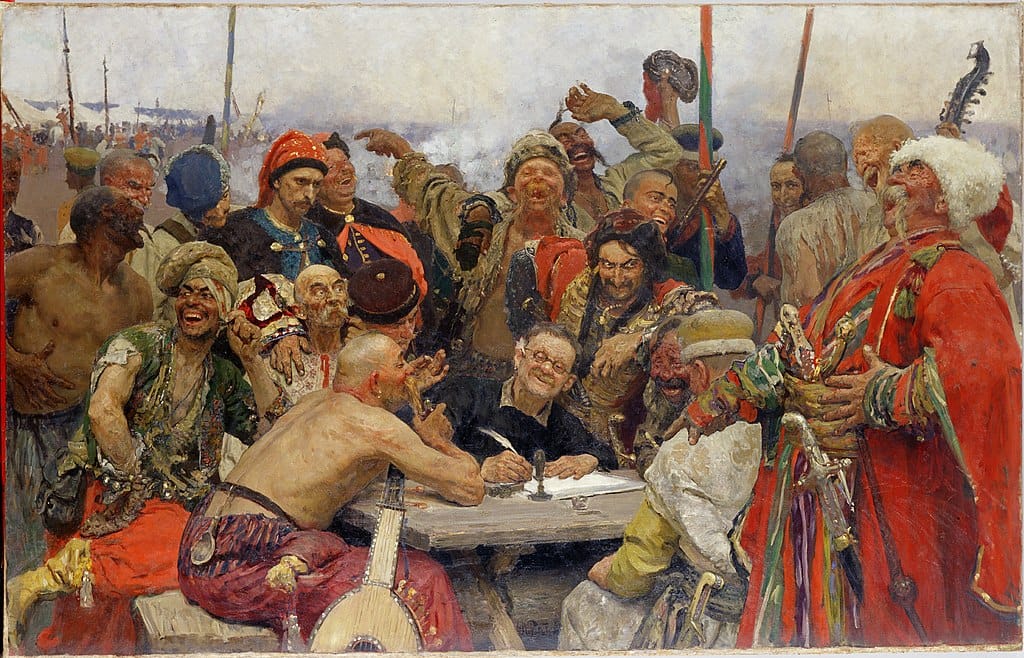
Let’s go back to the late days of the Tartars and the early days of the Cossacks, about 1600. There is a painting, below depicting Cossacks of those days writing a letter to The Sultan (original in the Kharkov museum). They do not seem the most savory of people, but they do seem independent and egalitarian. The letter is not written by a noble, but by a committee of pirates, and not everyone is happy about it.

Zaporozhian Cossacks write a letter to the sultan. These are the people who Putin claims should be loyal to Russia, but they have a long history of behaving otherwise. I like the scribe. A couple of people at left seem unhappy.

From 1250 to the mid 1700s, Southern Ukraine was ruled, to a greater or lesser extent, by the Crimean Tartars, a group of horse-riding Mongols who nominally served the great Khan. Moscow paid dues to them, and in 1571 the Tartar ruler,  Devlet I Giray burnt Moscow to collect his dues. The early Cossacks were Black-sea pirates, and enemies of the Tartars. Around 1600, the Cossacks and Tartars realized they had a lot in common (alcoholism, pederasty…) and formed an alliance. Mainly this was against the Poles and Jews. A famous result of this alliance was the Khmelnytsky Uprising (about 1650). Khmelnytsky was the “Hetman” (Head man?), the elected, temporary ruler for the uprising. He has become a symbol of Ukrainian independence, but he was also a brutal murderer of virtually all the Jews and Catholics. Today, he graces Ukraine’s $5 bill, and sits atop a statue in Kyiv’s central square. This elevation of Khmelnytsky is no small insult to Jews, Catholics, and civilization.

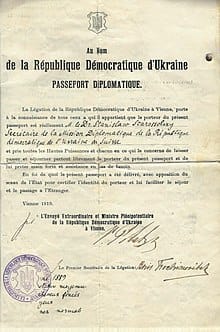
Ukrainian Republic passport, 1919.

 In 1654, via the Pereyaslav Agreement, Khmelnytsky’s Tartar-Cossacks formed an allegiance with the Tsar while retaining autonomy in Ukraine. This autonomy eroded over the years, and ended with Bolshevik rule in the early 20th century. After WWI, Ukrainians briefly tried for independence, forming the Ukraine Peoples Republic and the Ukraine Democratic republic, from 1917 to 1921. The head of the Republic was called hetman, an elected leader but also a throwback to a mass-murderer.

Stalin punished the Cossack remnant before WWIi, and when the Germans invaded in 1939, many of the remaining Ukrainians supported the Nazi invasion, and provided some of the most brutal murders of Jews; the murderers of Baba Year, for example. Putin recalls this collaboration when he calls the Ukrainians Nazis, and I suspect that he’s more right than our press will admit. These #azovbattalion pictures don’t look faked. On the other hand, the autonomy of the Ukrainians and Cossacks, and their attempts at independence provide historical backing for Ukraine’s claim to independence. Putting this another way, the more you accept that Ukraine is full of Nazi sympathizers, the more you should accept them as a distinct society from Russia.

Ukrainians of the Azov Battalion with a statue of Khmelnytsky, or some other murderer.

As an idea of how the war might go, I should mention another group of Tartar-Cossacks. These were Moslems who operated between the Don and Volga Rivers in what is known as Chechnya. Chechnya fought Russia in a long, bloody, unsuccessful struggle, that is only recently ended. Russia may win in Ukraine, but it is not likely to win easily or cheaply if Chechnya is any model.

Robert Buxbaum, Mar. 2, 2022