Tag Archives: Obama

A fair price for Bitcoin: less than $33,300.

Some 8 years ago, 2018, I calculated that a fair price for Bitcoin was likely $11,000, with a maximum of perhaps 4x more, $44,000. I used Fischer’s formula from my economics textbook, perhaps the only useful formula there. It’s based on the idea that the total currency value times the speed of money has to match the value of the things people buy with it. See the analysis here. Based on this formula, you see that, if you print more money, you get inflation — a concept that seems forgotten today.

It’s eight years later, and while there has been some inflation in the price of everything, the price of bitcoin has outstripped most everything else. After years of Bitcoin staying in the price range I’d suggested, it jumped to over $120,000 in 2025 before dropping back to $70,500. I figured I should revisit my calculations, and again find about the same result corrected for normal inflation: a “true value”, of <$33,300. I show why I value it this much, and share why, I think the market is wrong.
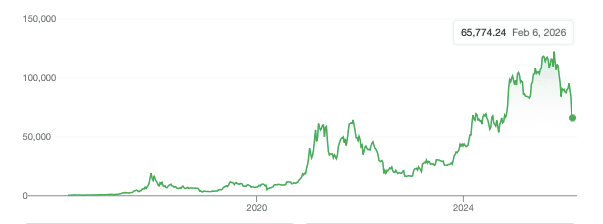
A history of Bitcoin prices

Bitcoin has only one “legitimate” use, as best I can tell, and that’s for illegal activities, like paying $6 million dollar to ransom Nancy Guthrie. The problems preventing a high bitcoin valuation, IMHO, are that there is not that much illegal trade, and there are other ways to pay for illegal things. Suitcases of cash can be used, or gold coins, or artwork. These are just as safe as bitcoin, and almost as easy to ship. For legitimate business, almost any pay method is better: easier, faster, and more secure.

Most people, I suspect, don’t use their bitcoin at all. They buy it as an investment, or as a gambling speculation, but that’s a zero-sum gamble, somewhat worse than gold, since gold have value above trade. Having no value aside from trade, Bitcoins are only as valuable as their use is.

One of the main use of bitcoin transactions is to avoid tariffs on legitimate goods – I explained how that was done, previously. I estimate the magnitude of this business to be $500 billion or so per year. The US collected about $220 billion in tariffs last year on a trillion dollars of trade, and I find it hard to believe that Bitcoins cover more than another 50%. Add to this, bitcoin is likely also used to hide payment for illegal, sanctioned oil from Iran and Russia. There are other ways to do this, but let’s assume it’s all bitcoin-trades. Since this oil trade seems to be about 8 million barrels per day, and since oil costs ~ $70 barrel, I calculate a business of $200 billion in world oil. Add a few more items that you don’t want traced: drugs, weapons, for a total of maybe $200 billion, add $100 billion to over-throw countries and for a kidnapping or two, and I find a total bitcoin trade of $1 trillion, or $1000 billion. If a bitcoin trades 1.5 times per year (a fairly low rate) the total value of bitcoin is $1000 billion /1.5 = $667 billion. Divide by the total number of bitcoins, 20 million, and I calculate a value of $33,300 per bitcoin or less.

A lot more value in bitcoins trade per year, about $10.5 trillion. The average Bitcoin price is three times higher than I estimate and it is spent 7.5 times per year. Most of this is churn: investment, plus some legitimate purchases based on illegal activity, like when the drug dealer buys a new car in Panama, but these sales are consequences of the other, illegal sales. I figured that each Bitcoin was used for an illegal purchase only 1.5 times per year because normal money is used ~4.5 times per year.

I should note that some illegal activity is done in US dollars, including most drug deals, and when Obama bought back US soldiers kidnaped by Iran, using bales of € 500 notes, and some is done using gold or silver. Bitcoin is easier to move but large quantity moves can still be traced, and there are other crypto currencies too. Bitcoin transactions aren’t free, either, or particularly cheap. And it takes time to process the transfer of bitcoin numbers, milliseconds, but that’s slow in world commerce. As a result. I don’t see bitcoin being used for legitimate business, and unless it can break out of the black market, the value seems limited to $33,300, and probably less.

Robert Buxbaum, February 15, 2026. Gold, by the way, is similarly overvalued, in my opinion. Like bitcoin, it’s a non-dividend investment that’s expensive to trade, but at least it has some other uses, as jewelry, and in electronics. Besides, it’s relatively hard to steal a billion dollars in gold from a Swiss bank – harder than stealing $1B in bitcoin.

The logic to think that prenatal Tylenol causes autism and ADHD

Robert Kennedy Jr. recently started the process to add a warning to the labels of acetaminophen products, including Tylenol, noting a correlation between its use during pregnancy and autism and ADHD in children. The advisability of this is controversial. Experts at Scientific American say “the evidence against Tylenol is thin,” The British Journal, Nature, went further: “It’s Dangerous to Avoid Tylenol While Pregnant”, reversing its call for caution. Similarly, Barak Obama: “Trump’s announcement is violence against the truth.” Nature’s current logic is that any risk of Autism and ADHD is smaller than the risk if pregnant women do not take fever medication. Given the confusion and politicalization of the topic, I thought I’d write about the magnitude of the risk, and the logic to think Tylenol causes autism and ADHD.

The evidence that there is some, large risk agent is the tremendous rise in the prevalence of autism and ADHD over the last 50 years, see chart above. The rise t matches the rise in the use of Tylenol as opposed to older medications, like aspirin. Correcting for other changes (confounders), this Oxford study finds 95% certainty association of acetaminophen with ADHD; care being taken to remove confounders.

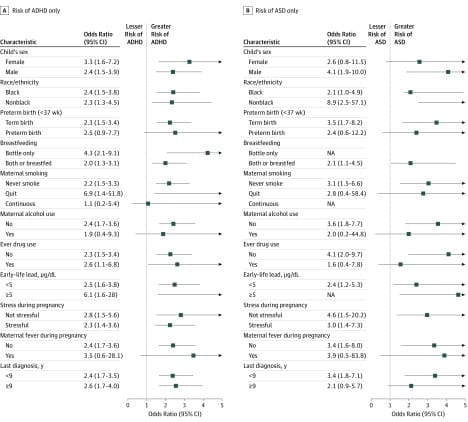
In terms of the magnitude of the Tylenol effect, this study from Johns Hopkins, compared fetal blood levels of acetaminophen enzymes (measured in the umbilical cord) to the risk of autism and ADHD. As shown below, there is roughly a three-times increase in risk for both in every sub-group of child: male and female, black and white, pre-term and full term, drug user or not, breast fed or not, fevered mother or not. Children with higher blood-acetaminophen levels (2nd, 3rd tercile) always have a higher chance of ADHD and ASD — about 3 times higher– than children in the lower tercile.

The higher cohorts of blood Tylenol is associated with higher risk of ASD and ADHD for every subgroup.

This European study found a similar association, but measured Tylenol use based on interviews. Between these studies, I find it reasonable to advise caution. This is the sort of evidence that caused us to put cancer warnings on cigarettes, caused us to caution against alcohol during pregnancy, and caused the mandate for seatbelts. This is usually what scientists use, it’s the best approach we have. I do not suggest dropping all fever medication, but suggest switching to older medications, like aspirin, or cool showers, or following the Harvard medical journal advice to take Tylenol in the minimum dose.

An upside to the political divide is that we’re likely to have better evidence in coming years. in Republican-leaning states, doctors have mostly favored the advisory. Meanwhile,in D-leaning states women are ignoring the advisory, some even filming themselves taking extra Tylenol, in distain for Trump. These two groups provide a controlled study, so that we should have have better data regarding Tylenol safety in 2-3 years.

Dr. Robert E. Buxbaum, October 12, 2025.

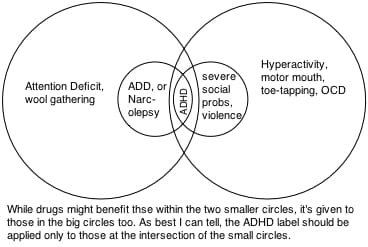
Added Oct. 20,2025: A cynical counter argument to the above, suggested by me ten years ago and others, is that there is no spike in ADHD, that it’s a scam perpetrated by teachers who prefer drugged students to antsy ones. If so, one could argue that the same genetics that make students antsy (ADHD and semi autistic) also affect Tylenol metabolism and use: Parents of such children take more Tylenol. Here is a good Swedish study that supports this view. If this proves to be true, the real scandal is how many normal students, mostly boys, have been drugged up and mis-educated.

Package postage from China: 70¢ for 2 oz.

The minimum US postage rate to send a 1 oz to 8 oz package across the street is $8.30. This is the price for any size package going in “zone 1”. That is, to a nearby, instate address. It costs more to send a package to nearby states or across the country, zones 2,3,4,5,6,7, 8 You don’t get shipping updates or delivery confirmation unless you pay more. By comparison the US post office charges no more than $1.50 to Chinese companies to deliver packages of up to 4.4 lbs (2 kg) and they get shipping and delivery confirmation thrown in free. The high US rates are, in part, because the post office is losing money to subsidize postage from China.

On the internet folks are amazed at how cheap things are shipped from China (I copied this post from this Forbes article)

US producers can not compete on the sale of small items, in part, because we subsidize the shipping costs. Go to Amazon or e-Bay and you can buy from China packaged items shipped by air for a total price of $1 or so. That includes the price of the item, the shipping cost, and some profit for Amazon or eBay. A US supplier could not sell this cheap even if it were a box of air. The low shipping costs result from a poorly negotiated postage deal of 2011 between us (Obama’s negotiator) and the Chinese. Until 2021, we are committed to deliver a package of 50g or less, (2 oz) for 5 Chinese Yuan, or 70¢ at the current exchange rate of 14¢/NCY. Additional ounces are billed at 35¢ up to 4.4 lbs; use the following table of prices and apply the dollar to CNY conversion. We threw in tracking services and an e-mail confirmation for free, in part because China was poor, and we were rich. Also, the deal was pushed by e-Bay and Amazon, two big supporters of Obama’s presidency.

US suppliers cannot compete.

Adding insult to injury, Obama raised the de minimis amount for billing tariffs from the normal $100 to $800 making almost all purchases from China duty free. Obama made some complaints about unfair trade, and about the counterfeits and knockoffs but no major enforcement. In 2012 and 2014, the Obama administration signed similar postage deals with Korea, Hong Kong, and the EU. The Germans applauded as it allows them to ship goods to the US for far less than the cost of us shipping to Germany. The US post office loses money on this and makes up for it by charging us more for domestic mail.

The Washington Post praised Obama on these deals claiming that they benefitted US customer and promoted democracy. Of course, the Washington Post is owned by Amazon’s main stock holder, Jeff Bezos– someone who benefits very much by the deal. He is among the relatively few people and organizations that own the media outlets. The Post loses money on newspaper sales but benefits the owners by the propaganda value of the stories, a situation also found with Al Jazeera and the emir of Qatar.

Trump has informed China that these special rates will end when the treaty runs out in January 1, 2021. A per-package ship fee will be $3.00 for a one ounce package, with 11¢ per additional once. This is less than the domestic rate, but far higher than the current 35¢ for 1 oz. I’d probably have raised their postage even more, but this is an election year, and Biden may well reverse any deal Trump signs.

Robert Buxbaum, July 14, 2020. Though I’m appalled by this postage deal, I just bought a 50 lb kayak from China, $99.99 including shipping. The prices are too low to pass up.

Bitcoin v cash to avoid Trump’s tariffs or ransom a sailor

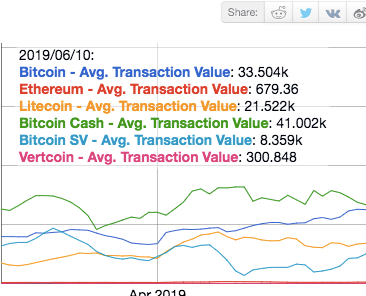
The number and cash value of bitcoin transactions has surged in the last two years, and it seems that a lot of the driving motivation is avoidance of Trump’s tariffs. If you want to avoid Trump’s tariffs, claim that the value of the shipment is less than it really is. Pay part via the normal banking system through the bill of lading (and pay tariffs on that) and pay the rest in bitcoin with no record and no taxes paid. The average bitcoin transaction amount has increased to $33,504, and that seems to be the amount of taxable value being dodged on each shipment. As noted in the journal, Cryptopolitan, “Smugglers attempting to export Chinese goods to the USA illegally have been found to be among the largest purchasers of Bitcoin.” https://www.cryptopolitan.com/is-us-china-trade-war-fueling-bitcoin-price-rally-to-7500/

Average transaction amount for several crypto currencies. The amount has surged for Bitcoin, blue line.

Bitcoin isn’t the only beneficiary of tariffs, of course, but it is the largest. The chart at right shows the average transaction value of the major cryptocurrencies. The average for most are in the dollar range that you’d expect for someone evading tariffs in containerized shipments. Someone who wants to import $100,000 worth of Chinese printers will arrange to have them shipped with a lower price bill of lading. The rest of the payment, 1/3 say, would be paid by a bitcoin transfer whose escrow is tied to the legally binding bill of lading.

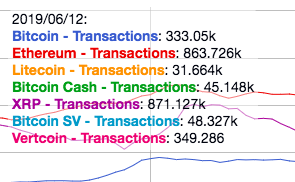
Number of transactions per day for several cryptocurrencies, data available from Bitinfocharts.com

Bitcoin does not stand out from the other cryptocurrencies so much in the amount of its average transaction, but in the number of transactions per day. As shown at left there are 333,050 bitcoin transactions per day at an average value of $33,504 per transaction. Multiplying these numbers together, we see that Bitcoin is used for some $11.2 billion in transactions per day, or $4.1 trillion dollars worth per year. The legitimate part of the US economy is only $58 billion per day, or $21 trillion per year. The amount will certainly rise if further tariffs are put into effect. 

Most other cryptocurrencies have fewer transactions per day, and the few that have similar (or higher) numbers deal in lower amounts. Etherium is used in 2.5 time more transactions, but the average Etherium transaction is only $679. This suggests that the total Etherium business is only $586 million per day. The dollar amounts of Etherium suggests that it is mostly used for drug trafficking, 

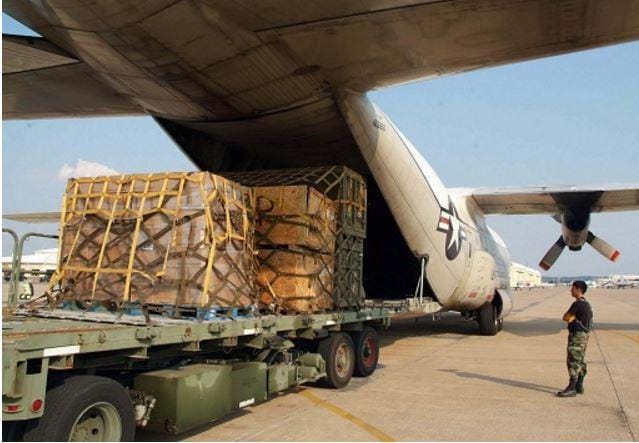
Cash-money is the old fashioned way to avoid tariffs, buy drugs, and do other illegal money transfers. This method isn’t going away any time soon. A suitcase of $100 bills gets handed over and the deal is done. Though it gets annoying as the amounts get large, there is a certain convenience at the other end, when you try to spend your ill-gotten gains. Thus, when Obama wanted to ransom the ten sailors that Iran had captured in 2016, he sent paper bills. According to the LA Times, this was three airplane shipments s of all non-US currency: Euros and Swiss Francs mostly. The first payment was $400 million, delivered as soon as Iran agreed to the release. The rest, $1.3 billion, was sent after the prisoners were released. Assuming that the bundles shown below contained only 100 Euro notes, each bundle would have held about $170 million dollars. We’d have had to send ten bundles of this size to redeem ten US sailors. The US ships, the laptops of sensitive information, and the weapons were granted as gifts to the Iranians. Obama claimed that all this was smart as it was cheaper than a war, and it likely is. The British had 15 sailors captured by Iran in 2009 and paid as well. In the late 1700s, John Adams (an awful president) paid 1/4 of the US budget as ransom to North African pirates. He paid in gold.

These are supposedly the pallets of cash used to ransom our sailors. Obama has justified the need to transfer the cash this way, and indeed a ransom is a lot cheaper than a war.

Obama could not have ransomed the sailors with Bitcoin as there was hardly enough Bitcoin value in existence at the time. Besides, the Iranians would have had a hard time spending it since, it is hard to spend Bitcoin on anything legal without first switching to bank checks or cash. Legitimate sellers want proof that they’ve paid, and financial watchdogs are always there sniffing at the conversion step. Things are simpler with paper money; not totally simple when there is no apparent source, but simply enough for mullahs.

Iranian released this picture of the US sailors captured. Obama ransomed them for $1.7 billion in Euros.

To get a sense of the amount of paper money used in illegal commerce, consider that there are $1.1 trillion in hundred dollar bills in circulation. This is four times more than the value of all Bitcoin in circulation currently. Based on the wear on our $100 bills, it seems each bill is used on average 30 times per year. This suggests there are $33 trillion dollars in trade that goes on with $100 bills. Not all of this trade is illegal, but I suspect a good fraction is, and this is eight times the trade in Bitcoin. The downside of cash is that cost of transferring large bails of it can be high, but at least it’s easy to make change for a bundle of $100 bills. With bitcoin, there is a fee for transfer too, and a fee charged to convert Bitcoin to cash; it’s often in excess of 1%, and that adds up when you do billion-dollar kidnappings and billion dollar arms buys. In case you are wondering how German uranium enrichment centrifuges got to Iran when there is an export embargo, I’m guessing it was done through an intermediary country using cash and/or Bitcoin payments.

It’s worth speculating on whether Bitcoin prices will rise as its use continues to rise. I think it will but don’t expect a fast rise. Over a year ago, I’d predicted that the price of Bitcoin would be about $10,500 each. I’d based that on Fisher’s monetary equation, that relates the value of a currency to the amount spent and the speed of money. As it happens I got the right dollar value because I’d underestimated the amount of Bitcoin purchases and the speed of the money by the same factor of four. For the price of a Bitcoin to rise, it is not enough for it to be used more. There also has to be no parallel rise in the velocity of transactions (turnovers per year). My sense is that both numbers will rise together and thus that the bitcoin price will level out, long term, with lots of volatility following daily changes in use and velocity.

As a political thought, I expect is that Bitcoin traders will mostly support Trump. My expectation here is for the classic alliance the existed between bootleggers and the prohibition police during prohibition. During prohibition, jobs among the police, plus salaries and bonuses depended on liquor being illegal, and thus they supported prohibition. Bootleggers benefitted too: their high prices and profits depended on prohibition. I thus expect Bitcoin traders will support Trump as a way of protecting profits and value. Real estate moguls, I suspect, support Trump because they benefit from the ability to sell real-estate with off tariff Bitcoin. If the tariffs went away, so would the amount of smuggling income going into real estate. Amazon’s owner, Jeff Bezos, is currently anti Trump, I suspect, because Amazon still pays tariffs.

Robert Buxbaum,  July 10, 2019. Here are my thoughts about tariffs and free trade, and here is Satochi’s original article proposing Bitcoin and explaining how it would work. As for Iran, they’ve announced a fee for any ship in the Gulf of Hormuz. If you don’t pay, you might get attacked as a Japanese tanker recently was. My guess is payments are made in cash or Bitcoin to avoid embarrassing the payer.