Tag Archives: innovation

What causes innovation? is it worth it?

Innovation is the special sauce that propels growth and allows a country to lead and prosper. The current Nobel prize believe that innovation powered the Industrial Revolution, causing England to become rich and powerful, while other nations remained poor, weak, and stagnant. Similarly, Innovation, they believe is why 19th century Japan rose to defeat China, and propelled China’s 21st century rise. But why did they succeed when others did not. What could the leader of a country do to bring power and wealth through innovation. Improved education seems to help; all of the innovation countries have it, but it is not the whole. Some educated countries (Germany, Russia) stagnate. An open economy is nice, but it isn’t sufficient or that necessary: (look at China). That was the topic of this year’s, 2025 Nobel prize in economics to Mokyr, Howitt, and Aghion, with half going to Joel Mokyr for his insights, historical and forward looking, the other half going for economic modeling. I give below my understanding of their insights, more technical than most, but not so mathematical as to be obtuse the normal reader..

The winners hold that innovation, as during the industrial revolution, is a non-continuous contribultion caused by a particular combination of education and market opportunity, of theoretical knowledge, and practical, and that a key aspect is depreciation (destruction) of other suppliers. Let’s start by creating a simple, continuous function model for economic growth where growth = capital growth, that is dK/dt. K, Capital, is understood to be the sum of money, equipment, and labor knowledge, and t is time with dK/dt, the change in K with time modeled as equal to the savings rate, s, times economic activity, Y minus a depreciation factor, δ, times capital, K.

growth = dK/dt = sY − δ K.
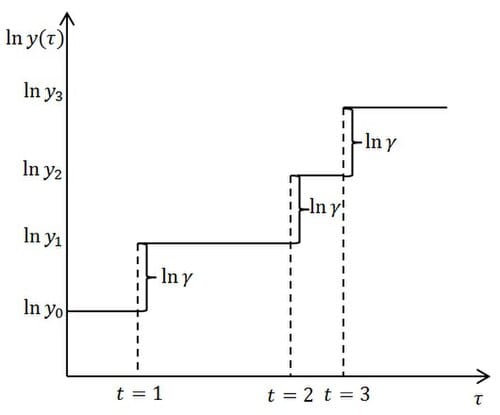
Innovation, in the Howett model, is discontinuous and accumulative. It builds on itself.

For the authors, Y = GDP + x, where x is the cost of outside goods used. They then claim that Y is a non-linear function of K, where K is now considered a product of capital goods and labor K = xL and,

dY/dK = AKα + γ where 0< α <1, and where γ is the contribution of innovation and/or depreciation. The power function, as I understand it, is a mathematical way of saying there are economies of scale. The authors assume a set of interacting enterprises (countries0 so that the innovation factor, γ for one country is the depreciation factor for the other. That is, growth and destruction are connected, with growth being a function of monopoly power — control of your innovation.

According to the Nobel winners, γ is built n previous γ as shown in the digram at right. It can not be predicted as such, but requires education and monopolistic power. The inventor-manufacturer of the typewriter has a monopolistic advantage over the makers of fountain pens. Innovation thus causes depreciation, δ K as one new innovation depreciates many old processes and products. If you add enough math, you can derive formulas for GDP and GDP growth, all based on factors like A and α, that are hard to measure.

GDP = α(2α/1−α) (1-α2)A L,

Thus, GDP is proportional to Labor, L and per-capita GDP is mostly an independent function related to economies of scale and the ability to use capital and labor which is related to general country-wide culture.

The above analysis, as I understand it, is in contrast to Kensyan models, where growth is unrelated to innovation, and where destruction is bad. In these Kenysean models, growth can be created by government spending, especial spending to maintain large industries with economies of scale and by spending to promote higher education. The culture preferred here, as I understand is one that rewards risk-taking, monopoly economics, and creative destruction. Howitt, and Aghion, importantly codify all this with formulas, as presented above that (to me) provide little specific. No great guidance to the head of a country. Nor does the math make the models more true, but it makes the statements somewhat clearer. Or perhaps the only real value of the math is to make things sound more scientific see the Tom Lehrer song, Sociology.
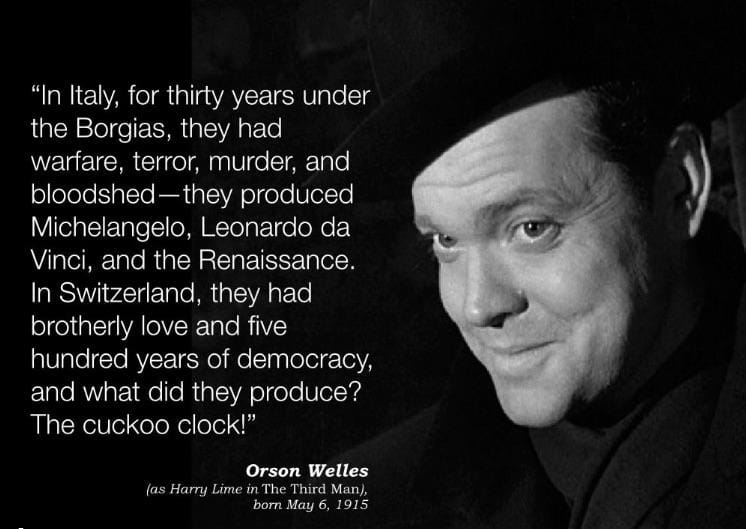
This insight from movie script by Grham Green suggests to me that progress may not be the greatest of advantages, perhaps not even worth it.

This work seems more realistic, to me, than the Keynesian models Both models are mathematically consistent, but if Keynes’s were true, Britain might still be on top, and Zambia would be a close competitor among the richest countries on earth. Besides these new fellows seem to agree with the views of Peter Cooper, my hero. See more here.

Writing all this reminds me that the fundamental assumption that progress is good, in not necessarily true. I quote above a line that Orson Wells, as Harry Lime, ad-libbed for the movie, “The Third Man.” Lime points out that innovation goes with suffering, and claims that Switzerland had little innovation because of its stability. Perhaps then, what you really want is the stability and peace of Switzerland, along with the lack of domination and innovation. On the same note, I’ve noticed that engineering innovators often ruin themselves dining in ruin, while the peaceable, stable civil engineers live long pleasant lives of honor.

Robert Buxbaum, November 16, 2025. A note about Switzerland is that was peaceful and stable because of a strong military. As Publius Vegetius wrote, Si vis pachim para bellum (if you wish of peace, prepare for war).

American education how do we succeed?

As the product of a top American college, Princeton University, I see that my education lacks in languages and history compared to Europeans. I can claim to know a little Latin and a little Greek, like they do, but I’m referring to Manuel Ramos and Stanos Platsis, two short people, one of Spanish descent, the other of Greek.

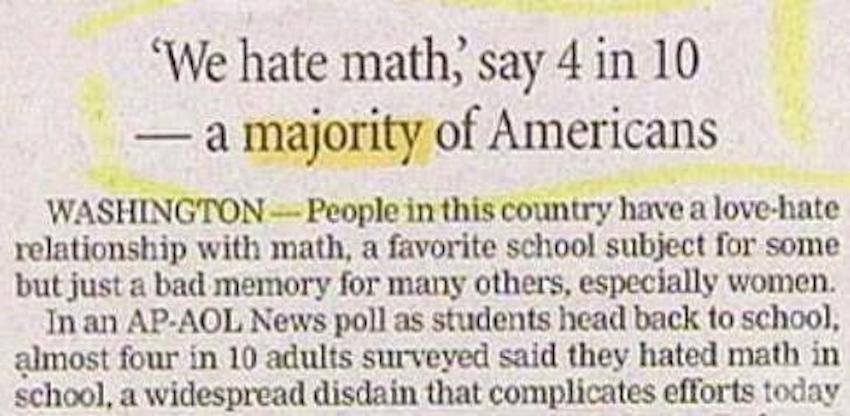
Americans hate math.

Americans hate math.

It was recently reported that one fourth of college-educated Americans did not know that the earth spun on an axis, a degree of science ignorance that would be inconceivable in any other country. Strange to say, despite these lacks, the US does quite well commercially, militarily, and scientifically. US productivity is the world’s highest. Our GNP and GNP per capita too is higher than virtually any other country (we got the grossest national product). How do we do it with so little education?

One part of US success is clearly imported talent, Immigration. We import Nobel chemists, Russian dancers, and German rocket scientists but we don’t import that many. They help our per-capita GNP, but the majority of our immigrants are more in the wretched refuse category. Even these appear to do better here than the colleagues they left behind. Otto von Bismark once joked that, “God protects children, drunks, and the United States of America.” But I’d like to suggest that our success is based on advantages our outlook our education provides for our more creative citizens.

Most of our successful businesses are not started by the A students, but by the C student who is able to use the little he (or she) knows. Consider the simple question of whether the earth goes round the sun. It’s an important fact, but only relevant if you can use it, as Sherlock Holmes points out. I suspect that few Europeans could use the knowledge that the earth spins (try to think of some applications; at the end of this essay I’ll provide some).

Benjamin Jowett. His students included the heads of 6 colleges and the head of Eaton

Benjamin Jowett, Master of Balliol College, Oxford.

A classic poem about European education describes Benjamin Jowett, shown at right. It goes: “The first come I, my name is Jowett. There is no knowledge, but that I know it. I am master of this college. What I don’t know isn’t knowledge.” Benjamin Jowett was Master of Balliol College, Oxford. By the time he died in 1893, his ex-student pallbearers included the heads of 6 colleges, and the head of Eaton. Most English heads of state and industry were his students directly or second-hand. All learned a passing knowledge of Greek, Latin, Plato, law, science, theology, classics, math, rhetoric, logic, and grammar. Only people so educated were deemed suited to run banks or manage backward nations like India or Rhodesia. It worked for a while but showed its limitations, e.g. in the Boer Wars.

In France and continental Europe the education system is similar to England’s under Jowett. There is a fixed set of knowledge and a fixed rate to learn it. Government and industry jobs go largely to those who’ve demonstrated their ability to give the fixed, correct answers to tests on this knowledge. In schools across France, the same page is turned virtually simultaneously in the every school– no student is left behind, but none jump ahead either. As new knowledge is integrated, the approved text books are updated and the correct answers are adjusted. Until then, the answers in the book are God’s truth, and those who master it can comfort themselves to have mastered the truth. The only people hurt are the very few dummies who see a new truth a year before the test acknowledges it. “College is a place where pebbles are polished but diamonds are dimmed.” The European system appears to benefit the many, providing useful skills (and useless tidbits) but it is oppressive to many others with forward-thinking, imaginative minds. The system appears to work best in areas that barely change year-to-year like French grammar, geometry, law, and the map of Europe. It does not work so well in music, computers, or the art of war. For these students, schooling is “another brick in the wall. For these students, the schools should teach more of how to get along without a teacher.

The American approach to education leans towards independence of thought, for good or bad. American graduates can live without the teacher, but leave school knowing no language but English, hardly and maths or science, hardly any grammar, and we can hardly find another country on a map. Teachers will take incorrect answers as correct as a way to build self-esteem, so students leave with the view that there is no such thing as truth. This model works well in music, engineering, and science where change is fast, creativity is king, and nature itself is a teacher. American graduate-schools are preeminent in these areas. In reading, history and math our graduates might well be described as galumphing ignorants.

Every now and again the US tries to correct this, by the way, and join the rest of the world. The “no child left behind” movement was a Republican-led effort to teach reading and math on the French model. It never caught on. Drugs are another approach to making American students less obstreperous, but they too work only temporarily. Despite these best efforts, American graduates leave school ignorant, but not stupid; respectful of those who can do things, and suspicious of those with lengthy degrees. We survive as managers of the most complex operations with our bumptious optimism and distain for hierarchy. As viewed from abroad, our method is to greet colleagues in a loud, cheerful voice, appoint a subordinate to “get things done,” and then get in the way until lunchtime.

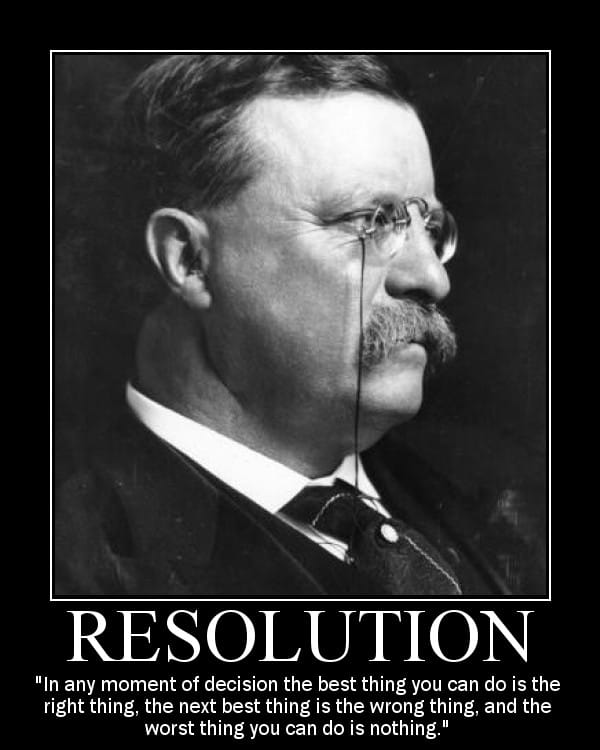
In any moment of decision, the best thing you can do is the right thing, the next bet thing is the wrong thing, and the worst thing you can do is nothing. An American attitude that sometimes blows up, but works surprisingly well at times.

Often the inability to act is worse than acting wrong.

The American-educated boss will do some damage by his ignorance but it is no more than  comes from group-think: non-truths passed as truths. America stopped burning witches far sooner than Europe, and never burned Jews. America dropped nobles quicker, and transitioned to electric lights and motor cars quicker, perhaps because we put less weight on what nobles and universities did.

European scholars accepted that nobility gave one a better handle on leadership, and this held them back. Since religion was part of education, they accepted that state should have an established religion: Anglican, in England, Catholicism in France; scientific atheism now. They learned and accepted that divorce was unnecessary and that homosexuality should be punished by prison or worse. As late as the early 60s, Turing, the brilliant mathematician and computer scientist, was chemically castrated as a way to cure his homosexuality. In America our “Yankee ingenuity,” as we call it, had a tendency to blow up, too (prohibition, McCarthyism, and disco), but the problems resolved relatively soon. “Ready, fire, aim” is a European description of the American method. It’s not great, but works after a fashion.

The best option, I think, is to work together with those from “across the pond.” It worked well for us in WWI, WWII, and the American Revolution, where we benefitted from the training of Baron Von Steuben, for example. Heading into the world cup of football (fifa soccer) this week, we’re expected to lose badly due to our lack of stars, and general inability to pass, dribble, or strategize. Still, we’ve got enthusiasm, and we’ve got a German coach. The world’s bookies give us 0.05% odds, but our chances are 10 times that, I’d say: 5%. God protects our galumphing side of corn-fed ignorants when, as in the Revolution, it’s attached to German coaching.

Some practical aspects of the earth spinning: geosynchronous satellites (they only work because the earth spins), weather prediction (the spin of hurricanes is because the earth spins), cyclone lifting. It amazes me that people ever thought everything went around the earth, by the way; Mercury and Venus never appear overhead. If authorities could have been so wrong about this for so long, what might they be wrong about today?

Dr. Robert Buxbaum, June 10, 2014 I’ve also written about ADHD on Lincoln’s Gettysburg Address, on Theodore Roosevelt, and how he survived a gun shot.