Tag Archives: health

Marijuana, paranoia, and creativity

Many studies have shown that marijuana use and paranoid schizophrenia go together, the effect getting stronger with longer-term and heavy use. There also seems to be a relation between marijuana (pot) and creativity. The Beetles and Stones; Dylan, DuChaps, and Obama: creative musicians painters, poets and politicians, smoked pot. Thus, we can ask what causes what: do crazy, creative folks smoke pot, or does pot-smoking cause normal folks to become crazy and creative, or is there some other relationship. Dope dealers would like you to believe that pot-smoking will make you a creative, sane genius, but this is clearly false advertising. If you were not a great artist, poet, or musician before, you are unlikely to be one after a few puffs of weed.

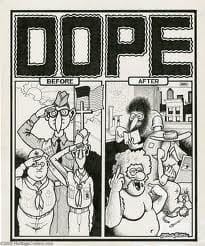
The Freak Brothers, by Gilbert Shelton. While these boys were not improved by dope, It would be a shame to put the artist in prison for any length of time.

The Freak Brothers, by Gilbert Shelton. What’s the relationship?

When things go together, we apply inductive reasoning. There are four possibilities: A causes B (pot makes you crazy and/or creative), B causes A (crazy folks smoke pot, perhaps as self medication), A and B are caused by a third thing C (in this case, poverty culture, or some genetic mutation). Finally, it’s possible there’s no real relationship but a failure to use statistics right. If we looked at how many golf tournaments were won by people with W last names (Woods, Wilson, Watson) we might be fooled to think it’s a causal relationship. Key science tidbit: correlation does not imply causation.

The most likely option, I suspect is that some of all of the above is going on here: There is an Oxford University study that THC, the main active ingredient in pot, causes some, temporary paranoia, and another study suggests that pot smoking and paranoid insanity may be caused by the same genetics. To this mix I’d like to add another semi-random causative: that heavy metals and other toxins that are sometimes found in marijuana are the main cause of the paranoia — while being harmful to creativity.

marijuana -paranoia

Pot cultivation is easy — that’s why it’s called weed– and cultivation is often illegal, even in countries with large pot use, like Jamaica. As a result, I suspect pot is grown preferentially in places contaminated with heavy metal toxins like vanadium, cadmium, mercury, and lead. No one wants to grow something illegal on their own, good crop-land. Instead it will be grown on toxic brownfields where no one goes. Heavy metals are known to absorb in plants, and are known to have negative psychoactive properties. Inhalation of mercury is known to make you paranoid: mad as a hatter. Thus, while the pot itself may not drive you nuts, it’s possible that heavy metals and other toxins in the pot-soil may. The creativity would have to come from some other source, and would be diminished by smoking bad weed.

I suspect that creativity is largely an in-born, genetic trait that can be improved marginally by education, but I also find that creative people are necessarily people who try new things, go off the beaten path. This, I suspect, is what leads them to pot and other “drug experiments.” You can’t be creative and walk the same, standard path as everyone else. I’d expect, therefore, that in high use countries, like Jamaica, creative success is preferentially found in the few, anti-establishment folks who eschew it.

Robert E. (landslide) Buxbaum, September 4, 2014. The words pot, marijuana, dope, and weed all mean the same but appear in different cultural contexts. To add to the confusion, Jamaicans refer to pot as ganja or skiff, and their version of paranoid schizophrenia is called “ganja psychosis”. I’m not anti-pot, but favor government regulation— perhaps along the lines of beer regulation, or perhaps the stricter regulation of Valium. My most recent essay was on the tension-balance between personal freedom and government control. I was recently elected in Oak Park’s 3rd voting district. My slogan: “A Chicken in every pot, not pot in every chicken”. I won by one vote. For those who are convinced they’ve become really deep, creative types without having to create anything, let me suggest the following cartoon about talent. Also, if pot made you smart, Jamaica would be floating in Einsteins.

In praise of openable windows and leaky construction

It’s summer in Detroit, and in all the tall buildings the air conditioners are humming. They have to run at near-full power even on evenings and weekends when the buildings are near empty, and on cool days. This would seem to waste a lot of power and it does, but it’s needed for ventilation. Tall buildings are made air-tight with windows that don’t open — without the AC, there’s be no heat leaving at all, no way for air to get in, and no way for smells to get out.

The windows don’t open because of the conceit of modern architecture; air tight building are believed to be good design because they have improved air-conditioner efficiency when the buildings are full, and use less heat when the outside world is very cold. That’s, perhaps 10% of the year. 

No openable windows, but someone figured you should suffer for art

Modern architecture with no openable windows. Someone wants you to suffer for his/her art.

Another reason closed buildings are popular is that they reduce the owners’ liability in terms of things flying in or falling out. Owners don’t rain coming in, or rocks (or people) falling out. Not that windows can’t be made with small openings that angle to avoid these problems, but that’s work and money and architects like to spend time and money only on fancy facades that look nice (and are often impractical). Besides, open windows can ruin the cool lines of their modern designs, and there’s nothing worse, to them, than a building that looks uncool despite the energy cost or the suffering of the inmates of their art.

Most workers find sealed buildings claustrophobic, musty, and isolating. That pain leads to lost productivity: Fast Company reported that natural ventilation can increase productivity by up to 11 percent. But, as with leading clothes stylists, leading building designers prefer uncomfortable and uneconomic to uncool. If people in the building can’t smell an ocean breeze, or can’t vent their area in a fire (or following a burnt burrito), that’s a small price to pay for art. Art is absurd, and it’s OK with the architect if fire fumes have to circulate through the entire building before they’re slowly vented. Smells add character, and the architect is gone before the stench gets really bad. 

No one dreams of working in an unventilated glass box.

No one dreams of working in a glass box. If it’s got to be an office, give some ventilation.

So what’s to be done? One can demand openable windows and hope the architect begrudgingly obliges. Some of the newest buildings have gone this route. A simpler, engineering option is to go for leaky construction — cracks in the masonry, windows that don’t quite seal. I’ve maintained and enlarged the gap under the doors of my laboratory buildings to increase air leakage; I like to have passive venting for toxic or flammable vapors. I’m happy to not worry about air circulation failing at the worst moment, and I’m happy to not have to ventilate at night when few people are here. To save some money, I increase the temperature range at night and weekends so that the buildings is allowed to get as hot as 82°F before the AC goes on, or as cold as 55°F without the heat. Folks who show up on weekends may need a sweater, but normally no one is here. 

A bit of air leakage and a few openable windows won’t mess up the air-conditioning control because most heat loss is through the walls and black body radiation. And what you lose in heat infiltration you gain by being able to turn off the AC circulation system when you know there are few people in the building (It helps to have a key-entry system to tell you how many people are there) and the productivity advantage of occasional outdoor smells coming in, or nasty indoor smells going out.

One irrational fear of openable windows is that some people will not close the windows in the summer or in the dead of winter. But people are quite happy in the older skyscrapers (like the empire state building) built before universal AC. Most people are nice — or most people you’d want to employ are. They will respond to others feelings to keep everyone comfortable. If necessary a boss or building manager may enforce this, or may have to move a particularly crusty miscreant from the window. But most people are nice, and even a degree of discomfort is worth the boost to your psyche when someone in management trusts you to control something of the building environment.

Robert E. Buxbaum, July 18, 2014. Curtains are a plus too — far better than self-darkening glass. They save energy, and let you think that management trusts you to have power over your environment. And that’s nice.

Is ADHD a real disorder

When I was in school, ADHD hadn’t been invented. There were kids who didn’t pay attention for a good part of the day, or who couldn’t sit in their seats, but the first activity was called day-dreaming and the second “shpilkas” or “ants in your pants.” These problems were recognized but were considered “normal.” Though we were sometimes disorderly, the cause wasn’t labeled a disorder. It’s now an epidemic.

There were always plenty of kids, me included, who were day-dreamers. Mostly these were boys who would get bored after a while and would start to look around the room, or doodle, or gaze into space thinking of this or that. Perhaps I’d do some writing or math in the margin of a notebook while listening with one ear; perhaps I’d work on my handwriting, or I’d read something in another textbook. This was not called a disorder or even an attention deficit (AD), but rather day-dreaming, wool-gathering, napping, or just not paying attention. Sometimes teachers got annoyed, other times not. They went on teaching, but sometimes tossed chalk or erasers at us to get us to wake up. Kids like me took enough notes to do OK on tests and homework, though I was never at the top of the class in elementary or middle school. The report cards tended to say things like “he could do better if he really concentrated.”  It’s something that could apply to everyone.

Then there were the boys who would now be labeled HD, or “hyperactive disordered.” These were always boys: those who didn’t sit well in their chairs, or fidgeted, or were motor mouths and got up and walked about, or got into fights, or went to the bathroom; these were the class clowns, and the trouble makers — not me except for the fidgeting. Girls would fidget or talk too, and they’d pass notes to each other, but they didn’t get into fights, and they weren’t as disruptive. They tended to have great handwriting, and took lots of notes in class: every single word from the board, plus quite a bit more.

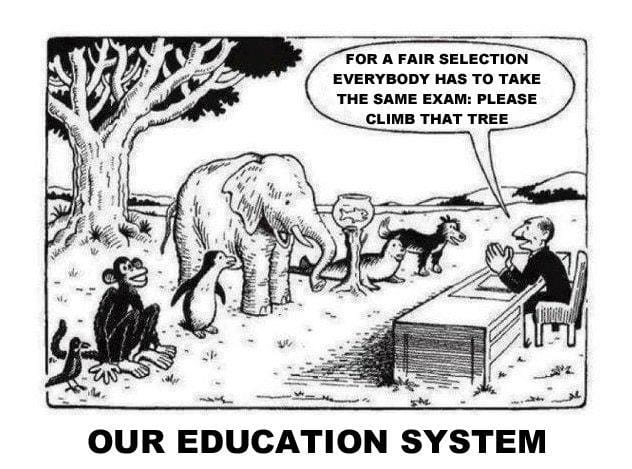
There are different measures of education, if you measure a fish's intelligence by the ability to climb a tree it will spend its life thinking it's stupid.

There are different measures of education, if you measure a fish’s skill level by the ability to climb a tree you’ll conclude the fish is ADD or worse.

Elementary and middle schools had activities to work out the excess energy that caused hyper-activity. We had dancing, shop, fire drills, art, some music, and sports. None of these helped all that much, but they did some good. I think the fire drills helped the most because we all went outside even in the winter, and eventually we calmed down without drugs. Sometimes a kid didn’t calm down, got worse, and did real damage; these kids were not called hyperactive disordered, but “bad kids” or “juvenile delinquents.” Nowadays, schools have far less art and music, and no shop or dancing. There are a lot more hyperactive kids, and the claim nowadays is that these hyperactive kids, violent or not, are disordered, ADHD, and should be given drugs. With drugs, the daydreamers take better notes, the nappers wake up, and the hyperactive kids calm down. Today about 30% of high-school seniors are given either a version of amphetamine, e.g. Adderall, or of Methylphenidate (Ritalin, etc.) The violent ones, the juvenile delinquents, are given stronger versions of the same drugs, e.g. methamphetamine, the drug at the heart of “breaking bad.”

Giving drugs to the kids seems to help the teacher a lot more than it helps the kids. According to a famous joke, giving the Ritalin to the teacher would be the best solution. When the kids are given drugs the disorderly boys (it’s usually given to boys) begin to act more like “goodie goodies”. They sit better and pay attention more; they take better notes and don’t interrupt, but I’m not sure they are learning more, or that the class is, or that they are socializing any better than before. The “goodie-goodies” in elementary school (mostly girls) did great in the early grades, but their good habits seemed to hold them back later. They worked too hard to please and tended to not notice, or pretended to not notice, when the teacher said nonsense. When it came time for independent or creative endeavors, their diligent acceptance of authority stood in the way of excellence.Venn diagram of ADHD

The hyperactive and daydreamers were more used to thinking for themselves, a prerequisite of leadership. The AD ones had gotten used to half-ignoring the teacher, and the HD ones were more openly opinionated and oppositional: obstreperous, in a word. Those bright enough to get by got more out of their education, perhaps because it was more theirs. To the extent that education was supposed to make you a leader and a thinker, the goodie-goodie behavior was a distraction and a disorder. This might be expected if education is supposed to be the lighting of a fire, not the filling of a pit. If everyone thinks the same, it’s a sign that few are thinking.

Map  of ADHD variation with location for US kids ages 6-18, Scrips Research.

Map of ADHD variation with location for US kids ages 6-18, Scrips Research. Boys are 2-3 times more often diagnosed as ADHD; diagnosis and medication increase with grade, peaking currently in early college.

This is not to say that there is no such disorder as ADHD, or no benefit from the drugs. My sense, though, is that the label is given too widely, and that the drugs are given too freely. Today drugs are pushed on virtually any kid who’s distracted, napping or hyperactive — to all the members of the big circles in the Venn diagram above, plus to athletes and others who feign ADD to get these, otherwise illegal, performance enhancing drugs. Currently, about 10% of US kids between 6 and 18 are diagnosed ADHD and given drugs, see figure. The numbers higher for boys than girls, higher in the US than abroad, and higher as the kids progress through school. It’s estimated that about 25% of US, 12th grade boys are given amphetamine or Ritalin and its homologs. My sense is that only a small fraction of these deserve drugs, only those with severe social problems, the violent or narcoleptic: those in the smaller circles of the Venn diagram. The test should not be that the kid’s behavior improves on them. Everyone’s attention improves when taking speed. ADHD appears more as an epidemic of overworked, undertrained, underfunded teachers, and a lack of outlets, not of disordered kids, or of real learning, and real learning is never pretty or easy (on all involved).

Robert Buxbaum, April 18, 2014. In general, I think people would be happier if they’d do more artmusicdance and shop, and if they’d embrace their inner weirdo. It would also help if doctors and teachers would use words rather than initials to describe people. It’s far better to be told you’re hyperactive, or that you’re not paying attention, then to be called ADD, HD, or ADHD. There’s far more room for gradation and improvement. I’m not an expert, just an observant observer.

Dada, or it’s hard to look cool sucking on a carrot.

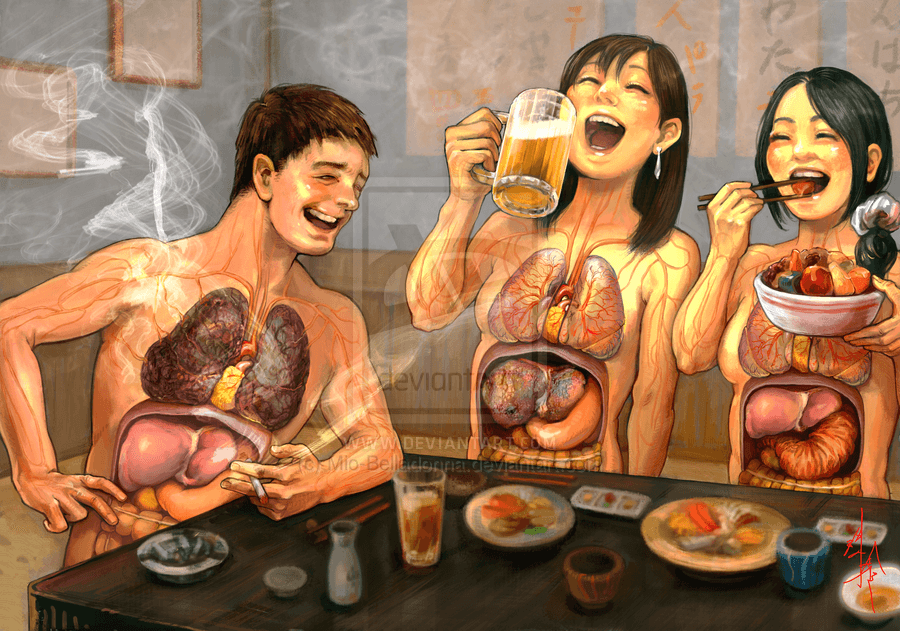
When it’s done right, Dada art is cool. It’s not confusing or preachy; it’s not out there, or sloppy; just cool. And today I found the most wonderful Dada piece: “Attention”, by Gabriel -Belladonna, shown below from “deviant art” (sorry about the water-mark).

At first glance it’s an advertisement against smoking, drinking, and eating sweets. The smoker has blackened lungs, the drinker has an enlarged liver, and the eater of sweets a diseased stomach. But something here isn’t right; the sinners are happy and young. These things are clearly bad for you but they’re enjoyable too and “cool” — Smoking is a lot cooler than sucking on a carrot.

Dada at it's best: Attention by Mio Belladonna. The sinners are happy.

Dada at it’s best: “Attention” by Dadaist Gabriel (Mio) Belladonna, 2012; image from deviant art. If I were to choose the title it would be “But it’s hard to look cool sucking on a carrot.”

At its best, Dada turns advertising and art on its head; it uses the imagery of advertising to show the shallowness of that, clearly slanted medium, or uses art-museum settings to show the narrow definition of what we’ve come to call “art”. In the above you see the balance of life- reality and the mind control of advertising.

Marcel Duchamp's fountain and "Manikken Pis" Similar idea, Manikken is better executed, IMHO.

Marcel Duchamp’s fountain and “Manikken Pis.”

Any mention of dada should also, I suppose, mention Duchamp’s fountain (at right, signed fancifully by R. Mutt). In 2004, fountain was voted “the most influential artwork of the 20th century” by a panel of artists and art historians. The basic idea was to show the slight difference between art and not-art (to be something, there has to be a non-something, as in this joke). Beyond this, the idea would be that same as for the Manikken Pis sculpture in Brussels. Duchamp’s was done with a lot less work — just by signing a “found object.” He submitted the work for exhibition in 1917, but it was rejected as not being art — proving, I guess, the point. Fountain is related to man: his life, needs, and vain ambitions; it’s sort-of beautiful, so why ain’t it art? (It has something to do with skill, I’d say.)

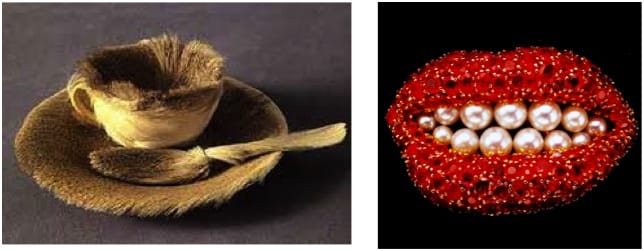
Duchamp designed two major surrealist exhibitions — a similar approach, but surrealism typically employs more skill and humor than Dada, with less shock. Below is another famous work of dada, Oppenheim’s fur-lined tea-cup (Breakfast in fur — see it at the Modern Museum in NYC) compared to a wonderful (and in my mind similar) surreal work, “Ruby lips” by Dali. Oppenheim made the tea-cup and spoon disgusting by making it out of a richer material, fur. That’s really cool, and sort-of shocking, even today.

Duchap's tea cup (left), and Dali's ruby lips (right). Similar ideas treated as Dada or Surreal.

Meret Oppenheim’s fur tea-cup (Breakfast in fur) and Dali’s ruby lips; the same idea (I think); dada vs surreal.

Dali’s “ruby libs” brooch took more skill than gluing fur to a cup and spoon; that adds to the humor, I’d say, but took from the shock. It’s made from real rubies and pearls: hard materials for something that should be soft; it’s sort of disgusting this way, and the message is more or less the same as Oppenheim’s, I’d say, but the message gets a little lost in the literal joke (pearly teeth, ruby lips…). I could imagine someone wearing Dali’s brooch, but no one would use the fur-lined cup. 

There is a lot of bad dada, too unfortunately, and it tends to be awful: incomprehensible, trite, or advertising. An unfortunate tendency is to collect some found pieces of garbage, and set it out in an attempt to scandalize the art world, or put down “the man” for his closed mindset. But that’s fountain, and it’s been done. A key way to tell if it’s good dada — is it cool; is it something that makes you say “Wow.” Christo’s surrounded islands certainly have the wow-cool factor, IMHO. 

Christo's wrapped Islands. Islands near Miami Beach wrapped in pink (fuscha) plastic.

Christo’s surrounded Islands: Islands near Miami Beach wrapped in pink (fuchsia) plastic.

A nice thing about Christo is that he takes it down 2 weeks or so after he makes the sculptures. Thus, the wow factor of his work never has a chance to go stale. Sorry to say, most dada stays around. Duchamp’s “fountain” sits in a museum and has grown stale, at least to me and Duchamp. What was scandalous and shocking in 1917 is passé and boring in 2014. The decline in shock is somewhat less for “breakfast in fur,” I think because the work is better crafted, a benefit I see in “Attention” too; skill matters.

Paris Street art. I don't know the artist, but it's cool.

Paris Street art; it’s just cool.

At the height of his success, Duchamp left art for 30 years and played chess. He became a chess grand master (life is as strange as art) and played for France in international tournaments. He later came back to art and did one, last, final piece, a very fine one, seen only through a peephole. Here’s some further thoughts on good vs bad modern art, and on surrealism, and on the aesthetic of strength in engineering: what materials to use; how strong should it be, and on architecture humor

Robert E. Buxbaum. April 4-7, 2014. Here is a link to my attempt at good Dada: Kilroy with eyes that follow you, and at right some Paris street art that I consider good dada too. As far as what the word “dada” means, I translate it as “cool,” “wow,” “gnarly,” or “go go.” It’s dada, man, y’ dig?

Genetically modified food not found to cause cancer.

It’s always nice when a study is retracted, especially so if the study alerts the world to a danger that is found to not exist. Retractions don’t happen often enough, I think, given that false positives should occur in at least 5% of all biological studies. Biological studies typically use 95% confidence limits, a confidence limit that indicates there will be false positives 5% of the time for the best-run versions (or 10% if both 5% tails are taken to be significant). These false positives will appear in 5-10% of all papers as an expected result of statistics, no matter how carefully the study is done, or how many rats used. Still, one hopes that researchers will check for confirmation from other researchers and other groups within the study. Neither check was not done in a well publicized, recent paper claiming genetically modified foods cause cancer. Worse yet, the experiment design was such that false positives were almost guaranteed.

Séralini published this book, “We are all Guinea Pigs,” simultaneously with the paper.

As reported in Nature, the journal Food and Chemical Toxicology retracted a 2012 paper by Gilles-Eric Séralini claiming that eating genetically modified (GM) maize causes cancerous tumors in rats despite “no evidence of fraud or intentional misrepresentation.” I would not exactly say no evidence. For one, the choice of rats and length of the study was such that a 30% of the rats would be expected to get cancer and die even under the best of circumstances. Also, Séralini failed to mention that earlier studies had come to the opposite conclusion about GM foods. Even the same journal had published a review of 12 long-term studies, between 90 days and two years, that showed no harm from GM corn or other GM crops. Those reports didn’t get much press because it is hard to get excited at good news, still you’d have hoped the journal editors would demand their review, at least, would be referenced in a paper stating the contrary.

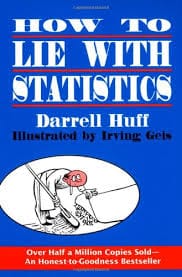
A wonderful book on understanding the correct and incorrect uses of statistics.

A wonderful book on understanding the correct and incorrect uses of statistics.

The main problem I found is that the study was organized to virtually guarantee false positives. Séralini took 200 rats and divided them into 20 groups of 10. Taking two groups of ten (one male, one female) as a control, he fed the other 18 groups of ten various doses of genetically modified grain, either alone of mixed with roundup, a pesticide often used with GM foods. Based on pure statistics, and 95% confidence, you should expect that, out of the 18 groups fed GM grain there is a 1- .9518 chance (60%) that at least one group will show cancer increase, and a similar 60% chance that at least one group will show cancer decrease at the 95% confidence level. Séralini’s study found both these results: One group, the female rats fed with 10% GM grain and no roundup, showed cancer increase; another group, the female rats fed 33% GM grain and no roundup, showed cancer decrease — both at the 95% confidence level. Séralini then dismissed the observation of cancer decrease, and published the inflammatory article and a companion book (“We are all Guinea Pigs,” pictured above) proclaiming that GM grain causes cancer. Better editors would have forced Séralini to acknowledge the observation of cancer decrease, or demanded he analyze the data by linear regression. If he had, Séralini would have found no net cancer effect. Instead he got to publish his bad statistics, and (since non of the counter studies were mentioned) unleashed a firestorm of GM grain products pulled from store shelves.

Did Séralini knowingly design a research method aimed to produce false positives? In a sense, I’d hope so; the alternative is pure ignorance. Séralini is a long-time, anti GM-activist. He claims he used few rats because he was not expecting to find any cancer — no previous tests on GM foods had suggested a cancer risk!? But this is mis-direction; no matter how many rats in each group, if you use 20 groups this way, there is a 60% chance you’ll find at least one group with cancer at the 95% confidence limit. (This is Poisson-type statistics see here). My suspicion is that Séralini knowingly gamed the experiments in an effort to save the world from something he was sure was bad. That he was a do-gooder twisting science for the greater good.

The most common reason for retraction is that the article has appeared elsewhere, either as a substantial repeat from the authors, or from other authors by plagiarism or coincidence. (BC Comics, by Johnny Hart, 11/25/10).

It’s important to cite previous work and aspects of the current work that may undermine the story you’d like to tell; BC Comics, Johnny Hart.

This was not the only major  retraction of the month, by the way. The Harrisburg Patriot & Union retracted its 1863 review of Lincoln’s Gettysburg Address, a speech the editors originally panned as “silly remarks”, deserving “a veil of oblivion….” In a sense, it’s nice that they reconsidered, and “…have come to a different conclusion…” My guess is that the editors were originally motivated by do-gooder instinct; they hoped to shorten the war by panning the speech.

There is an entire blog devoted to retractions, by the way:  http://retractionwatch.com. A good friend, Richard Fezza alerted me to it. I went to high school with him, then through under-grad at Cooper Union, and to grad school at Princeton, where we both earned PhDs. We’ll probably end up in the same old-age home. Cooper Union tried to foster a skeptical attitude against group-think.

Robert Buxbaum, Dec 23, 2013. Here is a short essay on the correct way to do science, and how to organize experiments (randomly) to make biassed analysis less likely. I’ve also written on nearly normal statistics, and near poisson statistics. Plus on other random stuff in the science and art world: Time travel, anti-matter, the size of the universe, Surrealism, Architecture, Music.

The Scientific Method isn’t the method of scientists

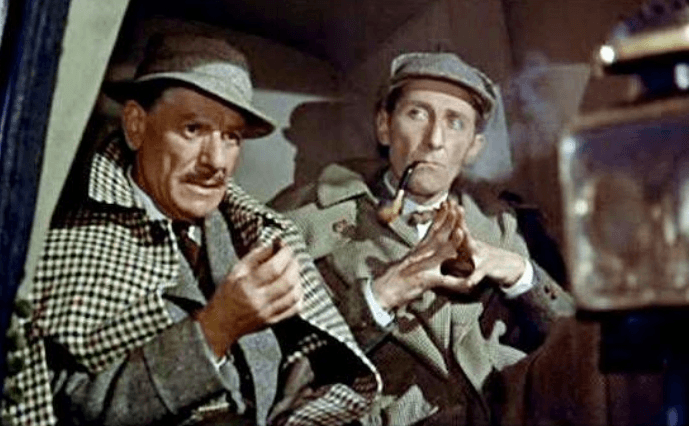
A linchpin of middle school and high-school education is teaching ‘the scientific method.’ This is the method, students are led to believe, that scientists use to determine Truths, facts, and laws of nature. Scientists, students are told, start with a hypothesis of how things work or should work, they then devise a set of predictions based on deductive reasoning from these hypotheses, and perform some critical experiments to test the hypothesis and determine if it is true (experimentum crucis in Latin). Sorry to say, this is a path to error, and not the method that scientists use. The real method involves a few more steps, and follows a different order and path. It instead follows the path that Sherlock Holmes uses to crack a case.

The actual method of Holmes, and of science, is to avoid beginning with a hypothesis. Isaac Newton claimed: “I never make hypotheses” Instead as best we can tell, Newton, like most scientists, first gathered as much experimental evidence on a subject as possible before trying to concoct any explanation. As Holmes says (Study in Scarlet): “It is a capital mistake to theorize before you have all the evidence. It biases the judgment.”

It is a capital mistake to theorize before one has data. Insensibly one begins to twist facts to suit theories, instead of theories to suit facts (Holmes, Scandal in Bohemia).

Holmes barely tolerates those who hypothesize before they have all the data: “It is a capital mistake to theorize before one has data. Insensibly one begins to twist facts to suit theories, instead of theories to suit facts.” (Scandal in Bohemia).

Then there is the goal of science. It is not the goal of science to confirm some theory, model, or hypothesis; every theory probably has some limited area where it’s true. The goal for any real-life scientific investigation is the desire to explain something specific and out of the ordinary, or do something cool. Similarly, with Sherlock Holmes, the start of the investigation is the arrival of a client with a specific, unusual need – one that seems a bit outside of the normal routine. Similarly, the scientist wants to do something: build a bigger bridge, understand global warming, or how DNA directs genetics; make better gunpowder, cure a disease, or Rule the World (mad scientists favor this). Once there is a fixed goal, it is the goal that should direct the next steps: it directs the collection of data, and focuses the mind on the wide variety of types of solution. As Holmes says: , “it’s wise to make one’s self aware of the potential existence of multiple hypotheses, so that one eventually may choose one that fits most or all of the facts as they become known.” It’s only when there is no goal, that any path will do

In gathering experimental data (evidence), most scientists spend months in the less-fashionable sections of the library, looking at the experimental methods and observations of others, generally from many countries, collecting any scrap that seems reasonably related to the goal at hand. I used 3 x5″ cards to catalog this data and the references. From many books and articles, one extracts enough diversity of data to be able to look for patterns and to begin to apply inductive logic. “The little things are infinitely the most important” (Case of Identity). You have to look for patterns in the data you collect. Holmes does not explain how he looks for patterns, but this skill is innate in most people to a greater or lesser extent. A nice set approach to inductive logic is called the Baconian Method, it would be nice to see schools teach it. If the author is still alive, a scientist will try to contact him or her to clarify things. In every SH mystery, Holmes does the same and is always rewarded. There is always some key fact or observation that this turns up: key information unknown to the original client.

Based on the facts collected one begins to create the framework for a variety of mathematical models: mathematics is always involved, but these models should be pretty flexible. Often the result is a tree of related, mathematical models, each highlighting some different issue, process, or problem. One then may begin to prune the tree, trying to fit the known data (facts and numbers collected), into a mathematical picture of relevant parts of this tree. There usually won’t be quite enough for a full picture, but a fair amount of progress can usually be had with the application of statistics, calculus, physics, and chemistry. These are the key skills one learns in college, but usually the high-schooler and middle schooler has not learned them very well at all. If they’ve learned math and physics, they’ve not learned it in a way to apply it to something new, quite yet (it helps to read the accounts of real scientists here — e.g. The Double Helix by J. Watson).

Usually one tries to do some experiments at this stage. Homes might visit a ship or test a poison, and a scientist might go off to his, equally-smelly laboratory. The experiments done there are rarely experimenti crucae where one can say they’ve determined the truth of a single hypothesis. Rather one wants to eliminated some hypotheses and collect data to be used to evaluate others. An answer generally requires that you have both a numerical expectation and that you’ve eliminated all reasonable explanations but one. As Holmes says often, e.g. Sign of the four, “when you have excluded the impossible, whatever remains, however improbable, must be the truth”. The middle part of a scientific investigation generally involves these practical experiments to prune the tree of possibilities and determine the coefficients of relevant terms in the mathematical model: the weight or capacity of a bridge of a certain design, the likely effect of CO2 on global temperature, the dose response of a drug, or the temperature and burn rate of different gunpowder mixes. Though not mentioned by Holmes, it is critically important in science to aim for observations that have numbers attached.

The destruction of false aspects and models is a very important part of any study. Francis Bacon calls this act destruction of idols of the mind, and it includes many parts: destroying commonly held presuppositions, avoiding personal preferences, avoiding the tendency to see a closer relationship than can be justified, etc.

In science, one eliminates the impossible through the use of numbers and math, generally based on your laboratory observations. When you attempt to the numbers associated with our observations to the various possible models some will take the data well, some poorly; and some twill not fit the data at all. Apply the deductive reasoning that is taught in schools: logical, Boolean, step by step; if some aspect of a model does not fit, it is likely the model is wrong. If we have shown that all men are mortal, and we are comfortable that Socrates is a man, then it is far better to conclude that Socrates is mortal than to conclude that all men but Socrates is mortal (Occam’s razor). This is the sort of reasoning that computers are really good at (better than humans, actually). It all rests on the inductive pattern searches similarities and differences — that we started with, and very often we find we are missing a piece, e.g. we still need to determine that all men are indeed mortal, or that Socrates is a man. It’s back to the lab; this is why PhDs often take 5-6 years, and not the 3-4 that one hopes for at the start.

More often than not we find we have a theory or two (or three), but not quite all the pieces in place to get to our goal (whatever that was), but at least there’s a clearer path, and often more than one. Since science is goal oriented, we’re likely to find a more efficient than we fist thought. E.g. instead of proving that all men are mortal, show it to be true of Greek men, that is for all two-legged, fairly hairless beings who speak Greek. All we must show is that few Greeks live beyond 130 years, and that Socrates is one of them.

Putting numerical values on the mathematical relationship is a critical step in all science, as is the use of models — mathematical and otherwise. The path to measure the life expectancy of Greeks will generally involve looking at a sample population. A scientist calls this a model. He will analyze this model using statistical model of average and standard deviation and will derive his or her conclusions from there. It is only now that you have a hypothesis, but it’s still based on a model. In health experiments the model is typically a sample of animals (experiments on people are often illegal and take too long). For bridge experiments one uses small wood or metal models; and for chemical experiments, one uses small samples. Numbers and ratios are the key to making these models relevant in the real world. A hypothesis of this sort, backed by numbers is publishable, and is as far as you can go when dealing with the past (e.g. why Germany lost WW2, or why the dinosaurs died off) but the gold-standard of science is predictability.  Thus, while we a confident that Socrates is definitely mortal, we’re not 100% certain that global warming is real — in fact, it seems to have stopped though CO2 levels are rising. To be 100% sure you’re right about global warming we have to make predictions, e.g. that the temperature will have risen 7 degrees in the last 14 years (it has not), or Al Gore’s prediction that the sea will rise 8 meters by 2106 (this seems unlikely at the current time). This is not to blame the scientists whose predictions don’t pan out, “We balance probabilities and choose the most likely. It is the scientific use of the imagination” (Hound of the Baskervilles)The hope is that everything matches; but sometimes we must look for an alternative; that’s happened rarely in my research, but it’s happened.

You are now at the conclusion of the scientific process. In fiction, this is where the criminal is led away in chains (or not, as with “The Woman,” “The Adventure of the Yellow Face,” or of “The Blue Carbuncle” where Holmes lets the criminal free — “It’s Christmas”). For most research the conclusion includes writing a good research paper “Nothing clears up a case so much as stating it to another person”(Memoirs). For a PhD, this is followed by the search for a good job. For a commercial researcher, it’s a new product or product improvement. For the mad scientist, that conclusion is the goal: taking over the world and enslaving the population (or not; typically the scientist is thwarted by some detail!). But for the professor or professional research scientist, the goal is never quite reached; it’s a stepping stone to a grant application to do further work, and from there to tenure. In the case of the Socrates mortality work, the scientist might ask for money to go from country to country, measuring life-spans to demonstrate that all philosophers are mortal. This isn’t as pointless and self-serving as it seems, Follow-up work is easier than the first work since you’ve already got half of it done, and you sometimes find something interesting, e.g. about diet and life-span, or diseases, etc. I did some 70 papers when I was a professor, some on diet and lifespan.

One should avoid making some horrible bad logical conclusion at the end, by the way. It always seems to happen that the mad scientist is thwarted at the end; the greatest criminal masterminds are tripped by some last-minute flaw. Similarly the scientist must not make that last-mistep. “One should always look for a possible alternative, and provide against it” (Adventure of Black Peter). Just because you’ve demonstrated that  iodine kills germs, and you know that germs cause disease, please don’t conclude that drinking iodine will cure your disease. That’s the sort of science mistakes that were common in the middle ages, and show up far too often today. In the last steps, as in the first, follow the inductive and quantitative methods of Paracelsus to the end: look for numbers, (not a Holmes quote) check how quantity and location affects things. In the case of antiseptics, Paracelsus noticed that only external cleaning helped and that the help was dose sensitive.

As an example in the 20th century, don’t just conclude that, because bullets kill, removing the bullets is a good idea. It is likely that the trauma and infection of removing the bullet is what killed Lincoln, Garfield, and McKinley. Theodore Roosevelt was shot too, but decided to leave his bullet where it was, noticing that many shot animals and soldiers lived for years with bullets in them; and Roosevelt lived for 8 more years. Don’t make these last-minute missteps: though it’s logical to think that removing guns will reduce crime, the evidence does not support that. Don’t let a leap of bad deduction at the end ruin a line of good science. “A few flies make the ointment rancid,” said Solomon. Here’s how to do statistics on data that’s taken randomly.

Dr. Robert E. Buxbaum, scientist and Holmes fan wrote this, Sept 2, 2013. My thanks to Lou Manzione, a friend from college and grad school, who suggested I reread all of Holmes early in my PhD work, and to Wikiquote, a wonderful site where I found the Holmes quotes; the Solomon quote I knew, and the others I made up.

Ozone hole shrinks to near minimum recorded size

The hole in the ozone layer, prominently displayed in Al Gore’s 2006 movie, an inconvenient truth has been oscillating in size and generally shrinking since 1996. It’s currently reached its second lowest size on record.

South pole ozone hole shrinks to 2nd smallest size on record. Credit: BIRA/IASB

South pole ozone hole (blue circle in photo), shrinks to its 2nd smallest size on record. Note outline of antarctica plus end of south america and africa. Photo Credit: BIRA/IASB

The reason for the oscillation is unknown. The ozone hole is small this year, was large for the last few years, and was slightly smaller in 2002. My guess is that it will be big again in 2013. Ozone is an alternate form of oxygen containing three oxygen atoms instead of the usual two. It is an unstable compound formed by ions in the upper atmosphere acting on regular oxygen. Though the ozone concentration in the atmosphere is low, ozone is important because it helps shield people from UV radiation — radiation that could otherwise cause cancer (it also has some positive effects on bones, etc.).

An atmospheric model of ozone chemistry implicated chlorofluorocarbons (freons) as a cause of observed ozone depletion. In the 1980s, this led to countries restricting the use of freon refrigerants. Perhaps these laws are related to the shrinkage of the ozone hole, perhaps not. There has been no net decrease in the amount of chlorofluorocarbons in the atmosphere, and the models that led to banning them did not predicted the ozone oscillations we now see are common — a fault also found with models of global warming and of stock market behavior. Our best computer models do not do well with oscillatory behaviors. As Alan Greenspan quipped, our best models successfully predicted eight of the last five recessions. Whatever the cause, the good news is that the ozone hole has closed, at least temporarily. Here’s why the sky is blue, and some thoughts on sunlight, radiation and health.

by Dr. Robert E. Buxbaum, dedicated to bringing good news to the perpetually glum.

Slowing Cancer with Fish and Unhealth Food

Some 25 years ago, while still a chemical engineering professor at Michigan State University, I did some statistical work for a group in the Physiology department on the relationship between diet and cancer. The research involved giving cancer to groups of rats and feeding them different diets of the same calorie intake to see which promoted or slowed the disease. It had been determined that low-calorie diets slowed cancer growth, and were good for longevity in general, while overweight rats died young (true in humans too, by the way, though there’s a limit and starvation will kill you).

The group found that fish oil was generally good for you, but they found that there were several unhealthy foods that slowed cancer growth in rats. The statistics were clouded by the fact that cancer growth rates are not normally distributed, and I was brought in to help untangle the observations.

With help from probability paper (a favorite trick of mine), I confirmed that healthy rats fared better on healthily diets, but cancerous rats did better with some unhealth food. Sick or well, all rats did best with fish oil, and all rats did pretty well with olive oil, but the cancerous rats did better with lard or palm oil (normally an unhealthy diet) and very poorly with corn oil or canola, oils that are normally healthful. The results are published in several articles in the journals “Cancer” and “Cancer Research.”

Among vitamins, they found something similar (it was before I joined the group). Several anti-oxidizing vitamins, A, D and E made things worse for carcinogenic rats while being good for healthy rats (and for people in moderation). Moderation is key; too much of a good thing isn’t good, and a diet with too much fish oil promotes cancer.

What seems to be happening is that the cancer cells grow at the same rate with all of the equi-caloric diets, but that there was a difference the rate of natural cancer cell death. More cancer cells died when the rat was fed junk food oils than those fed a diet of corn oil and canola. Similarly, the reason anti-oxidizing vitamins hurt cancerous rats was that fewer cancer cells died when the rats were fed these vitamins. A working hypothesis is that the junk oils (and the fish oil) produced free radicals that did more damage to the cancer than to the rats. In healthy rats (and people), these free radicals are bad, promoting cell mutation, cell degradation, and sometimes cancer. But perhaps our body use these same free radicals to fight disease.

Larger amounts of vitamins A, D, and E hurt cancerous-rats by removing the free radicals they normally use fight the disease, or so our model went. Bad oils and fish-oil in moderation, with calorie intake held constant, helped slow the cancer, by a presumed mechanism of adding a few more free radicals. Fish oil, it can be assumed, killed some healthy cells in the healthy rats too, but not enough to cause problems when taken in moderation. Even healthy people are often benefitted by poisons like sunlight, coffee, alcohol and radiation.

At this point, a warning is in-order: Don’t rely on fish oil and lard as home remedies if you’ve got cancer. Rats are not people, and your calorie intake is not held artificially constant with no other treatments given. Get treated by a real doctor — he or she will use radiation and/ or real drugs, and those will form the right amount of free radicals, targeted to the right places. Our rats were given massive amounts of cancer and had no other treatment besides diet. Excess vitamin A has been shown to be bad for humans under treatment for lung cancer, and that’s perhaps because of the mechanism we imagine, or perhaps everything works by some other mechanism. However it works, a little fish in your diet is probably a good idea whether you are sick or well.

A simpler health trick is that it couldn’t hurt most Americans is a lower calorie diet, especially if combined with exercise. Dr. Mites, a colleague of mine in the department (now deceased at 90+) liked to say that, if exercise could be put into a pill, it would be the most prescribed drug in America. There are few things that would benefit most Americans more than (moderate) exercise. There was a sign in the physiology office, perhaps his doing, “If it’s physical, it’s therapy.”

Anyway these are some useful things I learned as an associate professor in the physiology department at Michigan State. I ended up writing 30-35 physiology papers, e.g. on how cells crawl and cell regulation through architecture; and I met a lot of cool people. Perhaps I’ll blog more about health, biology, the body, or about non-normal statistics and probability paper. Please tell me what you’re interested in, or give me some keen insights of your own.

Dr. Robert Buxbaum is a Chemical Engineer who mostly works in hydrogen I’ve published some 75 technical papers, including two each in Science and Nature: fancy magazines that you’d normally have to pay for, but this blog is free. August 14, 2013

Hormesis, Sunshine and Radioactivity

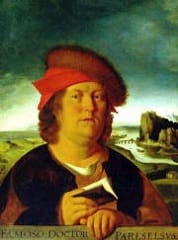
It is often the case that something is good for you in small amounts, but bad in large amounts. As expressed by Paracelsus, an early 16th century doctor, “There is no difference between a poison and a cure: everything depends on dose.”

Aereolis Bombastus von Hoenheim (Paracelcus)

Phillipus Aureolus Theophrastus Bombastus von Hoenheim (Dr. Paracelsus).

Some obvious examples involve foods: an apple a day may keep the doctor away. Fifteen will cause deep physical problems. Alcohol, something bad in high doses, and once banned in the US, tends to promote longevity and health when consumed in moderation, 1/2-2 glasses per day. This is called “hormesis”, where the dose vs benefit curve looks like an upside down U. While it may not apply to all foods, poisons, and insults, a view called “mitridatism,” it has been shown to apply to exercise, chocolate, coffee and (most recently) sunlight.

Up until recently, the advice was to avoid direct sun because of the risk of cancer. More recent studies show that the benefits of small amounts of sunlight outweigh the risks. Health is improved by lowering blood pressure and exciting the immune system, perhaps through release of nitric oxide. At low doses, these benefits far outweigh the small chance of skin cancer. Here’s a New York Times article reviewing the health benefits of 2-6 cups of coffee per day.

A hotly debated issue is whether radiation too has a hormetic dose range. In a previous post, I noted that thyroid cancer rates down-wind of the Chernobyl disaster are lower than in the US as a whole. I thought this was a curious statistical fluke, but apparently it is not. According to a review by The Harvard Medical School, apparent health improvements have been seen among the cleanup workers at Chernobyl, and among those exposed to low levels of radiation from the atomic bombs dropped on Hiroshima and Nagasaki. The health   improvements relative to the general population could be a fluke, but after a while several flukes become a pattern.

Among the comments on my post, came this link to this scholarly summary article of several studies showing that long-term exposure to nuclear radiation below 1 Sv appears to be beneficial. One study involved an incident where a highly radioactive, Co-60 source was accidentally melted into a batch of steel that was subsequently used in the construction of apartments in Taiwan. The mistake was not discovered for over a decade, and by then the tenants had received between 0.4 and 6 Sv (far more than US law would allow). On average, they were healthier than the norm and had significantly lower cancer death rates. Supporting this is the finding, in the US, that lung cancer death rates are 35% lower in the states with the highest average radon radiation levels (Colorado, North Dakota, and Iowa) than in those with the lowest levels (Delaware, Louisiana, and California). Note: SHORT-TERM exposure to 1 Sv is NOT good for you; it will give radiation sickness, and short-term exposure to 4.5 Sv is the 50% death level

Most people in the irradiated Taiwan apartments got .2 Sv/year or less, but the same health benefit has also been shown for people living on radioactive sites in China and India where the levels were as high as .6 Sv/year (normal US background radiation is .0024 Sv/year). Similarly, virtually all animal and plant studies show that radiation appears to improve life expectancy and fecundity (fruit production, number of offspring) at dose rates as high as 1 Sv/month.

I’m not recommending 1 Sv/month for healthy people, it’s a cancer treatment dose, and will make healthy people feel sick. A possible reason it works for plants and some animals is that the radiation may kill proto- cancer, harmful bacteria, and viruses — organisms that lack the repair mechanisms of larger, more sophisticated organisms. Alternately, it could kill non-productive, benign growths allowing the more-healthy growths to do their thing. This explanation is similar to that for the benefits farmers produce by pinching off unwanted leaves and pruning unwanted branches.

It is not conclusive radiation improved human health in any of these studies. It is possible that exposed people happened to choose healthier life-styles than non-exposed people, choosing to smoke less, do more exercise, or eat fewer cheeseburgers (that, more-or-less, was my original explanation). Or it may be purely psychological: people who think they have only a few years to live, live healthier. Then again, it’s possible that radiation is healthy in small doses and maybe cheeseburgers and cigarettes are too?! Here’s a scene from “Sleeper” a 1973, science fiction, comedy movie where Woody Allan, asleep for 200 years, finds that deep fat, chocolate, and cigarettes are the best things for your health. You may not want a cigarette or a radium necklace quite yet, but based on these studies, I’m inclined to reconsider the risk/ benefit balance in favor of nuclear power.

Note: my company, REB Research makes (among other things), hydrogen getters (used to reduce the risks of radioactive waste transportation) and hydrogen separation filters (useful for cleanup of tritium from radioactive water, for fusion reactors, and to reduce the likelihood of explosions in nuclear facilities.

by Dr. Robert E. Buxbaum June 9, 2013

How Theodore Roosevelt survived being shot

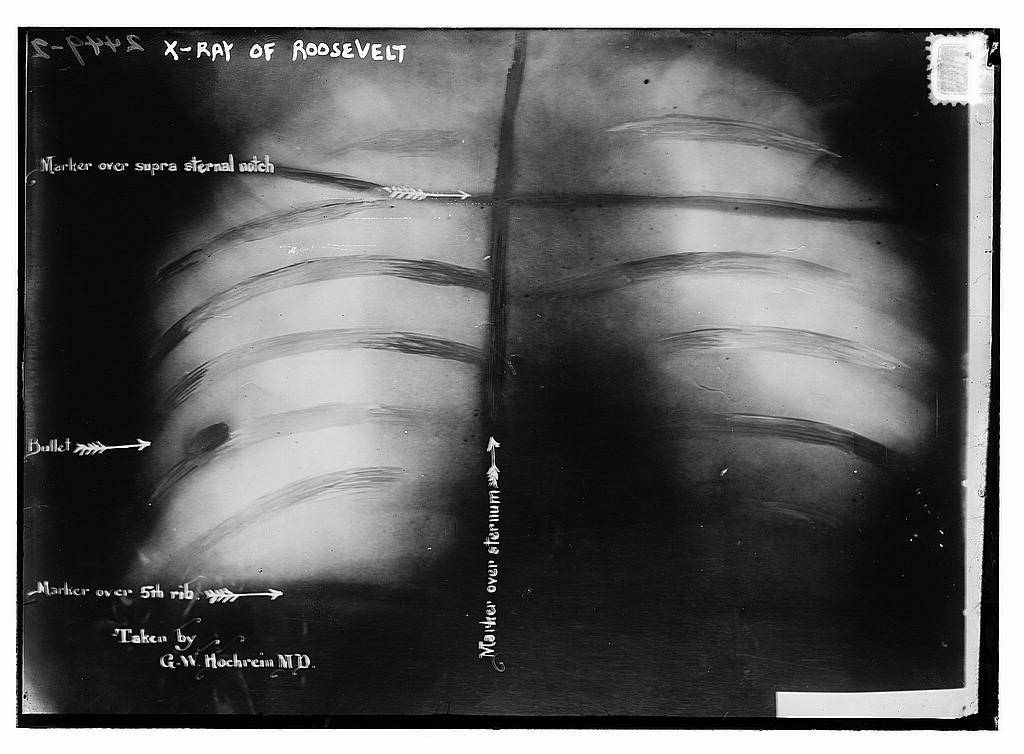
Two more pictures of Theodore Roosevelt. The first is an x-ray showing the bullet he received as he entered a hall to give a 90 minute speech in 1912. How he survived the shooting: he did nothing. He left the bullet stay where it was for the rest of his life. It seems that both McKinley and Garfield had died from infection of their shooting wounds after doctors poked around trying to extract the bullet. It’s quite possible that Lincoln died the same way (Lincoln’s doctor was the one who killed Garfield by poking around this way).X-ray of Teddy Roosevelt showing the bullet where he let it lie.

X-ray of Teddy Roosevelt showing the bullet where he let it lie. The stripes look like lead paint, used to mark the spot. 

Roosevelt knew from hunting that a shot animal could last for years with the bullet still inside him. Roosevelt (and his doctors) knew, or suspected, that his bullet had stopped in a place where it would be harmless unless someone tried to extract it.

T. Roosevelt with Rhino, 1909.

T. Roosevelt with Rhino, 1909. Teddy would be shot 3 years later, in 1912.

In the speech, Roosevelt said, “it takes more than that to stop a Bull Moose.” He ought to know. For more T. Roosevelt pictures, click here.