Tag Archives: health

Vitamin A and E, killer supplements; B, C, and D are meh.

It’s often assumed that vitamins and minerals are good for you, so good for you that people buy all sorts of supplements providing more than the normal does in hopes of curing disease. Extra doses are a mistake unless you really have a mis-balanced diet. I know of no material that is good in small does that is not toxic in large doses. This has been shown to be so for water, exercise, weight loss, and it’s true for vitamins, too. That’s why there is an RDA (a Recommended Daily Allowance). 

Lets begin with Vitamin A. That’s beta carotene and its relatives, a vitamin found in green and orange fruits and vegetables. In small doses it’s good. It prevents night blindness, and is an anti-oxidant. It was hoped that Vitamin A would turn out to cure cancer too. It didn’t. In fact, it seems to make cancer worse. A study was preformed with 1029 men and women chosen random from a pool that was considered high risk for cancer: smokers, former smokers, and people exposed to asbestos. They were given either15 mg of beta carotene and 25,000 IU of vitamin A (5 times the RDA) or a placebo. Those taking the placebo did better than those taking the vitamin A. The results were presented in the New England Journal of Medicine, read it here, with some key findings summarized in the graph below.

Comparison of cumulative mortality and cardiovascular disease between those receiving Vitamin A (5 times RDA) and those receiving a placebo. From Omenn et. al, Clearly, this much vitamin A does more harm than good.

The main causes of death were, as typical, cardiovascular disease and cancer. As the graph shows, the rates of death were higher among people getting the Vitamin A than among those getting nothing, the placebo. Why that is so is not totally clear, but I have a theory that I presented in a paper at Michigan state. The theory is that your body uses oxidation to fight cancer. The theory might be right, or wrong, but what is always noticed is that too much of a good thing is never a good thing. The excess deaths from vitamin A were so significant that the study had to be cancelled after 5 1/2 years. There was no responsible way to continue. 

Vitamin E is another popular vitamin, an anti-oxidant, proposed to cure cancer. As with the vitamin A study, a large number of people who were at high risk  were selected and given either a large dose  of vitamin or a placebo. In this case, 35,000 men over 50 years old were given either vitamin E (400 to 660 IU, about 20 times the RDA) and/or selenium or a placebo. Selenium was added to the test because, while it isn’t an antioxidant, it is associated with elevated levels of an anti-oxidant enzyme. The hope was that these supplements would prevent cancer and perhaps ward off Alzheimer’s too. The full results are presented here, and the key data is summarized in the figure below. As with vitamin A, it turns out that high doses of vitamin E did more harm than good. It dramatically increased the rate of cancer and promoted some other problems too, including diabetes.  This study had to be cut short, to only 7 years, because  of the health damage observed. The long term effects were tracked for another two years; the negative effects are seen to level out, but there is still significant excess mortality among the vitamin takers. 

Cumulative incidence of prostate cancer with supplements of selenium and/or vitamin E compared to placebo.

Cumulative incidence of prostate cancer with supplements of selenium and/or vitamin E compared to placebo.

Selenium did not show any harmful or particularly beneficial effects in these tests, by the way, and it may have reduced the deadliness of the Vitamin A.. 

My theory, that the body fights cancer and other disease by oxidation, by rusting it away, would explain why too much antioxidant will kill you. It laves you defenseless against disease As for why selenium didn’t cause excess deaths, perhaps there are other mechanisms in play when the body sees excess selenium when already pumped with other anti oxidant. We studied antioxidant health foods (on rats) at Michigan State and found the same negative effects. The above studies are among the few done with humans. Meanwhile, as I’ve noted, small doses of radiation seem to do some good, as do small doses of chocolate, alcohol, and caffeine. The key words here are “small doses.” Alcoholics do die young. Exercise helps too, but only in moderation, and since bicycle helmets discourage bicycling, the net result of bicycle helmet laws may be to decrease life-span

What about vitamins B, C, and D? In normal doses, they’re OK, but as with vitamin A and E you start to see medical problems as soon as you start taking more– about  12 times the RDA. Large does of vitamin B are sometimes recommended by ‘health experts’ for headaches and sleeplessness. Instead they are known to produce skin problems, headaches and memory problems; fatigue, numbness, bowel problems, sensitivity to light, and in yet-larger doses, twitching nerves. That’s not as bad as cancer, but it’s enough that you might want to take something else for headaches and sleeplessness. Large does of Vitamin C and D are not known to provide any health benefits, but result in depression, stomach problems, bowel problems, frequent urination, and kidney stones. Vitamin C degrades to uric acid and oxalic acid, key components of kidney stones. Vitamin D produces kidney stones too, in this case by increasing calcium uptake and excretion. A recent report on vitamin D from the Mayo clinic is titled: Vitamin D, not as toxic as first thought. (see it here). The danger level is 12 times of the RDA, but many pills contain that much, or more. And some put the mega does in a form, like gummy vitamins” that is just asking to be abused by a child. The pills positively scream, “Take too many of me and be super healthy.”

It strikes me that the stomach, bowel, and skin problems that result from excess vitamins are just the problems that supplement sellers claim to cure: headaches, tiredness, problems of the nerves, stomach, and skin.  I’d suggest not taking vitamins in excess of the RDA — especially if you have skin, stomach or nerve problems. For stomach problems; try some peniiiain cheese. If you have a headache, try an aspirin or an advil. 

In case you should want to know what I do for myself, every other day or so, I take 1/2 of a multivitamin, a “One-A-Day Men’s Health Formula.” This 1/2 pill provides 35% of the RDA of Vitamin A, 37% of the RDA of Vitamin E, and 78% of the RDA of selenium, etc. I figure these are good amounts and that I’ll get the rest of my vitamins and minerals from food. I don’t take any other herbs, oils, or spices, either, but do take a baby aspirin daily for my heart. 

Robert Buxbaum, May 23, 2019. I was responsible for the statistics on several health studies while at MichiganState University (the test subjects were rats), and I did work on nerves, and on hydrogen in metals, and nuclear stuff.  I’ve written about statistics too, like here, talking about abnormal distributions. They’re common in health studies. If you don’t do this analysis, it will mess up the validity of your ANOVA tests. That said,  here’s how you do an anova test

The Japanese diet, a recipe for stomach cancer.

Japan has the highest life expectancy in the world, an average about 84.1 years, compared to 78.6 years for the US. That difference is used to suggest that the Japanese diet must be far healthier than the American. We should all drink green tea and eat such: rice with seaweed and raw or smoked fish. Let me begin by saying that correlation does not imply causation, and go further to say that, to the extent that correlation suggests causation, the Japanese diet seems worse. It seems to me that the quantity of food (and some other things) are responsible for Americans have a shorter life-span than Japanese, the quality our diet does not appear to be the problem. That is, Americans eat too much, but what we eat is actually healthier than what the Japanese eat.

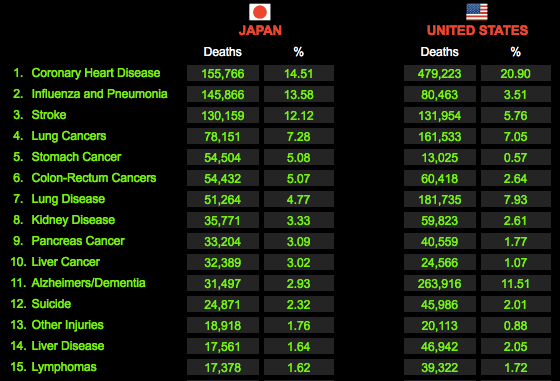
Top 15 causes of death in Japan and the US in order of Japanese relevance.

Top 15 causes of death in Japan and the US in order of Japanese relevance.

Let’s look at top 15 causes of deaths in Japan and the US in order of significance for Japan (2016). The top cause of disease death is the same for Japan and the US: it’s heart disease. Per-capita, 14.5% of Japanese people die of this, and 20.9% of Americans. I suspect the reason that we have more heart disease is that we are more overweight, but the difference is not by that much currently. The Japanese are getting fatter. Similarly, we exceed the Japanese in lung cancer deaths (not by that much) a hold-over of smoking, and by liver disease (not by that much either), a holdover of drinking, I suspect.

Japan exceeds the US in Stroke death (emotional pressure?) and suicide (emotional pressure?) and influenza deaths (climate-related?). The emotional pressure is not something we’d want to emulate. The Japanese work long hours, and face enormous social pressure to look prosperous, even when they are not. There is a male-female imbalance in Japan that is a likely part of the emotional pressure. There is a similar imbalance in China, and a worse one in Qatar. I would expect to see social problems in both in the near future. So far, the Japanese deal with this by alcoholism, something that shows up as liver cancer and cirrhosis. I expect the same in China and Qatar, but have little direct data.

Returning to diet, Japan has more far more stomach cancer deaths than the US; it’s a margin of nine to one. It’s the number 5 killer in Japan, taking 5.08% of Japanese, but only 0.57% of Americans. I suspect the difference is the Japanese love of smoked and raw fish. Other diet-related diseases tell the same story. Japan has double our rate of Colon-rectal cancers, and higher rates of kidney disease, pancreatic cancer, and liver cancer. The conclusion that I draw is that green tea and sushi are not as healthy as you might think. The Japanese would do well to switch the Trump staples of burgers, pizza, fries, and diet coke.

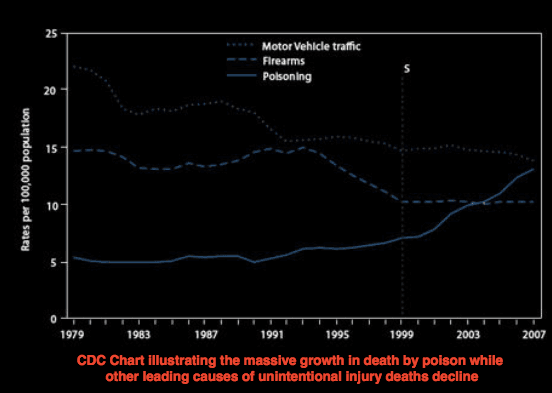
The three horsemen of the US death-toll:  Automobiles, firearms, and poisoning (drugs). 2008 data.

The three horsemen of the US death-toll: Automobiles, firearms, and poisoning (drugs). 2008 data.

At this point you can ask why our lives are so much shorter than the Japanese, on average. The difference in smoking and weight-related diseases are significant but explain only part of the story. There is also guns. About 0.7% of Americans are killed by guns, compared to 0.07% of Japanese. Still, guns give Americans a not-unjustified sense of safety from worse crime. Then there is traffic death, 1.5% in the US vs 0.5% in Japan. But the biggest single reason that Americans live shorter lives  is drugs. Drugs kill about 1.5% of Americans, but mostly the young and middle ages. They show up in US death statistics mostly as over-dose and unintentional poisoning (overdose deaths), but also contribute to many other problems like dementia in the old. Drugs and poisoning do not shown on the chart above, because the rate of both is insignificant in Japan, but it is the single main cause of US death in middle age Americans.

The king of the killer drugs are the opioids, a problem that was bad in the 60s, the days of Mother’s Little helper, but that have gotten dramatically worse in the last 20 years as the chart above shows. Often it is a doctor who gets us hooked on the opioids. The doctor may think it’s a favor to us to keep us from pain, but it’s also a favor to him since the drug companies give kickbacks. Often people manage to become un-hooked, but then some doctor comes by and re-hooks us up. Unlike LSD or cocaine, opioid drugs strike women and men equally. It is the single major reason we live 5 1/2 years shorter than the Japanese, with a life-span that is shrinking.

Drug overuse seems like the most serious health problem Americans face, and we seem intent on ignoring it. The other major causes of death are declining, but drug-death numbers keep rising. By 2007, more people died of drugs than guns, and nearly as many as from automobile accidents. It’s passed automobile accidents since then. A first suggestion here: do not elect any politician who has taken significant money from the drug companies. A second suggestion: avoid the Japanese diet.

Robert Buxbaum, April 28, 2019.

Penicillin, cheese allergy, and stomach cancer

penecillin molecule

The penicillin molecule is a product of the penicillin mold

Many people believe they are allergic to penicillin — it’s the most common perceived drug allergy — but several studies have shown that most folks who think they are allergic are not. Perhaps they once were, but when people who thought they were allergic were tested, virtually none showed allergic reaction. In a test of 146, presumably allergic patients at McMaster University, only two had their penicillin allergy confirmed; 98.6% of the patients tested negative. A similar study at the Mayo Clinic tested 384 pre-surgical patients with a history of penicillin allergy; 94% tested negative. They were given clearance to receive penicillin antibiotics before, during, and after surgery. Read a summary here.

08

Orange showing three different strains of the penicillin mold; some of these are toxic.

This is very good news. Penicillin is a low-cost, low side-effect antibiotic, effective against many diseases including salmonella, botulism, gonorrhea, and scarlet fever. The penicillin molecule is a common product of nature, produced by a variety of molds, e.g. on the orange at right, and in cheese. It is thus something people have been exposed to, whether they realize it or not.

Penicillin allergy is a deadly danger for the few who really are allergic, and it’s worthwhile to find out if that means you. The good news: that penicillin is found in common cheeses suggests, to me, a simple test for penicillin allergy. Anyone who suspects penicillin allergy and does not have a general dairy allergy can try eating appropriate cheese: brie, blue, camembert, or Stilton. That is any of the cheeses made with penicillin molds. If you don’t break out in a rash or suffer stomach cramps, you’re very likely not allergic to penicillin.

There is some difference between cheeses, so if you have problems with Roquefort, but not brie or camembert, there’s still a good chance you’re not allergic to penicillin. Brie and camembert have a white fuzzy mold coat of Penicillium camemberti. This mold exudes penicillin — not in enough quantity to cure gonorrhea, but enough to give taste and avoid spoilage, and enough to test for allergy. Danish blue and Roquefort, shown below, have a different look and a sharper flavor . They’re made with blue-green, Penicillium roqueforti. This mold produces penicillin, but also a small amount of neurotoxin, roquefortine C. It’s not enough to harm most people, but it could cause an allergic reaction to folks who are not allergic to penicillin. Don’t eat a moldy orange, by the way; some forms of the mold produce a lot of neurotoxin.

For people who are not allergic, a thought I had is that one could, perhaps treat heartburn or ulcers with cheese; perhaps even cancer? H-Pylori, the bacteria associated with heartburn, is effectively treated by amoxicillin, a penicillin variant. If a penicillin variant kills the bacteria, it seems plausible that penicillin cheese might too. And since amoxicillin, is found to reduce the risk of gastric cancer, it’s reasonable to expect that penicillin or penicillin cheese might be cancer-protective. To my knowledge, this has never been studied, but it seems worth considering. The other, standard treatment for heartburn, pantoprazole / Protonix, is known to cause osteoporosis, and increase the risk of cancer, and it doesn’t taste as good as cheese.

A culture of Penicillium roqueforti. Most people are not allergic to it.

The blue in blue cheese is Penicillium roqueforti. Most people are not allergic.

Penicillin was discovered by Alexander Fleming, who noticed that a single spore of the mold killed the bacteria near it on a Petrie dish. He tried to produce significant quantities of the drug from the mold with limited success, but was able to halt disease in patients, and was able to interest others who had more skill in large-scale fungus growing. Kids looking for a good science fair project, might consider penicillin growing, penicillin allergy, treatment of stomach ailments using cheese, or anything else related to the drug. Three Swedish journals declared that penicillin was the most important discovery of the last 1000 years. It would be cool if the dilute form, the one available in your supermarket, could be shown to treat heartburn and/or cancer. Another drug you could study is Lysozyme, a chemical found in tears, in saliva, and in human milk (but not in cow milk). Alexander Fleming found that tears killed bacteria, as did penicillin. Lysozyme, the active ingredient, is currently used to treat animals, but not humans.

Robert Buxbaum, November 9, 2017. Since starting work on this essay I’ve been eating blue cheese. It tastes good and seems to cure heartburn. As a personal note: my first science fair project (4th grade) involved growing molds on moistened bread. For an incubator, I used the underside of our home radiator. The location kept my mom from finding the experiment and throwing it out.

Fat people live longer, show less dementia

Life expectancy is hardly affected by weight in the normal - overweight- obese range. BMI 30-34.9 = obese.

Life expectancy is hardly affected by weight in the normal – overweight – obese range. BMI 30-34.9 = obese.

Lets imagine you are a 5’10” man and you weigh 140 lbs. In that case, you have a BMI of 20, and you probably think you’re pretty healthy, or perhaps you think you’re a bit overweight. Our institutes of health will say that you are an “average-wight” or “normal-weight” American, and then claim that the average-weight American is overweight. What they don’t tell you, is that low weight, and so-called average weight people in the US live shorter lives. Other things being equal, the morbidity (chance of death) for a thin American, BMI 18.5 is nearly triple that of someone who’s obese, BMI 32. The morbidity of the normal-weight American is better, but is still nearly double that of the obese fellow whose BMI is 32.

Our NIH has created a crisis of overweight Americans, that is not based on health. They work hard to solve this obesity crisis by telling people to jog to work, and by creating ever-more complicated food pyramids. Those who listen live shorter lives. A prime example is Jim Fixx, author of several running books including “The complete Book of Running.” He was 52 when he died of a heart attack while running. Similar to this is the diet-expert, Adelle Davis, author of “Let’s eat right to keep fit”. She died at 70 of cancer — somewhat younger than the average American woman. She attributed her cancer to having eaten junk food as a youth. I would attribute it to being thin. Not only do thin people live shorter lives, but their chances of recovering from cancer, or living with it, seem to improve if you start with some fat.

The same patter exists where age-related dementia is concerned. If you divide the population into quartiles of weight, the heaviest has the least likelihood of dementia, the second heaviest has the second-least, the third has the third-least, and the lightest Americans have the highest likelihood of dementia. Here are two studies to that effect, “Association between late-life body mass index and dementia”, The Kame Project, Neurology. 2009 May 19; 72(20): 1741–1746. And “BMI and risk of dementia in two million people over two decades: a retrospective cohort study” The Lancet, Volume 3, No. 6, p431–436, June 2015.

Morbidity and weight, uncorrected data, and corrected by removing the demented.

Morbidity and weight, uncorrected data, and corrected by removing the demented. The likelihood of dementia decreases with weight.

Now you may think that there is a confounding, cause and effect here: that crazy old people don’t live as long. You’d be right there, crazy people don’t live as long. Still, if you correct the BMI-mortality data to remove those with dementia, you still find that in terms of life-span, for men and women, it pays to be overweight or obese but not morbidly so. The study concludes as follows: “Weight loss was related to a higher mortality risk (HR = 1.5; 95% CI: 1.2,1.9) but this association was attenuated when persons with short follow-up or persons with dementia were excluded.” As advice to those who are planning a weight loss program, you might go crazy and reduce your life-span a lot, but if you don’t go crazy, you’re only reducing your life-span a little.

In terms of health food, I’ve noticed that many non-health foods, like alcohol and chocolate are associated with longevity and mental health. And while low-impact exercise helps increase life-span, that exercise is only minimally associated with weight loss. Mostly weight loss involves changing the amount you eat and changing your clothes choices to maximize radiant heat loss.

Dr. Robert E. Buxbaum, October 26, 2017. A joke: Last week I was mugged by a vegan. You may ask how I know it was a vegan. He told be before running off with my wallet.

bicycle helmets kill

There is rarely a silver lining that does not come with a cloud, and often the cloud is bigger than the lining. A fine example is bicycle helmets. They provide such an obvious good that, at first glance, you’d think everyone would wear one, even without a law mandating it. Why would anyone risk their skull in a bicycle accident if injury were prevented by merely wearing a particular hat? Yet half the people ride without, even when there are laws and fines. There are some down-side to helmets, but they are so small that even mentioning them seems small. Helmets are inconvenient, and this causes people to ride a little less, so what?

hospital admissions for bicycle related head injuries, red, left; and bicycle related, non-head injuries, blue, right. Victoria Australia.

Hospital admissions for bicycle-related, head injuries, red, left scale, and bicycle-related, non-head injuries, blue, right scale. The ratio is 1:2 before and after the helmet law suggesting that helmet law did nothing but reduce ridership.

As to turns out, helmets hardly stop accidental injury, yet cause people to ride a lot less, and this lack of exercise causes all sorts of problems — far more than the benefits. In virtually every city where it was studied, bicycle ridership dropped by 30-40% when helmets were required, and as often as not, those who still rode, rode unhelmeted. There was a 30-40% decrease in head-trauma injuries, but it appears that this was just the result of 30-40% less ridership. You’d expect a larger decrease if the helmet helped, as such.

Take the experience of Victoria, Australia; head and non-head bicycle injury data plotted above. Victoria required bicycle helmets in January 1990. Before then, in the peak summer months, hospital records show some 50 bicycle-related head injuries per month, and 100 bicycle-related, non-head injuries — a 1:2 proportion. Later, after the law went into effect, each summer month saw about 35 bicycle-related, head injuries, and 70 bicycle-related, non head injuries. This proportion, 1:2, remained the same suggesting the only effect of the helmet law was to reduce ridership, with no increase in safety. The same 30% decrease was seen by direct count of riders on major streets, though now a greater proportion of those still riding were flaunting the law, and not wearing helmets.

One reason that helmets don’t help much is that the skull is already a very good helmet. As things stand, the main injury in a bicycle flip does not come from your skull cracking, it comes from your brain hitting the inside of your skull, and a second helmet doesn’t help stop that. There’s no increase in safety, and perhaps a decrease as the helmet appears to decrease vision. In a study of bicycle-injury-related highway deaths, Piet de Jong found that countries with the highest helmet use had the highest highway death rates. The country with the highest helmet use (the USA, 38% helmeted) had the highest cyclist death rate, 44 deaths per 1,000,000,000 km. By comparison, the nation with the least helmet use (Holland, 1% helmeted) had among the lowest death rates, only 10.7 deaths per 1,000,000,000 km. There are many explanations for this finding, one sense is that the helmets hurt vision making all types of injury and death more likely.

An hour or three of exercise per week adds years to your life -- especially among the middle aged.

From the national cancer institute. An hour or three of exercise per week adds years to your life — especially among the middle aged. Note these are healthy weight individuals. 

Worse than the effect on visibility, may be the effect on exercise. Exercise is tremendously beneficial, especially for middle-aged people in a sedentary population like the US. The lack of exercise is a lot more deadly, it turns out, than any likelihood of flying over the handlebars. How do I know? From studies like the National Cancer institute, shown at right. To calculate the cost/benefit of a little riding, less say you ride 3 hours per week at 10 mph (slow roll). The chart at right suggests a middle-aged person will add 3.4 years to your life, or about 10% life extension. Now consider the risks. This person will ride 30 miles per week, or 2400 km per year. Over 35 years the chance of death is only 0.36%. In order to get a 10% chance of death, you’d have to ride, over 2.3 million km, or 1000 years. Clearly the life extension benefit far outweighs the risk from fatal accident.

But life extension isn’t the total benefit of exercise. Exercise is shown to improve metal health, reducing depression and ADD in children, and likely in adults. Exercise also helps with weight loss, and that is another big health benefit (the chart above was for healthy body weight riders). So my first suggestion is get rid of bicycle helmet laws. I would not go so far as to ban helmets, but see clear disadvantages to the current laws.

The other suggestion: invent a better helmet. While most helmets are vented, and reasonably cool while you ride. They become uncomfortably hot when you stop. And they look funny in a store or restaurant. You can’t easily take them off, either: Restaurants no longer have hat racks, and stores never had them. What’s needed is a lighter, cooler helmet. Without that, and with helmet laws in place, people in the US tend to drive rather than ride a bicycle — and the lack of exercise is killing them.

Robert Buxbaum, January 19, 2017. One of my favorite writing subjects is the counter-intuitiveness of health science. See, eg. on radiation, or e-cigarettes, or sunshine, or health food. Here is a general overview of how to do science; I picked all the quotes from Sherlock Holmes.

Rethinking fluoride in drinking water

Every now and again, it pays to rethink what everyone knows is so. As it happens I was asked to rethink fluoride in the drinking water. So here goes.

Fluoride is a poison, toxic for a small child in doses of 500 mg, and toxic to an adult in doses of a few thousand mg. It is a commonly used rat poison that kills by robbing the brain of its ability to absorb oxygen. In the form of hydrofluoric acid, it is responsible for the deaths of more famous chemists than any other single compound: Humphrey Davy died trying to isolate fluorine; Paul Louyet and Jerome Nickles, too. Thomas Knox nearly died, and Henri Moissan’s life was shortened. Louis-Joseph Gay Lussac, George Knox, and Louis- Jacques Thenard suffered burns and similar, George Knox was bedridden for three years. Among the symptoms of fluoride poisoning is severe joint pain and that your brain turns blue.

In low doses, though, fluoride is thought to be safe and beneficial. If true, this would be an example of hormesis. It’s found that many things that are toxic at high doses are beneficial at low. Most drugs fall into this category; chemotherapy works this way. Sunshine and radioactivity show hormesis too. Fluoride seems to be like this. In small doses, Fluoride is associated with strong teeth, and few cavities, and no obvious health risks. It is found at ppm levels many well water systems, and has shown no sign of toxicity, either for humans or animals at these ppm levels. Following guidelines set by the AMA, most US cities have been putting fluoride in drinking water since the 1960s, typically at concentrations between 0.7 and 1.2 ppm. We have seen no deaths or clear evidence of any injury from this, but there has been controversy. Much of the controversy stems from a Chinese study that links fluoride to diminished brain function, and passivity (Anti-fluoriders falsely attribute this finding to a Harvard researcher, but the Harvard study merely cites the Chinese). The American dental association strongly maintains that worries based on this study are groundless, and that the advantage in lower cavities more than off-sets any other risks. Notwithstanding, I thought I’d take another look. The typical US adult consumes 1-3 mg/day the result of drinking 1-3 liters of fluoridated water (1 ppm = 1 mg/liter). This < 1/1000 the toxic dose,

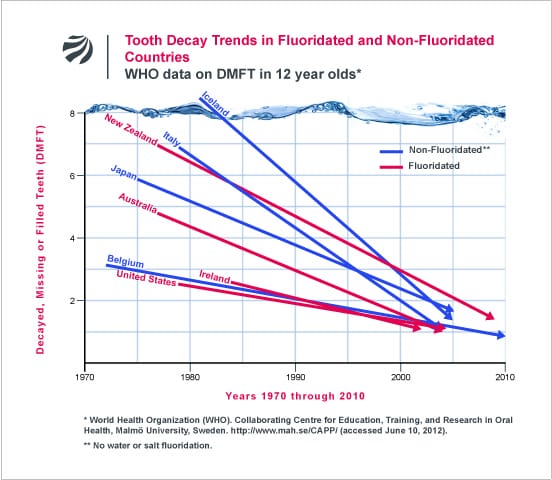
While there is no evidence that people who drink high-fluoride well water are any less-healthy than those who drink city water, or distilled / filtered water, that does not mean that our city levels are ideal. Two months ago, while running for water commissioner, I was asked about fluoride, and said I would look into it. Things have changed since the 1960s: our nutrition has changed, we have vitamin D milk, and our toothpastes now contain fluoride. My sense is we can reduce the water concentration. As shown below, many industrial countries that don’t add fluoride have similar tooth decay rates to the US.

World Health Organization data on tooth decay and fluoridation.

World Health Organization data on tooth decay and fluoridation.

This chart should not be read to suggest that fluoride doesn’t help; all the countries shown use fluoride toothpaste, and some give out fluoride pills, too. And some countries that don’t add fluoride have higher levels of cavities. Norway and Japan, for example. They don’t add fluoride and have 50% more cavities than we do. Germany doesn’t add fluoride, and has fewer cavities, but they hand out fluoride pills, To me, the chart suggests that our levels should be lower than the AMA guidance, though not zero. In 2015, the Department of Health recommend lowering the fluoride level to 0.7 ppm, the lower end of the previous range, but based on the experience of Europe, I’d pick 1/2 the original dose: 0.6 to 0.35 ppm. I’d then revisit the data in another 15 years.

Having picked my target fluoride concentration, I checked to see what the levels we use in my county, Oakland county, MI. I was happy to discover that the levels were already below the AMA guide. The water the county drinks, provided by Detroit Water and Sewage, NOCWA and SOCWA contains 0.43-0.55 ppm fluoride, in the center of in the range I would have picked. Fluoride concentrations are higher in towns that use well water, about  0.65-0.85 ppm. I do not know if this is because the well water comes from the ground with these fluoride concentrations or if the towns add more, aiming at the Department of Health target. In either case, I don’t find these levels alarming. If you live in one of these towns, or outside of Oakland county, check your fluoride levels. If they seem high, write to your water commissioner or add a filter to your tap. You can also switch from fluoride toothpaste to non-fluoride, or baking soda. In any case, remember to brush. That does make a difference, and it’s completely non-toxic.

Robert Buxbaum, January 9, 2017. Another toxic additive is chlorine. I discuss chlorine addition a bit in this essay. As a side issue, a main mechanism of sewer pipe decay is related to tooth decay. The roofs of sewer pipes grow acid-producing, cavity causing bacteria that live off of the foul sewer gas. In time these bacteria destroy concrete sewer pipes. The remedies for this erosion is to clean sewer pipes regularly, after having them checked by a professional, about once per year. As with death, one should repair cavities early. Here too, it seems high fluoride cement resists cavities better.

The boon of e-cigarettes

E-cigarette use is rising fast among US smokers, and have passed traditional cigarette smoking among US High Schoolers, according to a recent CDC surveyAmong the advantages: e-cigarettes are less regulated and cheaper than regular cigarettes. The vapors smell better. The smoke is supposed to be 95% less unhealthy. And the vape (e-cigarette “smoke”) doesn’t stain teeth like regular cigarettes. Not everyone is thrilled to see a safer cigarette alternative, though. A 2014 Harvard Study, The E-cigarette Quandary, points out that 95% less dangerous is not the same as 100%, that kids might come to smoke who might not otherwise, and that one could still get unwelcome, second-hand nicotine from exhaled vape. To correct these issues, some 200 regulation and prohibition bills have been introduced in 40 states in the past year alone. Among these, prohibitions on selling to minors, prohibitions on vaping where smoking is prohibited, and a National Park Service prohibition on e-cigarette use anywhere in a national park. 

Inside an e-cigarette

Inside an e-cigarette

My sense is that, for some people, those who already smoke, a 95% less dangerous alternative has got to be a boon, unless (as seems unlikely) people come to smoke twenty times more e-cigarettes than regular. To the contrary, It appears that e-cigarettes seem to help smokers quit tobacco, even with no help from a smoking cessation service. And over time, e-smokers tend to reduce the amount of nicotine in the juice, in that way reducing the toxic burden of the e-cigarette too. This is an option that is not possible with traditional, combustion cigarettes.

The claim that e-cigarettes are 95% less harmful than combustion cigarettes is based on a comparison between the concentrations of poisonous vapors inhaled, as measured for a study published in the journal, Addiction. Sorry to say, you have to pay to read the whole article, but you can read the abstract for free, or read a blog post by the lead author, Dr. Konstantinos Farsalinos. A British study supports this too, as described in a more-recent report by Public Health England. While it is not 100% clear that a 95% reduction in harmful vapor means that e-cigarettes are 95% less dangerous, that would seem to be the conclusion on a puff-per-puff basis, assuming no change in the formulation of e-cigarette “juice”, and only if the smokers don’t end up smoking vastly more.

Have e-cigarettes caused  the decrease of regular smoking, or is it a threat to the decrease in regular smoking?

E-cigarette use among US High School students, 2014. The rise in e-cigarette use parallels a decrease regular smoking; perhaps it’s the cause of the decrease. From “The E-cigarette Quandary.”

For the reasons above, I gave an e-cigarette device to an employee who smokes. So far, it seems he likes it, and I’m happy that he doesn’t have to go outside to smoke. It also seems to have saved him some money and his teeth look a bit whiter as best I can tell. Interestingly, he claims he has less of a desire for regular cigarettes, too matching observations among high school use, and among the population in general. My first impression, the e-cigarette seems to be a boon, a good thing, for him at least.

Despite the sense that e-cigarettes are a boon, that sense is rooted in cæteris paribus, the assumption at all else remains static. Without regulations, I expect some nasty developments — in the content of e-cigarette juice, in the operation of the cigarette, and in the product marketing. Nicotine is a drug, cigarette makers are clever, and there is money to be had. I see regulation being needed over the acceptable composition of the juice, over the operating temperatures and flows of the cigarettes, and over sales and advertising to minors. With these put into place, I see no need for further prohibitions on e-cigarettes in the work-places or the national parks — or so it appears to me today.

Dr. Robert E. Buxbaum, November 8, 2015.

Zombie invasion model for surviving plagues

Imagine a highly infectious, people-borne plague for which there is no immunization or ready cure, e.g. leprosy or small pox in the 1800s, or bubonic plague in the 1500s assuming that the carrier was fleas on people (there is a good argument that people-fleas were the carrier, not rat-fleas). We’ll call these plagues zombie invasions to highlight understanding that there is no way to cure these diseases or protect from them aside from quarantining the infected or killing them. Classical leprosy was treated by quarantine.

I propose to model the progress of these plagues to know how to survive one, if it should arise. I will follow a recent paper out of Cornell that highlighted a fact, perhaps forgotten in the 21 century, that population density makes a tremendous difference in the rate of plague-spread. In medieval Europe plagues spread fastest in the cities because a city dweller interacted with far more people per day. I’ll attempt to simplify the mathematics of that paper without losing any of the key insights. As often happens when I try this, I’ve found a new insight.

Assume that the density of zombies per square mile is Z, and the density of susceptible people is S in the same units, susceptible population per square mile. We define a bite transmission likelihood, ß so that dS/dt = -ßSZ. The total rate of susceptibles becoming zombies is proportional to the product of the density of zombies and of susceptibles. Assume, for now, that the plague moves fast enough that we can ignore natural death, immunity, or the birth rate of new susceptibles. I’ll relax this assumption at the end of the essay.

The rate of zombie increase will be less than the rate of susceptible population decrease because some zombies will be killed or rounded up. Classically, zombies are killed by shot-gun fire to the head, by flame-throwers, or removed to leper colonies. However zombies are removed, the process requires people. We can say that, dR/dt = kSZ where R is the density per square mile of removed zombies, and k is the rate factor for killing or quarantining them. From the above, dZ/dt = (ß-k) SZ.

We now have three, non-linear, indefinite differential equations. As a first step to solving them, we set the derivates to zero and calculate the end result of the plague: what happens at t –> ∞. Using just equation 1 and setting dS/dt= 0 we see that, since ß≠0, the end result is SZ =0. Thus, there are only two possible end-outcomes: either S=0 and we’ve all become zombies or Z=0, and all the zombies are all dead or rounded up. Zombie plagues can never end in mixed live-and-let-live situations. Worse yet, rounded up zombies are dangerous.

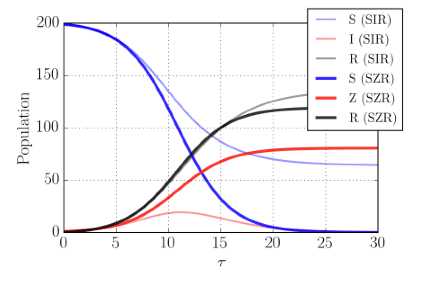
If you start with a small fraction of infected people Z0/S0 <<1, the equations above suggest that the outcome depends entirely on k/ß. If zombies are killed/ rounded up faster than they infect/bite, all is well. Otherwise, all is zombies. A situation like this is shown in the diagram below for a population of 200 and k/ß = .6

FIG. 1. Example dynamics for progress of a normal disease and a zombie apocalypse for an initial population of 199 unin- fected and 1 infected. The S, Z, and R populations are shown in (blue, red, black respectively, with solid lines for the zombie apocalypse, and lighter lines for the normal plague. t= tNß where N is the total popula- tion. For both models the k/ß = 0.6 to show similar evolutions. In the SZR case, the S population disap- pears, while the SIR is self limiting, and only a fraction of the population becomes infected.

Fig. 1, Dynamics of a normal plague (light lines) and a zombie apocalypse (dark) for 199 uninfected and 1 infected. The S and R populations are shown in blue and black respectively. Zombie and infected populations, Z and I , are shown in red; k/ß = 0.6 and τ = tNß. With zombies, the S population disappears. With normal infection, the infected die and some S survive.

Sorry to say, things get worse for higher initial ratios,  Z0/S0 >> 0. For these cases, you can kill zombies faster than they infect you, and the last susceptible person will still be infected before the last zombie is killed. To analyze this, we create a new parameter P = Z + (1 – k/ß)S and note that dP/dt = 0 for all S and Z; the path of possible outcomes will always be along a path of constant P. We already know that, for any zombies to survive, S = 0. We now use algebra to show that the final concentration of zombies will be Z = Z0 + (1-k/ß)S0. Free zombies survive so long as the following ratio is non zero: Z0/S0 + 1- k/ß. If Z0/S0 = 1, a situation that could arise if a small army of zombies breaks out of quarantine, you’ll need a high kill ratio, k/ß > 2 or the zombies take over. It’s seen to be harder to stop a zombie outbreak than to stop the original plague. This is a strong motivation to kill any infected people you’ve rounded up, a moral dilemma that appears some plague literature.

Figure 1, from the Cornell paper, gives a sense of the time necessary to reach the final state of S=0 or Z=0. For k/ß of .6, we see that it takes is a dimensionless time τ of 25 or to reach this final, steady state of all zombies. Here, τ= t Nß and N is the total population; it takes more real time to reach τ= 25 if N is high than if N is low. We find that the best course in a zombie invasion is to head for the country hoping to find a place where N is vanishingly low, or (better yet) where Z0 is zero. This was the main conclusion of the Cornell paper.

Figure 1 also shows the progress of a more normal disease, one where a significant fraction of the infected die on their own or develop a natural immunity and recover. As before, S is the density of the susceptible, R is the density of the removed + recovered, but here I is the density of those Infected by non-zombie disease. The time-scales are the same, but the outcome is different. As before, τ = 25 but now the infected are entirely killed off or isolated, I =0 though ß > k. Some non-infected, susceptible individuals survive as well.

From this observation, I now add a new conclusion, not from the Cornell paper. It seems clear that more immune people will be in the cities. I’ve also noted that τ = 25 will be reached faster in the cities, where N is large, than in the country where N is small. I conclude that, while you will be worse off in the city at the beginning of a plague, you’re likely better off there at the end. You may need to get through an intermediate zombie zone, and you will want to get the infected to bury their own, but my new insight is that you’ll want to return to the city at the end of the plague and look for the immune remnant. This is a typical zombie story-line; it should be the winning strategy if a plague strikes too. Good luck.

Robert Buxbaum, April 21, 2015. While everything I presented above was done with differential calculus, the original paper showed a more-complete, stochastic solution. I’ve noted before that difference calculus is better. Stochastic calculus shows that, if you start with only one or two zombies, there is still a chance to survive even if ß/k is high and there is no immunity. You’ve just got to kill all the zombies early on (gun ownership can help). Here’s my statistical way to look at this. James Sethna, lead author of the Cornell paper, was one of the brightest of my Princeton PhD chums.

Addendum following COVID. Watch out for your politicians here. They will champion the zombie cause, moving zombies into old age homes with non-zombies, they will ignore simple protections and force you to ride the subways with zombies to provide essential services while they go to empty ballparks to watch games, and they will deny the efficacy of drugs that don’t provide money to them and promote cures that benefit them

you are what you eat?

The simplest understanding of this phrase is that you should eat good, healthy foods to be healthy, and that this will make you healthy in body and mind.

The author of the study published this book against GM foods simultaneously with release of his paper.

The author of this book against unhealthy foods faked his analysis to support the book.

Clearly there is some truth to this. Crazy people look crazy and often eat crazy. Even ‘normal’ people, if they eat too much are likely to become fat, lazy, and sick. There is a socio- economic effect (fat people earn less), and a physiological evidence that gut bacteria affects anxiety and depression (at least in rats). My sense here is at the diet extremes though. There is little, or no evidence to suggest you can make yourself more intelligent (or kind or good) by eating more of the right stuff, or just the right foods in just the right amounts. A better diet can make you look better, but there is a core lie at work when you extend this to imply that the real you is your body, or so tied to your body that a healthy mind can not be found in a sickly body. But most evidence is that the mind is the real you, and (following Socrates) that beautiful minds are found in sickly bodies. I’ve seen few (basically, no) healthy poets, writers, or great artists. Neither are there scientists of note (that I can recall) who lived without smoking, drinking, and any bad habits. Many creative people did drugs. George Orwell smoked cigarette, and died of TB, but wrote well to the end. There is no evidence that bad writing or thinking can be improved by health foods. Stupid is as stupid does, and many healthy people are clearly dolts.

Not that it’s always clear what constitutes good health, or what constitutes good food for health, or what constitutes a good mind. Skinny people may be admired and may earn more, but it is not clear they are healthy. Yule Gibbons, the natural food guru died young of stomach cancer. Adele Davis, another the author of “eat right to be healthy,” died of brain cancer. And Jim Fix, “the running doctor” died young of a heat attack while running. Their health foods may have killed them, and that unhealthy foods, like chocolate and coffee can be good for you. It’s likely a question of balance. While a person will feel better who dresses well, the extreme is probably no good. Very often, a person is drawn after his self-image to be the person he pretends. Show me a man who eats only vegetarian, and I’ll show you someone who sees himself as spiritual, or wants to be seen as spiritual. And that man is likely to be drawn to acting spiritual. Among the vegetarians you find Einstein, George B. Shaw, and Gandhi, people who may have been spiritual from the start, but may have been kept to spirituality from their diets. You also find Hitler: spirituality can take all sorts of forms.

Ward Sullivan in the New Yorker

Ward Sullivan in the New Yorker. People eat, drink, and dress like who they are. And people become like those they eat drink and dress like.

Choice of diet also helps select the people you run into. If you eat vegetarian, you’re likely to associate with other vegetarians, and you will likely behave like them. If you eat Chinese, Greek, or Mexican food, you’re likely to associate with these communities and behave like them. Similarly, an orthodox Jew or Moslem is tied to his community with every dinner and every purchase from the kosher or halal store.

And now we come to the bizarre science of bio-systems. Each person is a complex bio-system, with more non-human DNA than human, and more non-human cells than human. A person has a vast army of bugs on him, and a similarly vast pool of bugs within him. Recent research suggests that what we eat affects this bio-system, and through it our mental state. For whatever the mechanism, show me someone who drinks only 30 year Scotch or 40-year-old French wine, and I’ll show you a food snob. By contrast, show me someone who eats good, cheap food, and drinks good, cheap wine or Scotch (Lauder’s or Dewar’s), and I’ll show you a decent person very much like myself, a clever man who either is a man of the people or who wants to be known as one.”Dis-moi ce que tu manges, je te dirai ce que tu es.” [Tell me what you eat and I will tell you what you are].

Robert E. Buxbaum, February, 2015. My 16-year-old daughter asked me to write on this topic. Perhaps she didn’t know what it meant, or how true I thought it was, or perhaps she liked my challenges of being 16.

Change your underwear, bomber; of mites and men

The underware bomber mites make it right.

Umar, the underwear bomber.

For those who don’t know it, the underwear bomber, Umar Farook Abdulmutallab, wore his pair of explosive underwear for 3 weeks straight before trying to detonate them while flying over Detroit in 2009. They didn’t go off, leaving him scarred for life. It’s quite possible that the nasty little mites that live in underwear stopped the underwear bomber. They are a main source of US allergens too.

Dust mite, skin, and pollen seen with a light  microscope. Gimmie some skin.

Dust mite, skin, and pollen seen with a light microscope. Gimmie some skin.

If you’ve ever used an electron microscope to look at household objects, you’ll find them covered with brick-like flakes of dried out skin-cells: yours and your friends’. Each person sheds his or her skin every month, on average. The outer layer dries out and flakes off as new skin grows in behind it. Skin flakes are the single largest source of household dust, and if not for the fact that these flakes are the main food for mites, your house would be chock full of your left over skin. When sunlight shines in your window, you see the shimmer of skin-flakes hanging in the air. Under the electron microscope, the fresh skin flakes look like bricks, but mite-eaten skin flakes look irregular. Less common, but more busy are the mites.

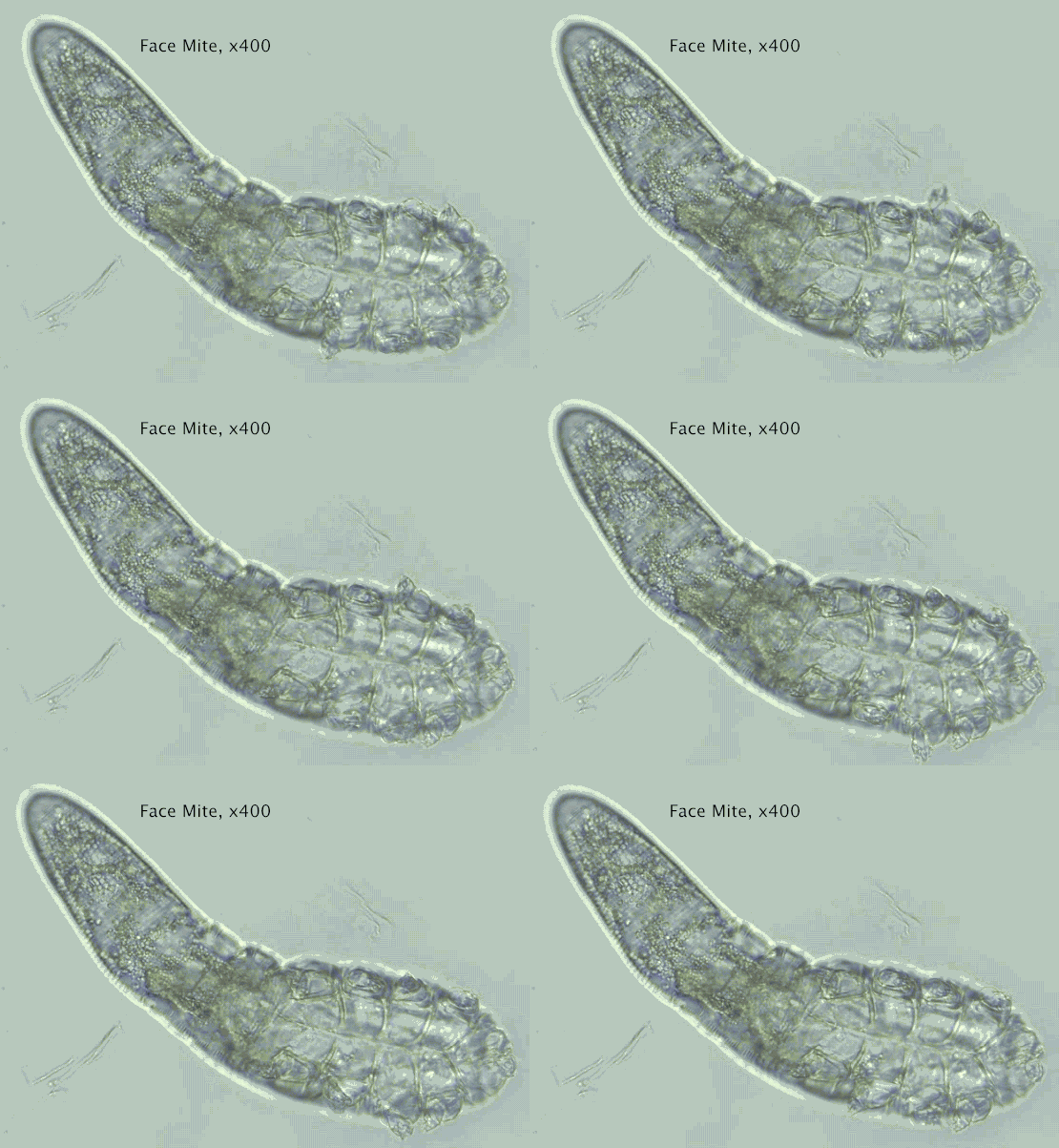
The facial mite movie. They live on in us, about 1 per hair follicle, particularly favoring eyelashes. Whenever you shower, your shower with a friend.

The facial mite movie. They live on in us, about 1 per hair follicle, particularly favoring eyelashes. Whenever you shower, you shower with a friend.

Dry skin is mostly protein (keratin), plus cholesterol and squalene. This provides great nutrition for dust mites and their associated bacteria. In warm, damp environments, as in your underwear or mattress, these beasties multiply and eat the old skin. The average density of dust mites on a mattress is greater than 2500/gram of dust.[1]  The mites leave behind excrement and broken off mite-limbs: nasty bits that are the most common allergens in the US today.

An allergy to dust shows up as sneezing, coughing, clogged lungs, and eczema. The most effective cure is a high level of in-home hygiene; mites don’t like soap or dry air. You’ve go to mop and vacuum regularly. Clean and change your clothing, particularly your undergarments; rotate your mattresses, and shake the dust out of your bedding. Vacuuming is less-effective as a significant fraction of the nasties go through the filter and get spread around by the vacuum blower.

As it turns out, dust mites and their bacteria eat more than skin. They also eat dried body fluids, poop residue, and the particular explosive used by Umar Farook, pentaerythritol tetra nitrate, PETN (humans can eat and metabolize this stuff too — it’s an angina treatment). The mites turn PETN into less-explosive versions, plus more mites.

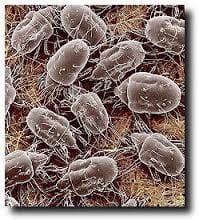
Mighty mites as seen with electron microscopy. They eat more than skin.

Mighty mites as seen with electron microscopy. They eat more than skin.

There are many varieties of mite living on and among us. Belly button mites, for example, and face mites as shown above (click on the image to see it move). On average, people have one facial mite per hair follicle. It’s also possible that the bomber was stopped by poor quality control engineering and not mites at all. Religion tends to be at odds with a science like quality control, and followers tend to put their faith in miracles.

Chigger turning on a dime

Chigger turning on a dime

larger than the dust mite is the chigger, shown at left. Chiggers leave visible bites, particularly along the underwear waste-band. There are larger-yet critters in the family: lice, bed bugs, crabs. Bathing regularly, and cleaning your stuff will rid yourself of all these beasties, at least temporarily. Keeping your hair short and your windows open helps too. Mites multiply in humid, warm environments. Opening the windows dries and cools the air, and blows out mite-bits that could cause wheezing. Benjamin Franklin and took air-baths too: walking around naked with the windows open, even in winter. It helped that he lived on the second floor. Other ways to minimize mite growth include sunlight, DOT (a modern version of DDT), and eucalyptus oil. At the very minimum, change your underwear regularly. It goes a long way to reduce dust embarrassing moments at the jihadist convention.

Dr. Robert E. Buxbaum, Sept 21, 2014. Not all science or life is this weird and wonderful, but a lot is, and I prefer to write about the weird and wonderful bits. See e.g. the hazards of health food, the value of sunshine, or the cancer hazard of living near a river. Or the grammar of pirates.