Tag Archives: Engineering

How is Chemical Engineering?

I’m sometimes asked about chemical engineering by high-schoolers with some science aptitude. Typically they are trying to decide between a major in chemistry or chemical engineering. They’ve typically figured out that chemical engineering must be some practical version of chemistry, but can’t quite figure out how that could be engineering. My key answer here is: unit operations.

If I were a chemist trying to make an interesting product, beer or whisky say, I might start with sugar, barley, water and yeast, plus perhaps some hops and tablets of nutrients and antimicrobial. After a few hours of work, I’d have 5 gallons of beer fermenting, and after a month I’d have beer that I could either drink or batch-distill into whisky. If I ran the cost numbers, I’d find that my supplies cost as much to make as buying the product in a store; the value of my time was thus zero and would not be any higher if I were to scale up production: I’m a chemist.

The key to making my time more valuable is unit operations. I need to scale up production and use less costly materials. Corn costs less than sugar but has to be enzyme processed into a form that can be fermented. Essentially, I have to cook a large batch of corn at the right temperatures (near boiling) and then add enzymes from the beer or from sprouted corn and then hold the temperature for an hour or more. Sounds simple, but requires good heat control, good heating, and good mixing, otherwise the enzymes will die or won’t work or the corn will burn and stick to the bottom of the pot. These are all unit operations; you’ll learn more about them in chemical engineering.

Reactor design is a classical unit operation. Do I react in large batches, or in a continuous fermentor. How do I hold on to the catalyst (enzymes); what is the contact time; these are the issues of reactor engineering, and while different catalysts and reactions have different properties and rates, the analysis is more-or-less the same.

Another issue is solid-liquid separation, in this case filtration of the dregs. When made in small batches, the bottoms of the beer barrel, the dregs, were let to settle and then washed down the sink. At larger scales, settling will take too long and will still leave a beer that is cloudy. Further, the dregs are too valuable to waste. At larger scales, you’ll want to filter the beer and will want to do something to the residue. Centrifugal filtration is typically used and the residue is typically dried and sold as animal feed. Centrifugal filtration is another unit operation.

Distillation is another classical unit operation. An important part here is avoiding hangover-producing higher alcohols and nasty tasting, “fusel oils.” There are tricks here that are more-or-less worth doing depending on the product you want. Typically, you start with a simple processes and equipment and keep tweaking them until the product and costs are want you want. At the end, typically, the process equipment looks more like a refinery than like a kitchen: chemical engineering equipment is fairly different from the small batch equipment that was used as the chemist.

The same approach to making things and scaling them up also applied in management situations, by the way, and many of my chemical engineering friends have become managers.

Heat conduction in insulating blankets, aerogels, space shuttle tiles, etc.

A lot about heat conduction in insulating blankets can be explained by the ordinary motion of gas molecules. That’s because the thermal conductivity of air (or any likely gas) is much lower than that of glass, alumina, or any likely solid material used for the structure of the blanket. At any temperature, the average kinetic energy of an air molecule is 1/2kT in any direction, or 3/2kT altogether; where k is Boltzman’s constant, and T is absolute temperature, °K. Since kinetic energy equals 1/2 mv2, you find that the average velocity in the x direction must be v = √kT/m = √RT/M. Here m is the mass of the gas molecule in kg, M is the molecular weight also in kg (0.029 kg/mol for air), R is the gas constant 8.29J/mol°C, and v is the molecular velocity in the x direction, in meters/sec. From this equation, you will find that v is quite large under normal circumstances, about 290 m/s (650 mph) for air molecules at ordinary temperatures of 22°C or 295 K. That is, air molecules travel in any fixed direction at roughly the speed of sound, Mach 1 (the average speed including all directions is about √3 as fast, or about 1130 mph).

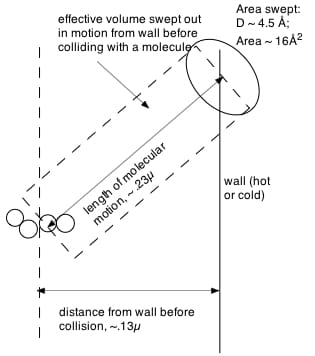
The distance a molecule will go before hitting another one is a function of the cross-sectional areas of the molecules and their densities in space. Dividing the volume of a mol of gas, 0.0224 m3/mol at “normal conditions” by the number of molecules in the mol (6.02 x10^23) gives an effective volume per molecule at this normal condition: .0224 m3/6.0210^23 = 3.72 x10^-26 m3/molecule at normal temperatures and pressures. Dividing this volume by the molecular cross-section area for collisions (about 1.6 x 10^-19 m2 for air based on an effective diameter of 4.5 Angstroms) gives a free-motion distance of about 0.23×10^-6 m or 0.23µ for air molecules at standard conditions. This distance is small, to be sure, but it is 1000 times the molecular diameter, more or less, and as a result air behaves nearly as an “ideal gas”, one composed of point masses under normal conditions (and most conditions you run into). The distance the molecule travels to or from a given surface will be smaller, 1/√3 of this on average, or about 1.35×10^-7m. This distance will be important when we come to estimate heat transfer rates at the end of this post.


Molecular motion of an air molecule (oxygen or nitrogen) as part of heat transfer process; this shows how some of the dimensions work.

Molecular motion of an air molecule (oxygen or nitrogen) as part of heat transfer process; this shows how some of the dimensions work.

The number of molecules hitting per square meter per second is most easily calculated from the transfer of momentum. The pressure at the surface equals the rate of change of momentum of the molecules bouncing off. At atmospheric pressure 103,000 Pa = 103,000 Newtons/m2, the number of molecules bouncing off per second is half this pressure divided by the mass of each molecule times the velocity in the surface direction. The contact rate is thus found to be (1/2) x 103,000 Pa x 6.02^23 molecule/mol /(290 m/s. x .029 kg/mol) = 36,900 x 10^23 molecules/m2sec.

The thermal conductivity is merely this number times the heat capacity transfer per molecule times the distance of the transfer. I will now calculate the heat capacity per molecule from statistical mechanics because I’m used to doing things this way; other people might look up the heat capacity per mol and divide by 6.02 x10^23: For any gas, the heat capacity that derives from kinetic energy is k/2 per molecule in each direction, as mentioned above. Combining the three directions, that’s 3k/2. Air molecules look like dumbbells, though, so they have two rotations that contribute another k/2 of heat capacity each, and they have a vibration that contributes k. We begin with an approximate value for k = 2 cal/mol of molecules per °C; it’s actually 1.987 but I round up to include some electronic effects. Based on this, we calculate the heat capacity of air to be 7 cal/mol°C at constant volume or 1.16 x10^-23 cal/molecule°C. The amount of energy that can transfer to the hot (or cold) wall is this heat capacity times the temperature difference that molecules carry between the wall and their first collision with other gases. The temperature difference carried by air molecules at standard conditions is only 1.35 x10⁻⁷ times the temperature difference per meter because the molecules only go that far before colliding with another molecule (remember, I said this number would be important). The thermal conductivity for stagnant air per meter is thus calculated by multiplying the number of molecules times that hit per m2 per second, the distance the molecule travels in meters, and the effective heat capacity per molecule. This would be 36,900 x 10^23  molecules/m2sec x 1.35 x10-7m x 1.16 x10^-23 cal/molecule°C = 0.00578 cal/ms°C or .0241 W/m°C. This value is (pretty exactly) the thermal conductivity of dry air that you find by experiment.

I did all that math, though I already knew the thermal conductivity of air from experiment for a few reasons: to show off the sort of stuff you can do with simple statistical mechanics; to build up skills in case I ever need to know the thermal conductivity of deuterium or iodine gas, or mixtures; and finally, to be able to understand the effects of pressure, temperature and (mainly insulator) geometry — something I might need to design a piece of equipment with, for example, lower thermal heat losses. I find, from my calculation that we should not expect much change in thermal conductivity with gas pressure at near normal conditions; to first order, changes in pressure will change the distance the molecule travels to exactly the same extent that it changes the number of molecules that hit the surface per second. At very low pressures or very small distances, lower pressures will translate to lower conductivity, but for normal-ish pressures and geometries, changes in gas pressure should not affect thermal conductivity — and does not.

I’d predict that temperature would have a larger effect on thermal conductivity, but still not an order-of magnitude large effect. Increasing the temperature increases the distance between collisions in proportion to the absolute temperature, but decreases the number of collisions by the square-root of T since the molecules move faster at high temperature. As a result, increasing T has a √T positive effect on thermal conductivity.

Because neither temperature nor pressure has much effect, you might expect that the thermal conductivity of all air-filed insulating blankets at all normal-ish conditions is more-or-less that of standing air (air without circulation). That is what you find, for the most part; the same 0.024 W/m°C thermal conductivity with standing air, with high-tech, NASA fiber blankets on the space shuttle and with the cheapest styrofoam cups. Wool felt has a thermal conductivity of 0.042 W/m°C, about twice that of air, a not-surprising result given that wool felt is about 1/2 wool and 1/2 air.

Now we can start to understand the most recent class of insulating blankets, those with very fine fibers, or thin layers of fiber (or aluminum or gold). When these are separated by less than 0.2µ you finally decrease the thermal conductivity at room temperature below that for air. These layers decrease the distance traveled between gas collisions, but still leave the same number of collisions with the hot or cold wall; as a result, the smaller the gap below .2µ the lower the thermal conductivity. This happens in aerogels and some space blankets that have very small silica fibers, less than .1µ apart (<100 nm). Aerogels can have much lower thermal conductivities than 0.024 W/m°C, even when filled with air at standard conditions.

In outer space you get lower thermal conductivity without high-tech aerogels because the free path is very long. At these pressures virtually every molecule hits a fiber before it hits another molecule; for even a rough blanket with distant fibers, the fibers bleak up the path of the molecules significantly. Thus, the fibers of the space shuttle (about 10 µ apart) provide far lower thermal conductivity in outer space than on earth. You can get the same benefit in the lab if you put a high vacuum of say 10^-7 atm between glass walls that are 9 mm apart. Without the walls, the air molecules could travel 1.3 µ/10^-7 = 13m before colliding with each other. Since the walls of a typical Dewar are about 0.009 m apart (9 mm) the heat conduction of the Dewar is thus 1/150 (0.7%) as high as for a normal air layer 9mm thick; there is no thermal conductivity of Dewar flasks and vacuum bottles as such, since the amount of heat conducted is independent of gap-distance. Pretty spiffy. I use this knowledge to help with the thermal insulation of some of our hydrogen generators and hydrogen purifiers.

There is another effect that I should mention: black body heat transfer. In many cases black body radiation dominates: it is the reason the tiles are white (or black) and not clear; it is the reason Dewar flasks are mirrored (a mirrored surface provides less black body heat transfer). This post is already too long to do black body radiation justice here, but treat it in more detail in another post.

RE. Buxbaum

Engineering joke

An optimist says the cup is half full.

A pessimist says the cup is half empty.

An engineer says the cup is twice as big as it has to be.

(A quantum physicist might say that the water isn’t in the cup till he looks at it; then again, the quantum physicist isn’t there until someone looks at him. And that’s why I’m an engineer).

How much wood could a woodchuck chuck?

How much wood could a woodchuck chuck, if a woodchuck could chuck wood. It’s a classic question with a simple answer: The woodchuck, also known as a groundhog or marmot, is a close relative to the beaver: it looks roughly the same, but is about 1/5 the weight  (10 pounds versus 50 pounds), and beavers do chuck wood, using their teeth to pile it onto their dams. I’ll call the tooth piling process chucking, since that’s what we would call it if a person did it by hand.

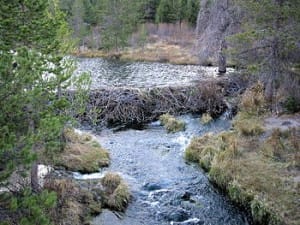
Beaver Dam

A beaver dam. From the size of this dam, and the rate of construction (one night) you can figure out how much wood a beaver could chuck, and from that how much a woodchuck could.

A reasonable assumption, is that a wood chuck would chuck about 1/5 as much wood as a beaver does. You might think this isn’t very much wood — and one researcher claimed it would be less than 1/2 lb. — but he’s wrong. A beaver is able to build a dam like the one shown in a single night. From the size of the dam and the speed of building you can estimate that the beaver chucked on the pile about 1000 lbs of wood per night (beavers work at night). To figure out how much wood a woodchuck would chuck, divide this rate by 5. Based on this, I’d estimate that a woodchuck would chuck some 200 lbs per day, if it chose to.

Woodchucks don’t chuck wood, as the question implies. Unlike beavers they do not build wood dams or lodges. Instead they live in burrows in the ground. Also woodchuck teeth are not so useful. Woodchucks do kick up a lot of dirt digging a burrow, as much as 700 lb/ day of dirt, but the question implies that this activity should not be counted as chucking. Well, now you know: it’s 200 lbs/night.

Robert Buxbaum. This post is revised January 30, 2020. My original estimate, from  January 2013 was half the value here. I’d come to believe that wood-chucks/ groundhogs are 1/10 the size of a beaver, so I’d estimated 100 lb/night.