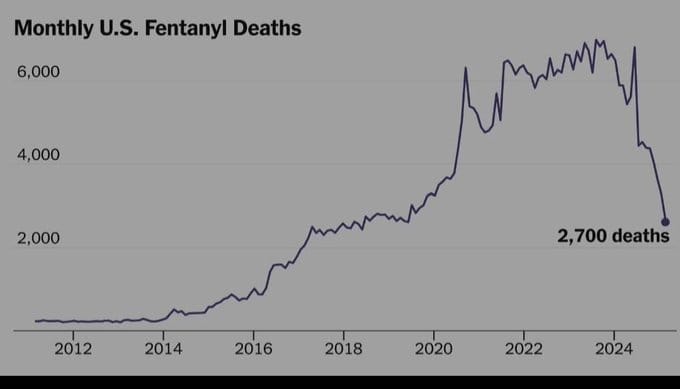
For the past few months, the US navy has been attacking drug-running boats from Venezuela. Videos show ships trying to run away with packages pushed overboard before the sailors are captured or killed. It’s claimed that the packages contained fentanyl, a deadly synthetic heroin. At the same time, there has been a dramatic drop in the rate of fentanyl deaths. Based on the graph above, it seems that some 1500 US lives were saved per month, from fentanyl death alone.
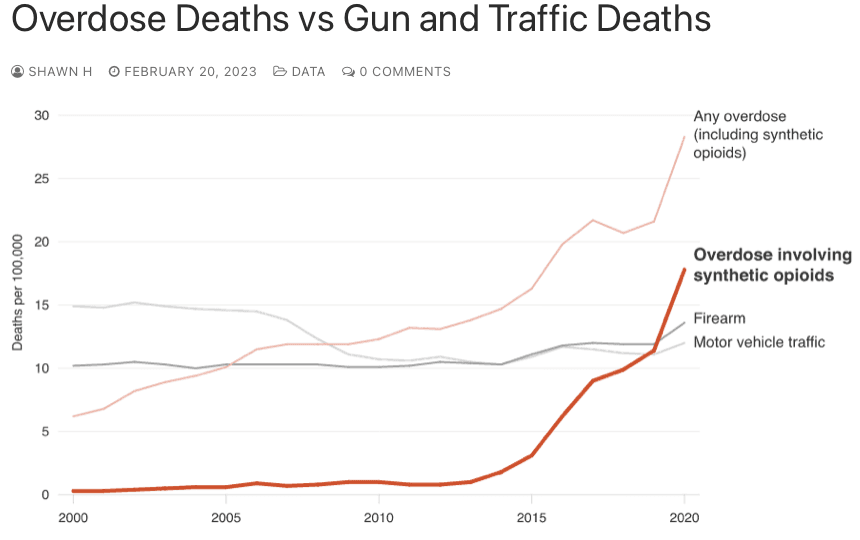
2023 from the Harlem Coalition. There are far more US drug overdose deaths than firearm or vehicle deaths/year.
Opioid overdose deaths have exceeded gun or vehicle deaths since 2005. But there has been a big uptick since the introduction of synthetic opioids, about 2014. Fentanyl is now the leading cause of overdose deaths, alone outpacing gun and vehicle deaths, see graph.
It’s not clear that the attacks on the boats is a primary reason for the drop in deaths, by the way. A lot of credit goes to seizures at the Mexico and Canada border, including the decrease in migrant passage. Some of those were “mules”, carrying drugs. Improved screening at the border seems to have help stop the mules. In 2025, the DEA seized over 47 million fentanyl-laced pills and nearly 10,000 pounds of fentanyl powder, some made in the US, some brought in, cross-border.
An other positive change is increased screening of small packages, of value under $800. They previously entered the US, tariff free, at reduced postage rates. Chinese companies could send 2 oz packages to customers here for 70¢, cheaper than Americans could ship cross town. The DEA reports that most of the precursor chemicals enter the US in packages from China. More checking, and help from China, means fewer of these chemicals get in.
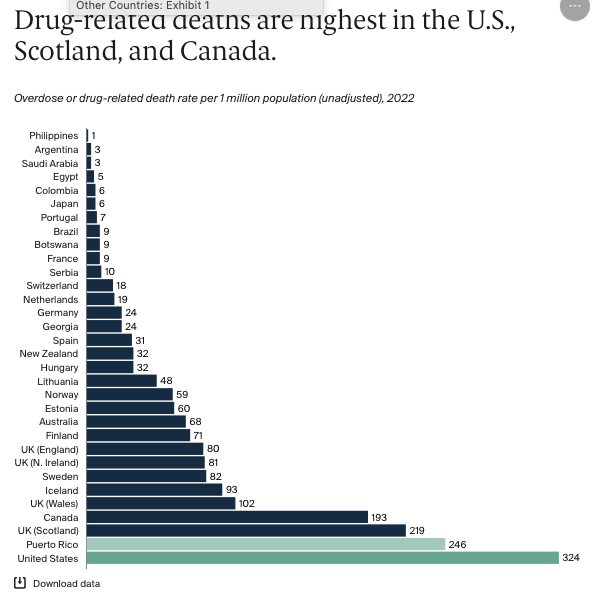
Before we compliment ourselves, our drug numbers are still vastly too high, about 70,000 overdose deaths in 2025, a vastly higher rate than in Europe or Japan, see chart below. The reason is, in my opinion, that we are over-diagnosed and over-medicated. We see ads for drugs on TV, magazines telling us to ask for a pill for any pain or discomfort. They’re all addictive. Doctors are happy to comply, and when the prescription stops, or stops being effective, you’re a hooked customer for heroin or fentanyl.
Addiction has become a middle-aged problem affecting mostly those 25 to 45. It’s made US lifespan significantly shorter. Doctors are curing the pain and killing us patients. Magazines, TV, and drug companies, too. Europe has stricter regulations on pills with fewer prescriptions allowed, no drug ads, and no automatic refills. Does everyone over 50 need blood pressure meds, for example.
China is likely the largest economy in the world, 11% lager than the US calculated here based on food purchasing parity They also have a larger army and navy, 754 ships vs 440, with military ambitions for Taiwan and new, man-made islands in the China sea. They continue to add aircraft carriers and submarines (we’re still ahead there), but China fuels all this with oil. They use some 17 million barrels per day: 11.3 million imported by ship, and put another million bb//day per into reserve in case there is a shutoff.
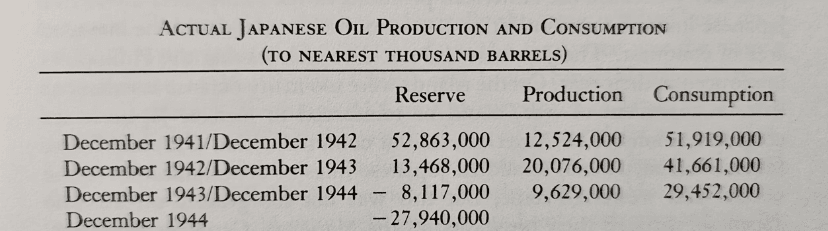
A problem for China is that their internal production, 4.5million bbl/day, is far below their consumption, a big vulnerability. One of their main suppliers, Venezuela, just went off line, sending 800,000 bbl/day of oil to the US that would have gone to China. Two other of their major, sanctioned suppliers, Iran and Russia have had delivery issues too; a disruption in oil could cause a revolt in China. Perhaps this fear will drive China to war with us, similar to the way that a cut off in oil caused Japan went to go to war with us in WWII, see table below. Japan had the choice of war or shutting down their economy and ambitions. Perhaps China may choose the same if Iran and/or Russia goes off-line. That was my worry, I’m no longer that concerned.
This shows how dependent Japan was on foreign oil, before and during WWII. The cut off of imports sues them to attack Pearl Harbor, source = Sarah Paine, military historian
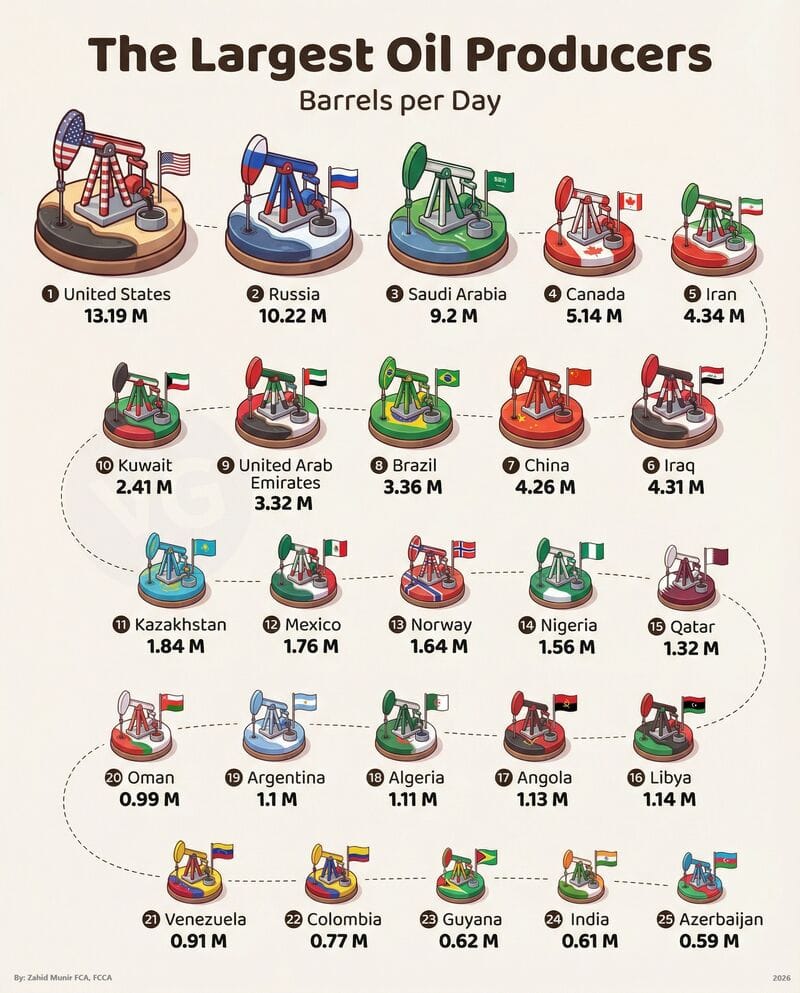
Currently, China buys most of its imported oil from four countries: Russia, Iran, Saudi Arabia, and Iraq; two of these are under sanction. China used to get another 0.8 million barrels per day from Venezuela, another country under sanction, but that route was closed by Trump last week. Buying from sanctioned countries saves them significantly, and supports the BRICS alliance, an alliance specifically against the US (NAFTA?) and the EU. The money they pay to Russia and Iran supports the war against Ukraine, plus ISIS’, war against us, and the mullahs oppression in Iran.
Oil production worldwide, 2024. How much China buys from each varies month to month.
China was buying, from Russia, some 2.2 million barrels of oil and refined products, plus natural gas and coal (China is a big coal user). The rest of Russia’s output goes to India, Turkey, and the EU. The EU buys more than half of eastern Russia’s natural gas output, shamefully it has likely kept Germany from collapsing. The problem for China is that Russian production is under attack from Ukraine. Ukraine sank or disabled several Russian tankers, and we took some more; they’ve blown up pumping stations, including three on the Caspian Sea, set fire, to a large liquid natural gas terminal and damaged the major off-load platform for Kazakh oil. According to the Foundation for Democracy report, here, by October 2025, China was down to getting only 800,000 bbl/day from Russia, a major blow, and Ukraine’s attacks continue.
Some dark fleet ships captured by the US navy off of Venezuela, on their way to China with sanctioned oil.
Iran is another major supplier under attack. Up until recently they provided nearly 2 million barrels of oil per day, 90% of Iran’s seaborne export. Much of that went indirectly, going to Indonesia, turkey, Iraq, and Kuwait where it was relabeled, blended or refined to avoid sanction penalties. Everyone makes a profit here, but Iran is in the midst of a revolution. Last week, Trump imposed an across-the board 25% additional tariff on counties that help Iran avoid the sanctions. My guess is that this tariff will be effective and that it will last until the revolution is over. His tariffs have been effective and profitable, it seems.
China has non-sanctioned suppliers. They buy some 1.6 million barrels per day from Saudi Arabia, about 1.2 million bbl/day, from Iraq, about 1.3 million bbl per day from Malaysia, about 700,000/ day from Brazil, and about 900,000/day from the USA. In principle, they could make up any losses by buying more here, but the price would be higher. Worse yet, Trump could cut China off. That would be devastating; it’s the reason China built up a reserve of 2.2 billion barrels amounting to 6 months of current use. Japan did something similar in 1941, building up a year’s worth. They then used all of it in the first year of the war, while conquering Indonesia, a new supplier. For all I know, Trump’s activities in Venezuela and Iran are meant to force a war decision on China before they are strong enough to defeat us. It seems to have been FDR’s logic.
China’s main way to address a possible oil disruption, as best I can tell, has been to push EVs development. They’ve financed some 500 new EV companies who now (late 2025) provide about 50% of new Chinese automobiles. Another 19% are hybrids. In the US, only 8% of new cars are EVs, and 16% hybrids. Large-scale use of EVs lessens the pressure on Chinese leaders to find oil sources, some 40% of oil imports can be assumed to go to fuel automobiles; if China were to go 80% EV, it would save 5.5 million barrels/day, more than it gets from Russia and Iran combined. For now, though, China has a big need for gasoline, and has a big excess in EV manufacturing. It has turned to Canada both as a customer for EVs and as a supplier for oil.
Last week, Canadian PM, Mark Carney visited China and announced a “Strategic Partnership” on Agriculture, energy, finance, and Global governance.” There’s no specific mention of oil, but it’s implied. China gets most favored nation status sending goods, including EVs to Canada at rates lower than on US goods. China will export some 50,000 EVs in 2026, rising to 70,000 by 2030 with tariffs set to 6.1%. US-made cars are tariffed at 25%. Canadians will get visa-free, tourist visits), plus a loan of $1B to be used buying Chinese ships. In Davos last week, “We are in the midst of a Rupture” away from the US. He urged the EU and other “middle powers” to band together. He talks like China is a good, reliable friend to Canada, and like the US isn’t. I would worry more about his comments and the “global governance” phrase, if the EU seemed to be going along, but it is not. Nor do I see a real move in China for war. I see positive effects of increased EV sales for China, Canada, and the world. Even if the quality isn’t great, Go Canada, go peace.
Robert Buxbaum, January 25, 2026. *The plan to attack Pearl Harbor was made in December 1940, a year before it happened and 9 months before we cut off oil shipments. We cut off oil shipments in September, following Japan’s invasion of Indonesia, done to take the oil there. While oil was not Japan’s only aim in WWII, it was an aim and a big participant at every step.
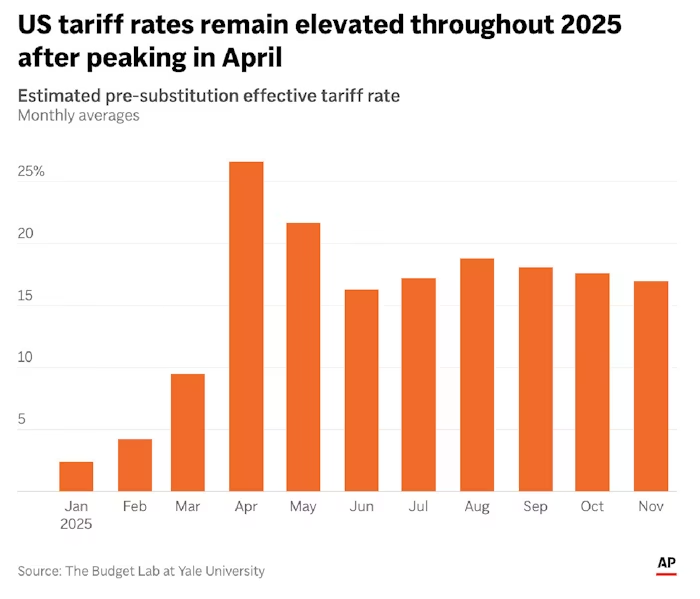
Economic experts claimed the tariffs would raise no signifiant money, would bring in no jobs, and would be so inflationary that the damage would far exceed any benefit. President Trump instituted them anyway, claiming they would benefit workers, raising wages, returning manufacturing to the US, and serving as a tool of diplomacy. Based on data so far, it appears the experts were completely wrong, and that Trump was right on all counts.
As an average, for the last nine months, our tariff rate has been about 17%, as shown in the chart above, bringing in about $30 billion per month. That tariff rate is as high as it’s been since the 1940s, but far lower than it was in the early 20th century. Chinese products are taxed more, at 47.5% on average, while goods from Mexico and Canada are taxed less, about 5%. High or low the tariffs generate complaints all around. Strangely, those complaining, in the US and out, see nothing amiss with the tariffs that our trading partners have placed on US products. The money from these tariffs came in handy, for example during the recent government shutdown, when we could not borrow money. This tariff money allowed us to pay the military and has helped reduce the annual deficit.
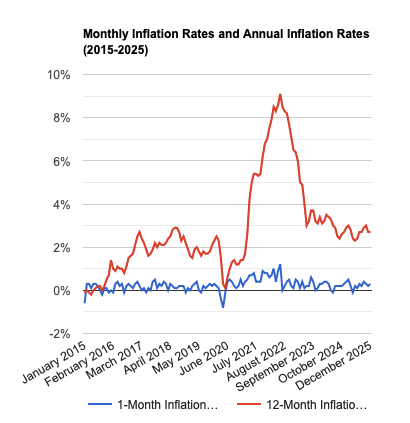
Despite the dire inflation prediction, there has been no noticeable uptick. Inflation has held constant for the last year, at about 2.7%. This is the same as during the last months under Biden, see chart, and is far lower than the 4-8% we saw for most of the Biden term. Basic commodities, in particular, remain cheap, with the price of gasoline and beer lower than in 2024, and luxury imports somewhat more expensive. Lower and middle income Americans don’t seem to mind since most of us don’t buy these goods. This year of inflation data supports Milton Friedman’s claim that taxes are inflation neutral, and that the cause of inflation is government overspending, as he says here. Liberal experts disagree, but the data says otherwise. I suspect the experts are blinded by overly simple theory, of Keynes, that they refuse to abandon. Alternately, they may be willfully lying to promote the agenda of university heads and all others who fund them. I noticed this pattern with global warming experts too. They don’t change their models and dire predictions though it’s way past 2014, and the arctic isn’t ice free.
There has been some job growth, but less than hoped for. There was a decrease in the tech sector and in government employment, but an uptick in services and healthcare. Unemployment has changed little, remaining at 4.4%. Several foreign businesses have moved manufacturing to the US. These include BASF, Volkswagen, LG, and Hanwha to name a few. Hanwha just completed its purchase of the Philadelphia shipyard, and committed $5B to its modernization. I consider this very important. It provides jobs, but beyond this, improved shipbuilding will help us commercially and militarily.
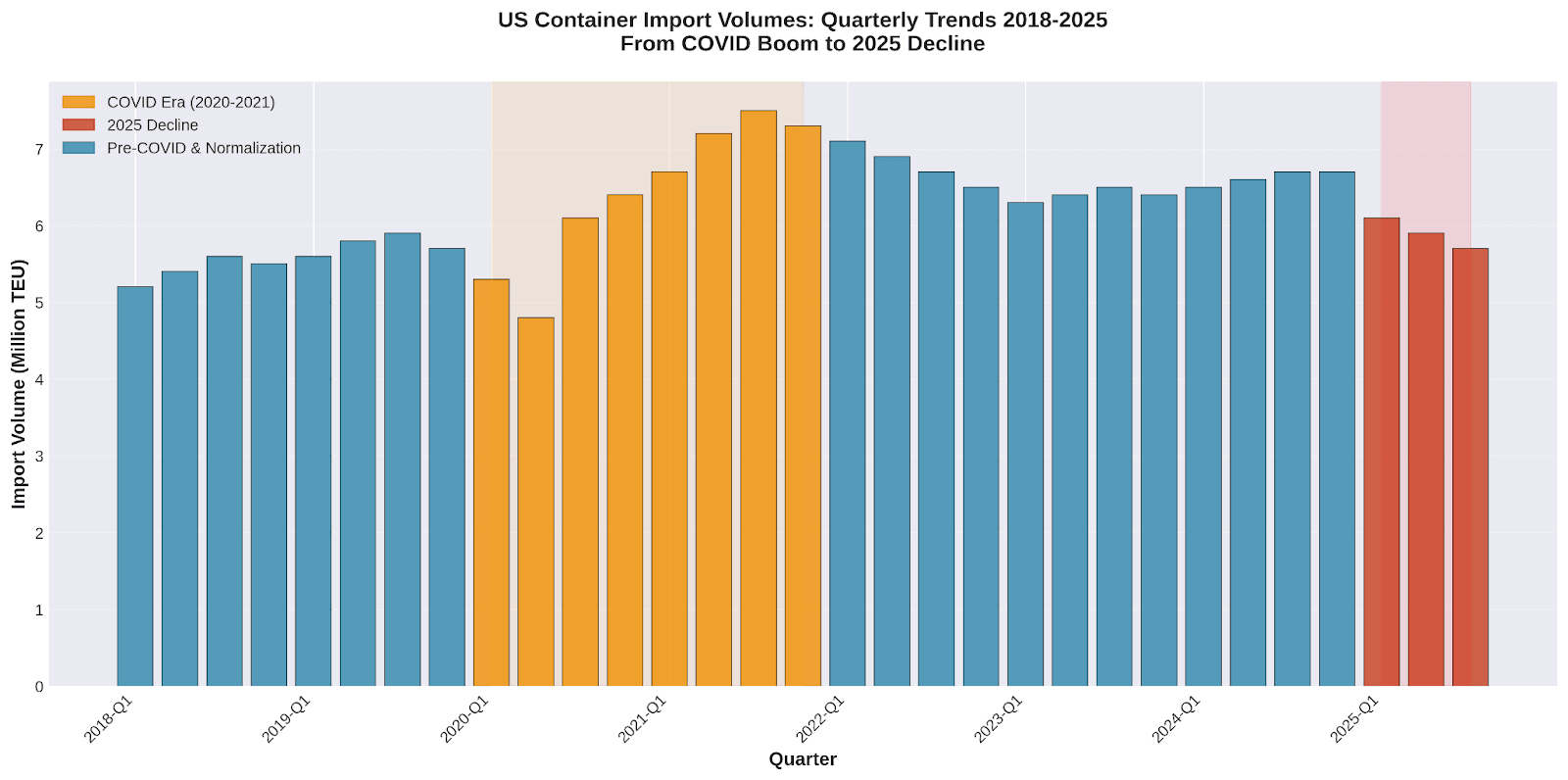
The reason that employment has not gone up as much as hoped seems to be that we’re still buying the same amount from abroad as before, containerized are the same as in the pre-COVID years, see chart below. There’s been some switching of sources, with more coming from Mexico, Taiwan, and Vietnam, and less from Canada and India. Import volumes from China have hardly changed though, since last year, nor have the prices that Americans pay risen. This suggests that China is “eating the tariffs”. I suspect they’ve undervalued their currency to make this happen. We’re selling a little more too, causing the trade imbalance to narrow, but the sales increase are largely precious metals (gold) to China, about 1000 tons in 2025. I’m not sure what China achieves by this; they’ve raised the price of gold to $4,675/oz currently, about double in 1.5 years, and kept the price of Chinese currency low. Perhaps that’s the intent — to keep their currency devalued relative to the dollar. Maybe they have some other idea, like to switch to a gold-backed currency? Who knows? Their purchases increase the value of our gold in Ft. Knox.
Trump’s other justification for the tariffs was as a tool of diplomacy. Trump is using tariffs somewhat this way, as a non-military stick to encourage friendly nations to do what he wants. He got Mexico to stop immigrants and drugs, encouraged the same from Canada and Columbia. He got the EU to spend more in their defense, and got them deal a little less with Russia. They’re still the biggest buyer of Russian natural gas. He also used tariffs to nudge for peace in the Middle East, and between Cambodia and Thailand. Recently, he’s using them to support the Iranian rebels by threatening countries that buy from Iran, or that help the mullahs launder their money and oil. All in all, the tariffs seem to be working for us. The experts are not impressed.
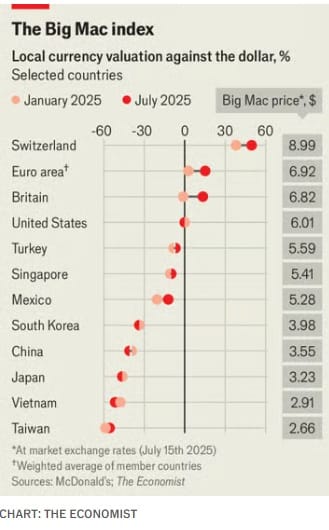
The Economist has run this burger-metric of currency valuation for 40 years or so. I find it instructive.
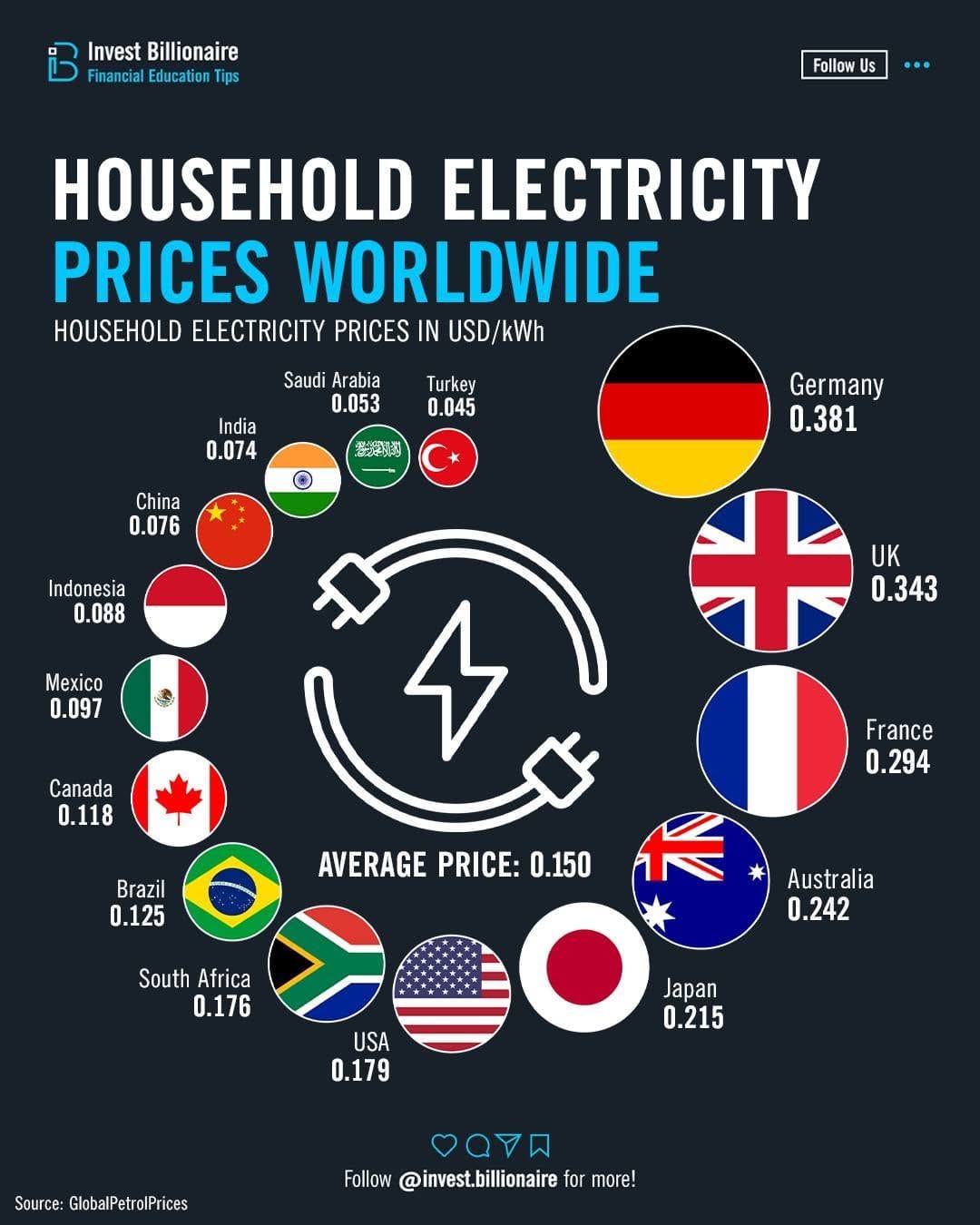
One can buy a new electric car in China for US $20,000, roughly half of what it would cost in the US. Similarly, a good phone is cheaper in China, or clothes, or a Big Mac. A McDonald’s Big Mac in China costs, effectively $3.55, 59% of what it costs in the US, slightly less than 3/5 the US price. The Chinese explanation is that China is nearly twice as efficient as the US at most every type of manufacturing. I don’t believe this explanation, though there is some truth to it: Their electricity is cheaper, in part because they burn mostly coal for electric power. Meanwhile we have shut-down our coal plants, and have hardly built nuclear since the 1970s.
Another source of efficiency is that China arranges its manufacturing into dedicated cities for different products, one city for toys, another for luggage, others for cars, planes, hair driers… This helps efficiency but I’m not sure how much, and I don’t see these advantages applying to McDonald’s. There is no way I believe their workers are 5/3 as efficient as US workers when it comes to making burgers. It’s not like they ship the burgers from a central factory, and they buy gain and meat from us. My sense, then, is that it’s not efficiency that keeps prices low, but that the Chinese currency, the yuan is undervalued.
It’s hard to estimate how much their currency is undervalued, but I will use the burger-metric, above and say the yuan selling for about 3/5 its true value, and that this explains most of why Chinese shoes, cars, and clothes are so cheap. The rest of the price difference is efficiency, I’d guess. China isn’t the only country with an under-valued currency; Japan’s currency seems even more undervalued. Similarly India, Taiwan… The China is a bigger economy, though, and correcting the Chinese GDP by 5/3, I find their economy is yet bigger, about 111% as big as ours. By a similar correction, European economies appear smaller than they are given credit for.
Chinese electricity is cheap, in part because they burn coal. Also, their currency is undervalued; ditto for India, Indonesia, Turkey.
China’s undervalued currency helps propel its growth, I think, and provides us with cheap goods, but our industry suffers. Also troubling, China will likely surpass us militarily in 3-5 years. One way of slowing this is through tariffs. Trump’s tariff formula, as I understand it, was designed to preserve some China trade, allowing US consumers to benefit, but also taxing the exchange. I think this is a good idea.
Another proposal is to lower the US interest rates. Currently our prime interest rate is 6.5% while China’s is 3%. This provides an incentive for the Chinese industry to invest in the US, maintaining its undervalued currency. The benefit isn’t quite as large as it might seem since we have a 2.7% inflation rate and China has a 0.7% inflation rate. Correcting for this, our bonds return an effective 3.8% and Chinese bonds return 2.3%. The difference is about 3/5 similar to the mismatch in our currencies. Trump has been pushing the Federal Reserve to lower our interest rates, and The Fed has grudgingly agreed, slowly. A lower interest rate would also spike US industry and inflation, and help reduce the government deficit. Trump has also proposed new ships for the navy. Too little, too late, I think. Things should get dicy in the next decade between the US and China.
Robert Buxbaum, December 30, 2025. I started this post not knowing where it would lead. As I research and write, I learn. Perhaps you will too,
We’ve become accustomed to buying cheap products from China: items made of glass, plastic, and metal come to the US by the ship-load, approximately $600 B worth last year, the highest from any country. Labor isn’t cheaper in China, certainly not when compared to Mexico or India, nor are the machines that make the products more advanced. What’s behind China’s ability to produce at their low prices is cheap energy—specifically, coal and nuclear-based electricity. While the US and most western countries have shut down coal plants to stop global warming, and have even shut working nuclear reactors for no obvious reason, China has aggressively expanded coal and nuclear energy production. The result? They are the largest single source of CO2, and have some of the lowest electricity prices in the world, Chinese electricity prices are about 1/4 of European, and 2/3 of U.S.
In recent years, the U.S. and Europe have increasingly relied on renewable energy sources like wind and solar. While these can work in certain areas, they require far more land than nuclear or coal, and expensive infrastructure because the power is intermittent, and generally not located close to the customer. The UK and Germany, countries with long periods of cloudy, windless conditions, have switched to solar and wind, leading to soaring electricity prices and a moribund industrial sector. Germany shut down all of its nuclear plants, 17 of them, largely to rely on electricity imported from its neighbors, and coal-fired sources that are far more polluting and unsafe than the nuclear plants they shut. The UK shut 5 nuclear reactors since 2012.
Meanwhile, China continues to build nuclear and coal plants. China is the largest user of coal power, and is planning to build 100 more coal-fired plants this year. Beyond this, China is building nuclear power rectors, including the world’s first 4th generation reactor (a pebble bed design). China has built 20 nuclear plants since 2016, and has 21 under construction. With this massive energy advantage, China produces things at low price for export: appliances, clothes, furniture, metal and plastic goods, all at a fraction of our cost. By selling us the things we used to make, China imports our jobs and exports pollution from their coal plants.
Many people instinctively understand that outsourcing production to China is harmful to both US employment and world pollution. Yet, until recently, US politicians encouraged this transfer through trade agreements like the TPP. Politicians bow to high-spending importers, and to environmental activists. It seems we prefer cheap goods to employment, and we’re OK with pollution so long as we don’t see the pollution being made. But, by outsourcing production, we’ve also outsourced control over critical industries, we’ve limited out ability to innovate, and we make ourselves dependent on China. Likely, that was part of China’s intent.
Russia has followed a similar path, keeping electricity costs mostly through low through coal, but also nuclear power, exporting their goods mostly to the EU. Before the Ukraine war, Germany in particular, relied on Russian gas, electricity, and fertilizer, products of Russian cheap power. By cutting off those energy, Germany has dealt a severe blow to its economy. Not everyone is happy.
Transfer of electricity, GWh, between European countries, 2023. Energy is most expensive in importer-nations, and GDP growth is slowest.
The incoming Trump administration has decide that, to compete with China’s manufacturing power, we need to develop our own through tariffs, and we need to increase our energy production. Tariffs can help balance the budget, and bring production back home, but without more energy, our industries will struggle to produce. I’m generally in support of this.
US production is more energy efficient than Chinese production, and thus less polluting. Besides, making things here saves on transport, provides jobs, and helps to build US technology for the future. I’m happy to see us start to build more nuclear power reactors, and restart some old plants. Solar and wind is good too, but is suited to only in some areas, windy and sunny ones, and even there, they need battery storage so that the power is available when needed.
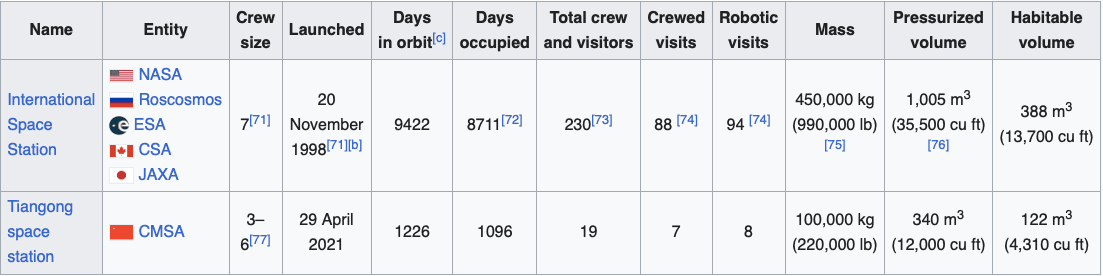
It gets so little notice from the news agencies that many will be surprised to find that China has a space station. It’s known alternately as the Tiangong Space Station or the CSS, Chinese Space Station; it’s smaller than the International Space Station, ISS, but it’s not small. Here is a visual and data comparison, both from Wikipedia.
China’s space station is smaller than the ISS, but just about as capable. Cooperation leads to messiness (and peace?)
The ISS has far more solar panels, but the power input is similar because the CSS panels are of higher efficiency. As shown in the table below, the mass of the ISS is about 4.5 times that of CSS but the habitable volume is only 3 times greater than of CSS, and the claimed crew size is similar, of 3 to 6 compared to 7. The CSS is less messy, less noisy, with less mass, and more energy efficiency. Part of the efficiency comes from that the CSS uses ion propulsion thrusters to keep the station in orbit, while the ISS uses chemical rockets. The CSS thus seems better, on paper. To some extent that’s because it’s more modern.
Another reason that the ISS is more messy is that it’s a collaboration. A major part of its mission is to develop peaceful cooperation between the US, Europe and Russia. It’s been fairly successful at this, especially in the first two decades, and part of making sure parts from The US, Russia, Europe, Japan, and Canada all work together is that many different standards must be tolerated and connected. The ISS tolerates different space suits, different capsules, different connections, and different voltages. The result is researchers communicate, and work together on science, sending joint messages of peace to the folks on earth. Peace is an intended product.
By contrast, the Chinese space station is solely Chinese. There are no interconnection issues, but also no peace dividend. It has a partially military purpose too, including operation of killer satellites, and some degree of data mining. This was banned for ISS. So far the CSS has hosted Chinese astronauts. No Chinese astronauts have visited the ISS, either.
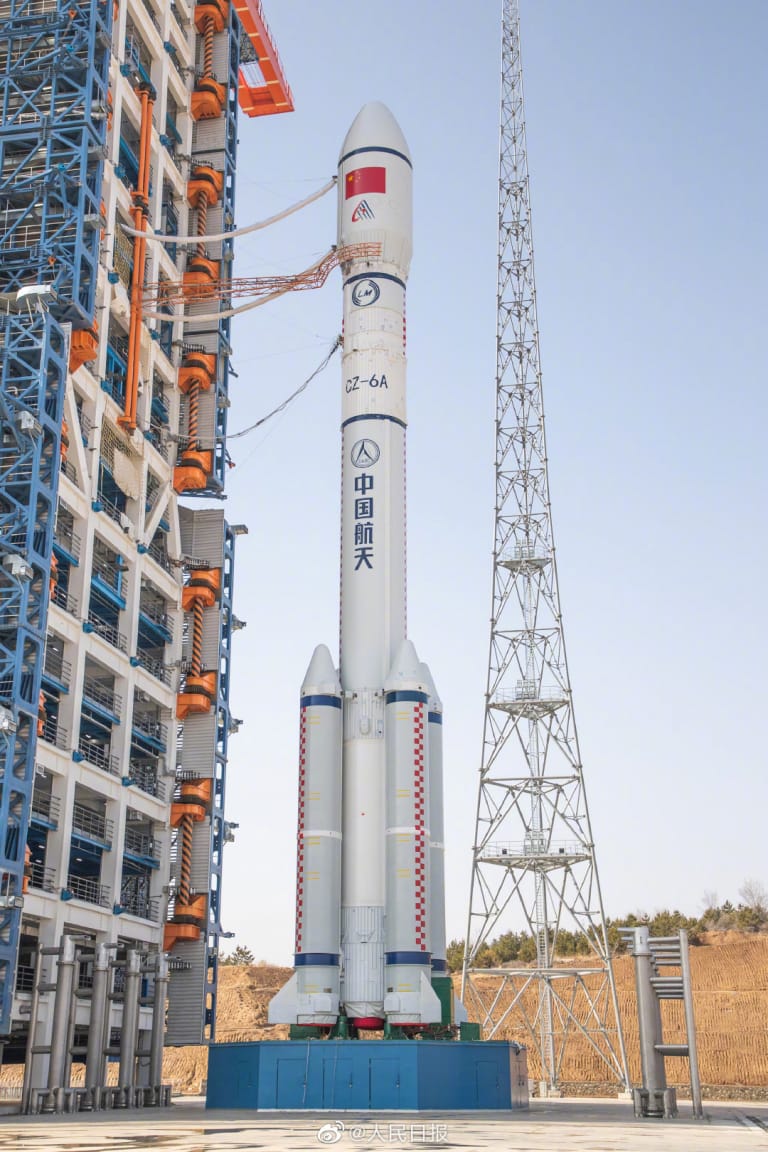
Long march 6A rocket set to supply the CSS. It is very similar to the Delta IV.
India was asked to join the ISS, but has declined, wishing to follow China’s path of space independence. The Indian Space Research Organization plans to launch a small space station on its own, Gaganyaan, in 2025, and after that, a larger version. That’s a shame, though it’s not clear how long cooperation will continue on the ISS, either. See the movie I.S.S. (2023) for how this might play out. Currently, there is a tradition of cooperation about ISS, and it’s held despite the War in Ukraine. The various nations manage to work together in space and on the ground, launching people and materials to the ISS, and working together reliability.
Although it isn’t a direct part of the space stations, I should mention the troubles of the Boeing Star-liner capsule that took two astronauts to the ISS compared to the apparently flawless record of the CSS. The fact is, I’m not bothered by failures, so long as we learn from them. I suspect Boeing will learn, and suspect that this and other flailing projects would be in worse shape without the ISS. Besides, the ISS has been a major catalyst in the development of SpaceX, a US success story that China seems intent on trying to copy. SpaceX was originally funded, at low level, to serve as a backup to Boeing, but managed to bypass them. They now provide cheaper, more reliable travel through use of reusable boosters. The program supplying CSS uses traditional, disposable rockets, the Long March 5 and 6 and 7. These resemble the Atlas V, Delta IV and Delta IV Heavy. They appear to be reliable, but I suspect they are costly too. China is currently developing a series of reusable rocket systems. The Long March 9, for example will have the same lift capacity as SapceX’s Starship, we’re told. Will the Indian program choose this rocket to lift their space station, or will they choose SpaceX, or something else? The advantages of a reusable product mostly show up when you get to reuse it, IMHO.
In Q4 2023, BYD became the world’s largest electric vehicle (EV) manufacturer, passing Tesla in world wide sales. They mostly sell in China, and claim to make a profit while selling cars for about half the price of a Tesla. They also make robots, trucks, busses, smart phones, and batteries — including blade batteries that Tesla uses for a variant in its Berlin facility. They are a darling of the wall-street experts, in part because Warren Buffett is an investor. BYD cars look to be about as nice as Tesla’s at least from the outside and sell (In China) for a fraction of the price. The experts are convinced enough to write glowing articles, but I suspect that the experts have not invested, nor bought BYD products. — What do I know?
BYD truck. It looks good on the outside. Is it competition?
Part of the BYD charm is that it is considered socially progressive, while Tesla is seen as run by a dictatorial villain. A Delaware judge who concluded that Musk did non deserve the majority of his salary, and confiscated it. There are no such claims against BYD. BYD also has far more models than Tesla, 41 by my count, compared to Tesla’s 4. The experts seem to believe that all BYD has to do is bring their low-cost cars west, and they will own the market. My sense is that, if that was all they needed, they’d have done it already. I strongly suspect the low cost cars that are the majority of BYD’s sales are low quality versions — too low to sell in the US. Here are some numbers.
Total number of vehicles made 2023: Tesla: ~1,800,000 BYD: ~3,020,000 (1,570,000 BEV)
Net Profit 2023: Profit per employee: Profit per vehicle: Tesla: ~$9.5B (9.7%). Tesla: $67,857. Tesla: $5,280. BYD: ~$3.5B (4.1%). BYD: $5,542. BYD: $1,160
Market share based on sales in western countries 2023: Tesla: US: 4%, EU: 2.6% BYD: US: 0%, EU: 0.1%
The most telling comparison, in my opinion, is BYD’s tiny market share in western countries. Their cars sell for 1/2 what Tesla’s sell for. If their low-cost cars were as good as Tesla’s, there is no way their market penetration would be so low. My sense is that the average BYD vehicle is lacking in something. Maybe they’re underpowered, or poorly constructed, unsafe, or unreliable: suitable only for China, India, or other poor markets. I suspect that the cars BYD sells in Europe are made on a separate line. Even so, customers say that BYD cars feel “cheap.” BYD charges more for these cars in Europe than Tesla charges for its top sellers, suggesting that these vehicles are of a different, better design. Even so, the low numbers suggest that BYD does not turn a profit on the sales. I suspect they do it for PR.
Both cars look sporty. Why doesn’t the BYD sell?
Another observation is that BYD produces 5.03 vehicles per worker, per year. That’s half as many as Tesla workers produce per worker-year. It’s also about half of Ford’s Rouge plant (Detroit) worker production in the 1930s. That Ford plant was vertically integrated starting with raw materials and outputting finished cars. This low output per worker suggests that BYD is built on low wage, low skill production, or equally damning, that none of these models are really mass-produced.
A first world market favors a polished product that your mechanic is somewhat familiar with. That favors Tesla as it has significant market penetration, and a network of mechanics. Also, Tesla has built up a network of fast charge stations and reliable service providers. BYD has no particular charging infrastructure and virtually no service network. Charging price and experience is a key decider among first world customers. No American will tolerate slow charging in the snow at a high price — especially if they must travel to a charger without being sure the charger will be working when they get there. Tesla has figured out how to make charging less painful, and that’s worth a lot.
Tesla might fail, but if so I don’t think it will be because of BYD success. Months ago the experts assured us that cybertruck would be deadly a failure. I disagree, but it might be. I don’t think BYDs will be better. Government subsidies have ended in many states and countries (Germany, California…) putting a dent in Tesla sales, and they are having manufacturing difficulties, particularly with batteries. These seem fix-able, but might not be. I see relatively little first world competition in the US EV market from legacy auto companies. Maybe they know to avoid EVs. They currently make decent products, IC and EV, but lose money on every EV. They treat EVs as a passing fad. If they are right, Tesla and BYD will fail. If they are wrong, Tesla will do fine, and they may not be able to make up their lost place in the market. As for BYD, given their low production numbers, they will need some 3 million new workers and many new factories. I don’t think they can find them, nor raise the money for the factories.
Most of the data here was taken from @NicklasNilsso14. All of the opinions are mine.
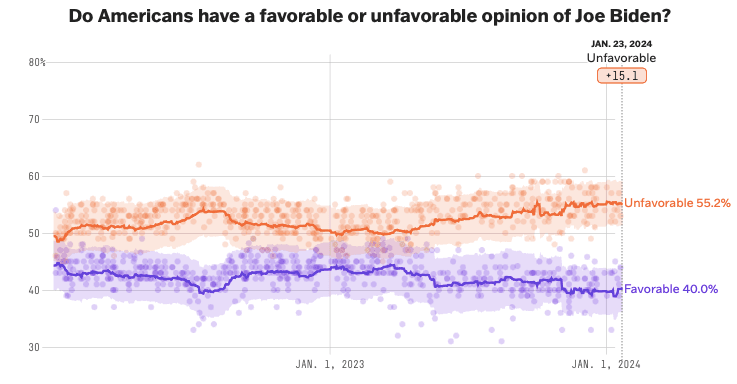
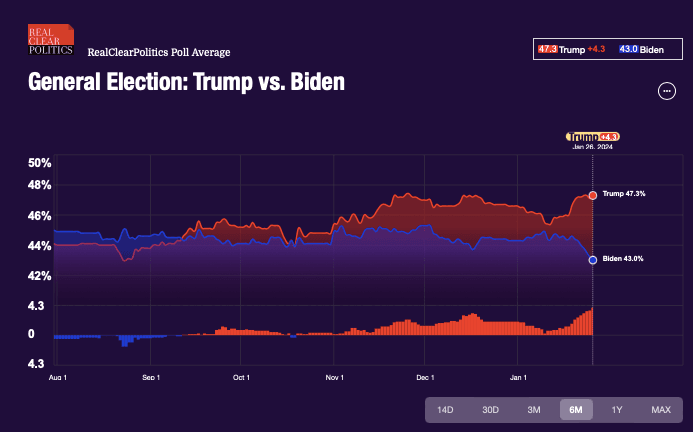
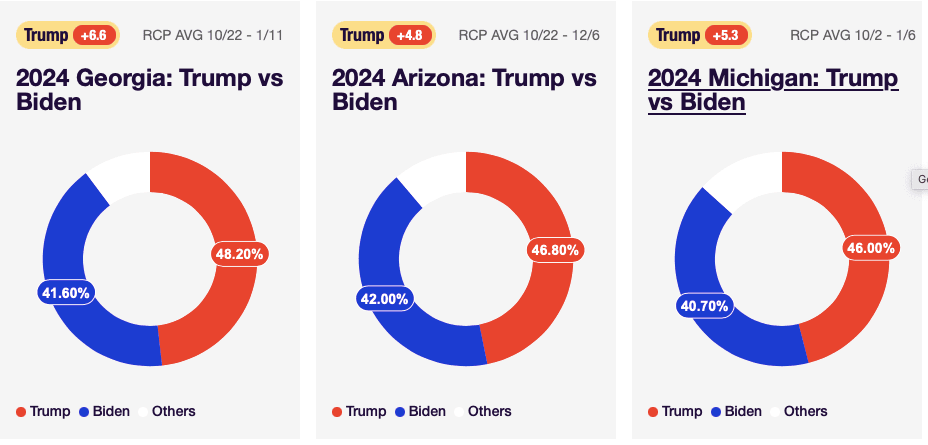
Both Trump and Biden are unpopular. Academics and the press favor Biden, and find it inconceivable that anyone would like Trump but polls show him leading in the country as a whole, and leading in key swing states, Arizona, Georgia, Michigan, etc. Some 15.1% more Americans have an unfavorable view of Biden than a favorable view.
Biden’s problems include his age, the border crisis, and the economy. People say they find that essentials are expensive, while luxuries are cheap, and that Biden seems out of touch, perhaps that he favors the rich (the Democratic Party is increasingly the party of billionaires). Then there are religious objections, including to diversity, or gender-affirming child surgery, or abortion till birth and doctor-assisted suicide.
Trump leads in the polls, pointing to misuse of the Justice Department including Republican civil servants fired over phony mask mandates, the many illegal immigrants, the EV agenda, even Trump’s impeachment hearings that began as soon as he was elected, based on a made up “Russian collision” dossier. There’s a claim from Twitter, that the Biden’s DOJ demanded Twitter favor Biden, and then demanded that Trump be “deplatformed”, completely silenced before the election.
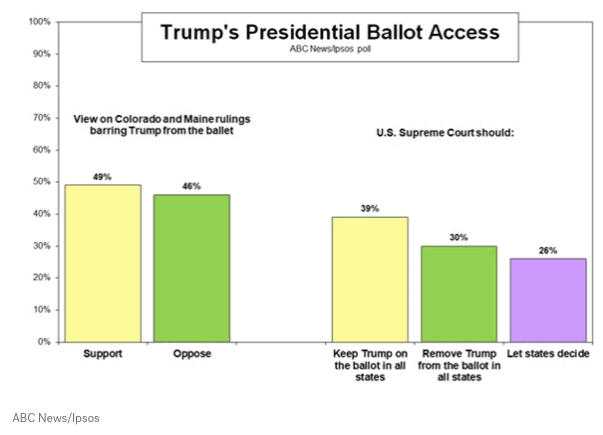
The Democrats fire back that Trump is ineligible to be president as he is a seditionist — citing an anti-confederate clause of the 14th amendment. They have so far, removed him from the ballot in two battleground states, Colorado and Maine, and are looking at removing him from the ballot in several others. These moves are surprisingly popular, supported by 49% of voters, despite the fact that Trump leads in the polls.
In New York, the district attorney ran on the platform that he would “get Trump,” that is put him in prison for something, and thus stop his presidential bid. NY has already pulled Trump’s business license and has indicted Trump on 48 felony counts based on the assertion that he paid a prostitute and called it legal fees on his internal books. They also claim he over-valued his buildings. No one has ever been charged or convicted on such crimes before this, but it seems certain he will be found guilty in NY. Either way, it’s is a big drain on Trump’s time and money, and the case allows the judge to command Trump not speak. Meanwhile, the ex-prosecutor has an open mike to claim he heads a crime family, now that he’s handed the case over to another DA. The judge has threatened to jail Trump for saying the charges are bogus and the treatment unfair.
In Colorado, the decision the case is stronger – sedition. They decision to remove Trump’s name from the ballot was made by a 5 to 4 vote in the Democrat-majority Supreme Court. In Maine the Secretary of State removed his name, acting alone. The claim is that what happened January 7 was not a protest, but an insurrection, and that Trump is guilty for it, along with many others who didn’t participate. Further they maintain that it is a false narrative that it was the FBI who entered the capital, fanning the flames as a sting operation against Trump. Similarly false is any claim that the Democrats skewed the election by stuffing the ballot box or overruling laws that required voter ID. That Trump says otherwise shows that Trump is a danger to democracy, they say. They find extremely offense that he calls them the “Department of Injustice.”
According to a January 16, 2024 Ispos, ABC poll, here nearly every voter who favors Biden favors removing Trim from the ballot. Most do not require that Trump be convicted. Not that it’s unlikely that Trump will be convicted of something. In NY it’s likely to be for paying a prostitute and for saying his buildings are worth more than the DA thinks they are. In Georgia, the DA took the unusual step of indicting Trump’s lawyers and his witnesses too. She thus prevents anyone who could testify for Trump from doing so. The Georgia DA seems to have done some other illegal things, but it seems certain that she’ll win her case, even if she goes to jail in the process. Several other battle-ground states’ DAs have said thay will remove Trump from the ballot, or try. Among these are Michigan, Arizona, and Georgia — states where Trump is the leading candidate.
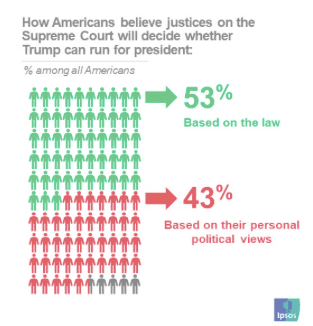
Behi d the effort to remove Trump, guiltier not, is a generally low opinion of the legal system. Polls show that 53% of America believes that judges decide based on their politics, not on law. If Trump is found guilty, they believe it’s politics. If he’s found innocent, tit’s also politics, according to the majority of Americans. Given that folks are convinced the judges are crooked, they want to make sure that their crooked judges are the ones to stay in power, and those with other views are kept from office. It’s a tribal view of justice, not uncommon in 3rd world countries. Man for all seasons is a classic movie/ play about it.
In Russia and China the same tribal view of justice prevails, and the same story is playing out. Putin is running for president in 2024, and has take the precaution to jail his opposition as seditionist. Chinese chairman Xi has not only jailed his opposition, but also most major business leaders. The people in these countries don’t seem to mind, and seem genuinely supportive. The press there, as here, can’t understand why anyone would support anyone but the boss, and have warned against false news in an eerily unified voice.
Efforts are underway to keep Trump off the ballot in these states where he is winning, plus Wisconsin and Minnesota, states where he’s tied or losing by a small margin. A majority people don’t want him or Biden, so removal is popular.
Robert Buxbaum, Jan 31, 2024. To me, the removal of Trump from the ballot is related to the desire for term limits, and for our support, in Ukraine for the elimination of upcoming elections. Folks like democracy, in theory, but need to make sure the wrong person doesn’t win. It’s a paradox.
I predicted dire times for China six years ago, when Xi Jinping amended the constitution to make himself leader for life, in charge of the government, the party, the military, and the banks. Emperor, I called him, here. It now seems the collapse has begun, or at least stagnation. Chinese history is cyclic. Good times of peace and plenty give rise to a supreme emperor whose excesses bring war and famine, or at least stagnation. The cycle repeats every 50 to 100 years. Since Nixon opened China in 1973, the country has seen 50 years of prosperity and spectacular growth, but the growth has stopped and may be in decline. The stock market (Shanghai Shenzen 300) peaked in 2021 and has declined 50% from there. It’s down 30% for the last 12 months to levels seen in December 2010. US growth seemed slower than China’s but it’s been more steady. The main US stock market, the S+P 500, has more than tripled since 2010, up 24.5% this year.
Five years of the Shanghai 300 index with hardly any change. There has hardly been change in 15 years. One could argue that the lost decade is here and on-going. .
Each year Chairman Xi’s behaves more dictatorial. Last year he arrested his predecessor, Hu Jintao in front of the Communist party. He now tracks all his citizens actions by way of face recognition and phone software, and gives demerits for wrong thinking and wrong behaviors. You lose merits by buying western cars or visiting western internet sites. Taking money abroad is generally illegal. Needless to say, such behavior causes people to want to take money abroad, just in case. Last week, Xi proposed a limit on video game playing and clamped down on banks, demanding low interest rates. This is bad for the gaming corporations and teenagers, and banks, but so far there are no protests as there is no war.
Kissinger said that war was likely, though. Xi is building the navy at a fast pace, adding fast surface ships, nuclear submarines, aircraft carriers, and new attack airplanes. They’ve added hypersonic missiles too, and added listening stations and bases. There’s now a naval base in Djibouti, at the entrance to the Red Sea, where they oversee (or promote?) Iran’s attacks on Western shipping. Then there are the new Chinese Islands that were built to take oil and fishing rights, and to provide yet more military bases on key trade routes. These could easily be a trigger for war, but so far just one military interaction in the region. Last month, the Chinese and Philippines navy clashed over fishing!
In the Gulf of Finland last Month, a Chinese ship, New New Polarbear, destroyed the offshore cables and gas pipes between Finland and Estonia, in protest of Finland’s entry into NATO. It’s belligerent but not war. Undersea cables are not covered by the UN charter, law of the sea. Then there is the evidence that COVID-19 was the result of Chinese bioweapon development, and the Chinese spy ballon that was sent over the US. We maintain at peace, but an unsettled sort of peace — is it a preface to war? Wars don’t have to be big war against the west or Taiwan, more likely is Vietnam, IMHO.
China’s negative population growth means that property values will drop along with product consumption. Kids buy stuff; old folks don’t.
News from China is increasingly unreliable so it’s hard to tell what’s going on. There were claims of a coupe, but perhaps it was fake news. Reporters and spies have been arrested or shot so there is no window on anyone who knows. There are claims of high unemployment, and COVID deaths, and claims of a movement to “lie flat” and stop working. Perhaps that was behind the ban on excessive gaming. Who knows? Xi claims that China is self sufficient in food production, but record food shipments from the US to China suggest otherwise.
Major businesspeople have disappeared, often to reappear as changed men or women. Most recently, Jimmy Lai, the Hong Kong clothing magnate, was indicted for sedition by tweets. Perhaps he just wanted to fire workers, or pay down debt, or move abroad (his daughter is). Many businesses exist just to make jobs, it seems. Not all of these businesses are efficient, or profitable. Some exist to violate US patents or steal technology, particularly military technology. I suspect that China’s hot new car company, BYD, is a money-losing, job factory, behind Tesla in every open market. Some 91 public firms have delisted over the last two years, effectively vanishing from oversight. Are they gone, or still operating as employment zombies. Will BYD join them? If China manages to avoid war, I have to expect stagnation, a “lost decade” or two, as in Japan saw from 1990 to 2010, as they unwound their unprofitable businesses.
A sign suggesting that a Chinese lost decade has begun is that China’s is seeing deflation, a negative inflation rate of -0.2%/year according to the world bank. It seems people want to hold money, and don’t want Chinese products, services, or investment. Japan saw this and tried a mix of regulation and negative interest rates to revive the interest, basically paying people to borrow in hopes they spend.
In Japan, the main cause of their deflation seems to have been an excess of borrowing against overvalued and unoccupied real estate. The borrowed money was used to support unprofitable businesses to buy more real estate. This seems to be happening in China too. As in Japan, China originally needed new lots of new apartments when they opened up and people started moving to the cities. The first apartments increased in value greatly so people built more. But now they have about 100% oversupply: one unoccupied or half-built apartment for every one occupied, with many mortgaged to the hilt against other overvalued apartments and flailing businesses.
Chinese Dept, personal and corporate match Japan’s at the start of the lost decade(s). Personal debt is at 150% of GDP, corporate debt is at65% of GDP, all propped up by real estate.
As in Japan 30 years ago, China’s corporate + personal debt is now about two times their GDP. Japan tried to stop the deflation and collapse by increased lending, and wasteful infrastructure projects. People in the know sent the borrowed money abroad confident that they would repay less when they repaid. We are already seeing this; low interest loans, money flowing abroad and a profusion of fast trains, unused roads, and unused bridges. I suspect most fast trains don’t pay off, as planes are faster and cheaper. These investments are just postponing the collapse. China is also seeing a birth dearth, 1.1 children per woman. This means that within a generation there will be half as many new workers and families to use the trains, or occupy the apartments. As the country ages, retirees will need more services with fewer people to provide them. China’s culture promotes abortion. China’s working population will decline for the next 30 years at least.
Japan came through all this without war, somewhat poorer, but unified and modern. It helped that Japan was a democracy, unified in culture, with an open press and good leaders (Abe). There was no collapse, as such, but 20 years of stagnation. China is a dictatorship, with a disunited culture, and a closed press. I think it will get through this, but it will have a much rougher time.
Leading up to the Cybertruck launch 4 weeks ago, the expert opinion was that it was a failure. Morgan Stanley, here dubbed it as one, as did Rolling Stone here. Without having driven the vehicle, the experts at Motor trend, here, declared it was worse than you thought, “a novelty” car. I’d like to differ. The experts point out that the design is fundamentally different from what we’ve made for years. They claim it’s ugly, undesirable, and hard to build. Ford’s F-150 trucks are the standard, the top selling vehicle in the US, and Cybertruck looks nothing like an F-150. I suspect that, because of the differences, the Cybertruck can hardly fail to be a success in both profit and market share.
Cybertruck pulls a flat-bed trailer at Starbase.
Start with profit. Profit is the main measure of company success. High profit is achieved by selling significant numbers at a significant profit margin. Any decent profit is a success. This vehicle could trail the F-150 sales forever and Musk could be the stupidest human on the planet, so long as Tesla sells at a profit, and does so legally, the company will succeed. Tesla already has some 2 million pre-orders, and so far they show no immediate sign of leaving despite the current price of about $80,000. Unless you think they are all lying or that Musk has horribly mispriced the product, he should make a very decent profit. My guess is he’s priced to make over $10,000 per vehicle, or $20B on 2 million vehicles. Meanwhile, no other eV company seems to be making a profit.
The largest competing electric pickup company is Rivian. They sold 16,000 electric trucks in Q3 2023, but the profit margin is -100%. This is to say, they lose $1 for every $1 worth of sales –and that’s unsustainable. Despite claims to the contrary, a money-losing business is a failure. The other main competitors are losing too. Ford is reported to lose about $50,00 per eV. According to Automotive News, here, last week, Ford decided to cut production of its electric F-150, the Lightning, by 50%. This makes sense, but provides Cybertruck a market fairly clear of US e-competition.
2024 BYD, Chinese pickup truck
Perhaps the most serious competitor is BYD, a Chinese company backed by the communist government, and Warren Buffet. They are entering the US market this month with a new pickup. It might be profitable, but BYD is relatively immune to profitability. The Chinese want dominance of the eV market and are willing to lose money for years until they get it. Fortunately for Tesla, the BYD truck looks like Rivian’s. Tesla’s trucks should exceed them in range, towing, and safety. BYD, it seems, is aiming for a lower price point and a different market, Rivian’s.
A video, here, shows the skin of a Cybertruck is bulletproof to 9mm, shotgun, and 45 caliber machine gun fire. Experts scoff at the significance of bulletproof skin — good for folks working among Mexican drug lords, or politicians, or Israelis. Tesla is aiming currently for a more upscale customer, someone who might buy a Hummer or an F-250. This is more usable and cheaper.
Don’t try this with other trucks.
Another way Cybertruck could fail is through criminal activity. Musk could be caught paying off politicians or cheating on taxes or if the trucks fail their safety tests. So far, Cybertruck seems to meet Federal Motor Vehicle Safety Standards by a good margin. In a video comparison, here, it appears to take front end collisions as well as an F-150, and appears better in side collisions.
This leaves production difficulty. This could prevent the cybertruck from being a big success, and the experts have all harped on this. The vehicle body is a proprietary stainless steel, 0.07″ thick. Admittedly it’s is hard to form, but Tesla seems to manage it. VIN number records indicate that Tesla had delivered 448 cybertrucks as Friday last week, many of them to showrooms, but some to customers. Drone surveys of the Gigafactory lot show that about 19 are made per day. That’s a lot more than you’d see if assembly was by hand. Assuming a typical learning curve, it’s reasonable to expect some 600 will be delivered by December 31, and that production should reach 6000 per month in mid 2024. At that rate, they’ll be making and selling at the same rate as Rivian or Ford, and making real money doing it. The stainless body might even be a plus, deterring copycat competition. Other pluses are the add-ons, like the base-camp tent option, a battery extension, a ramp, and (it’s claimed) some degree of sea worthiness. Add-ons add profit and deter direct copying (for a time).
Basecamp, tent option.
So why do I think the experts are so wrong? My sense is that these people are experts because of long experience at other companies — the competitors. They know what was tried, and that innovation failed. They know that their companies chose not to make anything like a Cybertruck, and not to provide the add-ons. They know that the big boys avoid “novelty cars” and add-ons. There is an affinity among experts for consensus and sure success, the success that comes from Chinese companies, government support and international banking. If the Cybertruck success is an insult to them and their expertise. Nonetheless, if Cybertruck succeeds, they will push their companies towards a more angular design plus add-ons. And they will claim cybertruck is no way novel, but that government support is needed to copy it.