Tag Archives: bitcoin

Does solar powered AI on the moon and in space make sense?

Jeff Bezos’s “Blue Alchemist” program recently got $25M from NASA to develop moon-based solar cell manufacturing on earth. See article here. The idea sort of makes sense to me: instead of transporting solar cells to the moon from earth, why not make them on the moon in bulk. Even light solar cells would weigh about 1kg/kW, making cells on the moon would reduce the effective weight per kW by a factor of 100 it is predicted, see figure. Given a need for megawatts of power, and the high cost to transport things to the moon, $1M/kg currently, this may make sense for the not super-distant future. Moon-made solar cells could reduce the cost per kW on the moon from $1million currently, to a mere $10,000/kW, cheap by moon prices, though super expensive by earth standards.
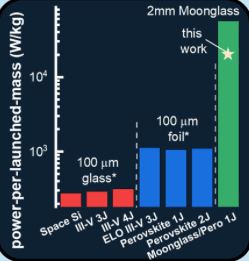
Elon Musk, perhaps out of envy or long-range vision, wants to go far further. He” recently’s posted’s proposed, at length a plan to launch moon-made solar cells into space along wit moon-made AI chips, with all this done to power AI centers in space, orbiting the earth or moon, see him discuss it here. He notes that “It’s always sunny in space”, so this electricity should be cheap. I don’t consider even moon-solar at $10,000/kW cheap, and power from these moon-launched cells will be pricer yet.

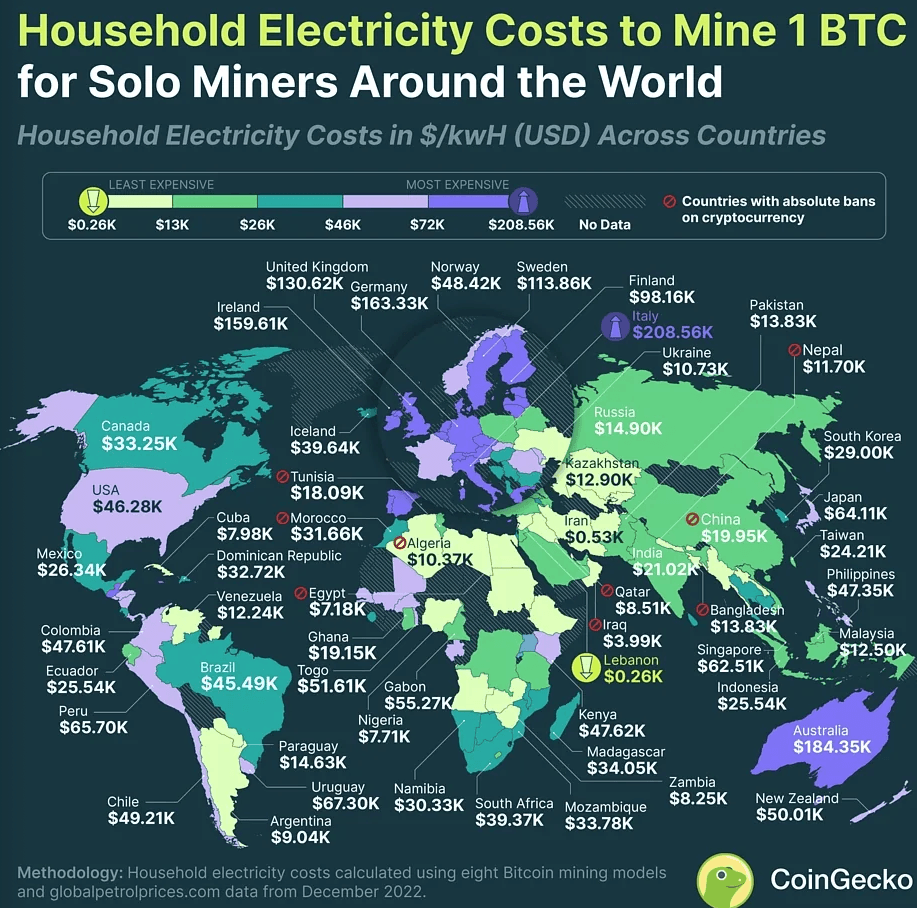
The reason all this makes sense to Musk is that he avoids the disruptions of solar power that come at night-time, and he avoids regulatory boards. He argues that there is no real alternative! given that power on earth is too hard and expensive, and complains that regulators oppose new power plants. I suspect there are some over-regulations, but some regulations are necessary, and I doubt he’ll avoid by going to space. As for the high cost of power, it’s really cheap in China, Lebanon, Iraq, Iran…Just look att he figure below showing the electric cost of bitcoin harvesting around the world. China runs on nuclear power or coal, delivering large-scale electricity at ~ 2¢/kWh. You can make power at a similar cost if you build your own plant, many of the bit-coin folks operate that way. It’s not exactly cheap, but a known technology, and cheaper than space solar amortized to less than 50 years.
AI chip-making is hard to do, even on earth, requiring water, chemicals, equipment and technical attention. Most companies can’t do it; China has barely cracked the technology. Doing it on the moon adds unnecessary difficulties: water and chemicals scarce, skilled servicing labor is hard to find. At some point, the moon and Mars community will want to make AI in space, but before that, they’ll want to make simpler things, like rice cookers. Until we have a fairly large community on the moon, why now make AI chips on earth. If he’s looking for practice, Musk could manufacture in a place that’s inhospitable, but more accessible than the moon: Greenland or Antarctica or the top of Everest. These locations are wam compared to the moon, and they have air and water, and I suspect electricity on Everest is cheaper than on the moon.

Operating AI centers in space is not particularly attractive, by the way. Chips have a tendency to flake-out in space because of cosmic radiation and stronger electromagnetic fields (EM). For this to work at all, chips have to be built specially robust, with correction software that must be particularly active, and you must shield everything from EM to a much greater extent than on earth.

I suspect the reason Musk wants to manufacture AI in space, and to operate there, is to over-shadow Bezos’s solar cell factory, and show off his own (Tesla) technology. Also to have a use for his Starships lifting heavy complicated things. It’s not a plan I would back.

Robert Buxbaum, March 1, 2026
A fair price for Bitcoin: less than $33,300.

Some 8 years ago, 2018, I calculated that a fair price for Bitcoin was likely $11,000, with a maximum of perhaps 4x more, $44,000. I used Fischer’s formula from my economics textbook, perhaps the only useful formula there. It’s based on the idea that the total currency value times the speed of money has to match the value of the things people buy with it. See the analysis here. Based on this formula, you see that, if you print more money, you get inflation — a concept that seems forgotten today.

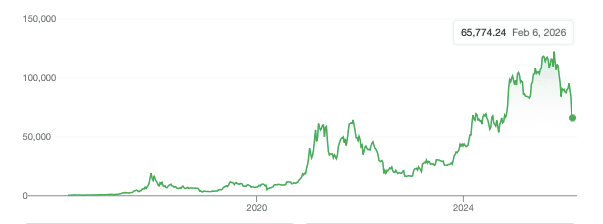
It’s eight years later, and while there has been some inflation in the price of everything, the price of bitcoin has outstripped most everything else. After years of Bitcoin staying in the price range I’d suggested, it jumped to over $120,000 in 2025 before dropping back to $70,500. I figured I should revisit my calculations, and again find about the same result corrected for normal inflation: a “true value”, of <$33,300. I show why I value it this much, and share why, I think the market is wrong.

A history of Bitcoin prices

Bitcoin has only one “legitimate” use, as best I can tell, and that’s for illegal activities, like paying $6 million dollar to ransom Nancy Guthrie. The problems preventing a high bitcoin valuation, IMHO, are that there is not that much illegal trade, and there are other ways to pay for illegal things. Suitcases of cash can be used, or gold coins, or artwork. These are just as safe as bitcoin, and almost as easy to ship. For legitimate business, almost any pay method is better: easier, faster, and more secure.

Most people, I suspect, don’t use their bitcoin at all. They buy it as an investment, or as a gambling speculation, but that’s a zero-sum gamble, somewhat worse than gold, since gold have value above trade. Having no value aside from trade, Bitcoins are only as valuable as their use is.

One of the main use of bitcoin transactions is to avoid tariffs on legitimate goods – I explained how that was done, previously. I estimate the magnitude of this business to be $500 billion or so per year. The US collected about $220 billion in tariffs last year on a trillion dollars of trade, and I find it hard to believe that Bitcoins cover more than another 50%. Add to this, bitcoin is likely also used to hide payment for illegal, sanctioned oil from Iran and Russia. There are other ways to do this, but let’s assume it’s all bitcoin-trades. Since this oil trade seems to be about 8 million barrels per day, and since oil costs ~ $70 barrel, I calculate a business of $200 billion in world oil. Add a few more items that you don’t want traced: drugs, weapons, for a total of maybe $200 billion, add $100 billion to over-throw countries and for a kidnapping or two, and I find a total bitcoin trade of $1 trillion, or $1000 billion. If a bitcoin trades 1.5 times per year (a fairly low rate) the total value of bitcoin is $1000 billion /1.5 = $667 billion. Divide by the total number of bitcoins, 20 million, and I calculate a value of $33,300 per bitcoin or less.

A lot more value in bitcoins trade per year, about $10.5 trillion. The average Bitcoin price is three times higher than I estimate and it is spent 7.5 times per year. Most of this is churn: investment, plus some legitimate purchases based on illegal activity, like when the drug dealer buys a new car in Panama, but these sales are consequences of the other, illegal sales. I figured that each Bitcoin was used for an illegal purchase only 1.5 times per year because normal money is used ~4.5 times per year.

I should note that some illegal activity is done in US dollars, including most drug deals, and when Obama bought back US soldiers kidnaped by Iran, using bales of € 500 notes, and some is done using gold or silver. Bitcoin is easier to move but large quantity moves can still be traced, and there are other crypto currencies too. Bitcoin transactions aren’t free, either, or particularly cheap. And it takes time to process the transfer of bitcoin numbers, milliseconds, but that’s slow in world commerce. As a result. I don’t see bitcoin being used for legitimate business, and unless it can break out of the black market, the value seems limited to $33,300, and probably less.

Robert Buxbaum, February 15, 2026. Gold, by the way, is similarly overvalued, in my opinion. Like bitcoin, it’s a non-dividend investment that’s expensive to trade, but at least it has some other uses, as jewelry, and in electronics. Besides, it’s relatively hard to steal a billion dollars in gold from a Swiss bank – harder than stealing $1B in bitcoin.

Bitcoin v cash to avoid Trump’s tariffs or ransom a sailor

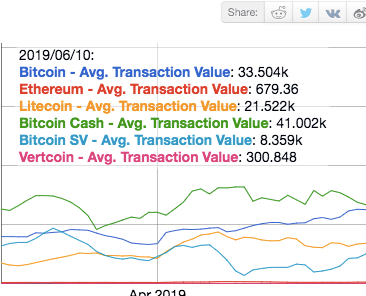
The number and cash value of bitcoin transactions has surged in the last two years, and it seems that a lot of the driving motivation is avoidance of Trump’s tariffs. If you want to avoid Trump’s tariffs, claim that the value of the shipment is less than it really is. Pay part via the normal banking system through the bill of lading (and pay tariffs on that) and pay the rest in bitcoin with no record and no taxes paid. The average bitcoin transaction amount has increased to $33,504, and that seems to be the amount of taxable value being dodged on each shipment. As noted in the journal, Cryptopolitan, “Smugglers attempting to export Chinese goods to the USA illegally have been found to be among the largest purchasers of Bitcoin.” https://www.cryptopolitan.com/is-us-china-trade-war-fueling-bitcoin-price-rally-to-7500/

Average transaction amount for several crypto currencies. The amount has surged for Bitcoin, blue line.

Bitcoin isn’t the only beneficiary of tariffs, of course, but it is the largest. The chart at right shows the average transaction value of the major cryptocurrencies. The average for most are in the dollar range that you’d expect for someone evading tariffs in containerized shipments. Someone who wants to import $100,000 worth of Chinese printers will arrange to have them shipped with a lower price bill of lading. The rest of the payment, 1/3 say, would be paid by a bitcoin transfer whose escrow is tied to the legally binding bill of lading.

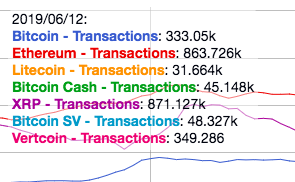
Number of transactions per day for several cryptocurrencies, data available from Bitinfocharts.com

Bitcoin does not stand out from the other cryptocurrencies so much in the amount of its average transaction, but in the number of transactions per day. As shown at left there are 333,050 bitcoin transactions per day at an average value of $33,504 per transaction. Multiplying these numbers together, we see that Bitcoin is used for some $11.2 billion in transactions per day, or $4.1 trillion dollars worth per year. The legitimate part of the US economy is only $58 billion per day, or $21 trillion per year. The amount will certainly rise if further tariffs are put into effect. 

Most other cryptocurrencies have fewer transactions per day, and the few that have similar (or higher) numbers deal in lower amounts. Etherium is used in 2.5 time more transactions, but the average Etherium transaction is only $679. This suggests that the total Etherium business is only $586 million per day. The dollar amounts of Etherium suggests that it is mostly used for drug trafficking, 

Cash-money is the old fashioned way to avoid tariffs, buy drugs, and do other illegal money transfers. This method isn’t going away any time soon. A suitcase of $100 bills gets handed over and the deal is done. Though it gets annoying as the amounts get large, there is a certain convenience at the other end, when you try to spend your ill-gotten gains. Thus, when Obama wanted to ransom the ten sailors that Iran had captured in 2016, he sent paper bills. According to the LA Times, this was three airplane shipments s of all non-US currency: Euros and Swiss Francs mostly. The first payment was $400 million, delivered as soon as Iran agreed to the release. The rest, $1.3 billion, was sent after the prisoners were released. Assuming that the bundles shown below contained only 100 Euro notes, each bundle would have held about $170 million dollars. We’d have had to send ten bundles of this size to redeem ten US sailors. The US ships, the laptops of sensitive information, and the weapons were granted as gifts to the Iranians. Obama claimed that all this was smart as it was cheaper than a war, and it likely is. The British had 15 sailors captured by Iran in 2009 and paid as well. In the late 1700s, John Adams (an awful president) paid 1/4 of the US budget as ransom to North African pirates. He paid in gold.

These are supposedly the pallets of cash used to ransom our sailors. Obama has justified the need to transfer the cash this way, and indeed a ransom is a lot cheaper than a war.

Obama could not have ransomed the sailors with Bitcoin as there was hardly enough Bitcoin value in existence at the time. Besides, the Iranians would have had a hard time spending it since, it is hard to spend Bitcoin on anything legal without first switching to bank checks or cash. Legitimate sellers want proof that they’ve paid, and financial watchdogs are always there sniffing at the conversion step. Things are simpler with paper money; not totally simple when there is no apparent source, but simply enough for mullahs.

Iranian released this picture of the US sailors captured. Obama ransomed them for $1.7 billion in Euros.

To get a sense of the amount of paper money used in illegal commerce, consider that there are $1.1 trillion in hundred dollar bills in circulation. This is four times more than the value of all Bitcoin in circulation currently. Based on the wear on our $100 bills, it seems each bill is used on average 30 times per year. This suggests there are $33 trillion dollars in trade that goes on with $100 bills. Not all of this trade is illegal, but I suspect a good fraction is, and this is eight times the trade in Bitcoin. The downside of cash is that cost of transferring large bails of it can be high, but at least it’s easy to make change for a bundle of $100 bills. With bitcoin, there is a fee for transfer too, and a fee charged to convert Bitcoin to cash; it’s often in excess of 1%, and that adds up when you do billion-dollar kidnappings and billion dollar arms buys. In case you are wondering how German uranium enrichment centrifuges got to Iran when there is an export embargo, I’m guessing it was done through an intermediary country using cash and/or Bitcoin payments.

It’s worth speculating on whether Bitcoin prices will rise as its use continues to rise. I think it will but don’t expect a fast rise. Over a year ago, I’d predicted that the price of Bitcoin would be about $10,500 each. I’d based that on Fisher’s monetary equation, that relates the value of a currency to the amount spent and the speed of money. As it happens I got the right dollar value because I’d underestimated the amount of Bitcoin purchases and the speed of the money by the same factor of four. For the price of a Bitcoin to rise, it is not enough for it to be used more. There also has to be no parallel rise in the velocity of transactions (turnovers per year). My sense is that both numbers will rise together and thus that the bitcoin price will level out, long term, with lots of volatility following daily changes in use and velocity.

As a political thought, I expect is that Bitcoin traders will mostly support Trump. My expectation here is for the classic alliance the existed between bootleggers and the prohibition police during prohibition. During prohibition, jobs among the police, plus salaries and bonuses depended on liquor being illegal, and thus they supported prohibition. Bootleggers benefitted too: their high prices and profits depended on prohibition. I thus expect Bitcoin traders will support Trump as a way of protecting profits and value. Real estate moguls, I suspect, support Trump because they benefit from the ability to sell real-estate with off tariff Bitcoin. If the tariffs went away, so would the amount of smuggling income going into real estate. Amazon’s owner, Jeff Bezos, is currently anti Trump, I suspect, because Amazon still pays tariffs.

Robert Buxbaum,  July 10, 2019. Here are my thoughts about tariffs and free trade, and here is Satochi’s original article proposing Bitcoin and explaining how it would work. As for Iran, they’ve announced a fee for any ship in the Gulf of Hormuz. If you don’t pay, you might get attacked as a Japanese tanker recently was. My guess is payments are made in cash or Bitcoin to avoid embarrassing the payer.

Bitcoin risks, uses, and bubble

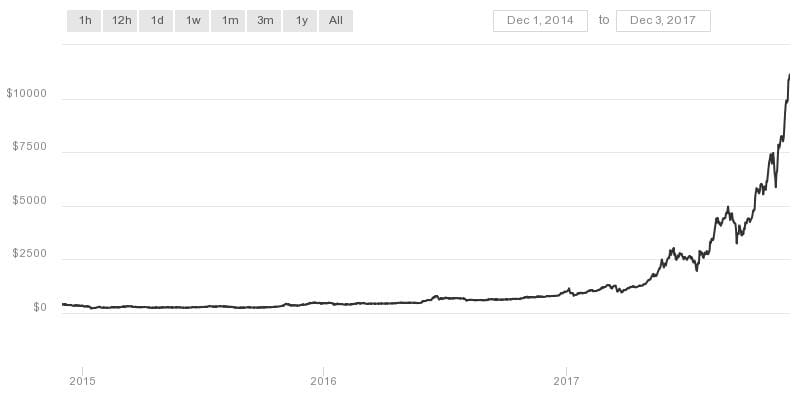
Bitcoin prices over the last 3 years

Bitcoin prices over the last 3 years

As I write this, the price of a single bitcoin is approximately $11,100 yesterday, up some 2000% in the last 6 months. The rise rate suggests it is a financial bubble. Or maybe it’s not: just a very risky investment suited for inclusion in a regularly balanced portfolio. These are two competing views of bitcoin, and there are two ways to distinguish between them. One is on the basis of technical analysis — does this fast rise look like a bubble (Yes!), and the other is to accept that bitcoin has a fundamental value, one I’ll calculate that below. In either case, the price rise is so fast that it is very difficult to conclude that the rise is not majorly driven by speculation: the belief that someone else will pay more later. The history of many bubbles suggests that all bubbles burst sooner or later, and that everyone holding the item loses when it does. The only winners are the brokers and the last investors who get out just before the burst. The speculator thinks that’s going to be him, while the investor uses rebalancing to get some of benefit and fun, without having to know exactly when to get out.

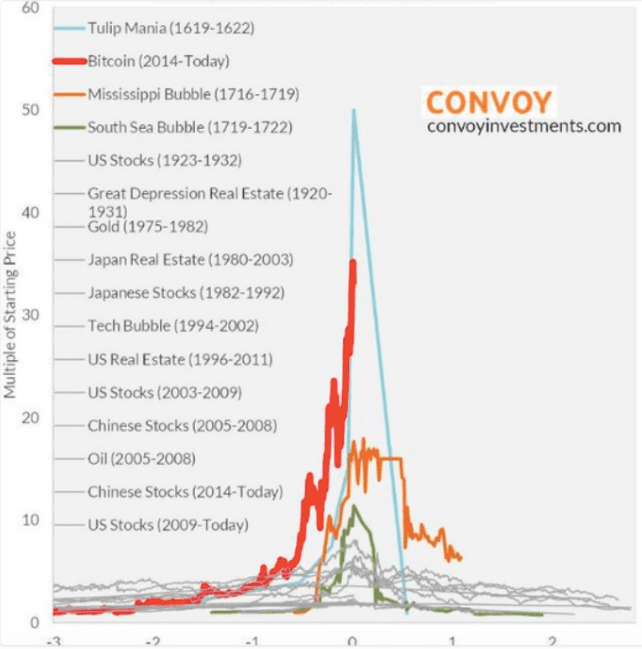
That bitcoin is a bubble may be seen by comparing the price three years ago. At that point it was $380 and dropping. A year later, it was $360 and rising. One can compare the price rise of the past 2-3 years with that for some famous bubbles and see that bitcoin has risen 30 times approximately, an increase that is on a path to beat them all except, perhaps, the tulip bubble of 1622.

A comparison between Bitcoin prices, and those of tulips, 1929 stocks, and other speculative bubbles; multiple of original price vs year from peak.

A comparison between Bitcoin prices, and those of tulips, 1929 stocks, and other speculative bubbles; multiple of original price vs year from peak.

That its price looks like a bubble is not to deny that bitcoin has a fundamental value. Bitcoin is nearly un-counterfeit-able, and its ownership is nearly untraceable. These are interesting properties that make bitcoin valuable mostly for illegal activity. To calculate the fundamental value of a bitcoin, it is only necessary to know the total value of bitcoin business transactions and the “speed of money.” As a first guess, lets say that all the transactions are illegal and add up to the equivalent of the GDP of Michigan, $400 billion/year. The value of a single bitcoin would be this number divided by the number of bitcoin in circulation, 15,000,000 currently, and by the “speed of money,” the number of business transactions per year per coin. I’ll take this to be 3 per year. It turns out there are 5 bitcoin transactions total per year per coin, but 2/5 of that, I’ll assume, are investment transactions. Based on this, a single bitcoin should be worth about $8890, slightly below its current valuation. The gross speed number, 5/year, includes bitcoin transactions that are investments and never traded for goods, and those actively being used in smuggling, drug-deals, etc.

If the bitcoin trade will grow to $600 billion year in a year with no other change, the price rise of a single coin would surpass that of Dutch tulip bulbs except that more coins are bing minted, and that the speed is increasing. If you assume that coin use will reach $1,600 billion/year, the GDP of Texas in the semi-near future, before the Feds jump in, the fundamental value of a coin should grow no higher than $44,000 or so. There are several problems for bitcoin investors who are betting on this. One is that the Feds are unlikely to tolerate so large an unregulated, illegal economy. Another is that bitcoin transactions are not likely to go totally legal. It is very hard (near impossible) to connect a bitcoin to its owner. This is a plus for someone trying to deal in drugs or trying hide profits from the IRS (or his spouse), but a legal merchant will want the protection of courts of law. For this, he or she needs to demonstrate ownership of the item being traded, and that is not available with bitcoin. The lack of a solid, legitimate business need suggests to me that the FBI will likely sweep in sooner or later, and that the value of a coin will never reach $44,000.

Yet another problem for those wishing to invest in bitcoin is the existence of more bitcoins (undiscovered, or un-mined so far) and the existence of other cryptocurrencies with the same general qualities: Litecoin (LTC), Ethereum (ETH), and Zcash (ZEC) as examples. The existence of these coins increases the divisor one should use when calculating the value of a bitcoin. The total number of bitcoins is capped at 21,000,000, that is 6,000,000 coins more than known today. Assuming more use and more acceptance, the speed (turnovers per year) is likely to increase to four or five, similar to that of other currencies. Let’s assume that the bitcoin will control 1 trillion dollars per year of a $1.6 trillion/year illegal market. One can now calculate the maximum long term target price of a bitcoin by dividing $1 trillion/year by the number of bitcoins, 21,000,000, and by the speed of commercial use, 4.5/year. This suggests a maximum fundamental value of $10,582 per coin. This is just about the current price. Let the investment buyer beware.

For an amusing, though not helpful read into the price: here are Bill Gates, Warren Buffet, Charlie Munger, and Noam Chomsky discussing Bitcoin.

Robert Buxbaum, December 3, 2017.