Tag Archives: AI

Does solar powered AI on the moon and in space make sense?

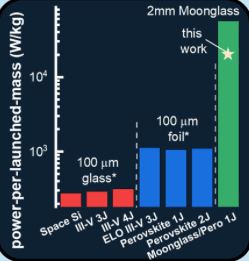
Jeff Bezos’s “Blue Alchemist” program recently got $25M from NASA to develop moon-based solar cell manufacturing on earth. See article here. The idea sort of makes sense to me: instead of transporting solar cells to the moon from earth, why not make them on the moon in bulk. Even light solar cells would weigh about 1kg/kW, making cells on the moon would reduce the effective weight per kW by a factor of 100 it is predicted, see figure. Given a need for megawatts of power, and the high cost to transport things to the moon, $1M/kg currently, this may make sense for the not super-distant future. Moon-made solar cells could reduce the cost per kW on the moon from $1million currently, to a mere $10,000/kW, cheap by moon prices, though super expensive by earth standards.
Elon Musk, perhaps out of envy or long-range vision, wants to go far further. He” recently’s posted’s proposed, at length a plan to launch moon-made solar cells into space along wit moon-made AI chips, with all this done to power AI centers in space, orbiting the earth or moon, see him discuss it here. He notes that “It’s always sunny in space”, so this electricity should be cheap. I don’t consider even moon-solar at $10,000/kW cheap, and power from these moon-launched cells will be pricer yet.

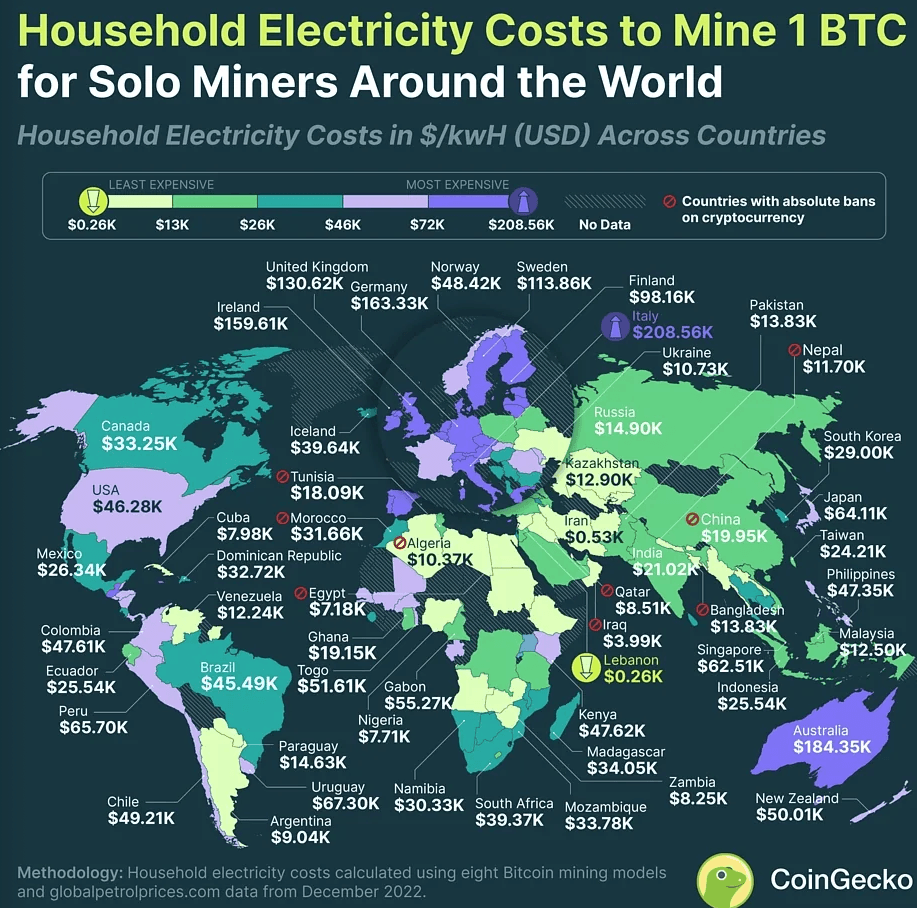
The reason all this makes sense to Musk is that he avoids the disruptions of solar power that come at night-time, and he avoids regulatory boards. He argues that there is no real alternative! given that power on earth is too hard and expensive, and complains that regulators oppose new power plants. I suspect there are some over-regulations, but some regulations are necessary, and I doubt he’ll avoid by going to space. As for the high cost of power, it’s really cheap in China, Lebanon, Iraq, Iran…Just look att he figure below showing the electric cost of bitcoin harvesting around the world. China runs on nuclear power or coal, delivering large-scale electricity at ~ 2¢/kWh. You can make power at a similar cost if you build your own plant, many of the bit-coin folks operate that way. It’s not exactly cheap, but a known technology, and cheaper than space solar amortized to less than 50 years.
AI chip-making is hard to do, even on earth, requiring water, chemicals, equipment and technical attention. Most companies can’t do it; China has barely cracked the technology. Doing it on the moon adds unnecessary difficulties: water and chemicals scarce, skilled servicing labor is hard to find. At some point, the moon and Mars community will want to make AI in space, but before that, they’ll want to make simpler things, like rice cookers. Until we have a fairly large community on the moon, why now make AI chips on earth. If he’s looking for practice, Musk could manufacture in a place that’s inhospitable, but more accessible than the moon: Greenland or Antarctica or the top of Everest. These locations are wam compared to the moon, and they have air and water, and I suspect electricity on Everest is cheaper than on the moon.

Operating AI centers in space is not particularly attractive, by the way. Chips have a tendency to flake-out in space because of cosmic radiation and stronger electromagnetic fields (EM). For this to work at all, chips have to be built specially robust, with correction software that must be particularly active, and you must shield everything from EM to a much greater extent than on earth.

I suspect the reason Musk wants to manufacture AI in space, and to operate there, is to over-shadow Bezos’s solar cell factory, and show off his own (Tesla) technology. Also to have a use for his Starships lifting heavy complicated things. It’s not a plan I would back.

Robert Buxbaum, March 1, 2026

Golfball dimples on a car for improved mpg.

The Mythbusters dimpled Taurus, and a diagram meant to show how drag is reduced. On a golf ball, at low NRE, vortex separation is moved back to 110°, the mechanism on a car is different, I suspect.

The dimples on a golf ball reduce air-drag resistance, so why don’t we put dimples on planes or cars? Perhaps because it’s ugly, or that cars are much bigger and than golf-balls, so we expect the effect of skin effects to be smaller. Finally, a Reynolds number analysis suggests that dimples on cars should increase drag, not reduce it.

In 2009, the Mythbusters decided to test the conjecture. Hosts Jamie Hyneman and Adam Savage ran careful gas usage tests on a Ford Taurus that was first covered with smooth clay. They drove the car repeatedly (5X) on a track at 65 mph (about 100 km/h), and measured “slightly over 26 mpg,” 9.047 l/100km, a respectable value. They then carved dimples into the clay to simulate the surface of a golf ball. See picture at right, and put the removed clay into the trunk so there would be no decrease in weight.

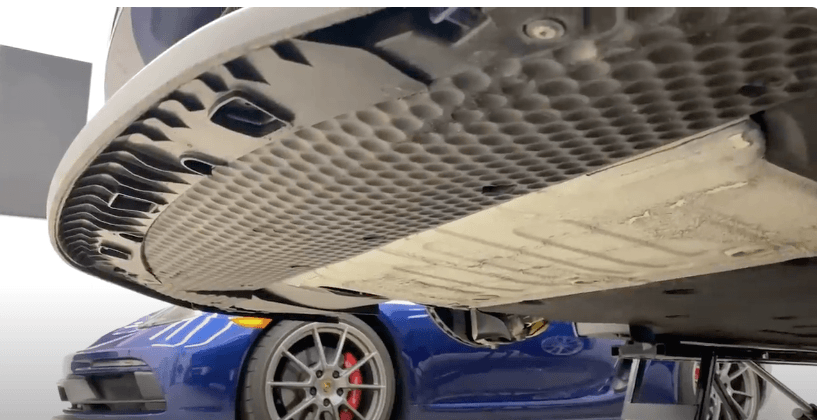
Underneath a Porche GT4, smallish dimples.

They then drove the dimpled car over the same course, five times as before at exactly 65 mph, and found the car got 14% more mpg, 29.6 mpg, or 7.946 l/100 km. See video excerpt here. They considered it their most surprising Mythbuster episode.

As it happens, dimples had been put on some production cars, even before the episode. They are just located underneath where most people don’t see them. The VW “Golf” had dimples even before the episode, and the Porsche Cayman GT4 does today, see picture above left, but most experiments find little or nothing. Car dimples are typically smaller than those used on Mythbusters, so that may be an explanation. Dimples have been found to help on soccer balls (the stitching acts as the dimples), and bicycle wheels (less advantage).

PHYSICS OF FLUIDS 18, 041702 (2006) Mechanism of drag reduction by dimples on a sphere, Jin Choi, Woo-Pyung Jeon, and Haecheon Choia.

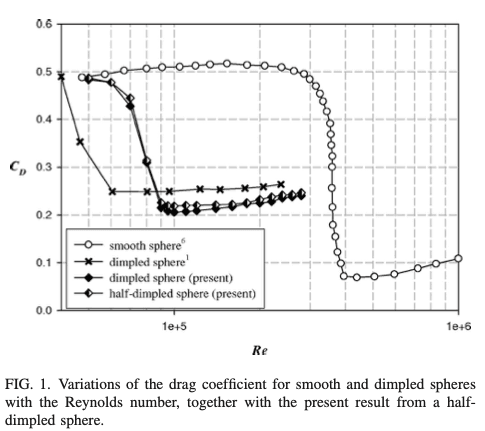
The graph at right shows the source of confusion for cars and the great advantage for golf balls. It’s a plot of the drag coefficient for smooth and dimpled golf balls, as a function of the Reynolds Number, where NRE = Vdρ/µ. In this formula, V is velocity, d is the diameter of the car, ball or whatever, ρ is the density of the fluid, and µ is viscosity. NRE can be thought of as the ratio of the inertial to viscous forces acting on the object. It’s a way of describing the combined effects of speed and size for different objects in motion.

We see, above, that dimples reduce golf-ball drag by more than 50%, but only at speeds/ Reynolds numbers that are much lower than for normal cars, NRE between about 4×10⁴ and 3.5×10⁵, as are typical of golf balls during play. A typical car at 65mph will have a NRE.CAR = 3×10⁶, suggesting that there should be no advantage for dimples, or possibility a disadvantage, that dimples should increase drag. A side note one sees, above, is that it is only the dimples on the front of the golf-ball that reduce drag: other dimples do nothing. If one were to add dimples to high-speed trains and airplanes I’d suggest them only on the front, so far I have not seen them.

I think that the Mythbusters did a good job with their experiments, and find their 14% improvement significant. So why do so few other cars see and advantage. One thought I had was to note that the Ford Taurus is a remarkably round car, providing ample space for front dimples to help, most cars today are more angular. I also note that the production cars have smaller dimples, as on the Porsche, above. Then again, the Mythbusters folks may have made some non-obvious experimental error.

Robert Buxbaum, January 4, 2024. An important side issue in this is that Google’s AI was awful, a handicap in researching this article. It lies continuously and convincingly, and did so here. I’d asked it for the year of the episode, and the AI lied, and said 2012. I asked for the type of car, the AI said an SUV, and it gave a misdescription of the tests. Lying AIs appear as villains in science fiction, e.g. HAL of 2001 A Space Odyssey, now in real life.