Some 2-3 years ago I did an interview where I stood inside one of our hydrogen generator shacks (with the generator running) and poked a balloon filled with hydrogen with a lit cigar — twice. No fire, no explosion, either time. It’s not a super hit, but it’s gotten over 5000 views so far. Here it is
New hydrogen generator from REB Research
8 Replies
Here’s the new, latest version of our Me150 hydrogen generator with our wonder-secretary, Libby, shown for scale. It’s smaller and prettier than the previous version shown at left (previous version of Me150, not of secretary). Hydrogen output is 99.9999% pure, 9.5 kg/day, 75 slpm, 150 scfh H2; it generates hydrogen from methanol reforming in a membrane reactor. Pricing is $150,000. Uses about 7 gal of methanol-water ($6 worth) per kg of H2 (380 ft3). Can be used to fill weather balloons, cool electric dynamos, or provide hydrogen fuel for 2-10 fuel cell cars.

New REB Research hydrogen generator 150 scfh of 99.9999% pure H2 from methanol-water reforming against metal membranes.
Nuclear Power: the elephant of clean energy
As someone who heads a hydrogen energy company, REB Research, I regularly have to tip toe about nuclear power, a rather large elephant among the clean energy options. While hydrogen energy looks better than battery energy in terms of cost and energy density, neither are really energy sources; they are ways to transport energy or store it. Among non-fossil sources (sources where you don’t pollute the air massively) there is solar and wind: basically non-reliable, low density, high cost and quite polluting when you include the damage done making the devices.
Compared to these, I’m happy to report that the methanol used to make hydrogen in our membrane reactors can come from trees (anti-polluting), even tree farming isn’t all that energy dense. And then there’s uranium: plentiful, cheap and incredibly energy dense. I try to ignore how energy dense uranium is, but the cartoon below shows how hard that is to do sometimes. Nuclear power is reliable too, and energy dense; a small plant will produce between 500 and 1000 MW of power; your home uses perhaps 2 kW. You need logarithmic graph paper just to compare nuclear power to most anything else (including hydrogen):
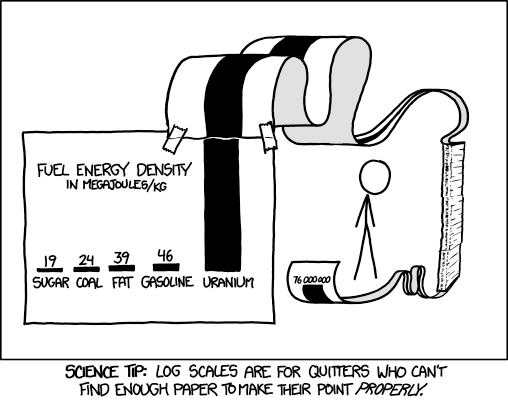
A tiny amount of uranium-oxide, the size of a pencil will provide as much power as hundreds of train cars full of coal. After transportation, the coal sells for about $80/ton; the sells for about $25/lb: far cheaper than the train loads of coal (there are 100-110 tons of coal to a train-car load). What’s more, while essentially all of the coal in a train car ends up in the air after it’s burnt, the waste uranium generally does not go into the air we breathe. The coal fumes are toxic, containing carcinogens, carbon monoxide, mercury, vanadium and arsenic; they are often radioactive too. All this is avoided with nuclear power unless there is a bad accident, and bad accidents are far rarer with nuclear power than, for example, with natural gas. Since Germany started shutting nuclear plants and replacing them with coal, it appears they are making all of Europe sicker).
It is true that the cost to build a nuclear plant is higher than to build a coal or gas plant, but it does not have to be: it wasn’t that way in the early days of nuclear power, nor is this true of military reactors that power our (USA) submarines and major warships. Commercial nuclear reactors cost a lot largely because of the time-cost for neighborhood approval (and they don’t always get approval). Batteries used for battery power get no safety review generally though there were two battery explosions on the Dreamliner alone, and natural gas has been known to level towns. Nuclear reactors can blow up too, as Chernobyl showed (and to a lesser extent Fukushima), but almost any design is better than Chernobyl.
The biggest worry people have with nuclear, and the biggest objection it seems to me, is escaped radiation. In a future post, I plan to go into the reality of the risk in more detail, but the worry is far worse than the reality, or far worse than the reality of other dangers (we all die of something eventually). The predicted death rate from the three-mile island accident is basically nil; Fukushima has provided little health damage (not that it’s a big comfort). Further, bizarre as this seems the thyroid cancer rate in Belarus in the wind-path of the Chernobyl plant is actually slightly lower than in the US (7 per 100,000 in Belarus compared to over 9 per 100,000 in the USA). This is clearly a statistical fluke; it’s caused, I believe, by the tendency for Russians to die of other things before they can get thyroid cancer, but it suggests that the health risks of even the worst nuclear accidents are not as bad as you might think. (BTW, Our company makes hydrogen extractors that make accidents less likely)
The biggest real radiation worry (in my opinion) is where to put the waste. Ever since President Carter closed off the option of reprocessing used fuel for re-use there has been no way to permanently get rid of waste. Further, ever since President Obama closed the Yucca Mountain burial repository there have been no satisfactory place to put the radioactive waste. Having waste sitting around above ground all over the US is a really bad option because the stuff is quite toxic. Just as the energy content of nuclear fuel is higher than most fuels, the energy content of the waste is higher. Burying it deep below a mountain in an area were no-one is likely to live seems like a good solution: sort of like putting the uranium back where it came from. And reprocessing for re-use seems like an even better solution since this gets rid of the waste permanently.
I should mention that nuclear power-derived electricity is a wonderful way to generate electricity or hydrogen for clean transportation. Further, the heat of hot springs comes from nuclear power. The healing waters that people flock to for their health is laced with isotopes (and it’s still healthy). For now, though I’ll stay in the hydrogen generator business and will ignore the clean elephant in the room. Fortunately there’s hardly any elephant poop, only lots and lots of coal and solar poop.
Science is the Opposite of Religion
Some years ago, my daughter came back from religions school and asked for a definition of science. I told her that science was the opposite of religion. I didn’t mean to insult religion or science; the big bang for one thing, strongly suggests there is a God -creator, and quantum mechanics suggests (to me) that there is a God -maintainer, but religion deals with other things beyond a belief in God, and I meant to point out that every basic of how science looks at things finds its opposite in religion.
Science is based on reproducibility and lack of meaning: if you do the same experiment over and over, you’ll always get the same result as you did before and the same result as anyone else — when the results are measured to some good, statistical norm. The meaning for the observation? that’s a meaningless question. Religion is based on the centrality of drawing meaning, and the centrality of non-reproducible, one-time events: creation, the exodus from Egypt, the resurrection of Jesus, the birth of Zeus, etc. A religious believer is one who changes his or her life based on the lesson of these; to him, a non-believer is one who draws no meaning, or needs reproducible events.
Science also requires that anyone will get the same result if they do the same process. Thus, chemistry class results don’t depend on the age, sex, or election of the students. Any student who mixes the prescribed two chemicals and heats to a certain temperature is expected to get the same result. The same applies to measures of the size of the universe, or its angular momentum or age. In religion, it is fundamentally important what sex you are, how old you are, who your parents were, or what you are thinking at the time. If the right person says “hoc es corpus” over wine and wafers, they change; if not, they do not. If the right person opens the door to heaven, or closes it, it matters in religion.
A main aspect of all religion is prayer; the idea that what you are thinking or saying changes things on high and here below. In science, we only consider experiments where the words said over the experiment have no effect. Another aspect of religion is tchuvah (regret, repentance); the idea is that thoughts can change the effect of actions, at least retroactively. Science tends to ignore repentance, because they lack the ability to measure things that work backwards in time, and because the scientific instruments we have currently do not take measurements on the soul to see if the repentance had any effect. Basically, the science-universe is only populated with those things which can be measured or reproducibly affected, and that pretty much excludes the soul. That the soul does not exist in the science universe doesn’t mean it doesn’t exist.
Another main aspect of religion is morality: you’re supposed to do the right thing. Morality varies from one religion to another, and you may think the other fellow’s religion has a warped morality, but at least there is one in all religions. In science, for better or worse, there is no apparent morality, either to man or to the universe. Based on science, the universe will end, either by a bang or a whimper, and in that void of end it would seem that killing a mouse is about as important as killing a person. No religion I know of sees the universe ending in either cold or hot death; as a result. Consistent with this, they all see murder is a sin against God. This difference is a big plus for religion, IMHO. That man sees murder as a true evil is either a sign that religion is true, or that it isn’t depending on the value you put on life. Another example of the moral divide: Scientists, especially academics, tend to be elitists. Their morality, such as it is, values great minds and great projects over the humble and stupid. Classical religion sees the opposite; it promoting the elevation of the poor, weak, and humble. There is no fundamental way to tell which one is right, and I tend to think that both are right in their own, mirror-image universes.
It is now worthwhile to consider what each universe sees as wisdom. An Explanation in the universe of science has everything to do with utility and not any internal sense of having understood, as such. I understand something only to the extent I predict that thing or can do something based on the knowledge. in religion, the motivation for all activity is always just understanding — typically of God on the bone-deep level. This difference shows up very clearly in dealing with quantum mechanics. To a scientist, the quantum world is fundamentally a door from religion because it is basically non-understandable but very useful. Religion totally ignores quantum mechanics for the same reason: it’s non-understandable, but very precise and useful. Anything you can’t understand is meaningless to them (literally), and useful is mostly defined in terms of building the particular religion; I think this is a mistake on many levels. I note that looking for disproof is the glory-work of all science development, but the devil’s work of every religion. A religious leader will grab on to statistical findings that suggest that his type of prayer cures people, but will always reject disproof, e.g. evidence that someone else’s prayers works better, or that his prayer does nothing at all. Each religion is thus in a war with the other, each trying to build belief, while not removing it. Science is the opposite. Religion starts with the answer and accepts any support it can; fundamental change is considered a bad thing in religion. The opposite is so with science; disproof is considered “progress,” and change is good.
These are not minor aspects of science and religion, by the way, but these are the fundamental basics of each, as best I can tell. History, politics, and psychology seem to be border-line areas, somewhere between science and religion. The differences do not reflect a lack in these fields, but just a recognition that each works according to its own logic and universe.
My hope in life is to combine science and religion to the extent possible, but find that supporting science in any form presents difficulties when I have to speak to others in the religious community, my daughter’s teachers among them. As an example of the problem that come up, my sense is that the big bang is a fine proof of creation and should be welcomed by all (most) religious people. I think its a sign that there is a creator when science says everything came from nothing, 14,000,000 years ago. Sorry to say, the religious leaders I’ve met reject the big bang, and claim you can’t believe in anything that happened 14,000,000,000 years ago. So long as science shows no evidence of a bearded observer at the center, they are not interested. Scientists, too have trouble with the bang, I find. It’s a one-time event that they can’t quite explain away (Steven Hawking keeps trying). The only sane approach I’ve found is to keep blogging, and otherwise leave each to its area. There seems to be little reason to expect communal agreement.
by Robert E. Buxbaum, Apr. 7, 2013. For some further thoughts, see here.
The Gift of Chaos
Many, if not most important engineering systems are chaotic to some extent, but as most college programs don’t deal with this behavior, or with this type of math, I thought I might write something on it. It was a big deal among my PhD colleagues some 30 years back as it revolutionized the way we looked at classic problems; it’s fundamental, but it’s now hardly mentioned.
Two of the first freshman engineering homework problems I had turn out to have been chaotic, though I didn’t know it at the time. One of these concerned the cooling of a cup of coffee. As presented, the coffee was in a cup at a uniform temperature of 70°C; the room was at 20°C, and some fanciful data was presented to suggest that the coffee cooled at a rate that was proportional the difference between the (changing) coffee temperature and the fixed room temperature. Based on these assumptions, we predicted exponential cooling with time, something that was (more or less) observed, but not quite in real life. The chaotic part in a real cup of coffee, is that the cup develops currents that move faster and slower. These currents accelerate heat loss, but since they are driven by the temperature differences within the cup they tend to speed up and slow down erratically. They accelerate when the cup is not well stirred, causing new stir, and slow down when it is stirred, and the temperature at any point is seen to rise and fall in an almost rhythmic fashion; that is, chaotically.
While it is impossible to predict what will happen over a short time scale, there are some general patterns. Perhaps the most remarkable of these is self-similarity: if observed over a short time scale (10 seconds or less), the behavior over 10 seconds will look like the behavior over 1 second, and this will look like the behavior over 0.1 second. The only difference being that, the smaller the time-scale, the smaller the up-down variation. You can see the same thing with stock movements, wind speed, cell-phone noise, etc. and the same self-similarity can occur in space so that the shape of clouds tends to be similar at all reasonably small length scales. The maximum average deviation is smaller over smaller time scales, of course, and larger over large time-scales, but not in any obvious way. There is no simple proportionality, but rather a fractional power dependence that results in these chaotic phenomena having fractal dependence on measure scale. Some of this is seen in the global temperature graph below.

Global temperatures measured from the antarctic ice showing stable, cyclic chaos and self-similarity.
Chaos can be stable or unstable, by the way; the cooling of a cup of coffee was stable because the temperature could not exceed 70°C or go below 20°C. Stable chaotic phenomena tend to have fixed period cycles in space or time. The world temperature seems to follow this pattern though there is no obvious reason it should. That is, there is no obvious maximum and minimum temperature for the earth, nor any obvious reason there should be cycles or that they should be 120,000 years long. I’ll probably write more about chaos in later posts, but I should mention that unstable chaos can be quite destructive, and quite hard to prevent. Some form of chaotic local heating seems to have caused battery fires aboard the Dreamliner; similarly, most riots, famines, and financial panics seem to be chaotic. Generally speaking, tight control does not prevent this sort of chaos, by the way; it just changes the period and makes the eruptions that much more violent. As two examples, consider what would happen if we tried to cap a volcano, or provided clamp-downs on riots in Syria, Egypt or Ancient Rome.
From math, we know some alternate ways to prevent unstable chaos from getting out of hand; one is to lay off, another is to control chaotically (hard to believe, but true).
Statistics Joke
A classic statistics joke concerns a person who’s afraid to fly; he goes to a statistician who explains that planes are very, very safe, especially if you fly a respectable airline in good weather. In that case, virtually the only problem you’ll have is the possibility of a bomb on board. The fellow thinks it over and decides that flying is still too risky, so the statistician suggests he plant a bomb on the airplane, but rig it to not go off. The statistician explains: while it’s very rare to have a bomb onboard an airplane, it’s really unheard of to have two bombs on the same plane.
It’s funny because …. the statistician left out the fact that an independent variable (number of bombs) has to be truly independent. If it is independent, the likelihood is found using a poisson distribution, a non-normal distribution where the greatest likelihood is zero bombs, and there are no possibilities for a negative bomb. Poisson distributions are rarely taught in schools for some reason.
By Dr. Robert E. Buxbaum, Mar 25, 2013. If you’ve got a problem like this (particularly involving chemical engineering) you could come to my company, REB Research.
Hydrogen versus Battery Power
There are two major green energy choices that people are considering to power small-to-medium size, mobile applications like cars and next generation, drone airplanes: rechargeable, lithium-ion batteries and hydrogen /fuel cells. Neither choice is an energy source as such, but rather a clean energy carrier. That is, batteries and fuel cells are ways to store and concentrate energy from other sources, like solar or nuclear plants for use on the mobile platform.
Of these two, rechargeable batteries are the more familiar: they are used in computers, cell phones, automobiles, and the ill-fated, Boeing Dreamliner. Fuel cells are less familiar but not totally new: they are used to power most submarines and spy-planes, and find public use in the occasional, ‘educational’ toy. Fuel cells provided electricity for the last 30 years of space missions, and continue to power the international space station when the station is in the dark of night (about half the time). Batteries have low energy density (energy per mass or volume) but charging them is cheap and easy. Home electricity costs about 12¢/kWhr and is available in every home and shop. A cheap transformer and rectifier is all you needed to turn the alternating current electricity into DC to recharge a battery virtually anywhere. If not for the cost and weight of the batteries, the time to charge the battery (usually and hour or two), batteries would be the obvious option.
Two obvious problems with batteries are the low speed of charge and the annoyance of having to change the battery every 500 charges or so. If one runs an EV battery 3/4 of the way down and charges it every week, the battery will last 8 years. Further, battery charging takes 1-2 hours. These numbers are acceptable if you use the car only occasionally, but they get more annoying the more you use the car. By contrast, the tanks used to hold gasoline or hydrogen fill in a matter of minutes and last for decades or many thousands of fill-cycles.
Another problem with batteries is range. The weight-energy density of batteries is about 1/20 that of gasoline and about 1/10 that of hydrogen, and this affects range. While gasoline stores about 2.5 kWhr/kg including the weight of the gas tank, current Li-Ion batteries store far less than this, about 0.15 kWhr/kg. The energy density of hydrogen gas is nearly that of gasoline when the efficiency effect is included. A 100 kg of hydrogen tank at 10,000 psi will hold 8 kg of hydrogen, or enough to travel about 350 miles in a fuel-cell car. This is about as far as a gasoline car goes carrying 60 kg of tank + gasoline. This seems acceptable for long range and short-range travel, while the travel range with eVs is more limited, and will likely remain that way, see below.
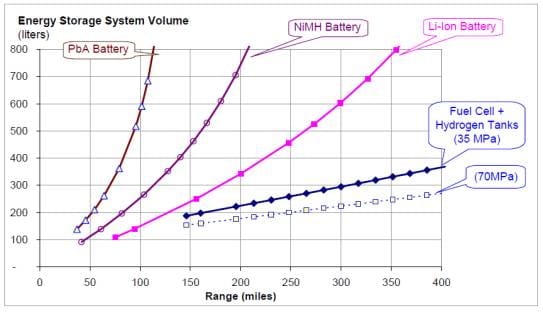
The volumetric energy density of compressed hydrogen/ fuel cell systems is higher than for any battery scenario. And hydrogen tanks are far cheaper than batteries. From Battery University. http://batteryuniversity.com/learn/article/will_the_fuel_cell_have_a_second_life
Cost is perhaps the least understood problem with batteries. While electricity is cheap (cheaper than gasoline) battery power is expensive because of the high cost and limited life of batteries. Lithium-Ion batteries cost about $2000/kWhr, and give an effective 500 charge/discharge cycles; their physical life can be extended by not fully charging them, but it’s the same 500 cycles. The effective cost of the battery is thus $4/kWhr (The battery university site calculates $24/kWhr, but that seems overly pessimistic). Combined with the cost of electricity, and the losses in charging, the net cost of Li-Ion battery power is about $4.18/kWhr, several times the price of gasoline, even including the low efficiency of gasoline engines.
Hydrogen prices are much lower than battery prices, and nearly as low as gasoline, when you add in the effect of the high efficiency fuel cell engine. Hydrogen can be made on-site and compressed to 10,000 psi for less cost than gasoline, and certainly less cost than battery power. If one makes hydrogen by electrolysis of water, the cost is approximately 24¢/kWhr including the cost of the electrolysis unit.While the hydrogen tank is more expensive than a gasoline tank, it is much cheaper than a battery because the technology is simpler. Fuel cells are expensive though, and only about 50% efficient. As a result, the as-used cost of electrolysis hydrogen in a fuel cell car is about 48¢/kWhr. That’s far cheaper than battery power, but still not cheap enough to encourage the sale of FC vehicles with the current technology.
My company, REB Research provides another option for hydrogen generation: The use of a membrane reactor to make it from cheap, easy to transport liquids like methanol. Our technology can be used to make hydrogen either at the station or on-board the car. The cost of hydrogen made this way is far cheaper than from electrolysis because most of the energy comes from the methanol, and this energy is cheaper than electricity.
In our membrane reactors methanol-water (65-75% Methanol), is compressed to 350 psi, heated to 350°C, and reacted to produce hydrogen that is purified as it is made. CH3OH + H2O –> 3H2 + CO2, with the hydrogen extracted through a membrane within the reactor.
The hydrogen can be compressed to 10,000 psi and stored in a tank on board an automobile or airplane, or one can choose to run this process on-board the vehicle and generate it from liquid fuel as-needed. On-board generation provides a saving of weight, cost, and safety since you can carry methanol-water easily in a cheap tank at low pressure. The energy density of methanol-water is about 1/2 that of gasoline, but the fuel cell is about twice as efficient as a gasoline engine making the overall volumetric energy density about the same. Not including the fuel cell, the cost of energy made this way is somewhat lower than the cost of gasoline, about 25¢/kWhr; since methanol is cheaper than gasoline on a per-energy basis. Methanol is made from natural gas, coal, or trees — non-imported, low cost sources. And, best yet, trees are renewable.
Why the Boeing Dreamliner’s batteries burst into flames
Boeing’s Dreamliner is currently grounded due to two of their Li-Ion batteries having burst into flames, one in flight, and another on the ground. Two accidents of the same type in a small fleet is no little matter as an airplane fire can be deadly on the ground or at 50,000 feet.
The fires are particularly bad on the Dreamliner because these lithium batteries control virtually everything that goes on aboard the plane. Even without a fire, when they go out so does virtually every control and sensor. So why did they burn and what has Boeing done to take care of it? The simple reason for the fires is that management chose to use Li-Cobalt oxide batteries, the same Li-battery design that every laptop computer maker had already rejected ten years earlier when laptops using them started busting into flames. This is the battery design that caused Dell and HP to recall every computer with it. Boeing decided that they should use a massive version to control everything on their flagship airplane because it has the highest energy density see graphic below. They figured that operational management would insure safety even without the need to install any cooling or sufficient shielding.
All lithium batteries have a negative electrode (anode) that is mostly lithium. The usual chemistry is lithium metal in a graphite matrix. Lithium metal is light and readily gives off electrons; the graphite makes is somewhat less reactive. The positive electrode (cathode) is typically an oxide of some sort, and here there are options. Most current cell-phone and laptop batteries use some version of manganese nickel oxide as the anode. Lithium atoms in the anode give off electrons, become lithium ions and then travel across to the oxide making a mixed ion oxide that absorbs the electron. The process provides about 4 volts of energy differential per electron transferred. With cobalt oxide, the cathode reaction is more or less CoO2 + Li+ + e– —> LiCoO2. Sorry to say this chemistry is very unstable; the oxide itself is unstable, more unstable than MnNi or iron oxide, especially when it is fully charged, and especially when it is warm (40 degrees or warmer) 2CoO2 –> Co2O3 +1/2O2. Boeing’s safety idea was to control the charge rate in a way that overheating was not supposed to occur.
Despite the controls, it didn’t work for the two Boeing batteries that burst into flames. Perhaps it would have helped to add cooling to reduce the temperature — that’s what’s done in lap-tops and plug-in automobiles — but even with cooling the batteries might have self-destructed due to local heating effects. These batteries were massive, and there is plenty of room for one spot to get hotter than the rest; this seems to have happened in both fires, either as a cause or result. Once the cobalt oxide gets hot and oxygen is released a lithium-oxygen fire can spread to the whole battery, even if the majority is held at a low temperature. If local heating were the cause, no amount of external cooling would have helped.
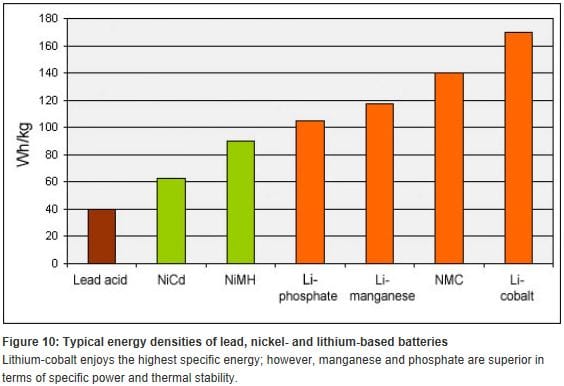
Something that would have helped was a polymer interlayer separator to keep the unstable cobalt oxide from fueling the fire; there was none. Another option is to use a more-stable cathode like iron phosphate or lithium manganese nickel. As shown in the graphic above, these stable oxides do not have the high power density of Li-cobalt oxide. When the unstable cobalt oxide decomposed there was oxygen, lithium, and heat in one space and none of the fire extinguishers on the planes could put out the fires.
The solution that Boeing has proposed and that Washington is reviewing is to leave the batteries unchanged, but to shield them in a massive titanium shield with the vapors formed on burning vented outside the airplane. The claim is that this shield will protect the passengers from the fire, if not from the loss of electricity. This does not appear to be the best solution. Airbus had planned to use the same batteries on their newest planes, but has now gone retro and plans to use Ni-Cad batteries. I don’t think that’s the best solution either. Better options, I think, are nickel metal hydride or the very stable Lithium Iron Phosphate batteries that Segway uses. Better yet would be to use fuel cells, an option that appears to be better than even the best batteries. Fuel cells are what the navy uses on submarines and what NASA uses in space. They are both more energy dense and safer than batteries. As a disclaimer, REB Research makes hydrogen generators and purifiers that are used with fuel-cell power.
More on the chemistry of Boeing’s batteries and their problems can be found on Wikipedia. You can also read an interview with the head of Tesla motors regarding his suggestions and offer of help.
Two things are infinite
Einstein is supposed to have commented that there are only two things that are infinite: the size of the universe and human stupidity, and he wasn’t sure about the former.
While Einstein still appears to be correct about the latter infinite, there is now more disagreement about the size of the universe. In Einstein’s day, it was known that the universe appeared to have originated in a big bang with all mass radiating outward at a ferocious rate. If the mass of the universe were high enough, and the speed were slow enough the universe would be finite and closed in on itself. That is, it would be a large black hole. But in Einstein’s day, the universe didn’t look to have enough mass. It thus looked like the universe was endless, but non-uniform. It appeared to be mostly filled with empty space — something that kept us from frying from the heat of distant stars.
Since Einstein’s day we’ve discovered more mass in the universe, but not quite enough to make us a black hole given the universe’s size. We’ve discovered neutron stars and black holes, dark concentrated masses, but not enough of them. We’ve discovered neutrinos, tiny neutral particles that fill space, and we’ve shown that they have rest-mass enough that neutrinos are now thought to make up most of the mass of the universe. But even with these dark-ish matter, we still have not found enough for the universe to be non-infinite, a black hole. Worse yet, we’ve discovered dark energy, something that keeps the universe expanding at nearly the speed of light when you’d think it should have slowed by now; this fast expansion makes it ever harder to find enough mass to close the universe (why we’d want to close it is an aesthetic issue discussed below).
Still, there is evidence for another, smaller mass item floating in space, the axion. This particle, and it’s yet-smaller companion, the axiono, may be the source of both the missing dark matter and the dark energy, see figure below. Axions should have masses about 10-7 eV, and should interact enough with matter to explain why there is more matter than antimatter while leaving the properties of matter otherwise unchanged. From normal physics, you’d expect an equal amount of matter and antimatter as antimatter is just matter moving backwards in time. Further, the light mass and weak interactions could allow axions to provide a halo around galaxies (helpful for galactic stability).
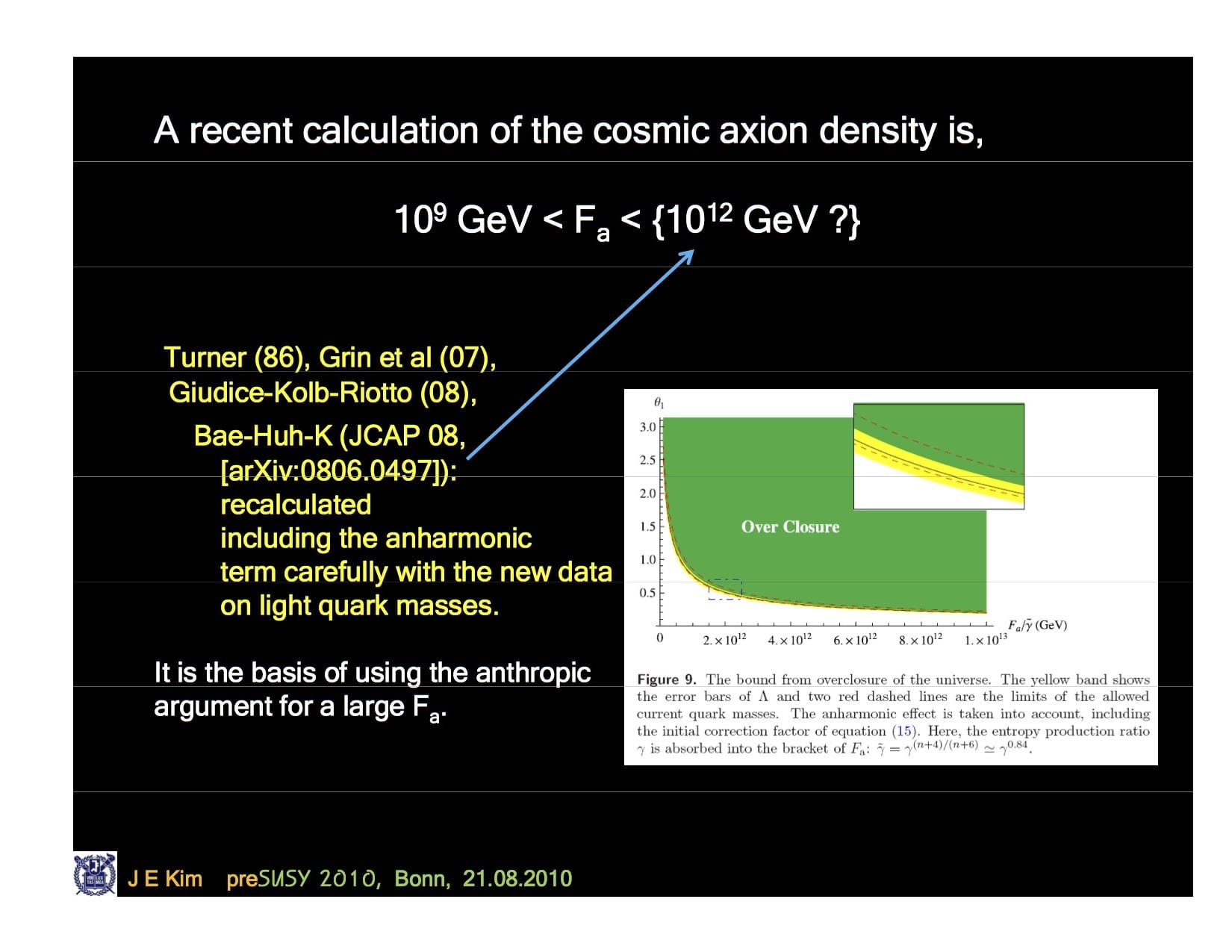
Mass of the Universe with Axions, no axions. Here is a plot from a recent SUSY talk (2010) http://susy10.uni-bonn.de/data/KimJEpreSUSY.pdf
The reason you’d want the universe to be closed is aesthetic. The universe is nearly closed, if you think in terms of scientific numbers, and it’s hard to see why the universe should not then be closed. We appear to have an awful lot of mass, in terms of grams or kg, but appear to have only 20% of the required mass for a black hole. In terms of orders of magnitudes we are so close that you’d think we’d have 100% of the required mass. If axions are found to exist, and the evidence now is about 50-50, they will interact with strong magnetic fields so that they change into photons and photons change into axions. It is possible that the mass this represents will be the missing dark matter allowing our universe to be closed, and will be the missing dark energy.
As a final thought I’ve always wondered why religious leaders have been so against mention of “the big bang.” You’d think that the biggest boost to religion would be knowledge that everything appeared from nothing one bright and sunny morning, but they don’t seem to like the idea at all. If anyone who can explain that to me, I’d appreciate it. Thanks, Robert E. B.
How is Chemical Engineering?
I’m sometimes asked about chemical engineering by high-schoolers with some science aptitude. Typically they are trying to decide between a major in chemistry or chemical engineering. They’ve typically figured out that chemical engineering must be some practical version of chemistry, but can’t quite figure out how that could be engineering. My key answer here is: unit operations.
If I were a chemist trying to make an interesting product, beer or whisky say, I might start with sugar, barley, water and yeast, plus perhaps some hops and tablets of nutrients and antimicrobial. After a few hours of work, I’d have 5 gallons of beer fermenting, and after a month I’d have beer that I could either drink or batch-distill into whisky. If I ran the cost numbers, I’d find that my supplies cost as much to make as buying the product in a store; the value of my time was thus zero and would not be any higher if I were to scale up production: I’m a chemist.
The key to making my time more valuable is unit operations. I need to scale up production and use less costly materials. Corn costs less than sugar but has to be enzyme processed into a form that can be fermented. Essentially, I have to cook a large batch of corn at the right temperatures (near boiling) and then add enzymes from the beer or from sprouted corn and then hold the temperature for an hour or more. Sounds simple, but requires good heat control, good heating, and good mixing, otherwise the enzymes will die or won’t work or the corn will burn and stick to the bottom of the pot. These are all unit operations; you’ll learn more about them in chemical engineering.
Reactor design is a classical unit operation. Do I react in large batches, or in a continuous fermentor. How do I hold on to the catalyst (enzymes); what is the contact time; these are the issues of reactor engineering, and while different catalysts and reactions have different properties and rates, the analysis is more-or-less the same.
Another issue is solid-liquid separation, in this case filtration of the dregs. When made in small batches, the bottoms of the beer barrel, the dregs, were let to settle and then washed down the sink. At larger scales, settling will take too long and will still leave a beer that is cloudy. Further, the dregs are too valuable to waste. At larger scales, you’ll want to filter the beer and will want to do something to the residue. Centrifugal filtration is typically used and the residue is typically dried and sold as animal feed. Centrifugal filtration is another unit operation.
Distillation is another classical unit operation. An important part here is avoiding hangover-producing higher alcohols and nasty tasting, “fusel oils.” There are tricks here that are more-or-less worth doing depending on the product you want. Typically, you start with a simple processes and equipment and keep tweaking them until the product and costs are want you want. At the end, typically, the process equipment looks more like a refinery than like a kitchen: chemical engineering equipment is fairly different from the small batch equipment that was used as the chemist.
The same approach to making things and scaling them up also applied in management situations, by the way, and many of my chemical engineering friends have become managers.