Murder rate in Finland, Japan higher than in US

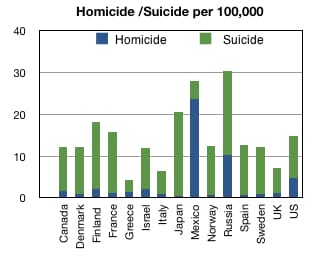
The murder rate in Finland and Japan is higher than in the US if suicide is considered as a type of murder. In the figure below, I’ve plotted total murder rates (homicide plus suicide) for several developed-world countries. The homicide component is in blue, with the suicide rate above it, in green. In terms of this total, the US is seen to be about average among the developed counties. Mexico has the highest homicide rate for those shown, Japan has the highest suicide rate, and Russia has this highest total murder rate shown (homicide + suicide): nearly double that of the US and Canada. In Russia and Japan, some .02% of the population commit suicide every year. The Scandinavian countries are quite similar to the US, and Japan, and Mexico are far worse. Italy, Greece and the UK are better than the US, both in terms of low suicide rate and low homicide rate.

  Combined homicide and suicide rates for selected countries, 2005.


Homicide and suicide rates for selected countries, 2005 Source: Wikipedia.

In the US, pundants like Piers Morgan like to use our high murder rate as an indicator of the ills of American society: loose gun laws are to blame, they say, along with the lack of social welfare safety net, a lack of support for the arts, and a lack of education and civility in general. Japan, Canada, and Scandinavia are presented as near idyls, in these regards. When murder is considered to include suicide though, the murder-rate difference disappears. Add to this, that violent crime rates are higher in Europe, Canada, and the UK, suggesting that clean streets and education do not deter crime.

The interesting thing though is suicide, and what it suggests about happiness. According to my graphic, the happiest, safest countries appear to be Italy and Greece. Part of this is likely weather , people commit suicide more in cold countries, but another part may be that some people (malcontents?) are better served by dirty, noisy cafés and pubs where people meet and complain, and are not so well served by clean streets and civility. It’s bad enough to be a depressed outsider, but it’s really miserable if everything around you is clean, and everyone is polite but busy.

Yet another thought about the lower suicide rates in the US and Mexico, is that some of the homicide in these countries is really suicide by proxy. In the US and Mexico depressed people (particularly men) can go off to war or join gangs. They still die, but they die more heroically (they think) by homicide. They volunteer for dangerous army missions or to attack a rival drug-lord outside a bar. Either they succeed in killing someone else, or they’re shot dead. If you’re really suicidal and can’t join the army, you could move to Detroit; the average house sold for $7100 last year (it’s higher now, I think), and the homicide rate was over 56 per 100,000. As bad as that sounds, it’s half the murder rate of Greenland, assuming you take suicide to be murder.

R.E. Buxbaum, Sept 14, 2013

Why random experimental design is better

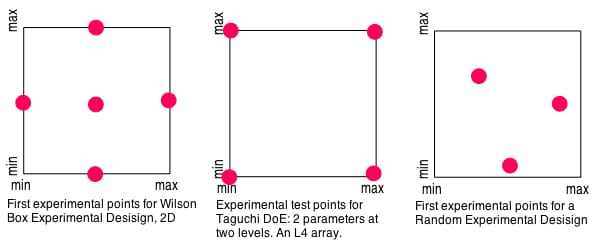
In a previous post I claimed that, to do good research, you want to arrange experiments so there is no pre-hypothesis of how the results will turn out. As the post was long, I said nothing direct on how such experiments should be organized, but only alluded to my preference: experiments should be organized at randomly chosen conditions within the area of interest. The alternative, shown below is that experiments should be done at the cardinal points in the space, or at corner extremes: the Wilson Box and Taguchi design of experiments (DoE), respectively. Doing experiments at these points implies a sort of expectation of the outcome; generally that results will be linearly, orthogonal related to causes; in such cases, the extreme values are the most telling. Sorry to say, this usually isn’t how experimental data will fall out. First experimental test points according to a Wilson Box, a Taguchi, and a random experimental design. The Wilson box and Taguchi are OK choices if you know or suspect that there are no significant non-linear interactions, and where experiments can be done at these extreme points. Random is the way nature works; and I suspect that's best -- it's certainly easiest.

First experimental test points according to a Wilson Box, a Taguchi, and a random experimental design. The Wilson box and Taguchi are OK choices if you know or suspect that there are no significant non-linear interactions, and where experiments can be done at these extreme points. Random is the way nature works; and I suspect that’s best — it’s certainly easiest.

The first test-points for experiments according to the Wilson Box method and Taguchi method of experimental designs are shown on the left and center of the figure above, along with a randomly chosen set of experimental conditions on the right. Taguchi experiments are the most popular choice nowadays, especially in Japan, but as Taguchi himself points out, this approach works best if there are “few interactions between variables, and if only a few variables contribute significantly.” Wilson Box experimental choices help if there is a parabolic effect from at least one parameter, but are fairly unsuited to cases with strong cross-interactions.

Perhaps the main problems with doing experiments at extreme or cardinal points is that these experiments are usually harder than at random points, and that the results from these difficult tests generally tell you nothing you didn’t know or suspect from the start. The minimum concentration is usually zero, and the minimum temperature is usually one where reactions are too slow to matter. When you test at the minimum-minimum point, you expect to find nothing, and generally that’s what you find. In the data sets shown above, it will not be uncommon that the two minimum W-B data points, and the 3 minimum Taguchi data points, will show no measurable result at all.

Randomly selected experimental conditions are the experimental equivalent of Monte Carlo simulation, and is the method evolution uses. Set out the space of possible compositions, morphologies and test conditions as with the other method, and perhaps plot them on graph paper. Now, toss darts at the paper to pick a few compositions and sets of conditions to test; and do a few experiments. Because nature is rarely linear, you are likely to find better results and more interesting phenomena than at any of those at the extremes. After the first few experiments, when you think you understand how things work, you can pick experimental points that target an optimum extreme point, or that visit a more-interesting or representative survey of the possibilities. In any case, you’ll quickly get a sense of how things work, and how successful the experimental program will be. If nothing works at all, you may want to cancel the program early, if things work really well you’ll want to expand it. With random experimental points you do fewer worthless experiments, and you can easily increase or decrease the number of experiments in the program as funding and time allows.

Consider the simple case of choosing a composition for gunpowder. The composition itself involves only 3 or 4 components, but there is also morphology to consider including the gross structure and fine structure (degree of grinding). Instead of picking experiments at the maximum compositions: 100% salt-peter, 0% salt-peter, grinding to sub-micron size, etc., as with Taguchi, a random methodology is to pick random, easily do-able conditions: 20% S and 40% salt-peter, say. These compositions will be easier to ignite, and the results are likely to be more relevant to the project goals.

The advantages of random testing get bigger the more variables and levels you need to test. Testing 9 variables at 3 levels each takes 27 Taguchi points, but only 16 or so if the experimental points are randomly chosen. To test if the behavior is linear, you can use the results from your first 7 or 8 randomly chosen experiments, derive the vector that gives the steepest improvement in n-dimensional space (a weighted sum of all the improvement vectors), and then do another experimental point that’s as far along in the direction of that vector as you think reasonable. If your result at this point is better than at any point you’ve visited, you’re well on your way to determining the conditions of optimal operation. That’s a lot faster than by starting with 27 hard-to-do experiments. What’s more, if you don’t find an optimum; congratulate yourself, you’ve just discovered an non-linear behavior; something that would be easy to overlook with Taguchi or Wilson Box methodologies.

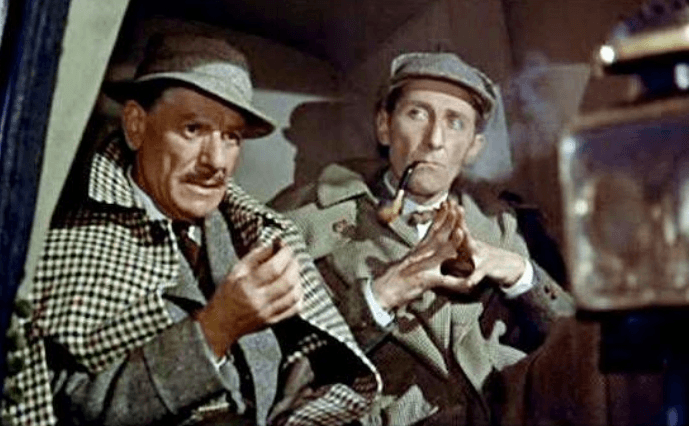
The basic idea is one Sherlock Holmes pointed out (Study in Scarlet): It is a capital mistake to theorize before one has data. Insensibly one begins to twist facts to suit theories, instead of theories to suit facts.” (Case of Identity). Life is infinitely stranger than anything which the mind of man could invent.

Robert E. Buxbaum, September 11, 2013. A nice description of the Wilson Box method is presented in Perry’s Handbook (6th ed). SInce I had trouble finding a free, on-line description, I linked to a paper by someone using it to test ingredient choices in baked bread. Here’s a link for more info about random experimental choice, from the University of Michigan, Chemical Engineering dept. Here’s a joke on the misuse of statistics, and a link regarding the Taguchi Methodology. Finally, here’s a pointless joke on irrational numbers, that I posted for pi-day.

The Scientific Method isn’t the method of scientists

A linchpin of middle school and high-school education is teaching ‘the scientific method.’ This is the method, students are led to believe, that scientists use to determine Truths, facts, and laws of nature. Scientists, students are told, start with a hypothesis of how things work or should work, they then devise a set of predictions based on deductive reasoning from these hypotheses, and perform some critical experiments to test the hypothesis and determine if it is true (experimentum crucis in Latin). Sorry to say, this is a path to error, and not the method that scientists use. The real method involves a few more steps, and follows a different order and path. It instead follows the path that Sherlock Holmes uses to crack a case.

The actual method of Holmes, and of science, is to avoid beginning with a hypothesis. Isaac Newton claimed: “I never make hypotheses” Instead as best we can tell, Newton, like most scientists, first gathered as much experimental evidence on a subject as possible before trying to concoct any explanation. As Holmes says (Study in Scarlet): “It is a capital mistake to theorize before you have all the evidence. It biases the judgment.”

It is a capital mistake to theorize before one has data. Insensibly one begins to twist facts to suit theories, instead of theories to suit facts (Holmes, Scandal in Bohemia).

Holmes barely tolerates those who hypothesize before they have all the data: “It is a capital mistake to theorize before one has data. Insensibly one begins to twist facts to suit theories, instead of theories to suit facts.” (Scandal in Bohemia).

Then there is the goal of science. It is not the goal of science to confirm some theory, model, or hypothesis; every theory probably has some limited area where it’s true. The goal for any real-life scientific investigation is the desire to explain something specific and out of the ordinary, or do something cool. Similarly, with Sherlock Holmes, the start of the investigation is the arrival of a client with a specific, unusual need – one that seems a bit outside of the normal routine. Similarly, the scientist wants to do something: build a bigger bridge, understand global warming, or how DNA directs genetics; make better gunpowder, cure a disease, or Rule the World (mad scientists favor this). Once there is a fixed goal, it is the goal that should direct the next steps: it directs the collection of data, and focuses the mind on the wide variety of types of solution. As Holmes says: , “it’s wise to make one’s self aware of the potential existence of multiple hypotheses, so that one eventually may choose one that fits most or all of the facts as they become known.” It’s only when there is no goal, that any path will do

In gathering experimental data (evidence), most scientists spend months in the less-fashionable sections of the library, looking at the experimental methods and observations of others, generally from many countries, collecting any scrap that seems reasonably related to the goal at hand. I used 3 x5″ cards to catalog this data and the references. From many books and articles, one extracts enough diversity of data to be able to look for patterns and to begin to apply inductive logic. “The little things are infinitely the most important” (Case of Identity). You have to look for patterns in the data you collect. Holmes does not explain how he looks for patterns, but this skill is innate in most people to a greater or lesser extent. A nice set approach to inductive logic is called the Baconian Method, it would be nice to see schools teach it. If the author is still alive, a scientist will try to contact him or her to clarify things. In every SH mystery, Holmes does the same and is always rewarded. There is always some key fact or observation that this turns up: key information unknown to the original client.

Based on the facts collected one begins to create the framework for a variety of mathematical models: mathematics is always involved, but these models should be pretty flexible. Often the result is a tree of related, mathematical models, each highlighting some different issue, process, or problem. One then may begin to prune the tree, trying to fit the known data (facts and numbers collected), into a mathematical picture of relevant parts of this tree. There usually won’t be quite enough for a full picture, but a fair amount of progress can usually be had with the application of statistics, calculus, physics, and chemistry. These are the key skills one learns in college, but usually the high-schooler and middle schooler has not learned them very well at all. If they’ve learned math and physics, they’ve not learned it in a way to apply it to something new, quite yet (it helps to read the accounts of real scientists here — e.g. The Double Helix by J. Watson).

Usually one tries to do some experiments at this stage. Homes might visit a ship or test a poison, and a scientist might go off to his, equally-smelly laboratory. The experiments done there are rarely experimenti crucae where one can say they’ve determined the truth of a single hypothesis. Rather one wants to eliminated some hypotheses and collect data to be used to evaluate others. An answer generally requires that you have both a numerical expectation and that you’ve eliminated all reasonable explanations but one. As Holmes says often, e.g. Sign of the four, “when you have excluded the impossible, whatever remains, however improbable, must be the truth”. The middle part of a scientific investigation generally involves these practical experiments to prune the tree of possibilities and determine the coefficients of relevant terms in the mathematical model: the weight or capacity of a bridge of a certain design, the likely effect of CO2 on global temperature, the dose response of a drug, or the temperature and burn rate of different gunpowder mixes. Though not mentioned by Holmes, it is critically important in science to aim for observations that have numbers attached.

The destruction of false aspects and models is a very important part of any study. Francis Bacon calls this act destruction of idols of the mind, and it includes many parts: destroying commonly held presuppositions, avoiding personal preferences, avoiding the tendency to see a closer relationship than can be justified, etc.

In science, one eliminates the impossible through the use of numbers and math, generally based on your laboratory observations. When you attempt to the numbers associated with our observations to the various possible models some will take the data well, some poorly; and some twill not fit the data at all. Apply the deductive reasoning that is taught in schools: logical, Boolean, step by step; if some aspect of a model does not fit, it is likely the model is wrong. If we have shown that all men are mortal, and we are comfortable that Socrates is a man, then it is far better to conclude that Socrates is mortal than to conclude that all men but Socrates is mortal (Occam’s razor). This is the sort of reasoning that computers are really good at (better than humans, actually). It all rests on the inductive pattern searches similarities and differences — that we started with, and very often we find we are missing a piece, e.g. we still need to determine that all men are indeed mortal, or that Socrates is a man. It’s back to the lab; this is why PhDs often take 5-6 years, and not the 3-4 that one hopes for at the start.

More often than not we find we have a theory or two (or three), but not quite all the pieces in place to get to our goal (whatever that was), but at least there’s a clearer path, and often more than one. Since science is goal oriented, we’re likely to find a more efficient than we fist thought. E.g. instead of proving that all men are mortal, show it to be true of Greek men, that is for all two-legged, fairly hairless beings who speak Greek. All we must show is that few Greeks live beyond 130 years, and that Socrates is one of them.

Putting numerical values on the mathematical relationship is a critical step in all science, as is the use of models — mathematical and otherwise. The path to measure the life expectancy of Greeks will generally involve looking at a sample population. A scientist calls this a model. He will analyze this model using statistical model of average and standard deviation and will derive his or her conclusions from there. It is only now that you have a hypothesis, but it’s still based on a model. In health experiments the model is typically a sample of animals (experiments on people are often illegal and take too long). For bridge experiments one uses small wood or metal models; and for chemical experiments, one uses small samples. Numbers and ratios are the key to making these models relevant in the real world. A hypothesis of this sort, backed by numbers is publishable, and is as far as you can go when dealing with the past (e.g. why Germany lost WW2, or why the dinosaurs died off) but the gold-standard of science is predictability.  Thus, while we a confident that Socrates is definitely mortal, we’re not 100% certain that global warming is real — in fact, it seems to have stopped though CO2 levels are rising. To be 100% sure you’re right about global warming we have to make predictions, e.g. that the temperature will have risen 7 degrees in the last 14 years (it has not), or Al Gore’s prediction that the sea will rise 8 meters by 2106 (this seems unlikely at the current time). This is not to blame the scientists whose predictions don’t pan out, “We balance probabilities and choose the most likely. It is the scientific use of the imagination” (Hound of the Baskervilles)The hope is that everything matches; but sometimes we must look for an alternative; that’s happened rarely in my research, but it’s happened.

You are now at the conclusion of the scientific process. In fiction, this is where the criminal is led away in chains (or not, as with “The Woman,” “The Adventure of the Yellow Face,” or of “The Blue Carbuncle” where Holmes lets the criminal free — “It’s Christmas”). For most research the conclusion includes writing a good research paper “Nothing clears up a case so much as stating it to another person”(Memoirs). For a PhD, this is followed by the search for a good job. For a commercial researcher, it’s a new product or product improvement. For the mad scientist, that conclusion is the goal: taking over the world and enslaving the population (or not; typically the scientist is thwarted by some detail!). But for the professor or professional research scientist, the goal is never quite reached; it’s a stepping stone to a grant application to do further work, and from there to tenure. In the case of the Socrates mortality work, the scientist might ask for money to go from country to country, measuring life-spans to demonstrate that all philosophers are mortal. This isn’t as pointless and self-serving as it seems, Follow-up work is easier than the first work since you’ve already got half of it done, and you sometimes find something interesting, e.g. about diet and life-span, or diseases, etc. I did some 70 papers when I was a professor, some on diet and lifespan.

One should avoid making some horrible bad logical conclusion at the end, by the way. It always seems to happen that the mad scientist is thwarted at the end; the greatest criminal masterminds are tripped by some last-minute flaw. Similarly the scientist must not make that last-mistep. “One should always look for a possible alternative, and provide against it” (Adventure of Black Peter). Just because you’ve demonstrated that  iodine kills germs, and you know that germs cause disease, please don’t conclude that drinking iodine will cure your disease. That’s the sort of science mistakes that were common in the middle ages, and show up far too often today. In the last steps, as in the first, follow the inductive and quantitative methods of Paracelsus to the end: look for numbers, (not a Holmes quote) check how quantity and location affects things. In the case of antiseptics, Paracelsus noticed that only external cleaning helped and that the help was dose sensitive.

As an example in the 20th century, don’t just conclude that, because bullets kill, removing the bullets is a good idea. It is likely that the trauma and infection of removing the bullet is what killed Lincoln, Garfield, and McKinley. Theodore Roosevelt was shot too, but decided to leave his bullet where it was, noticing that many shot animals and soldiers lived for years with bullets in them; and Roosevelt lived for 8 more years. Don’t make these last-minute missteps: though it’s logical to think that removing guns will reduce crime, the evidence does not support that. Don’t let a leap of bad deduction at the end ruin a line of good science. “A few flies make the ointment rancid,” said Solomon. Here’s how to do statistics on data that’s taken randomly.

Dr. Robert E. Buxbaum, scientist and Holmes fan wrote this, Sept 2, 2013. My thanks to Lou Manzione, a friend from college and grad school, who suggested I reread all of Holmes early in my PhD work, and to Wikiquote, a wonderful site where I found the Holmes quotes; the Solomon quote I knew, and the others I made up.

Ozone hole shrinks to near minimum recorded size

The hole in the ozone layer, prominently displayed in Al Gore’s 2006 movie, an inconvenient truth has been oscillating in size and generally shrinking since 1996. It’s currently reached its second lowest size on record.

South pole ozone hole shrinks to 2nd smallest size on record. Credit: BIRA/IASB

South pole ozone hole (blue circle in photo), shrinks to its 2nd smallest size on record. Note outline of antarctica plus end of south america and africa. Photo Credit: BIRA/IASB

The reason for the oscillation is unknown. The ozone hole is small this year, was large for the last few years, and was slightly smaller in 2002. My guess is that it will be big again in 2013. Ozone is an alternate form of oxygen containing three oxygen atoms instead of the usual two. It is an unstable compound formed by ions in the upper atmosphere acting on regular oxygen. Though the ozone concentration in the atmosphere is low, ozone is important because it helps shield people from UV radiation — radiation that could otherwise cause cancer (it also has some positive effects on bones, etc.).

An atmospheric model of ozone chemistry implicated chlorofluorocarbons (freons) as a cause of observed ozone depletion. In the 1980s, this led to countries restricting the use of freon refrigerants. Perhaps these laws are related to the shrinkage of the ozone hole, perhaps not. There has been no net decrease in the amount of chlorofluorocarbons in the atmosphere, and the models that led to banning them did not predicted the ozone oscillations we now see are common — a fault also found with models of global warming and of stock market behavior. Our best computer models do not do well with oscillatory behaviors. As Alan Greenspan quipped, our best models successfully predicted eight of the last five recessions. Whatever the cause, the good news is that the ozone hole has closed, at least temporarily. Here’s why the sky is blue, and some thoughts on sunlight, radiation and health.

by Dr. Robert E. Buxbaum, dedicated to bringing good news to the perpetually glum.

Detroit Teachers are not paid too much

Detroit is bankrupt financially, but not because the public education teachers have negotiated rich contracts. If anything Detroit teachers are paid too little given the hardship of their work. The education problem in Detroit, I think, is with the quality of education, and of life. Parents leave Detroit, if they can afford it; students who can’t leave the city avoid the Detroit system by transferring to private schools, by commuting to schools in the suburbs, or by staying home. Fewer than half of Detroit students are in the Detroit public schools.

The average salary for a public school teacher in Detroit is (2013) $51,000 per year. That’s 3% less than the national average and $3,020/year less than the Michigan average. While some Detroit teachers are paid over $100,000 per year, a factoid that angers some on the right, that’s a minority of teachers, only those with advanced degrees and many years of seniority. For every one of these, the Detroit system has several assistant teachers, substitute teachers, and early childhood teachers earning $20,000 to $25,000/ year. That’s an awfully low salary given their education and the danger and difficulty of their work. It’s less than janitors are paid on an annual basis (janitors work more hours generally). This is a city with 25 times the murder rate in the rest of the state. If anything, good teachers deserve a higher salary.

Detroit public schools provide among the worst math education in the US. In 2009, showing the lowest math proficiency scores ever recorded in the 21-year history of the national math proficiency test. Attendance and graduation are low too: Friday attendance averages 71.2%, and is never as high as 80% on any day. The high-school graduation rate in Detroit is only 29.4%. Interested parents have responded by shifting their children out of the Detroit system at the rate of 8000/year. Currently, less than half of school age children go to Detroit public schools (51,070 last year); 50,076 go to charter schools, some 9,500 go to schools in the suburbs, and 8,783, those in the 5% in worst-performing schools, are now educated by the state reform district.

Outside a state run reform district school, The state has taken over the 5% worst performing schools.

The state of Michigan has taken over the 5% worst performing schools in Detroit through their “Reform District” system. They provide supplies and emphasize job-skills.

Poor attendance and the departure of interested students makes it hard for any teacher to handle a class. Teachers must try to teach responsibility to kids who don’t show up, in a high crime setting, with only a crooked city council to look up to. This is a city council that oversaw decades of “pay for play,” where you had to bribe the elected officials to bid on projects. Even among officials who don’t directly steal, there is a pattern of giving themselves and their families fancy cars or gambling trips to Canada using taxpayers dollars. The mayor awarded Cadillac Escaldes to his family and friends, and had a 22-man team of police to protect him. On this environment, a teacher has to be a real hero to achieve even modest results.

Student departure means there a surfeit of teachers and schools, but it is hard to see what to do. You’d like to reassign teachers who are on the payroll, but doing little, and fire the worst teachers. Sorry to say, it’s hard to fire anyone, and it’s hard to figure out which are the bad teachers; just because your class can’t read doesn’t mean you are a bad teacher. Recently a teacher of the year was fired because the evaluation formula gave her a low rating.

Making changes involves upending union seniority rules. Further, there is an Americans with Disability Act that protects older teachers, along with the lazy, the thief, and the drug addict — assuming they claim disability by frailty, poor upbringing or mental disease. To speed change along, I would like to see the elected education board replaced by an appointed board with the power to act quickly and the responsibility to deliver quality education within the current budget. Unlike the present system, there must be oversight to keep them from using the money on themselves.

She state could take over more schools into the reform school district, or they could remove entire school districts from Detroit incorporation and make them Michigan townships. A Michigan township has more flexibility in how they run schools, police, and other services. They can run as many schools as they want, and can contract with their neighbors or independent suppliers for the rest. A city has to provide schools for everyone who’s not opted out. Detroit’s population density already matches that of rural areas; rural management might benefit some communities.

I would like to see the curriculum modified to be more financially relevant. Detroit schools could reinstate classes in shop and trade-skills. In effect that’s what’s done at Detroit’s magnet schools, e.g. the Cass Academy and the Edison Academy. It’s also the heart of several charter schools in the state-run reform district. Shop class teaches math, an important basis of science, and responsibility. If your project looks worse than your neighbor’s, you can only blame yourself, not the system. And if you take home your work, there is that reward for doing a good job. As a very last thought, I’d like to see teachers paid more than janitors; this means that the current wage structure has to change. If nothing else, a change would show that there is a monetary value in education.

Robert Buxbaum, August 16, 2013; I live outside Detroit, in one of the school districts that students go to when they flee the city.

Slowing Cancer with Fish and Unhealth Food

Some 25 years ago, while still a chemical engineering professor at Michigan State University, I did some statistical work for a group in the Physiology department on the relationship between diet and cancer. The research involved giving cancer to groups of rats and feeding them different diets of the same calorie intake to see which promoted or slowed the disease. It had been determined that low-calorie diets slowed cancer growth, and were good for longevity in general, while overweight rats died young (true in humans too, by the way, though there’s a limit and starvation will kill you).

The group found that fish oil was generally good for you, but they found that there were several unhealthy foods that slowed cancer growth in rats. The statistics were clouded by the fact that cancer growth rates are not normally distributed, and I was brought in to help untangle the observations.

With help from probability paper (a favorite trick of mine), I confirmed that healthy rats fared better on healthily diets, but cancerous rats did better with some unhealth food. Sick or well, all rats did best with fish oil, and all rats did pretty well with olive oil, but the cancerous rats did better with lard or palm oil (normally an unhealthy diet) and very poorly with corn oil or canola, oils that are normally healthful. The results are published in several articles in the journals “Cancer” and “Cancer Research.”

Among vitamins, they found something similar (it was before I joined the group). Several anti-oxidizing vitamins, A, D and E made things worse for carcinogenic rats while being good for healthy rats (and for people in moderation). Moderation is key; too much of a good thing isn’t good, and a diet with too much fish oil promotes cancer.

What seems to be happening is that the cancer cells grow at the same rate with all of the equi-caloric diets, but that there was a difference the rate of natural cancer cell death. More cancer cells died when the rat was fed junk food oils than those fed a diet of corn oil and canola. Similarly, the reason anti-oxidizing vitamins hurt cancerous rats was that fewer cancer cells died when the rats were fed these vitamins. A working hypothesis is that the junk oils (and the fish oil) produced free radicals that did more damage to the cancer than to the rats. In healthy rats (and people), these free radicals are bad, promoting cell mutation, cell degradation, and sometimes cancer. But perhaps our body use these same free radicals to fight disease.

Larger amounts of vitamins A, D, and E hurt cancerous-rats by removing the free radicals they normally use fight the disease, or so our model went. Bad oils and fish-oil in moderation, with calorie intake held constant, helped slow the cancer, by a presumed mechanism of adding a few more free radicals. Fish oil, it can be assumed, killed some healthy cells in the healthy rats too, but not enough to cause problems when taken in moderation. Even healthy people are often benefitted by poisons like sunlight, coffee, alcohol and radiation.

At this point, a warning is in-order: Don’t rely on fish oil and lard as home remedies if you’ve got cancer. Rats are not people, and your calorie intake is not held artificially constant with no other treatments given. Get treated by a real doctor — he or she will use radiation and/ or real drugs, and those will form the right amount of free radicals, targeted to the right places. Our rats were given massive amounts of cancer and had no other treatment besides diet. Excess vitamin A has been shown to be bad for humans under treatment for lung cancer, and that’s perhaps because of the mechanism we imagine, or perhaps everything works by some other mechanism. However it works, a little fish in your diet is probably a good idea whether you are sick or well.

A simpler health trick is that it couldn’t hurt most Americans is a lower calorie diet, especially if combined with exercise. Dr. Mites, a colleague of mine in the department (now deceased at 90+) liked to say that, if exercise could be put into a pill, it would be the most prescribed drug in America. There are few things that would benefit most Americans more than (moderate) exercise. There was a sign in the physiology office, perhaps his doing, “If it’s physical, it’s therapy.”

Anyway these are some useful things I learned as an associate professor in the physiology department at Michigan State. I ended up writing 30-35 physiology papers, e.g. on how cells crawl and cell regulation through architecture; and I met a lot of cool people. Perhaps I’ll blog more about health, biology, the body, or about non-normal statistics and probability paper. Please tell me what you’re interested in, or give me some keen insights of your own.

Dr. Robert Buxbaum is a Chemical Engineer who mostly works in hydrogen I’ve published some 75 technical papers, including two each in Science and Nature: fancy magazines that you’d normally have to pay for, but this blog is free. August 14, 2013

Surrealists art joke

How many surrealists does it take to screw in a lightbulb.

The fish.

Surrealism aims to show the reality that exceeds realism; the dream-like absurd that is beyond the rational, common-sensical and practical. Beyond control engineering.

And you know “How many engineers would it take to screw in a lightbulb?” —- “Minimally two, and it would have to be a very large lightbulb.”

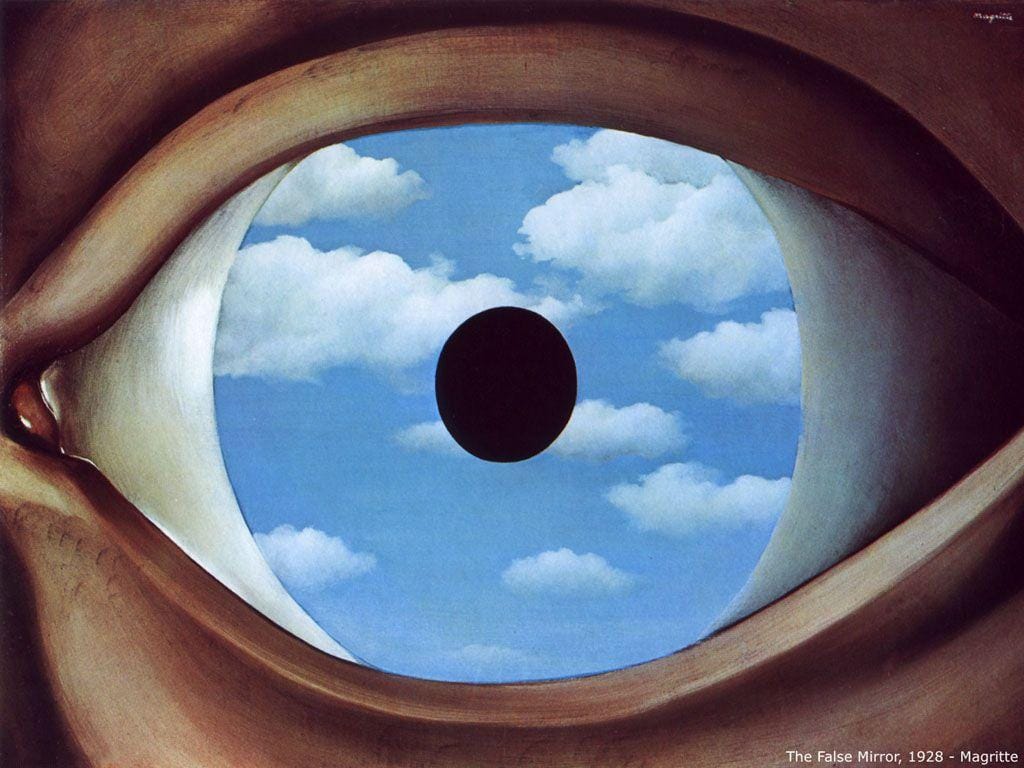
Even if the insights of surrealism are common-place, for example, that the eye is a false mirror of the world, I like is that they become real (if the surrealist is talented.)

False Mirror by Magritte; The idea, I suppose is that the eye is a false mirror of the world, seeing what's already within it.

False Mirror by Magritte; the idea, I suppose is that we see what’s already within us.

“The greatest obstacle to discovering the shape of the earth, the continents, and the oceans was not ignorance but the illusion of knowledge.” What I particularly like is the falseness of the mirror is shown as both false and true. The world is rarely this or that. Another insight / joke.

We all have masks, especially with those we love.

We all have masks, especially with those we love.

I imagine most I could make second-rate surrealistic works. The way to know your work is second rate it’s beautiful and insightful, but not funny.

Creation of Man-the-militant in the style of Michelangelo

Creation of Man-the-militant. Kuksi. It’s well done, and interesting (a retake on Michelangelo), but it’s not funny. See my cartoon in mechanical v civil engineers joke.

And then there is bad modern art. You could argue that this isn’t surreal, but some sort of other modern art, or post modern art. But that’s all false: it’s just bad art.

Bad modern art: little skill, little meaning, no humor. If you have to ask: "is it art?" It usually isn't.

Bad modern art: little skill, little meaning, no humor. If you have to ask: “is it art?” It usually isn’t.

If you buy something like this, and put it in your corporate headquarters lobby, the joke’s on you, and the artist is laughing his or her way to the bank.  Here is a link to why surrealism should be funny, And why architecture should not be (someone’s got to live in that joke).

R. E. Buxbaum, August 5, 2013

Mechanical Engineer v Civil Engineer Joke

What’s the difference between a mechanical engineer and a civil engineer?

Mechanical engineers make weapons, and civil engineers make targets.

Is funny because ….. it’s sort of true. Much of engineering is war-related, and always was. In earlier times, an engineer was someone who made engines of war: catapults, battering rams, and the like. Nowadays, mechanical engineers are the main designers for tanks, cannons, and ships. A civil engineer is one whose projects have civilian applications. But as these projects have military uses (roads, ports, offices, and bridges, for example), civilian projects are major targets for an opposing army.

An observation about war and peace: if you are really at making peacetime products, you’re a hero in your country and outside; if you design weapons, you are vilified by the enemy and likely to become a prisoner in your own land. Consider the designers of the atom bomb in the US, Russia, Israel, India, or Iran. They can’t go abroad, and are likely suspect at home. The leaders have to worry that these scientists will give the same weapons to their enemies (it’s happened) or that they will not be dedicated enough to make the next iteration of the weapon (ditto).

My advice: specialize items for peacetime or civilian use if you can. Those who make better cars, music, art or architecture are welcome everywhere; advances in death usually rebound on the inventor. Here’s a joke comparing chemists and chemical engineers, a piece on a favorite car engine advance, on perfect tuning of musical instrumentsan architecture joke, and a control engineer joke. People like civil engineers.

What sort of guy does a king keep locked in the castle dungeon — not the common thief.  #wordstothewise.

R. E. Buxbaum, August 1, 2013. I’m a chemical engineer, who makes hydrogen stuff and consults, mostly for peace-time use.

Global warming takes a 15 year rest

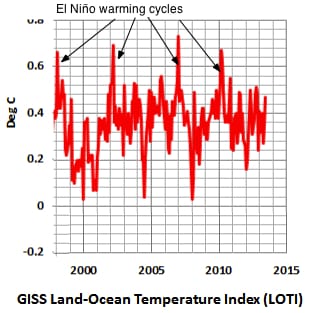
I have long thought that global climate change was chaotic, rather than steadily warming. Global temperatures show self-similar (fractal) variation with time and long-term cycles; they also show strange attractors generally states including ice ages and El Niño events. These are sudden rests of the global temperature pattern, classic symptoms of chaos. The standard models of global warming is does not predict El Niño and other chaotic events, and thus are fundamentally wrong. The models assume that a steady amount of sun heat reaches the earth, while a decreasing amount leaves, held in by increasing amounts of man-produced CO2 (carbon dioxide) in the atmosphere. These models are “tweaked” to match the observed temperature to the CO2 content of the atmosphere from 1930 to about 2004. In the movie “An Inconvenient Truth” Al Gore uses these models to predict massive arctic melting leading to a 20 foot rise in sea levels by 2100. To the embarrassment of Al Gore, and the relief of everyone else, though COconcentrations continue to rise, global warming took a 15 year break starting shortly before the movie came out, and the sea level is, more-or-less where it was except for temporary changes during periodic El Niño cycles.

Global temperature variation Fifteen years and four El Niño cycles, with little obvious change. Most models predict .25°C/decade.

Fifteen years of global temperature variation to June 2013; 4 El Niños but no sign of a long-term change.

Hans von Storch, a German expert on global warming, told the German newspaper, der Spiegel: “We’re facing a puzzle. Recent CO2 emissions have actually risen even more steeply than we feared. As a result, according to most climate models, we should have seen temperatures rise by around 0.25 degrees Celsius (0.45 degrees Fahrenheit) over the past 10 years. That hasn’t happened. [Further], according to the models, the Mediterranean region will grow drier all year round. At the moment, however, there is actually more rain there in the fall months than there used to be. We will need to observe further developments closely in the coming years.”

Aside from the lack of warming for the last 15 years, von Storch mentions that there has been no increase in severe weather. You might find that surprising given the news reports; still it’s so. Storms are caused by temperature and humidity differences, and these have not changed. (Click here to see why tornadoes lift stuff up).

At this point, I should mention that the majority of global warming experts do not see a problem with the 15 year pause. Global temperatures have been rising unsteadily since 1900, and even von Storch expects this trend to continue — sooner or later. I do see a problem, though, highlighted by the various chaotic changes that are left out of the models. A source of the chaos, and a fundamental problem with the models could be with how they treat the effects of water vapor. When uncondensed, water vapor acts as a very strong thermal blanket; it allows the sun’s light in, but prevents the heat energy from radiating out. CObehaves the same way, but weaker (there’s less of it).

More water vapor enters the air as the planet warms, and this should amplify the CO2 -caused run-away heating except for one thing. Every now and again, the water vapor condenses into clouds, and then (sometimes) falls as rain or show. Clouds and snow reflect the incoming sunlight, and this leads to global cooling. Rain and snow drive water vapor from the air, and this leads to accelerated global cooling. To the extent that clouds are chaotic, and out of man’s control, the global climate should be chaotic too. So far, no one has a very good global model for cloud formation, or for rain and snowfall, but it’s well accepted that these phenomena are chaotic and self-similar (each part of a cloud looks like the whole). Clouds may also admit “the butterfly effect” where a butterfly in China can cause a hurricane in New Jersey if it flaps at the right time.

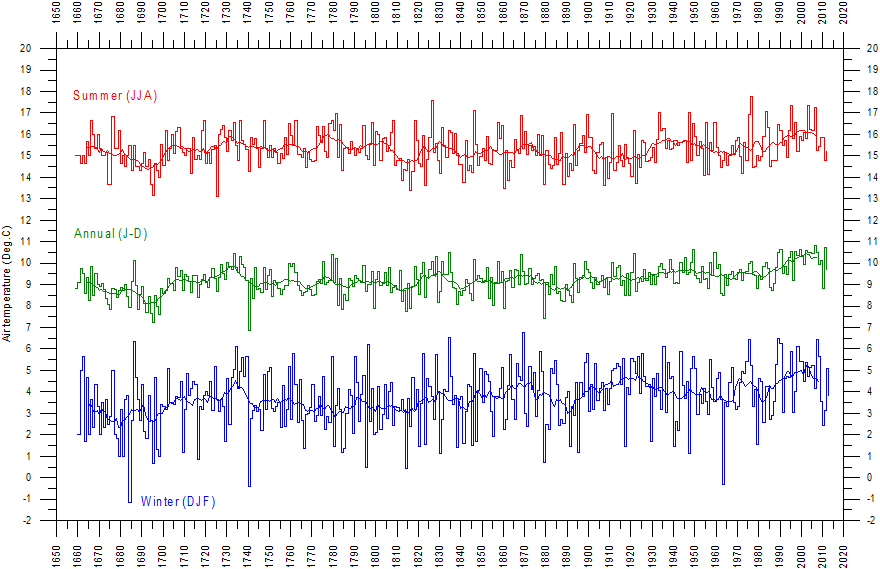
For those wishing to examine the longer-range view, here’s a thermal history of central England since 1659, Oliver Cromwell’s time. At this scale, each peak is an El Niño. There is a lot of chaotic noise, but you can also notice either a 280 year periodicity (lat peak around 1720), or a 100 year temperature rise beginning about 1900.

Global warming; Central England Since 1659; From http://www.climate4you.com

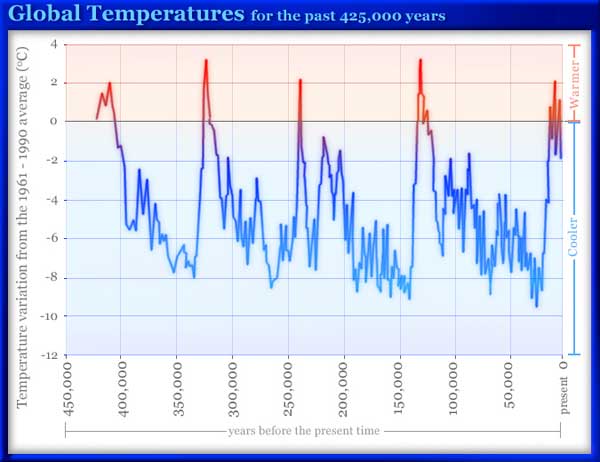
It is not clear that the cycle is human-caused,but my hope is that it is. My sense is that the last 100 years of global warming has been a good thing; for agriculture and trade it’s far better than an ice age. If we caused it with our  CO2, we could continue to use CO2 to just balance the natural tendency toward another ice age. If it’s chaotic, as I suspect, such optimism is probably misplaced. It is very hard to get a chaotic system out of its behavior. The evidence that we’ve never moved an El Niño out of its normal period of every 3 to 7 years (expect another this year or next). If so, we should expect another ice age within the next few centuries.

Global temperatures measured from the antarctic ice showing stable, cyclic chaos and self-similarity.

Global temperatures measured from the antarctic ice showing 4 Ice ages.

Just as clouds cool the earth, you can cool your building too by painting the roof white. If you are interested in more weather-related posts, here’s why the sky is blue on earth, and why the sky on Mars is yellow.

Robert E. Buxbaum July 27, 2013 (mostly my business makes hydrogen generators and I consult on hydrogen).

chemistry and dentistry joke

What do you get when you dissolve all your rear teeth in water.


An eight molar solution.


Is funny because ….. most adults have eight molars (four on the bottom, four on the top); and there is a measure of solution concentration called molarity; an eight molar solution is one that contains 8 formula weights of solute per liter of solution.

For a chemistry joke about dissolving bears, go here; for a chemist v chemical engineer joke, here; for my latest quantum joke, here; and for an architecture joke, here. On a more serious note, if you’d like to see how we do simple electroplating, see the previous post.


R.E.Buxbaum, July 24, 2013