Gatling guns and the Spanish American War

I rather like inventions and engineering history, and I regularly go to the SME, a fair of 18th to 19th century innovation. I am generally impressed with how these machines work, but what really brings things out is when talented people use the innovation to do something radical. Case in point, the Gatling gun; invented by Richard J. Gatling in 1861 for use in the Civil war, it was never used there, or in any major war until 1898 when Lieut. John H. Parker (Gatling Gun Parker) showed how to deploy them successfully, and helped take over Cuba. Until then, they were considered another species of short-range, grape-shot cannon, and ignored.

1876_Gatling_gun_NPS_Fort_Laramie_WY_by-Matthew_Trump_2004

A Gatling gun of the late 1800s. Similar, but not identical to the ones Parker brought along.

Parker had sent his thoughts on how to deploy a Gatling gun in a letter to West Point, but they were ignored, as most new thoughts are. For the Spanish-American War, Parker got 4 of the guns, trained his small detachment to use them, and registered as a quartermaster corp in order to sneak them aboard ship to Cuba. Here follows Theodore Roosevelt’s account of their use.

“On the morning of July 1st, the dismounted cavalry, including my regiment, stormed Kettle Hill, driving the Spaniards from their trenches. After taking the crest, I made the men under me turn and begin volley-firing at the San Juan Blockhouse and entrenchment’s against which Hawkins’ and Kent’s Infantry were advancing. While thus firing, there suddenly smote on our ears a peculiar drumming sound. One or two of the men cried out, “The Spanish machine guns!” but, after listening a moment, I leaped to my feet and called, “It’s the Gatlings, men! It’s our Gatlings!” Immediately the troopers began to cheer lustily, for the sound was most inspiring. Whenever the drumming stopped, it was only to open again a little nearer the front. Our artillery, using black powder, had not been able to stand within range of the Spanish rifles, but it was perfectly evident that the Gatlings were troubled by no such consideration, for they were advancing all the while.
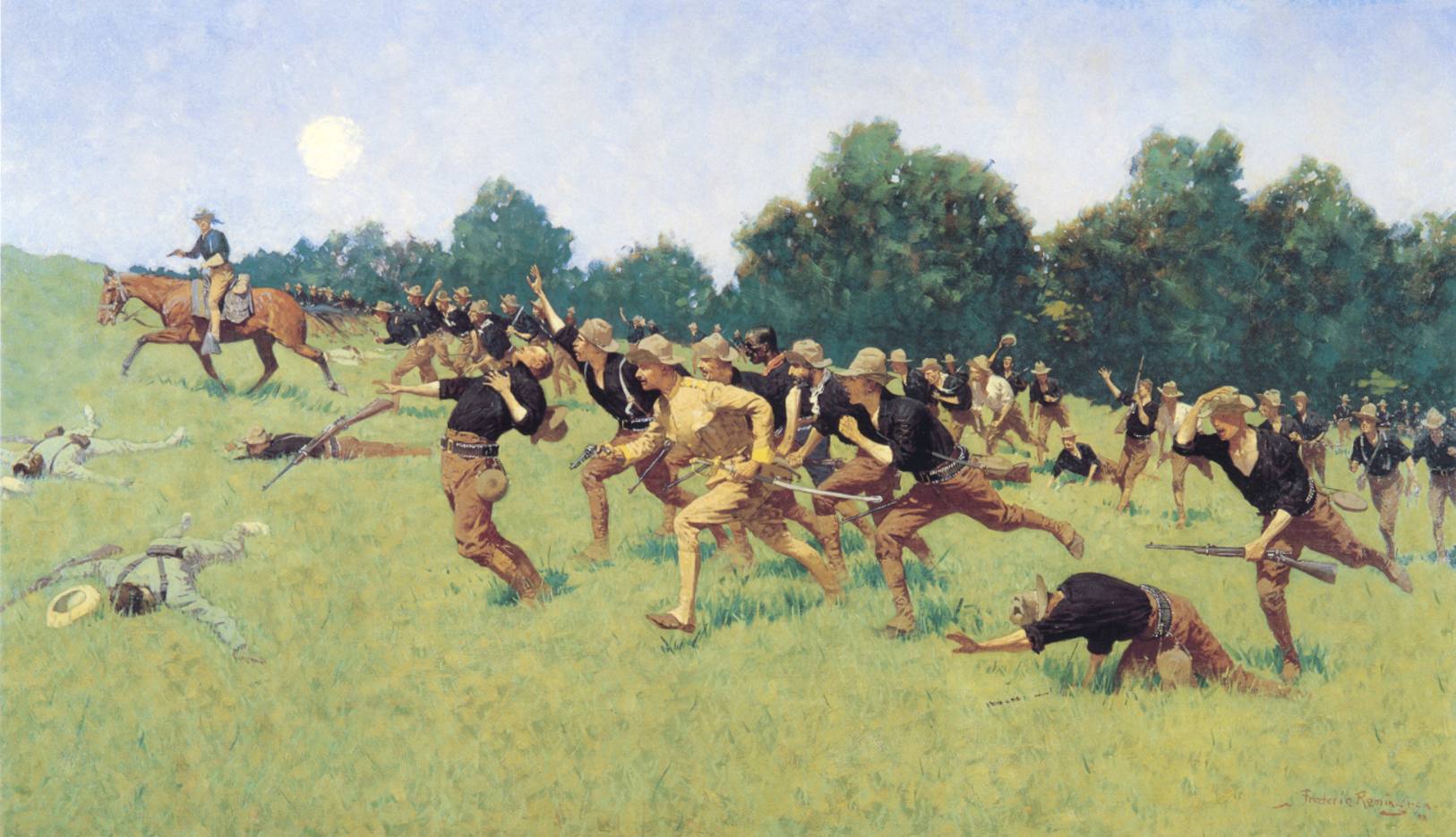
Roosevelt and the charge up Kettle Hill, Frederick Remington

Roosevelt, his volunteers, and the Buffalo soldiers charge up Kettle Hill, Frederick Remington.

Soon the infantry took San Juan Hill, and, after one false start, we in turn rushed the next line of block-houses and intrenchments, and then swung to the left and took the chain of hills immediately fronting Santiago. Here I found myself on the extreme front, in command of the fragments of all six regiments of the cavalry division. I received orders to halt where I was, but to hold the hill at all hazards. The Spaniards were heavily reinforced and they opened a tremendous fire upon us from their batteries and trenches. We laid down just behind the gentle crest of the hill, firing as we got the chance, but, for the most part, taking the fire without responding. As the afternoon wore on, however, the Spaniards became bolder, and made an attack upon the position. They did not push it home, but they did advance, their firing being redoubled. We at once ran forward to the crest and opened on them, and, as we did so, the unmistakable drumming of the Gatlings opened abreast of us, to our right, and the men cheered again. As soon as the attack was definitely repulsed, I strolled over to find out about the Gatlings, and there I found Lieut. Parker with two of his guns right on our left, abreast of our men, who at that time were closer to the Spaniards than any others.

From thence on, Parker’s Gatlings were our inseparable companion throughout the siege. They were right up at the front. When we dug our trenches, he took off the wheels of his guns and put them in the trenches. His men and ours slept in the same bomb-proofs and shared with one another whenever either side got a supply of beans or coffee and sugar. At no hour of the day or night was Parker anywhere but where we wished him to be, in the event of an attack. If a troop of my regiment was sent off to guard some road or some break in the lines, we were almost certain to get Parker to send a Gatling along, and, whether the change was made by day or by night, the Gatling went. Sometimes we took the initiative and started to quell the fire of the Spanish trenches; sometimes they opened upon us; but, at whatever hour of the twenty-four the fighting began, the drumming of the Gatlings was soon heard through the cracking of our own carbines.
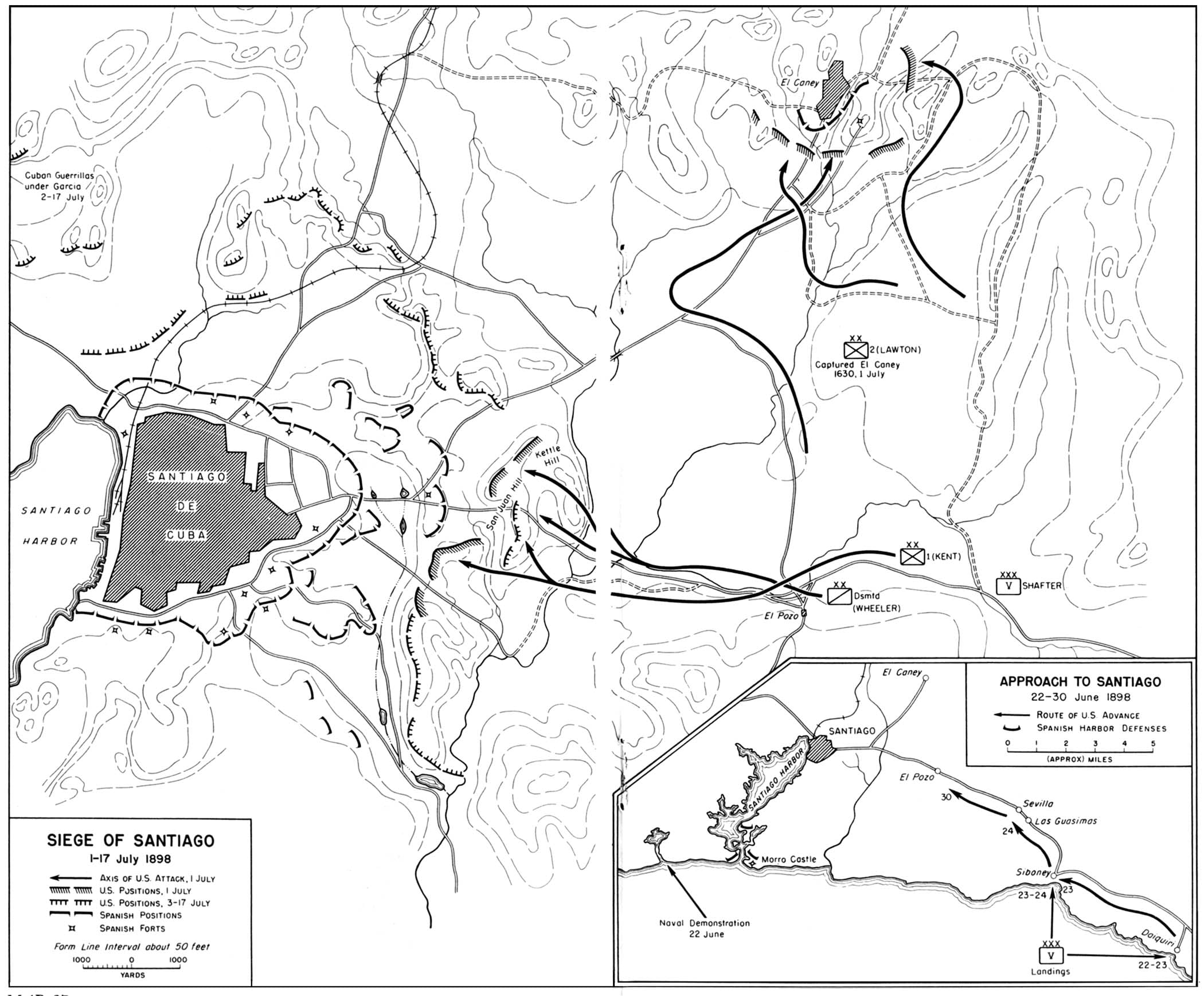
Map of the Attack on Kettle Hill and San Juan Hill in the Spanish American War.

Map of the Attack on Kettle Hill and San Juan Hill in the Spanish-American War, July 1, 1898 The Spanish had 760 troops n the in fortified positions defending the crests of the two hills, and 10,000 more defending Santiago. As Americans were being killed in “hells pocket” near the foot of San Juan Hill, from crossfire, Roosevelt, on the right, charged his men, the “Rough Riders” [1st volunteers] and the “Buffalo Soldiers [10th cavalry], up Kettle Hill in hopes of ending the crossfire and of helping to protect troops that would charge further up San Juan Hill. Parker’s Gatlings were about 600 yards from the Spanish and fired some 700 rounds per minute into the Spanish lines. Theyy were then repositioned on the hill to beat back the counter attack. Without the Parker’s Gatling guns, the chances of success would have been small.

I have had too little experience to make my judgment final; but certainly, if I were to command either a regiment or a brigade, whether of cavalry or infantry, I would try to get a Gatling battery–under a good man–with me. I feel sure that the greatest possible assistance would be rendered, under almost all circumstances, by such a Gatling battery, if well handled; for I believe that it could be pushed fairly to the front of the firing-line. At any rate, this is the way that Lieut. Parker used his battery when he went into action at San Juan, and when he kept it in the trenches beside the Rough Riders before Santiago.”

Here is how the Gatling gun works; it’s rather like 5 or more rotating zip guns; a pall pulls and releases the firing pins. Gravity feeds the bullets at the top and drops the shells out the bottom. Lt’ Parker’s deployment innovation was to have them hand-carried to protected positions, near-enough to the front that they could be aimed. The swivel and rapid fire of the guns allowed the shooter to aim them to correct for the drop in the bullets over fairly great distances. This provided rapid-fire accurate protection from positions that could not be readily hit. Shortly after the victory on San Juan HIll, July 1 1898, the Spanish Caribbean fleet was destroyed July 3, Santiago surrendered July 17, and all of Cuba surrendered 4 days later, July 21 (my birthday) — a remarkably short war. While TR may not have figured out how to use the Gatling guns effectively, he at least recognized that Lt. John Parker had.

A new type of machine gun,  a colt browning repeating rifle, a gift from Con'l Roosevelt to John Parker's Gatling gun detachment.

Roosevelt gave two of these, more modern, Colt-Browning repeating rifles to Parker’s detachment the day after the battle. They were not particularly effective. By WWI, “Gatling Gun” Parker would be a general; by 1901 Roosevelt would be president.

The day after the battle, Col. Roosevelt gifted Parker’s group with two Colt-Browning machine guns that he and his family had bought, but had not used. According to Roosevelt, but these rifles, proved to be “more delicate than the Gatlings, and very readily got out-of-order.” The Brownings are the predecessor of the modern machine gun used in the Boxer Rebellion and for wholesale deaths in WWI and WWII.

Dr. Robert E. Buxbaum, June 9, 2015. The Spanish-American War was a war of misunderstanding and colonialism, but its effects, by and large, were good. The cause, the sinking of the USS Maine, February 15, 1898, was likely a mistake. Spain, a decaying colonial power, was a conservative monarchy under Alfonso XIII; the loss of Cuba seems to have lead to liberalization. The US, a republic, became a colonial power. There is an inherent friction, I think between conservatism and liberal republicanism, Generally, republics have out-gunned and out-produced other countries, perhaps because they reward individual initiative.

An approach to teaching statistics to 8th graders

There are two main obstacles students have to overcome to learn statistics: one mathematical one philosophical. The math is somewhat difficult, and will be new to a high schooler. What’s more, philosophically, it is rarely obvious what it means to discover a true pattern, or underlying cause. Nor is it obvious how to separate the general pattern from the random accident, the pattern from the variation. This philosophical confusion (cause and effect, essence and accident) is exists in the back of even in the greatest minds. Accepting and dealing with it is at the heart of the best research: seeing what is and is not captured in the formulas of the day. But it is a lot to ask of the young (or the old) who are trying to understand the statistical technique while at the same time trying to understand the subject of the statistical analysis, For young students, especially the good ones, the issue of general and specific will compound the difficulty of the experiment and of the math. Thus, I’ll try to teach statistics with a problem or two where the distinction between essential cause and random variation is uncommonly clear.

A good case to get around the philosophical issue is gambling with crooked dice. I show the class a pair of normal-looking dice and a caliper and demonstrate that the dice are not square; virtually every store-bought die is not square, so finding an uneven pair is easy. After checking my caliper, students will readily accept that these dice are crooked, and so someone who knows how it is crooked will have an unfair advantage. After enough throws, someone who knows the degree of crookedness will win more often than those who do not. Students will also accept that there is a degree of randomness in the throw, so that any pair of dice will look pretty fair if you don’t gable with them too long. I can then use statistics to see which faces show up most, and justify the whole study of statistics to deal with a world where the dice are loaded by God, and you don’t have a caliper, or any more-direct way of checking them. The underlying uneven-ness of the dice is the underlying pattern, the random part in this case is in the throw, and you want to use statistics to grasp them both.

Two important numbers to understand when trying to use statistics are the average and the standard deviation. For an honest pair of dice, you’d expect an average of 1/6 = 0.1667 for every number on the face. But throw a die a thousand times and you’ll find that hardly any of the faces show up at the average rate of 1/6. The average of all the averages will still be 1/6. We will call that grand average, 1/6 = x°-bar, and we will call the specific face average of the face Xi-bar. where i is one, two three, four, five, or six.

There is also a standard deviation — SD. This relates to how often do you expect one fact to turn up more than the next. SD = √SD2, and SD2 is defined by the following formula

SD2 = 1/n ∑(xi – x°-bar)2

Let’s pick some face of the dice, 3 say. I’ll give a value of 1 if we throw that number and 0 if we do not. For an honest pair of dice, x°-bar = 1/6, that is to say, 1 out of 6 throws will be land on the number 3, going us a value of 1, and the others won’t. In this situation, SD2 = 1/n ∑(xi – x°-bar)2 will equal 1/6 ( (1/6)2 + 5 (5/6)2 )= 1/6 (126/36) = 3.5/6 = .58333. Taking the square root, SD = 0.734. We now calculate the standard error. For honest dice, you expect that for every face, on average

SE = Xi-bar minus x°-bar = ± SD √(1/n).

By the time you’ve thrown 10,000 throws, √(1/n) = 1/100 and you expect an error on the order of 0.0073. This is to say that you expect to see each face show up between about 0.1740 and 0.1594. In point of fact, you will likely find that at least one face of your dice shows up a lot more often than this, or a lot less often. To the extent you see that, this is the extent that your dice is crooked. If you throw someone’s dice enough, you can find out how crooked they are, and you can then use this information to beat the house. That, more or less is the purpose of science, by the way: you want to beat the house — you want to live a life where you do better than you would by random chance.

As a less-mathematical way to look at the same thing — understanding statistics — I suggest we consider a crooked coin throw with only two outcomes, heads and tails. Not that I have a crooked coin, but your job as before is to figure out if the coin is crooked, and if so how crooked. This problem also appears in political polling before a major election: how do you figure out who will win between Mr Head and Ms Tail from a sampling of only a few voters. For an honest coin or an even election, on each throw, there is a 50-50 chance of head, or of Mr Head. If you do it twice, there is a 25% chance of two heads, a 25% chance of throwing two tails and a 50% chance of one of each. That’s because there are four possibilities and two ways of getting a Head and a Tail.

pascal's triangle

Pascal’s triangle

You can systematize this with a Pascal’s triangle, shown at left. Pascal’s triangle shows the various outcomes for a coin toss, and shows the ways they can be arrived at. Thus, for example, we see that, by the time you’ve thrown the coin 6 times, or polled 6 people, you’ve introduced 26 = 64 distinct outcomes, of which 20 (about 1/3) are the expected, even result: 3 heads and 3 tails. There is only 1 way to get all heads and one way to get all tails. While an honest coin is unlikely to come up all heads or tails after six throws, more often than not an honest coin will not come up with half heads. In the case above, 44 out of 64 possible outcomes describe situations with more heads than tales, or more tales than heads — with an honest coin.

Similarly, in a poll of an even election, the result will not likely come up even. This is something that confuses many political savants. The lack of an even result after relatively few throws (or phone calls) should not be used to convince us that the die is crooked, or the election has a clear winner. On the other hand there is only a 1/32 chance of getting all heads or all tails (2/64). If you call 6 people, and all claim to be for Mr Head, it is likely that Mr Head is the true favorite to a confidence of 3% = 1/32. In sports, it’s not uncommon for one side to win 6 out of 6 times. If that happens, it is a good possibility that there is a real underlying cause, e.g. that one team is really better than the other.

And now we get to how significant is significant. If you threw 4 heads and 2 tails out of 6 throws we can accept that this is not significant because there are 15 ways to get this outcome (or 30 if you also include 2 heads and 4 tail) and only 20 to get the even outcome of 3-3. But what about if you threw 5 heads and one tail? In that case the ratio is 6/20 and the odds of this being significant is better, similarly, if you called potential voters and found 5 Head supporters and 1 for Tail. What do you do? I would like to suggest you take the ratio as 12/20 — the ratio of both ways to get to this outcome to that of the greatest probability. Since 12/20 = 60%, you could say there is a 60% chance that this result is random, and a 40% chance of significance. What statisticians call this is “suggestive” at slightly over 1 standard deviation. A standard deviation, also known as σ (sigma) is a minimal standard of significance, it’s if the one tailed value is 1/2 of the most likely value. In this case, where 6 tosses come in as 5 and 1, we find the ratio to be 6/20. Since 6/20 is less than 1/2, we meet this, very minimal standard for “suggestive.” A more normative standard is when the value is 5%. Clearly 6/20 does not meet that standard, but 1/20 does; for you to conclude that the dice is likely fixed after only 6 throws, all 6 have to come up heads or tails.

From skdz. It's typical in science to say that <5% chances, p <.050 are significant. If things don't quite come out that way, you redo.

From xkcd. It’s typical in science to say that <5% chances, p< .05. If things don’t quite come out that way, you redo.

If you graph the possibilities from a large Poisson Triangle they will resemble a bell curve; in many real cases (not all) your experiential data variation will also resemble this bell curve. From a larger Poisson’s triange, or a large bell curve, you  will find that the 5% value occurs at about σ =2, that is at about twice the distance from the average as to where σ  = 1. Generally speaking, the number of observations you need is proportional to the square of the difference you are looking for. Thus, if you think there is a one-headed coin in use, it will only take 6 or seven observations; if you think the die is loaded by 10% it will take some 600 throws of that side to show it.

In many (most) experiments, you can not easily use the poisson triangle to get sigma, σ. Thus, for example, if you want to see if 8th graders are taller than 7th graders, you might measure the height of people in both classes and take an average of all the heights  but you might wonder what sigma is so you can tell if the difference is significant, or just random variation. The classic mathematical approach is to calculate sigma as the square root of the average of the square of the difference of the data from the average. Thus if the average is <h> = ∑h/N where h is the height of a student and N is the number of students, we can say that σ = √ (∑ (<h> – h)2/N). This formula is found in most books. Significance is either specified as 2 sigma, or some close variation. As convenient as this is, my preference is for this graphical version. It also show if the data is normal — an important consideration.

If you find the data is not normal, you may decide to break the data into sub-groups. E.g. if you look at heights of 7th and 8th graders and you find a lack of normal distribution, you may find you’re better off looking at the heights of the girls and boys separately. You can then compare those two subgroups to see if, perhaps, only the boys are still growing, or only the girls. One should not pick a hypothesis and then test it but collect the data first and let the data determine the analysis. This was the method of Sherlock Homes — a very worthwhile read.

Another good trick for statistics is to use a linear regression, If you are trying to show that music helps to improve concentration, try to see if more music improves it more, You want to find a linear relationship, or at lest a plausible curve relationship. Generally there is a relationship if (y – <y>)/(x-<x>) is 0.9 or so. A discredited study where the author did not use regressions, but should have, and did not report sub-groups, but should have, involved cancer and genetically modified foods. The author found cancer increased with one sub-group, and publicized that finding, but didn’t mention that cancer didn’t increase in nearby sub-groups of different doses, and decreased in a nearby sub-group. By not including the subgroups, and not doing a regression, the author mislead people for 2 years– perhaps out of a misguided attempt to help. Don’t do that.

Dr. Robert E. Buxbaum, June 5-7, 2015. Lack of trust in statistics, or of understanding of statistical formulas should not be taken as a sign of stupidity, or a symptom of ADHD. A fine book on the misuse of statistics and its pitfalls is called “How to Lie with Statistics.” Most of the examples come from advertising.

The mystery of American productivity

Americans are among the richest and best paid people in the world. On a yearly basis, Americans produce and earn about 20% more than Britons and about 30% more than Japanese. On an hourly basis, counter to what you might expect, American workers produce about 30% more than Britons or Canadians, and about 50% more than the vaunted Japanese.

Per hour worker productivity, from the Economist.  We do OK for backward hicks.

Per hour worker productivity, from the Economist. We do OK for backward hicks.

French and German workers produce about as much as we do, per hour, but tend to work fewer hours. Still, the differences are not quite what you might expect. French workers take many more hours off than we do and are still so much more productive than the British that it appears they could take an extra month off and still beat them in yearly output. Japanese workers meanwhile produce only as much as the French, per year, but take far more hours to do it. One thought is that it’s all the vacation time that makes French so productive and it’s perhaps the lack of vacations that causes the Japanese to be relatively unproductive.

Not that vacation time alone explains our high productivity, nor that of the Germans or Italians relative to the Canadians and Britons. One part of an answer, I suspect, is that we put fewer roadblocks to workers becoming business owners, and to running things their own way. Another thought is that US and Germany have a low minimum wage, comparatively, and Italy has no minimum wage at all; Germany had no minimum wage in 2013, the time of the productivity comparison. In countries like this, there is a larger profit to be had by clever individuals who work hard, think, and start their own businesses. With minimal requirement on how much to pay, the business owner can bring to bear a mix of low-wage, minimally productive workers with labor-saving innovation, allowing them to become rich while decreasing unemployment. It also allows them to serve otherwise under-served parts of the market and profit from it. And profit is a powerful motivator. As Friedrich Nietzsche said, “a why beats a how.” 

The nine European countries with no minimum wage are among the richest on the continent, and among those with the lowest unemployment: Iceland, Lichtenstein, Norway, Sweden, Finland, Denmark, Austria, Italy, and Switzerland. By contrast, England, Canada, and Japan have relative high minimum wages and relatively high unemployment. There are also some poor countries with no minimum wage (Egypt, Zimbabwe, Rwanda…) but these countries suffer from other issues, like rampant crime. I’ve argued that the high “Living Wage” in Detroit is a major cause of Detroit’s high unemployment and bankruptcy. If low minimum wage is a major source of American worker productivity and wealth, it would be a real mistake to raise it.

Worker productivity is the best single predictor of long-term national success. As such, the long-term prediction for Britain, Canada, and Japan is not good. Unless something changes in these countries, we may expect to see them off to a long, dark tea-time of declining significance. Perhaps, it is a fear of this that was behind the resounding defeat of the Labour party in British elections last week. The Labour government oversaw England’s last big drop in productivity.

R.E. Buxbaum, May 28, 2015. It’s also possible (unlikely) that US universities are really good, or at least not as bad as thought. We don’t seem to quite beat the enthusiasm out of our students, though we do drug them quite a lot. Here’s a Forbes article on minimum wage.

From Princeton: dare to be dumb.

Let’s say you have a good education and a good idea you want to present to equally educated colleagues. You might think to use your big words, your long sentences, and your dialectically organized, long paragraphs. A recent, Princeton University study suggests this is a route to disaster, even with the educated. It’s even more so with the un-educated. Big words don’t convince anyone, and don’t even impress. Small words do.

Most people won't care what you know unless they know that you care.

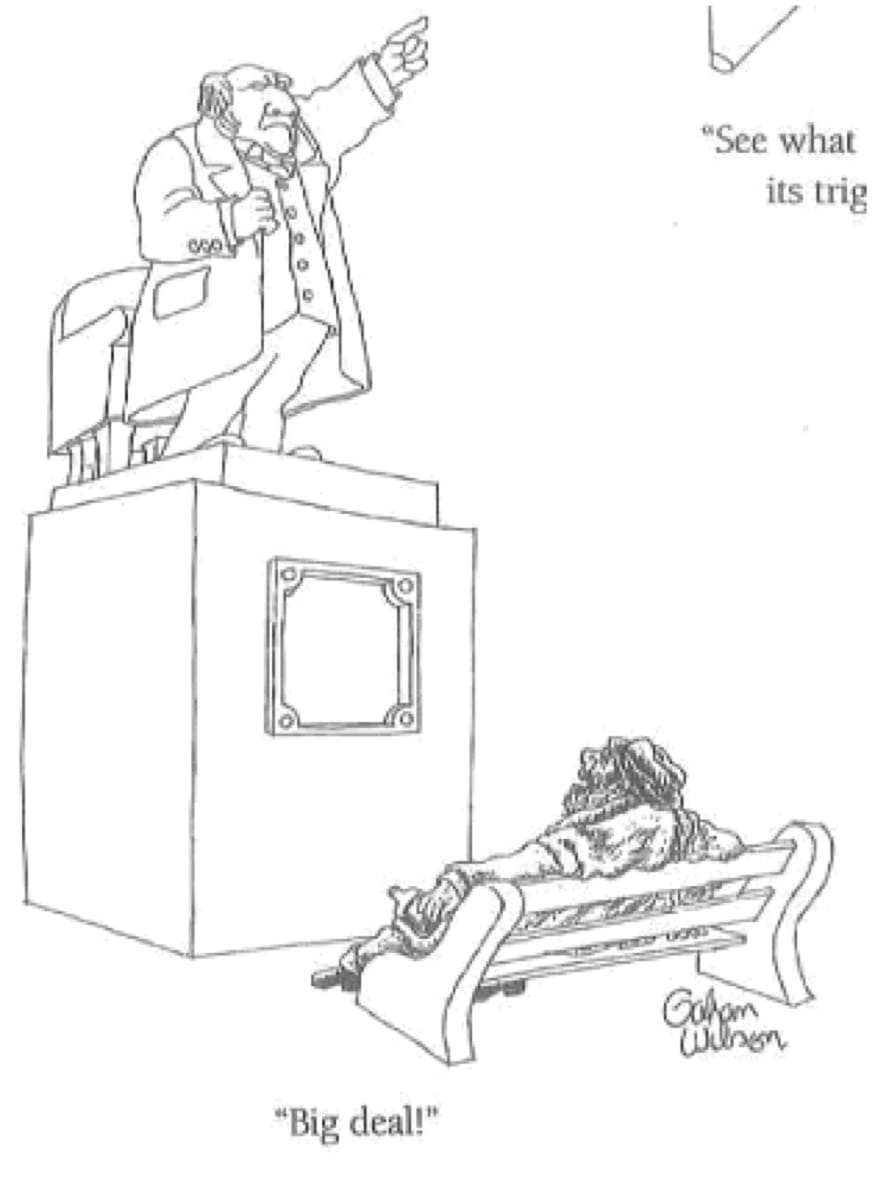
Like this fellow, most folks aren’t impressed by fancy speeches. (cartoon by Gahan Wilson)

http://web.princeton.edu/…/Opp%20Consequences%20of%20Erudit…

People, even educated ones, want ideas presented in simple words and straight, simple sentences. They trust  and respect people who speak this way far more than those who shoot high, and sometimes over their heads. Even educated people find long words and sentences confusing, and off-putting. To them, as to the less-educated, it sounds like you’re using your fancy english as a cover for lies and ignorance, and that you’re trying to claim superiority. Who knew that George W Bush. was so smart (Al Gore?). Here’s George W. at the SMU graduation yesterday (May 18). He does well, I’d say, and keeps mostly to one-syllable words.

This is the sort of advertising that people notice -- and trust.

Lower yourself to be one of the crowd, but don’t go so far that you’re the butt of jokes.

I’ve come to ask why fancy language skills are used for college entrance exams, and why their use adds points when writing a college paper. Put another way, why are professors pleased by something that’s off-putting to everyone else. Perhaps this is a jargon test, to show you’re a reader and wish to join the pedantics’ club. Alternately, perhaps professors have gotten so used to Latinate language that it’s become natural language to them, spoken when they visit musea. Whatever the reason, when outside of university, keep it simple (and) stupid.

Some specifics: at job interviews, say you want to work at their company doing a job in your field. Only when dealing with professors can you claim your goal is capitalizing on your intellectual synergies, a phrase that means the same thing. Don’t say, you’ll do anything, and remember it’s OK to ask for training; poor education is the secret to American success.

Dr. Robert E. Buxbaum, May 19, 2015. Here are some further thoughts on education, and some pictures of my dorm and the grad college at Princeton back in the day.

My latest invention: improved fuel cell reformer

Last week, I submitted a provisional patent application for an improved fuel reformer system to allow a fuel cell to operate on ordinary, liquid fuels, e.g. alcohol, gasoline, and JP-8 (diesel). I’m attaching the complete text of the description, below, but since it is not particularly user-friendly, I’d like to add a small, explanatory preface. What I’m proposing is shown in the diagram, following. I send a hydrogen-rich stream plus ordinary fuel and steam to the fuel cell, perhaps with a pre-reformer. My expectation that the fuel cell will not completely convert this material to CO2 and water vapor, even with the pre-reformer. Following the fuel cell, I then use a water-gas shift reactor to convert product CO and H2O to H2 and CO2 to increase the hydrogen content of the stream. I then use a semi-permeable membrane to extract the waste CO2 and water. I recirculate the hydrogen and the rest of the water back to the fuel cell to generate extra power, prevent coking, and promote steam reforming. I calculate the design should be able to operate at, perhaps 0.9 Volt per cell, and should nearly double the energy per gallon of fuel compared to ordinary diesel. Though use of pure hydrogen fuel would give better mileage, this design seems better for some applications. Please find the text following.

Use of a Water-Gas shift reactor and a CO2 extraction membrane to improve fuel utilization in a solid oxide fuel cell system.

Inventor: Dr. Robert E. Buxbaum, REB Research, 12851 Capital St, Oak Park, MI 48237; Patent Pending.

Solid oxide fuel cells (SOFCs) have improved over the last 10 years to the point that they are attractive options for electric power generation in automobiles, airplanes, and auxiliary power supplies. These cells operate at high temperatures and tolerate high concentrations of CO, hydrocarbons and limited concentrations of sulfur (H2S). SOFCs can operate on reformate gas and can perform limited degrees of hydrocarbon reforming too – something that is advantageous from the stand-point of fuel logistics: it’s far easier to transport a small volume of liquid fuel that it is a large volume of H2 gas. The main problem with in-situ reforming is the danger of coking the fuel cell, a problem that gets worse when reforming is attempted with the more–desirable, heavier fuels like gasoline and JP-8. To avoid coking the fuel cell, heavier fuels are typically reforming before hand in a separate reactor, typically by partial oxidation at auto-thermal conditions, a process that typically adds nitrogen and results in the inability to use the natural heat given off by the fuel cell. Steam reforming has been suggested as an option (Chick, 2011) but there is not enough heat released by the fuel cell alone to do it with the normal fuel cycles.

Another source of inefficiency in reformate-powered SOFC systems is basic to the use of carbon-containing fuels: the carbon tends to leave the fuel cell as CO instead of CO2. CO in the exhaust is undesirable from two perspectives: CO is toxic, and quite a bit of energy is wasted when the carbon leaves in this form. Normally, carbon can not leave as CO2 though, since CO is the more stable form at the high temperatures typical of SOFC operation. This patent provides solutions to all these problems through the use of a water-gas shift reactor and a CO2-extraction membrane. Find a drawing of a version of the process following.

RE. Buxbaum invention: A suggested fuel cycle to allow improved fuel reforming with a solid oxide fuel cell

RE. Buxbaum invention: A suggested fuel cycle to allow improved fuel reforming with a solid oxide fuel cell

As depicted in Figure 1, above, the fuel enters, is mixed with steam or partially boiled water, and heated in the rectifying heat exchanger. The hot steam + fuel mix then enters a steam reformer and perhaps a sulfur removal stage. This would be typical steam reforming except for a key difference: the heat for reforming comes (at least in part) from waste heat of the SOFC. Normally speaking there would not be enough heat, but in this system we add a recycle stream of H2-rich gas to the fuel cell. This stream, produced from waste CO in a water-gas shift reactor (the WGS) shown in Figure 1. This additional H2 adds to the heat generated by the SOFC and also adds to the amount of water in the SOFC. The net effect should be to reduce coking in the fuel cell while increasing the output voltage and providing enough heat for steam reforming. At least, that is the thought.

SOFCs differ from proton conducting FCS, e.g. PEM FCs, in that the ion that moves is oxygen, not hydrogen. As a result, water produced in the fuel cell ends up in the hydrogen-rich stream and not in the oxygen stream. Having this additional water in the fuel stream of the SOFC can promote fuel reforming within the FC. This presents a difficulty in exhausting the waste water vapor in that a means must be found to separate it from un-combusted fuel. This is unlike the case with PEM FCs, where the waste water leaves with the exhaust air. Our main solution to exhausting the water is the use of a membrane and perhaps a knockout drum to extract it from un-combusted fuel gases.

Our solution to the problem of carbon leaving the SOFC as CO is to react this CO with waste H2O to convert it to CO2 and additional H2. This is done in a water gas shift reactor, the WGS above. We then extract the CO2 and remaining, unused water through a CO2- specific membrane and we recycle the H2 and unconverted CO back to the SOFC using a low temperature recycle blower. The design above was modified from one in a paper by PNNL; that paper had neither a WGS reactor nor a membrane. As a result it got much worse fuel conversion, and required a high temperature recycle blower.

Heat must be removed from the SOFC output to cool it to a temperature suitable for the WGS reactor. In the design shown, the heat is used to heat the fuel before feeding it to the SOFC – this is done in the Rectifying HX. More heat must be removed before the gas can go to the CO2 extractor membrane; this heat is used to boil water for the steam reforming reaction. Additional heat inputs and exhausts will be needed for startup and load tracking. A solution to temporary heat imbalances is to adjust the voltage at the SOFC. The lower the voltage the more heat will be available to radiate to the steam reformer. At steady state operation, a heat balance suggests we will be able to provide sufficient heat to the steam reformer if we produce electricity at between 0.9 and 1.0 Volts per cell. The WGS reactor allows us to convert virtually all the fuel to water and CO2, with hardly any CO output. This was not possible for any design in the PNNL study cited above.

The drawing above shows water recycle. This is not a necessary part of the cycle. What is necessary is some degree of cooling of the WGS output. Boiling recycle water is shown because it can be a logistic benefit in certain situations, e.g. where you can not remove the necessary CO2 without removing too much of the water in the membrane module, and in mobile military situations, where it’s a benefit to reduce the amount of material that must be carried. If water or fuel must be boiled, it is worthwhile to do so by cooling the output from the WGS reactor. Using this heat saves energy and helps protect the high-selectivity membranes. Cooling also extends the life of the recycle blower and allows the lower-temperature recycle blowers. Ideally the temperature is not lowered so much that water begins to condense. Condensed water tends to disturb gas flow through a membrane module. The gas temperatures necessary to keep water from condensing in the module is about 180°C given typical, expected operating pressures of about 10 atm. The alternative is the use of a water knockout and a pressure reducer to prevent water condensation in membranes operated at lower temperatures, about 50°C.

Extracting the water in a knockout drum separate from the CO2 extraction has the secondary advantage of making it easier to adjust the water content in the fuel-gas stream. The temperature of condensation can then be used to control the water content; alternately, a separate membrane can extract water ahead of the CO2, with water content controlled by adjusting the pressure of the liquid water in the exit stream.

Some description of the membrane is worthwhile at this point since a key aspect of this patent – perhaps the key aspect — is the use of a CO2-extraction membrane. It is this addition to the fuel cycle that allows us to use the WGS reactor effectively to reduce coking and increase efficiency. The first reasonably effective CO2 extraction membranes appeared only about 5 years ago. These are made of silicone polymers like dimethylsiloxane, e.g. the Polaris membrane from MTR Inc. We can hope that better membranes will be developed in the following years, but the Polaris membrane is a reasonably acceptable option and available today, its only major shortcoming being its low operating temperature, about 50°C. Current Polaris membranes show H2-CO2 selectivity about 30 and a CO2 permeance about 1000 Barrers; these permeances suggest that high operating pressures would be desirable, and the preferred operation pressure could be 300 psi (20 atm) or higher. To operate the membrane with a humid gas stream at high pressure and 50°C will require the removal of most of the water upstream of the membrane module. For this, I’ve included a water knockout, or steam trap, shown in Figure 1. I also include a pressure reduction valve before the membrane (shown as an X in Figure 1). The pressure reduction helps prevent water condensation in the membrane modules. Better membranes may be able to operate at higher temperatures where this type of water knockout is not needed.

It seems likely that, no matter what improvements in membrane technology, the membrane will have to operate at pressures above about 6 atm, and likely above about 10 atm (upstream pressure) exhausting CO2 and water vapor to atmosphere. These high pressures are needed because the CO2 partial pressure in the fuel gas leaving the membrane module will have to be significantly higher than the CO2 exhaust pressure. Assuming a CO2 exhaust pressure of 0.7 atm or above and a desired 15% CO2 mol fraction in the fuel gas recycle, we can expect to need a minimum operating pressure of 4.7 atm at the membrane. Higher pressures, like 10 or 20 atm could be even more attractive.

In order to reform a carbon-based fuel, I expect the fuel cell to have to operate at 800°C or higher (Chick, 2011). Most fuels require high temperatures like this for reforming –methanol being a notable exception requiring only modest temperatures. If methanol is the fuel we will still want a rectifying heat exchanger, but it will be possible to put it after the Water-Gas Shift reactor, and it may be desirable for the reformer of this fuel to follow the fuel cell. When reforming sulfur-containing fuels, it is likely that a sulfur removal reactor will be needed. Several designs are available for this; I provide references to two below.

The overall system design I suggest should produce significantly more power per gm of carbon-based feed than the PNNL system (Chick, 2011). The combination of a rectifying heat exchange, a water gas reactor and CO2 extraction membrane recovers chemical energy that would otherwise be lost with the CO and H2 bleed steam. Further, the cooling stage allows the use of a lower temperature recycle pump with a fairly low compression ratio, likely 2 or less. The net result is to lower the pump cost and power drain. The fuel stream, shown in orange, is reheated without the use of a combustion pre-heater, another big advantage. While PNNL (Chick, 2011) has suggested an alternative route to recover most of the chemical energy through the use of a turbine power generator following the fuel cell, this design should have several advantages including greater reliability, and less noise.

Claims:

1.   A power-producing, fuel cell system including a solid oxide fuel cell (SOFC) where a fuel-containing output stream from the fuel cell goes to a regenerative heat exchanger followed by a water gas shift reactor followed by a membrane means to extract waste gases including carbon dioxide (CO2) formed in said reactor. Said reactor operating a temperatures between 200 and 450°C and the extracted carbon dioxide leaving at near ambient pressure; the non-extracted gases being recycled to the fuel cell.

Main References:

The most relevant reference here is “Solid Oxide Fuel Cell and Power System Development at PNNL” by Larry Chick, Pacific Northwest National Laboratory March 29, 2011: http://www.energy.gov/sites/prod/files/2014/03/f10/apu2011_9_chick.pdf. Also see US patent  8394544. it’s from the same authors and somewhat similar, though not as good and only for methane, a high-hydrogen fuel.

Robert E. Buxbaum, REB Research, May 11, 2015.

Hamas head deposed, no peace in the middle east

Just about one month ago, the head of the head of Hamas in Syria was removed from his position atop Sheikh Abu Salah Taha’s shoulders. ISIS gave the Sheikh the metaphorical 72 virgins of severance, and his head was given a new post, a wooden pole. Though the fighting has died down since, as it were, we seem no closer to peace. As head of Hamas, Sheik Taha killed many, and ISIS has killed many more. And now, Hamas has pledged Jihad against ISIS, It’s likely ISIS heads will roll, as surviving Hamas members have joined Assad, their murderous enemy of just a few months previous.

Hamas head removed, Sheik Sala, presumed dead.

Hamas head deposed by ISIS. Sheik Salah presumed dead. Prediction: those who killed him will be killed. 

My sense is that bringing peace to the region will require 4 things: (1) one side must have a decisive military victory; (2) They must get the defeated leader to sign a surrender with some clear terms (3) They have to treat the defeated well enough that others will surrender too, and (4) They had to demonstrate the ability to govern. The surrender at Appomattox included all these things, as did Texas independence and the US revolution. By contrast, the history Mexican civil wars suggests that peace becomes near-impossible when you kill the losers, as ISIS has done in Syria. When Santa Ana killed the Texans who surrendered to him at the Alamo and at Goliad, he guaranteed that the Texans would fight on forever, no matter how desperate the odds.

When Santa Anna ordered the execution of all the Texans who surrendered he guaranteed that Texans would not surrender. That's not a road to peace.

When Santa Anna executed the Texans who surrendered at the Alamo and Goliad he guaranteed that Texans would not surrender. That’s not the road to peace.

Governance of any kind is a key distinction between countries and non-countries. In the Middle East, there is a tradition of governance by tyranny and partial genocide, but the rule cemented this way is tenuous at best. About 100 years ago, the Turks cemented their rule over Armenia by killing off many Armenians, and Russia did the same toward to Cossacks, but 70 years later Kasackstan seceded. Sadam Hussain, Bashar Assad, Col’nl Khadaffi, and Ayatollah Khomeini all ruled for reasonable times as murderous tyrants, but two of those ruler’s were killed and three of the kingdoms have descended into chaos. People who’ve seen war will often accept tyranny as a better alternative to chaos in the streets, but eventually they revolt. By contrast, Israel and Jordan have stayed reasonably stable by providing a degree of tolerance and justice.

In the Mid-East peace, we’ve chosen to support tyrants: Hamas and the Iranian Khomeini, even though they are murderously anti-democracy, and even though the Ayatollah has vowed to wipe us out, and even though ISIS seems to be winning. This strategy may work for us temporarily, but I suspect these leaders will fall in a few years, and leave us to deal with anger in the wake. Faced with the options available, I’d prefer to let the war take its course, and only step in when things wind down. This is what Theodore Roosevelt did with the Russo-Japanese war: he waited for it to die down, and then stepped in to make peace when asked to do so. Syria doesn’t seem ready for peace right now, but when it is, I suspect it will be better for us if we take the role of peacemaker later than if we support a losing murder now.

Robert E. Buxbaum, May 7, 2015, edited May 11. I’ve shown previously that there is no peace with zombies until there is a cure. Until then, it’s best to run. For those who don’t know it, Roosevelt was an odd dude: here he is riding a moose.

No need to conserve energy

Earth day, energy conservation stamp from the 1970s

Energy conservation stamp from the early 70s

I’m reminded that one of the major ideas of Earth Day, energy conservation, is completely unnecessary: Energy is always conserved. It’s entropy that needs to be conserved.

The entropy of the universe increases for any process that occurs, for any process that you can make occur, and for any part of any process. While some parts of processes are very efficient in themselves, they are always entropy generators when considered on a global scale. Entropy is the arrow of time: if entropy ever goes backward, time has reversed.

A thought I’ve had on how do you might conserve entropy: grow trees and use them for building materials, or convert them to gasoline, or just burn them for power. Under ideal conditions, photosynthesis is about 30% efficient at converting photon-energy to glucose. (photons + CO2 + water –> glucose + O2). This would be nearly same energy conversion efficiency as solar cells if not for the energy the plant uses to live. But solar cells have inefficiency issues of their own, and as a result the land use per power is about the same. And it’s a lot easier to grow a tree and dispose of forest waste than it is to make a solar cell and dispose of used coated glass and broken electric components. Just some Earth Day thoughts from Robert E. Buxbaum. April 24, 2015

Zombie invasion model for surviving plagues

Imagine a highly infectious, people-borne plague for which there is no immunization or ready cure, e.g. leprosy or small pox in the 1800s, or bubonic plague in the 1500s assuming that the carrier was fleas on people (there is a good argument that people-fleas were the carrier, not rat-fleas). We’ll call these plagues zombie invasions to highlight understanding that there is no way to cure these diseases or protect from them aside from quarantining the infected or killing them. Classical leprosy was treated by quarantine.

I propose to model the progress of these plagues to know how to survive one, if it should arise. I will follow a recent paper out of Cornell that highlighted a fact, perhaps forgotten in the 21 century, that population density makes a tremendous difference in the rate of plague-spread. In medieval Europe plagues spread fastest in the cities because a city dweller interacted with far more people per day. I’ll attempt to simplify the mathematics of that paper without losing any of the key insights. As often happens when I try this, I’ve found a new insight.

Assume that the density of zombies per square mile is Z, and the density of susceptible people is S in the same units, susceptible population per square mile. We define a bite transmission likelihood, ß so that dS/dt = -ßSZ. The total rate of susceptibles becoming zombies is proportional to the product of the density of zombies and of susceptibles. Assume, for now, that the plague moves fast enough that we can ignore natural death, immunity, or the birth rate of new susceptibles. I’ll relax this assumption at the end of the essay.

The rate of zombie increase will be less than the rate of susceptible population decrease because some zombies will be killed or rounded up. Classically, zombies are killed by shot-gun fire to the head, by flame-throwers, or removed to leper colonies. However zombies are removed, the process requires people. We can say that, dR/dt = kSZ where R is the density per square mile of removed zombies, and k is the rate factor for killing or quarantining them. From the above, dZ/dt = (ß-k) SZ.

We now have three, non-linear, indefinite differential equations. As a first step to solving them, we set the derivates to zero and calculate the end result of the plague: what happens at t –> ∞. Using just equation 1 and setting dS/dt= 0 we see that, since ß≠0, the end result is SZ =0. Thus, there are only two possible end-outcomes: either S=0 and we’ve all become zombies or Z=0, and all the zombies are all dead or rounded up. Zombie plagues can never end in mixed live-and-let-live situations. Worse yet, rounded up zombies are dangerous.

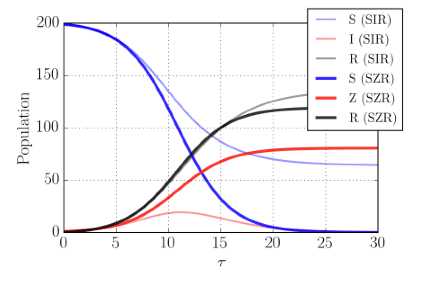
If you start with a small fraction of infected people Z0/S0 <<1, the equations above suggest that the outcome depends entirely on k/ß. If zombies are killed/ rounded up faster than they infect/bite, all is well. Otherwise, all is zombies. A situation like this is shown in the diagram below for a population of 200 and k/ß = .6

FIG. 1. Example dynamics for progress of a normal disease and a zombie apocalypse for an initial population of 199 unin- fected and 1 infected. The S, Z, and R populations are shown in (blue, red, black respectively, with solid lines for the zombie apocalypse, and lighter lines for the normal plague. t= tNß where N is the total popula- tion. For both models the k/ß = 0.6 to show similar evolutions. In the SZR case, the S population disap- pears, while the SIR is self limiting, and only a fraction of the population becomes infected.

Fig. 1, Dynamics of a normal plague (light lines) and a zombie apocalypse (dark) for 199 uninfected and 1 infected. The S and R populations are shown in blue and black respectively. Zombie and infected populations, Z and I , are shown in red; k/ß = 0.6 and τ = tNß. With zombies, the S population disappears. With normal infection, the infected die and some S survive.

Sorry to say, things get worse for higher initial ratios,  Z0/S0 >> 0. For these cases, you can kill zombies faster than they infect you, and the last susceptible person will still be infected before the last zombie is killed. To analyze this, we create a new parameter P = Z + (1 – k/ß)S and note that dP/dt = 0 for all S and Z; the path of possible outcomes will always be along a path of constant P. We already know that, for any zombies to survive, S = 0. We now use algebra to show that the final concentration of zombies will be Z = Z0 + (1-k/ß)S0. Free zombies survive so long as the following ratio is non zero: Z0/S0 + 1- k/ß. If Z0/S0 = 1, a situation that could arise if a small army of zombies breaks out of quarantine, you’ll need a high kill ratio, k/ß > 2 or the zombies take over. It’s seen to be harder to stop a zombie outbreak than to stop the original plague. This is a strong motivation to kill any infected people you’ve rounded up, a moral dilemma that appears some plague literature.

Figure 1, from the Cornell paper, gives a sense of the time necessary to reach the final state of S=0 or Z=0. For k/ß of .6, we see that it takes is a dimensionless time τ of 25 or to reach this final, steady state of all zombies. Here, τ= t Nß and N is the total population; it takes more real time to reach τ= 25 if N is high than if N is low. We find that the best course in a zombie invasion is to head for the country hoping to find a place where N is vanishingly low, or (better yet) where Z0 is zero. This was the main conclusion of the Cornell paper.

Figure 1 also shows the progress of a more normal disease, one where a significant fraction of the infected die on their own or develop a natural immunity and recover. As before, S is the density of the susceptible, R is the density of the removed + recovered, but here I is the density of those Infected by non-zombie disease. The time-scales are the same, but the outcome is different. As before, τ = 25 but now the infected are entirely killed off or isolated, I =0 though ß > k. Some non-infected, susceptible individuals survive as well.

From this observation, I now add a new conclusion, not from the Cornell paper. It seems clear that more immune people will be in the cities. I’ve also noted that τ = 25 will be reached faster in the cities, where N is large, than in the country where N is small. I conclude that, while you will be worse off in the city at the beginning of a plague, you’re likely better off there at the end. You may need to get through an intermediate zombie zone, and you will want to get the infected to bury their own, but my new insight is that you’ll want to return to the city at the end of the plague and look for the immune remnant. This is a typical zombie story-line; it should be the winning strategy if a plague strikes too. Good luck.

Robert Buxbaum, April 21, 2015. While everything I presented above was done with differential calculus, the original paper showed a more-complete, stochastic solution. I’ve noted before that difference calculus is better. Stochastic calculus shows that, if you start with only one or two zombies, there is still a chance to survive even if ß/k is high and there is no immunity. You’ve just got to kill all the zombies early on (gun ownership can help). Here’s my statistical way to look at this. James Sethna, lead author of the Cornell paper, was one of the brightest of my Princeton PhD chums.

Addendum following COVID. Watch out for your politicians here. They will champion the zombie cause, moving zombies into old age homes with non-zombies, they will ignore simple protections and force you to ride the subways with zombies to provide essential services while they go to empty ballparks to watch games, and they will deny the efficacy of drugs that don’t provide money to them and promote cures that benefit them

Winning the peace at Appomattox

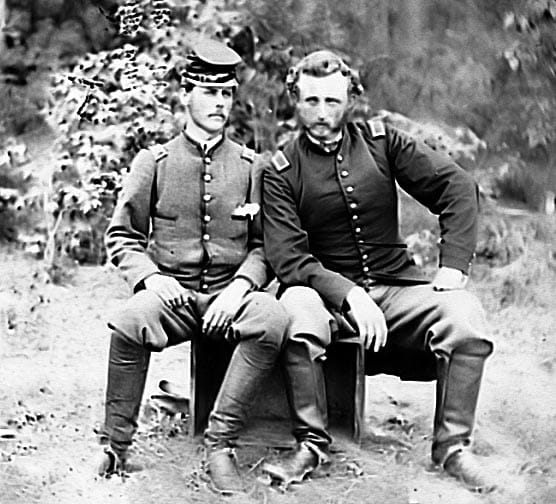
George A. Custer with captured confederate prisoner. Custer was a man of action but not of cruelty.

George A. Custer with a captured confederate prisoner. Custer was a man of action, but not of cruelty.

It is often forgotten that the aim of generalship is not winning a war, but winning a stable peace. In that sense, most generals and most diplomats are failures; their victories benefit only the undertaker; their peace-treaties only provide time to reload. That was the case with the Mexican civil war but not the US civil war. The choices and surrender at Appomattox, 150 years ago lead to a genuine, stable peace. It’s worthwhile, therefore to consider the how that was done here and not in Mexico, perhaps as a lesson for the future.

I begin, near the end of the war with a much-maligned general, George A Custer on April 8, 1865; this  is the day the 13th Amendment passed, four days after Lincoln walked through a defeated, smoldering Richmond, the capital of the south. The war would end soon, but would the result be peace, or chaos. George A. Custer had graduated at the very bottom of his class at West Point, the position known as goat. As is not atypical with goats, he was not particularly suited to following orders during peacetime, but was supremely suited to war and action. Custer liked to attack first and think later, but he was also a man of peace; he become the youngest Union Brevet General in US history. On April 8, with Lee at Appomattox Court House (that’s the name of the town), Custer led a small group of men to attack a nearby town, Appomattox Station, a rail depot three miles to the southwest. There he captured, without a fight, three, rail cars full of desperately needed arms, ammunition and supplies that had been sent to Lee’s army from Lynchburg.

While leaving the station, Custer’s men ran into the artillery unit of Confederate Brig. Gen. Reuben Walker, and attacked (of course) eventually capturing 25 artillery pieces, nearly 1,000 prisoners and all of their supplies. It took several attacks to win, but the results were worth it. Custer took the cannon and his troops, and positioned them on Lee’s likely escape route, on the Richmond-Lynchburg Stage Road south of Appomattox Courthouse. Lee was now nearly trapped, but didn’t know it yet.

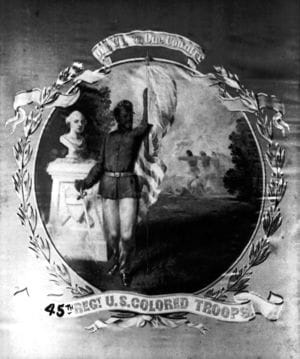
Paining in honor of the 45th regiment colored troops: Afro-American soldier stands with flag before a bust of Washington.

Painting in honor of the 45th regiment colored troops: Afro-American soldier stands, with flag, before a bust of Washington and a depiction of battle (Fair Oaks? Petersburg?)

On the same day, April 8, General Grant sent Lee a proposition to surrender. Lee responded that he was not interested in that, but would like to meet at the McLean House at 10:00 A.M. April 9 to discuss “restoration of peace.” Grant replied that he didn’t have that power but agreed to meet Lee, none the less.

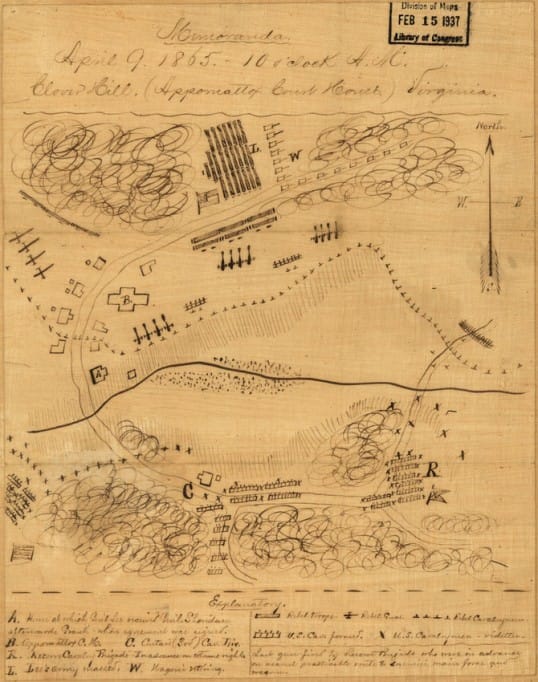
In the meantime, Lee prepared his forces to clear the Stage Road so his forces could escape south-west, to Appomattox station and home. Grant, no newcomer to war, ordered two corps (XXIV and V) under the commands of Maj. Gen. John Gibbon and Bvt. Maj. Gen. Charles Griffin to march all night to the west and north. These corps included 5000 Afro-American troops, mostly in the 45th and 116th U.S. Colored Troop Brigades. On the morning of April 9, Lee attacked to the south and managed to capture the forward pickets defending the Richmond-Lynchburg Stage Road. But when he reached the rise of the hill, he saw his escape was blocked. His 45,000 troops were surrounded by 113,000, better-armed Union soldiers, cannon and cavalry. It was then suggested that Lee disband his troops for an extended guerrilla war, an option he refused as it would lead to murdering bands roaming the county, and would make peace nearly impossible. Instead Lee rode off to discuss surrender to Grant. 

Map of the troop arrangements April 9, 1865. Checkmate. Lee's forces, x or + are out numbered, out gunned and surrounded. The end.

Map of the troop arrangements April 9, 1865. Checkmate. Lee’s forces, x or +, are out numbered, out gunned, and surrounded.

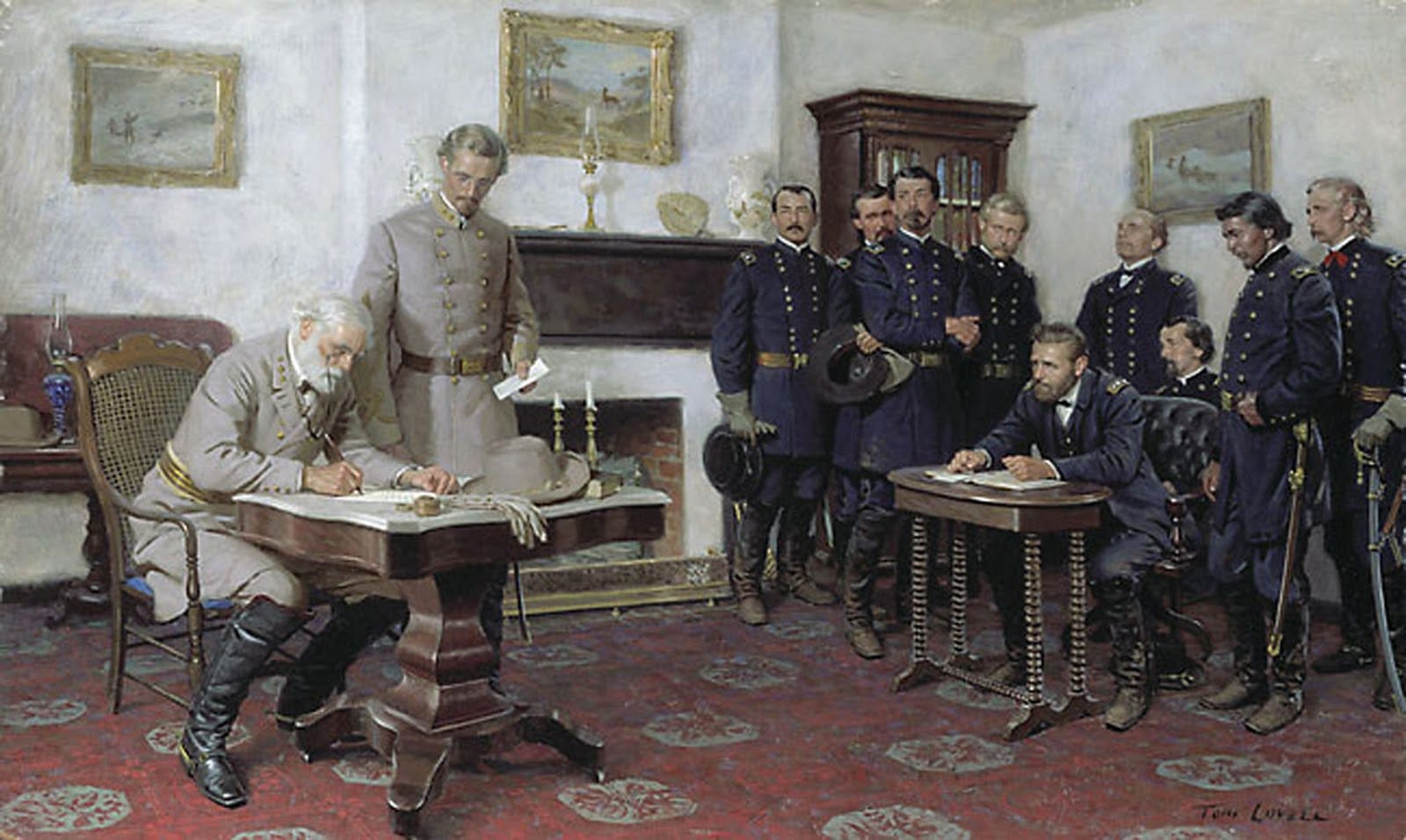
Lee’s surrender, finalized that afternoon, was penned by Grant’s aide-de camp, Lt Col’, Ely S. Parker, a Seneca Indian who had an engineering degree and studied law. The kindness to Indians may have suggested similar kindness to the surrendering Confederates. Parker eventually rose to the rank of general, and then to head of the Bureau of Indian Affairs. The terms of surrender too, were chosen to be unusually generous. Grant did not take the confederates soldiers captive, but instead allowed them to return home, relatively unmolested. Also, he allowed the officers to keep their swords and personal weapons. Kind acts like these may have eased reconstruction. Custer had demanded unconditional surrender from General Beauregard on April 9, something he probably imagined U.S. (Unconditional Surrender) Grant would have wanted; he was over-ruled by his commanding officer, Phillip Sheridan, who probably knew Grant better. 

After the war, most of the confederates swore loyalty to the US. Lee did what he could to promote reconciliation; he supported civil rights and reconstruction, and became president of Washington and Lee College. Some confederate generals and 2500 soldiers headed south to Mexico to join the French/Austrian forces of Emperor, Maximilian I, engaged in a civil war of his own. Maximilian, only 34 years old and a highly decorated Austrian officer, had little local support. He was captured and executed, June 19, 1867. Mexico then descended into chaos: a Pyrrhic victory, and a model to avoid.

Surrender at Appomattox; with Grant are Philip H. Sheridan, Orville E. Babcock, Horace Potter, Edward O.C. Ord, Seth Williams, Theodore S. Bowers, Ely S. Parker and George A. Custer. With Lee is Charles Marshall, his military secretary.

Surrender at Appomattox; with Grant are Philip H. Sheridan, Orville E. Babcock, Horace Potter, Edward O.C. Ord, Seth Williams, Theodore S. Bowers, Ely S. Parker and George A. Custer. With Lee is Charles Marshall, his military secretary. After the signing, most of the furnishings were purchased by Union officers as souvenirs. Lee shook Parker’s hand and said, I’m glad to see a real American here.” Parker replied, “We are all Americans.”

What did Mexico do wrong? For one, in order to win a peace, they failed to get the other side to agree to the peace, with clear documentation about what it is that’s been agreed to (That’s why Parker’s role is so important). Instead of killing Maximilian, they should have had him sign some sort of document and retire him to a farm or college where he could support the peace. In order to win a peace, it’s important to leave a stable country, with stable borders and a strong military, one that can govern itself fairly and well. A stable peace generally involves recognition of your government by other nations, and that too requires not killing your defeated enemy wholesale.

Robert E. Buxbaum, April 7-12, 2015. My sense is that the conditions for building a lasting peace get far too little attention in the study of war and history. I should mention that the 45th were mostly escaped slave volunteers. The 116th were ex-slaves that the Union purchased from Kentucky slave-owners at the beginning of the war to fight for the Union cause. This was thought to be a good emollient for peace, and may have helped keep Kentucky on the Union side. I should note too, that Lee freed his slaves in 1862, near the beginning of the war, a time when Grant still owned some. I’ve noted that men who choose beards tend to show a surprising republican (or communist) generosity. As Lincoln said, “Do I not defeat my enemy when I make him a friend?” For more thoughts on Lincoln’s Gettysburg Address, see here.

For All Fools Day, April 1, 2015

On this April Fools day I’m reminded of:

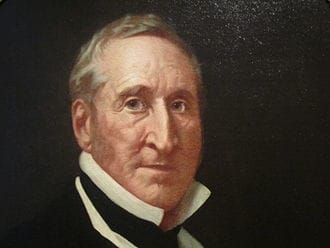
Democratic Senator Thomas Hart Benton, of Missouri. Before being elected to the US senate, he had been the lawyer for another Democrat, Andrew Jackson (before he was president). Like most prominent Americans of their day both men liked to settle arguments through by use of gunnery at close range. After Andrew Jackson participated in a duel with Benton’s brother, Benton himself challenged Jackson to a duel (I try to avoid this with my lawyers).

Seantor Thomas Hart Benton

Senator Thomas Hart Benton; his feud with A. Jackson, ended by common hatred of the Federal Reserve Bank

When asked about it later, Benton said, “Yes, sir, I knew him, sir; General Jackson was a very great man, sir. I shot him, sir. Afterward he was of great use to me, sir, in my battle with the United States Bank.” Ain’t that America. You can be shooting enemies one day, best of buddies the next.

In world politics and life this doesn’t happen as regularly as perhaps it should, but it happens. A few years after WWII we were allies with Germany and Italy, but enemies with the USSR. After WWI we were allies with Japan, until we weren’t; now we are again. Some day ISIS and Iran will be friends (won’t Mr A Bomb be sad).

I should also mention, and recommend the most amusing work of philosophy you are ever likely to encounter: St Erasmus of Rotterdam’s panegyric, “In Praise of Folly”. The thesis, if I may summarize: that most people like a fool and some folly; so does God. That most people don’t like long, boring lectures; neither does God. Etc. Good folly is likely to hurt you in a way you don’t mind (e.g. music, drinking, chasing women, reading long boring books if you like them); bad folly hurts others, e.g. when priest lives royally off of charity.

You might imagine that Erasmus would be executed for this but it seems he was not. It seems to me that Erasmus did something even more remarkable and made himself into a saint by claiming that God would not mind if people prayed to him for all good things. Apparently they started to, and got answered. A cheerful answer from a world of fools.

Robert E. Buxbaum, April 1, 2015.