Category Archives: Science: Physics, Astronomy, etc.

Virus and cancer treatment by your immune system

There are two standard treatments for a disease. One is through a chemical, pill or shot, often using a patented antibiotic or antiviral molecule, sometimes a radioactive chemical or anti-inflammatory. There have been quite a lot of success with these molecules especially against bacterial disease. E.g. penicillin, a molecule found in cheese, was quite effective against infection, syphilis, and even the viral disease, rabies. Still, in surprisingly many cases, a molecule that you’d expect should cure a disease does not. For this reason, recent research has looked into the other approach to a cure — use your own immune system.

In the most basic version of this approach, that of Paracelcius, is to give the patient nothing beyond sunshine, a clean dressing, and good food. In surprisingly many cases, this is enough to allow the patient’s own immune system will fight the disease successfully. Currently, this seems like our best option to fight COVID-19, the new Wuhan coronavirus.; antivirals seem to have no particular effect on COVID-19, as with rabies, but patients do get better on their own with time, and there is some indication that sunlight helps too, at least in fighting the disease spread, and perhaps in effecting a cure.

Your immune system is remarkably flexible. When it is up to the task, as in the video below white blood cells multiply enormously around the invader and attack. The white cells do not harm your body cells nor those of friendly bacteria, but rally to kill nearly any invader, even one the cells have never seen before. There is a minimum of side effects (fever, tiredness) but these go away after the invader is gone. The immune system then keeps the memory of the invader alive via “Memory T cells” so that it can attack more quickly if the same invader is seen again. This is what we call immunity, and it’s a type of protection that you generally don’t get from pills.

View post on imgur.com

Unfortunately, not every disease is fought well by the immune system alone. Measles, for example, or smallpox. For several of these diseases we’ve found we can activate the patient’s immune system with a vaccination, even after the patient contacts the disease. An injection of a weaker form of the disease seems to help kick-start the patients own immune system. Vaccination tends to have bad side-effects, but for many diseases, e.g. measles, the bad is outweighed by the good. Interestingly we’ve begun to use this approach on some cancers, too, and it seems to work. Immune therapy, it’s called.

Immune therapy is not generally the first line approach to cancer, but it might be the best for slow cancers, like prostate. Generally, in the fight against cancer, the preferred method is to removes as much of cancer cells as possible, and treat any missed cells using a mix of radiation and chemicals. This works but there are a lot of side-effects. Immune therapy is sort of similar, in a way. Instead of irradiating the bad cells inside the body, one takes the cancer cells outside of the body (or the virus molecules) and uses radiation and chemicals to knock off bits. These bits, a weakened form of the cancer or of the virus, are then cultured and re-injected into the body. Sometimes it works, sometimes not. For melanoma, skin cancer, immune therapy is found to works about 1/4 of the time. Why not more? It seems that sometimes the immune system gets “exhausted” fighting a foe that’s to much for it. And sometimes the activated immune system starts attacking the host body. This is an auto-immune response.

Dr. Robert E. Buxbaum, February 21, 2020

The main route of lead poisoning is from the soil by way of food, dust, and smoke.

While several towns have had problems with lead in their water, the main route for lead entering the bloodstream seems to be from the soil. The lead content in the water can be controlled by chemical means that I reviewed recently. Lead in the soil can not be controlled. The average concentration of lead in US water is less than 1 ppb, with 15 ppb as the legal limit. According to the US geological survey, of lead in the soil, 2014., the average concentration of lead in US soil is about 20 ppm. That’s more than 1000 times the legal limit for drinking water, and more than 20,000 times the typical water concentration. Lead is associated with a variety of health problems, including development problems in children, and 20 ppm is certainly a dangerous level. Here are the symtoms of lead poisoning.

Several areas have deadly concentrations of lead and other heavy metals. Central Colorado, Kansas, Washington, and Nevada is particularly indicated. These areas are associated with mining towns with names like Leadville, Telluride, Silverton, Radium, or Galena. If you live in an areas of high lead, you should probably not grow a vegetable garden, nor by produce at the local farmer’s market. Even outside of these towns, it’s a good idea to wash your vegetables to avoid eating the dirt attached. There are hardly any areas of the US where the dust contains less than 1000 times the lead level allowed for water.

Lead content of US soils, from the US geological survey of soils, 2014. Michigan doesn’t look half bad.

Breathing the dust near high-lead towns is a problem too. The soil near Telluride Colorado contains 1010 mg/kg lead, or 0.1%. On a dust-blown day in the area, you could breath several grams of the dust, each containing 1 mg of lead. That’s far more lead than you’d get from 1000 kg of water (1000 liters). Tests of blood lead levels, show they rise significantly in the summer, and drop in the winter. The likely cause is dust: There is more dust in the summer.

Recalled brand of curry powder associated with recent poisoning.

Produce is another route for lead entering the bloodstream. Michigan produce is relatively safe, as the soil contains only about 15 ppm, and levels in produce are generally far smaller than in the soil. Ohio soils contains about three times as much lead, and I’d expect the produce to similarly contain 3 times more lead. That should still be safe if you wash your food before eating. When buying from high-lead states, like Colorado and Washington, you might want to avoid produce that concentrates heavy metals. According Michigan State University’s outreach program, those are leafy and root vegetables including mustard, carrots, radishes, potatoes, lettuce, spices, and collard. Fruits do not concentrate metals, and you should be able to buy them anywhere. (I’d still avoid Leadville, Telluride, Radium, etc.). Spices tend to be particularly bad routes for heavy metal poisoning. Spices imported from India and Soviet Georgia have been observed to have as much as 1-2% lead and heavy metal content; saffron, curry and fenugreek among the worst. A recent outbreak of lead poisoning in Oakland county, MI in 2018 was associated with the brand of curry powder shown at left. It was imported from India.

Marijuana tends to be grown in metal polluted soil because it tolerates soil that is too polluted fro most other produce. The marijuana plant concentrates the lead into the leaves and buds, and smoking sends it to the lungs. While tobacco smoking is bad, tobacco leaves are washed and the tobacco products are regulated and tested for lead and other heavy metals. If you choose to smoke cigarettes, I’d suggest you chose brands that are low in lead. Here is an article comparing the lead levels of various brands. . Better yet, I’s suggest that you vape. There are several advantages of vaping relative to smoking the leaf directly. One of them is that the lead is removed in the process of making concentrate.

Some states test the lead content of marijuana; Michigans and Colorado do not, and even in products that are tested, there have been scandals that the labs under-report metal levels to help keep tainted products on the shelves. There is also a sense that the high cost encourages importers to add lead dust deliberately to increase the apparent density. I would encourage the customer to buy vape or tested products, only.

Here is a little song, “pollution” from Tom Lehrer, to lighten the mood.

Robert Buxbaum, November 24, 2019. I ran for water commissioner in 2016 and lost. I may run again in 2020. Who knows, this time I may win.

The chemistry of lead in drinking water

Our county, like many in the US and Canada, is served by thousands of miles of lead pipes. Some of these are the property of the government, others sit beneath our homes and are the property of the home-owner. These pipes are usually safe, but sometimes poison us. There is also problem of lead-tin solder. It was used universally to connect iron and copper pipes until it was outlawed in 1986. After years of sitting quietly, this lead caused a poisoning crisis in DC in 2004, and in Flint in 2015-16. Last month my town, Oak Park, registered dangerous lead levels in the drinking water. In an attempt to help, please find the following summary of the relevant lead chemistry. Maybe people in my town, or in other towns, will find some clue here to what’s going on, and what they can do to fix it.

lead pipes showing the three oxides: brown, yellow, and red, PbO2, PbO, and Pb2O3.

Left to itself, lead and solder pipe could be safe; lead is not soluble in clean water. But, if the water becomes corrosive, as happens every now and again, the lead becomes oxidized to one of several compounds that are soluble. These oxides are the main route of poisoning; they can present serious health issues including slow development, joint and muscle pain, memory issues, vomiting, and death. The legal limit for lead content in US drinking water is 15 ppb, a level that is far below that associated with any of the above. The solubility of PbO, lead II oxide, is more than 1000 times this limit 0.017 g/L, or 17,000 ppb. At this concentration serious health issues will show up.

PbO is the yellow lead oxide shown in the center of the figure above, right; the other pipes show other oxides, that are less-soluble, and thus less dangerous. Yellow lead oxide and red lead oxides on the right were used as paint colors until well into the 20th century. Red lead oxide is fairly neutral, but yellow PbO is a base; its solubility is strongly dependent on the PH of the water. In neutral water, its solution can be described by the following reaction.

PbO + H2O(l) –> Pb2+(aq) + 2 OH(aq).

In high pH water (basic water), there are many OH(aq) ions, and the solubility is lower. In low pH, acidic water the solubility is even higher. For every 1 point of lower pH the lowubility increases by a factor of 10, for every 1 point of higher pH, it decreases by a factor of ten. In most of our county, the water is slightly basic, about pH 8. It also helps that our water contains carbonate. Yellow lead forms basic lead carbonate, 2PbCO3·Pb(OH)2, the white lead that was used in paint and cosmetics. Its solubliity is lower than that of PbO, 110 ppb, in pure water, or within legal limit in water of pH 8. If you eat white lead, though, it reacts with stomach acid, pH 2, and becomes quite soluble and deadly. Remember, each number here is a factor of ten.

A main reason lead levels a very low today are essentially zero, even in homes with lead solder or pipe, involves involves the interaction with hypochlorite. Most water systems add hypochlorite to kill bacteria (germs) in the water. A side benefit is significant removal of lead ion, Pb2+(aq).

Pb2+(aq) + 2 ClO(aq) –> Pb(ClO)2(s). 

Any dissolved lead reacts with some hypochlorite ion reacts to form insoluble lead hypochlorite. Lead hypochlorite can slowly convert to Lead IV oxide — the brown pyrophilic form of lead shown on the left pipe in the figure above. This oxide is insoluble. Alkaline waters favor this reaction, decreasing solubility, but unlike with PbO, highly alkaline waters provide no significant advantage.

PbClO+(aq) + H2O(l) –> PbO2(s) + 2 H+(aq) + Cl(aq)

Lead IV oxide, PbO2 was used in old-fashioned matches; it reacts violently with phosphorus or sulfur. People were sometimes poisoned by sucking on these matches. In the stomach, or the presence of acidic drinking water, PbO2 is decomposed forming soluble PbO:

PbO2(s) +2 H+(aq) + 2 e –> PbO(s) + H2O(l).

You may wonder at the presence of the two electrons in the reaction above. A common source in water systems is the oxidation of sulphite:

SO3-2(aq)–> SO4-2(aq) + 2 e.

The presence of sulphite in the water means that hypochlorite is removed.

ClO(aq) + 2 H+(aq) + 2 e —> Cl(aq) + H2O(l).

Removal of hypochlorite can present a serious danger, in part because the PbO2(s) slowly reverts to PbO and becomes soluble, but mostly because bacteria start multiplying. In the Flint crisis of 2016, and in a previous crisis in Washington DC, the main problem, in my opinion was a lack of hypochlorite addition. The lead crisis was preceded by an uptick in legionnaires disease; It killed 12 people in Flint in 2014 and 2015, and 87 were sickened, all before the lead crisis. Eventually, it was the rise of legionaries disease that alerted water officials in Virginia that there was something seriously wrong in Flint. Most folks were unaware because Flint water inspectors seem to have been fudging the lead numbers to make things look better.

Most US systems add phosphate to remove lead from the water. Flint water folks could have stopped the lead crisis, but not the legionnaires, by adding more phosphate. Lead phosphate solubility is 14 ppb at 20°C, and my suspicion is that this is the reason that the legal limit in the US is 15 ppb. Regulators chose 15 ppb, I suspect, not for health reasons, but because the target could be met easily through the addition of phosphate. Some water systems in the US and Canada disinfect with chloramine, not hypochlorite, and these systems rely entirely on phosphate to keep lead levels down. Excess phosphate is used in Canada to lower lead levels below 10 ppb. It works better on systems with hypochlorite.

Chloramine is formed by reacting hypochlorite with ammonia. It may be safer than hypochlorite in terms of chlorite reaction products, a real problem when the water source is polluted. But chloramine is not safe. It sickened 72 soldiers, 36 male and 36 female in 1998. They’d used ammonia and bleach for a “cleaning party” on successive days. Here’s a report and first aid instructions for the poisoning. That switching to chloramine can expose people to lead is called “the chloramine catch”.

Unlike PbO, PbO2 is a weak acid. PbO2 and PbO can react to form red lead, PbO•PbO2(s), the red stuff on the pipe at right in the picture above. Red lead can react with rust to form iron plumbable, an insoluble corrosion resister. A simple version is:

PbO•PbO2(s) + Fe2O3(s) —> 2FePbO3(s).

This reaction is the basis of red-lead, anti-rust compounds. Iron plumbable is considered to be completely insoluble in water, but like PbO it is soluble in acid. Bottom line, slightly basic water is good, as are hypochlorite in moderation, and phosphate.

Robert Buxbaum, November 18, 2019. I ran for water commissioner, and might run again. Even without being water commissioner, I’ll be happy to lend my expertise, for free, to any Michigan town or county that is not too far from my home.

Ladder on table, safe till it’s not.

via GIFER

Two years ago I wrote about how to climb a ladder safely without fear. This fellow has no fear and has done the opposite. This fellow has chosen to put a ladder on a table to reach higher than he could otherwise. That table is on another table. At first things are going pretty well, but somewhere about ten steps up the ladder there is disaster. A ladder that held steadily, slips to the edge of the table, and then the table tips over. It’s just physics: the higher he climbs on the ladder the more the horizontal force. Eventually, the force is enough to move the table. He could have got up safely if he moved the tables closer to the wall or if he moved the ladder bottom further to the right on the top table. Either activity would have decreased the slip force, and thus the tendency for the table to tip.

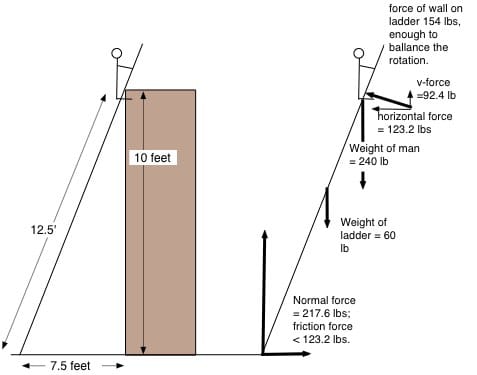
Perhaps the following analysis will help. Lets assume that the ladder is 12.5′ long and sits against a ten foot ledge, with a base 7.5′ away from the wall. Now lets consider the torque and force balance at the bottom of the ladder. Torque is measured in foot-pounds, that is by the rotational product of force and distance. As the fellow climbs the ladder, his weight moves further to the right. This would increase the tendency for the ladder to rotate, but any rotation tendency is matched by force from the ledge. The force of the ledge gets higher the further up the ladder he goes. Let’s assume the ladder weighs 60 lbs and the fellow weighs 240 pounds. When the fellow has gone up ten feet up, he has moved over to the right by 7.5 feet, as the diagram shows. The weight of the man and the ladder produces a rotation torque on the bottom of 60 x 3.75 + 240 x 7.5 = 1925 foot pounds. This torque is combatted by a force of 1926 foot pounds provided by the ledge. Since the ladder is 12.5 feet long the force of the ledge is 1925/12.5 = 154 pounds, normal to the ladder. The effect of this 154 lbs of normal force is to push the ladder to the left by 123.2 lbs and to lift the ladder by 92.4lbs. It is this 123.2 pounds of sideways push force that will cause the ladder to slip.

The slip resistance at the bottom of the ladder equals the net weight times a coefficient of friction. The net weight here equals 60+240-92.4 = 217.6 lbs. Now lets assume that the coefficient of friction is 0.5. We’d find that the maximum friction force, the force available to stop a slip is 217.6 x 0.5 = 108.8 lbs. This is not equal to the horizontal push to prevent rotation, 123.2 lbs. The net result, depending on how you loot at things, is either that the ladder rotates to the right, or that the ladder slips to the left. It keeps slipping till, somewhere near the end of the table, the table tips over.

Force balance of man on ladder. Based on this, I will go through the slippage math in gruesome detail.

I occasionally do this sort of detailed physics; you might as well understand what you see in enough detail to be able to calculate what will happen. One take home from here is that it pays to have a ladder with rubber feet (my ladders do). That adds to the coefficient of friction at the bottom.

Robert Buxbaum, November 6, 2019.

Water Towers, usually a good thing.

Most towns have at least one water tower. Oakland county, Michigan has four. When they are sized right, they serve several valuable purposes. They provide water in case of a power failure; they provide increased pressure in the morning when people use a lot of water showering etc.; and they allow a town to use smaller pumps and to pump with cheaper electricity, e.g. at night. If a town has no tower, all these benefits are gone, but a town can still have water. It’s also possible to have a situation that’s worse than nothing. My plan is to show, at the end of this essay, one of the ways that can happen. It involves thermodynamic properties of state i a situation where there is no expansion headspace or excess drain (most towers have both).

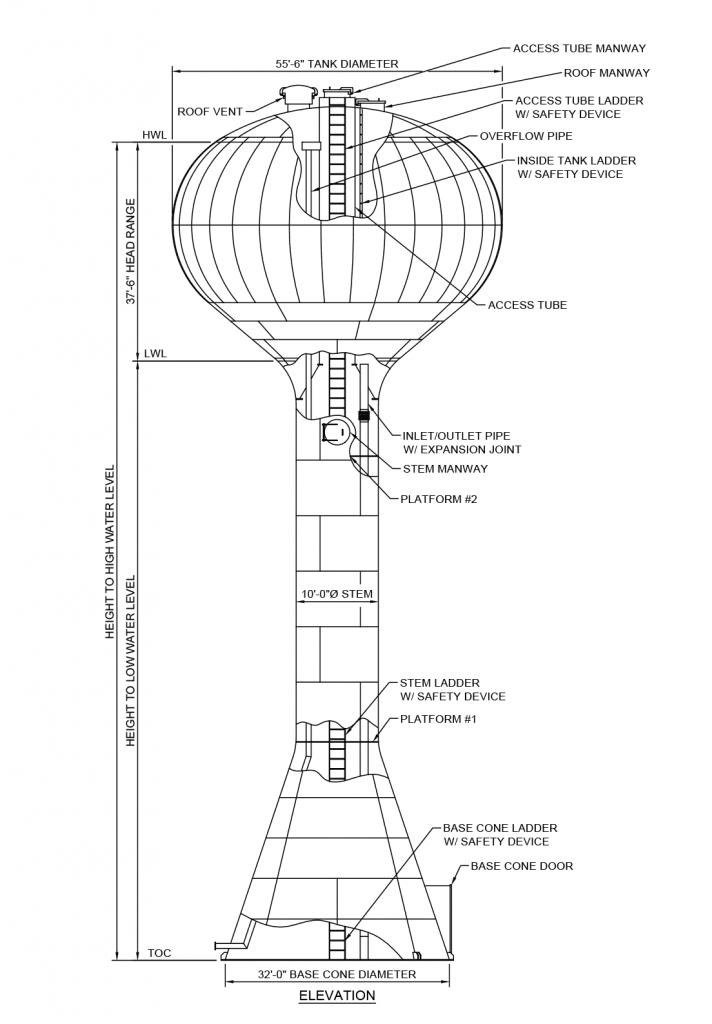
A typical water tower — spheroidal design. A tower of the dimensions shown would contain about 1/2 million gallons of water.

The typical tower stands at the highest point in the town, with the water level about 170 feet above street level. It’s usable volume should be about as much water as the town uses in a typical day. The reason for the height has to do with the operating pressure of most city-level water pipes. It’s about 75 psi and each foot of water “head” gives you about 0.43 psi. You want pressures about 75 psi for fire fighting, and to provide for folks in apartment buildings. If you have significantly higher pressures, you pay a cost in electricity, and you start losing a lot of water to leaks. These leaks should be avoided. They can undermine the roads and swallow houses. Bob Dadow estimates that, for our water system the leakage rate is between 15 and 25%.

Oakland county has four water towers with considerably less volume than the 130 million gallons per day that the county uses. I estimate that the South-east Oakland county tower, located near my home, contains, perhaps 2 million gallons. The other three towers are similar in size. Because our county’s towers are so undersized, we pay a lot for water, and our water pressure is typically quite low in the mornings. We also have regular pressure excursions and that leads to regular water-boil emergencies. In some parts of Oakland county this happens fairly often.

There are other reasons why a system like ours should have water towers with something more like one days’ water. Having a large water reserve means you can benefit from the fact that electric prices are the lowest at night. With a days’ volume, you can avoid running the pumps during high priced, day times. Oakland county loses this advantage. The other advantage to having a large volume is that it gives you more time to correct problems, e.g. in case of an electric outage or a cyber attack. Perhaps Oakland thinks that only one pump can be attacked at one time or that the entire electric grid will not go out at one time, but these are clearly false assumptions. A big system also means you can have pumps powered by solar cells or other renewable power. Renewable power is a good thing for reliability and air pollution avoidance. Given the benefits, you’d expect Oakland county would reward towns that add water towers, but they don’t, as best I can tell.

Here’s one way that a water column can cause problems. You really need those pressure reliefs.

Now for an example of the sort of things that can go wrong in a water tower with no expansion relief. Every stand-pipe is a small water tower, and since water itself is incompressible, it’s easy to see that a small expansion in the system could produce a large pressure rise. The law requires that every apartment hose water system has to have expansion relief to limit these increases; The water tower above had two forms of reliefs, a roof vent, and an overflow pipe, both high up so that pressure could be maintained. But you can easily imagine a plumber making a mistake and installing a stand pipe without an expansion relief. I show a system like that at left, a 1000 foot tall water pipe, within a skyscraper, with a pump at the bottom, and pipes leading off at the sides to various faucets.

Lets assume that the pressure at the top is 20 psi, the pressure at the bottom will be about 450 psi. The difference in pressure (430 psi) equals the weight of the water divided by the area of the pipe. Now let’s imagine that a bubble of air at the bottom of the pipe detaches and rises to the top of the pipe when all of the faucets are closed. Since air is compressible, while water is not, the pressure at the bubble will remain the same as the bubble rises. By the time the bubble reaches the top of the pipe, the pressure there will rise to 450 psi. Since water has weight, 430 psi worth, the pressure at the bottom will rise to 880 psi = 450 + 430. This is enough to damage pump and may blow the pipes as well. A scenario like this likely destroyed the New Horizon oil platform to deadly consequences. You really want those pressure reliefs, and you want a competent plumber / designer for any water system, even a small one.

Robert Buxbaum, September 28- October 6, 2019. I ran for water commissioner is 2016.

Vitamin A and E, killer supplements; B, C, and D are meh.

It’s often assumed that vitamins and minerals are good for you, so good for you that people buy all sorts of supplements providing more than the normal does in hopes of curing disease. Extra doses are a mistake unless you really have a mis-balanced diet. I know of no material that is good in small does that is not toxic in large doses. This has been shown to be so for water, exercise, weight loss, and it’s true for vitamins, too. That’s why there is an RDA (a Recommended Daily Allowance). 

Lets begin with Vitamin A. That’s beta carotene and its relatives, a vitamin found in green and orange fruits and vegetables. In small doses it’s good. It prevents night blindness, and is an anti-oxidant. It was hoped that Vitamin A would turn out to cure cancer too. It didn’t. In fact, it seems to make cancer worse. A study was preformed with 1029 men and women chosen random from a pool that was considered high risk for cancer: smokers, former smokers, and people exposed to asbestos. They were given either15 mg of beta carotene and 25,000 IU of vitamin A (5 times the RDA) or a placebo. Those taking the placebo did better than those taking the vitamin A. The results were presented in the New England Journal of Medicine, read it here, with some key findings summarized in the graph below.

Comparison of cumulative mortality and cardiovascular disease between those receiving Vitamin A (5 times RDA) and those receiving a placebo. From Omenn et. al, Clearly, this much vitamin A does more harm than good.

The main causes of death were, as typical, cardiovascular disease and cancer. As the graph shows, the rates of death were higher among people getting the Vitamin A than among those getting nothing, the placebo. Why that is so is not totally clear, but I have a theory that I presented in a paper at Michigan state. The theory is that your body uses oxidation to fight cancer. The theory might be right, or wrong, but what is always noticed is that too much of a good thing is never a good thing. The excess deaths from vitamin A were so significant that the study had to be cancelled after 5 1/2 years. There was no responsible way to continue. 

Vitamin E is another popular vitamin, an anti-oxidant, proposed to cure cancer. As with the vitamin A study, a large number of people who were at high risk  were selected and given either a large dose  of vitamin or a placebo. In this case, 35,000 men over 50 years old were given either vitamin E (400 to 660 IU, about 20 times the RDA) and/or selenium or a placebo. Selenium was added to the test because, while it isn’t an antioxidant, it is associated with elevated levels of an anti-oxidant enzyme. The hope was that these supplements would prevent cancer and perhaps ward off Alzheimer’s too. The full results are presented here, and the key data is summarized in the figure below. As with vitamin A, it turns out that high doses of vitamin E did more harm than good. It dramatically increased the rate of cancer and promoted some other problems too, including diabetes.  This study had to be cut short, to only 7 years, because  of the health damage observed. The long term effects were tracked for another two years; the negative effects are seen to level out, but there is still significant excess mortality among the vitamin takers. 

Cumulative incidence of prostate cancer with supplements of selenium and/or vitamin E compared to placebo.

Cumulative incidence of prostate cancer with supplements of selenium and/or vitamin E compared to placebo.

Selenium did not show any harmful or particularly beneficial effects in these tests, by the way, and it may have reduced the deadliness of the Vitamin A.. 

My theory, that the body fights cancer and other disease by oxidation, by rusting it away, would explain why too much antioxidant will kill you. It laves you defenseless against disease As for why selenium didn’t cause excess deaths, perhaps there are other mechanisms in play when the body sees excess selenium when already pumped with other anti oxidant. We studied antioxidant health foods (on rats) at Michigan State and found the same negative effects. The above studies are among the few done with humans. Meanwhile, as I’ve noted, small doses of radiation seem to do some good, as do small doses of chocolate, alcohol, and caffeine. The key words here are “small doses.” Alcoholics do die young. Exercise helps too, but only in moderation, and since bicycle helmets discourage bicycling, the net result of bicycle helmet laws may be to decrease life-span

What about vitamins B, C, and D? In normal doses, they’re OK, but as with vitamin A and E you start to see medical problems as soon as you start taking more– about  12 times the RDA. Large does of vitamin B are sometimes recommended by ‘health experts’ for headaches and sleeplessness. Instead they are known to produce skin problems, headaches and memory problems; fatigue, numbness, bowel problems, sensitivity to light, and in yet-larger doses, twitching nerves. That’s not as bad as cancer, but it’s enough that you might want to take something else for headaches and sleeplessness. Large does of Vitamin C and D are not known to provide any health benefits, but result in depression, stomach problems, bowel problems, frequent urination, and kidney stones. Vitamin C degrades to uric acid and oxalic acid, key components of kidney stones. Vitamin D produces kidney stones too, in this case by increasing calcium uptake and excretion. A recent report on vitamin D from the Mayo clinic is titled: Vitamin D, not as toxic as first thought. (see it here). The danger level is 12 times of the RDA, but many pills contain that much, or more. And some put the mega does in a form, like gummy vitamins” that is just asking to be abused by a child. The pills positively scream, “Take too many of me and be super healthy.”

It strikes me that the stomach, bowel, and skin problems that result from excess vitamins are just the problems that supplement sellers claim to cure: headaches, tiredness, problems of the nerves, stomach, and skin.  I’d suggest not taking vitamins in excess of the RDA — especially if you have skin, stomach or nerve problems. For stomach problems; try some peniiiain cheese. If you have a headache, try an aspirin or an advil. 

In case you should want to know what I do for myself, every other day or so, I take 1/2 of a multivitamin, a “One-A-Day Men’s Health Formula.” This 1/2 pill provides 35% of the RDA of Vitamin A, 37% of the RDA of Vitamin E, and 78% of the RDA of selenium, etc. I figure these are good amounts and that I’ll get the rest of my vitamins and minerals from food. I don’t take any other herbs, oils, or spices, either, but do take a baby aspirin daily for my heart. 

Robert Buxbaum, May 23, 2019. I was responsible for the statistics on several health studies while at MichiganState University (the test subjects were rats), and I did work on nerves, and on hydrogen in metals, and nuclear stuff.  I’ve written about statistics too, like here, talking about abnormal distributions. They’re common in health studies. If you don’t do this analysis, it will mess up the validity of your ANOVA tests. That said,  here’s how you do an anova test

The Japanese diet, a recipe for stomach cancer.

Japan has the highest life expectancy in the world, an average about 84.1 years, compared to 78.6 years for the US. That difference is used to suggest that the Japanese diet must be far healthier than the American. We should all drink green tea and eat such: rice with seaweed and raw or smoked fish. Let me begin by saying that correlation does not imply causation, and go further to say that, to the extent that correlation suggests causation, the Japanese diet seems worse. It seems to me that the quantity of food (and some other things) are responsible for Americans have a shorter life-span than Japanese, the quality our diet does not appear to be the problem. That is, Americans eat too much, but what we eat is actually healthier than what the Japanese eat.

Top 15 causes of death in Japan and the US in order of Japanese relevance.

Top 15 causes of death in Japan and the US in order of Japanese relevance.

Let’s look at top 15 causes of deaths in Japan and the US in order of significance for Japan (2016). The top cause of disease death is the same for Japan and the US: it’s heart disease. Per-capita, 14.5% of Japanese people die of this, and 20.9% of Americans. I suspect the reason that we have more heart disease is that we are more overweight, but the difference is not by that much currently. The Japanese are getting fatter. Similarly, we exceed the Japanese in lung cancer deaths (not by that much) a hold-over of smoking, and by liver disease (not by that much either), a holdover of drinking, I suspect.

Japan exceeds the US in Stroke death (emotional pressure?) and suicide (emotional pressure?) and influenza deaths (climate-related?). The emotional pressure is not something we’d want to emulate. The Japanese work long hours, and face enormous social pressure to look prosperous, even when they are not. There is a male-female imbalance in Japan that is a likely part of the emotional pressure. There is a similar imbalance in China, and a worse one in Qatar. I would expect to see social problems in both in the near future. So far, the Japanese deal with this by alcoholism, something that shows up as liver cancer and cirrhosis. I expect the same in China and Qatar, but have little direct data.

Returning to diet, Japan has more far more stomach cancer deaths than the US; it’s a margin of nine to one. It’s the number 5 killer in Japan, taking 5.08% of Japanese, but only 0.57% of Americans. I suspect the difference is the Japanese love of smoked and raw fish. Other diet-related diseases tell the same story. Japan has double our rate of Colon-rectal cancers, and higher rates of kidney disease, pancreatic cancer, and liver cancer. The conclusion that I draw is that green tea and sushi are not as healthy as you might think. The Japanese would do well to switch the Trump staples of burgers, pizza, fries, and diet coke.

The three horsemen of the US death-toll:  Automobiles, firearms, and poisoning (drugs). 2008 data.

The three horsemen of the US death-toll: Automobiles, firearms, and poisoning (drugs). 2008 data.

At this point you can ask why our lives are so much shorter than the Japanese, on average. The difference in smoking and weight-related diseases are significant but explain only part of the story. There is also guns. About 0.7% of Americans are killed by guns, compared to 0.07% of Japanese. Still, guns give Americans a not-unjustified sense of safety from worse crime. Then there is traffic death, 1.5% in the US vs 0.5% in Japan. But the biggest single reason that Americans live shorter lives  is drugs. Drugs kill about 1.5% of Americans, but mostly the young and middle ages. They show up in US death statistics mostly as over-dose and unintentional poisoning (overdose deaths), but also contribute to many other problems like dementia in the old. Drugs and poisoning do not shown on the chart above, because the rate of both is insignificant in Japan, but it is the single main cause of US death in middle age Americans.

The king of the killer drugs are the opioids, a problem that was bad in the 60s, the days of Mother’s Little helper, but that have gotten dramatically worse in the last 20 years as the chart above shows. Often it is a doctor who gets us hooked on the opioids. The doctor may think it’s a favor to us to keep us from pain, but it’s also a favor to him since the drug companies give kickbacks. Often people manage to become un-hooked, but then some doctor comes by and re-hooks us up. Unlike LSD or cocaine, opioid drugs strike women and men equally. It is the single major reason we live 5 1/2 years shorter than the Japanese, with a life-span that is shrinking.

Drug overuse seems like the most serious health problem Americans face, and we seem intent on ignoring it. The other major causes of death are declining, but drug-death numbers keep rising. By 2007, more people died of drugs than guns, and nearly as many as from automobile accidents. It’s passed automobile accidents since then. A first suggestion here: do not elect any politician who has taken significant money from the drug companies. A second suggestion: avoid the Japanese diet.

Robert Buxbaum, April 28, 2019.

Let’s visit an earth-like planet: Trappist-1d

According to Star Trek, Vulcans and Humans meet for the first time on April 5, 2063, near the town of Bozeman, Montana. It seems that Vulcan is a relatively nearby, earth-like planet with strongly humanoid inhabitants. It’s worthwhile to speculate why they are humanoid (alternatively, how likely is it that they are), and also worthwhile to figure out which planets we’d like to visit assuming we’re the ones who do the visiting.

First things first: It’s always assumed that life evolved on earth from scratch, as it were, but it is reasonably plausible that life was seeded here by some space-traveling species. Perhaps they came, looked around and left behind (intentionally or not) some blue-green algae, or perhaps some more advanced cells, or an insect or two. A billion or so years later, we’ve evolved into something that is reasonably similar to the visiting life-form. Alternately, perhaps we’d like to do the exploring, and even perhaps the settling. The Israelis are in the process of showing that low-cost space travel is a thing. Where do we want to go this century?

As it happens we know there are thousands of stars with planets nearby, but only one that we know that has reasonably earth-like planets reasonably near. This one planet circling star is Trappist-1, or more properly Trappist 1A. We don’t know which of the seven planets that orbit Trappist-1A is most earth-like, but we do know that there are at least seven planets, that they are all roughly earth size, that several have earth-like temperatures, and that all of these have water. We know all of this because the planetary paths of this star are aligned so that seven planets cross the star as seen from earth. We know their distances from their orbital times, and we know the latter from the shadows made as the planets transit. The radiation spectrum tells us there is water.

Trappist 1A is smaller than the sun, and colder than the sun, and 1 billion years older. It’s what is known as an ultra-cool dwarf. I’d be an ultra cool dwarf too, but I’m too tall. We can estimate the mass of the star and can measure its brightness. We then can calculate the temperatures on the planets based their distance from the star, something we determine as follows:

The gravitational force of a star, mass M, on a planet of mass, m,  is MmG/r2, where G is the gravitational constant, and r is the distance from the star to the planet. Since force = mass times acceleration, and the acceleration of a circular orbit is v2/r, we can say that, for these orbits (they look circular),

MmG/r2 = mv2/r = mω2r.

Here, v is the velocity of the planet and ω is its rotational velocity, ω = v/r. Eliminating m, we find that

r3 = MG/ω2.

Since we know G and ω, and we can estimate M (it’s 0.006 solar masses, we think), we have a can make good estimates of the distances of all seven planets from their various rotation speeds around the star, ω. We find that all of these planets are much closer to their star than we are to ours, so the their years are only a few days or weeks long.

We know that three planets have a temperatures reasonably close to earths, and we know that these three also have water based on observation of the absorption of light from their atmosphere as they pass in front of their star. To tell the temperature, we use our knowledge of how bright the star is (0.0052 times Sol), and our knowledge of the distance. As best we can tell, the following three of the Trappist-1 planets should have liquid surface water: Trappist 1c, d and e, the 2nd, 3rd and 4th planets from the star. With three planets to choose from, we can be fairly sure that at least one will be inhabitable by man somewhere in the planet.

The seven orbital times are in small-number ratios, suggesting that the orbits are linked into a so-called Laplace resonance-chain. For every two orbits of the outermost planet, the next one in completes three orbits, the next one completes four, followed by 6, 9 ,15, and 24. The simple whole number relationships between the periods are similar to the ratios between musical notes that produce pleasant and harmonic sounds as I discussed here. In the case of planets, resonant ratios keep the system stable. The most earth-like of the Trappist-1 planets is likely Trappist-1d, the third planet from the star. It’s iron-core, like earth, with water and a radius 1.043 times earth’s. It has an estimated average temperature of 19°C or 66°F. If there is oxygen, and if there is life there could well be, this planet will be very, very earth-like.

The temperature of the planet one in from this, Trappist-1c, is much warmer, we think on average, 62°C (143°F). Still, this is cool enough to have liquid water, and some plants live in volcanic pools on earth that are warmer than this. Besides this is an average, and we might the planet quite comfortable at the poles. The average temperature of the planet one out from this, Trappist-1e, is ice cold, -27°C (-17°F), an ice planet, it seems. Still, life can find a way. There is life on the poles of earth, and perhaps the plant was once warmer. Thus, any of these three might be the home to life, even humanoid life, or three-eyed, green men.

Visiting Trappist-1A won’t be easy, but it won’t be out-of hand impossible. The system is located about 39 light years away, which is far, but we already have a space ship heading out of the solar system, and we are developing better, and cheaper options all the time. The Israeli’s have a low cost, rocket heading to the moon. That is part of the minimal technology we’d want to visit a nearby star. You’d want to add enough rocket power to reach relativistic speeds. For a typical rocket this requires a fuel whose latent energy is on the order mc2. That turns out to be about 1 GeV/atomic mass. The only fuel that has such high power density is matter-antimatter annihilation, a propulsion system that might have time-reversal issues. A better option, I’d suggest is ion-propulsion with hydrogen atoms taken in during the journey, and ejected behind the rocket at 100 MeV energies by a cyclotron or bevatron. This system should work if the energy for the cyclotron comes from solar power. Perhaps this is the ion-drive of Star-Trek fame. To meet the Star-Trek’s made-up history, we’d have to meet up by April, 2063: forty-four years from now. If we leave today and reach near light speed by constant acceleration for a few of years, we could get there by then, but only as time is measured on the space-ship. At high speeds, time moves slower and space shrinks.

This planetary system is named Trappist-1 after the telescope used to discover it. It was the first system discovered by the 24 inch, 60 cm aperture, TRAnsiting Planets and PlanetesImals Small Telescope. This telescope is operated by The University of Liége, Belgium, and is located in Morocco. The reason most people have not heard of this work, I think, has to do with it being European science. Our news media does an awful job covering science, in my opinion, and a worse job covering Europe, or most anything outside the US. Finally, like the Israeli moon shot, this is a low-budget project, the work to date cost less than €2 million, or about US $2.3 million. Our media seems committed to the idea that only billions of dollars (or trillions) will do anything, and that the only people worth discussing are politicians. NASA’s budget today is about $6 billion, and its existence is barely mentioned.

The Trappist system appears to be about 1 billion years older than ours, by the way, so life there might be more advanced than ours, or it might have died out. And, for all we know, we’ll discover that the Trappist folks discover space travel, went on to colonize earth, and then died out. The star is located, just about exactly on the ecliptic, in the constellation Aquarius. This is an astrological sign associated with an expansion of human consciousness, and a revelation of truths. Let us hope that, in visiting Trappist, “peace will guide the planets and love will steer the stars”.

Robert Buxbaum, April 3, 2019. Science sources are: http://www.trappist.one. I was alerted to this star’s existence by an article in the Irish Times.

Why concrete cracks and why sealing is worthwhile

The oil tanker Palo Alto is one of several major ships made with concrete hulls.

The oil tanker Palo Alto is one of several major ships made with concrete hulls.

Modern concrete is a wonderful construction material. Major buildings are constructed of it, and major dams, and even some ships. But under the wrong circumstances, concrete has a surprising tendency to crack and fail. I thought I’d explain why that happens and what you can do about it. Concrete does not have to crack easily; ancient concrete didn’t and military or ship concrete doesn’t today. A lot of the fault lies in the use of cheap concrete — concrete with lots of filler — and with the cheap way that concrete is laid. First off, the major components of modern concrete are pretty uniform: sand and rock, Portland cement powder (made from cooked limestone, mostly), water, air, and sometimes ash. The cement component is what holds it all together — cements it together as it were — but it is not the majority of even the strongest concretes. The formula of cement has changed too, but the cement is not generally the problem. It doesn’t necessarily stick well to the rock or sand component of concrete (It sticks far better to itself) but it sticks well enough that spoliation, isn’t usually a problem by itself.

What causes problem is that the strength of concrete is strongly affected (decreased) by having lots of sand, aggregate and water. The concrete used in sidewalks is as cheap as possible, with lots of sand and aggregate. Highway and wall concrete has less sand and aggregate, and is stronger. Military and ship concrete has little sand, and is quite a lot stronger. The lowest grade, used in sidewalks, is M5, a term that refers to its compressive strength: 5 Mega Pascals. Pascals are European (Standard International) units of pressure and of strength. One Pascal is one Newton per square meter (Here’ a joke about Pascal units). In US (English) units, 5 MPa is 50 atm or 750 psi.

Ratios for concrete mixes of different strength.

Ratios for concrete mixes of different strength; the numbers I use are double these because these numbers don’t include water; that’s my “1”.

The ratio of dry ingredients in various concretes is shown at right. For M5, and including water, the ratio is 1 2 10 20. That is to say there is one part water, two parts cement, 10 parts sand, and 20 parts stone-aggregate (all these by weight). Added to this is 2-3% air, by volume, or nearly as much air as water. At least these are the target ratios; it sometimes happens that extra air and water are added to a concrete mix by greedy or rushed contractors. It’s sometimes done to save money, but more often because the job ran late. The more the mixer turns the more air gets added. If it turns too long there is extra air. It the job runs late, workers will have to add extra water too because the concrete starts hardening. I you see workers hosing down wet concrete as it comes from the truck, this is why. As you might expect, extra air and water decrease the strength of the product. M-10 and M-20 concrete have less sand, stone, and water as a proportion to cement. The result is 10 MPa or 20 MPa strength respectively.

A good on-site inspector is needed to keep the crew from adding too much water. Some water is needed for the polymerization (setting) of the concrete. The rest is excess, and when it evaporates, it leaves voids that are similar to the voids created by having air mix in. It is not uncommon to find 6% voids, in commercial concrete. This is to say that, after the water evaporates, the concrete contains about as much void as cement by volume. To get a sense of how much void space is in the normal concrete outside your house, go outside to a piece of old concrete (10 years old at least) on a hot, dry day, and pour out a cup of water. You will hear a hiss as the water absorbs, and you will see bubbles come out as the water goes in. It used to be common for cities to send inspectors to measuring the void content of the wet (and dry) concrete by a technique called “pycnometry” (that’s Greek for density measurement). I’ve not seen a local city do this in years, but don’t know why. An industrial pycnometer is shown below.

Pyncnometer used for concrete. I don't see these in use much any more.

Pycnometer used for concrete. I don’t see these in use much any more.

One of the main reason that concrete fails has to do with differential expansion, thermal stress, a concept I dealt with some years ago when figuring out how cold it had to be to freeze the balls off of a brass monkey. As an example of the temperature change to destroy M5, consider that the thermal expansion of cement is roughly 1 x 10-5/ °F or 1.8 x10-5/°C. This is to say that a 1 meter slab of cement that is heated or cooled by 100°F will expand or shrink by 10-3 m respectively; 100 x 1×10-5 = 10-3. This is a fairly large thermal expansion coefficient, as these things go. It would not cause stress-failure except that sand and rock have a smaller thermal expansion coefficients, about 0.6×10⁻⁵ — barely more than half the value for cement. Consider now what happens to concrete that s poured in the summer when it is 80°F out, and where the concrete heats up 100°F on setting (cement setting releases heat). Now lets come back in winter when it’s 0°F. This is a total of 100°F of temperature change. The differential expansion is 0.4 x 10⁻⁵/°F x 100°F =  4 x10⁻⁴ meter/meter = 4 x10⁻⁴ inch/inch.

The force created by this differential expansion is the elastic modulus of the cement times the relative change in expansion. The elastic modulus for typical cement is 20 GPa or, in English units, 3 million psi. This is to say that, if you had a column of cement (not concrete), one psi of force would compress it by 1/3,000,000. The differential expansion we calculated, cement vs sand and stone is 4×10⁻⁴ ; this much expansion times the elastic modulus, 3,000,000 = 1200 psi. Now look at the strength of the M-5 cement; it’s only 750 psi. When M-5 concrete is exposed to these conditions it will not survive. M-10 will fail on its own, from the temperature change, without any help needed from heavy traffic. You’d really like to see cities check the concrete, but I’ve seen little evidence that they do.

Water makes things worse, and not only because it creates voids when it evaporates. Water also messes up the polymerization reaction of the cement. Basic, fast setting cement is mostly Ca3SiO5

2Ca3SiO5 + 6 H2O –> 3Ca0SiO2•H2O +3Ca(OH)2•H2O.

The former of these, 3Ca0SiO2•H2O, forms something of a polymer. Monomer units of SiO4 are linked directly or by partially hydrated CaO linkages. Add too much water and the polymeric linkages are weakened or do not form at all. Over time the Ca(OH)2 can drain away or react with  CO2 in the air to form chalk.

concrete  strength versus-curing time. Slow curing of damp concrete helps; fast dry hurts. Carbonate formation adds little or no strength. Jehan Elsamni 2011.

Portland limestone cement strength versus curing time. Slow curing and damp helps; fast dry hurts. Carbonate formation adds little or no strength. Jehan Elsamni 2011.

Ca(OH)2 + CO2 → CaCO3 + H2O

Sorry to say, the chalk adds little or no strength, as the graph at right shows. Concrete made with too much water isn’t very strong at all, and it gets no stronger when dried in air. Hardening goes on for some weeks after pouring, and this is the reason you don’t drive on 1 too 2 day old concrete. Driving on weak concrete can cause cracks that would not form if you waited.

You might think to make better concrete by pouring concrete in the cold, but pouring in the cold makes things worse. Cold poured cement will expand the summer and the cement will detach from the sand and stone. Ideally, pouring should be in spring or fall, when the temperature is moderate, 40-60°F. Any crack that develops grows by a mechanism called Rayleigh crack growth, described here. Basically, once a crack starts, it concentrates the fracture forces, and any wiggling of the concrete makes the crack grow faster.

Based on the above, I’ve come to suspect that putting on a surface coat can (could) help strengthen old concrete, even long after it’s hardened. Mostly this would happen by filling in voids and cracks, but also by extending the polymer chains. I imagine it would be especially helpful to apply the surface coat somewhat watery on a dry day in the summer. In that case, I imagine that Ca3SiO5 and Ca(OH)2 from the surface coat will penetrate and fill the pores of the concrete below — the sales pores that hiss when you pour water on them. I imagine this would fill cracks and voids, and extend existing CaOSiO2•H2O chains. The coat should add strength, and should be attractive as well. At least that was my thought.

I should note that, while Portland cement is mostly Ca3SiO5, there is also a fair amount (25%) of Ca2SiO4. This component reacts with water to form the same calcium-silicate polymer as above, but does so at a slower rate using less water per gram. My hope was that this component would be the main one to diffuse into deep pores of the concrete, reacting there to strengthen the concrete long after surface drying had occurred.

Trump tower: 664', concrete and glass. What grade of concrete would you use?

Trump tower: 664′, concrete and glass. What grade of concrete would you use?

As it happened, I had a chance to test my ideas this summer and also about 3 years ago. The city inspector came by to say the concrete flags outside my house were rough, and thus needed replacing, and that I was to pay or do it myself. Not that I understand the need for smooth concrete, quite, but that’s our fair city. I applied for a building permit to apply a surface coat, and applied it watery. I used “Quickrete” brand concrete patch, and so far it’s sticking OK. Pock-holes in the old concrete have been filled in, and so far surface is smooth. We’ll have to see if my patch lasts 10-20 years like fresh cement. Otherwise, no matter how strong the concrete becomes underneath, the city will be upset, and I’ll have to fix it. I’ve noticed that there is already some crumbling at the sides of flags, something I attribute to the extra water. It’s not a problem yet, but hope this is not the beginning of something worse. If I’m wrong here, and the whole seal-coat flakes off, I’ll be stuck replacing the flags, or continuing to re-coat just to preserve my reputation. But that’s the cost of experimentation. I tried something new, and am blogging about it in the hope that you and I benefit. “Education is what you get when you don’t get what you want.” (It’s one of my wise sayings). At the worst, I’ll have spent 90 lb of patching cement to get an education. And, I’m happy to say that some of the relatively new concrete flags that the city put in are already cracked. I attribute this to: too much sand, air, water or air (they don’t look like they have much rock): Poor oversight.

Dr. Robert E. Buxbaum. March 5, 2019. As an aside, the 664 foot Trump Tower, NY is virtually the only skyscraper in the city to be built of concrete and glass. The others are mostly steel and glass. Concrete and glass is supposed to be stiffer and quieter. The engineer overseeing the project was Barbara Res, the first woman to oversee a major, NY building project. Thought question: if you built the Trump Tower, which quality of concrete would you use, and why.

Great waves, small circles, and the spread of ideas.

Simplified wave motion, GIf by Dan Russel (maybe? I think?).

The scientific method involves looking closely at things. Sometimes we look closely for a purpose — to make a better mouse-trap, say. But sometimes it’s just to understand what’s happening: to satisfy curiosity, to understand the way the world works, or to answer a child. Both motivations bring positive results, but there is a difference in how people honor the product of these motivations. Scientific knowledge developed for curiosity is considered better; it tends to become the model for social understanding, and for art and literature. Meanwhile, science developed for a purpose is considered suspect, and often that suspicion is valid. A surprising amount of our knowledge was developed for war: for the purpose of killing people, destroying things, and occupying lands.

Waves provide a wonderful example of science exploration that was developed mostly for curiosity, and so they have become models of social understanding and culture — far more so than the atom bomb and plague work discussed previously.

Waves appear magical: You poke a pond surface with a stick, and the influence of that poke travels, as if by magic, to all corners of the pond. Apparently the initial poke set off something, and that sets off something else, and we’ve come to use this as a model for cultural ideas. Any major change in music, art, or cultural thought is described as a wave (and not as a disease). The sense of wave is  that a small push occurs, and the impact travels across a continent and across an ocean. The Gifs above and below shows how this happens for the ordinary wave — the one with a peaked top. As shown, the bits of water do not move with the wave. Instead they just circulate in a small circle. The powerful waves that crosses an ocean are composed of many small circles of water rolling in the general direction of the wave. With ideas too, I think, one person can push a second, and that second a third, each acting in his or her own circle, and a powerful transmission of ideas results. Of course, for a big wave, you need a big circle, but maybe not in cases of reflection (reflected waves can add, sometimes very destructively).

simplified wave movement

In the figures I’ve shown, you will notice that the top of the circle always moves in the same direction as the top of the wave. If the wave moves to the right, the circle is clockwise. There are also Rayleigh waves. In these, the top of the wave is not peaked, but broad, with little indents between ripples. For Rayleigh wave the motion is not circular, but elliptical, and the top of the ellipse moves in the opposite direction to that of the wave. These waves go slower than the normal waves, but they are more destructive. Most of the damage of earthquakes is by the late-arriving Rayleigh waves.

If regular waves are related to fast-moving ideas, like rock n roll, Rayleigh waves might be related to slower-traveling, counter-intuitive ideas, paradigm shifts: Religions, chaos, entropyfeminism, or communism. Rayleigh waves are mostly seen in solids, and the destructive power of counter-intuitive ideas is mostly seen in rigid societies.

Then there are also pressure waves, like sound, and wiggle waves (transverse waves). Pressure waves travel the fastest, and work in both solids and liquids. Wiggle waves travel slower (and don’t travel in liquids). Both of these involve no circles at all, but just one bit of material pushing on its neighbor. I think the economy works this way: bouncing springs, for the most part. Life is made up of all of these, and life is good. The alternative to vibration, I should mention, is status. Status is a form of death. There is a certain sort of person who longs for nothing more than an unchanging, no-conflict world: one government and one leadership. Avoid such people.

Robert Buxbaum, February 10, 2019