Category Archives: Astronomy

Joke about antimatter and time travel

I’m sorry we don’t serve antimatter men here.

Antimatter man walks into a bar.

Is funny because … in quantum-physics there is no directionality in time. Thus an electron can change directions in time and then appears to the observer as a positron, an anti electron that has the same mass as a normal electron but the opposite charge and an opposite spin, etc. In physics, the reason electrons and positrons appear to annihilate is that it’s there was only one electron to begin with. That electron started going backwards in time so it disappeared in our forward-in-time time-frame.

The thing is, time is quite apparent on a macroscopic scales. It’s one of the most apparent aspects of macroscopic existence. Perhaps the clearest proof that time is flowing in one direction only is entropy. In normal life, you can drop a glass and watch it break whenever you like, but you can not drop shards and expect to get a complete glass. Similarly, you know you are moving forward in time if you can drop an ice cube into a hot cup of coffee and make it luke-warm. If you can reach into a cup of luke-warm coffee and extract an ice cube to make it hot, you’re moving backwards in time.

It’s also possible that gravity proves that time is moving forward. If an anti apple is just a normal apple that is moving backwards in time, then I should expect that, when I drop an anti-apple, I will find it floats upward. On the other hand, if mass is inherently a warpage of space-time, it should fall down. Perhaps when we understand gravity we will also understand how quantum physics meets the real world of entropy.

Why isn’t the sky green?

Yesterday I blogged with a simple version of why the sky was blue and not green. Now I’d like to add mathematics to the treatment. The simple version said that the sky was blue because the sun color was a spectrum centered on yellow. I said that molecules of air scattered mostly the short wavelength, high frequency light colors, indigo and blue. This made the sky blue. I said that, the rest of the sunlight was not scattered, so that the sun looked yellow. I then said that the only way for the sky to be green would be if the sun were cooler, orange say, then the sky would be green. The answer is sort-of true, but only in a hand-waving way; so here’s the better treatment.

Light scatters off of dispersed small particles in proportion to wavelength to the inverse 4th power of the wavelength. That is to say, we expect air molecules will scatter more short wavelength, cool colors (purple and indigo) than warm colors (red and orange) but a real analysis must use the actual spectrum of sunlight, the light power (mW/m2.nm) at each wavelength.

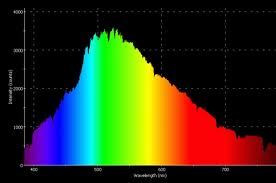
intensity of sunlight as a function of wavelength (frequency)

intensity of sunlight as a function of wavelength

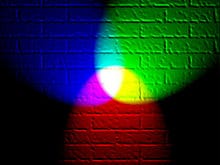
The first thing you’ll notice is that the light from our sun isn’t quite yellow, but is mostly green. Clearly plants understand this, otherwise chlorophyl would be yellow. There are fairly large components of blue and red too, but my first correction to the previous treatment is that the yellow color we see as the sun is a trick of the eye called additive color. Our eyes combine the green and red of the sun’s light, and sees it as yellow. There are some nice classroom experiment you can do to show this, the simplest being to make a Maxwell top with green and red sections, spin the top, and notice that you see the color as yellow.

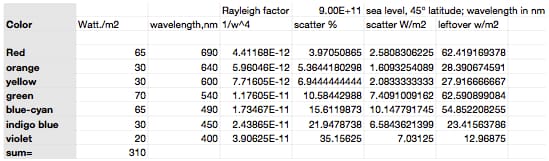
In order to add some math to the analysis of sky color, I show a table below where I divided the solar spectrum into the 7 representative colors with their effective power. There is some subjectivity to this, but I took red as the wavelengths from 620 to 750nm so I claim on the table was 680 nm. The average power of the red was 500 mW/m2nm, so I calculate the power as .5 W/m2nm x 130 nm = 65W/m2. Similarly, I took orange to be the 30W/m2 centered on 640nm, etc. This division is presented in the first 3 columns of the following table. The first line of the table is an approximate of the Rayleigh-scatter factor for our atmosphere, with scatter presented as the percent of the incident light. That is % scattered = 9E11/wavelength^4.skyblue scatter

To use the Rayleigh factor, I calculate the 1/wavelength of each color to the 4th power; this is shown in the 4th column. The scatter % is now calculated and I apply this percent to the light intensities to calculate the amount of each color that I’d expect in the scattered and un-scattered light (the last two columns). Based on this, I find that the predominant wavelength in the color of the sky should be blue-cyan with significant components of green, indigo, and violet. When viewed through a spectroscope, I find that these are the colors I see (I have a pocket spectroscope and used it an hour ago to check). Viewed through the same spectroscope (with eye protection), I expect the sun should look like a combination of green and red, something our eyes see as yellow (I have not done this personally). At any rate, it appears that the sky looks blue because our eyes see the green+ cyan+ indigo + purple in the scattered light as sky blue.220px-RGB_illumination

At sunrise and sunset when the sun is on the horizon the scatter percents will be higher, so that all of the sun’s colors will be scattered except red and orange. The sun looks orange then, as expected, but the sky should look blue-green, as that’s the combination of all the other colors of sunlight when orange and red are removed. I’ve not checked this last yet. I’ll have to take my spectroscope to a fine sunset and see what I see when I look at the sky.

Why isn’t the sky green and the sun orange?

Part of the reason the sky isn’t green has to do with the color of the sun. The sun’s color, and to a lesser extent, the sky color both are determined by the sun’s surface color, yellow. This surface color results from black body radiation: if you heat up a black object it will first glow red, then orange, yellow, green etc. Red is a relatively cool color because it’s a low frequency (long wavelength) and low frequencies are the lowest energy photons, and thus are the easiest for a black body to produce. As one increases the temperature of a black object, the total number of photons increases for all wavelengths, but the short wavelength (high frequency) colors increase faster than the of long wavelength colors. As a result, the object is seen to change color to orange, then yellow, or to any other color representative of objects at that particular temperature.

Our star is called a yellow sun because the center color of its radiation is yellow. The sun provides radiation in all colors and wavelengths, even colors invisible to the eye, infra red and ultra violet, but because of its temperature, most of the radiated energy appears as yellow. This being said, you may wonder why the sky isn’t yellow (the sky of Mars mostly is).

The reason the sky is blue, is that some small fraction of the light of the sun (about 10%) scatters off of the molecules of the air. This is called Rayleigh scatter — the scatter of large wavelegth waves off of small objects.  The math for this will be discussed in another post, but the most relevant aspect here is that the fraction that is scattered is proportional to the 4th power of the frequency. This is to say, that the high frequencies (blue, indigo, and violet) scatter a lot, about 20%, while the red hardly scatters at all. As a result the sky has a higher frequency color than the sun does. In our case, the sky looks blue, while the sun looks slightly redder from earth than it does from space — at least that’s the case for most of the day.

The sun looks orange-red at sundown because the sunlight has to go through more air. Because of this, a lot more of the yellow, green, and blue scatter away before we see it. Much more of the scatter goes off into space, with the result that the sky to looks dark, and somewhat more greenish at sundown. If the molecules were somewhat bigger, we’d still see a blue sky, maybe somewhat greener, with a lot more intensity. That’s the effect that carbon dioxide has — it causes more sunlight to scatter, making the sky brighter. If the sun were cooler (orange say), the sky would appear green. That’s because there would be less violet and blue in the sunlight, and the sky color would be shifted to the longer wavelengths. On planets where the sun is cooler than ours, the sky is likely green, but could be yellow or red.

Rayleigh scatter requires objects that are much smaller than the light wavelength. A typical molecule of air is about 1 nm in size (1E-9 of a meter), while the wavelength of yellow light is 580 nm. That’s much larger than the size of air molecules. Snow appears white because the size of the crystals are the size of the sun wavelengths, tor bigger, 500-2000 nm. Thus, the snow looks like all the colors of the sun together, and that’s white. White = the sum of all the colors: red + orange + blue + green + yellow + violet + indigo.

Robert Buxbaum  Jan. 27, 2013 (revised)

True (magnetic) north

Much of my wife’s family is Canadian, so I keep an uncommon interest in Canada — for an American. This is to say, I think about it once a month or so, more often during hockey season. So here is a semi-interesting factoid:

The magnetic north pole, the “true north” has been moving northwest for some time, but the rate has increased over the last few decades as the picture shows. It has now left the northern Canadian islands, so Canada is no longer “The true north, strong and free.” (It seems to be strong and free). True north  is now moving northwest, toward Siberia. true magnetic north heading to Russia

Why is the galaxy stable?

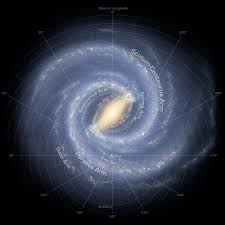
Our planet, Earth, is located in a spiral galaxy, with two arms. We’re about 30,000 light years out from the galactic center (1.8E17 miles), and based on red-shift data, our spot moves around the center at about 1,000,000,000 miles/year or 100,000 mph. This is a normal, average speed for other galaxies too. Our whole of the galaxy thus goes round every 200,000,000 years, maintaining its spiral shape as it does. Based on the age of the sun. We’ve gone around the center about 50 times so far. Based on this, there are a few obvious questions that were unknown when I was in grad school in 1976-81 and still unknown now. 

First question, why are we moving round so fast, and why are the other galaxies doing the same. Large rotation speeds should not naturally come out of random variation of the gas molecule speeds. And if it comes from different galaxies moving past one another, that just pushes the rotation source problem further out. Maxwell averaging of gas molecules should produce 2000 mph at most, given the temperatures in space. 

Another question, even more interesting: If the galaxy’s gone around about 50 times since it condensed, why are there still spiral arms? That’s an awful lot of turns for our galactic arms to retain stable; you’d expect that the outer parts of the arms would have rotated far fewer times, perhaps only once, while the inner parts would have rotated perhaps 1000 times. After a billion years, you’d expect the arms to be gone. The going explanation is that there is dark matter, matter we can’t see, but there should be a lot of dark matter, more than normal matter in fact. Where does it come from? Why don’t we see it?

After bugging astrophysicists for a few years, I’ve come to believe that many of their models (MACHOs, WIMPs) don’t make much sense. I’ve come to be able to model the distribution of dark matter on my own. Based on the stability of things, it seems clear that it is a particular distribution of light, non-interacting particles, with just the right mass to keep it as a non-rotating cloud. This is fine, as far as it goes, a version of the “WIMP theory” where WIMP stands for Weakly Interacting, Massive Particles. It turns out there is only a narrow range of size-mass for these WIMP particles that fits our rotation stability and does not mess up other galaxies. We want our galaxy rotating as a unit — can you figure out what the WIMP particle distribution is? If interested think, or ask: buxbaum@rebresearch.com

A spiral galaxy

A spiral galaxy, much like our own.

But this doesn’t mean that I now know what dark matter WIMPs are. I think I know where they are, but now we need to find the missing matter and understand it. It directly interacts with itself, but not with other matter except by gravity, and yet it came to be, so it should interact at some energy.  Also, how did it avoid becoming a spinning disc. All you need is gravity to get other things spinning in the galaxy, why not the dark matter? All the other matter ended up in a spinning disc, because of…. a galactic collision, but this stuff isn’t. The properties of this dark matter are very weird indeed. 

A current theory, and it barely justifies being called a theory, is that gravity diminishes at intra-galactic distances. That is, it works like Newton and Einstein say at planetary distances, and does so exactly to fine, fine detail. Then it works the same at inter-galactic distances, moving on galaxy relative to another using the exact same behavior, but somehow, within the galaxy, it becomes weaker. This would be a nonsense theory except that no-one has found the WIMPy particles, or massive MACHOs for that matter. 

As a challenge, see if you can calculate the distribution of dark matter that would result in our galaxy rotating as a unit. 

— Robert Buxbaum, Dec. 10, 2012. Perhaps an easier question, why doesn’t the heat of all the stars cook us?

The universe is not endless

You may have heard that the universe is not endless, ending at a brick wall, perhaps, some 15 billion light years out. But what you may not know is that this understanding is backed by a classic proof, going back to the middle ages. What follows is that proof.

Consider an endless universe with a fairly uniform distribution of stars. In any large-enough volume of this universe we expect to find many stars, e.g. in the spherical shell between 100 and 101 trillion miles from earth. At this distance, each of these stars is close enough to see individually; the combination of them (the sum in this volumetric shell) sheds a small amount of heat on the earth. Now consider another shell, the same thickness but twice as far from us, that is between 200 and 201 trillion miles from earth. If the universe is uniform, there will be 4 times as many stars in this shell, but since these stars are twice the distance from us, each star will present us with ¼ as much heat. Now, with 4 times the stars, the total effect is to radiate as much heat to us as from the first shell.

The same argument goes for each spherical shell of this 1 trillion miles thickness: each one presents us with the same amount of heat. If the universe is infinite and uniform, we find there will be an infinite number of shells radiating this amount of heat, and therefore an infinite amount of heat bathing us. We should expect to roast from all of it. Since we have not roasted, we conclude that the universe is not an endless, uniform expanse.

Based on this proof, the universe could be uniform, but only if it’s not endless. It could end with a brick wall, as in the Hitch-hikers guide. Alternately, the universe could have an end because it’s expanding from a big bang. This latter is suggested by the observed red shift showing that stars far from us move away faster in proportion to their distance. I’d expect this to be a favored answer of creationists because a point of creation suggests a creator. Creationists hate this finding, and dismiss the data too because the observed redshift suggests creation happened 15 Billion years ago. Atheists, needless to say, hate this “Big Bang” explanation.

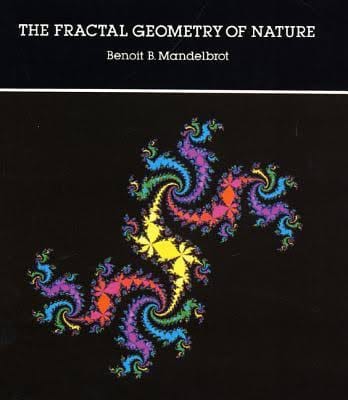
Book: Fractals in Nature by Mandelbrot

The mathematician Bernard B Mandelbrot noticed that much of nature has a distribution that scaled by fractional dimensional, like 2.5

Another thought, more acceptable to atheists, is that the universe is a closed, oscillating four dimensional hypersphere, where time is oscillating along with space. Einstein liked this view, but never fleshed it out, perhaps because there was no way for this expansion to bounce in, and periodically reverse time and entropy.

A fairly recent view that I like is that the universe could be fractal in distribution. (Mandelbrot). It isn’t clear how the universe got that way, or how it fits with the observed redshift, but it easily allows for a universe that isn’t endless nor possessing a clear limit, a last star as it were. It also provides a uniform/ non-uniform model of mass distribution. Besides, this matches much of nature. As it turns out to be fractal. Chaos of this sort is sort of God’s fingerprint.

For another unsolved cosmological question, consider why are there stable galactic arms, see here. Robert Buxbaum, October 22, 2012.