The Houtis, a Shia Islamic group, have been attacking ships in the Red Sea, hitting European ships, mostly carrying goods going between China and Europe. They use ballistic missiles plus cheap drones with great effect, targeted by an Iranian spotter ship in the Red Sea narrows, the Bab el Mandab. The US response is “Prosperity Guardian.” We’ve sent four missile destroyers. and the British one. These are arrayed along the entire coastline, too much coast for 5 ships to protect, and we try to shoot down drones and missiles. We manage to shoot down most of the missiles and and drones, but some always get through, and they mostly hit US and British targets. Recently the Maersk Detroit, a US flagged ship and 3 days ago, the British tanker, Marlin Luanda, shown below. It was carrying Russian naphtha headed for China. Some months ago, The Houtis kidnapped a British ship (Jewish owned) and took it to Yemen, as described previously.
British oil tanker, Marlin Luanda, on fire in the Gulf of Aden after being hit by an Iranian missile fired by Yemen’s Houthis. The tanker is hauling Russian naphtha, headed for China.
Iran supplies the missiles, and helps choose targets. According to Kissinger the aim of their attacks, and of the attacks on Israel, is to delegitimize Sunni Moslem countries like Egypt and Turkey that have made peace with Israel and the west. Whatever the motivation, Chinese and Russian ships are not targeted, but our ships are. We don’t attack the Iranian spotter for fear of starting a war. Instead we bomb Yemen, and protect ships carrying Chinese good and Russian oil. Currently 80% of the oil tanker transits of the Suez carry Russian oil (see below).
Most of the oil trade in the Suez is Russian — yellow line. Everyone else is shown in blue-black. It’s down to 0.5 ships per day, on average.
I don’t mind helping European countries get cheap Chinese goods, but I think the the main folks to pay should be the Europeans. We’re firing expensive anti-missiles and we’re showing the strengths and vulnerabilities to the Iranians, Chinese and Russians. Currently it’s our sailors who are at risk. The US trades with China too, but our China trade is not benefitted by ‘Prosperity guardian. Mostly our China trade avoids the Suez Canal, and comes around Africa to Savana or NY, or it comes across the Pacific, directly to Los Angeles. Our India trade most goes the same way. Some used to go through the Suez before the Houtis started attacking.
France and Japan have not joined prosperity guardian. Instead they have chosen to convoy their own flagged ships, even allowing the occasional stringer to tag along. Doing this, they use fewer ships, and it seems to work better than our approach. The picture at left shows a French courvair-escort escorting two French container ships. Note how much bigger the container ships are than the French warship. Should the Houtis’s missiles get too close to a French ship, I suspect that the French would retaliate hard. I think we should switch to following the French model and convoy-protect our shipping, plus whoever wants to tag along.
Map of Yemen and the Red Sea narrows.
Shipping, insurance rates have risen to about 1% of the cargo value. It’s now so expensive that no US cargo carrier will transit the area except when needed to supply our troops. At this point it’s worth asking, “Whose property are we guarding?” Also, is this really worth the lives of US sailors? If it is, why not hit the source of the problem — The Iranian spotter. The behavior of the French and Japanese makes sense to me. Biden’s behavior here does not.
Robert Buxbaum, February 6, 2024. Iran also funds and arms Hezbollah, a group that killed 3 US soldiers two months ago, and who killed several Kurdish allied troops in Syria just yesterday, and have shelled Israel intensely for months. IMHO, you want a few, well defended bases, not in harms way in Syria, but close enough to come back fast, in force.
Both Trump and Biden are unpopular. Academics and the press favor Biden, and find it inconceivable that anyone would like Trump but polls show him leading in the country as a whole, and leading in key swing states, Arizona, Georgia, Michigan, etc. Some 15.1% more Americans have an unfavorable view of Biden than a favorable view.
Biden’s problems include his age, the border crisis, and the economy. People say they find that essentials are expensive, while luxuries are cheap, and that Biden seems out of touch, perhaps that he favors the rich (the Democratic Party is increasingly the party of billionaires). Then there are religious objections, including to diversity, or gender-affirming child surgery, or abortion till birth and doctor-assisted suicide.
Trump leads in the polls, pointing to misuse of the Justice Department including Republican civil servants fired over phony mask mandates, the many illegal immigrants, the EV agenda, even Trump’s impeachment hearings that began as soon as he was elected, based on a made up “Russian collision” dossier. There’s a claim from Twitter, that the Biden’s DOJ demanded Twitter favor Biden, and then demanded that Trump be “deplatformed”, completely silenced before the election.
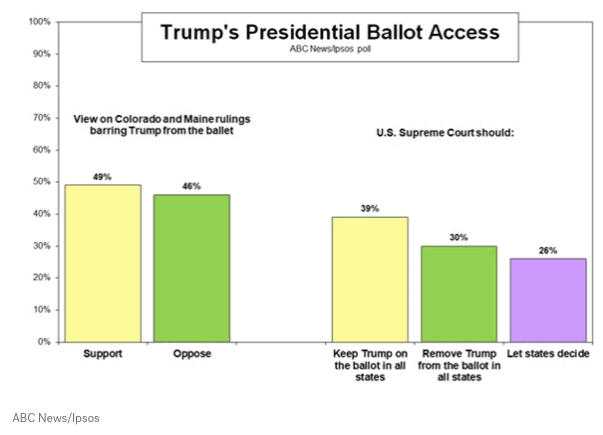
The Democrats fire back that Trump is ineligible to be president as he is a seditionist — citing an anti-confederate clause of the 14th amendment. They have so far, removed him from the ballot in two battleground states, Colorado and Maine, and are looking at removing him from the ballot in several others. These moves are surprisingly popular, supported by 49% of voters, despite the fact that Trump leads in the polls.
In New York, the district attorney ran on the platform that he would “get Trump,” that is put him in prison for something, and thus stop his presidential bid. NY has already pulled Trump’s business license and has indicted Trump on 48 felony counts based on the assertion that he paid a prostitute and called it legal fees on his internal books. They also claim he over-valued his buildings. No one has ever been charged or convicted on such crimes before this, but it seems certain he will be found guilty in NY. Either way, it’s is a big drain on Trump’s time and money, and the case allows the judge to command Trump not speak. Meanwhile, the ex-prosecutor has an open mike to claim he heads a crime family, now that he’s handed the case over to another DA. The judge has threatened to jail Trump for saying the charges are bogus and the treatment unfair.
In Colorado, the decision the case is stronger – sedition. They decision to remove Trump’s name from the ballot was made by a 5 to 4 vote in the Democrat-majority Supreme Court. In Maine the Secretary of State removed his name, acting alone. The claim is that what happened January 7 was not a protest, but an insurrection, and that Trump is guilty for it, along with many others who didn’t participate. Further they maintain that it is a false narrative that it was the FBI who entered the capital, fanning the flames as a sting operation against Trump. Similarly false is any claim that the Democrats skewed the election by stuffing the ballot box or overruling laws that required voter ID. That Trump says otherwise shows that Trump is a danger to democracy, they say. They find extremely offense that he calls them the “Department of Injustice.”
According to a January 16, 2024 Ispos, ABC poll, here nearly every voter who favors Biden favors removing Trim from the ballot. Most do not require that Trump be convicted. Not that it’s unlikely that Trump will be convicted of something. In NY it’s likely to be for paying a prostitute and for saying his buildings are worth more than the DA thinks they are. In Georgia, the DA took the unusual step of indicting Trump’s lawyers and his witnesses too. She thus prevents anyone who could testify for Trump from doing so. The Georgia DA seems to have done some other illegal things, but it seems certain that she’ll win her case, even if she goes to jail in the process. Several other battle-ground states’ DAs have said thay will remove Trump from the ballot, or try. Among these are Michigan, Arizona, and Georgia — states where Trump is the leading candidate.
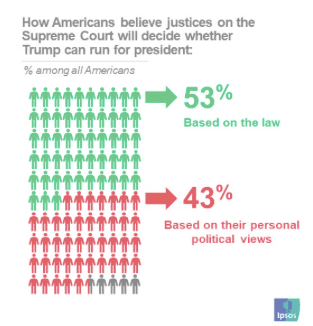
Behi d the effort to remove Trump, guiltier not, is a generally low opinion of the legal system. Polls show that 53% of America believes that judges decide based on their politics, not on law. If Trump is found guilty, they believe it’s politics. If he’s found innocent, tit’s also politics, according to the majority of Americans. Given that folks are convinced the judges are crooked, they want to make sure that their crooked judges are the ones to stay in power, and those with other views are kept from office. It’s a tribal view of justice, not uncommon in 3rd world countries. Man for all seasons is a classic movie/ play about it.
In Russia and China the same tribal view of justice prevails, and the same story is playing out. Putin is running for president in 2024, and has take the precaution to jail his opposition as seditionist. Chinese chairman Xi has not only jailed his opposition, but also most major business leaders. The people in these countries don’t seem to mind, and seem genuinely supportive. The press there, as here, can’t understand why anyone would support anyone but the boss, and have warned against false news in an eerily unified voice.
Efforts are underway to keep Trump off the ballot in these states where he is winning, plus Wisconsin and Minnesota, states where he’s tied or losing by a small margin. A majority people don’t want him or Biden, so removal is popular.
Robert Buxbaum, Jan 31, 2024. To me, the removal of Trump from the ballot is related to the desire for term limits, and for our support, in Ukraine for the elimination of upcoming elections. Folks like democracy, in theory, but need to make sure the wrong person doesn’t win. It’s a paradox.
I predicted dire times for China six years ago, when Xi Jinping amended the constitution to make himself leader for life, in charge of the government, the party, the military, and the banks. Emperor, I called him, here. It now seems the collapse has begun, or at least stagnation. Chinese history is cyclic. Good times of peace and plenty give rise to a supreme emperor whose excesses bring war and famine, or at least stagnation. The cycle repeats every 50 to 100 years. Since Nixon opened China in 1973, the country has seen 50 years of prosperity and spectacular growth, but the growth has stopped and may be in decline. The stock market (Shanghai Shenzen 300) peaked in 2021 and has declined 50% from there. It’s down 30% for the last 12 months to levels seen in December 2010. US growth seemed slower than China’s but it’s been more steady. The main US stock market, the S+P 500, has more than tripled since 2010, up 24.5% this year.
Five years of the Shanghai 300 index with hardly any change. There has hardly been change in 15 years. One could argue that the lost decade is here and on-going. .
Each year Chairman Xi’s behaves more dictatorial. Last year he arrested his predecessor, Hu Jintao in front of the Communist party. He now tracks all his citizens actions by way of face recognition and phone software, and gives demerits for wrong thinking and wrong behaviors. You lose merits by buying western cars or visiting western internet sites. Taking money abroad is generally illegal. Needless to say, such behavior causes people to want to take money abroad, just in case. Last week, Xi proposed a limit on video game playing and clamped down on banks, demanding low interest rates. This is bad for the gaming corporations and teenagers, and banks, but so far there are no protests as there is no war.
Kissinger said that war was likely, though. Xi is building the navy at a fast pace, adding fast surface ships, nuclear submarines, aircraft carriers, and new attack airplanes. They’ve added hypersonic missiles too, and added listening stations and bases. There’s now a naval base in Djibouti, at the entrance to the Red Sea, where they oversee (or promote?) Iran’s attacks on Western shipping. Then there are the new Chinese Islands that were built to take oil and fishing rights, and to provide yet more military bases on key trade routes. These could easily be a trigger for war, but so far just one military interaction in the region. Last month, the Chinese and Philippines navy clashed over fishing!
In the Gulf of Finland last Month, a Chinese ship, New New Polarbear, destroyed the offshore cables and gas pipes between Finland and Estonia, in protest of Finland’s entry into NATO. It’s belligerent but not war. Undersea cables are not covered by the UN charter, law of the sea. Then there is the evidence that COVID-19 was the result of Chinese bioweapon development, and the Chinese spy ballon that was sent over the US. We maintain at peace, but an unsettled sort of peace — is it a preface to war? Wars don’t have to be big war against the west or Taiwan, more likely is Vietnam, IMHO.
China’s negative population growth means that property values will drop along with product consumption. Kids buy stuff; old folks don’t.
News from China is increasingly unreliable so it’s hard to tell what’s going on. There were claims of a coupe, but perhaps it was fake news. Reporters and spies have been arrested or shot so there is no window on anyone who knows. There are claims of high unemployment, and COVID deaths, and claims of a movement to “lie flat” and stop working. Perhaps that was behind the ban on excessive gaming. Who knows? Xi claims that China is self sufficient in food production, but record food shipments from the US to China suggest otherwise.
Major businesspeople have disappeared, often to reappear as changed men or women. Most recently, Jimmy Lai, the Hong Kong clothing magnate, was indicted for sedition by tweets. Perhaps he just wanted to fire workers, or pay down debt, or move abroad (his daughter is). Many businesses exist just to make jobs, it seems. Not all of these businesses are efficient, or profitable. Some exist to violate US patents or steal technology, particularly military technology. I suspect that China’s hot new car company, BYD, is a money-losing, job factory, behind Tesla in every open market. Some 91 public firms have delisted over the last two years, effectively vanishing from oversight. Are they gone, or still operating as employment zombies. Will BYD join them? If China manages to avoid war, I have to expect stagnation, a “lost decade” or two, as in Japan saw from 1990 to 2010, as they unwound their unprofitable businesses.
A sign suggesting that a Chinese lost decade has begun is that China’s is seeing deflation, a negative inflation rate of -0.2%/year according to the world bank. It seems people want to hold money, and don’t want Chinese products, services, or investment. Japan saw this and tried a mix of regulation and negative interest rates to revive the interest, basically paying people to borrow in hopes they spend.
In Japan, the main cause of their deflation seems to have been an excess of borrowing against overvalued and unoccupied real estate. The borrowed money was used to support unprofitable businesses to buy more real estate. This seems to be happening in China too. As in Japan, China originally needed new lots of new apartments when they opened up and people started moving to the cities. The first apartments increased in value greatly so people built more. But now they have about 100% oversupply: one unoccupied or half-built apartment for every one occupied, with many mortgaged to the hilt against other overvalued apartments and flailing businesses.
Chinese Dept, personal and corporate match Japan’s at the start of the lost decade(s). Personal debt is at 150% of GDP, corporate debt is at65% of GDP, all propped up by real estate.
As in Japan 30 years ago, China’s corporate + personal debt is now about two times their GDP. Japan tried to stop the deflation and collapse by increased lending, and wasteful infrastructure projects. People in the know sent the borrowed money abroad confident that they would repay less when they repaid. We are already seeing this; low interest loans, money flowing abroad and a profusion of fast trains, unused roads, and unused bridges. I suspect most fast trains don’t pay off, as planes are faster and cheaper. These investments are just postponing the collapse. China is also seeing a birth dearth, 1.1 children per woman. This means that within a generation there will be half as many new workers and families to use the trains, or occupy the apartments. As the country ages, retirees will need more services with fewer people to provide them. China’s culture promotes abortion. China’s working population will decline for the next 30 years at least.
Japan came through all this without war, somewhat poorer, but unified and modern. It helped that Japan was a democracy, unified in culture, with an open press and good leaders (Abe). There was no collapse, as such, but 20 years of stagnation. China is a dictatorship, with a disunited culture, and a closed press. I think it will get through this, but it will have a much rougher time.
Per pound mile of material, the transport cost by ship is 1/4 as much as by train, and about 1/8 as much as by truck. Ships are slower, it is true, but they can go where trucks and trains can not. They cross rivers and lakes at ease and can haul weighty freight with ease. I think America could use many more ferries, particularly drive-on, fast ferries. I don’t think we need new fast rail lines, because air travel will always be faster and cheaper. The Biden administration thinks otherwise, and spends accordingly.
Amtrak gets $30 Billion for train infrastructure this year, basically nothing for ferries.
The Biden administration’s infrastructure bill, $1.2 Trillion dollars total, provides $30 Billion this year for new train lines, but includes less than 1% as much for ferries, $220 million, plus $1B for air travel. I think it’s a scandal. The new, fast train lines are shown on the map, above. Among them is a speed upgrade to the “Empire Builder” train running between Chicago and Seattle by way of Milwaukee. I don’t think this will pay off — the few people who take this train, takes it for the scenery, I think, and for the experience, not to get somewhere fast.
There is money for a new line between Cleveland and Detroit, and for completion of the long-delayed, and cost-over-run prone line between LA and San Francisco. Assuming these are built, I expect even lower ridership since the scenery isn’t that great. Even assuming no delays (and there are always delays), 110 mph is vastly slower than flying, and typically more expensive and inconvenient. Driving is yet slower, but when you drive, you arrive with your car. With a train or plane, you need car rental, typically.
New Acela train, 150 mph max. 1/4 as fast as flying at the same price.
Drive-on ferries provide a unique advantage in that you get there with your car, often much faster than you would with by driving or by train. Consider Muskegon to Milwaukee (across the lake), or Muskegon to Chicago to Milwaukee, (along the lake). Cleveland to Canada, or Detroit to Cleveland. No land would have to be purchased and no new track would have to be laid and maintained. You’d arrive, rested and fed (they typically sell food on a ferry), with your car.
There’s a wonderful song, “City of New Orleans”, sung here by Arlo Guthrie describing a ride on the historic train of that name on a trip from Chicago to New Orleans, 934 miles in about one day. Including stops but not including delays, the average speed is 48 mph, and there are always delays. On board are, according to the song, “15 restless riders, 3 conductors, and 25 sacks of mail.” The ticket price currently is $200, one way, or about as much as a plane ticket. The line loses money. I’ve argued, here, for more mail use to hep make this profitable, but the trip isn’t that attractive as a way to get somewhere, it’s more of a land-cruise. The line is scheduled for an upgrade this year, but even if upgraded to 100 mph (14 hours to New Orleans including stops?) it’s still going to be far slower than air travel, and likely more expensive, and you still have to park your car before you get on, and then rent another when you get off. And will riders like it more? I doubt it, and doubt the speed upgrade will be to 100 mph.
Lake Express, 30 mph across Lake Michigan
Ferry travel tends to cost less than train or plane travel because water traffic is high volume per trip with few conductors per passenger. At present, there are only two ferryboats traveling across Lake Michigan, between Michigan and Wisconsin, Milwaulkee to Muskegon. They are privately owned, and presumably make money. The faster is the Lake Express, 30 mph. It crosses the lake in 2.5 hours. Passenger tickets cost $52 one way, or $118 for passenger and car. That’s less than the price of an Amtrak ticket or a flight. I think a third boat would make sense and that more lines would be welcome too. Perhaps Grand Haven to Racine or Chicago.
Route of the Lake Express. I’d like to see more like this; St. Joseph to Milwaukee say, and along Lake Erie.
Currently, there are no ferries across Lake Erie. Nor are there any along Lake Erie, or even across Lake St. Clair, or along the Detroit River, Detroit to Toledo or Toledo to Cleveland. These lines would need dock facilities, but they would have ridership, I think. New York’s Staten Island ferry has good ridership, 35,000 riders on a typical day, plus cars and trucks. In charge are roughly 120 engineers, captains and mates, one employee for every 300 passengers or so. By comparison, Amtrak runs 300 trains that carry a total of87,000 passengers on an average day, mostly on the east coast. These 300 trains are run by 17,100 employees as of fiscal year 2021, one employee for every 4 passengers. Even at the slow speeds of our trains the cost is far higher per passenger and per passenger mile.
The Staten Island ferry is slow, 18.5 mph, but folks don’t seem to mind. The trip takes 20 minutes, about half as long as most people’s trips on Amtrak. There are also private ferry lines in NY, many of these on longer trips. People would take ferries for day-long trips along our rivers, I think. Fast ferries would be nice, 40 mph or more, but I think even slow ferries would have ridership and would make money. A sea cruise is better than a land cruise, especially if you can have a cabin. On the coal-steam powered, Badger, you can rent a state-room to spend the night in comfort. Truckers seem to like that they cover ground during their mandatory rest hours. The advantage is maximized, I think, for ferry trips that take 12 hours or so, 250 to 350 miles. That’s Pittsburgh to Cincinnatti or Chicago to Memphis.
New York’s Staten Island ferry leaves every 15 minutes during rush hour. Three different sizes of boat are used. The largest carry over 5000 passengers and 100 cars and trucks at a crossing.
A low risk way to promote ferry traffic between the US and Canada would be to negotiate bilateral exemption to The Jones Act and its Canadian equivalent. Currently, we allow only US ships with US crews for US travel within the US.* Cabotage it’s called, and it applies to planes as well, with exemptions. Canada has similar laws and exemptions. A sensible agreement would allow in-country and cross-country travel on both Canadian and US ships, with Canadian and/or US crew. In one stoke, ridership would double, and many lines would be profitable.
Politicians of a certain stripe support trains because they look futuristic and allow money to go to friends. Europeans brag of their fast trains, but they all lose money, and Europe had to ban many short hop flights to help their trains compete. Without this, Europeans would fly. There is room to help a friend with a new ferry, but not as much as when you buy land and lay track. We could try to lead in fancy ferries going 40 mph or faster, providing good docks, and some insurance. Investors would take little risk since a ferry route can be moved**. Don’t try that with a train.
In Detroit we have a close up of train mismanagement involving the “People Mover.” It has no ridership to speak of. Our politicians then added “The Q line” to connect to it. People avoid both lines. I think people would use a ferry along the Detroit river, though, St. Claire to Wyandotte, Detroit, Toledo — and to Cleveland or Buffalo. Our lakes and rivers are near-empty superhighways. Let’s use them.
Robert Buxbaum, January 2, 2024. *The US air cabotage act (49 U.S.C. 41703) prohibits the transportation of persons, property, or mail for compensation or hire between points of the U.S. in a foreign civil aircraft. We’ve managed exemptions, though, e.g. for US air traffic with Airbus and Embraer planes. We can do the same with ferries.
** I notice that it was New York’s ferries, and their captains, that rescued the people on Sullenberger’s plane when it went down in the Hudson River — added Jan. 6.
Leading up to the Cybertruck launch 4 weeks ago, the expert opinion was that it was a failure. Morgan Stanley, here dubbed it as one, as did Rolling Stone here. Without having driven the vehicle, the experts at Motor trend, here, declared it was worse than you thought, “a novelty” car. I’d like to differ. The experts point out that the design is fundamentally different from what we’ve made for years. They claim it’s ugly, undesirable, and hard to build. Ford’s F-150 trucks are the standard, the top selling vehicle in the US, and Cybertruck looks nothing like an F-150. I suspect that, because of the differences, the Cybertruck can hardly fail to be a success in both profit and market share.
Cybertruck pulls a flat-bed trailer at Starbase.
Start with profit. Profit is the main measure of company success. High profit is achieved by selling significant numbers at a significant profit margin. Any decent profit is a success. This vehicle could trail the F-150 sales forever and Musk could be the stupidest human on the planet, so long as Tesla sells at a profit, and does so legally, the company will succeed. Tesla already has some 2 million pre-orders, and so far they show no immediate sign of leaving despite the current price of about $80,000. Unless you think they are all lying or that Musk has horribly mispriced the product, he should make a very decent profit. My guess is he’s priced to make over $10,000 per vehicle, or $20B on 2 million vehicles. Meanwhile, no other eV company seems to be making a profit.
The largest competing electric pickup company is Rivian. They sold 16,000 electric trucks in Q3 2023, but the profit margin is -100%. This is to say, they lose $1 for every $1 worth of sales –and that’s unsustainable. Despite claims to the contrary, a money-losing business is a failure. The other main competitors are losing too. Ford is reported to lose about $50,00 per eV. According to Automotive News, here, last week, Ford decided to cut production of its electric F-150, the Lightning, by 50%. This makes sense, but provides Cybertruck a market fairly clear of US e-competition.
2024 BYD, Chinese pickup truck
Perhaps the most serious competitor is BYD, a Chinese company backed by the communist government, and Warren Buffet. They are entering the US market this month with a new pickup. It might be profitable, but BYD is relatively immune to profitability. The Chinese want dominance of the eV market and are willing to lose money for years until they get it. Fortunately for Tesla, the BYD truck looks like Rivian’s. Tesla’s trucks should exceed them in range, towing, and safety. BYD, it seems, is aiming for a lower price point and a different market, Rivian’s.
A video, here, shows the skin of a Cybertruck is bulletproof to 9mm, shotgun, and 45 caliber machine gun fire. Experts scoff at the significance of bulletproof skin — good for folks working among Mexican drug lords, or politicians, or Israelis. Tesla is aiming currently for a more upscale customer, someone who might buy a Hummer or an F-250. This is more usable and cheaper.
Don’t try this with other trucks.
Another way Cybertruck could fail is through criminal activity. Musk could be caught paying off politicians or cheating on taxes or if the trucks fail their safety tests. So far, Cybertruck seems to meet Federal Motor Vehicle Safety Standards by a good margin. In a video comparison, here, it appears to take front end collisions as well as an F-150, and appears better in side collisions.
This leaves production difficulty. This could prevent the cybertruck from being a big success, and the experts have all harped on this. The vehicle body is a proprietary stainless steel, 0.07″ thick. Admittedly it’s is hard to form, but Tesla seems to manage it. VIN number records indicate that Tesla had delivered 448 cybertrucks as Friday last week, many of them to showrooms, but some to customers. Drone surveys of the Gigafactory lot show that about 19 are made per day. That’s a lot more than you’d see if assembly was by hand. Assuming a typical learning curve, it’s reasonable to expect some 600 will be delivered by December 31, and that production should reach 6000 per month in mid 2024. At that rate, they’ll be making and selling at the same rate as Rivian or Ford, and making real money doing it. The stainless body might even be a plus, deterring copycat competition. Other pluses are the add-ons, like the base-camp tent option, a battery extension, a ramp, and (it’s claimed) some degree of sea worthiness. Add-ons add profit and deter direct copying (for a time).
Basecamp, tent option.
So why do I think the experts are so wrong? My sense is that these people are experts because of long experience at other companies — the competitors. They know what was tried, and that innovation failed. They know that their companies chose not to make anything like a Cybertruck, and not to provide the add-ons. They know that the big boys avoid “novelty cars” and add-ons. There is an affinity among experts for consensus and sure success, the success that comes from Chinese companies, government support and international banking. If the Cybertruck success is an insult to them and their expertise. Nonetheless, if Cybertruck succeeds, they will push their companies towards a more angular design plus add-ons. And they will claim cybertruck is no way novel, but that government support is needed to copy it.
Piracy is illegal throughout the world, but has become increasingly popular. Over the last 3 weeks, perhaps 15 ships have been attacked by pirates (or privateers) in the narrow entrance to the Red Sea between Yemen, Somalia, and Djibouti, the “Bab el Mandab,” In Arabic, this means “the gate of tears”. Most of the ships attacked are large commercial vessels operating between Europe and Asia. The US destroyer, Carney has been attacked as well. Three of the attacked ships have been boarded, and two have been successfully hijacked, the car-carrier Galaxy Leader was taken to South Yemen, while the MV Ruen a Bulgarian owned dry bulk (grain) ship was brought to Somalia. The last of the hijacked ships, the Strinda, was recaptured by the US and Japanese navy. The other ships were attacked, at a distance, by Iranian ballistic missiles, cruise missiles, and drones, all fired from Yemen. All of these acts are defined as piracy under the UN Charter, Law of the Sea, UNCLOS. The punishment is 10+ years in prison, assuming you catch the pirate.
Bab al Mandab = Gate of tears, where the pirates operate.
All of these ships are European except for the Carney and a Chinese container ship flagged in, Hong Kong. You’d think that the European navies would protect their own ships here, but they do not. Neither did the Chinese navy, though they are stationed in Djibouti. It’s clear that Iran is organizing the attacks, and that they are using a spotter ship to help direct the missiles. My guess is that the European countries don’t want to annoy Iran here, nor do they like to use their $1 million missiles.
In theory, these attacks are in response to the Israel – Gaza war. The hijacked Galaxy Leader was registered in the UK, but owned by an Israeli Jew (see a video of the attack). Another ship that was attacked, the Strinda, was not directly associated with Israel, but was going to go to Israel at some point in the future. While it’s possible that the other attacked ships had Jewish or Israel connection, a simpler explanation is that this is economic terror. Israel-based Zim shipping has elected to avoid the straight and redirect around Africa instead, a much longer route that is sure to damage the shipper and Israel’s economy. I suppose that was an intent, but the damage is spreading.
Commercial vessel attacks in Bab al Mandab, chart from “What the Ship” video blog.
The European shippers have demanded that the US protect their ships, and perhaps Biden will agree. My sense is that Trump would have said no, or at least demand something in return. Personally, I see no reason to defend trade that doesn’t involve us, with no obvious payback. Yesterday, British Petroleum BP announced that it would avoid the Bab. Four major European container freight firms, MSC (Swiss), Maersk (Danish), Hapag-Lloyd (German) and CMA CGM (Italian, French). Currently Maersk supplies our troops, but has threatened to stop unless we defend their whole fleet. I consider this an offensive, a breech of contract. They European press seems to think it’s clever. We used to have a US company that supplied our troops, Landsea intermodal, but Maersk bought them out. Personally, I think it’s time to look for a company that doesn’t play these games.
As of two days ago, the economic damage has been minimal, except to Israel. Only 55 ships had diverted around Africa, or begun to. This is a small fraction of the 2,128 ships that have gone through the Bab since November 15. In the last day or so, European oil prices have started to rise, while ours fell. The thought is that Saudi oil will now flow to the US, not Europe. I think this is the beginning of a serious problem for Europe and that they should defend their own shipping. A few, million dollar missiles are a lot cheaper than the billions of loss to their economies that rerouting will cause. At present, Europe expects us to save them while they do little or nothing. I think we should say no. They think Biden will cave.
Jean-Paul Sartre was a Catholic who did not believe in God or external morality, but believed in socialism and being true to ones self without having to do anything for anyone. His most famous work, “Being and Nothingness” was written in France in 1943, during the Nazi occupation. The last 200 pages of the book deal with freedom and its limitations. Sartre points out that there are always limitations (prison guards, Nazis, your own body, etc.) It is dangerous and impractical to oppose these guards, or or to oppose your own body. Sartre’s advice is to go along in body, but oppose them in your mind. Thus, he believed, he was being true to himself to the extent of rational choice. He was totally free because he was free in his mind and in his reactions to the limitations. “Freedom is what we do with what is done to us.” This was his version of existentialism, and many Frenchmen agreed that this was the right way to behave under the circumstances. Many Nazis agreed and enjoyed his writing and plays. If they didn’t totally like what Sartre had to say, they didn’t object enough to send him to a concentration camp. In practical terms, he thus survived better than Jews and oppositional Frenchmen.
Sartre had eyes that pointed in different directions. Some try to claim this related to his philosophy
Although there is a stink of cowardice and collaboration hanging over Sartre and his outlook, it could be worse. A Sartre Joke: Sartre had just finished talk at a restaurant, and sat down. A waitress who understood the talk better than most, asked if she could get him something. Sartre said, “please bring me a coffee, no sugar, no milk.” The waitress came back and said, “we’re out of milk. I can get you coffee with no sugar and no cream.” The point of the joke being that Sartre’s freedom of choice can only be among the choices he could reasonably make. If he’d asked for milk, it’s irrational to expect that the restauranteur would run out and buy some, so it was pointless to ask for no milk.
As the Germans were leaving, Sartre took French antisemites to task in a short book, “Antisemite and Jew” (1944) where he discusses the inauthentic logic of French antisemites and the motivations behind their behavior and beliefs. He claimed the motivation was a sort of mob empowerment where the antisemite, by oppressing Jews sees himself as noble, and comes to feel himself as the heir of all France, its history and its culture. They the thus imagine themselves empowered and enriched by their hatred of he-who-isn’t-them. This motivation he inferred in the liberal Frenchman as much as in the thug; the liberal objects to the yellow star, not out of sympathy for the Jew or justice, but for an inauthentic reason. It makes him feel small by his inaction, and it crates, in the Jew, an identity that is beyond the essence they prefer; he’s more than just ‘not-them’. As I read him, the main character in “Catcher in the Rye”, Holden Caulfield, is a Sartre stand in, a privileged kid bothered by the “phoniness” around him, Like Sartre, he complains and does nothing for anyone, but he does no harm either.
Sartre didn’t join the resistance, even after the Germans were losing, nor did he hide Jews or gentles, or help anyone but himself. After the war, he pushed for the execution of those who were insufficiently anti Nazi, like Tintin author, Hergé. Hergé survived, many of those he attacked were killed in post war purges. Sartre’s philosophy actually works for prisoners in extreme circumstances. Similar philosophies were created by Victor Frankl and Primo Levi during their stays in Auschwitz. It helped them survive and stay sane. Frankl’s “Man’s search for meaning”, was alternately titled, “From concentration camp to existentialism,” a lot concerns the importance of keeping your mind clear – of not becoming an animal.
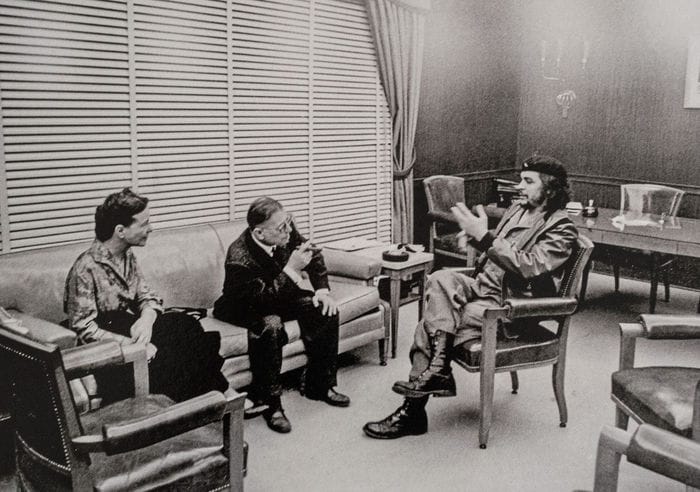
Simone de Beauvoir & Jean-Paul Sartre with Che Guevara, a favorite Communist murderer, in Havana, Cuba, 1960 (photo by Alberto Korda).
After the war, Frankl became a successful psychologist helping people by helping them to see that they had a reason to exist. This is a more positive version of Sartre’s existentialism, where there was no reason. Primo Levi seems to have followed Sartre’s line more and become ever more depressed; eventually he committed suicide. Eventually, Sartre found a reason to exist in socialism. He believed that, while life was a cruel joke, socialism was pure. People could die in the millions, and he acknowledged that, the leaders were brutal thugs who did murder millions, but he believed that socialism and communism must live on. He tried to keep the bad truths hidden. So what of the killing and torture. So what if writers were imprisoned or shot — in Russia all the Jewish ones were shot in the same day — Sartre said they should have written better books, more pro-communist. Sartre would never have willingly lived in communist Russia, China, or Cuba — he stayed safe in France, and championed the oppression.
Gays for Gaza are not interested in a queer state of Palestine; they attack Jews to make themselves feel generous and powerful — it gives their lives meaning.
This brings me to the pro-Palestinian authors of today, and of 1973. Fifty years ago on Yom Kippur, Iraq, Syria, and Egypt attacked Israel by surprise simultaneously with aid from Russia. Communists and socialists supported the Arabs. Among them was Sartre, though he knew these states to be brutal dictatorships. Pretty soon Sartre discovered that his friends motivation was that they liked attacking Jews, a phony motivation, said Sartre in an interview, and he found he could not join them
I detect the same phony motivation in today’s demonstrations. The loud feminists for Palestine, the Gays for Gaza, those attacking Jews for complicity. Very few of them would willingly live in these countries or among Hamas or ISIS, and fewer of those would survive. Their love of Palestine is an excuse to hit Jews. The better version is Sartre’s he did nothing then, and would likely have done nothing today. You have to have authentic thoughts, at least.
Donald Trump has a lot of signature behaviors, including his “America first” politics, his hair, his ‘tan,’ his way of speech, and his way of wearing suits. Half of America finds them attractive or at least OK, while the other half finds them super-unattractive. Trump seems to have a super-power, that there is no middle. Those who dislike him dislike everything about him to his policies to his clothes. Let Trump propose immigration control, and the opposition demands open borders. Let Trump propose tariffs, an ole Republican approach to diplomacy that is thought to bring in Jobs, and the opposition (even unions!) goes crazy for free trade.
Trump likes dark colors, long ties, long jackets, and long sleeves on his suits.
In the book “Fear”, by Bob Woodward’s first story is about folks on Whitehouse staff stealing Trump’s first tariff proposal from his desk in an effort to prevent it being signed. Whatever they thought of the tariff (it was not that weird, and didn’t do much) the fact that they stole it showed the dramatic reaction people have. In this case, folks who otherwise understood that they are there to serve the president, not to overturn his policies.
LeBron James in the Thom Browne, Anti Trump look. The pants are too short, as are the sleeves and jacket. Note the dull grey color and the short, dull-grey tie. The fellow behind him is dressed normal or Trumpish: dark clothes, long sleeves, bright, long tie.
In terms of fashion, the anti-Trump fever is to react against Trump’s choice of suits in dark colors, paired with bright ties that hang below the waist. The anti men’s fashion has moved to dull grey suits and short, grey ties. Trumps’s suits’s typically have extra-long long sleeves and long pant legs that hit the shoe-top. He likes long jackets too, that to me look vaguely like Lincoln’s. The fashion back-lash is men are wearing ridiculously short pants and jackets, with socks showing.
LeBron James, at right, is wearing a complete mens, anti-Trump look, likely a Thom Browne suit, a very expensive ill fit. This suit doesn’t look comfortable, but it’s fashion, and as I’ve said before, you’ve got to suffer for fashion.
There is also a woman’s version of anti Trump fashion. The Trump women wore feminine, closely fitting clothing and wore their hair long. The anti-Trump women’s look is the opposite; it includes short hair and masculine, often covered. This is paired with loose fitting male clothes: cargo pants or combat fatigues. Topping it off, ideally ideally is a checkered, keffiyeh scarf, either over the head or around the neck. The style of scarf was made popular by former PLO head, Yassar Arafat. This look is particularly popular on college campuses and at demonstrations. It implies that the wearer supports Palestine (Trump supported Israel), and shows you are part of the cool set. The wearer, herself, is typically is not in favor of kidnapping or rape or putting babies in oven, but they are so strongly anti Israel and Trump that they are OK with it, especially if it is Jews being kidnapped, rabed, or cooked alive. They will call for Jews to be gassed or tortured. It’s part of being in the in-crowd, and antisemitism is what’s in these days — it’s been popular for many centuries.
The women’s anti-Trump look includes short hair and a keffiyeh scarf. Photo from WRLN Florida.
It is a misconception to think that those wearing the keffiye don’t understand that they would not live long if they had to dwell among the Arabs they support. These feminists do understand, as do the ‘Queers for Palestine’. They’d never want to live in even the most moderate Arab country, the same way that those supporting Mao would never want to live in China under Mao. It is fashion, and like all fashion, it’s a mob behavior that exists only for fashion’s sake. In this case there is the added advantage that you get to hit Jews and break their windows — something that is particularly attractive for feminist women, I notice; the majority of people at the Palestine protests are women.
For most working folks, the majority of your taxes are social security, certainly the majority of your federal taxes. The tax structure of SS is strongly weighted to help the rich. This is a fact that politicians have created and typically hide. Both parties proclaim tax help for the middle class, by instituting income tax changes that barely affect anyone, and really sticking it to the low wage-earner and middle class by a highly recessive SS tax that charges 14.2% off the top for a self-employed person, or 7.1% for an employee, but only to a cut-off of $160,000.
Anyone making more than this pays nothing on the overage, with the result that high earners, on a percent basis, pay essentially 0% tax. The rest of the high eaters income is generally protected by deductions. His car is a work expense, rented from the company, his travel is too. The working plumber benefits from these same deductions, but ends up paying 14.2% because of Social Security, while someone earning $1.6 million ends up paying 1.42% effectively.
People earring more than $1.6 million gain credit for other exemptions. Bill Gates has been buying farm land and claims the depreciation of the land value. Land does not actually depreciate, but you can claim it does because people like him get to fix the tax code (Donald Trump gets the same deduction, BTW on his gold courses). Less rich folks can still deduct the high cost of country club membership, of travel, entertainment, and meetings in exotic places (you can claim some of that too). Because so much of what you pay is Social security, it will come out that, while the executive may pay more in absolute tax, he or she will pay far less as a percentage. Many rich folks claim to find this offensive, but neglect to suggest the most obvious correction raise the ceiling on social security and (ideally) lower the the %.
I strongly suspect that we could bill for social security at 5% and 10% if we raised the ceiling to $2,000,000 per year. I suspect that SS would then be more solvent too. The net result would be drastically fairer.
Solar power is only available during the day, and people need power at night too. As a result, the people of a town will either need a lot of storage, or a back-up electric generator for use at night and on cloudy days. These are expensive, and use gasoline (generally) and they are hard to maintain for an individual. Central generated alternate power is cheaper, but the wires have to be maintained. As a result, solar power is duck curve, or canon curve power. It never frees you from hydrocarbons and power companies, and it usually saves no money or energy.
People need power at twilight and dawn too, and sunlight barely generates any power during these hours, and sometimes clouds appear and disappear suddenly while folks expect uniform power to their lights. The mismatch between supply and demand means that your backup generator, must run on and off suddenly. It’s difficult for small, home generators, but impossible for big central generators. In order to have full power by evening, the big generators need to run through the day. The result is that, for most situations, there is no value to solar power.
Installed solar power has not decreased the amount of generation needed, just changed when it is needed.
Power leveling through storage will address this problem, but it’s hardly done. Elon Musk has suggested that the city should pay people to use a home battery power leveler, a “power wall” or an unused electric car to provide electricity at night, twilight, and on cloudy days. It’s a legitimate idea, but no city has agreed, to date. In Europe, some locations have proposed having a central station that generates hydrogen from solar power during the day using electrolysis. This hydrogen can drive trucks or boats, especially if it is used to make hythane. One can also store massive power by water pumping or air compression.
Scottsbluff Neb. solar farm damaged by hail, 6/23.
In most locations, storage is not available, so solar power has virtually no value. I suspect that, at the very least, in these locations, the price per kWh should be significantly lower at noon on a sunny day (1/2 as expensive or less). The will cause people to charge their eVs at noon, and not at midnight. Adjusted prices will cause folks to do heavy manufacturing at noon and not at midnight. We have the technology for this, but not the political will, so far. Politicians find it easier to demand solar, overcharge people (and industry) and pretend to save the environment.