Category Archives: politics

The worst president was John Adams

Every now and again a magazine incites a group of historians to pick the best and worst presidents. And there, at the bottom of their scale, I typically find James Buchanan, Franklin Pierce, Andrew Johnson; Warren Harding, and/or Ulysses Grant, none of whom deserve the dishonor, in my opinion. For Pierce and Buchanan, their high crime was to not solve the slavery /succession problem — as if this was a problem that any PhD historian would have been able to solve in a weekend. It was not so simple; the slavery question bedeviled the founding fathers, tormented Daniel Webster and Henry Clay; George Washington and Thomas Jefferson wrestled with it. None could solve it, and we accept that they served the country well, promoting prosperity and relative levels of good feeling. Now, in the 1850s, Pierce and Buchanan inherit this monster, the slave issue, and we blame them for not resolving it when the nation was at the boiling point and Kansas was burning. They did the best they could in impossible circumstance, buying us time. Pierce also bought us southern Arizona and helped open Japan.

Similarly, with Johnson: our historians’ complaint is that he didn’t manage reconstruction well — as if any one of them could have done better. You can’t blame a person for failing in a hopeless situation. Be happy they filled their terms, avoided war with our neighbors, and left the country richer and more populous than they found it.

Moving on to Grant and Harding, their crime was to be president at a time of scandal. But the very essence of this condemnation is that it presents the scandal, a non-issue in the large sweep of America, as if it were the only issue. Both Harding and Grant drank in the white house, and played cards while members of their cabinets stole money. These are major scandals to blue noses, but not so relevant to normal people. Most presidents drank, and many had corrupt associates. Both presidencies were periods of prosperity, employment, and growth. Both presidents paid down the national debt. Harding paid down $2,000,000 of debt, a good chunk of the debt from WWI. Grant paid down a similarly large chunk of the debts of the civil war. Both oversaw times of peace, and both signed peace treaties: Harding from WWI, Grant from the civil war and the Indian wars. Both left office with the nation far more prosperous than when they came in. No, these are not bad presidents except in the eyes of puritans who require purity in everyone but them, and care little for the needs of the average American.

The worst president, in my opinion, was John Adams, and I would say he set a standard for bad that’s not likely to be beat. How bad was Adams? He oversaw the worst single law ever in American history, the Sedition act. This act, a partner to the Alien act (almost as bad), was pushed though by Adams a mere 8 years after passage of the bill of rights. The act made it illegal to criticize the government in any way. In this, it made a mockery of free expression. Adams put someone in jail for calling him “his rotundancy” — that is, for calling him fat. The supreme court had to step in and undo this unbelievably horrible law, but this was only one of several horrible acts of president Adams.

Another horrible act of president Adams is his decision to pick a war with France, our ally from the revolution. Adams himself had signed the treaty of Paris guaranteeing that we would never go to war with France. So why did Adams do it? He was a puritan, literally. He didn’t like French immorality and hated French Catholicism. He was insulted that French officials had overthrown their king (not that we had done otherwise) that they wore fancy clothes, and that they wanted bribes. He leaked their request for bribes to the press (the XYZ affair) and presented this as the reason for war. So Adams, pure Adams, got us to war with our oldest ally, a war we could not win, and didn’t.

But Adams didn’t stop there. Having decided to go to war, he also decided to stop paying on US debt to the French. He was too pure to pay debt to a nation that overthrew its king and set up a more-egalitarian state than we had. One where slavery was abolished.

Adams, of course, did nothing to address slavery, though he berated others about it. And it’s not like Adams didn’t pay out bribes, just not to the despised Catholics. At the beginning of Adams’s single term a group of Moslems, the Barbary pirates, captured some American ships. Adams agreed to pay bribe after bribe to the Barbary Pirates for return of these US ships. But the more we paid, the more ships the Barbary pirates captured. So Adams, the idiot, just bribed them more. By the end of Adams’s term, 1/4 of the US budget went to pay these pirates. When Jefferson became president, he ended the war with France by the simple solution of buying Louisiana and he sent the US Marines to deal with the pirates of North Africa. Adams could have done these things but didn’t; Jefferson did, and is ranked barely above Adams as a result. So why is it that no historian calls out Adams as an awful president? I think it’s because Adams wrote beautifully about all the right sentiments, including to his wife. Historians like writers of high sentiment. According to 170 scholars, the top ten presidents, not counting those on Mount Rushmore are FDR, Truman, Eisenhower, Reagan, Obama, and LBJ, all of them fairly recent.

The bottom ten presidents. And there's Trump at the very bottom, with the usual suspects. Harrison was only president for a month.

The bottom ten presidents. And there’s Trump at the very bottom, with the usual suspects. Harrison was only president for a month.

And that brings us to the new poll. It puts William Henry Harrison among the worst. Harrison took office, became sick almost immediately, and died 31 days later of Typhoid. The white house water supply was just down river from the sewage outlet, something you find in Detroit as well. He did nothing to deserve dishonor except drinking the water. he ran a great presidential campaign, BTW. His campaign song, Tippecanoe and Tyler too is wonderful listening, even today.

And that brings us to the historian’s worst of the worst. The current president, Donald J. Trump. This is remarkable since it’s only a year into Trumps term, and since he’s done a variety of potentially good things: He ended a few trade deals and regulations that most people agree were bad, and made some that most people agree are good. A result is that the stock market is up, employment is up, people are back at work, and historians are unhappy. What they want is another FDR, someone who’ll tell us: “We have nothing to fear, but fear itself.” whatever that means; who overspends liberally and oversees 9 years of the Great Depression. By historian polls, FDR is the second or third best president ever.

Robert Buxbaum. April 25, 2018. Semi-irrelevant: here’s a humorous song about Harrison.  Two other bad presidents: James Madison and Zachary Taylor. Madison started a war against Britain without preparing, and Taylor crafted the horrible compromise of 1850.

New Chinese emperor, will famine not follow

For most of its 2300 year history, the Chinese empire has rattled between strong leaders who brought famine, and weak leaders who brought temporary reprieve. Mao, a strong leader, killed his associates plus over 100 million by his “great leap forward” famine. Since then, 30+ years, we’ve had some weaker leaders, semi-democracy, and some personal wealth, plus the occasional massacre, e.g. at Tiananmen square, and a growing demographic problem. And now a new strongman is establishing himself with hopes of solving China’s problems. I hope for the best, but fear the repeat of the worse parts of Chinese history.

Two weeks ago, Chairman Xi amended the Chinese constitution to make himself emperor for life, essentially. He’s already in charge of the government, the party, and the military. Yesterday (Tuesday), he consolidated his power further by replacing the head of the banks. The legal system is, in theory, is the last independent part of government, but there is hardly any legal system in the sense of a balance of power. If history is any guide, “Emperor” Xi will weaken the courts further before the year is out. He will also likely remove many or all of his close associates and relatives. It is not for nothing that Nero, Stalin, and Mao killed their relatives and friends — generally for “corruption” following a show trial.

China's Imperial past is never is quite out of sight. Picture from the Economist.

China’s past is never is quite out of sight. Picture from the Economist.

Xi might be different, but he faces a looming demographic problem that makes it likely he will follow the president of the stronger emperors. China’s growth was fueled in part by a one child policy. Left behind is an aging, rural population with no children to take care of the elderly. As top-down societies do not tolerate “useless workers,” I can expect a killing famine within the next 10 years. This would shed the rural burden while providing a warning to potential critics. “Burn the chicken to scare the monkey,” is a Chinese Imperial aphorism. Besides, who needs dirt farmers when we have modern machines.

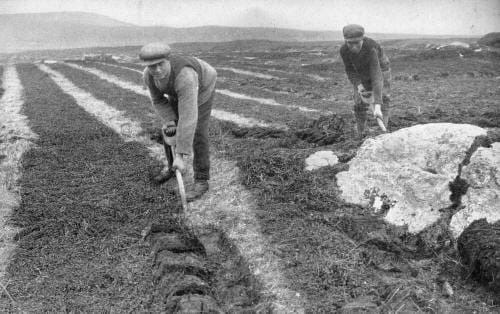
Lazy beds (feannagan) use only half the soil are for planting. The English experts were sure this was inefficient and land-wasting. Plowing was imposed on Ireland, and famine followed

“Lazy beds” of potatoes were used in Ireland for a century until experts forced their abandonment in the mid 1800s. The experts saw the beds, and the Irish as lazy, inefficient, and land-wasting. Famine followed.

Currently about 40% of the country is rural, about 560 million people spread out over a country the size of Canada or the US. The rest, 60% or 830 million, live concentrated in a few cities. The cities are rich, industrial, and young. The countryside is old, agricultural and poor, salaries are about 1/3 those of the cities. The countryside holds about 2/3 of those over 65, about 100 million elderly with no social safety net. The demographic imbalance is likely to become worse — a lot worse — within the next decade.

What is likely to happen, I fear, is that the party leaders — all of whom live in the cities — will decide that the countryside is full of non-productive, uneducated whiners. They will demand that more food should be produced, and will help them achieve this by misguided science and severe punishments. Mao’s experts, like Stalin’s and Queen Victoria’s, demanded unachievable quotas and academic-based advice that neither the leaders nor the academics had ever tried to make work. Mao’s experts told peasants to kill the birds that were stealing their grain. It worked for a while until the insects multiplied. As for the quotas, the party took grain as if the quotas were being met. If the peasants starved, they starved.

I expect that China’s experts will propose machine-based modern agriculture, perhaps imported from the US or Israel: Whatever is in style at the time. The expert attitude exists everywhere to this day, and the results are always the same. See potato famine picture above. When the famine comes, the old will request food and healthcare, but the city leaders will provide none, or just opioids as they did to ailing Elvis. When the complaining stops the doctor is happy.

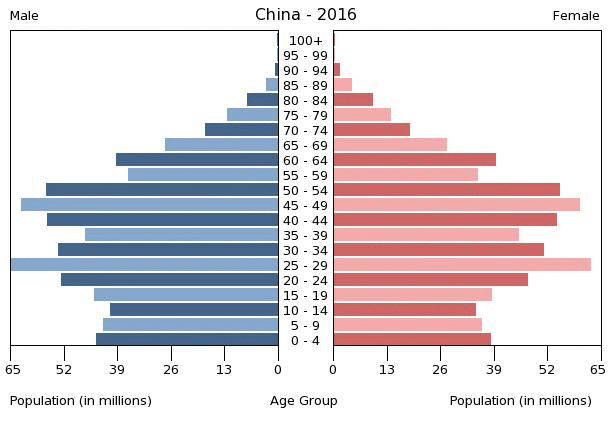
China's population pyramid as of 2016. Notice the bulge of 40-55 year olds.

China’s population pyramid as of 2016. Notice the bulge of 40-55 year olds. Note too that there are millions more males (blue) than females (pink).

In single leader societies, newspapers do not report bad news. Rather, they like to show happy, well-fed peasants singing the leaders’ praise. When there’s a riot too big to ignore, rioters are presented as lazy malcontents and counter-revolutionaries. Sympathizers are sent to work in the fields. American academia will sing the praises of the autocratic leader, or will be silent. We never see the peasants, but often see the experts. And we live in a society where newspapers report only the bad, and where we only believe when there pictures. No pictures, no story. As with Stalin’s Gulags, Mao’s famine, or North Korea today, there are likely to be few pictures released to the press. Eventually, a census will reveal that tens of million aged have vanished, and we’ll have to guess where they went.

I can expect China to continue its military buildup over the next decade. The military will be necessary to put down riots, and keep young men occupied, and to protect China from foreign intervention. China will especially need to protect its ill-gotten, new oil-assets. Oil is needed if China is to replace its farmers with machines. It will be a challenge for a wise American leader to avoid being drawn into war with China, while protecting some of our interests: Taiwan, Hong Kong, etc. As with Theodore Roosevelt, he should offer support and non-biassed mediation. Is Trump up to this?  Hu Knows?

Robert Buxbaum, March 21, 2018. The above might be Xi-nephobia, Then again, this just in: Chairman Xi announces that Taiwan will face punishment if it attempts to break free. Doesn’t sound good.

Elvis Presley and the opioid epidemic

For those who suspect that the medical profession may bear some responsibility for the opioid epidemic, I present a prescription written for Elvis Presley, August 1977. Like many middle age folks, he suffered from back pain and stress. And like most folks, he trusted the medical professionals to “do no harm” prescribing nothing with serious side effects. Clearly he was wrong.

Elis prescription, August 1977. Opioid city.

Elis prescription, August 1977. Opioid city.

The above prescription is a disaster, but you may think this is just an aberration. A crank doctor who hooked (literally) a celebrity patient, but not as aberrant as one might think. I worked for a pharmacist in the 1970s, and the vast majority of prescriptions we saw were for these sort of mood altering drugs. The pharmacist I worked for refused to service many of these customers, and even phoned the doctor to yell at him for one particular egregious case: a shivering skinny kid with a prescription for diet pills, but my employer was the aberration. All those prescriptions would be filled by someone, and a great number of people walked about in a haze because of it.

The popular Stones song, Mother’s Little Helper, would not have been so popular if it were not true to life. One might ask why it was true to life, as doctors might have prescribed less addicting drugs. I believe the reason is that doctors listened to advertising then, and now. They might have suggested marijuana for pain or depression — there was good evidence it worked — but there were no colorful brochures with smiling actors. The only positive advertising was for opioids, speed, and Valium and that was what was prescribed then and still today.

One of the most common drugs prescribed to kids these days is speed, marketed as “Ritalin.” It prevents daydreaming and motor-mouth behaviors; see my essay is ADHD a real disease?. I’m not saying that ADD kids aren’t annoying, or that folks don’t have back ached, but the current drugs are worse than marijuana as best I can tell. It would be nice to get non-high-inducing pot extract sold in pharmacies, in my opinion, and not in specialty stores (I trust pharmacists). AS things now stand the users have medical prescription cards, but the black sellers end up in jail..

Robert Buxbaum, January 25, 2018. Please excuse the rant. I ran for sewer commissioner, 2016, And as a side issue, I’d like to reduce the harsh “minimum” penalties for crimes of possession with intent to sell, while opening up sale to normal, druggist channels.

Bitcoin risks, uses, and bubble

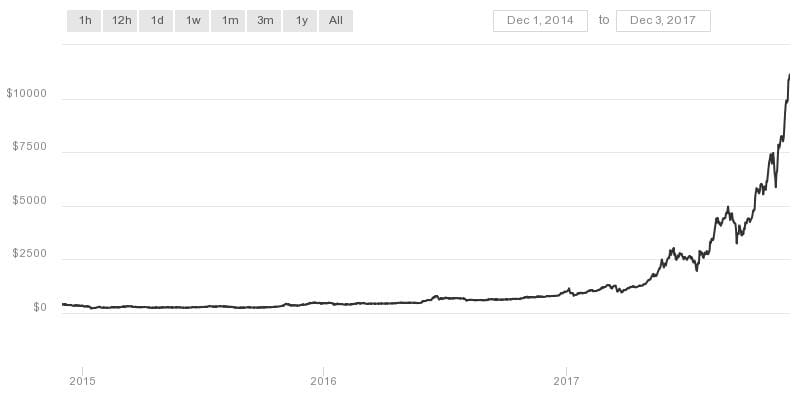
Bitcoin prices over the last 3 years

Bitcoin prices over the last 3 years

As I write this, the price of a single bitcoin is approximately $11,100 yesterday, up some 2000% in the last 6 months. The rise rate suggests it is a financial bubble. Or maybe it’s not: just a very risky investment suited for inclusion in a regularly balanced portfolio. These are two competing views of bitcoin, and there are two ways to distinguish between them. One is on the basis of technical analysis — does this fast rise look like a bubble (Yes!), and the other is to accept that bitcoin has a fundamental value, one I’ll calculate that below. In either case, the price rise is so fast that it is very difficult to conclude that the rise is not majorly driven by speculation: the belief that someone else will pay more later. The history of many bubbles suggests that all bubbles burst sooner or later, and that everyone holding the item loses when it does. The only winners are the brokers and the last investors who get out just before the burst. The speculator thinks that’s going to be him, while the investor uses rebalancing to get some of benefit and fun, without having to know exactly when to get out.

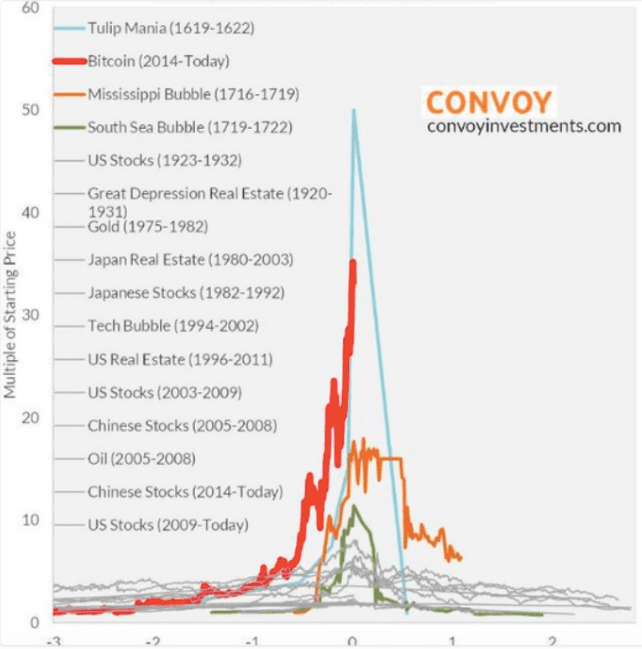
That bitcoin is a bubble may be seen by comparing the price three years ago. At that point it was $380 and dropping. A year later, it was $360 and rising. One can compare the price rise of the past 2-3 years with that for some famous bubbles and see that bitcoin has risen 30 times approximately, an increase that is on a path to beat them all except, perhaps, the tulip bubble of 1622.

A comparison between Bitcoin prices, and those of tulips, 1929 stocks, and other speculative bubbles; multiple of original price vs year from peak.

A comparison between Bitcoin prices, and those of tulips, 1929 stocks, and other speculative bubbles; multiple of original price vs year from peak.

That its price looks like a bubble is not to deny that bitcoin has a fundamental value. Bitcoin is nearly un-counterfeit-able, and its ownership is nearly untraceable. These are interesting properties that make bitcoin valuable mostly for illegal activity. To calculate the fundamental value of a bitcoin, it is only necessary to know the total value of bitcoin business transactions and the “speed of money.” As a first guess, lets say that all the transactions are illegal and add up to the equivalent of the GDP of Michigan, $400 billion/year. The value of a single bitcoin would be this number divided by the number of bitcoin in circulation, 15,000,000 currently, and by the “speed of money,” the number of business transactions per year per coin. I’ll take this to be 3 per year. It turns out there are 5 bitcoin transactions total per year per coin, but 2/5 of that, I’ll assume, are investment transactions. Based on this, a single bitcoin should be worth about $8890, slightly below its current valuation. The gross speed number, 5/year, includes bitcoin transactions that are investments and never traded for goods, and those actively being used in smuggling, drug-deals, etc.

If the bitcoin trade will grow to $600 billion year in a year with no other change, the price rise of a single coin would surpass that of Dutch tulip bulbs except that more coins are bing minted, and that the speed is increasing. If you assume that coin use will reach $1,600 billion/year, the GDP of Texas in the semi-near future, before the Feds jump in, the fundamental value of a coin should grow no higher than $44,000 or so. There are several problems for bitcoin investors who are betting on this. One is that the Feds are unlikely to tolerate so large an unregulated, illegal economy. Another is that bitcoin transactions are not likely to go totally legal. It is very hard (near impossible) to connect a bitcoin to its owner. This is a plus for someone trying to deal in drugs or trying hide profits from the IRS (or his spouse), but a legal merchant will want the protection of courts of law. For this, he or she needs to demonstrate ownership of the item being traded, and that is not available with bitcoin. The lack of a solid, legitimate business need suggests to me that the FBI will likely sweep in sooner or later, and that the value of a coin will never reach $44,000.

Yet another problem for those wishing to invest in bitcoin is the existence of more bitcoins (undiscovered, or un-mined so far) and the existence of other cryptocurrencies with the same general qualities: Litecoin (LTC), Ethereum (ETH), and Zcash (ZEC) as examples. The existence of these coins increases the divisor one should use when calculating the value of a bitcoin. The total number of bitcoins is capped at 21,000,000, that is 6,000,000 coins more than known today. Assuming more use and more acceptance, the speed (turnovers per year) is likely to increase to four or five, similar to that of other currencies. Let’s assume that the bitcoin will control 1 trillion dollars per year of a $1.6 trillion/year illegal market. One can now calculate the maximum long term target price of a bitcoin by dividing $1 trillion/year by the number of bitcoins, 21,000,000, and by the speed of commercial use, 4.5/year. This suggests a maximum fundamental value of $10,582 per coin. This is just about the current price. Let the investment buyer beware.

For an amusing, though not helpful read into the price: here are Bill Gates, Warren Buffet, Charlie Munger, and Noam Chomsky discussing Bitcoin.

Robert Buxbaum, December 3, 2017.

Why Warren Buffett pays 0% social security tax

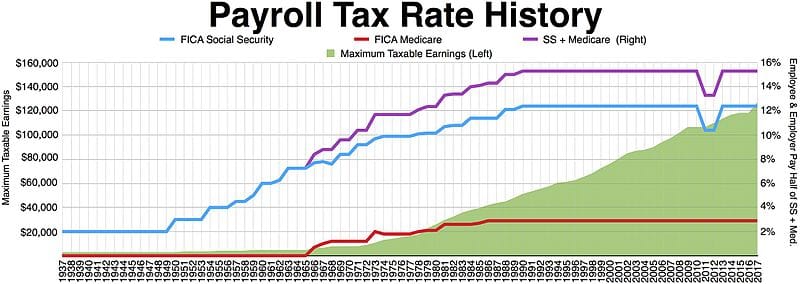
Social Security is billed along with Medicare (health care for the poor) as an anti-flat tax called FICA where middle class workers pay 7.65 -15.3%, and rich people pay essentially 0%. The reason that Warren Buffet and other rich people pay 0%, on a percentage basis, far less than their secretaries, is that there is a FICA cap of $127,200 currently, and he earns far more than $127,200. Buffett’s secretaries pays 7.65%, or which 6% approximately is social-security payment, and the rest Medicare. Buffett’s company then matches the 7.65% — a situation that applies to virtually every employee in the US.

A self employed person though, a gardener say, pays both the employee and employer portion or 15.3%. The same $127,200 cap applies, but since few gardeners make more than this amount, they are likely to pay 15.3% on all earnings, with no deductions. FICA really socks the poor and middle class, and barely touches a rich man like Buffett. This is the tax-inequality that most needs addressing, in my opinion, and one I have not heard discussed.

A short history of FICA

A visual history of FICA rates (right), and of the salary cap (left). Medicare contributions were added in 1966.

As I write this, there is a debate about tax reform that mostly involves income tax, but not at all FICA. Income tax could be improved, in my opinion, and should be. We could remove some exemptions that are being abused, and we should lower the general rates, especially for foreign-earnings, but the current income tax isn’t that bad, in my opinion. Buffett likes to brag about the high rate he pays, but it’s not a bad rate compared to the rest of the world. And Buffett benefits from a lot of things we don’t. His income is taxed at a lower rate than a worker’s would be since most of it is unearned. And, like most rich folks, he has exemptions and deductions that do not apply to most. He can deduct cars, private airplanes, and interest; most folks don’t deduct these things since they don’t spend enough to exceed the “standard deduction”. I’m happy to say these issues are being addressed in the current tax re-write.

The current, House version of the GOP tax proposal includes a raise in the standard deduction and a cap on interest and other deductions. There is a general decrease in the tax rate for earnings, and a decrease for earnings made abroad and repatriated. I’d like to see tariffs, too but they do not appear in the versions I’ve seen. And I’ve very much like to see a decrease in the FICA rate coupled with a removal of the salary cap. Pick a rate, 4% say, where we collect the same amount, but spread the burden uniformly. Why should 7.65%-15.3% or the workmanship wages got to the window, the orphan, and healthcare of the poor, while 0% of Buffett’s go for this?

Some other tax ideas: I’d like to see shorter criminal sentences, especially for drugs, and I’d like to see healthcare addressed to reduce the administrative burden.

Robert E. Buxbaum, November 17, 2017. In the news today, the senate version puts back the tax exemption on private jets. The opposite of progress, they say, is congress.

Forced diversity of race is racist

Let me browse through some thoughts on efforts to address endemic racism. I’m not sure I’ll get anywhere, but you might as well enter the laboratory of my mind on the issue.

I’d like to begin with a line of the bible (why not?) “‘Do not pervert justice; do not show partiality to the poor or favoritism to the great, but judge your neighbor fairly.” (Lev. 19:15). This sounds good, but in college admissions, I’ve found we try to do better by showing  favoritism to the descendants of those who’ve been historically left-out. This was called affirmative action, it’s now called “diversity”.  

In 1981, when I began teaching chemical engineering at Michigan State University, our department had race-based quotas to allow easier admission to the descendants of historically-disadvantaged groups. All major universities did this at the time. The claim was that it would be temporary; it continues to this day. In our case, the target was to get 15% or so black, Hispanics and American Indians students (7 in a class of 50). We achieved this target by accepting such students with a 2.0 GPA, and not requiring a math or science background; Caucasians required 3.0 minimum, and we did require math or science. I’m not sure we helped the disadvantaged by this, either personally or professionally, but we made the administration happy. The kids seemed happy too, at least for a while. The ones we got were, by and large, bright. To make up for the lack of background we offered tutoring and adjusted grades. Some diversity students did well, others didn’t. Mostly they went into HR or management after graduation, places they could have gone without our efforts.

After some years, the Supreme court ended our quota based selection, saying it was, itself racist. They said we could still reverse-discriminate for “diversity,” though. That is, if the purpose wasn’t to address previous wrongs, but to improve the class. We changed our literature, but kept our selection methods and kept the same percentage targets as before.

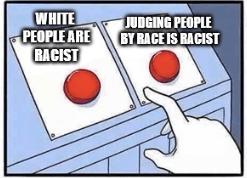
This is a popular meme about racism. It makes sense to me.

This is a popular meme about racism.

The only way we monitored that we met the race-percent target was by a check-box on forms. Students reported race, and we collected this, but we didn’t check that black students look black or Hispanic students spoke Spanish. There was no check on student honesty. Anyone who checked the box got the benefits. This lack of check bread cheating at MSU and elsewhere. Senator Elizabeth Warren got easy entry into Harvard and Penn, in part by claiming to be an Indian on her forms. She has no evidence of Indian blood or culture Here’s Snopes. My sense is that our methods mostly help the crooked.

The main problem with is, I suspect, is the goal. We’ve decided to make every university department match the state’s racial breakdown. It’s a pretty goal, but it doesn’t seem like one that helps students or the state. Would it help the MSU hockey squad to force to team to racially match the state; would it help the volleyball team, or the football team?  So why assume it helps every academic department to make it’s racial makeup match the state’s. Why not let talented black students head to business or management departments before graduation. They might go further without our intervention.

This is not to say there are not racial inequalities, but I suspect that these diversity programs don’t help the students, and may actually hurt. They promote crookedness, and divert student attention from achieving excellence to maintaining victim status. Any group that isn’t loud enough in claiming victim status is robbed of the reverse-discrimination that they’ve been told they need. They’re told they can’t really compete, and many come to believe it. In several universities, we gone so far as to hire “bias referees” to protect minorities from having to defend their intellectual views in open discussion. The referee robs people of the need to think, and serves, I suspect, no one but a group of powerful politicians and administrators — people you are not supposed to criticize. On that topic, here is a video of Malcolm X talking about the danger of white liberals. Clearly he can hold his own in a debate without having a bias referee, and he makes some very good points about white liberals doing more harm than good.

Robert Buxbaum, November 5, 2017. In a related problem, black folks are arrested too often. I suggest rational drug laws. Some financial training could help too.

Fat people live longer, show less dementia

Life expectancy is hardly affected by weight in the normal - overweight- obese range. BMI 30-34.9 = obese.

Life expectancy is hardly affected by weight in the normal – overweight – obese range. BMI 30-34.9 = obese.

Lets imagine you are a 5’10” man and you weigh 140 lbs. In that case, you have a BMI of 20, and you probably think you’re pretty healthy, or perhaps you think you’re a bit overweight. Our institutes of health will say that you are an “average-wight” or “normal-weight” American, and then claim that the average-weight American is overweight. What they don’t tell you, is that low weight, and so-called average weight people in the US live shorter lives. Other things being equal, the morbidity (chance of death) for a thin American, BMI 18.5 is nearly triple that of someone who’s obese, BMI 32. The morbidity of the normal-weight American is better, but is still nearly double that of the obese fellow whose BMI is 32.

Our NIH has created a crisis of overweight Americans, that is not based on health. They work hard to solve this obesity crisis by telling people to jog to work, and by creating ever-more complicated food pyramids. Those who listen live shorter lives. A prime example is Jim Fixx, author of several running books including “The complete Book of Running.” He was 52 when he died of a heart attack while running. Similar to this is the diet-expert, Adelle Davis, author of “Let’s eat right to keep fit”. She died at 70 of cancer — somewhat younger than the average American woman. She attributed her cancer to having eaten junk food as a youth. I would attribute it to being thin. Not only do thin people live shorter lives, but their chances of recovering from cancer, or living with it, seem to improve if you start with some fat.

The same patter exists where age-related dementia is concerned. If you divide the population into quartiles of weight, the heaviest has the least likelihood of dementia, the second heaviest has the second-least, the third has the third-least, and the lightest Americans have the highest likelihood of dementia. Here are two studies to that effect, “Association between late-life body mass index and dementia”, The Kame Project, Neurology. 2009 May 19; 72(20): 1741–1746. And “BMI and risk of dementia in two million people over two decades: a retrospective cohort study” The Lancet, Volume 3, No. 6, p431–436, June 2015.

Morbidity and weight, uncorrected data, and corrected by removing the demented.

Morbidity and weight, uncorrected data, and corrected by removing the demented. The likelihood of dementia decreases with weight.

Now you may think that there is a confounding, cause and effect here: that crazy old people don’t live as long. You’d be right there, crazy people don’t live as long. Still, if you correct the BMI-mortality data to remove those with dementia, you still find that in terms of life-span, for men and women, it pays to be overweight or obese but not morbidly so. The study concludes as follows: “Weight loss was related to a higher mortality risk (HR = 1.5; 95% CI: 1.2,1.9) but this association was attenuated when persons with short follow-up or persons with dementia were excluded.” As advice to those who are planning a weight loss program, you might go crazy and reduce your life-span a lot, but if you don’t go crazy, you’re only reducing your life-span a little.

In terms of health food, I’ve noticed that many non-health foods, like alcohol and chocolate are associated with longevity and mental health. And while low-impact exercise helps increase life-span, that exercise is only minimally associated with weight loss. Mostly weight loss involves changing the amount you eat and changing your clothes choices to maximize radiant heat loss.

Dr. Robert E. Buxbaum, October 26, 2017. A joke: Last week I was mugged by a vegan. You may ask how I know it was a vegan. He told be before running off with my wallet.

Military heroes, Genghis and confederate

genghis-khan-statue-complex

This 13 story statue of Genghis Kahn looks over the plains of Mongolia.

All military statues are offensive, as best I can tell. Among the most offensive, is the 131 foot tall monument to Genghis Kahn in central Mongolia. Genghis Kahn is known for near-perfect military success, and for near-total disregard for non-Mongols; he treated them as cattle, to be herded, slaughtered, raped or pillaged. I imagine this statue is offensive to Chinese, Russians, Koreans, Moslems, Jews, Hindus, Poles, and Germans — people he slaughtered by the millions. For some Mongols too, I imagine this statue is offensive as a sad reminder that Mongolia no longer rules the eastern world. But the monument is not for the maudlin, nor is it intended to offend. Like other military statues, the Genghis monument is a rally point for soldiers, old and new. It’s a way to inspire Mongols to be great leaders of men, military and not. Such will see, in Genghis, a man who made tough choices, and carried through to great achievements. That he killed and oppressed others will be justified by noting he did it to keep his Mongols from being killed or oppressed. The grand size is chosen to encourage Mongols to think big.

Genghis appears in fictional form as the villain, Shan Yu, in Mulan. There, his motivation is he doesn’t like the wall. Mulan and the Chinese army stop his Mongol attack by burying them at a snow-covered mountain pass. Historically, a Chinese army did meet Genghis and his army at a mountain pass, but the Mongols were not defeated. Instead they bypassed the Chinese and captured their supplies. Genghis then offered the starving Chinese a choice: join or die. Those that joined had to fight those who did not. A few months later, Peking fell, and in a few years, the rest of Asia. Few of the turncoats survived. Given the same choice, Genghis’s men never turned on him.

General Lee planted a maple tree on this spot in Fort Hamilton, New York. in 2017 the  plaque is removed as it's considered offensive.

General Lee planted a maple tree on this spot in Fort Hamilton, New York. in 2017 the plaque is removed as offensive.

Genghis’s most famous saying is that one arrow is easily broken, but a bundle will overcome any adversary. Similar to this, he is supposed to have said that, if you treat your soldiers as sons, they will follow you even into death. Such words are nonsense to non-soldiers and professional complainers: those who do not imagine themselves going to war. Those who go to war as generals know this is how to behave; those who go as soldiers hope for a leader who values them as sons, and not as cannon fodder.

In the US we’ve begun removing all monuments to the southern forces of the Civil War. This may be a mistake, but it seems irreversible. We’ve kept our monuments for Northern generals including William Sherman, known for his tactic of total destruction, and for Phillip Sheridan, equally known for total war, and for the saying: “The only good Indian is a dead Indian.” But we no longer tolerate Confederates. Among the reasons is that we claim to ease the pain of black people — a pain I feel looking at the Genghis Kahn monument. Another reason, we’re told, is that the statues are “dog-whistles” to racists and white supremacists — a particular danger now, evidenced in the election of Donald Trump. A danger, I think, that’s been largely trumped up as a way to keep politicians and newscasters politically relevant.

For these reasons, or politicians have removed every last confederate monument in Florida, the last being a large grave-stone in the Woodlawn cemetery. Virginia’s governor has similarly declared his intention to remove them all from his state. The city of Baltimore removed all four civil-war monuments in the middle of one busy night, August 18, 2017, and the University of Texas did similarly, working at night. New York City removed a plaque remembering Robert E. Lee for planting a tree at Ft. Hamilton, And, last week, an honorary window at the Washington cathedral where Lee had been a deacon.

Statues of Robert E. Lee are a particular target. There are quite a few in Virginia where his family was prominent — it was Richard H. Lee’s motion in the Continental Congress that carried as independence; his home now serves as Arlington Cemetery. While Lee opposed slavery and freed his slaves before the war, he fought for the Confederacy, so clearly he didn’t oppose slavery as totally as we would like. And Lee only freed his wife’s inherited slaves in 1862, fairly late, though Grant still had slaves at that time. Besides, in 1852, Lee caused an escaped slave to be whipped. I imagine he did the same to runaway soldiers. Historians used to praise Lee, but now call him a cruel racist. In hindsight, we imagine we would have done much better.

General Lee statue being removed from University of Texas.

General Lee statue being removed from the University of Texas.

As best I can tell, Virginians still remember Lee fondly, particularly soldiers, veterans, and those who imagine themselves leading men in difficult situations. When I try to put myself in Lee’s position, I find I can’t imagine myself doing better or achieving more. His life involved thousands of divisions and hundreds of inspiring actions. In the choice to fight for Virginia and not for the north, I note that Lee was given the same no-win choice as Genghis’s trapped Chinese: join the Union army and kill your brothers, or be killed by that army. The exchange appears in this movie. I admire Lee’s courage to stand by his brothers; it seems the more honorable of two bad choices. Early in his life, Lee committed himself to only honorable behavior  — according to his conception. This is all I expect from myself, and the most I hope for from any other person.

Another thing is Lee’s surrender. I find it a model of how to end a war so that lasting peace is achieved. It’s remembered in Johnny Cash’s song, “God Bless Robert E. Lee.”  Another song, “The night they drove old Dixie down” calls Lee “the very best.” I would be hard pressed to find a better US general: one who won more or was better loved.

Japanese resettlement.

Japanese resettlement in WWII. Our history is full of painful decisions by people we admire. Let’s try to not repeat our mistakes or pretend we don’t make them.

A killer complaint lodged against Lee, and against all the confederates, is that they were traitors. If so, George Washington and Ben Franklin were traitors too. In England, Benedict Arnold is honored as a patriot with a statue on Trafalgar square, but we do not honor him, rightly I think. He turned on his friends and brothers. I think it’s politics that’s motivated the current spate of removal. Most of the confederate statues stand (stood) in Democrat-leaning cities of five Republican-leaning states: Virginia, Texas, Georgia, North Carolina, and Mississippi. The white, non-college country-folk of these states are being pitted against the darker, college-educated city folk in a fight for their hearts and pocket books.

As for my guess at interpretation of the statues themselves. I’m inclined to suggest that the statues and their inscriptions do not appear racists to me, so much as soldierly. The statues were largely erected between the Spanish-American war and WWII with soldierly (to my eyes) comments. Baltimore monument to Jackson and Lee, reads on one side: “STRAIGHT AS THE NEEDLE TO THE POLE JACKSON ADVANCED TO THE EXECUTION/ OF MY PURPOSE” and on the other side: “SO GREAT IS MY CONFIDENCE IN GENERAL LEE THAT I AM WILLING TO FOLLOW HIM BLINDFOLDED.” Another Baltimore inscription: “THEY FOUGHT AS GENTLEMEN.” To me this latter is a swipe at Sherman and Sheridan, who did not. Removing these statues is a swipe at the honor of southern soldiers. The statues now read “BLACK LIVES MATTER,” a slogan I read as anti-police, anti-Trump, and anti-white.

The remnant of Baltimore's Lee- Jackson statue, showing the old inscription and the new.

The remnant of Baltimore’s Lee – Jackson statue with the old inscription and the new..To me, the old inscription is military, mostly, and not as racist as the new.

The pain of black America is real, but the thing that’s missed is that it is similar to the pain of rural white America. Both have been left behind. I’ve noted that urban black Americans and rural whites have virtually no savings, It could be the two poor cultures don’t realize they have much in common. Or it could be (I think) some folks purposefully fermenting dissension. What is needed, at least is better financial sense, and a recognition that race isn’t racism, but to listen to CNN or read the New York Times, such understandings seem unlikely. The Trump election shocked everyone, I think, those who voted for him and those who didn’t — and perhaps even Trump himself. Hillary, it seems had already bought a house in DC to house her staff. The surprise is not a reason to turn on one’s fellow. I can hope that Trump will prove to be a great president. For now, he is the president, and we are faced by nuclear enemies. It hardly helps to see half of our electorate call the other half racists and deplorables. As with a bundle of arrows, we have strength in union, weakness in disunion. May we all be blessed for a good, sweet year of peace and brotherly love

Robert E. Buxbaum. September 24, 2017. Perhaps my fondness for Lee is because I’m named after him. Here’s my theory for why Mongol arrows flew further.

Estimating the strength of an atom bomb

As warfare is a foundation of engineering, I thought I’d use engineering to evaluate the death-dealing power of North Korea’s atomic/hydrogen bomb, tested September 3, 2017. The key data in evaluating a big bomb is its seismic output. They shake the earth like earthquakes do, and we measure the power like earthquakes, using seismometers. I’ve seen two seismographs comparing the recent bomb to the previous. One of these, below, is from CTBTO, the Center for Test Ban Treaty Oversight, via a seismometer in western Kazakhstan (see original data and report).

Seismic output of all North Korean nuclear tests.

Seismic output, to scale, of all declared DPNK nuclear tests as observed from IMS station AS-59 in Western Kazakhstan

North Korea’s previous bomb, exploded 9 September 2016, was reported to be slightly more powerful than the ones we dropped on Hiroshima and Nagasaki, suggesting it was about 20 kilotons. According to CTBTO, it registered 5.3 on the Richter scale. The two tests before that appear somewhat less powerful, perhaps 7-10 kilotons, and the two before that appear as dismal failures — fizzles, in atomic bomb parlance. The MOAB bomb, by comparison, was 9 Tons, or 0.009 kiloTons, a virtual non-entity.

To measure the output of the current bomb, I place a ruler on my screen and measure the maximum distance between the top to bottom wiggles. I find that this bomb’s wiggles measure 5 cm, while the previous measures 5 mm. This bomb’s wiggles are ten times bigger, and from this I determine that this explosion registered 6.3 on the Richter scale, 1.0 more than the previous — the Richter scale is the logarithmic measure of the wiggle amplitude, so ten times the shake magnitude  is an addition of 1.0 on the scale. My calculation of 6.3 exactly matches that of the US geological survey. The ratio of wiggle heights was less on the, NORSAR seismometer, Norway, see suggesting 5.8 to 5.9 on the Richter scale. The European agencies have taken to reporting 6.1, an average value, though they originally reported only the 5.8 from NORSAR, and a bomb power commensurate with that.

We calculate the bomb power from the Richter-scale measure, or the ratio of the wiggles. Bomb power is proportional to wiggle height to the 3/2 power. Using the data above, ten times the wiggle, this bomb appears to be 10^3/2 = 31.6 times as powerful as the last, or 31.6 x 20kTon = 630kTon (630,000 tons of TNT). If we used the European value of 6.1, the calculated power would be about half this, 315 kTons, and if we used the NORSAR’s original value, it would suggest the bomb had less than half this power. Each difference of 0.2 on the Richter scale is a factor of two in power. For no obvious reason we keep reporting 120 to 160 kTons.

NORSAR comparison of North Korean bomb blasts

NORSAR comparison of North Korean blasts — suggests the current bomb is smaller; still looks like hydrogen.

As it happens, death power is proportional to the kiloton power, other things being equal. The bombs we dropped on Hiroshima and Nagasaki were in the 15 to 20 kTon range and killed 90,000 each. Based on my best estimate of the bomb, 315 kTons, I estimate that it would kill 1.6 million people if used on an industrial city, like Seoul, Yokohama, or Los Angeles. In my opinion, this is about as big a bomb as any rational person has reason to make (Stalin made bigger, as did Eisenhower).

We now ask if this is an atom bomb or a hydrogen-fusion bomb. Though I don’t see any war-making difference, if it’s a hydrogen bomb that would make our recent treaty with Iran look bad, as it gave Iran nuclear fusion technology — I opposed the treaty based on that. Sorry to say, from the seismic signature it looks very much like a hydrogen bomb. The only other way to get to this sort of high-power explosion is via a double-acting fission bomb where small atom bomb sets off a second, bigger fission bomb. When looking at movies of Eisenhower-era double-acting explosions, you’ll notice that the second, bigger explosion follows the first by a second or so. I see no evidence of this secondary-delay in the seismic signature of this explosion, suggesting this was a hydrogen bomb, not a double. I expect Iran to follow the same path in 3-4 years.

As a political thought, it seems to me that the obvious way to stop North Korea would be to put pressure on China by making a military pact with Russia. Until that is done, China has little to fear from a North Korean attack to the south. Of course, to do that we’d likely have to cut our support of NATO, something that the Germans fear. This is a balance-of-power solution, the sort that works, short of total annihilation. It was achieved at the congress of Vienna, at the treaty of Ghent, and by Henry Kissinger through détente. It would work again. Without it, I see the Korean conflict turning hot again, soon.

Robert Buxbaum, September 11, 2017.

Kennedy’s perfect, boring college-entry essays

To get into any college you have to write an essay or two, generally including one describing why you want to go that particular college, and many students have trouble. How do I make myself stand out, they ask. My suggestion: Don’t. Make it clear that you want to go, but dare to be dull with the details. John Kennedy did; you can too.

JFK's dull letter to Harvard. It's his only essay.

JFK’s dull letter to Harvard. It’s his only essay.

Most school essays limit the number of words. The reviewer too prefers you keep it short. If you want to go to Harvard, or Princeton, or Iowa state, show you can say what needs to be said within the word limit. The first sentence must tell them that you want to go that college, specifically. Mention the college: you want to go to Old Ivy, say. Once that’s taken care of, just state your reasons. Unless you’re going into the writing program, the baldest, simplest terms will work just fine — e.g. that Old Ivy provides an excellent education. It’s better if you can mention a more-specific field of study, e.g. liberal arts or zoölogy, but that’s not necessary. You can now list three or so details to back up your claims. For example, you might mention that the zoölogy program at Old Ivy is well-regarded (mention the school often), that you enjoy their sports team (the ground-hogs, say), or their extracurriculars. Mention that your dad went there or your uncle (and is your hero — hero is a good word) or that you like the location. Surely there is some reason you want to go. If you can mention a famous teacher or alumnus, all the better. Flesh it out if you have space; don’t if you don’t. Conclude with a sentence pointing to the future: that this school will help me do something you want to achieve. You can be specific or not, but don’t lie. Dull is more effective than a lie. I’ve copied, above, John Kennedy’s essay to Harvard, and below his essay to Princeton. These essays follow the pattern, and are dull within the pattern. His conclusion for the first essay: that he wants to go to Harvard to be “a Harvard Man.” He got in. He used the same, dull letter for Princeton, but had more space. For Princeton he said It would have a good effect on me, and that he wanted to be “a Princeton Man.” He got into Princeton too, and went there for two months before switching to Harvard.

John F. Kennedy's, almost identical letter to Princeton. He got in there too.

John F. Kennedy’s, almost identical letter to Princeton. He got in there too.

You may think that letters like this only work if you are John F. Kennedy, and to some extent that is true. But not totally. I got into Princeton grad school from a background in public school, with no famous relatives or money. My grades were better than JFKs, but my essay had the same structure with some more specifics. As I recall, I explained that I wanted to go to Princeton because I wanted to study chemical engineering in a top department. I may have mentioned a famous professor, and stated I wanted to work on nuclear fusion — a big Princeton specialty at the time. That’s about all, as I recall.

This formula can be tweaked for the other college (and non-college) essays. I’ve previously written about the two speeches at the opening of the Gettysburg cemetery, in 1863. Edwin Everett gave the first speech of the day, excerpted and analyzed here. His speech followed the formula and was lauded. He told folks that it was important that we are here honoring the dead, and followed with three or four reasons for why it was important. His conclusion pointed to the future significance of the events. Republicans and Democrat listeners agreed this was a speech to remember from a scholar of note. Everett’s face graced the $50 bill for the 40 years after his death.

Abraham Lincoln also spoke at the Gettysburg dedication, but he didn’t follow the formula. He spoke of liberty, and America, and of a government of the people. His speech was panned at the time, even by Republicans. More details here. Though people now see his Gettysburg address as a landmark, at the time even the Republican press didn’t like it  Fortunately for Lincoln and the republic, they warmed to the speech over the next year – in time for the election of 1864. When you apply to college, you want entry now. You can’t wait a year for people to warm to your essay. Stick to the formula. You don’t want the compliment of finding, years from now, that one of the reviewers who rejected you remembers your words fondly. That will be too late. Write for the dull audience in front of you; help them put your application in the “accepted” box. As a last note: If you can not find any truthful reason that you want to go to Harvard or Old Ivy you probably should not be going there. The beginning of wisdom is self-knowledge, and the primary audience for your essay is you.

If you find you have good reasons, but find you need help with the process or with your english grammar, I should mention that my niece owns a company to help folks get into college — link here. She also has a book “From Public School to The Ivy League.

Robert E. Buxbaum, August 7, 2017. Some two years ago, I wrote an essay for my daughter on the joys and pressures of entering her junior year in high school. Here it is.