Category Archives: politics

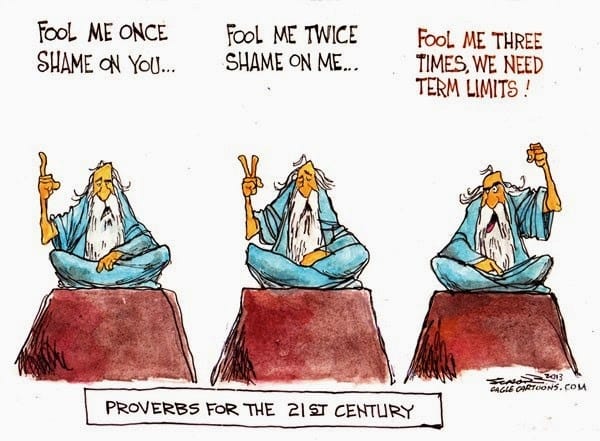
Term limits, in what world are they Republican or conservative?

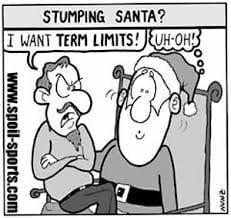
The desire for term limits is one of the political innovations that leaves me baffled. What is the logic, especially for conservatives or Republicans. In theory, Republicans favor any freedom that does not hurt the individual, and in theory conservatives favor things according to the Bible. Both should oppose term limits. No individual is hurt by term limits, and in the Bible, good kings, judges, and advisors should serve for life. Rehoboam, Solomon’s son, splits Israel by ignoring his father’s advisors (1 Kings 12 ff). term limits

In a more-secular context, if you have a good doctor, one who took years to learn the craft, would you get rid of him just because you’re afraid he’ll become comfortable? It’s insane personally, and worse to make a law forcing other people to do it. It suggests a paranoia of public will, the opposite of what a Democratic Republic stands for. These are laws to keep people from voting for the fellow they like! it’s like we believe ourselves to be addicts with a deadly addiction. It’s also like we believe policy is so simple and so corrupting that a beginner is always better than everyone with experience. As it happened, Rehoboam’s young councilors were more money-hungry than the old.

Protect me from making the same mistake thrice.

Protect me from making the same mistake thrice.

Michigan’s term limits are worse than most because ours are uncommonly short: 6 years for the house. 8 for the senate, 8 for governor. While I can accept an eight year  term limit for the governor, in theory he’s just an executor, I can see no basis for the short term limits on those serving in the MI house or senate. If we can’t eliminate these limits, we should at least extend them. Also I would not make the exclusion on any of these individuals life-long. If someone served in the senate say, then left and served as governor, why not let the fellow run again for senate?

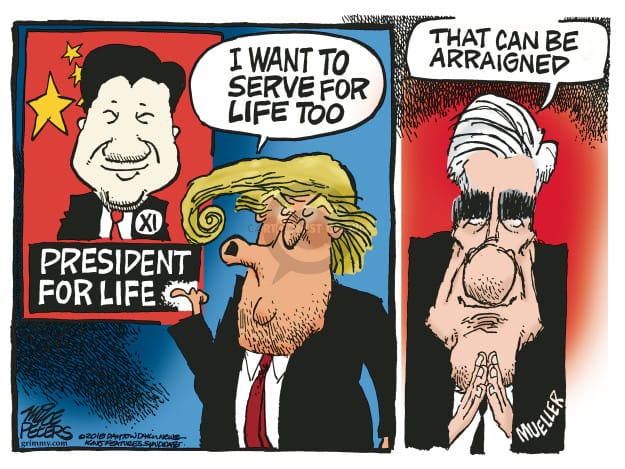
For those reading this in future decades, it's funny because XI is president of China for life, something US presidents (Trump) can't be. But they can be  put in prison for life.

behind bars  For those reading this in future decades, it’s funny because XI is president of China for life, something US presidents (Trump) can’t be. But they can be put in prison for life.

For the same reason, I’m not a fan of long, mandatory minimum prison sentences. It’s like we don’t trust our judges to be tough enough. If we don’t trust them, don’t elect them, or remove them. As it is, we have more people per-capita behind bars than any other nation on earth. We assume, I guess that we can’t pick a good judge, but have to make sure he or she isn’t a lenient rascal who’ll serve for life. But is that so bad? Is it better to force the judge to spit on everyone?

There are many problems with fair sentencing, but I’m inclined to say that extenuating circumstances are always relevant, and that the shortest sentence sufficient to prevent further crime is usually the best. If judges are rascals, then the way to deal with it is judicial review or un-election. As Cotton Mather said years after overseeing the Salem witch hunts: “It’s better that a hundred witches go free than that we kill a single innocent person”. With judges, as with voters, restricting choice by law seems proper only when the effect is to protect the individual, not when the effect is to increase his burden, or so it seems to me.

Robert E. Buxbaum, October 11, 2018.

Feminism in law and middle east diplomacy

If you went to college in the last 40 years and learned there was a concept called “the rape culture” that was supposed to drive law and diplomacy. In terms of law the assumption was that all men – or most — were rapists or would be rapists. Along with this, women are weaker, and almost always the victim in male-female interactions. As such the woman has to be believed in all cases of “he-said, she-said.” To do otherwise was “rape-shaming” a form of blaming the victim. Male on female rape is supposed to have infected international affairs as well. War and peace are assumed to be rape situations where no country is assumed to want foreign influence or industry unless they say so, and any demand that you take your embassy or hotel out has to be met with immediate withdrawal. The female country is the weaker in these deals, and where that could not be determined, the raper country was determined by geography. Israel was always the raper country because of its shape and position within the Arab world. Israel was asked to withdraw — cease to exist as a non-Islamic nation — and admit that it was raping the Arab world just by existing.

Before World War I, there was no such thing as a world court. If one country attacked another, the attacked country could appeal to allies, or perhaps to public opinion, but there was no certainty of rescue. Without a world court, and without a world set of laws, claiming victim status did little. Weaker principalities could be divided up, and sometimes sold off or traded. Manhattan went from being a Dutch settlement to being an English settlement when the English traded an island in the Pacific for it. Napoleon acquired Louisiana from the Spanish by trading northern Italy, then promptly sold Louisiana to America. And all this was normal. The international version of human trafficking, I suppose.

After WWI, a world court was created along with a new diplomatic theory: the world should protect the weak and the wronged. In this context, feminist analysis of which country is wronged would have been important except that there was no army to do the enforcing. Woodrow Wilson championed a League of Nations, one of his 19 points. The weak and abused would be protected from the strong; democracy would be protected from the dictator. This is a softer, kinder view of the world, a cooperative world, a feminist world, and in academia it is considered the only good version — a one world order with academics at the top. Still, without an army or much of a budget, it was all academic, as it were. This changed when the United Nations was created with a budget and an army. If the army was to protect the victim, we had to determine who was the aggressor. In 95% of all cases considered before the UN, the aggressor was asserted to be Israel. This in not despite its small size, but because of it. By feminist analysis, the surrounding country is always the victim.

In feminist analysis, there is the need for a third type of person, almost a third gender. This is the male feminist. This is the warlike defender of the weak. Such people are assumed to make up the UN army and its management. When an outsider country appears within the boundaries of another nation, that’s national rape and has to be prevented by this third-gender army. Hitler’s takeover of Europe was rape, not because he was totalitarian (he was elected democratically) but because his was an unwelcome intrusion. The counter-invasion of Germany was/is only justified by assuming that the allies (the good guys) represented, not rape, but some third gender interaction. It all made a certain type of sense in college seminars, if not in life, and men were not quite expected to understand; we were just expected to become this third gender.

Being a Male Feminist is uncomfortable both in personal and international affairs. It is very uncomfortable to have to defend every victim, making every sacrifice no matter how personally objectionable the victim is, or how arbitrary the distinction of victim, or how much the victim hates her savior. In personal affairs, this is a theme in Bob Dylan song “It’s ain’t me, babe.”  Dylan agrees with a lady that she has a right to want all sorts of things, but says, “it ain’t me babe,” about him being the guy to provide them all.

In international affairs the discomfort is even worse. We found, with depressing frequency, that we were expected to donate the lives of countless soldiers in support of regimes that were objectionable, and that hated us. Jimmy Carter supported the PLO and Idi Amin, and the Ayatollah because they were weak regimes with incursions: by the oil companies or the CIA. The people we were helping hated us before Jimmy Carter, and they hated us more after. The Ayatollah in Iran captured or killed our diplomatic staff, and beheaded anyone with western sympathies.

I have come to think that a redefinition of rape is what is needed. I note that not all rape is male-on female, and not all wars are won by incursion. The Mongols won by surrounding. Similarly, the game of GO is won by surrounding. I would like to stop assuming that the surrounding nation is always the victim and that the woman is always telling the truth. In personal injury law, I’d like more freedom to try to decide which is right or wrong or maybe both have a case, and we may want to just sit back and wait to offer mediation. Here’s another Bob Dylan song on the difficulty of figuring out who is right or wrong: “God on our sides.”

Robert E. Buxbaum, September 21, 2018

God bless you Canada

Canada is a fine country, rarely appreciated in the USA because most of it is so similar to us — One of my favorite places to visit in Canada was the museum of Canadiana — a museum dedicated to the differences between the US and Canada. Differences do exist, but they are few and small, as you can tell perhaps from the song below, “God Bless You Canada,” by Lee Greenwood, the same fellow who wrote, “God Bless the USA.” The tunes and words are strongly similar, I’d say.

Canada is much easier to reach than Hawaii for the most part, or Alaska, Puerto Rico, or Guam, it’s just north of Montana and south of Alaska and Detroit. And Canadian English is at least as understandable as a southern drawl or a New Yorker twang. Canada has far fewer murders but far more rapes, armed robberies and assaults. It has the same suicide rate as we do, but by different means. And Toronto’s mayor was on crack like Detroit’s mayor.

Canadian $2 coin, Elizabeth II, by the grace of god, Queen. The last part is in Latin.

Canadian $2 coin, Elizabeth II, by the grace of god, Queen (it’s in Latin).

Canada has a Queen, Elizabeth II, that it shares with several other countries including England, Australia, and Barbados. This is no to say that Canada isn’t quite independent: the main power of Canada’s Queen, like with the US president, is “the bully pulpit”. As in The United States. The press does its best to rein in this power.

If Canada were to join the US as the 51 state, it be the 3rd largest state in population (after Texas and California) and the 3rd largest in GDP (after New York and California). Not that all of Canada is likely to join, but certain parts might (New Brunswick, Newfoundland, Labrador) if Quebec goes its separate way. Québécois like remember that they were originally French. “Je me Souviens” is the Quebec motto, and having an English Queen irks. One of my favorite Canada facts (maybe true) is that the name Canada is French for Ça nada (nothing here) but tit’s not sure, there is stuff and people there. My wife is from there. Listen to the song, “God Bless you, Canada”, I suspect you’ll like it.

Robert Buxbaum, September 17, 2018.

A Pastor to Trump’s Soul

Trump’s religious connection is so different from the norm that most people think it must be fake, but the truth of his connection to Christianity, as best I can determine it, is even more bizarre than the assumption that there is none. From the time that he was six years old, Donald Trump attended a famous church in New York City, The Marble Collegiate Presbyterian Church. He attended along with his grandfather, his parents, his brother, and his sisters. He was married in this church as was his sister. Both his parents funerals were in the sanctuary, and unlike most children in a family church, he seems to have been generally moved by the sermons — moved to change his life.

Trump and NVP

Various scenes of Trump and his family with Dr. Norma Vincent Peale.

The pastor of the church and the author of these sermons was not a standard Christian, though. It was Norman Vincent Peele, author of “The Power of Positive Thinking.” According to President Trump, he loved the sermons almost from the beginning. They went on for an hour or so and as Trump remembers it, the Reverend Peele could have spoken for twice as long at least. Dr. Peale did not talk fo sin, but rather of success and other of the most positive things. Peale claimed that you could do anything you wanted with the help of God and proving you believed in your self and didn’t let anything anyone said interfere. He backed up this take on the bible by a cherry-picked selection from all the positive lines in the Bible — Lines that are really there, but that most pastors avoid because they can make a person arrogant (or seem arrogant). A source for all of president Trumps bizarre self-image ideas can be found in Peele’s “The power of positive thinking,”I  find.presidents-billy-right-960x640BG-Kennedy-960x640

Dwight Eishenhouer

Some other US presidents with Reverend Billy Graham.

Most other American pastors have emphasized self reflection and humility. They would pray for the power to avoid bragging or other forms of puffing one’s self up —  the very opposite approach of Dr. Peale’s. The most popular of the alternates approaches, one embraced by virtually every president from 1952 to today was Billy Graham’s fire humility.

Eisenhower golfed with Graham regularly, as did Kennedy, Johnson, Nixon, Ford, and G. H.W. Bush. Graham was a feature at prayer breakfasts with Johnson and Reagan, and Carter. In time of trouble it was Billy Graham who counseled Carter, Clinton, and Nixon, and it was Graham who got George W. Bush to give up drinking. After a time, one could imagine that Billy Graham’s quiet humility and fiery faith was the real American belief. Or at least that this was the form of American soul that one associated with success.bill graham reagan BG-JOHNSON

After decades of seeing Billy Graham at the White House, one began to believe that his was the image of the believing American. To believe meant to see oneself as a sinner who often made mistakes but was genuinely sorry for these failures. A believing American was genuinely penitent, but not too loudly. Was reborn, but didn’t make too much fuss of it. Thus it’s more than a little shock to find believer in God’s plan who claims to believes that God wants him to have success, money, and power, and who claims, as Trump does, that those who criticize him are “fake news”.

I’ve mentioned before that a strong belief in ones self has a positive side for leaders, but it strikes me that perhaps it’s also good for religion. These lines really do appear in the Bible, Humility is there too, of course, but we could all use a reminder that “God gives to all who believe in Him.”

Robert Buxbaum, September 3, 2018

Beavers, some of the best dam builders

I ran for water commissioner in 2016 (Oakland county, Michigan; I’ll be running again in 2020), and one of my big issues was improving our rivers. Many are dirty and “flashy”. Shortly after a rain they rise too high and move dangerously fast. At other times, they become, low, smelly, and almost disappear. There are flash floods in these rivers, few fish or frogs, and a major problem with erosion. A big part of a solution, I thought, would be to add few small dams, and to refurbish a few others by adding over-flow or underflow weirs. We had a small dam in the middle of campus at Michigan State University where I’d taught, and I’d seen that it did wonders for river control, fishing, and erosion. The fellow I was running against had been removing small dams in the belief that this made the rivers “more natural”. The Sierra Club thought he was right doing this; the fishing community and some homeowners and MSU alumni thought I was. My problem was that I was a Republican running in a Democratic district. Besides, the county executive, L. Brooks Patterson (also a Republican) was a tightwad. Among my the first stops on my campaign trail was to his office, and while he liked many of my ideas, and promised to support me, he didn’t like the idea of spending money on dams. I suggested, somewhat facetiously, using beavers, and idea that’s grown on me since. I’m still not totally convinced it’s a good idea, but bear with me as I walk you through it.

Red Cedar River dam as seen from behind the Michigan State University Administration Building.

Small dam on the Red Cedar River at Michigan State University behind the Administration Building. The dam provided good fishing and canoeing, and cleaned the water somewhat.

The picture at right shows the dam on the Red Cedar River right behind the Administration building at Michigan State University, looking south. During normal times the dam slows the river flow and raises the water level high enough to proved a good canoe trail, 2 1/2 miles to Okemos. Kids would fish behind the dam, and found it a very good fishing spot. The slow flow meant less erosion, and some pollution control. The speed of flow and the height of the river are related; see calculation here. After a big rain, a standing wave (a “jump”) would set up at the dam, raising its effective height by three or four feet. Students would surf the standing wave. More importantly, the three or four feet of river rise provided retention so that the Red Cedar did little damage. Some picnic area got flooded, but that was a lot better than having a destructive torrent. Here’s some more on the benefits of dams.

Between July 31 and Aug 1 the Clinton River rose nine feet in 3 hours, sending 130,000,000 cubic feet of water and sewage to lake St Clair.

Between July 31 and Aug 1 the Clinton River rose nine feet in 3 hours, sending 130,000,000 cubic feet of water to lake St Clair.

The Sierra club supported (supports) my opponent, in part because he supports natural rivers, without dams. I think they are wrong about this, and about their political support in general. Last night, following a 1 1/2 inch rain, the Clinton River flash flooded, going from 5.2 feet depth to 14 feet depth in just two hours. My sense is that the natural state of our rivers had included beavers and beaver dams until at least the mid 1700s. I figured that a few well-designed dams, similar to those at Michigan State would do wonders to stop this. Among the key locations were Birmingham, on the Rouge, Rochester, near Oakland University, Auburn Hills, and the Clinton River gorge, and near Lawrence Technical University. If we could not afford to build man-made dams, I figured we could seed some beaver into nearby nature areas, and let the beavers dam the rivers for free. It would bring back the natural look of these areas, as in the picture below. And engineers at Lawrence Tech and Oakland University might benefit from seeing the original dam engineers at work.

Beaver dam on a branch of the Huron River. Beavers are some of the best dam builders.

Beaver dam on a branch of the Huron River. A rather professional and attractive job at a bargain price.

Beavers are remarkably diligent. Once they set about a task, they build the basics of a dam in a few days, then slowly improve it like any good craftsman. As with modern dams, beaver dams begin with vertical piles set into the river bottom. Beavers then fill in the dam with cross-pieces, moving as much as 1000 lbs of wood in a night to add to the structure and slow the flow. They then add mud. They use their hearing to detect leaks, and slowly plug the leaks till the dam is suitably tight. Most of the streams I identified are narrow and pass through wooded areas. I think a beaver might dam them in a few days. Based on the amount of wood beavers move, and the fact that beavers are shaped like big woodchucks, I was able to answer the age-old question: how much wood would a woodchuck chuck if a woodchuck could chuck wood — see my calculation here.

Me, visiting the DNR to talk beavers

Me, visiting the DNR to talk beavers

There are a few things to check out before I start hiring beavers to take care of Oakland county flooding, and I have not checked them all out yet. Beavers don’t necessarily build where you want or as solidly, and sometimes they don’t build at all. If there are no predators, beavers can get lazy and just build a low-water lodge and a high water lodge, moving from one to the other as the river rises and falls. Hiring a beaver is like hiring an artistic contractor, it seems: you don’t necessarily get what you ask for, and sometimes you get more. Given the flash flooding we have, it’s hard to picture they’d make things worse, but what do I know? In some cases, e.g. the Red Run near the 12 towns drain, the need is for more than a beaver can deliver. Still, without beavers, the need would be for a billion gallons of retention on the Clinton alone, a 10 billion dollar project if carried out as my opponent likes to build. So, with no budget to work with, my next stop was at the Department of Natural Resources Customer Service Center (Lansing). I had some nice chats with beaver experts, and I’m happy to say they liked the idea, or at least they were not opposed. I’ve yet to talk to the Michigan director of dams, and will have to see what he has to say, but so far it seems like, if I get elected in 2020, I’ll be looking for some hard-working beavers, willing to relocate. I’d like to leave it to Beaver.

Robert E. Buxbaum, August 2, 2018. I still don’t get the Sierra Club’s idea of what a natural river would look like, or their commitment to Democrats. In my opinion, a river should include beavers, fish, and fishermen, and drainage should be done by whoever can do it best. Sierra club folks are welcomed to comment below.

The Great, New York to Paris, Automobile race of 1908.

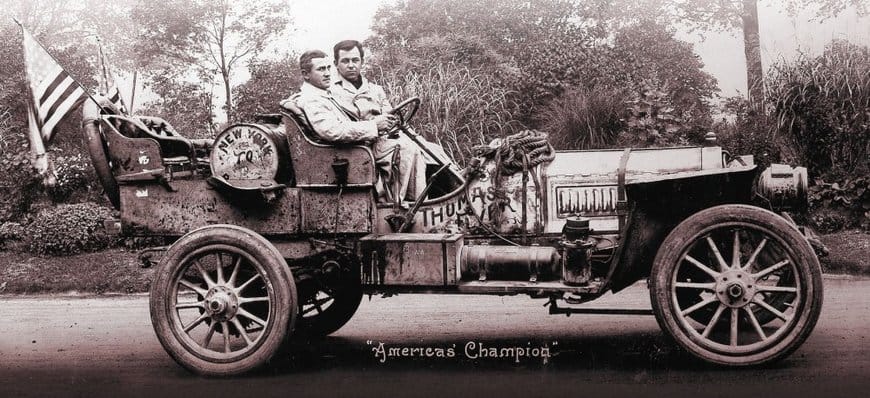
As impressive as Lindberg’s transatlantic fight was in 1926, more impressive was George Schuster driving and winning the New York to Paris Automobile race beginning in the dead of winter, 1908, going the long way, through Russia. As of 1908, only nine cars had ever made the trip from Chicago to California, and none had done it in winter, but this race was to go beyond California, to Alaska and then over the ice through Russia and to Paris. Theodore Roosevelt was president, and Americans were up to any challenge. So, on February 12, 1908 there congregated in Times Square, New York, a single, US-made production car, along with five, specially made super-cars from Europe; one each from Italy and Germany; and three from France. The US car, a Thomas Flyer (white), is shown in the picture below. The ER Thomas company sent along George Schuster, as an afterthought: he was a mechanic and test-driver for the company, and was an ex bicycle racer. The main driver was supposed to be Montague Roberts, a dashing sportsmen, but the fellow dropped out in Cheyenne, Wyoming. Schuster reached the Eiffel tower on July 30, 1908, 169 days after leaving New York. The Germans and Italians followed. None of the French super-cars got further than Vladivostok, and one dropped out after less than 100 miles.

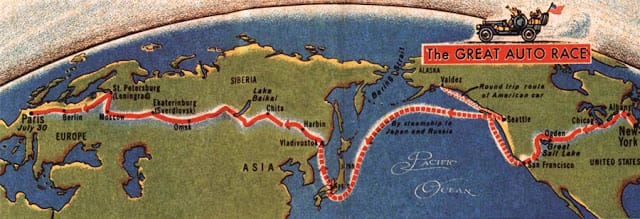
The race was sponsored by The New York Times and Le Matin, a Paris newspaper. They offered a large trophy, a cash prize of $1000, not enough to pay for the race, and the prospect of fame. The original plan was for drivers to go from New York to San Francisco, then to Seattle by ship, and Northern Alaska, driving to Russia across the Arctic ice. That plan was abandoned when Schuster, the first driver to reach Alaska, discovered ten foot snows outside of Valdez. The race was modified so that travel to Russia would be by ship. Schuster took his Thomas to Russia from Alaska, the other two drivers reached Russia from Seattle by way of Japan. Schuster was given a bonus of days to account for having taken the longer route. Because of his detour, he was the last to arrive in Russia. From Japan, the route was Vladivostok, Omsk, Moscow, St. Petersburg, Berlin, and Paris, 21,900 miles total; 13,341 miles driven. Schuster drove most of those 13,341 miles, protected by his own .32-caliber pistol, and mostly guided by the stars and a sextant. He’d taught himself celestial navigation as there were no roadmaps, and hardly any roads.

George Schuster driving the Thomas Flyer, the only American entry, and the only production motorcar in the race.

George Schuster driving the Thomas Flyer with another mechanic, George Miller, the Flyer was only American entry, and the only production motorcar in the race. Note that the flag has only 45 stars.

The ship crossing of the Pacific was a good idea given that, even in the dead of winter, global warming meant that the arctic could not be relied upon to be solid ice. As it was, Schuster had to content with crossing the Rockies in deep snow, and crossing Russia in the season of deepest mud. He reached the Eiffel tower at 6 p.m. on July 30, 1908. The German car had arrived in Paris three days ahead of Schuster, but was penalized to second place because the German team had avoided the trip to Alaska, and had traveled some 150 km of the Western US by railroad while Schuster had driven. The Italian team reached Paris months later, in September, 1908. That the win went to the only production car to compete is indicative, perhaps of the reliability that comes with mass production. That Mr. Schuster was not given the fame that Lindberg got may have to do with the small size of the prize, or with him being a mechanic while Lindberg was a “flyer”. Flyers were sexy; even the car was called a flyer. The Times saw fit to hardly mention Schuster at all, and when it did, it spelled his name wrong. Instead the Times headline read, “Thomas Flyer wins New York to Paris Race.” You’d think the car did it on its own, or that the driver was named Thomas Flyer.

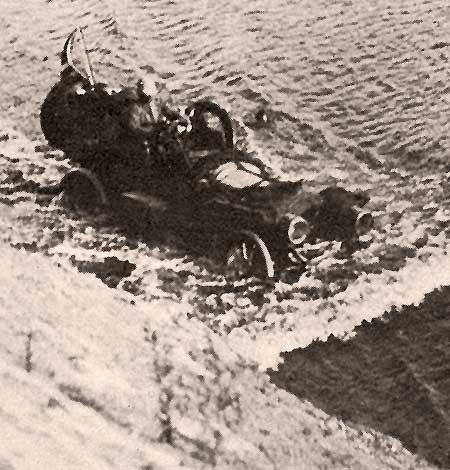
The Flyer crossing a swollen  river in Manchuria.

Schuster in his Flyer crossing a swollen river in Manchuria.

The Times could not get enough of Montague Roberts; the driver of the first leg was famous and photographic. They tried to get Roberts to drive the last few miles into Paris, “once the roads were good”. And Roberts was the one chosen to drive in the hero-parade in New York, Schuster rode too, but didn’t drive. Schuster was feted by Theodore Roosevelt, though, who said he liked people “who did things.” Schuster said he’d never do a race like that again, and he never did race again.

The race did wonders for the reputation of American automobiles, and greatly spurred the desire for roads, but it did little or nothing for the E.R.Thomas company. Thomas cars were high cost, high power models, and they lost out in the marketplace to Henry Ford’s, low-cost Model T’s. You’d think that, in the years leading up to WWI, the US Army might buy a high cost, high reliability car, but they were not interested, and the Thomas company did little to capitalize on their success. The Flyer design that won the race was discontinued. It was a 60 hp, straight 4 cylinder engine version, replaced by lower cost Flyers with 3 cylinders and 24 hp. Shortly after that, Edwin R. Thomas, decided to drop the Flyer altogether. His company went bankrupt in 1912, and was bought by Empire Smelting. The original Flyer was sold in 1913 at a bankruptcy action, lot #1829, “Famous New York to Paris Racer.”

ER Thomas went on to found another car company, as was the style in those days. Thomas-Detroit went on make similar cars to the Flyer, but cheaper. The largest, the K-30, was only 30 hp. The original Thomas Flyer is now in the National Automobile Museum, Reno Nevada. after being identified by Schuster and restored. Here is a video showing the original Flyer being driven by a grandson of George Schuster. There is a lower-power Thomas Flyer (black) in a back space of the Henry Ford museum (Detroit). Protos vehicles, similar to the one that came in second, were produced for the German military through WWI. Their manufacturer, Siemens, benefited, as did the German driver.

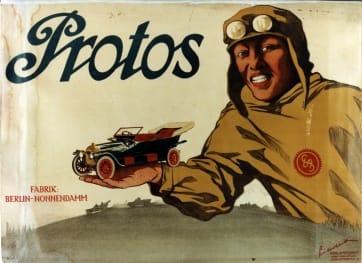
Advertisement for the Protos Automobile, a product of Siemens motor company. The race did not include a production Protos but one made specially for the race.

Advertisement for the Protos Automobile, a product of Siemens motor company. The race did not include a production Protos but one made specially for the race.

The Thomas engine (and the Protos) engine) live on in a host of cars with water-cooled, four-cylinder, straight engines. In 1922, Chalmers-Detroit merged with Maxwell and continued to produce versions of the old Flyer design, now with an internal drive-shaft. The original Flyer was powered via a gear-chain, like a bicycle. In 1928, Maxwell was sold to Chrysler. Chrysler persists in calling their high-power, four-cylinder engines by the name Chalmers. As for Schuster, when ER Thomas closed its doors, he had still not been paid for his time as a race driver. He went to work for Pierce-Arrow, another maker of large, heavy vehicles. The “cheaper by the dozen” family (two parents, 12 kids) drove a Pierce-Arrow.

The Great race appears in two documentaries and two general audience movies, both comedies. The first of these was Mishaps of the New York–Paris Race, released by Georges Méliès, July 1908, just about as the Flyer was entering Paris. The second movie version  “The Great Race” was released in 1965. It’s one of my favorite movies, with Jack Lemon as the Protos driver (called Dr. Fate in the movie), Tony Curtis as “The Great Leslie”, the Flyer driver. For the movie, the Flyer is called “The Leslie”, and with Natalie Wood as a female reporter who rides along and provides the love interest. In the actual race reporters from the New York Times, male, traveled in the Flyer’s rear seat sending stories back by carrier pigeon.

Path of the Great Race

Path of the Great Race

As a bit of fame, here’s George Schuster in 1958 on “What’s my secret.” He was 85, and no one knew of him or the race. Ten years later, in 1968, Schuster finally received his $1000 prize, but still no fame. A blow-by-blow of the race can be found here, in Smithsonian magazine. There is also an article about the race in The New York Times, February 10, 2008. This article includes only two pictures, a lead picture showing one of the French cars, and another showing Jeff  Mahl, the grandson of George Schuster, and a tiny bit of the flyer. Why did the New York Times choose these pictures? My guess is it’s the same reason that they reported as they did in 1908: The French car looked better than the Flyer, and Jeff Mahl looked better than George Schuster.

Robert Buxbaum, July 20, 2018. What does all this mean, I’ve wondered as I wrote this essay. There were so many threads, and so many details. After thinking a bit, my take is that the movie versions were right. It was all a comedy. Life becomes a comedy when the wrong person wins, or the wrong vehicle does. A simple mechanic working for a failing auto company beat great drivers and super cars, surpassing all sorts of obstacles that seem impossible to surpass. That’s comedy, It’s for this reason that Dante’s Divine Comedy is a comedy. When we see things like this we half-choose to disbelieve, and we half-choose to laugh, and because we don’t quite believe, very often we don’t reward the winner as happened to Schuster for the 60 years after the race. Roberts should have won, so we’ll half-pretend he did.

Trump, tariffs, and the national debt

My previous post was about US foreign policy, Obama’s and Trumps. This one is about Trump’s domestic policy as I see it. The main thing I see, the pattern is that I think he’s trying to do is pay down the national debt while increasing employment. So far unemployment is down, but borrowing is not. I suspect that a major reason for the low unemployment is that Americans (particularly black Americans) are taking jobs that used to be held by Mexicans. As for US borrowing, it’s still bad. For his first budget, Trump, like all other recent politicians caved to the forces that favor borrow and spend than to pay back. In this century, only Wm. McKinley, Theodore Roosevelt, Taft, Harding, and Coolidge managed to pay down the national debt. But only one man, Andrew Jackson, managed to pay it off completely. Jackson’s picture hangs in the pride of place in the Trump white house, something that I find significant. I suspect that Trump’s tariffs and spats are intended to pay down the debt without raising unemployment, or weakening the military. Andrew Jackson is his idea of “Make America Great Again.”

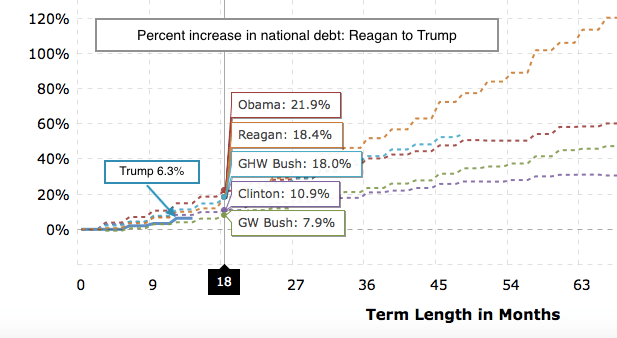
All recent presidents have raised the national debt. Trump claims he will shrink it.

All recent presidents have raised the national debt. Trump data to April 20, 2018.

As the graph above shows, if Trump plan is to pay down the debt, he is not succeeding. Trump is overspending — at a somewhat slower rate than other recent presidents, but in 1 1/4 year he’s increased the debt by 6.3%, about $1220 B. He’s saved a few billion by reduced payments to the UN, and to the EU for climate studies, and he’s asking NATO to pay more for Europe’s defense, but he’ll have to do a lot more, and the rest of the world is already unhappy with him.

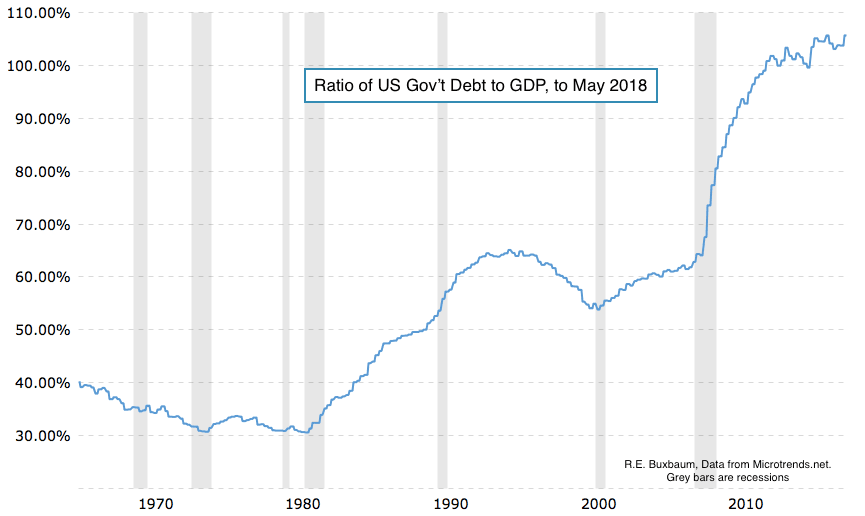
Many US economists — Keynesians – are not happy with him for another reason. They claim that debt is good, and that borrowing increases employment. As proof they note that FDR borrowed and spent heavily though the 1930s,and we got out of the depression. Other economists point out that it took longer in the US to get out of the depression than in many other countries. More recently, under Jimmy Carter, deficit spending created a combination of high inflation and high unemployment, “stagflation,” suggesting that Keynes should be modified to “Neo Keynesians” who claim you can overspend if you don’t outspend the GDP growth rate. Sorry to say, even in these terms, Obama and GW Bush overspent badly, as did Reagan before them (see graph below). Obama raised the debt from 65% of the GDP to its current 105%, and GW Bush raised it from 50% of GDP to 65%. This borrowing did not increase employment, or raise the standard of living for most Americans, though several at the top became fabulously wealthy. As Alan Greenspan noted, “If national borrowing was a path to wealth, Zimbabwe would be the richest country on earth.” I’m more of a hard money man, as Greenspan was, inclined to think that a balanced budget is good, and that tariffs are good too.

Ratio of US government debt to GDP

Ratio of US government debt to GDP

As of June 1, 2018, Trump has imposed ~20% tariffs on five items: wood, steel, aluminum, washing machines, and solar panels. Combined, these items constitute 4.1% of our imports, $130 B/ year. Taxed at 20%, the US will collect $25 B/year. it’s a step, but I suspect that Trump knows that, if tariffs are to wipe out all of our deficit, he’ll have to impose a lot more, about 40% on all of our imports ($3,100 B/year). Trump may yet do this, and may yet cut spending, and put a lot more America to work. My sense is that this is his aim.

The next step in the Trump MAGA plan involves adding another $35B to the list of items being taxed; that’s about 1.1% of US imports (5.2% total). In response, our trade-partners have complained to the press and to the world court, and have imposed their own tariffs — so far on about $100 B of US products, mostly food items, like bourbon and cheese, chosen to hit Republicans in politically – sensitive states: Tennessee and Wisconsin. Canada now taxes US cheese at over 100%. It’s an effort to embarrass Trump and get Democrats elected in 2018. If these tactics don’t work, Trump will impose another round, e.g. on foreign-made cars and motorcycles. I’d also expect him to cut NATO funding unilaterally, too, as a counter-slap to the EU.

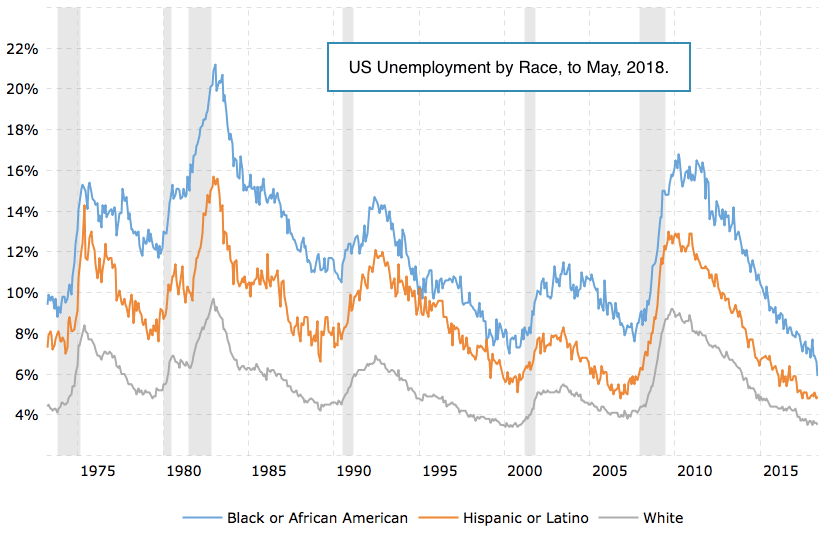
US unemployment by race

US unemployment by race, data to May 2018.

Speaking of Keynesian economists, Nobel Laureate economist, Paul Krugman of the New York Times has been predicting severe job losses, and a permanent stock collapse since 2016, and especially following Trump’s election. Virtually every week he announces that the end is near, and every month the economy looks better. But he’s not deterred, and neither are most economists. In a survey of nearly 100 economists by Reuters, 80% said that Trump’s policies will hurt the U.S. economy, and the rest said there would be little or no effect.[1] . So far it looks like they are all wrong. Unemployment is at record lows, particularly for African-Americans (see chart above); we’re adding new jobs at the rate of 200,000 new jobs per month, nearly 0.8% of the population per year. Inflation is a modest 2.3%, GDP growth is excellent, at 3.2% (or an incredible 4.5%). All we need now is a sensible immigration policy plus some healthcare reform, a modified social security tax, and for the economy to stay this way for another 5-10 years. It’s unlikely, but that’s the plan.

Robert Buxbaum, July 5, 2018. I’d hoped to see the employment and deficit numbers for June by now, but it’s not out. I’ve also argued that free trade is half right, as there is a benefit to workers, And there is a certain greatness that comes from paying your bills. Today, the EU offered to lower some auto tariffs if Trump does not move forward.

Wilsonian Obama vs the Trump Doctrine

As best I see it, Obama’s approach to world peace was a version of Woodrow Wilson’s: he consistently supported left-leaning, popular groups and governments, even when they were anti-American over pro-American kings, generals, and dictators. Obama heaped money and praise on elected leaders of Iran and the Palestinian Authority, while condemning Israel, and encouraging Democrats to walk out of a speech its PM. He then sent a statement to be read on the floor of congress that the Israeli PM  had nothing to say. Similarly, Obama refused to negotiate with Kim Jung Un of North Korea, a dictator in his eyes, but he had no problem with Raul Castro. Leftists, in his view, were for the masses, and thus democratic. Such democrats were on the side of the angels in his view, though Castro’s Cuba was not exactly free.

The co-head of the Democratic Party wears a shirt that reads "I don't believe in borders." It's a Moslem Brotherhood slogan. They do not believe in borders between Gaza and Israel, but do believe in them between Yemen and Saudi Arabia.

The co-head of the Democratic Party wears a shirt that reads “I don’t believe in borders.” It’s a globalist slogan, a Moslem Brotherhood slogan. The Trump doctrine requires boundaries between ‘turf.”

One of the most popular, if violent groups on the world stage was (is) the Moslem Brotherhood. A few months after becoming president, he gave his first foreign speech at Cairo University,  making the Wilsonian request to include the Brotherhood here and in all further negotiations. The Moslem Brotherhood was anti-American and left leaning, and they favored elections. On the other hand, they had assassinated Egyptian president Anwar el-Sadat and Egyptian prime minister Mohammad Pasha just a few years previous. They had also tried to overthrow the government of Egypt and Jordan by force, and had tried to assassinate Egyptian president Nasser and Jordan’s kings Abdullah and Hussein, unsuccessfully. Including the Brotherhood was symptomatic of a general problem of Wilsonian diplomacy; it provides no good way to tell the good guys from the bad without putting them in power. Some hints: the Brotherhood afforded no rights to women or gays; they had no clear distinctions from Hezbollah, Hamas, or Al Qaeda; and they were anti-American and anti Israel to the extent that they shouted death to both.

Even though the Moslem Brotherhood was Sunni-Moslem, a fair number in the mid-east cane to claim that Obama had included them because he was a Shiite Moslem, and just using them to overthrow more-stable Sunni governments of Egypt, Jordan, Turkey, and Saudi Arabia. Here’s a bit from an Iraqi MP, and from Saudi TV making this claim. Here too is a joke about Sunni and Shia to help you keep the two groups straight. Whatever his motivation, the outcome was the so-called Arab Spring (2011) uprisings that overthrew pro-American regimes in Egypt, Algeria, Tunisia and Turkey. It also brought the end of a free press in Turkey, and trouble for pro-American regimes in Bahrain, UAE, and Saudi Arabia. After the Brotherhood murdered the American ambassador in Libya and his (few) US guards, Obama blamed the death on some Jewish film-makers. My sense is that Obama was unwilling to believe that a fellow leftist of the Brotherhood would lie to him and murder our ambassador just to get at billions of dollars of Libya’s oil.

Trump, his daughter, el Sisi, and the King of Saudi Arabia. No Emir of Qatar.

Trump, Melania, the King of Saudi Arabia, and  el-Sisi of Egypt at a meeting in Riyadh with other friendly leaders; no Emir of Qatar, no Muslim Brotherhood.

Wilson lived to see the Mid-east parts of his 14 points lead to disaster in country after country (those were points V, XI, and XII for the Woody Woo fans). Obama similarly backed Kurdish and Hezbollah “moderates” only to see them turn sides and fight one another, or fight against our ally Turkey, or join together and form ISIS. He backed Palestinians in Gaza too, and saw them murder gays and suspected traitors on TV. He supported “moderate” Turkey, and found his Turkish allies killing his Kurds. Obama fueled a murderous tribal war, like Wilson had done, based on the best of intentions, and an American naiveté about how the world works.

Closer to home, at the very end of Obama’s presidency, he ended the registry of the National Security Entry-Exit System (NSEERS) intended to track terrorists. He closed this border program because it was racist in his view. Most of the illegals caught were Moslems or brown-skinned. Republicans seem to agree that a border-security program like this is problematic, especially where children are involved, but they claim it is better than letting in terrorists, or criminals, or the occasional human trafficker. Lacking anyone with a better answer, they elected Donald Trump, a man who claimed he’d bring peace by building a wall.

Trump made his first mideast speech in Saudi Arabia, but unlike Obama, he invited only pro-American, authoritarian leaders. He left out the Muslim Brotherhood and the rulers of any “republican” government that chanted “Death to America.” Trump announced that the US will not dictate how leaders should run their countries, or how people in these countries should live. Instead, we would be a friend to our friends, and that we would mediate disputes where necessary and helpful. There was also a threat against “bad guys” understood to be the enemies of America.

This “Trump doctrine” seems (to me) to have been borrowed from Charles (Lucky) Luciano, a New York mob boss who kept peace between the various mob families of New York and New Jersey by keeping the territories separate and clear (similar to Trump’s wall). Luciano allowed the various family heads to do what they wanted on their own turf, and offered to mediate disputes (see the similarity?). He also treated to hit those who hit him, and he took no guff. So far, Trump’s version of this seems to be working. The mideast is far calmer than when Obama was president, perhaps because its leaders understand Trump better, and Trump may have negotiated an end to the Korean war. Wilsonian Democrats (Obama) claimed that you can’t negotiate with a murderous thug like Kim Jung Un, but Trump has no problem — they both like walls. Besides, Trump points out that the alternative is nuclear war.

I suspect that Trump is hated by the Europeans is the comparison with Obama. Obama spent our money liberally, on them and on their issues, while Trump does not. A thought: if the Europeans think a president is spending enough, he's spending too much.

Obama spent our money liberally on the Europeans while Trump does not. A thought: if the Europeans think you spend enough, you’re spending too much.

How does Trump hit back? For one, he refuses to serve as free protector for those who can defend themselves. Trump has threatened Germany saying they must pay for their own defense, and has cut funding to the UN Human Rights commission and the Paris climate council, groups he considers pointless or worse. More recently, he ended Obama’s constraints on natural gas exploration and exports. In 2017 US gas exports rose by $4B, a factor of four from 2016, dramatically lowering the price of natural gas on the open market. Several oil nations were hit by this including Qatar the main gas exporter in 2014 (Russia is now) and a main funder of Al Jazeera, and of Al Qaeda, Hezbollah, and Hamas.

Robert Buxbaum, June 26, 2018. I’ve never understood why people expect Marxist leaders to be peaceful. Marx himself claims that the mode of production determines a country’s social, political and intellectual life. A leader hoping to control the latter must control the former with a war-like ferocity if he’s to be a Marxist, and even the most milk-toast Marxists have done so.

Al Jazeera, a multi billion-dollar influence buyer

Given the hand-wringing over the $300,000 spent by Russia to influence the 2016 US election, I thought it worthwhile to point out that Qatar spent roughly 2.5 billion on influence, mostly through Qatar’s news agency, Al Jazeera. Qatar is a Shiite (Shia) Moslem Emirate solely ruled by a Sunni Emir (king). Here’s a joke to help distinguish Sunni from Shia. It is also the 4th largest exporter of natural gas in the world behind Russia, Norway, and Canada. It’s a solid supporter of leftist political causes from anti-climate change to Hamas and Al Qaeda/ ISIS, and it is the host for the FIFA world cup of soccer, 2022. For more about Qatar and the logic of its behavior, see the American Foreign Policy Analysis. Interesting in general, but I’d like to focus on influence buying.

FILE - In this Aug. 20, 2013 file photo, Al Jazeera America editorial newsroom staff prepare for their first broadcast in New York. Shannon High-Bassalik former head of Al Jazeera America’s documentary unit has sued the news network, claiming it is biased against non-Arabs in stories that it produces and how it treats employees.  (AP Photo/Bebeto Matthews, File)

Al Jazeera America prepares for its first broadcast from New York, August, 2013. AP Photo/Bebeto Matthews.

The Emir of Qatar is the sole owner of Al Jazeera, a news organization, that he uses as profit-losing, influence machine. It allowed him to support leftist politicians who he believes to be pro-Arab, pro-Muslim Brotherhood, anti-Israel, and anti-American. In Europe he pursues pro-immigration, anti-fracking policies. In conservative, Islamic countries, like Saudi Arabia, Egypt, and Iran, he’s used Al Jazeera to supported free elections to unseat the king, Shah, or military president. Al Jazeera uniformly portrays Qatar and its emir well, helping it get rights to host the FIFA world cup. No other country gets anywhere near such uniform, positive support.

A bit of history: Al Jazeera began operations in Doha, the capital of Qatar in 1996, as an antidote to Saudi Arabia’s arabic-language news outlet, MBC (Mid-East Broadcast Company, now called Al Arabia). By 2003, Al Jazeera was broadcasting in Europe in various EU languages, and had an english language version broadcast out of London, Al Jazeera-English. It is available in the US via cable TV, Channels 100, 200, and 300. In 2013, the Emir of Qatar expanded Al Jazeera directly to the US, paying 1/2 billion dollars for an Emmy-winning, non-profitable, cable news company “Current TV”, partially owned by Al Gore. “Current TV” operated out of San Francisco with a left-leaning, pro-environment message and a modest audience. Their shows include The War Room with Jennifer Granholm (Jennifer is the ex-governor of Michigan), Talking Liberally, The Stephanie Miller Show, and  Viewpoint with Eliot SpitzerThe Emir added a news headquarters in New York and gave it a new name: Al Jazeera America, or AJAM. The old Current TV was retained as AJ+, a video arm. Over the next 5 years the emir spent 2 billion dollars setting up 12 news bureaus in the US with instructions that there was no need for profit, but only for “influence”. It is arguable how much influence he got, but it is clear he didn’t make any profit.

Despite what you might imagine would be the opinions of a petro-monarch, AJAM continues to back Gore’s anti-fracking message. I will speculate this is because he is against US gas because it competes with Qatari gas. AJAM also strongly supports the Muslim Brotherhood, Hamas, and ISIS. Perhaps that’s radical chic (radical sheik?). He’s against any authoritarian ruler that isn’t him.

Trump, his daughter, el Sisi, and the King of Saudi Arabia. No Emir of Qatar.

Trump, his daughter, Ibn-Said (king of Saudi Arabia) and el Sisi, (president of Egypt). Global control with no Emir.

Some notable controversies — I got these from Wikipedia –Ahmed Mansour, a prominent Al Jazeera anchor, is quoted saying that Egyptian president, el-Sisi was “a Jew carrying out an Israeli plot.” Faisal al-Qassim, another Al Jazeera presenter, hosted a segment on whether Syria’s Alawite (Shia) population deserved to be killed en-mass, and in 2014, the channel’s Iraqi affairs editor tweeted approvingly about the Islāmic State killing more than 1,500 air-force cadets in Tikrit, singling out those who were Shia and non-Muslim. Closer to home, they charged a half-dozen athletes with doping, including Peyton Manning, hero of the super bowl. In the end, Shannon High-Bassalik, former head of the documentary unit, also sued claiming bias against non-Arabs in stories and in how it treats employees.

Among Republicans, AJAM became to be known as “The Terror Network”, while they retained some good reputation on left. The Emir bought not only the network, but spent liberally on sympathetic experts, and on academic think tanks. Further, it seems that Al Jazeera writers had no fixed budget or expense limit. The Russians are nowhere near this generous.

In April of 2016, with the world cup coming to Qatar, and American oil reviving, the emir cut AJAM staff by 900 workers. Part of the decision may have been that it looked like he had the 2016 election in the bag. Al Jazeera English remains, still operating out of London, and AJ+, the old Current TV, still operating out of San Francisco. And then Donald Trump was elected 45th US president. AJ / AJ+ was shocked (as was I); and called for protests. Trump, in a publicized meeting with el-Sisi of Egypt (the Jewish Spy), and Salmon al-Saud, (above, 2017) issued a set of 13 demands including that the emir stop to support for Hamas and the Brotherhood, and that he shut Al Jazeera. The emir has not complied, and the world cup is still on for Qatar.

I should mention that the Emir and Putin work together on some things and oppose on others. They both support politicians who oppose oil and gas production while opposing each other on pipeline construction. Qatar backs the pan Arabian pipeline to Turkey, while Russia funds Assad and the PKK (Russia-friendly, Kurdish independents) to block such access. The Emir supports ISS, Hamas, and Turkish Kurds, I suspect, as a way to fight Russia. It’s Byzantine politics in both senses of the word. Given how much Qatar has spent buying influence with Clinton and Gore, I don’t understand why the FBI is so focussed on Trump and Russia.

Robert Buxbaum, May 29, 2018.

School violence and the prepositional subjective

There is a new specialty in the law, both in prosecution and defense: dealing with possible school shooters and other possible purveyors of violence. Making threats of violence has always been a felony — it’s a form of assault. But we’ve recently extended this assault charge to those student who make statements to the effect that they might like to commit violence, a conditional subjunctive statement of assault. This finer net manages to catch, in Michigan alone, about 100 per month. That’s a large number. Mostly they are male high-school age students who shot off their mouth, kids caught for saying “I’ll kill you” often in an argument, or following one. They are arrested for protection of others, but the numbers are so high and the charge so major, 15 – 20 year felonies, it’s possible that the cure is worse than the disease.

Eight students of the 100 charged in the last month in crimes of potential violence.

Putting some faces to the crime. Eight of the 100 charged in Michigan in the last month for potential violence. All or most are boys. 

Several of the cases are described in this recent Free-Press article, along with the picture at right. According to the article, many of those charged, are sentenced to lower crimes than the 15 -20 maximum, things like reckless endangerment. Many, the majority, I hope — they are not mentioned in the article — are let go with a warning. But even there, one wonder if these are the richer, white ones. In any case, it’s clear that many are not let go and have their lives ruined because they might come to commit a crime.

Let’s consider one case in-depth, outcome unknown: A top high school student, skinny, but without many friends, who gets picked on regularly. One day, one of the more popular kids in school calls him out and says, “You look like you’re one of those school shooters.” The loner responds, “If I were a school shooter, you’d be the first I’d shoot.” And that’s enough to ruin the kid’s life. Straight to the principal, and then to the police. The ACLU has not seen to get involved as there are competing rights at play: the right of the loner to have a normal education, and the rights of the other students. One thing that bothers me is that this crime hangs on the conditional subjunctive:  “If I were…., then you would be…”

What makes the threat subjective is that “I’ll kill you” or “I’d shoot you first” is something you’d like to be true at some time in the indefinite future. There is no clear time line or weapon, just a vague desire that the person should be shot. It’s a desire that more-likely than not, is a fleeting hyperbole, and not an actual threat. What makes the threat conditional on the person has yet to decide to show up with a weapon or show any sign of doing violence: “If I were to become a school shooter.”

The person who drew this faces 15 years in prison. The only evidence is this picture.

The person who drew this faces 15 years in prison. The only evidence of a threat is this picture.

It did not used to be that either the conditional or the subjunctive were considered threats. A person was assumed to be blowing off steam if he (or she) said “I’d like to see you dead” or even “I’ll kill you.” And we certainly never bothered folks who prefaced it with, “If I were a …” In theory, we had to extend the law to protect the weak from a shooter, but we’ve also put a weapon in the hands of the schoolyard bully. The school bully can now ruin the life of his fellow by accusing him of being a potential school scooter. We’ve weaponized the conditional subjunctive, and I don’t like it. The boy who drew the picture at right was charged with a 15 year felony for drawing something that, in earlier generations, would be called a fantasy picture.

It bothers me is that the majority of those charged — perhaps all those charged — are boys. Generally these boys are doing things that normal boys have often done. The picture of a shooting is considered a written threat of violence, but to me it looks like a normal boy picture. Girls have not been caught, so far, perhaps because their words and pictures are more “girly” so their threats are not considered threats. Sometimes is seems that it is boy-behaviors themselves are being criminalized, or at minimum diagnosed as ADHD (crazy). There is so much we don’t like about boy-behaviors, and we’ve elevated the female to such an extent, that we may have lost the positive idea of what a male should be. We want boys to be “girly” or at least “trans,” and that’s not normal in the sense that it’s not normative. We’ve come to worry about boyness, creating a cure that may be worse than the harm we are trying to prevent.

Robert Buxbaum, May 7, 2018. I’ve also noted how bizarre US sex laws are, and have written about pirates and transgender grammar.