Category Archives: personal relationships

James K. Polk, a great president who did what he said and made America great

One of my favorite presidents is James K. Polk. While running for president he claimed we would do four major things –and do them as a one-term president. He then did them, and left office — and died 103 days later at the age of 53. Mr Polk’s four stated objectives were: a reduction in the tariff, an independent treasury, settlement of the Oregon boundary dispute, and acquisition of California. Acquisition of California required admission of Texas, plus a war with Mexico and a cash payment, but he was ready. Settling the Oregon border required a compromise and a cash payment. But he did it and more. Modern professors are not happy with Polk, ranking him far below Obama, Kennedy, or Adams, but his aims were good, and he got hem done. Few presidents do that, and even fewer left office if they had the power to stay. No professor I know has ever willingly left if he had the power to stay, and didn’t have a better job to go to.

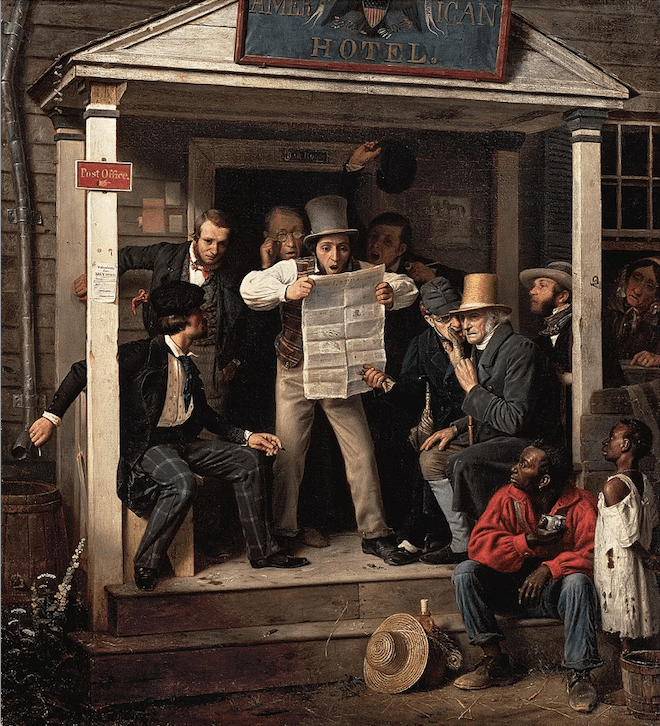
News from Mexico, oil on canvas painting by Richard Caton Woodville Sr., Düsseldorf, 1848. Polk was a god-send for newspaper sales.

I believe that the clarity of Polk’s four objectives was the reason he was a candidate at all, and the reason he won the election, and also the reason he achieved the objectives. There is a magic in clear objectives, repeated often, I find. It’s a formula that got Trump elected that few seem to understand: “Make America Great Again.” “Build the Wall”, “Drill baby Drill” “Deport illegals” “Tariffs. ” Like these ideas or not, you know Trump’s aims. Also, you know that, if. you oppose them, you oppose him. Trump’s pastor, Norman Vincent Peale promoted this approach, one I’ve thought of trying myself. I suspect that Polk died so shortly after leaving office because he had no further goal beyond relaxing; bad water hurt him too.. I suspect that Trump will die shortly after leaving office too- from lack of purpose.

Polk wasn’t expected to be a candidate, but was a “dark horse”, ex-governor of Tennessee, who had lost his past two elections. Martin Van Burin was expected to be the Democrats’ candidate, but he opposed slavery, and most Democrats were for it. What’s more, he was opposing annexation of Texas, at least south of the Nueces River, and many Democrats were for, as were some Whigs.

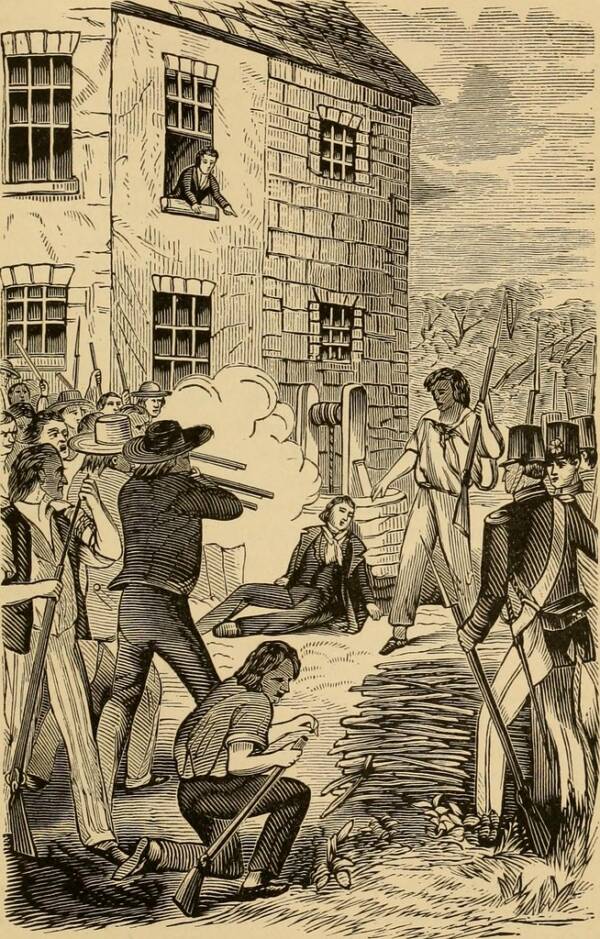
Joseph Smith was shot multiple times while campaigning for president.

Polk was pro-slavery, as was the Whig candidate, Henry Clay. But Polk said repeatedly that he would annex Texas — all the way to the Rio Grande, “no matter what any Mexican said.” He also said he’d fight for California and all of Oregon too: “Fifty four forty or fight”. You might not agree with this, Grant did not, but you knew where he stood. And Polk said he’d serve only one term. Thus, if you didn’t like him, he’d be gone in four years. After a few ballots, Polk became the Democratic Party candidate, with George Dallas as his VP. Like Polk, Dallas was pro Texas – they eventually named a city after him. Clay was Polk’s main opposition, anti Texas, and more vague about everything else.

At first John Tyler, the incumbent, also ran against Polk, but when he saw he was losing, he dropped out to help Polk. Also running for president, 1844 was Joseph Smith, the Mormon founder-profit. he ran as an independent because God told him to. He was shot multiple times, and died while campaigning. Finally there was James G. Birney, the Liberty party candidate. He gained few votes running on an abolitionist ticket. It’s been speculated that Polk won because Birney split the Whig vote. My take is that’s unlikely: Clay was pro-slavery. Polk’s win, I think, was in the power of his clarity.

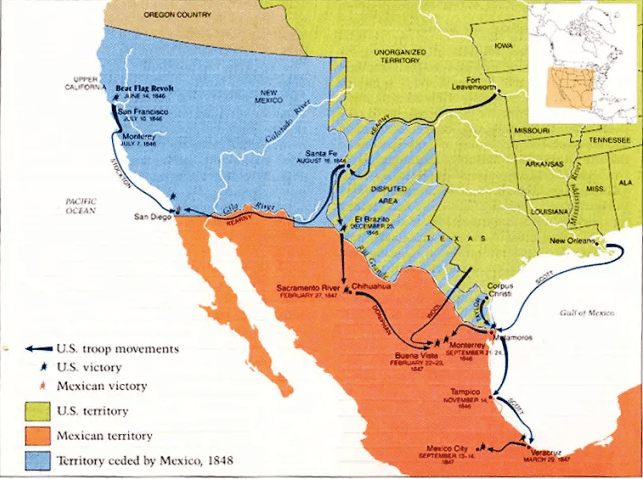
Map of the territory and war.

Once elected, Polk first moved to annex Texas, something he achieved with the help of expresident John Tyler. Tyler sent his Secretary of State, Abel Upsher to negotiat an annexation treaty with Sam Houston, but the Whig-controlled congress rejected it. After the election, Tyler resubmitted the treaty to the new, Democrat-controlled congress, and got two versions passed. The house passed a pro-slavery version, while the senate, pushed by Thomas Hart Benton (a favorite of mine) produced an annexation treaty that divided Texas in half, with a pro-slave and an anti-slave half. Polk liked the pro-slave, House version, returning it to Texas in his first week in office. He instructed the Texas legislature to accept it unconditionally, with no change so he could submit it directly to the Senate. The Texans did so, and congress approved this version later that year. Texas entered the union as one, large, slaveholder state.

With annexation not yet ratified by congress, Polk sent a diplomatic mission to buy California from Mexico along with all of the disputed Texas territory and everything in between for $25 million. Mexico refused, so Polk invited war. He sent 4000 soldiers into disputed Texas territory south of the Nueces River, under command of General Zachary Taylor. Mexican forces attacked them in April 1846, and Polk declared war. The war lasted to 1848, winning all the desired lands including California, and achieving a release of any rights Mexico might have on Oregon.

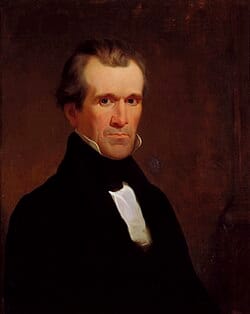
Polk, as governor of Tennessee

The next Polk goal was resolution of the Oregon dispute, ideally with us getting all of it: land that included the current states of Washington, Oregon, and Idaho, plus the Canadian Provence of British Columbia. Britain and Russia also claimed this land, so Polk’s first step was to buy off Russia. The British said they’d fight, noting that they had a larger army and navy and that the US was already at war with Mexico. Polk’s response was to back settlers going to Oregon. Americans had started migrating to Oregon in 1843. In his inaugural address, 1845, Polk said he would defend them “against the British and Indians.” By 1846 Britain recognized the difficulty of fighting US settlers so far from home. On June 15, they agreed to a deal that split the territory along the 49th parallel, giving the US the lower half, except for Vancouver Island, thus allowing Britain an opening to the sea. This deal had been proposed by Edward Everett, Tyler’s minister in London. Polk gave up nothing, beyond an informal agreement to lower tariffs on British goods, something he aimed to do anyway. It’s generally thought that Polk’s willingness for war allowed him to achieve so much without fighting. Polk said, in his inaugural, March 1845: “The world has nothing to fear from military ambition in our government,” a statement that clearly means the opposite of what it claims to say.

Polk’s third goal was lowering the “Black Tariffs”. High and uneven, they were 32% on average, with cut-outs to help specific, northern businesses. Polk’s secretary of the treasury, Robert Walker negotiated a flat advalorum tariff of 25%, with luxury goods, tobacco and alcohol tariffed higher. The “Walker tariff” bill was passed July, 1846, one month after the Oregon agreement. The British, reduced their “corn tariffs” against US grain, benefitting both countries. Our tariffs average 17%, currently, with many cut-outs. I think our tariffs should be more like the Walker tariff, perhaps 20% and simpler.

Polk’s 4th campaign promise was establishing an independent treasury. This was done to weaken “pet” banks, and stabilize the economy. The treasury would now hold all US assets; they would issue most currency, and would pay people directly, either in specie (gold or silver) or notes of debt. Independent banks could still issue notes, but only in amounts over $20. Polk passed this bill August 6, 1846, one week after the Walker Tariff bill. With this, Polk had already achieved all of his goals except California by the mid-term elections, 1846.

Having achieved so much, Polk set out to buy Cuba, but Spain said no. Some other accomplishments: opening the U.S. Naval Academy and the Smithsonian Institution, overseeing the groundbreaking for the Washington Monument, and the issuance of the first United States postage stamp. By the summer of 1848 Polk confirmed that he was satisfied and would not run for re-election. In his address to congress, December 1848, he said, “Peace, plenty, and contentment reign throughout our borders, and our beloved country presents a sublime moral spectacle to the world.” …. “I am heartily rejoiced that my term is so near its close. I will soon cease to be a servant and will become a sovereign.” I trust that was met with applause.

Robert Buxbaum. February 6, 2026. Edward Everett would go on to make the better received speech at Gettysburg. The officer who commanded the 4000 man Texas force, Zachary Taylor, became president in 1849. Like Polk, he died of bad water with too little alcohol added.

Sayings of Zen Judaism

All of the following bits of Zen-like wisdom are derived from David M. Bader’s book, “Zen Judaism”. Some of these (in italics) have been modified by me. I’ve posted several other examples of zen-wisdom/ humor, e.g this. Most every piece of real wisdom appears as a joke, IMHO.

I bought a copy, then modified some as I saw fit. He’s holding a bagel.

If you meet the Buddha on the road, show him pictures of the grandchildren.

One may take a vow of fasting, or of celibacy, a vow of silence or to avoid sleep is out of the question.

Wherever you go, there you are.  Your luggage is another story.

Be here now, be someplace else later; is that so complicated?

Accept misfortune.  Do not wish for perfect health, or a life without problems. What would you talk about?

Drink tea and nourish life; with the first sip, joy; with the second sip, satisfaction; with the third sip, Danish.

Self abnegation is not easy. It takes much effort, and then what have you got? Bupkis.

The words, “there is no self,” can be terrifying. Still they’re not as bad as, “may you grow like an onion with your head in the ground.”

Bring the Buddha to your table, and on Passover, the prophet Elijah. That’s about as many invisible guests as anyone needs.

If there is no self, whose arthritis is this?

The journey of a thousand miles begins with a single Oy.

The world does not speak. It does not blame or take sides. The world has no expectations, and it demands nothing of others. The world is not Jewish.

Be patient and achieve all things. Be impatient and achieve all things faster.

Be aware of your body. Be aware of your perceptions.  Keep in mind that not every physical sensation is a symptom of a terminal illness.

To find the Buddha, look within. Deep inside you are ten thousand flowers. Each flower blossoms ten thousand times. Each blossom has ten thousand petals.
You might want to see a specialist.

Seek not the outer enticements. Dwell not in the inner strife. Try to find a nice place in the suburbs with good schools.

Practice a livelihood that does not harm yourself or others, choose an occupation furthering love and compassion. Ask about the health plan, too. No freelancing.

Let go of pride, ego, and opinions. Admit your error and forgive those of others. Relinquishment will lead to calm and healing in your relationships. If that doesn’t work, try small claims court.

For the wary Pilgrim, a Zen poem: thousands reach the gateless gate from many paths; once through, they dwell serenely between heaven and earth; enjoying golf, line dancing, Yiddish lessons, and aquacise. Come see our model units at Century Village.

Breathe in. Breathe out. Breathe in. Breathe out. Do this and achieve peace. Forget this and attaining Enlightenment will be the least of your problems.

Go then and wander for the good of the many, for the welfare of the many, out of compassion for the world. Teach what is good in the beginning, good in the middle, and good in the end. Don’t forget to write, and always wear clean underwear. You never know when you could end up in the emergency room.

Robert Buxbaum, March 24, 2025. Other books by David Bader include “Haikus for jews”, “The book of Murray”, and “How to be an extremely Reform Jew”. Bader claims to have achieved complete and perfect emptiness, although two hours later he often feels full again.

So long to the SS United States, the fastest ocean liner.

The SS United States is in the process of being towed to its final resting place, on the sea floor near florida, to be a scuba-diving reef. She is the largest ocean liner to be entirely constructed in the United States and was the fastest ocean liner to cross the Atlantic Ocean in either direction, 36 knots or 41 mph average speed. She won the Blue Riband for this on her first voyage, in 1952, and retained that title till today. There was a faster crossing in June, 1990 by the Hoverspeed Great Britain, 36.6 knots, 42.1 mph average speed, but the Hoverspeed was a 76 meter channel catamaran, not an ocean liner.

The SS United States was half-paid for by the US government. Its purpose was fast passenger transport across the Atlantic. The government contributed because it might be used as a troop ship if needed in times of war. In terms of speed, she handily beat the luxurious British liners, Queen Elizabeth and Queen Ann, but the compromises for speed and military use made the SS United States unsuited for use as a luxury cruise ship.

Designed by William Francis Gibbs, one of the greatest ship designers, the high speed was achieved, in part, by making the ship very light. He used aluminum for the entire superstructure, the stuff above water level, making it the largest aluminum construction when built, 1951. Though larger than the Titanic, the United States is thinner and more pointy. Much lighter than the Queen Elizabeth or Queen Ann, she could go as fast backward as the Titanic could forward. The hull is doubled, with fuel stored between the layers as a protection from collisions and canon; the interior is highly compartmentalized too, to make her fairly unsinkable. This was confirmed when she survived a sea collision shortly after launch. Making the ship light on the top made the SS United States stable in wind and rough seas despite its narrow shape. There were two engine sections, divided into four engine rooms, done to increase the chances that the engines would survive an explosion or torpedo attack.

The interior design was American modern, and fire-proof, with few weighty decorations. Furnishings were fiberglass, steel or aluminum, for the most part, see picture below. The red, white, and blue stacks added to the American look. Both are used (recall that there are two engine rooms), and both have aluminum wings. These shield the deck from any sparks that might come out the stacks.

In the end, it was the crossing speed not the comfort level that doomed the SS United States. Even at a top speed of 44.1 mph, crossing the Atlantic took 3+ days. That could not compete with jet planes that travelled at 500 mph. I’ve argued that long range, “high speed” passenger trains make little sense for the same reason. Even at 100+ mph, few Americans will be willing to spend 36 hours traveling from Chicago to Seattle. Fast boats are useful, I think, but only in smaller size foreshorten trips, similar to the Hoverspeed.

5 blade propeller on display at Throg’s neck. Paired with a 4 blade propeller it reduced vibration and wear at high speed.

Also helping it reach the speeds it did, the SS United States benefitted from innovations in the engines and in the propellers. There were four engines, in two engine sections. These were modern, light weight, compact, steam turbines running at high pressures and temperatures: 975°F and 925 psi. Each turbine delivered 60,000 shaft hp to a variable-speed, geared shaft. The inboard propellers had 5 blades and the outboard (end of ship) had four. This difference in blade number was a secret, design innovation that allowed faster speed, without vibration and cavitation. The 5 blade propeller shown on display at left, accelerated the water, while the 4 blade accelerated it faster. At the time, this was secret technology. We now have some better propellers, though no faster ocean liners. The Hoverspeed uses water jet for propulsion, by the way.

Leaving the Delaware River heading to the Gulf of X

On its way to the bottom of the sea, the ship will first stop at MARS. That is not the planet Mars, but at an engineering firm, “Modern American Recycling Services” in Mobile Alabama, on The Gulf of X. There the MARS folks will prepare the ship to sink in an even way, where its supposed to; a way that works for scuba divers.

Robert Buxbaum, February 28, 2025. My sense is there is still room for steam power. I also think the US government should return to investing in US ship-building, especially for double-use, military and commercial, like this one. A new favorite phrase, from Ovid, Metamorphosis: “Omnia mutantur, nihil interit”. Everything changes, but nothing passes away. RIP, old friend.

Bendy hockey sticks, and my, half-bendy version.

Hockey sticks have gotten bendier in recent years, with an extreme example shown below: Alex Ovechkin getting about 3″ of bend using a 100# stiffness stick. Bending the stick allows a player to get more power out of wrist shots by increasing the throw distance of the puck. There is also some speed advantage to the spring energy stored in the stick — quite a lot in Mr Ovechkin’s case.

Alexander Ovechkin takes a wrist shot using a bendy stick.

A 100# stiffness stick takes 100 pounds of force in the middle to get 1″ of bend. That Ovechkin gets 3″ of bend with his 100# stick suggests that he shoots with some 300 lbs of force, an insane amount IMHO. Most players use a lot less force, but even so a bendy stick should help them score goals.

There is something that bothers me about the design of Alex Ovechkin’s stick though, something that I think I could improve. You’ll notice that the upper half of his stick bends as much as the lower half. This upper-bend does not help the shot, and it takes work-energy. The energy in that half of the bend is wasted energy, and its release might even hurt the shooter by putting sudden spring-stress on his wrist. To correct for this, I designed my own stick, shown below, with an aim to have no (or minimal) upper bend. The modification involved starting with a very bendy stick, then covering most of the upper half with fiberglass cloth.

I got ahold of a junior stick, 56″ long with 60# flex, and added a 6″ extension to the top. Doing this made the stick longer, 62″ long (adult length) and even more bendy. One 1″ of flex requires less force on a longer stick. I estimate that, by lengthening the stick, I reduced it to about 44#. Flex is inversely proportional to length cubed. I then sanded the upper part of the stick, and wrapped 6 oz” fiberglass cloth (6 oz) 2-3 wraps around the upper part as shown, holding it tight with tape at top and bottom when I was done. I then applied epoxy squeezing it through the cloth so that the composite was nearly transparent, and so the epoxy filled the holes. This added about 15g, about 1/2 oz to the weight. Transparency suggested that the epoxy had penetrated the cloth and bonded to the stick below, though the lack of total transparency suggests that the bond could have been better with a less viscous epoxy. Once the epoxy had mostly set, I took the tape off, and stripped the excess fiberglass so that the result looked more professional. I left 23″ of fiberglass wrap as shown. The fiberglass looks like hockey tape.

Assuming I did the gluing right, this hockey stick should have almost all of the spring below the shooter’s lower hand. I have not measured the flex, but my target was about 80 lbs, with improved durability and the new lower center of bend. In theory, more energy should get into the puck. It’s a gift for my son, and we’ll see how it works in a month or so.

Robert Buxbaum, December 5, 2024.

Sailors, boaters, and motor sailing at the hull speed.

I’ve gone sailing a few times this summer, and once again was struck by the great difference between sailing and boating, as well as by the mystery of the hull speed.

Sailors are distinct from boaters in that they power their boats by sails in the wind. Sailing turns out to be a fairly pleasant way to spend an afternoon. At least as I did it, it was social, pleasant, and not much work, but the speeds were depressingly slow. I went on two boats (neither were my own), each roughly 20 feet long, with winds running about 10-15 knots (about 13 mph). We travelled at about 3 knots, about 3.5 mph. That’s walking speed. At that speed it would take about 7 hours to cross Lake St. Clair (25 miles wide). To go across and back would take a full day.

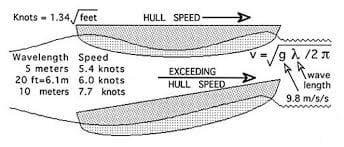
Based on the length of the boats, they should have been able to go a lot faster, at about 5.8 knots (6 mph). This target speed is called the hull speed; it’s the speed where the wave caused by the bow provides a resonance at the back of the boat giving it a slight surfing action, see drawing.

This speed can be calculated from the relationship between wave speed and wavelength, so that Vhull = √gλ/2π where g is the gravitational constant and λ is the water line length of the boat. For Vhull in knots, it’s calculated as the square-root of the length in feet, multiplied by 1.34. For a 20 foot boat, then,

Hull speed, 20′ = 1.34 √20 = 1.34 x 4.5 = 6.03 knots.

While power boats routinely go much faster than this, as do racing skulls and Americas cup sailboats, most normal sailboats are designed for this speed. One advantage is that it leads to a relatively comfortable ride. There is just enough ballast and sail so that the boat runs out of wind at this speed while tipping no more than 15°. Sailors claim there is a big increase in drag at this speed, but a look at the drag profile of some ocean kayaks (12 to 18 feet, see below) shows only a very slight increase around this magical speed. More important is weight; the lowest drag in the figure below is found for the shortest kyack that is also the lightest. I suspect that the sailboats I was on could have gone at 6 knots or faster, even with our current wind, if we’d unrolled the spinnaker, and used a ‘screecher’ (a very large jib), and hung over the edge to keep the boat upright. But the owner chose to travel in relative comfort, and the result is that we had a pleasant afternoon going nowhere.

Data from Vaclav Stejskal of “oneoceankyacks.com”

And this brings me to my problem with power boating. Th boats are about the same length as the sailboats I was in, and the weight is similar too. You travel a lot faster, 20 to 25 knots, and you get somewhere, but the boats smell, and provide a jarring ride, and I felt they burn gas too fast for my comfort. The boats exceed hull speed and hydroplane, somewhat. That is, they ride up one wave, fly a bit, and crash down the other side, sending annoying wakes to the sailboaters. We crossed lake St. Clair and rode a way down the Detroit river. This was nice, but it left me thinking there was room for power -assisted sailing at an intermediate speed, power sailing.

Both sailboats I was on had outboard motors, 3 hp, as it happened, and both moved nicely at 1 hp into and out of the harbor, even without the sail up. Some simple calculations suggest that, with I could power a 15 to 20 foot sailboat or canoe at a decent speed – hull speed – by use of a small sail and an electric motor drawing less than 1 hp, ~400 W, powered by one or two car batteries.

Consider the drag for the largest, heaviest kayak in the chart a move, the Cape Ann Double, going at 6.5 knots. At 6 knots, the resistance is seen to be 15 lbs. To calculate the power demand, convert this speed to 10 fps and multiply by the force:

Power for 6 knot cruising = 10 fps x 15 lbs = 150 ft lbs/s = 202 W or 0.27 hp.

Outboard motors are not 100% efficient, so let’s assume that you need to draw more like 250 W at the motor, and you will need to add power by a sail. How big a battery is needed for the 250 W? I’ll aim for powering a 4 hour trip, and find the battery size by multiplying the 250 W by 4 hours: that’s 1250 Hrs, or 1.25 kWh. A regular, lithium car battery is all that’s needed. In terms of the sail, I’m inclined to get really invovative, and use a Flettner sail, as discussed here.

It seems to me that adding this would be a really fun way to sail. I’d expect to be able to go somewhere, without the smell, or the cost, or being jarred to badly. Now, all I need is a good outboard motor, and a willing companion to try this with.

Robert Buxbaum, Sept. 9, 2024

China’s space station and the ISS, a comparison

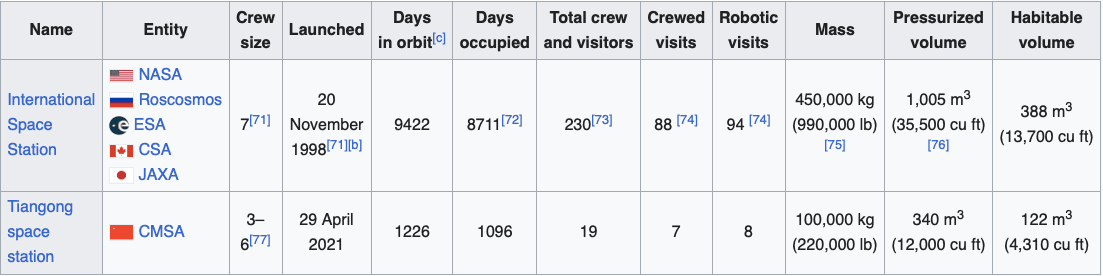
It gets so little notice from the news agencies that many will be surprised to find that China has a space station. It’s known alternately as the Tiangong Space Station or the CSS, Chinese Space Station; it’s smaller than the International Space Station, ISS, but it’s not small. Here is a visual and data comparison, both from Wikipedia.

China’s space station is smaller than the ISS, but just about as capable. Cooperation leads to messiness (and peace?)

The ISS has far more solar panels, but the power input is similar because the CSS panels are of higher efficiency. As shown in the table below, the mass of the ISS is about 4.5 times that of CSS but the habitable volume is only 3 times greater than of CSS, and the claimed crew size is similar, of 3 to 6 compared to 7. The CSS is less messy, less noisy, with less mass, and more energy efficiency. Part of the efficiency comes from that the CSS uses ion propulsion thrusters to keep the station in orbit, while the ISS uses chemical rockets. The CSS thus seems better, on paper. To some extent that’s because it’s more modern.

Another reason that the ISS is more messy is that it’s a collaboration. A major part of its mission is to develop peaceful cooperation between the US, Europe and Russia. It’s been fairly successful at this, especially in the first two decades, and part of making sure parts from The US, Russia, Europe, Japan, and Canada all work together is that many different standards must be tolerated and connected. The ISS tolerates different space suits, different capsules, different connections, and different voltages. The result is researchers communicate, and work together on science, sending joint messages of peace to the folks on earth. Peace is an intended product.

By contrast, the Chinese space station is solely Chinese. There are no interconnection issues, but also no peace dividend. It has a partially military purpose too, including operation of killer satellites, and some degree of data mining. This was banned for ISS. So far the CSS has hosted Chinese astronauts. No Chinese astronauts have visited the ISS, either.

Long march 6A rocket set to supply the CSS. It is very similar to the Delta IV.

India was asked to join the ISS, but has declined, wishing to follow China’s path of space independence. The Indian Space Research Organization plans to launch a small space station on its own, Gaganyaan, in 2025, and after that, a larger version. That’s a shame, though it’s not clear how long cooperation will continue on the ISS, either. See the movie I.S.S. (2023) for how this might play out. Currently, there is a tradition of cooperation about ISS, and it’s held despite the War in Ukraine. The various nations manage to work together in space and on the ground, launching people and materials to the ISS, and working together reliability.

Although it isn’t a direct part of the space stations, I should mention the troubles of the Boeing Star-liner capsule that took two astronauts to the ISS compared to the apparently flawless record of the CSS. The fact is, I’m not bothered by failures, so long as we learn from them. I suspect Boeing will learn, and suspect that this and other flailing projects would be in worse shape without the ISS. Besides, the ISS has been a major catalyst in the development of SpaceX, a US success story that China seems intent on trying to copy. SpaceX was originally funded, at low level, to serve as a backup to Boeing, but managed to bypass them. They now provide cheaper, more reliable travel through use of reusable boosters. The program supplying CSS uses traditional, disposable rockets, the Long March 5 and 6 and 7. These resemble the Atlas V, Delta IV and Delta IV Heavy. They appear to be reliable, but I suspect they are costly too. China is currently developing a series of reusable rocket systems. The Long March 9, for example will have the same lift capacity as SapceX’s Starship, we’re told. Will the Indian program choose this rocket to lift their space station, or will they choose SpaceX, or something else? The advantages of a reusable product mostly show up when you get to reuse it, IMHO.

Robert Buxbaum, September 10, 2024.

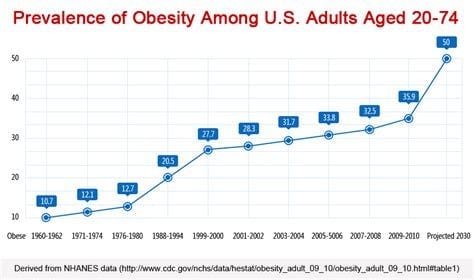
We’re depressed, allergic, overweight, alone, and demented. What causes what?

Among the wonders of the western world is how many people are allergic to nuts compared to a few decades ago, and to gluten, and to a host of other things that hardly anyone was allergic to 50 years ago. Perhaps it’s a change in perception, but it doesn’t seem that way.

When I was in public school in NY, back in the 1960s, there was a subsidized lunch program serving, every day, peanut butter sandwiches. Peanut butter is nearly totally fat. It was ladled each day, from a giant tub, provided by the USDA, and slathered on USDA bread along with jelly from some other vat. The smell filled the lunch area, and the fats and sugars filled our stomaches. No one seemed bothered by the nuts, and no one showed obvious signs of passing out. And despite the ill diet, we were less obeease than today. Even today, in poor countries, thy still serve massive peanut butter dishes, or bread covered in lard, and these countries show fewer allergy problems, and less obesity in general.

Perhaps it is the lack of exposure to peanuts in the US that caused the allergy (sounds almost plausible), and maybe it’s the dietetic food that causes obesity, and the glut of non-gluten that causes gluten allergies. These connections may be false, but If true, it would suggest we’re in for many more problems.

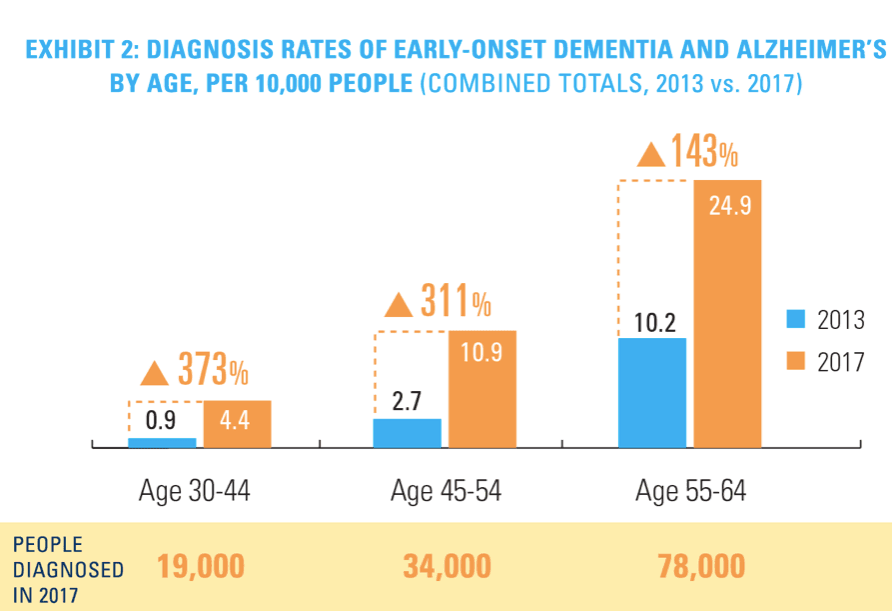
Moving to depression and dementia. We’re seeing more and more of both, and at earlier ages. In our era, virtually everyone over 80 shows signs of clinical dementia, often Alzheimer’s dementia, but the rates are rising, especially in those 55-70, and it seems most every adult is depressed. I don’t know why, though lots of people on the internet have speculative explanations. There are also cures, and perhaps some work. The research behind at least one of the best hopes for an Alzheimers cure was shown to be falsified, just made up. Not that funding was stopped quite, highlighting another problem that is becoming more common: people in trust positions no longer behave in a trustworthy way. Nor are they punished for lying. Strange to add that an anti-obesity drug, Metformin, seems to actually work at weight loss, and helps against Alzheimers dementia. Then again, from other research, it seems that obesity protects from dementia.

Some of the problem seems to be societal, a lack of friendship and companionship. I could imagine that isolation leads to dementia, depression, and weight gain. Another thought, pushed by RFK Jr., is that new drugs and vaccines are responsible for allergies and ADHD, along with changes in diet. It’s possible. At least some comes from early diagnosis, and a change in the definition of dementia. Perhaps that’s the reason for the significant difference state to state. Yesterday’s curmudgeon is redefined as depressed, and drugged (more in some states than others), and becomes isolated (again more in some communities). The disoriented, lonely patient is then given anti anxiety drugs and classified as a dementia patient. It happens in some cases, but there seems to be a rise in real dementia too: the sort of stumbling and blankness that reflects general brain deterioration. As for ADHD, I’m still not convinced this is a new real disease; it could be that’s how boys always behaved.

Would we be less depressed or demented or less autistic with different vaccinations, or different foods, or with more human interaction? Would people be less isolated if they were less depressed or autistic? RFK’s family now claims that RFK Jr is demented himself for even asking these questions. My guess, totally unsupported is that the rise in allergies, dementia, obesity, and depression are related somehow, but I’m not convinced that RFK Jr. has picked out the right connection. What causes what? Perhaps someone can use statistics, or biology experiments to help untangle this stuff. It seems horribly important to the majority of Americans.

Robert Buxbaum, Sept 10, 2024. There was a. bit of a joke in the last comments: my daughter got a degree in epidemiology, and is employed in part to answer just the sort of questions I’ve posed.

Cursive writing is art, and should be taught in school

Few people learn cursive these days with any skill or speed. It’s a shame. This is a form of traditional art and communication. Handwriting is a slower way of writing, that leads to a different type of letter or essay. The sentences are, typically longer, and the words more expressive because the experience of writing and reading cursive is more expressive than with text. The emotional state and energy of the writer comes through the cursive writing, because the writing itself is a form of creative art, adding to the words.

Send a letter or a post card, and you’ve sent a work of art. You’ve communicated words, or course, but far more than with a text or email. First off, there is the picture on the card. You bought that card, or took the picture. Then there is the art of how many words you use. Each letter is directed to only one person, not to 100 as with a text. As a result, people will keep your letter or card far more than they will not keep a text an email. It is more from you, and more to them. You are likely to put more (or different) things in: experiences and feelings that don’t go into an email or text-letter. The size of your writing communicates and even your cross-outs are part of a cursive communication. With email or text, there are no natural cross outs, and you can send the same letter to 100 people, so you write more blandly, with an eye for eventual reuse for someone else. A cursive note is intended for only one person, the one recipient, and this affects both the words, and the form of the words.

Cursive also lends itself to adding a small sketch or doodle. This becomes part of a personal part of the art in a way that does not fit with normal text. It’s calligraphy and conceptional art, an important part of education, and a continuation of western culture. In normal texts, some people have come to add emojis or GIFs, but these are nowhere near as personal or expressive. The cursive letter or note is personal and spicy. It’s an important art form, at least a valid an art form as any that could be taught in school, and it should be.

Robert E. Buxbaum, Sept 1, 2024. I’m running for school board, and like the idea of teaching basic knowledge as a foundation of creativity. One of these basics, I think, is cursive writing.

Fewer serial killers, more mass shootings, blame unfriendliness not lax gun laws

It’s hard to notice the lack of something, but there’s been a sharp drop-off in the the number of serial killers. Nearly gone are folks like John Wayne Gacy (the clown killer), Jeffrey Dahmer (severed heads, cannibalism, necrophilia), Gary Ridgway, “The Green River Killer” (71 prostitutes killed). Mostly, they were sexual sadists, men who’d have sex with strangers (able or female) and then kill them. In 1987, there were 198 active in the US and many more inactive; by 2018 it was down to 12. And these few are less-prolific, and less-colorful, like Anthony Robinson, “the shopping cart killer”, who killed 4-6 in DC, transporting the bodies in shopping carts.

It’s not clear why there are so few these days. Perhaps it’s the prevalence of surveillance cameras, or improvements in DNA and other pic technology. But these explanations don’t explain why there were so few before 1960. There were some mass murderers, “Jack the Ripper,” “the Boston Strangler” but few before 1960.

Police like to credit the drop off to their detective skills, but there are still plenty of violent crimes that go unsolved, about half the murders in Detroit for example, or most of the rapes in Europe. I suspect that serial killing spiked up in the 60s because of a spike in friendliness, and spiked down in the 2000s because it ended. Before the hippy era, people were cautious of gangsters, rapists, homosexuals, and spies under the bed. But that changed in the 60s. Folks thought it was cool to hitchhike, or pick up random guys. Now, we’re back to being cautious.

A personal story: I was visiting Toronto in the late 1980s and someone I didn’t know overheard that I was planning to drive back to Detroit that afternoon. He asked if I would not mind driving his teenaged daughters to Detroit to see their grandmother, and I said “yes.” At the border, the guards asked who these girls were, and I said I didn’t know. I hadn’t asked. The border guards let us through without passports after a call to the grandmother. I would not be as ready to offer a ride today, and the parents would not be as trusting, nor would the guards.

Serial killings are down since 1990, but mass shootings are up.

Despite much the stricter gun laws, there’s been a rise in crime and a steady growth in the number of murderers in our major cities. There’s also been a rise in synagogue attacks, and a rise in mass murders. These folks kill many in one day or as part of gang-drug activity. Stricter gun laws seem to have made things worse, not better. They do not stop the killers and they hamper the defenders. I took a look at synagogue attacks, and find a pistol would have helped.

On a societal level, I think it would help to have fewer illegal aliens, or aliens who enter with no positive record or skills. It would help to have psychological treatment and lockup for crazy folks and prisoners. Currently, we send violent crazy folks out on the streets until they do something true horrific. More consistent prison sentences are needed for criminals too. We’ now’ve come to use the courts for political theater: Biden’s son should not go to jail for years because he lied on a gun purchase, nor should Trump get for putting down a prostitute as “legal fees”. Nor is his half-billion dollar fine appropriate. Minor crime deserves minor punishment. As a result of our crazy courts, violent criminals are let go as with the MSU killings near me. He was a crazy violent black man, and there was no way, in the law to give him a short sentence, or counseling, or job training. When our incarcerated leave prison, they have anger, plus no jobs or skills. Don’t be surprised when these folks turn to violent crime.

Robert Buxbaum, June 23, 2024

Why did the UK reject Trump’s trade deals?

When the UK left the EU, they gained some economic freedom, but lost easy access to their largest trade partner. They avoided having to follow the weird green policies of the EU, and no longer had to take low cost workers from Poland, Bulgaria, Tec, but having lost easy access to European trade, the assumption was that they would want a trade deal soon, with someone, and the likely someone was the USA.

At first things went pretty well. there was the predicted crash didn’t come, showing that the top economists were talking out their hats, or trying to scare people to stay in the EU. And then Trump proposed the first of four attempts at a trade deal, and things got ugly. All four attempts were rejected in a most-forceful and insulting way.

When Trumps first forays at a trade deal were rejected, he attempt a visit in the summer of 2017. The British Parliament forbidding the visit, accepting it only by a slim majority with the PM, May making no strong case. The mayor of London protested with a blimp of Trump as a big baby, and the Queen was not sure she had time for tea (she had time for Obama). Trump cancelled the visit, and May made deals with Norway, Switzerland, Israel, Palestine, and Iceland. Why these but not the US? Pride, I guess, or UK’s leaders thought they could do better.

Over the next two years Trump made trade deals with Mexico, Canada, Japan, and Korea, trying The UK again in July, 2019. This time, Theresa May was more welcoming — she was facing an election — but the blimp was brought out again, and allowed to follow Trump around England, along with a statue of Trump on the toilet, tweeting, and making fart sounds while saying “witch hunt,” “no collusion*”, and other comic comments. All rather insulting, and no deal with the UK was signed.

I suspect Trump’s offers to the UK were similar to those with Japan, and Japan seemed very happy with the deal (Biden offered them an exit from Trump’s deal, but Abe stayed — and proposed Trump for the Nobel Prize. So why the British antagonism? Even if they had to say no, why didn’t they arrange to say no politely. India said no to Trump’s trade deal, politely, in 2020, and to the UK too.

My theory is that Theresa May was taken by the anti-Trump propaganda of the German press (see magazine covers of the time). Germany was the leader of Europe (this status has diminished), and its press presented Trump as a racist murderer. May kept trying to get back into the EU, and may have thought that ill-treating Trump would help. It didn’t. Boris Johnson followed May as UK prime minister. He was pro-Trump, but his cabinet was not. They acted as if they could recreate the British empire of Queen Victoria — a silly thought, and tried for free trade deals with India, Turkey, and Saudi Arabia. These members of the old empire said no, politely. Then COVID came and the UK economy stalled. Johnson was removed, and Biden replaced Trump. The current PM, Rishi Sunak, seems to have got nowhere with Biden.

The UK needs free trade, it seems to me, soon, and with some substantial countries. Britains is a hub with hardly and spokes — of manufacturing, information, and banking, currently without any good suppliers or customers. India likely turned them down because the UK no longer has the power to protect them, nor to protect their trade. Aside from rejoining the EU (good luck there), the US is the obvious partner. If personality clashes were the problem, you’d think there would have been a deal signed between Rishi Sunak and Joe Biden. I think it’s national ego now. They don’t like feeling second-best to India, Brazil, etc.

Since leaving the EU, the UK is doing better than Germany, but that’s not saying much. British exports were helped by the cut off of trade between the EU and Russia, but London is having trouble remaining a financial center, beset by difficult travel and work rules, and the decline of the pound. Maybe it’s Biden’s fault that there is no deal. Last week, the British Foreign secretary, David Cameron, came to visit Trump at Mar a Lago for a good feelings chat and to start on a trade deal should Trump become president. It’s not clear that Trump will become president, but there are at least hopes for a deal, ideally signed at a distance from the baby balloon.

Robert Buxbaum, April 18, 2024 *”Russian collusion” was a big deal at the time. A dossier was supposed show that Trump was a Russian agent. It turned out the dossier was created by Democrats working with the FBI.