Category Archives: Engineering

Sewage reactor engineering, Stirred tank designs

Over the past few years, I’ve devoted several of these essays to analysis of first-stage sewage treatment reactors. I described and analyzed the rotating disc reactor found at the plant is Holly here, and described the racetrack,“activated sludge” plug reactor found most everywhere else here. I also described a system without a primary clarifier found near Cincinatti. All of these were effective for primary treatment; soluble organics are removed by bio-catalyzed oxidation:

2 H-C-O-H + O2 –> CO2 + H2O.

A typical plant in Oakland county treats 2,000,000 gallons per day of this stuff, with the bio-reactor receiving liquid waste containing about 200 ppm of soluble and colloidal biomass. That’s 400 dry gallons for those interested, or about 3200 dry lbs./day. About half of this will be oxidized to CO2 and water. The rest (cell bodies) are removed with insoluble components, and applied to farmers fields or buried, or burnt in an incinerator.

There is another type of reactor used in Oakland County. It’s mostly used for secondary treatment, converting consolidated sludge to higher-quality sludge that can be sold or used on farms with less restriction, but it is a type of reactor used at the South Lyon treatment plant, for primary treatment. It is a Continually stirred tank reactor, or CSTR, a design that is shown in schematic below.

As of some years ago, the South Lyon system involved a single largish pond lined with plastic with a volume about 2,000,000 gallons total. About 700,000 gallons per day of sewage liquids went into the lagoon, at 200 ppm soluble organics. Air was bubbled through the liquid providing a necessary reactant, and causing near-perfect mixing of the contents. The aim of the plant managers is to keep the soluble output to the, then-acceptable level of 10 ppm; it’s something they only barely managed, and things got worse as the flow increased. Assume as before, a value V and a flow Q.

We will call the concentration of soluble organics C, and call the initial concentration, the concentration that enters,  Ci. It’s about 200 ppm. We’ll call the output concentration Co, and for this type of reactors, Co = C.  The reaction is first order, approximately, so that, if there were no flow into or out of the reactor, the concentration of organics would decrease at the rate of

dC/dt = -kC.

Here k is a reaction constant, dependent on temperature oxygen and cell content. It’s typically about 0.5/hour. For a given volume of tank the rate of organic removal is VkC. We can now do a mass balance on soluble organics. Since the rate of organic entry is QCi and the rate leaving by flow is QC. The difference must be the amount that is reacted away:

QCi – QC = VkC.

We now use algebra, to find that

Co = Ci/(1 + kV/Q).

V/Q is sometimes called a residence time; for the system. At normal flow, the residence time of the South Lyon system is about 2.8 days or 68.6 hours. Plugging these numbers in, we find that the effluent from the reactor leaves at 1/35 of the input concentration, or 5.7 ppm, on average. This would be fine except that sometimes the temperature drops, or the flow increases, and we start violating the standard. A yet bigger problem was that the population increased by 50% while the EPA standard got more stringent to 2 ppm. This was solved by adding another, smaller reactor, volume = V2. Using the same algebraic analysis, as above you can show that, with two reactors,

Co = Ci/ [(1 + kV/Q)(1+kV2/Q)].

It’s a touchy system, but it meets government targets, just barely, most of the time. I think it is time to switch to a plug-flow reactor system, as used in much of Oakland county. In these, the fluid enters a channel and is reacted as it flows along. Each gallon of fluid, in a sense moves by itself as if it were its own reactor. In each gallon, we can say that dC/dt = -kC. We can thus solve for Co in terms of the total residence time, where t again is V/Q. We can rearrange this equation and integrate: ∫dC/C = – ∫kdt. We then find that, 

      ln(Ci/Co) = kt = kV/Q

To convert 200 ppm sewage to 2 ppm we note that Ci/Co = 100 and that V = Q ln(100)/k = Q (4.605/.5) hours. An inflow of 1000,000 gallons per day = 41,667 gal/ hour, and we find the volume of tank is 41,667 x 9.21 = 383,750 gallons. This is quite a lot smaller than the CSTR tanks at South Lyon. If we converted the South Lyon tanks to a plug-flow, race-track design, it would allow it to serve a massively increased population, discharging far cleaner sewage. 

Robert Buxbaum, November 17, 2019

Maximum height of an NYC skyscraper, including wind.

Some months ago, I demonstrated that the maximum height of a concrete skyscraper was 45.8 miles, but there were many unrealistic assumptions. The size of the base was 100 mi2, about that of Sacramento, California; the shape was similar to that of the Eiffel tower, and there was no wind. This height is semi-reasonable; it’s about that of the mountains on Mars where there is a yellow sky and no wind, but it is 100 times taller than the tallest skyscraper on earth. the Burj Khalifa in Dubai, 2,426 ft., shown below. Now I’d like to include wind, and limit the skyscraper to a straight tower of a more normal size, a city-block square of manhattan, New York real-estate. That’s 198 feet on a side; this is three times the length of Gunther’s surveying chain, the standard for surveying in 1800.

Burj Khalifa, the world’s tallest building, Concrete + glass structure. Dubai tourism image.

As in our previous calculation, we can find the maximum height in the absence of windby balancing the skyscrapers likely strength agains its likely density. We’ll assume the structure is made from T1 steel, a low carbon, vanadium steel used in bridges, further assume that the structure occupies 1/10 of the floor area. Because the structure is only 1/10 of the area, the average yield strengthener the floor area is 1/10 that of T1 steel. This is 1/10 x 100,000 psi (pounds per square inch) = 10,000 psi. The density of T1 steel is 0.2833 pounds per cubic inch, but we’ll assume that the density of the skyscraper is about 1/4 this; (a skyscraper is mostly empty space). We find the average is 0.07 pounds per cubic inch. The height, is the strength divided by the density, thus

H’max-tower = 10,000psi / 0.07 p/in3 = 142, 857 inches = 11, 905 feet = 3629 m,

This is 4 1/4 times higher than the Burj Khalifa. The weight of this structure found from the volume of the structure times its average density, or 0.07 pounds per cubic inch x 123 x 1982x 11,905 = 56.45 billion pounds, or, in SI units, a weight of 251 GNt.

Lets compare this to the force of a steady wind. A steady wind can either either tip over the building by removing stress on the upwind side, or add so much extra stress to the down-wind side that the wall fails. The force of the wind is proportionals to the wind’s energy dissipation rate. I’ll assume a maximum wind speed of 120 mph, or 53.5 m/s. The force of the wind equals the area of the building, times a form factor, ƒ, times the rate of kinetic energy dissipation, 1/2ρv2. Thus,

F= (Area)*ƒ* 1/2ρv2, where ρ is the density of air, 1.29kg/m3.

The form factor, ƒ, is found to be 1.15 for a flat plane. I’ll presume that’s also the form factor for a skyscraper. I’ll take the wind area as

Area = W x H,

where W is the width of the tower, 60.35 m in SI, and the height, H, is what we wish to determine. It will be somewhat less than H’max-tower, =3629 m, the non-wind height. As an estimate for how much less, assume H = H’max-tower, =3629 m.
For this height tower, the force of the wind is found to be:

F = 3629 * 60.35* 2123 = 465 MNt.

This is 1/500 the weight of the building, but we still have to include the lever effect. The building is about 60.1 times taller than it is wide, and as a result the 465 MNt sideways force produces an additional 28.0 GNt force on the down-wind side, plus and a reduction of the same amount upwind. This is significant, but still only 1/9 the weight of the building. The effect of the wind therefore is to reduce the maximum height of this New York building by about 9 %, to a maximum height of 2.05 miles or 3300 m.

The tallest building of Europe is the Shard; it’s a cone. The Eiffel tower, built in the 1800s, is taller.

A cone is a better shape for a very tall tower, and it is the shape chosen for “the shard”, the second tallest building in Europe, but it’s not the ideal shape. The ideal, as before, is something like the Eiffel tower. You can show, though I will not, that even with wind, the maximum height of a conical building is three times as high as that of a straight building of the same base-area and construction. That is to say that the maximal height of a conical building is about 6 miles.

In the old days, one could say that a 2 or 6 mile building was inconceivable because of wind vibration, but we’ve found ways to deal with vibration, e.g. by using active damping. A somewhat bigger problem is elevators. A very tall building needs to have elevators in stages, perhaps 1/2 mile stages with exchanges (and shopping) in-between. Yet another problem is fire. To some extent you eliminate these problems by use of pre-mixed concrete, as was used in the Trump tower in New York, and later in the Burj Khalifa in Dubai.

The compressive strength of high-silica, low aggregate, UHPC-3 concrete is 135 MPa (about 19,500 psi), and the density is 2400 kg/m3 or about 0.0866 lb/in3. I will assume that 60% of the volume is empty and that 20% of the weight is support structure (For the steel building, above, I’d assumed 3/4 and 10%). In the absence of wind,

H’max-cylinder-concrete = .2 x 19,500 psi/(0.4 x.0866  lb/in3) = 112,587″ = 9,382 ft = 1.77 miles. This building is 79% the height of the previous, steel building, but less than half the weight, about 22,000,000,000 pounds. The effect of the wind will be to reduce the above height by about 14%, to 1.52 miles. I’m not sure that’s a fire-safe height, but it is an ego-boost height.

Robert Buxbaum. December 29, 2019.

The chemistry of lead in drinking water

Our county, like many in the US and Canada, is served by thousands of miles of lead pipes. Some of these are the property of the government, others sit beneath our homes and are the property of the home-owner. These pipes are usually safe, but sometimes poison us. There is also problem of lead-tin solder. It was used universally to connect iron and copper pipes until it was outlawed in 1986. After years of sitting quietly, this lead caused a poisoning crisis in DC in 2004, and in Flint in 2015-16. Last month my town, Oak Park, registered dangerous lead levels in the drinking water. In an attempt to help, please find the following summary of the relevant lead chemistry. Maybe people in my town, or in other towns, will find some clue here to what’s going on, and what they can do to fix it.

lead pipes showing the three oxides: brown, yellow, and red, PbO2, PbO, and Pb2O3.

Left to itself, lead and solder pipe could be safe; lead is not soluble in clean water. But, if the water becomes corrosive, as happens every now and again, the lead becomes oxidized to one of several compounds that are soluble. These oxides are the main route of poisoning; they can present serious health issues including slow development, joint and muscle pain, memory issues, vomiting, and death. The legal limit for lead content in US drinking water is 15 ppb, a level that is far below that associated with any of the above. The solubility of PbO, lead II oxide, is more than 1000 times this limit 0.017 g/L, or 17,000 ppb. At this concentration serious health issues will show up.

PbO is the yellow lead oxide shown in the center of the figure above, right; the other pipes show other oxides, that are less-soluble, and thus less dangerous. Yellow lead oxide and red lead oxides on the right were used as paint colors until well into the 20th century. Red lead oxide is fairly neutral, but yellow PbO is a base; its solubility is strongly dependent on the PH of the water. In neutral water, its solution can be described by the following reaction.

PbO + H2O(l) –> Pb2+(aq) + 2 OH(aq).

In high pH water (basic water), there are many OH(aq) ions, and the solubility is lower. In low pH, acidic water the solubility is even higher. For every 1 point of lower pH the lowubility increases by a factor of 10, for every 1 point of higher pH, it decreases by a factor of ten. In most of our county, the water is slightly basic, about pH 8. It also helps that our water contains carbonate. Yellow lead forms basic lead carbonate, 2PbCO3·Pb(OH)2, the white lead that was used in paint and cosmetics. Its solubliity is lower than that of PbO, 110 ppb, in pure water, or within legal limit in water of pH 8. If you eat white lead, though, it reacts with stomach acid, pH 2, and becomes quite soluble and deadly. Remember, each number here is a factor of ten.

A main reason lead levels a very low today are essentially zero, even in homes with lead solder or pipe, involves involves the interaction with hypochlorite. Most water systems add hypochlorite to kill bacteria (germs) in the water. A side benefit is significant removal of lead ion, Pb2+(aq).

Pb2+(aq) + 2 ClO(aq) –> Pb(ClO)2(s). 

Any dissolved lead reacts with some hypochlorite ion reacts to form insoluble lead hypochlorite. Lead hypochlorite can slowly convert to Lead IV oxide — the brown pyrophilic form of lead shown on the left pipe in the figure above. This oxide is insoluble. Alkaline waters favor this reaction, decreasing solubility, but unlike with PbO, highly alkaline waters provide no significant advantage.

PbClO+(aq) + H2O(l) –> PbO2(s) + 2 H+(aq) + Cl(aq)

Lead IV oxide, PbO2 was used in old-fashioned matches; it reacts violently with phosphorus or sulfur. People were sometimes poisoned by sucking on these matches. In the stomach, or the presence of acidic drinking water, PbO2 is decomposed forming soluble PbO:

PbO2(s) +2 H+(aq) + 2 e –> PbO(s) + H2O(l).

You may wonder at the presence of the two electrons in the reaction above. A common source in water systems is the oxidation of sulphite:

SO3-2(aq)–> SO4-2(aq) + 2 e.

The presence of sulphite in the water means that hypochlorite is removed.

ClO(aq) + 2 H+(aq) + 2 e —> Cl(aq) + H2O(l).

Removal of hypochlorite can present a serious danger, in part because the PbO2(s) slowly reverts to PbO and becomes soluble, but mostly because bacteria start multiplying. In the Flint crisis of 2016, and in a previous crisis in Washington DC, the main problem, in my opinion was a lack of hypochlorite addition. The lead crisis was preceded by an uptick in legionnaires disease; It killed 12 people in Flint in 2014 and 2015, and 87 were sickened, all before the lead crisis. Eventually, it was the rise of legionaries disease that alerted water officials in Virginia that there was something seriously wrong in Flint. Most folks were unaware because Flint water inspectors seem to have been fudging the lead numbers to make things look better.

Most US systems add phosphate to remove lead from the water. Flint water folks could have stopped the lead crisis, but not the legionnaires, by adding more phosphate. Lead phosphate solubility is 14 ppb at 20°C, and my suspicion is that this is the reason that the legal limit in the US is 15 ppb. Regulators chose 15 ppb, I suspect, not for health reasons, but because the target could be met easily through the addition of phosphate. Some water systems in the US and Canada disinfect with chloramine, not hypochlorite, and these systems rely entirely on phosphate to keep lead levels down. Excess phosphate is used in Canada to lower lead levels below 10 ppb. It works better on systems with hypochlorite.

Chloramine is formed by reacting hypochlorite with ammonia. It may be safer than hypochlorite in terms of chlorite reaction products, a real problem when the water source is polluted. But chloramine is not safe. It sickened 72 soldiers, 36 male and 36 female in 1998. They’d used ammonia and bleach for a “cleaning party” on successive days. Here’s a report and first aid instructions for the poisoning. That switching to chloramine can expose people to lead is called “the chloramine catch”.

Unlike PbO, PbO2 is a weak acid. PbO2 and PbO can react to form red lead, PbO•PbO2(s), the red stuff on the pipe at right in the picture above. Red lead can react with rust to form iron plumbable, an insoluble corrosion resister. A simple version is:

PbO•PbO2(s) + Fe2O3(s) —> 2FePbO3(s).

This reaction is the basis of red-lead, anti-rust compounds. Iron plumbable is considered to be completely insoluble in water, but like PbO it is soluble in acid. Bottom line, slightly basic water is good, as are hypochlorite in moderation, and phosphate.

Robert Buxbaum, November 18, 2019. I ran for water commissioner, and might run again. Even without being water commissioner, I’ll be happy to lend my expertise, for free, to any Michigan town or county that is not too far from my home.

Ladder on table, safe till it’s not.

via GIFER

Two years ago I wrote about how to climb a ladder safely without fear. This fellow has no fear and has done the opposite. This fellow has chosen to put a ladder on a table to reach higher than he could otherwise. That table is on another table. At first things are going pretty well, but somewhere about ten steps up the ladder there is disaster. A ladder that held steadily, slips to the edge of the table, and then the table tips over. It’s just physics: the higher he climbs on the ladder the more the horizontal force. Eventually, the force is enough to move the table. He could have got up safely if he moved the tables closer to the wall or if he moved the ladder bottom further to the right on the top table. Either activity would have decreased the slip force, and thus the tendency for the table to tip.

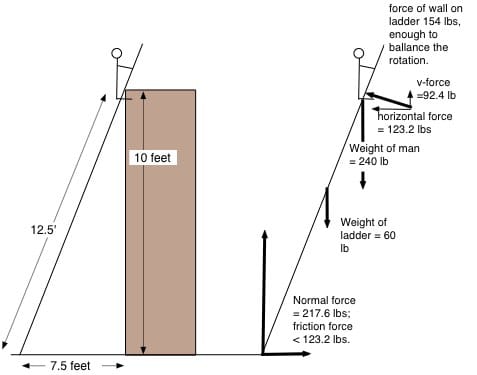
Perhaps the following analysis will help. Lets assume that the ladder is 12.5′ long and sits against a ten foot ledge, with a base 7.5′ away from the wall. Now lets consider the torque and force balance at the bottom of the ladder. Torque is measured in foot-pounds, that is by the rotational product of force and distance. As the fellow climbs the ladder, his weight moves further to the right. This would increase the tendency for the ladder to rotate, but any rotation tendency is matched by force from the ledge. The force of the ledge gets higher the further up the ladder he goes. Let’s assume the ladder weighs 60 lbs and the fellow weighs 240 pounds. When the fellow has gone up ten feet up, he has moved over to the right by 7.5 feet, as the diagram shows. The weight of the man and the ladder produces a rotation torque on the bottom of 60 x 3.75 + 240 x 7.5 = 1925 foot pounds. This torque is combatted by a force of 1926 foot pounds provided by the ledge. Since the ladder is 12.5 feet long the force of the ledge is 1925/12.5 = 154 pounds, normal to the ladder. The effect of this 154 lbs of normal force is to push the ladder to the left by 123.2 lbs and to lift the ladder by 92.4lbs. It is this 123.2 pounds of sideways push force that will cause the ladder to slip.

The slip resistance at the bottom of the ladder equals the net weight times a coefficient of friction. The net weight here equals 60+240-92.4 = 217.6 lbs. Now lets assume that the coefficient of friction is 0.5. We’d find that the maximum friction force, the force available to stop a slip is 217.6 x 0.5 = 108.8 lbs. This is not equal to the horizontal push to prevent rotation, 123.2 lbs. The net result, depending on how you loot at things, is either that the ladder rotates to the right, or that the ladder slips to the left. It keeps slipping till, somewhere near the end of the table, the table tips over.

Force balance of man on ladder. Based on this, I will go through the slippage math in gruesome detail.

I occasionally do this sort of detailed physics; you might as well understand what you see in enough detail to be able to calculate what will happen. One take home from here is that it pays to have a ladder with rubber feet (my ladders do). That adds to the coefficient of friction at the bottom.

Robert Buxbaum, November 6, 2019.

Water Towers, usually a good thing.

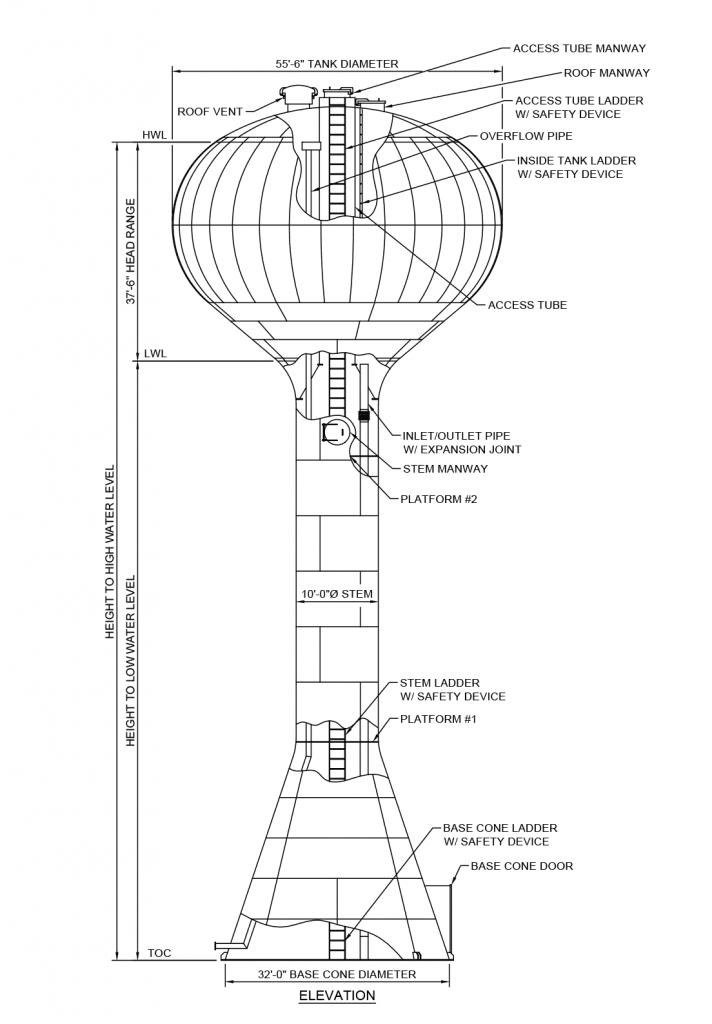
Most towns have at least one water tower. Oakland county, Michigan has four. When they are sized right, they serve several valuable purposes. They provide water in case of a power failure; they provide increased pressure in the morning when people use a lot of water showering etc.; and they allow a town to use smaller pumps and to pump with cheaper electricity, e.g. at night. If a town has no tower, all these benefits are gone, but a town can still have water. It’s also possible to have a situation that’s worse than nothing. My plan is to show, at the end of this essay, one of the ways that can happen. It involves thermodynamic properties of state i a situation where there is no expansion headspace or excess drain (most towers have both).

A typical water tower — spheroidal design. A tower of the dimensions shown would contain about 1/2 million gallons of water.

The typical tower stands at the highest point in the town, with the water level about 170 feet above street level. It’s usable volume should be about as much water as the town uses in a typical day. The reason for the height has to do with the operating pressure of most city-level water pipes. It’s about 75 psi and each foot of water “head” gives you about 0.43 psi. You want pressures about 75 psi for fire fighting, and to provide for folks in apartment buildings. If you have significantly higher pressures, you pay a cost in electricity, and you start losing a lot of water to leaks. These leaks should be avoided. They can undermine the roads and swallow houses. Bob Dadow estimates that, for our water system the leakage rate is between 15 and 25%.

Oakland county has four water towers with considerably less volume than the 130 million gallons per day that the county uses. I estimate that the South-east Oakland county tower, located near my home, contains, perhaps 2 million gallons. The other three towers are similar in size. Because our county’s towers are so undersized, we pay a lot for water, and our water pressure is typically quite low in the mornings. We also have regular pressure excursions and that leads to regular water-boil emergencies. In some parts of Oakland county this happens fairly often.

There are other reasons why a system like ours should have water towers with something more like one days’ water. Having a large water reserve means you can benefit from the fact that electric prices are the lowest at night. With a days’ volume, you can avoid running the pumps during high priced, day times. Oakland county loses this advantage. The other advantage to having a large volume is that it gives you more time to correct problems, e.g. in case of an electric outage or a cyber attack. Perhaps Oakland thinks that only one pump can be attacked at one time or that the entire electric grid will not go out at one time, but these are clearly false assumptions. A big system also means you can have pumps powered by solar cells or other renewable power. Renewable power is a good thing for reliability and air pollution avoidance. Given the benefits, you’d expect Oakland county would reward towns that add water towers, but they don’t, as best I can tell.

Here’s one way that a water column can cause problems. You really need those pressure reliefs.

Now for an example of the sort of things that can go wrong in a water tower with no expansion relief. Every stand-pipe is a small water tower, and since water itself is incompressible, it’s easy to see that a small expansion in the system could produce a large pressure rise. The law requires that every apartment hose water system has to have expansion relief to limit these increases; The water tower above had two forms of reliefs, a roof vent, and an overflow pipe, both high up so that pressure could be maintained. But you can easily imagine a plumber making a mistake and installing a stand pipe without an expansion relief. I show a system like that at left, a 1000 foot tall water pipe, within a skyscraper, with a pump at the bottom, and pipes leading off at the sides to various faucets.

Lets assume that the pressure at the top is 20 psi, the pressure at the bottom will be about 450 psi. The difference in pressure (430 psi) equals the weight of the water divided by the area of the pipe. Now let’s imagine that a bubble of air at the bottom of the pipe detaches and rises to the top of the pipe when all of the faucets are closed. Since air is compressible, while water is not, the pressure at the bubble will remain the same as the bubble rises. By the time the bubble reaches the top of the pipe, the pressure there will rise to 450 psi. Since water has weight, 430 psi worth, the pressure at the bottom will rise to 880 psi = 450 + 430. This is enough to damage pump and may blow the pipes as well. A scenario like this likely destroyed the New Horizon oil platform to deadly consequences. You really want those pressure reliefs, and you want a competent plumber / designer for any water system, even a small one.

Robert Buxbaum, September 28- October 6, 2019. I ran for water commissioner is 2016.

Recycle nuclear waste

In a world obsessed with stopping global warming by reducing US carbon emissions, you’d think there would be a strong cry for nuclear power, one of the few reliable sources of large-scale power that does not discharge CO2. But nuclear power produces dangerous waste, and I have a suggestion: let’s recycle the waste so it’s less dangerous and so there is less of it. Used nuclear fuel rods, in particular. We burn perhaps 5% of the uranium, and produce a waste that is full of energy. Currently these, semi-used rods are stored in very expensive garbage dumps waiting for us to do something. Let’s recycle.

I’ve called nuclear power the elephant in the room for clean energy. Nuclear fuel produces about 25% of America’s electricity, providing reliable baseline generation along with polluting alternatives: coal and natural gas, and less-reliable renewables like solar and wind. Nuclear power does not emit CO2, and it’s available whether or not the sun shines or the wind blows. Nuclear power uses far less land area than solar or wind too, and it provides critical power for our navy aircraft carriers and submarines. Short of eliminating our navy, we will have to keep using nuclear.

Although there are very little nuclear waste per energy delivered, the waste that there is, is hard to manage. Used nuclear fuel rods in particular. For one thing, the used rods are hot, physically. They give off heat, and need to be cooled. At first they give off so much heat that the rods must be stored under water. But rod-heat decays fractally. After ten years or so, rods can be stored in naturally cooled concrete; it’s still a headache, but a smaller one The other problem with the waste rods is that they contain about 1.2% plutonium, a material that can be used for atomic bombs. A major reason that you can’d just dump the waste into the ocean or into a salt mine is the fear that someone will dig it up and extract the plutonium for an a- bomb. The extraction is easy compared to enriching uranium to bomb-grade, and the bombs work at least as well. Plutonium made this way was used for the bomb that destroyed Nagasaki.

The original plan for US nuclear power had been that we would extract the plutonium, and burn it up by recycling it to the nuclear reactor. We’d planned to burry the rest, as the rest is far less dangerous and far less, long-term radioactive. We actually did some plutonium recycling of this sort but in the 1970s a disgruntled worker named Silkwood stole plutonium and recycling was shut down in the US. After that, political paralysis set in and we’ve come to just let the waste sit in more-or-less guarded locations. There was a thought to burry everything in a guarded location (Yucca Mountain, Nevada) but the locals were opposed. So the waste sits waiting to leak out or be stolen. I’d like to return to recycling, but not necessarily of pure plutonium as we did before Silkwood: there is no guarantee that there won’t be other plutonium thieves.

Instead of removing the plutonium for recycling, I’d like to suggest that we remove about 40% of the uranium in the rod, and all of the “ash”, this is all of the lighter atom elements created from the split uranium atoms. This ash is about 5% of the total. The resultant rods would have about 2% plutonium, 97.5% enriched uranium (about 1% enriched at this stage) plus about 0.5% higher transuranics. This composition would be a far less dangerous than purified plutonium. It would be less hot and it would not be possible to use it directly for atom bombs. It would still be fissionable, though, at the same energy content as fresh rods.

There is an uncommonly large amount of power available in nuclear fuel

Several countries recycle by removing the ash. Because no uranium is removed, the material they get has about half the usable life of a fresh rod. After one recycle, there is not much more they could do. If we remove uranium material is a lot more easily used, and more easily recycled again. If we keep removing ash and uranium, we could get many, many recycles. The result is a lot less uranium mining, and more power per rod, and fewer rods to store under guard.

The plutonium of multiply recycled rods is also less-usable for fission bombs. With each recycle, the rods build up a non-fisionabl isotope of plutonium: Pu 240. This isotope is not readily separated from the fissionable isotope, Pu 239, making multiply used rods relatively useless for fission bombs.

Among the countries that do some nuclear waste recycling are Canada, France, Russia, China, and Germany. Not a bad assortment. I would be happy to see us join them.

Robert Buxbaum September 9, 2019

Why does water cost what it does?

Water costs vary greatly about Oakland county, and around the US, and I have struggled in vain to find out why. In part the problem is that each city gets to add as much maintenance and management costs as the city government thinks appropriate. High management and infrastructure fees can increase to the cost of water, but I also not that different cities about Oakland County Michigan get their water at different rates from the multi-county organization that oversees water in South East Michigan: GLWA, The Great Lakes Water Authority.

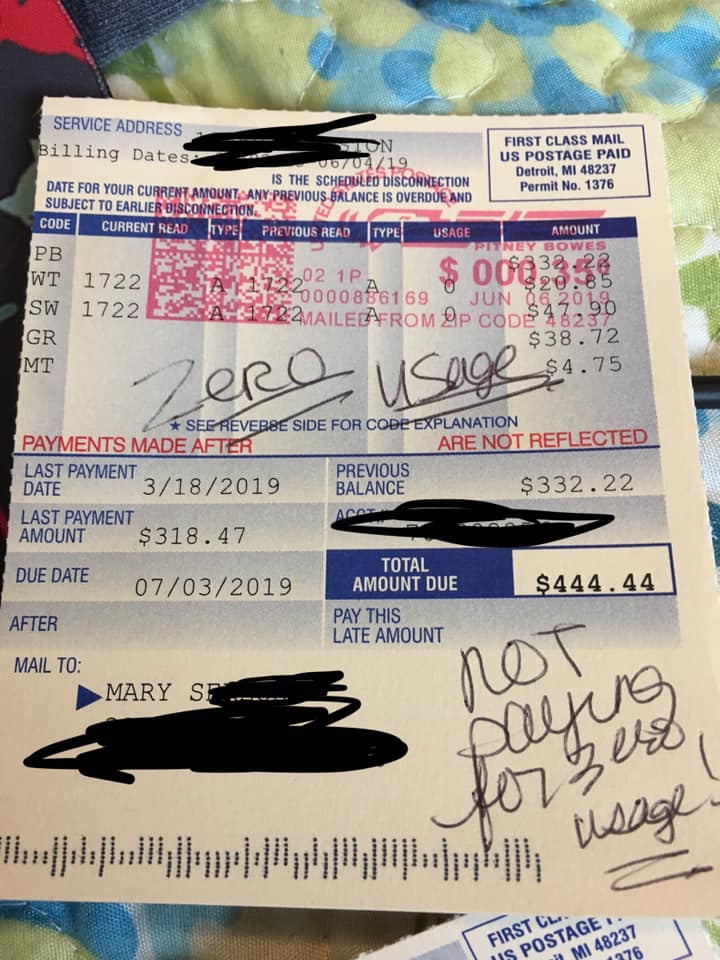
$112 water bill for zero usage. The base charge is so large that prices are essentially independent of useage.

I’ve attended meetings, both local and multi county and have tried to find out why one town gets its water at a far lower rate than another, near by. Towns get lower rates if they have a water tower, but it is not at all clear what the formula is. It also helps to separate the storm sewage from the sanitary sewage — something that I have proposed for all of Oakland county, but if there is fixed formula of how that affects rates, I’ve not seen it. And I wonder how well communities monitor the amount of storm sewage they generate.

The water itself is free. For the most part, in this county, we pump it from the Detroit river. Some of the rest of the water is pumped from wells. None of this costs anything. There is a pump cost, but it is manicure. Pumping 1 gallon of water up 75 feet, costs about 0.002¢ in pumping cost. The rest of the cost is infrastructure: the cost of the pumps, the pipes, the treatment, the billing and sewage. Among the sewage fees is a pollution penalty, and Oakland county pays plenty of pollution penalties. When it rains, we generate more sewage than the system will handle, and we dump the rest into the rivers and lakes. This results in closed beaches and poisoned fish, and fines too. The county pays the EPA when we do this, and the county passes the cost to the cities. I don’t know what the formula for fee distribution is, and don’t even know what it should be. What I do know is that we do this vastly too often. I’d really like us to stop this by moving to separate the sewers so that, as a city, we don’t spend so much on treating rainwater and we don’t pollute so often.

Another oddity is that we do a propaganda campaign to tell folks to use less water. Why? I’d much prefer if people would use more. We could then charge a lower base charge, and then collect the rest on per-gallon fees. As with much that is socialist, the current system is inefficient, but pleasant for the management. Or, for those cheapskates and environmentalists who wish to save water, here are some ideas.

August 21, 2019, Robert Buxbaum

Kindness and Cholera in California

California likely leads the nation in socially activist government kindness. It also leads the nation in homelessness, chronic homelessness, and homeless veterans. The US Council on Homelessnesses estimates that, on any given day, 129,972 Californians are homeless, including 6,702 family households, and 10,836 veterans; 34,332 people are listed among “the chronic homeless”. That is, Californians with a disability who have been continuously homeless for one year or cumulatively homeless for 12 months in the past three years. No other state comes close to these numbers. The vast majority of these homeless are in the richer areas of two rich California cities: Los Angeles and San Francisco (mostly Los Angeles). Along with the homeless in these cities, there’s been a rise in 3rd world diseases: cholera, typhoid, typhus, etc. I’d like to explore the relationship between the policies of these cities and the rise of homelessness and disease. And I’d like to suggest a few cures, mostly involving sanitation. 

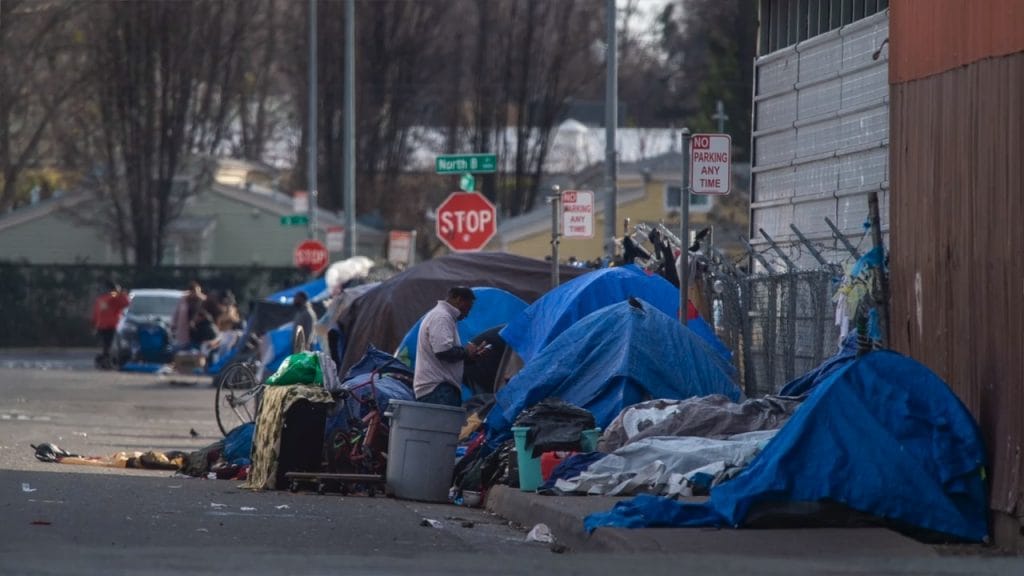
A homeless encampment in LosAngeles

Most of the US homeless do not live in camps or on the streets. The better off US homelessness find it is a temporary situation. They survive living in hotels or homeless shelters, or they “couch-serf,” with family or friends. They tend to take part time jobs, or collect unemployment, and they eventually find a permanent residence. For the chronic homeless things are a lot grimmer, especially in California. The chronic unemployed do not get unemployment insurance, and California’s work rules tend to mean there are no part time jobs, and there is not even a viable can and bottle return system in California, so the homeless are denied even this source of income*. There is welfare and SSI, but you have to be somewhat stable to sign up and collect. The result is that California’s chronic homeless tend to live in squalor strewn tent cities, supported by food handouts.

Californians provide generous food handouts, but there is inadequate sewage, or trash collection, and limited access to clean water. Many of the chronic homeless are drug-dependent or mentally ill, and though they might  benefit from religion-based missions, Los Angeles has pushed the missions to the edges of the cities, away from the homeless. The excess food and lack of trash collection tends to breed rats and disease, and as in the middle ages, the rats help spread the diseases. 

Total homelessness by state, 2018; California leads the nation. The better off among these individuals do not live on the streets, but in hotels or homeless shelters. For most, this is a short term situation. The rest, about 20%, are chronically homeless. About half of these live on the streets without adequate sewage and water. Many are drug-dependent.

The first major outbreaks of the homeless camps appeared in Los Angeles in August and September of 2017. They reappeared in 2018, and by late summer, rates were roughly double 2017’s. This year, 2019, looks like it could be a real disaster. The first case of a typhoid infected police officer showed up in May. By June there were six police officers with typhoid, and that suggests record numbers are brewing among the homeless.

To see why sanitation is an important part of the cure, it’s worth noting that typhoid is a disease of unclean hands, and a relative of botulism. It is spread by people who go to the bathroom and then handle food without washing their hands first. The homeless camps do not, by and large, have hand washing stations. and forced hygiene is prohibited. Los Angeles has set up porta-potties, with no easy hand washing. The result is typhoid epidemic that’s even affecting the police (six policemen in June!).

rate od disease spread.
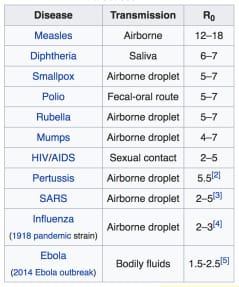
R-naught, reproduction number for some diseases, CDC.

Historically, the worst outbreaks of typhoid were spread by food workers. This was the case with “typhoid Mary of the early 20th century.” My guess is that some of the police who got typhoid, got it while trying to feed the needy. If so, this fellow could become another Typhoid Mary. Ideally, you’d want shelters and washing stations where the homeless are. You’d also want to pickup the dirtier among the homeless for forced washing and an occasional night in a homeless shelter. This is considered inhumane in Los Angeles, but they do things like this in New York, or they did.

Typhus is another major disease of the California homeless camps. It is related to typhoid but spread by rodents and their fleas. Infected rodents are attracted to the homeless camps by the excess food. When the rodents die, their infected fleas jump to the nearest warm body. Sometimes that’s a person, sometimes another animal. In a nastier city, like New York, the police come by and take away old food, dead animals, and dirty clothing; in Los Angeles they don’t. They believe the homeless have significant squatters rights. California’s kindness here results in typhus.

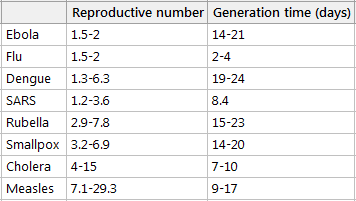
Reproduction number and generation time for some diseases.

The last of the major diseases of the homeless camps is cholera. It’s different from the others in that it is not dependent on squalor, just poor health. Cholera is an airborne disease, spread by coughing and sneezing. In California’s camps, the crazy and sick dwell close to each other and close to healthy tourists. Cholera outbreaks are a predictable result. And they can easily spread beyond the camps to your home town, and if that happens a national plague could spread really fast.

I’d discussed R-naught as a measure of contagiousness some months ago, comparing it to the reproductive number of an atom bomb design, but there is more to understanding a disease outbreak. R-naught refers merely to the number of people that each infected person will infect before getting cured or dying. An R-naught greater than one means the disease will spread, but to understand the rate of spread you also need the generation time. That’s the average time between when the host becomes infected, and when he or she infects others. The chart above shows that, for cholera, r-naught is about 10, and the latency period is short, about 9 days. Without a serious change in California’s treatment of the homeless, each cholera case in June will result in over 100 cases in July, and well over 10,000 in August. Cholera is somewhat contained in the camps, but once an outbreak leaves the camps, we could have a pandemic. Cholera is currently 80% curable by antibiotics, so a pandemic would be deadly.

Hygiene is the normal way to prevent all these outbreaks. To stop typhoid, make bathrooms available, with washing stations, and temporary shelters, ideally these should be run by the religious groups: the Salvation Army, the Catholic Church, “Loaves and Fishes”, etc. To prevent typhus, clean the encampments on a regular basis, removing food, clothing, feces and moving squatters. For cholera, provide healthcare and temporary shelters where people will get clean water, clean food, and a bed. Allow the homeless to work at menial jobs by relaxing worker hiring and pay requirements. A high minimum wage is a killer that nearly destroyed Detroit. Allow a business to hire the homeless to sweep the street for $2/hour or for a sandwich, but make a condition that they wash their hands, and throw out the leftovers. I suspect that a lot of the problems of Puerto Rico are caused by a too-high minimum wage by the way. There will always be poor among you, says the Bible, but there doesn’t have to be typhoid among the poor, says Dr. Robert Buxbaum.

*California has a very strict can and bottle return law where — everything is supposed to be recycled– but there are very few recycling centers, and most stores refuse to take returns. This is a problem in big government states: it’s so much easier to mandate things than to achieve them.

July 30, 2019. I ran for water commissioner in Oakland county, Michigan, 2016. If there is interest, I’ll run again. One of my big issues is clean water. Oakland could use some help in this regard.

Thermal stress failure

Take a glass, preferably a cheap glass, and set it in a bowl of ice-cold water so that the water goes only half-way up the glass. Now pour boiling hot water into the glass. In a few seconds the glass will crack from thermal stress, the force caused by heat going from the inside of the glass outside to the bowl of cold water. This sort of failure is not mentioned in any of the engineering material books that I had in college, or had available for teaching engineering materials. To the extent that it is mentioned mentioned on the internet, e.g. here at wikipedia, the metric presented is not derived and (I think) wrong. Given this, I’d like to present a Buxbaum- derived metric for thermal stress-resistance and thermal stress failure. A key aspect: using a thinner glass does not help.

Before gong on to the general case of thermal stress failure, lets consider the glass, and try to compute the magnitude of the thermal stress. The glass is being torn apart and that suggests that quite a lot of stress is being generated by a ∆T of 100°C temeprarture gradient.

To calcule the thermal stress, consider the thermal expansivity of the material, α. Glass — normal cheap glass — has a thermal expansivity α = 8.5 x10⁻⁶ meters/meter °C (or 8.5 x10⁻⁶ foot/foot °C). For every degree Centigrade a meter of glass is heated, it will expand 8.5×10⁻⁶ meters, and for every degree it is cooled, it will shrink 8.5 x10⁻⁶ meters. If you consider the circumference of the glass to be L (measured in meters), then
∆L/L = α ∆T.

where ∆L is the change in length due to heating, and ∆L/L is sometimes called the “strain.”. Now, lets call the amount of stress caused by this expansion σ, sigma, measured in psi or GPa. It is proportional to the strain, ∆L/L, and to the elasticity constant, E (also called Young’s elastic constant).

σ = E ∆L/L.

For glass, Young’s elasticity constant, E = 75 GPa. Since strain was equal to α ∆T, we find that

σ =Eα ∆T 

Thus, for glass and a ∆T of 100 °C, σ =100°C x 75 GPa x 8.5 x10-6 /°C  = 0.064  GPa = 64MPa. This is about 640 atm, or 9500 psi.

As it happens, the ultimate tensile strength of ordinary glass is only about 40 MPa =  σu. This, the maximum force per area you can put on glass before it breaks, is less than the thermal stress. You can expect a break here, and wherever σu < Eα∆T. I thus create a characteristic temperature difference for thermal stress failure:

The Buxbaum failure temperature, ß = σu/Eα

If ∆T of more than ß is applied to any material, you can expect a thermal stress failure.

The Wikipedia article referenced above provides a ratio for thermal resistance. The usits are perhaps heat load per unit area and time. How you would use this ratio I don’t quite know, it includes k, the thermal conductivity and ν, the Poisson ratio. Including the thermal conductivity here only makes sense, to me, if you think you’ll have a defined thermal load, a defined amount of heat transfer per unit area and time. I don’t think this is a normal way to look at things.  As for including the Poisson ratio, this too seems misunderstanding. The assumption is that a high Poisson ratio decreases the effect of thermal stress. The thought behind this, as I understand it, is that heating one side of a curved (the inside for example) will decrease the thickness of that side, reducing the effective stress. This is a mistake, I think; heating never decreases the thickness of any part being heated, but only increases the thickness. The heated part will expand in all directions. Thus, I think my ratio is the correct one. Please find following a list of failure temperatures for various common materials. 

Stress strain properties of engineering materials including thermal expansion, ultimate stress, MPa, and Youngs elastic modulus, GPa.

You will notice that most materials are a lot more resistant to thermal stress than glass is and some are quite a lot less resistant. Based on the above, we can expect that ice will fracture at a temperature difference as small as 1°C. Similarly, cast iron will crack with relatively little effort, while steel is a lot more durable (I hope that so-called cast iron skillets are really steel skillets). Pyrex is a form of glass that is more resistant to thermal breakage; that’s mainly because for pyrex, α is a lot smaller than for ordinary, cheap glass. I find it interesting that diamond is the material most resistant to thermal failure, followed by invar, a low -expansion steel, and ordinary rubber.

Robert E. Buxbaum, July 3, 2019. I should note that, for several of these materials, those with very high thermal conductivities, you’d want to use a very thick sample of materials to produce a temperature difference of 100*C.

Making the train, City of New Orleans profitable

The City of New Orleans is the name of the only passenger train between Chicago and New Orleans. It’s also the name of a wonderful song by Steve Goodman, 1971. Hear it, sung by Arlo Guthrie with scenes from a modern ride.

“Riding on the City of New Orleans
Illinois Central Monday morning rail
Fifteen cars and fifteen restless riders
Three conductors and twenty-five sacks of mail
All along the southbound odyssey
The train pulls out at Kankakee
Rolls along past houses, farms and fields
Passin’ trains that have no names
Freight yards full of old black men
And the graveyards of the rusted automobiles…”

Every weekday, this train leaves Chicago at 9:00 PM and gets into New Orleans twenty hours later, at 5:00 PM. It’s a 925 mile trip at a 45 mph average: slow and money-losing, propped up by US taxes. Like much of US passenger rail, it “has the disappearing railroad blues.” It’s a train service that would embarrass the Bulgarians: One train a day?! 45 mph average speed!? It’s little wonder is that there are few riders, and that they are rail-enthusiasts: “the sons of Pullman porters, and the sons of engineers, Ride[ing] their father’s magic carpets made of steel.” The wonder, to me was that there was ever fifteen cars for these, “15 restless riders”.

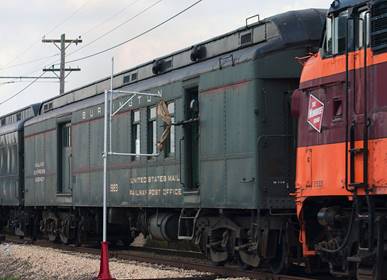
A sack of mail being picked up on the fly.

I would be happy to see more trips and a faster speed, at an average speed of at least 60 mph. This would require 85 mph or higher between stops, but it would save on salaries, and it would bring in some new customers. But even if these higher speeds cost nothing extra, in net, you’d still need something more to make the trip profitable; a lot more if the goal is to add another train. Air-traffic will always be faster, and the automobile, more convenient. I find a clue to profitability in the fifteen cars of the song and in the sacks of mail.

Unless I’m mistaken, mail traffic was at least as profitable as passenger traffic, and those “twenty-five sacks of mail” were either very large, or just the number on-loaded at Kankakee. Passenger trains like ‘the city of New Orleans’ were the main mail carriers till the late 1970s, a situation that ended when union disputes made it unprofitable. Still, I suspect that mail might be profitable again if we used passenger trains only for fast mail — priority and first class — and if we had real fast mail again. We currently use trucks and freight trans for virtually all US mail, we do not have a direct distribution system. The result is that US mail is vastly slower than it had been. First class mail used to arrive in a day or two, like UPS now. But these days the post office claims 2 to 4 business days for “priority mail,” and ebay guarantees priority delivery time “within eight business days”. That’s two weeks in normal language. Surely there is room for a faster version. It costs $7.35 for a priority envelope and $12.80 for a priority package (medium box, fixed price). That’s hardly less than UPS charges.

Last day of rail post service New York to Washington, DC. .June 30, 1977.

Passenger trains could speed our slow mail a lot, even with our slow speed trains. The City of New Orleans makes its trip in less than a day, with connections to major cities across the US. If priority mail went north-south in under one day, people would use it more, and that could make the whole operation profitable. Trains are far cheaper than trucks when you are dealing with large volumes; there are fewer drivers per weight, and less energy use per weight. Still there are logistical issues to making this work, and you want to move away from having many post men handling individual sacks, I think. There are logistical advantages to on-loading and off-loading much larger packages and to the use of a system of standard sizes on a moving conveyor.

How would a revised mail service work? I’d suggest using a version of intermodal logistics. Currently this route consists of 20 stops including the first and last, Chicago and New Orleans. This suggests an average distance between stops of 49 Miles. Until the mid 70s, , mail would be dropped off and picked up at every stop, with hand sorting onboard and some additional on-off done on-the-fly using sacks and hooks, see picture above. For a modern version, I would suggest the same number of passenger stops, but fewer mail pick ups and drop offs, perhaps only 1/3 as many. These would be larger weight, a ton or more, with no hand sorting. I’d suggest mail drop offs and pick ups every 155 miles or so, and only of intermodal containers or pods: ten to 40 foot lengths. These containers plus their contents would weigh between 2,500 and 25,000 pounds each. They would travel on flatcars at the rear of the passenger cars, and contain first class and priority mail only. Otherwise, what are you getting for the extra cost?

The city of New Orleans would still leave Chicago with six passenger cars, but now these would be followed by eight to ten flatcars holding six or more containers. They’d drop off one of the containers at a stop around the 150 mile mark, likely Champaign Urbana, and pick up five or so more (they’d now have ten). Champaign Urbana is a major east-west intermodal stop, by the way. I’d suggest the use of six or more heavy forklifts to speed the process. At the next mail-stop, Centralia, two containers might come off and four or more might come on. Centralia is near St. Louis, itself a major rail hub for trains going west. See map below. The next mail stop might be Memphis. Though it’s not shown as such, Memphis is a major east-west rail hub; it’s a hub for freight. A stripped down mail-stop version of passenger train mail like this seems quite do-able — to me at least. It could be quite profitable, too.

Amtrak Passenger rail map. The city of New Orleans is the dark blue line going north-south in the middle of the map.

Intermodal, flat-bed trucks would take the mail to sorting locations, and from there to distribution points. To speed things, the containers might hold pre-sorted sacks of mail. Intermodal trucks might also carry some full containers east and west e.g. from Centralia to St. Louis, and some full flatcars could be switched on and off too. Full cars could be switched at the end, in New Orleans for travel east and west, or in the middle. There is a line about “Changing cars in Memphis Tennessee.” I imagine this relates to full carloads of mail joining or leaving the train in Memphis. Some of these full intermodal containers could take priority mail east and west. One day mail to Atlanta, and Houston would be nice. California in two days. That could be a money maker.

At this point, I would like to mention “super-fast” rail. The top speeds of these TGV’s “Transports of Grande Vitess” are in the range of 160 mph (265 km/hr) but the average speeds are lower because of curves and the need to stop. The average speeds are roughly 125 mph on the major routes in Europe, but they require special rails and rail beds. My sense is that this sort of special-use improvement is not worth the cost for US rail traffic. While 60 -90 mph can be handled on the same rails that carry freight, the need for dedicated track comes with a doubling of land and maintenance costs. And what do you have when you have it? The bullet rail is still less than half as fast as air travel. At an average speed of 125 mph, the trip between Chicago and New Orleans would take seven hours. For business travelers, this is not an attractive alternative to a two hour flight, and it is not well suited for intermodal mail. The fuel costs are unlikely to be lower than air travel, and there is no easy way to put mail on or off a TGV. Mail en-route would slow the 125 mph speed further, and the use of intermodal containers would dramatically increase the drag and fuel cost. Air travel has less drag because air density is lower at high altitude.

Meanwhile, at 60 mph average speeds, train travel can be quite profitable. Energy use is 1/4 as high at 60 mph average as at 120 mph. An increase of average speed to 60 mph would barely raise the energy use compared to TGV, but it would shorten the trip by five hours. The new, 15 hour version of “The City of New Orleans” would not be competitive for business travel, but it would be attractive for tourists, and certainly for mail. Having fewer hours of conductor/ engineer time would save personnel costs, and the extra ridership should allow the price to stay as it is, $135 one-way. A tourist might easily spend $135 for this overnight trip: leaving Chicago after dinner and arriving at noon the next day. This is far nicer than arriving at 5:00 PM, “when the day is done.”

Robert Buxbaum, June 21, 2019. One summer during graduate school, I worked in the mail room of a bank, stamping envelopes and sorting them by zip code into rubber-band tied bundles. The system I propose here is a larger-scale version of that, with pre-sorted mail bags replacing the rubber bands, and intermodal containers replacing the sacks we put them in.