Category Archives: Engineering

How I size heat exchangers

Heat exchange is a key part of most chemical process designs. Heat exchangers save money because they’re generally cheaper than heaters and the continuing cost of fuel or electricity to run the heaters. They also usually provide free, fast cooling for the product; often the product is made hot, and needs to be cooled. Hot products are usually undesirable. Free, fast cooling is good.

So how do you design a heat exchanger? A common design is to weld the right amount of tubes inside a shell, so it looks like the drawing below. The the hot fluid might be made to go through the tubes, and the cold in the shell, as shown, or the hot can flow through the shell. In either case, the flows are usually in the opposite direction so there is a hot end and a cold end as shown. In this essay, I’d like to discuss how I design our counter current heat exchangers beginning a common case (for us) where the two flows have the same thermal inertia, e.g. the same mass flow rates and the same heat capacities. That’s the situation with our hydrogen purifiers: impure hydrogen goes in cold, and is heated to 400°C for purification. Virtually all of this hot hydrogen exits the purifier in the “pure out” stream and needs to be cooled to room temperature or nearly.

Typical shell and tube heat exchanger design, Black Hills inc.

For our typical designs the hot flows in one direction, and an equal cold flow is opposite, I will show the temperature difference is constant all along the heat exchanger. As a first pass rule of thumb, I design so that this constant temperature difference is 30°C. That is ∆THX =~ 30°C at every point along the heat exchanger. More specifically, in our Mr Hydrogen® purifiers, the impure, feed hydrogen enters at 20°C typically, and is heated by the heat exchanger to 370°C. That is 30°C cooler than the final process temperature. The hydrogen must be heated this last 30°C with electricity. After purification, the hot, pure hydrogen, at 400°C, enters the heat exchanger leaving at 30°C above the input temperature, that is at 50°C. It’s hot, but not scalding. The last 30°C of cooling is done with air blown by a fan.

The power demand of the external heat source, the electric heater, is calculated as: Wheater = flow (mols/second)*heat capacity (J/°C – mol)* (∆Theater= ∆THX = 30°C).

The smaller the value of ∆THX, the less electric draw you need for steady state operation, but the more you have to pay for the heat exchanger. For small flows, I often use a higher value of ∆THX = 30°C, and for large flows smaller, but 30°C is a good place to start.

Now to size the heat exchanger. Because the flow rate of hot fluid (purified hydrogen) is virtually the same as for cold fluid (impure hydrogen), the heat capacity per mol of product coming out is the same as for mol of feed going in. Since enthalpy change equals heat capacity time temperature change, ∆H= Cp∆T, with effectiveCp the same for both fluids, and any rise in H in the cool fluid coming at the hot fluid, we can draw a temperature vs enthalpy diagram that will look like this:

The heat exchanger heats the feed from 20°C to 370°C. ∆T = 350°C. It also cools the product 350°C, that is from 400 to 50°C. In each case the enthalpy exchanged per mol of feed (or product is ∆H= Cp*∆T = 7*350 =2450 calories.

Since most heaters work in Watts, not calories, at some point it’s worthwhile to switch to Watts. 1 Cal = 4.174 J, 1 Cal/sec = 4.174 W. I tend to do calculations in mixed units (English and SI) because the heat capacity per mole of most things are simple numbers in English units. Cp (water) for example = 1 cal/g = 18 cal/mol. Cp (hydrogen) = 7 cal/mol. In SI units, the heat rate, WHX, is:

WHX = flow (mols/second)*heat capacity per mol (J/°C – mol)* ∆Tin-out (350°C).

The flow rate in mols per second is the flow rate in slpm divided by 22.4 x 60. Since the driving force for transfer is 30°C, the area of the heat exchanger is WHX times the resistance divided by ∆THX:

A = WHX * R / 30°C.

Here, R is the average resistance to heat transfer, m2*∆T/Watt. It equals the sum of all the resistances, essentially the sum of the resistance of the steel of the heat exchanger plus that of the two gas phases:

R= δm/km + h1+ h2

Here, δm is the thickness of the metal, km is the thermal conductivity of the metal, and h1 and h2 are the gas-phase heat transfer parameters in the feed and product flow respectively. You can often estimate these as δ1/k1 and δ2/k2 respectively, with k1 and k2 as the thermal conductivity of the feed and product, both hydrogen in my case. As for, δ, the effective gas-layer thickness, I generally estimate this as 1/3 the thickness of the flow channel, for example:

h1 = δ1/k1 = 1/3 D1/k1.

Because δ is smaller the smaller the diameter of the tubes, h is smaller too. Also small tubes tend to be cheaper than big ones, and more compact. I thus prefer to use small diameter tubes and small diameter gaps. in my heat exchangers, the tubes are often 1/4″ or bigger, but the gap sizes are targeted to 1/8″ or less. If the gap size gets too low, you get excessive pressure drops and non-uniform flow, so you have to check that the pressure drop isn’t too large. I tend to stick to normal tube sizes, and tweak the design a few times within those parameters, considering customer needs. Only after the numbers look good to my aesthetics, do I make the product. Aesthetics plays a role here: you have to have a sense of what a well-designed exchanger should look like.

The above calculations are fine for the simple case where ∆THX is constant. But what happens if it is not. Let’s say the feed is impure, so some hot product has to be vented, leaving les hot fluid in the heat exchanger than feed. I show this in the plot at right for the case of 14% impurities. Sine there is no phase change, the lines are still straight, but they are no longer parallel. Because more thermal mass enters than leaves, the hot gas is cooled completely, that is to 50°C, 30°C above room temperature, but the cool gas is heated at only 7/8 the rate that the hot gas is cooled. The hot gas gives off 2450 cal as before, but this is now only enough to heat the cold fluid by 2450/8 = 306.5°. The cool gas thus leave the heat exchanger at 20°C+ 306.8° = 326.5°C.

The simple way to size the heat exchanger now is to use an average value for ∆THX. In the diagram, ∆THX is seen to vary between 30°C at the entrance and and 97.5°C at the exit. As a conservative average, I’ll assume that ∆THX = 40°C, though 50 to 60°C might be more accurate. This results in a small heat exchanger design that’s 3/4 the size of before, and is still overdesigned by 25%. There is no great down-side to this overdesign. With over-design, the hot fluid leaves at a lower ∆THX, that is, at a temperature below 50°C. The cold fluid will be heated to a bit more than to the 326.5°C predicted, perhaps to 330°C. We save more energy, and waste a bit on materials cost. There is a “correct approach”, of course, and it involves the use of calculous. A = ∫dA = ∫R/∆THX dWHX using an analytic function for ∆THX as a function of WHX. Calculating this way takes lots of time for little benefit. My time is worth more than a few ounces of metal.

The only times that I do the correct analysis is with flame boilers, with major mismatches between the hot and cold flows, or when the government requires calculations. Otherwise, I make an H Vs T diagram and account for the fact that ∆T varies with H is by averaging. I doubt most people do any more than that. It’s not like ∆THX = 30°C is etched in stone somewhere, either, it’s a rule of thumb, nothing more. It’s there to make your life easier, not to be worshiped.

Robert Buxbaum June 3, 2024

7% of new US vehicles were EVs in 2023. Expect slow growth in 2024.

About 7% of new US car and truck sales in 2023 were electric, 1.2 million vehicles. Of these, about 55% were Teslas. These numbers make sense based on US manufacturing and driving habits, so I don’t expect fast sales growth in 2024.

Currently home owners are the only major group of private drivers that save on fuel cost from owning an EVs. Home owners pay relatively little for electricity, about 11¢ per kWh, and they can generally charge their EVs conveniently, at home, overnight. Charging is more expensive and inconvenient for apartment dwellers. As a result, in 2023, some 95% of US EV sales went to home owners. Over 2 to 3 years they could hope to recover in gasoline savings the $7000 more that their EVs cost compared to petrol-powered vehicles, but they still have to drive a fair amount. A full charge of 80kWh EV at home will cost about $8.80 at current rates. This will power about 250 miles at a cost of 3.5¢/mile = $8.80/250.

Home, level 2 Chargers will cost about $1500 including the electrician cost.

The cost of gasoline is about 16.5¢/mile = $3.80/gal/ 23mi/gal) suggesting that you save 13¢ per mile by owning an EV. In order to recover the extra $7000 cost of the car in two years, you’d have to drive 27,000 miles per year, or 74 miles per day. To recover the difference in three years, you must drive 50 miles per day or 18,000 miles per year. This is more than most people drive.

EVs also offer reduced maintenance, but customers can balance this against the inconvenience of long charge times and spotty availability of chargers. My sense is that the fraction of Americans who benefit and drive 50-75 miles per day is about 7%. This fraction will increase as EVs get cheaper, but families that can benefit already own an EV.

The average Tesla costs today about $3000 more than the equivalent petrol car, but that still makes it relatively expensive, and it seems that the price differential was intentionally set to match sales to Tesla’s production capacity. Tesla could make EVs cheaper than petrol cars and still make a profit on each, but if they did this, they would have too much demand. Other US auto makers are mostly lose money on EVs and are unmotivated to lower prices. Based on this, my sense is that it is unlikely that sales will be much higher in 2024 than the 1.2 million sold in 2023.

The Chinese have plenty of new EVs, and they are eager to export. Their car market is currently about 50% EV, with companies like BYD selling EVs for as little as $12,000. The Chinese government subsidizes production and powers their EVs with cheap electricity by burning coal. These cars do not seem very good, compared to Tesla, but at this price they would flood the market if allowed to compete. The US government has kept them out with tariffs and with complaints about slave labor. Trump has promised a yet higher tariff, 100% on Chinese cars, if elected. The intent is to preserve US jobs and manufacturing. This is one of those situations where tariffs are good, IMHO.

Toyota Prius, the most popular hybrid.

Hybrids are a third option, cheaper than EVs, high mpg than normal engines. Though they are sometimes touted as a transition to EVs, to me they’ seem to suit a completely different demographic: those who don’t own their own home and drive a lot. Toyota makes the most popular hybrids in the US. They cost about $4000 more than the equivalent petrol car, $30,000 for a Prius vs $26,000 for a Corolla. When using a Prius in the city, you’ll get about 50 mpg, spending 7.5¢ per mile ($3.80/gal / 50 mpg = 7.5¢). This implies a gas savings of about 9¢ per mile vs an ordinary Corolla. Based on this, you have to drive about 27,000 miles per year in the city to recover the cost difference in two years. That’s a lot, and your performance is typically worse with a hybrid: you have a heavier car with a small engine. Maintenance cost is also higher with a hybrid than with an EV: you still need oil changes, fluid changes, belts, etc. and the mpg advantage vanishes on the highway. A hard driving home owner is better off with an EV, IMHO, an apartment dweller with a hybrid. Hybrids also should make sense for taxis and local-haul trucks. I can imagine hybrid sales rising in 2024, perhaps as high as 15% of vehicle sales. What we’re all waiting for is more near-shore manufacturing (or mandates), and this is not likely in 2024.

Robert Buxbaum April 28, 2024

Einstein’s theory of diffusion in liquids, and my extension.

In 1905 and 1908, Einstein developed two formulations for the diffusion of a small particle in a liquid. As a side-benefit of the first derivation, he demonstrated the visible existence of molecules, a remarkable piece of work. In the second formulation, he derived the same result using non-equilibrium thermodynamics, something he seems to have developed on the spot. I’ll give a brief version of the second derivation, and will then I’ll show off my own extension. It’s one of my proudest intellectual achievements.

But first a little background to the problem. In 1827, a plant biologist, Robert Brown examined pollen under a microscope and noticed that it moved in a jerky manner. He gave this “Brownian motion” the obvious explanation: that the pollen was alive and swimming. Later, it was observed that the pollen moved faster in acetone. The obvious explanation: pollen doesn’t like acetone, and thus swims faster. But the pollen never stopped, and it was noticed that cigar smoke also swam. Was cigar smoke alive too?

Einstein’s first version of an answer, 1905, was to consider that the liquid was composed of atoms whose energy was a Boltzmann distribution with an average of E= kT in every direction where k is the Boltzmann constant, and k = R/N. That is Boltsman’s constant equals the gas constant, R, divided by Avogadro’s number, N. He was able to show that the many interactions with the molecules should cause the pollen to take a random, jerky walk as seen, and that the velocity should be faster the less viscous the solvent, or the smaller the length-scale of observation. Einstein applied the Stokes drag equation to the solute, the drag force per particle was f = -6πrvη where r is the radius of the solute particle, v is the velocity, and η is the solution viscosity. Using some math, he was able to show that the diffusivity of the solute should be D = kT/6πrη. This is called the Stokes-Einstein equation.

In 1908 a French physicist, Jean Baptiste Perrin confirmed Einstein’s predictions, winning the Nobel prize for his work. I will now show the 1908 Einstein derivation and will hope to get to my extension by the end of this post.

Consider the molar Gibbs free energy of a solvent, water say. The molar concentration of water is x and that of a very dilute solute is y. y<<1. For this nearly pure water, you can show that µ = µ° +RT ln x= µ° +RT ln (1-y) = µ° -RTy.

Now, take a derivative with respect to some linear direction, z. Normally this is considered illegal, since thermodynamic is normally understood to apply to equilibrium systems only. Still Einstein took the derivative, and claimed it was legitimate at nearly equilibrium, pseudo-equilibrium. You can calculate the force on the solvent, the force on the water generated by a concentration gradient, Fw = dµ/dz = -RT dy/dz.

Now the force on each atom of water equals -RT/N dy/dz = -kT dy/dz.

Now, let’s call f the force on each atom of solute. For dilute solutions, this force is far higher than the above, f = -kT/y dy/dz. That is, for a given concentration gradient, dy/dz, the force on each solute atom is higher than on each solvent atom in inverse proportion to the molar concentration.

For small spheres, and low velocities, the flow is laminar and the drag force, f = 6πrvη.

Now calculate the speed of each solute atom. It is proportional to the force on the atom by the same relationship as appeared above: f = 6πrvη or v = f/6πrη. Inserting our equation for f= -kT/y dy/dz, we find that the velocity of the average solute molecule,

v = -kT/6πrηy dy/dz.

Let’s say that the molar concentration of solvent is C, so that, for water, C will equal about 1/18 mols/cc. The atomic concentration of dilute solvent will then equal Cy. We find that the molar flux of material, the diffusive flux equals Cyv, or that

Molar flux (mols/cm2/s) = Cy (-kT/6πrηy dy/dz) = -kTC/6πrη dy/dz -kT/6πrη dCy/dz.

where Cy is the molar concentration of solvent per volume.

Classical engineering comes to a similar equation with a property called diffusivity. Sp that

Molar flux of y (mols y/cm2/s) = -D dCy/dz, and D is an experimentally determined constant. We thus now have a prediction for D:

D = kT/6πrη.

This again is the Stokes Einstein Equation, the same as above but derived with far less math. I was fascinated, but felt sure there was something wrong here. Macroscopic viscosity was not the same as microscopic. I just could not think of a great case where there was much difference until I realized that, in polymer solutions there was a big difference.

Polymer solutions, I reasoned had large viscosities, but a diffusing solute probably didn’t feel the liquid as anywhere near as viscous. The viscometer measured at a larger distance, more similar to that of the polymer coil entanglement length, while a small solute might dart between the polymer chains like a rabbit among trees. I applied an equation for heat transfer in a dispersion that JK Maxwell had derived,

where κeff is the modified effective thermal conductivity (or diffusivity in my case), κl and κp are the thermal conductivity of the liquid and the particles respectively, and φ is the volume fraction of particles. 

To convert this to diffusion, I replaced κl by Dl, and κp by Dp where

Dl = kT/6πrηl

and Dp = kT/6πrη.

In the above ηl is the viscosity of the pure, liquid solvent.

The chair of the department, Don Anderson didn’t believe my equation, but agreed to help test it. A student named Kit Yam ran experiments on a variety of polymer solutions, and it turned out that the equation worked really well down to high polymer concentrations, and high viscosity.

As a simple, first approximation to the above, you can take Dp = 0, since it’s much smaller than Dl and you can take Dl to equal Dl = kT/6πrηl as above. The new, first order approximation is:

D = kT/6πrηl (1 – 3φ/2).

We published in Science. That is I published along with the two colleagues who tested the idea and proved the theory right, or at least useful. The reference is Yam, K., Anderson, D., Buxbaum, R. E., Science 240 (1988) p. 330 ff. “Diffusion of Small Solutes in Polymer-Containing Solutions”. This result is one of my proudest achievements.

R.E. Buxbaum, March 20, 2024

BYD is not first world competition for Tesla

In Q4 2023, BYD became the world’s largest electric vehicle (EV) manufacturer, passing Tesla in world wide sales. They mostly sell in China, and claim to make a profit while selling cars for about half the price of a Tesla. They also make robots, trucks, busses, smart phones, and batteries — including blade batteries that Tesla uses for a variant in its Berlin facility. They are a darling of the wall-street experts, in part because Warren Buffett is an investor. BYD cars look to be about as nice as Tesla’s at least from the outside and sell (In China) for a fraction of the price. The experts are convinced enough to write glowing articles, but I suspect that the experts have not invested, nor bought BYD products. — What do I know?

BYD truck. It looks good on the outside. Is it competition?

Part of the BYD charm is that it is considered socially progressive, while Tesla is seen as run by a dictatorial villain. A Delaware judge who concluded that Musk did non deserve the majority of his salary, and confiscated it. There are no such claims against BYD. BYD also has far more models than Tesla, 41 by my count, compared to Tesla’s 4. The experts seem to believe that all BYD has to do is bring their low-cost cars west, and they will own the market. My sense is that, if that was all they needed, they’d have done it already. I strongly suspect the low cost cars that are the majority of BYD’s sales are low quality versions — too low to sell in the US. Here are some numbers.

Total number of vehicles made 2023:
Tesla: ~1,800,000
BYD: ~3,020,000 (1,570,000 BEV)

Employees 2023: Vehicles / Employee 2023:
Tesla: ~140,000 Tesla: 12.86
BYD: ~631,500 BYD: 5.03

Gross Revenue 2023: Gross revenue per vehicle:
Tesla: ~$96.8B Tesla: $53,900
BYD: ~ $85B BYD: $28,100

Net Profit 2023: Profit per employee: Profit per vehicle:
Tesla: ~$9.5B (9.7%). Tesla: $67,857. Tesla: $5,280.
BYD: ~$3.5B (4.1%). BYD: $5,542. BYD: $1,160

Market share based on sales in western countries 2023:
Tesla: US: 4%, EU: 2.6%
BYD: US: 0%, EU: 0.1%

The most telling comparison, in my opinion, is BYD’s tiny market share in western countries. Their cars sell for 1/2 what Tesla’s sell for. If their low-cost cars were as good as Tesla’s, there is no way their market penetration would be so low. My sense is that the average BYD vehicle is lacking in something. Maybe they’re underpowered, or poorly constructed, unsafe, or unreliable: suitable only for China, India, or other poor markets. I suspect that the cars BYD sells in Europe are made on a separate line. Even so, customers say that BYD cars feel “cheap.” BYD charges more for these cars in Europe than Tesla charges for its top sellers, suggesting that these vehicles are of a different, better design. Even so, the low numbers suggest that BYD does not turn a profit on the sales. I suspect they do it for PR.

Both cars look sporty. Why doesn’t the BYD sell?

Another observation is that BYD produces 5.03 vehicles per worker, per year. That’s half as many as Tesla workers produce per worker-year. It’s also about half of Ford’s Rouge plant (Detroit) worker production in the 1930s. That Ford plant was vertically integrated starting with raw materials and outputting finished cars. This low output per worker suggests that BYD is built on low wage, low skill production, or equally damning, that none of these models are really mass-produced.

A first world market favors a polished product that your mechanic is somewhat familiar with. That favors Tesla as it has significant market penetration, and a network of mechanics. Also, Tesla has built up a network of fast charge stations and reliable service providers. BYD has no particular charging infrastructure and virtually no service network. Charging price and experience is a key decider among first world customers. No American will tolerate slow charging in the snow at a high price — especially if they must travel to a charger without being sure the charger will be working when they get there. Tesla has figured out how to make charging less painful, and that’s worth a lot.

Tesla might fail, but if so I don’t think it will be because of BYD success. Months ago the experts assured us that cybertruck would be deadly a failure. I disagree, but it might be. I don’t think BYDs will be better. Government subsidies have ended in many states and countries (Germany, California…) putting a dent in Tesla sales, and they are having manufacturing difficulties, particularly with batteries. These seem fix-able, but might not be. I see relatively little first world competition in the US EV market from legacy auto companies. Maybe they know to avoid EVs. They currently make decent products, IC and EV, but lose money on every EV. They treat EVs as a passing fad. If they are right, Tesla and BYD will fail. If they are wrong, Tesla will do fine, and they may not be able to make up their lost place in the market. As for BYD, given their low production numbers, they will need some 3 million new workers and many new factories. I don’t think they can find them, nor raise the money for the factories.

Most of the data here was taken from @NicklasNilsso14. All of the opinions are mine.

Robert Buxbaum February 18, 2024.

Deadly screw sizes, avoid odd numbers and UNF.

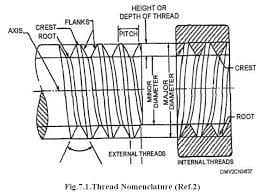
The glory of American screws and bolts is their low cost ubiquity, especially in our coarse thread (UNC = United National Coarse) sizes. Between 1/4 inch and 5/8″, they are sized in 1/16″ steps, and after that in 1/8″ steps. Below 3/16″, they are sized by wire gauges, and generally they have unique pitch sizes. All US screws and bolts are measured by their diameter and threads per inch. Thus, the 3/8-16 (UNC) has an outer diameter (major diameter) of 3/8″ with 16 threads per inch (tpi). 16 tpi is an ideal thread number for overall hold strength. No other bolt has 16 threads per inch so it is impossible to use the wrong bolt in a hole tapped for 3/8-16. The same is true for basically every course thread with a very few exceptions, mainly found between 3/16″ and 1/4″ where the wire gauges transition to fractional sizes. Because of this, if you stick to UTC you are unlikely to screw up, as it were. You are also less-likely to cross-thread.

I own one of these. It’s a tread pitch gauge.

US fine threads come in a variety of standards, most notably UNF = United National Fine. No version of fine thread is as strong as coarse because while there are more threads per inch, each root is considerably weaker. The advantage of fine treads is for use with very thin material, or where vibration is a serious concern. The problem is that screwups are far more likely and this diminishes the strength even further. Consider the 7/16″ – 24 (UNF). This bolt will fit into a nut or flange tapped for 1/2″- 24. The fit will be a little loose, but you might not notice. You will be able to wrench it down so everything looks solid, but only the ends of the threads are holding. This is a accident waiting to happen. To prevent such mistakes you can try to never allow a 7/6″-24 bolt into your shop, but this is uncomfortably difficult. If you ever let a 7/6″-24 bolt in, some day someone will grab it and use it, in all likelihood with a 1/2″ -24 nut or flange, since these are super-common. Under stress, the connection will fail in the worst possible moment.

Other UNF bolts and nuts present the same screwup risk. For example, between the 3/8″-24 and 5/16″-24 (UNF), or the #10-32 (UNF) and also with the 3/16″- 32, and the latter with the #8-32 (UNC). There is also a French metric with 0.9mm — this turns out to be identical to -32 pitch. The problem appears with any bolt pair where with identical pitch and the major diameter of the smaller bolt has a larger outer diameter (major diameter) than the inner diameter (minor diameter) of the larger bolt. If these are matched, the bolts will seem to hold when tightened, but they will fail in use. You well sometimes have to use these sizes because they match with some purchased flange. If you have to use them, be careful to use the largest bolt diameter that will fit into the threaded hole.

Where I have the option, my preference is to stick to UNC as much as possible, even where vibration is an issue. In vibration situations, I prefer to add a lock nut or sometimes, an anti-vibration glue, locktite, available in different release temperatures. Locktite is also helpful to prevent gas leaks. In our hydrogen purifiers, I use lock washers on the ground connection from the power cord, for example.

I try to avoid metric, by the way. They less readily available in the US, and more expensive. The other problem with metric is that there are two varieties (Standard and French — God love the French engineering) and there are so many sizes and pitches that screwups are common. Metric bolts come in every mm diameter, and often fractional mm too. There is a 2mm, a 2.3mm, a 2.5mm, and a 2.6mm, often with overlapping pitches. The pitch of metric screws and bolts is measured by their spacing, by the way, so a 1mm metric pitch means there is 1mm between threads, the the equivalent of a 24.5 pitch in the US, and a 0.9mm pitch = US-32. Thread confusion possibilities are endless. A M6x1 (6mm OD x 1mm pitch) is easily confused with a M5x1 or a M7x1, and the latter with the M7.5×1. A M8x1.25 is easily confused with a M9x1.25, and a M14x2 with an M16x2. And then there is confusion with US bolts: a 2.5mm metric pitch is nearly identical to a US 10tpi pitch. I can not rid myself of US threads, so I avoid metric where I can. As above, problems arise if you use a smaller diameter bolt in a larger diameter nut.

For those who have to use metric, I suggest you always use the largest bolt that will fit (assuming you can find it). I try to avoid bringing odd-size bolts into their shop, that is, stick to M6, M8, M10. It’s not always possible, but it’s a suggestion. I get equipment with odd-size metric bolts too. My preference is to stick to UNC and to avoid odd numbers.

Robert Buxbaum, January 23, 2024. Note: I’ve only really discussed bolt sizes between about #4 and 1″, and I didn’t consider UNRC or UNJF or other, odd options. You can figure these issues out yourself from the above, I think.

Ferries make more sense than fast new trains.

Per pound mile of material, the transport cost by ship is 1/4 as much as by train, and about 1/8 as much as by truck. Ships are slower, it is true, but they can go where trucks and trains can not. They cross rivers and lakes at ease and can haul weighty freight with ease. I think America could use many more ferries, particularly drive-on, fast ferries. I don’t think we need new fast rail lines, because air travel will always be faster and cheaper. The Biden administration thinks otherwise, and spends accordingly.

Amtrak gets $30 Billion for train infrastructure this year, basically nothing for ferries.

The Biden administration’s infrastructure bill, $1.2 Trillion dollars total, provides $30 Billion this year for new train lines, but includes less than 1% as much for ferries, $220 million, plus $1B for air travel. I think it’s a scandal. The new, fast train lines are shown on the map, above. Among them is a speed upgrade to the “Empire Builder” train running between Chicago and Seattle by way of Milwaukee. I don’t think this will pay off — the few people who take this train, takes it for the scenery, I think, and for the experience, not to get somewhere fast.

There is money for a new line between Cleveland and Detroit, and for completion of the long-delayed, and cost-over-run prone line between LA and San Francisco. Assuming these are built, I expect even lower ridership since the scenery isn’t that great. Even assuming no delays (and there are always delays), 110 mph is vastly slower than flying, and typically more expensive and inconvenient. Driving is yet slower, but when you drive, you arrive with your car. With a train or plane, you need car rental, typically.

New Acela train, 150 mph max. 1/4 as fast as flying at the same price.

Drive-on ferries provide a unique advantage in that you get there with your car, often much faster than you would with by driving or by train. Consider Muskegon to Milwaukee (across the lake), or Muskegon to Chicago to Milwaukee, (along the lake). Cleveland to Canada, or Detroit to Cleveland. No land would have to be purchased and no new track would have to be laid and maintained. You’d arrive, rested and fed (they typically sell food on a ferry), with your car.

There’s a wonderful song, “City of New Orleans”, sung here by Arlo Guthrie describing a ride on the historic train of that name on a trip from Chicago to New Orleans, 934 miles in about one day. Including stops but not including delays, the average speed is 48 mph, and there are always delays. On board are, according to the song, “15 restless riders, 3 conductors, and 25 sacks of mail.” The ticket price currently is $200, one way, or about as much as a plane ticket. The line loses money. I’ve argued, here, for more mail use to hep make this profitable, but the trip isn’t that attractive as a way to get somewhere, it’s more of a land-cruise. The line is scheduled for an upgrade this year, but even if upgraded to 100 mph (14 hours to New Orleans including stops?) it’s still going to be far slower than air travel, and likely more expensive, and you still have to park your car before you get on, and then rent another when you get off. And will riders like it more? I doubt it, and doubt the speed upgrade will be to 100 mph.

Lake Express, 30 mph across Lake Michigan

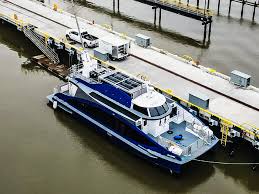
Ferry travel tends to cost less than train or plane travel because water traffic is high volume per trip with few conductors per passenger. At present, there are only two ferryboats traveling across Lake Michigan, between Michigan and Wisconsin, Milwaulkee to Muskegon. They are privately owned, and presumably make money. The faster is the Lake Express, 30 mph. It crosses the lake in 2.5 hours. Passenger tickets cost $52 one way, or $118 for passenger and car. That’s less than the price of an Amtrak ticket or a flight. I think a third boat would make sense and that more lines would be welcome too. Perhaps Grand Haven to Racine or Chicago.

Route of the Lake Express. I’d like to see more like this; St. Joseph to Milwaukee say, and along Lake Erie.

Currently, there are no ferries across Lake Erie. Nor are there any along Lake Erie, or even across Lake St. Clair, or along the Detroit River, Detroit to Toledo or Toledo to Cleveland. These lines would need dock facilities, but they would have ridership, I think. New York’s Staten Island ferry has good ridership, 35,000 riders on a typical day, plus cars and trucks. In charge are roughly 120 engineers, captains and mates, one employee for every 300 passengers or so. By comparison, Amtrak runs 300 trains that carry a total of 87,000 passengers on an average day, mostly on the east coast. These 300 trains are run by 17,100 employees as of fiscal year 2021, one employee for every 4 passengers. Even at the slow speeds of our trains the cost is far higher per passenger and per passenger mile.

The Staten Island ferry is slow, 18.5 mph, but folks don’t seem to mind. The trip takes 20 minutes, about half as long as most people’s trips on Amtrak. There are also private ferry lines in NY, many of these on longer trips. People would take ferries for day-long trips along our rivers, I think. Fast ferries would be nice, 40 mph or more, but I think even slow ferries would have ridership and would make money. A sea cruise is better than a land cruise, especially if you can have a cabin. On the coal-steam powered, Badger, you can rent a state-room to spend the night in comfort. Truckers seem to like that they cover ground during their mandatory rest hours. The advantage is maximized, I think, for ferry trips that take 12 hours or so, 250 to 350 miles. That’s Pittsburgh to Cincinnatti or Chicago to Memphis.

New York’s Staten Island ferry leaves every 15 minutes during rush hour. Three different sizes of boat are used. The largest carry over 5000 passengers and 100 cars and trucks at a crossing.

A low risk way to promote ferry traffic between the US and Canada would be to negotiate bilateral exemption to The Jones Act and its Canadian equivalent. Currently, we allow only US ships with US crews for US travel within the US.* Cabotage it’s called, and it applies to planes as well, with exemptions. Canada has similar laws and exemptions. A sensible agreement would allow in-country and cross-country travel on both Canadian and US ships, with Canadian and/or US crew. In one stoke, ridership would double, and many lines would be profitable.

Politicians of a certain stripe support trains because they look futuristic and allow money to go to friends. Europeans brag of their fast trains, but they all lose money, and Europe had to ban many short hop flights to help their trains compete. Without this, Europeans would fly. There is room to help a friend with a new ferry, but not as much as when you buy land and lay track. We could try to lead in fancy ferries going 40 mph or faster, providing good docks, and some insurance. Investors would take little risk since a ferry route can be moved**. Don’t try that with a train.

In Detroit we have a close up of train mismanagement involving the “People Mover.” It has no ridership to speak of. Our politicians then added “The Q line” to connect to it. People avoid both lines. I think people would use a ferry along the Detroit river, though, St. Claire to Wyandotte, Detroit, Toledo — and to Cleveland or Buffalo. Our lakes and rivers are near-empty superhighways. Let’s use them.

Robert Buxbaum, January 2, 2024. *The US air cabotage act (49 U.S.C. 41703) prohibits the transportation of persons, property, or mail for compensation or hire between points of the U.S. in a foreign civil aircraft. We’ve managed exemptions, though, e.g. for US air traffic with Airbus and Embraer planes. We can do the same with ferries.

** I notice that it was New York’s ferries, and their captains, that rescued the people on Sullenberger’s plane when it went down in the Hudson River — added Jan. 6.

Cybertruck an almost certain success

Leading up to the Cybertruck launch 4 weeks ago, the expert opinion was that it was a failure. Morgan Stanley, here dubbed it as one, as did Rolling Stone here. Without having driven the vehicle, the experts at Motor trend, here, declared it was worse than you thought, “a novelty” car. I’d like to differ. The experts point out that the design is fundamentally different from what we’ve made for years. They claim it’s ugly, undesirable, and hard to build. Ford’s F-150 trucks are the standard, the top selling vehicle in the US, and Cybertruck looks nothing like an F-150. I suspect that, because of the differences, the Cybertruck can hardly fail to be a success in both profit and market share.

Cybertruck pulls a flat-bed trailer at Starbase.

Start with profit. Profit is the main measure of company success. High profit is achieved by selling significant numbers at a significant profit margin. Any decent profit is a success. This vehicle could trail the F-150 sales forever and Musk could be the stupidest human on the planet, so long as Tesla sells at a profit, and does so legally, the company will succeed. Tesla already has some 2 million pre-orders, and so far they show no immediate sign of leaving despite the current price of about $80,000. Unless you think they are all lying or that Musk has horribly mispriced the product, he should make a very decent profit. My guess is he’s priced to make over $10,000 per vehicle, or $20B on 2 million vehicles. Meanwhile, no other eV company seems to be making a profit.

The largest competing electric pickup company is Rivian. They sold 16,000 electric trucks in Q3 2023, but the profit margin is -100%. This is to say, they lose $1 for every $1 worth of sales –and that’s unsustainable. Despite claims to the contrary, a money-losing business is a failure. The other main competitors are losing too. Ford is reported to lose about $50,00 per eV. According to Automotive News, here, last week, Ford decided to cut production of its electric F-150, the Lightning, by 50%. This makes sense, but provides Cybertruck a market fairly clear of US e-competition.

2024 BYD, Chinese pickup truck

Perhaps the most serious competitor is BYD, a Chinese company backed by the communist government, and Warren Buffet. They are entering the US market this month with a new pickup. It might be profitable, but BYD is relatively immune to profitability. The Chinese want dominance of the eV market and are willing to lose money for years until they get it. Fortunately for Tesla, the BYD truck looks like Rivian’s. Tesla’s trucks should exceed them in range, towing, and safety. BYD, it seems, is aiming for a lower price point and a different market, Rivian’s.

A video, here, shows the skin of a Cybertruck is bulletproof to 9mm, shotgun, and 45 caliber machine gun fire. Experts scoff at the significance of bulletproof skin — good for folks working among Mexican drug lords, or politicians, or Israelis. Tesla is aiming currently for a more upscale customer, someone who might buy a Hummer or an F-250. This is more usable and cheaper.

Don’t try this with other trucks.

Another way Cybertruck could fail is through criminal activity. Musk could be caught paying off politicians or cheating on taxes or if the trucks fail their safety tests. So far, Cybertruck seems to meet Federal Motor Vehicle Safety Standards by a good margin. In a video comparison, here, it appears to take front end collisions as well as an F-150, and appears better in side collisions.

This leaves production difficulty. This could prevent the cybertruck from being a big success, and the experts have all harped on this. The vehicle body is a proprietary stainless steel, 0.07″ thick. Admittedly it’s is hard to form, but Tesla seems to manage it. VIN number records indicate that Tesla had delivered 448 cybertrucks as Friday last week, many of them to showrooms, but some to customers. Drone surveys of the Gigafactory lot show that about 19 are made per day. That’s a lot more than you’d see if assembly was by hand. Assuming a typical learning curve, it’s reasonable to expect some 600 will be delivered by December 31, and that production should reach 6000 per month in mid 2024. At that rate, they’ll be making and selling at the same rate as Rivian or Ford, and making real money doing it. The stainless body might even be a plus, deterring copycat competition. Other pluses are the add-ons, like the base-camp tent option, a battery extension, a ramp, and (it’s claimed) some degree of sea worthiness. Add-ons add profit and deter direct copying (for a time).

Basecamp, tent option.

So why do I think the experts are so wrong? My sense is that these people are experts because of long experience at other companies — the competitors. They know what was tried, and that innovation failed. They know that their companies chose not to make anything like a Cybertruck, and not to provide the add-ons. They know that the big boys avoid “novelty cars” and add-ons. There is an affinity among experts for consensus and sure success, the success that comes from Chinese companies, government support and international banking. If the Cybertruck success is an insult to them and their expertise. Nonetheless, if Cybertruck succeeds, they will push their companies towards a more angular design plus add-ons. And they will claim cybertruck is no way novel, but that government support is needed to copy it.

Robert Buxbaum, December 25, 2023.

Solving the evening solar power problem

Solar power is only available during the day, and people need power at night too. As a result, the people of a town will either need a lot of storage, or a back-up electric generator for use at night and on cloudy days. These are expensive, and use gasoline (generally) and they are hard to maintain for an individual. Central generated alternate power is cheaper, but the wires have to be maintained. As a result, solar power is duck curve, or canon curve power. It never frees you from hydrocarbons and power companies, and it usually saves no money or energy.

People need power at twilight and dawn too, and sunlight barely generates any power during these hours, and sometimes clouds appear and disappear suddenly while folks expect uniform power to their lights. The mismatch between supply and demand means that your backup generator, must run on and off suddenly. It’s difficult for small, home generators, but impossible for big central generators. In order to have full power by evening, the big generators need to run through the day. The result is that, for most situations, there is no value to solar power.

Installed solar power has not decreased the amount of generation needed, just changed when it is needed.

Power leveling through storage will address this problem, but it’s hardly done. Elon Musk has suggested that the city should pay people to use a home battery power leveler, a “power wall” or an unused electric car to provide electricity at night, twilight, and on cloudy days. It’s a legitimate idea, but no city has agreed, to date. In Europe, some locations have proposed having a central station that generates hydrogen from solar power during the day using electrolysis. This hydrogen can drive trucks or boats, especially if it is used to make hythane. One can also store massive power by water pumping or air compression.

Scottsbluff Neb. solar farm damaged by hail, 6/23.

In most locations, storage is not available, so solar power has virtually no value. I suspect that, at the very least, in these locations, the price per kWh should be significantly lower at noon on a sunny day (1/2 as expensive or less). The will cause people to charge their eVs at noon, and not at midnight. Adjusted prices will cause folks to do heavy manufacturing at noon and not at midnight. We have the technology for this, but not the political will, so far. Politicians find it easier to demand solar, overcharge people (and industry) and pretend to save the environment.

Robert Buxbaum Aug 8, 2023

Chemistry, chemical engineering joke

A catalyst walks into a bar. The bartender says, “We can’t serve you.”

The catalyst asks, “Why not?”

The bartender says, “The last time you were here, you started something.”

Robert Buxbaum, July 14, 2023 (Bastille day). If you like this, maybe you’d like another, chemistry joke or this physics joke.

I’d like to expand the Jones act so more ships can do US trade.

If you visit most any European port city, you’ll see a lot more shipping than in the Midwestern US. In Detroit, where I am, your’ll see an occasional ore boat from Wisconsin, and an occasional tourist cruise, but nothing to compare to German, Belgian, or Turkish ports. The reason for the difference is “The Jones act.”

The port of Istanbul with many ships

The Jones act , also known as “The Merchant Marine Act of 1920”, requires that all ships depositing cargo or people between US ports must be US owned, US built, US captained, US flagged, and at least 70% US manned. This raises costs and reduces options. The result is that few ships can move people or cargo between US cities, and these ships are older and less efficient than you’ll see elsewhere. World wide water traffic costs about 1/8 that of rail traffic per ton-mile, but in the US, the prices are more comparable. The original justification was to make sure the US would always have a merchant marine. The Jones act does that, sort of, but mostly, it just makes goods more expensive and travel more restrictive.

The port of Detroit — we rarely see more than one ship at a time.

Because it does some good, I don’t want to get rid of the Jones act entirely, but I’d like to see US shipping options expanded. Almost any expansion would do, e.g. allowing 50% US manned ships delivering along US rivers, or expanding to allow Canadian built ships or flagged, and ships that are more than 50% US owned, or expanding to any NAFTA vessel that meets safety standards. Any expansion of the number of ships available and would help.

The jones act increase the price of oil transport by a factor of five, about.

Currently, the only exceptions to the Jones act are for emergencies (Trump voided the act during several storms) and for ships that visit a foreign port along the route. This exception is how every cruise ship between California and Hawaii works. They’re all foreign, but they stop in Mexico along the way. Similarly, cruises between Florida and Puerto Rico will stop in Bermuda typically, because the ships are foreign owned. Generally, passengers are not allowed to get off in Puerto Rico, but must sleep on board. This is another aspect of the Maritime act that I’d like to see go away.

Because of the Jones act, there is some US freight-ship building, and a supply of sailors and captains. A new, US ore-ship for the Great Lakes was launched last year, so far it’s been used to carry salt. There is also a US built and operated cruise ship in Hawaii, the “Pride of America,” that makes no stop in Mexico. I’d like to see these numbers expanded, and the suggestions above seem like they’d do more good than harm, lowering prices, and allowing modern container ships plus roll-on-roll-off car transports. Our rivers and lakes are super highways; I’d like to see them used more.

The port of Antwerp – far busier than Detroit.

Another way to expand the Jones act while perhaps increasing the number of US-built and operated ship would be through a deal with Canada so that ships from either country could ply trade on either countries rivers. As things stand, Canada has its own version of the Jones act, called the Coastal Trade Act where Canadian vessels must be used for domestic transport (cabotage) unless no such vessel is available. Maybe we can strike a deal with Canada so that the crew can be Canadian or US, and where built ships in either country are chosen on routes in either country, providing they meet the safety and environmental requirements of both.

Robert Buxbaum, June 14, 2023.