Category Archives: Education

My solution to the world’s problems: better people

Most of the problems of the world are caused by people. Look at war, it’s caused by people; look at pollution, people; look at overeating, or welfare, or gun violence. You name it, the problem is people. My simple solution, then: better people. Immigration is a simple solution for a county that can do it selectively (take in the best, leave the rest); it’s worked for the US and it doesn’t have to beggar the third world. Education is another way to help, but we’re not quite sure what sort of education makes people better. “An uneducated man may steel from a boxcar, an educated one may steal the whole railroad.” Theodore Roosevelt is supposed to have quipped.

Those who claim they are uncommonly moral and good at teaching it have barely any proof that they are. American schools produce financially successful people, but not particularly moral ones; Europe’s approach is different, but there’s no indication they’ve done better at moral education. We look to the 18th century, or the Greeks, but they were no more moral than us, as best I can tell. The Taliban, the communists, or similar fundamentalists claim moral superiority over the west, but from my perspective, they look even worse. 

I notice that people learn morality from one another — that is each person acts like his neighbor. I also note that people tend to act better when they are involved, and feel part of whatever country, city or group they are in. Targeted immigration might bring in better people–honest, hard working, non-violent — and these people might help improve and motivate the locals. And even if we don’t improve by interaction, perhaps lazy Americans will ride on the backs of the hard-working immigrants. But it strikes me that the disconnect between world problems of high unemployment, world hunger, and lots of open, US jobs is a moral problem that could be solved by targeted love. Allowing some increased mobility from country to country and job to job (plus better preaching?). If you can move you are more-likely to find a job or place where you feel fulfilled, and you are likely to do better and more there. Even the countries and jobs that are left might benefit by being rid of their malcontents. And we don’t have to take everyone.

From "Hispanic-hope."

From “Hispanic-hope.”, an interesting combination of Bible-study and immigration morality.

Living in America is desirable for most people from most countries. Far more people want to live here than we can accept. As a result, we are in a position to target the bright, honest, hard-working Peoples from virtually any country. These folks are helpful to industry and to the US tax base as these immigrants tend to work out — or get deported. In the short-term they might displace Americans or depress salaries, but even that is not certain. There is no fixed slate of US jobs nor a fixed amount of work need. Yesterday’s job taker is tomorrow’s job creator. Our country is built on immigrants, and has not suffered from it. We should not take those who hate the US, or those who hate freedom, or have no skills, criminals and the sick. Nor should we give citizenship immediately. But that still leaves plenty who we’d want, and who want to be here. Th. Roosevelt said, “you can not take in too many of the right people, and even one of the wrong type is too many.” I suspect this is true.

I suspect we’d have 90+% odds picking good people from a crowd. The Immigration system does a good job now, and the great colleges have done better for years. The past is usually a great indicator. If someone is well, and has worked for years, or has been here in school; if they’ve managed to stay productive and out of trouble, he/she is a good candidate. A first step would be a work permit, and in a few years they can apply for permanent residence or citizenship. Many of the most successful people in America are either immigrants or descendents of immigrants. The founders of Google and Facebook; the builders and the shakers. These people have the ‘get-up and go.’ You can tell because they’ve gotten up and gone.

Dr. Robert Buxbaum, June 16, 2014. I’m a child of an immigrant, went to public school, got a PhD at Princeton, have built my own company, and have (so far) avoided arrest, imprisonment or serious scandal. With the help of my Canadian-immigrant wife, I’ve produced three Buxbaum clones, my biggest contribution to improving the US and the world.

American education how do we succeed?

As the product of a top American college, Princeton University, I see that my education lacks in languages and history compared to Europeans. I can claim to know a little Latin and a little Greek, like they do, but I’m referring to Manuel Ramos and Stanos Platsis, two short people, one of Spanish descent, the other of Greek.

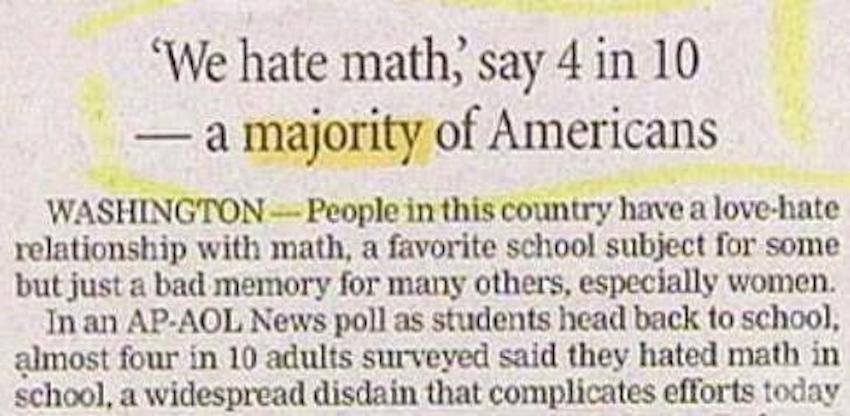
Americans hate math.

Americans hate math.

It was recently reported that one fourth of college-educated Americans did not know that the earth spun on an axis, a degree of science ignorance that would be inconceivable in any other country. Strange to say, despite these lacks, the US does quite well commercially, militarily, and scientifically. US productivity is the world’s highest. Our GNP and GNP per capita too is higher than virtually any other country (we got the grossest national product). How do we do it with so little education?

One part of US success is clearly imported talent, Immigration. We import Nobel chemists, Russian dancers, and German rocket scientists but we don’t import that many. They help our per-capita GNP, but the majority of our immigrants are more in the wretched refuse category. Even these appear to do better here than the colleagues they left behind. Otto von Bismark once joked that, “God protects children, drunks, and the United States of America.” But I’d like to suggest that our success is based on advantages our outlook our education provides for our more creative citizens.

Most of our successful businesses are not started by the A students, but by the C student who is able to use the little he (or she) knows. Consider the simple question of whether the earth goes round the sun. It’s an important fact, but only relevant if you can use it, as Sherlock Holmes points out. I suspect that few Europeans could use the knowledge that the earth spins (try to think of some applications; at the end of this essay I’ll provide some).

Benjamin Jowett. His students included the heads of 6 colleges and the head of Eaton

Benjamin Jowett, Master of Balliol College, Oxford.

A classic poem about European education describes Benjamin Jowett, shown at right. It goes: “The first come I, my name is Jowett. There is no knowledge, but that I know it. I am master of this college. What I don’t know isn’t knowledge.” Benjamin Jowett was Master of Balliol College, Oxford. By the time he died in 1893, his ex-student pallbearers included the heads of 6 colleges, and the head of Eaton. Most English heads of state and industry were his students directly or second-hand. All learned a passing knowledge of Greek, Latin, Plato, law, science, theology, classics, math, rhetoric, logic, and grammar. Only people so educated were deemed suited to run banks or manage backward nations like India or Rhodesia. It worked for a while but showed its limitations, e.g. in the Boer Wars.

In France and continental Europe the education system is similar to England’s under Jowett. There is a fixed set of knowledge and a fixed rate to learn it. Government and industry jobs go largely to those who’ve demonstrated their ability to give the fixed, correct answers to tests on this knowledge. In schools across France, the same page is turned virtually simultaneously in the every school– no student is left behind, but none jump ahead either. As new knowledge is integrated, the approved text books are updated and the correct answers are adjusted. Until then, the answers in the book are God’s truth, and those who master it can comfort themselves to have mastered the truth. The only people hurt are the very few dummies who see a new truth a year before the test acknowledges it. “College is a place where pebbles are polished but diamonds are dimmed.” The European system appears to benefit the many, providing useful skills (and useless tidbits) but it is oppressive to many others with forward-thinking, imaginative minds. The system appears to work best in areas that barely change year-to-year like French grammar, geometry, law, and the map of Europe. It does not work so well in music, computers, or the art of war. For these students, schooling is “another brick in the wall. For these students, the schools should teach more of how to get along without a teacher.

The American approach to education leans towards independence of thought, for good or bad. American graduates can live without the teacher, but leave school knowing no language but English, hardly and maths or science, hardly any grammar, and we can hardly find another country on a map. Teachers will take incorrect answers as correct as a way to build self-esteem, so students leave with the view that there is no such thing as truth. This model works well in music, engineering, and science where change is fast, creativity is king, and nature itself is a teacher. American graduate-schools are preeminent in these areas. In reading, history and math our graduates might well be described as galumphing ignorants.

Every now and again the US tries to correct this, by the way, and join the rest of the world. The “no child left behind” movement was a Republican-led effort to teach reading and math on the French model. It never caught on. Drugs are another approach to making American students less obstreperous, but they too work only temporarily. Despite these best efforts, American graduates leave school ignorant, but not stupid; respectful of those who can do things, and suspicious of those with lengthy degrees. We survive as managers of the most complex operations with our bumptious optimism and distain for hierarchy. As viewed from abroad, our method is to greet colleagues in a loud, cheerful voice, appoint a subordinate to “get things done,” and then get in the way until lunchtime.

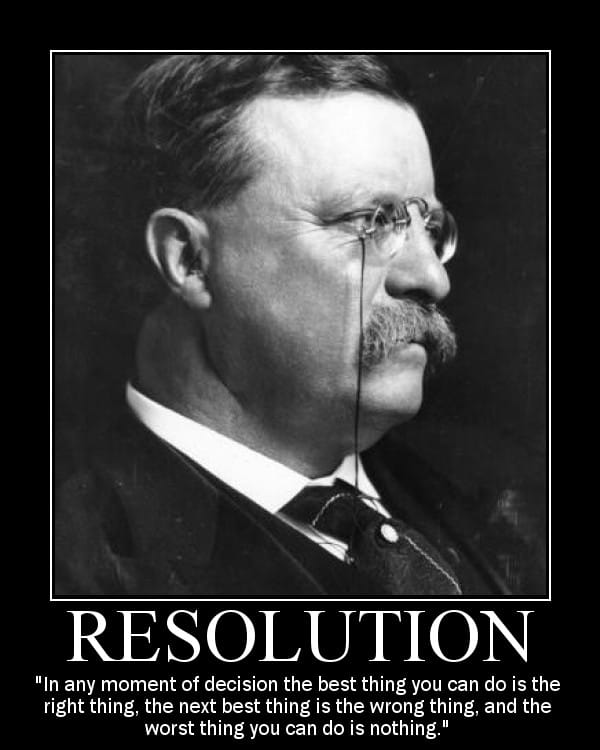
In any moment of decision, the best thing you can do is the right thing, the next bet thing is the wrong thing, and the worst thing you can do is nothing. An American attitude that sometimes blows up, but works surprisingly well at times.

Often the inability to act is worse than acting wrong.

The American-educated boss will do some damage by his ignorance but it is no more than  comes from group-think: non-truths passed as truths. America stopped burning witches far sooner than Europe, and never burned Jews. America dropped nobles quicker, and transitioned to electric lights and motor cars quicker, perhaps because we put less weight on what nobles and universities did.

European scholars accepted that nobility gave one a better handle on leadership, and this held them back. Since religion was part of education, they accepted that state should have an established religion: Anglican, in England, Catholicism in France; scientific atheism now. They learned and accepted that divorce was unnecessary and that homosexuality should be punished by prison or worse. As late as the early 60s, Turing, the brilliant mathematician and computer scientist, was chemically castrated as a way to cure his homosexuality. In America our “Yankee ingenuity,” as we call it, had a tendency to blow up, too (prohibition, McCarthyism, and disco), but the problems resolved relatively soon. “Ready, fire, aim” is a European description of the American method. It’s not great, but works after a fashion.

The best option, I think, is to work together with those from “across the pond.” It worked well for us in WWI, WWII, and the American Revolution, where we benefitted from the training of Baron Von Steuben, for example. Heading into the world cup of football (fifa soccer) this week, we’re expected to lose badly due to our lack of stars, and general inability to pass, dribble, or strategize. Still, we’ve got enthusiasm, and we’ve got a German coach. The world’s bookies give us 0.05% odds, but our chances are 10 times that, I’d say: 5%. God protects our galumphing side of corn-fed ignorants when, as in the Revolution, it’s attached to German coaching.

Some practical aspects of the earth spinning: geosynchronous satellites (they only work because the earth spins), weather prediction (the spin of hurricanes is because the earth spins), cyclone lifting. It amazes me that people ever thought everything went around the earth, by the way; Mercury and Venus never appear overhead. If authorities could have been so wrong about this for so long, what might they be wrong about today?

Dr. Robert Buxbaum, June 10, 2014 I’ve also written about ADHD on Lincoln’s Gettysburg Address, on Theodore Roosevelt, and how he survived a gun shot.

Is ADHD a real disorder

When I was in school, ADHD hadn’t been invented. There were kids who didn’t pay attention for a good part of the day, or who couldn’t sit in their seats, but the first activity was called day-dreaming and the second “shpilkas” or “ants in your pants.” These problems were recognized but were considered “normal.” Though we were sometimes disorderly, the cause wasn’t labeled a disorder. It’s now an epidemic.

There were always plenty of kids, me included, who were day-dreamers. Mostly these were boys who would get bored after a while and would start to look around the room, or doodle, or gaze into space thinking of this or that. Perhaps I’d do some writing or math in the margin of a notebook while listening with one ear; perhaps I’d work on my handwriting, or I’d read something in another textbook. This was not called a disorder or even an attention deficit (AD), but rather day-dreaming, wool-gathering, napping, or just not paying attention. Sometimes teachers got annoyed, other times not. They went on teaching, but sometimes tossed chalk or erasers at us to get us to wake up. Kids like me took enough notes to do OK on tests and homework, though I was never at the top of the class in elementary or middle school. The report cards tended to say things like “he could do better if he really concentrated.”  It’s something that could apply to everyone.

Then there were the boys who would now be labeled HD, or “hyperactive disordered.” These were always boys: those who didn’t sit well in their chairs, or fidgeted, or were motor mouths and got up and walked about, or got into fights, or went to the bathroom; these were the class clowns, and the trouble makers — not me except for the fidgeting. Girls would fidget or talk too, and they’d pass notes to each other, but they didn’t get into fights, and they weren’t as disruptive. They tended to have great handwriting, and took lots of notes in class: every single word from the board, plus quite a bit more.

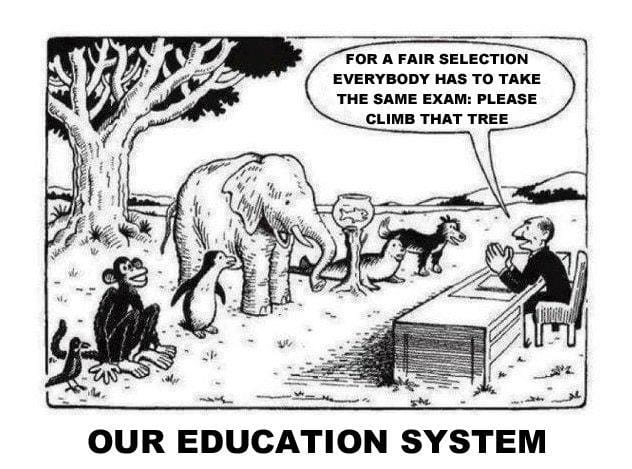
There are different measures of education, if you measure a fish's intelligence by the ability to climb a tree it will spend its life thinking it's stupid.

There are different measures of education, if you measure a fish’s skill level by the ability to climb a tree you’ll conclude the fish is ADD or worse.

Elementary and middle schools had activities to work out the excess energy that caused hyper-activity. We had dancing, shop, fire drills, art, some music, and sports. None of these helped all that much, but they did some good. I think the fire drills helped the most because we all went outside even in the winter, and eventually we calmed down without drugs. Sometimes a kid didn’t calm down, got worse, and did real damage; these kids were not called hyperactive disordered, but “bad kids” or “juvenile delinquents.” Nowadays, schools have far less art and music, and no shop or dancing. There are a lot more hyperactive kids, and the claim nowadays is that these hyperactive kids, violent or not, are disordered, ADHD, and should be given drugs. With drugs, the daydreamers take better notes, the nappers wake up, and the hyperactive kids calm down. Today about 30% of high-school seniors are given either a version of amphetamine, e.g. Adderall, or of Methylphenidate (Ritalin, etc.) The violent ones, the juvenile delinquents, are given stronger versions of the same drugs, e.g. methamphetamine, the drug at the heart of “breaking bad.”

Giving drugs to the kids seems to help the teacher a lot more than it helps the kids. According to a famous joke, giving the Ritalin to the teacher would be the best solution. When the kids are given drugs the disorderly boys (it’s usually given to boys) begin to act more like “goodie goodies”. They sit better and pay attention more; they take better notes and don’t interrupt, but I’m not sure they are learning more, or that the class is, or that they are socializing any better than before. The “goodie-goodies” in elementary school (mostly girls) did great in the early grades, but their good habits seemed to hold them back later. They worked too hard to please and tended to not notice, or pretended to not notice, when the teacher said nonsense. When it came time for independent or creative endeavors, their diligent acceptance of authority stood in the way of excellence.Venn diagram of ADHD

The hyperactive and daydreamers were more used to thinking for themselves, a prerequisite of leadership. The AD ones had gotten used to half-ignoring the teacher, and the HD ones were more openly opinionated and oppositional: obstreperous, in a word. Those bright enough to get by got more out of their education, perhaps because it was more theirs. To the extent that education was supposed to make you a leader and a thinker, the goodie-goodie behavior was a distraction and a disorder. This might be expected if education is supposed to be the lighting of a fire, not the filling of a pit. If everyone thinks the same, it’s a sign that few are thinking.

Map  of ADHD variation with location for US kids ages 6-18, Scrips Research.

Map of ADHD variation with location for US kids ages 6-18, Scrips Research. Boys are 2-3 times more often diagnosed as ADHD; diagnosis and medication increase with grade, peaking currently in early college.

This is not to say that there is no such disorder as ADHD, or no benefit from the drugs. My sense, though, is that the label is given too widely, and that the drugs are given too freely. Today drugs are pushed on virtually any kid who’s distracted, napping or hyperactive — to all the members of the big circles in the Venn diagram above, plus to athletes and others who feign ADD to get these, otherwise illegal, performance enhancing drugs. Currently, about 10% of US kids between 6 and 18 are diagnosed ADHD and given drugs, see figure. The numbers higher for boys than girls, higher in the US than abroad, and higher as the kids progress through school. It’s estimated that about 25% of US, 12th grade boys are given amphetamine or Ritalin and its homologs. My sense is that only a small fraction of these deserve drugs, only those with severe social problems, the violent or narcoleptic: those in the smaller circles of the Venn diagram. The test should not be that the kid’s behavior improves on them. Everyone’s attention improves when taking speed. ADHD appears more as an epidemic of overworked, undertrained, underfunded teachers, and a lack of outlets, not of disordered kids, or of real learning, and real learning is never pretty or easy (on all involved).

Robert Buxbaum, April 18, 2014. In general, I think people would be happier if they’d do more artmusicdance and shop, and if they’d embrace their inner weirdo. It would also help if doctors and teachers would use words rather than initials to describe people. It’s far better to be told you’re hyperactive, or that you’re not paying attention, then to be called ADD, HD, or ADHD. There’s far more room for gradation and improvement. I’m not an expert, just an observant observer.

Toxic electrochemistry and biology at home

A few weeks back, I decided to do something about the low quality of experiments in modern chemistry and science sets; I posted to this blog some interesting science experiments, and some more-interesting experiments that could be done at home using the toxic (poisonous dangerous) chemicals available under the sink or on the hardware store. Here are some more. As previously, the chemicals are toxic and dangerous but available. As previously, these experiments should be done only with parental (adult) supervision. Some of these next experiments involve some math, as key aspect of science; others involve some new equipment as well as the stuff you used previously. To do them all, you will want a stop watch, a volt-amp meter, and a small transformer, available at RadioShack; you’ll also want some test tubes or similar, clear cigar tubes, wire and baking soda; for the coating experiment you’ll want copper drain clear, or copper containing fertilizer and some washers available at the hardware store; for metal casting experiment you’ll need a tin can, pliers, a gas stove and some pennies, plus a mold, some sand, good shoes, and a floor cover; and for the biology experiment you will need several 9 V batteries, and you will have to get a frog and kill it. You can skip any of these experiments, if you like and do the others. If you have not done the previous experiments, look them over or do them now.

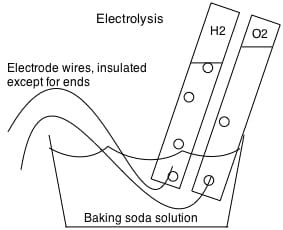
1) The first experiments aim to add some numerical observations to our previous studies of electrolysis. Here is where you will see why we think that molecules like water are made of fixed compositions of atoms. Lets redo the water electrolysis experiment now with an Ammeter in line between the battery and one of the electrodes. With the ammeter connected, put both electrodes deep into a solution of water with a little lye, and then (while watching the ammeter) lift one electrode half out, place it back, and lift the other. You will find, I think, that one of the other electrode is the limiting electrode, and that the amperage goes to 1/2 its previous value when this electrode is half lifted. Lifting the other electrode changes neither the amperage or the amount of bubbles, but lifting this limiting electrode changes both the amount of bubbles and the amperage. If you watch closely, though, you’ll see it changes the amount of bubbles at both electrodes in proportion, and that the amount of bubbles is in promotion to the amperage. If you collect the two gasses simultaneously, you’ll see that the volume of gas collected is always in a ratio of 2 to 1. For other electrolysis (H2 and Cl2) it will be 1 to1; it’s always a ratio of small numbers. See diagram below on how to make and collect oxygen and hydrogen simultaneously by electrolyzing water with lye or baking soda as electrolyte. With lye or baking soda, you’ll find that there is always twice as much hydrogen produced as oxygen — exactly.

You can also do electrolysis with table salt or muriatic acid as an electrolyte, but for this you’ll need carbon or platinum electrodes. If you do it right, you’ll get hydrogen and chlorine, a green gas that smells bad. If you don’t do this right, using a wire instead of a carbon or platinum electrode, you’ll still get hydrogen, but no chlorine. Instead of chlorine, you’ll corrode the wire on that end, making e.g. copper chloride. With a carbon electrode and any chloride compound as the electrolyte, you’ll produce chlorine; without a chloride electrolyte, you will not produce chlorine at any voltage, or with any electrode. And if you make chlorine and check the volumes, you’ll find you always make one volume of chlorine for every volume of hydrogen. We imagine from this that the compounds are made of fixed atoms that transfer electrons in fixed whole numbers per molecule. You always make two volumes of hydrogen for every volume of oxygen because (we think) making oxygen requires twice as many electrons as making hydrogen.

At home electrolysis experiment

At home electrolysis experiment

We get the same volume of chlorine as hydrogen because making chlorine and hydrogen requires the same amount of electrons to be transferred. These are the sort of experiments that caused people to believe in atoms and molecules as the fundamental unchanging components of matter. Different solutes, voltages, and electrodes will affect how fast you make hydrogen and oxygen, as will the amount of dissolved solute, but the gas produced are always the same, and the ratio of volumes is always proportional to the amperage in a fixed ratio of small whole numbers.

As always, don’t let significant quantities of use hydrogen and oxygen or pure hydrogen and chlorine mix in a closed space. Hydrogen and oxygen is quite explosive brown’s gas; hydrogen and chlorine are reactive as well. When working with chlorine it is best to work outside or near an open window: chlorine is a poison gas.

You may also want to try this with non-electrolytes, pure water or water with sugar or alcohol dissolved. You will find there is hardly any amperage or gas with these, but the small amount of gas produced will retain the same ratio. For college level folks, here is some physics/math relating to the minimum voltage and relating to the quantities you should expect at any amperage.

2) Now let’s try electro-plating metals. Using the right solutes, metals can be made to coat your electrodes the same way that bubbles of gas coated your electrodes in the experiments above. The key is to find the right chemical, and as a start let me suggest the copper sulphate sold in hardware stores to stop root growth. As an alternative copper sulphate is often sold as part of a fertilizer solution like “Miracle grow.” Look for copper on the label, or for a blue color fertilizer. Make a solution of copper using enough copper so that the solution is recognizably green, Use two steel washers as electrodes (that is connect the wires from your battery to the washers) and put them in the solution. You will find that one side turns red, as it is coated with copper. Depending on what else your copper solution contained, bubbles may appear at the other washer, or the other washer will corrode. 

You are now ready to take this to a higher level — silver coating. take a piece of silver plated material that you want to coat, and clean it nicely with soap and water. Connect it to the electrode where you previously coated copper. Now clean out the solution carefully. Buy some silver nitrate from a drug store, and dissolve a few grams (1/8 tsp for a start) in pure water; place the silverware and the same electrodes as before, connected to the battery. For a nicer coat use a 1 1/2 volt lantern battery; the 6 V battery will work too, but the silver won’t look as nice. With silver nitrate, you’ll notice that one electrode produces gas (oxygen) and the other turns silvery. Now disconnect the silvery electrode. You can use this method to silver coat a ring, fork, or cup — anything you want to have silver coated. This process is called electroplating. As with hydrogen production, there is a proportional relationship between the time, the amperage and the amount of metal you deposit — until all the silver nitrate in solution is used up.

As a yet-more complex version, you can also electroplate without using a battery. This was my Simple electroplating (presented previously). Consider this only after you understand most everything else I’ve done. When I saw this the first time in high school I was confused.

3) Casting metal objects using melted pennies, heat from a gas stove, and sand or plaster as a cast. This is pretty easy, but sort of dangerous — you need parents help, if only as a watcher. This is a version of an experiment I did as a kid.  I did metal casting using lead that some plumbers had left over. I melted it in a tin can on our gas stove and cast “quarters” in a plaster mold. Plumbers no longer use lead, but modern pennies are mostly zinc, and will melt about as well as my lead did. They are also much safer.

As a preparation for this experiment, get a bucket full of sand. This is where you’ll put your metal when you’re done. Now get some pennies (1970 or later), a pair of pliers, and an empty clean tin can, and a gas stove. If you like you can make a plaster mold of some small object: a ring, a 50 piece — anything you might want to cast from your pennies. With parents’ help, light your gas stove, put 5-8 pennies in the empty tin can, and hold the can over the lit gas burner using your pliers. Turn the gas to high. In a few minutes the bottom of the can will burn and become red-hot. About this point, the pennies will soften and melt into a silvery puddle. By tilting the can, you can stir the metal around (don’t get it on you!). When it looks completely melted you can pour the molten pennies into your sand bucket (carefully), or over your plaster mold (carefully). If you use a mold, you’ll get a zinc copy of whatever your mold was: jewelry, coins, etc. If you work at it, you’ll learn to make fancier and fancier casts. Adult help is welcome to avoid accidents. Once the metal solidifies, you can help cool it faster by dripping water on it from a faucet. Don’t touch it while it’s hot!

A plaster mold can be made by putting a 50¢ piece at the bottom of a paper cup, pouring plaster over the coin, and waiting for it to dry. Tear off the cup, turn the plaster over and pull out the coin; you’ve got a one-sided mold, good enough to make a one-sided coin. If you enjoy this, you can learn more about casting on Wikipedia; it’s an endeavor that only costs 4 or 5 cents per try. As a safety note: wear solid leather shoes and cover the floor near the stove with a board. If you drop the metal on the floor you’ll have a permanent burn mark on the floor and your mother will not be happy. If you drop hot metal on your you’ll have a permanent injury, and you won’t be happy. Older pennies are made of copper and will not melt. Here’s a video of someone pouring a lot of metal into an ant-hill (kills lots of ants, makes a mold of the hill).

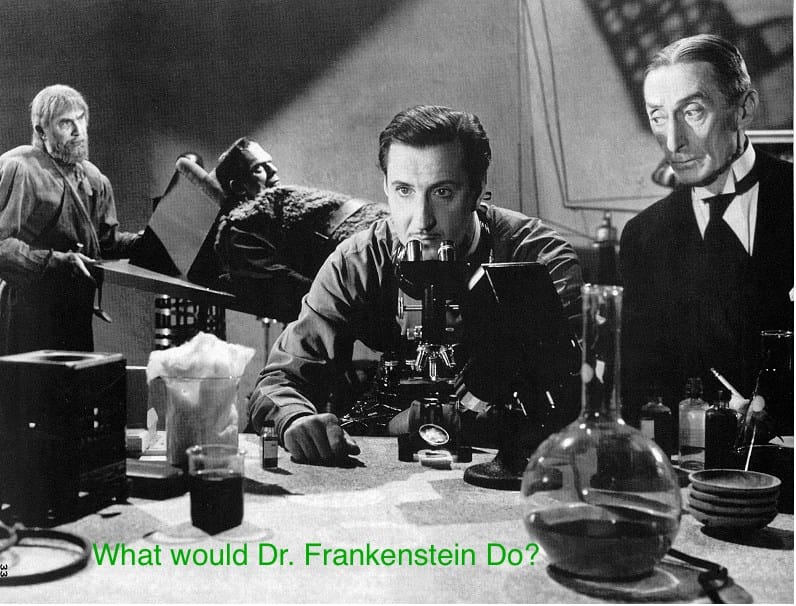
It's often helpful to ask yourself, "what would Dr. Frankenstein do?"

It’s nice to have assistants, friends and adult help in the laboratory when you do science. Even without the castle, it’s what Dr. Frankenstein did.

4) Bringing a dead frog back to life (sort of). Make a high voltage battery of 45 to 90 V battery by attaching 5-10, 9V batteries in a daisy chain they will snap together. If you touch both exposed contacts you’ll give yourself a wicked shock. If you touch the electrodes to a newly killed frog, the frog legs will kick. This is sort of groovy. It was the inspiration for Dr. Frankenstein (at right), who then decides he could bring a person back from the dead with “more power.” Frankenstein’s monster is brought back to life this way, but ends up killing the good doctor. Shocks are sometimes helpful reanimating people stricken by heat attacks, and many buildings have shockers for this purpose. But don’t try to bring back the long-dead. By all accounts, the results are less-than pleasing. Try dissecting the rest of the frog and guess what each part is (a world book encyclopedia helps). As I recall, the heart keeps going for a while after it’s out of the frog — spooky.

5) Another version of this shocker is made with a small transformer (1″ square, say, radioshack) and a small battery (1.5-6V). Don’t use the 90V battery, you’ll kill someone. As a first version of this shocker, strip 1″ of  insulation off of the ends of some wire 12″ long say, and attach one end to two paired wires of the transformer (there will usually be a diagram in the box). If the transformer already has some wires coming out, all you have to do is strip more insulation off the ends so 1″ is un-inuslated. Take two paired ends in your hand, holding onto the uninsulated part and touch both to the battery for a second or two. Then disconnect them while holding the bare wires; you’ll get a shock. As a nastier version, get a friend to hope the opposite pair of wires on the uninsulated parts, while you hold the insulated parts of your two. Touch your two to the battery and disconnect while holding the insulation, you will see a nice spark, and your friend will get a nice shock. Play with it; different arrangements give more sparks or bigger shocks. Another thing you can do: put your experiment near a radio or TV. The transformer sparks will interfere with most nearby electronics; you can really mess up a computer this way, so keep it far from your computer. This is how wireless radio worked long ago, and how modern warfare will probably go. The atom bomb was detonated with a spark like this.

If you want to do more advanced science, it’s a good idea to learn math. This is important for statistics, for engineering, for quantum mechanics, and can even help for music. Get a few good high school or college books and read them cover to cover. An approach to science is to try to make something cool, that sort-of works, and then try to improve it. You then decide what a better version would work like,  modify your original semi-randomly and see if you’re going in the right direction. Don’t redesign with only one approach –it may not work. Read whatever you can, but don’t believe all you read. Often books are misleading, or wrong, and blogs are worse (I ought to know). When you find mistakes, note them in the margin, and try to explain them. You may find you were right, or that the book was right, but it’s a learning experience. If you like you can write the author and inform him/her of the errors. I find mailed letters are more respectful than e-mails — it shows you put in more effort.

Robert Buxbaum, February 20, 2014. Here’s the difference between metals and non-metals, and a periodic table cup that I made, and sell. And here’s a difference between science and religion – reproducibility.

Toxic chemistry you can do at home

I got my start on science working with a 7 chemical, chemistry set that my sister got me when I was 7 years old (thanks Beverly). The chemicals would never be sold by a US company today — too much liability. What if your child poisons himself/herself or someone else, or is allergic, or someone chokes on the caps (anything the size of a nut has to be labeled as a hazard). Many of the experiments were called magic, and they were, in the sense that, if you did them 200 years earlier, you’d be burnt as a witch. There were dramatic color changes (phenolphthalein plus base, Prussian Blue) a time-delay experiment involving cobalt, and even an experiment that (as I recall) burst into fire on its own (glycerine plus granulated potassium permanganate).

Better evil through science. If you get good at this, the military may have use of your services.

“Better the evil you know.” If you get good at this, the military may have use of your services. Yes, the American military does science.

Science kits nowadays don’t do anything magically cool like that, and they don’t really teach chemistry, either, I think. Doing magical things requires chemicals that are reasonably reactive, and that means corrosive and/or toxic. Current kits use only food products like corn-starch or baking soda, and the best you can do with these is to make goo and/ or bubbles. No one would be burnt at the stake for this, even 300 years ago. I suppose one could design a program that used these materials to teach something about flow, or nucleation, but that would require math, and the kit producers fear that any math will turn off kids and stop their parents from spending money. There is also the issue of motivation. Much of historical chemistry was driven by greed and war; these are issues that still motivate kids, but that modern set-makers would like to ignore. Instead, current kits are supposed to be exciting in a cooperative way (whatever that means), because the kit-maker says so. They are not. I went through every experiment in my first kit in the first day, and got things right within the first week — showing off to whoever would watch. Modern kits don’t motivate this sort of use; I doubt most get half-used in a lifetime.

There are some foreign-made chemistry sets still that are pretty good. Here is a link to a decent mid-range one from England. But it’s sort of pricy, and already somewhat dumbed down. Instead, here are some cheaper, more dangerous, American options: 5 experiments you can do (kids and parents together, please) using toxic household chemicals found in our US hardware stores. These are NOT the safest experiments, just cheap ones that are interesting. I’ll also try to give some math and explanations — so you’ll understand what’s happening on a deeper level — and I’ll give some financial motivation — some commercial value.

1) Crystal Drano + aluminum. Crystal Drano is available in the hardware store. It’s mostly lye, sodium hydroxide, one of the strongest bases known to man. It’s a toxic (highly poisonous) chemical used to dissolve hair and fat in a drain. It will also dissolve some metals and it will dissolve you if you get it on yourself (if you do get it on yourself, wash it off fast with lots of water). Drano also contains ammonium nitrate (an explosive) and bits of aluminum. For the most part, the aluminum is there so that the Drano will get hot in the clogged drain (heat helps it dissolve the clog faster). I’ll explain the ammonium nitrate later. For this experiment, you’re going to want to work outside, on a dinner plate on the street. You’ll use additional aluminum (aluminum foil), and you’ll get more heat and fun gases. Fold up a 1 foot square of aluminum foil to 6″ x 4″ say, and put it on the plate (outside). Put an indent in the middle of the foil making a sort of small cup — one that can stand. Into this indent, put a tablespoon or two of water plus a teaspoon of Drano. Wait about 5 minutes, and you will see that the Drano starts smoking and the aluminum foils starts to dissolve. The plate will start to get hot and you will begin to notice a bad smell (ammonia). The aluminum foil will turn black and will continue to dissolve till there is a hole in the middle of the indent. Draino

The main reaction is 2 Al + 3 H2O –> Al2O3 + H2; that is, aluminum plus water gives you aluminum oxide (alumina), and hydrogen. The sodium hydroxide (lye) in the Drano is a catalyst in this reaction, something that is not consumed in this reaction but makes it happen faster than otherwise. The hydrogen you produce here is explosive and valuable (I explain below). But there is another reaction going on too, the one that makes the bad smell. When ammonium nitrate is heated in the presence of sodium hydroxide, it reacts to make ammonia and sodium nitrate. The reaction formula is: NH4-NO3 + NaOH –> NH3 + NaNO3 + H2O. The ammonia produced gives off a smell, something that is important for safety — the smell is a warning — and (I think) helps keep the aluminum gunk from clogging the drain by reacting with the aluminum oxide to form aluminum amine hydroxide Al2O3(NH3)2. It’s a fun experiment to watch, but you can do more if you like. The hydrogen and ammonia are flammable and is useful for other experiments (below). If you collect these gases, you can can make explosions or fill a balloon that will float. Currently the US military, and several manufacturers in Asia are considering using the hydrogen created this way to power motorcycles by way of a fuel cell. There is also the Hindenburg, a zeppelin that went around the world in the 1930s. It was kept aloft by hydrogen. The ammonia you make has value too, though toxic; if bubbled into water, it makes ammonium hydroxide NH3 + H2O –> NH4OH. This is a common cleaning liquid. Just to remind you: you’re supposed to do these experiments outside to dissipate the toxic gases and to avoid an explosion in your house. A parent will come in handy if you get this stuff on your hand or in your eye.

Next experiment: check that iron does not dissolve in Drano, but it does in acid (that’s experiment 5; done with Muriatic acid from the hardware store). Try also copper, and solder (mostly tin, these days). Metals that dissolve well in Drano are near the right of the periodic table, like aluminum. Aluminum is nearly a non-metal, and thus can be expected to have an oxide that reacts with hydroxide. Iron and steel have oxides that are bases themselves, and thus don’t react with lye. This is important as otherwise Drano would destroy your iron drain, not only the hair in it. It’s somewhat hard on copper though, so beware if you’ve a copper drain.

Thought problem: based on the formulas above figure out the right mix of aluminum, NaOH, water and Ammonium nitrate. Answer: note that, for every two atoms of aluminum you dissolve, you’ll need three molecules of water (for the three O atoms), plus at least two molecules of ammonium nitrate (to provide the two NH2 (amine) groups above. You’ll also want at least 2 molecules of NaOH to have enough Na to react with the nitrate groups of the ammonium nitrate. As a first guess, assume that all atoms are the same size. A better way to do this involves molecular weights (formula weights), read a chemistry book, or look on the internet.

Four more experiments can be seen here. This post was getting to be over-long.As with this experiment, wear gloves and eye protection; don’t drink the chemicals, and if you get any chemicals on you, wash them off quick.

Here are a few more experiments in electrochemistry and biology, perhaps I’ll add more. In the meantime, if you or your child are interested in science, I’d suggest you read science books by Mr Wizard, or Isaac Asimov, and that you learn math. Another thought, take out a high school chemistry text-book at the library — preferably an old one with experiments..

Robert Buxbaum, December 29, 2013. If you are interested in weather flow, by the way, here is a bit on why tornadoes and hurricanes lift stuff up, and on how/ why they form. 

Calculus is taught wrong, and is often wrong

The high point of most people’s college math is The Calculus. Typically this is a weeder course that separates the science-minded students from the rest. It determines which students are admitted to medical and engineering courses, and which will be directed to english or communications — majors from which they can hope to become lawyers, bankers, politicians, and spokespeople (the generally distrusted). While calculus is very useful to know, my sense is that it is taught poorly: it is built up on a year of unnecessary pre-calculus and several shady assumptions that were not necessary for the development, and that are not generally true in the physical world. The material is presented in a way that confuses and turns off many of the top students — often the ones most attached to the reality of life.

The most untenable assumption in calculus teaching, in my opinion, are that the world involves continuous functions. That is, for example, that at every instant in time an object has one position only, and that its motion from point to point is continuous, defining a slow-changing quantity called velocity. That is, every x value defines one and only one y value, and there is never more than a small change in y at the limit of a small change in X. Does the world work this way? Some parts do, others do not. Commodity prices are not really defined except at the moment of sale, and can jump significantly between two sales a micro-second apart. Objects do not really have one position, the quantum sense, at any time, but spread out, sometimes occupying several positions, and sometimes jumping between positions without ever occupying the space in-between.

These are annoying facts, but calculus works just fine in a discontinuous world — and I believe that a discontinuous calculus is easier to teach and understand too. Consider the fundamental law of calculus. This states that, for a continuous function, the integral of the derivative of changes equals the function itself (nearly incomprehensible, no?) Now consider the same law taught for a discontinuous group of changes: the sum of the changes that take place over a period equals the total change. This statement is more general, since it applies to discrete and continuous functions, and it’s easier to teach. Any idiot can see that this is true. By contrast, it takes weeks of hard thinking to see that the integral of all the derivatives equals the function — and then it takes more years to be exposed to delta functions and realize that the statement is still true for discrete change. Why don’t we teach so that people will understand? Teach discrete first and then smooth as a special case where the discrete changes happen at a slow rate. Is calculus taught this way to make us look smart, or because we want this to be a weeder course?

Because most students are not introduced to discrete change, they are in a very poor position  to understand, or model, activities that are discreet, like climate change or heart rate. Climate only makes sense year to year, as day-to-day behavior is mostly affected by seasons, weather, and day vs night. We really want to model the big picture and leave out the noise by considering each day or year as a whole, keeping track of the average temperature for noon on September 21, for example. Similarly with heart rate, the rate has no meaning if measured every microsecond; it’s only meaning is as a measure of the time between beats. If we taught calculus in terms of discrete functions, our students would be in a better place to deal with these things, and in a better place to deal with total discontinuous behaviors, like chaos and fractals, an important phenomena when dealing with economics, for example.

A fundamental truth of quantum mechanics is that there is no defined speed and position of an object at any given time. Students accept this, but (because they are used to continuous change) they come to wonder how it is that over time energy is conserved. It’s simple, quantum motion involves a gross discrete changes in position that leaves energy conserved by the end, but where an item goes from here to there without ever having to be in the middle. This helps explain the old joke about Heisenberg and his car.

Calculus-based physics is taught in terms of limits and the mean value theorem: that if x is the position of a thing at any time, t then the derivative of these positions, the velocity, will approach ∆x/∆t more and more as ∆x and ∆t become more tightly defined. When this is found to be untrue in a quantum sense, the remnant of the belief in it hinders them when they try to solve real world problems. Normal physics is the limit of quantum physics because velocity is really a macroscopic ratio of difference in position divided by macroscopic difference in time. Because of this, it is obvious that the sum of these differences is the total distance traveled even when summed over many simultaneous paths. A feature of electromagnetism, Green’s theorem becomes similarly obvious: the sum effect of a field of changes is the total change. It’s only confusing if you try to take the limits to find the exact values of these change rates at some infinitesimal space.

This idea is also helpful in finance, likely a chaotic and fractal system. Finance is not continuous: just because a stock price moved from $1 to $2 per share in one day does not mean that the price was ever $1.50 per share. While there is probably no small change in sales rate caused by a 1¢ change in sales price at any given time, this does not mean you won’t find it useful to consider the relation between the sales of a product. Though the details may be untrue, the price demand curve is still very useful (but unjustified) abstraction.

This is not to say that there are not some real-world things that are functions and continuous, but believing that they are, just because the calculus is useful in describing them can blind you to some important insights, e.g. of phenomena where the butterfly effect predominates. That is where an insignificant change in one place (a butterfly wing in China) seems to result in a major change elsewhere (e.g. a hurricane in New York). Recognizing that some conclusions follow from non-continuous math may help students recognize places where some parts of basic calculus allies, while others do not.

Dr. Robert Buxbaum (my thanks to Dr. John Klein for showing me discrete calculus).

How to make a simple time machine

I’d been in science fairs from the time I was in elementary school until 9th grade, and  usually did quite well. One trick: I always like to do cool, unexpected things. I didn’t have money, but tried for the gee-whiz factor. Sorry to say, the winning ideas of my youth are probably old hat, but here’s a project that I never got to do, but is simple and cheap and good enough to win today. It’s a basic time machine, or rather a quantum eraser — it lets you go back in time and erase something.

The first thing you should know is that the whole aspect of time rests on rather shaky footing in modern science. It is possible therefore that antimatter, positrons say, are just regular matter moving backwards in time.

The trick behind this machine is the creation of entangled states, an idea that Einstein and Rosen proposed in the 1930s (they thought it could not work and thus disproved quantum mechanics, turned out the trick works). The original version of the trick was this: start with a particle that splits in half at a given, known energy. If you measure the energy of either of the halves of the particle they are always the same, assuming the source particle starts at rest. The thing is, if you start with the original particle at absolute zero and were to measure the position of one half, and the velocity of the other, you’d certainly know the position and velocity of the original particle. Actually, you should not need to measure the velocity, since that’s fixed by they energy of the split, but we’re doing it just to be sure. Thing is quantum mechanics is based on the idea that you can not know both the velocity and position, even just before the split. What happens? If you measure the position of one half the velocity of the other changes, but if you measure the velocity of both halves it is the same, and this even works backward in time. QM seems to know if you intend to measure the position, and you measure an odd velocity even before you do so. Weird. There is another trick to making time machines, one found in Einstein’s own relativity by Gödel. It involves black holes, and we’re not sure if it works since we’ve never had a black hole to work with. With the QM time machine you’re never able to go back in time before the creation of the time machine.

To make the mini-version of this time machine, we’re going to split a few photons and play with the halves. This is not as cool as splitting an elephant, or even a proton, but money don’t grow on trees, and costs go up fast as the mass of the thing being split increases. You’re not going back in time more than 10 attoseconds (that’s a hundredth of a femtosecond), but that’s good enough for the science fair judges (you’re a kid, and that’s your lunch money at work). You’ll need a piece of thick aluminum foil, a sharp knife or a pin, a bright lamp, superglue (or, in a pinch, Elmer’s), a polarizing sunglass lens, some colored Saran wrap or colored glass, a shoe-box worth of cardboard, and wood + nails  to build some sort of wooden frame to hold everything together. Make your fixture steady and hard to break; judges are clumsy. Use decent wood (judges don’t like splinters). Keep spares for the moving parts in case someone breaks them (not uncommon). Ideally you’ll want to attach some focussing lenses a few inches from the lamp (a small magnifier or reading glass lens will do). You’ll want to lay the colored plastic smoothly over this lens, away from the lamp heat.

First make a point light source: take the 4″ square of shoe-box cardboard and put a quarter-inch hole in it near the center. Attach it in front of your strong electric light at 6″ if there is no lens, or at the focus if there is a lens. If you have no lens, you’ll want to put the Saran over this cardboard.

Take two strips of aluminum foil about 6″ square and in the center of each, cut two slits perhaps 4 mm long by .1 mm wide, 1 mm apart from each other near the middle of both strips. Back both strips with some cardboard with a 1″ hole in the middle (use glue to hold it there). Now take the sunglass lens; cut two strips 2 mm x 10 mm on opposite 45° diagonals to the vertical of the lens. Confirm that this is a polarized lens by rotating one against the other; at some rotation the pieces of sunglass, the pair should be opaque, at 90° it should be fairly clear. If this is not so, get a different sunglass.

Paste these two strips over the two slits on one of the aluminum foil sheets with a drop of super-glue. The polarization of the sunglasses is normally up and down, so when these strips are glued next to one another, the polarization of the strips will be opposing 45° angles. Look at the point light source through both of your aluminum foils (the one with the polarized filter and the one without); they should look different. One should look like two pin-points (or strips) of light. The other should look like a fog of dots or lines.

The reason for the difference is that, generally speaking a photon passes through two nearby slits as two entangled halves, or its quantum equivalent. When you use the foil without the polarizers, the halves recombine to give an interference pattern. The result with the polarization is different though since polarization means you can (in theory at least) tell the photons apart. The photons know this and thus behave like they were not two entangled halves, but rather like they passed either through one slit or the other. Your device will go back in time after the light has gone through the holes and will erase this knowledge.

Now cut another 3″ x 3″ cardboard square and cut a 1/4″ hole in the center. Cut a bit of sunglass lens, 1/2″ square and attach it over the hole of this 3×3″ cardboard square. If you view the aluminum square through this cardboard, you should be able to make one hole or the other go black by rotating this polarized piece appropriately. If it does not, there is a problem.

Set up the lamp (with the lens) on one side so that a bright light shines on the slits. Look at the light from the other side of the aluminum foil. You will notice that the light that comes through the foil with the polarized film looks like two dots, while the one that comes through the other one shows a complex interference pattern; putting the other polarizing lens in front of the foil or behind it does not change the behavior of the foil without the polarizing filters, but if done right it will change things if put behind the other foil, the one with the filters.

Robert Buxbaum, of the future.

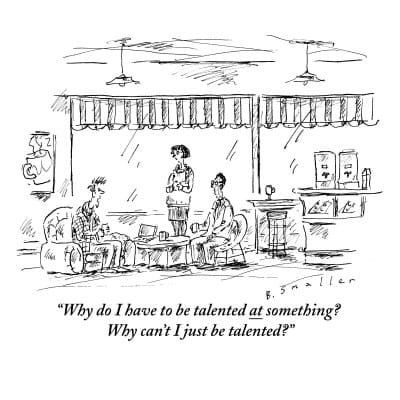
Self Esteem Cartoon

Having potential makes a fine breakfast, but a lousy dinner.

Barbara Smaller cartoon, from The New Yorker.

Is funny because ……  it holds a mirror to the adulteration of adulthood: our young adults come out of college with knowledge, some skills, and lots of self-esteem, but with a lack of direction and a lack of focus in what they plan to do with their talents and education. One part of the problem is that kids enter college with no focused major or work background beyond an expectation that they will be leaders when they graduate.

In a previous post I’d suggested that Detroit schools should teach shop as a way to build responsibility. On further reflection, most schools should require shop, or similar subjects where tangible products are produced and where quality of output is apparent and directly related to the student, e.g. classical music, representative art, automotive tuning. Responsibility is not well taught through creative writing or non-representative art, as here quality is in the eye of the beholder.

My sense is that it’s not enough to teach a skill, you have to teach an aesthetic about the skill (Is this a good job), and a desire to put the skill to use. Two quotes of my own invention: “it’s not enough to teach a man how to fish, you have to teach him to actually do it, or he won’t even eat for a day.” Also, “Having potential makes a fine breakfast, but a lousy dinner” (if you use my quotes please quote me). If you don’t like these, here’s one from Peter Cooper, the founder of my undergraduate college. “The problem with Harvard and Yale is that they teach everything about doing honest business except that you are supposed to do it.”

by R.E. Buxbaum,  Sept 22, 2013; Here’s another personal relationship cartoon, and a thought about engineering job-choice.

The Scientific Method isn’t the method of scientists

A linchpin of middle school and high-school education is teaching ‘the scientific method.’ This is the method, students are led to believe, that scientists use to determine Truths, facts, and laws of nature. Scientists, students are told, start with a hypothesis of how things work or should work, they then devise a set of predictions based on deductive reasoning from these hypotheses, and perform some critical experiments to test the hypothesis and determine if it is true (experimentum crucis in Latin). Sorry to say, this is a path to error, and not the method that scientists use. The real method involves a few more steps, and follows a different order and path. It instead follows the path that Sherlock Holmes uses to crack a case.

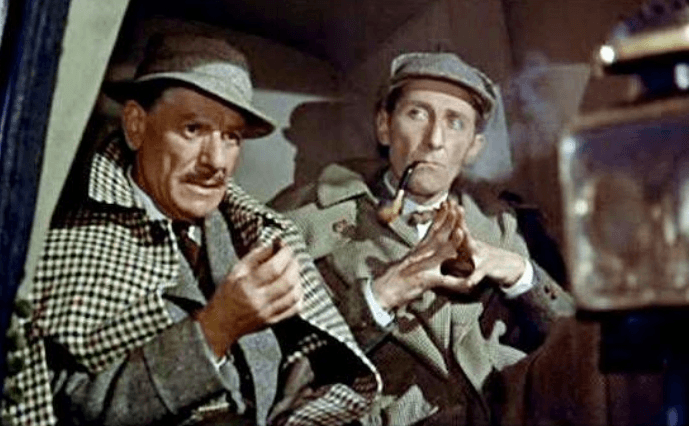
The actual method of Holmes, and of science, is to avoid beginning with a hypothesis. Isaac Newton claimed: “I never make hypotheses” Instead as best we can tell, Newton, like most scientists, first gathered as much experimental evidence on a subject as possible before trying to concoct any explanation. As Holmes says (Study in Scarlet): “It is a capital mistake to theorize before you have all the evidence. It biases the judgment.”

It is a capital mistake to theorize before one has data. Insensibly one begins to twist facts to suit theories, instead of theories to suit facts (Holmes, Scandal in Bohemia).

Holmes barely tolerates those who hypothesize before they have all the data: “It is a capital mistake to theorize before one has data. Insensibly one begins to twist facts to suit theories, instead of theories to suit facts.” (Scandal in Bohemia).

Then there is the goal of science. It is not the goal of science to confirm some theory, model, or hypothesis; every theory probably has some limited area where it’s true. The goal for any real-life scientific investigation is the desire to explain something specific and out of the ordinary, or do something cool. Similarly, with Sherlock Holmes, the start of the investigation is the arrival of a client with a specific, unusual need – one that seems a bit outside of the normal routine. Similarly, the scientist wants to do something: build a bigger bridge, understand global warming, or how DNA directs genetics; make better gunpowder, cure a disease, or Rule the World (mad scientists favor this). Once there is a fixed goal, it is the goal that should direct the next steps: it directs the collection of data, and focuses the mind on the wide variety of types of solution. As Holmes says: , “it’s wise to make one’s self aware of the potential existence of multiple hypotheses, so that one eventually may choose one that fits most or all of the facts as they become known.” It’s only when there is no goal, that any path will do

In gathering experimental data (evidence), most scientists spend months in the less-fashionable sections of the library, looking at the experimental methods and observations of others, generally from many countries, collecting any scrap that seems reasonably related to the goal at hand. I used 3 x5″ cards to catalog this data and the references. From many books and articles, one extracts enough diversity of data to be able to look for patterns and to begin to apply inductive logic. “The little things are infinitely the most important” (Case of Identity). You have to look for patterns in the data you collect. Holmes does not explain how he looks for patterns, but this skill is innate in most people to a greater or lesser extent. A nice set approach to inductive logic is called the Baconian Method, it would be nice to see schools teach it. If the author is still alive, a scientist will try to contact him or her to clarify things. In every SH mystery, Holmes does the same and is always rewarded. There is always some key fact or observation that this turns up: key information unknown to the original client.

Based on the facts collected one begins to create the framework for a variety of mathematical models: mathematics is always involved, but these models should be pretty flexible. Often the result is a tree of related, mathematical models, each highlighting some different issue, process, or problem. One then may begin to prune the tree, trying to fit the known data (facts and numbers collected), into a mathematical picture of relevant parts of this tree. There usually won’t be quite enough for a full picture, but a fair amount of progress can usually be had with the application of statistics, calculus, physics, and chemistry. These are the key skills one learns in college, but usually the high-schooler and middle schooler has not learned them very well at all. If they’ve learned math and physics, they’ve not learned it in a way to apply it to something new, quite yet (it helps to read the accounts of real scientists here — e.g. The Double Helix by J. Watson).

Usually one tries to do some experiments at this stage. Homes might visit a ship or test a poison, and a scientist might go off to his, equally-smelly laboratory. The experiments done there are rarely experimenti crucae where one can say they’ve determined the truth of a single hypothesis. Rather one wants to eliminated some hypotheses and collect data to be used to evaluate others. An answer generally requires that you have both a numerical expectation and that you’ve eliminated all reasonable explanations but one. As Holmes says often, e.g. Sign of the four, “when you have excluded the impossible, whatever remains, however improbable, must be the truth”. The middle part of a scientific investigation generally involves these practical experiments to prune the tree of possibilities and determine the coefficients of relevant terms in the mathematical model: the weight or capacity of a bridge of a certain design, the likely effect of CO2 on global temperature, the dose response of a drug, or the temperature and burn rate of different gunpowder mixes. Though not mentioned by Holmes, it is critically important in science to aim for observations that have numbers attached.

The destruction of false aspects and models is a very important part of any study. Francis Bacon calls this act destruction of idols of the mind, and it includes many parts: destroying commonly held presuppositions, avoiding personal preferences, avoiding the tendency to see a closer relationship than can be justified, etc.

In science, one eliminates the impossible through the use of numbers and math, generally based on your laboratory observations. When you attempt to the numbers associated with our observations to the various possible models some will take the data well, some poorly; and some twill not fit the data at all. Apply the deductive reasoning that is taught in schools: logical, Boolean, step by step; if some aspect of a model does not fit, it is likely the model is wrong. If we have shown that all men are mortal, and we are comfortable that Socrates is a man, then it is far better to conclude that Socrates is mortal than to conclude that all men but Socrates is mortal (Occam’s razor). This is the sort of reasoning that computers are really good at (better than humans, actually). It all rests on the inductive pattern searches similarities and differences — that we started with, and very often we find we are missing a piece, e.g. we still need to determine that all men are indeed mortal, or that Socrates is a man. It’s back to the lab; this is why PhDs often take 5-6 years, and not the 3-4 that one hopes for at the start.

More often than not we find we have a theory or two (or three), but not quite all the pieces in place to get to our goal (whatever that was), but at least there’s a clearer path, and often more than one. Since science is goal oriented, we’re likely to find a more efficient than we fist thought. E.g. instead of proving that all men are mortal, show it to be true of Greek men, that is for all two-legged, fairly hairless beings who speak Greek. All we must show is that few Greeks live beyond 130 years, and that Socrates is one of them.

Putting numerical values on the mathematical relationship is a critical step in all science, as is the use of models — mathematical and otherwise. The path to measure the life expectancy of Greeks will generally involve looking at a sample population. A scientist calls this a model. He will analyze this model using statistical model of average and standard deviation and will derive his or her conclusions from there. It is only now that you have a hypothesis, but it’s still based on a model. In health experiments the model is typically a sample of animals (experiments on people are often illegal and take too long). For bridge experiments one uses small wood or metal models; and for chemical experiments, one uses small samples. Numbers and ratios are the key to making these models relevant in the real world. A hypothesis of this sort, backed by numbers is publishable, and is as far as you can go when dealing with the past (e.g. why Germany lost WW2, or why the dinosaurs died off) but the gold-standard of science is predictability.  Thus, while we a confident that Socrates is definitely mortal, we’re not 100% certain that global warming is real — in fact, it seems to have stopped though CO2 levels are rising. To be 100% sure you’re right about global warming we have to make predictions, e.g. that the temperature will have risen 7 degrees in the last 14 years (it has not), or Al Gore’s prediction that the sea will rise 8 meters by 2106 (this seems unlikely at the current time). This is not to blame the scientists whose predictions don’t pan out, “We balance probabilities and choose the most likely. It is the scientific use of the imagination” (Hound of the Baskervilles)The hope is that everything matches; but sometimes we must look for an alternative; that’s happened rarely in my research, but it’s happened.

You are now at the conclusion of the scientific process. In fiction, this is where the criminal is led away in chains (or not, as with “The Woman,” “The Adventure of the Yellow Face,” or of “The Blue Carbuncle” where Holmes lets the criminal free — “It’s Christmas”). For most research the conclusion includes writing a good research paper “Nothing clears up a case so much as stating it to another person”(Memoirs). For a PhD, this is followed by the search for a good job. For a commercial researcher, it’s a new product or product improvement. For the mad scientist, that conclusion is the goal: taking over the world and enslaving the population (or not; typically the scientist is thwarted by some detail!). But for the professor or professional research scientist, the goal is never quite reached; it’s a stepping stone to a grant application to do further work, and from there to tenure. In the case of the Socrates mortality work, the scientist might ask for money to go from country to country, measuring life-spans to demonstrate that all philosophers are mortal. This isn’t as pointless and self-serving as it seems, Follow-up work is easier than the first work since you’ve already got half of it done, and you sometimes find something interesting, e.g. about diet and life-span, or diseases, etc. I did some 70 papers when I was a professor, some on diet and lifespan.

One should avoid making some horrible bad logical conclusion at the end, by the way. It always seems to happen that the mad scientist is thwarted at the end; the greatest criminal masterminds are tripped by some last-minute flaw. Similarly the scientist must not make that last-mistep. “One should always look for a possible alternative, and provide against it” (Adventure of Black Peter). Just because you’ve demonstrated that  iodine kills germs, and you know that germs cause disease, please don’t conclude that drinking iodine will cure your disease. That’s the sort of science mistakes that were common in the middle ages, and show up far too often today. In the last steps, as in the first, follow the inductive and quantitative methods of Paracelsus to the end: look for numbers, (not a Holmes quote) check how quantity and location affects things. In the case of antiseptics, Paracelsus noticed that only external cleaning helped and that the help was dose sensitive.

As an example in the 20th century, don’t just conclude that, because bullets kill, removing the bullets is a good idea. It is likely that the trauma and infection of removing the bullet is what killed Lincoln, Garfield, and McKinley. Theodore Roosevelt was shot too, but decided to leave his bullet where it was, noticing that many shot animals and soldiers lived for years with bullets in them; and Roosevelt lived for 8 more years. Don’t make these last-minute missteps: though it’s logical to think that removing guns will reduce crime, the evidence does not support that. Don’t let a leap of bad deduction at the end ruin a line of good science. “A few flies make the ointment rancid,” said Solomon. Here’s how to do statistics on data that’s taken randomly.

Dr. Robert E. Buxbaum, scientist and Holmes fan wrote this, Sept 2, 2013. My thanks to Lou Manzione, a friend from college and grad school, who suggested I reread all of Holmes early in my PhD work, and to Wikiquote, a wonderful site where I found the Holmes quotes; the Solomon quote I knew, and the others I made up.

Detroit Teachers are not paid too much

Detroit is bankrupt financially, but not because the public education teachers have negotiated rich contracts. If anything Detroit teachers are paid too little given the hardship of their work. The education problem in Detroit, I think, is with the quality of education, and of life. Parents leave Detroit, if they can afford it; students who can’t leave the city avoid the Detroit system by transferring to private schools, by commuting to schools in the suburbs, or by staying home. Fewer than half of Detroit students are in the Detroit public schools.

The average salary for a public school teacher in Detroit is (2013) $51,000 per year. That’s 3% less than the national average and $3,020/year less than the Michigan average. While some Detroit teachers are paid over $100,000 per year, a factoid that angers some on the right, that’s a minority of teachers, only those with advanced degrees and many years of seniority. For every one of these, the Detroit system has several assistant teachers, substitute teachers, and early childhood teachers earning $20,000 to $25,000/ year. That’s an awfully low salary given their education and the danger and difficulty of their work. It’s less than janitors are paid on an annual basis (janitors work more hours generally). This is a city with 25 times the murder rate in the rest of the state. If anything, good teachers deserve a higher salary.

Detroit public schools provide among the worst math education in the US. In 2009, showing the lowest math proficiency scores ever recorded in the 21-year history of the national math proficiency test. Attendance and graduation are low too: Friday attendance averages 71.2%, and is never as high as 80% on any day. The high-school graduation rate in Detroit is only 29.4%. Interested parents have responded by shifting their children out of the Detroit system at the rate of 8000/year. Currently, less than half of school age children go to Detroit public schools (51,070 last year); 50,076 go to charter schools, some 9,500 go to schools in the suburbs, and 8,783, those in the 5% in worst-performing schools, are now educated by the state reform district.

Outside a state run reform district school, The state has taken over the 5% worst performing schools.

The state of Michigan has taken over the 5% worst performing schools in Detroit through their “Reform District” system. They provide supplies and emphasize job-skills.

Poor attendance and the departure of interested students makes it hard for any teacher to handle a class. Teachers must try to teach responsibility to kids who don’t show up, in a high crime setting, with only a crooked city council to look up to. This is a city council that oversaw decades of “pay for play,” where you had to bribe the elected officials to bid on projects. Even among officials who don’t directly steal, there is a pattern of giving themselves and their families fancy cars or gambling trips to Canada using taxpayers dollars. The mayor awarded Cadillac Escaldes to his family and friends, and had a 22-man team of police to protect him. On this environment, a teacher has to be a real hero to achieve even modest results.

Student departure means there a surfeit of teachers and schools, but it is hard to see what to do. You’d like to reassign teachers who are on the payroll, but doing little, and fire the worst teachers. Sorry to say, it’s hard to fire anyone, and it’s hard to figure out which are the bad teachers; just because your class can’t read doesn’t mean you are a bad teacher. Recently a teacher of the year was fired because the evaluation formula gave her a low rating.

Making changes involves upending union seniority rules. Further, there is an Americans with Disability Act that protects older teachers, along with the lazy, the thief, and the drug addict — assuming they claim disability by frailty, poor upbringing or mental disease. To speed change along, I would like to see the elected education board replaced by an appointed board with the power to act quickly and the responsibility to deliver quality education within the current budget. Unlike the present system, there must be oversight to keep them from using the money on themselves.

She state could take over more schools into the reform school district, or they could remove entire school districts from Detroit incorporation and make them Michigan townships. A Michigan township has more flexibility in how they run schools, police, and other services. They can run as many schools as they want, and can contract with their neighbors or independent suppliers for the rest. A city has to provide schools for everyone who’s not opted out. Detroit’s population density already matches that of rural areas; rural management might benefit some communities.

I would like to see the curriculum modified to be more financially relevant. Detroit schools could reinstate classes in shop and trade-skills. In effect that’s what’s done at Detroit’s magnet schools, e.g. the Cass Academy and the Edison Academy. It’s also the heart of several charter schools in the state-run reform district. Shop class teaches math, an important basis of science, and responsibility. If your project looks worse than your neighbor’s, you can only blame yourself, not the system. And if you take home your work, there is that reward for doing a good job. As a very last thought, I’d like to see teachers paid more than janitors; this means that the current wage structure has to change. If nothing else, a change would show that there is a monetary value in education.

Robert Buxbaum, August 16, 2013; I live outside Detroit, in one of the school districts that students go to when they flee the city.