Category Archives: Detroit

Activated sludge sewage treatment bioreactors

I ran for water commissioner of Oakland county in 2016, a county with 1.3 million people and eight sewage treatment plants. One of these plants uses the rotating disk contractor, described previously, but the others process sewage by bubbling air through it in a large tank — the so-called, activated sludge process. A description is found here in Wikipedia, but with no math, and thus, far less satisfying than it could be. I thought I might describe this process relevant mathematics, for my understanding and those interested: what happens to your stuff after you flush the toilet or turn on the garbage disposal.
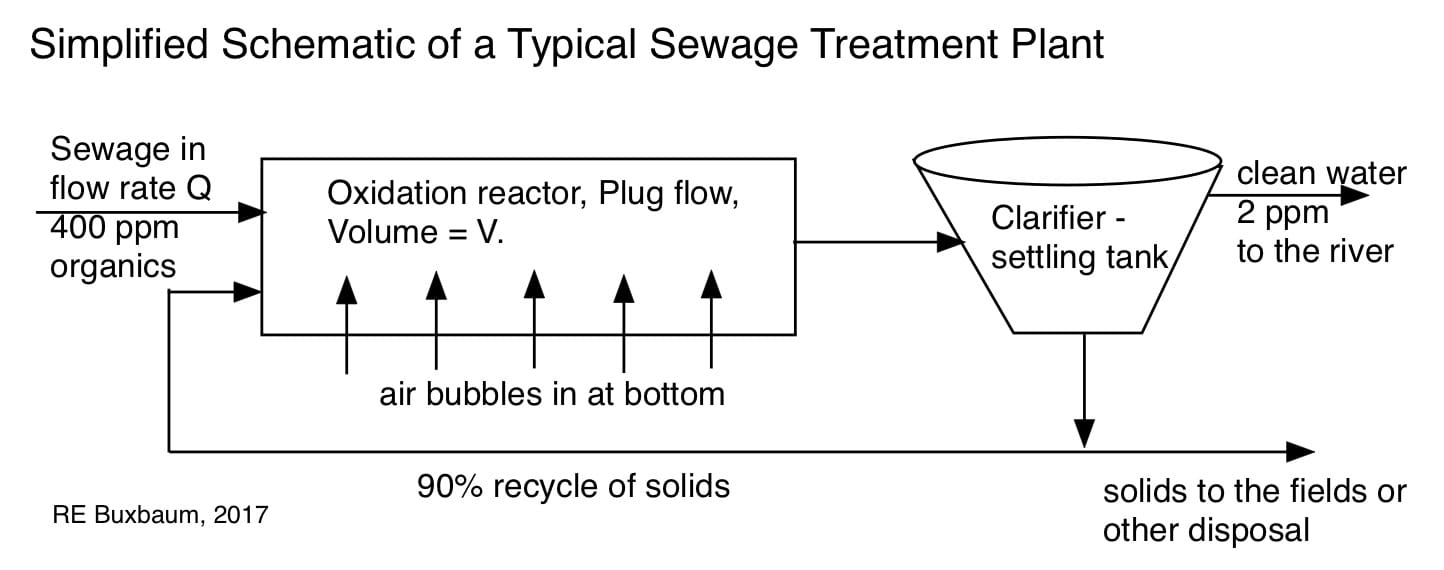
Simplified sewage plant: a plug-flow reactor with a 90+% solids recycle used to maintain a high concentration of bio-catalyst material.

Simplified sewage plant: a bubbling, plug-flow bio-reactor with 90% solids recycle and a settler used to extract floc solids and bio-catalyst material.

In most of the USA, sanitary sewage, the stuff from your toilet, sink, etc. flows separately from storm water to a treatment plant. At the plant, the sewage is first screened (rough filtered) and given a quick settle to remove grit etc. then sent to a bubbling flow, plug-flow bioreactor like the one shown at right. Not all cities use this type of sludge processes, but virtually every plant I’ve seen does, and I’ve come to believe this is the main technology in use today.

The sewage flows by gravity, typically, a choice that provides reliability and saves on operating costs, but necessitates that the sewage plant is located at the lowest point in the town, typically on a river. The liquid effluent of the sewage, after bio-treatment is typically dumped in the river, a flow that is so great more than, during dry season, more than half the flow of several rivers is this liquid effluent of our plants – an interesting factoid. For pollution reasons, it is mandated that the liquid effluent leaves the plant with less than 2 ppm organics; that is, it leaves the plant purer than normal river water. After settling and screening, the incoming flow to the bio-reactor typically contains about 400 ppm of biomaterial (0.04%), half of it soluble, and half as suspended colloidal stuff (turd bits, vegetable matter, toilet paper, etc). Between the activated sludge bio-reactor and the settler following it manage to reduce this concentration to 2 ppm or less. Soluble organics, about 200 ppm, are removed by this cellular oxidation (metabolism), while the colloidal material, the other 200 ppm, is removed by adsorption on the sticky flocular material in the tank (the plug-flow tank is called an oxidation ditch, BTW). The sticky floc is a product of the cells. The rate of oxidation and of absorption processes are proportional to floc concentration, F and to organic concentration, C. Mathematically we can say that

dC/dt = -kFC

where C and F are the concentration of organic material and floc respectively; t is time, and k is a reaction constant. It’s not totally a constant, since it is proportional to oxygen concentration and somewhat temperature dependent, but I’ll consider it constant for now.

As shown in the figure above, the process relies on a high recycle of floc (solids) to increase the concentration of cells, and speed the process. Because of this high recycle, we can consider the floc concentration F to be a constant, independent of position along the reactor length.

The volume of the reactor-ditch, V, is fixed -it’s a concrete ditch — but the flow rate into the ditch, Q, is not fixed. Q is high in the morning when folks take showers, and low at night. It’s also higher — typically about twice as high — during rain storms, the result of leakage and illegal connections. For any flow rate, Q, there is a residence time for a bit of sewage flowing through a tank, τ = V/Q. We can now solve the above equation for the value of τ for an incoming concentration C° = 400 ppm, an outgoing concentration Co of 2 ppm. We integrate the equation above and find that:

ln (C°/Co) = kFτ

Where τ equals the residence time, τ = V/Q. Thus,

ln (C°/Co) = kFV/Q.

The required volume of reactor, V, is related to the flow rate, Q, as follows for typical feed and exit concentrations:

V = Q/kF ln( 400/2) = 5.3 Q/kF.

The volume is seen to be dependent on F. In Oakland county, tank volume V is chosen to be one or two times the maximum expected value of Q. To keep the output organic content to less than 2 ppm, F is maintained so that kF≥ 5.3 per day. Thus, in Oakland county, a 2 million gallon per day sewage plant is built with a 2-4 million gallon oxidation ditch. The extra space allows for growth of the populations and for heavy rains, and insures that most of the time, the effluent contains less than 2 ppm organics.

Bob Martin by the South Lyon, MI, Activated Sludge reactor

Bob Martin chief engineer the South Lyon, MI, Activated Sludge plant, 2016. His innovation was to control the air bubblers according to measurements of the oxygen content. The O2 sensor is at bottom; the controller is at right. When I was there, some bubblers were acting up.

As you may guess, the activated sludge process requires a lot of operator control, far more than the rotating disk contractor we described. There is a need for constant monitoring and tweaking. The operator deals with some of the variations in Q by adjusting the recycle amount, with other problems by adjusting the air flow, or through the use of retention tanks upstream or downstream of the reactor, or by adding components — sticky polymer, FeCl3, etc. Finally, in have rains, the settler-bottom fraction itself is adjusted (increased). Because of all the complexity. sewer treatment engineer is a high-pay, in demand, skilled trade. If you are interested, contact me or the county. You’ll do yourself and the county a service.

I’d mentioned that the effluent water goes to the rivers in Oakland county. In some counties it goes to the fields, a good idea, I think. As for the solids, in Oakland county, the solid floc is concentrated to a goo containing about 5% solids. (The goo is called unconsolidated sludge) It is shipped free to farmer fields, or sometimes concentrated to more than 5% (consolidated sludge), and provided with additional treatment, anaerobic digestion to improve the quality and extract some energy. If you’d like to start a company to do more with our solids, that would be very welcome. In Detroit the solids are burned, a very wasteful, energy-consuming process, IMHO. In Wisconsin, the consolidated sludge is dried, pelletized, and sold as a popular fertilizer, Milorganite.

Dr. Robert Buxbaum, August 1, 2017. A colleague of mine owned (owns?) a company that consulted on sewage-treatment and manufactured a popular belt-filter. The name of his company: Consolidated Sludge. Here are some sewer jokes and my campaign song.
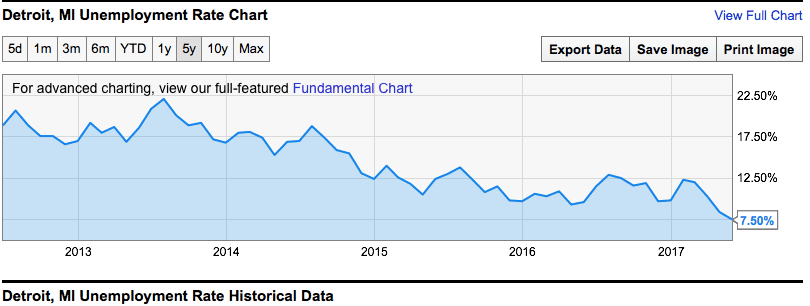
Detroit 1967 to 2017: unemployment comes down, murder rate doesn’t.

Almost 50 years ago today, July 23, 1967 white policemen raided an unlicensed, “blind pig” bar in a black neighborhood, the 12th street of Detroit, and the city responded with four days of rioting, 43 killings (33 black, 10 white), 2509 stores looted, and over 1000 fires. In 2017, at last the city is beginning to show signs of recovery. By 2015 the city’s unemployment had gone down from about 20% to 12%, and  in the first six months 2017, the firs six months of the Trump presidency, 2017 it’s gone down again to 7 1/2%. It’s not that 7 1/2% unemployment is good, but it’s better. Per-hour salaries are hardly up, but I take that as better than having a high average salary at very low employment. As a point of reference, the unemployment rate in Detroit in 1967, before the riots was 3.4%. Within weeks, 150,000 jobs were lost, and anyone who could leave the city, did.

Detroit Unemployment rates are way down, but the city still looks like a mess.

Detroit Unemployment rates are way down, but the city still looks like a mess.

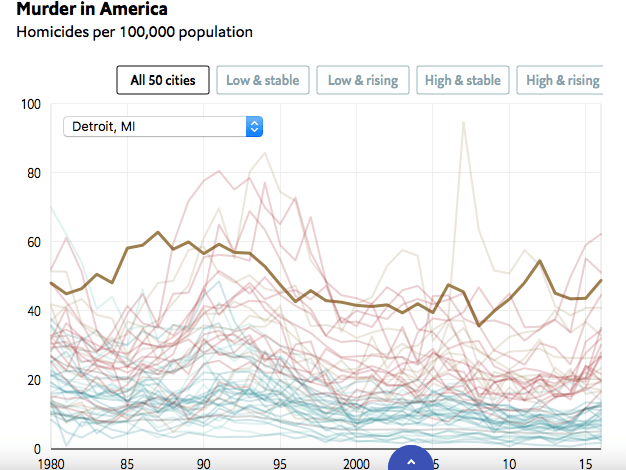
Another issue for Detroit is its uncommonly high murder rate. In the mid-80s, Detroit had the highest murder rate in the US, about 55 murders per 100,000 population per year (0.055%/year). As of February 1, 2017, the murder rate was virtually unchanged: 50 per 100,000 or 0.05%/year, but two cities have higher rates yet. At present rates, you have a 3.5% of dying by homicide if you live in Detroit for 70 years — even higher if you’re male. The rate in the rest of the US is about 1/10th this, 0.005%/year, or 5 per 100,000, with a dramatic difference between rural and urban populations.

Murder rate in 50 cities with Detroit highlighted. From The Economist, February 2017.

Murder rate in 50 cities with Detroit highlighted, from The Economist.

One of the causes of the high murder rate in Detroit, and in the US generally, I suspect, is our stiff, minimum-penalties for crime. As sir Thomas Moose pointed out, when crime is punished severely, there is a tendency to murder. If you’re going to spend the next 20 years behind bars, you might as well try any means you can to escape. Another thought — the one favored by social liberals — is that it’s the presence of guns in the US encourages murder. It may, but it also seems to prevent crime by allowing the victim to defend himself or herself. And the effect on murder is not so clear, if you consider suicide as a form of murder. In countries like Canada with few guns, people kill themselves by hanging or by throwing themselves off high buildings. My hope is that Detroit’s murder rate will drop in 2017 to match its improved economic condition, but have no clear reason to think it will.

Robert Buxbaum, July 20, 2017. Here are some suggestions I’ve made over the years.

Nestle pays 1/4,000 what you pay for water

When you turn on your tap or water your lawn, you are billed about 1.5¢ for every gallon of water you use. In south-east Michigan, this is water that comes from the Detroit river, chlorinated to remove bacteria, e.g. from sewage, and delivered to you by pipe. When Nestle’s Absopure division buys water, it pays about 1/4000 as much — $200/ year for 218 gallons per minute, and they get their water from a purer source, a pure glacial aquifer that has no sewage and needs no chlorine. They get a far better deal than you do, in part because they provide the pipes, but it’s mostly because they have the financial clout to negotiate the deal. They sell the Michigan water at an average price around $1/gallon, netting roughly $100,000,000 per year (gross). This allows them to buy politicians — something you and I can not afford.

Absopure advertises that I t will match case-for-case water donations to Flint. Isn't that white of them.

Absopure advertises that I t will match case-for-case water donations to Flint. That’s awfully white of them.

We in Michigan are among the better customers for the Absopure water. We like the flavor, and that it’s local. Several charities purchase it for the folks of nearby Flint because their water is near undrinkable, and because the Absopure folks have been matching the charitable purchases bottle-for bottle. It’s a good deal for Nestle, even at 50¢/gallon, but not so-much for us, and I think we should renegotiate to do better. Nestle has asked to double their pumping rate, so this might be a good time to ask to increase our payback per gallon. So far, our state legislators have neither said yes or no to the proposal to pump more, but are “researching the matter.” I take this to mean they’re asking Nestle for campaign donations — the time-honored Tammany method. Here’s a Detroit Free Press article.

I strongly suspect we should use this opportunity to raise the price by a factor of 400 to 4000, to 0.15¢ to 1.5¢ per gallon, and I would like to require Absopure to supply a free 1 million gallons per year. We’d raise $300,000 to $3,000,000 per year and the folks of Flint would have clean water (some other cities need too). And Nestle’s Absopure would still make $200,000,000 off of Michigan’s, clean, glacial water.

Robert Buxbaum, May 15, 2017. I ran for water commissioner, 2016, and have occasionally blogged about water, E.g. fluoridationhidden rivers, and how you would drain a swamp, literally.

May 1, St. Tammany day

May 1 is St. Tammany day, a day to rejoice in the achievements of Tammany Hall, and of St Tammany, the guardian of crooked politicians everywhere. The Sons of St. Tammany started in 1773 as a charitable club of notable revolutionary-era individuals including Benjamin Franklin, John Hancock, and John Dickenson, but evolved into perhaps the most corrupt, and American, of political organizations. The picture of a US politician – the cartoon version at least — is the Tammany Democrat: a loud, drunken, womanizer, willing to do or promise whatever the people seem to want at the moment. Tammany and its bosses helped form this image. They helped new immigrants, but did so by creating needless government jobs, by filling them often with incompetent loyalists, and by overcharging on government contracts. Today, these Tammany ways rule in every major American city; the other clubs of the day are gone or influence-less.

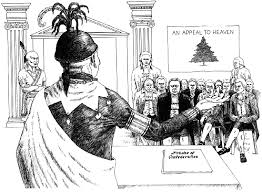
John Hancock leads a meeting of the St. Tammany (Columbian) society. Note the "Appeal to Heaven flag and the Indian, real or imagined. Indians participated in several, early St. Tammany meetings.

John Hancock leads a meeting of the St. Tammany society. Note the “Appeal to Heaven” flag. While Indians participated in some, early meetings, the one here is, I suspect, a ghost: St. Tammany.

In revolutionary-era America, the Sons of St. Tammany was just one of many social-charitable clubs (Americans like to form clubs), in many ways it was similar to the Masons and the Cincinnati, but those clubs were international and elitist. The sons of Tammany was purely American, and anti-elitist. It was open to anyone born on this side of the Atlantic, and had Indian customs. The Cincinnati society, for comparison, started with members who were as notable (Alexander Hamilton, George Washington, Marie, Marquis de Lafayette, Henry Knox, etc.) but was originally open only to high officers of the regular army, including foreigners like Lafayette, but not ordinary soldiers, minutemen (militia), or the general public. The symbols of the Tammanies were American: the liberty-cap and the “Appeal to Heaven” flag, now a popular symbol of the Tea Party; the leader was called by an Indian name: Sachem. By contrast, the Cincinnati society symbol was the Imperial Eagle (Washington’s was gold with diamonds), and the leader was called “general”. The Tammany society began admitting immigrants in 1810 or so, while the Cincinnati society remains closed to this day, except to descendants of Revolutionary officers — an aristocratic affectation in the eyes of some.

It was Aaron Burr who first saw the opportunity to use the Tammany organization as a for-profit, political machine. In the years 1795-9, New York was suffering from yellow fever and a variety of other diseases that were taken to be caused by a lack of clean water. Burr proposed, with Tammany support, the creation of a corporation to build a new water system to bring fresh, clean water from the Bronx River to lower Manhattan via iron pipes. The Manhattan company was duly chartered, with directors who were primarily Tammany men, Republican-Democrats, and not Federalists. Federalists (Hamilton, primarily) controlled the only NY banks at the time and controlled the directorate of every chartered company in the city. The Manhattan company requested a $2,000,000 perpetual charter, twice as big as the charter of Hamilton’s Bank of New York, and a monopoly on water distribution. These were reasonable requests given the task, but unusual in the lack of Federalist or governmental oversight. But the Manhattan company was a water company, and water was needed. But Burr’s intent, all along, it seems was to build a bank, not a water company. After the charter was approved, but before signing, he amended it to allow any excess funds to be used for any legal purpose. 

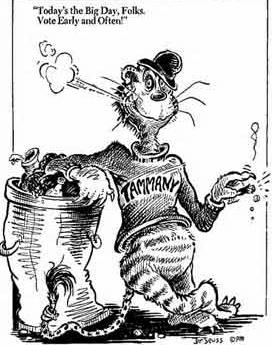
In this cartoon by Dr. Seuss, The Tammany Tiger says, "Today is the Big Day Folks. Vote Early and Often."

In this cartoon by Dr. Seuss, The Tammany Tiger says, “Today is the Big Day Folks. Vote Early and Often.”

Money was raised, but only $100,000 used for the water system. The remaining 95% of the charter funds, $1,900,000, went to found “The Bank of The Manhattan company” — later to be known as “The Chase Manhattan Bank” or “The Manhattan Bank of Cholera.” Instead of building the reservoir in upper Manhattan and filling it with clean water as originally proposed, Burr’s Tammany trustees voted to dig wells in lower Manhattan, and placed its reservoir in lower Manhattan too, near Chamber’s St,  next to a cemetery where Cholera victims were buried. New York suffered with Cholera, Typhoid, and leaky, wooden pipes until 1842 when Peter Cooper brought clean water to lower Manhattan from the Groton River via iron pipes. To this day, crooked water contracts are a staple of Tammany politics

The Bank of the Manhattan company opened at 40 Wall St on September 1, 1799, a mere four months after the water company’s incorporation. Hamilton was furious. The company continues today as The JP Morgan, Chase Manhattan Bank, one of the largest banking institutions in the world. Burr used the money and power of his company to reward supporters and to run for vice president with Thomas Jefferson’s tacit support. Except for his Tammany candidacy, John Adams would have won New York and a second term as president. Burr’s career pretty-well died after the Hamilton duel, but Tammany did well without him. By 1812, the Society built its first Tammany Hall, officially called the Wigwam, a $55,000, five-story building with a meeting hall for 2000. New York Democratic politics would center on Tammany Hall for the next century at least.

Following disappointment with John Quincy Adams, “the bitter branch of the bitter tree,” Tammy leaders went national. They recruited Andrew Jackson, a war hero and early recruit of Burr’s. They’d support Jackson if he’d hand over spoils, control of government jobs. He agreed and, as president, fired perfectly good, long-standing government employees He replaced them with Democratic loyalists. When Jackson stepped down in 1833, Tammany elected an equally corrupt New Yorker, Martin van Buren. Though there were periodic Whig and Republican reforms, Tammany learned they could wait those out. They always re-emerged like mushrooms after a rain.

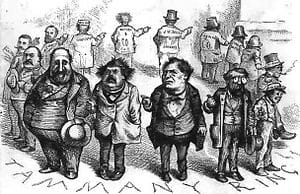
Boss Tweed and other Tammany leaders: who stole the money?

Boss Tweed and other Tammany leaders in a cartoon by Nast, Tammany Ring. “Who stole the money? He did.”  

A key vote-getter in the Tammany system is to provide Thanksgiving dinners and other charitable giveaways for the poor, as well as promises of jobs. By the late 1800s, William J. Brian added promises of soft money and wealth redistribution, cornerstones of the Democratic platform to this day. Tammany also tends to be for low tariffs as opposed to the high tariff ideas of Hamilton and many Whigs and 19th century Republicans. A case can be made for either view.

Tammany helped New York immigrants, particularly the Irish to get citizenship and avoid legal troubles in return for votes and occasional muscle. In other cities, Democratic clubs were less open to Catholics, reflecting the views of the common voter in each state. In the North they were pro-union, in the South anti, electing Klu Kluxers like George Wallace, Sam Ervin, and Robert Byrd. This lead to a famous split in the Democratic party about the 1968 convention. Famous Tammany leaders include William M. “Boss” Tweed, “Big” Tim Sullivan, and “Gentleman” Jimmy Walker. Sullivan famously authored the first anti-gun law, the Sullivan act; it was designed to protect his thugs against private citizens shooting them. It didn’t always work.

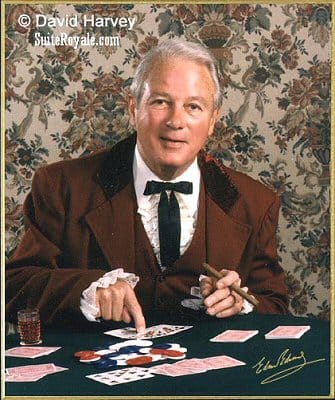
Edwin Edwards, Democratic Governor of Louisiana. 1972-1996. Who would not trust this man?

Hon. (?) Edwin Edwards, Governor of Louisiana. 1972-1996. Tammany lives

If you want to see Tammany politics in action, visit almost any large US city, or read its newspaper. In Chicago, the dead vote, and 4 of the last 6 governors have gone to jail. Mayor Daily famously told Kennedy that 90 percent of the registered voters of Cook County would vote for him. They did (sort of); because of this, JFK won Illinois and the presidency. In New York, voters discovered only in the 1960s that Tammany’s leader, Carmine DeSapio had been working for 30 years with known gangland murderer, Charles “Lucky” Luciano. In Detroit, where I live and corruption in the water department is legendary. Race-based job handouts, unemployment is high along with high minimum (living) wages. We’re now in the process of a $70,000,000 project to replace 100 feet of sewer pipe, and we’re building a $140 million, 3.3 mile trolley. Tammany loves all public works.

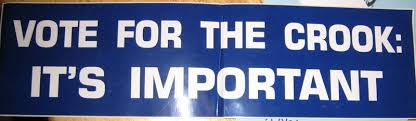
Then there is Louisiana, home to St Tammany parish. Louisiana Democrats like Huey Long and Edwin Edwards (shown at left) are unusual in that they’re proud to say that their corrupt methods are corrupt. Edwards has had two long runs as governor despite several convictions for doing illegal things he admits to doing. When Edwards was asked why he did favors for his friends. He responded: “Who should I do them for? My enemies?” Or, to quote one of Edwin Edwards campaign ads. Vote Edwin EdwardsPeople seem to love it, or did until the levy broke. There is a particularly American grandeur to all this. As Will Rodgers said, “America has the best politicians money can buy.” Today is the day to be proud of that uniquely American tradition. You too can grow up to buy a president.

Robert Buxbaum, April 28, 2017. I ran for water commissioner, and have written about sewage treatment, flood avoidance, and fluoride, as well as the plusses and minuses of trade unionization, and the difference between Republicans and Conservatives.

Black folks have no savings (poor whites too)

The wealth of the mean American household has dropped since 2007, a result of  de-industrialization, and unmet expectations. On average, America is richer, but we’ve increased the economic divide. The richest have left behind the working and bourgeoise classes. Though we are beginning to come back, with home ownership rising, a particularly nasty legacy remains, especially among black families. Some 47% of black families have no liquid savings  — a far greater fraction than in 2007. This. has to change if black folks are ever to get ahead as a group.

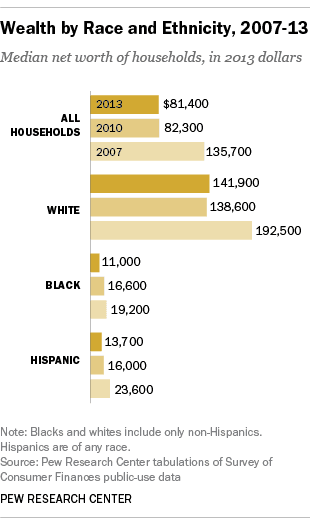
College graduation rates have increased among black students, and black salaries, but I’m not sure the degrees are in productive fields (true for white students too). As of 2015, 22.5% of black students and 15.5% of Hispanic students had completed four years of college. That’s less than the 36.2% of white students, an inequality, but not a horrible one. As of 2013, the average salary of a black college grad was over $1000/week, somewhat less than the average for white grads, but enviable compared to the world as whole. The big problem I see is that black workers save very little compared to other ethnic groups, or compared to previous savings rates as shown by the graphic below. By 2013, the net worth of the median black family (savings, plus paid-off part of home and car) was $11,000 (Pew Research Data, below), down from $19,200 six years earlier. This is much lower than the net worth of white families (also down since 2007). In terms of liquid savings the mean is near zero, and this is the mean. Half of all black families are doing worse.

Net worth disparity 2007 - 2011. Black folks are doing poorly and it's getting worse.

Net worth disparity 2007 – 2011. Black folks are doing poorly and it’s getting worse.

The combination of low savings and low net worth puts black folks at a distinct disadvantage to their condition six years earlier. Without savings, it is near-impossible to weather the loss of a job, or even to fix a car or pay a ticket; a major disease is basically a one-way ticket to the welfare office. Six years ago, when people saved more and prices were lower, problems like this were annoyances. Now, it’s a family disaster.

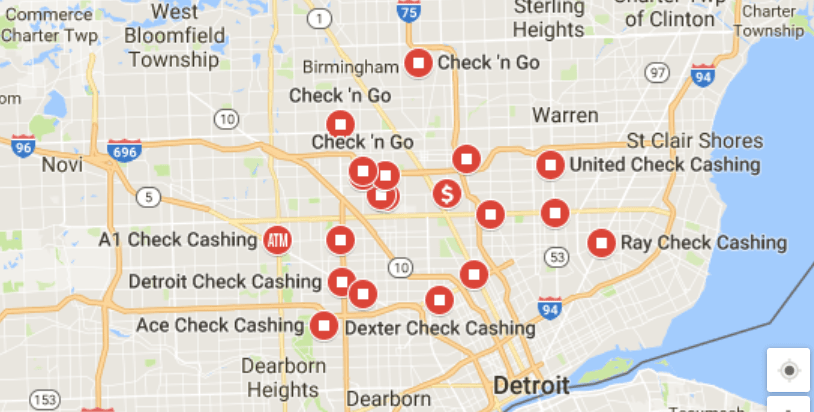
A person without savings will not have a savings account or a checking account. As such, he or she will not have a credit card or check cashing privileges. The only way to cash a check will be via a for-fee service, and these tend to come at a steep cost (2-5%). The growth of check-cashing services in black neighborhoods is a symptom of this. People with savings accounts cash checks essentially for free, and can usually borrow money by way of a credit card. Black people and poor whites tend to use debit cards instead. They look and work like credit cards, but they incur fees upon use, and do not provide instant loans. When black folks and poor whites need quick cash, their options are the loan-shark or the pawn shop: high-cost options.

While black individuals have lower incomes than whiteindividuals, most of the blame seems to be family stability. Employed, college-educated blacks earn, on average, 95% as much as employed, college-educated whites — not great, and I trust that will improve. The bigger problem is not being able to show up for work because of family instability., Single-parent families are significantly more common among black folks. Roughly 40% of black families are single-mother, or mother+grandparent households compared to “only” 26% in the population generally. In both populations, the number of single parent households have increased dramatically in the last few years, a result I suspect of the government’s desire to help. The government gives more aid to a split-up couple than to one that stays together, but the aid brings with it long-term damage to net worth. A family with one parent will naturally have a lower-income and savings rate than a family with two. The lack of stability that comes from a single parent family, I suspect, has contributed to crime, births out-of-wedlock, and the tendency of black folks to drop out of college.

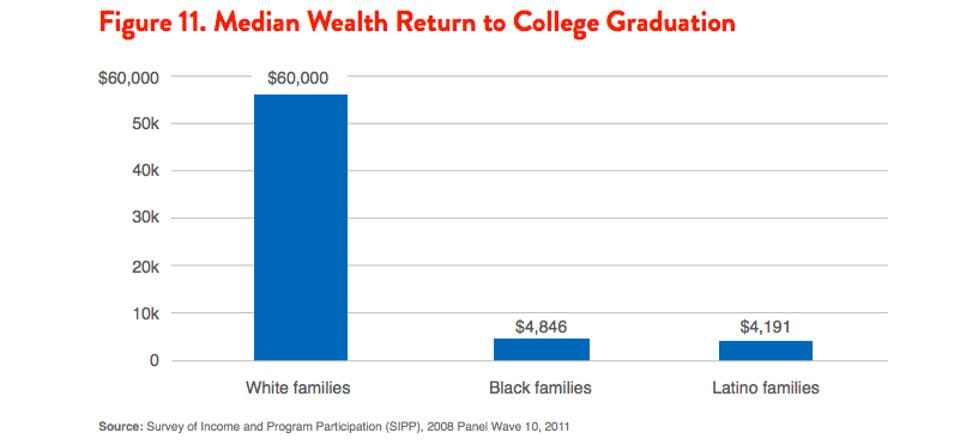
Black families don't benefit as much from college --in part a result of the choice of courses.

Black families don’t benefit much from college –in part a result of course choices, in part the result of borrowing. (Forbes, 2015).

Some white do-gooders want to eliminate check cashing businesses and pawn shops in a misguided desire to help the low-income neighborhoods, but the success of these companies tell me that they are needed. Though check services and pawn brokers take a nasty bite, urban life would be much worse without them, I suspect.

Another so-called solution of the do-gooders, is to tax savings and transfer the wealth to the poor. This form of wealth redistribution has been a cornerstone of the Democratic party for the last century. The idea of the tax is that it will transfer “idle wealth” from rich savers to poor folks who will spend it immediately. The problem is that great swathes of the nation don’t save at all currently; net worth is down all across the US — among white and black families both. Taxing savings will almost-certainly reduce the savings rate even further. Besides, savings are the stuff of self-determination and dreams — far more than spending, it is savings that allows a person to start a new business. One does not provide for the dreams of one group by taking them from another — particularly when the merit of the receiving group is that they are immediate spenders. The danger of this is seen by looking at Detroit.

As it is, inner city children do not see a path out via education. Detroit school attendance hovers around 50%, and business startups are lacking. With higher savings rates and higher family stability, folks could start businesses, and/or take advantage of job opportunities that come along, and that would help the community more than redistribution.  It sometimes seems that the only successful businesses in Detroit are check cashing, pawn brokers, churches, hair-salons, fast food, and medical marijuana — businesses that provide little community return. Detroit has lost its manufacturing center, and now has more medical marijuana providers than groceries — a sad state of affairs.

The Check cashing services of south-eastern MI are concentrated in poor black and white neighborhoods.

The Check cashing services of south-eastern MI are concentrated in poor black and white neighborhoods.

In 2016, both presidential candidates touted major building projects to help the inner city poor. In principle this could help, but the  inner city youth lack the training or licenses to build roads and bridges. They have barely the math skills to manage a McDonald’s. For another thing, many of the project aren’t needed. They’re form of income redistribution and graft. Surely we can do better. Trump makes the case for tariffs (reducing free trade) as a way to rebuild the industrial base of cities like Detroit. It’s an approach with merit, I think. He’s also and has suggested closing the border to low-wage workers. This is expected to raise the price of California lettuce and NY hotel stays, but it’s likely to increase employment and wages among lower-skilled, black and white Americans. Small steps, I think, to solving a serious problem.

One more thing: open a bank account if you don’t have one. Mine is at a credit union. I opened it with $5, and opened a checking account at the same time. Have your wages deposited automatically, if you can. And avoid the check cashing services. Let your savings grow.

Robert E. Buxbaum, April 21, 2017.  I ran for water commissioner 2016 (Republican) and lost. If you find my comments insensitive, that could be why I lost.

The argument for free trade is half sound

In 1900, the average tariff on imported goods was 27.4% and there was no income tax. Import tariffs provided all the money to run the US government and there was no minimum wage law. The high tariffs kept wage rates from falling to match those in the 3rd world. Currently, the average tariff is near-zero: 1.3%. There is a sizable income tax and a government income deficit; minimum wage laws are used to prop up salaries. Most economists claim we are doing things right now, and that the protective tariffs of the past were a mistake. Donald Trump claimed otherwise in his 2016 campaign. Academic economists are appalled, and generally claim he’s a fool, or worse. The argument they use to support low tariffs was made originally by Adam Smith (1776): “It is the maxim of every prudent master of a family, never to attempt to make at home what it will cost him more to make than to buy…. If a foreign country can supply us with a commodity cheaper than we ourselves can make it, better buy it of them with some part of the produce of our own industry.” As a family benefits from low cost products, a country must too. How stupid would you have to be to think otherwise?

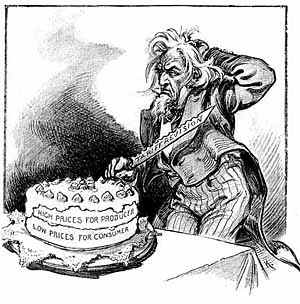
A cartoon from Puck 1911. Do you cut tariffs, and if so how much. High tariffs provide high wages and expensive prices for the consumer. Low tariffs lead to cheap products and low wages. Uncle Sam is confused.

A cartoon from Puck, 1911. Should tariffs be cut, and if so, how much. High tariffs provide high prices and high wages. Low tariffs lead to low prices for the consumer, but low wages. Uncle Sam is confused.

Of course, a country is not a family, and there are certain benefits in keeping manufacturing and employment here, in not exporting jobs and expertise. It is clear that some people benefit from a flood of cheap, imported products, while some folks suffer. Consumers and importers benefit, while employees generally do not. They are displaced from work, or find they must compete with employees in very low wage countries, and often with child labor or slave labor. The cartoon at right shows the conundrum. Uncle Sam holds a knife labeled “Tariff Revision” trying to decide where to cut. Any cut that helps consumers hurts producers just as much. Despite the cartoon, it seems to me there is likely an optimal, non-zero tariff rate that allows productive trade, but also provides revenue and protects American jobs.

A job-protecting tariff was part of the Republican platform from Lincoln’s time, well into the 20th century, and part of the Whig platform before that. Democrats, especially in the south, preferred low tariffs, certainly no more than needed to provide money for government operation. That led to a diminution of US tariffs, beginning in the mid- 1800s, first for US trade with developed countries, and eventually with third world as well. By the 1930s, we got almost no government income from tariffs, and almost all from an ever-larger income tax. After WWII low tariff reductions became a way to promote world stability too: our way of helping the poor abroad get on their feet again. In the 2016 campaign, candidate Donald Trump challenged this motivation and the whole low-tariff approach as anti- American (amor anti America-first). He threatened to put a 35% tariff on cars imported from Mexico as a way to keep jobs here, and likely to pay for the wall he claimed he would build as president. Blue-collar workers loved this threat, whether they believed it or not, and they voted Republican to an extent not seen in decades. Educated, white collar folks were uniformly appalled at Trump’s America-first insensitivity, and perhaps (likely) by the thought that they might have to pay more for imported goods. As president, Trump re-adjusted his threat to 20%, an interesting choice, and (I suspect) a good one.

The effect of a 20% tariff can be seen better, I think, by considering a barter-economy between two countries, one developed, one not: Mexico and the US, say with an without a 20% tax. Assume these two countries trade only in suits and food. In the poor country, the average worker can make either 4 suits per month or 200 lbs of food. In the developed country, workers produce either 10 suits or 1000 lbs of food. Because it’s a barter economy with a difference in production, we expect that, in the poor country, a suit costs 50 lbs of food; in the rich country, 100 lbs of food. There is room here to profit by trade.

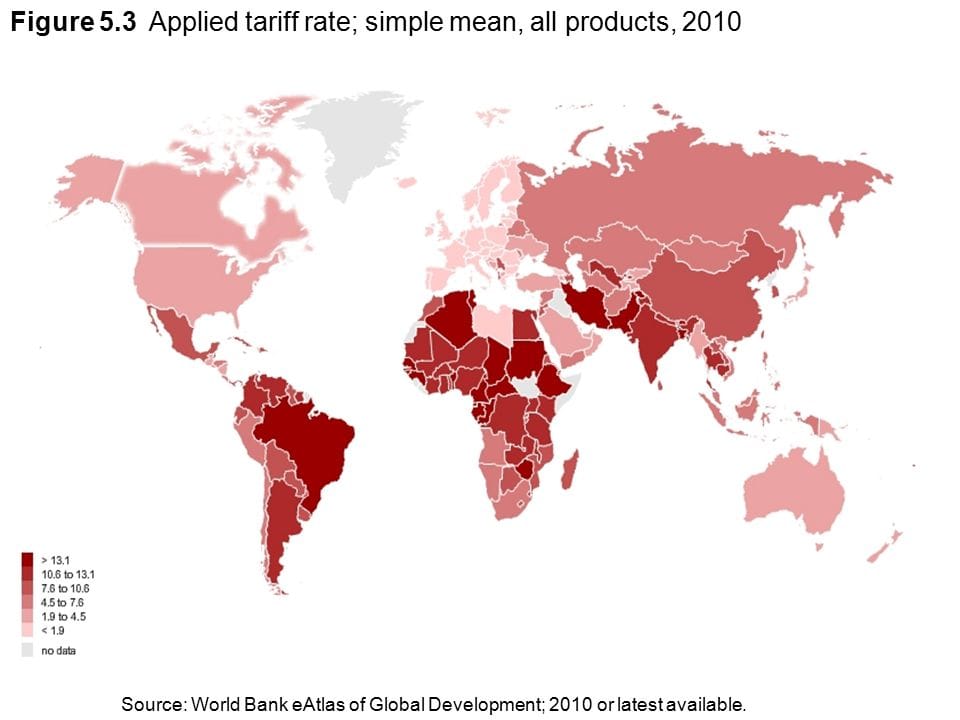
The current state of tariffs world-wide. Quite a few countries have tariffs much higher than ours. Among those, Mexico.

Tariffs world-wide. We put no tax on most imported products while much of the world taxes our products heavily.

With no tariff, totally free trade, an importer will find he can make a profit bringing 100 lbs of US food to Mexico to trade for 2 suits. He can return two suits to the US having gotten his two suits at the price of one, less the cost of transport, lawyers, and middlemen (relatively low). Some US suit-makers will suffer, but the importer benefits immediately, and eventually US consumers and Mexican suit workers will benefit too. Eventually, US suit prices will go down, and Mexican wages up, We will have cheaper suits and will shift production to what we make best —  food.

In time, we can expect that an American suit maker will move his entire production to Mexico bringing better equipment and better management. Under his hand, lets assume his Mexican workers make 6 suits per month. The boss can now pay them better, perhaps 100 lbs of food and two suits per month. He still makes a nice profit, more than before: he ships two suits to the US to buy the 200 lbs of food, and retains now two suits as profit. Hillary Clinton believed this process was irreversible. “Those jobs are gone and they’re not coming back,” her campaign told CNN. She claimed she’d train the jobless “for the jobs of the future” and redistribute the wealth of the rich, a standard plank of the democratic platform since 1896. But, for several reasons, industrial voters didn’t trust her to succeed, or even to try. Redistribution of wealth rarely works because, even if a politician has the will, and most don’t, manufacturers can usually keep their profits off-shore, and they do.

A very high tariff would stop all trade, but lets see what would happen with Trump’s 20% tariff. With a 20% tariff, when the first two suits come to the US, we’d extract 0.4 suits in tax revenue. The importer still makes a profit, but it’s now 0.6 suits, the equivalent of 60 lbs of food. He can sell suits for less than the American, but not as much less. If the manufacturer moves to Mexico he makes more money, but not quite as much. Tax is still collected on every suit brought to America — now 20% of the 3 suits per Mexican worker that the Boss must export. The American worker’s wages are depressed but he/she isn’t forced to compete with the Mexican dollar-for-dollar (suit for suit). In barter terms, he isn’t required to make 6 suits for every 100 lbs of food.lincoln-national-bank-internal-improvements-tariffs

We find that, in the above fictional economy, a 50% tariff in the maximum to allow any profitable suit trade: the first two suits might enter the US; but they’d be taxed at one suit, just enough to pay for the 100 lbs of food that he’d have to barter for the 2 suits. At that rate, there would be no profit for the importer, and he/she would stop importing. A 50% tariff is thus counter-productive to the consumer and the US gov’t: we would get no imported goods, and we’d collect no import revenue – a bad situation in general, though good for the manufacturer. Lincoln’s “protective tariffs” of 1861 contributed to Southern succession and the start of the civil war. It seems to me that some modest tariff of 10% to 20% is fair and productive — tariff rates that Trump seems to have intuited, and that many other countries have adopted, see map-chart above. As for the academic economists, I note that they also predicted a stock market crash should Trump be elected; it’s gone nearly straight up since November 8, 2016. I find that most economists are not rich despite claiming to be experts on money.

Robert E. Buxbaum, March 27, 2017. I learned such economics as I have from my one course in economics, plus comic books like the classic “Once upon a dime” produced by the New York Federal Reserve. Among the lessons learned: that money is a distraction, just a more convenient way to carry around a suit, 100 lbs of food, or a month of work. If you want to understand economics, I think it helps to work things out in terms of barter, as above.

Arrested for decriminalized possession

The arrest rate for marijuana is hardly down despite widespread decriminalization, but use is up. decriminalization, but use is up. A rate that exceeds that for all violent crime.

Despite years of marijuana decriminalization, arrest rates for marijuana are up from 20-25 years ago, and hardly down from last year. Why?

There are a couple of troubling patterns in US drug arrests. For one, though marijuana has been decriminalized in much of the USA, marijuana arrest rates are hardly down from five years ago, and higher than 20-30 years ago — see graph at right. Besides that, it’s still mostly black-people and Latinos arrested. And the crime is, 4/5 the of the time, drug possession, not sale.

At the same time that violent crime rates are falling, marijuana possession arrests are rising (see graph below). Currently, according to FBI statistics,  more people are arrested for marijuana possession than for all violent crime combined. You’d expect it would not be this way, and a question I’d like to explore is why. But first, let’s look at more data. I note that part of an explanation is that marijuana use is up (18% in 2015 vs 12% in 1990). This still doesn’t explain the racial imbalance but it could explain the general rise. Marijuana isn’t quite legal, and if use is up, you’d expect arrests to be up. But even here, something is fishy: use rates are the same as in 1980, 35+ years ago in the midst of the “war on drugs,” but arrest rates have more than doubled since. Why? Take New York City as an example, 17,762 people were arrested for low-level marijuana possession in 2016 (smoking in public or possession of 25 gm to 2 oz). The low-level arrest rate is twice the national average in this Democratic-bastion city, where the drug was decriminalized years ago. Arrest rates in NYC went up an additional 10% in 2016, with black people arrested at 11 times the rate of white people. How could this be?

The race discrepancy of arrests persists across the US. Though black citizens use drugs only 15% or so more often than whites, and make up only 13% of the US population, they are arrested for drugs about three times as often and incarcerated about 4 times as often. It’s mostly for marijuana possession too, and the discrepancy varies very strongly by location In Louisiana, Illinois, and New York City arrests are particularly weighted to people of color. When New York City police precinct captains were asked about this, they explained that their instructions come from above. It’s a curious answer, I’d say, reflecting perhaps their dislike of the mayor.

Drug arrests are mostly for possession, not sale, and the spread is rising.

Drug arrests are mostly for possession, not sale and the spread is rising. More than half the time, it’s marijuana.

One of the race-affecting instructions is that the police are instructed to patrol black neighborhoods, but not the student unions of majority-white colleges like NYU. They’re mandated to stop and search junky cars but not nice ones, and to search people who have outstanding parking tickets, but not generally. They even get raises that depend on the number of tickets given, a practice that does not lead to a pattern of looking the other way — one many New Yorkers would prefer. Another issue: in many states, including New York, the police can keep money or cars, if they can claim that the asset was purchased with drug money or used in the drug trade. This leads to a practice where the city budget benefits when the police arrest persons they don’t expect will be convicted. It’s a practice called civil asset forfeiture, one lampooned, on Last Week Tonight, but jealously guarded. Since it is near impossible to prove that the money or car was not used in any way illegally, once they arrest someone, the police can expect to keep his or her money or cars indefinitely. The annoyance of lawyers perhaps encourages the arrest of people who do not seem to have them — people of color. New York mayor deBlassio justifies his arrests as a way to protect the neighborhoods, as his version of former mayor, Guilliani’s broken window approach. Maybe. But I think the profit motive is at least as relevant.

drug arrests hit black folks a lot more than white

Drug arrests hit black folks a lot more than white.

I note that strict justice tends to land hardest on the poor and defenseless. I also note that many important people have used marijuana without it damaging their lives in any obvious way. Both Jeb! Bush and Bill Clinton claimed to have smoked it; as did Barak Obama, Al Gore, and the Beatles. My bottom line: while marijuana decriminalization is worthwhile, it must go along with the repeal of civil asset forfeiture laws, and other means that make arrests into profit centers – or so it appears to me. Otherwise we’ll keep on flushing lives down the drain for no good reason.

Robert Buxbaum, March 6, 2017. I’ve previously blogged about the structure of criminal sentencing, coming to conclude that the least strict sentence that does the job is to be preferred. I also ran for water commissioner in 2016.

Rethinking fluoride in drinking water

Every now and again, it pays to rethink what everyone knows is so. As it happens I was asked to rethink fluoride in the drinking water. So here goes.

Fluoride is a poison, toxic for a small child in doses of 500 mg, and toxic to an adult in doses of a few thousand mg. It is a commonly used rat poison that kills by robbing the brain of its ability to absorb oxygen. In the form of hydrofluoric acid, it is responsible for the deaths of more famous chemists than any other single compound: Humphrey Davy died trying to isolate fluorine; Paul Louyet and Jerome Nickles, too. Thomas Knox nearly died, and Henri Moissan’s life was shortened. Louis-Joseph Gay Lussac, George Knox, and Louis- Jacques Thenard suffered burns and similar, George Knox was bedridden for three years. Among the symptoms of fluoride poisoning is severe joint pain and that your brain turns blue.

In low doses, though, fluoride is thought to be safe and beneficial. If true, this would be an example of hormesis. It’s found that many things that are toxic at high doses are beneficial at low. Most drugs fall into this category; chemotherapy works this way. Sunshine and radioactivity show hormesis too. Fluoride seems to be like this. In small doses, Fluoride is associated with strong teeth, and few cavities, and no obvious health risks. It is found at ppm levels many well water systems, and has shown no sign of toxicity, either for humans or animals at these ppm levels. Following guidelines set by the AMA, most US cities have been putting fluoride in drinking water since the 1960s, typically at concentrations between 0.7 and 1.2 ppm. We have seen no deaths or clear evidence of any injury from this, but there has been controversy. Much of the controversy stems from a Chinese study that links fluoride to diminished brain function, and passivity (Anti-fluoriders falsely attribute this finding to a Harvard researcher, but the Harvard study merely cites the Chinese). The American dental association strongly maintains that worries based on this study are groundless, and that the advantage in lower cavities more than off-sets any other risks. Notwithstanding, I thought I’d take another look. The typical US adult consumes 1-3 mg/day the result of drinking 1-3 liters of fluoridated water (1 ppm = 1 mg/liter). This < 1/1000 the toxic dose,

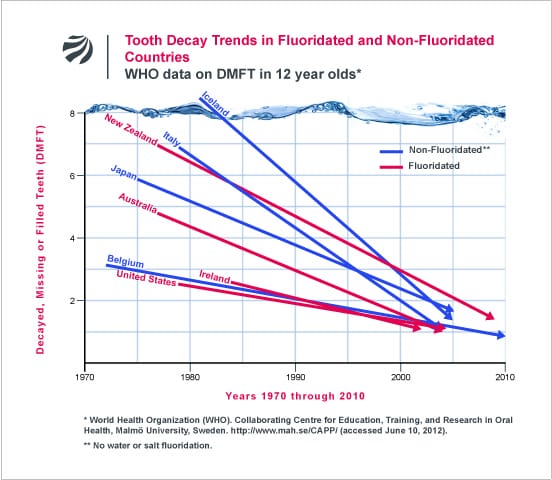
While there is no evidence that people who drink high-fluoride well water are any less-healthy than those who drink city water, or distilled / filtered water, that does not mean that our city levels are ideal. Two months ago, while running for water commissioner, I was asked about fluoride, and said I would look into it. Things have changed since the 1960s: our nutrition has changed, we have vitamin D milk, and our toothpastes now contain fluoride. My sense is we can reduce the water concentration. As shown below, many industrial countries that don’t add fluoride have similar tooth decay rates to the US.

World Health Organization data on tooth decay and fluoridation.

World Health Organization data on tooth decay and fluoridation.

This chart should not be read to suggest that fluoride doesn’t help; all the countries shown use fluoride toothpaste, and some give out fluoride pills, too. And some countries that don’t add fluoride have higher levels of cavities. Norway and Japan, for example. They don’t add fluoride and have 50% more cavities than we do. Germany doesn’t add fluoride, and has fewer cavities, but they hand out fluoride pills, To me, the chart suggests that our levels should be lower than the AMA guidance, though not zero. In 2015, the Department of Health recommend lowering the fluoride level to 0.7 ppm, the lower end of the previous range, but based on the experience of Europe, I’d pick 1/2 the original dose: 0.6 to 0.35 ppm. I’d then revisit the data in another 15 years.

Having picked my target fluoride concentration, I checked to see what the levels we use in my county, Oakland county, MI. I was happy to discover that the levels were already below the AMA guide. The water the county drinks, provided by Detroit Water and Sewage, NOCWA and SOCWA contains 0.43-0.55 ppm fluoride, in the center of in the range I would have picked. Fluoride concentrations are higher in towns that use well water, about  0.65-0.85 ppm. I do not know if this is because the well water comes from the ground with these fluoride concentrations or if the towns add more, aiming at the Department of Health target. In either case, I don’t find these levels alarming. If you live in one of these towns, or outside of Oakland county, check your fluoride levels. If they seem high, write to your water commissioner or add a filter to your tap. You can also switch from fluoride toothpaste to non-fluoride, or baking soda. In any case, remember to brush. That does make a difference, and it’s completely non-toxic.

Robert Buxbaum, January 9, 2017. Another toxic additive is chlorine. I discuss chlorine addition a bit in this essay. As a side issue, a main mechanism of sewer pipe decay is related to tooth decay. The roofs of sewer pipes grow acid-producing, cavity causing bacteria that live off of the foul sewer gas. In time these bacteria destroy concrete sewer pipes. The remedies for this erosion is to clean sewer pipes regularly, after having them checked by a professional, about once per year. As with death, one should repair cavities early. Here too, it seems high fluoride cement resists cavities better.

A British tradition of inefficiency and silliness

While many British industries are forward thinking and reasonably efficient, i find Britons take particular pride in traditional craftsmanship. That is, while the Swiss seem to take no particular pride in their coo-coo clocks, the British positively glory in their handmade products: hand-woven, tweed jackets, expensive suits, expensive whiskey, and hand-cut diamonds. To me, an American-trained engineer, “traditional craftsmanship,” of this sort is another way of saying silly and in-efficient. Not having a better explanation, I associate these behaviors with the decline of English power in the 20th century. England went from financial and military preëminence in 1900 to second-tier status a century later. It’s an amazing change that I credit to tradition-bound inefficiency — and socialism.

Queen Elizabeth and Edward VII give the Nazi solute.

Queen Elizabeth and Edward VII give the Nazi solute.

Britain is one of only two major industrial nations to have a monarch and the only one where the monarch is an actual ambassador. The British Monarchy is not all bad, but it’s certainly inefficient. Britain benefits from the major royals, the Queen and crown prince in terms of tourism and good will. In this she’s rather like our Mickey Mouse or Disneyland. The problem for England has to do with the other royals, We don’t spend anything on Mickey’s second cousins or grandchildren. And we don’t elevate Micky’s relatives to military or political prominence. England’s royal leaders gave it horrors like the charge of the light brigade in the Crimean war (and the Crimean war itself), Natzi-ism doing WWII, the Grand Panjandrum in WWII, and the attack on Bunker Hill. There is a silliness to its imperialism via a Busby-hatted military. Britain’s powdered-wigged jurors are equally silly.

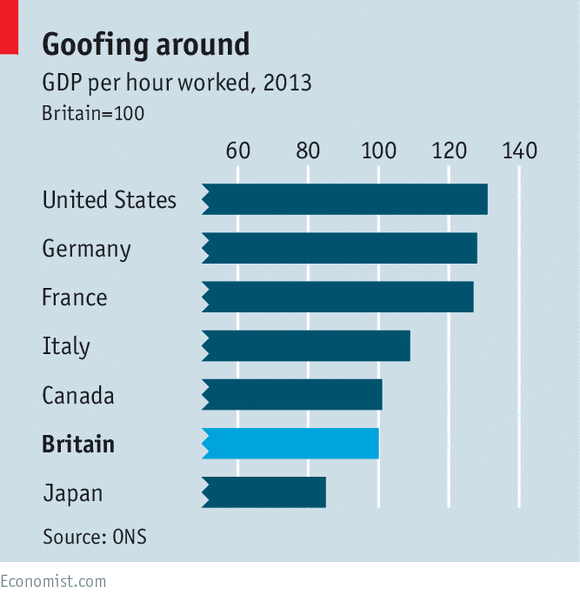
Per hour worker productivity in the industrial world.

Per hour worker productivity in the industrial world.

As the chart shows, England has the second lowest per-hour productivity of the industrial world. Japan, the other industrial giant with a monarch, has the lowest. They do far better per worker-year because they work an ungodly number of hours per year. French and German workers produce 20+% more per hour: enough that they can take off a month each year and still do as well. Much of the productivity advantage of France, Germany, and the US derive from manufacturing and management flexibility. US Management does not favor as narrow a gene pool. Our workers are allowed real input into equipment and product decisions, and are given a real chance to move up. The result is new products, efficient manufacture, and less class-struggle.

The upside of British manufacturing tradition is the historical cachet of English products. Americans and Germans have been willing to pay more for the historical patina of British whiskey, suits, and cars. Products benefit from historical connection. British suits remind one of the king, or of James Bond; British cars maintain a certain style, avoiding fads of the era: fins on cars, or cup-holders, and electric accessories. A lack of change produces a lack of flaws too, perhaps the main things keeping Britain from declining faster. A lack of flaws is particularly worthwhile in some industries, like banking and diamonds, products that have provided an increasing share of Britain’s foreign exchange. The down-side is a non-competitive military, a horrible food industry, and an economy that depends, increasingly on oil.

Britain has a low birthrate too, due in part to low social mobility, I suspect. Social mobility looked like it would get worse when Britain joined the European Union. An influx of foreign workers entered taking key jobs including those that with historical cachet. The Brits reacted by voting to leave the EC, a vote that seems to have taken the upper class by surprise, With Brexit, we can hope to see many years more of manufacturing by the traditional and silly.

Robert Buxbaum, December 31, 2016. I’ve also written about art, good and bad, about the US aesthetic of strength, about the French tradition of innovation, And about European vs US education.

How do you drain a swamp, literally

The Trump campaign has been claiming it wants to “drain the swamp,” that is to dispossess Washington’s inbred army of academic consultants, lobbyists, and reporter-spin doctors, but the motto got me to think, how would you drain a swamp literally? First some technical definitions. Technically speaking, a swamp is a type of wetland distinct from a marsh in that it has no significant flow. The water just, sort-of sits there. A swamp is also unlike a fen or a bog in that swamp water contains enough oxygen to support life: frogs, mosquitos, alligators,., while a fen or bog does not. Common speech ignores these distinctions, and so will I.report__jaguars_running_back_denard_robi_0_5329357_ver1-0_640_360

If you want to drain a large swamp, such as The Great Dismal Swamp that covered the south-east US, or the smaller, but still large, Hubbard Swamp that covered south-eastern Oakland county, MI, the classic way is to dig a system of open channel ditches that serve as artificial rivers. These ditches are called drains, and I suppose the phrase, “drain the swamp comes” from them. As late as the 1956 drain code, the width of these ditch-drains was specified in units of rods. A rod is 16.5 feet, or 1/4 of a chain, that is 1/4 the length of the 66′ surveyor’s chains used in the 1700’s to 1800’s. Go here for the why these odd engineering units exist and persist. Typically, 1/4 rod wide ditches are still used for roadside drainage, but to drain a swamp, the still-used, 1956 code calls for a minimum of a 1 rod width at the top and a minimum of 1/4 rod, 4 feet, at the bottom. The sides are to slope no more than 1:1. This geometry is needed. experience shows, to slow the flow, avoid soil erosion and help keep the sides from caving in. It is not unusual to add one or more weirs to control and slow the flow. These weirs also help you measure the flow.

The main drain for Royal Oak and Warren townships, about 50 square miles, is the Red Run drain. For its underground length, it is 66 foot wide, a full chain, and 25 feet deep (1.5 rods). When it emerges from under ground at Dequindre rd, it expands to a 2 chain wide, open ditch. The Red Run ditch has no weirs resulting in regular erosion and a regular need for dredging; I suspect the walls are too steep too. Our county needs more and more drainage as more and more housing and asphalt is put in. Asphalt reduces rain absorption and makes for flash floods following any rain of more than 1″. The red run should be improved, and more drains are needed, or Oakland county will become a flood-prone, asphalt swamp.

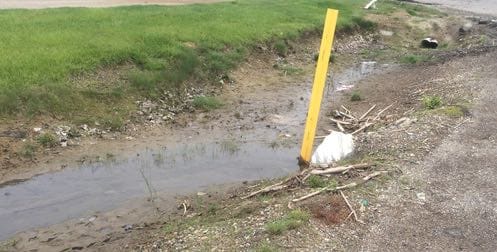
Classic ditch drain, Bloomfiled MI. Notice the culverts used to convey water from the ditch under the road.

Small ditch drain, Bloomfield, MI. The ditches connect to others and to the rivers via the culvert pipes in the left and center of the picture. A cheap solution to flooding.

Ditch drains are among the cheapest ways to drain a swamp. Standard sizes cost only about $10/lineal foot, but they are pretty ugly in my opinion, they fill up with garbage, and they tend to be unsafe. Jaguars running back Denard Robinson was lucky to have survived running into one in his car (above) earlier this year. Ditches can become mosquito breeding grounds, too and many communities have opted for a more expensive option: buried, concrete or metal culverts. These are safer for the motorist, but reduce ground absorption and flow. In many places, we’ve buried whole rivers. We’ve no obvious swamps but instead we get regular basement and road flooding, as the culverts still have combined storm and sanitary (toilet) sewage, and as more and more storm water is sent through the same old culverts.

Given my choice I would separate the sewers, add weirs to some of our ditch drains, weirs, daylight some of the hidden rivers, and put in French drains and bioswales, where appropriate. These are safer and better looking than ditches but they tend to cost about $100 per lineal foot, about 10x more than ditch drains. This is still 70x cheaper than the $7000/ft, combined sewage tunnel cisterns that our current Oakland water commissioner has been putting in. His tunnel cisterns cost about $13/gallon of water retention, and continue to cause traffic blockage.

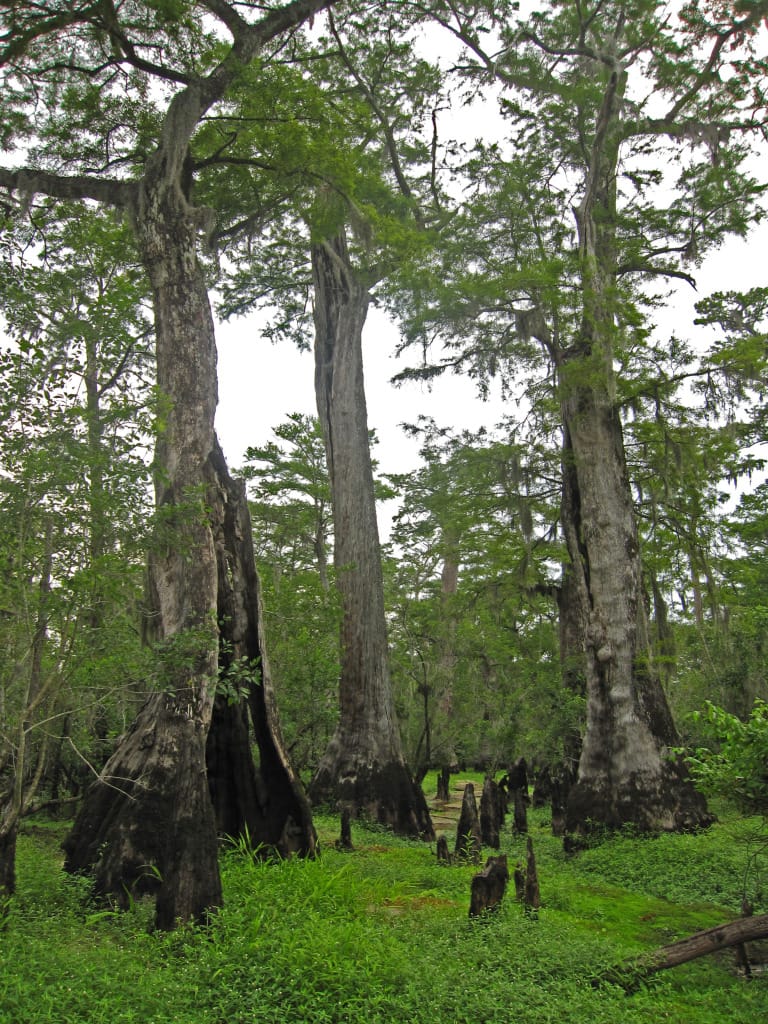
Bald cypress swamp

Bald cypress in a bog-swamp with tree knees in foreground.

Another solution is trees, perhaps the cheapest solution to drain a small swamp or retention pond, A full-grown tree will transpire hundreds of gallons per day into the air, and they require no conduit connecting the groundwater to a river. Trees look nice and can complement French drains and bioswales where there is drainage to river. You want a species that is water tolerant, low maintenance, and has exceptional transpiration. Options include the river birch, the red maple, and my favorite, the bald cypress (picture). Bald cypress trees can live over 1000 years and can grow over 150 feet tall — generally straight up. When grown in low-oxygen, bog water, they develop knees — bits of root-wood that extend above the water. These aid oxygen absorption and improve tree-stability. Cypress trees were used extensively to drain the swamps of Israel, and hollowed-out cypress logs were the first pipes used to carry Detroit drinking water. Some of these pipes remain; they are remarkably rot-resistant.

Robert E Buxbaum, December 2, 2016. I ran for water commissioner of Oakland county, MI 2016, and lost. I’m an engineer. While teaching at Michigan State, I got an appreciation for what you could do with trees, grasses, and drains.