Category Archives: crime

Detroit Teachers are not paid too much

Detroit is bankrupt financially, but not because the public education teachers have negotiated rich contracts. If anything Detroit teachers are paid too little given the hardship of their work. The education problem in Detroit, I think, is with the quality of education, and of life. Parents leave Detroit, if they can afford it; students who can’t leave the city avoid the Detroit system by transferring to private schools, by commuting to schools in the suburbs, or by staying home. Fewer than half of Detroit students are in the Detroit public schools.

The average salary for a public school teacher in Detroit is (2013) $51,000 per year. That’s 3% less than the national average and $3,020/year less than the Michigan average. While some Detroit teachers are paid over $100,000 per year, a factoid that angers some on the right, that’s a minority of teachers, only those with advanced degrees and many years of seniority. For every one of these, the Detroit system has several assistant teachers, substitute teachers, and early childhood teachers earning $20,000 to $25,000/ year. That’s an awfully low salary given their education and the danger and difficulty of their work. It’s less than janitors are paid on an annual basis (janitors work more hours generally). This is a city with 25 times the murder rate in the rest of the state. If anything, good teachers deserve a higher salary.

Detroit public schools provide among the worst math education in the US. In 2009, showing the lowest math proficiency scores ever recorded in the 21-year history of the national math proficiency test. Attendance and graduation are low too: Friday attendance averages 71.2%, and is never as high as 80% on any day. The high-school graduation rate in Detroit is only 29.4%. Interested parents have responded by shifting their children out of the Detroit system at the rate of 8000/year. Currently, less than half of school age children go to Detroit public schools (51,070 last year); 50,076 go to charter schools, some 9,500 go to schools in the suburbs, and 8,783, those in the 5% in worst-performing schools, are now educated by the state reform district.

Outside a state run reform district school, The state has taken over the 5% worst performing schools.

The state of Michigan has taken over the 5% worst performing schools in Detroit through their “Reform District” system. They provide supplies and emphasize job-skills.

Poor attendance and the departure of interested students makes it hard for any teacher to handle a class. Teachers must try to teach responsibility to kids who don’t show up, in a high crime setting, with only a crooked city council to look up to. This is a city council that oversaw decades of “pay for play,” where you had to bribe the elected officials to bid on projects. Even among officials who don’t directly steal, there is a pattern of giving themselves and their families fancy cars or gambling trips to Canada using taxpayers dollars. The mayor awarded Cadillac Escaldes to his family and friends, and had a 22-man team of police to protect him. On this environment, a teacher has to be a real hero to achieve even modest results.

Student departure means there a surfeit of teachers and schools, but it is hard to see what to do. You’d like to reassign teachers who are on the payroll, but doing little, and fire the worst teachers. Sorry to say, it’s hard to fire anyone, and it’s hard to figure out which are the bad teachers; just because your class can’t read doesn’t mean you are a bad teacher. Recently a teacher of the year was fired because the evaluation formula gave her a low rating.

Making changes involves upending union seniority rules. Further, there is an Americans with Disability Act that protects older teachers, along with the lazy, the thief, and the drug addict — assuming they claim disability by frailty, poor upbringing or mental disease. To speed change along, I would like to see the elected education board replaced by an appointed board with the power to act quickly and the responsibility to deliver quality education within the current budget. Unlike the present system, there must be oversight to keep them from using the money on themselves.

She state could take over more schools into the reform school district, or they could remove entire school districts from Detroit incorporation and make them Michigan townships. A Michigan township has more flexibility in how they run schools, police, and other services. They can run as many schools as they want, and can contract with their neighbors or independent suppliers for the rest. A city has to provide schools for everyone who’s not opted out. Detroit’s population density already matches that of rural areas; rural management might benefit some communities.

I would like to see the curriculum modified to be more financially relevant. Detroit schools could reinstate classes in shop and trade-skills. In effect that’s what’s done at Detroit’s magnet schools, e.g. the Cass Academy and the Edison Academy. It’s also the heart of several charter schools in the state-run reform district. Shop class teaches math, an important basis of science, and responsibility. If your project looks worse than your neighbor’s, you can only blame yourself, not the system. And if you take home your work, there is that reward for doing a good job. As a very last thought, I’d like to see teachers paid more than janitors; this means that the current wage structure has to change. If nothing else, a change would show that there is a monetary value in education.

Robert Buxbaum, August 16, 2013; I live outside Detroit, in one of the school districts that students go to when they flee the city.

Crime: US vs UK and Canada

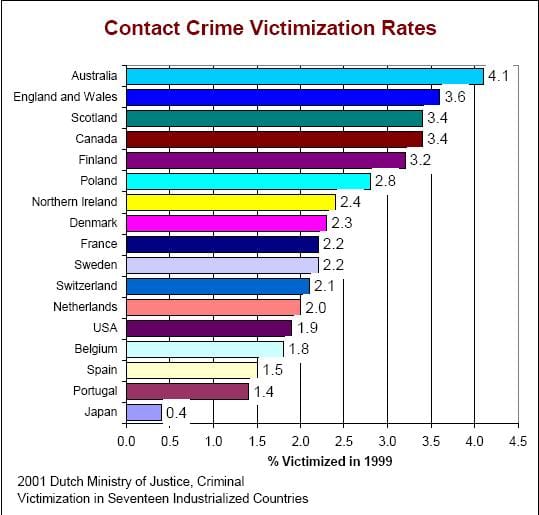
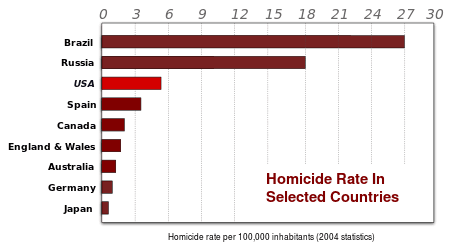
The US has a lot of guns and a lot of murders compared to England, Canada, and most of Europe. This is something Piers Morgan likes to point out to Americans who then struggle to defend the wisdom of gun ownership and the 2nd Amendment: “How do you justify 4.8 murders/year per 100,000 population when there are only 1.6/year per 100,000 in Canada, 1.2/year per 100,000 in the UK, and 1.0/year per 100,000 in Australia — countries with few murders and tough anti-gun laws?,” he asks. What Piers doesn’t mention, is that these anti-gun countries have far higher contact crime (assault) rates than the US, see below.

Contact Crime Per Country

Contact crime rates for 17 industrialized countries. From the Dutch Ministry of Justice. Click here for details about the survey and a breakdown of crimes.

The differences narrow somewhat when considering most violent crimes, but we still have far fewer than Canada and the UK. Canada has 963/year per 100,000 “most violent crimes,” while the US has 420/year per 100,000. “Most violent crimes” here are counted as: “murder and non-negligent manslaughter,” “forcible rape,” “robbery,” and “aggravated assault” (FBI values). England and Wales classify crimes somewhat differently, but have about two times the US rate, 775/year per 100,000, if “most violent crimes” are defined as: “violence against the person, with injury,” “most serious sexual crime,” and “robbery.”

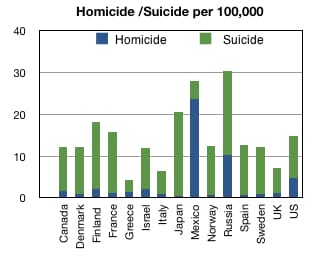
It is possible that the presence of guns protects Americans from general crime while making murder more common, but it’s also possible that gun ownership is a murder deterrent too. Our murder rate is 1/5 that of Mexico, 1/4 that of Brazil, and 1/3 that of Russia; all countries with strong anti-gun laws but a violent populous. Perhaps the US (Texan) penchant for guns is what keeps Mexican gangs on their, gun-control side of the border. Then again, it’s possible that guns neither increase nor decrease murder rates, so that changing our laws would not have any major effect. Switzerland (a country with famously high gun ownership) has far fewer murders than the US and about 1/2 the rate of the UK: 0.7 murders/ year per 100,000. Japan, a country with low gun ownership has hardly any crime of any sort — not even littering. As in the zen buddhist joke, change comes from within.

Homicide rate per country

Homicide rate per country

One major theory for US violence was that drugs and poverty were the causes. Remove these by stricter anti-drug laws and government welfare, and the violent crime would go away. Sorry to say, it has not happened; worse yet, murder rates are highest in cities like Detroit where welfare is a way of life, and where a fairly high fraction of the population is in prison for drugs.

I suspect that our welfare payments have hurt Detroit as much as they’ve helped, and that Detroit’s higher living wage, has made it hard for people to find honest work. Stiff drug penalties have not helped Detroit either, and may contribute to making crimes more violent. As Thomas More pointed out in the 1500s, if you are going to prison for many years for a small crime, you’re more likely to use force to avoid risk capture. Perhaps penalties would work better if they were smaller.

Charity can help a city, i think, and so can good architecture. I’m on the board of two charities that try to do positive things, and I plant trees in Detroit (sometimes).

R. E. Buxbaum, July 10, 2013. To make money, I sell hydrogen generators: stuff I invented, mostly.

How Theodore Roosevelt survived being shot

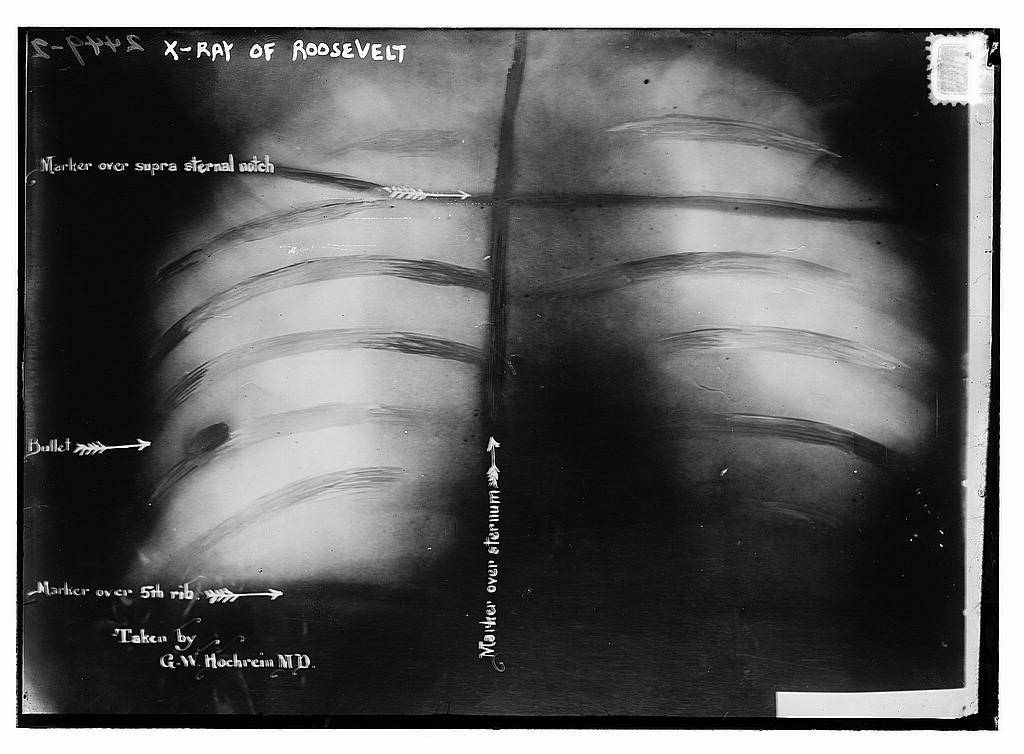
Two more pictures of Theodore Roosevelt. The first is an x-ray showing the bullet he received as he entered a hall to give a 90 minute speech in 1912. How he survived the shooting: he did nothing. He left the bullet stay where it was for the rest of his life. It seems that both McKinley and Garfield had died from infection of their shooting wounds after doctors poked around trying to extract the bullet. It’s quite possible that Lincoln died the same way (Lincoln’s doctor was the one who killed Garfield by poking around this way).X-ray of Teddy Roosevelt showing the bullet where he let it lie.

X-ray of Teddy Roosevelt showing the bullet where he let it lie. The stripes look like lead paint, used to mark the spot. 

Roosevelt knew from hunting that a shot animal could last for years with the bullet still inside him. Roosevelt (and his doctors) knew, or suspected, that his bullet had stopped in a place where it would be harmless unless someone tried to extract it.

T. Roosevelt with Rhino, 1909.

T. Roosevelt with Rhino, 1909. Teddy would be shot 3 years later, in 1912.

In the speech, Roosevelt said, “it takes more than that to stop a Bull Moose.” He ought to know. For more T. Roosevelt pictures, click here.

Detroit: maximum punishment

Some moths ago, I argued that getting rid of its extra-high minimum wage was perhaps the single best thing that Detroit could do to improve its bankrupt finances and to provide jobs for its youth. I argued that this living wage of $11 or $14/hr, depending on whether healthcare was provided, was too much for the city to pay for it’s minimal skill workers. I also argued that a lower minimum wage would help the city finances, and would allow the unskilled of Detroit to find jobs: it would provide the first rung of a ladder. Well, sort-of good news: Detroit’s living wage has been declared unenforceable by the Michigan Supreme court.

Unenforceable does not mean that wages will lower immediately: anyone working for the city will keep their high salary job, so the finances of the city will remain strained. Also, private companies can not lower anyone’s contracted wages. The only difference is that workers on non-city jobs who agree to be paid $7.50 to $14/hr, can no longer sue to recover additional dollars to meet Detroit’s “living wage.” Bit by bit I expect that more low-skilled workers will be hired, and that their wages will stabilize downward to a free-market value.

The next big things that are needed are reduced crime and increased population who are employed in businesses other than selling drugs or themselves. One way to reduce crime, I think is to have less-stiff minimum penalties for non-violent crimes like drug possession and driving with a suspended license. Currently the penalty for possession runs to 15-20 years. No one who spends that much time in prison will fit back into society. Let’s do them and ourselves a favor by reducing minimum sentences so that the normal sentence is only 1-5 years (ideally with < 1 oz marijuana possession punished by a fine).

Another horror is the penalty for driving with a suspended license. It’s $3000 for a start (a reasonable amount, I think), but then the state adds a $4000 per year penalty for the next 3 years: a total of $15,000. That’s too much for a minimum-wage earner to pay, but the minimum wage earner needs a car to get to work. So he/she can’t work, or he/she drives without a license or insurance. Is this what we want? Lets give a second chance and lower the penalty to produce more working, law-abiding citizens. There is nothing wrong with Detroit that could not be fixed by 200,000 more, law-abiding, employed Detroiters.

R.E. Buxbaum owns REB Research, a maker of hydrogen purifiers and hydrogen generators. We used to be located in Detroit, but are now in Oakland county, 1/2 mile north of the Detroit border.

Dwarf joke

I tripped over a dwarf the other day; I know — bad news. The fellow gets all huffy with me, and seems to think I was looking down on him (So weird, if I’d been looking down on him, I’d never have tripped!).

At any rate he says, “I’m not happy.” “That’s OK.” I say, “So which one are you?” And he gets all upset. These dwarves are all the same, they’re so small. 

Detroit crime demographics

For some reason I find Detroit’s crime demographics fascinating. The city has had more professional makeovers than Sofia Loren, yet the crime rate in the city is about 12 times that of New York on a per-capita basis. What’s more telling is that the distribution has several sharp cut-offs, the most famous being Eight mile road — memorialized in a movie about Emenem — on one side of the Eight mile you have a murder rate higher than Guatemala’s on average, on the other, a relatively decent rate — similar to Brooklyn, NY. I’ve long thought that the high crime was related to the good intentions of the reformers, but I could be wrong. The data is amazing, though.

1 week of crime in Detroit with special focus on 8 mile road -- that's the horizontal cut dividing Detroit, lower from the northern suburbs. The crime area in the upper right is Royal Oak.

1 week of crime in Detroit with special focus on 8 mile road — that’s the horizontal cut dividing Detroit, lower from the northern suburbs. The crime area in the upper right is Royal Oak.

Detroit economics and the minimum wage

A cause of Detroit’s financial problems, it seems to me, is that Detroit has an uncommonly high minimum wage, $13.75/hr for all employees in any company that contracts with the city and does not provide free health care; or $10.50/hr for companies that provide healthcare. This minimum, called a living wage, is about double the state minimum wage of $7.40.

Although the city is financially bankrupt, the city can not hire janitors and pay less than this, nor hire accountants from a company that pays its janitors less than this. Besides the burden on Detroit’s budget, this puts a burden on its unemployment system. Many in Detroit don’t possess the education or skills to justify jobs at this wage. This high minimum wage effectively cuts them from the bottom rung of jobs at these companies — jobs at the bottom of the ladder of success. Many businesses find innovative ways around the law, using corruption and bribes to skirt enforcement, if the recent trials of the mayor are any indication, but a system of corruption is not good for the city.

As these wages are far above standard, most employed workers for the city get their jobs by corruption and connections, and most everyone knows they got their jobs this way rather than skill. As a result, workers have no incentive to improve at their job. In a corrupt system like this, there is no likelihood that  a raise would come with improved performance.

The justification for the living wage is the cost to support a family of 4 or 5, but Detroit is a much cheaper place to live than most, and not all workers are supporting families of 4 or 5. It therefore makes little sense to force all potential workers to refuse entry-level employment at $8.00/hour, a wage that would allow a single, motivated individual a decent living and a chance to climb as his/her needs and skills grew. Instead of promoting hard work and merit, this ordinance fosters corruption and cronyism; it makes it expensive for the city to hire contractors, makes it hard for workers to get their first jobs, and removes the benefits that normally come with improved skills. It’s a disaster, I suspect, and a reason the city is bankrupt.

Dr. Robert E. Buxbaum is a self-employed curmudgeon who tries to speak the truth as he sees it.