Category Archives: Business

Google+ vs Facebook and Twitter; of virtue and sin

Google has just announced the end of support for Google+; I’m sorry to see it go. It was supposed to be the better version of Facebook killer. It was, and I suspect that’s why it died. Unlike Facebook, Google+ allowed me to decide which group of friends I would get to see which group of my posts. I thought that was a good thing. I only shared political posts with some folks — those who I thought would not mind; and only shared jokes with other folks; family photos with yet others; religion thoughts with others, and technical thoughts with other folks still.

Google+ called the different groups in your life, “rings of friendship,” and it seemed to me that such rings were an important part of being able to live in a polite society. Any normal person shares different things with different people. There will be some overlap, of course, but rings of friendship allowed you to shield your friends from your religious and political views, and allowed you to shield technical colleagues from family photos that would bore them. Behaving this way is common sense and simple politeness.

Google+ died, in part I think, because maintaining rings of friendship requires forethought. It also requires that your friends honor your privacy, and accept that they will not be a complete part of your life and confidence. But such activity requires work, both on the part of the poster, and on the part of the recipient. Besides, posting this way tends to make your posts dull. It reduced the number of eye-ball-grabbing rants that get seen by people who are highly offended by seeing the rant. Facebook, by contrast, uses and algorithm to decide who sees what. It requires no work from us, and I suspect the algorithm makes posts more interesting as it seems to favor the sensational, salacious, and inappropriate.

Facebook spreads the most salacious posts, I think, to increase the amount of time people spend on FB. That would be entirely self-serving, but it also gives the user a thrill as you see how many likes and followers, Facebook suggests “friends” that you never knew, who your other friends know, or who have similar interests. People friend these folks they hardly know, and post the most controversial of things in hope of getting followers and “likes.” It’s destructive to privacy, but it’s a dopamine rush in having people think you are a more interesting and exciting person than you are. The graphic below associates FB with the deadly sin of Envy — the desire to have what you don’t have.

An interesting take on social media

An interesting take on social media — the main platforms are the seven deadly sins.

There are six other deadly sins, and six of the other major social platforms seem designed to target one each. LinkedIn seems to target greed; Tinder targets Lust and Yelp targets gluttony. Instagram targets pride, the greatest of the deadly sins. It was natural that Facebook would acquire Instagram as Facebook had the most money, and pride is the strongest draw among the sins. In the graphic above Netflix is associated with sloth; I’m not sure that’s entirely fair: Netflix is passive, but no more passive than YouTube (owned by Google).

Twitter deserves a special mention. It was designed to be more immediate than FB, and I find it’s even more tipped to the salacious. When you post to Twitter, you have no control over who sees it; your only control is over what you see, and most people like to see salacious. President Donald Trump’s presidency is largely built on his Twitter posts. He claims he’s the Hemingway of 140 characters, and he certainly is good at grabbing eyeballs with outrageous comments and short simplifications of difficult matters. Last week his Twitter insult of Congressman Adam Schiff caught the news services all about. Similarly several congressmen calling Trump a mother***ker made news, Trump’s insult was more amusing, IMHO, if you read the name Adam a variant pronunciation. Facebook can tolerate the salacious like this, but it still limits the number of eyeballs to friends and acquaintances. Twitter is the home of wrath, and so far it seems a lot more successful than Google+.

Google+ was a reminder that world of social media is not all darkness and deadly sins. To my mind, Google+ was supposed to contract the evils of envy and intemperance with the virtue of temperance. That is Google+ was one of the cardinal virtues: Temperance in this case amounted to giving the appropriate amount of information to each of your friends, and not being excessive with any. It’s possible that the failure of Google+ was that it did not directly go after the audience for LinkedIn, but instead tried to mimic Facebook. Linked In (Greed) is almost exactly the opposite of Temperance.

The seven godly virtues are listed below, as set out by Pope Gregory, based on Paul. The first three are considered Godly, the other four Cardinal.

  1. Faith: belief in the right things (including the virtues!).
  2. Hope: taking a positive future view, that good will prevail.
  3. Charity: concern for, and active helping of, others.
  4. Fortitude: never giving up.
  5. Justice: being fair and equitable with others.
  6. Prudence: care of and moderation with money.
  7. Temperance: moderation of needed things and abstinence from things which are not needed.

Looking at this list it strikes me that the first three virtues are already present in social media. I associate Wikipedia with Faith, I associate it with a belief in knowledge itself, and in the ability of people to self govern. I associate Google, before it decided to be political, with Hope. It was based on a positive view of nature and people: that given free access to organized information they will come to the right conclusions. I liked that originally, ranking was decided based on people’s common choice. It was anti-FB, and humbling: there was no way that you could proclaim yourself greater than your neighbor if others didn’t see you that way. Currently Google allows paid customers to promote themselves, and conforms search for political patrons, eg China. In this way, it has become more like FB.

I associate “Go fund me,” with the virtue of Charity, and would like to propose that perhaps Prudence is Consumer Reports, or maybe e-bay. This leaves room for Fortitude, Justice, and Temperance (now that Google+ is dead). I leave it to you to fill in the gap.

Robert Buxbaum, January 8, 2019. There is a great manga fiction involving the seven deadly sins; Full Metal Alchemist. Also I should note that there are many versions of the seven virtues including the seven virtues of Buddhism: Right decisions, Valor, Benevolence, Respect, Honesty, Honor, and Loyalty.

The hard scrabble dictionary

The rules or Scrabble are unchanging and always changing. The general rule is that Scrabble allows the use of every common word in the English language. In practice, there are two or more dictionaries of words. One of these has virtually no abbreviations, only a few foreign-derived words, and only a select few offensive terms. It is this one, “The Official Scrabble Players Dictionary,” that determines play. You’ll need the other dictionary to look up swear words or secondary meanings, or find common abbreviations.

Words get removed from the scrabble dictionary when someone -- anyone might find them offensive.

Words get removed from the scrabble dictionary when someone — anyone might find them offensive.

Both of these dictionaries change on a regular basis, by the way. And this is as it should be, and both exist in both English and American versions. The common dictionary adds words slowly, as they come into use and drops them slowly as they fall out. The Scrabble dictionary changes fast and for no obvious reason, adding and removing words for political and social aspect and for improved playability (whatever that is). Thus there is little rhyme or reason to the additions or deletions. Four years ago some ten 4000 words were added, mostly unusual words, and many insult words were removed. When the dictionary was changed again in September of this year, players are not told of some changes, but for the most part, there no obvious way to guess. Several words that were offensive in the last version, now are not. Other words that were OK then are now removed as offensive. You’ll play a word you’ve used for years and be told that it is no longer valid. Or someone will use a word you’ve never seen, and never will see otherwise, and you’ll find it is valid. Words added this year include: OK (previously an abbreviation), zen (previously a foreign word), and sheeple (previously a portmanteau, non-word). Also, I’m happy to say, fuck (a welcome addition). I looked up a bunch of previously removed insult words, and find that goy and spic are back, but i find that negro is not.  There is no list in print that tells you what’s been added, and that’s not right. Some articles have a few examples of new words, and some claim to have a list, but clearly it’s only a small fraction of the real list. There is nothing like a full addition list that I could find.

I’ve a bigger gripe though against removed words, especially when they are common words made to disappear for political effect. The previous dictionary, 2014, removed spic, goy, goyim, and negro; that was not right. The current dictionary added back all but negro (check for yourself, here). The word is still in use, both verbally and in literature, and not particularly offensive, less offensive than spic, IMHO. The American Negro College Fund doesn’t seem to mind the word negro. Malcolm X didn’t either. No one tells you these words are gone; they just disappear in the night.

My opinion, such as it is. I’m asking Mattel, Hasbro, Colliers, and/or Merriam-Webster: allow in all normal words, despite the fact that several have implied insults, or real ones. AND PUBLISH A COMPLETE CORRECTIONS PAGE, you [non recognized word]. Thank you.

Robert Buxbaum, December 27, 2018.

Measles, anti-vaxers, and the pious lies of the CDC.

Measles is a horrible disease that contributed to the downfall that had been declared dead in the US, wiped out by immunization, but it has reappeared. A lot of the blame goes to folks who refuse to vaccinate: anti-vaxers in the popular press. The Center for Disease Control is doing its best to promote to stop the anti-vaxers, and promote vaccination for all, but in doing so, I find they present the risks of measles worse than they are. While I’m sympathetic to the goal, I’m not a fan of bending the truth. Lies hurt the people who speak them and the ones who believe them, and they can hurt the health of immune-compromized children who are pushed to vaccinate. You will see my arguments below.

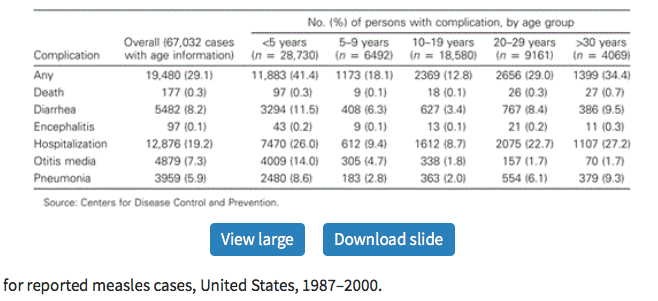
The CDC’s most-used value for the mortality rate for measles is 0.3%. It appears, for example, in line two of the following table from Orenstein et al., 2004. This table also includes measles-caused complications, broken down by type and patient age; read the full article here.

Measles complications, death rates, US, 1987-2000, CDC.

Measles complications, death rates, US, 1987-2000, CDC, Orenstein et. al. 2004.

The 0.3% average mortality rate seems more in tune with the 1800s than today. Similarly, note that the risk of measles-associated encephalitis is given as 10.1%, higher than the risk of measles-diarrhea, 8.2%. Do 10.1% of measles cases today produce encephalitis, a horrible, brain-swelling disease that often causes death. Basically everyone in the 1950s and early 60s got measles (I got it twice), but there were only 1000 cases of encephalitis per year. None of my classmates got encephalitis, and none died. How is this possible; it was the era before antibiotics. Even Orenstein et. al comment that their measles mortality rates appear to be far higher today than in the 1940s and 50s. The article explains that the increase to 3 per thousand, “is most likely due to more complete reporting of measles as a cause of death, HIV infections, and a higher proportion of cases among preschool-aged children and adults.”

A far more likely explanation is that the CDC value is wrong. That the measles cases that were reported and certified as such are the ones that are the most severe. There were about 450 measles deaths per year in the 1940s and 1950s, and 408 in 1962, the last year before the MMR vaccine was developed and by Dr. Hilleman of Merck (a great man of science, forgotten). In the last two decades there were some 2000 measles cases reported US cases but only one measles death. A significant decline in cases, but the ratio does not support the CDC’s death rate. For a better estimate, I propose to divide the total number of measles deaths in 1962 by the average birth rate in the late 1950s. That is to say, I propose to divide 408 by the 4.3 million births per year. From this, I calculate a mortality rate just under 0.01% in 1962, That’s 1/30th the CDC number, and medicine has improved since 1962.

I suspect that the CDC inflates the mortality numbers, in part by cherry-picking its years. It inflates them further by treating “reported measles cases.” as if they were all measles cases. I suspect that the reported cases in these years were mainly the very severe ones. Mild case measles clears up before being reported or certified as measles. This seems the only normal explanation for why 10.1% of cases include encephalitis, and only 8.2% diarrhea. It’s why the CDC’s mortality numbers suggest that, despite antibiotics, our death rate has gone up by a factor of 30 since 1962.

Consider the experience of people who lived in the early 60s. Most children of my era went to public elementary schools with some 1000 other students, all of whom got measles. By the CDC’s mortality number, we should have seen three measles deaths per school, and 101 cases of encephalitis. In reality, if there had been one death in my school it would have been big news, and it’s impossible that 10% of my classmates got encephalitis. Instead, in those years, only 48,000 people were hospitalized per year for measles, and 1,000 of these suffered encephalitis (CDC numbers, reported here).

To see if vaccination is a good idea, lets now consider the risk of vaccination. The CDC reports their vaccine “is virtually risk free”, but what does risk-free mean? A British study finds vaccination-caused neurological damage in 1/365,000 MMR vaccinations, a rate of 0.00027%, with a small fraction leading to death. These problems are mostly found in immunocompromised patients. I will now estimate the neurological risk for actual measles based on the ratio of encephalitis to births, as before using the average birth rate as my estimate for measles cases; 1000/4,300,000 = 0.023%. This is far lower than the risk the CDC reports, and more in line with experience.

The risk for neurological damage from measles that I calculate is 86 times higher risk than the neurological risk from vaccination, suggesting vaccination is a very good thing, on average: The vast majority of people should get vaccinated. But for people with a weakened immune system, my calculations suggest it is worthwhile to not immunize at 12 months as doctors recommend. The main cause of vaccination death is encephalitis, but this only happens in patients with weakened immune systems. If your child’s immune system is weakened, even by a cold, I’d suggest you wait 1-3 months, and would hope that your doctor would concur. If your child has AIDS, ALS, Lupus, or any other, long-term immune problem, you should not vaccinate at all. Not vaccinating your immune-weakened child will weaken the herd immunity, but will protect your child.

We live in a country with significant herd immunity: Even if there were a measles outbreak, it is unlikely there would be 500 cases at one time, and your child’s chance of running into one of them in the next month is very small assuming that you don’t take your child to Disneyland, or to visit relatives from abroad. Also, don’t hang out with anti-vaxers if you are not vaccinated. Associating with anti-vaxers will dramatically increase your child’s risk of infection.

As for autism: there appears to be no autism advantage to pushing off vaccination. Signs of autism typically appear around 12 months, the same age that most children receive their first-stage MMR shot, so some people came to associate the two. Parents who push-off vaccination do not push-off the child’s chance of developing autism, they just increase the chance their child will get measles, and that their child will infect others. Schools are right to bar such children, IMHO.

I’ve noticed that, with health care in, particular, there is a tendency for researchers to mangle statistics so that good things seem better than they are. Health food: is not necessarily so healthy as they say; nor is weight lossBicycle helmets: ditto. Sometimes this bleeds over to outright lies. Generic modified grains were branded as cancer-causing based on outright lies and  missionary zeal. I feel that I help a bit, in part by countering individual white lies; in part by teaching folks how to better read statistic arguments. If you are a researcher, I strongly suggest you do not set up your research with a hypothesis so that only one outcome will be publishable or acceptable. Here’s how.

Robert E. Buxbaum, December 9, 2018.

China worse than the US in CO2 per output

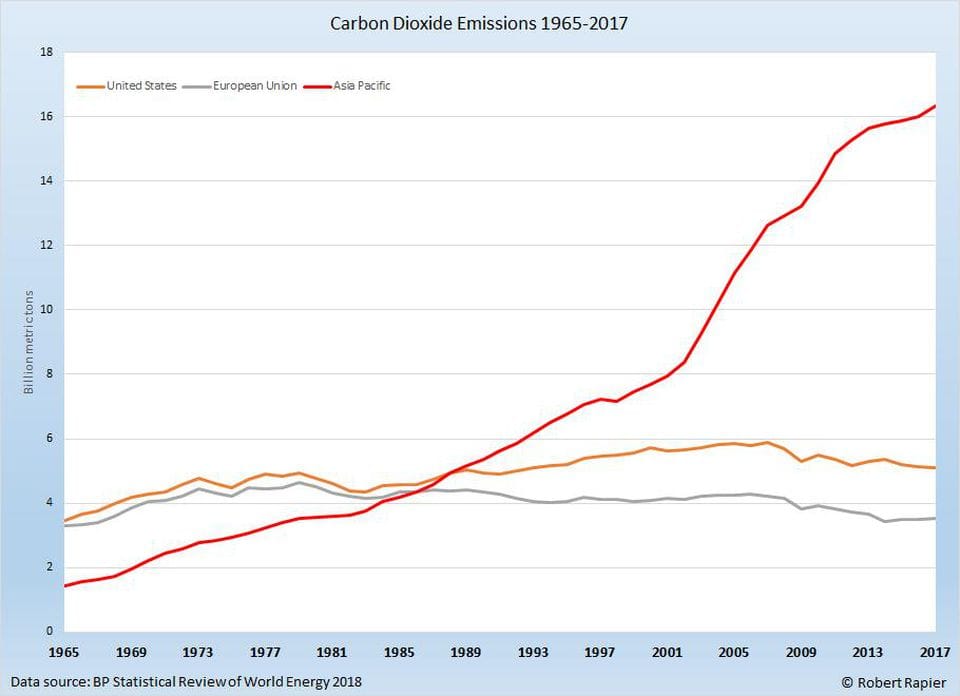
CO2 per year, 1965-2017, China and developed world

CO2 output per year, 1965-2017, China and developed world

For the last decade at least, China has been the industrial  manufacturer to the world. If not for Chinese shoes, the US would go barefoot. if not for Chinese electronics, Americans would be without iPhones, laptops, and TVs. China still trails the US and Europe in banking, software, movies and the like, but relying on China for manufactured goods is a dangerous position for the free world economically, and it’s not much better in terms of pollution.

China is among the world’s worst polluters. It burns coal for power to an extent that the air quality of China’s major cities would be unacceptable most everywhere else. On most days, it is thick with a yellow and grey haze. By 1969 China had passed the US and the European union in terms of CO2 production. And, as 2017, they produce nearly three times as much CO2 as the USA, four times more than the entire European Union. While China claims an interest in changing, the amount of pollution China’s CO2 output is still growing while ours and the EU’s is decreasing.

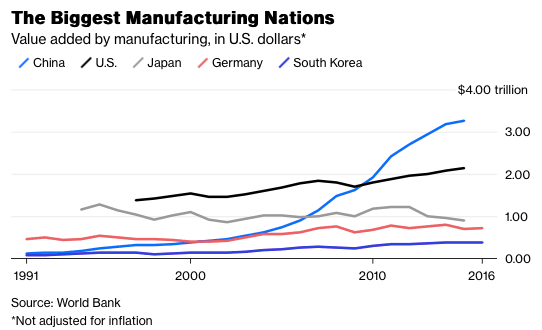
Manufacturing in the US, China, EU, Japan, Korea. Source: World Bank.

Manufacturing in the US, China, Germany, Japan, Korea. Source: World Bank.

China’s pollution would not be so bad if it were an efficient manufacturer, but there is a lot to suggest that it is not. China produces 50% more industrial goods than the US, but employs far more man hours, and generates more than three times the  CO2. Even in a fairly developed industry like steel, the US uses fewer man hours per ton and generates less CO2. I’m thus drawn to conclude that US companies off-load work to China mainly to get around US labor and pollution laws. Alternately, they off-load manufacture to gain entry to the Chinese market, a market that is otherwise closed to them. When US companies do this, they benefit the corporate managers and owners, but not the US worker. 

The hope (expectation) is that president Trump’s tariffs on Chinese goods will decrease the wage advantage of manufacturing in China, and will decrease the amount of US goods manufactured there. Some of that production, I expect, will move to the US, some will remain in China, and will be imported at a higher price-point. I expect a net decrease in CO2 as the US appears to be the more efficient producer, and because fewer ships will be crossing the Pacific bringing Chinese goods to the US. I expect some increase in tax revenue to the US, and some price inflation as well, as importers pass along the increased cost of Chinese goods. Overall, I think this is an acceptable trade-off, but what do I know.

Robert Buxbaum, November 29, 2018

Less than 1 year to the crash

Stock market crashes happen for a reason, and generally the reason is that owning stock is seen as less profitable than owning bonds, gold, guns, or hundred-dollar bills stuffed into one’s mattress. For this essay, I thought I might explain the reasoning behind the alarm bells that virtually every economist has been sounding. For the last year and a half they’ve been sure a severe correction is imminent. The reason has to do with price and predictions of profitability.

Let’s begin with Nobel Laureate economist, Paul Krugman of the New York Times. He has been predicting severe job losses, and a permanent stock collapse since Trump’s election in November 2016. Virtually every week he announces that the end is near, and every month the economy looked better. A lesser man would give up, but he has not. Why? Mostly it’s his hatred of all things Trumpian: Krugman can not accept that Trump could avoid destroying the economy, and can’t imagine any investor would see otherwise.

Apparently some folks saw otherwise, and caused unemployment to drop and the market to rise. but then, in September 2017, Krugman’s dire predictions were echoed by Robert Schiller, 2013 Nobel winner, and author of a textbook the majority of schools use to teach market analysis. Robert Schiller, has argued that valuations are extremely expensive. “This stock market bears striking similarities to that of 1929. “The market is about as highly priced as it was in 1929,” “In 1929 from the peak to the bottom, it was 80 percent down. And the market really wasn’t much higher than it is now in terms of my CAPE [cyclically adjusted price-to-earnings] ratio. So, you give pause when you notice that.

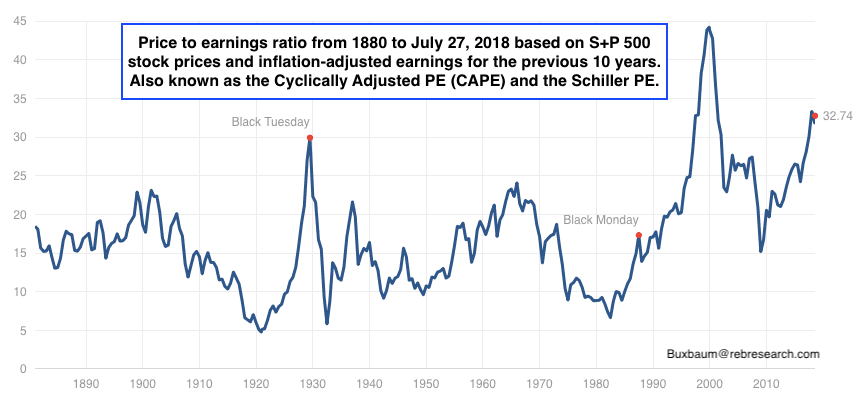
What Schiller is referring to is his particular version of the price to earnings ratio, the price of the average stock share divided by the amount of the average earnings per share. Schiller’s CAPE version uses the ten-year, inflation-averaged earnings, rather than today’s earnings, and finds the ratio is high, as the graph below shows. When he made these comments, this ratio was 25, nearly as high as the 1929 peak. The ratio is now higher, 32.74, higher than it stood on “Black Tuesday.” Why this number is important is that the profitability of a stock-share is merely the inverse of the Price/ Earnings ratio. The current ratio, 32.74 suggests that the average dollar’s worth of shares will return about 3.05% (1/32.74 = 3.05%). By comparison, one could buy a five-year treasury bond and get 2.96%. That’s hardly less return, and federal bonds are totally safe. More alarming for stock prices, the Federal Reserve has indicated that it will continue to raise interest rates at a planned rate of 1%/year for at least the next year. At some point, people will decide bonds are the far better bargain, and will exit stocks en-mass. And then it’s crash-city, or so the theory goes.

The Schiller Price to Earnings ratio as of July 27, 2018. It suggests a crash is past due.

The Schiller Price to Earnings ratio as of July 27, 2018. It suggests a crash is past due.

Shown above is a historical plot of Schiller’s particular version of the price to earnings ratio based on the S+P 500 index, with data going back to 1880. It’s argued that his version using a ten-year, trailing average of corporate profits, is better than the non-adjusted, one year P/E ratio: the version you find in the newspapers. In the newspaper version, the peaks don’t show up until just after the crash because company profits tend to spike along with prices. In this version, profits can’t exactly spike, and  stock crashes show up as valuation peaks. The crash is seen as a consequence to high values of the Schiller P/E.  In terms of CAPE, we are at a more dangerous spot than in 1929. We are more exuberant than in 2008, or when Alan Greenspan warned of irrational exuberance. Schiller: “you give pause when you notice that.”

Schiller Price to earnings ratios are a good predictor of future stock prices. We are past the end of this chart, suggesting a significant loss of stock value ahead.

Schiller Price to earnings ratio plotted versus 20 year stock return. The higher the Schiller P/E, the lower the return. We are past the end of this chart suggesting we should expect a significant loss of capital value.

Stock pull-backs are sometimes gradual, as in 1968 through 1982, but more often the pullback is sudden, a crash. People typically expect a stock return in excess of bonds of 2% or so. They sometimes accept less, and sometimes demand more. Schiller calls the cause “animal spirits.” The fear is that investors will suddenly go back to the historical norm and demand of stocks 2% more return than the 3.05% they get from bonds. If they’d suddenly demand a 5.05% return on stocks to balance, the stock prices would fall by 40%. If the crash happened now, it would take a 40% drop in stock prices to raise the earnings ratio to 5.05%. But if they wait a year, until after the Fed raised the interest rate to 3.5%, we’d expect a greater pull-back 50% or so, a major crash. As early as last year, Schiller has advised moving out of US stock into foreign stocks, particularly European, noting that the US market was  the most expensive in the world. I don’t agree that Europe is a safe haven, but agree that a crash is likely given current return rates, snd the treasury plan to raise interests by 1% over the next year.

Schiller claims that the reason the recession has not hit so far is that people trust Trump. I would not have expected a comment like that from a Yale economist given their constant carping on the TV news. Still Schiller may be right. The stock market went up dramatically after the Trump election. There are some advantages to a narcissist president. It also seems Trump’s tariffs are helping to provide jobs, as I predicted. In this quarter, the GDP rose at an impressive 4.1% rate. Gains came even where you’d expect otherwise. US soybean exports rose 9600% despite a boycott from China. If the economy keeps going like this it might be as much as a year before the correction. A likely scenario is that the Fed raises interest rates, growth slows to 2.5% or less, and with bond interest rates at 3.5% people will get out of stocks in a big way. My expectation is that China will suffer too, and with it Europe. With luck, the Fed will then lower interest rates to 2%, or so. In my opinion interest rates should matches the inflation rate, more or less. I don’t know why the Federal Reserve does not do this, but instead swings its interest rates from very high to low, now aiming for a far excess of inflation rate. I suspect it’s mistake, one that we will pay for soon.

Robert Buxbaum, July 29, 2018. My only other stock analysis post was on bitcoin, In December 2017 I thought it had gone about as far as it would go. Shortly there-after bitcoin value crashed. I hope I don’t cause a crash

The Great, New York to Paris, Automobile race of 1908.

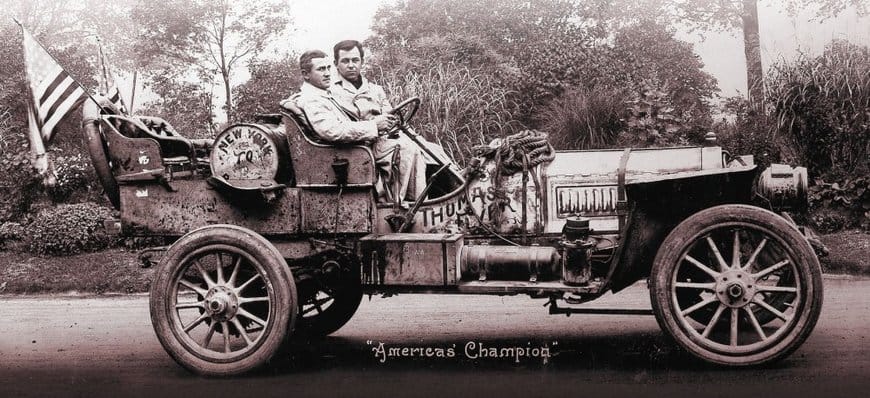
As impressive as Lindberg’s transatlantic fight was in 1926, more impressive was George Schuster driving and winning the New York to Paris Automobile race beginning in the dead of winter, 1908, going the long way, through Russia. As of 1908, only nine cars had ever made the trip from Chicago to California, and none had done it in winter, but this race was to go beyond California, to Alaska and then over the ice through Russia and to Paris. Theodore Roosevelt was president, and Americans were up to any challenge. So, on February 12, 1908 there congregated in Times Square, New York, a single, US-made production car, along with five, specially made super-cars from Europe; one each from Italy and Germany; and three from France. The US car, a Thomas Flyer (white), is shown in the picture below. The ER Thomas company sent along George Schuster, as an afterthought: he was a mechanic and test-driver for the company, and was an ex bicycle racer. The main driver was supposed to be Montague Roberts, a dashing sportsmen, but the fellow dropped out in Cheyenne, Wyoming. Schuster reached the Eiffel tower on July 30, 1908, 169 days after leaving New York. The Germans and Italians followed. None of the French super-cars got further than Vladivostok, and one dropped out after less than 100 miles.

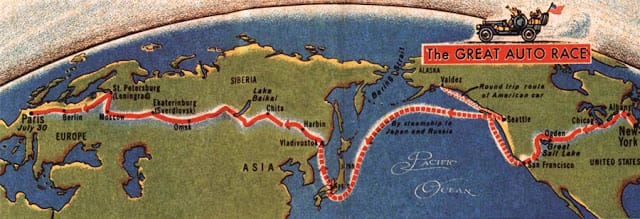
The race was sponsored by The New York Times and Le Matin, a Paris newspaper. They offered a large trophy, a cash prize of $1000, not enough to pay for the race, and the prospect of fame. The original plan was for drivers to go from New York to San Francisco, then to Seattle by ship, and Northern Alaska, driving to Russia across the Arctic ice. That plan was abandoned when Schuster, the first driver to reach Alaska, discovered ten foot snows outside of Valdez. The race was modified so that travel to Russia would be by ship. Schuster took his Thomas to Russia from Alaska, the other two drivers reached Russia from Seattle by way of Japan. Schuster was given a bonus of days to account for having taken the longer route. Because of his detour, he was the last to arrive in Russia. From Japan, the route was Vladivostok, Omsk, Moscow, St. Petersburg, Berlin, and Paris, 21,900 miles total; 13,341 miles driven. Schuster drove most of those 13,341 miles, protected by his own .32-caliber pistol, and mostly guided by the stars and a sextant. He’d taught himself celestial navigation as there were no roadmaps, and hardly any roads.

George Schuster driving the Thomas Flyer, the only American entry, and the only production motorcar in the race.

George Schuster driving the Thomas Flyer with another mechanic, George Miller, the Flyer was only American entry, and the only production motorcar in the race. Note that the flag has only 45 stars.

The ship crossing of the Pacific was a good idea given that, even in the dead of winter, global warming meant that the arctic could not be relied upon to be solid ice. As it was, Schuster had to content with crossing the Rockies in deep snow, and crossing Russia in the season of deepest mud. He reached the Eiffel tower at 6 p.m. on July 30, 1908. The German car had arrived in Paris three days ahead of Schuster, but was penalized to second place because the German team had avoided the trip to Alaska, and had traveled some 150 km of the Western US by railroad while Schuster had driven. The Italian team reached Paris months later, in September, 1908. That the win went to the only production car to compete is indicative, perhaps of the reliability that comes with mass production. That Mr. Schuster was not given the fame that Lindberg got may have to do with the small size of the prize, or with him being a mechanic while Lindberg was a “flyer”. Flyers were sexy; even the car was called a flyer. The Times saw fit to hardly mention Schuster at all, and when it did, it spelled his name wrong. Instead the Times headline read, “Thomas Flyer wins New York to Paris Race.” You’d think the car did it on its own, or that the driver was named Thomas Flyer.

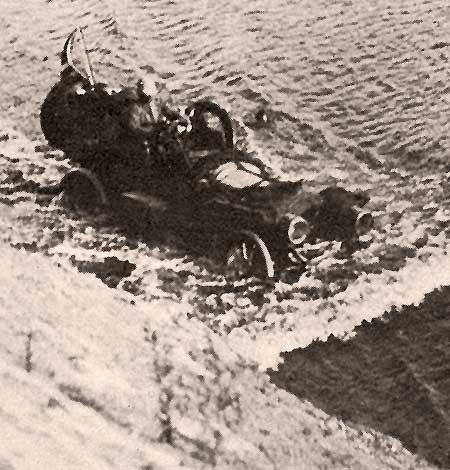
The Flyer crossing a swollen  river in Manchuria.

Schuster in his Flyer crossing a swollen river in Manchuria.

The Times could not get enough of Montague Roberts; the driver of the first leg was famous and photographic. They tried to get Roberts to drive the last few miles into Paris, “once the roads were good”. And Roberts was the one chosen to drive in the hero-parade in New York, Schuster rode too, but didn’t drive. Schuster was feted by Theodore Roosevelt, though, who said he liked people “who did things.” Schuster said he’d never do a race like that again, and he never did race again.

The race did wonders for the reputation of American automobiles, and greatly spurred the desire for roads, but it did little or nothing for the E.R.Thomas company. Thomas cars were high cost, high power models, and they lost out in the marketplace to Henry Ford’s, low-cost Model T’s. You’d think that, in the years leading up to WWI, the US Army might buy a high cost, high reliability car, but they were not interested, and the Thomas company did little to capitalize on their success. The Flyer design that won the race was discontinued. It was a 60 hp, straight 4 cylinder engine version, replaced by lower cost Flyers with 3 cylinders and 24 hp. Shortly after that, Edwin R. Thomas, decided to drop the Flyer altogether. His company went bankrupt in 1912, and was bought by Empire Smelting. The original Flyer was sold in 1913 at a bankruptcy action, lot #1829, “Famous New York to Paris Racer.”

ER Thomas went on to found another car company, as was the style in those days. Thomas-Detroit went on make similar cars to the Flyer, but cheaper. The largest, the K-30, was only 30 hp. The original Thomas Flyer is now in the National Automobile Museum, Reno Nevada. after being identified by Schuster and restored. Here is a video showing the original Flyer being driven by a grandson of George Schuster. There is a lower-power Thomas Flyer (black) in a back space of the Henry Ford museum (Detroit). Protos vehicles, similar to the one that came in second, were produced for the German military through WWI. Their manufacturer, Siemens, benefited, as did the German driver.

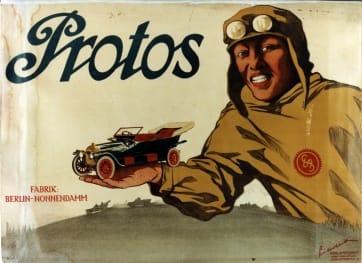
Advertisement for the Protos Automobile, a product of Siemens motor company. The race did not include a production Protos but one made specially for the race.

Advertisement for the Protos Automobile, a product of Siemens motor company. The race did not include a production Protos but one made specially for the race.

The Thomas engine (and the Protos) engine) live on in a host of cars with water-cooled, four-cylinder, straight engines. In 1922, Chalmers-Detroit merged with Maxwell and continued to produce versions of the old Flyer design, now with an internal drive-shaft. The original Flyer was powered via a gear-chain, like a bicycle. In 1928, Maxwell was sold to Chrysler. Chrysler persists in calling their high-power, four-cylinder engines by the name Chalmers. As for Schuster, when ER Thomas closed its doors, he had still not been paid for his time as a race driver. He went to work for Pierce-Arrow, another maker of large, heavy vehicles. The “cheaper by the dozen” family (two parents, 12 kids) drove a Pierce-Arrow.

The Great race appears in two documentaries and two general audience movies, both comedies. The first of these was Mishaps of the New York–Paris Race, released by Georges Méliès, July 1908, just about as the Flyer was entering Paris. The second movie version  “The Great Race” was released in 1965. It’s one of my favorite movies, with Jack Lemon as the Protos driver (called Dr. Fate in the movie), Tony Curtis as “The Great Leslie”, the Flyer driver. For the movie, the Flyer is called “The Leslie”, and with Natalie Wood as a female reporter who rides along and provides the love interest. In the actual race reporters from the New York Times, male, traveled in the Flyer’s rear seat sending stories back by carrier pigeon.

Path of the Great Race

Path of the Great Race

As a bit of fame, here’s George Schuster in 1958 on “What’s my secret.” He was 85, and no one knew of him or the race. Ten years later, in 1968, Schuster finally received his $1000 prize, but still no fame. A blow-by-blow of the race can be found here, in Smithsonian magazine. There is also an article about the race in The New York Times, February 10, 2008. This article includes only two pictures, a lead picture showing one of the French cars, and another showing Jeff  Mahl, the grandson of George Schuster, and a tiny bit of the flyer. Why did the New York Times choose these pictures? My guess is it’s the same reason that they reported as they did in 1908: The French car looked better than the Flyer, and Jeff Mahl looked better than George Schuster.

Robert Buxbaum, July 20, 2018. What does all this mean, I’ve wondered as I wrote this essay. There were so many threads, and so many details. After thinking a bit, my take is that the movie versions were right. It was all a comedy. Life becomes a comedy when the wrong person wins, or the wrong vehicle does. A simple mechanic working for a failing auto company beat great drivers and super cars, surpassing all sorts of obstacles that seem impossible to surpass. That’s comedy, It’s for this reason that Dante’s Divine Comedy is a comedy. When we see things like this we half-choose to disbelieve, and we half-choose to laugh, and because we don’t quite believe, very often we don’t reward the winner as happened to Schuster for the 60 years after the race. Roberts should have won, so we’ll half-pretend he did.

The wealth of nations in beer

We generally compare the wealth of nations in dollars per capita, but this is a false comparison. You can not eat dollars, and even if dollars can be exchanged for products or other countries’ currencies with minimum cost, the same is not true for their products. A sack of rice in America costs more than in India; you can not easily buy it at the Indian price. Nonetheless we generally measure the wealth of a county as if all products cost the same everywhere. Based on this, we declare that the citizens of Lichtenstein are the richest on the planet, followed by Norway and Denmark. US citizens not far behind, vastly richer than the people of Africa who we picture living on pennies per day. But pennies in Africa buy more than pennies in America; wealth is spent locally, and things are expensive where people have money.

GDP for various countries in pints of beer per person per year in main city bar or restaurant

GDP for various countries in pints of beer per person per year in main city bar or restaurant

To correct for this local value of money effect, some economists modify consider the ratio of per-capita GDP by relation to the cost of a basket of goods. This is called purchasing power parity, or ppp. By this measure, American’s are not as much richer than Africans, but the problem remains that people don’t all buy the same basket of goods. The Economist magazine has thus suggested correcting ppp by choosing a single consumable, the MacDonald’s Big Mac, a standard product available world-wide. The Economist’s “Big Mac Index” is quite good in my opinion, but it could be better, and I decided to make it better by using beer instead of Big Macs.

It strikes me that typical Africans don’t eat Big Macs — the price is out of range. Meanwhile, in rich countries mostly it’s the poor who eat MacDonald’s (and Donald Trump). The advantage of using beer to measure the wealth of nations is it’s something most-everyone consumes across all social strata. A country is wealthy in terms of many pints of beer a person can buy based on his or her, per-capita GDP.

Shown at left is the top countries from a table I made by dividing the GDP per capita by the price of a pint (or half-liter) of local beer as served in a tavern or restaurant of the major city. Measured this way I find Lichtenstein is still the richest country on earth, now followed by Saudi Arabia and the Czech Republic. Norway is no longer among the richest countries — beer is expensive there, as is labor. The Czech Republic, normally considered a middle-to-poor country, is number 3 because of the low cost of its excellent beer. The US is several stages down, just below Denmark, and barely above Hungary and Kazakhstan. The socialist countries: Russia, Cuba, and Venezuela are as poor in beer as they are in dollars. Socialism distributes wealth without creating it.

Number of beers one can buy on a month's minimum wage in Europe

Number of beers one can buy on a month’s minimum wage in Europe, by Reddit:adilu.

By now you’re wondering about my use of per-capita GDP. Perhaps a better comparison — one where socialism looks better would involve the minimum wage. At right I show a map of Europe in terms of the number of beers one can buy per month based on 40 hour weeks at the minimum wage. Several countries are greyed out: Italy, Austria, Sweden, Finland, Lichtenstein, etc. These are mostly rich countries bu have no minimum wage. Based on the data, Belgium’s working classes are the best off, with Ireland and England not far behind. Germany’s workers look like they are doing well, but they don’t really have a minimum wage (the chart, by Reddit editor adieu assumes one based on a proposal). The United States’s minimum worker is poorer in beer (327/month) based on a minimum wage of $7.85 and an average cost of beer about $4/pint (bar + supermarket). He is richer than the French, Poles, Italians, Norwegians, Danes, Austrians and Swedes in beer, and better off than the Turks and Russians too. It’s clear that high minimum wages harm community wealth and job prospects. Though some at the bottom of the work scale are left dry at the bar.

Robert Buxbaum, July 18, 2018. I write these blogs to help me think. If you’d like to see more of the wealth of nations in beer, I’ll be happy to provide.

Trump, tariffs, and the national debt

My previous post was about US foreign policy, Obama’s and Trumps. This one is about Trump’s domestic policy as I see it. The main thing I see, the pattern is that I think he’s trying to do is pay down the national debt while increasing employment. So far unemployment is down, but borrowing is not. I suspect that a major reason for the low unemployment is that Americans (particularly black Americans) are taking jobs that used to be held by Mexicans. As for US borrowing, it’s still bad. For his first budget, Trump, like all other recent politicians caved to the forces that favor borrow and spend than to pay back. In this century, only Wm. McKinley, Theodore Roosevelt, Taft, Harding, and Coolidge managed to pay down the national debt. But only one man, Andrew Jackson, managed to pay it off completely. Jackson’s picture hangs in the pride of place in the Trump white house, something that I find significant. I suspect that Trump’s tariffs and spats are intended to pay down the debt without raising unemployment, or weakening the military. Andrew Jackson is his idea of “Make America Great Again.”

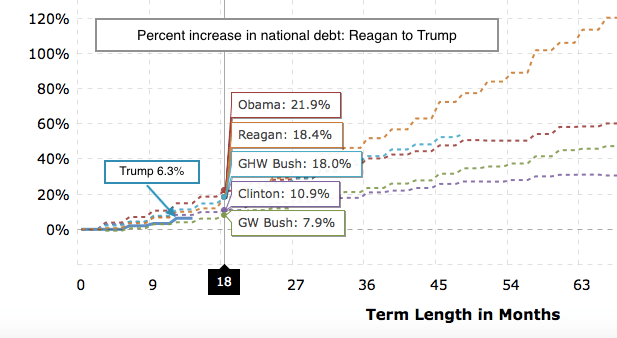
All recent presidents have raised the national debt. Trump claims he will shrink it.

All recent presidents have raised the national debt. Trump data to April 20, 2018.

As the graph above shows, if Trump plan is to pay down the debt, he is not succeeding. Trump is overspending — at a somewhat slower rate than other recent presidents, but in 1 1/4 year he’s increased the debt by 6.3%, about $1220 B. He’s saved a few billion by reduced payments to the UN, and to the EU for climate studies, and he’s asking NATO to pay more for Europe’s defense, but he’ll have to do a lot more, and the rest of the world is already unhappy with him.

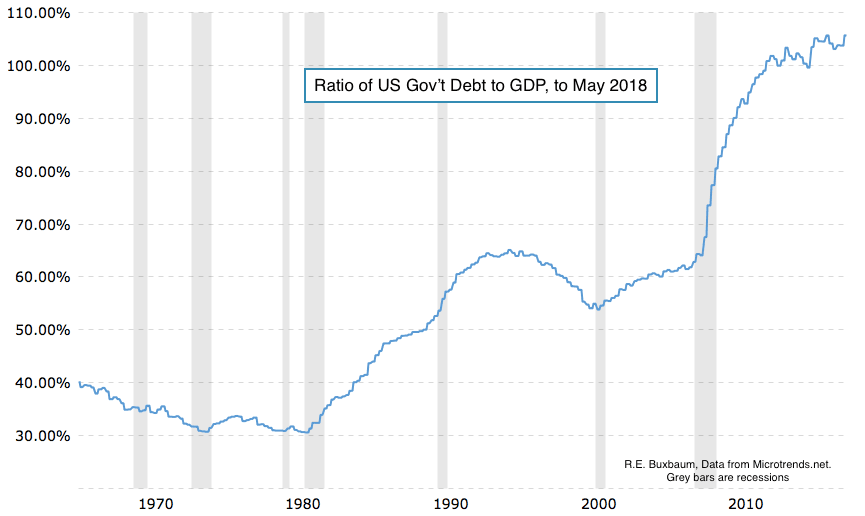
Many US economists — Keynesians – are not happy with him for another reason. They claim that debt is good, and that borrowing increases employment. As proof they note that FDR borrowed and spent heavily though the 1930s,and we got out of the depression. Other economists point out that it took longer in the US to get out of the depression than in many other countries. More recently, under Jimmy Carter, deficit spending created a combination of high inflation and high unemployment, “stagflation,” suggesting that Keynes should be modified to “Neo Keynesians” who claim you can overspend if you don’t outspend the GDP growth rate. Sorry to say, even in these terms, Obama and GW Bush overspent badly, as did Reagan before them (see graph below). Obama raised the debt from 65% of the GDP to its current 105%, and GW Bush raised it from 50% of GDP to 65%. This borrowing did not increase employment, or raise the standard of living for most Americans, though several at the top became fabulously wealthy. As Alan Greenspan noted, “If national borrowing was a path to wealth, Zimbabwe would be the richest country on earth.” I’m more of a hard money man, as Greenspan was, inclined to think that a balanced budget is good, and that tariffs are good too.

Ratio of US government debt to GDP

Ratio of US government debt to GDP

As of June 1, 2018, Trump has imposed ~20% tariffs on five items: wood, steel, aluminum, washing machines, and solar panels. Combined, these items constitute 4.1% of our imports, $130 B/ year. Taxed at 20%, the US will collect $25 B/year. it’s a step, but I suspect that Trump knows that, if tariffs are to wipe out all of our deficit, he’ll have to impose a lot more, about 40% on all of our imports ($3,100 B/year). Trump may yet do this, and may yet cut spending, and put a lot more America to work. My sense is that this is his aim.

The next step in the Trump MAGA plan involves adding another $35B to the list of items being taxed; that’s about 1.1% of US imports (5.2% total). In response, our trade-partners have complained to the press and to the world court, and have imposed their own tariffs — so far on about $100 B of US products, mostly food items, like bourbon and cheese, chosen to hit Republicans in politically – sensitive states: Tennessee and Wisconsin. Canada now taxes US cheese at over 100%. It’s an effort to embarrass Trump and get Democrats elected in 2018. If these tactics don’t work, Trump will impose another round, e.g. on foreign-made cars and motorcycles. I’d also expect him to cut NATO funding unilaterally, too, as a counter-slap to the EU.

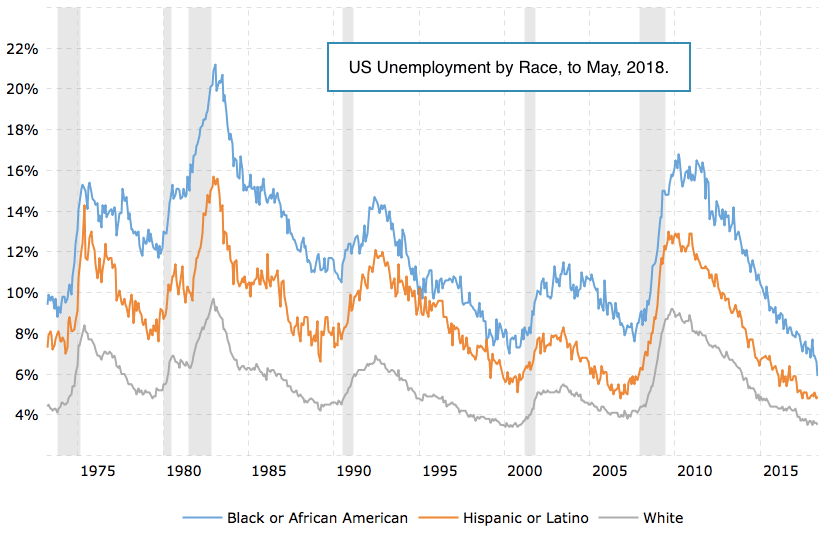
US unemployment by race

US unemployment by race, data to May 2018.

Speaking of Keynesian economists, Nobel Laureate economist, Paul Krugman of the New York Times has been predicting severe job losses, and a permanent stock collapse since 2016, and especially following Trump’s election. Virtually every week he announces that the end is near, and every month the economy looks better. But he’s not deterred, and neither are most economists. In a survey of nearly 100 economists by Reuters, 80% said that Trump’s policies will hurt the U.S. economy, and the rest said there would be little or no effect.[1] . So far it looks like they are all wrong. Unemployment is at record lows, particularly for African-Americans (see chart above); we’re adding new jobs at the rate of 200,000 new jobs per month, nearly 0.8% of the population per year. Inflation is a modest 2.3%, GDP growth is excellent, at 3.2% (or an incredible 4.5%). All we need now is a sensible immigration policy plus some healthcare reform, a modified social security tax, and for the economy to stay this way for another 5-10 years. It’s unlikely, but that’s the plan.

Robert Buxbaum, July 5, 2018. I’d hoped to see the employment and deficit numbers for June by now, but it’s not out. I’ve also argued that free trade is half right, as there is a benefit to workers, And there is a certain greatness that comes from paying your bills. Today, the EU offered to lower some auto tariffs if Trump does not move forward.

Most traffic deaths are from driving too slow

About 40,100 Americans lose their lives to traffic accidents every year. About 10,000 of these losses involve alcohol, and about the same number involve pedestrians, but far more people have their lives sucked away by waiting in traffic, IMHO. Hours are spent staring at a light, hoping it will change, or slowly plodding between destinations with their minds near blank. This slow loss of life is as real as the accidental type, but less dramatic.

Consider that Americans drive about 3.2 trillion miles each year. I’ll assume an average speed of 30 mph (the average speed registered on my car is 29 mph). Considering only the drivers of these vehicles, I calculate 133 billion man-hours of driving per year; that’s 15.2 million man-years or 217,000 man-lifetimes. If people were to drive a little faster, perhaps 10% faster, some 22,000 man lifetimes would be saved per year in time wasted. The simple change of raising the maximum highway speed to 80 mph from 70, I’d expect, would save half this, maybe 10,000 lifetimes. There would likely be some more accidental deaths, but not more accidents. Tiredness is a big part of highway accidents, as is highway congestion. Faster speeds decreases both, decreasing the number of accidents, but one expects there will be an increase in the deadliness of the accidents.

Highway deaths for the years before and after Nov. 1995. Most states raised speeds, but some left them unchanged.

Highway deaths for the years before and after speed limit were relaxed in Nov. 1995. At that time most states raised their speed limits, but some did not, leaving them at 65 rural, 55 urban; a few states were not included in this study because they made minor changes.

A counter to this expectation comes from the German Autobahn, the fastest highway in the world with sections that have no speed limit. German safety records show that there are far fewer accidents per km on the Autobahn, and that the fatality rate per km is about 1/3 that on other stretches of highway. This is about 1/2 the rate on US highways (see safety comparison). For a more conservative comparison, we could turn to the US experience of 1995. Before November 1995, the US federal government limited urban highway speeds to 55 mph, with 65 mph allowed only on rural stretches. When these limits were removed, several states left the speed limits in place, but many others raised their urban speed limits to 65 mph, and raised rural limits to 70 mph. Some western states went further and raised rural speed limits to 75 mph. The effect of these changes is seen on the graph above, copied from the Traffic Operations safety laboratory report. Depending on how you analyze the data, there was either a 2% jump (institute of highway safety) in highway deaths or perhaps a 5% jump. These numbers translate to a 3 or 6% jump because the states that did not raise speeds saw a 1% drop in death rates. Based on a 6% increase, I’d expect higher highway speed limits would cost some 2400 additional lives. To me, even this seems worthwhile when balanced against 10,000 lives lost to the life-sucking destruction of slow driving.

Texas has begun raising speed limits. Texans seem happy.

Texas has begun raising speed limits. So far, Texans seem happy.

There are several new technologies that could reduce automotive deaths at high speeds. One thought is to only allow high-speed driving for people who pass a high-speed test, or only for certified cars with passengers who are wearing a 5-point harness, or only on roads. More relevant to my opinion is only on roads with adequate walk-paths — many deaths involve pedestrians. Yet another thought; auto-driving cars (with hydrogen power?). Computer-aided drivers can have split second reaction times, and can be fitted with infra-red “eyes” that see through fog, or sense the motion of a warm object (pedestrian) behind an obstruction. The ability of computer systems to use this data is limited currently, but it is sure to improve.

I thought some math might be in order. The automotive current that is carried by a highway, cars/hour, can be shown to equal to the speed of the average vehicle multiplied by the number of lanes divided by the average distance between vehicles. C = v L/ d.

At low congestion, the average driving speed, v remains constant as cars enter and leave the highway. Adding cars only affects the average distance between cars, d. At some point, around rush hour, so many vehicles enter the highway that d shrinks to a distance where drivers become uncomfortable; that’s about d = 3 car lengths, I’d guess. People begin to slow down, and pretty soon you get a traffic jam — a slow-moving parking lot where you get less flow with more vehicles. This jam will last for the entirety of rush hour. One of the nice things about auto-drive cars is that they don’t get nervous, even at 2 car lengths or less at 70 mph. The computer is confident that it will brake as soon as the car in front of it brakes, maintaining a safe speed and distance where people will not. This is a big safety advantage for all vehicles on the road.

I should mention that automobile death rates vary widely between different states (see here), and even more widely between different countries. Here is some data. If you think some country’s drivers are crazy, you should know that many of the countries with bad reputations (Italy, Ireland… ) have highway death rates that are lower than ours. In other countries, in Africa and the mid-east death rates per car or mile driven are 10x, 100x, or 1000x higher than in the US. The countries have few cars and lots of people who walk down the road drunk or stoned. Related to this, I’ve noticed that old people are not bad drivers, but they drive on narrow country roads where people walk and accidents are common.

Robert Buxbaum, June 6, 2018.

Al Jazeera, a multi billion-dollar influence buyer

Given the hand-wringing over the $300,000 spent by Russia to influence the 2016 US election, I thought it worthwhile to point out that Qatar spent roughly 2.5 billion on influence, mostly through Qatar’s news agency, Al Jazeera. Qatar is a Shiite (Shia) Moslem Emirate solely ruled by a Sunni Emir (king). Here’s a joke to help distinguish Sunni from Shia. It is also the 4th largest exporter of natural gas in the world behind Russia, Norway, and Canada. It’s a solid supporter of leftist political causes from anti-climate change to Hamas and Al Qaeda/ ISIS, and it is the host for the FIFA world cup of soccer, 2022. For more about Qatar and the logic of its behavior, see the American Foreign Policy Analysis. Interesting in general, but I’d like to focus on influence buying.

FILE - In this Aug. 20, 2013 file photo, Al Jazeera America editorial newsroom staff prepare for their first broadcast in New York. Shannon High-Bassalik former head of Al Jazeera America’s documentary unit has sued the news network, claiming it is biased against non-Arabs in stories that it produces and how it treats employees.  (AP Photo/Bebeto Matthews, File)

Al Jazeera America prepares for its first broadcast from New York, August, 2013. AP Photo/Bebeto Matthews.

The Emir of Qatar is the sole owner of Al Jazeera, a news organization, that he uses as profit-losing, influence machine. It allowed him to support leftist politicians who he believes to be pro-Arab, pro-Muslim Brotherhood, anti-Israel, and anti-American. In Europe he pursues pro-immigration, anti-fracking policies. In conservative, Islamic countries, like Saudi Arabia, Egypt, and Iran, he’s used Al Jazeera to supported free elections to unseat the king, Shah, or military president. Al Jazeera uniformly portrays Qatar and its emir well, helping it get rights to host the FIFA world cup. No other country gets anywhere near such uniform, positive support.

A bit of history: Al Jazeera began operations in Doha, the capital of Qatar in 1996, as an antidote to Saudi Arabia’s arabic-language news outlet, MBC (Mid-East Broadcast Company, now called Al Arabia). By 2003, Al Jazeera was broadcasting in Europe in various EU languages, and had an english language version broadcast out of London, Al Jazeera-English. It is available in the US via cable TV, Channels 100, 200, and 300. In 2013, the Emir of Qatar expanded Al Jazeera directly to the US, paying 1/2 billion dollars for an Emmy-winning, non-profitable, cable news company “Current TV”, partially owned by Al Gore. “Current TV” operated out of San Francisco with a left-leaning, pro-environment message and a modest audience. Their shows include The War Room with Jennifer Granholm (Jennifer is the ex-governor of Michigan), Talking Liberally, The Stephanie Miller Show, and  Viewpoint with Eliot SpitzerThe Emir added a news headquarters in New York and gave it a new name: Al Jazeera America, or AJAM. The old Current TV was retained as AJ+, a video arm. Over the next 5 years the emir spent 2 billion dollars setting up 12 news bureaus in the US with instructions that there was no need for profit, but only for “influence”. It is arguable how much influence he got, but it is clear he didn’t make any profit.

Despite what you might imagine would be the opinions of a petro-monarch, AJAM continues to back Gore’s anti-fracking message. I will speculate this is because he is against US gas because it competes with Qatari gas. AJAM also strongly supports the Muslim Brotherhood, Hamas, and ISIS. Perhaps that’s radical chic (radical sheik?). He’s against any authoritarian ruler that isn’t him.

Trump, his daughter, el Sisi, and the King of Saudi Arabia. No Emir of Qatar.

Trump, his daughter, Ibn-Said (king of Saudi Arabia) and el Sisi, (president of Egypt). Global control with no Emir.

Some notable controversies — I got these from Wikipedia –Ahmed Mansour, a prominent Al Jazeera anchor, is quoted saying that Egyptian president, el-Sisi was “a Jew carrying out an Israeli plot.” Faisal al-Qassim, another Al Jazeera presenter, hosted a segment on whether Syria’s Alawite (Shia) population deserved to be killed en-mass, and in 2014, the channel’s Iraqi affairs editor tweeted approvingly about the Islāmic State killing more than 1,500 air-force cadets in Tikrit, singling out those who were Shia and non-Muslim. Closer to home, they charged a half-dozen athletes with doping, including Peyton Manning, hero of the super bowl. In the end, Shannon High-Bassalik, former head of the documentary unit, also sued claiming bias against non-Arabs in stories and in how it treats employees.

Among Republicans, AJAM became to be known as “The Terror Network”, while they retained some good reputation on left. The Emir bought not only the network, but spent liberally on sympathetic experts, and on academic think tanks. Further, it seems that Al Jazeera writers had no fixed budget or expense limit. The Russians are nowhere near this generous.

In April of 2016, with the world cup coming to Qatar, and American oil reviving, the emir cut AJAM staff by 900 workers. Part of the decision may have been that it looked like he had the 2016 election in the bag. Al Jazeera English remains, still operating out of London, and AJ+, the old Current TV, still operating out of San Francisco. And then Donald Trump was elected 45th US president. AJ / AJ+ was shocked (as was I); and called for protests. Trump, in a publicized meeting with el-Sisi of Egypt (the Jewish Spy), and Salmon al-Saud, (above, 2017) issued a set of 13 demands including that the emir stop to support for Hamas and the Brotherhood, and that he shut Al Jazeera. The emir has not complied, and the world cup is still on for Qatar.

I should mention that the Emir and Putin work together on some things and oppose on others. They both support politicians who oppose oil and gas production while opposing each other on pipeline construction. Qatar backs the pan Arabian pipeline to Turkey, while Russia funds Assad and the PKK (Russia-friendly, Kurdish independents) to block such access. The Emir supports ISS, Hamas, and Turkish Kurds, I suspect, as a way to fight Russia. It’s Byzantine politics in both senses of the word. Given how much Qatar has spent buying influence with Clinton and Gore, I don’t understand why the FBI is so focussed on Trump and Russia.

Robert Buxbaum, May 29, 2018.