Category Archives: economics

Rich folks aren’t taxed because they have no income; you can do some of this too.

Two tax questions: (1) How do the top rich people manage to pay such low taxes, e.g. Warren Buffett paying at 0.1%. and (2) why do these rich folks campaign for higher taxes. Warren Buffett has campaigned for higher taxes for 50 years. These questions seem perhaps related.

I got my tax data from a public tax advocacy group, ProPublica. In 2021 they received the tax filings for many important people including the 25 US richest from the years 2014 to 2018. They find that these individuals paid a total of $13.6 billion in federal income tax while their wealth rose a collective $401 billion, go here for more. Dividing the numbers, we see an average income tax rate of only 3.4%, with Warren Buffett paying the least, 0.1%. This is far less than the “half of the rate that my secretary pays,” that Buffett likes to claim.

The reason these people pay so little tax is that their taxable income is zero. They use a very wide variety techniques to do this. Among these are charitable foundations, including those that lobby for higher taxes and against climate change. The foundations buy private planes and send the founders (and their families) to climate change events in the South of France or Davos, Switzerland. “Pro-tax” foundations hire tax accountants to research ways that the rich avoid taxes, often the founders then use these methods while speaking out against others who do the same. Bezos was so successful at avoiding income that he got welfare payments in two of the five years, ProPublica found. Soros and his son got $2,400 in COVID payments. They had almost no income. The one tax all these folks hate is tariffs because it is almost impossible to buy new, expensive things from abroad while avoiding them. See my essay, “Tariffs are inflationary, but not on you.”

Another advantage of a charitable foundation is that 74% of your donation can offset capital gains. You have to itemize your donations, but If you give $1 million to your foundation, you can use it to offset $740,000 of stock appreciation earnings. Not a bad deal. You can also use any stock losses against gains. Thus, it’s a good idea, if you itemize, to sell some losing stocks when you sell gainers (while holding on to other gainers, of course.) All of this is only available to those who itemize, and it’s only the rich who benefit by itemizing.

Borrowing money against your assets is another popular tax avoidance scheme, one that ordinary folks could use (but don’t over-do it*). The scheme is often called “Borrow, Buy, Die.” You borrow a large sum against your assets (your home, your stocks, or options –Musk has lots of Tesla options, etc). You then use the borrowed money to purchase property, typically: a vacation home, rental properties, a hotel, or a car. If you structure the purchase right, the interest can be deducted from any other earnings you have including rents. You then have no taxable income, or a lower income while the property appreciates. You can often structure the purchase so that depreciation can be deducted against income as well. Meanwhile, you get to drive the car, live at the vacation home, or rent it as an Air B&B, or stay at the hotel for free.

You live this way until you die. When you die, your heirs get the asset, but they are not taxed on the appreciation. The asset is transferred at its value at the time of death. You’ve avoided paying all the income tax you’d have to pay if you were to sell before death. Most home-owners do this on a small scale: They borrow to buy their home or the building where their business is. Or borrow to buy a vacation home or income property. They use through their life-time, deducting the interest, then leave it to their kids. There is no inheritance tax on most homes or small businesses, and the asset appreciates year to year. Both Nixon and Obama proposed eliminating this loophole by taxing appreciation at death. This would be a lot fairer than the current inheritance tax that is full of loopholes, and unfair when it works. If your parent bought a $10,000,000 item with taxable income, and it remains at that value, why should it be taxed a second time at death?

For a small businessman like me, it made sense to borrow to buy the building that my business operates out of and pay myself a normal rent. It’s income, as real as salary, but taxed at a lower rate, Besides there is no payroll tax on rental income. Another advantage of renting to myself is I can be trusted to fix the building and pay the rent, and I will not throw myself out if there is a downturn, nor will I raise the rents exorbitantly. My car is owned by my business, another plus. I pay a fee for personal use, but this is cheaper than using my own taxed income. When I die, the building (and car) will go to my heirs, tax free.

One last change I’d like to see is in the payroll tax. I’d like to see it tax the entire taxable income, but at a lower percent than the current 15.2 or 7.6. Currently the first $150,000 of income is payroll taxed at 15.2% for a self-employed individual, a plumber or office cleane, even before he/she pays income tax. An office worker is taxes at half this rate, 7.6% before income tax, with the company making up the other 7.6%. A CEO making $10 million pays this rate too, but only on the first $150,000. This amounts to $11,400 in payroll tax, or less than 0.11% of salary. I consider this disparity a bigger scandal than the fact that the richest 25 Americans paid only 3.4% in income tax.

Robert Buxbaum, November 25, 2025. *Trump presents a cautionary tale about property investing; if you invest at the wrong time, you can lose your shirt. In the late 80s, the property market in NY collapsed briefly, and he really was less than penniless. Don’t over-extend. The property market doesn’t collapse often, but you don’t want to be wiped out if it does.

What causes innovation? is it worth it?

Innovation is the special sauce that propels growth and allows a country to lead and prosper. The current Nobel prize believe that innovation powered the Industrial Revolution, causing England to become rich and powerful, while other nations remained poor, weak, and stagnant. Similarly, Innovation, they believe is why 19th century Japan rose to defeat China, and propelled China’s 21st century rise. But why did they succeed when others did not. What could the leader of a country do to bring power and wealth through innovation. Improved education seems to help; all of the innovation countries have it, but it is not the whole. Some educated countries (Germany, Russia) stagnate. An open economy is nice, but it isn’t sufficient or that necessary: (look at China). That was the topic of this year’s, 2025 Nobel prize in economics to Mokyr, Howitt, and Aghion, with half going to Joel Mokyr for his insights, historical and forward looking, the other half going for economic modeling. I give below my understanding of their insights, more technical than most, but not so mathematical as to be obtuse the normal reader..

The winners hold that innovation, as during the industrial revolution, is a non-continuous contribultion caused by a particular combination of education and market opportunity, of theoretical knowledge, and practical, and that a key aspect is depreciation (destruction) of other suppliers. Let’s start by creating a simple, continuous function model for economic growth where growth = capital growth, that is dK/dt. K, Capital, is understood to be the sum of money, equipment, and labor knowledge, and t is time with dK/dt, the change in K with time modeled as equal to the savings rate, s, times economic activity, Y minus a depreciation factor, δ, times capital, K.

growth = dK/dt = sY − δ K.

Innovation, in the Howett model, is discontinuous and accumulative. It builds on itself.

For the authors, Y = GDP + x, where x is the cost of outside goods used. They then claim that Y is a non-linear function of K, where K is now considered a product of capital goods and labor K = xL and,

dY/dK = AKα + γ where 0< α <1, and where γ is the contribution of innovation and/or depreciation. The power function, as I understand it, is a mathematical way of saying there are economies of scale. The authors assume a set of interacting enterprises (countries0 so that the innovation factor, γ for one country is the depreciation factor for the other. That is, growth and destruction are connected, with growth being a function of monopoly power — control of your innovation.

According to the Nobel winners, γ is built n previous γ as shown in the digram at right. It can not be predicted as such, but requires education and monopolistic power. The inventor-manufacturer of the typewriter has a monopolistic advantage over the makers of fountain pens. Innovation thus causes depreciation, δ K as one new innovation depreciates many old processes and products. If you add enough math, you can derive formulas for GDP and GDP growth, all based on factors like A and α, that are hard to measure.

GDP = α(2α/1−α) (1-α2)A L,

Thus, GDP is proportional to Labor, L and per-capita GDP is mostly an independent function related to economies of scale and the ability to use capital and labor which is related to general country-wide culture.

The above analysis, as I understand it, is in contrast to Kensyan models, where growth is unrelated to innovation, and where destruction is bad. In these Kenysean models, growth can be created by government spending, especial spending to maintain large industries with economies of scale and by spending to promote higher education. The culture preferred here, as I understand is one that rewards risk-taking, monopoly economics, and creative destruction. Howitt, and Aghion, importantly codify all this with formulas, as presented above that (to me) provide little specific. No great guidance to the head of a country. Nor does the math make the models more true, but it makes the statements somewhat clearer. Or perhaps the only real value of the math is to make things sound more scientific see the Tom Lehrer song, Sociology.

This insight from movie script by Grham Green suggests to me that progress may not be the greatest of advantages, perhaps not even worth it.

This work seems more realistic, to me, than the Keynesian models Both models are mathematically consistent, but if Keynes’s were true, Britain might still be on top, and Zambia would be a close competitor among the richest countries on earth. Besides these new fellows seem to agree with the views of Peter Cooper, my hero. See more here.

Writing all this reminds me that the fundamental assumption that progress is good, in not necessarily true. I quote above a line that Orson Wells, as Harry Lime, ad-libbed for the movie, “The Third Man.” Lime points out that innovation goes with suffering, and claims that Switzerland had little innovation because of its stability. Perhaps then, what you really want is the stability and peace of Switzerland, along with the lack of domination and innovation. On the same note, I’ve noticed that engineering innovators often ruin themselves dining in ruin, while the peaceable, stable civil engineers live long pleasant lives of honor.

Robert Buxbaum, November 16, 2025. A note about Switzerland is that was peaceful and stable because of a strong military. As Publius Vegetius wrote, Si vis pachim para bellum (if you wish of peace, prepare for war).

The shutdown will drag; we will win

In theory, both US parties are committed to a balanced budget. Both claim they’ll tax as much as they spend, and we’ll pay our debts. In practice, both parties overspend wildly, year after year. The growth in non-defense spending (pork) is particularly egregious, see graph. For fiscal 2024, the 12 month period ending Sept. 30 2024, the government spent $6.75 trillion ($6750 billion), over 20% of GDP and 37% more than the $4.92 trillion we took in in taxes ($4,920 Billion). The difference, $1830 billion, was added to the national debt, already at $34 trillion, pushing it to $36 trillion, that’s more than 100% of our GDP. The interest cost alone is $1.22 trillion per year, 1/4 of our tax income.

Trump campaigned claiming he was going to balance the budget, but he has not (yet). There were some attempts via DOGE, saving about $214 billion, but the DOGE boys were outed, attacked, and gave up. And now the Democrats have forced a shutdown, using their power to prevent additional borrowing. This leaves Trump with a choice, either balance the budget or accept their spending demands. The expectation is that Trump will fold: there is no way he can find $1830 billion/year. Otherwise, many of the governments 4.2 million workers will go without pay, and many important services will stop.

So far, three weeks in, Trump seems fairly successful at keeping most things running while trying to balance the budget. Even if he fails, as seems likely, we will benefit from the attempt, I think.

Some government services are guaranteed to continue despite the shutdown: Social security and the post office because they are funded separately. Similarly, the patent office, the ports, and the airports. In the past some had to shut, but Trump has raised fees so they remain open and operating.

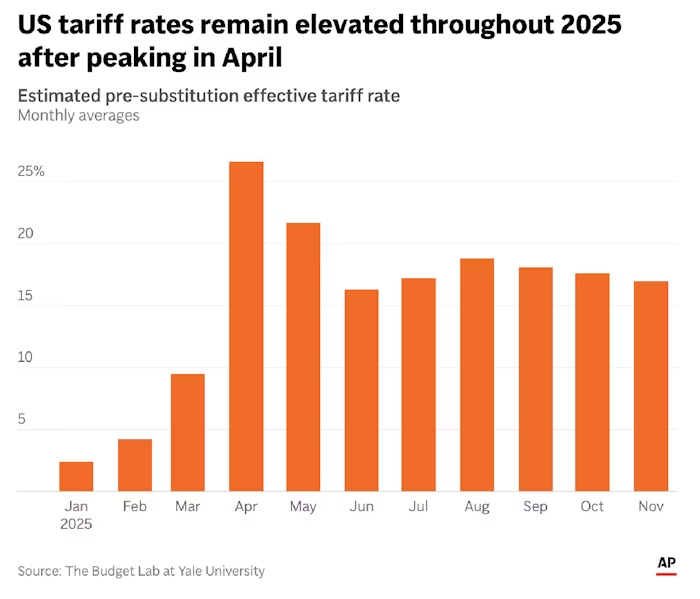
Essential workers, 800,000 people including customs agents and air traffic controllers continue working with most going unpaid. Trump committed to paying active duty military and for the WIC food program using money raised by new, 2025 tariffs. Tariffs are currently bringing in ~$300 Billion/ year, and so far tariffs mostly don’t affect ordinary folks, and help return manufacturing to the US. Some time soon we’ll have to pay the necessary workers and also some 750,000 non-necessary employees including: half the Dept. of Education, most of NASA and Energy.. They are not really useless, but are doing nothing essential to the day-to-day operation of the country.

Trump seems committed to removing many non-necessary workers in an effort to streamline and balance the budget. He fired 4200, bought out another 25,000 earlier this year, and has issued pre-termination notices to 75,000. A federal judge has blocked all firings as unlawful, but my sense is they are quite lawful and mostly beneficial. If you can’t fire non-working, un-necessary workers that you can’t afford to pay, who can you fire?

I suspect the shutdown will last well into November, well past the election, and that more folks will be fired or bought out. The key November crossroads will be food stamps, SNAP. These benefits are scheduled to end November 1 baring an end to the shutdown. Normally the bill is $110 billion/year, but Trump has eliminated benefits for illegal aliens and asylum seekers, and has instituted tougher work requirements. Democrats seem certain that Trump will fold. For the 11th time they scotched a bill to fund this and reopen the government and pay SNAP. I suspect that, at the last minute, Trump will find savings, or left-over funds and will keep SNAP funded through November.

Among the new savings, Trump ended the EV subsidy last month, saving about $7.5 billion/year ($7500 x 1 million EVs), and has negotiated some reductions in drug costs. He also increased the tariff on some Chinese and Canadian goods appropriate for rectifying trade imbalance, it’s been blocked by a federal judge. He’s also cancelled some rail work and research, saving $28 billion, and cancelled $20 billion for hydrogen hubs, and 83% of USAID. Also two navy ships that were years behind schedule and billions over budget. We need the ships, but don’t have the money. So far, this saved enough to pay all military servicemen.

Beyond this, I hope he cuts Biden’s high speed rail plans: $550 Billion for fast trains, Chicago to Seattle, Detroit to Toledo, San Francisco to LA, etc. The investment is $1,500 per person in the US. The eager thinkers overseeing this would never invest their own money, but are happy to invest everyone else’s. I also hope to see the end of NASA’s SLS rocket to the moon, nice but far more expensive than Falcon. We could also cancel some F35s ($0.1 Billion each to buy, and far more to maintain). Musk suggested replacing them with drones. I don’t know that these savings are enough. I don’t know how long we can continue, but each day shut, we move closer to a balanced budget, and that’s a good thing.

Robert Buxbaum, October 21, 2025

Thomas Kuhn, and why half of America loves/ hates Trump

This post was inspired by articles like the one below asking how it was that some Americans, MAGAs think Trump is good when everyone of value sees him as a fat, bigoted, criminal clown. The Atlantic’s answer is they’re detached from classic ideals of good or moral, and are now fueled by “narcissism, fanaticism, and authoritarianism”. I thought a more helpful explanation was that we’re going through a paradigm shift, perhaps progressing in our thought of what it means to be good.

Consider Thomas Kuhn’s analysis of scientific progress. Tomas Kuhn was a major American Philosopher of the 1960s-70s who claimed that science progress was not uniform but included long periods of “normal science” punctuated by change. A “crisis” leading a “Revolution” resulting in big changes in language, outlook and thinking, a “paradigm shift”. In the midst of these scientific revolutions, the experts of the old system fight bitterly against the new while being confounded by the fact that it seems to work.

Consider the resistance to relativity and quantum mechanics. Before 1905 the experts were doing fine: Professors taught and students learned — formulas, tools and techniques were handed over. Educated had respect and money, and could communicate. There were some few contradictions, as in why the sun burned hot, or why the sky was blue, but one could ignore these. You knew who the experts were, and they didn’t include Einstein, Bohr, Pauli, Plank.

Democrats sell red hats and buttons with Fascist or Felon because Trump’s red MAGA (Make America Great Again) hats work for him.

But then came a few more problems, (inconsistencies in Kuhn-speak: radioactivity, photoelectrons, the speed of light… Einstein published on them in 1905, thoughts that few took seriously: imaginary time was a fourth dimension at right angles to the others, etc. The explantations seemed mad and for 14 years after he published, Einstein could not get a university job — anywhere. By 1919 detailed experiments suggested he might be right on a lot of things. It lead to the rise of a new group of experts plus a loss of esteem for the old, and a bunch of crank explainers who were neither but flourished in the confusion.

Hate abounded; new weapons and cures WWI removed aristocrats and beards. A popular book a lecture series of the time was “100 scientists against Einstein.” There followed a lost generation with no clear foundation. It took 50 years to resolve confusion, but there developed new thought leaders, a new language, new standard formulas and books were sold, and we were returned slowly to “normal science” in a new thought paradigm.

I see the conflict of opinion surrounding Mr Trump as a crisis in political thought similar to the crisis in science thought 100 years ago. Polite discourse if gone, replaced by stunts and insults. The government is currently shut, with 40% federal workers, those whose jobs are non-critical, on unpaid leave. It’s a collapse, not of morals, but of language. Trump hopes to use the shutdown, I think, to show that most of these 40%, are not needed. If they are not needed, it reflects a big lack in government — actually a big bloat in government. You can see why the opponents of cuts see Trump as a fascist who uses “dog whistles” to motivate “his base”, there is a lack of communication and a fear Trump may be right too, I think. The experiment in smaller government is being run as I write, and Trump seems confident that some 400,000 federal workers are not needed. Are they? Instead of debating, we’ve got to violence: two attempts on Trump’s life so far, the main college debater, Charlie Kirk, shot dead. Appropriate, I think, is Bob Dylan’s, “Times are a-changing” and “something is happening here, but you don’t know what it is, do you, Mr Jones.”

Other questions are being worked out as we speak -sending chills through the old order: Are China and Europe “ripping us off,” by free trade and stolen technology? Are tariffs an answer. Canadian and European leaders deride these thoughts openly, but I notice that both Canada and the EU have put heavy tariffs on Chinese goods.

Another issue is respect for experts. The Atlantic bemoaned that Trump supporters don’t respect experts on health, climate, and education, but perhaps they are lying. The seas have not risen as expected. Some warming may be good, or better than the remedies. Even if RFK Jr.’s ideas are wrong it seems that science has become unreliable (irreproducible), and that elite colleges aren’t fair in their assessment, nor do they provide great value.

Eventually things will settle down; we will some day have polite discourse. In 40-50 years, I suspect we’ll agree that some tariffs are good and that Trump’s tariffs are either to high or low, We’ll think that the climate push to no nuclear power, was a mistake, as was the giant, Ivanpah solar farm). And we’ll be able to discuss it civilly. I hope the change in thought takes less than 50 years.

Robert Buxbaum, October 3, 2025 – we are now entering another physics crisis too, I think.

Tariffs on German cars are inflationary, but not for you.

As things stand, the major export of Germany to the US is high end cars: Mercedes, Audis, Porsches, BMWs, $100,000+ on average. The lower end models are made in the US, Mexico, and Canada. These high end cars are the biggest profit centers of their makers and of the German economy. Currently, they face an import tax (tariff) of 15%, the same as everything from Germany (or Italy or Japan). Liberal economists are furious at this; they claim it’s a tax and that it is inflationary. They are right on both counts except that this is only a tax and inflationary for the few Americans who buy new, high end cars.

The Americans who buy such cars are typically rich folks — poor and middle class folks can’t afford them. They are also folks with ‘taste’, folks who need a BMW, and would not be caught dead behind the wheel of a US car. Normally liberal economists would favor taxing such people, but these are often the who hire economists. They run the TV programs and newspapers, universities and hedge funds. They choose the economists and the economists are eager to see things their way.

Another high tariff item imported from Europe is art. Modern art for $1 million dollars that ends up in museums. For the average Americans the tariff on this, or on art is irrelevant or beneficial. The income it generates is used to offset other taxes, allowing Trump to remove the tax on tips, for example. That this tariff falls on rich people and replaces a tax that otherwise fell on poor workers. Liberal economists should favor of this, but their opinions are not their own.

A side benefit of these tariffs for ordinary folks, is that that they cause some buyers to switch to American-made products, cars and art. Perhaps not for themselves, but for for their children. They may buy a German car made in the US, rather than one made in Germany, or art from an American. This provides jobs for US workers — and an opportunity for Detroit to retool for the future. Detroit auto workers seem to understand this; they voted for Trump in 2016 and 2024. Detroit’s union leaders opposed tariffs. In Michigan, the union leaders get their power mostly from MI politicians, Democrats, who force union membership.

This is not to ignore the suffering of those who buy foreign products, the buyers of new BMWs, or French cheese, or high end art. As things stand, Columbian coffee is tariffed at 10%, and that may add 50¢/lb. Mexican coffee is not taxed, but many average Americans prefer Columbian. I hope they can be consoled by Trump’s tax breaks.

Some months ago, Trump showed off a tariff schedule that he considered ideal, with rates targeted to reduce our trade deficit by half. I derive here, Trump’s formula and rates, and give my opinions of the target. By the formula he presented, the EU tariff should be higher than it is, 20%. Trump has it at 15%, I think, for diplomatic leverage, to goad the EU into lowering their tariffs on us goods, now 15%. He’s also pushed them to spend more on defense, and pushed to end the war between Cambodia and Thailand. He threatened them with near 100% tariffs if they didn’t stop fighting.

Robert Buxbaum, September 2, 2025. Here’s a Bob Dylan song, union sundown, making a musical case against free trade. Once upon a time that was a liberal view. Now not. The NY appeals court ruled to block Trump’s tariffs to stop the horrible damage being done. My guess is the judges drink high-end coffee, eat French cheese, and drive new, German cars.

Deriving Trump’s tariff formula, and correcting it.

We have a trade imbalance with many countries, it causes a loss of American jobs, and a transfer of currency abroad. This imbalance is not all negative, of course, it provides US consumers with cheaper consumer goods. Trump would like to eliminate the imbalance using tariffs. He hopes that this will create jobs, and that the money raised will help balance the US budget. He’s already moved to end income taxes on tips expecting to replace that tax with tariff income. Trump claims that the tariffs are not inflationary compared to current the tax system that he claims has been hacked by the elites. In past essays, I’ve discussed the pluses and minuses of tariffs here, and here. Now I’d now like to derive the formula Trump uses, see below. The proposed tariff for any country or region, i, he calls ∆τi.

In the equation at left, χi = our exports to country, i. Similarly, mi = our imports from that country. The difference between these two is our trade imbalance, something he’d like to set to zero. There are two other greek terms that I will discuss, ε and φ. These are the elasticity of elasticity of consumption to price, and the elasticity of price to tariffs. Trump uses an asterix here to indicate multiplication. I will use a, more normal, “dot” symbol, •, to the same purpose. For most countries, he takes the two elasticities to cancel to 2, and produces a chart.

Let’s say that the dollar amount we currently buy from some country, i, = m = ni • Pi, where ni is the number of items bought from this country, and Pi is the average price. The intended effect of tariffs is to reduce mby raising Pi, the price consumers pay for goods from that country. This increase is certainly inflationary in terms of the consumer: a consumer of French wine will pay more per bottle unless he/she switches to US wine. Typically this price rise is not inflationary in terms of the country as a whole, because the producer likely swallows some of the tariff, so for the country as a whole, we pay less per bottle of French wine. The customer does not see that, but it’s worth noting. Trump sees things this way.

Back to the formula, we need to figure out how much the price will go up and how much sales will change. Economists have elasticity numbers for both these relations, denoted φ and ε. We can say that, for any country, I, the rise in the price of the average product is ∆Pi = Pi•∆τi •φ. Where Pi is the original price, ∆τi is the tariff, and φ is the fraction of this tariff that gets passed on to the consumer. A typical value is φ= 1/2 though some claim less. Assuming φ= 1/2 , if we add a 20%=∆τi tariff, as on on French wine, the consumer price will rise by 10%, a change that will cause him/her to buy less.

How much less will the consumer buy? That’s determined by the elasticity of sales, ε. This is the fractional decrease in the number items bought per fractional rise in the price. In math terms, ∆ni /ni = -ε∆Pi/Pi where ε is the elasticity. Now, since ∆Pi = Pi•∆τi •φ, we find that:

∆ni = -ni•ε•∆τi •φ.

There is evidence to suggest that, for the average product, ε equals about 2, and also evidence that it’s 4. Trump prefers 4, and uses it for his calculations. I prefer 2, and will get nearly the same tariffs at the end. Whatever our preferred value for ε, our next step is to use the following approximation, accurate for small ∆(mi);

∆mi  = ∆(ni•Pi) = ∆ni•Pi, +  ni•∆Pi

Trump seems to ignore the second term. Perhaps because it can either be positive or negative, as I’d mentioned above, depending on whether you look at things in terms of the customer or of the US as a whole. I’ll keep it in, writing this term in lighter text. In the end I will calculate a fairly similar tariff to Trump:

∆mi = -ni•ε•∆τi •φ•Pi  + ni•Pi•∆τi •φ.

Rearranging the above, and recalling that ni•Pi• =mi, you can find the appropriate tariff to eliminate the trade imbalance.

∆τi =   -∆m/(ε • φ• mi  + φ•mi) .

To make the trade imbalance go away, you need -∆mi = χi-mi . Thus,

∆τi =   χi-m /(ε • φ • mi  + φ•mi)

This is the Trump formula with an extra term in light text. If you ignore that term and use the values Trump prefers, ε =4 and φ=1/2, you get the exact values of the tariffs he listed on the chart for most countries — those with positive trade imbalances.

∆τi =   χi-m/ 2 mi  

Now, I’d like to put back in the missing term, and use the (better) values, values I would trust, ε =2 and φ=1/2. Using those values, I find the tariff should be slightly higher.

∆τi =   χi-m/ 3/2 mi  .

I should note that some countries are creating to these trips by raising their own tariffs, and some are lowering theirs. This will cause a change in the imbalance of trade, and Trump will have to change the tariff schedule periodically to keep up.

Robert Buxbaum, April 10, 2025.

Coal and nuclear power, the secret to China’s cheap products

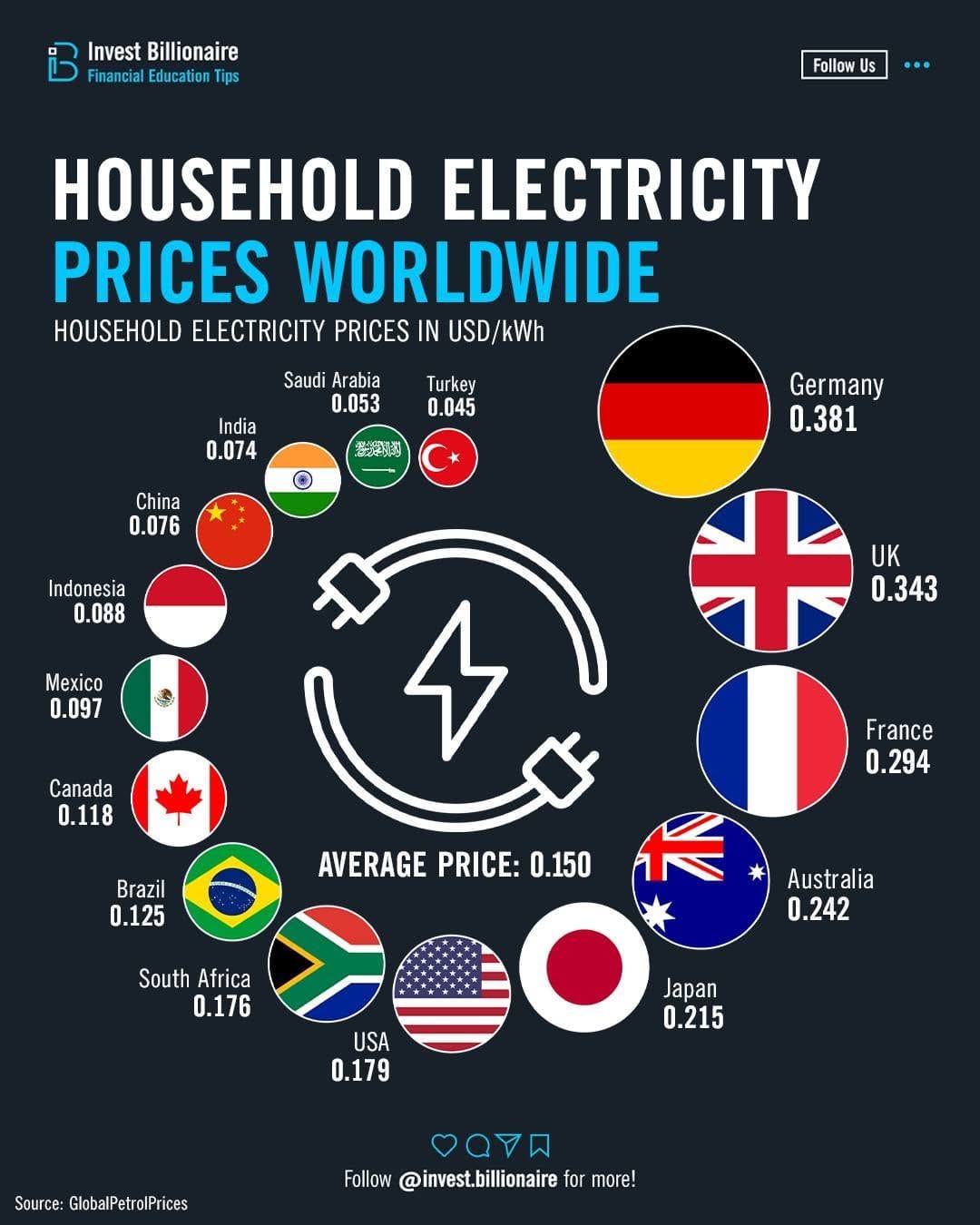
We’ve become accustomed to buying cheap products from China: items made of glass, plastic, and metal come to the US by the ship-load, approximately $600 B worth last year, the highest from any country. Labor isn’t cheaper in China, certainly not when compared to Mexico or India, nor are the machines that make the products more advanced. What’s behind China’s ability to produce at their low prices is cheap energy—specifically, coal and nuclear-based electricity. While the US and most western countries have shut down coal plants to stop global warming, and have even shut working nuclear reactors for no obvious reason, China has aggressively expanded coal and nuclear energy production. The result? They are the largest single source of CO2, and have some of the lowest electricity prices in the world, Chinese electricity prices are about 1/4 of European, and 2/3 of U.S.

In recent years, the U.S. and Europe have increasingly relied on renewable energy sources like wind and solar. While these can work in certain areas, they require far more land than nuclear or coal, and expensive infrastructure because the power is intermittent, and generally not located close to the customer. The UK and Germany, countries with long periods of cloudy, windless conditions, have switched to solar and wind, leading to soaring electricity prices and a moribund industrial sector. Germany shut down all of its nuclear plants, 17 of them, largely to rely on electricity imported from its neighbors, and coal-fired sources that are far more polluting and unsafe than the nuclear plants they shut. The UK shut 5 nuclear reactors since 2012.

Meanwhile, China continues to build nuclear and coal plants. China is the largest user of coal power, and is planning to build 100 more coal-fired plants this year. Beyond this, China is building nuclear power rectors, including the world’s first 4th generation reactor (a pebble bed design). China has built 20 nuclear plants since 2016, and has 21 under construction. With this massive energy advantage, China produces things at low price for export: appliances, clothes, furniture, metal and plastic goods, all at a fraction of our cost. By selling us the things we used to make, China imports our jobs and exports pollution from their coal plants.

Many people instinctively understand that outsourcing production to China is harmful to both US employment and world pollution. Yet, until recently, US politicians encouraged this transfer through trade agreements like the TPP. Politicians bow to high-spending importers, and to environmental activists. It seems we prefer cheap goods to employment, and we’re OK with pollution so long as we don’t see the pollution being made. But, by outsourcing production, we’ve also outsourced control over critical industries, we’ve limited out ability to innovate, and we make ourselves dependent on China. Likely, that was part of China’s intent.

Russia has followed a similar path, keeping electricity costs mostly through low through coal, but also nuclear power, exporting their goods mostly to the EU. Before the Ukraine war, Germany in particular, relied on Russian gas, electricity, and fertilizer, products of Russian cheap power. By cutting off those energy, Germany has dealt a severe blow to its economy. Not everyone is happy.

Transfer of electricity, GWh, between European countries, 2023. Energy is most expensive in importer-nations, and GDP growth is slowest.

The incoming Trump administration has decide that, to compete with China’s manufacturing power, we need to develop our own through tariffs, and we need to increase our energy production. Tariffs can help balance the budget, and bring production back home, but without more energy, our industries will struggle to produce. I’m generally in support of this.

US production is more energy efficient than Chinese production, and thus less polluting. Besides, making things here saves on transport, provides jobs, and helps to build US technology for the future. I’m happy to see us start to build more nuclear power reactors, and restart some old plants. Solar and wind is good too, but is suited to only in some areas, windy and sunny ones, and even there, they need battery storage so that the power is available when needed.

Robert Buxbaum, January 21, 2025

Sleepwalking into WWI, and WWIII

A remarkable book by Christopher Clark on WWI posits that WWI was an accident, entered into, by sleepwalk. That is, it was not brought on by the elaborate plan of an evil aggressor, Germany or Britain, acting for dominance or economic gain, but rather that many individuals precipitated the deadly conflict through a series of ever-more dangerous, unplanned steps. The great diplomats went on vacation following the June 28, 1914 assassination, and each minor actor felt a need to push for a previous status quo, emboldened by the certainty that nothing bad would happen, since none of the last acts had caused any serious harm, at least not to them. There was, in Clark’s view, a general numbness caused by earlier wars: in China and Russia, in Serbia and Albania, and by Italy’s invasion of Africa, and the fact that there had not been a major, deadly conflict since the Crimean war. In this environment, one nation shoving another was seen as normal conflict until a war broke out that killed millions and toppled four empires: the Russian, Austrian, German, and Ottoman.

Princip shoots Count Ferdinand, June 28, 914. Getty Immage.

Clark points out, too that the Serbs, the folks who started the war, benefited from it. They escaped from imperial control by Austria and from The Ottoman Empire. Self determination was the motivation for the assassination, and it worked too, for the Czechs, Croats, Poles, and communists. In just a few years, the former group got their own countries, and the communists took Russia, something that no one saw coming in June, 1914.

The key sleep-walk steps to war were as follows: In response to the assassination, and a decade of earlier insults, Austria-Hungary, demanded harsh cocessions from Serbia that Serbia found unacceptable. Austria Hungary, backed by Germany and Italy, declared war on Serbia. Russia then mobilized its troops for war with Germany, so Germany declared war on Russia. France, an ally of Russia, then mobilized for war with Germany, so on August 2 – 3, Germany declared war on France and invaded Luxembourg and Belgium. Why Luxembourg and Belgium — because they would not allow free transport of German troupes to attack France. This forced Great Britain to declare war on Germany, which, finally, on August 6, brought Austria-Hungary to declared war on Russia, and effectively on the rest of the Allies. Over the next few years, we (the US) were dragged in along with Japan, on our side.

What a mess, but I fear we may be sleepwalking to the same, grim altercation via our wars in Ukraine and Syria. As at the beginning of WWI, there are two big power alliances: NATO including The US and most of Europe, versus a BRICS alliance of Brazil, Russia, India, Iran, China, and South Africa, along with a few minor others. The alliances are now three years into a proxy war in Ukraine, and another one in Syria. So far the declared combatants are Russia vs Ukraine, and Turkey vs Syria, but both sides keeps harassing the other at a higher and higher pace. So far, the sleep-walk steps were that Russia invaded Crimea, in response to some insult, and then attempted to take Kiev. The NATO alliance responded provided limited weapons to Ukraine. But, as these proved insufficient, we (NATO) provided greater and more deadly weapons, plus some volunteer troops. Meanwhile Russia’s BRICS allies are selling drones and missiles into the conflict in return for Russian gold, wheat, and raw materials. One of us, perhaps Ukraine, then cut the RussianGerman gas pipeline, while China seems to have cut important communications cables in the Baltic Sea.

North Korea began sending troops, 12,000 apparently, to fight on the Russian side, while Biden has sent long-range missiles to be used for strikes deep into Russian territory, on logistic centers, train depots, food stores, airports, etc. Putin has threatened a nuclear response, but has done nothing so far beyond sending a few long range, hypersonic missiles against civilian targets and against Ukraine’s power grid. He’s lost some 600,000 Russians, and has lost control of Syria and Armenia, so he has reason to be upset. Ukraine has lost some 400,000, and is still losing territory, but is still demanding total victory, the removal of all Russian forces, including those in Crimea.

The fight has spread to Syria, where the US, Israel, and Turkey have bombed in recent days, something I would call an act of offensive war against a sovereign unstable government. It’s not totally unprevoked, of course. Syria and Iran had been attacking Israel for years from Lebanon, by way of Hezbollah jihadists. Recently Israel took out a major fraction of Hezbollah, and the jihadists (Sunni) seems to have gone back to Syria, and have removed Assad, Syria’s Shia president for life, with help from Turkey, another Sunni Moslem country. This too is an act of war. Assad retains a sliver on the coast where the Russian bases are, the red areas in the map below, but he isn’t popular with anyone at the moment. The rebel leader, Abu Mohammed al Jolani, was a member of Al Quada till 2006, and then member of ISIS (ISIL) under Abu Baghdadi till 2016 at least. He’s still on our terrorist list, though he now claims to be a progressive Moslem. Not everyone is convinced, or happy with him. Syria is divided into seven (or more) control zones, shown on the map below. He could bring peace to Syria, but his path to peace is clearly further war.

On the legal and PR front, we’ve called Russian president Putin a madman and war criminal, we support Turkey’s efforts to overthrow Assad, but complain about his attacks on the Kurds, the yellow areas, and dark green at right, and we both applaud and condemn Israeli President Netanyahu for attacking Syria in the south, and in the red sliver, destroying Syria’s navy. Meanwhile, we (the US) have taken it upon ourselves to attack ISIS (ISIL) camps in central Syria, the grey areas, as well as attacking troops (Iranian Shia) entering from Iraq. By normal definition, this would put us at war with Syria, and perhaps with Turkey since we support the Kurds in their war against Turks.

Recently we’ve decided that the rebel leader, al Jolani, might be taken off the terrorist list subject to a few conditions (I wonder which). We (Biden, Shumer) along with the International Criminal Court have called for the arrest and imprisonment of Israel’s PM Netanyahu. The Turks too have join in on this, while somewhat cheering Israel’s destruction of Assad’s navy. The Druze, allies of Israel (and us?) seem to be at war with al Jolani, and likely the Turks and Iran. They’re in south-east Syria, near Deraa, not shown by a color on the map. Meanwhile, Russia is trying to make peace with al Jolani, to secure their military bases, while Iran (Shia) has reached out to al Jolani (Sunni) in an effort to join with him in a war against Israel. It’s not quite tipped into world war, but it seems awfully close.

One possible peace maker might be the incoming US president, Trump, but the outgoing president, Biden, has done his best to tie his hands, branding him as a felon and seditionist, as well as claiming he’s a Russian asset. European leaders don’t like him either. France’s Macron might a peacemaker, but Macron’s government has fallen. The Germans or Turks might be peacemakers, but the government of Germany has nearly fallen, the economy of Germany is hurting, and Turkey is a combatant, at war with the Kurds and Druze. Iran, and Russia, though not combatants, are directly involved in the fighting, and both countries are under sanction by the US and EU, and the UN is discredited from it’s years helping Hezbolla. I thus see no clear path to peace and no peacemaker who will dial back the drama before we sleep-march into WWIII.

Robert Buxbaum, December 11, 2024

This is not the most important election, 1860 was

Every year we hear the same claim: that this the most important election of America’s history. This year is among the more contentious than most, but the issues dividing the candidates are few. Both, for example, claim they will protect the border and spur the economy. In lieu of issues, there’s name calling. Trump claims Harris is as incompetent buffoon and Harris claims Trump is a fascist dictator. The rancor practically guarantees as they’ll be riots whoever wins but, as these things go, the election is less important, and divisive than ’64 and ’68, and in particular, the election of 1860.

Following the 1860 election, election seven states ceded from the union and we had a Civil War. Even the most bleak prediction for 2024-25 is for a more peaceful transfer of power. The election of 1860 had two major issues on the ballot; one was slavery or rather the expansion of slavery to the territories, and the other was implementation of the Morrill tariffs. These import taxes, proposed by Justin Morrill and passed but not yet implemented, would have raised the average agricultural duty from 15% to to 47%. Duties on durable goods wool rise to 65%, with the burden falling disproportionately on the southern states. Duties on durable goods. There was also a price schedule that would have prevented British shippers from minimizing the effect by falsely claiming a price far below market, something China currently does. In September 1860, Republican Leader Thaddeus Stevens told a New York City audience that “the Tariff would impoverish the southern and western states, but that was essential for advancing national greatness and the prosperity of industrial workers.”

Matching the two sides to the two major issues of the day, there were four major candidates for president in 1860. All of them won states. Lincoln carried the greatest number, 18, and won the most electoral votes, 180. He was for high tariffs and against the expansion of slavery. Second was John Breckinridge, the Southern Democrat, who carried 11 states and got 72 electoral votes. He was for the expansion of slavery and against the higher tariffs. Then there was Stephen Douglas, the Northern Democrat, who was for allowing the expansion of slavery, considering it a “states right,” and also for the higher tariffs. Douglas carried only one state, Missouri, with 12 electoral votes. Finally, there was John Bell, the Constitutional Union candidate, who carried three states, Virginia, Tennessee, and Kentucky, representing 39 electoral votes. He opposed the expansion of slavery and also the increased tariff, but he generally believed that compromise was always possible. This was the worst vote split in US history. The worst split I’ve seen was 1968, when three candidates carried states.

Had either Bell or Douglas won, I suspect that the Civil War could have been avoided, at least temporarily. Virginia, the most important of the slave states, had shown it was willing to accept an anti-slavery president so long as he did not impose high tariffs — tariffs that benefitted the northern industrial workers and manufacturers at the expense of southern consumers and agricultural producers. Lincoln’s victory precipitated the immediate secession of 3 states. Another 4 seceded after inauguration.

The south imagined they could walk away because that’s how they read the constitution before the 13th amendment. They imagined they could win a civil war because they imagined they had British military support. “Cotton was king,” they claimed. The UK prime minister, Lord Palmerston, had told secretary Adams, “We do not like slavery, but we want cotton, and we dislike very much your Morrill tariff.” As it was, the British stayed on the sidelines, in part because of diplomacy. Besides, the gunship Monitor showed that the North could sink most any British ship that entered US waters.

As for 2024, I expect there will be riots whoever wins, but nothing more. The parties are realigning significantly, as happened in 1964-68, and neither side much understands the appeal of the other. This seems like less of a wrenching election than in 1964 and 1968, though. In ’64-’68 US boys were dying in Vietnam in numbers, and black folks and their white friends were being lynched in the south. Nothing like that is happening today. Today’s riots have been fueled by nothing more than name-calling, fear, and the occasional assassination attempt. Mild, even compared to 1968.

Robert Buxbaum, November 4, 2024. Justin Morrill is mostly remembered today for the Land-grant college act of 1862. This created an agricultural -technical college in each state. I taught at Michigan State University, Michigan’s land grant university. I’m generally a fan of tariffs, both as an aid to the domestic economy and as a tool of foreign policy. I present these views here. I got these views from Peter Cooper.

Veteran owned business startup ideas

Someone has to repair airplanes, why not you?

I started my own business, rebresearch. It puts food on my table, and provides satisfaction that I’m helping people. It seems to me that other folks, particularly veterans, could benefit from owning their own businesses. Veterans seem to possess more of the skills for successful business startup than found the general population, and I notice that veterans start businesses more than most folk do, too.

Some 50% of returning veterans from WWII started their own businesses, I’ve read, and some were very successful. Walmart, the world’s largest retail company, for example, was founded by WWII Army intelligence officer Sam Walton. Then there’s FedEx, founded by Fred Smith, a Marine Corps Veteran of Vietnam, two tours, where he earned two Purple Hearts, a Bronze Star, and Silver Star.

Both of the above are in supply/ logistics, but veterans also open real estate shops, coffee shops, construction… Their success rate is higher than non-veterans perhaps due to skills they may not appreciate: physical stamina, organization, discipline, and the ability to “get the job done.” Having a successful business requires that you either show up every day at 6:30, or 7:30 — and to have a trusted replacement ready if you can’t. Many folks in the population don’t seem to understand the need to show up. This Is not to say that starting a successful business is easy, even if you show up and know what you’re doing, but reliability and hard work go a long way. Besides, many veterans have specific skills that transfer directly. See below, some business ideas with links to veteran-started companies in each area.

Aerospace and Defense
Aerospace and Defense Contracting (85) Aerospace and Defense Consulting (81) Aerospace and Defense Parts Distributors (43)
Agriculture and Forestry
Farms (101) Land Surveying and Mapping (46) Animal Control Services (30)
Arts and Entertainment
Photography Services (311) Artists and Art Related(138) Production Studios (126)
Automotive
Auto Repair Services (214) Auto Glass and Windshield Replacement (110) Auto Windshield Repair (90)
Business Services
Consulting Services (403) Franchises (281)Information Technology (222)
Commercial Contracting
Commercial General Contractors (366) Commercial Renovation, Maintenance and Repair Services (291)Commercial Cleaning Services (252)
Construction
Construction Management Services (274) Plumbing Services (109) Custom Home Builders (101)
Education and Training
Firearms Training and Instruction (243) Leadership Training Programs (86) Martial Arts Training (83)
Employment Services
Staffing (163) Recruiting Firms (99) Human Resources Consulting (73)
Energy and Utilities
Solar Energy (92) Energy Consulting Services (73) Green Energy (63)
Engineering Services
Civil Engineering (85) Architectural Engineering Services (80) Land Surveying and Mapping Services(52)
Environmental Services
Environmental Consulting Services (73) Recycling Services(37) Environmental Engineering Services (35)
Financial Services
Financial Advisors (170) Tax Preparation Services(155) Bookkeeping Services (150)
Food and Drink
Restaurants and Dining (191) Catering (137) Commercial Sales and Delivery (114)
Government
Government Consulting (95) Government Contract Consulting (75) Government Procurement Services(38)
Health, Medical and Dental
Exercise and Rehabilitation Services (199) Wellness Programs (181) Medical Equipment and Parts (143)
Insurance Services
Insurance Agencies (174) Life Insurance (160) Auto Insurance (117)
Internet Services
Web Design (420) Search Engine Optimization (SEO) (220)Web Development (172)
Legal Services
Law Firms (261) Legal Notary Services (136) Process Server Services (94)
Lodging and Travel
Travel Services (86) Vacations and Getaways (56) Vacation Cruises (49)
Manufacturing
Wood Products Manufacturing (120) Machine Shops(115) Fabrication (108)
Marketing and Sales
Marketing Services (207) Advertising Services (120) Public Relations (PR) (43)
Nonprofit and Free Help
Veterans Service Offices (VSO) (699) Veterans Services (685) Chamber of Commerce (399)
Publishing and Printing
Printing Services (209) Graphic Design Services (113)Embroidery Services (95)
Real Estate Services
Home Inspection Companies (507) Real Estate Agents (Independent) (430) Real Estate Agencies (313)
Residential Services
Residential Construction, Repair and Improvements (919)Residential Cleaning Services (405) Residential Landscape Services (335)
Security and Safety
Security Services (234) Surveillance and Alarm Systems (205) Investigations (191)
Stores and Dealers
Clothing, Shoe Stores and Accessories (357) Online Stores(336) Food and Drink Stores (291)
Technology
Information Technology Services (521) Technology Support Services (173) Telecommunications (160)
Transportation Services
Transportation Logistics Services (214) Trucking and Transportation Companies (193) Trash and Junk Haulers(180)
veteran-owned business directory copied from https://www.veteranownedbusiness.com.

One advantage of stating a business over working for others is that you are guaranteed to get hired. And you can hire your wife, etc. Also, there’s a bigger up-side than working for others. There are tax benefits too — your car and computer can be bought with pre-tax dollars assuming you use them in the business. These are not insignificant benefits — usually your tax bracket is higher than your profit margin. You generally have to work more hours per day as an entrepreneur, but if you like the work and have the skills that might not be too bad.

Perhaps you learned cybersecurity

Veterans often have credentials and skills that are rare in the country at large, and this can set you up for a good job. A high security clearance, for example– it’s necessary for many jobs in security –or skills in airplane repair, fire-arms, martial arts, shipping, recruiting, food service, communications, security, commissary… If these areas appeal to you, you can get extra training, either while still in the military or outside, and the gov’t will often pay for it. If you’re already out, think of using your VA benefits to go to school. You’ll want to fill in gaps, too, like in accounting. Good luck.

Robert Buxbaum May 14, 2024