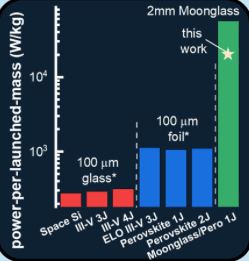
Jeff Bezos’s “Blue Alchemist” program recently got $25M from NASA to develop moon-based solar cell manufacturing on earth. See article here. The idea sort of makes sense to me: instead of transporting solar cells to the moon from earth, why not make them on the moon in bulk. Even light solar cells would weigh about 1kg/kW, making cells on the moon would reduce the effective weight per kW by a factor of 100 it is predicted, see figure. Given a need for mega watts of power, and a cost to transport things to the moon of about $1M/kg., currently, this change would reduce the cost per kW from $1million to a mere $10,000: a lot more expensive than on earth, but cheap by moon prices.
Elon Musk goes further yet, making solar cells on the moon is just a beginning for him. He recently posted at length that his company is poised to make AI chips and solar cells on the moon, and that he’d like to use these moon-made, solar cells to power AI centers that he will operate in space, orbiting the earth or moon. Hard to believe – see him discuss it here. He notes that “It’s always sunny in space”, so solar electricity should be cheap, he says. I don’t consider power at $10,000/kW cheap. He hopes to lower launch costs by a factor of ten using starship, but then the price will likely likely rise again as he sends his solar cells and AI chips out into space so that they can do AI calculations without the distractions of night-time or regulatory boards.
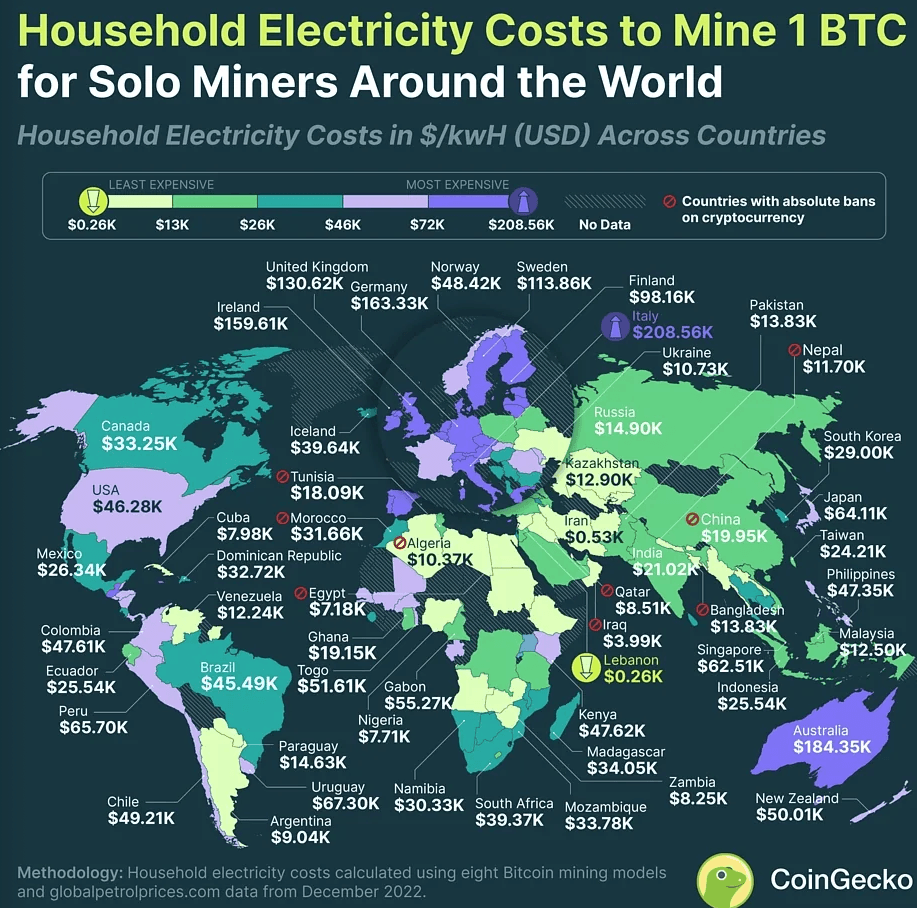
Musk suggests launching the moon-made solar cells and AI centers into space with a mass-launcher, essentially a rail-gun, operating from the moon. He argues there is no real alternative!? He claims that powering AI centers on earth is too hard and expensive, and complains about regulators who oppose new power plants. While I can agree with him about the benefits of solar energy, especially for power on the moon, I find these power prices prohibitive compared to solar or nuclear power on earth — It’s really cheap in China, Lebanon, Iraq, Iran…, as shown below based on the cost of bitcoin harvesting around the world. China runs on nuclear power or coal, delivering large-scale electricity at ~ 2¢/kWh. If you need to operate on the moon or in space, a good option is space-based nuclear power, not exactly cheap, but a known technology.
As for AI chip-making, it’s hard to do, even on earth, requiring lots of water, chemicals, equipment and technical attention. Doing that on the moon adds difficulties. Not only are water and chemicals scarce, but skilled servicing labor is hard to find, and harder to find in outer space. At the very least, why doesn’t Musk see value in making chips on earth. He could then shoot them into space, if he wanted. They are among the most value dense items one could launch, more dense than the chemicals to make chips. Musk could manufacture chips, if he wishes, in a place that’s uninhabited and inhospitable, but more accessible than the moon: Greenland for example, or Antarctica. They are wam compared to the moon, and they have air and water. As for electricity, most of the cost of chip fabrication is not electricity, and I suspect electricity on Everest is cheaper than on the moon.
I suspect the reason Musk wants to manufacture in space, and to operate there, is to have practice for Mars. Also to have a use for his Starships.
Operating the chips in space is not a particularly attractive by the way. There are problems with durability, and a tendency to flake-out because of cosmic radiation and stronger electromagnetic fields. Space memory has to be built specially robust, correction software must be particularly active, and the operation must shield from EM to a much greater extent than on earth.
Musk has some solar technology, but it’s not that competitive, currently. He could have pushed battery power to level intermittent solar from the Sahara desert, or focus on serving customers who are willing to wait 12-24 hours for their solutions. Ill be t some folks who want to make AI videos won’t care if it takes a day or two. Bottom line: putting AI in space (and manufacturing on the moon) seems more like a justification for making lots of Starships, and not so much like a necessary project that really needs the Starships.
Robert Buxbaum, February 27, 2025